Showing posts with label nypd. Show all posts

Wednesday, November 9, 2022

November 9, 1965: The Night the Lights Went Out

November 9, 1965: It was "The Night the Lights Went Out." At 5:27 PM, just as the Tuesday night rush hour was getting rough, a blackout hit the Northeastern United States, hitting New York City especially hard. Over 30 million people were without power.

Given the time of year, it was already dark out. Traffic lights went out. People got stuck in elevators. People got stuck in the City's Subway system.

The Consolidated Edison Company, a.k.a. Con Ed, managed to spare Staten Island and parts of Brooklyn from the blackout when they disconnected their Arthur Kill Generation Station, on Staten Island, from the grid. Some parts of New Jersey, powered by Public Service Electric & Gas, a.k.a. PSE&G, were not affected, allowing the City's newspapers to use the printing presses of the Newark Evening News to print their next day's editions, such as they were: Even The New York Times only printed 10 pages.

The New York Police Department later said that the City had the fewest reported crimes of any night since records began to be kept, breaking the record of February 9, 1964, the night The Beatles made their 1st appearance on The Ed Sullivan Show. This would end up in sharp contrast to the next major blackout, in 1977, when rioting developed, and it was the most arrests the NYPD ever made in 1 night.

Power was restored before the morning rush hour. Ever since, while there were also blackouts in New York in 1961, 1963, 1967, 1977 (as mentioned), and in 2003, people old enough to remember it mean November 9, 1965 when they asked, "Where were you when the lights went out?" (UPDATE: There was a brief blackout in 2023 as well.)

And there is no truth to the (pardon my choice of words) urban legend: There were no more babies born in New York in early August 1966, 9 months later, than there were in early August 1965 or in early August 1967.

*

As I said, November 9, 1965 was a Tuesday. The baseball season was over, as the Los Angeles Dodgers had won the World Series 26 days earlier, beating the Minnesota Twins in the World Series. Both the NFL and the AFL were in midweek.

It was early in the NBA and NHL seasons. However, because of the blackout, for only the 2nd time in their history, the New York Knicks had to postpone a game. The 1st was on November 22, 1963, the night of the day that President John F. Kennedy was assassinated.

The New York Rangers were not affected by the blackout, as they were not scheduled. None of the NHL's 6 teams were. But there were 3 games played in the NBA that night -- 2 of them, surprisingly, in the Northeast:

* The Boston Celtics beat the Baltimore Bullets, 130-116, at the Rhode Island Auditorium in Providence.

* The Philadelphia 76ers beat the Los Angeles Lakers, 118-110 at the Philadelphia Civic Center's Convention Hall. Wilt Chamberlain scored 39 points, and Hal Greer scored 32. In a losing effort, Jerry West scored 32.

* And the San Francisco Warriors beat the Detroit Pistons, 107-102 at the Cow Palace in the San Francisco suburb of Daly City, California. Nate Thurmond scored 18 points, and grabbed 42 rebounds.

Thursday, October 20, 2022

October 20, 2001: The Concert for New York City

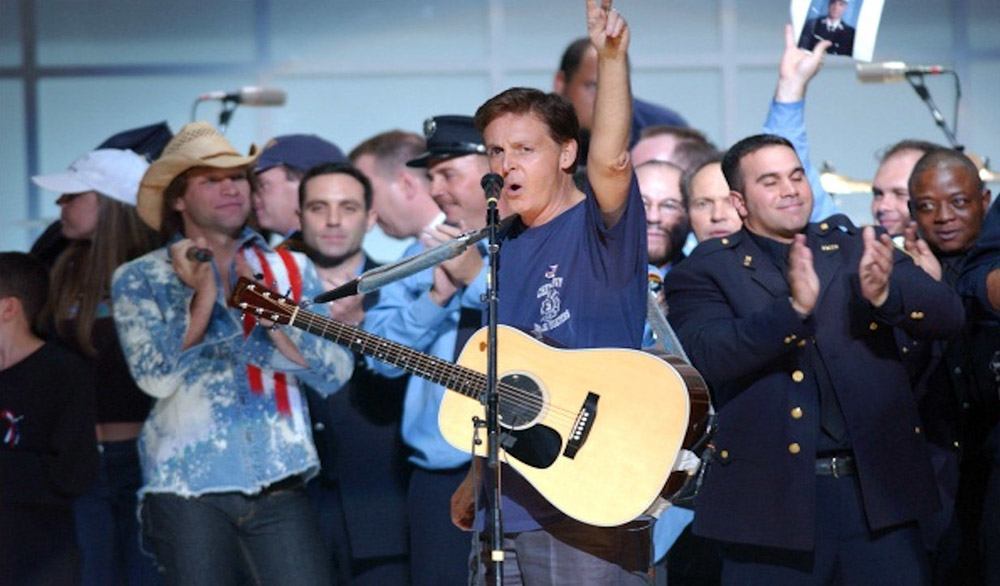
Sir Paul with cops and firemen

October 20, 2001: The Concert for New York City is held at Madison Square Garden. Played just 6 weeks after the 9/11 attacks, emotions were still running deep. Most of the audience was cops, firemen, rescue workers, and people who had lost family members in the attacks, many of them holding up photos of the victims. Billy Crystal was the master of ceremonies.

David Bowie opened the show with Simon & Garfunkel's "America," then did his own "Heroes" with a full band. Also on hand: Bon Jovi, Jay-Z, Goo Goo Dolls, Destiny's Child (including Beyoncé), Eric
Clapton & Buddy Guy, the Backstreet Boys, Macy Gray, James Taylor, John Mellencamp & Kid Rock, Five For Fighting, and Janet Jackson.

Billy Joel showed up drunk, and went into rehab not long thereafter. Of course, he played "New York State of Mind." But first, he played "Miami 2017." On September 10, 2001, it looked like the apocalypse he'd predicted for The City in 1976 had been prevented. But on the 11th, it came far too close to reality: "I watched the mighty skyline fall" -- although it was the World Trade Center, not the Empire State Building, that he saw "laid low." He later joined Elton John, who had played his New Yorker-themed "Mona Lisas and Mad Hatters," for a performance of Elton's "Your Song."

Melissa Etheridge's microphone went out during her acoustic performance of "Come to My Window," but everybody was singing along anyway, and none of those hard-edged, blue-collar cops and firemen gave a damn that she was openly gay. (Well, maybe a few from Staten Island. But, as for the rest, this was New York.) Her mike went out again as she did an acoustic version of Springsteen's "Born to Run" -- and nobody flinched as she sang lines of love and passion to a woman named Wendy.

Mick Jagger and Keith Richards of the Rolling Stones sang "Salt of the Earth" and "Miss You" (with its reference to walking through Central Park in the '70s). When they were done, Mick said, "If there's one thing we've learned from all this, it's that you don't fuck with New York!" True.

The Who came out, with former Beatle Ringo Starr's son Zak Starkey filling in on drums for the late Keith Moon, and it turned out to be bass player John Entwistle's last performance. They did a nasty "Who Are You," an intense "Baba O'Riley," a melancholy "Behind Blue Eyes," and a roaring "Won't Get Fooled Again." Crystal said, "I'd never seen The Who live before. It was great to see these middle-aged men get out on stage and kick ass."

With Elvis Presley dead and unavailable, it was appropriate that the show closed with a surviving Beatle, Paul McCartney, who played, among others, "Yesterday," his new song "Freedom," and "Let It Be."

*

October 20, 2001 was a Saturday. Game 3 of the American League Championship Series was played at Yankee Stadium, and the Yankees were clobbered by the Seattle Mariners, 14-3. But the pattern from the 1999 ALCS against the Boston Red Sox was followed: Game 3 was a disaster for the Yankees, but it would be the only game in the series that they would lose.

Game 4 of the National League Championship Series was played at Turner Field in Atlanta. The Arizona Diamondbacks beat the Atlanta Braves, 11-4. They would beat the Yankees in the World Series, putting a damper on what had been a great story.

Being a Saturday, college football games were played. But the team then ranked Number 1, the University of Miami, was not scheduled. They went on to win the National Championship.

It was a rare "Third Saturday in October" for Tennessee over Alabama, 35-24 at Bryant-Denny Stadium in Tuscaloosa, Alabama.

Notre Dame beat USC, 27-16 at Notre Dame Stadium in South Bend, Indiana.

Penn State beat Northwestern, 38-35 at Ryan Field in the Chicago suburb of Evanston, Illinois.

Rutgers beat Navy, 23-17 at the new Rutgers Stadium (now SHI Stadium) in Piscataway, New Jersey. It was 1 of only 2 games the Scarlet Knightd would win all season.

Princeton lost to Harvard, 28-26 at Harvard Stadium in Boston.

The NBA season wouldn't start for another 10 days. But there were 14 NHL games played:

* The New Jersey Devils beat the Ottawa Senators, 3-2 at the Brendan Byrne Arena at the Meadowlands. (It was then named the Continental Airlines Arena.) Jason Arnott, Patrik Elias and Scott Niedermayer scored.

* The New York Rangers lost to the Tampa Bay Lightning, 5-2 at the Ice Palace (now the Benchmark International Arena) in Tampa.

The New York Islanders retire the Number 19 of Hall-of-Fame center Bryan Trottier. This was a bit late: He'd played his last NHL game 7 years earlier, and his last game for the team 11 years earlier. The team had already retired 5 for Denis Potvin, 9 for Clark Gillies, 22 for Mike Bossy, 23 for Bobby Nystrom and 31 for Billy Smith.

Their game that night, at the Nassau Coliseum, against the San Jose Sharks, ended in a 2-2 tie. (No shootouts yet.)

* The Philadelphia Flyers beat the Washington Capitals, 6-3 at the First Union Center in Philadelphia. (It's now the Xfinity Mobile Arena, although Flyer fans miss calling the building "The F.U. Center.")

* The Buffalo Sabres beat the Montreal Canadiens, 3-1 at the Molson Centre in Montreal. (It's now the Bell Centre.)

* The Carolina Hurricanes beat the Atlanta Thrashers, 2-1 at the Raleigh Sports and Entertainment Center. (It's now the Lenovo Center.) Jeff O'Neill scored the winner, 1:33 into overtime.

* The Boston Bruins beat the Nashville Predators, 2-1 at Gaylord Entertainment Center in Nashville. (It's now the Bridgestone Arena.)

* The Colorado Avalanche beat the Columbus Blue Jackets, 5-0 at the Nationwide Arena in Columbus.

* The Detroit Red Wings beat the Los Angeles Kings, 3-2 at Joe Louis Arena in Detroit. The Wings went on to beat the Hurricanes in the Stanley Cup Finals.

* The St. Louis Blues beat the Pittsburgh Penguins, 2-1 at the Savvis Center in St. Louis. (It's now the Enterprise Center.) Pavol Demitra scored the winner with 1:25 left in overtime. 

* The Chicago Blackhawks and the Dallas Stars played to a tie, 2-2 at the American Airlines Center in Dallas.

* The Calgary Flames beat the Toronto Maple Leafs, 4-1 at the Saddledome in Calgary.

* The Edmonton Oilers beat the Florida Panthers, 6-2 at the Northlands Coliseum in Edmonton. (It was then named the Skyreach Centre.)

* The Phoenix Coyotes beat the Vancouver Canucks, 5-2 at the AmericaWest Arena in Phoenix.

Also, Arsenal had a 3-3 draw with Blackburn Rovers at Highbury, North London. 

Friday, October 7, 2022

October 7, 1971: "The French Connection" Premieres

October 7, 1971: The French Connection premieres, based on the 1969 book by Robin Moore, itself based on a real break-up of a drug-smuggling operation in New York in 1962.

Moore (1925-2008) had served in the U.S. Army Special Forces, and not only co-wrote the lyrics to "The Ballad of the Green Berets" with Staff Sergeant Barry Sadler, but wrote the novel The Green Berets, which became a 1968 John Wayne film. In 1971, he collaborated with Dutch call girl Xaviera Hollander on her memoir The Happy Hooker: My Own Story, which was made into a series of 3 films, each starring a different actress. In 1986, Moore was convicted of tax fraud.

The real case, with heroin going from Indonesia, where the poppies were grown; to Turkey, where it was processed; to Marseille on the south coast of France, where it was distributed throughout the world; to New York, and then distributed throughout America, was cracked by Detectives Eddie Egan (1930-1995) and Sonny Grosso (1930-2020).

The French drug kingpin they sabotaged, but never arrested, was Jean Jehan. Jehan used French television personality Jacques Angelvin (1914-1978) to make contacts in America. Angelvin apparently never knew what was really going on until he was arrested. Jehan was arrested by French authorities in 1967, because he was given immunity due to being an anti-Nazi Resistance fighter in World War II. He was seen alive in Nice, on the French Riviera, as late as 1977, and is believed to have died of old age in his native Corsica. But Angelvin served 4 years in an American prison.

In the movie, directed by William Friedkin, Egan became Jimmy "Popeye" Doyle, played by Gene Hackman; Grosso became Buddy "Cloudy" Russo ("Cloudy" being the opposite of "Sunny," or "Sonny"), played by Roy Scheider; Jehan became Alan Charnier, played by Fernando Rey. Angelvin became actor Henri Devereaux, played by Frédéric de Pasquale. And Angelvin's 1960 Buick Invicta, with 112 pounds of bagged heroin hidden in the rocker panels, became a 1970 Lincoln Continental Mark III.

Friedkin, who had previously directed The Thin Blue Line, The Night They Raided Minsky's and The Boys In the Band; and would go on to direct The Exorcist, The Brink's Job, Cruising, To Live and Die In L.A. and Blue Chips, knew who he wanted to play Charnier, but couldn't remember the man's name: All he remembered was that he was a Spanish actor who had worked with Spanish director Luis Buñuel in a French-language movie.

Someone told him it was Rey, and he invited Rey to come to New York to discuss the movie. Then he found out that the actor he really wanted was Francisco Rabal -- and that Rey hadn't even appeared in the movie that Friedkin was thinking of, Belle du Jour. Rabal was able to meet with Friedkin first, but, as it turned out, he could speak neither English nor French. Rey, as it turned out, could speak both of those languages just well enough to pull the role off.

The film made a star of Hackman, but he wasn't even close to the first choice to play Doyle. Friedkin wanted Paul Newman. If not him, then Steve McQueen. Both were superstar actors and experienced drivers, which was integral for the chase scene. But both would have demanded paychecks too big for the producers, so they never asked Newman. They did ask McQueen, but he had made Bullitt in 1968, with its famous chase scene over the hills of San Francisco, and he didn't want to do another cop film.

They considered Jackie Gleason, who was already too old for the role (he was 54 when it was filmed in 1970; Newman was 45, while McQueen and Hackman were both 40), and hadn't done a film since his comedy Gigot flopped in 1962. (Gleason later played a cop in chase scenes in the Smokey and the Bandit films.) They asked Peter Boyle (who was 35), who thought the idea for the film was too violent.

They asked a real New Yorker, but not a real actor: New York Daily News columnist Jimmy Breslin (who was 42). Breslin, who had covered the original story, was intrigued with the idea of playing a detective. But he had never driven a car before -- living your whole life in New York City, that is possible -- and didn't want to start with such an important scene. He wanted the movie to succeed enough to admit that he was the wrong guy.

They asked Lee Marvin (46) and Robert Mitchum (53, nearly as old as Gleason), already veteran tough guys; and James Caan (30), who'd just finished Brian's Song, and was already in line to play Sonny Corleone in The Godfather. All of them turned it down. Rod Taylor (40), star of the 1960 version of The Time Machine, wanted it, but Friedkin didn't want him. So he cast Hackman, then known for a supporting role in Bonnie and Clyde and starring in I Never Sang for My Father.

What everyone remembers from the film is the chase: After Pierre Nicoli, played by Marcel Bozzuffi, escapes from Doyle, he boards an elevated train in New York's Subway system. So Doyle commandeers a 1971 Pontiac Le Mans (a brand-new car at the time), and drives under the elevated line, hitting other cars but staying on the chase, until he sees Nicoli disembark, and finally shoots him. The line was the old BMT West End Line in Brooklyn, at the time running as the B Train, now the D Train. The chase lasts from the 86th Street station to the 62nd Street station.

Some of the cops who acted as advisors on the film told Friedkin that a cop would not have shot a suspect in the back, because that would be murder, not self-defense. Friedkin told them, "I am secure in my conviction that that's exactly what Eddie Egan would have done, and Eddie was on the set while all of this was being shot."

The ending of the film matches the reality: While the big deal is busted, and the heroin is confiscated, Charnier gets away. This inspired one of the earliest film sequels, The French Connection II, in which Doyle gives up the home-field advantage to try to bust Charnier on his own turf, in Marseille, with results that, at first, prove disastrous. (That film has no connection to real life: Egan did not pursue Jehan any further.)

The French Connection was nominated for 8 Academy Awards, and won 5, including Best Picture, Best Actor for Hackman, and Best Director for Friedkin. Over 50 years later, it has a 96 percent rating on Rotten Tomatoes, and a 94 percent rating on Metacritic. Akira Kurosawa called it one of his favorite films, David Fincher called it one of the five films that "had a profound impact on my life," Brad Pitt called it one of the reasons he took the lead role in Fincher's film Se7en, and Steven Spielberg said he studied it in preparation for his film Munich.

Bozzuffi died in 1988, Rey in 1994, de Pasquale in 2001, Scheider in 2008. As of October 7, 2022, Friedkin and Hackman are still alive. (UPDATE: Friedkin died in 2023.)

One more thing: For a stakeout, Hackman as Doyle plays a "sidewalk Santa," ringing a bell and raising money for the Salvation Army. And the scene takes place on a very cold day in New York, with some snow on the ground. If Die Hard, which has no snow at all, is a "Christmas movie," then so is The French Connection, which is a much better movie.

*

October 7, 1971 was a Thursday. Football was in midweek. The NHL season started the next day; the NBA season, 4 days after that; the American Basketball Association season, the night after that. And baseball was between its League Championship Series and its World Series, which the Pittsburgh Pirates would win over the Baltimore Orioles in 7 games. So there were no scores on this historic day.

Wednesday, September 21, 2022

September 21, 1993: "NYPD Blue" Premieres

Left to right: David Caruso, Dennis Franz, Sherry Stringfield,
James McDaniel, Nicholas Turturro and Amy Brenneman

September 21, 1993: NYPD Blue premieres on ABC. Stephen Bochco's police procedural stretches the boundaries of what can be said and shown on TV. Airing at 10:00 PM on Tuesday nights allows them to do that.

And that may not have been a good thing, given what some shows have tried since. And co-creators Stephen Bochco and David Milch knew they wouldn't have gotten away with it if the writing, the acting, and the camera work -- showing New York as it grew out of being an urban hole to comparative safety -- hadn't been so damn good.

Bochco had previously developed successful series like the police drama Hill Street Blues, the legal drama L.A. Law, and the medical drama/coming-of-age comedy Doogie Howser, M.D. However, in 1990, his project Cop Rock, trying to make a musical police series, flopped. He had become a laughingstock, and needed a comeback. So he and Milch, who went on to create the Western series Deadwood, created NYPD Blue.

The show takes place in the 15th Precinct, which doesn't exist in real life. The precinct house used for exterior shots was the 9th, on East 5th Street on the Lower East Side, which covers the area that the 15th would. That same house was later used for the 12th on the ABC series Castle, and the 2nd on the NBC series The Mysteries of Laura.

(Those precincts don't exist, either. Nor does the 99th, later used for the NBC comedy Brooklyn Nine-Nine. Nor does the 125th, later used for the ABC drama Life On Mars. The 12th Precinct was also used for the 1970s ABC sitcom Barney Miller, but the outside of that building was never shown.)

Right off the bat, the show tests the censors, and the country's self-appointed moral arbiters. Dennis Franz plays Detective Andy Sipowicz, an old-school cop, bigoted, alcoholic, and never suffering fools gladly. He's testifying in court against a Mob soldier he'd busted, but the prosecutor, Sylvia Costas, played by Sharon Lawrence, thinks his testimony is biased and undermining the case, and it gets thrown out.

As they exit the courthouse, he tells her, "Wow, you really prosecuted the hell out of that one, Counselor!" (I suppose, at this point, even this show wasn't willing to say, "prosecuted the shit out of that one.") She turns back and, as a lawyer might, throws some Latin phrases at him. He grabs his crotch and yells, "Ipso this, you pissy little bitch!"

But as the show went on, Andy went to rehab, Sylvia decided she liked the new version of him, they got married, and had a son named Theo -- but Sylvia is killed in Season 6, 3 years after Andy Jr., his son from his 1st marriage, a cop in nearby Hackensack, New Jersey, was killed in the line of duty.

Andy's partner, Detective John Kelly, played by David Caruso, is introduced as the son and namesake of a cop killed in the line of duty. In the pilot, he starts a relationship with Officer Janice Licalsi, played by Amy Brenneman. The middle of the episode shows the two of them in bed, flashing his rear end and her breasts. The end of the episode is even more shocking: Like her cop father before her, Janice is compromised by the boss of the Mob soldier that Sipowicz and Kelly had been investigating.

This eventually leads to both John's and Janice's downfalls. Caruso left the show for movies, flopped, and returned to TV, as a cop on CBS' CSI: Miami. He was replaced on NYPD Blue in Season 2 by Jimmy Smits as Bobby Simone. Simone died of heart trouble in Season 6, and was replaced by Ricky Schroeder as Danny Sorenson. Schroeder didn't like how the character was written, and so was written out after Season 8.

Season 9 began right after the real-life 9/11 attacks, and it was written that Sorenson had been missing since that day, and was presumed killed in the attack, but it turned out that he'd been killed earlier in the day by a Mob group he was infiltrating. Mark-Paul Gosselaar replaced him as John Clark Jr., son and namesake of a retired cop Andy with whom had a running feud.

The show ran for 12 seasons, with Andy the constant, and was nominated for 84 Emmy Awards, winning 20 of them.

*

September 21, 1993 was a Tuesday. These Major League Baseball games were played that day:

* The New York Yankees lost to the Minnesota Twins, 5-4 at Yankee Stadium. Willie Banks outpitched Jim Abbott. Pedro Muñoz hit 2 home runs for the Twins. Don Mattingly went 0-for-5, and the Yankees fell to 5 games out of 1st place in the American League Eastern Division, with 10 games to play. And Yankee Fans of a certain generation object when I call Mattingly a "loser."

* The Toronto Blue Jays beat the Boston Red Sox, 5-0 at the SkyDome (now the Rogers Centre) in Toronto. This put them the aforementioned 5 games ahead of the Yankees. They went on to win the World Series.

Todd Stottlemyre, son of Yankee pitching legend Mel, pitched a 3-hit shutout, outpitching Roger Clemens. Paul Molitor went 1-for-3 with a walk. Rickey Henderson was available for this game, but did not play.

* The New York Mets beat the Pittsburgh Pirates, 4-3 at Three Rivers Stadium in Pittsburgh.

* The Atlanta Braves beat the Montreal Expos, 18-5 at the Olympic Stadium in Montreal. John Smoltz was the winning pitcher. Terry Pendleton hit 2 home runs, and Fred McGriff added one.

* The Philadelphia Phillies beat the Florida Marlins, 5-3 at Veterans Stadium in Philadelphia. Seven days later, in Pittsburgh, the Phillies clinched the National League Eastern Division title.

* The Baltimore Orioles beat the Cleveland Indians, 7-6 at Cleveland Municipal Stadium. The O's came from 6-5 down in the 9th inning to win it. Cal Ripken went 2-for-5.

* The Los Angeles Dodgers beat the Cincinnati Reds, 5-3 at Riverfront Stadium in Cincinnati. Jody Reed's sacrifice fly and Brett Butler's single scored the winning runs in the top of the 11th inning.

* The Milwaukee Brewers beat the Detroit Tigers, 7-4 at Tiger Stadium in Detroit.

* The Chicago Cubs beat their arch-rivals, the St. Louis Cardinals, 13-3 at Wrigley Field in Chicago.

* The Houston Astros beat the San Francisco Giants, 6-0 at the Astrodome in Houston. Mark Portugal pitched a 3-hit shutout. Barry Bonds went 0-for-4.

* The Colorado Rockies beat the San Diego Padres, 15-4 at Mile High Stadium in Denver. Future Yankee manager Joe Girardi hit a home run for the Rockies. Tony Gwynn did not play for the Padres. Their "fire sale," and the Rockies' really taking to their baseball-hungry fans in their expansion season, allowed them to finish ahead of the Padres in the NL Western Division.

* The California Angels beat the Chicago White Sox, 8-0 at Anaheim Stadium (now Angel Stadium of Anaheim). John Farrell (6 1/3rd innings) and Steve Frey combined on a 7-hit shoutout.

* The Oakland Athletics beat the Kansas City Royals, 9-6 at the Oakland Coliseum. George Brett hit his 314th career home run. He hit 3 more that season, and retired.

* And the Seattle Mariners beat the Texas Rangers, 8-0 at the Kingdome in Seattle. Ken Griffey Jr. hit a home run.

Friday, September 16, 2022

September 16, 1992: The Giuliani Police Riot

September 16, 1992: Thousands of off-duty police officers crowd in front of New York’s City Hall to protest against Mayor David Dinkins.

The cops were there to oppose a bill that would have removed the police from the city's Civilian Complaint Review Board, an oversight body that handled allegations of police misconduct, and, crucially, would have made it independent of the Police Department itself. Faced with the prospect of potentially greater civilian accountability, New York City police officers took their anger to the streets.

"The cops held up several of the most crude drawings of Dinkins, black, performing perverted sex acts," Jimmy Breslin, the great New York newspaper columnist then working for Newsdaywho was present at the riot, wrote. "'Now you got a n****r right inside City Hall,' one officer reportedly said," Breslin continued. "'How do you like that? A n****r mayor.'" Other officers chanted slogans like "Dinkins gotta go!" and "The mayor's on crack!"

"The mayor doesn’t know why the morale of the New York City Police Department is so low," he said, jabbing his finger in the air. "He blames it on me, he blames it on you. The reason the morale of the Police Department of the City of New York is so low is one reason and one reason alone: David Dinkins!"

Giuliani had risen to fame in the mid-1980s, as a U.S. Attorney for Manhattan, prosecuting criminals both low-class, like the Mafia, and high-class, like Wall Street insider traders. He ran for Mayor in 1989, and it was close: Dinkins, then the Borough President of Manhattan, won 50.4 percent of the vote, while Giuliani won 47.8. Dinkins' margin of victory was 47,080, and he became the City's 1st black Mayor.

Crime, rising in New York ever since World War II, peaked in 1990, then started to go down. But events such as the Crown Heights riot of 1991, and the New York media's twisting of events to favor their conservative owners, made Dinkins look like he didn't care about white people. In 1993, Giuliani won a rematch, getting 49.2 percent of the vote, Dinkins 46.4. Giuliani won by 53,367 votes, becoming the City's 1st Republican Mayor elected since John Lindsay in 1965, and its 1st Italian Mayor since Fiorello La Guardia was last elected in 1941.

What made the difference? Giuliani gained 28,000 votes in Brooklyn, 26,000 in Staten Island, 21,000 in Manhattan, 17,000 in Queens, and 8,000 in The Bronx. So it was a Republican get-out-the-vote effort in Staten Island, the whitest, most conservative Borough; but it was also fear of white liberals in Manhattan and Brooklyn. In particular, Jewish votes in both of those Boroughs shifted. Giuliani particularly pandered to Orthodox Jews in Brooklyn, led by State Senator Dov Hikind, officially a Democrat, but a very conservative man.

Giuliani never acknowledged or condemned the racism of the 1992 police riot. And his Administration, from January 1, 1994 to December 31, 2001, would have some notorious examples of police brutality. After leaving office, without having to face the voters again, he drifted even further to the right, eventually providing legal counsel for Donald Trump, causing him, as of September 16, 2022, to need legal counsel of his own.

UPDATE: As Jamelle Bouie put it in a column for the August 18, 2023 edition of The New York Times, "The line from 'America's mayor' to indicted co-conspirator is a straight one. The answer to What happened to Rudy Giuliani? is Nothing happened. He is the same man he’s always been."

*

September 16, 1992 was a Wednesday. These Major League Baseball games were played that day:

* The New York Yankees lost to the Chicago White Sox, 9-6 at Yankee Stadium. Don Mattingly went 3-for-5, but Sterling Hitchcock was knocked out of the box in the 3rd inning. and Curt Young barely finished the 5th.

* The New York Mets lost to the St. Louis Cardinals, 10-4 at Shea Stadium.

* The Montreal Expos beat the Pittsburgh Pirates, 6-3 at Three Rivers Stadium in Pittsburgh. Barry Bonds went 2-for-5.

* The Boston Red Sox beat the Milwaukee Brewers, 2-1 at Fenway Park in Boston. Bob Zupcic grounded into a fielder's choice to get the winning run home in the bottom of the 15th inning. Wade Boggs did not play. Paul Molitor went 3-for-7 with an RBI, but Robin Yount went 0-for-5 with 2 walks.

* The Baltimore Orioles beat the Kansas City Royals, 3-0 at Camden Yards in Baltimore. Mike Mussina pitched a 4-hit shutout. Cal Ripken went 3-for-4.

* The Cleveland Indians beat the Toronto Blue Jays, 6-3 at the SkyDome (now the Rogers Centre) in Toronto.

* The Atlanta Braves beat the Cincinnati Reds, 3-2 at Riverfront Stadium in Cincinnati.

* The Detroit Tigers beat the Texas Rangers, 4-1 at Tiger Stadium in Detroit.

* The Chicago Cubs beat the Philadelphia Phillies, 14-9 at Wrigley Field in Chicaog.

* The Houston Astros beat the San Francisco Giants, 3-1 at the Astrodome in Houston.

* The San Diego Padres beat their arch-rivals, the Los Angeles Dodgers, 3-1 at Jack Murphy Stadium in San Diego.

* The Oakland Athletics beat the Minnesota Twins, 4-2 at the Oakland Coliseum. Rickey Henderson went 1-for-3 with a walk and a stolen base.

* And the California Angels beat the Seattle Mariners, 2-1 at the Kingdome in Seattle. Luis Sojo singled home the winning run in the top of the 13th inning. Ken Griffey Jr. went 0-for-4 with a walk, and was hit with a pitch.

Tuesday, September 13, 2022

September 13, 1990: The "Law & Order" Franchise Begins

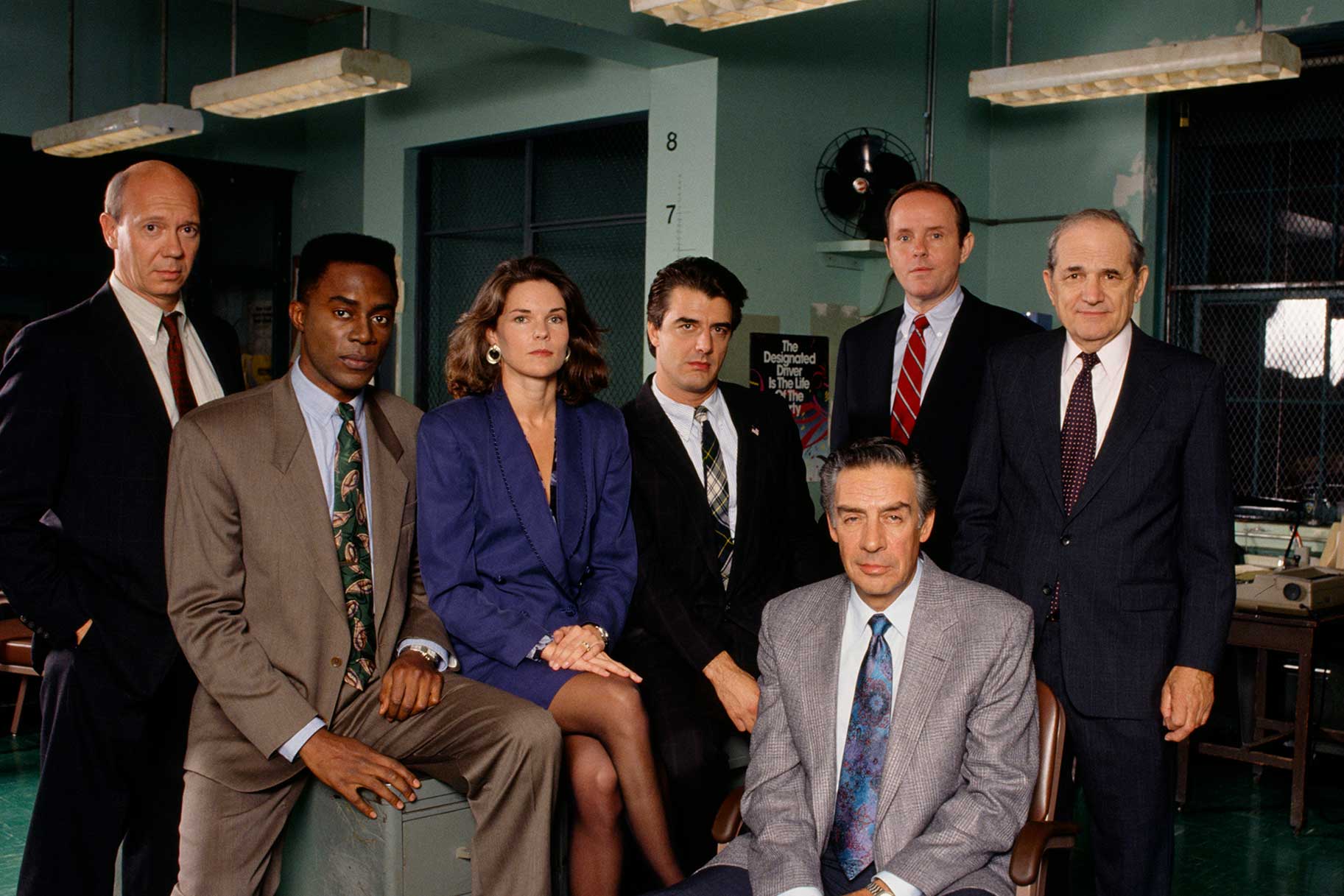
The original cast

September 13, 1990: Law & Order premieres on NBC, created by Dick Wolf. The original series runs for 20 seasons.

The opening narration, delivered by Steve Zirnkilton, a former member of the Maine House of Representatives, explains: "In the criminal justice system, the people are represented by two separate yet equally important groups: the police who investigate crime, and the district attorneys who prosecute the offenders. These are their stories."

The 1st half-hour then shows detectives in the New York Police Department as they work on cracking a case, and the 2nd half-hour shows how the Manhattan District Attorney's office tries to prosecute it – and "the good guys" didn't always win.

The music for Law & Order was composed by veteran composer Mike Post, and was deliberately designed to be minimal to match the abbreviated style of the series. Post wrote the theme song using electric piano, guitar, and clarinet.

In addition, scene changes were accompanied by a tone generated by Post. He refers to the tone as "The Clang." Entertainment Weekly critic Ken Tucker called it the "ominous chung CHUNG." Dann Florek, one of the actors on the show, called it the "doink doink." Another, Richard Belzer, called it "the Dick Wolf Cash Register Sound," because Wolf has made so much money off of it.

Each show is an ensemble affair. Among the many stars of the original series have been George Dzundza, Chris Noth, Michael Moriarty, Paul Sorvino, Jerry Orbach, S. Epatha Merkerson, Jill Hennssy, Sam Watersoton, Benjamin Bratt, Carey Lowell, Angie Harmon, Jesse L. Martin, Fred Dalton Thompson, Dennise Farina, Linus Roache, Anthony Anderson, Camryn Manheim, Tony Goldwyn and Maura Tierney.

Going into the 2022-23 TV season, the franchise has now had 8 shows, with occasional crossovers, totaling 1,172 episodes -- with Steve Zirnkilton proving the opening narration for each, making him, in all likelihood, the "actor" with the most show appearances in the history of television on planet Earth.

That would be Mariska Hargitay, daugther of actress Jayne Mansfield and professional bodybuilder Mickey Hargitay. She has now played Olivia Benson, currently with the rank of Captain, for 24 seasons on Law & Order: Special Victims Unit, breaking the record shared by James Arness of Gunsmoke and Kelsey Grammer of Cheers and Frasier for the most seasons, and most consecutive seasons, playing the same character on U.S. primetime television.

SVU, which focuses on sex crimes, has also featured Christopher Maloney, Richard Belzer, Dann Florek, Michelle Hurd, BD Wong, and, turning his previous image on its head, rapper Ice-T.

Belzer played Detective John Munch, a character who also appeared on the TV shows Homicide: Life On the Street, The X-Files, and the X-Files spinoff The Lone Gunmen -- despite the L&O shows and Homicide appearing on NBC, and the X-Franchise appearing on Fox. This suggests that all of these shows exist in the same "fictional universe." I'm not going to get into the whole "Tommy Westphall Universe" idea, because there are serious flaws in it.

On the other hand, Dick Wolf also created NBC's linked One Chicago franchise, which has included 4 shows; and CBS' FBI franchise, which has included 3 shows. And a character from the former appeared on the latter, showing that both of those shows exist in the same universe. Whether they also exist in the L&O universe is uncertain.

*

September 13, 1990 was a Thursday. There was a college football game played that night: The University of Houston, ranked Number 18, beat Texas Tech, 51-35 at Jones Stadium in Lubbock, Texas.

And these games were played in Major League Baseball:

* The Chicago Cubs beat the Philadelphia Phillies, 6-5 at Wrigley Field in Chicago.

* The Chicago White Sox beat the Boston Red Sox, 9-6 at Comiskey Park in Chicago. Ordinarily, as a Yankee Fan who grew up on the New York side of New Jersey, I start this list with the New York Yankees, then the New York Mets, and then work my way North to South down the Eastern Seaboard, and then work my way West. So why am I mentioning the Chicago teams first?

Because I was at these games. As a baseball history buff, I wanted to see a game at Comiskey before it closed that month. And this was the last day on which both Chicago teams were going to be at home on the same day before the new White Sox stadium opened.

In the Cubs game, Rick Sutcliffe started against Bruce Ruffin, and neither got through the 5th inning. Dale Murphy, former 2-time National League Most Valuable Player for the Atlanta Braves, was now with the Phillies, and hit a home run over the left-field stands, onto Waveland Avenue.

I figured that the Wrigley tradition of the fan who caught the opposition's home run throwing the ball back onto the field was not going to happen. I was wrong. The fan who retrieved the ball on Waveland threw it back into the bleachers, and one of the "Bleacher Bums" threw it back onto the field. In baseball terms, the Waveland retriever hit the cutoff man.

Mark Grace went 4-for-4 with 2 RBIs. But the winning run scored on a groundout, Jerome Walton to 3rd base, where a forceout happened, but the runner who was on 3rd base, Joe Girardi, scored, and since Walton made it to 1st base, the run counted.

One thing I really wanted to see was a White Sox playing hitting a home run, so Comiskey's "exploding scoreboard" would light up and shoot off its fireworks. That home run came, not from Carlton Fisk, a veteran catcher who ended up with 376 home runs; not Frank Thomas, a rookie 1st baseman who ended up with 521; not Sammy Sosa, a 2nd-year right fielder who would later use steroid to hit 609; nor Robin Ventura, a young 3rd baseman who went on to hit 294; but Iván Calderón, a left fielder not known for his power, who finished with 104.

Alex Fernandez was the starter and winner for the South Siders, defeating Boston starter Tom Bolton. Ellis Burks and Mike Greenwell hit home runs for the Red Sox. 

The Cubs and the Phillies were way out of the NL Eastern Division race. In contrast, the White Sox were hanging on in the American League Western Division, while the Red Sox were leading, and would win, the AL Eastern Division. So this was a rare occasion when the White Sox had a better attendance than the Cubs: On a Thursday afternoon, the Cubs got 15,495 fans; on a Thursday night, the White Sox got 27,648.

And yet, I noticed something. There was a saxophone player outside Wrigley. He was doing pretty well with the coins and bills through into his case. He was outside Comiskey, too, but, despite having nearly double the crowd, he was making about half as much money.

* The New York Yankees beat the Detroit Tigers, 7-3 at Tiger Stadium in Detroit. Mike Witt outpitched Walt Terrell. Kevin Maas hit a home run, playing 1st base for the injured Don Mattingly. 

* The New York Mets beat the Pittsburgh Pirates, 6-3 at Shea Stadium. Dwight Gooden outpitched Doug Drabek. Darryl Strawberry and Daryl Boston hit home runs for the Mets. Barry Bonds went 4-for-4 with 2 RBIs.

* The St. Louis Cardinals beat the Montreal Expos, 6-4 at the Olympic Stadium in Montreal.

* The Baltimore Orioles beat the Toronto Blue Jays, 5-3 at the SkyDome (now the Rogers Centre) in Toronto. Cal Ripken went 1-for-5.

* The Cincinnati Reds beat the Houston Astros, 7-5 at Riverfront Stadium in Cincinnati.

* The California Angels beat the Seattle Mariners, 7-1 at Anaheim Stadium (now Angel Stadium of Anaheim). Ken Griffey Sr. did not play for the Mariners, but Ken Griffey Jr. did, going 0-for-3. The next night, against the Angels, the Griffeys, the 1st father & son to be major league teammates, hit back-to-back home runs.

* The Minnesota Twins beat the Oakland Athletics, 3-1 at the Oakland Coliseum. Paul Sorrento won the game with a home run in the top of the 10th inning. Rickey Henderson appeared only as a pinch-runner, and did not get to bat.

* And the following teams were not scheduled: The Cleveland Indians, the Kansas City Royals, the Milwaukee Brewers, the Texas Rangers, the Atlanta Braves, the Los Angeles Dodgers, the San Diego Padres and the San Francisco Giants. So many, because Thursday is often a travel day in baseball.

Wednesday, August 10, 2022

August 10, 1977: The Son of Sam Is Caught

August 10, 1977: The New York Police Department finally cracks the case, and arrests 24-year-old Yonkers mailman David Berkowitz as "The Son of Sam," whose 8 shootings in New York City in the last year wounded 13 people, killing 6 of them, permanently blinding another, and permanently paralyzing another.

Even though I was only 7 years old, and certainly didn't fit the profile of one of his victims, I followed the case intently on the local news. I was fascinated about how the big tough City collectively lost its mind over this one guy, and how they celebrated around 1:30 in the morning on August 11, when Mayor Abe Beame announced that they got him.

There were 2 other stories that really freaked me out as a kid: The Jonestown Massacre in November 1978, and the Three Mile Island nuclear plant meltdown in March 1979.

*

1st shooting: July 29, 1976, Pelham Bay Park, The Bronx: Donna Lauria, an 18-year-old medical technician, and her co-worker, Jody Valenti, a 19-year-old nurse, were sitting in Valenti's car, after returning from a disco in nearby New Rochelle. A man fired 3 shots, killing Lauria, while Valenti sustained a minor wound. The shooter got away, and Valenti gave the police a description of him.

2nd shooting: October 23, 1976, Flushing, Queens: Carl Denaro, a 20-year-old Citibank security guard, and Rosemary Keenan, an 18-year-old student at Queens College, were sitting in Keenan's car next to Bowne Park. 

Apparently, only one shot was fired, but Denaro was hit in the head. Keenan was cut by broken glass, but otherwise unharmed. She sped away, and got Denaro to a hospital, where he was saved, but a metal plate was needed to replace part of his skull. Neither of them saw the shooter.

3rd shooting: November 27, 1976, Floral Park, Queens: Two students at Martin Van Buren High School, 18-year-old Joanne Lomino and 16-year-old Donna DeMasi, were talking on the porch of Lomino's house when a man shot each of them once. DeMasi was hit in the neck, but her wound was not life-threatening. Lomino was hit in the back, and paralyzed.

Both girls said they didn't see the shooter's face. A neighbor said she saw a blond man running with a pistol in his left hand.

4th shooting: January 30, 1977, Forest Hills, Queens: After midnight, John Diel, a 30-year-old bartender, and his fiancé, Christine Freund, a 26-year-old secretary, were in Diel's car, having just seen the big hit movie of the moment, Rocky. Three shots were fired into the car. Diel was cut by broken glass, but not shot. He drove to a hospital, to no avail: Freund, hit twice, was dead within hours.

She lived long enough to tell the police that she hadn't seen the shooter. Diel said he didn't see the shooter, either. So far, the shooter had been very lucky -- at least, in terms of getting away with it.

Only now did the police begin to piece these crimes together. Each of these four shootings used .44 caliber bullets, and the shooter seemed to be targeting young women with long dark hair. But they were working on the theory that there were different shooters, because the suspect from the Lauria-Valenti shooting (the 1st) had black hair, and the one from the Lomino-DeMasi shooting (the 3rd) had blond hair.

5th shooting: March 8, 1977, Forest Hills, Queens: Virginia Voskerichian, 19, was returning home from her studies at Columbia University, when she saw a man point a gun at her head. She put her textbooks in front of her face to protect herself, but it wasn't enough: A single shot broke through the books, hit her, and killed her instantly. 

This was the only Son of Sam shooting that had a single victim, rather than having a pair of targets. This was just one block from the Freund-Diel shooting.

On March 10, the police announced that there were 5 shootings that all seemed to be the work of one man, whom they were calling "The .44-Caliber Killer," in lieu of evidence that would have suggested another name at the time.

The year before, Australian press baron Rupert Murdoch had bought the New York Post. Previously, it had been a liberal paper, particularly popular with Jewish intellectuals. Murdoch made it a hard right-wing newspaper, slamming the City's liberals, the State's liberals, the country's liberals, for allowing crime to go unchecked, for allowing government spending to go unchecked, you know, the usual right-wing bullshit. 

The City's other major tabloid that survived the big newspaper closings of the 1960s was the Daily News. (The words "New York" have never been in the official title, but their masthead has called them "New York's Picture Newspaper" and "New York's Hometown Paper.") It had previously been a populist conservative paper, due to its roots as having been a part of the Chicago Tribune Company. But with the Post taking a rightward turn, the News realized it needed to shift and fill the Post's former void, and they became a left-populist paper -- not Communist, or even Socialist, but definitely liberal. 

Murdoch's sensationalism, which he had perfected in his native country and then in Britain, was brought to the Post, and its huge, salacious headlines brought its circulation to unheard-of levels. The Daily News was forced to fight fire with fire. And the .44-Caliber Killer drove both papers' circulation to the higher points than they'd had in years.

6th shooting: April 17, 1977, Pelham Bay Park, The Bronx: Just a few blocks from the Lauria-Valenti shooting, Alexander Esau, a 20-year-old tow truck operator, had borrowed his brother's car for a date with Valentina Suriani, an 18-year-old student at Lehman College in The Bronx.

Four shots were fired. Both were hit in the head. Suriani died instantly. Esau died a few hours later, remaining conscious just long enough to tell the police that he didn't see the shooter. This was the first time that two people died in one of the shootings, and the first time with a male fatality.

It was here that the story took on macabre turn. A letter was found at the scene, addressed to the leader of the task force looking for the killer, Captain Joseph Borelli. The killer called himself "the Son of Sam." According to him, "Father Sam" was a demonic figure who commanded him to kill. The Son closed the letter with a warning that he would be back.

On May 30, Daily News columnist Jimmy Breslin -- whom, in a post I wrote after his death, I called "America's greatest newspaper writer" -- received a letter claiming to be from the killer. Now, he had sent a letter to the police and to a newspaper writer, matching the most famous serial killer in history, Jack the Ripper of 1888 London, who, as best as could be determined then, was never identified and never caught. This letter to Breslin was full of lurid prose, and Breslin said, "This guy could take my job."
Jimmy Breslin: A New Yorker's New Yorker.

Breslin conferred with the police, and they agreed with him that the letter should be published. After all, at the time, the Daily News had the highest circulation (most individual papers bought) of any newspaper in the country, over 2 million, and some of those two million people might find clues to the killer's identity in the writing style.. 

(Today, with the high cost of ink and paper, and the Internet, both having rewritten the rules, the Times gets about 830,000, no other single-city paper in America gets even 500,000, the Daily News gets about 260,000, and the Post is down to 230,000. It doesn't help that those high costs have driven up the cost of the newspapers themselves: From 1977 to 2021, the Times has gone from 25 cents to $4.00, the Daily News from 20 cents to $3.00, and the Post from 25 cents to $2.00.)

The Daily News did publish the letter, on Sunday, June 5, along with an editorial written by Breslin. Here's that front page:
Things weren't going so well in Chicago at the time, either.

The killer did not give up. And now, with his targets believed to be young women with long dark hair, women were tying their hair up, and afraid to go out to discos, as disco had taken over from Rock and Roll as the dominant form of music.

7th shooting: June 26, 1977, Bayside, Queens: Sal Lupo, a 20-year-old mechanic, and Judy Placido, 17, who had just graduated from high school, were not afraid to go to a disco, in this case Elephas in Bayside. But when they got into Lupo's car, Placido was scared to be just sitting there, even reminding Lupo that the Son of Sam was still on the loose. 

Sure enough, three shots were fired. Lupo was wounded in the arm. Placido was shot in the head, neck and shoulder. Incredibly, both survived. But neither one of them got a good look at the shooter. 

In spite of the fact that both had survived, the city's hysteria, and the hype from the media, both print and broadcast, became out of control. The first anniversary of the first shooting was coming up on July 29, and the NYPD were sure, based on something the killer had written in the Breslin letter, that this would be the date that he would strike again.

It turned out to be a fakeout. He waited one more night.

8th shooting: July 31, 1977, Bath Beach, Brooklyn: One night, plus a few hours (making it the 31st instead of the 30th), later. Robert Violante, a clothing store salesman, and Stacey Moskowitz, a secretary, both of them 20 years old, were sitting in Violante's car. Violante leaned over to kiss Moskowitz, when four shots were fired into the car. 

Both were hit in the head. Violante was blinded, and saw nothing after a flash of light, meaning the gunshot itself. Moskowitz hung on for 2 days, unconscious and unable to talk to the police, before she died.

This was the first shooting in Brooklyn, and Moskowitz was the first blonde victim. Perhaps the killer was changing his modus operandi to mess with the police. Whatever his intentions, the City was shaking with fear, and the media didn't help the situation. It seems like nothing they printed brought the police any closer to finding the guy.

But this time, he did something else he hadn't done before: He made a mistake. However insane he was suspected to be, he had always gotten away without leaving a clue behind. This time, the police looked for whatever witnesses they could find, and thought that, perhaps, people who got parking tickets near the latest shooting might be witnesses.

On August 10, they found a ticket given to a yellow 1970 Ford Galaxie, belonging to David Berkowitz, 24, an Army veteran living in Yonkers, just over the City Line, and who was working for the Post Office with a Bronx delivery route. 
Berkowitz's Galaxie

They made a call to the Yonkers police, and from talking to them, decided that Berkowitz no longer sounded like a potential witness, and now sounded like a potential suspect. 

When they found the Galaxie, they opened the trunk, and saw guns and other incriminating evidence. At night, they waited for him to come out of the apartment building at 35 Pine Street. He did, and approached the car. Was he on his way to kill again? This time, it didn't matter. When they arrested him, he asked, "What took you so long?"
The Post had the better headline. The Daily News had one that was much more subdued:
Berkowitz pleaded guilty to all eight shootings, thus avoiding a sensational trial, and possibly also the death penalty. In other words, he wasn't totally insane.

Years later, in prison, he would tell an interviewer that he had done the first shooting and the sixth, but not the others. In the Breslin letter, he referred to what he called "The Twenty Two Disciples of Hell." This has led to speculation that there were many people involved in the killings, in various capacities. It's also worth noting that Berkowitz did not match the description given by Jody Valenti, or the front-page-plastered police sketch.

He said that he was driven mad buy a barking dog, that he said told him to kill. The dog belonged to a neighbor, Sam Carr, the father of two of his friends. So that's where the name "Son of Sam" came from.

The Summer of '77 was a tough one for the City. In addition to the killings, crime in general seemed to be out of control, there was a terrible heat wave, a blackout on July 13 led to some of the worst looting the City has ever had, and the race to elect the Mayor got very nasty, leading to Beame's defeat after just one term, and the election of Ed Koch. And the City was still struggling to climb out of its financial crisis that bottomed out in the Autumn of 1975.

Between the arrest of the Son of Sam, and the Yankees going on the hot streak that led to a World Series win, this was the week that began to pull New York City out of the abyss, and let people feel optimistic again, reminding everyone just how good New York could be.

You know, before the mid-1980s' further escalations of crime, racial tension and municipal corruption reminded everyone just how bad New York could be.

Now 69 years old, Berkowitz remains in prison, at Shawangunk Correctional Facility in Shawangunk, Ulster County, New York. Since the early 1990s, he has claimed to be a born-again Christian, active in prison ministry, calling himself the Son of Hope. He says he doesn't expect to ever be released, and that may be for the best -- not because he could kill again, but because, even after all these years, someone might try to avenge his victims and kill him. After all, in 1979, he was stabbed in prison and nearly died.
Unlike Charles Manson, who maintained his crazy look until the end, Berkowitz no longer has the crazy eyes and the sadistic smirk. Now, he looks completely harmless. Maybe he is. But he still deserves to spend the rest of his life in prison.

As for those of his victims who survived: As far as I can tell, all of them are still alive as of this writing, 45 years later. Thus far, Jody Valenti, Carl Denaro and Robert Violante are the only ones to have spoken publicly about their experiences. Denaro is among those who believe that Berkowitz did not act alone.

Despite his blindness, Violante managed to get a job, and stay at it for 35 years until he retired. With some irony, it was with the U.S. Postal Service.

I should note that the expression "going postal," meaning carrying out a moment of madness that results in death, is not attributed to Berkowitz. It happened a few years later, when a different postal worker carried out a mass shooting.

*

August 10, 1977 was a Wednesday. It was the offseason for the NFL, the NBA and the NHL. Yes, I know this post is long. You probably thought I was never going to get around to the scores. Well, here are the Major League Baseball games that were played that night:

* The New York Yankees beat the Oakland Athletics, 6-3 at the original Yankee Stadium. Earlier in the day, Yankees owner George Steinbrenner called manager Billy Martin into his office, and gave him an ultimatum: Bat Reggie Jackson 4th, every game, or you're fired.

Billy had been betting Reggie 3rd, 5th and 6th, but didn't want him in the cleanup spot. Billy never respected Reggie, citing his poor defense (which was a gross exaggeration) and the fact that "His strikeouts are gonna mess up my running game."

Billy has often been called a genius. He wasn't. He had Reggie Jackson, Graig Nettles, Thurman Munson, Chris Chambliss and Lou Piniella. With hitters like those, he didn't need a running game. He did have one, though, with Mickey Rivers and Willie Randolph. Not wanting to lose the only job he ever wanted, Billy caved in, and batted Reggie 4th in every game remaining in that season, except for two when he gave Reggie a day off. 

Result? In this game, Reggie went 2-for-4 with an RBI, Nettles hit a home run, and Ron Guidry outpitched Vida Blue. The Yankees went on a hot streak, overtook the Boston Red Sox and the Baltimore Orioles, won the American League Eastern Division, beat the Kansas City Royals to win the AL Pennant, and beat the Los Angeles Dodgers to win the World Series. George's ultimatum worked.

* The New York Mets lost to the St. Louis Cardinals, 3-1 at Shea Stadium. That's right, both New York teams were at home on the same night. Incredibly, while the Yankees were winning and the Mets were collapsing, the Mets actually had the higher attendance on the night, although just barely, 16,463 to 16,440.

Soon, though, the move made by team president M. Donald Grant, including the trading away of Tom Seaver two months earlier, would begin to drive attendance down so far that Shea became known as Grant's Tomb.

* The Philadelphia Phillies swept a doubleheader from the Montreal Expos at Veterans Stadium in Philadelphia, winning both games by a 6-1 score. The Phils got home runs from Bake McBride in the opener, and Greg Luzinski and Bob Boone in the nightcap. (Yes, kids, that's Aaron Boone's father. Although he was best known as a good defensive catcher, he could hit a little.)

* The Boston Red Sox beat the California Angels, 11-10 at Fenway Park in Boston. The Angels led 10-5 going into the bottom of the 7th, but the Red Sox came back, sparked by a home run by Bernie Carbo.

* The Baltimore Orioles beat the Seattle Mariners, 5-4 at Memorial Stadium in Baltimore.

* The Pittsburgh Pirates beat the Chicago Cubs, 2-1 at Three Rivers Stadium in Pittsburgh. This was the longest game of the season, won by a sacrifice fly by Pirate catcher Ed Ott in the bottom of the 18th inning.

Like their fellow Chicagoans on the South Side, the North Side's Cubs were in 1st place in their division, the NL East, at the All-Star Break. But they faltered, as they so often did before 2016. It wasn't as dramatic as their regular-season collapse of 1969, but it was bad enough.

* The Detroit Tigers beat the Milwaukee Brewers, 5-3 at Tiger Stadium in Detroit.

* The Cleveland Indians beat the Chicago White Sox, 6-1 at Comiskey Park in Chicago. The White Sox, powered by a group of sluggers known as the South Side Hit Men, had led the AL Western Division for most of the season, but had just gotten swept at home by the Kansas City Royals, dooming them.

* Speaking of the Royals, they beat the Texas Rangers, 4-3 at Arlington Stadium in the Dallas suburb of Arlington, Texas.

* The San Diego Padres swept a doubleheader from the Atlanta Braves at San Diego Stadium. The Padres won the 1st game 8-6. They won the 2nd game 2-1 in the bottom of the 11th inning.

Jerry Turner led off the inning with a single. Dave Winfield hit a double, but Turner couldn't score. George Hendrick was intentionally walked, to load the bases and set up the play at any base. It didn't work, as Gene Tenace drew an unintentional walk to end it. Cliché Alert: Walks can kill you. (Mind you, that's only a metaphor. It's not actually going to end your life, the way the Son of Sam did for 6 people.)

* The Los Angeles Dodgers beat the Cincinnati Reds, 1-0 at Dodger Stadium in Los Angeles. Rick Rhoden pitched a 2-hit shutout to outduel Fred Norman. The "Big Red Machine" had won 5 of the last 7 National League Western Division titles, to the Dodgers' 1. This series would shift the dominance L.A.'s way, as the Dodgers made the Playoffs in 7 of the next 12 years, while the Reds only did so once over that stretch.

* And the game between the Minnesota Twins and the Toronto Blue Jays, scheduled for Exhibition Stadium in Toronto, was rained out. Because both teams finished far out of their respective Division races, it was never rescheduled.

December 31, 1999 & January 1, 2000: The Millennium

December 31, 1999:  The Millennium arrives. The people of planet Earth survived. At a terrible cost. But we hadn't destroyed ourselves. ...