Showing posts with label tennessee. Show all posts

Monday, November 28, 2022

November 28, 1925: The Grand Ole Opry Is First Broadcast

The Opry stage at the Ryman

November 28, 1925: The Grand Ole Opry is first broadcast, on radio station WSM, 650 on the AM dial, in Nashville, Tennessee. The station itself was brand-new, having gone on the air the preceding October 5, its call letters standing for the slogan of its original owner, the National Life & Accident Insurance Company: "We Shield Millions."

Note: This was also the day the 3rd Madison Square Garden, which would eventually be known as "The Old Garden," opened. I have a separate entry for that event.

George Hay, an Indiana native, had been a reporter for what was then the largest-circulating newspaper in Tennessee, the Memphis-based The Commercial Appeal. When that paper founded a radio station in 1923 (many early radio stations were founded by newspapers), WMC, he was its first evening announcer. In 1924, he left for Chicago station WLS, and hosted a program titled National Barn Dance.

In 1925, he took the concept to Nashville and WSM. The original Opry, officially titled WSM Barn Dance, was a one-hour program, simulating a barn dance but broadcasting from a radio studio. The show's 1st performer was Uncle Jimmy Thompson, a fiddler, already 77 years old. In other words, he had been born in 1848, only 52 years after Tennessee had become a State. (He lived until 1931.)

Most of the early performers on the show wouldn't be recognizable names today, but among them was Bill Monroe, the fiddler considered the inventor of bluegrass music, who was still performing up until his death in 1996, and whose song "Blue Moon of Kentucky" would be on the B-side of "That's All Right," the 1st single release of Elvis Presley.

(Elvis only appeared on the Opry once, on October 2, 1954. The audience reacted politely, but Jim Denny, by then the show's manager, told him that his style did not suit the program. Also before becoming nationally known, Elvis made several appearances, and was received considerably better, on a well-known radio show out of Shreveport: The Louisiana Hayride.)

An early regular act was the Fruit Jar Drinkers, whom Hay wanted to close every show, because he liked their "red hot fiddle playing." They were led by a banjo player, Uncle Dave Macon, a.k.a. the Dixie Dewdrop. Music historian Charles Wolfe wrote, "If people call yodelling Jimmie Rodgers 'the father of country music,' then Uncle Dave must certainly be 'the grandfather of country music.'"

If you've ever wondered why, in his song "Blue Suede Shoes" (covered by Elvis), among the things he would forgive before he would accept you stepping on said footwear, Carl Perkins listed, "drink my liquor from an ole fruit jar," this was clearly a tribute to the Fruit Jar Drinkers.

In 1926, WSM joined the 1st American radio network, the National Broadcasting Company, or NBC. On December 10, 1927, after playing Music Appreciation Hour, a classical music show which, that night, had been playing selections from grand opera, WSM Barn Dance came on. And Hay introduced DeFord Bailey by saying, "For the past hour, we have been listening to music largely from grand opera. But, from now on, we will present 'The Grand Ole Opry.'" The name stuck, and has been used ever since.

Bailey was the 1st black performer at the Opry. There wouldn't be a 2nd until Charley Pride in 1966, and a 3rd until Darius Rucker in 2008. As of November 28, 2022, there has yet to be a 4th. If that sounds exclusionary, keep in mind that it's not that easy for white performers to be invited, either. Most of the "members" of the Opry are regulars who live in and around Nashville, although they do tour.

The show became more popular, and made the City of Nashville synonymous with country music, and vice versa. People wanted to watch as they broadcast. The larger studio they built turned out not to be big enough. In 1934, they moved to the Hillsboro Theatre, so they could have a paying audience. They outgrew that, too. They moved to the Dixie Tabernacle in East Nashville in 1936. Then came the War Memorial Auditorium.

Finally, in 1943, they moved back downtown, to the 2,362-seat Ryman Auditorium, and it became known as "The Mother Church of Country Music."
It remained home to the show until 1974, when, due to cramped quarters, it was moved out to the new Grand Ole Opry House at the Opryland USA theme park. In 1997, the park closed, and the Opry Mills Mall was built on the site. All the while, the Opry House remained open.
The Ryman remained open, and was renovated with modern amenities in 1994. In 2010, the flooding of the Cumberland River damaged the Opry House, and the show temporarily moved back to the Ryman while repairs were made.

George Hay died in 1968, at the age of 72. The Opry lives on, sometimes alternating between the Ryman and the Opry House.

*

November 28, 1925 was a Saturday. Baseball season was over. There was no NBA yet. It was the 1st season for the American Basketball League, but that could hardly be called "major league," and I can't find a list of games played there that day. For all I know, there might not have been any.

Three games were played in the NHL. The Pittsburgh Pirates beat the Montreal Canadiens, 1-0 at the Mount Royal Arena in Montreal. The Ottawa Senators beat the Montreal Maroons, 3-2 at the Ottawa Auditorium. And the Boston Bruins beat the Toronto St. Patricks, 3-2 at the Mutual Street Arena. (The St. Patricks became the Toronto Maple Leafs in 1927.)

There were also college football games played that day. Most of them did not involved teams currently in major conferences. But one was the Army-Navy Game, played at the Polo Grounds in Upper Manhattan. Army won, 10-3.

Montana beat Montana State, 28-7 at Montana State's Dornblaser Field in Missoula. Baylor and Rice tied, 7-7 at Rice Field in Houston. And 2 games were played in the Pacific Coast Conference, the league that would eventually evolve into the Pac-12. Washington beat Oregon, 15-14 at Husky Stadium in Seattle. And Washington State beat USC, 17-12 at the Los Angeles Memorial Coliseum.

There was 1 NFL game played on that Saturday. The Frankford Yellow Jackets beat the Green Bay Packers, 13-7 at Frankford Stadium in Northeast Philadelphia. The Jackets won the NFL Championship in 1926, but the Great Depression did them in, and they folded in 1931. The Pennsylvania law banning professional sports on Sunday wasn't repealed until 1933, making the founding and profitability of the Philadelphia Eagles and the Pittsburgh Steelers possible.

The Cleveland Bulldogs were then an NFL team. The Atlantic City Roses were not: They were a semipro team run by the Melrose Athletic Club of Atlantic City, New Jersey. But the Bulldogs played the Roses on this day, winning 12-0 at Bader Field, a minor-league ballpark next to the airport of the same name, where The Sandcastle, later the home of the minor-league Atlantic City Surf, was built.

And in English soccer, Arsenal beat North-East team Sunderland, 2-0 at the Arsenal Stadium, a.k.a. Highbury, in North London.

Saturday, November 12, 2022

November 12, 2001: The Too-Soon Crash

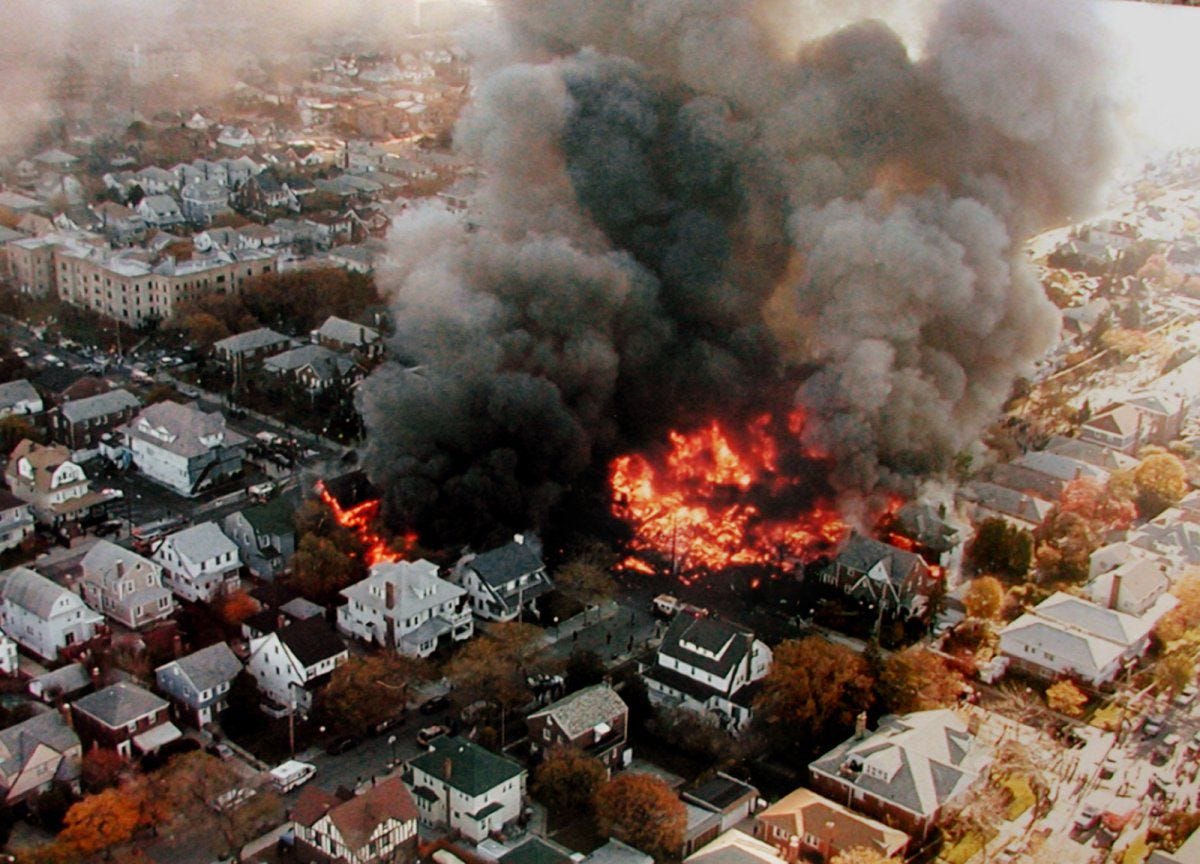
November 12, 2001: American Airlines Flight 587, an Airbus A300, crashes in the Belle Harbor section of Queens, near its takeoff point at John F. Kennedy International Airport.

Coming just 2 months after the 9/11 attacks, everyone's first thought was that was more terrorism, but it was due to pilot error causing mechanical failure.

One of the victims, Hilda Yolanda Mayol, survived the 9/11 attacks, having escaped from the North Tower of the World Trade Center.

The plane was headed for Las Américas International Airport, which serves Santo Domingo, the capital of the Dominican Republic. Most of the people on board were Dominican-Americans on their way to visit family, or Dominican citizens returning home from so doing.

From the Dominican community in Washington Heights, in Upper Manhattan, to the Rockaways in Queens, where the plane went down, killing 260 on board and 5 on the ground, the tragedy hit home (literally) from one end of New York City to the other. It was an awful day, and, had it not been for the 9/11 attacks, it would have been the dominant story of the year in New York City.

Belkis Lora, a relative of a passenger on Flight 587, said, "Every Dominican in New York has either taken that flight or knows someone who has. It gets you there early. At home, there are songs about it."

Seth Kugel, writing for The New York Times, said, "For many Dominicans in New York, these journeys home are the defining metaphor of their complex push-pull relationship with their homeland; they embody, vividly and poignantly, the tug between their current lives and their former selves. That fact gave Monday's tragedy a particularly horrible resonance for New York's Dominicans."

He added, "Even before Monday's crash, Dominicans had developed a complex love-hate relationship with American Airlines, complaining about high prices and baggage restrictions even while favoring the carrier over other airlines that used to travel the same route."

David Rivas, a New York City travel agency owner, said, "For the Dominican to go to Santo Domingo during Christmas and Summer is like the Muslims going to Mecca."

As of November 12, 2022, it remains the 2nd-deadliest plane crash in American history. More people died on this plane than on any of the 4 planes hijacked 2 months earlier.

*

November 12, 2001 was a Monday. Baseball season had ended 8 days earlier, when the Arizona Diamondbacks beat the New York Yankees in the World Series.

On ABC Monday Night Football, the Baltimore Ravens beat the Tennessee Titans, 16-10 at Adelphia Coliseum (now Nissan Stadium) in Nashville.

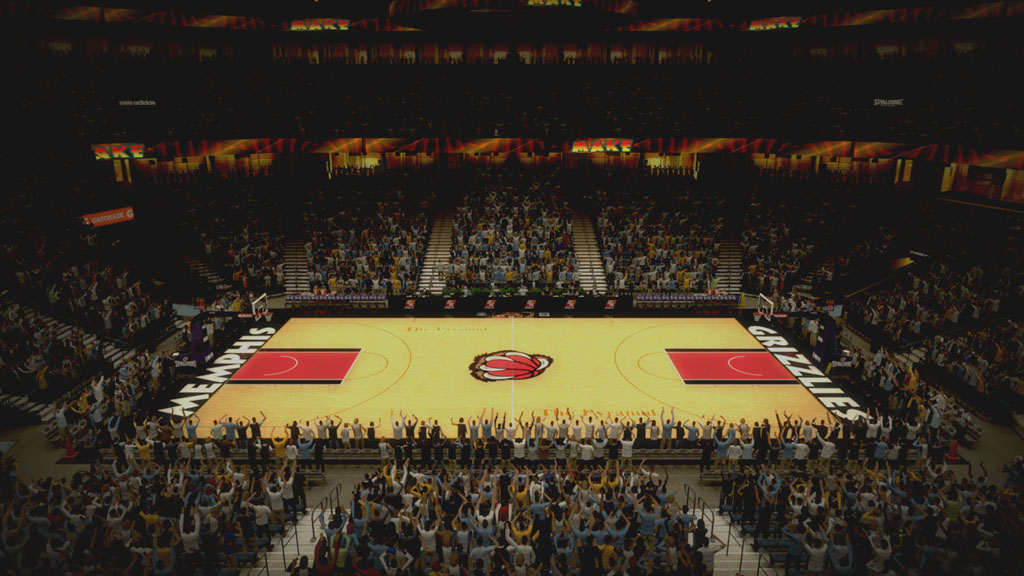
There were 2 games played in the NBA. The Golden State Warriors beat the Memphis Grizzlies, 86-79 at the Pyramid Arena in Memphis. And the Utah Jazz beat the Orlando Magic, 105-98 at the Delta Center in Salt Lake City.

One game was played in the NHL: The Buffalo Sabres beat the Florida Panthers, 5-3 at the National Car Rental Center (now named the Amerant Bank Center) in the Miami suburb of Sunrise, Florida.

Wednesday, November 9, 2022

November 9, 1991: Memphis: Blue Pyramid, Red Ink, White Elephant

November 9, 1991: The Great American Pyramid opens in Memphis, Tennessee. The sports arena's design was somewhat appropriate, as Memphis was named for a city in ancient Egypt. At 321 feet high, it is the tallest building ever built to house sporting events in North America. For comparison's sake, AT&T Stadium outside Dallas, so big that it's been nicknamed The Death Star, is 320 feet at its peak, not quite breaking the record.

The Mid-South Coliseum had hosted college and pro basketball games, minor-league hockey games, and concerts starting in 1964, but did not have the modern amenities that sports teams now demand, making it unlikely that the city could attract an NBA team.

But since the American Basketball Association team known as the Memphis Pros in the 1970-71 and 1971-72 seasons, the Memphis Tams in 1972-73 and 1973-74, and the Memphis Sounds in 1974-75 folded, the Blues City had been without a major league sports team -- unless you count the Memphis Showboats of the United States Football League in 1984 and 1985. The 1987 announcement of expansion teams for the 1988-89 and 1989-90 seasons included Charlotte, Miami and Orlando, all Southern teams, and Northern team Minnesota, but not Memphis.

The Pyramid was built on the bank of the Mississippi River, just north of the Hernando de Soto Bridge, which carries U.S. Route 40 over the River, to West Memphis, Arkansas. Built in 1973 and also known as the M Bridge, because its cantilevered shape makes it look like an M for Memphis, the de Soto is sometimes called "the New Bridge." "The Old Bridge" opened in 1949, is officially known as the Memphis & Arkansas Bridge, nicknamed the M&A, and carries Interstate 55. The M&A is "the Mississippi River Bridge" mentioned in Chuck Berry's song "Memphis," turned into hit covers by Lonnie Mack (instrumental) and Johnny Rivers (vocal).

The biggest team to move into the Pyramid at its opening was the men's basketball team at Memphis State University, which was renamed the University of Memphis in 1994. The NBA's 1993 announcement of expansion teams for the 1995-96 season put teams in Canada: The Toronto Raptors and the Vancouver Grizzlies. But the Grizzlies failed in Vancouver, and were moved to Memphis for the 2001-02 season.
In 1993, the Pyramid hosted the men's and women's basketball tournaments for the Great Midwest Conference. It hosted the Southeastern Conference's men's tournament in 1994 and 1997, Conference USA's men's tournament in 1996 and 2000, CUSA's women's tournament in 2003, NCAA men's tournament games in 1995, 1997 and 2001; and the Memphis Pharaohs of the Arena Football League in 1995 and 1996. In 2002, Lennox Lewis knocked Mike Tyson out there.

The Grizzlies are one seriously messed-up franchise. Their failure in Vancouver can be explained by playing at the same time as a hockey team in Canada. (In contrast, soccer's Vancouver Whitecaps play the other time of the year, and are doing well.) But while the Pyramid was designed to lure an NBA team to Memphis, it was considered unsuitable for 81 games a year. So a new arena was built in 2004, the FedEx Forum. The University of Memphis also moved from the Pyramid to the Forum.

Still, despite being the only major league team in town, the Grizzlies have not done well, either at the box office or on the court. Only once have they ever made the Conference Finals, in 2013, and they got swept. But they won't move, because they're all Memphis has got at the major league level. Like Nashville, their baseball team is Class AAA. And the NFL, the NHL and MLS have chosen Nashville over Memphis. It does seem to make sense, as Nashville is the larger city, with (according to the 2020 Census) 689,000 people to Memphis' 633,000, and a metropolitan area with 2.1 million people to Memphis' 1.3 million.

The Pyramid went dark after the Grizzlies and the Tigers left. In 2005, a plan was put forward to convert it into a retail complex, headed by a Bass Pro Shops store, but it took until 2010 to get it approved and for construction to start. Until then, it was unusable, an embarrassing "white elephant" for one of America's greatest cities.
Finally, the complex opened in 2015. There's also restaurants, a bowling alley, and an aquarium. It gets 3 million visitors a year.

UPDATE: The Grizzlies don't yet have a team Hall of Fame. They have retired 3 numbers: 9, for 2010-17 guard Tony Allen; 33, for 2008-19 center Marc Gasol; and 50, for 2009-17 forward Zach Randolph. They have also honored 1995-2005 broadcaster Don Poier with a banner; and announced that they will retire 11 for 2007-19 guard Mike Conley Jr. when he retires as a player.

Carter has also played for the Grizzlies, 2014-17. Gasol's brother, forward Pau Gasol, played for them 2001-08. Guard Allen Iverson played 3 games for them in 2009. Hubie Brown was their head coach, 2002-04. And Jerry West was their general manager, 2002-07. All have been elected to the Basketball Hall of Fame. None were involved with them in Vancouver.

Thus far, Zach Randolph is the only Grizzlies figure elected to the Tennessee Sports Hall of Fame.

*

November 9, 1991 was a Friday. Actor Anthony Ramos was born.

Baseball season was over. These were among the college football games played:

* Number 1 Florida State beat South Carolina, 38-10 at Doak Campbell Stadium in Tallahassee, Florida.

* Number 2 Miami beat West Virginia, 27-3 at the Orange Bowl stadium in Miami. The next week, they played Number 1 Florida State, one of their major rivals. Oddly, I don't remember it being promoted as "The Game of the Century." Miami won, as Florida State missed a field goal on the last play of the game. The same thing happened between the teams the next year. The games became known as "Wide Right I" and "Wide Right II," respectively, and each one cost the Seminoles a shot at the National Championship. Each time, the Hurricanes kept theirs.

Not yet members of the Atlantic Coast Conference, Florida State accepted a berth in the Cotton Bowl. Miami accepted a berth in the Orange Bowl game, on their home field.

* Number 3 Washington beat USC, 14-3 at the Los Angeles Memorial Coliseum. Washington won the Pacific-10 Conference title, and received the accompanying berth in the Rose Bowl.

* Number 4 Michigan beat Northwestern, 59-14 at Michigan Stadium in Ann Arbor. Michigan won the Big Ten Conference title, and received the accompanying berth in the Rose Bowl, where they lost to Washington.

Both Washington and Miami were 12-0. The National Championship vote couldn't have been much closer: The Associated Press (AP), the poll of college football writers, gave Miami the title by 4 votes; while United Press International (UPI), the poll of college football coaches, gave Washington the title by 9 votes. This split poll was one of the pushes forward the idea of a Playoff needed.

* Number 5 Notre Dame were upset by Number 13 Tennessee, 35-34 at Notre Dame Stadium in South Bend, Indiana. Despite losing again to Penn State the next week, the Fighting Irish were invited to the Sugar Bowl, where they beat Florida.

* Number 6 Florida beat Number 23 Georgia, 45-13 at the Gator Bowl in Jacksonville, the neutral site for their rivalry, "The World's Largest Outdoor Cocktail Party." Florida went on to win the Southeastern Conference title, and accepted the accompanying bid to the Sugar Bowl, where they lost to Notre Dame.

* Number 7 University of California beat Oregon State, 27-14 at Parker Stadium (now Reser Stadium) in Corvallis, Oregon. Cal had already blown the Pac-10 title by losing to Washington, but they did go to the Florida Citrus Bowl, where they beat Clemson.

It was a typically wretched season for Oregon State, as they went 0-10, but they ended it in the best way possible, going to Eugene and upsetting arch-rival University of Oregon. They weren't much better, going in at 3-7. Cliché Alert: In this game, you can throw out the records.

* Number 8 Alabama beat Louisiana State University (LSU), 20-17 at Tiger Stadium in Baton Rouge, Louisiana. The Crimson Tide had already blown the SEC title by getting embarrassed by Florida, 35-10, but that would be their only loss. They beat Colorado in the Blockbuster Bowl.

* Number 9 Penn State beat Maryland, 47-7 at Memorial Stadium in Baltimore. Penn State went to the Fiesta Bowl, where they beat Tennessee.

* Number 10 Iowa beat Number 25 Indiana, 38-21 at Kinnick Stadium in Iowa City. The Hawkeyes had already blown the Big 10 title by getting embarrassed by Michigan, 43-24, but that would be their only loss. They were invited to the Holiday Bowl, where they played Brigham Young University (BYU) to a 13-13 tie.

* Number 11 Nebraska beat Kansas, 59-23 at Memorial Stadium in Lawrence, Kansas. Nebraska won the Big 8 Conference title, and received the accompanying berth in the Orange Bowl. But, at least for a little longer, Miami had Nebraska's number, and it was not 1.

* Number 12 Texas A&M beat Texas Christian University (TCU), 44-7 at Amon G. Carter Stadium in Fort Worth, Texas. A&M won the Southwest Conference title, and accepted the accompanying bid to the Cotton Bowl, where they lost to Florida State.

* Number 18 North Carolina State were upset by Number 24 Virginia, 42-10 at Carter-Finley Stadium in Raleigh, North Carolina.

* Number 22 UCLA were upset by Stanford, 28-10 at Stanford Stadium outside San Francisco in Palo Alto, California.

* Air Force beat Army, 25-0 at Falcon Stadium in Colorado Springs, Colorado; while Navy lost to Tulane, 34-7 at the Superdome in New Orleans.

* And New Jersey's team, Rutgers, lost to the University of Pittsburgh, 22-17 at Pitt Stadium in Pittsburgh.

There were 10 games in the NBA, none of them, of course, in Memphis:

* The New York Knicks beat the Charlotte Hornets, 118-113 at Madison Square Garden.

* The New Jersey Nets lost to the Detroit Pistons, 110-100 at the Brendan Byrne Arena at the Meadowlands.

* The Golden State Warriors beat the Washington Bullets, 127-119 at the Capital Centre in the Washington suburb of Landover, Maryland. Chris Mullin led all scorers on the day with 38 points.

* The Atlanta Hawks beat the Miami Heat, 97-93 at The Omni in Atlanta. Dominique Wilkins scored 34 points.

* The Milwaukee Bucks beat the Dallas Mavericks, 111-95 at the Bradley Center in Milwaukee.

* The Chicago Bulls beat the Orlando Magic, 107-76 at the Chicago Stadium.

* The Houston Rockets beat the Phoenix Suns, 96-95 at The Summit in Houston. (It's now the Central Campus of televangelist Joel Osteen's Lakewood Church.)

* The Utah Jazz beat the Los Angeles Clippers, 101-84 at the Salt Palace in Salt Lake City, Utah. Karl Malone scored 31 points.

* The Minnesota Timberwolves beat the Sacramento Kings, 84-80 at the Arco Arena in Sacramento.

* And the Seattle SuperSonics beat the Indiana Pacers, 118-111 at the Seattle Center Coliseum.

There were 7 games played in the NHL:

* The New York Islanders lost to the San Jose Sharks, 4-3 at the Cow Palace outside San Francisco in Daly City, California.

* The New Jersey Devils lost to the Boston Bruins, 4-0 at the Boston Garden.

* In an "Original Six" matchup, the Montreal Canadiens beat the Chicago Blackhawks, 4-2 at the Montreal Forum.

* The Calgary Flames beat the Toronto Maple Leafs, 6-1 at Maple Leaf Gardens in Toronto.

* The Pittsburgh Penguins beat the Minnesota North Stars, 3-2 at the Metropolitan Sports Center in the Minneapolis suburb of Bloomington, Minnesota.


* The Hartford Whalers beat the St. Louis Blues, 4-3 at the St. Louis Arena.

* The Edmonton Oilers and the Los Angeles Kings played to a tie, 4-4 at The Forum outside Los Angeles in Inglewood, California.

And in New Jersey high school football, my Alma Mater, East Brunswick, beat Perth Amboy, 26-6 at Jay Doyle Field in East Brunswick.

Saturday, October 29, 2022

October 29, 1941: The Tragedy of Harvey Hendrick

October 29, 1941: Harvey Hendrick shoots and kills himself at his farm in Covington, Tennessee. He was only 43.

He was born on November 9, 1897 on a farm near Mason, Tennessee, about 40 miles northeast of Memphis. A star football player at Vanderbilt University in Nashville, he and Lou Gehrig were both rookie 1st basemen on the New York Yankees' 1st World Championship team in 1923, backing up Wally Pipp. "Gink" Hendrick also played the outfield. After Gehrig, a rookie at the time, he was the 2nd man to have played on that team to die.

He was also with the Yankees in 1924, and the Cleveland Indians in 1925. He spent the 1926 season with the New Orleans Pelicans of the Southern Association. He returned to the majors with the Brooklyn Robins (as the Dodgers were known while managed by Wilbert Robinson) in 1927. The Robins traded him to the Cincinnati Reds in 1931, the Reds traded him to the St. Louis Cardinals in 1932, and he spent 1933 with the Chicago Cubs and 1934 with the Philadelphia Phillies.

His baseball career ended in 1934, with a .308 lifetime batting average, though as mainly a reserve player. Apparently, by 1941, his farm wasn't working out well.

Judging by the reaction when active Yankee Cory Lidle was killed in a plane crash just after the 2006 regular season, I can imagine that, today, if a former Yankee player committed suicide, the story would soak the news (in blood) for days.

But Hendrick has been just about forgotten. The Yankees did not wear black armbands, or any kind of memorial patch, during the 1942 season -- just the red, white & blue "HEALTH" shield that all teams wore in that 1st full year of World War II for the U.S. And there is no mention of him in Monument Park, or anywhere else in the new Yankee Stadium.

*

October 29, 1941 was a Wednesday. This was also the day of the Kaunas Massacre, in which the Nazis killed over 9,000 Lithuanian Jews. I have a separate entry for that event.

Baseball season had ended 23 days earlier, with the New York Yankees winning the World Series over the Brooklyn Dodgers. Football was in midweek. The NBA hadn't been founded yet. And the NHL season wouldn't start for another 3 days. So there were no scores on this historic day.

Monday, October 10, 2022

October 10, 1998: The NHL Comes to Tennessee

Jeff Daniels (left) and Bret Hedican

October 10, 1998: The Nashville Predators play their 1st regular-season game. It had been 3 years and change since NHL Commissioner Gary Bettman had tried to get the New Jersey Devils to move to Nashville, a move derailed when the team won the 1995 Stanley Cup, resulting in Bettman getting the hell booed out of him when he presented the trophy.

But, what Bettman wants, he usually gets, and he wanted another team in the American South. So the City of Nashville built the Nashville Arena, now named the Bridgestone Arena, and the NHL expanded for the 1998-99 season.

The Predators became the 1st major league hockey team in Tennessee. The NHL had never had a team in the Volunteer State before: Not in Nashville, not in Memphis, not in Knoxville, not anywhere else. Nor did the World Hockey Association of the 1970s put a team there, despite putting teams in Houston and Birmingham, and trying to put a team in Miami.

The 1st game didn't go so well for the home team: They lost to the Florida Panthers, 1-0. Ray Whitney scored the only goal, 2:26 into the 3rd period. The Preds and their fans would have to wait 3 days for their 1st win, 3-2 at home to the Carolina Hurricanes.

With a large contingent of people who were not native -- including people who had come to Nashville for the music industry from places where hockey was popular and their allegiances could be transferred, and from places where it wasn't and their fandom could develop -- the Predators built a big fanbase that will probably prevent them from ever seriously considering moving.

They were competitive quickly, too: In their 1st season, they went 28-47-7, although they missed the Playoffs. It took them until 2004 to make the Playoffs, and until 2011 to win a Playoff round. But, by then, they were usually making it. In 2017, they reached the Western Conference Finals for the 1st time, and got all the way to the Stanley Cup Finals, before losing to the Pittsburgh Penguins.

UPDATE: The Predators do not yet have a team Hall of Fame. They have retired one uniform number, the 35 of 2005-21 goaltender Pekka Rinne. Three of their former players have been elected to the Hockey Hall of Fame. Defenseman Shea Weber played for them from 2006 to 2016. The others were elected mainly for how they played elsewhere: Left wing Paul Kariya, who played for them in the 2005-06 and 2006-07 seasons; and center Peter Forsberg, who played 27 games for them in 2006-07. In addition, David Poile, their 1st general manager, from the start of the organization in 1997 until 2023, and still in their front office, has been elected.

Poile, 2010-18 center Mike Fisher and 1998-2022 broadcaster Terry Crisp have been elected to the Tennessee Sports Hall of Fame. Fisher is married to country singer Carrie Underwood -- meaning her married name is Carrie Fisher.

*

October 10, 1998 was a Saturday. There were 11 other games in the NHL that day:

* In an "Original Six" matchup, the New York Rangers lost to the Montreal Canadiens, 7-1 at the Molson Centre (now the Bell Centre) in Montreal. In a rarity, the Habs got their 7 goals from 7 different players: Saku Koivu, Vincent Damphousse, Craig Rivet, Benoît Brunet, Scott Thronton, Igor Ulanov and Brett Clark. The Ranger goal was scored by Adam Graves.

* The New York Islanders lost to the Pittsburgh Penguins, 4-3 at the Nassau Coliseum.

* The New Jersey Devils made it an 0-3 night for the New York Tri-State Area teams, losing to the Chicago Blackhawks, 2-1 at the United Center in Chicago.

* The Calgary Flames beat the San Jose Sharks, 5-3 at the Yoyogi National Gymnasium in Tokyo, Japan. It was not the 1st regular-season NHL game: That came at the start of the previous season. 

* The Boston Bruins and the St. Louis Blues played to a tie, 3-3 at the FleetCenter (now the TD Garden) in Boston.

* The Washington Capitals beat the Mighty Ducks of Anaheim, 1-0 at the MCI Center (now the Capital One Arena) in Washington.

* The Tampa Bay Lightning and the Carolina Hurricanes played to a tie, 4-4 at the Greensboro Coliseum in Greensboro, North Carolina (now the First Horizon Coliseum).

* The Dallas Stars beat the Buffalo Sabres, 4-1 at the Reunion Arena in Dallas.

* In another "Original Six" matchup, the Toronto Maple Leafs beat the Detroit Red Wings, 2-1 at Maple Leaf Gardens in Toronto.

* The Ottawa Senators beat the Colorado Avalanche, 4-3 at the McNichols Arena in Denver.

* And the Los Angeles Kings beat the Edmonton Oilers, 2-1 at the Northlands Coliseum -- then named the Edmonton Coliseum. Two days later, the name was changed to the Skyreach Centre.

Baseball's League Championship Series were being played. In the American League, the New York Yankees won Game 4, beating the Cleveland Indians, 4-0 at Jacobs Field (now Progressive Field) in Cleveland. The Yankees won the series in 6 games.

In the National League, the San Diego Padres beat the Atlanta Braves, 4-1 at Qualcomm Stadium (formerly San Diego Stadium and Jack Murphy Stadium). The Padres won the series in 6 games.

Among the college football games played that day were these:

* Number 1 Ohio State beat Illinois, 41-0 at Memorial Stadium in Champaign, Illinois. Four weeks later, Ohio State lost to Michigan State, blowing their shot at the National Championship, sole ownership of the Big Ten Conference title, and a bid to the Rose Bowl. They were, however, invited to the Sugar Bowl.

* Number 2 Nebraska were upset by Number 18 Texas A&M, 28-21 at Kyle Field in College Station, Texas. A&M won the Big 12 Conference Championship, which, under the usual circumstances, would have resulted in an invitation to the Orange Bowl. But since SEC Champion Tennessee were ranked Number 1 at the end, they were invited to the BCS Championship Game, and the slot in the Sugar Bowl that would otherwise have been offered to them was offered instead to A&M. They were beaten by Ohio State.

* Number 3 University of California at Los Angeles beat Number 10 Arizona, 52-28 at Arizona Stadium in Tucson. UCLA won the Pacific-10 Conference title, and were invited to the Rose Bowl.

* Number 4 Tennessee beat Number 7 Georgia, 22-3 at Sanford Stadium in Athens, Georgia. Tennessee ended up winning the Southeastern Conference title, and were ranked Number 1 in the country after the Conference Championship Games.

* Number 5 Kansas State beat Number 14, Colorado, 16-9 at Folsom Field outside Denver in Boulder, Colorado.

* Number 6 Florida beat Number 11 Louisiana State, 22-10 at Ben Hill Griffin Stadium in Gainesville, Florida. A loss to Tennessee cost Florida the SEC title and a bid to the Sugar Bowl. They were, instead, invited to the Orange Bowl, where they beat Syracuse.

* Rivalry: Number 8 Florida State beat the University of Miami, 26-14 at the Orange Bowl in Miami. FSU ended up winning the Atlantic Coast Conference title, and were ranked Number 2 in the country after the Conference Championship Games. And so, in this 1st year of the Bowl Championship Series (BCS), they faced Number 1 Tennessee in the Fiesta Bowl in Tempe. Tennessee won, and were the undisputed National Champions.

* Number 9 Virginia were idle.

* Number 12 Wisconsin beat Purdue, 31-24 at Camp Randall Stadium in Madison, Wisconsin. Wisconsin went on to lose to Michigan, and ended up tied with Ohio State for the Big 10 title. Because Ohio State had been to the Rose Bowl more recently, Wisconsin were invited instead, and beat UCLA.

* Number 19 University of Southern California lost to the University of California: Cal beat USC, 32-31 at the Los Angeles Memorial Coliseum.

* Number 22 Notre Dame beat Arizona State, 28-9 at Sun Devil Stadium (now Mountain America Stadium) in the Phoenix suburb of Tempe, Arizona.

* Number 23 North Carolina State lost to Georgia Tech, 47-24 at Carter-Finley Stadium in Raleigh, North Carolina.

* Rivalry: Texas beat Oklahoma, 34-3 at the Cotton Bowl in Dallas. Although Texas did not win the Big 12 South Division, they received a bid to the Cotton Bowl game at the Cotton Bowl stadium, as they so often did as Champions of the Southwest Conference, and beat Mississippi State.

* Among the service academies, Army beat the University of Houston, 38-28 at Robertson Stadium in Houston; and Air Force beat Navy, 49-7 at Falcon Stadium in Colorado Springs, Colorado.

* Rutgers, New Jersey's team, were idle.

And in New Jersey high school football, my Alma Mater, East Brunswick, beat Woodbridge, 27-13 at Jay Doyle Field in East Brunswick.

Friday, October 7, 2022

October 8, 1918: The Heroics of Sergeant York

October 8, 1918: In Chatel-Chéhéry, in the Argonne Forest in northeastern France, near the border with Belgium, Corporal Alvin C. York attacks a German machine gun position, killing several soldiers with his rifle and then, having run out of ammunition, with his pistol. The commander of the German position surrendered it to him.

York was 30 years old at the time. He had been a pacifist growing up on a Tennessee farm, an his application for conscientious objector status was denied. He was assigned to the U.S. Army's 82nd Division, which later became an Airborne division and one of the Army's most famed units. He 
was awarded the Congressional Medal of Honor. He became a hero among the Allies of World War I, and was later promoted to the rank of a full Colonel in the Tennessee National Guard.

He later worked as an official for the Civilian Conservation Corps and as superintendent of Cumberland Mountain State Park. In 1941, with patriotism on their mind as America approached World War II, Warner Brothers made the film Sergeant York, and Gary Cooper won an Academy Award for his portrayal. The real Alvin York lived until 1964.

It has been noted that, on the 1960s TV show Bewitched, the character of Darrin Stephens was played first by Dick York (no relation), then by Dick Sargent, and that this can be rearranged as "Sargent York."

*

October 8, 1918 was a Tuesday. The baseball season had been cut short due to the war. Football was in midweek. It was too soon for the NHL season to start. And professional basketball barely existed. So there were no scores on this historic day.

Saturday, September 24, 2022

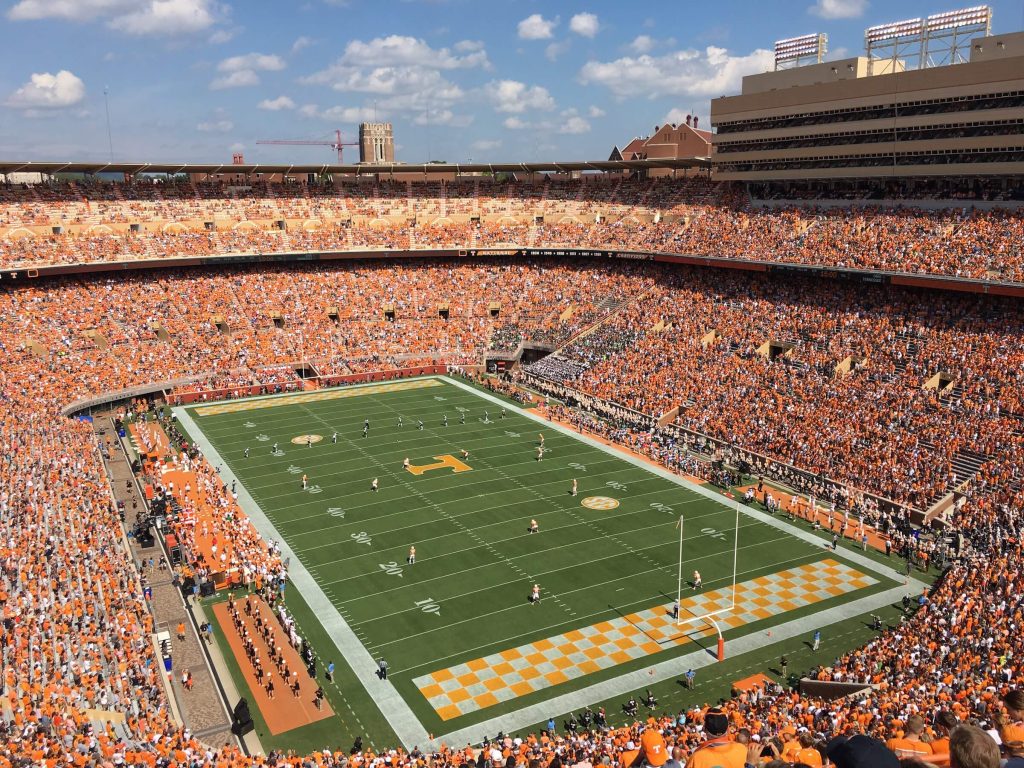
September 24, 1921: Neyland Stadium Opens

September 24, 1921: The University of Tennessee opens a new football season, and a new football venue, then named Shields-Watkins Field. The opponent is Emory and Henry University, of Emory, in the western panhandle of Virginia. Tennessee win, 27-0. Attendance: About 3,200, which was all that would fit at the time. The stadium would get considerably bigger.

The Emory and Henry Wasps dropped to Division III in the NCAA's reorganization of 1976, and rose to Division II in 2022. The Tennessee Volunteers, or "Vols," however, would become one of the leading programs in college football.

Built on the shore of the Tennessee River, it was named for Colonel W.S. Shields, president of Knoxville's City National Bank and a University of Tennessee trustee, who provided the initial capital to prepare and equip an athletic field; and his wife, Alice Watkins-Shields.

From most of the seasons between 1926 and 1952, the head coach at UT was Robert Neyland (pronounced NEE-land, not NAY-land), who was, concurrently, in the U.S. Army Reserve, having been a West Point graduate and a former Army assistant coach. His tenure there included Army's 1924 loss to Notre Dame at the Polo Grounds, the game where sportswriter Grantland Rice named the Notre Dame backfield "The Four Horsemen."

In 1935, the Army called him back into service, for a command within the Panama Canal Zone. He returned to UT for the 1936 season, and was named athletic director as well as head coach. But he was called away again during World War II, rising to the rank of Brigadier General.
General Bob Neyland

He returned in 1946, remained head coach through 1952, and athletic director until his death in 1962. At that time, the stadium was renamed Neyland Stadium, although the playing surface remains Shields-Watkins Field to this day.

He told his players, "Gentlemen, touchdowns follow blocking just as surely as night follows day." They must have listened well, because they played to a record of 173-31-12 during his tenure.

Before the opening of what became Neyland Stadium, Tennessee won the Championship of the Southern Intercollegiate Athletic Association (SIAA) in 1914. Neyland led them to the Southern Conference title in 1927 and 1932. He led them to the Southeastern Conference title in 1938, 1939, 1940, 1946 and 1951.

Bowden Wyatt coached them to the SEC title in 1956. Doug Dickey led them to the SEC title in 1967 and 1969. Johnny Majors, who nearly won the Heisman Trophy as a running back on their 1956 titlists, coached them to the SEC title in 1985, 1989 and 1990. And Phillip Fulmer coached them to the SEC title in 1997 and 1998. Total: 16 Conference Championships, 13 of them in the SEC.

They won the SEC Championship Game in 1997 and 1998, and won the SEC Eastern Division, but lost the Championship Game, in 2001, 2004 and 2007. They tied for the Division title in 2003, but lost a tiebreaker for the Championship Game bid to Georgia.

Tennessee were recognized as National Champions in 1951, and won the Bowl Championship Series to win the National Championship in 1998. They have also been selected as National Champions by secondary sources, other than the Associated Press (AP, the writers' poll) or United Press International (UPI, the coaches' poll) in 1938, 1940, 1950 and 1967.

In 1964, the orange-and-white checkerboard end zones were added. This was one of the many changes initiated by Dickey, who also added the "T" logo to the football helmet and initiated the tradition of the team running onto the field through the "Power T" formed by the Pride of the Southland Band. In 1968, Neyland Stadium became the 1st major-college stadium to switch from natural grass to artificial turf, but switched back to grass in 1994.
In 1967, country group The Osborne Brothers had a hit with "Rocky Top," a song written by Felice & Boudleaux Bryant, best known for hits written for The Everly Brothers. In 1972, the Pride of the Southland Band began playing it, and, while it is not the official UT fight song -- the official one is titled "Down the Field" -- it is more identified with the school than any other song. That 1972 season was also the one in which lights were added to Neyland Stadium.

But beyond "Rocky Top" and the checkerboard end zones, the biggest feature of Neyland Stadium is simply how big it is. In 1926, it was expanded to 17,860; in 1938, to 31,390; in 1948, to 46,290. The West Stands were double-decked in 1962, and the East Stands in 1968. Capacity became 64,429. The South Stand was double-decked in 1972, and the North Stand in 1976, making for 80,250.

There was another expansion in 1980, to 91,902; and another in 1996, to 102,544, making it, at the time, the largest on-campus stadium in the country. The addition of luxury boxes made it 104,037 in 2000. Adjustments over the next 10 years have led to the current capacity of 102,455. The record attendance is 109,061, on September 18, 2004, a nationally-televised night game in which they beat Florida, with both teams ranked in the Top 20, 30-28.

The street to the south is named Neyland Drive. The street to the west is named for a later title-winning UT coach, Philip Fulmer Way.

*

September 24, 1921 was a Saturday. Sportscaster Jim McKay and actress Sheila MacRae were born on this day.

Most of the country's college football teams opened their seasons the next week, including Army, Navy, Columbia and NYU in New York City, and Princeton in New Jersey. But these other notable college football games were played:

* Notre Dame beat Kalamazoo College, 56-0 at Cartier Field in South Bend, Indiana.

* Fordham beat the University of Maine, 25-14 at Fordham Field in The Bronx.

* And Rutgers beat Ursinus, 33-0 at Patterson Field in Collegeville, Pennsylvania.

These baseball games were played:

* The New York Yankees lost to the Cleveland Indians, 9-0 at the Polo Grounds. George Uhle pitched a 4-hit shutout, outpitching Harry Harper. Babe Ruth went 1-for-2 with a walk before leaving the game. Tris Speaker, the Indians' center fielder and manager, went 0-for-4 with a walk.

As a result of this game, the Yankees and the Indians were tied for 1st place, although the Yankees, having played 2 fewer games, were ahead on winning percentage. They got their act together, and won their 1st American League Pennant, beating the Indians by 4 1/2 games.

* The New York Giants lost to the St. Louis Cardinals, 8-4 at Sportsman's Park in St. Louis. Emil "Irish" Meusel went 4-for-4 with an RBI for the Giants.

* The Brooklyn Robins (as the Dodgers were known while Wilbert Robinson was their manager from 1914 to 1931) beat the Cincinnati Reds, 4-2 at Redland Field (later Crosley Field) in Cincinnati. Jimmy Johnston doubled home the winning runs in the top of the 10th innings.

* A doubleheader was split at Fenway Park in Boston. The Boston Red Sox won the opener, 2-1. The St. Louis Browns won the nightcap, 11-0. Frank "Dixie" Davis pitched a 6-hit shutout.

* A doubleheader was split at Shibe Park in Philadelphia. The Philadelphia Athletics won the 1st game, 7-4. The Chicago White Sox won the 2nd game, 18-1.

* The Washington Senators beat the Detroit Tigers, 5-1 at Griffith Stadium in Washington. Walter Johnson went the distance for the win. Ty Cobb went 2-for-5 with an RBI.

* The Pittsburgh Pirates beat the Philadelphia Phillies, 4-3 at Forbes Field in Pittsburgh.

* And the Boston Braves and the Chicago Cubs were rained out at Cubs Park (later Wrigley Field) in Chicago. The game was made up as part of a doubleheader the next day. The Cubs swept, 4-3 and 8-7.

Saturday, September 10, 2022

September 10, 2016: American Football's Biggest Crowd

September 10, 2016: The biggest crowd in the history of American football, at any level, is recorded. And not at a place known for hosting the sport.

The University of Tennessee is in Knoxville, Tennessee. The Virginia Polytechnic Institute, a.k.a. Virginia Tech, is in Blacksburg, Virginia. Their stadiums are 237 miles apart, separated by Interstates 81 and 40. However, they are not rivals, because they are in different leagues: Tennessee are in the Southeastern Conference (the SEC), Tech in the Atlantic Coast Conference (the ACC).

Perhaps the fact that they are not rivals made this neutral-site game easier to set up. Tech's Lane Stadium seats 65,632. Tennessee's Neyland Stadium seats 101,915. But they set up a game against each other at a racetrack, the Bristol Motor Speedway, in Bristol, Tennessee, 110 miles from Neyland Stadium, 138 miles from Lane Stadium, and 7 miles from the Virginia/Tennessee State Line that Bristol straddles. (Bristol, Virginia is home to 17,000 people; Bristol, Tennessee, to 26,000.)

The Speedway opened in 1961, is a regular on the NASCAR "short track" circuit, and is known as "The World's Fastest Half Mile." Officially, it seats 153,000. But when the Tennessee Volunteers and the Virginia Tech Hokies played each other there on September 10, 2016, the attendance was a new record for a game of the sport the rest of the world calls "American football": 156,990.

The current NFL record is 112,376, for an exhibition game at Estadio Azteca in Mexico City in 1994. The Houston Oilers beat the Dallas Cowboys, 6-0. The biggest crowd for a regular-season game was 105,121 at AT&T Stadium in Arlington, Texas, on September 20, 2009. The Cowboys lost this one, too, to the New York Giants, 33-31.

Here's what the 156,990 at "The Battle at Bristol" saw. Tech scored 2 touchdowns in the 1st quarter, for a 14-0 lead. The Volunteers took over from there, scoring 31 unanswered points: 4 touchdowns and a field goal, making it 31-14. The Hokies added a field goal to close it to within 31-17 at the end of 3 quarters.

The Vols scored 2 more touchdowns in the 4th quarter. The Hokies added a touchdown, but that would be it: Tennessee 45, Virginia Tech 24. Tech football is known for 2 things: Michael Vick and good defense. On this night, they had neither.

Tennessee went 9-4, staying at home for the postseason, winning the Music City Bowl in Nashville. Virginia Tech went 10-4, winning the Coastal Division of the ACC, losing the ACC Championship Game to Clemson, and winning the Belk Bowl (now the Duke's Mayo Bowl) in Charlotte.

*

September 10, 2016 was a Saturday. These other notable college football games were played that day:

* Number 1 Alabama beat Western Kentucky, 38-10 at Bryant-Denny Stadium in Tuscaloosa, Alabama.

* Number 2 Clemson beat Troy, 30-24 at Clemson Memorial Stadium in Clemson, South Carolina.

* Number 3 Florida State beat Charleston Southern at Doak Campbell Stadium in Tallahassee, Florida.

* Number 4 Ohio State beat the University of Tulsa, 48-3 at Ohio Stadium in Columbus, Ohio.

* Number 5 Michigan beat Central Florida, 51-14 at Michigan Stadium in Ann Arbor.

* Number 6 University of Houston beat Lamar University, 42-0 at TDECU Stadium in Houston.

* Number 8 University of Washington beat Idaho, 59-14 at Husky Stadium in Seattle.

* Number 9 Georgia beat Nicholls State, 26-24 at Sanford Stadium in Athens, Georgia.

* Number 10 Wisconsin beat the University of Akron, 54-1 at Camp Randall Stadium in Madison, Wisconsin.

* Number 15 Texas Christian (TCU) were upset by Arkansas at Amon G. Carter Stadium in Fort Worth, Texas.

* Number 22 Oklahoma State were upset by Central Michigan, 30-27 at Boone Pickens Stadium in Stillwater, Oklahoma.

* In a major rivalry, the University of Pittsburgh beat Penn State, 42-39 at Heinz Field (now Acrisure Stadium) in Pittsburgh.

* Among the service academies, Army beat Rice, 31-14 at Michie Stadium in West Point, New York; Navy beat the University of Connecticut, 28-24 at Navy-Marine Corps Memorial Stadium in Annapolis, Maryland; and Air Force beat Georgia State, 48-14 at Falcon Stadium in Colorado Springs, Colorado.

* And Rutgers beat Howard University, 52-14 at High Points Solutions Stadium (now SHI Stadium) in Piscataway, New Jersey.

It was a little early for the NBA and NHL seasons to start. But these baseball games were played that day:

* The New York Yankees beat the Tampa Bay Rays, 5-1 at Yankee Stadium. Masahiro Tanaka was the winning pitcher, and home runs were hit by two men who became pariahs among Yankee Fans, Jacoby Ellsbury and Gary Sánchez.

* The New York Mets lost to the Atlanta Braves, 4-3 at Turner Field (now Center Parc Stadium) in Atlanta. Adonis Garcia singled home the winning run in the bottom of the 10th inning.

* The Washington Nationals beat the Philadelphia Phillies, 3-0 at Nationals Park in Washington. How many Nats pitchers does it take to pitch a 5-hit shutout? This time, 4: Max Scherzer, 6 2/3rds innings; Marc Rzepczynski, 1 inning; Shawn Kelley, 1/3rd of an inning, faced only one batter, but, because he was their pitcher when the Nats took the lead, on a 3-run home run by Bryce Harper in the bottom of the 8th, he was credited as the winning pitcher; and Mark Melancon, who got the save.

* The Los Angeles Dodgers beat the Miami Marlins, 5-0 at Marlins Park (now LoanDepot Park) in Miami. How many Dodger pitchers does it take to pitch a 2-hit shutout? Also 4. At least this time, the starter got the win: Rich Hill pitched 7 no-hit innings, before manager Dave Roberts replaced him with Joe Blanton, who allowed a hit in the 8th; Grant Dayton allowed a hit in the 9th, and Kenley Jansen got the last out.

* The Toronto Blue Jays beat the Boston Red Sox, 3-2 at the Rogers Centre in Toronto.

* The Cincinnati Reds beat their arch-rivals, the Pittsburgh Pirates, 8-7 at PNC Park in Pittsburgh.

* The Baltimore Orioles beat the Detroit Tigers, 11-3 at Comerica Park in Detroit.

* The Kansas City Royals beat the Chicago White Sox, 6-5 at U.S. Cellular Field (soon to be renamed Guaranteed Rate Field, and now named just Rate Field) in Chicago.

* The Minnesota Twins beat the Cleveland Indians, 2-1 at Target Field in Minneapolis. Joe Mauer singled home the winning run in the bottom of the 12th inning.

* The St. Louis Cardinals beat the Milwaukee Brewers, 5-1 at Busch Stadium in St. Louis.

* The Houston Astros beat the Chicago Cubs, 2-1 at Minute Maid Park (now Daikin Park) in Houston.

* The San Francisco Giants beat the Arizona Diamondbacks, 11-3 at Chase Field in Phoenix.

* The San Diego Padres beat the Colorado Rockies, 6-3 at Petco Park in San Diego.

* The Texas Rangers beat the Los Angeles Angels, 8-5 at Angel Stadium of Anaheim.

* And the Seattle Mariners beat the Oakland Athletics, 14-3 at the Oakland Coliseum.

And in English soccer, Arsenal beat Hampshire team Southampton, 2-1 at the Emirates Stadium in North London.

Saturday, August 13, 2022

August 14, 1891: The Longest-Widowed First Lady

Sarah Polk, left; and Sarah Polk Fall, her great-niece

August 14, 1891: Sarah Polk dies in Nashville, at the age of 87. No former First Lady had lived longer without her husband, the former President.

NOTE: My cutoff date for this project is 1869, the year of the completion of the Transcontinental Railroad, the 1st openly professional baseball team, and the 1st American football game. I had managed to work in references to every pre-1869 President except Polk. This was the only way I could think of to do it.

Sarah Childress had been born on September 4, 1803 in Murfreesboro, Tennessee. James Knox Polk had been born on November 2, 1795 in Pineville, North Carolina, now a suburb of Charlotte, before his family moved to Murfreesboro. When he was 19, and she was 12, they were taught together in a one-room schoolhouse in Murfreesboro.

James graduated from the University of North Carolina, well before the invention of basketball. However, UNC still beats Duke: Its Presidential connection is that Richard Nixon graduated from its law school.

In 1823, he returned to Murfreesboro to practice law, and became acquainted with Tennessee's best-known lawyer, and its leading politician, former U.S. Army Major General Andrew Jackson. James was 27, Sarah was 20. Jackson told James that Sarah was "wealthy, pretty, ambitious and intelligent," and urged him to marry her. On January 1, 1824, he did, at her parents' plantation outside Murfreesboro.

A member of the U.S. House of Representatives from Tennessee from 1825 to 1839, Speaker of the U.S. House of Representatives from 1835 to 1839, and Governor of Tennessee from 1839 to 1841, Polk was nonetheless considered a "dark horse" candidate when he ran for the Democratic Party's nomination for President. Yet, on November 1, 1844, he was elected the 11th President of the United States. 

He defeated Senator Henry Clay of Kentucky, who thus became the 1st man to go 0-for-3 in Presidential elections. Others have done so, but Clay is the only man to be nominated 3 times and lose all 3. The popular vote was actually very close, since Clay, a leading figure in American politics for over 30 years, was better-known nationally than Polk. Polk won 49.5 percent of the popular vote, making him the 1st plurality President since the popular vote began being recorded from every State then in the Union (starting in 1828); while Clay won 48.1 percent. The Electoral Vote was less close, as Polk won 170-105.
The only known photo of the Polks together.
This is also the earliest known photo
of a President and a First Lady together.

Texas was annexed right before his Inauguration, so he doesn't get credit for adding Dallas, Houston and San Antonio. But in 1846, he launched the Mexican-American War, which was essentially won in a year and a half. Cities whose teams are possible because of his expansionism are San Francisco, Oakland, San Jose, Los Angeles, Anaheim, San Diego, Phoenix, Salt Lake City and, now, Las Vegas.

A devout Presbyterian, Sarah banned dancing, card games, and hard liquor (but not wine) at official receptions. Unlike the waltzed favored by her immediate predecessor, Julia Tyler, the Polk entertainments were sedate and sober affairs which earned the First Lady the nickname "Sahara Sarah."

Having achieved his ambitions, James kept his promise to not run for re-election, contracted cholera, and died on June 15, 1849, just 3 months after leaving office -- the shortest ex-Presidency ever. He was 53 years old, and left Sarah a widow at 46.

Sarah never remarried, and lived at Polk Place, the Nashville house she and James intended for their retirement. They never had children, but she unofficially adopted a grandniece, Sarah Polk, later Sarah Fall, whom she raised as her own daughter. Despite being a Southerner, she supported the Union during the American Civil War. Upon her death, she was buried alongside her husband in a tomb on the grounds of the State Capitol in Nashville.

Some First Ladies predeceased their husbands. A few wives of Presidents died before their husbands could become President, and thus they never became First Lady. Of those who did outlive their husbands, Sarah Polk did so by 42 years; Frances Cleveland, 39; Edith Wilson, 38; Lucretia Garfield, 37; Claudia Johnson (a.k.a. Lady Bird, Mrs. Lyndon), 34; Edith Roosevelt (Mrs. Theodore), 30; Jacqueline Kennedy, 30; Julia Tyler, 28; Grace Coolidge, 24; Anna Harrison (Mrs. William Henry), 23; Mary Lincoln, 17; Julia Grant, 17; Eleanor Roosevelt (Mrs. Franklin), 17; Dolley Madison, 13; Nellie Taft, 13; Nancy Reagan, 12; Bess Truman, 10; Mamie Eisenhower, 10; Ida McKinley, 6; Betty Ford, 5; Louisa Adams (Mrs. John Quincy), 4; Martha Washington, 3; Peggy Taylor, 2; Florence Harding, 1; and Eliza Johnson (Mrs. Andrew), just 6 months.

The longest any President has lived after being widowed is actually longer: Thomas Jefferson lived 44 years after the death of his wife, Martha.

George Bancroft, who served as Secretary of the Navy, was the last surviving member of Polk's Cabinet, dying the same year as Sarah Polk, 1891.

Polk remains the only President born in North Carolina, although he represented Tennessee.

*

August 14, 1891 was a Friday. There were 4 baseball games played that day, all in the National League, rather than in the American Association:

* The New York Giants beat the Cincinnati Reds, 2-1 at the Polo Grounds.

* The Brooklyn Bridegrooms beat the Chicago Colts, 10-6 at the original Washington Park in Brooklyn. The Chicago team became the Cubs in 1903, and the Brooklyn team became the Dodgers in 1911.

* The Boston Beaneaters beat the Cleveland Spiders, 5-2 at the South End Grounds in Boston. The Cleveland team went out of business after the 1899 season, making the American League team now known as the Cleveland Guardians possible. The Boston team became the Braves in 1912.

* And the Philadelphia Phillies beat the Pittsburgh Pirates at the Philadelphia Base Ball Grounds. That stadium burned down in 1894, and what would become known as Baker Bowl was built on the site.

December 31, 1999 & January 1, 2000: The Millennium

December 31, 1999:  The Millennium arrives. The people of planet Earth survived. At a terrible cost. But we hadn't destroyed ourselves. ...