Showing posts with label lorenz hart. Show all posts

Tuesday, November 22, 2022

November 22, 1943: Lorenz Hart Dies

November 22, 1943: Lorenz Hart dies in Manhattan. Years of hard drinking had caught up with him at the age of 48.

Lorenz Milton Hart was born on May 2, 1895 in Manhattan, to Jewish immigrant parents. He was introduced to Richard Rodgers at Columbia University in 1919, and the two of them wrote songs together for the next 24 years. Their hit musicals included On Your Toes, Babes In Arms and Pal Joey. Their individual hits included "Blue Moon," "The Lady Is a Tramp" and "My Funny Valentine."

But "Larry" Hart suffered from depression, which led him to drink heavily. It's been alleged that he was gay and in the closet. When the 1948 film Words and Music was made, with Tom Drake as Rodgers (who wrote the music for their songs) and Mickey Rooney as Hart (who wrote the lyrics), the film covered up for him, attributing his depression and his erratic behavior not to his drinking and his closeted nature, but to an obsession with a woman who rejected him.

In 1943, Rodgers had had enough, and ended their partnership. That same year, Hart's mother, with whom he lived, died. Depression overcame him, and he drank himself into a stupor on November 22, leaving him outside on a cold night, ending his life.

Oscar Hammerstein II, Rodgers' new partner, died in 1960. Rodgers lived on until 1979.

*

November 22, 1943 was a Monday. Baseball was out of season. Football was in midweek. The NBA hadn't been founded yet. The NHL season was underway, but no games were scheduled for this day. So there were no scores on this day. But 2 sports legends were born: Tennis icon Billie Jean King, and hockey star Yvan Cournoyer.

Wednesday, November 16, 2022

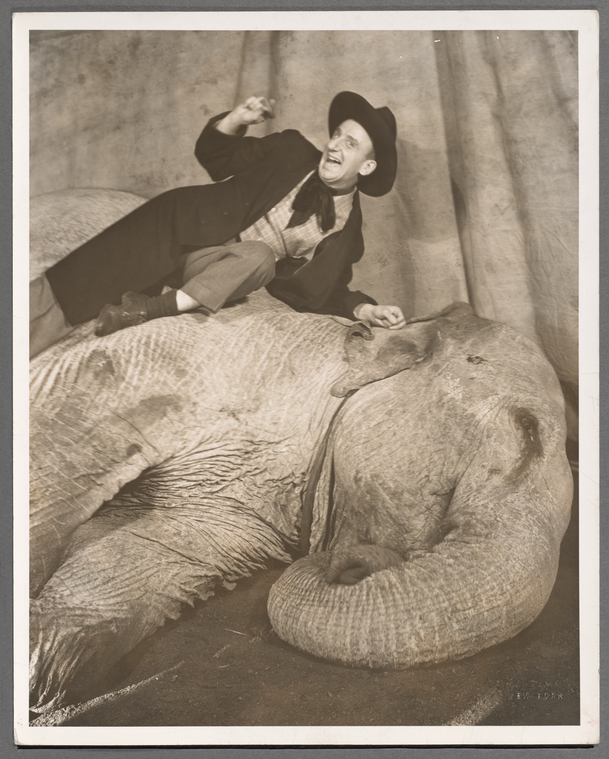
November 16, 1935: Billy Rose's "Jumbo" Premieres, Starring Jimmy Durante

November 16, 1935: Jumbo opens at the New York Hippodrome. The music was written by Richard Rodgers, the lyrics by Lorenz Hart, and the book by Ben Hecht and Charles MacArthur. It was produced by Billy Rose, one of the leading impresarios of the era.

It tells the story of a troubled circus that gets saved by a large elephant, a story based on how the real Jumbo was featured by P.T. Barnum from 1882 until its death in 1885. It is filmed in 1962, as Billy Rose's Jumbo, as Rose made a deal that, if it were ever made into a movie, his name would appear in the title, even if he had nothing to do with it.

William Samuel Rosenberg was born on September 6, 1899 in Manhattan. He began his entertainment career as a songwriter, writing the lyrics for such songs as "Me and My Shadow" with Edward Eliscu, "Does the Spearmint Lose Its Flavor on the Bedpost Overnight" (later "Does Your Chewing Gum Lose... ") with Marty Bloom, "I Found a Million Dollar Baby" with Mort Dixon, and "It's Only a Paper Moon" with Yip Harburg.

He moved into producing shows, including several on Broadway. In 1937, he established Billy Rose's Aquacade, a water stunt show, moving it to the New York World's Fair in 1939. The amphitheater where it was staged was one of the last remaining structures from that Fair.

He was married 5 times to 4 different women. The 1st of these was the famed comedienne Fanny Brice, on whom the musical Funny Girl was based. The 2nd was Olympic Gold Medal swimmer Eleanor Holm, who starred in his Aquacade. Their affair had broken up both of their marriages. His 3rd and 4th wife was showgirl Joyce Matthews, who had also married and divorced comedian Milton Berle twice.

In his later years, Rose continued to run theaters and produce shows, and was an activist for the State of Israel. He died on February 10, 1966, at his vacation home in Montego Bay, Jamaica.

The star of both the Broadway and the film versions of Jumbo was Jimmy Durante. In it, he led a live elephant across the stage. An actor playing a policeman asked him, "What are you doing with that elephant?" Durante said, "What elephant?" Thus was born the expression "the elephant in the room." Doris Day co-starred in the film version.

James Francis Durante was born on February 10, 1893, on the Lower East Side of Manhattan, the son of immigrants from Salerno in southern Italy. In 1918, Durante's Original New Orleans Jazz Band (he was the only member not from New Orleans) was (as far as is known) the 1st racially integrated jazz band. Known as "Ragtime Jimmy," he played piano and sang, but he couldn't resist stopping a song to tell a joke.

He was nicknamed "Schnozzola" (an Italianization of the Yiddish word "schnoz") for his enormous nose, but his heart was bigger. Through vaudeville, film, radio and television, he made people laugh from coast to coast. He was known for singing the 1934 hit "Inka Dinka Doo," the 1944 hit "You Gotta Start Off Each Day With a Song," and his version of the 1954 hit "Young at Heart." His catchphrases included "Ah-cha-cha-cha!" "Everybody wants to get into the act!" and "I got a million of 'em!"

In the 1942 film The Man Who Came to Dinner, he played Banjo, a character based on Harpo Marx of the Marx Brothers. In 1963, he played Smiler Grogan, the dying gangster whose stash of cash kicks off the "cast of thousands" comedy It's a Mad, Mad, Mad, Mad World. In 1969, he voiced the narrator of the Christmas special Frosty the Snowman. He inspired numerous cartoon characters, including Spike the bulldog in the Tom & Jerry cartoons, and Doggie Daddy (father of Augie Doggie) from the Hanna-Barbera cartoons.

He hosted 2 different TV shows in the 1950s, closing by saying, "And goodnight, Mrs. Calabash, wherever you are." "Mrs. Calabash" was his pet name for his 1st wife, Jeanne Olsen, died in 1943.

Jimmy was a poor kid who made it big, and, unlike some, he never forgot. He was a big supporter of President Franklin D. Roosevelt's New Deal. He was one of the performers at the Madison Square Garden fundraiser for President John F. Kennedy's birthday in 1962, which everyone remembered for Marilyn Monroe singing "Happy Birthday."

He died on January 29, 1980. The Shriners had a statue made of him, for his contributions to their cause, with an inscription that truthfully stated that his heart was even bigger than his nose.

The Hippodrome Theatrealso called the New York Hippodrome, was on 6th Avenue between 43rd and 44th Streets, a block east of Times Square. It operated from 1905 to 1939 and was called the world's largest theater by its builders, with a seating capacity of 5,300 and a stage measuring 100 by 200 feet. It had state-of-the-art theatrical technology, including a tank built into the stage apron that could be filled with water for aquatic performances. A modern office tower known as The Hippodrome Center opened on the site in 1952.

*

November 16, 1935 was a Saturday. Political columnist Elizabeth Drew was born.

Baseball was out of season. The NBA hadn't been founded yet. There were 2 games in the NHL. The New York Rangers lost to the Toronto Maple Leafs, 3-2 at Maple Leaf Gardens in Toronto. And the Montreal Maroons beat the Boston Bruins, 1-0 at the Montreal Forum.

And these notable college football games were played:

* Minnesota beat Michigan, 40-0. It was one of the worst defeats the Wolverines have ever sustained at Michigan Stadium in Ann Arbor. The Golden Gophers went on to go undefeated and win the Big Ten Conference and National Championships.

* In a major rivalry, Virginia and Virginia Tech played to a tie, 0-0 at Scott Stadium in Charlottesville, Virginia.

* In a major rivalry, Duke beat North Carolina, 25-0 at Duke Stadium (now Wallace Wade Stadium) in Durham, North Carolina. Duke won the Southern Conference Championship.

* In a major rivalry, Vanderbilt beat Tennessee, 13-7 at Shields-Watkins Field (later Neyland Stadium) in Knoxville, Tennessee. At the time, this was not an upset, let alone a major one, like it would be in the modern era.

* Louisiana State University beat Georgia, 13-0 at Sanford Stadium in Athens, Georgia. This clinched the Southeastern Conference Championship for LSU.

* The University of Pittsburgh beat Nebraska, 6-0 at Pitt Stadium in Pittsburgh. In spite of their defeat, Nebraska won the Big Six Conference title.

* Southern Methodist University beat Arkansas, 17-6 at The Hill in Fayetteville, Arkansas.

* Texas Christian University beat Texas, 28-0 at Memorial Stadium in Austin. Two weeks later, SMU beat TCU to win the Southwest Conference Championship. TCU went on to beat LSU in the Sugar Bowl.

* Stanford beat the University of Montana, 32-0 at Stanford Stadium in the San Francisco suburb of Palo Alto, California. The next week, Stanford beat the University of California, to win the Pacific Coast Conference title. They went on to beat SMU in the Rose Bowl, 7-0, eliminating SMU from National Championship consideration. A 7-6 loss to UCLA earlier in the season cost them an undefeated season and the National Championship.

* Army and Notre Dame played to a 6-6 tie in front of 78,114 people at Yankee Stadium.

* Navy beat Columbia, 28-7 at Thompson Stadium in Annapolis, Maryland.

* Fordham beat Muhlenberg, 45-0 at the Polo Grounds.

* The University of Pennsylvania beat Penn State, 33-6 at Franklin Field in Philadelphia.

* Princeton beat Lehigh, 27-0 at Palmer Stadium in Princeton, New Jersey.

* And the night before, New York University beat Rutgers, 48-0 at Ohio Field in The Bronx.

Thursday, April 14, 2022

April 14, 1937: "Babes In Arms" Premieres On Broadway

Mickey Rooney and Judy Garland in the film version

April 14, 1937: Babes In Arms premieres on Broadway, at the Shubert Theatre. Written by Richard Rodgers and Lorenz Hart, its text is not memorable. Most of its actors, led by Mitzi Green, aren't, either. But it did include brothers Harold and Fayard Nicholas, black men known for spectacular dance routines, as you can see if you check out the 1939 film version, with Mickey Rooney and Judy Garland.

It was the 1st of 10 movies that Rooney and Garland would make together. Typically, they would be teenagers deciding to put on a show together, while their parents are either absent -- due to death, or being out of town -- or looking on bemusedly.

The songs include "Where Or When," "My Funny Valentine" and "The Lady Is a Tramp." Considering those 3 songs alone, and what they would eventually mean to his repertoire, in retrospect, Frank Sinatra was right when he sang, "When I was 21, it was a very good year."

"Where Or When" would also be a hit in 1960 for Dion & the Belmonts.

*

April 14, 1937 was a Wednesday. The baseball season began 5 days later. Football was out of season. The NBA hadn't been founded yet. The Stanley Cup Finals were in progress, and, the next day, the Detroit Red Wings beat the New York Rangers, 3-0 at the Olympia Stadium in Detroit, to win the Stanley Cup. So there were no scores on this day.

Sunday, April 3, 2022

April 3, 1961: "Blue Moon" by The Marcels: The Final Triumph of Rock and Roll

The best known photo of The Marcels, but not the original lineup.
 Back row, left to right: Ronaldo "Bingo" Mundy,
Cornelius "Nini" Harp, Walt Maddox.
Front row: Allen Johnson (left) and Fred Johnson.

April 3, 1961: "Blue Moon" by The Marcels hits Number 1 on Billboard magazine's Hot 100. This marks the final triumph of rock and roll over the music it replaced.

How can I say that? Because rock and roll had taken one of the top songs in what had already become unofficially known as "The Great American Songbook," by one of its greatest songwriting teams, and turned it into a rock and roll song, and made it better. Much better.

In 1933, Richard Rodgers and Lorenz "Larry" Hart were hired by Metro-Goldwyn-Mayer to write the songs for its film Hollywood Party. Rodgers recalled:

One of our ideas was to include a scene in which Jean Harlow is shown as an innocent young girl saying, or rather singing, her prayers. How the sequence fitted into the movie I haven't the foggiest notion, but the purpose was to express Harlow's overwhelming ambition to become a movie star.

So it became:

Oh Lord
if You're not busy up there
I ask for help with a prayer.
So please don't give me the air.

But the song was not recorded, and Harlow didn't even appear in the finished movie. Hart wrote new lyrics for the tune, as the title song for the 1934 film Manhattan Melodrama:

Act One:
You gulp your coffee and run.
Into the subway you crowd.
Don't breathe, it isn't allowed.

But, again, the song was cut from the film. The studio then asked for a nightclub number for the film. Rodgers still liked the melody, so Hart wrote a third lyric, titling it "The Bad in Every Man":

Oh Lord
I could be good to a lover
But then I always discover
the bad in ev'ry man.

Finally, the song was included, and sung by Shirley Ross. Jack Robbins, the head of MGM's publishing company, decided that the tune was suited to commercial release, but needed more romantic lyrics and "a punchier title." Hart was initially reluctant to write yet another lyric, but he was persuaded, with these results:

Blue moon, you saw me standing aloneWithout a dream in my heartWithout a love of my own.
Blue moon, you knew just what I was there forYou heard me saying a prayer forSomeone I really could care for.
And then there suddenly appeared before meThe only one my arms will holdI heard somebody whisper, "Please adore me"And when I looked, the moon had turned to gold.
Blue moonNow I'm no longer aloneWithout a dream in my heartWithout a love of my own.
Robbins licensed the final version of the song to Hollywood Hotel, a nationally-syndicated (non-network) radio program, which used it as the theme. The cover of Robbins' 1934 sheet music edition credits the song to Ted Fio Rito, with a vocal by Muzzy Marcellino, recorded on Brunswick 7315, on October 19, 1934. Billboard magazine wasn't yet publishing popular music charts (they started in 1940), but Variety, the "trade paper" for the American film industry, did, and Fio Rito's version of "Blue Moon" hit Number 1 in their January 26, 1935 edition.

The song became a "standard," part of what has come to be called "The Great American Songbook." Billy Eckstine and Mel Tormé each had a hit with it in 1949. In 1954, in one of his earliest recordings, Elvis Presley recorded it, having already recorded Bill Monroe's bluegrass song "Blue Moon of Kentucky," which bears no relation beyond title to "Blue Moon."

On February 15, 1961, The Marcels, a doo-wop group from Pittsburgh, recorded the song for Colpix Records, for an album of the same title. It also included "Over the Rainbow" from The Wizard of Oz

Unusually for a doo-wop group, but like fellow Pittsburghers The Dell-Vikings, The Marcels were racially integrated: Gene Bricker and Richard Knauss were white, while lead singer Cornelius "Nini" Harp, bass singer Fred Johnson, and Ronald "Bingo" Mundy were black. The group was named after Harp's hairstyle, "The Marcel Wave."

They sang "Blue Moon" in doo-wop style, and it hit Number 1 in the April 3 edition of Billboard. It was followed by another rocked-up version of a standard, the 1931 Al Kenner and John Hoffman song "Heartaches," but that would be their last Top 10 hit.

It didn't help that Southern venues wouldn't book an integrated group. So the white members, Bricker and Knauss, left in 1962. The replacements were Walt Maddox and Johnson's brother Allen Johnson.

In 1979, the film An American Werewolf in London was released. Bobby Vinton's soft version of "Blue Moon" plays over the opening credits. Sam Cooke's slow version plays when the main character undergoes his first transformation. And The Marcels' version plays over the closing credits.

In a 1981 episode of Laverne & Shirley, set in 1965, characters argue over music, agree that they both like "Blue Moon," but disagree as to the versions: Frank DeFazio (Laverne's father, played by Phil Foster) loves the 1934 original, while Carmine Ragusa (Shirley's ex-boyfriend and still the group's friend, played by Eddie Mekka) prefers the 1961 doo-wopper. In a fantasy sequence, Leslie Easterbrook, who played group friend Rhonda Lee, sings both versions.

Lorenz Hart died in 1943, Sam Cooke was killed in 1964, Ted Fio Rito died in 1971, Elvis Presley in 1977, Richard Rodgers in 1979, Billy Eckstine in 1993, Maurice "Muzzy" Marcelino in 1997, and Mel Tormé in 1999. As of April 3, 2022, Bobby Vinton is still alive.

Of The Marcels: Gene Bricker died in 1983, Allen Johnson in 1995, lead singer Cornelius "Nini" Harp in 2013, Ronald "Bingo" Mundy in 2017, and Fred Johnson, the bass singer who gave the song it's "Bomp-ba-ba-bomp-a-dang-a-dang-dang," in 2022. Walt Maddox was definitely still alive at that point, and I can find no date of death for Richard Knauss, so he may still be alive, which would make him the last surviving original member.

*

April 3, 1961 was a Monday. Comedian and actor Eddie Murphy was born. So was ill-fated baseball pitcher Tim Crews, who died in a boating accident during Spring Training in 1993.

On this day, as well, baseball was in Spring Training. Football was out of season. No NBA games were scheduled. And while the Stanley Cup Playoffs were in progress, no games were played. So there were no scores on this historic day.

December 31, 1999 & January 1, 2000: The Millennium

December 31, 1999:  The Millennium arrives. The people of planet Earth survived. At a terrible cost. But we hadn't destroyed ourselves. ...