Showing posts with label houston oilers. Show all posts

Saturday, December 31, 2022

December 31, 1967: The 1st Oakland Championship

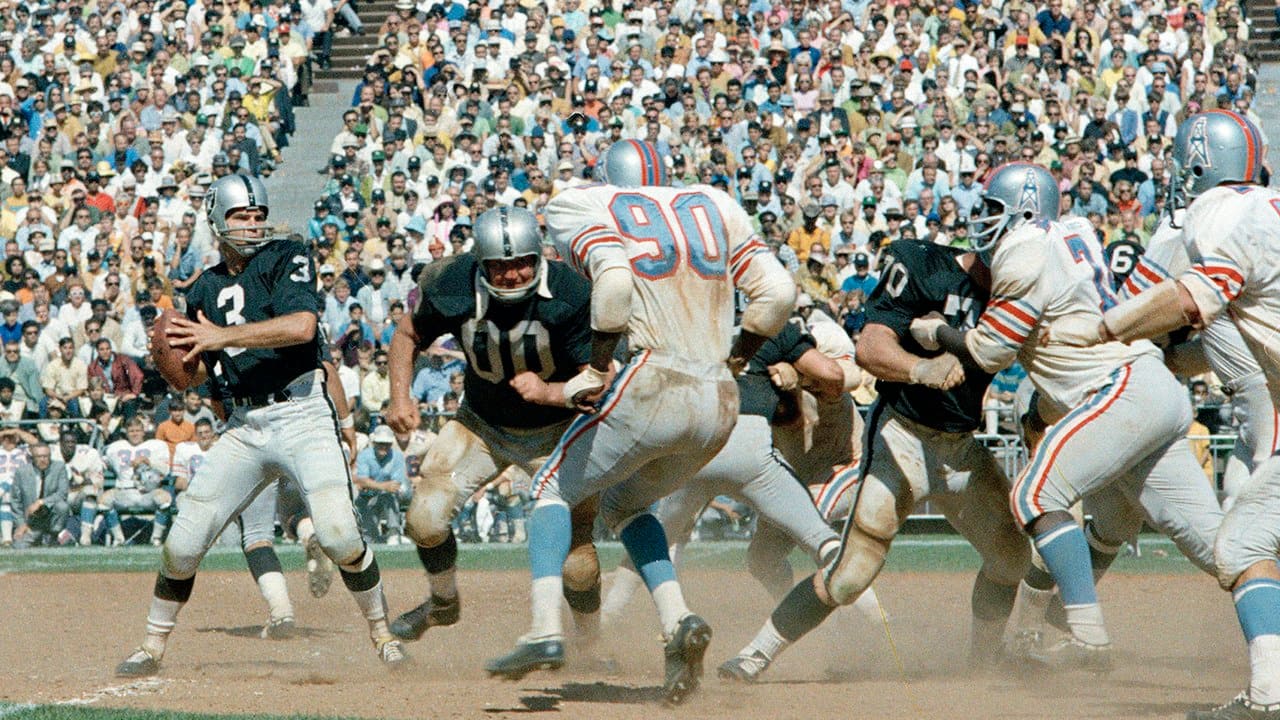
Daryle Lamonica (3) back to pass. Blocking for him
are Jim Otto (00), Dan Archer (78) and Jim Harvey (70).
Note the infield dirt, left over for baseball.

December 31, 1967: The American Football League Championship Game is played at the Oakland-Alameda County Coliseum on this New Year's Eve. The Oakland Raiders hosted the Houston Oilers.

The Oilers had played in the 1st 3 AFL Championship Games, winning in 1960 and 1961, but losing in 1962. Their starting quarterback was George Blanda. Pete Beathard was now the Oilers' quarterback. This would be the Raiders' 1st title game. Blanda was now playing for them.

But while he was their main placekicker, he was not their starting quarterback. That would be Daryle Lamonica, who threw the ball so often, and so far, he became known as "The Mad Bomber." Raider coach John Rauch, having been a quarterback himself, knew he had two good ones. Lamonica would not be elected to the Pro Football Hall of Fame, but Blanda would, along with receiver Fred Biletnikoff, center Jim Otto, guard Gene Upshaw, and cornerback Willie Brown.

The game kicked off at 2:00 Pacific Standard Time (5:00 Eastern), and the temperature was 47 degrees. Just a few minutes earlier, the NFL Championship Game had ended in Green Bay, Wisconsin, and, to those inside Lambeau Field, 47 degrees would have seemed like beach weather in comparison.

The only scoring in the 1st quarter was a 37-yard field goal by Blanda. But the Raiders pulled away in the 2nd quarter, with Hewritt Dixon scoring on a 69-yard run, and Lamonica throwing a 17-yard touchdown pass to Dave Kocourek. It was 17-0 Raiders at the half.

In the 3rd quarter, Lamonica scored on a quarterback sneak, and Blanda kicked a 40-yard field goal. Blanda kicked one from 42 yards, giving the Raiders a 30-0 lead early in the 4th quarter. The Oilers finally scored on a 5-yard touchdown pass from Beathard to Charley Frazier. But the Raiders put it away with another field goal from Blanda, this one 36 yards, and a 12-yard touchdown pass from Lamonica to Bill Miller. The final was Oakland 40, Houston 7.

This was the 1st league championship for Raiders owner Al Davis. There would be more. Moreover, while Oakland had been the much-maligned "little brother" to cosmopolitan San Francisco across the Bay, this game was the beginning of a shift.

The San Francisco Giants had won the National League Pennant in 1962, and just missed Pennants in 1964, '65 and '66. But the Raiders were now AFL Champions, and Oakland had just become home to the NHL's Seals and the ABA's Oaks, and were about to become home to baseball's Athletics. Oakland would soon have 4 teams, to San Francisco's 3 -- and when the San Francisco Warriors moved in 1971, taking the name "Golden State Warriors," taking the place of the Oaks who had moved, Oakland would, briefly, have 4 teams to San Francisco's 2.

From this game until the 49ers' NFC Championship of January 10, 1982, the City of San Francisco had no league champions in any sport, while the City of Oakland had 8: The 1967 AFL Champion Raiders; the 1969 ABA Champion Oaks; the 1972, 1973 and 1974 World Series Champion Athletics; the 1975 NBA Champion Warriors; and the 1976 and 1980 NFL Champion Raiders. And that doesn't even count the Oakland Clippers, earlier in 1967, winning the title in the National Professional Soccer League, which could hardly have been called "major league." But it did happen.

For a few years, sports-wise, Oakland was the place to be. It was a golden age -- or, as A's and Seals owner Charlie Finley might have put it, a Green and Golden Age.

In 1999, The Sporting News released their list of the 100 Greatest Football Players. Jim Otto was ranked 78th, and George Blanda 98th. In 2010, the NFL Network ranked Otto 63rd on its list of the 100 Greatest Players, but Blanda didn't make it.

*

December 31, 1967 was a Sunday. The 1967 NFL Championship Game was played the same day. While the Oakland Coliseum has been known for chilly conditions, there was no issue with the weather there on that day. That would not be the case for the NFL title game: It was well below zero at Lambeau Field in Green Bay, Wisconsin. The Green Bay Packers beat the Dallas Cowboys, 21-17, in a game that became known as the Ice Bowl. I have a separate entry for that event. The Packers went on to beat the Raiders, 33-14 in Super Bowl II, in a much-warmer Orange Bowl in Miami.

There were 2 games played in the NBA. The Los Angeles Lakers beat the expansion San Diego Rockets, 147-118. It was the 1st game the Lakers played at their new arena, The Forum, outside Los Angeles in Inglewood, California.

And the San Francisco Warriors beat the other expansion team, the Seattle SuperSonics, 126-124 at the Seattle Center Coliseum. For the Warriors, Nate Thurmond had 34 points and 25 rebounds.

There was 1 game played in the American Basketball Association, which was in its 1st season: The Pittsburgh Pipers beat the Indiana Pacers, 121-106 at the Civic Arena in Pittsburgh. The Pipers would go on to win the 1st ABA Championship. But before the 1972-73 season, they were out of business. The Pacers would win the ABA title in 1970, '72 and '73, and were 1 of the 4 teams absorbed from the ABA into the NBA in 1976.

There were 4 games played in the NHL that day:

* The New York Rangers beat the Toronto Maple Leafs, 4-0, in one of the last events at the old Madison Square Garden.

* The Philadelphia Flyers beat the Los Angeles Kings, 9-1 at The Spectrum in Philadelphia.

* The Detroit Red Wings beat the Boston Bruins, 6-4 at the Olympia Stadium in Detroit.

* The Chicago Blackhawks beat the Oakland Seals, 3-0 at the Chicago Stadium.

* The Montreal Canadiens, the Pittsburgh Penguins, the St. Louis Blues and the Minnesota North Stars were not scheduled. 

Friday, December 23, 2022

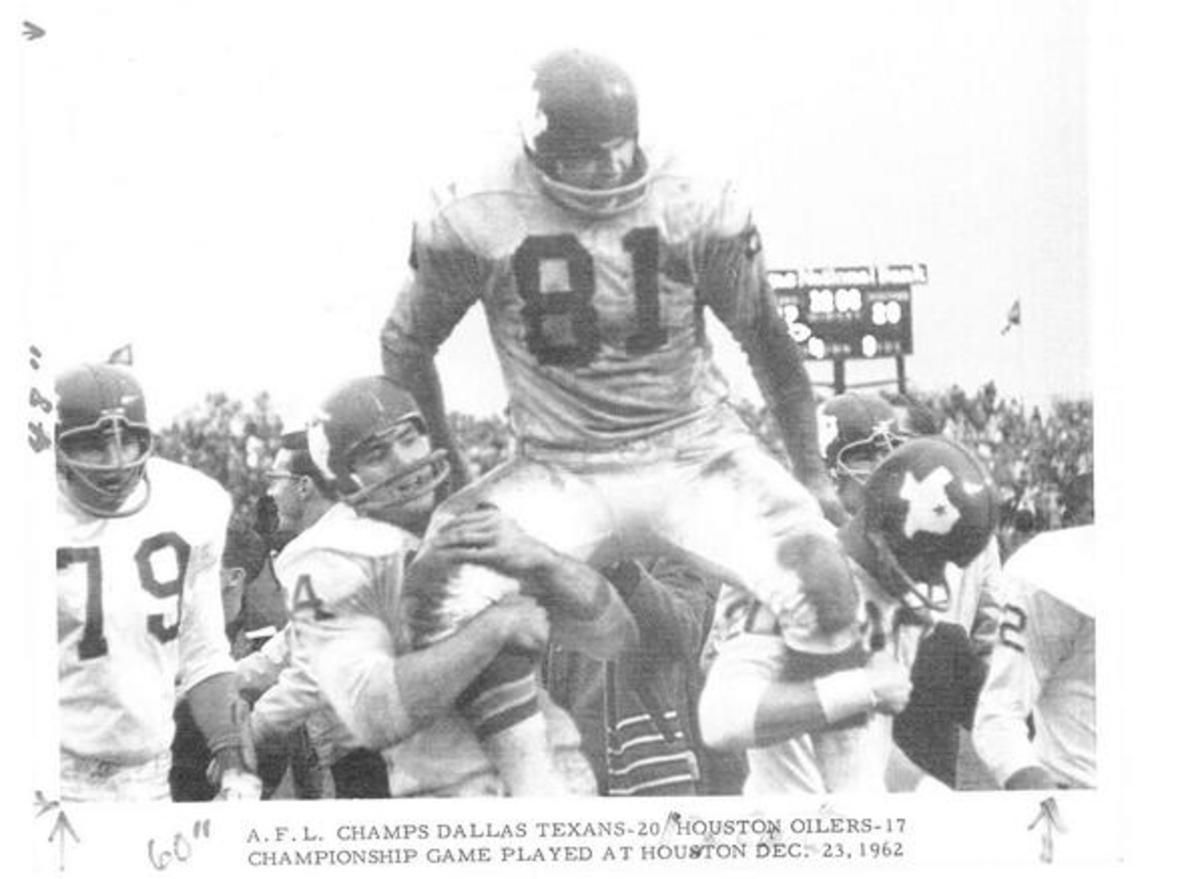
December 23, 1962: A Long Day In Texas

Tommy Brooker

December 23, 1962: The longest game in professional football history, to that point, is played. But not in the National Football League. This Championship Game is often given credit for boosting interest in the American Football League.

Like the NFL, the AFL was split into geographic Divisions, East and West. Also like the NFL, the AFL's Divisions didn't make as much sense as geography would make fans think. Putting the New York Titans, the Boston Patriots and the Buffalo Bills in the East made sense. Putting the Denver Broncos, the Oakland Raiders and the San Diego Chargers in the West made sense.

But there were 2 teams in Texas, and while Texas is the country's 2nd-biggest State by area after Alaska, both were in the eastern half of Texas. And yet, they were in different divisions: The Dallas Texans, founded and owned by AFL founder Lamar Hunt, were in the West, while the Houston Oilers were in the East.

The Cotton Bowl, then home to both the Texans and the NFL's Dallas Cowboys, is at 96 degrees, 45 minutes West longitude. Jeppesen Stadium, then home to the Oilers, was at 95 degrees, 20 minutes West. So the Texans were slightly to the west of the Oilers. This wasn't as bad as the NFL, putting the Cowboys in the Eastern Division and the East Coast's Baltimore Colts in the Western.

The Oilers won the AFL East in 1960, and beat the Los Angeles Chargers in the 1st AFL Championship Game. The Chargers moved to San Diego for 1961, and the Oilers beat them in the Championship Game again. The Oilers again won the East in 1962. This time, the Texans won the West Division. Both teams finished the regular season with a record of 11-3. They had played each other in back-to-back weeks of the regular season. On October 28, at Jeppesen, the Texans had won, 31-7. That was the last regular-season game the Oilers lost. Just 7 days later, they played again at the Cotton Bowl. Again, the visiting team won: The Oilers, 14-6.

Since the AFL followed the NFL's pattern of alternating the site of its Championship Game, the Oilers would host the Texans at Jeppesen. The facility was built in 1942, as Public School Stadium, but the University of Houston campus expanded toward it, and their football team made it their home field in 1946. In 1958, it was renamed for Holger Jeppesen, a school official who had lobbied for its construction. A crowd of 37,981, roughly a sellout, came for the Championship Game.

While the AFL had a reputation for emphasizing the passing game -- people who liked the more conservative NFL called the rebel league a "basketball league" -- both Texas teams relied on the running game. They played it mostly safe, and the only score of the 1st quarter was a field goal by the Texans' Tommy Brooker, a rookie who had been a member of the University of Alabama's National Championship team the year before. At the end of the quarter, George Blanda, the Oilers' quarterback and kicker, missed a 47-yard field goal, keeping the score 3-0 in the Texans' favor.

The Texans extended their lead in the 2nd quarter, as Abner Haynes scored on a 28-yard pass from Len Dawson, and later on a 2-yard run. The Texans led, 17-0, and any thoughts of this game being regarded as a classic had faded away.

But the Oilers weren't 2-time defending champions for nothing, and fought back. In the 3rd quarter, Blanda threw a touchdown pass to Willard Dewveall, to make it 17-7. Blanda kicked a field goal in the 4th quarter, to get the Oilers within a touchdown.

He then used the passing game to creep closer, throwing passes to Charley Hennigan, whose AFL receiving totals had surpassed the longtime NFL records of Don Hutson, and former Louisiana State Heisman Trophy winner Billy Cannon. Later, Blanda handed the ball to Charlie Tolar, a fullback known as "the Human Bowling Ball," and he barreled in the 1-yard line, tying the game at 17. The Oilers had 1 more shot, as Blanda tried a 42-yard field goal to win it on the last play of regulation, but Dave Grayson blocked his kick. The game went to overtime.

As with the opening of games, the captains met with the officials at midfield to start the overtime. The Texans won the toss. Haynes said, "We'll kick to the clock." He thought that would give the Texans the wind advantage. But by saying, "We'll kick," the referee, Harold Bourne, gave the Oilers the choice of which goal to defend, and thus whether to start with or against the wind.

This could have cost the Texans the championship, and it could have made Haynes the biggest goat in the history of Texas professional sports. As it turned out, it didn't matter: The entire "5th quarter" was played without either team scoring.

Early in the 2nd overtime, the 6th quarter, Dawson threw a 10-yard pass to Jack Spikes. Spikes then rushed for 19 yards. The Texans were in position for a title-winning field goal. Dawson ran a couple of more rushing plays to get Brooker a better kicking position. At 2:54 of the 2nd overtime, Brooker split the uprights, and the Texans won, 20-17. The team that founded the AFL had won its 1st Championship.

But, before the next season, realizing that, despite their title, they were never going to have more fans in Dallas than the NFL's Cowboys, the Texans moved, becoming the Kansas City Chiefs. The Oilers moved to Memphis in 1997 and Nashville in 1998, becoming the Tennessee Oilers, and the Tennessee Titans in 1999. In 2002, to replace the Oilers, the NFL added an expansion team -- and named it the Houston Texans.

The Tennessee team could take the Titans name because the New York team abandoned it in 1963, becoming the Jets. The New England moved to the Boston suburbs in 1971, and changed their name to the New England Patriots. The San Diego Chargers moved back to Los Angeles in 2017. The Raiders moved to Los Angeles in 1982, back to Oakland in 1995, and to Las Vegas in 2020.

The AFL Championship was won by the Oilers in 1960 and 1961; the Texans/Chiefs in 1962, 1966 and 1969; the Chargers in 1963; the Buffalo Bills in 1964 and 1965; the Raiders in 1967; and the Jets in 1968.

The fact that the Texans' title came before the advent of the Super Bowl means that it gets discounted: Even before the distance of time became what it is now, NFL fans have come to regard any title won before the Super Bowl, NFL or AFL, as not a "real" championship. 

In 1980, Jeppesen Stadium was renamed Corbin J. Robertson Stadium, after a University of Houston regent who had funded renovations. In 1996, it was renamed John O'Quinn Field at Corbin J. Robertson Stadium. O'Quinn was a Houston attorney who had donated to the latest round of renovations. The Houston Dynamo of Major League Soccer moved in for the 2006 season, and won back-to-back MLS Cups.

Robertson Stadium was demolished following the 2012 season, and John O'Quinn Field at TDECU Stadium opened on the site in 2014. UH plays football there, while in 2012, the Dynamo moved to a new soccer-specific stadium, currently named Shell Energy Stadium. (UPDATE: For 2026, UH's stadium will be renamed Space City Financial Stadium, due to TDECU's merger with another company.)

Tommy Brooker, who kicked the winning field goal, remained with the Chiefs through the 1966 season, and died in 2019.

*

December 23, 1962 was a Sunday. The NFL was in the off-week between the end of its regular season and its Championship Game. That game was played 1 week later. The Green Bay Packers beat the New York Giants, 16-7 at Yankee Stadium.

Baseball was out of season. The NBA was in season, but no games were scheduled for that day. But the NHL's entire "Original Six" were in action:

* The New York Rangers lost to the Chicago Black Hawks, 3-1 at the original Madison Square Garden.

* The Toronto Maple Leafs beat the Boston Bruins, 5-4 at the Boston Garden.

* And the Montreal Canadiens and the Detroit Red Wings played to a tie, 2-2 at the Olympia Stadium in Detroit.

Thursday, December 15, 2022

December 15, 1996: The End of the Houston Oilers

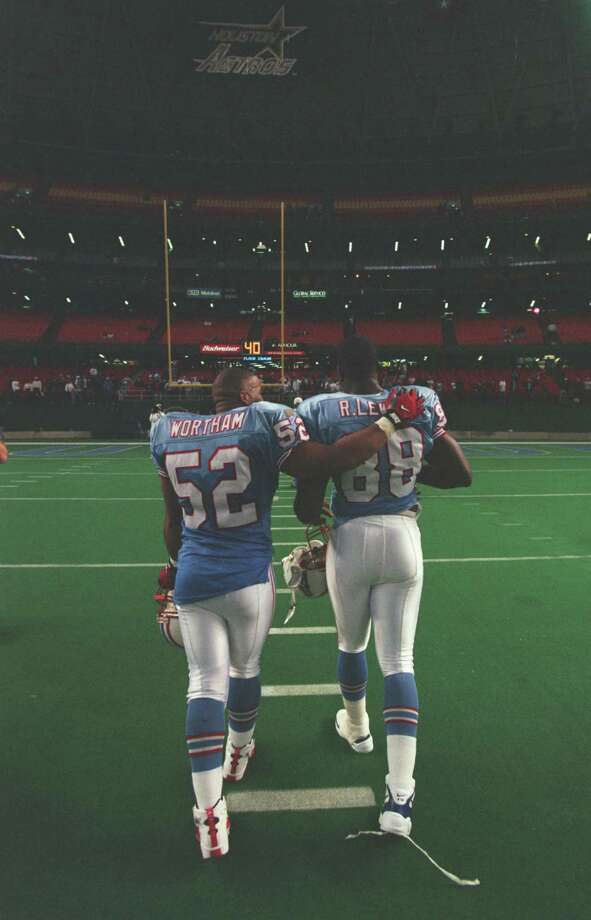
Barron Wortham and Reggie Lewis, after the last game at the Astrodome

December 15, 1996: The Cincinnati Bengals beat the Houston Oilers, 21-13 before just 15,131 fans at the Astrodome. Team founder/owner Bud Adams had already announced the team's move to Tennessee, and the fans took it out on him by not going. It remains the lowest attendance for an NFL game since World War II, not counting the "scab games" of 1987 and the COVID-restricted games of 2020.

The following Sunday, December 22, 1996, they played their final game as the Houston Oilers, beating the Ravens, 24-21 at Memorial Stadium in Baltimore.

Kenneth Stanley Adams Jr. was a 36-year-old executive with Phillips Petroleum in Oklahoma when he became a charter team owner in the American Football League, taking the Houston Oilers. They won the 1st 2 AFL Championships, in 1960 and 1961, and lost the AFL Championship Game in 1962 and 1967. They went into a down period that included the 1970 merger with the NFL, but by 1978, they were a Playoff team again, turning home games at the Astrodome into nationally-televised parties.

A.O. "Bum" Phillips, Oilers head coach from 1975 to 1980, compared the Oilers to the much more nationally-popular Dallas team, and said, "The Cowboys are America's Team, but the Oilers are Texas' Team."

But they couldn't get past the Pittsburgh Steelers and the Oakland Raiders into the Super Bowl, and the team was broken up. In 1987, Adams told the Houston city government that he would move the Oilers to Jacksonville if they didn't improve the Astrodome, including raising seating capacity and putting in more of what the place practically invented: Luxury boxes. He got his wish: In 1990, it was expanded from 50,000 to 62,439 seats, including 65 luxury boxes, and the Oilers stayed.

The expansion did not improve the lousy sightlines: The seats near the 50-yard line were the furthest from the playing field, while the closest ones were in the end zone. And as the Astros were the stadium's primary tenant, whenever there was a scheduling conflict, or any dispute between the Astros and the Oilers, the Astros would always win out. Hard to believe, considering that Texas is the football State.

By 1995, the Oilers' radio network, which had been statewide, had been reduced to 1 station in Houston. As a result, Harris County, owners of the Astrodome, agreed to let the Oilers out of their lease, to enable the move to Tennessee after the 1996 season, instead of 1997 as had been planned.

Despite an 8-8 finish, that 1997 season was a disaster. Playing at the Liberty Bowl in Memphis, they realized they weren't going to draw enough fans as a lame-duck team. All previous pro football teams in Tennessee had been based in Memphis, and, since Memphis and Nashville don't like each other, Nashvillians never really adopted the WFL's Memphis Southmen or the USFL's Memphis Showboats; and Memphis fans, knowing the Oilers would be in Nashville in 1999, rejected them.

The Liberty Bowl then seated 62,380, but the Titans had, on the average, the worst NFL attendance of the post-World War II era: 30,171 on August 31, 17,737 on September 21, bottoming out at 17,071 on October 12, 31,042 on October 19, 27,208 on November 2, 267,744 on November 9, 23,571 and bumped up to 50,677 on December 21 as Memphians realized the team might actually make the Playoffs, though they fell short.

So they moved to Nashville a year earlier than they'd intended, even though Vanderbilt Stadium seated only 41,000. After all, they weren't getting that much in Memphis.

In 1999, the Adelphia Coliseum -- now named Nissan Stadium -- opened, across the Cumberland River to the east of downtown Nashville. They changed their name again, to the Tennessee Titans, and adopted a new logo and new colors as well. The people of Nashville really took to them, because, for the first time, they had a true Nashville team to root for.

Winning helped: After going 8-8 in each of their 2 seasons as the Tennessee Oilers, head coach Jeff Fisher led the Titans to a record of 13-3, the best in the franchise's 40-season history. Ordinarily, this would be good enough to win the Division. But the Jacksonville Jaguars went 14-2 to win the AFC Central Division. So the Titans got into the Playoffs as a Wild Card.

In 2002, the Houston Texans debuted. In the interim, the Tennessee Titans went to a Super Bowl, but lost. Since then, the Texans have been contenders more regularly than the Titans, so maybe Houston was better off.

Adams died in 2013, the next-to-last of the original AFL owners still involved with his team. (Ralph Wilson of the Buffalo Bills was the last, and died the next year.)

UPDATE: The Oilers had a team Hall of Fame. From their 1960 and '61 AFL Champions, they have inducted founding owner Kenneth "Bud" Adams, quarterback George Blanda, and safety and punter Jim Norton. From their 1967 AFL Finalists: Adams, Blanda, Norton, and safety Ken Houston.

From their 1978 and '79 AFC Finalists: Adams, head coach O.A. "Bum" Phillips, running back Earl Campbell, receiver Billy "White Shoes" Johnson, defensive end Elvin Bethea, and linebacker Robert Brazile.

From their teams that made the AFC Playoffs every season from 1987 to 1993: Adams, executives Mike Holovak and Floyd Reese, quarterback Warren Moon, guard Mike Munchak, and tackle Bruce Matthews. The franchise now known as the Tennessee Titans has also honored coach Jeff Fisher, quarterback Steve McNair, running back Eddie George, and tight end Frank Wycheck, who were with the team at the time of the move.

Adams, Phillips, Campbell, Bethea, Brazile, Moon, Munchak, Matthews have also been inducted into the Texas Sports Hall of Fame. So have 1970s receiver Mike Renfro and 1980s and '90s defensive lineman Ray Childress.

Running back Ken Hall, "The Sugar Land Express," of Texas A&M, quarterback Don Trull and receiver Larry Elkins of Baylor University, and defensive tackle Lewis "Bud" McFadin of the University of Texas were also elected, and played for the Oilers in their founding days of the 1960s. Jack Pardee starred as a linebacker for Texas A&M, the Los Angeles Rams and the Washington Redskins, before serving as a head coach in Houston, for both the USFL's Gamblers and the Oilers.

*

December 15, 1996 was a Sunday. Ukrainian soccer player Oleksandr Zinchenko was born.
 
These other games were played in the NFL:

* The New York Giants lost to the New Orleans Saints, 17-3 at Giants Stadium in the Meadowlands.

* The Carolina Panthers beat the Baltimore Ravens, 27-16 at Ericsson Stadium (now Bank of America Stadium) in Charlotte.

* The St. Louis Rams beat the Atlanta Falcons, 34-27 at the Georgia Dome in Atlanta.

* The Jacksonville Jaguars beat the Seattle Seahawks, 20-13 at Jacksonville Municipal Stadium (now EverBank Stadium).

* The San Francisco 49ers beat the Pittsburgh Steelers, 25-15 at Three Rivers Stadium in Pittsburgh.

* The Green Bay Packers beat the Detroit Lions, 31-3 at the Silverdome in the Detroit suburb of Pontiac, Michigan.

* The Minnesota Vikings beat the Tampa Bay Buccaneers, 21-10 at the Metrodome in Minneapolis.

* The Indianapolis Colts beat the Kansas City Chiefs, 24-19 at Arrowhead Stadium in Kansas City.

* The Dallas Cowboys beat the New England Patriots, 12-6 at Texas Stadium in the Dallas suburb of Irving, Texas.

* The Denver Broncos beat the Oakland Raiders, 24-19 at Mile High Stadium in Denver.

* The Arizona Cardinals beat the Washington Redskins, 27-26 at Sun Devil Stadium (now Mountain America Stadium) in the Phoenix suburb of Tempe, Arizona.

* The day before, the New York Jets lost to the Philadelphia Eagles, 21-20 at Giants Stadium.

* Also the day before, the Chicago Bears beat the San Diego Chargers, 27-14 at Soldier Field in Chicago.

* And the night after, on ABC Monday Night Football, the Miami Dolphins beat the Buffalo Bills, 16-14 at Pro Player Stadium (now Hard Rock Stadium) in Miami Gardens, Florida.

Baseball was out of season. There were 4 games in the NBA:

* The Detroit Pistons beat the Boston Celtics, 99-89 at The Palace in the Detroit suburb of Auburn Hills, Michigan.

* The Phoenix Suns beat the Vancouver Grizzlies, 103-84 at the America West Arena (now the Mortgage Matchup Center) in Phoenix.

* The Washington Wizards beat the Golden State Warriors, 110-102 at the San Jose Arena (now the SAP Center). The Warriors played there that season, while the Oakland Coliseum Arena was being renovated. Latrell Sprewell scored 43 points in defeat for them.

* And Houston fared better in the NBA that day: The Houston Rockets beat the Portland Trail Blazers, 99-89 at the Rose Garden (now the Moda Center) in Portland.

And there were 6 games in the NHL:

* The Philadelphia Flyers beat the Boston Bruins, 6-0 at the new CoreStates Center (now the Xfinity Mobile Arena) in Philadelphia.

* The Florida Panthers beat the Edmonton Oilers, 6-0 at the Miami Arena.

* The Dallas Stars beat the Ottawa Senators, 4-0 at the Corel Centre (now the Canadian Tire Centre) in Ottawa.

* In an "Original Six" matchup, the Detroit Red Wings beat the Toronto Maple Leafs, 3-1 at the Joe Louis Arena in Detroit.

* The Chicago Blackhawks beat the Pittsburgh Penguins, 2-1 at the United Center in Chicago.

* And the Vancouver Canucks beat the St. Louis Blues, 8-0 at the Kiel Center (now the Enterprise Center) in St. Louis.

Friday, December 9, 2022

December 9, 1984: Eric Dickerson Becomes the Single-Season Rushing Leader

December 9, 1984: The Los Angeles Rams beat the Houston Oilers, 27-16 at Anaheim Stadium -- now named Angel Stadium of Anaheim -- in the Los Angeles suburb of Anaheim, California. Eric Dickerson rushes for 215 yards, including 2 runs ending in touchdowns. In so doing, he finishes the game with 2,007 yards rushing on the season. This breaks the NFL's single-season rushing record, 2,003, set by O.J. Simpson of the Buffalo Bills in 1973.

The Rams played 1 more game in that regular season, traveling to face their arch-rivals, the San Francisco 49ers. Dickerson added 98 yards to his total, raising it to 2,105. (The 49ers won, 19-16 at Candlestick Park.)

This remains the NFL record. In 1985, Herschel Walker ran for 2,411 yards for the New Jersey Generals of the United States Football League. But, just as Dickerson needed a 15th game to surpass Simpson (O.J. still holds the record for most rushing yards in the 1st 14 games of a season), Walker played an 18-game season. What's more, the USFL was not highly regarded. Dickerson himself said, "The difference is, I did it in the majors, and he did it in the minors." The next year, Walker came to the NFL, with the Dallas Cowboys. His peak total in the NFL was 1,514 yards, in 1988.

There have now been 8 2,000-yard rushing seasons in NFL history. Since Simpson and Dickerson: Barry Sanders had 2,053 for the 1997 Detroit Lions, Terrell Davis had 2,008 for the 1998 Denver Broncos, Jamal Lewis had 2,006 for the 2003 Baltimore Ravens, Chris Johnson had 2,006 for the 2009 Tennessee Titans, Adrian Peterson had 2,097 for the 2012 Minnesota Vikings, and Derrick Henry had 2,027 for the 2020 Titans.

For comparison's sake: The highest single-game total for Jim Brown, who held the single-season record before Simpson, at 1,863 in 1963, was 237; Walter Payton, the 1st man to rush for more yards in a game than Simpson (275), and eventually surpassed Brown as the NFL's all-time rushing leader, topped out at 1,852 yards in a season; and Emmitt Smith, who surpassed Payton and remains the all-time rushing leader, topped out at 237 for a game and 1,773 for a season.

In 1999, The Sporting News released their list of the 100 Greatest Football Players. Dickerson ranked 38th. In 2010, the NFL Network released their list of the 100 Greatest Players. Dickerson ranked 52nd.


*


December 9, 1984 was a Sunday. These other NFL games were played that day:

* The New York Giants lost to the football version of the St. Louis Cardinals, 31-21 at Busch Memorial Stadium in St. Louis.

* The Philadelphia Eagles beat the New England Patriots, 27-17 at Veterans Stadium in Philadelphia.

* The Tampa Bay Buccaneers beat the Atlanta Falcons, 23-6 at Atlanta-Fulton County Stadium.

* The Cincinnati Bengals beat the New Orleans Saints, 24-21 at the Superdome in New Orleans.

* The Washington Redskins beat their arch-rivals, the Dallas Cowboys, 30-28 at Texas Stadium in the Dallas suburb of Irving, Texas.

* The Pittsburgh Steelers beat their arch-rivals, the Cleveland Browns, 23-20 at Three Rivers Stadium in Pittsburgh.

* The Miami Dolphins beat the Indianapolis Colts, 35-17 at the Hoosier Dome in Indianapolis.

* The Green Bay Packers beat their arch-rivals, the Chicago Bears, 20-14 at Soldier Field in Chicago.

* The Denver Broncos beat the San Diego Chargers, 16-13 at Mile High Stadium in Denver.

* The San Francisco 49ers beat the Minnesota Vikings, 51-7 at Candlestick Park in San Francisco. The Niners finished 15-1 in the regular season, and went on to win the Super Bowl.

* The Kansas City Chiefs beat the Seattle Seahawks, 34-7 at Arrowhead Stadium in Kansas City.

* The day before, the New York Jets beat the Buffalo Bills, 21-17 at Giants Stadium in the Meadowlands.

* And the next night, on ABC Monday Night Football, the Los Angeles Raiders beat the Detroit Lions, 24-3 at the Silverdome in the Detroit suburb of Pontiac, Michigan.

There were 5 games played in the NBA that day:

* The New York Knicks lost to the Philadelphia 76ers, 110-94 at The Spectrum in Philadelphia.

* The Boston Celtics beat the Atlanta Hawks, 128-127 at the Boston Garden. Larry Bird scored 48 points.

* The Utah Jazz beat the Kansas City Kings, 123-120 at the Salt Palace in Salt Lake City, Utah. Adrian Dantley scored 38 points.

* The Los Angeles Clippers beat the San Antonio Spurs, 126-123 at the Los Angeles Memorial Sports Arena.

* And the Seattle SuperSonics beat the Houston Rockets, 96-90 at the Seattle Center Coliseum.

And there were 4 games played in the NHL:

* The Washington Capitals beat the Detroit Red Wings, 4-0 at the Capital Centre in the Washington suburb of Landover, Maryland.

* The Quebec Nordiques and the Buffalo Sabres played to a tie, 4-4 at the Buffalo Memorial Auditorium.

* In an "Original Six" matchup, the Chicago Black Hawks beat the Toronto Maple Leafs, 7-2 at the Chicago Stadium.

* And the Winnipeg Jets beat the Minnesota North Stars, 4-2 at the Winnipeg Arena.

Tuesday, December 6, 2022

December 6, 1969: The Altamont Disaster

Mick Jagger in cape. Note the Hell's Angel behind him.

December 6, 1969: The Altamont Free Concert is held at the Altamont Speedway in Tracy, California. After seeing the 500,000 or so people who had come to the Woodstock Music & Art Fair in New York's Catskill Mountains in August, with several West Coast acts performing, including Jefferson Airplane, that band's drummer, Spencer Dryden, suggested a "Woodstock West."

As with Woodstock, the hard part turned out to be securing a location. Finally, Altamont was suggested. The concert's poster says it's in Livermore, but current sources say it's in Tracy. Regardless, it's at the eastern edge of the San Francisco Bay Area's East Bay region. Opened in 1966, the facility last known as Altamont Raceway Park hosted auto racing until it was closed in 2008. The 7,500-seat main structure still stands, 56 miles east of San Francisco, 45 miles east of Oakland, 49 miles northeast of San Jose, and 78 miles south of Sacramento.

The initial plan was to have the Airplane, their San Francisco and Woodstock compatriots The Grateful Dead, and the band that, with The Beatles having retreated from live performing, were now the biggest live rock and roll band in the world, The Rolling Stones. Anybody else they could get would have been considered gravy.

Well, 5 bands performed, but The Dead wouldn't be one of them. In order of their taking the stage: Santana, also San Franciscans who had been at Woodstock; The Jefferson Airplane; The Flying Burrito Brothers, based in Los Angeles, including former members of The Byrds Gram Parsons and Chris Hillman; David Crosby, Stephen Stills, Graham Nash & Neil Young, who had also been at Woodstock, and Crosby had also been a Byrd; and The Rolling Stones.

The day before, The Stones had released a new album, titled Let It Bleed. Lead singer Mick Jagger would later call it his favorite Stones album. But on December 6, he got the title's wish -- which contradicted a line from the album's closing song: "You can't always get what you want, but if you try sometimes, you just might find you get what you need." What everybody got at Altamont, nobody wanted or needed.

Airplane lead singer Grace Slick was interviewed for Rolling Stone magazine 20 years later. (While the band was named for "Rollin' Stone," a blues song by Muddy Waters, the magazine was named for Bob Dylan's song "Like a Rolling Stone.") She was one of several performers who said that Woodstock was the worst performance of her career, and added that the music was better at Altamont.

But everything else was wrong. She said, "The vibes were bad. Something was very peculiar, not particularly bad, just real peculiar. It was that kind of hazy, abrasive and unsure day. I had expected the loving vibes of Woodstock, but that wasn't coming at me. This was a whole different thing."

On July 5, the Stones had given a concert at Hyde Park in London, in memory of bandmate Brian Jones, who had died of a drug-related drowning 2 days earlier. (After being kicked out of the band for his drug use, something no other member of that famously druggy band was.) Like Woodstock, it was said to have attracted 500,000 fans.

The security at that concert was run by the London chapter of the Hell's Angels Motorcycle Club. There were no security issues there. So Stones lead singer Mick Jagger suggested the Hell's Angels as security for Altamont. Unfortunately, no one counted on the fact that the Hell's Angels weren't just a motorcycle club: They were a gang, involved in organized crime, a Mafia on two wheels. And they would be operating out of the East Bay, their home territory.

At Woodstock, out of 500,000 people, there were 3 deaths, all accidental: A drug overdose, a burst appendix, and a kid who made the mistake of trying to sleep under a tractor on a hill. At Altamont, out of 300,000 people, there were 4 deaths. Three were accidental: Two in a hit-and-run car accident, and one kid high on LSD who fell into an irrigation canal and drowned.

One death at Altamont was no accident. As can be seen in Gimme Shelter, the documentary film made by Albert and David Maysles, during the performance of "Sympathy for the Devil," the Stones had to stop, because there were fights near the stage. While playing "Under My Thumb," they had to stop for a medical emergency.

Just as The Who, 10 years later to the week, didn't know until they had finished a concert in Cincinnati that 11 fans had been killed in an accident before the show, the Stones didn't know what the emergency was. If they did, they might have stopped the show entirely. Certainly, they would've closed with a song other than "Street Fighting Man," their song inspired by the Paris demonstrations of the year before.

The Hell's Angels guarding the stage were mean, and they were drunk. Meredith Hunter, an 18-year-old black man from Alameda, climbed onto a speaker. He had been told that, the further east you got from Oakland and Berkeley, the worse the racism got. This was a reasonable claim: Inland, California can be just as hicky as The South, just as New York State is the further you get from the City, and Pennsylvania is the further you get from Philadelphia and Pittsburgh.

Hunter had heard this, so he packed a gun. He wasn't using it when he stood on the speaker. But the Angels grabbed him, started punching him, and, discovering the gun, stabbed him. The Angel who did the stabbing would be charged with murder, but was acquitted on self-defense grounds.

Afterward, the Maysles Brothers showed Jagger their footage of what happened, and filmed him watching it. Mick, who has so often embraced his devilish image -- before taking the title role in "Sympathy for the Devil," he titled a Stones album Their Satanic Majesties Request -- is not a man known for attacks of conscience. On the film, he appears genuinely shocked and scared.

Not enough to change his ways, though. He was still 26 years old, and the leader of what was already being called "The World's Greatest Rock and Roll Band." He thought he could do anything, and get away with it. And he has gotten away with a lot. The shock is not that Jagger's excesses of the 1960s led to the disaster at Altamont, 25 days before the decade's end. It's that he, or the Stones as a whole, haven't had another incident like Altamont -- or worse.

Rolling Stone soon called Altamont "Rock and roll's all-time worst day, December 6th, a day when everything went perfectly wrong." Shades of Franklin Roosevelt calling December 7th, 1941, the day of the attack on Pearl Harbor, "a date which will live in infamy." And in 1990, writer A.E. Hotchner would publish a book about the Stones, Jones' death, and Altamont, titled Blown Away: The Rolling Stones and the Death of the Sixties.

Of course, worse was to come: The rest of December 1969 -- I was born 12 days after Altamont -- and the 1st half of 1970 would see the breakup of The Beatles, Diana Ross leaving the Supremes, President Richard Nixon extending the Vietnam War into Cambodia, the Kent State Massacre, and the Hard Hat Demonstration that essentially supported the 2 previous occurrences.

As the poet William Butler Yeats wrote half a century earlier, "Things fall apart. The center cannot hold."

*

December 6, 1969 was a Saturday. "Na Na Hey Hey Kiss Him Goodbye," by the "studio group" Steam, hit Number 1. I have a separate entry for this event.

It was the off-season for baseball. There was 1 game played in the NFL that day, and it was also in the Bay Area: The San Francisco 49ers beat the Chicago Bears, 42-21 at Kezar Stadium in San Francisco. And there was 1 game played in the AFL: The New York Jets beat the Houston Oilers, 34-26 at the Astrodome in Houston.

The big story in America that day was not expected to be Altamont. It was expected to be a college football game that was moved to the Saturday after the intended last week of the regular season, because it looked like the teams involved would be ranked the top two in the nation. In this "Game of the Century," Number 1 Texas beat Number 2 Arkansas, 15-14 at Razorback Stadium in Fayetteville, Arkansas. I have a separate entry for this event.

There was 1 other college football game played that day: The Pasadena Bowl, held at the Rose Bowl stadium in Pasadena. San Diego State beat Boston University, 28-7.

Also that day, there were 5 games played in the NBA: 

* The New York Knicks beat the Milwaukee Bucks, 124-99 at what was still being called "The New Madison Square Garden Center." Walt Frazier and Bill Bradley each scored 29 points for the Knickerbockers, who advanced to 26-2 on the season that would end with their 1st NBA title. In a losing cause, Lew Alcindor (he changed his name to Kareem Abdul-Jabbar in 1972) scored 26, and Len Chappell scored 24.

* The Philadelphia 76ers beat the Cincinnati Royals, 120-102 at The Spectrum in Philadelphia.

* The Seattle SuperSonics beat the Baltimore Bullets, 132-129 in overtime at the Baltimore Civic Center (now the CFG Bank Arena).

* The Chicago Bulls beat the Boston Celtics, 116-114 in overtime at the Chicago Stadium.

* And the Los Angeles Lakers beat the San Diego Rockets, 128-115 at the San Diego Sports Arena. Wilt Chamberlain did not play for L.A., but Jerry West scored 30, and Elgin Baylor 25. Elvin Hayes scored 40 in a losing effort. The Rockets moved to Houston in 1971, and the arena is now named the Pechanga Arena.

Two games were played in the American Basketball Association:

* The Denver Rockets beat the Washington Caps, 108-97 at the Washington Coliseum. The Rockets would become the Denver Nuggets in 1974, renaming themselves for the city's 1st NBA team, which were founded in 1935, joined the NBA in 1948, and folded in 1950. After the 1969-70 season, the Caps moved to Norfolk, and became the Virginia Squires. The Nuggets, the New York Nets, the Indiana Pacers and the San Antonio Spurs were merged from the crumbling ABA into the NBA in 1976. The Squires were not.

* And the New Orleans Buccaneers beat the Miami Floridians, 112-104 at the Miami Beach Convention Hall.

* Five games were played in the NHL. The New York Rangers, the only NHL team in the Tri-State Area at the time, were not involved in any of them:

* The Minnesota North Stars beat the Montreal Canadiens, 4-3 at the Montreal Forum.

* The Boston Bruins beat the Chicago Black Hawks, 6-1 at the Boston Garden.

* The Toronto Maple Leafs beat the Pittsburgh Penguins, 5-0 at Maple Leaf Gardens.

* The Detroit Red Wings beat the St. Louis Blues, 5-1 at the St. Louis Arena.

* And the Los Angeles Kings beat the Oakland Seals, 5-3 at The Forum in the Los Angeles suburb of Inglewood, California.

Also, Arsenal drew with Southampton, 2-2 at Highbury in North London.

Sunday, November 20, 2022

November 20, 1978: The Earl Campbell Game

November 20, 1978: ABC Monday Night Football airs a game between the Houston Oilers and the Miami Dolphins, at the Astrodome in Houston.

The Oilers had drafted Earl Campbell, who had won the Heisman Trophy the year before, at the University of Texas, nearly leading them to the National Championship. He became perhaps the greatest fullback the NFL had seen since Jim Brown, knocking over much bigger men trying to tackle him. In this game, he ran for 199 yards and 4 touchdowns, and the Oilers beat the Dolphins, 35-30 in front of 50,000 rapturous fans, many of them waving pom-poms of the Oilers' powder blue.

This was the "Luv Ya Blue" era, where Oail Andrew "Bum" Phillips, a native of Orange, in the southeastern corner of Texas, was the head coach and the general manager. He built a team led by quarterback Dan Pastorini. Joining Campbell in the backfield was former USC star Anthony Davis. They had 3 good receivers in Billy "White Shoes" Johnson, Ken Burrough (known as "Double-O," because he was the last NFL player to wear Number 00), and Mike Renfro. The defense had end Elvin Bethea, tackle Curley Culp, and linebacker Robert Brazile.

But Campbell was the key. Phillips said, "I don't know if he's in a class by himself, but I do know that when that class gets together, it sure don't take long to call the roll." When asked about Earl's inability to finish a one-mile run in training camp, he said, "When it's first and a mile, I won't give it to him."

And, at the height of the Dallas Cowboys' self-proclaimed "America's Team" era, South Texas fans couldn't get enough of them. Phillips said, "The Cowboys may be America's Team, but the Oilers are Texas' team." (Ironically, at least for this game, the song they sang had been stolen from the Dolphins: "We're the Houston Oilers, Houston Oilers, Houston Oilers, Number 1... ")

But the Oilers were victims of geography and NFL alignment. They had been placed in the AFC Central Division, the same as the Pittsburgh Steelers, who were at the height of their powers. Phillips coined a saying that has since been adapted to fit other teams: "The road to the Super Bowl runs through Pittsburgh. Sooner or later, you've got to go to Pittsburgh."

In 1978, the Oilers went 10-6, and got to the AFC Championship Game, but lost to the Steelers at Three Rivers Stadium in Pittsburgh. In 1979, they went 11-5, and got to the AFC Championship Game, but lost at Three Rivers again. In 1980, Phillips traded Pastorini to the Oakland Raiders for Ken Stabler, who was more his kind of quarterback. The Oilers went 11-5 again, and had a home Playoff game with the Raiders. What happened? Pastorini had gotten hurt, and replaced by Jim Plunkett, who led the Raiders all the way to the Super Bowl. The Steelers finally got old, and the Oilers couldn't take advantage. Campbell was named NFL Offensive Player of the Year all 3 times, but they didn't get to the Super Bowl.

Oilers owner Bud Adams fired Phillips, and the team went into decline. They were a Playoff team again from 1987 to 1993, then fell apart again. After the 1996 season, Adams moved them, making them the Tennessee Titans. They finally reached the Super Bowl in the 1999 season. The Houston Texans began play in 2002, and while they've made the Playoffs a few times, they've never gotten to the AFC Championship Game.

The Oilers had won the AFL Championship in its 1st 2 seasons, 1960 and 1961; and Houston has hosted the Super Bowl 3 times. But that 1978 Monday Night Football game remains the signature moment in the history of Houston professional football; and Campbell, more than the Oilers' 1960s quarterback George Blanda and the Texans' 2010s defensive end J.J. Watt, remains their signature player.

Campbell and Phillips would be reunited when Phillips was named head coach of the New Orleans Saints, but they couldn't win together there, either. Campbell, Bethea, Culp, Brazile and Stabler went on to be elected to the Pro Football Hall of Fame.

In 1999, The Sporting News released their list of the 100 Greatest Football Players. In spite of his short career, Campbell was ranked 33rd. In 2010, the NFL Network released their list of the 100 Greatest Players. Campbell was ranked 55th.


Campbell has paid for these accolades, dearly: Playing football the way he did left him with a bad back, and arthritis in his hands. It has left maybe the toughest running back I've ever seen in a wheelchair, and he had to go to rehab to overcome an addiction to painkilling prescription drugs. He has been an advocate for those with his difficulties.


*


November 20, 1978 was, as stated, a Monday. Baseball was in the off-season. There were no games in the NBA or the World Hockey Association, and only 1 in the NHL: The Los Angeles Kings beat the Chicago Black Hawks, 4-3 at The Forum outside Los Angeles in Inglewood, California. Apparently, by this point, the leagues had learned not to try to compete with Monday Night Football for TV viewers.

Saturday, September 3, 2022

September 3, 1995: Jacksonville & the Carolinas Go Major League

September 3, 1995: The Jacksonville Jaguars play their 1st game, at Jacksonville Municipal Stadium (now EverBank Field). Ironically, it's against a team that had, in the late 1980s, threatened to move to Jacksonville, the Houston Oilers. The Oilers win, 10-3. After starting 0-4, the Jags won their 1st game on October 1, away to the Oilers, 17-16.

The irony was deepened when, after the Oilers did move to become the Tennessee Titans, the 2 franchises developed a regional rivalry, and played each other in the 1999 AFC Championship Game, which the Titans won.

Jacksonville is far from the most famous city in the State of Florida, but it is by far the most populous, with just under 1 million people according to the 2020 Census, to Miami with 442,000, Tampa with 403,000, Orlando with 308,000, St. Petersburg (part of Tampa Bay) with 258,000. But in terms of metropolitan areas, it's Miami 6.5 million, Tampa Bay 3.4 million, Orlando 2.9 million, Jacksonville 1.8 million. Meaning Jacksonville is the 4th-largest market in its own State. It's also the smallest market in the AFC South Division, compared with Houston at 7.8 million, and Indianapolis and Nashville both at 2.1 million.

This comparatively small size carries over to other sports. Jacksonville has only had minor-league teams: They have Class AAA in baseball, only recently promoted from AA; they have the ECHL, generally considered to be a 2nd-class team even by the standards of minor-league hockey; and in basketball, they recently lost their NBA G-League team. In college sports, Jacksonville University only moved up to what would now be classified as NCAA Division I in 1969, and the University of North Florida only got there in 2009, with both schools being in what's known as "mid-major" conferences.

Which is not to say that Jacksonville doesn't have football tradition. The Gator Bowl has been played in the city since 1946, at the old Gator Bowl Stadium until 1993 and at the new stadium since 1995. The annual rivalry game between the universities of Florida and Georgia, a.k.a. "The World's Largest Outdoor Cocktail Party," has been played on the site since 1933. The exceptions were 1994, when both games were moved to UF's Ben Hill Griffin Stadium while the old stadium was torn down and the new one built on the site; and 1995, when, to be fair, the WLOCP was played at UGa's Sanford Stadium.

The Gator Bowl stadium previously had the Jacksonville Sharks in the World Football League in 1974, and the Jacksonville Bulls in the United States Football League in 1984 and 1985. Neither team made its league's Playoffs.

Not surprisingly, the Jags struggled in their 1st season, going 4-12. But in their 2nd, they went 9-7, and made it all the way to the AFC Championship Game. They've won Division Championships in 1998 and 1999 in the AFC Central, and in 2017 in the AFC South; and reached the AFC Championship Game in 1996, 1999 and 2017. But they have yet to reach a Super Bowl.

They hosted Super Bowl XXXIX in 2005, with the New England Patriots beating the Philadelphia Eagles, 24-21. But complaints about insufficient hotel room capacity and poor access to the stadium made it a fiasco, and the city has never again been seriously considered as a Super Bowl host.

Attendance has been an issue, and the Jaguars have been convinced -- which might be a polite way of putting it -- to give up home games to play 9 games at the new Wembley Stadium in London. (UPDATE: Through the 2025 season, that number has grown to 14, and they are scheduled to play 1 more game there in both the 2026 and 2027 seasons.)

*

The Carolina Panthers made their regular-season debut on the same day as the Jaguars, against their newly-installed geographical rivals, the Atlanta Falcons, at the Georgia Dome in Atlanta. They lost, 23-20 in overtime, having blown a 10-0 lead. Blowing a big lead and letting the Falcons come back, can you believe that?

The Panthers played their 1st season's home games at Clemson University's Memorial Stadium in Clemson, South Carolina, and their st home game was on September 17, a 31-10 loss to the newly-moved St. Louis Rams. After starting 0-5, the Panthers won their 1st game on October 15, home to the New York Jets, 26-15, and were a surprisingly respectable 7-9 in their 1st season.

Opening Ericsson Stadium (now Bank of America Stadium) in downtown Charlotte the next season, their 1st regular-season home game there was a 29-6 win over the Falcons. Their 2nd season was a stunning success, winning their Division and beating the Dallas Cowboys to reach the NFC Championship Game, where they lost to the Green Bay Packers.
The Carolinas had previously had the Charlotte Hornets of the World Football League, the Carolina Cougars of the American Basketball Association, and an NBA team borrowing the Hornets name starting in the 1988 season. That team moved to New Orleans in 2002, was replaced by the expansion Charlotte Bobcats in 2004, and the Hornets name was restored in 2014 after the New Orleans team gave it up, becoming the Pelicans.

Having an NBA team or an NHL team is one thing, but a city, a metropolitan area, or a region is generally not considered to be "major league" until it gets an MLB team, or at least an NFL team. So the NBA Hornets didn't raise Charlotte, or the Carolinas as a whole, to that level. The Panthers did.

The Hartford Whalers became the Carolina Hurricanes in 1997, playing 2 years at the Greensboro Coliseum before their arena in the State capital of Raleigh opened in 1999. They remain the only major league team in the Raleigh-Durham area.

Both Carolinas have long been home to multiple minor-league baseball teams, but no major-league team. Charlotte, which has become a major banking center, has about 900,000 people; Raleigh, about 500,000. In metro area terms, Charlotte has about 2.9 million; Raleigh, about 1.5 million. North Carolina has about 10.5 million; South Carolina, about 5.1 million. The total of around 15.6 million is enough of a market to sustain an NFL team 8 times a year, and an NBA team and an NHL team 41 times a year each; but not an MLB team 81 times a year.

Add in the fact that the Atlanta Braves seem to have a hammerlock on MLB fandom in South Carolina, and it seems unlikely that Charlotte, whose metro area stretches into South Carolina -- and whose Class AAA team, the Charlotte Knights, played over the State Line in Fort Mill from 1989 to 2013, before moving to downtown Charlotte, close to both Bank of America Stadium and the new Hornets' Spectrum Center -- will ever get an MLB team.

The Panthers have won Division titles in 1996, 2003, 2013, 2014 and 2015; reached the NFC Championship Game in 1996, 2003, 2005 and 2015; and, unlike their expansion brethren in Jacksonville, they have reached the Super Bowl, losing Super Bowl XXXVIII to the New England Patriots and Super Bowl 50 to the Denver Broncos.

UPDATE: The Jaguars have a team hall of fame, called Pride of the Jaguars. Its members include quarterback Mark Brunell, running back Fred Taylor, receiver Jimmy Smith, offensive tackle Tony Boselli, founding owners Wayne and Delores Weaver, and head coach Tom Coughlin. Boselli and Coughlin have also been elected to the Florida Sports Hall of Fame.

The Panthers also have a team hall of fame, called the Carolina Panthers Hall of Honor. They have honored quarterback Jake Delhomme, receivers Steve Smith Sr. and Muhsin Muhammad, tight end Wesley Walls, offensive tackle Jordan Gross, defensive end Julius Peppers, linebacker Sam Mills, original general manager Mike McCormack, and the Personal Seat License owners who made the building of Bank of America Stadium possible. Smith, Peppers and Mills have also been elected to the North Carolina Sports Hall of Fame.

*

September 3, 1995 was a Sunday. This was also the day that the Oakland Raiders played their 1st game back in their former city, after 13 seasons in Los Angeles. They beat the San Diego Chargers, 17-7 at the Oakland Coliseum. I have a separate entry for that event.

These other NFL games were played:

* The New York Jets lost to the Miami Dolphins, 52-14 at Joe Robbie Stadium (now Hard Rock Stadium) in Miami Gardens, Florida.

* The New England Patriots beat the Cleveland Browns, 17-14 at Foxboro Stadium in the Boston suburb of Foxborough, Massachusetts.

* The Tampa Bay Buccaneers beat the Philadelphia Eagles, 21-6 at Veterans Stadium in Philadelphia.

* The Washington Redskins beat the Arizona Cardinals, 27-7 at Robert F. Kennedy Stadium in Washington.

* The Pittsburgh Steelers beat the Detroit Lions, 23-20 at Three Rivers Stadium in Pittsburgh.

* The Cincinnati Bengals beat the Indianapolis Colts, 24-21 at the RCA Dome (formerly the Hoosier Dome) in Indianapolis.

* The Chicago Bears beat the Minnesota Vikings, 31-14 at Soldier Field in Chicago.

* The St. Louis Rams, representing St. Louis for the 1st time after 48 seasons representing Los Angeles, beat the Green Bay Packers, 17-14 at Lambeau Field in Green Bay, Wisconsin.

* The San Francisco 49ers beat the New Orleans Saints, 24-22 at the Superdome in New Orleans.

* The Denver Broncos beat the Buffalo Bills, 22-7 at Mile High Stadium in Denver.

* The Kansas City Chiefs beat the Seattle Seahawks, 34-10 at the Kingdome in Seattle.

* And the next night, on ABC Monday Night Football, the Dallas Cowboys beat the New York Giants, 35-0 at Giants Stadium in the Meadowlands.

These games were played in Major League Baseball:

* The New York Yankees lost to the Oakland Athletics, 10-9 at Yankee Stadium. So both outdoor Oakland teams won on this day. Rickey Henderson went 2-for-6 with the game-winning home run in the top of the 10th inning, a stolen base, and 2 RBIs. David Cone started for the Yankees, but John Wetteland gave up the homer. Tony Fernández went 4-for-5 with a home run and 3 RBIs for the Yankees. Don Mattingly went 3-for-6.

* The New York Mets beat the San Francisco Giants, 11-6 at Candlestick Park in San Francisco. Carl Everett went 3-for-5 with 3 RBIs for the Mets. Barry Bonds and Deion Sanders each hit home runs for the Giants.

* The Boston Red Sox beat the California Angels, 8-1 at Fenway Park in Boston.

* The Seattle Mariners beat the Baltimore Orioles, 9-6 at Camden Yards in Baltimore. Ken Griffey Jr. only appeared as a late defensive replacement, and did not come to bat. Alex Rodriguez, then a rookie, did not appear at all. Cal Ripken Jr. went 2-for-5 with 2 RBIs.

* The Atlanta Braves beat the Chicago Cubs, 2-0 at Atlanta-Fulton County Stadium. Jason Schmidt pitched 8 innings of 6-hit shutout ball, and Mark Wohlers completed the 6-hit shutout.

* The Pittsburgh Pirates beat the Cincinnati Reds, 7-3 at Riverfront Stadium in Cincinnati.

* The Cleveland Indians beat the Detroit Tigers, 9-8 at Tiger Stadium in Detroit. Omar Vizquel singled Wayne Kirby home with the winning run in the top of the 10th inning.

* The Chicago White Sox beat the Toronto Blue Jays, 6-5 at the new Comiskey Park (now Rate Field) in Chicago.

* The Milwaukee Brewers beat the Minnesota Twins, 7-6 at the Metrodome in Minneapolis.

* The Colorado Rockies beat the St. Louis Cardinals, 5-4 at Busch Memorial Stadium in St. Louis. Joe Girardi singled Andrés Galarraga home with the winning run in the top of the 11th inning.

* The Kansas City Royals beat the Texas Rangers, 8-5 at The Ballpark (now Choctaw Stadium) in the Dallas suburb of Arlington, Texas.

* The Florida Marlins beat the Houston Astros, 8-7 at the Astrodome in Houston. The Marlins scored 2 runs in the top of the 11th, and the Astros only 1 in the bottom of the 11th.

* The Philadelphia Phillies beat the San Diego Padres, 3-2 at Jack Murphy Stadium in San Diego. Tony Gwynn went 3-for-4 with an RBI.

* And the Los Angeles Dodgers beat the Montreal Expos, 6-3 at Dodger Stadium in Los Angeles.

Monday, August 15, 2022

August 15, 1994: The NFL's Biggest Crowd

Herschel Walker

August 15, 1994: The Houston Oilers beat the Dallas Cowboys, 6-0 in a preseason exhibition game. A pair of field goals by Oiler kicker Al Del Greco served as all the scoring.

The game isn't played in Houston, or in Dallas, or anywhere else in Texas. Instead, it is played at the Estadio Azteca in Mexico City, and it has the highest attendance of any NFL game ever: 112,376.

The biggest crowd for a regular-season game was also played by the Cowboys, on September 20, 2009, with 105,121 coming into AT&T Stadium in the Dallas suburb of Arlington, Texas, to see the Cowboys lose to the New York Giants, 33-31. The biggest postseason crowd was 103,985, to see the Pittsburgh Steelers beat the Los Angeles Rams, 31-19 in Super Bowl XIV, at the Rose Bowl in the Los Angeles suburb of Pasadena, California.

The Houston Oilers and the Dallas Texans were charter members of the AFL in 1960, and the Texans beat the Oilers in the 1962 AFL Championship Game. But that was their last game, as, deciding he couldn't compete with the NFL and the Cowboys for attention, team and league founder Lamar Hunt reduced the rivalry by moving the Texans, becoming the Kansas City Chiefs.

From 1967, the beginning of AFL-NFL preseason crossover games, until 1996, their last season, the Oilers played the Cowboys in a preseason game every year, for a trophy called the Governor's Cup. The Cowboys won the 1st game, 30-17 at Rice Stadium in Houston. After the full merger in 1970, they also played each other in regular-season games. The Cowboys won in 1970, 1974, 1982, 1985 and 1994. The Oilers won in 1979, 1988 and 1991.

In 1992, this game was played outside of the Houston and Dallas metropolitan areas for the 1st time: The Oilers won, 34-23, at the Tokyo Dome in Japan. In 1993, it was played at the new Alamodome in San Antonio, and the Oilers won, 23-20. It was played at the Alamodome again in 1995, and the Cowboys won, 10-0. The last such game was played in 1996, at the Citrus Bowl in Orlando, and the Cowboys won, 24-19.

The Oilers moved after the 1996 season, becoming the Tennessee Titans. The expansion Houston Texans began play in 2002, and the Governor's Cup preseason game was renewed. The game was not played in 2011 or 2012, but was resumed in 2013, and has been played every year since, except in 2017, when it was canceled due to Hurricane Harvey; and and in 2020, when it was canceled due to COVID restrictions. In regular-season play, the Texans have won in 2002 and 2018; while the Cowboys have won in 2006, 2010 and 2014. (UPDATE: The Cowboys won in 2022, and the Texans won in 2024. The Cowboys lead the Texans, 4-3; and, overall, Dallas leads Houston, 14-9.)

*

August 15, 1994 was a Monday. This was the only score of any significance on the day. The NFL was still in its preseason, the NBA and the NHL were out of season, and baseball's Strike of '94 had started 3 days earlier. 

Sunday, August 14, 2022

August 14, 1959: The American Football League Is Founded

AFL Founder Lamar Hunt

August 14, 1959: The founding meeting of what was soon named the American Football League is held in Chicago. That city would not have a team in this league, the 4th to assume the name. (Previous AFLs operated in 1926, 1936-37 and 1940-41.)

The 8 founding teams that would begin play in September 1960 were, in alphabetical order:

* The Boston Patriots, founded by Billy Sullivan. With their move to suburban Foxborough, Massachusetts in 1971, they were renamed the New England Patriots.
* The Buffalo Bills, founded by Ralph Wilson. A team with that name had played in the All-America Football Conference from 1946 to 1949.
* The Dallas Texans. They were moved and renamed the Kansas City Chiefs in 1963. The team was owned by the League's founder, Lamar Hunt. Today, the AFC Championship trophy is named for him.
* The Denver Broncos, founded by Bob Howsam.
* The Houston Oilers, founded by Bud Adams. They were moved to Memphis and renamed the Tennessee Oilers in 1997, moved to Nashville in 1998, and renamed the Tennessee Titans in 1999.
* The Los Angeles Chargers, founded by Barron Hilton. They were moved to San Diego in 1961, and back to the Los Angeles market in 2016.
* The New York Titans, founded by Harry Wismer, before being taken over by Sonny Werblin and Leon Hess. They were renamed the New York Jets in 1963.
* The Oakland Raiders, founded by Wayne Valley, before being taken over by Al Davis. They were moved to Los Angeles in 1982, moved back to Oakland in 1995, and moved to Las Vegas for the 2020 season.

In 1966, the AFL would add the Miami Dolphins. In 1968, it would add the Cincinnati Bengals. From 1966 to 1970, having made peace in their wild war with the established National Football League, the process of merging the 2 leagues into the modern NFL was undertaken.

The 1960s AFL was the most successful "rebel league" in U.S. sports history. You could argue that the NHL was, but it was an all-Canadian league at the start. In baseball, the National League wasn't really a "rebel league." The American League did get to make peace with the National League in 1902.

But people didn't really think of "Major League Baseball" as a single entity at that time. It can be argued that MLB didn't become such an entity until the establishment of the Office of the Commissioner of Baseball in 1920, or even until 2000, when the AL and the NL were rendered team groupings only, with a single baseball and a single set of umpires for both Leagues.

Compare the number of teams that were absorbed into the established league:

* 1926 AFL: None.
* 1936-37 AFL: 1, the Cleveland (later Los Angeles) Rams.
* 1940-41 AFL: None.
* 1946-49 AAFC: 3, the Cleveland Browns, the San Francisco 49ers, and the original Baltimore Colts, who soon failed.
* 1960-69 AFL: 10, all of them.
* 1961-62 American Basketball League: None. It had 8 teams, including in 6 cities that didn't then have NBA teams. Cleveland, the San Francisco Bay Area and Washington would get NBA teams; Kansas City had one, but lost it.
* 1967-76 American Basketball Association: 4, the New York (now Brooklyn) Nets, the Denver Nuggets, the Indiana Pacers and the San Antonio Spurs. It had 12 franchises in all. Of these cities in which those teams played, the following now have NBA teams, in addition to the preceding: Charlotte, Dallas, Houston, Memphis, Miami, Minneapolis, New Orleans, Salt Lake City and Washington. Kansas City and San Diego got teams, but lost them.
* 1972-79 World Hockey Association: 4, the Edmonton Oilers, the original Winnipeg Jets (now the Arizona Coyotes), the Quebec Nordiques (now the Colorado Avalanche) and the Hartford Whalers (now the Carolina Hurricanes). Besides the preceding, the NHL would also put teams in Calgary, Cleveland (failed), the Miami area, New Jersey, Ottawa and Phoenix.
* 1974-75 World Football League: None. It had teams in 8 cities that did not then have NFL teams. Only 2 of those cities now have them: Charlotte and Jacksonville.
* 1983-85 United States Football League: None. It had teams in 10 cities that did not then have NFL teams. 3 of those cities would get NFL teams long-term: Baltimore, Jacksonville and Phoenix; 2 others would get them temporarily: Memphis and Oakland.
* 2001 XFL: None.
* 2019 Alliance of American Football: None.

Despite being the son of oil baron H.L. Hunt and the brother of Nelson Bunker Hunt and William Herbert Hunt, some real pieces of work, Lamar Hunt was universally admired. He was also a key figure in American soccer, having attended the 1966 World Cup in England. He helped to found the North American Soccer League in 1967, trying and failing to save it in 1985, helping to found Major League Soccer in 1996, and using his clout to save MLS in 2001. He was also a minority owner of the NBA’s Chicago Bulls from their 1966 founding until his death.

The American Football Conference’s championship trophy and the U.S. Open Cup, America's answer to England’s FA Cup, are named for him. He died in 2006, having been elected to the Pro Football, National Soccer and International Tennis Halls of Fame.

*

August 14, 1959 was a Friday. Basketball legend Earvin "Magic" Johnson and actress Marcia Gay Harden were born. And these baseball games were played:

* The New York Yankees lost to the Boston Red Sox, 11-6 at Yankee Stadium. The Yankees led 6-0 after 3 innings, but the Sox scored 9 runs in the top of the 8th, off Whitey Ford and then Ryne Duren. Vic Wertz and Gary Geiger hit home runs, while Ted Williams went 0-for-3 with 2 walks. Mickey Mantle went 0-for-2 with 2 walks.

This was the one season in his career that Williams did not bad at least .316, finishing at .254; and the one season between 1947 and 1964 in which the Yankees were out of the American League Pennant race before the 2nd week of September.

* The Cincinnati Reds swept a doubleheader from the Philadelphia Phillies, 15-13 and 5-4 at Connie Mack Stadium in Philadelphia. Over the 2 games, Frank Robinson went 6-for-10 with a home run and 4 RBIs.

* The Washington Senators beat the Baltimore Orioles, 7-3 at Memorial Stadium in Baltimore. Harmon Killebrew went 3-for-4 with a home run and 3 RBIs. Brooks Robinson went 1-for-2 with 2 walks.

* The Pittsburgh Pirates beat the Milwaukee Braves, 2-1 at Forbes Field in Pittsburgh. Roberto Clemente and Hank Aaron both went 1-for-4, and Clemente also had an RBI.

* The Detroit Tigers beat the Cleveland Indians, 11-1 at Briggs Stadium (renamed Tiger Stadium in 1961) in Detroit. Al Kaline went 1-for-4 with a walk and an RBI. Harvey Kuenn went 3-for-5 with a home run and 2 RBIs. For the Indians, Tito Francona hit a home run, and Rocky Colavito went 1-for-4. Just before the next season started, Kuenn and Colavito would be traded for each other.

* The Chicago Cubs beat the San Francisco Giants, 7-5 at Wrigley Field in Chicago. Ernie Banks, Walt "Moose" Moryn and Dale Long hit home runs for the Cubs. For the Giants, Willie Mays went 2-for-5, and Willie McCovey went 3-for-4 with a home run and 3 RBIs.

* The Chicago White Sox beat the Kansas City Athletics, 5-1 at Kansas City Municipal Stadium.

* And the St. Louis Cardinals beat the Los Angeles Dodgers, 2-1 at the 1st Busch Stadium (formerly the last Sportsman's Park) in St. Louis. Alex Grammas singled Bill White home with the winning run in the bottom of the 11th inning. This made a winning pitcher of Lindy McDaniel, in a game where the starting pitchers were Bob Gibson for the Cards and Don Drysdale for the Bums. Neither of them hit a batter. Stan Musial appeared only as a pinch-hitter, and did not reach base. Duke Snider went 3-for-4, including a home run.

December 31, 1999 & January 1, 2000: The Millennium

December 31, 1999:  The Millennium arrives. The people of planet Earth survived. At a terrible cost. But we hadn't destroyed ourselves. ...