Showing posts with label harry truman. Show all posts

Friday, December 30, 2022

December 30, 1952: "The Ernie Kovacs Show" Premieres

December 30, 1952: The Ernie Kovacs Show premieres on NBC. It becomes a landmark in television production.

Up until then, TV production was basically done with what Leonard Nimoy on Star Trek would have called "stone knives and bear skins." Kovacs' visually experimental and often spontaneous comedic style influenced numerous television comedy programs for years after his death.

With his visual tricks, Kovacs has been credited as an influence by many individuals and shows, including Johnny Carson, Laugh-In, Monty Python, Saturday Night Live, and various PBS programs.

The Ernie Kovacs Show was one of only six TV shows broadcast on all four U.S. television networks during the Golden Age of Television. It was on NBC in the 1952-53 season, CBS in 1953-54, DuMont in 1954-55, and, in its return of 1961-62, ABC. The show probably would have continued had it not been for Kovacs' death in a car crash.

The others were: The Original Amateur Hour, Pantomime Quiz, Down You Go, The Arthur Murray Party, and Tom Corbett, Space Cadet.

*

December 30, 1952 was a Tuesday. Baseball was out of season. Football season ended 2 days earlier, with the Detroit Lions beating the Cleveland Browns in the NFL Championship Game. There were no college football bowl games scheduled. Nor did the NHL schedule any games for this day.

There were 2 games in the NBA. The Rochester Royals beat their neighboring rivals, the Syracuse Nationals, 106-93 at the Edgerton Park Arena in Rochester, New York. And the Indianapolis Olympians beat the Minneapolis Lakers, 74-69 at the Butler Fieldhouse (now the Hinkle Fieldhouse) in Indianapolis.

December 30, 1950: The Dominoes Record "Sixty Minute Man"

December 30, 1950: The Dominoes, an all-black vocal group specializing in rhythm & blues songs, record "Sixty Minute Man" on Federal Records, National Studios, at 460 West 42nd Street in New York City.

At the time, The Dominoes consisted of singer, pianist, manager and songwriter Billy Ward; tenor Clyde McPhatter; baritones Charlie White, Joe Lamont; and bass singer Bill Brown. Ward had teamed up with white songwriter Rose Marks to write "Sixty Minute Man," in which a man brags about how he's a great lover:

Look-a-here, girls, I'm telling you now:
They call me Lovin' Dan.
I rock 'em, roll 'em, all night long.
I'm a sixty-minute man.

If you don't believe I'm all I say
come up and take my hand.
When I let you go, you'll cry, "Oh, yes:
He's a sixty-minute man!"

There'll be fifteen minutes of kissin'.
Then you'll holler, "Please, don't stop!"
There'll be fifteen minutes of teasin'
and fifteen minutes of pleasin'
and fifteen minutes of blowin' my top!

If your man ain't treatin' you right
come up and see ol' Dan.
I rock 'em, roll 'em, all night long.
I'm a sixty-minute man.

The record was released in May 1951, and within a month, it reached Number 1 on Billboard magazine's R&B chart, holding that top spot for 14 weeks, a record at the time. It actually crossed over onto Billboard's Popular Music chart -- in other words, white people's music -- reaching Number 17. Black singers had done better than that, but they were pop singers like Nat King Cole and Billy Eckstine, not R&B groups or soloists.

If you're asking, "How did a line like 'Fifteen minutes of blowin' my top' get past the censors in 1951?" I don't have an answer. 

Unusual for single records, then as now, the bass singer takes the lead, Bill Brown. There is guitar playing from RenĂ© Hall, and the drumming is on the 2nd and 4th beats. By a certain definition -- and not just because the words "rock" and "roll" are used together -- this is the very first rock and roll record. 

Another candidate, "Rocket 88" by Jackie Brenston & His Delta Cats -- actually Ike Turner and the band he was using at the time -- was recorded in March 1951 (after "Sixty Minute Man"), released in April (before "Sixty Minute Man"), but didn't debut on the charts until June (after "Sixty Minute Man"). It also has the drumming on the 1st and 3rd beats, which tends to disqualify it from the strict definition of "rock and roll." But then, rock and roll has always been about challenging boundaries, and thus strict definitions don't always apply. So either one of these songs could be claimed as the first.

(What was a "Rocket 88"? An Oldsmobile Delta 88. Where did the number come from? Naming conventions used by General Motors since the 1910s for all divisions used alphanumeric designations that changed every year. Starting after World War II, the Oldsmobile division changed their designations and standardized them, so that the first number signified the chassis platform, while the second number signified how many cylinders: 8 and 8. The Delta 88 was sold from 1949 until 1999. GM phased out the Oldsmobile name in 2004.) 

With his own name on the group, Ward took in most of the group's income, despite the fact that McPhatter was the lead singer on most songs. Ward even had Clyde billed as "Clyde Ward," to make it seem like Clyde was his brother. In 1953, Clyde decided he'd had enough, and left to form a new group, The Drifters, arguably inventing "doo-wop."

In 1955, after 2 years of great success on the R&B charts, Clyde was drafted into the U.S. Army. After serving a year, he started a solo career, while The Drifters built an entirely new lineup led by Ben E. King. After years of hard drinking and drug use, Clyde McPhatter died in 1972, not quite 40 years old.

But back in 1953, Ward was ready for Clyde's departure, as he already had a replacement lined up: Jackie Wilson. Eventually, he got sick of Ward, too, and launched a solo career in 1957. He became known as "Mr. Excitement," and had a bunch of hits.

In 1975, performing for a Dick Clark-sponsored oldies show at the Latin Casino in Camden, New Jersey, across the Delaware River from Philadelphia, Jackie suffered a heart attack -- just as he was singing the opening line of his 1st big solo hit, from 1959, "Lonely Teardrops": "My heart is cryin', cryin'... "

Since throwing his body all over the stage was a part of his act, it took about 30 seconds for people to realize that this collapse wasn't, and it cost his brain precious oxygen. It also didn't help that he was already sweating like crazy, as that was part of his act, too, so that didn't seem like a sign that anything was wrong. He was told that women liked that, and that taking salt tablets would make him sweat more. Those tablets are probably the reason he had a heart attack at the age of 41. He spent the rest of his life in and out of hospitals and nursing homes, dying in 1984.

Bill Brown was even unluckier than McPhatter and Wilson: He got sick of Ward's military-style discipline, left in 1952, joined The Clovers in 1953, and didn't even live to see their success, as he died in 1956. (I've looked for a cause, but I can't find one: Not an illness, not drugs, not an accident, not a murder.) He didn't live to see how his lead vocal would affect rock and roll, inspiring such basses as Fred Johnson of The Marcels (who hit Number 1 in 1961 with a doo-wop version of "Blue Moon") and Melvin Franklin of The Temptations.

RenĂ© Hall died in 1988, Joe Lamont in 1998, Billy Ward in 2002, and Charlie White was the last survivor, living until 2005. I can find no record of when Rose Marks died, but a photograph of her suggests that she was already middle-aged in 1950, so she has likely been dead for a long time.

Fats Domino, one of the founding fathers of rock and roll, did not name himself for the group: His real name was Antoine Dominique Domino Jr. However, later singer Ernest Evans did take the name "Chubby Checker" as a play on the name "Fats Domino." Still later, in 1970, Van Morrison released the song "Domino," and Eric Clapton formed a group named Derek & The Dominos (no E on the end). Both were tributes to Fats, not Billy Ward's group. (Morrison recorded another song with a tenuous connection to the Dominoes, "Jackie Wilson Said.")

The debate over "the first rock and roll record" continues, but I'm satisfied that it's "Sixty Minute Man" by The Dominoes.

*

December 30, 1950 was a Saturday. Baseball was out of season. There were no college football games played. The NFL season had ended 6 days earlier, with the Cleveland Browns beating the Los Angeles Rams in the NFL Championship Game.

There were 3 games in the NBA:

* The New York Knicks beat the Boston Celtics, 77-60 at the old Madison Square Garden.

* The Syracuse Nationals beat the Baltimore Bullets, 90-80 in overtime at the Baltimore Coliseum.

* And the Rochester Royals beat the Washington Capitols, 91-77 at the Edgerton Park Arena in Rochester, New York. The teams were going in opposite directions: At the end of the year, the Royals won the NBA Championship, while the Caps folded. The Royals became the Cincinnati Royals in 1957, the Kansas City Kings in 1972, and the Sacramento Kings in 1985.

There were 2 games in the NHL. The Montreal Canadiens beat the Chicago Black Hawks, 4-3 at the Montreal Forum. And the Detroit Red Wings beat the Toronto Maple Leafs, 3-1 at Maple Leaf Gardens in Toronto. The New York Rangers and the Boston Bruins were not scheduled.

And in English soccer, North London team Arsenal beat Sheffield Wednesday, 2-0 at Hillsborough Stadium in Sheffield, Yorkshire.

Wednesday, December 28, 2022

December 28, 1952: Lions vs. Browns

December 28, 1952: The Detroit Lions and the Cleveland Browns, both NFL powerhouses? Well, this was a long time ago.

Quarterback Bobby Layne and running back Doak Walker were teammates and best friends at Highland Park High School in Dallas. But they were rivals in college: Layne at the University of Texas in Austin, Walker staying in Dallas at Southern Methodist University (SMU). After 2 years with other teams, Layne was traded to the Lions in 1950, which, due to military service interrupting his college career, was Walker's rookie season with them.

By the time they got to Detroit, the Lions hadn't done much since their 1935 NFL Championship. Raymond "Buddy" Parker was a rookie running back on that team, and was now head coach of the Lions. In contrast, Paul Brown, as head coach and general manager, had built the Browns into the best franchise in the sport, winning the title in all 4 seasons of operation by the All-America Football Conference, coming into the NFL in 1950, winning the title, and then getting back to the title game in 1951 but losing it -- in both cases, against the Los Angeles Rams.

The Browns went through the 1952 regular season 8-4, winning the Eastern Division. The Lions rebounded from a 1-2 start to go 9-3, including a 17-6 win over the Browns at Briggs Stadium (renamed Tiger Stadium in 1961) on November 2. The Lions tied the Rams for the Western Division title, and beat the Rams in a Playoff on December 21, 31-12 at Briggs Stadium.

That set up an NFL Championship Game against the Browns. Being an even-numbered year, it was the East winners' turn to host, so it would be at Cleveland Municipal Stadium. There would be 14 future members of the Pro Football Hall of Fame on that field. For the Lions: Layne, Walker, guard Dick Stanfel, tackle Lou Creekmur, and safeties Yale Lary and Jack Christiansen. For the Browns: Quarterback Otto Graham, running back Marion Motley, center Frank Gatski, guard Bill Willis, tackle-placekicker Lou Groza, receivers Dante Lavelli and Mac Speedie, and defensive end Len Ford.
Briggs/Tiger Stadium, set up for football

There was no scoring in the 1st quarter. The only scoring in the 2nd quarter was a 2-yard touchdown run by Layne. In the 3rd quarter, Walker broke off a 67-yard run to put the Lions up, 14-0. Harry "Chick" Jagade run 7 yards for a touchdown later in the quarter, to close Cleveland within 7. But in the 4th quarter, Pat Harder kicked a 36-yard field goal, and the Lions had a 17-7 win.

The teams would face each other again the next 2 years. The Lions had home-field advantage, but the Browns played them tougher. Perhaps the addition of rookie linebacker Joe Schmidt, a future Hall-of-Famer, made a difference, as the Lions won, 17-16. Back in Cleveland in 1954, it was no contest: The Browns blew the Lions away, 56-10.

In 1955, the Browns played the Rams in the title game, winning 38-14 at the Los Angeles Coliseum. The team went into a transition, as this was Graham's last game. The 1956 title game was the New York Giants blowing the Chicago Bears away, 47-7.

But in 1957, with both teams having been revamped, the Browns and Lions again faced each other at Briggs Stadium. Parker had left the Lions in a dispute, and became head coach of the Pittsburgh Steelers. George Wilson replaced him. And Layne got hurt, and had to be replaced by Tobin Rote. And the Browns had the top rookie in the League, running back Jim Brown. Still, the Lions wrecked the Browns, 59-14. It remains the 2nd-most points scored in an NFL championship game, under any name, behind the 73 the Chicago Bears scored in 1940.

The Lions haven't been to an NFL championship game since. Only in the 1991 season have they even reached the NFC Championship Game. The Browns won the Championship in 1964, but that was their last title. They reached the NFL Championship Game in 1965, '68 and '69; and reached the AFC Championship Game in the seasons of 1986, '87 and '89 -- losing each of those.

Along with the Chicago, now Arizona, Cardinals, the Lions and Browns are 2 of the 3 teams to have won an NFL Championship, but not since the title game was renamed the Super Bowl. Indeed, of the 4 teams that have never reached the Super Bowl, the Houston Texans are a 2002 expansion team; the Jacksonville Jaguars are a 1995 expansion team, one that has, at least, reached 3 AFC Championship Games; and the other 2 are the Browns and the Lions, whose last titles could be called Super Bowl -II and Super Bowl -IX, respectively.

The fact that the Lions', Browns' and Cardinals' titles came before the advent of the Super Bowl means that they get discounted: Even before the distance of time became what it is now, NFL fans have come to regard any title won before the Super Bowl, NFL or AFL, as not a "real" championship.

And the fact that the 1970 AFL-NFL merger put the Browns in the AFC ended any real rivalry between the Browns and the Lions. So while Ohio State vs. Michigan is one of the biggest rivalries in college football, Cleveland vs. Detroit is much bigger in baseball and the NBA than it is in the NFL.

UPDATE: The Lions do not have a team Hall of Fame. But they did name an All-Time Team in 2019, in connection with the NFL's 100th Season. From their 1952, 1953 and 1957 NFL Championship teams, they named quarterback Bobby Layne, running back Doak Walker, guards Dick Stanfel and Harley Sewell, offensive tackle Lou Creekmur; and defensive backs Jack Christiansen, Jim David, Yale Lary and Don Doll. 

*

December 28, 1952 was a Sunday. There were no college football bowl games played on this day. Baseball was out of season. There were 4 games played in the NBA:

* The New York Knicks beat the Philadelphia Warriors, 72-54 at the old Madison Square Garden.

* The Syracuse Nationals beat the Indianapolis Jets, 84-73 at the Onondaga War Memorial (now the Upstate Medical University Arena) in Syracuse, New York.

* The Boston Celtics beat the Fort Wayne Pistons, 89-66 at the War Memorial Coliseum in Fort Wayne, Indiana.

* And the Minneapolis Lakers beat the Milwaukee Hawks, 86-77 at the Minneapolis Auditorium.

And there were 2 games in the NHL. The New York Rangers lost to the Chicago Black Hawks, 6-3 at the old Madison Square Garden, which hosted the NBA and the NHL on the same day. And the Detroit Red Wings beat the Boston Bruins, 7-1 at the Olympia Stadium in Detroit. Gordie Howe, Ted Lindsay and Marty Pavelich each scored 2 goals. The Canadian teams, the Montreal Canadiens and the Toronto Maple Leafs, were not scheduled.

December 28, 1947: A Dream Backfield Wins a Title for the Chicago Cardinals

"The Dream Backfield." Left to right: Paul Christman
Pat Harder, Marshall Goldberg and Charley Trippi.

December 28, 1947: The NFL Championship Game is played at Comiskey Park in Chicago. As was tradition at the time, the Western Division Champions hosted the Championship Game in odd-numbered years, the Eastern Division Champions in even-numbered years. So, this year, it is the Chicago Cardinals hosting the Philadelphia Eagles.

This was the 1st title game for the Eagles, established in 1933, coached by Earle "Greasy" Neale, and led by running back Steve Van Buren. They finished 8-4, including a loss to the Cardinals just 3 weeks earlier, 45-21 at Shibe Park in Philadelphia. Thus, they finished in a tie for the Eastern Division title, with their cross-State rivals, the Pittsburgh Steelers. A Playoff was necessary, and the Eagles won it, 21-0 at Forbes Field in Pittsburgh. The Steelers would not reach the postseason again until 1972, with the AFC Division Playoff won with "the Immaculate Reception."

The Cardinals, who dated their founding to a South Side athletic club in 1898, were charter members of the NFL in 1920. They had won the Championship in controversial fashion in 1925, but this was the 1st time they'd advanced to the Championship Game, which was 1st played in 1933.

They were playing under a cloud. Charles Bidwill, a lawyer who ran the company that ran the city's main arena, the Chicago Stadium, had bought the team in 1933, rescuing it from Depression-induced bankruptcy in 1933. He had been a part-owner of the Chicago Bears, and had to sell his share to buy the Cardinals. He had died on April 19, from pneumonia, only 51 years old. His widow, Violet, became the 1st woman to own an NFL team.

No one knew it at the time, but the Cardinals were on the verge of their greatest era -- and had sown the seeds of their own destruction.

Jimmy Conzelman, a former NFL quarterback who was player-coach of the 1928 NFL Champion Providence Steam Roller, was the Cards' head coach. He had what had become known as "The Dream Backfield": Quarterback Paul Christman, halfback Charley Trippi of the University of Georgia's 1942 National Champions; halfback Marshall "Biggie" Goldberg of the University of Pittsburgh's 1937 National Champions; and fullback Pat Harder.

Halfback Elmer Angsman was sometimes considered part of The Dream Backfield. In the era of "single-platoon football," each of these men played both offense and defense, and each played it very well. Indeed, football historians usually consider Harder to be the best defensive back of the 1940s, and Goldberg not that far behind him. Harder was also an excellent placekicker.

With the Bears having won the NFL Championship in 1940, 1941, 1943 and 1946, the Cards were reading to take over. They went 9-3, their losses all coming on the road, against the Los Angeles Rams, the Washington Redskins and the New York Giants. They served notice on the Bears, beating them 31-7 at Comiskey and 30-21 at Wrigley Field.
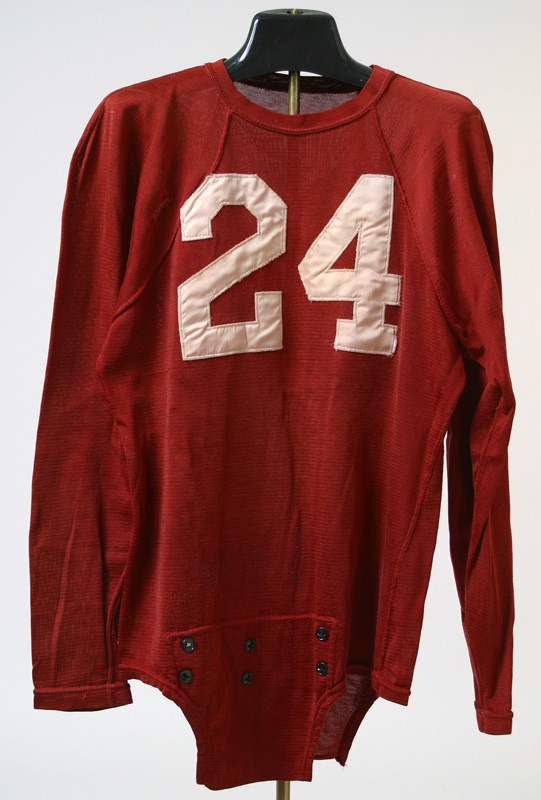
Game-worn 1947 Chicago Cardinals jersey.
Number 24 was backup back John "Red" Cochran.

Due to the Eastern Division Playoff, the Championship Game was moved to December 28, its latest date thus far. Although Comiskey Park was not right on Lake Michigan, it was still only 29 degrees at kickoff. Knowing that the field was frozen, the Cardinals wore sneakers instead of cleats, which was legal at the time.
Comiskey Park, set up for football

The game kicked off at 1:05 PM Central Time (2:05 Eastern). Trippi scored a touchdown on a 44-yard run in the 1st quarter. In the 2nd, Angsman scored on a 70-yard run in the 2nd quarter. Tommy Thompson threw a 53-yard touchdown pass to Pat McHugh, to close the Eagles to within 14-7 at halftime.

Special teams made the difference: In the 3rd quarter, Trippi returned a Joe Muha punt 75 yards for a touchdown, making it 21-7 Cards. The Eagles marched downfield, and Van Buren ran the ball in from the 1-yard line to make it 21-14. But in the 4th quarter, Angsman broke off a 70-yard run to make it 28-14. Russ Craft scored on a 1-yard run, but the Eagles got no closer. The Cardinals won, 28-21.

The teams played each other in the opening game of the next season, also at Comiskey, and the Cardinals won, 21-14. However, Cardinal tackle Stan Mauldin died from a head injury sustained in the game, the 1st NFL player known to have died as a result of an in-game condition. Still, the Cardinals may have been even better than in the season before: They lost their next game, to the Bears, and then ran the table, finishing 11-1. But they lost the Championship Game to the Eagles in Philadelphia.

That would be their last Playoff game for 26 years, and their last NFL championship game, under any name, for 58 years. The '47 title game would be their last postseason victory for 51 years. 

The '48 title game was Conzelman's last in any active role in football, as he was making more money and getting less stress in his off-season job in the advertising industry. It was also Goldberg's last game before retiring as a player. Christman last played for the Cardinals in 1949, Harder in 1950, while Trippi hung on until 1955.

In 1949, Violet Bidwill married Walter Wolfner, a St. Louis-based businessman who got rich selling coffee to the U.S. Army in World War I, who took over the operation of the Cardinals. From 1949 to 1959, 11 seasons, they went through 8 different head coaches. From 1950 onward, they never had another winning season, bottoming out at 1-10-1 in 1953. And, despite not winning another title until 1963, the Bears surged ahead of the Cardinals in popularity in Chicago.

After flirting with moving to Minneapolis, and even playing some "home games" at the new Metropolitan Stadium nearby, Wolfner moved the team to his hometown for the 1960 season, fully aware that there was already a baseball team named the St. Louis Cardinals, with whom they shared Busch Stadium (formerly Sportsman's Park) until 1965, and Busch Memorial Stadium thereafter.

Violet died in 1962, and left her 80 percent ownership of the team to her adopted sons, Charles Bidwill Jr. and William Bidwill. They immediately fired Wolfner. He sued, claiming that, as adoptees, they couldn't inherit the team. The court didn't buy it, and Wolfner was out. In 1972, Billy Bidwill bought out his brother "Stormy." In 1988, he moved the team, becoming the Phoenix Cardinals. In 1993, he renamed them the Arizona Cardinals. They reached Super Bowl XLIII, but lost it. The 2022 season will be the 75th in a row that they will not end as NFL Champions.

UPDATE: The Arizona Cardinals have established a Ring of Honor. It includes all Chicago Cardinals in the Pro Football Hall of Fame in Canton, Ohio: John "Paddy" Driscoll, Ernie Nevers, Charlie Trippi, Marshall "Biggie" Goldberg, Dick "Night Train" Laine, Ollie Matson, 1947 NFL Championship coach Jimmy Conzelman, and team owner Charles Bidwill.

*

December 28, 1947 was a Sunday. Aurelio RodrĂ­guez, a fine-fielding 3rd baseman for several teams, mainly the 1970s Detroit Tigers, was born on this day.

Baseball was out of season. In the Basketball Association of America, the league that would rename itself the NBA in 1949, there was 1 game: The St. Louis Bombers beat the Baltimore Bullets, 67-63 at the St. Louis Arena.

And there were 2 games in the NHL. The New York Rangers and the Toronto Maple Leafs played to a tie, 1-1 at the old Madison Square Garden. And the Detroit Red Wings beat the Boston Bruins, 3-0 at the Olympia Stadium in Detroit. The Boston Bruins and the Chicago Black Hawks were not scheduled.

Tuesday, December 27, 2022

December 27, 1949: Indonesia Is Recognized as Independent

December 27, 1949: The Kingdom of the Netherlands recognizes the independence of its colony, formerly the Dutch East Indies. For over 4 years, it had been operating as the independent Republic of Indonesia.

On August 17, 1945, in the wake of the Japanese surrender in World War II, the Dutch East Indies, devastated by the War, declared their independence as the Republic of Indonesia, under nationalist leader Sukarno (his entire name was just the one word) as President. It would take another 4 years of armed struggle before the Netherlands gives up and accepts their independence.

Today, the island nation is a democracy with, after the 1998 fall of dictator Suharto, who had overthrown Sukarno in 1970, an elected President. It is home to 255 million people, more than any except China, India and America. Most of them are ethnic Asians and Muslims, and it is the most populous majority-Muslim nation. Its flag, red on top and white on bottom, is identical to that of Monaco, and the reverse of that of Poland.
Since 1950, the nation's capital has been Jakarta, home to 10.7 million people, and a metropolitan area of over 35 million, on Java, the most populous island in the world, with 157 million, or about 61 percent of Indonesia's population.
But in 2019, President Joko Widodo officially announced that, due to climate change resulting in the slow sinking of the part of Java on which Jakarta stands, the national capital would be moved to East Kalimantan, on the island of Borneo. Most of that island belongs to Indonesia, but portions of it belong to Malaysia, and the Sultanate of Brunei is also on the island.
UPDATE: Due to construction delays, including due to COVID, the new capital city, named Nusantara, about 800 miles to the northeast, and already being promoted as "A global city for all," is set to open on August 17, 2028.

*

December 27, 1949 was a Tuesday. Baseball was out of season. Football season was over, except for a few bowl games. No games were scheduled for the NHL. There were 3 games in the NBA:

* The New York Knicks lost to the Boston Celtics, 97-78 at the Boston Arena (now the Matthews Arena).

* The Rochester Royals beat the Washington Capitols, 96-72 at the Edgerton Park Arena in Rochester, New York.

* And the Indianapolis Olympians beat their fellow Indianans, the Anderson Packers, 89-82 at the Butler Fieldhouse (now the Hinkle Fieldhouse) in Indianapolis.

December 27, 1947: "Howdy Doody" Premieres

December 27, 1947: Howdy Doody premieres on NBC. It becomes the most famous children's TV show of all time, until Sesame Street debuts in 1969.

Born in 1917 in Buffalo, Robert Emil Schmidt anglicized his name to Bob Smith, and became a popular figure on Buffalo radio station WGR. This got the attention of parent company NBC, who hired him away to do a morning show on New York flagship station WNBC, which he continued to do into the 1950s, until his TV show began to take up so much of his time.

On his radio show, Smith had a character named Elmer, a country boy, that proved popular enough that Smith was offered a Saturday morning kids' TV show, on the condition that Elmer be a character. So Elmer became a marionette, Howdy Doody, named for the Western-style transformation of the greeting, "How do you do?" into "Howdy do?" or sometimes even just "Howdy."

Smith became "Buffalo Bob," named for his hometown, and wearing Western gear like Buffalo Bill Cody. Howdy was dressed like a cowboy, and famously had 48 freckles on his face, one for every State then in the Union.

A section of seats called the Peanut Gallery was set aside on stage for kids to watch the show. Bob would start every show by sitting down at a piano and asking, "Say, kids, what time is it?" And they would yell, "It's Howdy Doody Time!" And Bob would play the theme song, to the tune of "Ta-ra-ra Boom-de-ay":

It's Howdy Doody time,
Bob Smith and Howdy, too,
Say "Howdy do" to you.
Let's give a rousing cheer
’Cause Howdy Doody's here.
It's time to start the show
So kids, let's go!

Despite his country-boy beginnings, and his similarity to ventriloquist "dummies," Howdy was no fool: Bob made him a stand-in for the kids, and made him pretty smart, to show the kids that he believed they could be smart, too.

The show had other characters, most famously Clarabell the Clown, who, like Harpo Marx, did not speak, except by honking a horn, which Bob and Howdy could translate. Not having a speaking role meant that NBC could pay him less: Networks being budget-conscious was even worse at the dawn of the TV era.

Clarabell He also used the old vaudeville stunt of squirting seltzer from the bottle. The original Clarabell was Bob Keeshan, who was fired in 1952 after hiring an agent to negotiate a better salary. NBC's loss was CBS' gain, as, in 1955, Keeshan began hosting Captain Kangaroo. And he long outlasted Bob and Howdy, as the show ran until 1984.

Robert Nicholson, the show's musical director, took over the role of Clarabell, and also played a farmer named J. Cornelius Cobb. In 1954, Lew Anderson took over the role of Clarabell, and played it for the remainder of the show's run, while Nicholson continued to direct the music and play "Corny" Cobb. For his own show, Keeshan may have based Hugh Brannum's character Mr. Green Jeans on Cobb.

This was not a good time for the portrayal of Native Americans in the American media. Bill Le Cornec played Chief Thunderthud, Chief of the Ooragnak tribe. Though it sounds like the Norse legend "Ragnarok," it's actually "kangaroo" spelled backwards. With no sensitivity whatsoever, him speak in broken English.

He also introduced an expression of excitement or happiness to the American lexicon: "Kowabunga!" This word would be adopted by Southern California surfers, and, in his comic strip Peanuts -- named by his national syndicator, against his will, in honor of Howdy Doody's peanut gallery -- the dog Snoopy would yell it when he went surfing. The word has also been adopted by Sesame Street's Cookie Monster, the Teenage Mutant Ninja Turtles, and Bart Simpson on The Simpsons.

In 1950, Chief Thunderthud got a girlfriend, Princess Summerfall Winterspring. She was played by Judy Tyler, only 18 at the time. She stayed on the show until in 1956, to film Jailhouse Rock with Elvis Presley. Coming back from Hollywood, intending to go to New York where she'd gotten an offer for a Broadway musical, she and her new husband, Gregory Lafayette, were killed in a car crash in Wyoming on July 3, 1957. The character was not recast.

The live characters lived in the Western town of Doodyville, which, in hindsight, was probably not a good choice of name. In addition to Howdy, the puppets included Heidi Doody, a girl who (how, was never explained) saved Buffalo Bob's life, and was adopted as Howdy's sister (not his girlfriend); Phineas T. Bluster, Mayor of Doodyville, a skinflint and the show's main antagonist; Dilly Dally, a friend of Howdy's who took on the dumb hick role of the former Elmer character; twin bears named Hyde and Zeke (like "hide and seek"); and Flub-a-Dub, who had a duck's bill, a cat's whiskers, a cocker spaniel's ears, a giraffe's neck, a dachshund's body, a seal's flippers, a pig's tail and an elephant's memory.

By August 1948, the show was enough of a hit that it was moved to Monday through Friday, at 5:30 PM Eastern Time. In September 1954, Smith suffered a heart attack, and his doctors ordered home recuperation. Allen Swift did Howdy's voice, and continued to do it for the rest of the show's run. Western movie star Gabby Hayes and then New York disc jockey Ted Brown, as Bison Bill, filled in for him, explaining that Buffalo Bob was "vacationing at Pioneer Village." The kids seemed to accept this.

The sponsors did not. They made a lot of money with Smith advertising their products, and wanted him back sooner than his doctors did. So NBC set up a studio in his house, making a room into "Pioneer Village," where he could do commercials. In September 1955, Smith was given the go-ahead to return, but, soon thereafter, partly to accommodate his health, the show was scaled back to Saturday mornings only. And they stopped doing it live, but this enabled them to record it on color videotape, not that many households yet had color TV.

All good things must come to an end, and, on September 24, 1960, the final episode of Howdy Doody aired. It was a retrospective of the show's history, and, at the end, Anderson revealed a big secret: Clarabell actually can talk. So Buffalo Bob asked everyone to be quiet, and listen. The camera closed in on Clarabell, close enough that the TV audience could see that Anderson was crying, and he whispered, just loud enough for the microphone to pick up, "Goodbye, kids."

The 1970s brought on a nostalgia wave for the 1950s, and the Baby Boomers had grown up. But Buffalo Bob still meant something to them. He visited troops in Vietnam, and battle-weary young men joyously sang along with him. He made an appearance on Happy Days, a show set in 1950s Milwaukee, in a storyline where Richie Cunningham (Ron Howard) wins a Howdy lookalike contest. Smith did a 40th Anniversary TV special in 1987, with Anderson, LeCornec and Nicholson in character, and Swift voicing Howdy. He proved popular doing appearances at shopping malls.

Nicholson died in 1993, LeCornec in 1997, Smith in 1998, Keeshan in 2004, Anderson in 2006, and Swift in 2010. Howdy Doody lives: He is still a point of reference, for people born long after the original show stopped, and the most-used puppet of him now rests in the television exhibit at the Smithsonian Institution in Washington, D.C., alongside such pieces as Archie Bunker's chair from All in the Family and Fonzie's original leather jacket from Happy Days.

*

December 27, 1947 was a Saturday. Baseball was out of season. The NFL Championship Game was played the next day: The Chicago Cardinals beat the Philadelphia Eagles. One college football game was played on this day: The University of Montana played the Hawaii All-Stars, 28-14 at Honolulu Stadium.

Three games were played in the Basketball Association of America, the league that would become the NBA for the 1949-50 season:

* The New York Knicks lost to the Chicago Stags, 79-70 at the old Madison Square Garden.

* The Boston Celtics beat the Providence Steam Rollers, 74-63 at the Rhode Island Arena in Providence.

* And the Washington Capitols beat the Philadelphia Warriors, 72-70 at the Uline Arena (now the Washington Coliseum).

Two games were played in the NHL. The Montreal Canadiens beat the Chicago Black Hawks, 3-1 at the Montreal Forum. And the Toronto Maple Leafs beat the Boston Bruins, 2-1 at Maple Leaf Gardens in Toronto. The New York Rangers and the Detroit Red Wings were not scheduled.

And in English soccer, Liverpool FC beat Arsenal, 2-1 at Highbury in North London. 

Monday, December 26, 2022

December 26, 1951: "The African Queen" Premieres

Katharine Hepburn and Humphrey Bogart

December 26, 1951: The African Queen premieres, based on the 1935 novel by C.S. Forester, and directed by John Huston. It stars Humphrey Bogart and Katharine Hepburn.

The film is set in August 1914, in German East Africa (now the nations of Burundi, Rwanda and Tanzania). Samuel Sayer (Robert Morley) and his sister Rose (Hepburn) are British missionaries. They are occasionally supplied by the steamboat African Queen, piloted by Charlie Allnut, not exactly a missionary's kind of guy. (He was a Cockney in the book, but Bogart didn't think he could do the accent, so the character was rewritten as a Canadian, so he was still a citizen of the British Empire.)

Charlie tells them that war has broken out (the one that would later be known as World War I), and that they should get out of German territory. They refuse, but German colonial troops burn down the village, and Samuel is killed. Charlie helps Rose bury him, and takes her upriver.

Charlie says the British are unable to attack the Germans because of the presence of a large gunboat, the Königin Luise (Queen Louise, named for the wife of King Frederick William III of Prussia), patrolling a large lake downriver. Rose comes up with a plan to convert the African Queen into a torpedo boat, and sink the Königin Luise. After first thinking that she's nuts, Charlie goes along with the plan.

The Königin Luise returns, and Charlie and Rose steam the African Queen out onto the lake in darkness, intending to set her on a collision course. A strong storm strikes, causing water to pour into the African Queen through the torpedo holes. Eventually the boat capsizes, throwing Charlie and Rose into the water. Charlie loses sight of Rose in the storm.

Charlie is captured and taken aboard the Königin Luise, where he is interrogated by German officers. Believing that Rose has drowned, he makes no attempt to defend himself against accusations of spying, and the German captain sentences him to death by hanging. Rose is brought aboard the ship just after Charlie's sentence is pronounced. The captain questions her, and Rose proudly confesses the plot to sink the Königin Luise, deciding that they have nothing to lose. The captain sentences her to be executed with Charlie, both as British spies.

Charlie asks the German captain to marry them before they are executed, as is allowed by the law of most countries. The captain agrees, and after conducting the briefest of marriage ceremonies, is about to carry out the execution when the Königin Luise is rocked by a series of explosions, quickly capsizing. The ship has struck the overturned submerged hull of the African Queen and detonated the torpedoes. The newly married couple is able to escape the sinking ship and swim to safety together.

Much of the film was shot on location in Uganda and the Belgian Congo (now the Democratic Republic of the Congo). This was unusual for that era, especially for a color film that used large, cumbersome "Three-Strip" cameras. The cast and crew endured sickness and spartan living conditions during their time on location, and Huston used his off-time to do a lot of hunting. This led to Clint Eastwood directing and starring in the thinly-disguised 1990 film White Hunter Black Heart.

Hepburn got sick. Bogart later said that he and Huston were the only members of the cast and crew who didn't, because they were drinking whiskey, not the local water. Given Bogie's well-known proclivities, I believe him.

The film was nominated for 4 Academy Awards: Bogart for Best Actor, Hepburn for Best Actress, Huston for Best Director, and Huston and James Agee for Best Screenplay. Only Bogart won. It was his only win.

The small steamboat used to depict the African Queen was contemporary to the time, built in 1912 in Britain, for service in Africa. At one time it was owned by actor Fess Parker, best known for playing Davy Crockett. The boat was restored, and is now on display in another location connected with Bogart: Key Largo, Florida.

In 1977, CBS aired a TV-movie with the same title, but as a sequel to the original film, with Warren Oates as Charlie and Mariette Hartley as Rose. The film was meant as the pilot for a series, but it was not picked up.

In 1999, Shakespeare in Love won the Academy Award for Best Picture. In that film, Judi Dench played Queen Elizabeth I. The ceremony was hosted by Whoopi Goldberg, who came out in costume as Elizabeth I, complete with whiteface makeup, and said, "I am the African Queen!"

*

December 26, 1951 was a Wednesday. Baseball was out of season. Football was in midweek. There were 3 games played in the NBA:

* The New York Knicks lost to the Milwaukee Hawks, 78-76 at the Baltimore Coliseum. This was the 1st half of a doubleheader. The Knicks had reached the NBA Finals the previous year, and would again, while the Hawks were a lousy team, and moved to St. Louis in 1955, and then to Atlanta in 1968. Nevertheless, the Hawks won this game.

* In the nightcap, the Baltimore Bullets beat the Philadelphia Warriors, 103-99 in triple overtime. So fans could pay for 48 minutes of basketball, and ended up getting 111 minutes.

* And the Fort Wayne Pistons beat the Boston Celtics, 94-86 at North Side High School in Fort Wayne, Indiana. As late as 1952, an NBA team was playing its home games in a high school gymnasium.

There were 2 games played in the NHL. The New York Rangers beat the Detroit Red Wings, 1-0 at the old Madison Square Garden. And the Montreal Canadiens beat the Toronto Maple Leafs, 3-2 at Maple Leaf Gardens in Toronto. The Boston Bruins and the Chicago Black Hawks were not scheduled.

And in English soccer, at a time when teams played back-to-back, home-and-home games on Christmas Day and Boxing Day, North London team Arsenal had beaten Hampshire team Portsmouth 4-1 the day before, but Portsmouth gained a 1-1 draw on this day, at Fratton Park.

December 26, 1947: The Northeast Blizzard of '47

December 26, 1947: The North American Blizzard of 1947 -- or the Northeast Blizzard of '47 -- falls on the Northeastern United States. When it's over, the snowfall at New York City's official measuring point, in Central Park, reads 26.4 inches. (While it was a record, that Daily News headline was a tad premature as to the total amount.)

The previous iconic blizzard in New York, from March 11 to 14, 1888, paralyzed the City for days, and led to the construction of the Subway system, and to the City's electric company, Consolidated Edison, moving most electrical lines underground as well. The snowfall was officially measured at 21 inches, so the Blizzard of '47 broke this record. Fortunately, by 1947, snow removal equipment was mechanized, so the City's paralysis didn't last nearly as long.

The '47 record would hold until January 6 to 8, 1996, 30 inches. That remains the record. But the Blizzard of '47 gained a life of its own. My mother was a baby at the time, and she told me that, for the rest of her life, her mother griped about having to take care of a baby in that Blizzard.

*

December 26, 1947 was a Friday. The day after Christmas is celebrated as Boxing Day in Britain, and England's Football League plays games on the day. But not every team did this time. Liverpool F.C., defending Champions, and North London team Arsenal, who would go on to win the title, played each other the day before, on Christmas, at Liverpool's home of Anfield, and Arsenal won, 3-1. But on the 27th, at Arsenal's home of Highbury, Liverpool avenged that defeat, winning 2-1.

It was the off-season for Major League Baseball. The NFL Championship Game was played 2 days later, at Comiskey Park in Chicago, and the Chicago Cardinals beat the Philadelphia Eagles, 28-21. The Eagles beat the Cardinals in the Championship Game the next year. The Cardinals moved to St. Louis in 1960 and Arizona in 1988, but have never won another NFL Championship, either before or after the title game began to be called the Super Bowl.

There were no games scheduled for the National Hockey League that day. There was 1 game played that night in the Basketball Association of America, the league that became the National Basketball Association in 1949, upon its merger with the National Basketball League. It was in the Northeast, but in Philadelphia, where the snowfall wasn't nearly as severe: 6 1/2 inches.

So the game was played. The Philadelphia Warriors beat the Providence Steamrollers, 89-61 at the Philadelphia Arena, at 46th & Market Streets in West Philadelphia. No attendance is listed in the box score.

Joe Fulks scored 24 points for the Warriors, who moved to the San Francisco Bay Area in 1962, and are now known as the Golden State Warriors. The Rollers, named for the football team that won the NFL Championship in 1928 before being doomed by the Great Depression, folded in 1949, and never entered the merged NBA. They remain the last major league sports team based in Rhode Island.

Also on this day, Carlton Fisk, later to be the Hall of Fame catcher for the Boston Red Sox and the Chicago White Sox, was born, in Bellows Falls, Vermont -- because that town had the closest hospital to his parents' home in Charlestown, New Hampshire.

Sunday, December 25, 2022

December 25, 1951: A Bloody Christmas for Civil Rights

Harriette (left) and Harry Moore

December 25, 1951: bomb explodes at the home of Harry T. Moore, President of the Florida branch of the NAACP, in Mims, Florida, not far from Cape Canaveral.
Moore was born on February 18, 1905, in Houston, on the Florida Panhandle, about halfway between Tallahassee and Jacksonville. By the early 1930s, he was secretary for the Florida chapter of the NAACP. He worked on housing and education, investigated lynchings, and registered black voters. By 1950, 31 percent of eligible black people in Florida were registered to vote, more than in any other Southern State.
But on the night of December 25, 1951, a bomb exploded at his house in Mims. The local hospital in Titusville would not treat black people, Moore was taken to the nearest one that would, 30 miles away in Sanford, and he died en route. He was 46 years old. His wife, teacher Harriette Moore, died from her injuries 9 days later, on January 3, 1952, at the Sanford hospital. She was 49.
The FBI investigated the murder, but not with any enthusiasm, and no one was ever prosecuted for it. In 2006, a State investigation suggested the perpetrators were 4 members of the Ku Klux Klan, all of them dead by that point, so there was nothing that could be done.
Moore was the 1st NAACP member to be assassinated for civil rights activism, and he and Harriette were the only husband and wife killed for it. They are considered the first martyrs of the Civil Rights Movement. Much of the community of Mims is now part of Harry T. and Harriette V. Moore Memorial Park.
Also on this day, Los Angeles policemen attack 5 Mexican-American and 2 white young men, leading to their hospitalization. Although they all survived, it became known as "Bloody Christmas." While 8 police officers were indicted, none were imprisoned. The event would be fictionalized in the 1990 novel and 1997 film L.A. Confidential.
*
December 25, 1951 was a Tuesday. Four games were played in the NBA, including a doubleheader at Madison Square Garden. In the opener, the Syracuse Nationals beat the Milwaukee Hawks, 70-65. In the nightcap, the New York Knicks beat the Fort Wayne Pistons, 72-65.
Also, the Rochester Royals beat the Indianapolis Olympians, 87-78 at the Edgerton Park Arena. And the Minneapolis Lakers beat the Boston Celtics, 100-93 at the Minneapolis Auditorium.
Two games were played in the NHL. The New York Rangers lost to the Detroit Red Wings, 2-1 at the Olympia Stadium. And the Chicago Black Hawks beat the Boston Bruins, 6-2 at the Boston Garden.
And in English soccer, Arsenal F.C. hosted Hampshire team Portsmouth at Highbury in North London, and won 4-1 on goals by Lewis, Logie, Freddie Cox and Peter Goring.

Saturday, December 24, 2022

December 24, 1951: The 1st Hallmark Christmas Movie

When was the 1st "Hallmark Christmas Movie"? It seems like a recent phenomenon. Indeed, the Hallmark Channel has made the sappy, holiday-themed romance films a regular feature of its October, November and December programming since 2009.

But before there was a Hallmark Channel, there was the anthology TV series Hallmark Hall of Fame. And the 1st one of those goes back a lot further than that. It's not a sappy romance story. And it's not an original story, either. Unless you mean a variation on the original Christmas story.

December 24, 1951: Amahl and the Night Visitors is broadcast on NBC, live from Studio 8H at 30 Rockefeller Plaza in New York. It is the 1st program in the Hallmark Hall of Fame series, sponsored by the Hallmark greeting-card company.

It is an opera, the 1st ever composed specifically for television, by Gian Carlo Menotti. He was born in 1911, in Cadegliano-Viconago, in Lombardy near the Italian border with Switzerland. In the booklet for the original cast recording, Menotti wrote:

This is an opera for children because it tries to recapture my own childhood. You see, when I was a child I lived in Italy, and in Italy we have no Santa Claus. I suppose that Santa Claus is much too busy with American children to be able to handle Italian children as well. Our gifts were brought to us by the Three Kings, instead.

I actually never met the Three Kings -- it didn't matter how hard my little brother and I tried to keep awake at night to catch a glimpse of the Three Royal Visitors, we would always fall asleep just before they arrived. But I do remember hearing them. I remember the weird cadence of their song in the dark distance; I remember the brittle sound of the camel's hooves crushing the frozen snow; and I remember the mysterious tinkling of their silver bridles.

(In fact, Italy does have a version of Santa Claus, although he's closer to St. Nicholas, the original bishop form of the character, known as Father Christmas in Britain, Père NoĂ«l in France, and, in Italy, Babbo Natale.)

The lead character is Amahl, a boy who, like Tiny Tim in Charles Dickens' A Christmas Carol, can walk only with a crutch. He compensates for his disability by telling tall tales. His mother does not believe him when he tells her there is an amazing star "as big as a window" outside over the roof of their house in Bethlehem.

After bedtime, there is a knock at the door and the mother tells Amahl to go see who it is. He is amazed when he sees three splendidly dressed kings, the Magi. (The Bible does not specifically call them kings. Nor does it specify the number of "wise men.") At first, the mother does not believe Amahl, but when she goes to the door to see for herself, she is stunned.

The Three Kings tell the mother and Amahl they are on a long journey, to give gifts to a wondrous Child, and they would like to rest at their house, to which the mother agrees, saying that all she can offer is "a cold fireplace and a bed of straw." The mother goes to fetch firewood, and Amahl seizes the opportunity to speak with the kings.

King Balthazar answers Amahl's questions about his life as a king, and asks what Amahl does. Amahl responds that he was once a shepherd, but his mother had to sell his sheep. Now, he and his mother will have to go begging.

Amahl then talks with King Kaspar, who is childlike, eccentric, and a bit deaf. Kaspar shows Amahl his box of magic stones, beads, and licorice, and offers Amahl some of the candy. The mother returns. He defends himself, saying "They kept asking me questions," when of course it has in fact been Amahl asking the kings questions. Amahl is told to go fetch the neighbors, so the kings may be fed and entertained properly.

After the neighbors have left and the kings are resting, the mother attempts to steal for her son some of the kings' gold that was meant for the Christ Child. She is thwarted by the kings' page. When Amahl wakes to find the page grabbing his mother, he attacks him. Seeing Amahl's defense of his mother and understanding the motives for the attempted theft, King Melchior says she may keep the gold, as the Holy Child will not need earthly power or wealth to build his kingdom.

The mother says she has waited all her life for such a king and asks the kings to take back the gold. She wishes to send a gift but has nothing to send. Amahl, too, has nothing to give the Child except his crutch. When he offers it to the kings, his leg is miraculously healed. With permission from his mother, he leaves with the kings to see the Child, and give his crutch in thanks for being healed.

Thomas Schippers conducted the orchestra. Chet Allen, then 12 years old, played Amahl. Rosemary Kuhlmann played the Mother, Andrew McKinley played King Kaspar, David Aiken played King Melchior, Leon Lishner played King Balthazar, and Francis Monachino played the page. Melissa Hayden, Glen Tetley and Nicholas Magallanes played "Dancing Shepherds."

Amahl and the Night Visitors was the 1st network television Christmas special to become an annual tradition. Until 1963, Amahl was nearly always presented with many of the same singers and production staff. From 1951 until 1966 it was presented every year on NBC on or around Christmas Eve. A 1978 production of Amahl also premiered on NBC, before it went to cable television in the early 1980s. A British film version was made in 1996.

Nicholas Magallanes and later Thomas Schippers died in 1977. Chet Allen became depressed over his failing career, and died by suicide in 1984. Leon Lishner died in 1995, Andrew McKinley in 1996, Francis Monachino in 2003, Melissa Hayden in 2006, Glen Tetley and later Gian Carlo Menotti in 2007, David Aiken in 2011, and Rosemary Kuhlmann was the last survivor of the cast, living until 2019.

Studio 8H has been the home of NBC's Saturday Night Live since 1975. Most of Menotti's work is forgotten. Arturo Toscanini, NBC's Italian-born main conductor, knew it when he heard the rehearsal for Amahl, telling him, "This is the best you've ever done."

*

December 24, 1951 was a Monday. Baseball was out of season. No games were scheduled in the NBA or the NHL And the NFL Championship Game was played the previous day, with the Los Angeles Rams beating the Cleveland Browns, 24-17 at the Los Angeles Memorial Coliseum. So there were no scores on this historic day.

December 24, 1950: The Cleveland Browns Make Their Point

The winning field goal, kicked by Groza, then wearing Number 50.
He would later switch to 76, which the Browns retired for him.
Note the snow on the field.

December 24, 1950: The NFL Championship Game is held at Cleveland Municipal Stadium. The weather was bitterly cold, but the action was hot.

In 1945, the Cleveland Rams had won the NFL Championship, but had low attendance. Team owner Dan Reeves (no relation to the later NFL coach of the same name) moved them to Los Angeles, where they became a runaway success at the box office, and on the field as well. In 1949, they won the NFL Western Division, and reached the NFL Championship Game. But, contrary to the image of sunny Southern California, a rainstorm hit the Los Angeles Memorial Coliseum, and the Rams lost to the Philadelphia Eagles.

They played the 1950 season as if on a benzedrine kick, with the most potent offense the NFL has ever seen. The "Greatest Show On Turf" that the St. Louis version of the Rams had half a century later had noting on this bunch.

Alternating quarterbacks between Bob Waterfield and Norm Van Brocklin, their runners included former Army Heisman Trophy winner Glenn Davis, Verda Thomas Smith (known as V.T. or "Vitamin"), Dick Hoerner, early black star "Deacon" Dan Towler, and one of the earliest NFL players from a "historically black" school, Paul "Tank" Younger of Grambling State University in Louisiana. Waterfield and Van Brocklin could throw to any of them, and to receivers Tom Fears and Elroy Hirsch, who was so fast, he was nicknamed "Crazy Legs."

The Rams went 9-3, and one of the losses was a 56-20 embarrassment against the Eagles. The other 2 losses came against the Chicago Bears. But on October 22, 1950, the Rams answered this question: "What would happen if the best offense in NFL history played the worst defense in NFL history?" The Rams ended up scoring more points per game in a season than any other, and the Baltimore Colts ended up allowing more per game than any other. Result: Rams 70, Colts 27. To this day, it's still the 3rd-highest-scoring single-game performance in NFL history. In addition, they hung 65 point on the Detroit Lions, 51 and 45 on the Green Bay Packers, 45 and 43 on the New York Yanks (not "Yankees"), and 35 on the San Francisco 49ers.

But the Cleveland Browns could match them for firepower. After winning the All-America Football Conference in all 4 seasons of its existence, 1946 to 1949, the Browns were invited to join the NFL from it, as were the 49ers and the Colts. The opening game of the 1950 season was against the defending Champion Eagles, in Philadelphia, and the Browns embarrassed the allegedly superior league's top team, 35-10.

Head coach Paul Brown was an offensive genius, and he built a team to carry out that genius: Quarterback Otto Graham, running back Marion Motley, and ends Mac Speedie and Dante Lavelli were weapons that any team would be lucky to have. Blocking for them were guard Bill Willis and tackles Lou Groza and Mike McCormack. All of these men would join Brown in the Pro Football Hall of Fame.

Motley and Willis were the men who provided the premiering AAFC with its racial integration, as the Rams' Kenny Washington and Woody Strode had done for the NFL. Alas, by 1950, neither Washington nor Strode was still with the Rams, but Younger and Towler were.

The Browns went 10-2, their only losses to the New York Giants, by a total of 10 points. In addition to the 35 they scored on the Eagles, they scored 45 each on the Pittsburgh Steelers and the Washington Redskins, 34 each on the 49ers and the Chicago Cardinals, and 31 on the Colts.

The Rams and the Browns won their respective Divisions, and, as it was the Eastern Division Champion's turn to host the NFL Championship Game, they met in Cleveland on a frigid Christmas Eve on the shore of Lake Erie. It was the team that did make it in Cleveland vs. the one that didn't in spite of bringing the city a title. It was also the 1st game back in Cleveland for the Rams, as the NFL did not yet allow crossover games from one Division to the other, except in the Championship Game.
The Rams wasted no time: On their 1st play from scrimmage, Waterfield passed to Davis, and he went 82 yards for a 7-0 Ram lead. The Browns responded with their own touchdown, but the Rams came back with another, leading 14-7 at the end of the 1st quarter.

The Browns scored a touchdown in the 2nd quarter, but a high snap caused Groza, also the team's main kicker, to miss the extra point. Waterfield, also the Rams' main kicker, attempted a field goal as the half ran out, from only 15 yards, but the stiff wind blasting in off the lake stopped it, and it was 14-13 Los Angeles.

In the 3rd quarter, Graham threw a 39-yard touchdown pass to Lavelli, giving the Browns a 20-14 lead. But the Rams scored 2 touchdowns, and it was 28-20 Rams after 3 quarters. With 10 minutes to go, the Browns faced 3 4th-down conversion attempts, and made them all. Graham threw another touchdown pass, and it was 28-27 Rams.

With 1:49 left, the Browns got the ball on their own 31-yard line. Graham threw for 1st downs, and ran for 2 of them himself. With 28 seconds left, Groza was sent on to attempt a 16-yard field goal. It was perfect, and it was 30-28 Cleveland. The Rams had 1 more chance, but could do nothing with it. The Browns had won, in their 1st season in the League, and, by staying in the city, gave Cleveland its 1st pro football championship defenders since the 1924 Cleveland Bulldogs.

Paul Brown called it the best game he ever saw, and never changed his mind. NFL Commissioner Bert Bell, who had orchestrated the sort-of-merger between the NFL and the AAFC, called the Browns "the greatest team ever to play football." The Browns may have dominated an inferior league, but now, they had won the superior one. They had made their point.

But it is more than that: By being the winning coach, Paul Brown, having coached Ohio State in 1942, became 1st head coach ever to win both a college football National Championship and an NFL Championship. It would take until the Super Bowl era before that happened again: Jimmy Johnson, with 1987 Miami and the 1993 and 1994 Dallas Cowboys; Barry Switzer, 1974, 1975 and 1985 Oklahoma and the 1996 Cowboys; and Pete Carroll, 2003 and 2004 USC and the 2014 Seattle Seahawks.

In 1981, historian John Thorn left his comfort zone, baseball, and published Pro Football's 10 Greatest Games. He included this game.

The same teams faced each other again the following year. But in 1951, at the Coliseum, the Rams beat the Browns for Los Angeles' 1st major league sports championship. They would play each other again in 1955, with the Browns winning in L.A. It would be Graham's last game, as he retired. The Browns had been to the AAFC or NFL Championship Game every year for 10 straight years. After missing in 1956, they made it 11 out of 12 in 1957. They beat the Detroit Lions in 1954, but lost to them in 1952, '53 and '57.

The fact that the Browns', the Lions', and the Chicago (now Arizona) Cardinals' titles came before the advent of the Super Bowl means that they get discounted: Even before the distance of time became what it is now, NFL fans have come to regard any title won before the Super Bowl, NFL or AFL, as not a "real" championship. This is unfair: A title is a title.

UPDATE: The Browns have a Ring of Honor. From their founding era, they have honored head coach Paul Brown, quarterback Otto Graham, running back Marion Motley; receivers Dante Lavelli, Mac Speedie and Bobby Mitchell; center Frank Gatski, guard Bill Willis, tackle and placekicker Lou Groza, tackle Mike McCormack and defensive end Len Ford.

From their 1964 NFL Championship, they have honored running backs Jim Brown and Leroy Kelly, receiver Paul Warfield and guard Gene Hickerson. From the 1980s, they have honored guard Joe DeLamielleure, tight end Ozzie Newsome, and linebacker Clay Matthews Jr. It says something about how the Browns have been run since their re-establishment in 1999 that they have honored just 1 player in that period, offensive tackle Joe Thomas.

Motley, Willis, Lavelli, Groza, Warfield, Hickerson, founding owner Arthur "Mickey" McBride, 1940s running back Tony Adamle, 1950s guard Chuck Noll, 1950s defensive tackle Bob Gain, 1950s linebacker Sam Palumbo (a Cleveland native), 1970s running backs Greg Pruitt and Mike Pruitt (not related to each other), 1970s offensive tackle Doug Dieken, 1980s head coach Sam Rutigliano, 1980s quarterback Bernie Kosar, 1980s running back Kevin Mack, 1980s defensive tackle Bob Golic, 1980s linebacker Tom Cousineau, and 1999-2002 re-establishing owner Al Lerner have been elected to the Greater Cleveland Sports Hall of Fame.

*

December 24, 1950 was a Sunday. It was the end of the football season. No college games were played on this day. Baseball was out of season. No NBA games were played. And only 1 NHL game was played: The New York Rangers beat the Chicago Black Hawks, 6-1 at the old Madison Square Garden. Nick Mickoski had 4 goals and an assist for the Broadway Blueshirts.

December 31, 1999 & January 1, 2000: The Millennium

December 31, 1999:  The Millennium arrives. The people of planet Earth survived. At a terrible cost. But we hadn't destroyed ourselves. ...