Showing posts with label roberto clemente. Show all posts

Saturday, December 31, 2022

December 31, 1972: Roberto Clemente Is Killed

December 31, 1972: Roberto Clemente is killed in a plane crash, trying to get relief supplies from his native Puerto Rico to earthquake-ravaged Nicaragua.

Eight days earlier -- the same day as the football play known as the "Immaculate Reception" -- an earthquake measuring 6.3 on the Richter scale struck the Nicaraguan capital of Managua.

As with the San Francisco earthquake of 1906, there were fires started, and the city's firefighting equipment was damaged by the earthquake. Between the initial quake and the fires, the Managua disaster killed about 11,000 people, and left about 300,000 of the city's 1 million or so people homeless. The city's top 4 hospitals were destroyed, and there were food shortages.

The world responded with relief, but the country's right-wing dictator, Anastasio Somoza Debayle -- my autocorrect poignantly tried to turn that into "Debacle" -- had it distributed according to his own purposes, much like an old-style American city "machine politician."

Enter Roberto Clemente. The right fielder for the Pittsburgh Pirates had just completed his 18th major league season. At age 38, he showed no signs of slowing down. That season, he batted .312, helped the Pirates win their 3rd straight National League Eastern Division title, was named to his 15th All-Star game, was awarded his 12th Gold Glove, and collected his 3,000th career hit. 

He had won 4 NL batting titles, was named the NL's Most Valuable Player in 1966, and had helped the Pirates win the World Series in 1960 and 1971, being named the Series MVP in the ladder. 

He was not the first black Hispanic player in the major leagues, but, at this point, he was easily the greatest. Indeed, like actor-comedian Jackie Gleason was, and hockey star Wayne Gretzky later would be, he was nicknamed "The Great One." He was a point of pride for baseball fans all over Latin America, not just in his native Puerto Rico.

Already heavily involved in charities all over Latin America, Clemente had visited Managua only a few weeks before the earthquake. He organized three planeloads of relief supplies, but heard they had all been diverted by the Somoza government. He decided to accompany the fourth flight himself, to make sure that it didn't happen again.

The plane was a propeller-driven cargo plane, a DC-7. This particular plane, one of 338 that McDonnell-Douglas built between 1953 and 1958, was a bad choice, as it had a history of mechanical problems. On December 31, 1972, New Year's Eve, it was loaded up at Isla Verde International Airport outside the Puerto Rican capital of San Juan.
A DC-7, similar to the Clemente relief plane

Between cargo, and regular supplies like fuel, the plane ended up 4,200 pounds over its recommended limit. The plane took off at 9:20 PM (8:20 PM, U.S. East Coast time), for a 4-hour flight from San Juan to Managua -- meaning the New Year of 1973 would have begun for them in midflight.

But within 3 minutes, the pilot, Jerry Hill, realized he couldn't get the plane high enough due to the weight, and told the San Juan control tower that he had begun to turn around. Just afterward, one of the plane's four engines exploded, and it crashed into the Atlantic Ocean. 

Although most pieces of the plane were found, Hill was the only one of the five people on board whose body was found. There is no grand memorial for Roberto Clemente at any cemetery: He still lies somewhere off the coast of his homeland. He left behind a wife and three sons.
For baseball fans, January 1, 1973 did not present a "Happy New Year." The Pirates retired Clemente's Number 21, and wore that number in a patch on their sleeves all season long. It would be the only season from 1970 to 1975 that they didn't win the NL East title. On March 20, a special election was held for the Baseball Hall of Fame, and the five-year waiting period after a player's last game was waived, making Clemente eligible. He was elected with nearly 93 percent of the vote.
Manager Bill Virdon with the patch

The Pirates dedicated a statue of him outside Three Rivers Stadium. When they moved to the adjacent PNC Park in 2001, the statue went with them, and the neighboring 6th Street Bridge connecting the North Side with downtown Pittsburgh was renamed the Roberto Clemente Bridge.

An arena that was nearly ready to open in San Juan at the time of his death was named the Roberto Clemente Coliseum. New York City named a park across from the Bronx apartment building where Hank Greenberg grew up after a member of the Hall of Fame -- not Greenberg, but, reflecting that this neighborhood is now mostly Puerto Rican, Clemente.

On December 31, 1985, 13 years later, another New Year's Eve would be struck by air travel tragedy, as the crash outside Dallas of another McDonnell-Douglas plane with a troubled history, this one an old DC-3, killed seven people including early rock and roll star Ricky Nelson.

Earlier in 1985, Isla Verde International Airport in San Juan was renamed Luis Muñoz Marín International Airport, after the 1st elected Governor of the island, who had presided over the airport's opening in 1955.

*

December 31, 1972 was a Sunday. The end of the year marked the 1st year that Americans bought more color television sets than black-and-white sets, and the 1st year that a majority of American homes had color TV sets. I have a separate entry for that event.

It was the off-season for baseball. The NFL played its Conference Championship Games:

* Although the Miami Dolphins had an undefeated regular season, the Pittsburgh Steelers hosted the AFC Championship Game at Three Rivers Stadium, because the NFL was still using a rotating system for hosting the title game, not home field advantage.

Eight days after the franchise's 1st-ever Playoff win, on the Franco Harris "Immaculate Reception," the Steelers led 10-7 in the 3rd quarter. But the Dolphins came from behind to win, 21-17.

* The Washington Redskins dominated the defending NFL Champions, the Dallas Cowboys, 26-3 at Robert F. Kennedy Stadium. Head coach George Allen led his veteran "Over-the-Hill Gang" to the team's 1st Playoff win in 30 years. 

But the Dolphins would complete the perfect season by beating the Redskins in Super Bowl VII, 2 weeks later at the Los Angeles Memorial Coliseum.

There were no games played in the NBA or the ABA on New Year's Eve 1972. There were 3 NHL games played that day:

* The New York Rangers beat the St. Louis Blues, 6-1 at Madison Square Garden. 

* The Detroit Red Wings and the Minnesota North Stars played to a tie, 4-4 at the Olympia Stadium in Detroit. 

* And the Chicago Black Hawks beat the Buffalo Sabres, 4-2 at Chicago Stadium. 

And there were 3 games played in the World Hockey Association, which was in its 1st season:

* The New England Whalers beat the New York Raiders, 3-0 in the other game played on Madison Square Garden ice that day.

* The Quebec Nordiques beat the Ottawa Nationals, 8-4 at Le Colisée de Québec. Rene Levesque must have loved that.

* And the Philadelphia Blazers beat the Los Angeles Sharks, 3-1 at the Los Angeles Memorial Sports Arena. 

Friday, December 23, 2022

December 23, 1972: The Managua Earthquake

December 23, 1972: An earthquake, measuring 6.3 on the Richter scale, strikes Managua, the capital of the Central American nation of Nicaragua, shortly after Midnight, local time: 12:29 AM. It would not be a merry Christmas for the nation, already stricken by poverty and political unrest.

Managua, which lies on the southern shore of Lake Xolotlán, near the western coast of Nicaragua, is situated within an active volcanic zone known as the Central American Volcanic Chain. The city has a long history of volcanic and seismic activity: It had previously been hit by a 6.1 earthquake on March 31, 1931, resulting in a fire, and, between them, the quake and the fire killed about 2,450 people.

As with the San Francisco earthquake of 1906, there were fires started, and the city's firefighting equipment was damaged. Between the initial quake and the fires, the disaster killed about 11,000 people, and left about 300,000 of the city's 1 million or so people homeless. The city's top 4 hospitals were destroyed, and there were food shortages.

The world responded with relief, but the country's right-wing dictator, Anastasio Somoza Debayle -- my autocorrect poignantly tried to turn that into "Debacle" -- had it distributed according to his own purposes, much like an old-style American city "machine politician."

Among the relief efforts was one put together in Puerto Rico by baseball star Roberto Clemente. On December 31, he loaded up a plane with relief supplies -- over-loaded it, so that it crashed into the Caribbean Sea shortly after takeoff, and was never found. I have a separate entry for this event.

On April 10, 2014, Nicaragua was struck by another 6.1 earthquake. The next day, an aftershock registered at 6.6. However, these were not nearly as damaging as the quakes of 1931 and 1972, probably due to new building codes that made buildings more "earthquake-proof." Only one person is known to have died as a result of the 2014 quakes.

*

December 23, 1972 was a Saturday. Baseball was out of season. Two NFL Playoff games were played that day. The Dallas Cowboys beat the San Francisco 49ers, 30-28 at Candlestick Park in San Francisco. And the Pittsburgh Steelers beat the Oakland Raiders, 13-7 at Three Rivers Stadium in Pittsburgh, thanks to the last-minute touchdown pass from Terry Bradshaw to Franco Harris that became known as "The Immaculate Reception." I have a separate entry for that event.

The next day, Christmas Eve, the Washington Redskins beat the Green Bay Packers, 16-3 at Robert F. Kennedy Stadium in Washington. And the Miami Dolphins beat the Cleveland Browns, 20-14 at the Orange Bowl in Miami. The following week, New Year's Eve, saw the Conference Championships: Dolphins 21, Steelers 17 at Three Rivers; and Redskins 26, Cowboys 3 at RFK Stadium. On January 14, 1973, at the Los Angeles Memorial Coliseum, the Dolphins completed their undefeated season, beating the Redskins, 14-7 in Super Bowl VII.

There were 4 games played in the NBA on December 23, 1972:

* The Baltimore Bullets beat the Detroit Pistons, 104-97 at the Baltimore Civic Center. While the arena still stands, now known as the CFG Bank Arena, this would be the Bullets' last season in Baltimore, as they moved to the Washington area, and are now named the Washington Wizards.

* The Atlanta Hawks beat the Philadelphia 76ers, 124-112 at The Omni in Atlanta. Pistol Pete Maravich scored 42 points, Super Lou Hudson scored 31, and Bob Christian scored 13 and had 25 rebounds.

* The Milwaukee Bucks beat the Boston Celtics, 104-98 at the Milwaukee Arena. In 1974, it was renamed the Milwaukee Exposition, Convention Center and Arena, or "The MECCA." Since 2014, it has been named the UW-Panther Arena.

* And the Golden State Warriors beat the Chicago Bulls, 127-109 at the Oakland Coliseum Arena.

There were 4 games played in the American Basketball Association:

* The New York Nets lost to the Memphis Tams, 105-103 at the Mid-South Coliseum in Memphis.

* The Virginia Squires beat the Dallas Chaparrals, 112-107 at The Scope in Norfolk. Julius "Dr. J" Erving scored 41 points.

* The Carolina Cougars beat the Utah Stars, 123-117 at the Greensboro Coliseum. Billy Cunningham scored 34 points and grabbed 15 rebounds.

* And the Kentucky Colonels beat the San Diego Conquistadors, 116-105 at Freedom Hall in Louisville.

These games were played in the NHL:

* The expansion New York Islanders beat the Minnesota North Stars, 4-2 at the Nassau Coliseum.

* The Montreal Canadiens beat the Pittsburgh Penguins, 6-3 at the Montreal Forum.

* The Boston Bruins beat the expansion Atlanta Flames, 3-1 at the Boston Garden.

* The Detroit Red Wings beat the Vancouver Canucks, 5-1 at the Olympia Stadium in Detroit.

* The Toronto Maple Leafs beat the Chicago Black Hawks, 5-3 at Maple Leaf Gardens in Toronto.

* The St. Louis Blues beat the Philadelphia Flyers, 6-1 at the St. Louis Arena.

* The Los Angeles Kings beat the Buffalo Sabres, 2-0 at The Forum outside Los Angeles in Inglewood, California.

* The New York Rangers and the California Golden Seals were not scheduled.

And these games were played in the inaugural-season World Hockey Association:

* The Quebec Nordiques beat the Los Angeles Sharks, 2-1 at the Colisee de Quebec.

* The Cleveland Crusaders beat the Minnesota Fighting Saints, 3-1 at the Cleveland Arena.

* The Chicago Cougars beat the Alberta Oilers (as the Edmonton Oilers were named in that inaugural season alone), 3-2 at the International Amphitheatre in Chicago.

* And the Houston Aeros beat the Philadelphia Blazers, 7-3 at the Sam Houston Coliseum in Houston.

Also: Arsenal played Birmingham City to a 1-1 draw at St. Andrews Stadium in Birmingham.  

Monday, October 17, 2022

October 17, 1971: Roberto Clemente Deja Claro Su Punto

October 17, 1971: Game 7 of the World Series is played at Memorial Stadium in Baltimore. The Baltimore Orioles were set to play the Pittsburgh Pirates. The Orioles were the defending World Champions. The Pirates last won in 1960, and 2 players from that team were left: 2nd baseman Bill Mazeroski, whose home run won that Series; and right fielder Roberto Clemente. Danny Murtaugh managed them in both, and 1960 player Bill Virdon was one of Murtaugh's 1971 coaches.
Earlier in the season, the Pirates had become the 1st team ever to field an all-black-and/or-Hispanic starting lineup, leading author Bruce Markusen to title his book about the '71 Bucs The Team That Changed Baseball.
Clemente was 37, the most popular Hispanic player in baseball, and the Pirates' greatest player since Honus Wagner. But English-speaking baseball fans -- especially white ones -- weren't as interested in him as they were in some others. To a racist, Willie Mays, Hank Aaron and Frank Robinson might be black, but at least they spoke English.
Of course, Clemente spoke English, too, even though it was his 2nd language. And he dared to insist upon being called "Roberto." His Topps baseball cards usually listed him as "Bob Clemente." And Pirates broadcaster Bob Prince, a.k.a. "The Gunner," called him "Bobby."
What's more, he played in Pittsburgh. He had never played in New York, like Mays and Mickey Mantle. He wasn't playing in Los Angeles, like Sandy Koufax and Maury Wills had. He wasn't playing in Chicago, like the newly-retired Ernie Banks. He wasn't playing in San Francisco, like Mays. He wasn't playing in the nation's capital, Washington, like Frank Howard. He wasn't playing in the strong-media city of Boston, like Carl Yastrzemski. And he wasn't playing in the baseball-beloved city of St. Louis, like Bob Gibson and Lou Brock. So he wasn't celebrated in the media as those men were. He had to deal with both the ignorance of racism and simply being ignored.
But the World Series is a national showcase. Every baseball fans watches. It helped launch Koufax to superstardom in 1963, Gibson and Brock in 1964, Frank Robinson in 1966, Al Kaline in 1968, and Brooks Robinson in 1970. In 1971, Roberto Clemente, already with 14 All-Star Game berths, 10 Gold Gloves, 4 National League batting titles, and a regular-season Most Valuable Player award, but without stardom outside Western Pennsylvania, wanted to show the country that he was as good as any of them.
But to do it, he and the Pirates would have to go through the Orioles, the defending World Champions, with Brooks Robinson, Frank Robinson, John "Boog" Powell, and pitchers Jim Palmer, Mike Cuellar and Dave McNally. And, being an odd-numbered year, the O's, as AL Champions, would have the home-field advantage for Games 1 and 2, and, if necessary, Games 6 and 7.
The Orioles won Game 1, 5-3, McNally outpitching Dock Ellis. They also won Game 2, 11-3, Palmer outpitching Bob Johnson. But when the Series went to Pittsburgh, the Pirates won Game 3, 5-4, with Steve Blass outpitching Cuellar; and Game 4, 4-3, Bruce Kison outpitching Eddie Watt. And in Game 5, Nelson Briles pitched a 2-hit shutout, beating McNally, and the Pirates won, 4-0. But, back at Memorial Stadium, the Orioles won Game 6, 3-2. Clemente hit a home run, but Brooks Robinson hit a sacrifice fly to score Frank Robinson with the winning run in the bottom of the 10th inning.
Hank Bauer of the Yankees still holds the record for the longest hitting streak in World Series play, 17 games. Clemente had gotten a hit in all 7 games in 1960, and had now gotten hits in all 6 games in 1971, for 13, the 2nd-longest such streak. But the Pirates had to win Game 7 on the road.
Prior to Game 7, Briles did something that no active player had ever done before: He sang the National Anthem before a competitive Major League Baseball game, and a Game 7 of the World Series, no less. It would not happen again until 2019, when another Pirates pitcher, Steven Brault, sang the Anthem before a regular-season game.
Blass started against Cuellar, the lefthanded screwball specialist from Cuba. The game was scoreless until the top of the 4th, when Clemente hit a home run off Cuellar. The teams exchanged runs in the 8th, but Blass went the distance. The outcome was still in doubt on the final play: Merv Rettenmund hit a bouncer that ricocheted off the pitcher's mound. Pirate shortstop Jacinto "Jackie" Hernández handled it, and threw Rettenmund out.
The Pirates had become World Champions for the 4th time, previously doing so in 1909, 1925 and 1960. In 1901 and 1902, they won the NL Pennant, and had a better record than the AL Champions both times, but there was no World Series until 1903, which they reached, losing to the team soon to be known as the Boston Red Sox.
Clemente played in all 7 games in '60 and in all 7 games in '71, and got hits in all 14 World Series games in which he played. In fact, all 5 of the Pirates' World Series wins, including the 1979 win that was yet to come, have been in 7 games.
Interviewed for Sports Illustrated, Pirate general manager Joe Brown said, "People said to me, 'My God, does he always play like that?' And I said, 'Yes. Always. You're not seeing anything that we don't see day in and day out.'" Clemente had shown the world what he not only could do, but had always done.
After the game‚ 40‚000 people rioted in celebration in downtown Pittsburgh. At least 100 people wre injured‚ some seriously, although no deaths were reported.
Immediately after the Game 7 victory, rookie hurler Bruce Kison and his champagne-soaked best man Bob Moose were whisked away from Memorial Stadium by helicopter to a waiting Lear Jet, to attend the 21 year-old Kison's 6:30 PM wedding in Pittsburgh, for which the groom arrived 33 minutes late.
Also after the game, NBC did what it usually did when covering the World Series, and not only hired the leading announcer for each participating team -- in this case, Prince for the Pirates and Chuck Thompson for the Orioles -- but sent the announcer for the winning team into the locker room to interview the victorious.
Clemente had become the 1st Spanish-speaking player to be named the World Series MVP. Prince called him over to the TV camera, and called him "Bobby." Roberto was 37 years old. He told Prince that he had something he wanted to say, in Spanish. He said: << En el día más orgulloso de mi vida, a mis hijos, les doy mi bendición. Y a mis padres pido su bendición desde Puerto Rico. >> 
They were the first words ever spoken in Spanish live on national television in America. In English, "In the proudest day in my life, to my children, I give my blessing. And from my parents, I ask their blessing from Puerto Rico."
At that point, with Honus Wagner dead, the Steelers yet to rise to dynasty status, and Mario Lemieux having just turned 6, Bob Prince might have been the one living person connected with Pittsburgh sports more popular than Roberto Clemente. But in that moment, Clemente transcended not just Pittsburgh, but his entire sport. He had shown the world how he always played. And he had shown Prince, and the world, that he was a human being, an adult, an American, a Puerto Rican, and a Spanish speaker, as well as a great baseball player, and that each status deserved respect.
He had made his point -- Había dejado claro su punto.
The following year, he collected his 3,000th career hit. Two months later, trying to fly relief supplies to earthquake-devastated Nicaragua, he was killed in a plane crash. In a span of 14 months, he had gone from local star to baseball icon to secular saint.
UPDATE: The Pirates have a team Hall of Fame. From their 1971 World Champions, they have inducted right fielder Roberto Clemente, 2nd baseman Bill Mazeroski, center fielder Al Oliver, catcher Manuel "Manny" Sanguillén, pitcher Steve Blass, and manager Danny Murtaugh.
*
October 17, 1971 was a Sunday. Byron Chamberlain, a Super Bowl-winning linebacker with the Denver Broncos and a Pro Bowl selection with the Minnesota Vikings, was born on this day. And this was the day what's now named the Azadi Stadium opened in Tehran, Iran. I have a separate entry for that event.

These NFL games were played:

* The New York Giants lost to the Baltimore Colts, 31-7 at Yankee Stadium.

* The New York Jets beat the Buffalo Bills, 28-17 at Shea Stadium. Both New York teams being at home on the same day could have been due to the baseball teams having scheduling priority at the stadiums, thus compressing each football team's home schedule to being from mid-October to late December.

* The Washington Redskins beat the football version of the St. Louis Cardinals, 20-0 at Robert F. Kennedy Memorial Stadium in Washington.

* The Los Angeles Rams beat the Atlanta Falcons, 24-16 at Atlanta Stadium (later renamed Atlanta-Fulton County Stadium).

* The Miami Dolphins beat the New England Patriots, 41-3 at the Orange Bowl in Miami.

* The New Orleans Saints beat the Dallas Cowboys, 24-14 at Tulane Stadium in New Orleans. This was an outlier: The Saints, as they usually did in their early days, finished below .500; while the Cowboys went on to win their 1st Super Bowl.

* The Detroit Lions beat the Houston Oilers, 31-7 at the Astrodome in Houston.

* The Cleveland Browns beat the Cincinnati Bengals, 27-24 at Riverfront Stadium in Cincinnati.

* The Minnesota Vikings beat their arch-rivals, the Green Bay Packers, 24-13 at Lambeau Field in Green Bay. Of course, the Packers consider their arch-rivals to be the Chicago Bears, not the Vikings.

* The Denver Broncos beat the San Diego Chargers, 20-16 at Mile High Stadium in Denver.

* The San Francisco 49ers beat the Chicago Bears, 13-0 in San Francisco. It turns out to be the last game for inured Bears star Gale Sayers. So, like the Beatles, Sayers' last paid performance was at Candlestick Park. Injuries limited Sayers to only enough games that it amounted to 4 full seasons. But he was still great enough to be elected to the Pro Football Hall of Fame.

* The Oakland Raiders beat the Philadelphia Eagles, 34-10 at the Oakland Coliseum.

* And the following day, on ABC Monday Night Football, the Kansas City Chiefs beat the Pittsburgh Steelers, 38-16 at Kansas City Municipal Stadium.

There were no games in the American Basketball Association that day, but there were 3 in the NBA:
* The New York Knicks beat the Cleveland Cavaliers, 121-120 in overtime at the Cleveland Arena.
* The Detroit Pistons beat the Houston Rockets, 112-99 at Cobo Hall (now Huntington Place) in Detroit.
* And the Milwaukee Bucks beat the Portland Trail Blazers, 127-94 at the Portland Memorial Coliseum.
There were 6 games in the NHL:
* The New York Rangers beat the Montreal Canadiens, 8-4 at Madison Square Garden.
* The Toronto Maple Leafs and the Boston Bruins played to a tie, 2-2 at the Boston Garden.
* The Minnesota North Stars beat the Buffalo Sabres, 3-2 at the Buffalo Memorial Auditorium.
* The Detroit Red Wings beat the St. Louis Blues, 5-3 at the Olympia Stadium in Detroit.
* The Chicago Black Hawks beat the Los Angeles Kings, 4-0 at the Chicago Stadium.
* The Pittsburgh Penguins beat the California Golden Seals, 4-2 at the Oakland Coliseum Arena.
* And the Philadelphia Flyers and the Vancouver Canucks were not scheduled. 

Tuesday, October 11, 2022

October 11, 1972: Bob Moose's Wild Pitch


October 11, 1972: The Pittsburgh Pirates, defending World Champions, lead the Cincinnati Reds 3-2 in the bottom of the 9th inning of the deciding Game 5 of the National League Championship Series at Riverfront Stadium in Cincinnati. But Johnny Bench hits a home run off Dave Guisti, over the left-field fence to tie the game‚ over the head of the Pirates' legendary right fielder, Roberto Clemente, who had joined the 3,000 Hit Club just 2 weeks earlier.
The Big Red Machine collect 2 more singles, and, with Hal McRae at bat, Bob Moose, who had come in to relieve Guisti, throws a wild pitch, and the Reds win, 4-3.
Not since Jack Chesbro in 1904 had a wild pitch decided a Pennant. Not since Johnny Miljus in the 1927 World Series had a wild pitch ended a postseason series. By a weird coincidence, Miljus threw his wild pitch as a Pirate, and Chesbro had also pitched for the Pirates before signing with the Highlanders/Yankees.
The Reds, taking their 2nd Pennant in 3 years, would go on to lose the World Series to the Oakland A's. The Pirates, having won their 3rd straight NL East title but having only 1 Pennant to show for it, would lose something far greater: A plane crash on New Year's Eve would make this game the last one that Clemente would ever play.
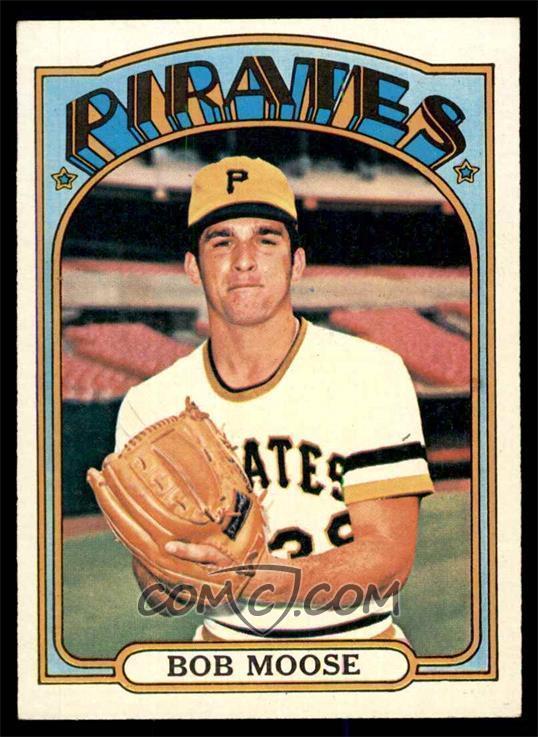
There would be more tragedy. Robert Ralph Moose Jr., a native of the Pittsburgh suburb of Export, Pennsylvania, a key figure on the Pirates' 1971 World Series winners, would be killed in a car crash in Ohio while still with the team, on October 9, 1976 -- his 29th birthday.
Still, he is remembered more for one pitch than for his achievements, or for his death. And he deserves better. The lead was already blown. The Pirates wouldn't have gotten that far without him. He went 13-10 that season, with a 2.91 ERA and a 1.150 WHIP. And he was much more reliable as a starter than as a reliever. Pirate manager Danny Murtaugh should have brought in someone else.
The Pirates should have held their home field advantage. They did win Game 3 at Riverfront. But the Reds won Game 2 at Three Rivers Stadium. Had the Pirates simply held at home, there never would have been a Game 4, let alone a Game 5.
And the Reds were better. True, the Pirates had won 96 games to the Reds' 95. They also scored 19 runs in the series, to the Reds' 15. But in the regular season, the Reds outscored the Pirates 707-691. The Reds had already beaten the Pirates in the 1970 NLCS. When the Pirates won the whole thing the next year, the team they had to beat in the NLCS was not the Reds, but the San Francisco Giants.
Overall, in the 1970s, in NLCS play, the Reds were 4-2, and the Pirates were 2-4. In games, the Reds were 14-8, and the Pirates were 9-13. Against each other, the Reds led 6-5.
Hall-of-Famers? The Pirates had Clemente, Bill Mazeroski and Willie Stargell. But the Reds had Bench, Joe Morgan and Tony Perez, not to mention Pete Rose, who would be in the Hall if he hadn't done something stupid as a manager.
With the 1st all-nonwhite starting lineup, and Clemente's triumph, in '71 and Stargell leading the "Family" in '79, the Pirates were a great story. But the Reds were a great team.
*
October 11, 1972 was a Wednesday. Game 4 of the American League Championship Series was played at Tiger Stadium in Detroit. Jim "Catfish" Hunter of the Oakland Athletics and Mickey Lolich of the Detroit Tigers battled into extra innings.
The A's scored 2 runs in the top of the 10th, but, in the bottom of the 10th, singles by Dick McAuliffe and Al Kaline, a walk by Gates Brown, and an error by Gene Tenace gave the Tigers a run. Norm Cash walked, and Jim Northrup singled home the tying and winning runs, giving the Tigers a 4-3 win and a tie in the series. But the A's won the Pennant the next day.
There were 7 games played in the NHL:

* The New York Rangers beat the Vancouver Canucks, 5-3 at Madison Square Garden. Rod Gilbert scored 2 goals.

* The Montreal Canadiens and the Toronto Maple Leafs, arch-rivals, played to a 2-2 tie at Maple Leaf Gardens in Toronto.

* The Buffalo Sabres beat the Los Angeles Kings, 7-3 at the Buffalo Memorial Auditorium.

* The Detroit Red Wings beat the Boston Bruins, 4-3 at the Olympia Stadium in Detroit.

* The Chicago Black Hawks beat the expansion Atlanta Flames, 4-1 at the Chicago Stadium.

* The Minnesota North Stars beat the California Golden Seals, 5-2 at the Metropolitan Sports Center in the Minneapolis suburb of Bloomington, Minnesota.

* The Pittsburgh Penguins beat the St. Louis Blues, 5-2 at the St. Louis Arena.

* And the expansion New York Islanders and the Philadelphia Flyers were not scheduled.

It was opening night for the World Hockey Association. I have a separate entry for this event. The 1st game is played at the Edmonton Gardens, and the Alberta Oilers -- they would switch from the Province's name to the City's the next season -- beat the Ottawa Nationals 7-4. Ron Anderson scores the team's 1st goal.

The Quebec Nordiques, trying to get good publicity, named Montreal Canadiens legend Maurice "the Rocket" Richard as head coach, but they lose their 1st game, 2-0 to the Cleveland Crusaders at the Cleveland Arena. Richard immediately quits, saying he wasn't meant to be a coach. Nords management asks him to stay on long enough to hire a replacement. They win their 2nd game, but the Rocket has had enough, and Maurice Filion is hired.

Football was in midweek. The American Basketball Association began its season the next day. There were 3 NBA games played:

* The Boston Celtics beat the Detroit Pistons, 121-108 at Cobo Hall (now Huntington Place) in Detroit.

* The Seattle SuperSonics beat the Philadelphia 76ers, 105-100 at The Spectrum in Philadelphia.

* And the Los Angeles Lakers beat the Kansas City-Omaha Kings, 129-94 at the Omaha Civic Auditorium in Omaha, Nebraska.

Also on this day, Australian actress Claudia Black was born. She is known for her roles in the science-fiction TV series Farscape and Stargate SG-1.

Thursday, September 1, 2022

September 1, 1971: MLB's 1st All-Minority Starting Lineup

September 1, 1971: The Pittsburgh Pirates make history -- by accident.

They host their cross-State rivals, the Philadelphia Phillies, at Three Rivers Stadium. Under normal circumstances, the Pirates, defending Champions of the National League Eastern Division, and entering this game with a 4 1/2-game lead over the St. Louis Cardinals -- the hopeless Phillies are 22 1/2 games back -- would take the field with this lineup:

9, 2nd base, Bill Mazeroski
20, 3rd base, Richie Hebner
21, right field, Roberto Clemente
8, left field, Willie Stargell
16, center field, Al Oliver
35, catcher, Manuel "Manny" Sanguillén
7, 1st base, Bob Robertson
2, shortstop, Jacinto "Jackie" Hernández
And that day's starting pitcher.

Clemente, Mazeroski and Stargell have been elected to the Baseball Hall of Fame. Oliver and Sanguillén were All-Stars. And Robertson and Hebner had some power: Later in the decade, the Pirates would be nicknamed "The Lumber Company," before an aging but still slugging "Pops" Stargell proclaimed them "The Family." So this was a very effective lineup.

But there were injuries. Hebner did not play between August 21 and September 4; Robertson, between August 30 and September 4. And Mazeroski had gotten hurt the day before, and would be out until September 5.

This was not an "injury crisis." The Pirates had a deep bench. And manager Danny Murtaugh would use it on this Wednesday night, in front of a crowd of 11,278, who had no idea as they filed into Three Rivers, on the north bank of the Ohio River across from downtown Pittsburgh, that they were going to witness history.

Indeed, Murtagh, a 53-year-old white man from Chester, Pennsylvania, outside Philadelphia, who had managed a Pirate team including Clemente and Mazeroski to win the 1960 World Series, didn't realize it himself as he was making out this lineup:

6 2B Reinaldo "Rennie" Stennett
15 CF Gene Clines
21 RF Roberto Clemente
8 LF Willie Stargell
35 C Manny Sanguillén
30 3B Dave Cash
16 1B Al Oliver
2 SS Jackie Hernández
17 P Dock Ellis ("Dock" was his real name, not a nickname)

Still a pretty good lineup, aside from Ellis, who, like most pitchers, was not a good hitter. Hernández was the only weak spot. Each of the top 6 men in the lineup entered the game batting .300 or better.

But as the Pirate players took the field at 8:05 PM, they looked around, and it dawned on them what had happened: They were all minorities. Clemente, the heart and soul of the team, was a dark-skinned Puerto Rican. Sanguillén was a dark-skinned Cuban. Hernández was a comparatively light-skinned Cuban, but still wouldn't have been accepted as "white" before Jackie Robinson. Stennett was a dark-skinned Panamanian. And Stargell, Oliver, Clines, Cash and Ellis were all African-Americans.

Murtaugh, having long since put aside whatever prejudices he had had, and treating his players equally, had put out the 1st all-black-and/or-Hispanic lineup in baseball history. At first, no one was sure whether this was the 1st time it had been done, but no one could remember it happening before. Research later determined that it hadn't.

Did the lineup work? At first, it wasn't clear that it would. The Phils scored 2 runs in the top of the 1st, but the Bucs scored 5 in the bottom of the 1st. In the 2nd, the Phils scored 4, to take a 6-5 lead, but the Pirates came back to take an 8-6 lead, thanks in part to a home run by Sanguillén. And that was just in the 1st 2 innings.

Stennett, Clines, Clemente, Stargell and Sanguillén each got 2 hits. Clemente, Stargell and Sanguillén each had 2 RBIs. Pitching was an issue: Ellis did not have good stuff, and left the game in the 2nd inning. He was replaced by Bob Moose, who was white. In the 3rd, he was replaced by Bob Veale, black. In the 4th, he was replaced by Luke Walker, white, who pitched the rest of the way, and was credited as the winning pitcher. Final score: Pirates 10, Phillies 7. In other words, Murtaugh's unintentionally-historic lineup got the job done.

By September 5, the injured starters had returned. The Pirates won the NL East by 7 games over the Cardinals. In the NL Championship Series, they beat the San Francisco Giants, 3 games to 1, to win their 1st Pennant in 11 years. They fell behind the Baltimore Orioles 3 games to 1, but, with Clemente getting a hit in every game, including 2 home runs, with 4 RBIs, and stellar defensive play, the Pirates came back to win the World Series in 7 games. With this 2nd World Series win, Murtaugh, like Clemente, Mazeroski and Stargell, secured his election to the Hall of Fame.

In 2009, baseball historian Bruce Markusen published The Team That Changed Baseball: Roberto Clemente and the 1971 Pittsburgh Pirates. He argued that, by being fully-integrated -- at their peak, nearly half the roster, 12 out of 25, was black and/or Hispanic -- the '71 Pirates paved the way for the well-integrated teams that would dominate the decade: The Oakland Athletics, the Cincinnati Reds, and, later, the New York Yankees.

And 2 teams that had long resisted integration would get it done, and have their best periods for a while: The Boston Red Sox were the last team in MLB to integrate, yet the won the American League Pennant in 1975, with near-misses for the AL Eastern Division in 1972, '74, '77 and '78; while the Phillies, the last team in the NL to integrate, won 3 straight NL East titles from 1976 to '78, won the World Series in 1980, made the Playoffs again in '81, and won another Pennant in '83.

Here's why it was a big deal: As pitcher Jim Bouton noted in Ball Four, his diary of the 1969 season, the defending World Champions were the Detroit Tigers, and yet they had only 3 black players on their roster: Willie Horton, one of the top sluggers of that generation; Gates Brown, recognized as the best pinch-hitter in the game; and Earl Wilson, who had been the 1st black pitcher to throw a no-hitter in the AL, and was good enough to be the ace on some teams, but was behind Denny McLain and Mickey Lolich on the Tigers.

Bouton, white, realized that, in order to be black and in the major leagues, you had to be a genuine star. If you were an average player, they weren't going to take a chance on you. But the '68 Tigers had Don Wert as their starting 3rd baseman, and he batted just .200; while Ray Oyler, Bouton's teammate on the 1969 Seattle Pilots, had been the main shortstop for the '68 Tigers, and he batted just .135. Even for "The Year of the Pitcher," that was pathetic. So to take that hole out of their lineup, once the future Hall-of-Famer Al Kaline returned from injury to right field, his replacement, Mickey Stanley, was moved to shortstop. He batted .259. There were black shortstops and 3rd basemen who could hit as well as Stanley, and better than Oyler and Wert, but the Tigers made no effort to acquire them.

But after the '71 Pirates, teams finally accepted that they couldn't win without black talent in numbers, whether their 1st language was English or Spanish.

*

September 1, 1971, as I said, was a Wednesday. These other games were played in Major League Baseball that day:

* The New York Yankees lost to the Washington Senators, 2-0 at Yankee Stadium. Bill Gogolewski pitched a 4-0 hit shutout to beat Steve Kline, who got 1 of the hits. Thurman Munson did not, going 0-for-4. 

* The New York Mets beat the St. Louis Cardinals, 7-1 at Busch Memorial Stadium in St. Louis. Tom Seaver outpitched Bob Gibson. Bud Harrelson went 3-for-5, and Ken Boswell went 2-for-3 with a walk and 2 RBIs. Lou Brock went 0-for-4. Joe Torre went 1-for-4 with an RBI.

* The Baltimore Orioles beat the Boston Red Sox, 8-2 at Fenway Park in Boston. Brooks Robinson went 1-for-4 with a walk. Frank Robinson did not play. Instead, Merv Rettenmund played right field, and hit a home run. Carl Yastrzemski went 2-for-4 with an RBI.

* The San Diego Padres beat the Cincinnati Reds, 3-1 at Riverfront Stadium in Cincinnati. Pete Rose went 0-for-4. Johnny Bench went 0-for-3 with a walk.

* The Detroit Tigers beat the Cleveland Indians, 4-3 at Tiger Stadium in Detroit. Al Kaline went 1-for-4.

* The Chicago Cubs beat the Montreal Expos, 5-2 at Wrigley Field in Chicago. Fergie Jenkins went the distance for the win, and helped his own cause with 2 home runs. Ernie Banks, entering his final month as a major league player, did not play.

* The Milwaukee Brewers beat the Kansas City Royals, 3-2 at Milwaukee County Stadium.

* The Chicago White Sox beat the Minnesota Twins, 2-0 at Metropolitan Stadium in the Minneapolis suburb of Bloomington, Minnesota. Carlos May singled home the winning run in the top of the 11th inning. Harmon Killebrew went 1-for-4 with a walk. Rod Carew went 0-for-3 with a walk.

* The Los Angeles Dodgers beat the Houston Astros, 9-2 at the Astrodome in Houston.

* The Oakland Athletics beat the California Angels, 7-0 at Anaheim Stadium (now Angel Stadium of Anaheim). Chuck Dobson pitched a 7-hit shutout. Reggie Jackson went 3-for-5 with a home run and 2 RBIs.

* And the San Francisco Giants beat the Atlanta Braves, 4-0 at Candlestick Park in San Francisco. John Cumberland pitched a 4-hit shutout. Willie Mays did not play. Hank Aaron went 0-for-4.

Wednesday, July 13, 2022

July 13, 1971: The Shelling of Tiger Stadium

Reggie Jackson

July 13, 1971: Major League Baseball holds its All-Star Game at Tiger Stadium in Detroit. It was a ballpark that strongly favored hitters, but nobody expected the onslaught that came that night.

For the 1st time in All-Star Game history, both starting pitchers were black: For the American League, Vida Blue of the Oakland Athletics; for the National League, Dock Ellis of the Pittsburgh Pirates. The year before, Ellis had pitched a no-hitter, which he later claimed to have done while under the influence of the drug LSD. From September 11, 1970 to August 15, 1971, Blue was 24-4 with an ERA of 1.76. That remains one of the best stretches of starting pitching in the post-1968, 10-Inch Mound Era.

Tiger Stadium was a hitter's park, with a 325-foot right field pole, an overhanging upper deck that made it even closer, and close power alleys on both sides. And, on this night, a strong wind was blowing out to right field.
Tiger Stadium set up for the 1971 All-Star Game.
Note the red, white and blue stars in the outfield.
It got the familiar blue and orange seats in the 1977-78 off-season.

In the top of the 2nd inning, with Ellis' Pirate teammate Willie Stargell on 1st base, Johnny Bench of the Cincinnati Reds, the previous season's (and the next season's) NL Most Valuable Player, hit a 2-run home run to the opposite field, to make the score 2-0 in the NL's favor. In the top of the 3rd, Hank Aaron hit one to the opposite field, also wind-aided. Although he would become the game's all-time home run leader, this was his 1st extra-base hit in an All-Star Game, in his 18th season. It was 3-0 NL.

Luis Aparicio, the former Chicago White Sox shortstop now playing with the Boston Red Sox, singled to lead off the bottom of the 3rd. The AL manager, Earl Weaver of the Baltimore Orioles, sent Reggie Jackson up to pinch-hit for Blue, his Oakland teammate. Reggie was already one of the top sluggers in the game, but nobody expected this: He crushed a drive that looked like it might clear the right-field roof. Instead, it hit the transformer of a light tower. It became Reggie's signature moment -- until the 1977 World Series.
The transformer is the box at the lower right of this light tower.

The AL was not done for the inning. Rod Carew of the Minnesota Twins walked. Bobby Murcer of the New York Yankees popped up. Carl Yastrzemski of the Red Sox hit one against the wind, to left field, and it was held up so that the shortstop, Bud Harrelson of the New York Mets, caught it. That brought up Frank Robinson of the Orioles, and he hit a home run with the wind to right field. The AL led, 4-3.

In the bottom of the 6th, against Ferguson Jenkins of the Chicago Cubs, Al Kaline of the host Detroit Tigers singled, and Harmon Killebrew of the Twins, like Jackson one of the few sluggers with enough power to beat the kind of wind this game had, did so, into the upper deck in left field. That made it 6-3.

In the top of the 8th, Mickey Lolich of the Tigers came in to pitch, to the delight of the home crowd. He gave up an opposite-field home run to Roberto Clemente of the Pirates. That made the score 6-4 AL, but the NL got no closer. Although previous pitchers have been retroactively credited with saves in All-Star Game competition, Lolich was the 1st one to be credited with one after the stat's official recognition in 1969.

Lolich ended up winning more games that season than Blue, going 25-14 to Blue's 24-8. But Blue edged Lolich in the voting of the AL's Cy Young Award, and also won the AL's MVP. For many years, my schoolmates, knowing I was a baseball trivia whiz, tried to trip me up with a trick question: Who was the last switch-hitter to win the MVP? In the AL, it was a pitcher, Blue. But they tended to forget that Pete Rose was a switch-hitter, and had won it in the NL in 1973, so he was the answer.

Since then, in the NL, it's been won by switch-hitters Willie McGee in 1985, Terry Pendleton in 1991, Ken Caminiti in 1996, Chipper Jones in 1999, and Jimmy Rollins in 2007. But Vida Blue remains the last switch-hitter to win the Most Valuable Player award in the American League.

In 1978, pitching for the San Francisco Giants, Blue was selected as the National League's starting pitcher. This made him the 1st pitcher to start the All-Star Game for both Leagues.

On May 15, 1984, playing for the team then known as the California Angels, on an NBC Game of the Week, Reggie Jackson, 38 years old, finally hit a home run over the roof of Tiger Stadium. It was the 485th homer of his career.

The 6 Hall-of-Famers who hit home runs in the 1971 All-Star Game would finish as follows: Hank Aaron, 755; Frank Robinson, 586; Harmon Killebrew 573, Reggie Jackson, 563; Johnny Bench, 389; Roberto Clemente, 240.

Clemente's total doesn't sound like much, but he played most of his home games at Forbes Field in Pittsburgh, whose dimensions were similar to those of the pre-renovation original Yankee Stadium: Close in right field, too far everywhere else. In contrast, Aaron and Clemente were the only ones of this group to collect at least 3,000 hits, and Clemente's .317 lifetime batting average was easily higher than any of the others.

Tiger Stadium was the home of the Detroit Tigers from 1912 to 1999, and the NFL's Detroit Lions from 1938 to 1974. It was named Navin Field from 1912 to 1937, and Briggs Stadium from 1938 to 1960. There were over 30 home runs hit over the right field roof, including 4 by the Tigers' Norm Cash, and 2 by the Yankees' Mickey Mantle, as a switch-hitter batting lefthanded.

But only 4 players hit one over the left-field roof: Harmon Killebrew, Frank Howard, Cecil Fielder and Mark McGwire. Mantle certainly had the power to hit one over the left field roof batting righthanded, having done so twice at Comiskey Park in Chicago and once at Shibe Park in Philadelphia, but he never did that at Tiger Stadium.

Tiger Stadium had also hosted the All-Star Game in 1941 and 1951. Its successor, Comerica Park, hosted its 1st All-Star Game in 2005.

*

July 13, 1971 was a Tuesday, as the day of the All-Star Game usually is. There were no other scores on this historic day.

December 31, 1999 & January 1, 2000: The Millennium

December 31, 1999:  The Millennium arrives. The people of planet Earth survived. At a terrible cost. But we hadn't destroyed ourselves. ...