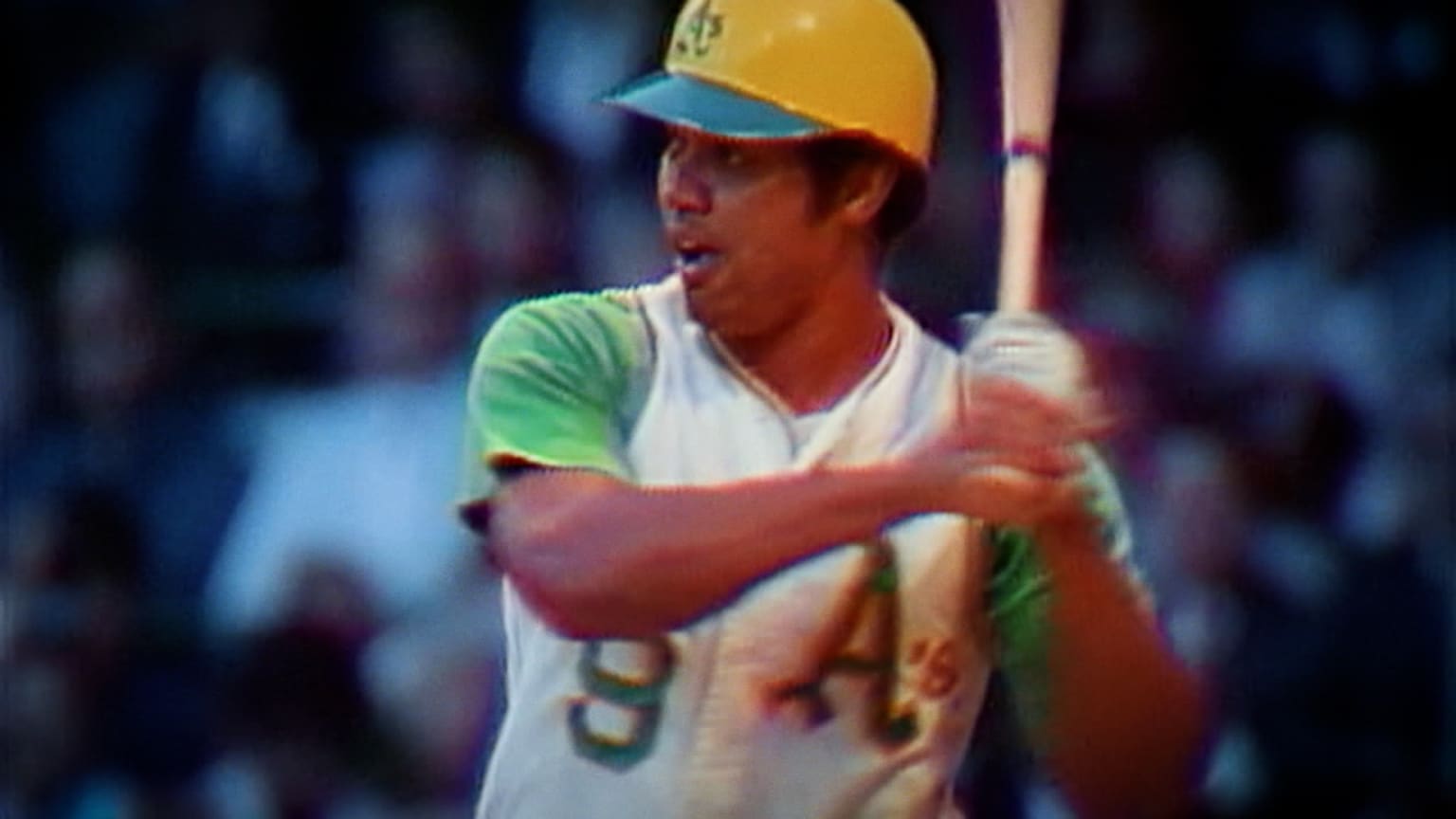
Reggie Jackson
July 13, 1971: Major League Baseball holds its All-Star Game at Tiger Stadium in Detroit. It was a ballpark that strongly favored hitters, but nobody expected the onslaught that came that night.
For the 1st time in All-Star Game history, both starting pitchers were black: For the American League, Vida Blue of the Oakland Athletics; for the National League, Dock Ellis of the Pittsburgh Pirates. The year before, Ellis had pitched a no-hitter, which he later claimed to have done while under the influence of the drug LSD. From September 11, 1970 to August 15, 1971, Blue was 24-4 with an ERA of 1.76. That remains one of the best stretches of starting pitching in the post-1968, 10-Inch Mound Era.
Tiger Stadium was a hitter's park, with a 325-foot right field pole, an overhanging upper deck that made it even closer, and close power alleys on both sides. And, on this night, a strong wind was blowing out to right field.

Tiger Stadium set up for the 1971 All-Star Game.
Note the red, white and blue stars in the outfield.
It got the familiar blue and orange seats in the 1977-78 off-season.
In the top of the 2nd inning, with Ellis' Pirate teammate Willie Stargell on 1st base, Johnny Bench of the Cincinnati Reds, the previous season's (and the next season's) NL Most Valuable Player, hit a 2-run home run to the opposite field, to make the score 2-0 in the NL's favor. In the top of the 3rd, Hank Aaron hit one to the opposite field, also wind-aided. Although he would become the game's all-time home run leader, this was his 1st extra-base hit in an All-Star Game, in his 18th season. It was 3-0 NL.
Luis Aparicio, the former Chicago White Sox shortstop now playing with the Boston Red Sox, singled to lead off the bottom of the 3rd. The AL manager, Earl Weaver of the Baltimore Orioles, sent Reggie Jackson up to pinch-hit for Blue, his Oakland teammate. Reggie was already one of the top sluggers in the game, but nobody expected this: He crushed a drive that looked like it might clear the right-field roof. Instead, it hit the transformer of a light tower. It became Reggie's signature moment -- until the 1977 World Series.

The transformer is the box at the lower right of this light tower.
The AL was not done for the inning. Rod Carew of the Minnesota Twins walked. Bobby Murcer of the New York Yankees popped up. Carl Yastrzemski of the Red Sox hit one against the wind, to left field, and it was held up so that the shortstop, Bud Harrelson of the New York Mets, caught it. That brought up Frank Robinson of the Orioles, and he hit a home run with the wind to right field. The AL led, 4-3.
In the bottom of the 6th, against Ferguson Jenkins of the Chicago Cubs, Al Kaline of the host Detroit Tigers singled, and Harmon Killebrew of the Twins, like Jackson one of the few sluggers with enough power to beat the kind of wind this game had, did so, into the upper deck in left field. That made it 6-3.
In the top of the 8th, Mickey Lolich of the Tigers came in to pitch, to the delight of the home crowd. He gave up an opposite-field home run to Roberto Clemente of the Pirates. That made the score 6-4 AL, but the NL got no closer. Although previous pitchers have been retroactively credited with saves in All-Star Game competition, Lolich was the 1st one to be credited with one after the stat's official recognition in 1969.
Lolich ended up winning more games that season than Blue, going 25-14 to Blue's 24-8. But Blue edged Lolich in the voting of the AL's Cy Young Award, and also won the AL's MVP. For many years, my schoolmates, knowing I was a baseball trivia whiz, tried to trip me up with a trick question: Who was the last switch-hitter to win the MVP? In the AL, it was a pitcher, Blue. But they tended to forget that Pete Rose was a switch-hitter, and had won it in the NL in 1973, so he was the answer.
Since then, in the NL, it's been won by switch-hitters Willie McGee in 1985, Terry Pendleton in 1991, Ken Caminiti in 1996, Chipper Jones in 1999, and Jimmy Rollins in 2007. But Vida Blue remains the last switch-hitter to win the Most Valuable Player award in the American League.
In 1978, pitching for the San Francisco Giants, Blue was selected as the National League's starting pitcher. This made him the 1st pitcher to start the All-Star Game for both Leagues.
On May 15, 1984, playing for the team then known as the California Angels, on an NBC Game of the Week, Reggie Jackson, 38 years old, finally hit a home run over the roof of Tiger Stadium. It was the 485th homer of his career.
The 6 Hall-of-Famers who hit home runs in the 1971 All-Star Game would finish as follows: Hank Aaron, 755; Frank Robinson, 586; Harmon Killebrew 573, Reggie Jackson, 563; Johnny Bench, 389; Roberto Clemente, 240.
Clemente's total doesn't sound like much, but he played most of his home games at Forbes Field in Pittsburgh, whose dimensions were similar to those of the pre-renovation original Yankee Stadium: Close in right field, too far everywhere else. In contrast, Aaron and Clemente were the only ones of this group to collect at least 3,000 hits, and Clemente's .317 lifetime batting average was easily higher than any of the others.
Tiger Stadium was the home of the Detroit Tigers from 1912 to 1999, and the NFL's Detroit Lions from 1938 to 1974. It was named Navin Field from 1912 to 1937, and Briggs Stadium from 1938 to 1960. There were over 30 home runs hit over the right field roof, including 4 by the Tigers' Norm Cash, and 2 by the Yankees' Mickey Mantle, as a switch-hitter batting lefthanded.
But only 4 players hit one over the left-field roof: Harmon Killebrew, Frank Howard, Cecil Fielder and Mark McGwire. Mantle certainly had the power to hit one over the left field roof batting righthanded, having done so twice at Comiskey Park in Chicago and once at Shibe Park in Philadelphia, but he never did that at Tiger Stadium.
Tiger Stadium had also hosted the All-Star Game in 1941 and 1951. Its successor, Comerica Park, hosted its 1st All-Star Game in 2005.
*
July 13, 1971 was a Tuesday, as the day of the All-Star Game usually is. There were no other scores on this historic day.


No comments:
Post a Comment