Showing posts with label dublin. Show all posts

Monday, November 21, 2022

November 21, 1920: Croke Park's Bloody Sunday

November 21, 1920: Ireland has had a few tragic days in its history that have become known as "Bloody Sunday." This is one of them.

Michael Hogan, 24, was a player in Gaelic football, Ireland's take on the sport. He played right full back, and was Captain of the Tipperary County team. He was also an officer in the Irish Volunteers, a paramilitary organization whose declared primary aim was "to secure and maintain the rights and liberties common to the whole people of Ireland."
Croke Park, as it would have appeared at the time

On November 21, 1920, with the Irish War of Independence ongoing, he played for Tipperary in a challenge match against Dublin County, at Croke Park in Dublin, the classic home of Gaelic football. During the game, officers of the Royal Ulster Constabulary, Protestants in the British Army, entered the stadium. In retaliation for General Michael Collins' "Squad" having killed 15 members of the Cairo Gang, a group of British Intelligence officers, earlier in the day, these "Black and Tans," already known and hated for their extrajudicial killings, and opened fire.

Hogan was 1 of 14 people killed. He died in the arms of his teammate, Tommy Ryan, who heard his last words: "Jesus, Mary and Joseph, I'm done for." Another teammate, Jim Egan, was wounded, but survived.

This was the middle portion of an all-day assault by the RUC. In the morning, they opened fire at the Gresham Hotel. At night, they shot people at Dublin Castle. At least 30 people died on the day.
A modernized Croke Park

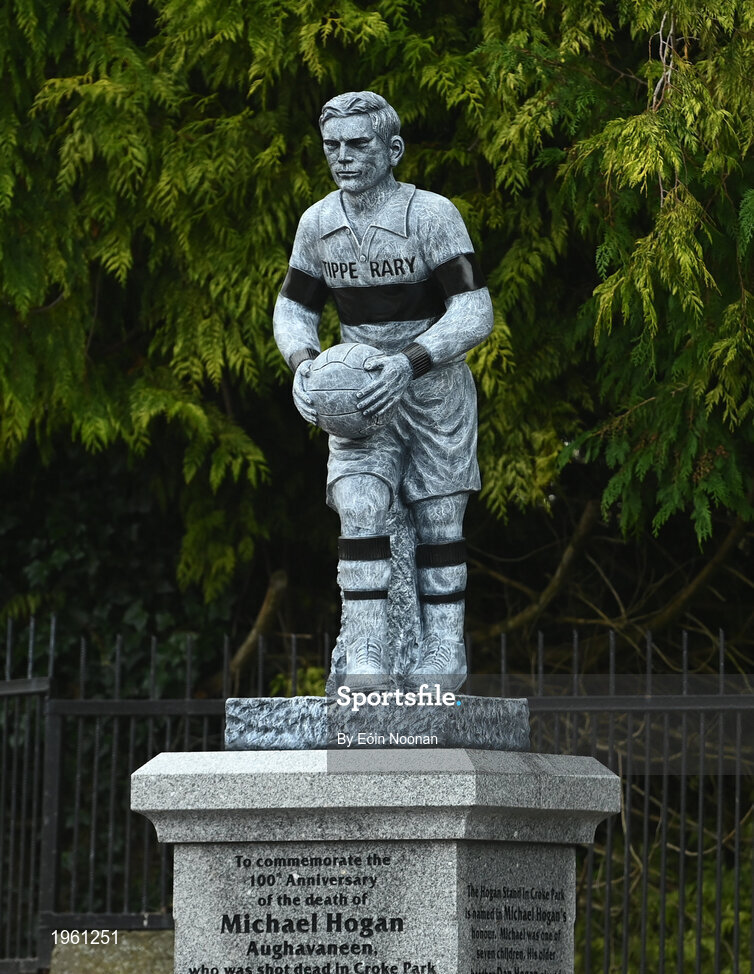
In 1924, a new stand was built at Croke Park. It was named the Hogan Stand in his memory. In 1999, as part of the stadium's redevelopment, a new Hogan Stand was built. A plaque at the now 82,300-seat stadium commemorates Bloody Sunday, including Hogan's death. A statue of Hogan has been dedicated in Tipperary.

Other "Bloody Sundays" in Ireland include August 31, 1913, when the Dublin Metropolitan Police killed 1 demonstrator and injured 400; July 10, 1921, when the IRA and the police fought in Belfast, with 20 dead, over 100 wounded, and over 200 houses destroyed; and, due to being the most recent, the most familiar of these, January 30, 1972, "The Battle of the Bogside," when an intended peace demonstration in Derry was fired upon, killing 14 people.

*

November 21, 1920 was a Sunday. Baseball was out of season. The NBA hadn't been founded yet. And the NHL season was a month away from starting. The NFL was in its 1st season, then named the American Professional Football Association. There were 7 games played, and 6 of them ended in shutouts. This was not unusual for that era:

* The Rochester Jeffersons beat a cross-town team that wasn't in the NFL, the Rochester Scalpers, 16-0 at the Rochester Baseball Park in Rochester, New York.

* The Canton Bulldogs beat the Buffalo All-Americans, 3-0 at Canisius Field in Buffalo.

* The Cleveland Tigers beat the Toledo Maroons, 14-0 at League Park in Cleveland.

* The Akron Pros beat the Dayton Triangles, 13-0 at League Park in Akron, Ohio.

* The Columbus Panhandles and a non-NFL team, Zanesville Mark Gray, played to a 0-0 tie at Neil Park in Columbus, Ohio.

* The Chicago Cardinals beat a non-NFL team, Lansing Oldsmobile, 14-0 at Normal Park on the South Side of Chicago.

* And the Decatur Staleys, the team that would become the Chicago Bears, beat the Hammond Pros, 28-7 at Staley Field in Decatur, Illinois.

Tuesday, November 1, 2022

November 1, 1920: William Butler Yeats Publishes "The Second Coming"

November 1, 1920: American literary magazine The Dial publishes "The Second Coming," a poem by William Butler Yeats.

Born on June 13, 1865 on the Southside of Dublin, Ireland, Yeats (pronounced like "yates") was a Protestant who became fascinated by poetry and by early Irish legends. He was first published in 1889, but by 1900, his poetry grew more physical and politicized.

With Ireland still in the British Empire, and its men forced to fight for an occupying force in World War I, leading to the Easter Rising of 1916 and the Irish struggle for independence, Yeats wrote "An Irish Airman Foresees His Death," published in 1919 after the war's end:

I know that I shall meet my fate
Somewhere among the clouds above;
Those that I fight I do not hate
Those that I guard I do not love.

World War I scarred so many, in so many ways. And, though they began during the war, neither the Irish struggle for independence nor the Spanish Flu epidemic ended with it. Indeed, Yeats' wife, Georgia Hyde-Lees, caught the flu, while pregnant, and she and the baby barely survived.

Things really did seem to be falling apart, and Yeats' poem "The Second Coming," rather than suggest the Second Coming of the Messiah, seemed to suggest the end of the world:

Turning and turning in the widening gyre
The falcon cannot hear the falconer;
Things fall apart; the centre cannot hold;
Mere anarchy is loosed upon the world,
The blood-dimmed tide is loosed, and everywhere
The ceremony of innocence is drowned;
The best lack all conviction, while the worst
Are full of passionate intensity.

Surely some revelation is at hand;
Surely the Second Coming is at hand.
The Second Coming! Hardly are those words out
When a vast image out of Spiritus Mundi
Troubles my sight: somewhere in sands of the desert
A shape with lion body and the head of a man,
A gaze blank and pitiless as the sun,
Is moving its slow thighs, while all about it
Reel shadows of the indignant desert birds.
The darkness drops again; but now I know
That twenty centuries of stony sleep
Were vexed to nightmare by a rocking cradle,
And what rough beast, its hour come round at last,
Slouches towards Bethlehem to be born?

In 1923, Yeats was awarded the Nobel Prize for Literature. He died on January 28, 1939, at the age of 73, having survived the post-World War I "mere anarchy," and the Great Depression, but knowing that World War II was on the horizon. Shortly before his death, he published "The Municipal Gallery Revisited," in which he wrote, "Think where man's glory most begins and ends, and say my glory was I had such friends."

Georgie lived on until 1968. Daughter Anne, born during the Spanish Flu epidemic, became a costume and stage designer, and then an esteemed painter, and lived until 2001. Son Michael became a lawyer, and was elected to the Irish Senate, the Seanad Éireann. He lived until 2007, and the poet's genetic line continues through Michael's children and grandchildren.

*

November 1, 1920 was a Monday. There were 2 other reasons that this was a big day in the history of writing. Eugene O'Neill's play The Emperor Jones premiered on Broadway. I have a separate entry for that event. And conservative newspaper columnist James J. Kilpatrick was born.

Baseball was out of season. Football was in midweek. Professional basketball barely existed. And the NHL season didn't start until December 22. So there were no scores on this historic day.

Monday, October 31, 2022

November 1, 1884: The Gaelic Athletic Association Is Founded

November 1, 1884: The Gaelic Athletic Association is founded at Hayes's Hotel in Thurles, County Tipperary, in what's now the Republic of Ireland. The GAA governs the traditional Irish sports such as hurling and Gaelic football -- but not Irish soccer, which is governed by the Football Association of Ireland (FAI). The Northern Ireland equivalent is the Irish Football Association (IFA).
For decades, Irish athletes resisted the sports that England were first to organize: Association football (soccer), rugby, and cricket. So they developed their own version of football, and rounders (a baseball-like game then less popular in England than cricket), and hurling. For girls, the game of canogie was invented, sort of a cross between field hockey and lacrosse.
By the 1960s, the growth of television allowed Irish people to see English sports more easily, and they decided to try to, literally, beat the English at their own games. An Ireland rugby team, made up of both Republic of Ireland players and Norther Ireland players, has been very successful. In soccer, though the Republic team (run by the Football Association of Ireland, or FAI) and the Northern Ireland team (run by the Irish Football Association, or IFA) remain separate, and tend not to do well.
The GAA also promotes Irish music and dance, as well as the Irish language, and it also promotes environmental stewardship through its Green Clubs initiative. Today, it is headquartered at Croke Park, the 82,300-seat national stadium, in Dublin. A GAA museum is at the stadium.
*
November 1, 1884 was a Saturday. In America, baseball was the most popular sport, especially among its many Irish immigrants, but the season was over. But some Irish turned to American-style football, due to its closer to resemblance to the Gaelic version and rugby than to English soccer. These were still the early days of college football, and only 4 games were played that day:
* Wesleyan University, of Middletown, Connecticut, beat Harvard, 16-0 at the Hartford Ball Club Grounds in Hartford, Connecticut.
* Rutgers beat Lehigh, 61-0 at College Field in New Brunswick, New Jersey.
* The College of New Jersey, renamed Princeton University in 1896, beat Stevens Institute of Technology, of Hoboken, New Jersey, at University Field in Princeton, New Jersey.
* And the University of Pennsylvania beat Lafayette, 21-0 at the University Athletic Grounds in Philadelphia.

Monday, July 18, 2022

July 18, 1938: The Wrong-Way Flight of Douglas Corrigan

July 18, 1938: Douglas Corrigan writes his name in the book of the history of aviation. Many people involved in aviation at the time wished he hadn't.

Born in Galveston, Texas in 1907, he became fascinated with airplanes while growing up in Los Angeles, became an airplane mechanic, and got his pilot's license at age 19. Working in San Diego in April 1927, he was part of the assembly crew for the Spirit of St. Louis, which Charles Lindbergh used to fly solo across the Atlantic Ocean the next month, from New York's Long Island to Paris.

Intrigued by this success, Corrigan, of Irish descent, decided he wanted to fly from New York to Ireland. To raise money to buy his own plane, he performed aerobatic stunts. But this would inevitably get him fired from his mechanic jobs, and he moved around, delaying his dream trip.

In 1935, having finally assembled a Curtiss Robin, but with parts from various other planes -- similar to the later Johnny Cash song "One Piece at a Time" -- he applied to the Bureau of Air Commerce, forerunner of the Federal Aviation Administration (FAA), for permission to make a nonstop flight from New York to Ireland. Although the BAC deemed his plane fit for transcontinental flights over land, it did not think it was flightworthy for crossing water, and turned him down for that purpose.

He refused to accept that his dream was dead. He kept modifying his plane, and reapplying, but was always turned down. Finally, on July 9, 1938, he applied for permission to fly the plane from San Diego to Floyd Bennett Field in Brooklyn and back, and got it. Upon arrival at Bennett Field, he filed a flight plan to return to San Diego on July 17.

That morning, he asked Kenneth Behr, manager of Bennett Field, which runway he should use. Behr said he could use any runway, as long as he didn't take off to the west, in the direction of the administration building where Behr had his office, so that he didn't crash into it, which would not only have killed Corrigan, but left Behr without an office.

So Behr thought nothing of it when, at 5:15 AM on July 17, Corrigan took off from Runway 06, heading east, figuring Corrigan would, given sufficient ground clearance, turn around and head west. He had no reason to believe Corrigan was doing anything other than what he said he would do.

Corrigan had no radio, so he couldn't contact anyone and ask if he was going the right way. His compass was 20 years old, and may not have been working properly. After 10 hours of flight, Corrigan noticed that his feet were cold. He looked down, and saw that gasoline was leaking from one of his tanks. He took a screwdriver, and punched a hole through the cockpit floor, draining the gasoline. This fact, which he later freely admitted, would, alone, have contradicted his stated intention to fly west from Brooklyn to San Diego, and his later statement that he only noticed his "error" 26 hours into his flight.

On July 18, at 2:28 PM local time, 28 hours and 13 minutes into his flight, Corrigan landed -- not in San Diego, or anywhere else in the Western Hemisphere, but at Baldonnel Aerodrome, outside Dublin, Ireland. If anything, his flight was more audacious than Lindbergh's: He had not the best plane that money could have bought at the time, but, rather, a "flying coffin" that he had personally jerry-rigged; and he had no one who knew what he was really doing.

Those awaiting him on the ground in San Diego would receive word by telegraph that he had landed safely in Ireland. Had he crashed into the ocean, no one would have ever known what happened, and the searchers, from New York to California, would have been looking over 2,700 miles of the wrong place. He would have been just a footnote in the history of early aviation.

Instead, he was an instant celebrity, hailed by the press as "Wrong Way Corrigan." Aviation officials sent a 600-word telegram to list the regulations broken by his flight, in a medium that encouraged brevity by charging at a rate per word. Despite the extent of Corrigan's illegality, he received only a mild punishment: His pilot's certificate was suspended for 14 days.

Upon his return to New York -- he and his plane came back by ship, arriving on the last day of his suspension -- the City gave him a ticker-tape parade, and more people attended his than Lindbergh's. He accepted an invitation to meet President Franklin D. Roosevelt at the White House.

He had a ghostwritten autobiography, titled That's My Story (with the implied follow-up: "And I'm sticking to it!"), that came out in time to be given as a Christmas present. He sent Lindbergh a copy, and Lindbergh responded with a friendly 4-page handwritten letter. Corrigan endorsed "wrong-way" products, including a wristwatch that ran counter-clockwise.

In 1939, he played himself in the film The Flying Irishman. He was paid $75,000, about 30 years' worth of income as an airfield mechanic. In World War II, he tested newly-built bomber planes. Afterward, he was a commercial pilot for a small California airline, always arriving where he said he would -- although, given the nature of air travel, not always on time, not that it was usually his fault. In 1950, he bought an orange grove in the Los Angeles suburb of Santa Ana, California. He lived there with his wife and 3 sons.

In 1957, he appeared on the TV game show To Tell the Truth. With help from the 2 stand-ins, he stumped the panel, including fellow Irish-American Bill Cullen, although he continued to push the lie that he had arrived in Ireland by mistake. (Given the additional 19 years, and the fact that he hadn't been seen on TV frequently in the interim, it was very possible for the panelists not to recognize the real Corrigan.)

He died in 1995, at the age of 88, sticking to his story until the end. His plane is now on display at the Planes Of Fame Air Museum in the Los Angeles suburb of Chino, California.

*

July 18, 1938 was a Monday. British rock keyboard player Ian Stewart and Dutch film director Paul Verhoeven was born on this day.

Only 3 baseball games were played:

* The New York Giants lost to the Pittsburgh Pirates, 7-4 at Forbes Field in Pittsburgh. Paul Waner went 2-for-3 with a walk. Lloyd Waner went 1-for-3 with 2 RBIs. Mel Ott went 2-for-3 with a walk and an RBI.

* The Chicago Cubs beat the Boston Bees (as the Braves were known from 1936 to 1940), 7-6 at Wrigley Field in Chicago.

* And the St. Louis Cardinals beat the Philadelphia Phillies, 5-3 at Sportsman's Park in St. Louis.

Tuesday, May 24, 2022

May 25, 1895: Oscar Wilde Is Convicted

May 25, 1895: Oscar Wilde is convicted of "gross indecency," and sentenced to 2 years in prison, at hard labor. It concludes one of the most shocking scandals of Victorian Britain.

Born in Dublin, Ireland (then ruled by Britain) on October 16, 1854, Oscar Fingal O'Flahertie Wills Wilde was a child of intellectuals, and excelled at Dublin's Trinity College, and then at Oxford University. He began publishing poetry in the 1880s, allowing him to move in London's fashionable circles.

He published his first collection of poems in 1881. Critics didn't like it: A reviewer in the popular magazine Punch wrote, "The poet is Wilde, but his poetry's tame." But it sold well, and he became a popular lecturer, discussing literature, art and fashion.

In 1882, he was hired for a lecture tour in America. He proved popular here as well, although his eccentricities did not please everyone. This was reflected in a 1958 episode of the TV Western Have Gun -- Will Travel, in which Wilde, incorrectly referred to as an Englishman, was played by Australian actor John O'Malley.

In 1884 he married Constance Lloyd. They had 2 sons, Cyril and Vyvyan. This may come as a surprise to people who only know Oscar for one thing: The reason for his trial. At any rate, Constance also became a published author: In 1888, she published There Once Was, a collection of children's stories she'd heard from her grandmother. Vyvyan went on to write a memoir, and said that, while Oscar was a loving father, he was often an absent husband.

In 1886, having been completely turned by his wife's back-to-back pregnancies, Oscar met Robert Ross, who was 17 (to Oscar's 31), and, as one account politely put it, "seemed unrestrained by the Victorian prohibition against homosexuality." To put it in modern terms, he was not afraid to be his true self, and Oscar fell for him. Ross became a journalist, and, while his affair with Wilde did not last, they remained friends for the rest of Wilde's life.

It may have been that Oscar's personality was already, to use the stereotype so often used for gay men in 20th Century America, "flamboyant." But Ross' example may have inspired him to do what some such men, like Charles Nelson Reilly and Paul Lynde, would later do: Come as close as he could to advertising his gayness, without actually saying the words.

In 1890, Lippincott's Monthly Magazine began serializing his novel The Picture of Dorian Gray. It told of a man who saw a painting of himself as a handsome young man, and he wished he could be that young and handsome forever. He begins to do rotten things, and every time he does, he stays the same, while his portrait begins to look meaner and older. Within 20 years, he's still young, while his portrait looks like a nasty old man. The story made Wilde a legend. It was published as a full novel in 1891.

He turned to writing plays: Lady Windermere's Fan was staged in 1892, A Woman of No Importance in 1893, and An Ideal Husband and The Importance of Being Earnest in 1895. At the age of 40, he was one of the most popular writers in the English language.

And he loved being a celebrity. Among the many witty sayings attributed to him is this: "There is one thing worse than being talked about, and that is not being talked about."

In 1891, Oscar met Lord Alfred Douglas. He was 20 years old, a student at Oxford, and the son of John Douglas, the 9th Marquess of Queensberry. A boxing and horse racing enthusiast, he is best known as the sponsor of the modern rules of boxing, known as "The Marquess of Queensberry Rules." In fact, he didn't write them: A Welsh rowing champion named John Graham Chambers did, in 1867. So the Marquess was a fraud, and if there is a hero in the story about to be told, he is not it.

The relationship between Oscar and Lord Alfred was stormy, a real "Can't live with you, can't live without you" affair. When the Marquess found out, he wrote to Lord Alfred and threatened to disown him. He threatened to "make a public scandal in a way you little dream of." Alfred wrote back, saying, "I detest you," and that if it came down to a fight between his father and Oscar, he would take Oscar's side "with a loaded revolver."

In 1894, Lord Alfred's eldest brother, Francis, Viscount Drumlanrig, who stood to become the 10th Marquess, died in what was ruled a hunting accident. There was a rumor that he, too, was in a gay relationship -- with, of all people, the man to whom he was private secretary, Archibald Primrose, the 5th Earl of Rosebery, then the Prime Minister of Great Britain. (Rosebery was a widower, with 4 children, and the rumor probably wasn't true.) There was another brother older than Lord Alfred, who would now inherit the title. But the current Marquess was more determined than ever to save his living wayward son.

The Marquess visited Oscar at his home, and said, "I do not say that you are it, but you look it, and pose at it, which is just as bad. And if I catch you and my son again in any public restaurant, I will thrash you." Oscar was unfazed: "I don't know what the Queensberry Rules are, but the Oscar Wilde Rule is to shoot on sight." Had it come to that, Oscar could have claimed self-defense, and, of the two, probably would have emerged with the less-damaged reputation.

It did not come to that. What it came to was this: On February 18, 1895, the Marquess arrived at the Albemarle Club in London, demanding to see Oscar. He was denied entrance. So he left a calling card, on which he had scrawled "For Oscar Wilde, posing somdomite." He meant "sodomite." This was a public accusation that Wilde had engaged in homosexual acts -- which, at the time, were criminally prohibited in Britain.

Oscar had 2 choices: Take the advice of his friends, and try to make a deal with prosecutors, take whatever legal punishment and public humiliation may come, and then try to rebuild his life and reputation; or take the advice of Lord Alfred, and sue the Marquess for libel -- essentially, lie about the Marquess being a liar, piling a libel of his own on top of what he was already accused of, which would compound his punishment should he lose the case.

Some friends, including Robert Ross, recommended that Oscar flee to France to avoid the British legal system completely. Instead, he sued the Marquess for libel, and the Marquess was arrested. Had he been convicted, he would have spent up to 2 years in prison. He could avoid conviction only by proving two things: That his accusation of Oscar was true, and that there was "public benefit" to openly making the accusation.

Wilde v. Queensberry opened at the Old Bailey, the central court of London, on April 3. The Marquess' lawyers had in their possession several letters from Oscar to Lord Alfred. Oscar insisted that the letters were works of art, rather than genuine love letters. His testimony made court spectators laugh, but undermined his case. He ended up admitting this on the stand to the Marquess' lawyer, Edward Carson, a fellow Dubliner whom he'd known at Trinity College: "You sting me and insult me, and try to unnerve me. And, at times, one says things flippantly when one ought to speak more seriously."

When Oscar's lawyer, Sir Edward Clarke, rested his case, Carson began his by announcing that he had located "several" male prostitutes who were to testify -- presumably, having been granted immunity from prosecution -- that Oscar was a customer of theirs. Oscar knew the case was lost. He dropped it. Thus, he was now not only open to prosecution for sodomy, but legally liable for the Marquess' legal costs. He was now bankrupt.

Again, Ross and others told him to get on a train for Dover, and then on a ferry across the English Channel, and into France, where he would not be extradited. His mother told him to stay and fight. He stayed. On April 6, just 3 days after the original trial began, he was arrested for, in the legal terms of the time, "gross indecency."

Regina v. Wilde -- "Regina" being Latin for "Queen," thus implying that the federal government was acting in the name of Queen Victoria herself -- began on April 26. Again, Oscar's ego, his sense that he was superior to those charging him, led him to undermine his own case with his testimony. It was revealed that one of the prostitutes he hired was only 16 -- and Oscar was 40. By that day's standards, he was the world's most famous gay person; by today's standards, he would have been "canceled" for taking a 16-year-old as a sex partner, regardless of gender. On May 25, he was convicted, and sentenced to two years in prison at hard labor.

He was taken to Pentonville Prison in North London, where his "hard labour" was separating the fibers in scraps of old navy ropes. After a few months, he was taken to Wandsworth Prison in South London. He found the food there terrible, and stopped eating. In November 1895, in the prison chapel, he collapsed, the fall rupturing his right eardrum.

He was transferred to Reading Gaol (pronounced like "Redding Jail"), in Reading, Berkshire, west of London. His witness of the treatment of Charles Woolridge, a former soldier convicted and hanged for murdering his wife, led Wilde (after being released) to write the The Ballad of Reading Gaol. Toward the end of his sentence, he wrote Lord Alfred a 50,000-word letter, ostensibly telling of what he'd learned, but ultimately showing that he'd learned very little. After his death, this letter would be published as De Profundis.

He was released on May 19, 1897, and finally got on a train for the coast and a ferry to France. He never returned to any place that was under British law. He had locked the barn door after the horse had already been turned into glue.

He reunited with Ross, and even briefly with Lord Alfred. Lord Alfred finally dumped Oscar for good, under the threat of being cut off financially, which finally worked, as it did not in 1894. Ross stayed with him, as loyal friend though not as lover, until the end.

The end was poverty and illness. He admitted, "I can write, but have lost the joy of writing," and, noting that his drinking wasn't helping matters, said, "I am dying beyond my means." On November 30, 1900, Oscar Wilde died of meningitis at his home in Paris. He was 46 years old. Supposedly, his last words were still capable of wit: "I am in a duel to the death with this wallpaper. One of us hast to go."

He was buried in Paris' famed Père Lachaise Cemetery, also the final home of writers Molière, Honoré de Balzac, Colette, Marcel Proust, Gertrude Stein and Alice B. Toklas, and Richard Wright; composer Georges Bizet; painters Eugène Delacroix and Georges-Pierre Seurat; actor Yves Montand, actresses Sarah Bernhardt and Simone Signoret; early filmmaker Georges Méliès; mime Marcel Marceau; dancer Isadora Duncan; singer Édith Piaf, and Jim Morrison, lead singer of The Doors. As with Morrison, Oscar Wilde's tomb has been so besieged by fans that is now guarded by a glass case.

Robert Ross became Oscar's literary executor, and had the unenviable task of determining which of the works with Oscar's name on it -- some of them salacious even beyond what Oscar would have written himself -- were real, and which were fakes riding his name. He died in 1918, although it appears his death had nothing to do with World War I. It may have been due to the worldwide influenza epidemic. His ashes were scattered on Wilde's tomb.

The Marquess of Queensberry died in 1900, 10 months before Oscar, at the not-so-old age of 55. If Oscar had any reaction to this, it has never been publicly revealed. The Marquess' eldest son, Percy Douglas, became the 10th Marquess. On December 19, 2021, Percy's grandson, David Douglas, the 12th Marquess of Queensberry, celebrated his 91st birthday.

Lord Alfred Douglas did what he could to distance himself from Oscar Wilde. He married, had a son, and converted to Roman Catholicism. He repudiated homosexuality -- having given it the epigram "the love that dare not speak its name," a phrase Wilde was challenged to explain in his trial -- and expressed anti-Semitic views.

With some irony, he went to prison for libel, over claims of misconduct in World War I by a young Cabinet official named Winston Churchill. He died in 1945. His son, mentally ill, died while committed in 1964, thus ending Lord Alfred's genetic line, if not that of the Douglases/Queensberrys.

Although they never divorced, to protect her sons from the fallout from Oscar's scandal, Constance changed her last name, and their sons', to Holland. Oscar never saw any of them again. Constance ended up predeceasing her husband, dying in 1898, from causes that are still questioned, but could have been the result of a botched surgery to correct a related condition. 

Captain Cyril Holland was killed in action in World War I, at the Second Battle of Artois in France on May 9, 1915. He was just short of turning 30, never married, and is not known to have had any children. Vyvyan Holland became a lawyer, and wrote poetry and short stories like his father. His first marriage only lasted 5 years, because his wife died in a fire.

In 1943, he married again, and lived until 1967. Oscar's only grandchild was born in 1945: Merlin Holland got his professional start writing about his grandfather, and doing what he could to restore his reputations, literary and social. He has also written on other subjects, mostly for magazines. He lives in Burgundy, France, with his 2nd wife. With his 1st wife, he continued the family line: Oscar's great-grandson, Lucian Holland, was born in 1979, and is a computer programmer living in London.

*

May 25, 1895 was a Saturday. On this same day, actor Henry Irving became the 1st entertainer ever to be knighted by a British monarch. I have a separate entry for this event.

An ocean removed from these proceedings in London, these games were played in baseball's National League:

* The New York Giants beat the Cleveland Spiders, 11-8 at League Park in Cleveland. The most familiar version of League Park was built on the same site in 1910.

* The Brooklyn Bridegrooms beat the Louisville Colonels, 9-7 at Eclipse Park in Louisville. The Dodgers-to-be took the "Bridegrooms" name after several players got married in the 1887-88 off-season.

* The Pittsburgh Pirates beat the Boston Beaneaters, 1-0 at Exposition Park in Pittsburgh. The Beaneaters would go through a few name changes before adopting "Braves" in 1912.

* The Cincinnati Reds beat the Philadelphia Phillies, 8-4 at League Park in Cincinnati.

* The Chicago Colts beat the Baltimore Orioles, 7-3 at West Side Park in Chicago. Despite this, the Orioles went on to win the Pennant. In 1903, the Colts took the name by which they have been known ever since: The Chicago Cubs.

* The Washington Senators beat the St. Louis Browns, 5-1 at Sportsman's Park in St. Louis. Both of these teams would later have American League teams named after them. The NL Senators folded after the 1899 season, as did the NL Orioles, the Spiders and the Colonels. The NL Browns became the St. Louis Cardinals in 1900. The most familiar version of Sportsman's Park was built on the same site in 1909.

This was also the birthdate of Dorothea Lange, the photographer famous for her 1936 Migrant Mother photo that became one of the familiar images of the Great Depression.
Tuesday, May 17, 2022

May 17, 1974: The UVF and the SLA

May 17, 1974: A violent day, on both sides of the Atlantic. The Dublin and Monaghan bombings are carried out by the Ulster Volunteer Force, when they explode four car bombs in counties Dublin and Monaghan in the Republic of Ireland.

The UVF were a Protestant paramilitary group, who committed terrorist attacks targeting Catholics in Ireland, both in the Republic and in Northern Ireland. On this day, their attacks killed 33 civilians and wounded almost 300, the highest number of casualties in any single event during "The Troubles."

The UVF declared a ceasefire in 1994, accepted the Good Friday Agreement in 1998, and officially disbanded in 007.

Meanwhile, in Compton, California, a shootout broke out between members of the Los Angeles Police Department and the Symbionese Liberation Army terrorist group. The firing of tear gas canisters into the residence was followed by a fire that killed six of the SLA members.
The shootout and fire were broadcast on live television in Los Angeles, preempting national news programming. Three SLA members escaped: William and Emily Harris, and the 20-year-old socialite they had kidnapped, Patty Hearst.

The Harrises were eventually arrested, convicted of their part in the Hearst kidnapping, and served eight years in prison.

*

May 17, 1974 was a Friday. Elsewhere in Ireland that day, in Dundalk, County Leith, Andrea Corr was born. She and her siblings formed music group The Corrs, and she was the lead singer.

The European Cup Final was held that day. Bayern Munich won the European Cup for the first time, defeating Atlético Madrid, 4-0, at Heysel Stadium in Brussels, Belgium. (The same stadium that hosted the 1985 Final, when it shouldn't have.) Uli Hoeness and Gerd Muller each scored 2 goals for Bayern. They subsequently made West Germany's team for the World Cup on home soil, along with Bayern teammates Franz Beckenbauer, Sepp Maier, Paul Breitner, Hans-Georg Schwarzenbeck and Jupp Kapellman. I have a separate entry for this event.

Game 3 of the World Hockey Association Finals was played. The Houston Aeros, led by Gordie Howe and his sons Mark and Marty, beat the Chicago Cougars, 7-4 at the Sam Houston Coliseum in Houston. They completed the sweep 2 days later.

Football was out of season. The Stanley Cup Finals were between Games 5 and 6. The Philadelphia Flyers beat the Boston Bruins in Game 6, to win the Cup. The NBA Finals ended 5 days earlier, with the Boston Celtics beating the Milwaukee Bucks in 7 games. The ABA Finals ended 2 days before that, with the New York Nets beating the Utah Stars in 5 games.

And these Major League Baseball games were played:

* The New York Yankees beat the Milwaukee Brewers, 3-2 at Milwaukee County Stadium. George "Doc" Medich outpitched Clyde Wright. Rookie Rick Dempsey caught for the Yankees instead of Thurman Munson. Rookie Robin Yount had a single and a sacrifice bunt before being pinch-hit for.

* The New York Mets beat the Montreal Expos, 5-0 at Shea Stadium. Tom Seaver pitched a 5-hit shutout, walking none, striking out 13. Rusty Staub hit a home run.

* The Baltimore Orioles led the Boston Red Sox, 6-0 after 6 innings at Memorial Stadium in Baltimore, when the umpires called the game due to rain. Mike Cuellar had a 6-hit shutout going. Tommy Davis hit 2 home runs for the O's. Brooks Robinson went 1-for-3. For the Sox, Carl Yastrzemski also went 1-for-3.

* The Detroit Tigers beat the Cleveland Indians, 4-3 at Cleveland Municipal Stadium. Al Kaline, in his last year as a player, went 1-for-4 with an RBI.

* The Oakland Athletics beat the Chicago White Sox, 10-4 at Comiskey Park in Chicago. Reggie Jackson did not play.

* The Minnesota Twins beat the California Angels, 2-1 at Metropolitan Stadium in the Minneapolis suburb of Bloomington, Minnesota. Harmon Killebrew and Rod Carew each went 1-for-3 with a walk. Frank Robinson, then with the Angels, did not play in the game.

* The St. Louis Cardinals beat their arch-rivals, the Chicago Cubs, 9-8 at Busch Memorial Stadium in St. Louis. Lou Brock went 1-for-4 with a walk and a stolen base.

* The Kansas City Royals beat the Texas Rangers, 6-4 at Royals Stadium (now Kauffman Stadium) in Kansas City. Rookie George Brett went 2-for-2 with 3 RBIs.

* The Cincinnati Reds beat the Houston Astros, 4-2 at the Astrodome in Houston. Pete Rose went 2-for-5. Johnny Bench went 2-for-4 with a walk and an RBI.

* The Atlanta Braves beat the Los Angeles Dodgers, 5-3 at Dodger Stadium in Los Angeles. Mike Lum doubled home the winning runs in the top of the 11th inning. Hank Aaron, then with 720 career home runs, went 0-for-3 with a walk.

* The San Diego Padres beat the San Francisco Giants, 7-3 at Candlestick Park in San Francisco. Nate Colbert hit a grand slam. Rookie Dave Winfield went 0-for-3 with a walk, and an RBI on a sacrifice fly. For the Giants, Bobby Bonds went 4-for-5 with 2 RBIs.

* And the Philadelphia Phillies and the Pittsburgh Pirates were rained out at Three Rivers Stadium in Pittsburgh. The game was made up 2 days later, as part of a Sunday doubleheader. The Phils won the opener, 3-2. Jim Lonborg outpitched Dock Ellis. The Bucs won the nightcap, 2-1. Jerry Reuss outpitched Dick Ruthven. Over the 2 games, Mike Schmidt went 0-for-8, and Willie Stargell went 2-for-8 with an RBI.

Tuesday, May 3, 2022

May 3, 1921: The Partition of Ireland

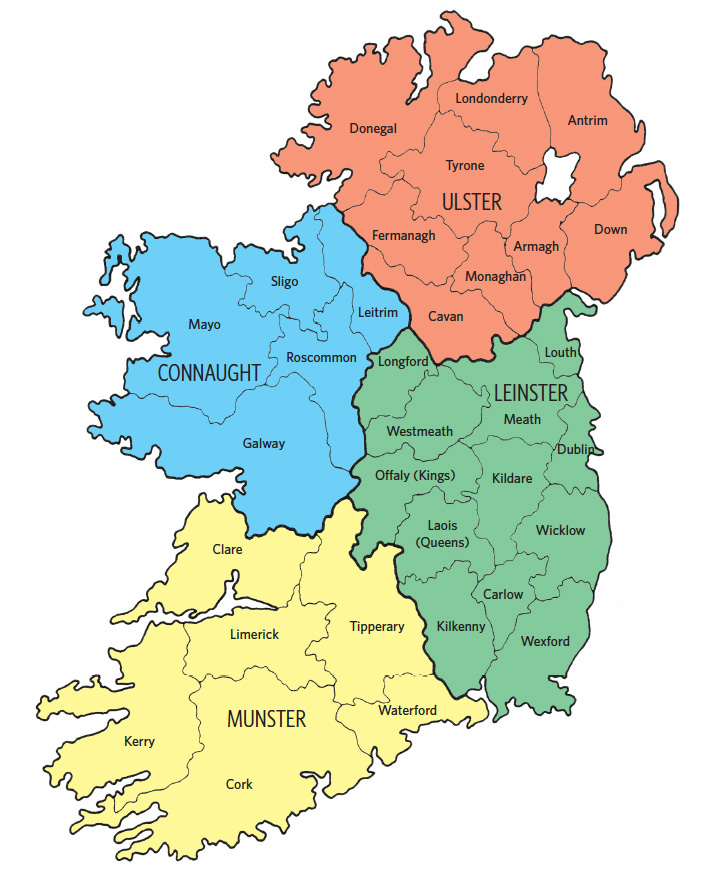
Map showing "Ireland's Four Courts"

May 3, 1921: The United Kingdom passes the Government of Ireland Act, creating the province of Northern Ireland, separate from what is then called the Irish Free State.

Of the traditional "Ireland's Four Courts," Ulster, with its 6 Counties of Antrim (including the capital of Belfast), Down, Armagh, Tyrone, Fermanagh and Derry, became Northern Ireland. The other three remained part of Ireland proper:

* Leinster: Carlow, Dublin, Kildare, Kilkenny, Laois (pronounced "Leesh"), Longford, Louth, Meath, Offaly, Westmeath, Wexford and Wicklow.

* Munster: Clare, Cork, Kerry, Limerick, Tipperary and Waterford. And:

* Connaught: Galway, Leitrim, Mayo, Roscommon and Sligo.

This partition of Ireland intended both territories to remain within the UK, and contained provisions for their eventual reunification. The smaller Northern Ireland was duly created with a devolved government (Home Rule), and remained part of the UK. The larger Southern Ireland was not recognized by most of its citizens, who instead recognized the self-declared 32-county Irish Republic.

Sent to London to negotiate peace terms, Michael Collins was offered a treaty that would establish the Irish Free State -- with an Oath of Allegiance to the Crown. The British Crown, held by King George V. In other words, this "Free State" would have another nation's head of state as its own -- just like Canada, Australia, and a few other "independent nations."

Collins accepted this compromise, calling it "the freedom to achieve freedom." Some in the Provisional Government did not, and the end of the Irish War of Independence led to the beginning of the Irish Civil War. This led to Collins' assassination on August 22, 1922.

On January 7, 1922, Dáil Éireann, the parliament of the Irish Republic, ratified the Anglo-Irish Treaty by a vote of 64–57 at Leinster House in Dublin.

On December 6, 1922, the Partition was complete. At that time, the territory of Southern Ireland left the UK,  and became the Irish Free State, now known as the Republic of Ireland.

Up until that moment, the British Empire had been at its greatest extent, ruling over one-quarter of the world's land, and over one-quarter of the world's people. That would never be the case again: Over the next 60 years, while some of the Empire would become part of the British Commonwealth, most of it would carry out its own "Brexit," and the old saying, "The Sun never sets on the British Empire," would no longer be true.

Today, the population of Northern Ireland is a little under 2 million, slightly more Protestant than Catholic; while that of the vast-majority-Catholic Republic is just under 5 million. The UK's recent "Brexit" deal has essentially reestablished a border between them.

*

May 3, 1921 was a Tuesday. These baseball games were played:

* The New York Yankees beat the Boston Red Sox, 2-0 at Fenway Park in Boston. Babe Ruth went 0-for-4, but catcher Wally Schang went 4-for-4. Bill Percy allowed 10 hits, but kept the shutout, outpitching future Yankee Herb Pennock.

* The New York Giants beat the Boston Braves, 7-2 at the Polo Grounds.

* The Brooklyn Robins (as the Dodgers were known while Wilbert Robinson managed them from 1914 to 1931) beat the Philadelphia Phillies, 4-3 at Ebbets Field. Brooklyn trailed 3-2 going to the bottom of the 9th, but a single by Zack Wheat and a triple by Ed Konetchy won the game.

* The Washington Senators beat the Philadelphia Athletics, 4-2 at Shibe Park in Philadelphia. Joe Judge tripled home 2 runs in the top of the 10th inning.

* And the the Detroit Tigers beat the Chicago White Sox, 13-1 at Navin Field (later Briggs Stadium and Tiger Stadium) in Detroit. Ty Cobb went 1-for-4 with a walk and 2 RBIs. Luzerne "Lu" Blue went 2-for-4 with 5 RBIs. For the White Sox, Eddie Collins went 1-for-4.

Tuesday, February 15, 2022

February 15, 1995: The Lansdowne Road Riot

February 15, 1995: Lansdowne Road Stadium in Dublin is the venue for a soccer game between the Republic of Ireland and England, a matchup fraught with political implications.

Ireland took the lead in the 22nd minute on a goal by David Kelly -- ironically, a native of England who, within the rules, chose to play for Ireland due to his ancestry, since he was unlikely to make the England team, which was then good. A lot better than it is now.
Lansdowne Road

Most likely, what happened next was due not to Kelly's choice, but to a reaction against the perception that the Ireland team supported the Irish Republican Army's attacks on Great Britain. Between the relationship between the countries, and the fact that it was a night game and there was more time for fans to drink before the game, something bad was bound to happen.

It did. A group of right-wing extremists calling themselves Combat-18 started a riot. The game was abandoned, and the 2 countries would not play each other again until 2013, a 1-1 draw at the new Wembley Stadium.

It's worth noting that, at the time, Ireland's manager was Jack Charlton, one of the heroes of English soccer's signature triumph, the 1966 World Cup (as was his brother Bobby). There had been some resistance in the Republic to his hiring by the Football Association of Ireland (FAI), but his working-class ways won the fans over. When Ireland and England next played each other, the Republic's manager was Martin O'Neill, Northern Ireland-born, -raised and -capped, but there was no resistance.

Lansdowne Road has since been demolished, and the new Aviva Stadium has been built on the site. Officially, these 2 teams have faced each other 16 times through February 15, 2022: England have won 6 times; the Republic of Ireland twice, a famous 1949 win at Everton's Goodison Park in Liverpool and at Stuttgart in Euro 88; and there have been 8 draws, including at the 1990 World Cup in Italy. (UPDATE: In 2024, England won 2 games for the 2025 UEFA Nations League, increasing their advantage to 8-2.)

*

February 15, 1995 was a Wednesday. Rapper Meghan Thee Stallion was born.

Baseball and football were out of season. There were 7 games played in the NBA:

* The Minnesota Timberwolves beat the Philadelphia 76ers, 101-97 at The Spectrum in Philadelphia.

* The Cleveland Cavaliers beat the Orlando Magic, 100-99 in overtime at the Gund Arena (now the Rocket Arena) in Cleveland.

* The Indiana Pacers beat the Detroit Pistons, 114-88 at the Market Square Arena in Indianapolis.

* The Chicago Bulls beat the Washington Bullets, 107-92 at the United Center in Chicago.

* The Phoenix Suns beat the Portland Trail Blazers, 120-113 in overtime at the America West Arena (now the Mortgage Matchup Center) in Phoenix. Charles Barkley led all scorers on the night with 35 points.

* The Los Angeles Lakers beat the Seattle SuperSonics, 102-96 at The Forum outside Los Angeles in Inglewood, California.

* The Boston Celtics beat the Golden State Warriors, 116-115 at the Oakland Coliseum Arena.

And there were 8 games in the NHL:

* The New York Rangers beat the Buffalo Sabres, 2-1 at the Buffalo Memorial Auditorium.

* The New Jersey Devils beat the Washington Capitals, 4-2 at the Brendan Byrne Arena at the Meadowlands.

* The Hartford Whalers beat the Montreal Canadiens, 4-1 at the Hartford Civic Center (now the PeoplesBank Arena).

* The Florida Panthers beat the Ottawa Senators, 2-0 at the Miami Arena.

* The Edmonton Oilers beat the Toronto Maple Leafs, 4-1 at Maple Leaf Gardens in Toronto.

* The Detroit Red Wings beat the Winnipeg Jets, 5-1 at the Winnipeg Arena.

* The Los Angeles Kings beat the Dallas Stars, 3-1 at the Reunion Arena in Dallas.

* And the San Jose Sharks beat the Vancouver Canucks, 3-1 at the San Jose Arena (now the SAP Ceter).

Wednesday, February 2, 2022

February 2, 1922: James Joyce Publishes "Ulysses"

February 2, 1922: James Joyce publishes Ulysses, which, in 1999, was called, by Time magazine and some other lists, the best novel of the 20th Century.

It was published on the author's 40th birthday. James Augustine Aloysius Joyce was born on February 2, 1882 in Dublin, Ireland. On June 16, 1904, he had his first date with Nora Barnacle, a chambermaid from Galway. That date became the day on which the events of Ulysses took place -- known to the book's fans, in honor of the character of Leopold Bloom, as "Bloomsday."

Finding opportunities in Ireland, still controlled by Britain, limited, James and Nora chose exile. He taught English in Trieste, Italy, then worked in a bank in Rome, then back to his teaching job in Trieste. He returned to Dublin in 1912, to introduce his son Giorgio to his family, but was disillusioned by his professional prospects there. He left, and never returned to his hometown. 

He spent World War I in Zürich, in neutral Switzerland, and finally got published, with The Dubliners in 1914 and A Portrait of the Artist as a Young Man in 1916. That year, the Easter Rising occurred, beginning the Irish War of Independence. He wanted Ireland independent, but not through violence, and stayed away from the cause. After the war, he moved to Paris, where he befriended publisher Sylvia Beach, who paved the way for the publication of Ulysses, first by sending chapters to magazines, and eventually by publishing it in full book form.

It was titled Ulysses because Joyce intended it as a modern retelling of Homer's The Odyssey, where the lead character was named Odysseus in Greek, translated as Ulysses by the Latin-speaking Romans. But, as the TV show Seinfeld would be said to be, 70 years later, it was really a story about nothing, pretty much just people talking, with a few sex acts thrown in. Indeed, Joyce biographer Richard Ellmann described Leopold Bloom, the Odysseus stand-in, as "a nobody," who "has virtually no effect upon the life around him." 

Ulysses had begun to be serialized in 1918, even though Joyce didn't finish it until 1921. It was declared obscene by the New York Society for the Suppression of Vice, and was immediately banned in Britain for perceived obscenity. Beach published Ulysses in full in Paris, but the book was only available in America in bootleg form until 1934, when the United States District Court for the Southern District of New York ruled in United States v. One Book Called Ulysses that the novel was not too obscene to be allowed in the country.

But the sales of Ulysses in countries where it had been allowed stoked Joyce's ambition. He said he wanted to write the most difficult book in the English language. In 1924, with Finnegan's Wake, he may have succeeded.

His vision was beginning to fail. Already wearing thick glasses, he was completely blind in his left eye by 1930, and began wearing an eye patch as well as glasses. He moved to London with Nora and their children, but it was only there, in 1931, that he and Nora actually got married. They went back to Paris, where he began helping Jews escape from the Nazis. They fled France before the Nazi invasion, and returned to Zürich. There, James Joyce died on January 13, 1941, a little short of his 59th birthday.

Nora outlived James by 10 years. Their son Giorgio, a singer, died in 1976, at 70. Their daughter Lycia, a dancer, was diagnosed as schizophrenic, was committed in 1951, and lived under psychiatric care until her death in 1982, age 75. Giorgio's son, Stephen James Joyce, worked with charitable organizations. With his death in 2020, Joyce's bloodline died out.

On March 14, 1967, a film version of Ulysses premiered, directed by Joseph Strick, and starring Milo O'Shea as Leopold Bloom, Barbara Jefford as Molly Bloom, Maurice Roëves as Stephen Dedalus, Sheila O'Sullivan as May Golding Dedalus, T.P. McKenna as Buck Mulligan, and Fionnula Flanagan as Gerty MacDowell. The film takes place in Dublin, but in what was then the present day.

Every year, on June 16, the anniversary of Bloomsday, Joyce fans -- in Dublin, New York, and elsewhere -- commemorate the novel by doing pub crawls to Irish-themed bars and reading selections from the novel. As with Sauk Centre, Minnesota and Sinclair Lewis, Dublin seems to love its favorite literary son more than he loved his hometown.

I had never read Ulysses, but I had a plan: I was hoping that, on June 16, 2004, the 100th Anniversary of Bloomsday, it would be available at the East Brunswick Public Library in my New Jersey hometown, and I would read it then. It was available, and I took it out. The clerk gave no reaction, so either she didn't know the significance of the date, or she didn't know about the book's salacious content.

I got 8 pages into the thing, and decided that I hated it. I could not get into it at all. I took it back the next day, and have never tried it again. Nor do I intend to. Anybody who wants to call it a great novel, they are free to do so. But count me out.

*

February 2, 1922 was a Thursday. Baseball and football were in the off-season. There had yet to be a major professional basketball league. The NHL season was underway, but no games were scheduled. Therefore, there were no scores on this historic day.

December 31, 1999 & January 1, 2000: The Millennium

December 31, 1999:  The Millennium arrives. The people of planet Earth survived. At a terrible cost. But we hadn't destroyed ourselves. ...