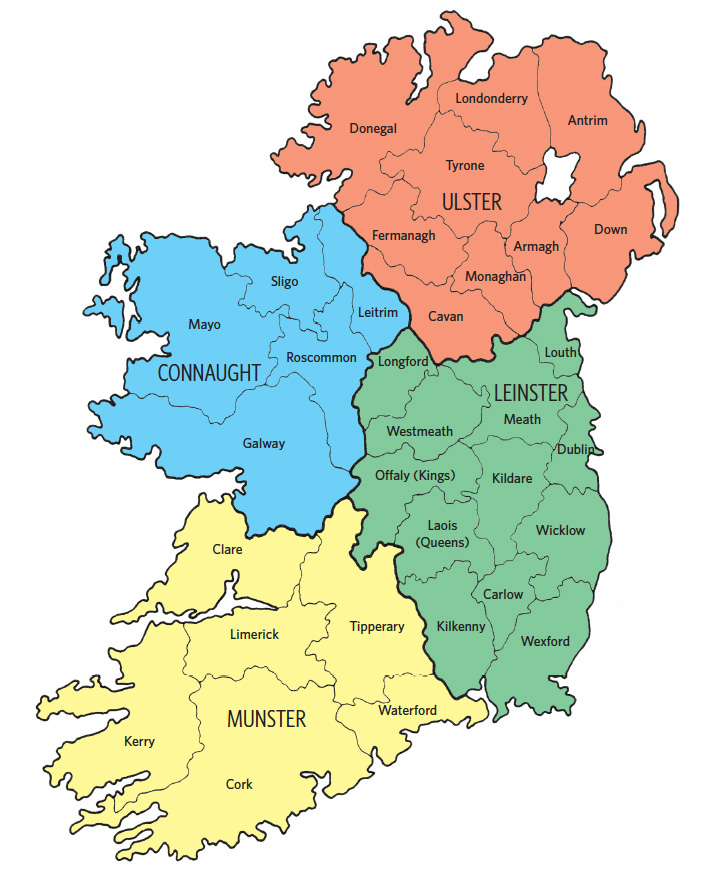
Map showing "Ireland's Four Courts"
May 3, 1921: The United Kingdom passes the Government of Ireland Act, creating the province of Northern Ireland, separate from what is then called the Irish Free State.
Of the traditional "Ireland's Four Courts," Ulster, with its 6 Counties of Antrim (including the capital of Belfast), Down, Armagh, Tyrone, Fermanagh and Derry, became Northern Ireland. The other three remained part of Ireland proper:
* Leinster: Carlow, Dublin, Kildare, Kilkenny, Laois (pronounced "Leesh"), Longford, Louth, Meath, Offaly, Westmeath, Wexford and Wicklow.
* Munster: Clare, Cork, Kerry, Limerick, Tipperary and Waterford. And:
* Connaught: Galway, Leitrim, Mayo, Roscommon and Sligo.
This partition of Ireland intended both territories to remain within the UK, and contained provisions for their eventual reunification. The smaller Northern Ireland was duly created with a devolved government (Home Rule), and remained part of the UK. The larger Southern Ireland was not recognized by most of its citizens, who instead recognized the self-declared 32-county Irish Republic.
Sent to London to negotiate peace terms, Michael Collins was offered a treaty that would establish the Irish Free State -- with an Oath of Allegiance to the Crown. The British Crown, held by King George V. In other words, this "Free State" would have another nation's head of state as its own -- just like Canada, Australia, and a few other "independent nations."
Collins accepted this compromise, calling it "the freedom to achieve freedom." Some in the Provisional Government did not, and the end of the Irish War of Independence led to the beginning of the Irish Civil War. This led to Collins' assassination on August 22, 1922.
On January 7, 1922, Dáil Éireann, the parliament of the Irish Republic, ratified the Anglo-Irish Treaty by a vote of 64–57 at Leinster House in Dublin.
On December 6, 1922, the Partition was complete. At that time, the territory of Southern Ireland left the UK, and became the Irish Free State, now known as the Republic of Ireland.
Up until that moment, the British Empire had been at its greatest extent, ruling over one-quarter of the world's land, and over one-quarter of the world's people. That would never be the case again: Over the next 60 years, while some of the Empire would become part of the British Commonwealth, most of it would carry out its own "Brexit," and the old saying, "The Sun never sets on the British Empire," would no longer be true.
Today, the population of Northern Ireland is a little under 2 million, slightly more Protestant than Catholic; while that of the vast-majority-Catholic Republic is just under 5 million. The UK's recent "Brexit" deal has essentially reestablished a border between them.
*
May 3, 1921 was a Tuesday. These baseball games were played:
* The New York Yankees beat the Boston Red Sox, 2-0 at Fenway Park in Boston. Babe Ruth went 0-for-4, but catcher Wally Schang went 4-for-4. Bill Percy allowed 10 hits, but kept the shutout, outpitching future Yankee Herb Pennock.
* The New York Giants beat the Boston Braves, 7-2 at the Polo Grounds.
* The Brooklyn Robins (as the Dodgers were known while Wilbert Robinson managed them from 1914 to 1931) beat the Philadelphia Phillies, 4-3 at Ebbets Field. Brooklyn trailed 3-2 going to the bottom of the 9th, but a single by Zack Wheat and a triple by Ed Konetchy won the game.
* The Washington Senators beat the Philadelphia Athletics, 4-2 at Shibe Park in Philadelphia. Joe Judge tripled home 2 runs in the top of the 10th inning.
* And the the Detroit Tigers beat the Chicago White Sox, 13-1 at Navin Field (later Briggs Stadium and Tiger Stadium) in Detroit. Ty Cobb went 1-for-4 with a walk and 2 RBIs. Luzerne "Lu" Blue went 2-for-4 with 5 RBIs. For the White Sox, Eddie Collins went 1-for-4.


No comments:
Post a Comment