Showing posts with label 1958. Show all posts

Wednesday, December 28, 2022

December 28, 1958: Pro Football's "Greatest Game"

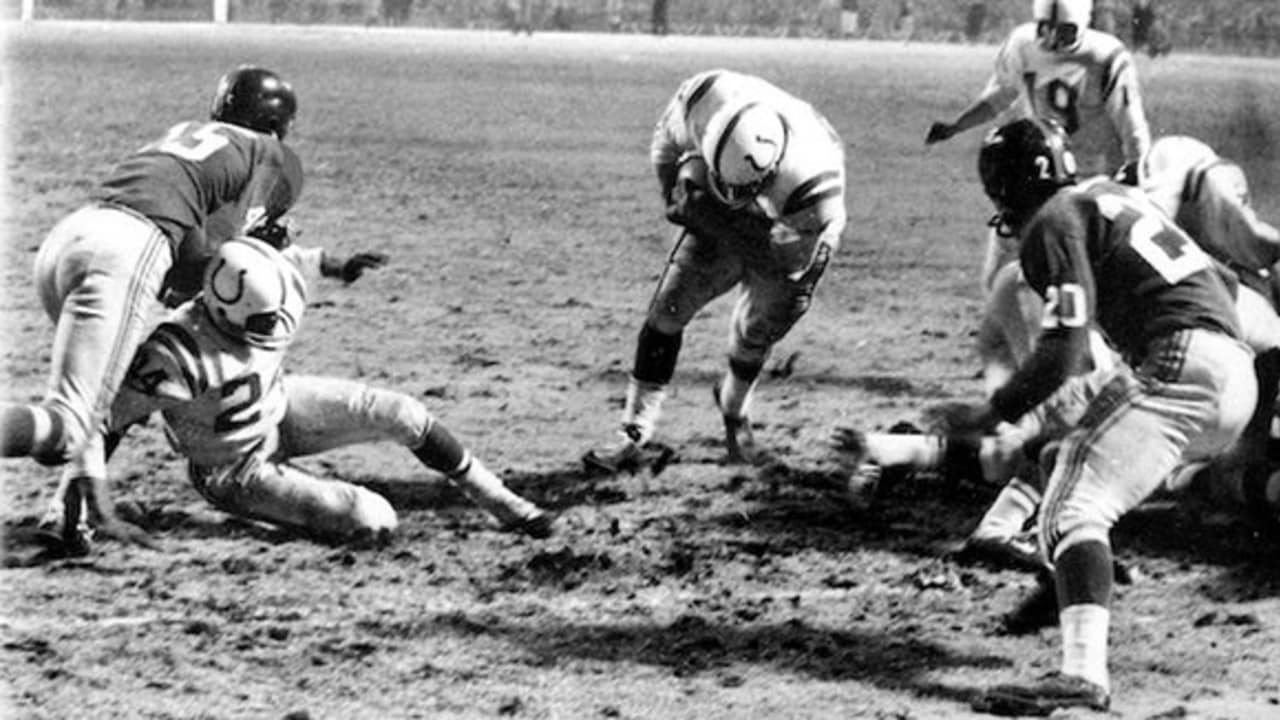
Alan Ameche scores the winning touchdown.
Lenny Moore (24) provides the key block on Emlen Tunnell.
Johnny Unitas (19) watches.

December 28, 1958: The NFL Championship Game is held at Yankee Stadium. The New York Giants, Champions of the NFL Eastern Division, play the Baltimore Colts, Champions of the Western Division. It is the 1st Championship Game for the Colts, the 10th for the Giants, who had previously won it in 1934, 1938 and 1956. (Why Baltimore, a Northeastern city, was placed in the League's Western Division, I don't know.)

The Giants had Charlie Conerly as their quarterback, and the biggest football star of the time, Frank Gifford, at running back. They were the 1st team to really make defense a priority, led by future Hall-of-Famers Sam Huff, Andy Robustelli and Emlen Tunnell. Two years earlier, they had destroyed the Chicago Bears in the Championship Game, 47-7.
The pre-renovation original Yankee Stadium, set up for football

But the Colts were on the rise. Their quarterback was Johnny Unitas. He had Raymond Berry to throw to, Lenny Moore in his backfield, and Jim Parker to block for him. All 4 would make the Hall of Fame. His defense was led by Hall-of-Famers Gino Marchetti and Art Donovan.

The 1st half was a bit sloppy, and didn't live up to the legend. Pat Summerall, future broadcasting legend, began the scoring with a field goal in the 1st quarter, putting the Giants up 3-0. In the 2nd quarter, Alan Ameche, who won the Heisman Trophy at the University of Wisconsin in 1954, scored a touchdown to put the Colts ahead. Unitas threw a touchdown pass to Berry, giving the Colts a 14-13 lead at the half.

In the 3rd quarter, Mel Triplett snuck the ball over the goal line to put the Giants back in it. Early in the 4th quarter, Conerly threw a touchdown pass to Gifford, giving the Giants a 17-14 lead. As the clock wound down, Unitas drove the Colts, but couldn't get them over. So Steve Myhra was sent in to kick a field goal as time expired. With the clock reading 0:00, the scoreboard read 17-17.

No NFL Championship Game had ever ended in a tie. Overtime was needed, for the 1st time in NFL history. (The League didn't institute overtime for the regular season until 1974.) The Giants won the toss, but couldn't score. Unitas led an inspiring drive, toward what would have been left field in The Stadium's baseball setup, which finally ended with Ameche scoring from the 1-yard line -- appropriately where Monument Park would later be in The Stadium's post-renovation period (1976-2008).

Bob Wolff, who had been in the same Stadium 2 years earlier to call Don Larsen's perfect game for the New York Yankees against the Brooklyn Dodgers in the 1956 World Series, was at the microphone for NBC again, and had the call: "Unitas gives to Ameche... The Colts are the World Champions! Ameche scores!" He later said he was glad he didn't "bury the lead" by saying, "Ameche scores!" first.

This game had the largest TV audience in NFL history to that point, 45 million people. The fact that it was in New York, and involved a New York team, helped it loom large in the public consciousness. This was the game that launched the NFL on a path to becoming, at least in perception, more popular than Major League Baseball.

It made legends of the Colts, and Unitas in particular. He would go on to be recognized as the greatest quarterback of all time. It's been 62 years, and some people still think he is. And the Colts, playing in a city that didn't have a big college football team -- Morgan State University is a historically black school, the U.S. Naval Academy is a national school, and the University of Maryland is closer to Washington -- became known as the team of America's working class, an "America's Team" in a way that felt artificial when the Dallas Cowboys later called themselves that.
Johnny Unitas

It also became known as "The Greatest Game Ever Played." It has been noted that it would never have been called that had the Colts beaten, say, the Philadelphia Eagles. But it was the New York team that they beat, in New York City. And so, every so often, polls are taken that show this game as the "greatest." The most recent was in 2019, for the NFL's 100th Anniversary. In 1981, John Thorn left his comfort zone, baseball, and published Pro Football's 10 Greatest Games. He included this game as one of them.

The teams had a rematch in the 1959 NFL Championship Game. In those days, home field was rotated between the Eastern and Western Champions, and the Colts hosted it at Memorial Stadium, beating the Giants again.

It remains the longest game in New York Giants history.

When The Sporting News ranked its 100 Greatest Football Players in 1999, Unitas came in 5th, Marchetti 15th, Parker 24th, Berry 40th, and Moore 71st. When the NFL Network ranked its 100 Greatest Players in 2010, Unitas was 6th, Parker 32nd, Berry 36th, Marchetti 39th and Moore 94th.


*

December 28, 1958, as you may have guessed, was a Sunday. There were no more NFL games to be played. It was the off-season for baseball.

There was only 1 NBA game played that day: The Cincinnati Royals beat the Minneapolis Lakers, 120-116 at the Cincinnati Gardens. Jack Twyman of the Royals scored 32 to lead all players in this game. Bob "Slick" Leonard, later to coach the Indiana Pacers to 3 ABA Championships, led the Lakers with 20 points.

The Lakers moved to Los Angeles in 1960. The Royals moved to Kansas City, becoming the Kings, in 1972, and to Sacramento in 1985.

All of the NHL's "Original Six" were in action that day:

* The New York Rangers beat the Montreal Canadiens, 5-3 at the old Madison Square Garden. This was an anomaly, as the Canadiens were in the middle of a run of 5 straight Stanley Cups, and the Rangers were in a down period.

* The Detroit Red Wings, beat the Boston Bruins, 5-3 at the Olympia Stadium in Detroit.

* And the Chicago Black Hawks beat the Toronto Maple Leafs, 4-3 at the Chicago Stadium. ("Black Hawks" was written as 2 words until 1986, when the team's original charter document was found, and it was discovered that "Blackhawks" was written as one word, and it has officially been so ever since.) 

Thursday, December 1, 2022

December 1, 1958: The Our Lady of the Angels Fire

December 1, 1958: A fire breaks out at Our Lady of the Angels School in the Humboldt Park section of the West Side of Chicago. Of the school’s 1,600 students, 92 die, as do 3 nuns. The cause has never been determined.

The elementary school was operated by the Archdiocese of Chicago. The fire originated in the basement near the foot of a stairway, shortly before classes were to be dismissed for the day. Smoke, heat, fire, and toxic gases cut off the normal means of egress through corridors and stairways. Many were injured when they jumped from second-floor windows which, because the building had a raised basement, were nearly as high above ground as a third floor would be on level ground, approximately 25 feet.

The severity of the fire shocked the nation and surprised educational administrators of both public and private schools. The disaster led to major improvements in standards for school design and fire safety codes.

*

December 1, 1958 was a Monday. Born that day were Dallas actress Charlene Tilton, Sex & the City creator Candace Bushnell, and Senator Gary Peters of Michigan.

Baseball was out of season. Football was in midweek: There would be no Monday Night Football for another 12 years. And no games were scheduled in the NBA or the NHL. So there were no scores on this historic day.

Tuesday, November 15, 2022

November 15, 1958: Tyrone Power Dies

November 15, 1958: Tyrone Power dies of a heart attack in Madrid, where he had been filming the Biblical movie Solomon and Sheba with Gina Lollobrigida. He was filming a dueling scene with George Sanders when he was stricken. He was only 44 years old.

Yul Brynner, who had turned the role of King Solomon down, was a friend of Power's, and accepted it in tribute, putting his planned film about Spartacus on hold, which allowed Kirk Douglas to make his planned version of Spartacus unopposed.

Tyrone Edmund Power III was born on May 5, 1914 in Cincinnati. He graduated from Marian High School (now Purcell Marian), which also produced Tom and Charlie Luken, a father and son who both became Mayors of Cincinnati; and football legend Roger Staubach.

He became a star with In Old Chicago in 1938, playing Dion O'Leary, owner of the barn where the Great Fire of 1871 began. He became a legend in 1940 in The Mark of Zorro, defining the role until Guy Williams played it on TV in the late 1950s, and typecasting him as a swashbuckler type.

Had somebody figured out how to make him fly, he might have been the right actor to be the 1st to play Superman. (Superheroes Batman, Captain Marvel and Captain America were filmed in the early 1940s.) But he found a way to become a real hero, flying rescue missions in the Pacific Theater for the U.S. Marine Corps in World War II. He stayed in the Marine Corps Reserves for the rest of his life, rising to the rank of Major.

He went on to play Suez Canal developer Ferdinand de Lesseps, Wild West desperado Jesse James, Ernest Hemingway's "hero" Jake Barnes in The Sun Also Rises, and bandleader Eddy Duchin, who also died young. His last completed role was defendant Leonard Vole in Witness for the Prosecution.

But, like so many people of his generation, including movie stars, he was a heavy smoker, and it is suspected that he had hereditary heart disease. Throw in the physicality of so many of his roles, and it's not surprising that he died while filming an action scene.

He had 3 daughters, including actress and singer Romina Power, and actress Taryn Power. Two months after his death, his 3rd and last wife, Deborah Jean Montgomery, gave birth to a son, Tyrone William Power IV, who acts under the name Tyrone Power Jr. His first film was Cocoon, with Tahnee Welch, Raquel's daughter.

*

November 15, 1958 was a Saturday. Baseball was out of season. Among the college football games played that day were these:

* Number 1 Louisiana State University beat Mississippi State, 7-6 at Mississippi Veterans Memorial Stadium in Jackson. LSU went undefeated, won the Southeastern Conference title, and beat Number 12 Clemson in the Sugar Bowl to win the National Championship.

* Number 2 Iowa were upset by Number 16 Ohio State, 38-28 at Iowa Stadium (now Kinnick Stadium) in Iowa City. This would be Iowa's only loss, as they went on to win the Big Ten title, and beat the University of California in the Rose Bowl. But despite wins over 5 ranked teams, this loss and a tie against Air Force, both at home, cost them the National Championship. They ended up ranked Number 2.

* Number 3 Army beat Villanova, 26-0 at Michie Stadium in West Point, New York. Led by Heisman Trophy-winning running back Pete Dawkins, Army finished 8-0-1, their only blemish a draw away to the University of Pittsburgh. But they did not accept a bowl bid, and were not seriously considered for the National Championship, finishing 3rd in the rankings.

* Number 4 Auburn beat Georgia, 21-6 at Memorial Stadium in Columbus, Georgia. Auburn finished 9-0-1, their only blemish a tie away to Georgia Tech, then an SEC team. This cost them the SEC title, and they were not invited to a bowl game. So they were not seriously considered for the National Championship, finishing 4th in the rankings.

* Number 5 Wisconsin beat Illinois, 31-12 at Memorial Stadium in Champaign, Illinois.

* Number 6 Oklahoma beat Missouri, 39-0 at Memorial Stadium in Norman, Oklahoma. OU won the Big Seven Conference title, and beat Syracuse in the Orange Bowl. Their only loss was to Texas in Dallas.

* Number 7 Mississippi were upset by Tennessee, 18-16 at Shields-Watkins Field (now Neyland Stadium) in Knoxville, Tennessee.

* Number 8 Purdue beat Number 13 Northwestern, 23-16 at Dyche Stadium in the Chicago suburb of Evanston, Illinois.

* Number 9 Texas Christian University beat Texas, 22-8 at Amon G. Carter Stadium in Fort Worth, Texas. TCU won the Southwest Conference title, and advanced to the Cotton Bowl, where Air Force held them to a tie.

* Number 10 Air Force beat Wyoming, 21-6 at Falcon Stadium in Colorado Springs, Colorado.

* Number 11 North Carolina were upset by Notre Dame, 34-24 at Notre Dame Stadium in South Bend, Indiana.

* Number 14 University of Pittsburgh were upset by Nebraska, 14-6 at Memorial Stadium in Lincoln, Nebraska.

* Number 15 Southern Methodist University (SMU) were upset by Arkansas, 13-6 at Razorback Stadium in Fayetteville, Arkansas.

* Number 17 Rice were upset by Texas A&M, 28-21 at Rice Stadium in Houston.

* Number 19 Rutgers -- a rare moment for Rutgers to be ranked in the 20th Century -- were upset by the Quantico Marines, 13-12 at Rutgers Stadium in Piscataway, New Jersey. It would be RU's only loss, and they were not invited to a bowl game. They ended the season ranked Number 20. The other New Jersey team, Princeton, beat Yale, 50-14 at the Yale Bowl in New Haven, Connecticut.

As for the Marines, they dropped the team from the Quantico base in the town of the same name in Virginia after the 1972 season.

* Number 20 Georgia Tech were upset by Alabama, 17-8 at Grant Field in Atlanta.

* Navy beat George Washington University, 28-8 at Griffith Stadium in Washington.

* In a rivalry game, Boston College beat Boston University, 18-13 at Alumni Stadium in the Boston suburb of Chestnut Hill, Massachusetts.

There were 4 games in the NBA:

* The New York Knicks beat the Syracuse Nationals, 96-92 at the Onondaga County War Memorial Auditorium (now the Upstate Medical University Arena) in Syracuse, New York.

* The Boston Celtics beat the Cincinnati Royals, 130-105 at the Boston Garden.

* The Philadelphia Warriors beat the Minneapolis Lakers, 106-101 at the Philadelphia Civic Center.

* And the St. Louis Hawks beat the Detroit Pistons, 102-91 at the Kiel Auditorium in St. Louis. Bob Pettit led all scorers on the day with 36 points.

The NHL's entire "Original Six" were in action. The New York Rangers beat the Boston Bruins, 4-2 at the old Madison Square Garden. The Detroit Red Wings beat the Toronto Maple Leafs, 4-1 at Maple Leaf Gardens in Toronto. And the Montreal Canadiens beat the Chicago Black Hawks, 3-1 at the Chicago Stadium.

And in English soccer, Arsenal beat Nottingham Forest, 3-1 at the Arsenal Stadium, a.k.a. Highbury, in North London.

Friday, November 4, 2022

November 4, 1958: The Anti-Ike Landslide?

November 4, 1958: Election Day. The Democratic Party, already in control of both houses of Congress, gain 49 seats in the House of Representatives, a total they have matched only once since, with the "Watergate Babies" Class of '74. They gain 12 seats in the Senate, a total they have matched only once since, in 1986.

Among the new Senators elected were some names that would get bigger as the years went by. They included these Democrats: Eugene McCarthy of Minnesota, Edmund Muskie of Maine, Robert Byrd of West Virginia, Thomas Dodd of Connecticut, Philip Hart of Michigan, and Harrison Williams of New Jersey. On the Republican side: Barry Goldwater of Arizona, Hugh Scott of Pennsylvania, and Ken Keating of New York.

Muskie had been his State's Governor, while most of the others were "promoted" from the House. Byrd died in 2010, making him not only the last 1958 winner still serving, but the longest-serving Senator in history.

Among the new Democratic Governors elected: Edmund G. "Pat" Brown of California, J. Millard Tawes of Maryland, Michael DiSalle of Ohio, David L. Lawrence of Pennsylvania, Ernest "Fritz" Hollings of South Carolina, and Gaylord Nelson of Wisconsin. On the Republican side, Nelson Rockefeller was elected in New York, defeating Democratic incumbent Averell Harriman; and Mark Hatfield in Oregon. Hollins, Nelson and Hatfield would later be elected to the Senate.

Another Democratic Governor elected was John Patterson of Alabama, who essentially won by winning the Primary over George Wallace, by running an outright racist campaign. Wallace swore he would never be "out-(N-word)ed again." Since the State Constitution then forbid Governors from succeeding themselves, Patterson didn't run again in 1962, and Wallace did, and, for want of a better choice of words, kept his word, and won.

This election is a hard one to figure out. President Dwight D. Eisenhower, a Republican, was personally popular, but his Party was not. There was a recession, but it had ended earlier in the year, and it wasn't as severe as those that would follow in 1973-76, 1981-83, 1990-93, 2001-02, 2007-10 and 2020-21.

Some people blamed U.S.-Soviet tensions, but 1958 wasn't an especially "cold" year in the Cold War. And the 2 biggest scandals to come out of the Eisenhower Administration -- the one surrounding his White House Chief of Staff, Sherman Adams, and the U-2 "spy plane" incident -- were both yet to come. Both of those may have helped the Democrats win the Presidency in 1960, but the Republicans actually gained Congressional seats at the same time.

During the recession, the unemployment rate rose from 3.7 percent in March 1957 to a peak of 7.5 percent in July 1958. In addition, industrial production declined by approximately 14 percent, and real Gross Domestic Project contracted by 3.7 percent. As a result, the stock market experienced significant losses, with the Standard & Poor 500 index falling by more than 20 percent.

The government extended unemployment benefits to those who lost their jobs during the recession. In September 1958, Congress passed the Temporary Unemployment Compensation Act, providing additional financial assistance to unemployed workers for 13 weeks.

Since Congress was already controlled by the Democrats, maybe the 1958 election wasn't so much a punishment of "Ike" as it was a reward to the Democrats.

The "Baby Boom" can't be credited, or blamed: The voting age was still 21, so the youngest voters would have been born in 1937, during the Depression. So maybe this election was the result of a "Baby Bust," as fewer children who would have grown up to vote Republican were born.

Who knows: Maybe the people were just sick of a Republican President playing so much golf.

*

November 4, 1958 was, like all modern American Election Days, a Tuesday. Baseball season was over. Football was in midweek. There were no games scheduled in the NBA.

There was 1 game played in the NHL: The Chicago Black Hawks beat the New York Rangers, 4-2 at the Chicago Stadium.

Sunday, October 23, 2022

October 23, 1958: Boris Pasternak Is Awarded the Nobel Prize for Literature

October 23, 1958: Boris Pasternak is awarded the Nobel Prize for Literature, for his novel Doctor Zhivago. He sends a telegram to the Nobel Committee in Stockholm, Sweden, saying he is "Infinitely grateful, touched, proud, surprised, overwhelmed." But he cannot accept the award -- and not by his own choice.

Boris Leonidovich Pasternak was born on February 10, 1890 in Moscow, the son of Sephardic Jews. His 1st work of poetry was published in 1922, and he was hailed as one of the top writers in the Russian language. That same year, he married Evgeniya Lurye. They had 2 sons, Yevgeny and Leonid. Boris made his living by translating stage plays into Russian, including those of William Shakespeare and Johann Wolfgang von Goethe.

After World War II, he began cheating on his wife with Olga Ivinskaya, also a poet and a writer, who had been helping him translate the works of others. In 1949, she was arrested as a spy (she was almost certainly innocent) and spent 5 years in a gulag. Pasternak had been on the edge of arrest by the Stalin regime since 1934, and dared not speak up on her behalf.

What he did to was write Doctor Zhivago, which takes place in Russia between 1902 and 1945, and includes scenes of the failed Russian Revolution of 1905, World War I, the Bolshevik Revolution in 1917, the Russian Civil War after it, the Stalinist Purges of the 1930s, and World War II. Pasternak patterned the character of Dr. Yuri Zhivago on himself, and that of Lara Guichard, Zhivago's mistress, on Olga.

It took Pasternak until 1955 to finish it, by which point Olga had been released. Soviet authorities rejected it for publication, because it seemed to reject socialism. The text was smuggled out of the country, and published in Italy on November 22, 1957. Premier Nikita Khrushchev and the Politburo were furious.

Once Pasternak was announced as the winner of the Nobel Prize, the KGB surrounded Pasternak his dacha in Peredelkino. Not only was he threatened with arrest, but the KGB also vowed to send Olgo back to the gulag, and told him that, if he went to Stockholm to collect his Nobel Medal, he would be refused re-entry to the Soviet Union.

So, on October 29, he sent a 2nd telegram to the Nobel Committee: "In view of the meaning given the award by the society in which I live, I must renounce this undeserved distinction which has been conferred on me. Please do not take my voluntary renunciation amiss."

In 1959, the CIA published a smaller-than-normal Russian-language edition, to smuggle into the Soviet Union, and let the people there read it. Pasternak did not have long to enjoy this: He died of lung cancer on May 23, 1960.

In 1965, a film adaptation premiered, one of several historical epics directed by David Lean. Yuri was played by Egyptian actor Omar Sharif, his son Tarek played Yuri as a boy, and Lara was played by English actress Julie Christie. Also in the film were Lean film veteran Alec Guinness, Geraldine Chaplin, Rod Steiger, Ralph Richardson and Klaus Kinski. It was nominated for 10 Academy Awards, including Best Picture, and Best Director for Lean; it won 5, mostly for artistic things like art direction and music.

Yevgeny Pasternak became a historian, and was able to collect his father's Nobel Prize in 1989. He lived until 2012.

*

October 23, 1958 was a Thursday. Baseball season had ended 14 days earlier, when the New York Yankees beat the Milwaukee Braves in Game 7 of the World Series. Football was in midweek. One game was played in the NBA: The St. Louis Hawks beat the Detroit Pistons, 104-103 at the Kiel Auditorium in St. Louis.

There were 2 games played in the NHL. The Montreal Canadiens beat the Chicago Black Hawks, 9-1 at the Montreal Forum. Jean Béliveau had 2 goals and an assist. So did Ralph Backstrom. Don Marshall had a goal and 2 assists. Maurice Richard had a goal and an assist.

And the Detroit Red Wings beat the Boston Bruins, 3-1 at the Olympia Stadium in Detroit. The New York Rangers and the Toronto Maple Leafs were not scheduled.

Friday, October 7, 2022

October 7, 1958: The Fall of Sherman Adams

October 7, 1958: Sherman Adams, arguably the 2nd-most powerful man in America, ceases to be so. And for reasons that would have seemed rather tame after 1974, let alone in the 21st Century.

Llewelyn Sherman Adams was born on January 8, 1899 in East Dover, Vermont, and grew up in Providence, Rhode Island. He served in the U.S. Marine Corps in World War I, and graduated from Dartmouth College, an Ivy League school in Hanover, New Hampshire.

He went into the lumber and banking businesses in New Hampshire, and was elected to the State House of Representatives in 1940 and 1942, briefly serving as Speaker in 1944. That year, he was elected to the U.S. House of Representatives. He ran for Governor, losing in 1946, then winning in 1948 and 1950.

When General Dwight D. Eisenhower ran for President in 1952, Adams aided his win in the New Hampshire Primary. Impressed by this, "Ike" made Adams a major part of his campaign, which paid off at the Republican Convention.

Upon winning the general election, Ike appointed Adams to be White House Chief of Staff, a position which came to be known as "the gatekeeper to the President": If the Chief of Staff doesn't tell you that you can see the President, or doesn't tell you that your concerns will reach him, you're out of luck. Although several men had held positions like this in the past -- Colonel Edward House to Woodrow Wilson, Harry Hopkins to Franklin Roosevelt -- the official post hadn't really existed before. Ike borrowed the title from military parlance.

And Adams relished it. Memos with "OK, S.A." written on them became prized possessions among the staff. On the other hand, he easily dismissed requests, often with a simple, "No." He became known as "The Abominable No Man" and "The Iceberg." When Eisenhower had his heart attack in 1955, and his less serious but still worrying stroke in 1957, he proved invaluable to Vice President Richard Nixon in carrying out official duties until Ike could return.

He was willing to make public statements that were less than "presidential," taking criticism from Ike's opponents, whether they be Democrats or the occasional Republican with whom Ike disagreed, like Senator Joseph McCarthy of Wisconsin. Adams was instrumental in Ike's contribution to McCarthy's downfall in 1954, after seeing what McCarthy and his handlers had asked Ike to do in Wisconsin in the 1952 campaign.

Because of his heroic status in World War II, and his overwhelming popularity, Eisenhower was unattackable -- one might even say, "unimpeachable." So his critics would attack Adams instead. After all, if the word of Adams was the word of Eisenhower, then an attack on Adams was a safe way of attacking the President. A joke circulated around Washington in the 1950s: Two Democrats were talking, and one said, "Wouldn't it be terrible if Eisenhower died, and Nixon became President?" The other replied, "Wouldn't it be terrible if Sherman Adams died, and Eisenhower became President!"

But on October 7, 1958, Adams was fired, for hypocrisy more than anything else. Washington Post columnist Jack Anderson discovered that Adams had accepted an expensive vicuña coat and an oriental rug from Bernard Goldfine, a Boston textile manufacturer, then under investigation for Federal Trade Commission violations. Goldfine, who had business with the federal government, was cited for contempt of Congress when he refused to answer questions regarding his relationship with Adams.

By the standards of the time, this conflict of interest was considered a resignation-necessary offense. But it was the hypocrisy: During the 1952 campaign, the Republicans had ripped the Democrats for "corruption." Their platform was "C2K1," , meaning, "Communism, Corruption, and Korea."

Although they never cited outgoing President Harry Truman, outgoing Vice President Alben Barkley, Presidential nominee Adlai Stevenson, or Vice Presidential nominee John Sparkman, for any particular legal questions, they noted that wives of Democratic officials had received fur coats -- sometimes mink, always the byword for fur coats, although vicuña coats were popular in the 1950s -- in apparent attempts to influence those officials on policy.

So when it became clear that Adams had done pretty much the same thing he and his '52 campaign aides had accused the Democrats of doing, he had to go. Ike resisted this, telling a press conference, in a voice seemingly too meek to have come from the man who was once the world's leading military man, "I need him."

By October 7, the outcry had become too much, and, instead of doing it face-to-face, man-to-man, Ike sent Meade Alcon, the Chairman of the Republican National Committee, to tell Adams he was fired. Historian Fred Greenstein titled his 1982 book about the Eisenhower Administration The Hidden-Hand Presidency, but this was too hidden: Not telling Adams himself was a cowardly move by the ultimate modern Army man.

Retroactively speaking, however, it was a just punishment, because Adams ended up costing the Republican Party, and thus Ike himself, very badly in the next 2 elections. The Adams scandal and a recession, minor compared to later ones from the 1970s onward, combined to make the Congressional elections a month later a Democratic landslide: The Democrats gained 49 seats in the House, a total they haven't topped since (they matched it in the post-Watergate election of 1974), and 15 seats in the Senate, a total neither party has matched since (the Republicans gained 12 in 1980).

And Adams' successor, Wilton "Jerry" Persons, simply was not as skilled. Had Adams not accepted those gifts, or had they not been discovered, he surely would still have been Chief of Staff in the Spring of 1960, and helped Ike better handle the U-2 "spy plane" incident, and also advised him to help Vice President Nixon out as he campaigned to succeed him. That failure, and the U-2 incident, among other things, were key to helping Senator John F. Kennedy win a close election over Nixon.

Adams returned to New Hampshire, and built and ran the popular Loon Mountain ski resort. He died on October 27, 1986, all but forgotten -- but, with Watergate having happened, and Iran-Contra having happened right after his death, any thought of his scandal quickly disappeared.

*

October 7, 1958 was a Tuesday. There was no scores on this historic day: It was a travel day in the World Series that the New York Yankees would win over the Milwaukee Braves, it was midweek for football, the NHL season started the next night, and the NBA season started 12 days later.

There was one notable event on this day, connected with sports: Scott Morrison was is born. A hockey writer for the Toronto Sun, he has contributed to Rogers Sportsnet and the CBC's Hockey Night In Canada. He has been awarded the Hockey Hall of Fame's media award, the Elmer Ferguson Memorial Award.

Tuesday, October 4, 2022

October 4, 1958: France Establishes Its Fifth Republic

October 4, 1958: France adopts a new Constitution, beginning its Fifth Republic. Charles de Gaulle demanded it, and Michel Debré did most of the writing. In the new government established in the new Republic, de Gaulle served as President, head of state; and Debré as Prime Minister, head of the government.

The First Republic was founded on September 21, 1792, when the French Revolution overthrew the monarchy of King Louis XVI. Napoleon Bonaparte brought it to an end when he declared the First Empire on May 18, 1804. That Empire lasted until April 11, 1814, and was restored briefly from March 20 to July 7, 1815.

The Bourbon Restoration lasted until February 23, 1848, when France's branch of the European Revolutions of 1848 established the Second Republic. That ended on December 2, 1852, when Napoleon's grandnephew, Louis-Napoleon Bonaparte, proclaimed the Second Empire, and himself as Emperor Napoleon III. (He considered Napoleon's son, who never actually reigned, to be Napoleon II.)

The Second Empire fell on September 4, 1870, after Napoleon III was captured in the Battle of Sedan 2 days earlier, costing France the Franco-Prussian War. The Third Republic lasted through the Dreyfus Affair, World War I and the Great Depression, until falling to the Nazis on July 10, 1940.

After de Gaulle's provisional government following the Liberation of Paris on August 25, 1944, the Fourth Republic began with the adoption of its Constitution on October 13, 1946. It was basically a resumption of the Third Republic. But it suffered from a lack of political consensus, a weak executive, and governments forming and falling in quick succession.

Finally, the Algieria Crisis of 1958 forced the government's hand. On June 1, it voted to return de Gaulle to power. He had offered himself as the savior of the nation. It was not the first time, and it would not be the last.

Many opposed him. Writer-philosopher Jean-Paul Sartre, publicly known to be a militant atheist in the mold of a new Voltaire, said, "I would rather vote for God." de Gaulle himself said, "Who honestly believes that, at age 67, I would start a career as a dictator?" Many did. But, as has so often been the case, a people's desire for stability topped all other concerns. de Gaulle once again turned out to be the right man for the job... for the moment.

On June 3, de Gaulle called for a new constitution. On September 28, the nation's voters approved it. It took effect on October 4, and de Gaulle was elected President on December 21, taking office on January 9, 1959. On its issue dated 5 days earlier, January 5, Time magazine named de Gaulle its Man of the Year for 1958.

The 1958 constitution also replaced the French Union with the French Community, similar to the British Empire transitioning to the British Commonwealth. Over the course of calendar year 1960, 14 French colonies in Africa declared their independence. Finally, Algeria was allowed to become independent on July 5, 1962. This kept France stable until the "May Days" of 1968, when de Gaulle sent troops in to settle things. France has not even approached the need for a Sixth Republic since then.

The Constitution of the Fifth Republic has been amended 24 times, most recently in 2008.

So, to recap. Chronologically:

1792-1804: First Republic
1804-1815: First Empire
1815-1848: Bourbon Restoration
1848-1852: Second Republic
1852-1870: Second Empire
1870-1940: Third Republic
1940-1944: Third Reich
1944-1946: Provisional Government
1946-1958: Fourth Republic
1958-present: Fifth Republic

By time: Third Republic, 70 years; Fifth Republic, 64 years and counting as of October 4, 2022; Bourbon Restoration, 33 years; Second Empire, 18 years; Fourth Republic, 12 years; First Republic, 11 years; First Empire, 11 years; Second Republic, 4 years; Third Reich, 4 years; post-WWII provisional government, 2 years.

*

October 4, 1958 was a Saturday. Game 3 of the World Series was played at Yankee Stadium, and the New York Yankees beat the Milwaukee Braves, 4-0. Don Larsen was not perfect, as he was 2 years earlier, but effective enough to combine with reliever Ryne Duren for a 6-hit shutout. Hank Bauer hit a home run. Mickey Mantle went 0-for-2 with 2 walks. Hank Aaron went 0-for-3 with a walk. The Yankees went on to win the Series in 7 games.

There was college football played that day, including the following games:

* Number 1 Oklahoma beat Oregon, 6-0 at Owen Field in Norman, Oklahoma. Oklahoma went on to win the Big Seven Conference (it became the Big Eight when Oklahoma State joined in 1960). The next week, they lost to Texas in the Cotton Bowl, which would be their only loss of the season.

* Number 2 Auburn beat Chattanooga, 30-8 at Cliff Hare Stadium (now Jordan-Hare Stadium) in Auburn, Alabama.

* Number 3 Ohio State beat the University of Washington, 12-7 at Ohio Stadium in Columbus.

* Number 4 Michigan State and Number 16 Michigan played to a 12-12 tie at Spartan Stadium in East Lansing, Michigan.

* Number 5 Army beat Penn State, 26-0 at Michie Stadium in West Point, New York. Army had the season's Heisman Trophy winner, running back Pete Dawkins.

* Number 6 Mississippi beat Trinity College, 21-0 at Alamo Stadium in San Antonio. Trinity now play in NCAA Division III.

* Number 7 Notre Dame beat Number 17 Southern Methodist (SMU), 14-6 at the Cotton Bowl in Dallas. In those days, Notre Dame didn't accept invitations to bowl games, so they did not go on to play in the Cotton Bowl game, or any other.

* Number 8 Iowa were held to a 13-13 tie by the Air Force Academy, at Iowa Stadium (now Kinnick Stadium) in Iowa City. Iowa still won the Big 10 Conference title.

* Number 9 Wisconsin beat cross-State Marquette, 50-0 at Camp Randall Stadium in Madison. Marquette, a participant in the 1st-ever Cotton Bowl (losing to Texas Christian on New Year's Day 1937), dropped its football program after the 1960 season.

* Number 10 Clemson beat Maryland, 8-0 at Byrd Stadium (now SECU Stadium) in the Washington suburb of College Park, Maryland. Clemson went on to win the Atlantic Coast Conference title.

* Number 11 Mississippi State were upset by Tennessee, 13-8 at Crump Stadium in Memphis. Although the venue was in Tennessee's State, it was much closer to MSU's campus.

* Number 13 Louisiana State beat Hardin-Simmons, 20-6 at Tiger Stadium in Baton Rouge, Louisiana. LSU went on to win the Southeastern Conference title, and beat Clemson in the Sugar Bowl, to win the National Championship.

* Number 15 Navy beat Boston University, 28-14 at Nickerson Field in Boston.

* The University of California beat Washington State, 34-14 at California Memorial Stadium in the San Francisco suburb of Berkeley. Neither team was then ranked. Cal went on to win the title of the American Association of Western Universities (AAWU, a precursor to the league now known as the Pacific-12 Conference), but lost the Rose Bowl to Iowa.

* Holy Cross beat Syracuse, 14-13 at Fitton Field in Worcester, Massachusetts. Neither team was then ranked. This would be the only game that Syracuse lost in the regular season, and they advance to the Orange Bowl, but were beaten by Oklahoma.

* Texas Christian beat Arkansas, 12-7 at Amon G. Carter Stadium in Fort Worth, Texas. Neither team was then ranked. TCU went on to win the Southwest Conference title, and beat Air Force in the Cotton Bowl.

* Among New Jersey's teams, Rutgers beat Colgate, 21-7 at Colgate Athletic Field (now Andy Kerr Stadium) in Hamilton, New York; while Princeton beat Columbia, 43-8 at Palmer Stadium in Princeton.

The NHL season began 4 days later; the NBA season, 11 days after that. In English soccer, Arsenal beat Birmingham-area team West Bromwich Albion, 4-3 at the Arsenal Stadium, a.k.a. Highbury. France? Like most countries on the European continent, they traditionally play soccer on Sundays.

Saturday, October 1, 2022

October 1, 1958: The American Express Card Is Launched

October 1, 1958: The American Express Card is launched. This is why, in every print ad campaign, the "Member Since" date on the cards shown is "58."

The name on the cards in print ads is "C F FROST," in honor of Charles Frost, advertising executive at Ogilvy & Mather, the company that began the "Do you know me?"/"Don't leave home without it" ad campaign in 1975.

American Express had introduced the concept of the traveler's cheque (not "check") in 1891. From 1975 to 1995, actor Karl Malden did commercials for American Express Traveler's Cheques: He asked, in the event that your cash or credit cards were stolen, "What will you do? What will you do?" And he closed the ads by saying, "American Express Traveler's Cheques: Don't leave home without them!"

At around the same time, AmEx hired celebrities who might not be recognized out of costume or out of makeup, asking, "Do you know me?" The ads would close with a joke based on their identity, their name being printed on the card, an announcer saying, "To apply for the card, look for this display wherever the card is welcomed," and the celebrity delivering the tagline: "The American Express Card: Don't leave home without it!"

Diners Club had introduced the concept of the credit card in 1950, but American Express made the concept take off.

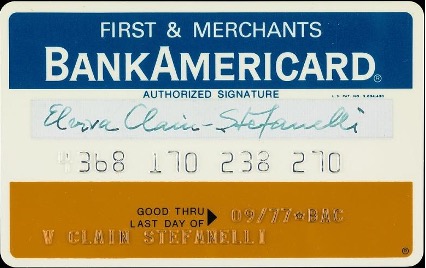
A few days earlier, on September 18, 1958, Bank of America launched BankAmericard. But their rollout flopped, though it turned a profit in 1961. By the 1970s, it surpassed American Express as the most-used credit card.

In 1969, Interbank introduced the MasterCharge card. This allowed lots of people to pay their BankAmericard bill with their MasterCharge, and their MasterCharge with their BankAmericard, a process that got them even deeper into debut, and was later outlawed with the Credit Card Accountability, Responsibility, and Disclosure (CARD) Act of 2009.

On March 1, 1977, BoA, consolidating its operations, changed the name of the card to Visa, to make it easier to use worldwide. On August 28, 1979, MasterCharge was renamed MasterCard.

*

October 1, 1958 was a Wednesday. There was only 1 score on this historic day, and it was in Game 1 of the World Series. The Milwaukee Braves beat the New York Yankees, 4-3 at Milwaukee County Stadium. Bill Bruton singled Joe Adcock home with the winning run in the bottom of the 10th inning, off Ryne Duren in relief of Whitey Ford -- who didn't allow another run in Series play until 1962. Warren Spahn went the distance for the win. Hank Aaron went 1-for-4 with a walk. Bill "Moose" Skowron and Hank Bauer hit home runs for the Yankees. Mickey Mantle went 0-for-3 with 2 walks.

Friday, September 30, 2022

September 30, 1958: "The Rifleman" Premieres

September 30, 1958: The Rifleman premieres on ABC. It is a Western, the most popular form of TV programming at the time.

Chuck Connors played Lucas McCain, a Lieutenant in the Union Army during the American Civil War. Having lost his wife Margaret to illness, in 1881, he buys a ranch about 3 miles outside the fictional town of North Folk, in the New Mexico Territory, where he raises his son, Mark, played by Johnny Crawford. (New Mexico gained Statehood in 1912.)

The opening theme at the beginning of each episode depicted McCain walking down the street of a town, while rapid-firing his Winchester 44-40 1892 model rifle that had been modified at the trigger and lever. (This makes the rifle an anachronism.) The rifle's modification allowed McCain to fire the rifle only by hand pumping the lever, which had a setscrew imbedded in it to trip the weapon's trigger.

McCain fires 12 shots from his rifle during the opening credits: 7 shots in the 1st close-up, and 5 more as the camera switches to another view. The blank cartridges are shorter than standard cartridges, so the magazine can hold more of the blanks. The soundtrack contained a dubbed 13th shot, to allow the firing to end with a section of the theme music.

The series ran for 5 seasons, had second chances as a common theme. Micah Torrance, the town Marshal, played by Paul Fix, was a recovering alcoholic. Some episodes saw the repairing of friendships broken by the Civil War.  

Like James Arness, the star of Gunsmoke, Connors was an imposing Western figure due to his height, in his case 6-foot-5. He played basketball at New Jersey's Seton Hall University, and 53 games for the Boston Celtics in 1946 and '47. He went on to play 1 baseball game for his hometown Brooklyn Dodgers in 1949, coming to bat once as a pinch-hitter, never playing the field for them. He then got traded to the Chicago Cubs, and played 66 games at 1st base for them in the 1951 season.

The Cubs' top farm team at the time was the Los Angeles Angels of the Pacific Coast League. While playing in L.A., this athlete found off-season work as a stuntman, and, like John Wayne, moved from stunts to acting, mostly in Westerns. After The Rifleman, he played Jason McCord, the lead in Branded. He died in 1992, at age 71. Johnny Crawford, who had been a Mouseketeer on The Mickey Mouse Club, became a singer and the leader of a retro swing band, and lived until 2021.

*

September 30, 1958 was a Tuesday. Baseball was between the end of its regular season and the start of the World Series. Football was in midweek. And the NBA and NHL seasons hadn't started yet. So there were no scores on this historic day.

Tuesday, September 27, 2022

September 27, 1958: “The Defiant Ones” Premieres

September 27, 1958: The Defiant Ones premieres. It stars Sidney Poitier, Tony Curtis, Theodore Bikel, Lon Chaney Jr., Claude Akins, Cara Williams, and, in what turned out to be his last role, Carl Switzer, a.k.a. Alfalfa from Our Gang.

One actor it did not star was Marlon Brando, who was originally supposed to star with Poitier, but Poitier was unavailable at the time. Director Stanley Kramer wanted Poitier so badly that he delayed filming. But, by the time that Poitier was available, Brando wasn't. Curtis was.

Another that this film could have starred, but didn't, was Robert Mitchum. At age 14, he had been arrested for vagrancy in Savannah, Georgia, and was put on a chain gang. He turned down the role because he knew that even chain gangs were segregated in the South. To his credit, once Curtis got the role, he insisted that Poitier have equal billing.

Noah Cullen (Poitier), black, and John "Joker" Jackson (Curtis), white, are shackled together because "the warden had a sense of humor." They are on a truck loaded with prisoners that crashes, allowing them to escape. Despite their mutual hatred, they are forced to cooperate, as they are chained together. At first, their co-operation is motivated by self-preservation, but gradually they begin to respect and like each other.

They end up being captured by a lynch mob, who threaten to hang both of them, but they are saved and aided by a big white man (Chaney) who was once a chain-gang prisoner himself. They meet a fatherless boy named Billy (Kevin Coughlin), who takes them home. His mother (Williams) breaks their chain, but sets them up to be captured. Joker gets shot, and the film ends with the Sheriff (Bikel) finding him, barely alive, in Cullen's arms.

Switzer was murdered just 4 months after the film's release. Chaney died in 1973. Coughlin was hit by a car and killed in 1976, only 30 years old. Akins died in 1994, Kramer in 2001, Curtis in 2010, Bikel in 2015, Williams in 2021, and Poitier on January 6, 2022.

*

September 27, 1958 was a Tuesday. Actor Shaun Cassidy was born. And these baseball games were played:

* The Boston Red Sox beat the Washington Senators, 9-5 at Griffith Stadium in Washington. Ted Williams and Pete Runnels hit home runs for the Red Sox. Eddie Yost hit one for the Senators. Harmon Killebrew appeared as a pinch-hitter, but did not reach base.

* The Philadelphia Phillies beat the Pittsburgh Pirates, 7-3 at Forbes Field in Pittsburgh. Roberto Clemente did not play.

* The Detroit Tigers beat the Cleveland Indians, 5-1 at Cleveland Municipal Stadium. Al Kaline went 1-for-4 with 3 RBIs.

* The Kansas City Athletics beat the Chicago White Sox, 2-1 at Comiskey Park in Chicago. For the A's, Roger Maris went 0-for-3 with 2 walks.

* The Milwaukee Braves beat the Cincinnati Redlegs, 6-1 at Milwaukee County Stadium. Warren Spahn was the winning pitcher, and helped his own cause with a home run. Red Schoendienst and Frank Torre also hit home runs. Hank Aaron went 0-for-2, and was then replaced. For the Redlegs, who were restored to the Reds name the next season, Frank Robinson went 0-for-5.

* The Chicago Cubs beat the Los Angeles Dodgers, 7-4 at the Los Angeles Memorial Coliseum. Ernie Banks went 0-for-4 with a walk.

* The St. Louis Cardinals beat the San Francisco Seals, 11-7 at Seals Stadium in San Francisco. Stan Musial went 1-for-5. Willie Mays went 2-for-5 with an RBI.

* And the New York Yankees and the Baltimore Orioles were rained out at Yankee Stadium. The game was rained out the next day, as part of a regular-season-ending doubleheader. The Yankees swept it, 7-0 and 6-3. In the opener, Yankee manager Casey Stengel trusted Don Larsen to start. Unlike in Game 5 of the 1956 World Series, he didn't trust him to take a shutout into the 6th inning, even though he'd allowed only 1 hit and 1 walk. Ryne Duren pitched the 6th and the 7th, and Johnny Kucks pitched the 8th and the 9th, finishing the 2-hit shutout. Tom Sturdivant won the nightcap.

Over the 2 games, Mickey Mantle went 3-for-7 with a walk. Yogi Berra went 0-for-3 with a walk in the 1st game, and sat out the 2nd game. Brooks Robinson did not play in the 1st game, but went 1-for-4 in the 2nd.

Sunday, September 18, 2022

September 18, 1958: The 1st True Credit Card

September 18, 1958: Bank of America introduces BankAmericard. They send their cards to 65,000 households in Fresno County, California, after making arrangements with 1,000 local merchants to accept them. It is not the 1st credit card, but it is the 1st one as we now understand the term.

Diners Club had introduced the credit card in 1950. What made BankAmericard different is that, unlike Diners Club and previous cards, where the amount charged had to be paid at the end of the month, BankAmericard introduced the concept of credit card debt: The customer had the option of making a minimum payment, and agreed for the remaining balance to be an interest-bearing loan. It didn't work out well at first, but it made a profit by May 1961.

American Express introduced its eventually famous card 13 days later, on October 1. In the 1970s, the card would become known for its commercials where celebrities, out of their usual context, would start by asking, "Do you know me?" and ending with, "The American Express Card: Don't leave home without it!" (American Express was already in the business of travelers' checks, and their card's commercials would be accompanied by ads for the checks, with actor Karl Malden saying, "Don't leave home without them!")

Interbank introduced its card in 1966. It became Master Charge in 1969, and MasterCard in 1979. By that point, credit card debt became a common problem. In the 1970s, my parents literally used their BankAmericard to pay their Master Charge, and vice versa. That is no longer legal. In 1974, Nipsey Russell, who used poetry for comedy, said:

If you hold too much on your American Express
and your Diners Club bill is too large
take a loan on your BankAmericard
and pay it off with your Master Charge! 
In 1974, Hank Aaron's 715th career home run fell into the Atlanta Braves' bullpen, in front of an ad for BankAmericard. But in 1976, Bank of America brought its various international cards, including Barclaycard and ChargeX, under a single name: VISA.
By the 1980s, the various credit cards were no longer tied to a single bank, and Bank of America issued MasterCards and Discover Cards as well as Visa cards.

*

September 18, 1958 was a Thursday. There were 3 baseball games played that day:

* The Chicago White Sox beat the Baltimore Orioles, 6-2 at Comiskey Park in Chicago.

* The Milwaukee Braves beat the St. Louis Cardinals, 9-3 at Busch Stadium (formerly Sportsman's Park) in St. Louis. Hank Aaron went 1-for-4 with a walk and an RBI. Stan Musial did not play.

* And the Kansas City Athletics beat the Boston Red Sox, 4-1 at Kansas City Municipal Stadium. Ted Williams went 1-for-3. Future Yankees Roger Maris and Bob Cerv both hit home runs for the A's.

Thursday, September 15, 2022

September 15, 1958: The Newark Bay Rail Disaster

September 15, 1958: A commuter train derails off a bridge, and plunges into Newark Bay, killing 48 people, and injuring 48 more. Among the dead was a former Yankee star.

George Henry Stirnweiss was born on October 26, 1918 in Manhattan, and grew up in The Bronx. He remains the closest thing to a Yankee Legend who grew up in the Bronx Bombers' home Borough. Lou Gehrig grew up in Manhattan; Willie Keeler, Waite Hoyt and Willie Randolph in Brooklyn; and Phil Rizzuto and Whitey Ford in Queens. 

His father had been a respected taxi driver, but got caught up in criminal activity, disgracing the family while George was a baseball, football and basketball star at Fordham Preparatory School. This may have been why, when he received scholarship offers, he didn't stay in The Bronx and go to Fordham University, but went south, to the University of North Carolina at Chapel Hill.

At Chapel Hill, he won the school's highest athletic honor, the Patterson Medal, which is awarded based on "athletic ability, sportsmanship, morale, leadership and general conduct." In 1940, the NFL's Chicago Cardinals drafted him. But, as with later University of Mississippi quarterback Jake Gibbs, the Yankees made him an offer, and he abandoned football for baseball.

It's not clear when, or why, George Stirnweiss first got the nickname "Snuffy." Maybe, playing in the South, either at UNC or for the Norfolk Tars, a Yankee farm team, he picked up the habit of chewing tobacco or using its nasal cousin, snuff. He certainly didn't resemble the rural comic strip character Snuffy Smith.

In 1943, defending American League Most Valuable Player Joe Gordon was called up into World War II. Snuffy was not. That led the Yankees to bring him to the major league roster as the starting 2nd baseman, giving him uniform Number 1. The Yankees won the World Series, although Snuffy was not a major contributor that season. But in 1944, he batted .319 and fielded brilliantly, finishing 4th in the MVP voting. In 1945, he batted .309, and that was enough to win the batting title and finish 3rd in the MVP voting.
With The War ending, there was a question of whether Snuffy had bulked up his stats on weakened pitching. Gordon returned as the starting 2nd baseman in 1946, and it looked like Snuffy's day in the Sun was over. But after that season, the Yankees traded Gordon to the Cleveland Indians for pitcher Allie Reynolds. This was a brilliant trade for both teams: Gordon helped the Indians win the World Series in 1948, while the Yankees essentially got 2 players: Reynolds, their pitching ace through 1954, and the "return" of Stirnweiss.

He helped the Yankees win the World Series again in 1947, getting 7 hits and drawing 8 walks in the 7 games. But by the time of their 1949 title, he had been replaced as starting 2nd baseman by Jerry Coleman. He was traded to the St. Louis Browns in 1950 and the Indians in 1951, and retired after the 1952 season.

Snuffy managed in the minor leagues, with the Philadelphia Phillies' Class AA team, the Schenectady Blue Jays; then for the Yankees' team in the same league, the Binghamton Triplets. But he didn't like managing, and it didn't pay well, and he had a wife and 6 children to support. He worked for a bank, but had a heart attack in 1957, and never returned to work for them.

Instead, he went to work for Caldwell & Company, a manufacturer of light fixtures, in Manhattan. Every morning, he would go to the Central Railroad of New Jersey station near his home in Red Bank, Monmouth County, and take the train up the Raritan Bayshore, past Newark Airport, and over Newark Bay, to the Communipaw Terminal in Jersey City, where he would take a ferry across the Hudson River into The City.

On September 15, 1958, he got on CRRNJ train #3314 in Red Bank, but the train never made it to Communipaw. The Newark Bay lift bridge was left open, and at 10:01 AM, the train went straight through signals, and 2 of the cars fell into the Bay. George H. "Snuffy" Stirnweiss was 1 of 48 people killed. He was just short of turning 40.
The locomotive crew were among those killed, so there was no one to interview about the cause of the crash. The investigation turned up nothing. No one was charged.

Increased car sales, the building of the New Jersey Turnpike (particularly the Newark Bay Extension in 1956) and the Garden State Parkway, and a 2nd and 3rd tube for the Lincoln Tunnel meant that the Jersey Central had already begun to decline, and it pretty much abandoned the bridge by 1967. Conrail took over the railroad's operations in 1976, stopped passenger service in 1978, and demolished the bridge in 1980.

The spot where Snuffy Stirnweiss and the others fell to their deaths is a few feet from the Jersey Gardens Mall in Elizabeth, Union County. He was buried in Mount Olivet Cemetery, across the Navesink River from Red Bank, in Middletown. Legendary football coach Vince Lombardi is also buried there, because Red Bank was his wife Marie's hometown.

*

September 15, 1958 was a Monday. It was before the NBA and the NHL started their seasons. The NFL season wouldn't start for another 2 weeks, and there was no Monday Night Football in those days, anyway. And, as Monday is often a travel day in Major League Baseball, only 2 of a possible 8 games were played:

* The Philadelphia Phillies beat the St. Louis Cardinals, 6-2 at Connie Mack Stadium in Philadelphia. Robin Roberts outpitched Wilmer "Vinegar Bend" Mizell. Jim Hegan got 3 hits for the Phils; Richie Ashburn, Bob Bowman and Ted Kazanski 2 each. (That's Ted Kazanski, not Ted Kaczynski, the future Unabomber.) The only home run of the game was hit by the Cards' Irv Noren, a former Yankee, playing left field in place of Stan Musial, who did not get into the game.

* And the Milwaukee Braves beat the Los Angeles Dodgers, 8-3 at Milwaukee County Stadium. Joe Adcock hit a home run. Hank Aaron did not, but did go 2-for-3 with an RBI. John Roseboro hit a home run in defeat for the Dodgers, in their 1st season in L.A. Gil Hodges 2-for-4, but Duke Snider did not play.

The Braves, defending World Champions, would win the Pennant again, but the Yankees -- who did not add a black armband to their left sleeves in memory of Stirnweiss -- would avenge their loss to the Braves in the 1958 World Series.

December 31, 1999 & January 1, 2000: The Millennium

December 31, 1999:  The Millennium arrives. The people of planet Earth survived. At a terrible cost. But we hadn't destroyed ourselves. ...