Showing posts with label holocaust. Show all posts

Thursday, December 15, 2022

December 15, 1993: "Schindler's List" Premieres

Left to right: The film's producer and director, Steven Spielberg;
and stars Liam Neeson and Ben Kingsley

December 15, 1993: Schindler's List premieres, based on the 1980 historical novel Schindler's Ark by Thomas Kenneally.

Oskar Schindler was born on April 28, 1908 in Zwittau, in the Austro-Hungarian Empire (now Svitavy, Czechia). In 1936, he joined the Abwehr, Nazi Germany's military intelligence unit, collecting information on railways and troop movements. In 1938, the Czech government arrested him for espionage, but he was released under the terms of the Munich Agreement. In gratitude, he joined the Nazi Party.

In 1939, he bought an enamelware factory in Kraków, Poland. His connections allowed him to hire Jewish workers: At its peak in 1944, he employed 1,750 people, 1,000 of them Jews. In order to keep higher Nazi officials out of his business, he had to send ever-larger bribes and gifts. But he kept his workers from being deported to the death camps, all through World War II.
Oskar Schindler

By V-E Day, May 8, 1945, with Germany's surrender, Schindler had spent his entire fortune on bribes and black market purchases of supplies for his workers. He moved to the new Federal Republic of Germany (West Germany) after The War. He was supported by assistance payments from Jewish relief organizations.

After receiving a partial reimbursement for his wartime expenses, he moved with his wife, Emilie, to Argentina -- ironically, a country to which many ex-Nazis had escaped to avoid capture by the Allies. There, they took up farming. When he went bankrupt in 1958, Schindler left his wife, and returned to Germany, where he failed at several business ventures and relied on financial support from the people who had become known as Schindlerjuden -- "Schindler Jews," the people whose lives he had saved.

He died on October 9, 1974 in Hildesheim, Germany, and was buried in Jerusalem on Mount Zion, the only former member of the Nazi Party to be honoured in this way. In 1982, Thomas Kenneally published the novel Schindler's Ark, based on his story. Film director Steven Spielberg, born into a Jewish family after The War, read it, and decided that, one day, he would make it into a film.

In 1993, while Spielberg was finishing production on the film, Oskar and Emilie Schindler received the highest honor that the Israeli government can give to foreign citizens: "Righteous Among the Nations." They also gave that honor to his wife, Emilie.

In the film, Schindler was played by Liam Neeson. Caroline Goodall played Emilie, who lived until 2001, and was present at the film's premiere. Ben Kingsley played Itzhak Stern, Schindler's Jewish accountant, who survived The War, moved to Israel, and lived until 1969.

Ralph Fiennes, already known in his native Britain, became famous in America for playing Amon Göth, commandant of the Kraków-Płaszów concentration camp. He was captured by the Allies, and, in 1946, became the 1st Nazi war criminal to be executed.

The film was nominated for 12 Academy Awards, winning 7, including Best Picture, Best Director for Spielberg, and Best Original Score for John Williams. Neeson and Fiennes were nominated for Best Actor and Best Supporting Actor, respectively, but neither won.  

*

December 15, 1993 was a Wednesday. Baseball was out of season. Football was in midweek. There were 7 games played in the NBA:

* The Chicago Bulls beat the Boston Celtics, 108-98 at the Boston Garden.

* The Philadelphia 76ers beat the Denver Nuggets, 101-93 at The Spectrum in Philadelphia.

* The Utah Jazz beat the Minnesota Timberwolves, 97-95 at the Target Center in Minneapolis.

* The San Antonio Spurs beat the Portland Trail Blazers, 111-91 at the Alamodome in San Antonio. David Robinson led all scorers on the night with 37 points.

* The Phoenix Suns beat the Golden State Warriors, 110-104  at the America West Arena (now the Mortgage Matchup Center) in Phoenix.

* The Los Angeles Clippers beat the Orlando Magic, 110-109 at the Los Angeles Memorial Sports Arena.

* And the Milwaukee Bucks beat the Sacramento Kings, 96-95 at the ARCO Arena in Sacramento.

And there were 8 games played in the NHL:

* The New York Rangers beat the Hartford Whalers, 5-2 at Madison Square Garden.

* The New Jersey Devils lost to the Boston Bruins, 5-4 at the Brendan Byrne Arena at the Meadowlands.

* The Tampa Bay Lightning beat the Ottawa Senators, 4-3 at the ThunderDome (now Tropicana Field) in St. Petersburg, Florida.

* The Montreal Canadiens and the Florida Panthers played to a tie, 3-3 at the Miami Arena.

* The Mighty Ducks of Anaheim beat the Toronto Maple Leafs, 1-0 at Maple Leaf Gardens in Toronto.

* The Chicago Blackhawks beat the Dallas Stars, 3-2 at the Reunion Arena in Dallas.

* The Edmonton Oilers beat the Vancouver Canucks, 7-2 at the Northlands Coliseum in Edmonton.

* And the St. Louis Blues beat the San Jose Sharks, 3-1 at the San Jose Arena (now the SAP Center).

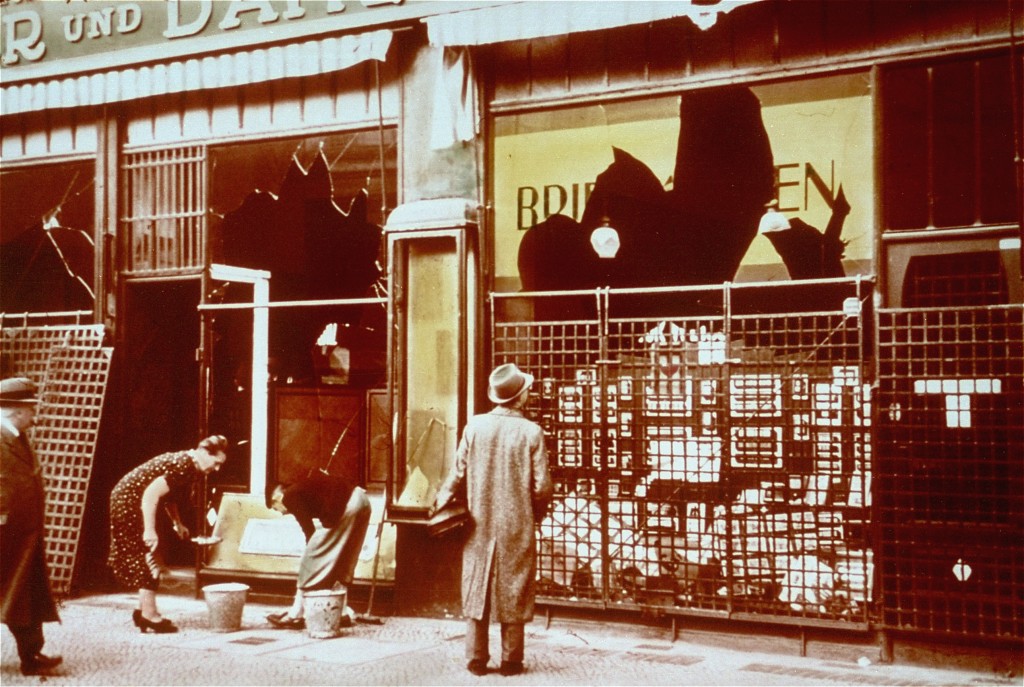
Wednesday, November 9, 2022

November 9, 1938: Kristallnacht, the Night of Broken Glass

November 9, 1938: Nazi paramilitary troops destroy 267 synagogues and over 7,000 Jewish businesses, all over Germany.

It had been nearly 6 years since the Nazi Party took power in Germany, with their leader, Adolf Hitler, becoming the Chancellor, the country's head of government. It had been a little over 4 years since Hitler also became President, thus becoming the country's head of state, and its absolute ruler.

He had told the people of Germany that their national woes -- from losing World War I and the deprivations that followed, to the difficulties of the worldwide Great Depression -- were the fault of Jews and Communists, and he linked them wherever he could. He told them it wasn't the country's own excesses that did it. It wasn't the fault of the people. It was some other group with an evil ideology.

Sound familiar?

And it had been a year and a half since he annexed his native Austria into his Third Reich. And it had been 40 days since the Munich Agreement, in which Britain and France, terrified of getting into a second world war with Germany, betrayed their ally, Czechoslovakia, and let Hitler take that country.

On November 7, Ernst vom Rath, the third secretary of the German Embassy in Paris -- a minor diplomat, only 29 years old -- was shot by Herschel Grynszpan, a 17-year-old Jew, born in Germany of Polish descent. His parents had been deported to Poland, and he blamed vom Rath. It took vom Rath 2 days to die.

Just as the Reichstag Fire of 1933 was the pretext the Nazis needed for their previous big round of persecutions, vom Rath's death on November 9 gave them the excuse they needed to do it again. The Party's paramilitary wing, the Sturmabteilung (SA, or "Storm Detachment," often called the "Brownshirts"), broke into Jewish people's homes, ransacking them and stealing valuables. They broke into Jewish-owned businesses, destroying both goods and property.

All the broken glass storefronts gave the event its name: Kristallnacht, or "Crystal Night," or "The Night of Broken Glass." It wasn't just in the national capital of Berlin: It was all over the Reich, including in Austria, and even on Polish soil in what was then "The Free City of Danzig." (Now Gdańsk.)

Over 30,000 people were arrested, and taken to concentration camps. The official death toll, from all over Germany, was 91. No one truly believes the figure was that low: It's been suggested that it might be over 600.

French police arrested Grynszpan for shooting vom Rath, and he was handed over to the Gestapo after the fall of France in June 1940, and brought him back to Germany. He was taken to the Sachenhausen concentration camp in 1942.

History loses track of him after that. Nazi war criminal Adolf Eichmann claimed he had been ordered to "examine" Grynszpan (there may have been something lost in translation), but couldn't remember whether this was in 1943 or 1944. A photograph taken in Paris in 1946 showed a man resembling Grzyszpan, but this is hardly definitive. The prevailing theory is that an epidemic went through Sachenhausen, Grynszpan died as a result, and the record-keepers covered this up, because Grynszpan hadn't yet gone to trial, and they were supposed to keep him alive until he could be tried.

Kristallnacht was a message, from the Nazis to the Jews: "We are the masters, and we can do whatever we want, including to you."

And, since the world's democracies stood by and did nothing about it, it was allowed to be a prelude to what the Nazis eventually decided to have, calling that "The Final Solution."

The world's democracies finally decided to do something about that. For the 120 million people who eventually lived under the Swastika Flag, it meant liberation from the most barbarous regime in human history. But for 6 million people, it was much too late.

November 9 has become Germany's "Day of Destiny": On that date, in 1918, the Kaiser abdicated and the 1st German Republic was proclaimed; in 1923, the Beer Hall Putsch failed; in 1938, Kristallnacht was carried out by the Nazis; and in 1989, the Berlin Wall was rendered legally moot.

*

November 9, 1938 was a Wednesday. There were no scores in America on that historic day. Baseball season was over, there was no NBA, the NHL season hadn't started yet, and it was a Wednesday, so no football. 

Thursday, November 3, 2022

November 3, 1943: Operation Harvest Festival

November 3, 1943: The Nazis carry out Aktion Erntefest -- in English, Operation Harvest Festival. Across Poland and Ukraine, they kill 43,000 Jews.

After a series of Jewish uprisings in ghettos and extermination camps, SS leader Heinrich Himmler ordered the murder of the remaining Jewish forced laborers in the Lublin District of German-occupied southeastern Poland. Jewish laborers in the camps had to dig zigzag trenches, supposedly for air defense, in late October. Thousands of SS and police personnel arrived in Lublin on November 2. That day, SS and Police Leader Jacob Sporrenberg, who was in charge of the operation, held a conference to plan it.

The killings began on the morning of November 3 at Majdanek, outside Lublin, where Jewish prisoners were separated from non-Jewish prisoners, and encompassed the Lipowa 7 and Lublin airfield camps, which imprisoned Jews in the city. A total of 18,400 people were shot by the early evening. The same day, 6,000 people were murdered at Trawniki, including some from Dorohucza.

After finishing the Majdanek operation, several of the involved units proceeded to Poniatowa, where they murdered the camp's 14,500 prisoners on November 4. In all three camps, Jews were forced to strip naked and walk into the previously dug trenches, where they were shot. Loud music was played to cover the sound of gunfire.

After the operation, about 10,000 Jews were left alive in various labor camps in the Lublin District. The bodies of the victims were burned by other Jews, who had been spared temporarily from death. With around 40,000 victims, Operation Harvest Festival was the largest single massacre of Jews by German forces during the Holocaust.

In May 1945, shortly before V-E Day, Sporrenberg and his staff were captured by British forces. Sporrenberg was extradited to Poland in October 1946, and sentenced to death by a Polish court in Warsaw in 1950. He was hanged on December 6, 1952. He was 50 years old.

*

November 3, 1943 was a Wednesday. Baseball was out of season. Football was in midweek. The NBA hadn't been founded yet. And while the NHL season had started, there were no games scheduled. So there were no scores on this historic day.

Saturday, October 29, 2022

October 29, 1941: The Kaunas Massacre

October 29, 1941: Nazi Germany's SS carries out its largest massacre of Lithuanian Jews, in the city of Kaunas. Unlike many of of their massacres, this was not in reprisal for an act of resistance. They just did it.

It started on October 4, when the Nazis destroyed a ghetto, killing almost all of its inhabitants. On October 28, SS-Rottenführer (section leader) Helmut Rauca, acting under the orders of SS-Obersturmführer (senior storm leader) Joachim Hamann, selected 9,180 Jewish men, women and children, about 1/3rd of the population of the largest ghetto in Kaunas. This included 2,007 men, 2,920 women, and 4,273 children. The next day, they were shot at the Ninth Fort, in huge pits dug in advance.

The Soviet Union's Red Army retook Kaunas on August 1, 1944. It would take until 1991 for Lithuania to liberate itself from Communism.

*

October 29, 1941 was a Wednesday. This was also the day on which former New York Yankees player Harvey Hendrick committed suicide. I have a separate entry for that event.

Baseball season had ended 23 days earlier, with the New York Yankees winning the World Series over the Brooklyn Dodgers. Football was in midweek. The NBA hadn't been founded yet. And the NHL season wouldn't start for another 3 days. So there were no scores on this historic day. 

Monday, October 24, 2022

October 24, 1941: The Odessa Massacre

October 24, 1941: Romanian troops, overseen by the Nazis, kill between 25,000 and 34,000 Jews in Odessa, in the Ukraine. It was the biggest massacre of the Holocaust to that point.

Before World War II, Odessa had a large Jewish population of approximately 200,000, or 30 percent of the city's total population. By the time the Romanians had taken the city on October 16, following a 2-month seige, between 80,000 and 90,000 Jews remained, the rest having fled or been evacuated by the Soviets. As the massacres occurred, Jews from surrounding villages were interned in Odessa and Romanian concentration camps set up in the surrounding areas.

The order was given by Lieutenant Colonel Mihail Niculescu, of the Jandarmeria Română, Romania's national police force. (It is still called that today.)

I can find no record of what happened to Niculescu after World War II, whether he was punished for his crimes. But since Romania was taken over by Communists, it seems likely that he did not live long thereafter.

*

October 24, 1941 was a Friday. Baseball season ended with the New York Yankees winning the World Series over the Brooklyn Dodgers, 18 days earlier. Football was in midweek. The NBA hadn't been founded yet. And the NHL season started 8 days later. So there were no scores on this historic day.

Sunday, October 23, 2022

October 23, 1943: The Last Dance of Franceska Mann

October 23, 1943: Franceska Mann is executed at the Auschwitz concentration camp in Poland. She was 26 years old. A Pole, a Jew, and a famous ballerina in her time, she served as the distraction for an escape attempt, doing a striptease. Down to just one shoe, she held the other shoe in her hand, and used its sharpened heel to stab a guard. She was shot, but the guard died, too.

Born on February 4, 1917 in Warsaw as Franceska Manheimer, she was considered one of the most beautiful and promising dancers of her generation in Poland, both in the classical and modern repertoire.

At the beginning of the Second World War, she was a performer at the Melody Palace nightclub in Warsaw. But she became a prisoner, first in the Warsaw Ghetto, then at Auschwitz.

According to some versions of the story, the new arrivals were not registered, but were told that they had to be disinfected before crossing the border into Switzerland. They were taken into the undressing room next to the gas chamber and ordered to undress. Other versions of the story mention the events that follow taking place at either the selection ramp or a labor area of the camp.

Regardless of location, what is confirmed is that she fatally wounded the roll call, officer, Oberscharführer Josef Schillinger, using a pistol (many accounts say his own), and fired two shots, wounding him in the stomach. Then she fired a third shot, which wounded another SS Sergeant named Emmerich.

Many Resistance heroes of World War II, including women, have had their stories told in films. As of October 23, 2022, Franceska Mann has not been one of them. (UPDATE: In 2024, she was the subject of a documentary, titled Francesca, directed by Lena Chaplin -- no relation to Charlie Chaplin.)

*

October 23, 1943 was a Saturday. Baseball season had ended 12 days earlier, when the New York Yankees beat the St. Louis Cardinals in the World Series. The NBA hadn't been founded yet. And the NHL season started a week later.

Among the college football games played that day were these:

* Number 1 Notre Dame beat Illinois, 47-0 at Notre Dame Stadium in South Bend, Indiana.

* Number 2 Army beat Yale, 39-7 at the Yale Bowl in New Haven, Connecticut.

* Number 3 Navy beat Georgia Tech, 28-14 at Thompson Stadium in Annapolis, Maryland.

* Number 4 Purdue beat Iowa, 28-7 at Ross-Ade Stadium in West Lafayette, Indiana.

* Number 5 University of Pennsylvania beat Columbia, 33-0 at Franklin Field in Philadelphia.

* Number 6 College of the Pacific were defeated by Number 7 University of Southern California, 6-0 at the Los Angeles Memorial Coliseum.

* Rivalry, the Little Brown Jug: Number 10 Michigan beat Number 11 Minnesota, 49-6 at Michigan Stadium in Ann Arbor.

* Number 13 Texas A&M were held to a 0-0 tie by the University of Texas at Arlington (not the main campus in Austin), at Kyle Field in College Stadium.

* Number 14 March Field, the team fielded by what was then designated the U.S. Army Air Forces' 4th Air Force at Riverside, California, were upset by the University of Washington, 27-7 at Husky Stadium in Seattle.

* Rivalry: Number 18 Colorado College beat the University of Colorado, 16-6 at Colorado Stadium (now Folsom Field) in Boulder, Colorado.

* Among New Jersey's teams, Princeton had the week off, and, due to the wartime manpower drain, Rutgers only scheduled 5 games, and didn't start until the next week.

Monday, October 17, 2022

October 17, 1944: The Near-Destruction of Warsaw

October 17, 1944: Having successfully put down an uprising in the Polish capital of Warsaw for the 2nd year in a row, Gestapo chief Heinrich Himmler gives an order: "The city must completely disappear from the surface of the earth and serve only as a transport station for the Wehrmacht. No stone can remain standing. Every building must be razed to its foundation."

Himmler's boss, Adolf Hitler, had been considering this since 1939: He wanted to tear the city down, and replace it with a modern city in the German style. He specifically said to get rid of historical monuments and the Polish national archives. Hitler didn't just want genocide, he wanted to completely wipe Poland from public memory.

By January 1945, 85 percent of the buildings that had stood in Warsaw before the initial German invasion of September 1, 1939 had been destroyed. In 2005, an estimate was made that the value of the damage was, in current U.S. dollars, $54.6 billion.

With Poland a client state after World War II -- the Eastern European version of the West's NATO was founded in 1955 as "The Warsaw Pact" -- the Soviet Union funded the rebuilding of the city, but in the Communist style. As a result, it is not considered an architectural marvel. No, if you want to see a classical Polish city, the only one left is 
Kraków, which was always the country's home of culture.

The 778-foot, 42-story Palace of Culture and Science was erected in 1955, a copy of the Moscow State University Building. It has nicknames of both genders: Since the State University Building is one of Moscow's "Seven Sisters," the Palace is called "The Eighth Sister"; but it's also known as "Stalin's Dick." (Also, "Stalin's Syringe.")

You've heard of Polish jokes? Here is an actual Polish joke, from Poland: Where is the best view of the city of Warsaw? From the Palace of Culture and Science. Why? Because, from there, you can't see the Palace of Culture and Science.

Much like Colonial Williamsburg in America, Warsaw's "Old Town" was reconstructed. The project was the world's first attempt to resurrect an entire historic city core, and was included on the UNESCO World Heritage list in 1980. 
Today, Warsaw is a thriving national capital, a metropolis of 1.8 million people, the 8th-largest in the European Union behind Berlin, Madrid, Rome, Bucharest, Paris, Vienna and Hamburg. 

*

October 17, 1944 was a Tuesday. The baseball season ended 8 days earlier, when the St. Louis Cardinals won the World Series, beating the St. Louis Browns in 6 games. Football was in midweek. The NBA hadn't been founded yet. And the NHL season didn't being for another 11 days. So there were no scores on this historic day.

Friday, October 14, 2022

October 14, 1943: The Sobibor Uprising

The memorial statue

October 14, 1943: The Sobibor Uprising occurs, at the concentration camp of the same name, in the town of the same name in eastern Poland.

It opened in April 1942, after the Wannsee Conference, and was the 1st camp specifically for extermination of Jewish prisoners, not just detention and slave labor, with earlier camps being adapted for extermination. There were 47 prisoners who managed to escape before the uprising.

After postponing their original escape plan by one day, due to a personnel changeover, the escape was launched. The prisoners killed 12 SS officers. There were 365 prisoners who escaped, but only 200 reached the nearby forest, and the rest were captured. There were 60 others who were stopped in their escape attempt. All were shot and killed.

The Nazi government ordered that the camp be shut down, burned to the ground, and a simple farm put on the site, so that no one would ever know what happened there. But the surviving escapees knew, and told the story. A statue of a mother and child was erected on the site of one of the gas chambers.

*

October 14, 1943 was a Thursday. Former Dallas Cowboys receiver Lance Rentzel and former Utah Jazz owner Karen Miller were born.

The baseball season ended 3 days earlier, when the New York Yankees beat the St. Louis Cardinals to win the World Series. Football was in midweek. The NBA hadn't been founded yet. And the NHL season didn't start until October 30. So there were no scores on this historic day.


Thursday, October 6, 2022

October 6, 1943: The Rabbis' March

October 6, 1943: A group of over 400 Jewish rabbis march on Washington, to protest American inaction against Nazi Germany's Holocaust. It was the only such protest in Washington during the entirety of the Third Reich.

It was organized by Hillel Kook, nephew of the chief rabbi of Mandatory Palestine, and head of the Bergson Group. (Kook used the name "Peter Bergson" as a codename while aiding the rebels who would help Mandatory Palestine become the State of Israel in 1948.) Most of the rabbis were members of the Union of Orthodox Rabbis of the United States and Canada, and came mostly from the Eastern U.S.

The rabbis were received at steps of the Capitol by the Senate Majority Leader, Alben Barkley of Kentucky; the Senate Minority Leader, Charles McNary of Oregon; and the Speaker of the House, Sam Rayburn of Texas. Then they marched to the White House, hoping to speak to President Franklin D. Roosevelt, but were told that he was busy all day. Instead, they met with Vice President Henry Wallace.

It was later learned that Roosevelt had several free hours that afternoon, but had avoided meeting the delegation, out of concern regarding diplomatic neutrality and on the advice of some of his Jewish aides and several prominent American Jews, many of whom thought the protest would stir up anti-Semitism. Both Rabbi Stephen Wise, head of the World Jewish Congress, and Samuel Rosenman, a longtime FDR advisor and speechwriter, and head of the American Jewish Committee, claimed that the protesting rabbis, many of whom were both Orthodox, as well as recent immigrants or first-generation Americans, "were not representative of American Jewry," and not the kind of Jews he should meet.

In the November 1943 issue of his journal Opinion, Wise referred to the march as a "painful and even lamentable exhibition," calling it "propaganda by stunts," and accused the rabbis of offending the dignity of the Jewish people.

After the establishment of the State of Israel, Rabbi Kook served in the Parliament, the Knesset, from 1949 to 1951. He lived until 2001.

*

October 6, 1943 was a Wednesday. Football was in midweek. The NBA hadn't been founded yet. And it was too early for the NHL season to start. There was only one score on this historic day. It came in Game 2 of the World Series, at Yankee Stadium in The Bronx. The St. Louis Cardinals beat the New York Yankees, 4-3.

Robert Cooper died that morning. Word reached his sons, Cardinal pitcher Mort Cooper and Cardinal catcher Walker Cooper. They played anyway, as Mort was scheduled to start. The Cards got home runs from Marty Marion and Ray Sanders, and led 4-1 going to the bottom of the 9th. The Yankees mounted a comeback, but it fell just short.

The winning pitcher, Mort took the next available train home. He would not have pitched again until Game 5, which would be in St. Louis, across the State of Missouri from the Coopers' hometown of Atherton, outside Kansas City. Walker stayed with the Cardinals. Game 2 turned out to be the only game the Cardinals won in that Series, as the Yankees avenged their loss to the Cardinals the year before.

Wednesday, October 5, 2022

October 5, 1941: The Berdychiv Massacre

Residents of the Jewish ghetto in Berdychiv, before the massacre

October 5, 1941: Nazi Germany's Gestapo conducts a massacre of Jews in the Ukrainian city of Berdychiv. It is yet another horrible page in the story of the Holocaust.

The city already had a history of strife. It was destroyed by Crimean Tatars in 1483, plundered by Cossacks in 1647, and defended from Russians by Kazimierz Pulaski (later "the Father of the American Cavalry") in 1764. It became part of the Russian Empire following the First Partition of Poland in 1772, and suffered greatly under the Stalin-induced famine of 1932-33.

Most civilians from areas near the border did not have a chance to evacuate when the Nazis began their invasion of the Soviet Union on June 22, 1941. Berdychiv was occupied by the Wehrmacht on July 7. An "extermination" German SS unit was established in early July, and a Jewish ghetto was set up.

It was stated in one of the Einsatzgruppen reports that on "Sept. 1, and 2, 1941, leaflets and inflammatory pamphlets were distributed by Jews in Berdychiv. As the perpetrators could not be found, 1,303 Jews, among them 875 Jewesses over 12 years, were executed by a unit of the Higher SS and Police Leaders."

In response to this, the ghetto was liquidated on October 5, when all the inhabitants were murdered. Eyewitnesses stated that Ukrainian auxiliary police aided the 25-member shooting squad in corralling Jews into the ghetto, policing it, and killing those who attempted to escape. One witness to a mass killing of Jews in Berdychiv said, "They had to wear their festivity-dresses. Then their clothes and valuables were taken. The pits were dug and filled in by war prisoners who were executed shortly after."

Most estimates put the death toll between 20,000 and 30,000. A 1973 article about the history of the city stated, "The Gestaopo killed 38,536 people."

The Red Army took Berdychiv back on January 5, 1944. In 1991, it became part of independent Ukraine. A few of its buildings have been destroyed in the Russian invasion of Ukraine in 2022. Its population is believed to be around 90,000 -- perhaps 1,000 of them Jewish.

*

October 5, 1941 was a Sunday. It was the day of Game 4 of the World Series, what became known as The Mickey Owen Game. Owen's passed ball on what would have been a game-ending strikeout of Tommy Henrich by Hugh Casey gave the New York Yankees another chance, and they came from behind to beat the Brooklyn Dodgers, 7-4 at Ebbets Field. I have a separate entry for that event. The Yankees clinched the Series the next day.

There were also NFL games on this day.

* The football version of the New York Giants beat the Pittsburgh Steelers, 37-10 at Forbes Field in Pittsburgh.

* The football version of the Brooklyn Dodgers lost to the Washington Redskins, 3-0 at Griffith Stadium in Washington.

* The Chicago Bears beat the Cleveland Rams, 48-21 at Cleveland Municipal Stadium. (The Rams moved to Los Angeles in 1946.)

* The Green Bay Packers beat the Chicago Cardinals, 14-13 at the Dairy Bowl in the Milwaukee suburb of West Allis, Wisconsin. The Dairy Bowl was a football stadium built in the infield of a speedway, now known as the Milwaukee Mile, at the Wisconsin State Fair Park.

* And the Philadelphia Eagles and the Detroit Lions had the week off. 

Tuesday, August 9, 2022

August 9, 1942: The Execution of Edith Stein

August 9, 1942: The Nazis execute Edith Stein, a Jewish woman who had become a Catholic nun, is executed at the Auschwitz concentration camp in Poland. She was 50 years old.

A native of what was then Breslau, Germany -- now Wrocław, Poland -- she read about Teresa of Ávila, the Spanish nun who founded the Carmelite order, converted, and joined the order, taking the name Teresa Benedicta of the Cross. In 1934, living in the Carmelite monastery in Echt, the Netherlands, she published Finite and Eternal Being – An Ascent to the Meaning of Being. This book proposed a phenomenological doctrine of being (Seinslehre), which knows itself to be Christian, i.e. as taking Christian Revelation to contribute towards the view of the world in which it looks for and finds the meaning of being in being's unfolding.  

When the Nazis took over the Netherlands in 1940, she began to believe that, because she was born a Jew, she would be arrested and taken to a concentration camp. On July 20, 1942, the Dutch Bishops' Conference had a public statement read in all churches across the nation on 20 July 1942, condemning the Nazis' racism. Six days later, the arrest of all Jewish converts in the Netherlands was ordered. Teresa Benedicta and her sister Rosa -- a biological sister, not a fellow nun with the title of "Sister" -- was arrested by the SS on August 2, and they were executed a week later.

She was officially declared a martyr of the Catholic Church, and is 1 of the 6 "Patron Saints of Europe." The others all long precede the modern era: Benedict of Nursia, in the 6th Century AD; Cyril and Methodius, Byzantines who ministered to the Slavic peoples of the 9th Century; Bridget of Sweden and Catherine of Siena, in the 14th Century.

*

August 9, 1942 was a Sunday. Comedian, actor and TV director David Steinberg was born on this day. This was also the day the Nazis played a soccer game against Dynamo Kyiv that became known as "The Death Match." I have a separate entry for that event.

These baseball games were played:

* The New York Giants swept a doubleheader from the Philadelphia Phillies at Shibe Park in Philadelphia, 3-2 and 2-0. Mel Ott went 1-for-8 with an RBI over the 2 games, and won the 1st game with a suicide squeeze bunt, belying his status as the National League's all-time home run leader (until surpassed by Willie Mays in 1966). Bill McGee pitched a 5-hit shutout in the 2nd game.

* The St. Louis Cardinals swept the Pittsburgh Pirates, 4-3 and 2-1 at Forbes Field in Pittsburgh. Rookie Stan Musial went 4-for-6 with 2 RBIs. The 2nd game was shortened to 8 innings, because of Pennsylvania's curfew for Sunday sports (long since repealed). 

* A doubleheader was split at Crosley Field in Cincinnati. The Chicago Cubs beat the Cincinnati Reds in the opener, 10-8 -- in 18 innings. Stan Hack went 5-for-5 with and an RBI for the Cubs in this game, Phil Cavarretta went 2-for-5 with 2 RBIs, and both of them drew 4 walks. For the Reds, Eddie Joost went 4-for-9 with 4 RBIs, and Bert Haas went 5-for-9 (but no RBIs). The Cubs led 4-0 going to the bottom of the 9th, and blew it. Both teams scored 2 runs in the 12th inning. Dom Dallessandro doubled home the winning run for the Cubs in the top of the 18th. The nightcap was shortened to 5 innings by a Sunday curfew. At that point, the Reds led, 2-1.

* The Chicago White Sox swept a doubleheader from the Cleveland Indians at Comiskey Park in Chicago, 11-1 and 3-2.

* The Detroit Tigers swept a doubleheader from the St. Louis Browns at Sportsman's Park in St. Louis, 9-3 and 3-1.

* The New York Yankees were supposed to play the Philadelphia Athletics at Yankee Stadium, but got rained out. It was made up as part of a doubleheader the next day. The A's won the 1st game, 4-1. The Yankees won the 2nd game, 3-2. Joe DiMaggio went 1-for-4 in each game.

* The Boston Red Sox were supposed to play the Washington Senators at Griffith Stadium in Washington, but got rained out. It was made up on September 8, and the Senators won, 15-11. Jake Early had 5 RBIs for the Senators, Jimmy Pofahl 4, and Bobby Estallela 3. Ted Williams went 1-for-4 with an RBI.

* The Brooklyn Dodgers were supposed to play the Boston Braves at Braves Field, but got rained out. The game was rescheduled for September 24, and the Dodgers won, 5-3. 

Wednesday, July 20, 2022

July 20, 1944: The Plot to Kill Hitler

July 20, 1944: Operation Valkyrie is carried out. The intention is to kill Chancellor Adolf Hitler of Nazi Germany. It is not successful.

A previous attempt to kill him was made on November 8, 1939, in Munich, as Hitler was celebrating the anniversary of the Beer Hall Putsch, the Nazi Party's failed attempt to take over the government of the German state of Bavaria in 1923. Hitler left earlier than expected, so he was not among the 8 people killed by a bomb planted by Georg Elser.

Elser was quickly found and imprisoned. With some irony, not only was he not executed immediately, but he outlived many of the 1944 plotters -- and almost outlived Hitler anyway, only being executed at the Dachau concentration camp on April 9, 1945.

By July 1944, on the Western Front, the Allies had made their D-Day invasion, and were rolling through France. On the Eastern Front, the Soviets had pushed Nazi troops out of their country. For the first time, it was clear that Germany was losing the war.

Generals begged Hitler for trains, to move troops and equipment to the fronts. Hitler said, "No, I need the trains to kill the Jews." In other words, to transport them to the concentration camps. So the generals knew that the thing that would most help them in the war was not coming.

So a plot was hatched to remove Hitler from power. And since he had been granted absolute power by the Reichstag years earlier, the only way to do that was to kill him. The hope was that the successor government would then be able to make peace with the Allies, and that Germany would be able to keep what it still had by that point.

The plotters had an inside man. Colonel Claus von Stauffenberg was an aide to the senior staff of the Germany Army, the Wehrmacht. Hitler had scheduled a meeting of the senior staff for his retreat, the Wolfsschanze (Wolf's Lair) in Rastenburg, East Prussia, for July 20.

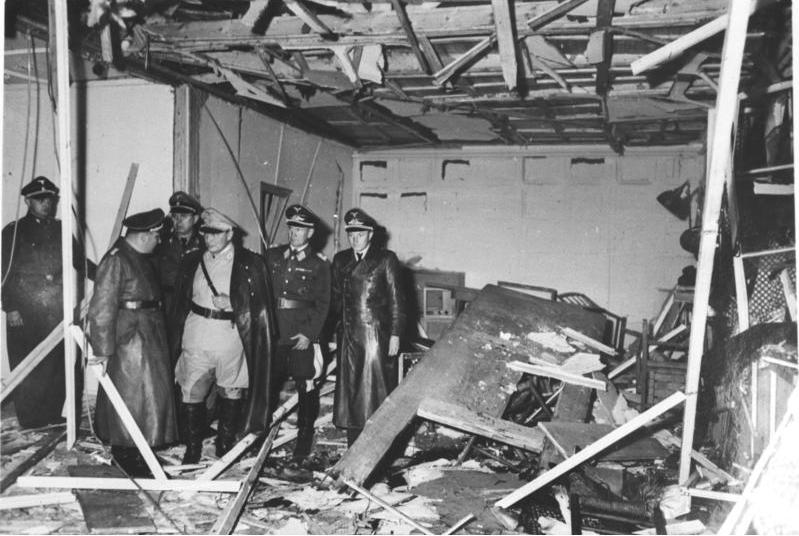
Stauffenberg walked into the briefing room carrying a briefcase containing two small bombs. But he only had time to arm one of the bombs. He left the briefcase under the conference table, as close to Hitler as he could get it. Then, as part of the plan, someone walked in and told Stauffenberg that there was a phone call for him. He excused himself, and left the room.

At 12:42 PM, Stauffenberg looked back, and saw the explosion and the smoke. He presumed that Hitler was dead. He got into a staff car, driven by his aide Werner von Haeften, and left the Wolfsschanze complex for the nearby airfield. By 1:00, he was airborne, with a plane whose flight was arranged by another conspirator.

At 4:00, Stauffenberg's plane landed at Berlin's Templehof airport, and he called the Bendlerblock, the Nazis' version of the Pentagon, telling them that Hitler was dead. This was his biggest mistake: It immediately made him something he had not been before the call: A suspect.

Had he waited for confirmation -- or, as it turned out, for denial -- he might not have become a suspect. Becoming one was bad for him, because Hitler was alive. When Stauffenberg left the briefing room, Colonel Heinz Brandt moved the briefcase. As a result, while the explosion did kill 4 people and injure almost everyone else in the room, Hitler was shielded by a leg of the solid oak conference table. Shrapnel ripped through his pants, giving him minor wounds to his legs. And, like almost everyone else in the room, Hitler suffered a perforated eardrum. But that was the extent of his injuries.

The Gestapo ended up arresting more than 7,000 people, executing 5,000 of them, including Stauffenberg, shot by a firing squad the next day. Field Marshal Erwin Rommel was a part of the plot, but, as Germany's greatest living military hero, he was given the option of suicide, and the use of a cover story that he had died in battle, which would protect his name and his family from dishonor.

The Allies continued closing in, and Hitler lasted another 9 months before taking the easy way out. The Soviets attempted to destroy the Wolfsschanze, but it was so solidly reinforced that conventional explosives couldn't do the job. The remains are now a historic site, and the redrawing of national borders after the war means that they're now located in Kętrzyn, Poland.

*

July 20, 1944 was a Thursday. Basketball star Mel Daniels was born on this day.

These baseball games were played:

* The New York Yankees lost to the St. Louis Browns, 7-3 at Sportsman's Park in St. Louis. Home runs in the bottom of the 7th inning by Mike Chartak and George McQuinn turned the game around. McQuinn would make it up to the Yankees, though, as their 1st baseman during their 1947 World Championship season.

* The New York Giants were swept in a doubleheader by the St. Louis Cardinals, 10-2 and 6-2 at the Polo Grounds. The Giants' bullpen melted down in the top of the 11th inning of the 2nd game.

* The Brooklyn Dodgers lost to the Cincinnati Reds, 6-0 at Ebbets Field. Harry Gumbert allowed 8 hits, but kept the shutout.

* The Boston Braves swept a doubleheader from the Chicago Cubs, with both games at Braves Field ending 5-4. In the opener, Chuck Workman singled home the winning run in the bottom of the 14th inning.

* A doubleheader was split at Shibe Park in Philadelphia. The Pittsburgh Pirates won the opener, 4-1. The Philadelphia Phillies won the nightcap, 3-2, with Ford Mullen singling home the winning run in the bottom of the 11th.

* The Cleveland Indians beat the Philadelphia Athletics, 2-1 at League Park in Cleveland.

* The Detroit Tigers beat the Washington Senators, 7-6 at Brigg Stadium in Detroit. (It was renamed Tiger Stadium in 1961.)

* The Boston Red Sox beat the Chicago White Sox, 11-7 at Comiskey Park in Chicago.

Monday, July 18, 2022

July 18, 1925: Adolf Hitler Publishes "Mein Kampf"

The last edition published by the Nazis, 1943

July 18, 1925: It's been said that the Holocaust began with one book, Mein Kampf (My Struggle) by Adolf Hitler; and ended with another, Het Achterhuis. Dagboekbrieven (The Annex: Daybook Notes), a.k.a. The Diary of Anne Frank.

Hitler wrote most of the book in 1924, while in Landsberg Prison in Landsburg am Lech, in Bavaria in southern Germany. He dictated it to Emil Maurice, his chauffeur, who was jailed along with him, also for a role in the previous year's failed Beer Hall Putsch; then to Rudolf Hess, his deputy in the National Socialist (Nazi) Party.

(Maurice was captured after the war, served 4 years in prison, returned to his former work as a watchmaker, and lived until 1972. Hess was captured on a diplomatic mission to Britain in 1940, and was the last survivor of the Nazi high command, dying in prison in 1987.)

So what is in the most hated book ever written? Is it the most hateful book ever written? It's two volumes. Volume One: A Reckoning is an autobiography, in 12 chapters. Volume Two: The National Socialist Movement is his political manifesto, in 15 chapters. He wrote of what he called "the Jewish peril," linking it to worldwide Communism, and blaming both for the German Empire's defeat in World War I.

He wrote, "The nationalization of our masses will succeed only when, aside from all the positive struggle for the soul of our people, their international poisoners are exterminated." And while that was an early sign that he wanted to wipe the Jewish people of Europe out, it was hardly the only spewing of anti-Semitism in the book.

After slow initial sales, the book became a bestseller in Germany following Hitler's rise to power in 1933. That year, it was published in English for the first time. It proved to be popular among rich Americans, who were focused less on its anti-Semitism, and more on its anti-Communism, and in particular its denunciation of labor unions.

At the time of his suicide, Hitler's official place of residence was in Munich, which led to his entire estate, including all rights to Mein Kampf, legally changing to ownership by the State of Bavaria. The government of Bavaria, in agreement with the federal government of Germany, refused to allow any copying or printing of the book in Germany. It also opposed copying and printing in other countries, but with less success.

Under German copyright law, the entire text entered the public domain on January 1, 2016, upon the expiration of the calendar year 70 years after the author's death. Owning the book in Germany is not a crime, nor is buying it, nor is selling it. Trading in old copies is lawful as well, unless it is done in such a fashion as to "promote hatred or war." In America, its purchase, sale, and availability in public libraries is protected by the "freedom of the press" clause of the 1st Amendment to the Constitution of the United States.

Vladimir Zhirinovsky, despite being a right-wing populist, led a party named the Liberal Democratic Party of Russia from 1992 until his death in 2022. In 1993, following an election that made his party the official opposition in Russia's parliament, the Duma, he published a book titled My Struggle: The Explosive Views of Russia's Most Controversial Political Figure. Whether he knew that, when translated from Russian into German, Моя борьба (Moya Borba) became "Mein Kampf," only he knew for sure.

Donald Trump, whose grandfather fled Germany to avoid serving in World War I, and changed the family name from "Drumpf," said in 1990 that he had a copy of Mein Kampf, and has been said to have kept it in his bedroom at Trump Tower. He has used Hitler-like phrases, like saying that immigrants are "poisoning the blood of our country."

He has since said he's never read the book. He lies. A lot. So did Hitler. And Trump has had delusions of dictatorship, demands of loyalty to him above all else, and concentration camps based on bigotry. So, you tell me. (UPDATE: And, in 2024, 80 years plus a few days after Hitler's closest call, Trump faced an assassination attempt, and, like his hero, sustained minor injuries.)

*

July 18, 1925 was a Saturday. These baseball games were played:

* The New York Yankees lost to the Detroit Tigers, 7-3 at Navin Field in Detroit. (That ballpark would be renamed Briggs Stadium in 1938, and Tiger Stadium in 1961.) Ty Cobb, by this point also the manager of the Tigers, did not put himself into the game. Babe Ruth went 1-for-2 with 2 walks and 2 RBIs, including a home run -- but, due to his early-season illness, it was only his 9th of the season. Rookie Lou Gehrig went 1-for-3 with a walk.

The Tigers' starting pitcher was named Ulysses Simpson Grant Stoner, but was known as Lil Stoner. It is incredibly unlikely that he actually was a stoner: Baseball team management has despised marijuana since it became aware of the weed's existence. At any rate, he pitched 7 innings, and Cobb replaced him with Ken Holloway, who became the winning pitcher when the Tigers scored 7 runs in the bottom of the 8th.

* The New York Giants lost to the Cincinnati Reds, 3-0 at the Polo Grounds. Dolf Luque pitched a 5-hit shutout. Frankie Frisch got 2 of those hits. One of the few Cubans considered "white" enough to appear in the major leagues before 1947, Luque would later pitch for the Giants.

* The Brooklyn Robins (as the Dodgers were known while Wilbert Robinson managed them from 1914 to 1931) lost to the St. Louis Cardinals, 4-1 at Ebbets Field. Rogers Hornsby went 0-for-4 with a walk. Zack Wheat also went 0-for-4.

* A doubleheader was split at Braves Field in Boston. The Pittsburgh Pirates won the opener, 9-8. The Boston Braves won the nightcap, 2-1, when Gus Fields singled Jimmy Welsh home with the winning run in the bottom of the 11th inning.

* The Chicago Cubs beat the Philadelphia Phillies, 7-6 at Baker Bowl in Philadelphia. The Cubs got 3 singles, 2 walks and an error to produce 5 runs in the top of the 10th inning. Cy Williams hit a grand slam in the bottom of the 10th, to get the Phils back within 1 run, but that was as close as they would get.

* The Washington Senators beat the Cleveland Indians, 19-6 at League Park in Cleveland. Despite this outburst, the Senators didn't score more than 5 runs in any inning, and only Goose Goslin hit a home run. Sam Rice had 4 hits, and he and Goslin each had 3 RBIs. Earl McNeely, Joe Judge and Ossie Bleuge each had 3 hits. Every Senator starter had at least 2 hits and an RBI, including Vean Gregg, who pitched a complete game and had 2 RBIs.

Indians center fielder and manager Tris Speaker went 1-for-4 with a walk and 2 RBIs. And Cliff Lee went 2-for-5. A right fielder, he appears not to be a relative of the later pitcher Cliff Lee, who also spent time with the Indians.

* The Chicago White Sox beat the Boston Red Sox, 10-2 at Comiskey Park in Chicago. Eddie Collins went 1-for-4 with a walk and an RBI.

* The St. Louis Browns beat the Philadelphia Athletics, 6-2 at Sportsman's Park in St. Louis. George Sisler went 1-for-5.

Friday, July 1, 2022

July 1, 1943: The Courage and Execution of Willem Arondéus

July 1, 1943: Dutch artist, author and Resistance fighter Willem Arondéus is executed by the Nazis in Haarlem, the city in the Netherlands that gave its name to the famous black neighborhood in New York City. He was 48 years old.

He was born on August 22, 1894 in Naarden, the Netherlands. He started working as an illustrator, designer of posters and tapestries and a painter. In 1923, he was commissioned to paint a large mural for Rotterdam City Hall. During that same period, he illustrated poems by writers J.H. Leopold, Pieter Cornelis Boutens and Martinus Nijhoff. He decided he could write as well as anyone he was working for. In 1938, he published Het Uilenhuis (The Owls House) and In de bloeiende Ramenas (In the Blossoming Winter Radish).

The Nazis conquered the Netherlands on May 17, 1940. In 1942, Arondéus began publishing the underground newspaper Brandarisbrief. (This translates as "Brandaris' Letter." Brandaris is the oldest lighthouse in the country, overlooking the Wadden Sea since 1594.) In 1943, the Brandarisbrief merged with another publication called De Vrije Kunstenaar (The Free Artist). Through this work, he met other members of the Dutch Resistance, and set his skills toward forging identity documents to help protect Jews against deportation and death.

But the forgeries could be checked against the Municipal Office for Population Registration to determine legitimacy. So, on the night of March 27, 1943 -- the day my father was born -- Arondéus and some friends disguised themselves as policemen, knocked the security guards out, dragged them to safety (they didn't want to kill any Dutch people), and went in.

They piled registration cards, and soaked them in benzene. They stole some blank cards to make more forgeries, and also some cash, then set their time bombs and got out. The firefighters put the fire out quickly, but the water damage ended up helping the Resistance cause: About 15 percent of the total cards were destroyed, probably saving many Dutch Jews from certain death.

The Nazis put up a reward, and someone ratted Arondéus out. He was arrested a month later. He refused to name anyone else involved in the plot, but the Gestapo found his notebook, and 13 others were arrested. All 14 were sentenced to death. Arondéus pleaded guilty and took all the blame, which resulted in two of his accomplices being granted clemency.

Arondéus was openly gay, at a time when few people were, even in the comparatively liberal Netherlands. His last words were to Laura Mazirel, his attorney and a fellow Resistance fighter: "Tell people that homosexuals are not cowards."

Many of those involved in the bombing, including Arondeus, were later honored by Yad Vashem as Righteous Among the Nations for their efforts to save Jews from the Holocaust.

*

July 1, 1943 was a Thursday. Stage composer Jeff Wayne was born that day.

These baseball games were played:

* The New York Yankees lost to the Cleveland Indians, 3-2 at League Park in Cleveland. Al Smith (not to be confused with the later White Sox outfielder or the former Governor of New York) outpitched Charles "Butch" Wensloff. Tribe shortstop and manager Lou Boudreau went 1-for-3 with 2 walks. Yankee right fielder George "Tuck" Stainback went 3-for-4. Most of the Yankees' big names, including Joe DiMaggio, were serving in The War.

* The Brooklyn Dodgers lost to the Cincinnati Reds, 10-9 at Ebbets Field. In the top of the 12th inning, Dain Clay singled Eddie Miller home, and Lonny Frey got Ray Mueller home on a sacrifice fly. In the bottom of the 12th, Bobby Bragan walked with the bases loaded to get a run home, but the Brooks could get no closer.

For the Reds, Miller went 4-for-6 with 2 RBIs, Frey went 3-for-7 with a home run and 3 RBIs, and Eric Tipton went 3-for-4 with 2 walks and an RBI. For Dem Bums, Joseph "Arky" Vaughan went 4-for-5 with 2 walks and 5 RBIs; and Mickey Owen went 3-for-5 with a walk.

* The Chicago Cubs beat the Boston Braves, 6-5 at Braves Field in Boston.

* A doubleheader was split at Shibe Park in Philadelphia. The Philadelphia Phillies won the opener, 6-1. The Pittsburgh Pirates won the nightcap, 2-1. Over the 2 games, for the Phils, Ron Northey went 5-for-9 with an RBI, and Babe Dahlgren went 4-for-9 with 2 RBIs.

* The Detroit Tigers beat the Boston Red Sox, 3-2 at Briggs Stadium (later Tiger Stadium) in Detroit. For the Red Sox, Leon Culberson went 4-for-5, and Jim Tabor went 3-for-5. Hank Greenberg of the Tigers and Ted Williams of the Red Sox were unavailable.

* The Chicago White Sox beat the Washington Senators, 2-0 at Comiskey Park in Chicago. Bill Dietrich pitched a 4-hit shutout, outpitching Early Wynn, who would later be the White Sox' ace. Luke Appling went 2-for-3 with a walk.

* And the St. Louis Browns beat the Philadelphia Athletics, 2-1 at Sportsman's Park in St. Louis. Browns catcher Joe Schultz, later to be a coach on the 1964 and 1967 World Champion St. Louis Cardinals and the manager of the infamous 1969 Seattle Pilots of Ball Four fame, singled Vern Stephens home with the winning run in the bottom of the 11th inning. Bob Muncrief of the Browns and Don Black of the A's both went the distance.

* And the New York Giants and the St. Louis Cardinals moved their game scheduled for this day to the previous day, making for a doubleheader. (They played again on July 2, so wartime travel restrictions had nothing to do with it.) The Giants won the 1st game, 4-3. Buster Maynard hit a sacrifice fly to score Sid Gordon with the winning run in the bottom of the 10th inning. former Cubs catching star Ernie Lombardi went 3-for-5 with a home run and 2 RBIs, then got the 2nd game off.

The Cards won the 2nd game, 5-0. Howie Pollet pitched a 6-hit shutout. Over the 2 games, Gordon went 3-for-9 with an RBI, Mikey Witek went 4-for-8 with a walk, Giant right fielder and manager Mel Ott went 0-for-7, but did draw 2 walks, and Stan Musial went 4-for-9 with an RBI.

Saturday, June 25, 2022

June 25, 1947: "The Diary of Anne Frank" Is Published

June 25, 1947: It's been said that the Holocaust began with one book, Mein Kampf (My Struggle) by Adolf Hitler; and ended with another, Het Achterhuis. Dagboekbrieven (The Annex: Diary Notes), a.k.a. The Diary of Anne Frank.

Annelies Marie Frank was born on June 12, 1929 in Frankfurt, Germany. In 1934, following the Nazi takeover, her family moved to Amsterdam, the Netherlands. But in 1940, the Nazis took over that country, too. Being Jewish, she and her family were stripped of their German citizenship.

On June 12, 1942, her 13th birthday, she received a diary as a gift. She begans it with these words: "I hope I will be able to confide everything to you, as I have never been able to confide in anyone, and I hope you will be a great source of comfort and support."

Just a month later, on July 6, her family -- also including her father, Otto; her mother, Edith; and her sister, Margot -- went into hiding in concealed rooms, behind a bookcase in the building where Otto, a bank employee, worked. They were soon joined by the van Pels family. For 2 years, they stayed there, hoping they wouldn't be found by the Nazis, and she kept up her diary.

On August 4, 1944, the Gestapo found them, and sent them to the Auschwitz concentration camp in Poland. On November 1, Anne and Margot were sent to the Bergen-Belsen camp, in Germany. Both died of typhus, probably in February of 1945. Anne was only 15 years old.

Otto was the only person living in the concealed rooms to have survived the Holocaust. When he returned to Amsterdam, he found that his secretary and contact to the outside world, Miep Gies, had saved Anne's diary. Anne had told her father that she wanted to be a writer, and Otto had the diary published. It was published in Dutch in 1947, and in English in 1952, as The Diary of a Young Girl.

In 1955, a play titled The Diary of Anne Frank premiered at the Cort Theatre on New York's Broadway, starring Susan Strasberg as Anne. The play changed the name of the van Pels family to Van Daan. It was filmed in 1959, starring Millie Perkins; for ABC in 1967, starring Diana Davila; for NBC in 1980, starring Melissa Gilbert; for the BBC in 1987, starring Katharine Schlesinger; for CBS in 1988, starring Lisa Jacobs; for ABC in 2001, starring Hannah Taylor-Gordon; and for the BBC in 2009, starring Ellie Kendrick.

There is an urban legend about a production of the play where the actress playing Anne was so bad, when the actor playing the Gestapo officer was looking around, a woman in the audience yelled, "She's upstairs!"

Otto Frank lived until 1980. Miep Gies lived until 2010, age 100.

*

June 25, 1947 was a Wednesday. These baseball games were played:

* The New York Yankees beat the Cleveland Indians, 3-0 at Yankee Stadium. Frank "Spec" Shea pitched a 3-hit shutout. Joe DiMaggio went 1-for-4 with an RBI.

* The New York Giants beat the Chicago Cubs, 9-3 at Wrigley Field in Chicago.

* The Brooklyn Dodgers beat the Pittsburgh Pirates, 6-2 at Forbes Field in Pittsburgh. Jackie Robinson went 1-for-3 with a walk. Hank Greenberg went 1-for-3 with a walk. Ralph Kiner went 1-for-4.

* A doubleheader was split at Fenway Park in Boston. The Detroit Tigers won the opener, 4-2. The Boston Red Sox won the nightcap, 4-3. Over the 2 games, Ted Williams went 2-for-6 with 2 walks.

* The Philadelphia Athletics beat the St. Louis Browns, 4-2 at Shibe Park in Philadelphia.

* The Cincinnati Reds beat the Philadelphia Phillies, 9-8 at Crosley Field in Cincinnati.

* And the Chicago White Sox, the Washington Senators, the Boston Braves and the St. Louis Cardinals were not scheduled.

December 31, 1999 & January 1, 2000: The Millennium

December 31, 1999:  The Millennium arrives. The people of planet Earth survived. At a terrible cost. But we hadn't destroyed ourselves. ...