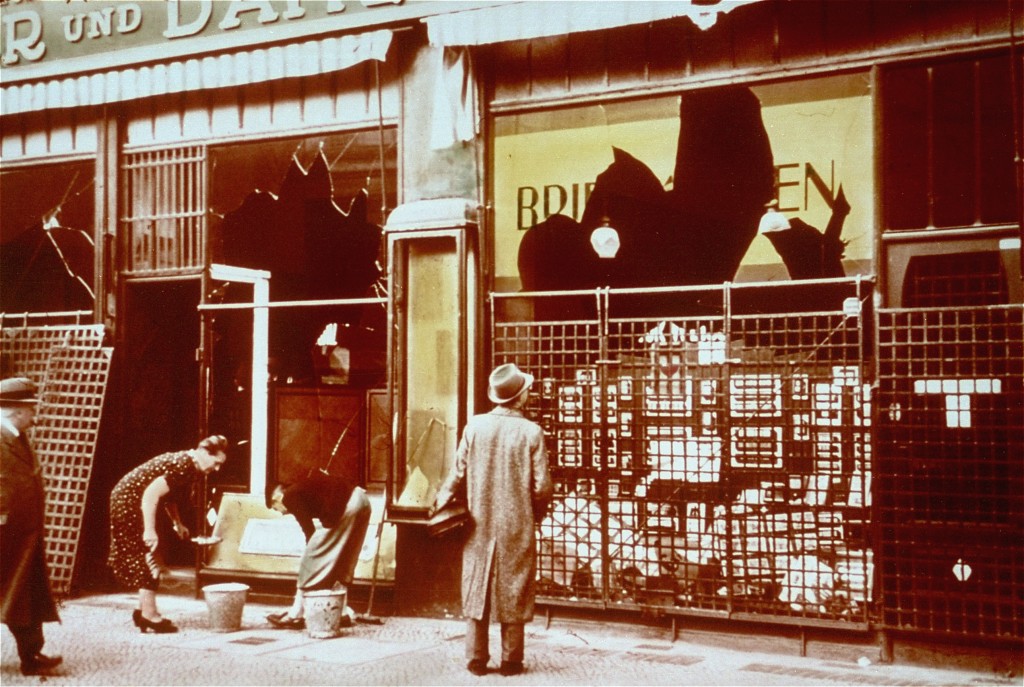
November 9, 1938: Nazi paramilitary troops destroy 267 synagogues and over 7,000 Jewish businesses, all over Germany.
It had been nearly 6 years since the Nazi Party took power in Germany, with their leader, Adolf Hitler, becoming the Chancellor, the country's head of government. It had been a little over 4 years since Hitler also became President, thus becoming the country's head of state, and its absolute ruler.
He had told the people of Germany that their national woes -- from losing World War I and the deprivations that followed, to the difficulties of the worldwide Great Depression -- were the fault of Jews and Communists, and he linked them wherever he could. He told them it wasn't the country's own excesses that did it. It wasn't the fault of the people. It was some other group with an evil ideology.
Sound familiar?
And it had been a year and a half since he annexed his native Austria into his Third Reich. And it had been 40 days since the Munich Agreement, in which Britain and France, terrified of getting into a second world war with Germany, betrayed their ally, Czechoslovakia, and let Hitler take that country.
On November 7, Ernst vom Rath, the third secretary of the German Embassy in Paris -- a minor diplomat, only 29 years old -- was shot by Herschel Grynszpan, a 17-year-old Jew, born in Germany of Polish descent. His parents had been deported to Poland, and he blamed vom Rath. It took vom Rath 2 days to die.
Just as the Reichstag Fire of 1933 was the pretext the Nazis needed for their previous big round of persecutions, vom Rath's death on November 9 gave them the excuse they needed to do it again. The Party's paramilitary wing, the Sturmabteilung (SA, or "Storm Detachment," often called the "Brownshirts"), broke into Jewish people's homes, ransacking them and stealing valuables. They broke into Jewish-owned businesses, destroying both goods and property.
All the broken glass storefronts gave the event its name: Kristallnacht, or "Crystal Night," or "The Night of Broken Glass." It wasn't just in the national capital of Berlin: It was all over the Reich, including in Austria, and even on Polish soil in what was then "The Free City of Danzig." (Now Gdańsk.)
Over 30,000 people were arrested, and taken to concentration camps. The official death toll, from all over Germany, was 91. No one truly believes the figure was that low: It's been suggested that it might be over 600.
French police arrested Grynszpan for shooting vom Rath, and he was handed over to the Gestapo after the fall of France in June 1940, and brought him back to Germany. He was taken to the Sachenhausen concentration camp in 1942.
History loses track of him after that. Nazi war criminal Adolf Eichmann claimed he had been ordered to "examine" Grynszpan (there may have been something lost in translation), but couldn't remember whether this was in 1943 or 1944. A photograph taken in Paris in 1946 showed a man resembling Grzyszpan, but this is hardly definitive. The prevailing theory is that an epidemic went through Sachenhausen, Grynszpan died as a result, and the record-keepers covered this up, because Grynszpan hadn't yet gone to trial, and they were supposed to keep him alive until he could be tried.
Kristallnacht was a message, from the Nazis to the Jews: "We are the masters, and we can do whatever we want, including to you."
And, since the world's democracies stood by and did nothing about it, it was allowed to be a prelude to what the Nazis eventually decided to have, calling that "The Final Solution."
The world's democracies finally decided to do something about that. For the 120 million people who eventually lived under the Swastika Flag, it meant liberation from the most barbarous regime in human history. But for 6 million people, it was much too late.
November 9 has become Germany's "Day of Destiny": On that date, in 1918, the Kaiser abdicated and the 1st German Republic was proclaimed; in 1923, the Beer Hall Putsch failed; in 1938, Kristallnacht was carried out by the Nazis; and in 1989, the Berlin Wall was rendered legally moot.
*
November 9, 1938 was a Wednesday. There were no scores in America on that historic day. Baseball season was over, there was no NBA, the NHL season hadn't started yet, and it was a Wednesday, so no football.


No comments:
Post a Comment