Showing posts with label billy martin. Show all posts

Sunday, December 25, 2022

December 25, 1989: The Death of Billy Martin

December 25, 1989: Billy Martin is killed when his pickup truck crashes outside his home in Johnson City, New York. He was 61. There is dispute as to whether he was the driver or the passenger, or whether it was his friend, Bill Reddy.

Growing up as a fan of the New York Yankees, I looked upon Billy as a hero, as the Yankees' only real manager, as their Number 1 forever. In the file of "Stupid things I used to think": As an 8-year-old boy, I actually thought that he wore Number 1 because he was the manager of the defending World Champions. After all, didn't Tommy Lasorda, manager of the team he beat, wear Number 2?

I was even at Yankee Stadium on August 10, 1986, the day he got that uniform number retired and received his Monument Park Plaque. He said that day, "I may not have been the greatest Yankee to put on the uniform, but I am the proudest." (The Yankees got pounded that day, 13-3, by, of all teams, the one from the city that Billy hated the most, Kansas City.)

I had no idea just what was going on in Billy's head, either as a 1950s player or a 1970s & '80s manager. He'd been dealt a tough hand as a boy, and he took it out on the world as a man. While he was an interesting player, helping the Yankees win 5 World Series, and an occasionally brilliant manager, taking 4 different teams to the postseason a total of 5 times and winning the 1977 World Series with the Yankees, he did some things, both inside the ballpark and out, that cannot be excused.

To lots of people, including Yankee owner George Steinbrenner and star slugger Reggie Jackson, he could go from beautiful to shameful and back to beautiful in a matter of hours. Star pitcher Ron Guidry said, "Billy's all right, if you approach him right. I try to avoid him altogether."

He was an enigma, wrapped in a fight, soaked in a bottle. He never found peace in life, and made it hard for others to find peace. I hope he found it in death.

He was laid to rest in Gate of Heaven Cemetery in Hawthorne, New York -- a moment's walk away from the grave of Babe Ruth.

*

December 25, 1989 was a Monday. This was also the day that Romania overthrew its dictator Nicolae CeauČ™escu, and executed him and his wife Eleana.

Baseball was out of season. On ABC Monday Night Football, the Minnesota Vikings beat the Cincinnati Bengals, 29-21 at the Metrodome in Minneapolis. There was a college bowl game, between ranked teams: Michigan State, ranked Number 22, defeated Number 25 Hawaii, 33-13, in the Aloha Bowl, despite the game being played on Hawaii's home field, Aloha Stadium in Honolulu.

The NHL does not play on Christmas Day. The NBA does, and 1 game was played: The Atlanta Falcons beat the Cleveland Cavaliers, 115-104 at The Omni in Atlanta.

Saturday, October 15, 2022

October 15, 1981: The Birth of "The Wave"

Krazy George, admiring his invention

October 15, 1981: The New York Yankees beat the Oakland Athletics, 4-0 at the Oakland Coliseum, and sweep the American League Championship Series in 3 straight.
Once and future Yankee manager Billy Martin, a native of nearby West Berkeley, California, had previously played for the Oakland Oaks' 1948 Pacific Coast League champion under Casey Stengel, and now, once again, he had revived the fortunes of his hometown team, saving the A’s from total incompetence and irrelevance, taking them from 108 losses the year before he arrived to 2nd place in his 1st season to the AL West title in his 2nd.
This was the 5th time Billy had managed a team into the postseason, and with the 4th different team: Minnesota in 1969, Detroit in '72, the Yankees in '76 and '77, and now the A's in '81. He came close to making it 6 times with 5 different teams, with Texas in '74.
When introduced before Game 1 of this series at Yankee Stadium, Billy got a huge ovation. That made him very happy. George Steinbrenner couldn't be reached for comment. But in this series, the Yankees just had too much for the A's, and took their 33rd Pennant -- the A's, if you count their Philadelphia years, are 2nd among AL teams, with 12.
Billy was outmanaged by the man who replaced him as Yankee manager the 1st time he left, Bob Lemon. Lemon dropped 2nd baseman Willie Randolph from his usual leadoff spot in the order to the bottom, 9th. Randolph responded by hitting a home run, and ended up catching the last out, a popup by Wayne Gross. Dave Righetti pitched 6 innings, Ron Davis 2, and Rich "Goose" Gossage 1, to complete a 5-hit shutout.
For reasons partly, but not entirely, his fault, Billy would never manage in the postseason again. And, for reasons partly, but not entirely, Billy's fault, the Yankees' 34th Pennant would not be soon in coming. Today, the total stands at Yankees 40, A's 16.
During this Game 3 at the Oakland Coliseum, "professional cheerleader" Krazy George Henderson, a snare-drum-beating native of nearby San Jose, led the audience in "The Wave." He invented it. "And anybody who says I didn't is a stinkin' liar," he would later say.

Robb Weller, later to co-host Entertainment Tonight, would say he invented the Wave himself, at a University of Washington football game. But the game in question happened 2 weeks later, so I'm inclined to believe Krazy George, who says he first did it in 1979, at a hockey game at the McNichols Arena in Denver.

In 1996, Krazy George once came to a Trenton Thunder game I was at, in Trenton, New Jersey, and we won. I told him, "George, stick around, we need the wins!" To be honest, though (and I didn't tell him this), I've always hated the Wave. I find it juvenile.
People outside North America first saw the Wave during the 1986 World Cup in Mexico, and that's why they call it the Mexican Wave.
As of October 15, 2022, Krazy George is still alive and leading fans in The Wave and other activities.
*
October 15, 1981 was a Thursday. It was a travel day for the National League Championship Series. The Montreal Expos and the Los Angeles Dodgers were tied, 1-1. The Dodgers won that series in 5 games.
Football was in midweek. The NBA season didn't start for another 15 days. There were 5 games in the NHL:
* The New York Islanders beat the Vancouver Canucks, 4-1 at the Nassau Coliseum. This would turn out to be a preview of the Stanley Cup Finals, with the Isles winning again.
* The Montreal Canadiens beat the Hartford Whalers, 7-2 at the Hartford Civic Center (now the PeoplesBank Arena).
* The Detroit Red Wings beat the St. Louis Blues, 6-3 at the Joe Louis Arena in Detroit.
* The Winnipeg Jets beat the Calgary Flames, 5-4 at the Saddledome in Calgary.
* And the Los Angeles Kings beat the Colorado Rockies, 10-2 at The Forum outside Los Angeles in Inglewood, California. The Kings got 2 goals each from Marcel Dionne, Greg Terrion and Larry Murphy. This would be the last season in Denver for the Rockies: The next season, they became the New Jersey Devils. In 1993, Denver would get a Major League Baseball team, and it would take on the Colorado Rockies name.
Also, singer Keyshia Cole was born on this day.

Saturday, October 8, 2022

October 8, 1972: Campaneris vs. LaGrow

October 8, 1972: Game 2 of the American League Championship Series. Bert Campaneris of the Oakland Athletics leads off the bottom of the 1st inning at the Oakland Coliseum with a single, steals 2nd and 3rd bases, and scores on a single. Campaneris would end up getting 3 hits on the day against the Detroit Tigers.

In the 7th, Tiger reliever Lerrin LaGrow -- possibly at the urging of manager Billy Martin, who frequently encouraged such behavior -- purposely hit Campaneris with a pitch, on the ankle. Campaneris responded by throwing his bat at LaGrow, who just barely ducked in time to avoid getting hit with it.
There was a bench-clearing brawl, and Martin had to be restrained from going after Campaneris. Both Campaneris and LaGrow were suspended for the rest of the series. The A's won the game, 5-0, and took a 2-games-to-0 lead in the series. But the Tigers would fight back in Detroit to force a 5th and deciding game.

In 2007, for work, I had to contact a Phoenix-area real estate office. Turned out, it was run by LaGrow. Now, I don't condone what Campaneris did, but I will say that, 35 years later, LaGrow wasn't any nicer.

*

October 8, 1972 was a Sunday. Game 2 was also played in the National League Championship Series. The Cincinnati Reds scored 4 runs in the top of the 1st inning, and beat the Pittsburgh Pirates, 5-3 at Three Rivers Stadium, to tie up the series. Joe Morgan hit a home run. The series went to a deciding 5th game, and the Reds won, before losing the World Series to the A's in 7.

And these games were played in the NFL:

* The New York Giants beat the New Orleans Saints, 45-21 at Yankee Stadium.

* The New York Jets lost to the Miami Dolphins 27-17 at Shea Stadium. Yes, the Giants and the Jets were both playing at home, at the same time, kicking off at 1:00 PM Eastern Time. Attendance in The Bronx: 65,720. Attendance in Queens: 63,841. Both were officially sellouts, so it's not clear which team would have sold more tickets had they both played in 100,000-seat stadiums, such as the Los Angeles Coliseum and the Rose Bowl could then have held. This was during what turned out to be the Dolphins' undefeated 17-0 season.

* The San Diego Chargers beat the Baltimore Colts, 23-20 at Memorial Stadium in Baltimore.

* The Washington Redskins beat the Philadelphia Eagles, 14-0 at Robert F. Kennedy Memorial Stadium in Washington.

* The Detroit Lions beat the Atlanta Falcons, 26-23 at Atlanta Stadium. (It was renamed Atlanta-Fulton County Stadium in 1975.) Steve Owens, winner of the 1969 Heisman Trophy for the University of Oklahoma, scored the winning touchdown as the clock wound down.

* The Buffalo Bills beat the New England Patriots, 38-14 at War Memorial Stadium in Buffalo.

* The Kansas City Chiefs beat the Cleveland Browns, 31-7 at Cleveland Municipal Stadium.

* The Cincinnati Bengals beat the Denver Broncos, 21-10 at Riverfront Stadium in Cincinnati.

* The Green Bay Packers beat their arch-rivals, the Chicago Bears, 20-17 at Lambeau Field in Green Bay.

* The football version of the St. Louis Cardinals beat the Minnesota Vikings, 19-17 at Metropolitan Stadium in the Minneapolis suburb of Bloomington, Minnesota.

* The Dallas Cowboys beat the Pittsburgh Steelers, 17-13 at Texas Stadium in the Dallas suburb of Irving, Texas.

* The Los Angeles Rams beat their arch-rivals, the San Francisco 49ers, 31-7 at the Los Angeles Memorial Coliseum.

* And the next night, on ABC Monday Night Football, the Oakland Raiders beat the Houston Oilers, 34-0 at the Astrodome in Houston.

Friday, October 7, 2022

October 7, 1952: Billy Martin's Desperate Dash

October 7, 1952: In the decisive Game 7 of the World Series, the New York Yankees beat the Brooklyn Dodgers at Ebbets Field, 4-2, to win their 4th consecutive World Championship, their 15th overall, and their 1st without Joe DiMaggio in 20 years.
The Dodgers still haven't won a World Series, and the idea that "Next Year" will come is getting more and more frustrating.
This game was highlighted by the Dodgers loading the bases with 1 out in the bottom of the 7th. Carl Furillo was on 3rd base, Billy Cox on 2nd, and Pee Wee Reese on 1st. Yankee manager Casey Stengel had already used each of his "Big Three" starting pitchers in the game: Vic Raschi, Eddie Lopat, and now Allie Reynolds. He called on the lefthanded reliever who had closed out the previous year's Series, Bob Kuzava.
The dangerous Duke Snider was up: The Dodgers' best slugger, a lefthanded hitter, with Ebbets Field being the best hitter's park in the National League, and the right-field pole being only 297 feet from home plate. But Kuzava got the Duke to pop up to 3rd baseman Gil McDougald. Now, to get out of the threat, he had to stop Jackie Robinson.
He got Robinson to pop the ball up, too, but the late afternoon Sun was peeking through the decks of Ebbets Field, and nobody saw the ball!
The day before, Raschi had attempted a sacrifice bunt, and it ricocheted off the leg of Dodger pitcher Billy Loes, helping a Yankee rally that forced this Game 7. Asked about it after the game, Loes said, "I lost the ball in the Sun!" It sounded stupid, because he was bent over, not looking up, but his teammates, more familiar with playing in the Flatbush ballyard, stood up for him.
Still, it ended up defining Loes' career: While such Brooklyn pitchers as Don Newcombe, Carl Erskine, Elwin "Preacher" Roe and this game's starter, Joe Black, would remain admired by reminiscing ex-Dodger fans, Loes was not.
This time, the Yankee infielders couldn't see the ball, and all 3 runners were on the move. If the ball dropped, it would have been no worse for the Dodgers than a tie game. None of them saw it, except 2nd baseman Billy Martin, who dashed in, and caught the ball at his knee to end the threat.
Game 7 of the 1952 World Series was the 1st time that Billy Martin was a Yankee hero, and the 1st time he ruined Dodger hopes. The last time for each of these, it would be as a manager, and the Dodgers would represent Los Angeles.
Even though he did not enter the game, or any game in this Series, Dodger pitcher Ralph Branca was ejected by home plate umpire Larry Goetz, for excesses in bench-jockeying.
Gil Hodges finished the Fall Classic hitless in 21 at-bats, which had prompted some Brooklyn fans, some fellow Catholics, some not, to gather at local churches asking for divine help for their beloved 1st baseman.
Fortunately, Dodger owner Walter O'Malley, mean old man that he was, was not George Steinbrenner, and didn't do what George did to Dave Winfield following his 1-for-21 performance in the '81 Series against the L.A. edition of the Dodgers: Call him "Mr. May," in comparison to "Mr. October," Reggie Jackson.
Outfielder Irv Noren was the last surviving 1952 Yankee, dying on November 15, 2019. Whitey Ford, who lived for nearly another year, was not on the roster in this season, as he was serving in the Korean War.
*

October 7, 1952 was a Tuesday. It was a great day for the Yankees, but it was a bad day for the world at large, only we wouldn't know it for half a century: Vladimir Putin was born in St. Petersburg, Russia (then Leningrad, the Soviet Union).

Football was in midweek. The new NHL season started in 2 days; the NBA season, in 24 days. So there were no other scores on this historic day.

Wednesday, October 5, 2022

October 5, 1953: Five Straight World Series Wins

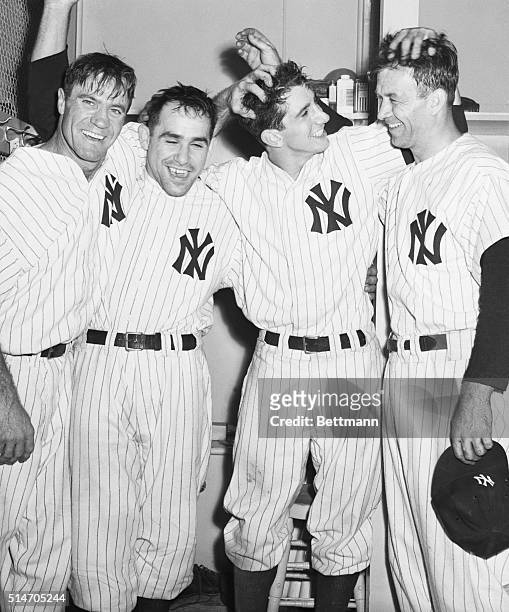
Left to right: Hank Bauer, Yogi Berra,
Billy Martin and Joe Collins

October 5, 1953: The New York Yankees beat the Brooklyn Dodgers, 4-3 at Yankee Stadium, to win Game 6 of the World Series, clinching it, 4 games to 2. This was the 5th straight World Championship for the Yankees. No other baseball team has ever done that.

The Yankees hired Charles Dillon "Casey" Stengel as their manager for the 1949 season, and he led them to the American League Pennant in each of the next 5 years. In 1949, they beat the Dodgers in the World Series in 5 games. In 1950, they swept the Philadelphia Phillies in 4 straight. In 1951, they beat the New York Giants in 6 games. That was Joe DiMaggio's last season, and Mickey Mantle's 1st season.

In 1952, it took them 7 games to finish the Dodgers off. That gave them 4 straight World Series wins, matching the Joe McCarthy-managed Yankees of 1936 to 1939.

In 1953, they faced the Dodgers again. It's important to note that, due to his U.S. Army commitments -- the Korean War was over by this point, but not everybody serving in it had been discharged yet -- the Dodgers did not have their best pitcher, Don Newcombe, for either the 1952 or the '53 Series. However, the Yankees had lost Whitey Ford to the war for the Series in '51 and '52. And the Giants had lost their best player, Willie Mays, for the '52 and '53 seasons, so if he was available, maybe they would have won those Pennants instead of the Dodgers.

The Dodgers were loaded. They won 105 games, which would remain a franchise record for 64 years. They finished 13 games ahead of the newly-moved Milwaukee Braves in the National League. They had 6 .300+ hitters, led by NL batting champion Carl Furillo at .344, and center fielder Edwin "Duke" Snider right behind at .336.

All 8 starting position players had at least 18 doubles, with Snider and Furillo each hitting 38. 2nd baseman Jim Gilliam led the NL with 17 triples. Snider hit 42 home runs, catcher Roy Campanella hit 41, and 1st baseman Gil Hodges hit 31. They had 5 players with at least 95 RBIs, with Campy leading the NL with 142, the Duke having 126, and Hodges 121. Campy was named NL Most Valuable Player.

They were superb defensively as well: Furillo also had the best right field arm in the game at the time, Snider was at least the equal with the glove in center as the Yankees' Mickey Mantle (if not of Mays), Hodges was the best-fielding 1st baseman in baseball, Billy Cox was the best-fielding 3rd baseman, Harold "Pee Wee" Reese was still the best shortstop in the NL; and Jackie Robinson, rotated between 2nd base, 3rd base and left field, played all of those positions well.

Their pitching was also strong, even without Newcombe available. Carl Erskine had the best curveball in the NL, going 20-6, leading the League with a .769 winning percentage. Russ Meyer, "The Mad Monk," was 15-5. Billy Loes was 14-8. Elwin "Preacher" Roe was 11-3. Rookie Johnny Podres was 9-4. Clem Labine, Joe Black and Jim Hughes made for a good bullpen.

But the Yankees were still the Yankees. They still had the best catcher in all of baseball, Lawrence "Yogi" Berra. Mantle, not yet 22 years old, had come into his own, launching some of the longest home runs anyone had ever seen: That season alone, he may have hit the longest ones ever seen at Griffith Stadium in Washington, Shibe Park/Connie Mack Stadium in Philadelphia, and Sportsman's Park/Busch Stadium in St. Louis. Left fielder Gene Woodling and right fielder Hank Bauer both batted over .300. Phil Rizzuto was still Reese's equal as a shortstop. Gil McDougald had become an excellent 3rd baseman.

And Ford returned to a starting rotation that still had "The Big Three": Allie Reynolds, Eddie Lopat and Vic Raschi. Stengel's alternation from the speedy Reynolds to the junkballing Lopat, then to the speedy Raschi, then to the mix-it-up master Ford kept American League batters on their toes, and made it hard for them to get into a day-to-day rhythm. The Yankees won 99 games, finishing 8 1/2 ahead of the Cleveland Indians, whose 3rd baseman, Al Rosen, narrowly lost the batting title to cost himself the Triple Crown. He was named the AL's MVP.

Despite the Dodgers' firepower, the Yankees' experience, especially against the Dodgers, made them slight betting favorites. Dwight D. Eisenhower, a former West Point baseball and football player in his 1st year as President, admitted before Game 1 that, "It would be nice if someone besides the Yankees won for a change."

With 85-year-old Cy Young throwing out the ceremonial first ball to Berra to open the World Series -- Yogi said, "It was like watching a statue come to life" -- the Yankees won Game 1, 9-5 at Yankee Stadium in The Bronx. Yogi hit a home run, and Eisenhower, having watched the television broadcast of the game on NBC, said, "I received a terrific kick out of Yogi Berra's home run. That fellow really slammed it out of the park."

The Yankees won Game 2 at home, 4-2. The Series moved to Ebbets Field in Brooklyn, and the Dodgers won Game 3, 3-2, and Game 4, 7-3. In Game 4, Erskine struck out 14 batters, setting a new Series record that would last for 10 years. But in Game 5, Mantle hit a grand slam to give the Yankees an 11-7 win, and a 3-2 lead in the Series.

Game 6 was played at Yankee Stadium, in front of 62,730 fans, about the twice the seating capacity of Ebbets Field. Ford started for the Yankees, Erskine for the Dodgers. With one of the best curveballs in the game at the time, "Oisk," as the Dodger fans called him in their Brooklyn accent, gave the Flatbush Faithful -- also known as the Flastbush Flock -- hope that "Dem Bums" could push the Series to a Game 7.

But the Yankees struck quickly. Woodling led off with a walk. 1st baseman Joe Collins struck out, but Bauer singled, and Berra hit a ground-rule double to get Woodling home. Mantle was walked intentionally. 2nd baseman Billy Martin grounded to 2nd, and Gilliam bobbled the ball, allowing Bauer to score. For whatever reason, Dodger manager Charlie Dressen had put his usual 2nd baseman, Jackie Robinson, in left field.

The Yankees scored again in the 2nd, on a sacrifice fly by Woodling. The game remained 3-0 until the top of the 6th. With 1 out, Robinson doubled to left, and stole 3rd base. Campanella got him home on a groundout, to make it 3-1.

Stengel brought Reynolds in for the 8th inning, thinking he had the right mentality to close the game out. Perhaps the best starting pitcher on his 5 Pennant winners, Reynolds had a blazing fastball, and was willing to throw inside. He hit 57 batters during his career, but claimed he only hit 6 on purpose. The Dodgers accused him of targeting black players, but he seemed to brush white players back with the same frequency. He once plunked a batter on a 3-0 count, telling a reporter after the game, "If I'm going to put you on, I might as well hurt you." Partly because of his Cherokee heritage, and partly because his fastball seemed to bring up memories of a speeding train of that name, he was known as the Superchief.

Reynolds got through the 8th, giving up only a single to Robinson. But with 1 out in the 9th, he walked Snider, and then gave up a home run to Furillo. The game tied, Reynolds then struck out Cox and the opposing pitcher, Labine.

This was the last game played by Hall-of-Famer Johnny Mize: "The Big Cat," a 1st baseman, pinch-hit for Collins in the 8th, and grounded out to 1st. He was 40 years old and fat, so, despite also being a 1st baseman, he did not take the position in the 9th, Stengel instead sending Don Bollweg in to do so.

ClichĂ© Alert: Walks can kill you, especially the leadoff variety. Labine walked Bauer to start the bottom of the 9th. He got Berra to fly to right. But Mantle beat out a single to 3rd. The batter was Martin. An ordinary player from April through September, he always seemed to turn it on for the World Series, turning a regular-season batting average of .257 to a World Series average of .333. In 28 World Series games, he hit 5 home runs and had 19 RBIs. Stretch that to a full 154-game season, as was standard at the time, and it would have been 28 homers and 105 RBIs. And a catch he made in Game 7 in 1952 may have saved the Series for the Yankees. Whatever else can be said about Billy -- as a player, as a manager, and as a person -- he was a clutch performer as a player.

At this point, 4 players had collected 12 hits in a single World Series: Charles "Buck" Herzog of the 1912 New York Giants, Shoeless Joe Jackson of the 1919 Chicago White Sox (in spite of the accusation that he helped "throw" the Series), Sam Rice of the 1925 Washington Senators, and Johnny "Pepper" Martin of the 1931 St. Louis Cardinals. Oddly, all but Pepper Martin -- no relation to Billy -- were on the losing side.

Billy Martin singled up the middle, for his 12th hit of the Series, and Bauer came around 3rd to score the winning run: Yankees 4, Dodgers 3. The Yankees had won their 5th straight World Series.

There were 11 players who played on all 5 of those Yankee World Champions: Phil Rizzuto, Yogi Berra, Johnny Mize, Gene Woodling, Hank Bauer, Jerry Coleman, Joe Collins, Allie Reynolds, Vic Raschi, Eddie Lopat, and, though he played just 156 games in those 5 seasons, and just 1 ever in the World Series, backup catcher Charlie Silvera. Coleman, however, was serving in the Korean War for most of the '52 and '53 seasons, and, though he returned for the end of the '53 season, was not placed on the Series roster. Collins was a rookie in '49, and was not on the Series roster.

Since then, 3 in a row has been done, but not 4, and certainly not 5. The MontrĂ©al Canadiens would soon start a streak of 5 straight Stanley Cups, but they were unable to make it 6. The Boston Celtics would later win 8 straight NBA Titles, but basketball didn't exactly get the best athletes then.

This was the last World Series, and the last Pennant in either League, won by an all-white team. The next season, the Yanks lost the American League Pennant to the well-integrated Cleveland Indians, and the argument of, "Why integrate? We're winning with what we've got" was no longer valid. Elston Howard became the 1st black man to play for the Yankees the following April, and the team went on to win 9 Pennants and 4 World Series in the next 10 years.

Art Schallock is the last surviving member of the 1953 World Champion New York Yankees. He is also the last surviving former teammate of Joe DiMaggio, although he was not on the World Series roster in either 1951 or 1952. As of October 5, 2022, he is the oldest living former player, age 98. (UPDATE: He lived to be 100, but died in 2025, shortly before he would have turned 101.)

There have now been 3 players with 13 hits in a single World Series: Bobby Richardson of the 1964 Yankees, Lou Brock of the 1968 Cardinals, and Marty Barrett of the 1986 Boston Red Sox -- and all 3 ended up on the losing side.

In 1972-74, the Oakland Athletics won 3 straight World Series. They remain the only team other than the Yankees ever to win more than 2 straight. The Yankees won 3 straight in 1996-98.

*

October 5, 1953 was a Monday. This was before Monday Night Football, so there were no football games. It was too early to start the new NBA and NHL seasons. So there were no other scores on this historic day.

But this was also the day that President Dwight D. Eisenhower appointed Earl Warren to be Chief Justice of the Supreme Court of the United States. I have a separate entry for that event.

Tuesday, August 2, 2022

August 2, 1975: "Billy, You're Hired!"

August 2, 1975: Bill Virdon is fired as manager of the New York Yankees. His replacement: Former Yankee 2nd baseman Billy Martin.

George Steinbrenner bought the Yankees in 1973, while Ralph Houk was the manager. After that season, tired of George's meddling, Houk resigned. George tried to hire Dick Williams, who had just quit as manager of the Oakland Athletics, despite leading them to back-to-back World Series wins, because he was tired of the meddling of his team's owner, Charlie Finley.

But Williams was still under contract to Finley, who wouldn't let him go. At least, not to George. In the middle of the 1974 season, when Gene Autry, the former country singer who owned the California Angels, fired his manager, Bobby Winkles, Finley gave him permission to hire Williams.

George hired Virdon, a former outfielder with the Pittsburgh Pirates, who had managed them to the National League Eastern Division title in 1972, and had nearly done so again in 1973. He nearly led the Yankees to the American League Eastern Division title in 1974, but the team was struggling in 1975, and Virdon had "lost the locker room." George fired him, but he was soon hired by the Houston Astros, whom he led to the NL West title in 1980.

Alfred Manuel Martin Jr. was born on May 16, 1928, in Berkeley, California, across the Bay from San Francisco. But it was not the tony Berkeley of the University of California where he grew up. Instead, it was the hardscrabble neighborhood of West Berkeley, home to immigrants, like his mother, who was from Italy; and his father's parents, who were from Portugal.

Al Martin and Juvan "Jenny" Salvini may never have gotten married. Al left when Alfred Jr. was a baby, and for the rest of her life, Jenny called Al "the Jackass." Her mother called Alfred Jr. "Bello," meaning "beautiful," in spite of a large nose that would later get him picked on, and which he would have surgically fixed. "Bella" became "Billy."

When Billy went off to school, and his teacher read off all the names of the students, he didn't hear his name. When he spoke up, and said his name was "Billy Martin," the teacher repeated the name of "Alfred Manuel Martin." That's how Billy found out his real name. When he went home, and asked his mother why she'd never told him his real name, she said, "I didn't want you to know you were named after the Jackass."

Unfortunately, Billy inherited the worst traits of both parents: The combativeness of his mother, and, by the time he grew up, it was clear that he had inherited the womanizing and drinking ways of his father. He had a talent for baseball, though, and starred at Berkeley High School.

His mother had been married before, and had an older son, Frank, a.k.a. "Tudo." Tudo was friends with a local baseball star, Augie Galan, who made 3 All-Star Games with the Chicago Cubs. Galan told the manager of the Pacific Coast League's Oakland Oaks about Billy, and the manager had Billy signed to a contract with an Oaks farm team in 1946. That manager was Casey Stengel.

In 1947, wearing uniform Number 1 for the 1st time, and liking it, Billy played for the Phoenix Senators of the Class C Arizona-Texas League (roughly equivalent to today's Class A), and had the highest batting average in all of "organized baseball," .393, plus 173 RBIs. He was named the league's Most Valuable Player. In 1948, Billy was one of the few young players on an Oaks team that included local hero and former Cincinnati Reds batting champion Ernie Lombardi, that was nicknamed "The Nine Old Men." Casey led them to the PCL Pennant.

Casey was hired to manage the Yankees, and told Billy that if he had the chance to bring him to New York, he would. He kept that promise, and Billy played his 1st major league game on April 18, 1950, at Fenway Park in Boston. Taking over for starting 2nd baseman Jerry Coleman in the 6th inning, he had no fielding chances, but he hit a single and an RBI double off Boston Red Sox ace Mel Parnell, and the Yankees beat the Red Sox, 15-10.

Billy wore Number 12 in that call-up, but spent most of the 1950 and 1951 seasons with the Yankees' top farm team, the Kansas City Blues. When Coleman went back into the Marines for the Korean War, Billy was called back up, and got Number 1 like he wanted.

In 1952, he made a key catch late in Game 7 of the 1952 World Series. In the 1953 Series, Billy tied what was then the Series record with 12 hits, the last of them a single driving Hank Bauer home in the bottom of the 9th inning of Game 6, to clinch the Yankees' 5th straight World Championship. Both victories, '52 and '53, were against the Brooklyn Dodgers.

Despite the Korean War ending, the U.S. Army still had a draft, and Billy missed the entire 1954 season and most of 1955 while serving. Interestingly, 1954 was the only season between 1948 and 1959 that the Yankees didn't win the American League Pennant. The Yankees lost the World Series to the Dodgers in 1955, but won it in 1956.

But Billy had not just a chip on his shoulder, he had an entire bag of chips on it. And he and pitcher Whitey Ford, a native of Queens, were leading the team's biggest star, Oklahoma country boy Mickey Mantle, astray, with late nights of drinking and womanizing.

Furthermore, Billy was always getting into fights, on and off the field. He brawled with St. Louis Browns catcher Clint Courtney in 1952, and again in 1953, having previously fought with him in the minor leagues. In 1956, with the Dodgers having given up on pitcher Tommy Lasorda, sending him to the Kansas City Athletics, Billy and Tommy got into a fight. Oddly, they would end up as opposing managers in the 1977 World Series, and, before pregame introductions, shook hands in mutual respect as fellow little Italians who'd made good.

On May 16, 1957, his 29th birthday, some of his teammates, seeing that he was feeling down after his divorce, decided to take him out for a night on the town. This included a visit to the famous Copacabana Club. Sammy Davis Jr. was performing, and a racist heckler got on his case. One thing led to another, and the heckler got knocked out, though all 6 Yankees involved, including Billy, said not only had none of them done it, but none of them had even seen it.

Thus far, Casey had been protecting Billy: General manager George Weiss had long wanted to get rid of him, but Casey would go over Weiss' head to team owners Dan Topping and Del Webb, and Billy stayed. This time, given the bad press over the fight, and the fact that he was batting only .241, and Topping, Webb and Weiss were high on rookie 2nd baseman Bobby Richardson, Billy figured Casey wouldn't be able to protect him. On trading deadline day, June 15, Billy hid in the bullpen, telling Mickey, "If they can't find me, they can't trade me." It didn't work that way, and he was traded to the A's. (By this point, they had also given up on Lasorda.) Richardson not only got Billy's job, he got Billy's number: 1. (He had been wearing 29.)

Billy played in Kansas City the rest of 1957, was traded to the Detroit Tigers in 1958, traded to the Cleveland Indians in 1959, traded to the Cincinnati Reds in 1960, traded to the Milwaukee Braves in 1961, and traded again in 1961, to the Minnesota Twins. At 33, his playing career was over.

But he had observed Casey Stengel's managing. He knew he could be a big-league manager. Twins owner Calvin Griffith made him a scout for the 1962 season. Billy urged Griffith to sign pitcher Jim Palmer, but Palmer wanted a $50,000 signing bonus, and Griffith, a notorious cheapskate, refused. Palmer would win 268 games for the Baltimore Orioles. Through the 2025 All-Star Break, the winningest pitcher in Twins history is Jim Kaat, with 189.

Billy became the Twins' 3rd base coach in 1965, and they won the Pennant. He worked with Zoilo Versalles, and he was named the AL's Most Valuable Player in 1965. He worked with Rod Carew, and he became one of the most aggressive young hitters and runners in baseball, winning the AL's Rookie of the Year in 1967, and winning the 1st of 7 batting titles in 1969. That season, Billy was named the Twins' manager, and led them to the AL Western Division title. However, a series of incidents, some of them affected by Billy's drinking, led Griffith to fire him after the season.

The Detroit Tigers hired him for 1971, and in 1972, he led them to the AL East title. But things fell apart in 1973, and he was fired. He was immediately picked up by the Texas Rangers, whom he managed to a surprise 2nd-place finish in 1974. He developed his "Cowboy Billy" persona during this time, and, despite his Bay Area roots, spoke with something of a Southern drawl for the rest of his life, something that irked some of his black players. But the pattern repeated: He and his team couldn't hold the prosperity, and he drank threw it, and there were incidents. He was fired on July 20, 1975.

Thirteen days later, George Steinbrenner hired him. Casey Stengel, now 85 and suffering from cancer, called him to congratulate him. The two men hadn't spoken for 18 years. It was just in time: Casey died 58 days later.

Billy's 1st game as manager of the Yankees -- uniform Number 1 being available after the trade of Bobby Murcer the preceding October -- was a 5-3 win over Cleveland at Shea Stadium, where the Yankees were playing home games while Yankee Stadium was being renovated. The Yankees trailed 3-0 going into the bottom of the 6th inning, but came from behind, including a home run by Roy White over former Yankee Fritz Peterson, making Sparky Lyle a winning pitcher in relief of Pat Dobson.

Over the next 14 years, George would hire and fire Billy 5 times. Some people think there would have been a 6th time if Billy hadn't died. It was one of the strangest relationships in the history of North American sports: They drove each other crazy, but they always managed to patch things up. They couldn't live with each other, and they couldn't live without each other.

*

August 2, 1975 was a Saturday. These other Major League Baseball games were played that day:

* The New York Mets beat the Pittsburgh Pirates, 6-0 at Three Rivers Stadium in Pittsburgh. Jon Matlack pitched a 5-hit shutout. Willie Stargell did not play for the Pirates.

* The Montreal Expos beat the Philadelphia Phillies, 4-3 at Jarry Park in Montreal. Nate Colbert won it for the Expos with a 3-run home run in the bottom of the 9th inning. For the Phillies, Greg Luzinski hit a home run. Mike Schmidt went 0-for-2 with 2 walks.

* The Boston Red Sox beat the Detroit Tigers, 7-2 at Fenway Park in Boston. Carl Yastrzemski went 2-for-4 with a walk and 2 RBIs.

* The Baltimore Orioles beat the Milwaukee Brewers, 6-1 at Memorial Stadium in Baltimore. Brooks Robinson went 1-for-4. Doug DeCinces, his eventual successor at 3rd base, but playing 2nd base today, hit a home run. So did Don Baylor. Hank Aaron, playing out the string with the Brewers, went 0-for-4.

* The St. Louis Cardinals beat their arch-rivals, the Chicago Cubs, 4-0 at Wrigley Field in Chicago. Bob Forsch pitched a 4-hit shutout, and helped his own cause by sacrifice-bunting a run home.

* The Minnesota Twins swept a doubleheader from the Chicago White Sox, 4-1 and 8-3 at Metropolitan Stadium in the Minneapolis suburb of Bloomington, Minnesota. Over the 2 games, Rod Carew went 3-for-6 with 2 walks and 3 RBIs.

* The Oakland Athletics beat the Kansas City Royals, 6-5 at Royals Stadium (now Kauffman Stadium) in Kansas City. Reggie Jackson and former Chicago Cub star Billy Williams hit home runs for the A's. Harmon Killebrew, playing out the string with the Royals, went 0-for-4. George Brett went 3-for-4 with 2 RBIs.

* The Texas Rangers beat the California Angels, 8-2 at Arlington Stadium in the Dallas suburb of Arlington, Texas.

* The Atlanta Braves beat the San Diego Padres, 8-6 at San Diego Stadium (later Jack Murphy Stadium and Qualcomm Stadium). Darrell Evans hit a home run in the top of the 15th inning.

* The Cincinnati Reds beat the Los Angeles Dodgers, 1-0 at Dodger Stadium in Los Angeles. Tom Carroll allowed 7 hits and 3 walks, but no runs, over 6 1/3rd innings. Clay Carroll, no relation, was perfect the rest of the way, preserving the shutout, and outpitching Andy Messersmith (8 innings) and Mike Marshall. Pete Rose went 0-for-4. Johnny Bench went 0-for-1 with 3 walks.

* And the San Francisco Giants beat the Houston Astros, 8-7 at Candlestick Park in San Francisco. With Bobby Murcer at bat in the bottom of the 10th inning, Jim Crawford threw a wild pitch, allowing Mike Sadek to score the winning run.

Sunday, July 24, 2022

July 24, 1983: The Pine Tar Game

July 24, 1983: The New York Yankees host the Kansas City Royals at the original Yankee Stadium in The Bronx. This is not a crazy game for the 1st 8 innings. But in the 9th, as Phil Rizzuto, who broadcast this game for the Yankees, would say, "Holy cow!"

The Royals score a run in the top of the 2nd. Dave Winfield ties it for the Yankees in the bottom half with a home run. The Royals make it 2-1 in the 4th, and 3-1 in the 6th. But the Yankees make it 4-3 in the bottom of the 6th.

With 2 outs in the top of the 9th, U L Washington (that's how his name is written, no periods) singles, and George Brett takes Yankee reliever Rich "Goose" Gossage deep, to make it 5-4 Royals.

Brett is a member of the Baseball Hall of Fame. He finished his career with a lifetime batting average of .305. He is a member of the 3,000 Hits Club. He is the only man to winning batting titles in 3 different decades: In 1976, 1980 and 1990. He was named to 13 All-Star Games. He helped the Royals reach the postseason 6 times in 10 seasons from 1976 to 1985, including their 1st Pennant in 1980 and their 1st World Series win in 1985. The franchise began play in 1969, and did not reach the postseason without him on their roster until 2014.

Moreover, he hit 317 home runs in regular season play, and another 10 in the postseason. And it sure seemed like a lot of them were against the Yankees. Kauffman Stadium, known as Royals Stadium while he played there, had long-distance power alleys and artificial turf, making it conducive to doubles (of which he hit 665, 7th all-time, and 4th in the Expansion Era) and triples (137, 70th, but 3rd among Expansion Era players), but not home runs. So he enjoyed hitting them at Yankee Stadium, with its "short porch" in right field: At the time, listed at 310 feet to the pole and 353 to straightaway right.

In the deciding Game 5 of the 1976 American League Championship Series, he hit a 3-run home run to tie the game in the top of the 8th inning. In Game 3 of the 1978 ALCS, he hit 3 home runs, the 1st time it had been done in either League's Championship Series, and still 1 of only 5. Both times, the Yankees won the game, anyway. That would not be the case in Game 3 of the 1980 ALCS, when his upper-deck blast off Gossage was the exclamation point on a Royals sweep of the Yankees, avenging their losses of 1976, '77 and '78.

So on this nice Sunday Summer afternoon in The Bronx, Brett has hit a go-ahead homer for the Royals, and it looks like he's beaten the Yankees again.

But Yankee manager Billy Martin, so often unhinged, comes out to talk to the umpires. This time, Billy is in full control. He points out that Brett has pine tar on his bat, surpassing the legal limit.

The umpires measure it, discover that Martin is right, and Brett is called out, restoring the 4-3 Yankee lead and ending the game. Brett has a fit, and has to be held back by his teammates, but there's nothing he can do.

His team files an appeal. Despite being a former Yankee general manager (and the son of another), AL President Lee MacPhail does something no League President had ever done before, or has since: He overrules his umpires.
Unofficially, we have since seen, many times, that the baseball establishment considers it okay to cheat if you do it against the Yankees. This may be the only time when it's actually been made official.

MacPhail rules that the game must be resumed, with 2 outs in the top of the 9th, and the Royals leading 5-4. An open date for both teams is found, August 18, and the game is resumed. Although an angry Yankee owner George Steinbrenner decided to let anybody with a ticket to the original version of the game into Yankee Stadium free of charge, since Yankee Fans have been screwed over by this as much as their team has, only about 1,200 people take him up on the offer.

Billy, a master of spite, decides that the game is already a farce, so he decides to deepen the point. He puts pitcher Ron Guidry in center field, and 1st baseman Don Mattingly at 2nd base -- making Mattingly one of the very few lefthanded-fielding 2nd basemen ever.

When plate umpire Tim McClelland, a rookie who will umpire in the AL until the combining of the umpiring crews in 2000, and then in the combined crews until 2015, yells, "Play ball!" to restart the game, Billy is prepared to act: He calls time out, and appeals at each base, suggesting that the runners hadn't touched them, and should be called out on that basis. But McClelland is prepared for Martin's preparation: He has a notarized affidavit signed by all the umpires from the original game -- also including Drew Coble, Joe Brinkman and Nick Bremigan -- stating that all bases had been touched by both runners.

Brett was not in the game, either, because his ejection from the game was allowed to stand. Which makes no sense: In a real court of law, any crime committed by someone in response to a false charge gets thrown out. If Brett's action was legal, then his ejection should have been rescinded; if his ejection was allowed to stand, then so should the ruling on the violation, and the Yankees should have been declared the winners. At any rate, Brett did not even show up for the resumption, instead going on to Baltimore, the Royals' next stop.

George Frazier strikes Hal McRae out to end the top of the 9th. Dan Quisenberry pitches the bottom of the 9th for the Royals. He gets Mattingly to fly to center, Roy Smalley to fly to left, and Oscar Gamble to ground to 2nd.

The game did have meaning in the standings when it began: The Yankees were only 2 games behind the Toronto Blue Jays in the AL East on July 24, while the Royals were 1 game behind the Texas Rangers in the AL West. As it turned out, though, none of those 4 teams won their Division: The Baltimore Orioles won the East, and the Chicago White Sox won the West, with the Orioles winning the Pennant, and then beating the Philadelphia Phillies in the World Series.

The Yankees ended up winning 91 games, finishing 7 games behind the Orioles. It was a 12-game improvement over the season before. Steinbrenner fired Martin from his 3rd tenure as manager, anyway.

*

July 24, 1983 was a Sunday. These other Major League Baseball games were played, and completed, that day:

* The New York Mets lost to the Cincinnati Reds, 4-2 at Riverfront Stadium in Cincinnati. Tom Seaver, back with the Mets, was outpitched by Joe Price. Johnny Bench, in his last season, did not get into the game.

* The Montreal Expos beat the Houston Astros, 7-3 at the Olympic Stadium in Montreal.

* The Atlanta Braves beat the Philadelphia Phillies, 12-4 at Atlanta-Fulton County Stadium. Mike Schmidt hit a home run, Pete Rose went 1-for-4, and Joe Morgan went 0-for-4.

* A doubleheader was split at Three Rivers Stadium in Pittsburgh. The Pittsburgh Pirates won the opener, 3-1. The San Francisco Giants won the nightcap, 8-5, when Jeffrey Leonard hit a home run in the top of the 11th.

* The Minnesota Twins swept a doubleheader from the Cleveland Indians at Cleveland Municipal Stadium, 7-5 and 5-4.

* The Chicago Cubs beat the San Diego Padres, 5-2 at Wrigley Field in Chicago.

* The Milwaukee Brewers beat the Chicago White Sox, 8-7 at Milwaukee County Stadium. Robin Yount went 1-for-3 with a walk and an RBI, and Paul Molitor went 1-for-4 with a walk.

* The St. Louis Cardinals beat the Los Angeles Dodgers, 3-0 at Busch Memorial Stadium in St. Louis. Neil Allen, traded to the Cards along with Rick Ownby for Keith Hernandez on June 15, pitched a 6-hit shutout, and that may have been the highlight of his St. Louis tenure.

* The Texas Rangers beat the Toronto Blue Jays, 3-0 at Arlington Stadium in the Dallas suburb of Arlington, Texas. Rick Honeycutt pitched a 5-hit shutout.

* The Detroit Tigers beat the California Angels, 4-3 at Anaheim Stadium (now Angel Stadium of Anaheim). Reggie Jackson went 1-for-5, and Rod Carew went 2-for-5 with an RBI. Lance Parrish won the game with a home run in the top of the 12th.

* The Baltimore Orioles beat the Oakland Athletics, 4-3 at the Oakland Coliseum. Eddie Murray went 1-for-3 with a walk and an RBI, Cal Ripken went 0-for-3 with a walk, and Rickey Henderson went 1-for-4.

* And the Boston Red Sox beat the Seattle Mariners, 6-0 at the Kingdome in Seattle. Wade Boggs went 3-for-5 with a homer and 2 RBIs, and John Tudor pitched a 6-hit shutout.

Also on this day, Italian soccer star Daniele De Rossi was born.

Thursday, July 21, 2022

July 21, 1988: The Buhner-Phelps Trade


July 21, 1988: The New York Yankees trade outfielder Jay Buhner, pitcher Rick Balabon, and a player to be named later, who turned out to be pitcher Troy Evers (that part of the trade was completed on the following October 12), to the Seattle Mariners for 1st baseman/designated hitter Ken Phelps.

Balabon had poor control, and Evers was injury-prone. Neither ever reached the major leagues. Balabon was 24 and Evers 26 when they threw their last pitches in "organized ball." So, whatever they were (and are) as human beings, as ballplayers, they were no great loss to the Yankees.

The key was Buhner. At the time of the trade, Jay Campbell Buhner was 23 years old, going on 24. He was a righthanded hitter, born in Louisville, Kentucky, and grew up in the Houston suburb of League City, Texas. He had a very good season at Triple-A Columbus in 1987, and had played 7 games for the Yankees late that season. Thus far in 1988, he had come to the plate 76 times for the Yankees, batting .188, hitting 3 home runs, with 13 RBIs.

I was there at the old Yankee Stadium when he hit his 2nd major league home run (I previously thought it was his 1st), a grand slam that gave the Yankees an 8-6 win over the Baltimore Orioles on June 11. From May 15 to July 6, he had been the Yankees' regular center fielder, as Claudell Washington had gone into decline.

It's important to remember that Buhner was righthanded, and that Yankee Stadium was not conducive to righthanded power hitting. It was much better for lefthanded hitters. With Don Mattingly having a bad back, and other injuries hitting the team, the Yankees needed a good lefthanded DH/pinch-hitter.

At the time of the trade, Kenneth Allen Phelps was 33 years old, going on 34. He was a lefthanded hitter, born and raised in Seattle. He debuted with the Kansas City Royals, having a 3-game "cup of coffee" in their 1980 Pennant season. He played 21 more games for them in 1981, and 10 for the Montreal Expos in 1982, before his hometown Mariners (keeping in mind that they weren't his hometown team while he was growing up, they didn't play their 1st game until he was 22) got him in 1983. By 1988, he had already had 3 seasons of at least 24 home runs, and in his last 2 seasons, he'd gotten 64 and 68 RBIs. These are decent totals.

But his highest batting average at that point was .259 in 1987. He was a one-dimensional player: He didn't really hit for singles, doubles or triples; he didn't hit to the opposite field; he wasn't much of a baserunner, being kind of a chubby guy who stole 10 bases in his entire career; and as for his fielding, well, there's a reason he was frequently a DH. (Well, 2 reasons: The Mariners had a pretty good 1st baseman in Alvin Davis.)
After the trade? Here's what Phelps did for the Yankees: Batted .224 for the rest of 1988, with 10 homers and 22 RBIs; continued to not hit well in 1989, and was traded on August 30 to the Oakland Athletics for Scott Holcomb, a 21-year-old pitcher who hadn't yet reached the majors -- and, as it turned out, never would.

Phelps wouldn't do much for the A's, either, and in 1990 they traded him to the Cleveland Indians, and that was it for him in the majors. Lifetime batting average: .239. Home runs: 123 -- not exactly a big total for a guy known for his power, especially since he played with short right-field porches at the Kingdome and Yankee Stadium.

Here's what Buhner did for the Mariners: 14 seasons, 307 home runs, 4 postseason berths.

The trade loomed pretty large to Yankee fans who watched the team fall apart in 1989, after 4 years of close-but-no-cigar contention, and begin 4 years of doldrums. Buhner's bat would have been a big help, wouldn't it?

It got worse after the 1995 American League Division Series, when the Yankees lost to the Mariners, with Buhner batting .458 with a homer and 3 RBIs in those 5 games. You'll notice that the Seinfeld episode in which Frank Costanza (played by Jerry Stiller) yells about this trade to George Steinbrenner (Larry David), "The Caddy," aired on January 26, 1996, less than 3 months after that series.

How could The Boss make this moronic trade? How could the Yankees as an organization have let such a stupid thing happen? Believe it or not, it was totally justifiable at the time.

Although the Yankees stayed in the AL Eastern Division race most of the way in 1988, they had a bunch of injuries. In the June 11, 1988 game I mentioned, the only player in the lineup who could hit and was playing his preferred position was Dave Winfield. It was so bad that Billy Martin, in perhaps his last masterstroke as a manager, put Rick Rhoden, a decent-hitting pitcher, in as the DH -- ahead of catcher Joel Skinner and shortstop Rafael Santana, forced into starting by injuries to others.

So bringing in a lefty bat with power was necessary. Whereas the Yankees had Winfield, Jack Clark, Gary Ward, and even Rickey Henderson to provide power from the right side. (Yes, Henderson: Despite playing most of his career in parks not conducive to righthanded power, he hit close to 300 homers.) For the 1988 Yankees, Jay Buhner was surplus to requirements.

At the time of the trade, Phelps had already had 3 seasons of at least 24 home runs, and in his last 2 seasons he'd gotten 64 and 68 RBIs. He had a lefty swing that was tailor-made for Yankee Stadium. If he had been 22 instead of 34, and had started out in the Yankee system, and had tailed off the same way, today he'd be thought of in the same vein as his contemporaries Steve Balboni, Dan Pasqua and Kevin Maas, guys who were great prospects but flamed out quickly. But he was brought in at age 34 (for all intents and purposes), and his reputation was dragged down.

Still, the Yankees traded something they didn't seem to need for something that looked like something they did need.

And, as I said, Buhner hadn't proven much. He had made a grand total of 99 plate appearances in the major leagues. His batting average as a Yankee was .199; on-base, .255; slugging, .319; OPS+, 58. For comparison's sake: Rhoden, the pitcher who was the DH in that game, then had an OPS+ of 60. In other words, in July 1988, you could be blunt and say that Jay Buhner stunk; or you could be charitable and say he wasn't ready for the major leagues.

Well, what about what he did afterward? Huh? The Yankees could have used that, couldn't they? Here's his career totals: BA, .254. OBP, .359. Slugging, .494. OPS, .852. OPS+, 124. Hits, 1,273. Doubles, 233. Triples, 19. Home runs, 310. RBIs, 965.

Decent stats, sure. The fact that his 1995, '96 and '97 HR & RBI stats were 40 & 121, 44 & 138, and 40 & 109 makes it look worse for the Yankees.

But as a wise man once said, Statistics are like bikinis: What they reveal can be great, but what they don't reveal is more important. Let's look beyond those basic stats:

His highest batting average for a single season was .272, in 1993. People who say that Phil Rizzuto doesn't belong in the Baseball Hall of Fame cite his .273 lifetime batting average. Well, Phil Rizzuto had a higher lifetime batting average than "good hitter" Jay Buhner -- and could run, and could field.

Mickey Mantle and Reggie Jackson are Yankee Hall-of-Famers who were criticized for striking out too much. Well, Mickey's highest single-season strikeout total was 126; Reggie's top total as a Yankee wasn't much more, 133; Buhner led the AL in strikeouts in 1996 with 159 and in '97 with 175.

And let's keep in mind: The Yankees were nowhere near contention for the next 4 seasons, 1989 through '92. And the Yankees traded for Jesse Barfield after this. Would Buhner have given the Yankees much more than Barfield at that time? Would having Buhner in those 4 seasons have helped much? I doubt it.

Yeah, but Buhner helped the Mariners reach the postseason 4 times, right? Well, look at his teammates: Ken Griffey Jr., future Hall-of-Famer; Edgar Martinez, also a HOFer; Tino Martinez, who was traded away after 1995 but consistently put up All-Star-quality numbers, including in 1995; Alex Rodriguez, you know his story; Mike Cameron, All-Star; John Olerud, wasn't a Mariner for long but played very well for them. And that's not even considering their pitching: Randy Johnson, Aaron Sele, Jamie Moyer, eventually Freddy Garcia. Buhner was never the most, or the 2nd-most, or even the 3rd-most important player on his own team.

And look at Buhner's decline:

1997 Age 33, 665 plate appearances, OPS+ of 132
1998 34, 286, 109
1999 35, 343, 105
2000 36, 430, 127
2001 37, 53 100

Wow, his appearances really dropped. And so did his production. Injuries. And he was famously bald. Steroids? As far as is publicly known, he was clean... but he does fit the profile. Remember, he didn't just go from 430 plate appearances to 53; that 2000 season was the anomaly for Buhner after 1997.

Let's be honest here: If Jay Buhner was the Yankees' right fielder from 1993 to 2001, you know the Yankee Haters would claim that his decline "proves" that he was using performance-enhancing drugs.

If Buhner had been the Yankees' right fielder from 1989 (a year in which Winfield was out the entire way with an injury) through 1992, instead of former Toronto Blue Jay slugger Jesse Barfield (who gave the Yankees 3 decent seasons, but was hurt, and really came to the team at the wrong time in its history), the Yankees wouldn't have traded Roberto Kelly to the Cincinnati Reds for O'Neill. Kelly might well have been traded for somebody -- Bernie Williams was on the way up, and became the Yankees' regular center fielder until 2006 -- but he wouldn't have been traded for O'Neill.

O'Neill became one of the cornerstones of the new Yankee dynasty, playing well and doing so consistently, playing while hurt, pushing himself to come through in big moments. No, he wasn't a Hall-of-Famer, but he was a better all-around player than Buhner: He could hit for average (batting .300 6 times), he could hit to the opposite field, he was a decent baserunner (stole double figures 5 straight seasons, including 22 at age 38 in his final season), and he was a much better-fielding right fielder than Buhner.

Nobody says Kelly for O'Neill was a bad trade -- unless, of course, they're a Cincinnati Reds fan, or a major Yankee hater. So don't think of the 1988 trade as Jay Buhner for Ken Phelps. Think of it as Jay Buhner for Paul O'Neill.

Would you make that trade? I'd make it in a New York minute.

Today, Buhner is still living in the Seattle area, living off his baseball earnings, acting as an official spokesman for a local car dealership, and indulging in his passion for fishing. Can't fault him for any of that. Phelps, who actually is from near Seattle, is living near Phoenix, broadcasting for a minor-league team.

*

July 21, 1988 was a Thursday. These Major League Baseball games were played:

* The New York Yankees lost to the Kansas City Royals, 6-5 at Royals Stadium (now Kauffman Stadium) in Kansas City. Rickey Henderson and Don Mattingly hit home runs in support of Rick Rhoden, but relivers Tim Stoddard and Cecile Guante blew it in the bottom of the 9th. George Brett had homered earlier for the Royals.

* The Boston Red Sox beat the Chicago White Sox, 6-1 at Fenway Park in Boston.

* The Pittsburgh Pirates beat the Los Angeles Dodgers, 3-2 at Three Rivers Stadium in Pittsburgh.

* The Montreal Expos beat the Cincinnati Reds, 3-2 at Riverfront Stadium in Cincinnati.

* The San Diego Padres beat the Chicago Cubs, 3-1 at Wrigley Field in Chicago.

* The Milwaukee Brewers beat the Texas Rangers, 6-1 at Milwaukee County Stadium.

* The St. Louis Cardinals beat the San Francisco Giants, 6-4 at Busch Memorial Stadium in St. Louis.

* The Houston Astros beat the Philadelphia Phillies, 2-0 at the Astrodome on Houston. Nolan Ryan pitched a 3-hit shutout, striking out 9.

* The Seattle Mariners beat the Toronto Blue Jays, 6-2 at the Kingdome in Seattle.

* The New York Mets were supposed to play the Atlanta Braves at Shea Stadium, but got rained out. In a doubleheader the next day, the Mets swept, 6-1 and 5-1.

* And the Baltimore Orioles, the California Angels, the Cleveland Indians, the Detroit Tigers, the Minnesota Twins and the Oakland Athletics were not scheduled to play.

Saturday, June 18, 2022

June 18, 1977: Billy Martin vs. Reggie Jackson at Fenway

June 18, 1977: The New York Yankees are playing the Boston Red Sox at Fenway Park. The game is nationally televised, on NBC's Game of the Week.

The Yankees won the American League Pennant the year before; the Red Sox, the year before that. The rivalry, which had heated up from 1939 to 1951, then cooled off, then was briefly revived in 1967, had gotten nasty again in 1973, and there'd been brawls that year and in 1976.

Now, the Yankees were in the place that hated them most, the little green pinball machine off Kenmore Square. As Alec Guinness, playing Obi-Wan Kenobi in the Summer's (and, to that point, history's) biggest box-office bonanza, Star Wars, said of Mos Eisley Spaceport, "You will never find a more wretched hive of scum and villainy."

The night before, the series had opened with a 9-4 Sox victory. The Sox now led the American League Eastern Division by half a game over the Yankees, and a game and a half over the Baltimore Orioles, with both teams trailing the Sox by 2 games in the loss column.

A crowd of 34,603 people shoehorned themselves into the Back Bay bandbox for a 2:20 first pitch. A pair of workhorses started: Mike Torrez for the Yankees, Reggie Cleveland for the Red Sox.

Neither of them had much that day. Mickey Rivers led off the game with a single, Willie Randolph doubled, Thurman Munson got Rivers home and Randolph to 3rd on a groundout. Then, with Chris Chambliss up, Cleveland threw a wild pitch that got Randolph home. It was 2-0 Yankees, and it could have been worse: Cleveland struck Chambliss out, but he allowed a double to Reggie Jackson, before getting Graig Nettles to fly out.

But in the bottom of the 1st, Torrez allowed leadoff singles to Rick Burleson and Fred Lynn. Jim Rice moved the runners over with a groundout, then Carl Yastrzemski, the venerable Boston captain, hit a home run to give the Sox a 3-2 lead.

Jackson led off the top of the 4th with a popup to 1st base. (Ordinarily, I would refer to him by his first name, "Reggie," but, with the Sox pitcher on this afternoon being Reggie Cleveland, that becomes a little problematic.) Bernie Carbo led off the bottom of the 4th with a home run, and the Sox scored 2 more to make it 6-2. In the 5th, the Yankees made it 6-3, but Carbo hit another homer to make it 7-3. In the top of the 6th, Jackson singled, and scored on Roy White's hit, to close to within 7-4.

Then came the bottom of the 6th inning, when all hell broke loose with the Yankees -- and the Sox didn't have to do anything but watch.

But let's step back, because this had been brewing for some time...

*

The Yankees, as I said, won the Pennant in 1976, but got swept by the Cincinnati Reds in the World Series. After the Series, manager Billy Martin, general manager Gabe Paul, and owner George Steinbrenner met in Steinbrenner's office to discuss how the team could be improved for 1977.

All agreed that a replacement for shortstops Fred "Chicken" Stanley and Jim Mason, who were good fielders but close to automatic outs at the plate, was needed, and the Yankees got Bucky Dent from the Chicago White Sox. All agreed that another outfield bat was needed.

But they disagreed on which outfield bat. Billy wanted Joe Rudi, an All-Star from the Oakland Athletics dynasty that was now breaking up due to free agency. At the time, there was nothing wrong with wanting a healthy Joe Rudi on your team: He'd just won his 3rd Gold Glove, he'd hit at least 10 home runs every season since 1970, and he had 94 RBIs in 1976.

The problem was that Rudi was a left fielder and a righthanded hitter. The Yankees already had Lou Piniella, who was both -- and a better hitter for average, if not for power. Why bring in a new guy when you've already got a guy who can do what the prospective new guy does? So George nixed the idea, and Rudi signed with the California Angels, giving them 4 solid years, but only 1 postseason berth, and no Pennants.

George wanted another outfielder from that A's dynasty, their best player: Reggie Jackson. He was sure that Reggie would thrive under the bright lights of New York City, especially with the short porch at right field at Yankee Stadium. Gabe had a problem with Reggie's ego. Billy had a big problem with Reggie's strikeouts. But George was The Boss, and Reggie was brought in.

George was the only one welcoming Reggie to the team, except for pitcher Jim "Catfish" Hunter, who had been Reggie's teammate in Oakland. Munson, the previous year's AL Most Valuable Player and the team's Captain, didn't like that Reggie was making more money. Rivers didn't like that a fellow black man was flaunting his wealth. And nobody was crazy about Reggie telling people what a good hitter he was, and how smart he was.

"You got an IQ of 160?" Rivers asked. "Out of what, 1,000?" Mick the Quick didn't understand how IQ ratings worked, and he didn't have a very high one himself, but he had some wit: "Reginald Martinez Jackson. You got a white man's first name, a Spanish man's middle name, and a black man's last name. No wonder you're so mixed up: You don't even know who you are."

Said John Milton Rivers, a man who, as sportswriter Roger Kahn, a student of the classics at NYU, said, was "maybe the only man named John Milton who had never heard of Paradise Lost."

In late May, the June 1977 issue of SPORT magazine hit the streets. It contained an article by Robert Ward, alleging that he'd talked to Reggie about what he could bring to the Yankees, in a bar during the Yankees' Spring Training in Fort Lauderdale, Florida. He and Reggie agreed on that.

But Ward quoted Reggie as saying,

You know, this team... it all flows from me. I've got to keep it all going. I'm the straw that stirs the drink. Maybe I should say me and Munson... but really he doesn't enter into it. He's being so damned insecure about the whole thing...

Munson thinks he can be the straw that stirs the drink, but he can only stir it bad.

Munson read the article, and could barely contain his fury. He saw other quotes where Reggie "rips me." Piniella tried to calm him down, and said, "Maybe he was misquoted." Thurman almost bit Lou's head off: "For four fucking pages?"

In 2007, ESPN would produce a film version of Jonathan Mahler's book about New York City in 1977, The Bronx Is Burning. In it, Reggie is played by Daniel Sunjata, and they got Ward to play himself, 30 years later. They filmed it exactly as Ward described it. In addition, Dayn Perry of Fox Sports published a biography of Reggie in 2008, also taking Ward's word for what had happened.

Reggie was furious, and wrote his own memoir, titled Becoming Mr. October. It backed up what he'd said in his previous memoir, in 1984, titled simply Reggie: An Autobiography: He hadn't ripped Munson at all, and had described a team as being like a drink, with all its ingredients, and suggesting that he was the last ingredient the Pennant-winning, but World Series-losing, Yankees needed -- and that it was Ward who suggested the straw analogy, not he.

It's been 45 years. Only those 2 men know what was really said. Both are still alive. Each is sticking to his story.

The night the article came out, everyone gave Reggie the cold shoulder. And they lost to the Red Sox at home. But Reggie hit a home run, with Thurman on base. When he came around to home plate, there was Thurman, offering to shake his hand. Reggie walked past him like he wasn't even there, and sat at the end of the dugout, not looking at any of his teammates.

He didn't like the hypocrisy: It was as if they were saying, "Two hours ago, you were a filthy son of a bitch who talked shit about our friend, our Captain, and we hate you. But now, you're a superstar, and we love you." Reginald Martinez Jackson was not having it.

It was totally understandable. But it may also have been a bigger mistake than granting the interview, especially considering SPORT had burned him in a previous interview. If he'd let bygones be bygones, the article might have become a 3-day story, and been forgotten.

But the team, with a few exceptions, took Thurman's side. About the only allies Reggie had were aging slugger Jimmy Wynn (black) and catcher Fran Healy (white -- and Munson's backup). Those resentments were still stewing on the afternoon of June 18.

*

Bottom of the 6th. Boston 7, New York 4. Torrez still on the mound for the Yankees. He gets Burleson to ground to short. But Lynn singles to right. Rice hits a looper to short right. Reggie takes too long to get to it. Once he scoops it up, he double-clutches his throw back to the infield. Lynn was going to make 3rd base anyway, but Rice, one of the hardest hitters but also one of the slowest runners in the game, gets to 2nd.

Billy comes out of the dugout. He calls for Sparky Lyle to come in to replace Torrez. Then he tells Thurman and the infielders he's going to show Reggie up, and take him out in the middle of an inning. He yells back to the dugout: "Blair! Right field!" Paul Blair, once a superb defensive outfielder and a decent hitter for Baltimore, now a role player, goes out to right field.

As Sparky trots in from the bullpen, just beyond the right field fence at Fenway, Reggie starts talking to Healy, who'd been warming Sparky up. He sees Blair coming.

Reggie: "Are you coming in for me?"
Blair: "Yeah."
Reggie: "Why?"
Blair, not sure himself: "Billy's the manager. Go ask him."


Reggie trots in, but does not, as one broadcaster said later, "come flying at Martin." Reggie is perplexed, but still very calm. He asks Billy why he's been taken out in mid-inning.

When Billy Martin was in control of his emotions, he was a genius. He was in control of his emotions all too rarely, and this was not one of those times.

If we presume that taking Reggie out for defensive purposes, in the middle of the inning, was the right thing to do (a big presumption), the right thing to do now would have been to tell Reggie, "We'll discuss it in my office after the game." If Reggie had then said, "No, I want to discuss it right now," Billy could have said, "I'm the manager. What I say goes. We'll discuss it in my office after the game, and you'll get a chance to defend yourself then."

Instead, Billy didn't want to discuss it at all. He wanted to chew Reggie out, right there, in the dugout, in front of his teammates. Billy wanted to show that he was the boss, and that Reggie was just a player, and that no player was bigger than the team. He started screaming at Reggie, pointing his finger in Reggie's face.
Billy: "You showed me up!"
Reggie, not understanding: "How can I show you up, when you showed me up?"

And Billy was still showing Reggie up, in front of his teammates... in front of TV cameras sending this game to a nationwide audience, tuning in to see the next chapter of Yankees vs. Red Sox. At this moment, Billy vs. Reggie was a hotter rivalry.

Batboy Ray Negron, who now runs the Yankees' community outreach program, realized that this could get bad, and threw a towel over a TV camera. Unfortunately, that wasn't the only camera recording the scene -- merely the only camera that he could reach.

Billy accused Reggie of loafing -- a defensible argument, but not one you make in front of the man's teammates. Reggie denied it. Certainly, he wasn't intentionally loafing. According to Reggie, Billy was not only cursing at him, but got so angry he was incoherent. Billy said he would kick Reggie's ass.

Billy was 49 years old, 5-foot-11, maybe 160 pounds soaking wet -- and if he was soaking in anything, it was whiskey. Reggie was 31 years old, 6 feet even, probably around 200 pounds, in as good a shape as any American athlete then was. To put it in football terms, Reggie was built like a fullback (which he had been, in high school and as a freshman at Arizona State, before switching to baseball full-time), and Billy was built like a placekicker.

If Billy had started a fight with Reggie, and nobody intervened, Reggie would have beaten the hell out of him.

But Reggie also knew that if he got violent, even in self-defense, the media would paint him as the aggressor and the villain -- because he was black and had a big mouth, and Billy was white and an authority figure.

This wasn't 1963 Birmingham -- and Reggie knew, because he'd played Double-A ball in Birmingham in 1967, and it wasn't a whole lot better. But Reggie knew that he was playing his home games in 1977 New York, with its power over the national media.

I doubt that what Dick Young of the New York Daily News had done to Tom Seaver earlier in the week crossed Reggie's mind at all that day, but what Young did was despicable -- and that was to a great white player who wasn't particularly controversial or egotistical, but still a player, and therefore a vassal whom the owners, and the media men who took their sides, believed should be seen and not heard.

What would they have done to a black man with a big ego and a big mouth, but not yet (at least, not for the New York team) the big results, as Seaver had gotten in 1969 and 1973? Reggie would have been roasted.

Reggie says he knew he couldn't fight Billy. But when Billy said he would kick his ass, Reggie called him an old man, and said, "I think all that alcohol you drink has gone to your brain."

"I'll show you who's an old man!" Billy shouted. How many legendary Yankee catchers turned coaches does it take to stop Billy Martin from starting a fight? Apparently, at least 2: Yogi Berra and Elston Howard. Meanwhile, Wynn was standing in front of Reggie, to keep him from charging.

This video is how The Bronx Is Burning portrayed it, combining actual game footage (including part of Phil Rizzuto's broadcasting) with moviemaking. As I said, Reggie is played by Daniel Sunjata, Billy by John Turturro, and George by Oliver Platt.

Reggie went back to the clubhouse, flipped a couple of things over, and yelled, to no one in particular, that Billy didn't understand him at all, and that, if he wanted a fight, he'd get one, after the game. By this point, Healy had gotten in there, and told Reggie that was the last thing he wanted, and that the best thing Reggie could do was to just get dressed and go back to the hotel. Reggie calmed down enough to realize that Fran was right, and did so.

The game resumed, and here's the weird part: In spite of Reggie's fielding gaffe (Rice was credited with a double, not a single and Reggie assessed an error), no runs scored in that inning: Sparky got Yaz to ground to 1st and Carlton Fisk to fly to center, ending the threat. The Red Sox did win the game, 10-4, adding runs on home runs by Yaz and George Scott, but, obviously, Reggie had nothing to do with that.

Blair ended up coming to the plate only once, grounding out to 3rd in the 7th. But neither did he record either a putout or an assist -- although that was mainly due to chance -- so his defense ended up not mattering a damn.

In other words, Reggie's defense had no more to do with the Yankees losing that game than a nude painting had to do with the sinking of the Titanic.

Reggie spent the rest of the day in his hotel room, not going out. He took a call from his agent, Gary Walker. He took a call from his father, Martinez "Marty" Jackson. He took a call from the Reverend Jesse Jackson (no relation). He picked up the room's Bible, and started reading it. He was still reading it when reporters came to talk to him, and he tried to use Scripture to justify his side of the story to them. That was probably a mistake. He should have used words that appear in the Scripture of no religion on Earth: "No comment."

*

The next day, there was no confrontation between Reggie and Billy. Billy put Reggie in the lineup -- not 4th, as Reggie preferred, but 5th. All season long, Billy had been putting Reggie in 3rd, 5th or 6th, but not 4th. But he did put Reggie in, not suspending him as he did for an incident the next season.

Reggie went 0-for-3 against a fellow future Hall-of-Famer, Ferguson Jenkins, himself wrapped up in turmoil with his team, also (he believed) with race being a factor. Reggie lined to short in the 2nd inning, lined to 2nd to start a double play in the 4th, and hit a pop fly to 3rd in the 7th. So he did kill a rally -- but he did not strike out, and his strikeouts were a big reason why Billy didn't want him on the team.

The Yankees led 1-0 going to the bottom of the 3rd inning, but Ed Figueroa did not have it, and the Sox won, 11-1, thanks to Carbo, Yaz and Scott each hitting another home run, and additional homers by Rice and Denny Doyle. The Yanks were now 2 1/2 games behind the Sox, 4 in the loss column.

The Yankees flew on to Detroit. The rumor was that George Steinbrenner had seen Saturday's dugout contretemps on TV, and was coming to Detroit to fire Billy in person, because of how Billy had embarrassed the organization on national television.

But when George arrived at the Book Cadillac, the downtown hotel that was long the home to teams visiting the Tigers, everyone told him not to fire Billy, because it would create more problems than it would solve. Gabe Paul told him that. Thurman Munson told him that. Even Reggie Jackson himself told him that, saying, "If you fire Billy now, it'll look like I'm running the team. I don't want that, and neither do you."

That Monday afternoon, George called Billy and Reggie over, and they posed together for the media, and George said that Billy was the manager, and that he and Reggie were friends, and that they were going to ride to Tiger Stadium together, in the same taxi.

It was Detroit. It was June 20. It was already a hot Summer for America, and, scientifically speaking, Summer hadn't even started yet.

But that cab didn't need air-conditioning. That back seat was probably icy cold. Billy and Reggie said nothing to each other for the entire ride.

If only Billy had known that Reggie had helped to save his job -- for now.

That night, a near-sellout crowd of 47,236, remembering Billy as the manager who'd gotten the Tigers into the Playoffs in 1972, gave him a standing ovation. Billy told Yogi how much it meant to him. He also told Yogi that it must have burned George up. He did not tell Yogi what he thought Reggie was thinking about it.

The Yankees lost 2-1, as the previous season's rookie sensation, Mark Fidrych, battled arm trouble but emerged victorious, striking out 9, walking none, and allowing just 3 hits, none until the 4th inning, when Munson singled, and Chris Chambliss singled him over to 3rd base. Then came the only Yankee run of the night, as Munson scored on a sacrifice fly to left by... Reggie Jackson.

*

Jimmy Wynn was released by the Yankees on July 14. Was it because he was seen as Reggie's ally? Probably not: At age 36, he wasn't hitting, and was clearly in sharp decline. He was soon picked up by the Milwaukee Brewers, but released after the season, and never played again.

On August 10 -- mere hours before the New York police finally discovered the identity of the serial killer calling himself "The Son of Sam," and arrested postal worker David Berkowitz for the 8 shootings that had wounded 13 people, killing 6 of them -- and with the Yankees 5 games behind the Red Sox, 6 in the loss column, with 53 games to play, George called Billy into his office, and, with Gabe also there, gave him an ultimatum: "Billy, bat Reggie 4th, or you're fired. Not just today, but every day, for the rest of the year."

Billy knew this was it: His job now depended on whether he batted Reggie 4th.

In the last 53 games, Reggie played in 51. He was given the day off in Detroit on August 18, and again at home to Seattle on August 31, but, both times, Billy used him as a pinch-hitter. He was given the day off in Minnesota on September 4, and was held out of the meaningless season finale at home to Detroit on October 2.

Other than that, given 49 chances, he was put into the 4th spot in the lineup 49 times. Usually, in right field, but, a few times, sending Paul Blair out late for defensive purposes. A few times, as the designated hitter. But, from the August 10 ultimatum onward, every time that Billy Martin put Reggie Jackson into the starting lineup, he put Reggie into the 4th position.

In those last 51 games, the Yankees went 38-13, and won the Division, the Sox and Orioles each finishing 2 1/2 games back. Despite another incident between Billy and Reggie in each round of the postseason, the Yankees went on to win the Pennant, beating the Kansas City Royals 3 games to 2, and they also won the World Series, beating the Los Angeles Dodgers 4 games to 2.

The 1978 season was full of turmoil, too, and Billy's loss of his job on July 24 was directly related to yet another argument with Reggie. But that's a story for another time.

*

June 18, 1977 was a Saturday. These other games were played in Major League Baseball that day:

* The New York Mets, without Tom Seaver, had a 3-0 lead after 5 innings, thanks to home runs by John Milner and Ed Kranepool, but blew it due to Jerry Koosman's collapse in the 6th and 7th innings, losing 4-3 to the Houston Astros at Shea Stadium. Attendance: 52,784, due to it being Banner Day -- and many of the banners were uncomplimentary toward team owner Lorinda de Roulet and team president M. Donald Grant.

* The Cincinnati Reds, with Seaver making his 1st appearance for them, beat the Montreal Expos 6-0 at the Olympic Stadium in Montreal. Tom Terrific went the distance, allowing only 3 hits and no walks, and striking out 8. George Foster hit a home run, 1 of a League-leading 52 he would hit in a season that saw him named the National League's Most Valuable Player.

* The Philadelphia Phillies beat the Atlanta Braves, 8-5 at Veterans Stadium in Philadelphia. Ollie Brown wins the game with a home run in the bottom of the 12th inning. Mike Schmidt goes 0-for-5.

* The Baltimore Orioles beat the Toronto Blue Jays, 4-2 at Exhibition Stadium in Toronto. 

* The Cleveland Indians beat the Detroit Tigers, 5-4 at Cleveland Municipal Stadium.

* The Chicago White Sox beat the Oakland Athletics, 2-0 at Comiskey Park in Chicago.

* The Milwaukee Brewers beat the California Angels, 4-2 at Milwaukee County Stadium.

* The Kansas City Royals beat the Minnesota Twins, 2-1 at Royals Stadium in Kansas City. (It was renamed Kauffman Stadium in 1993.) George Brett and Rod Carew both went 0-for-3 with a walk.

* The Seattle Mariners beat the Texas Rangers, 6-1 at Arlington Stadium in the Dallas suburb of Arlington, Texas. Bert Blyleven pitched well for 9 innings, but ran out of gas in the 10th, and Darold Knowles couldn't stop the Mariners, either.

* The San Diego Padres beat the St. Louis Cardinals, 4-1 at San Diego Stadium. (It was renamed Jack Murphy Stadium in 1980, and Qualcomm Stadium in 1997.)

* The Los Angeles Dodgers beat the Chicago Cubs, 2-1 at Dodger Stadium in Los Angeles.

* And the San Francisco Giants beat the Pittsburgh Pirates, 7-5 at Candlestick Park in San Francisco. The Pirates scored a run in the top of the 11th, but the Giants got home runs from Jack Clark in the bottom of the 11th and Gary Thomasson to win it in the 12th.

December 31, 1999 & January 1, 2000: The Millennium

December 31, 1999:  The Millennium arrives. The people of planet Earth survived. At a terrible cost. But we hadn't destroyed ourselves. ...