Showing posts with label dwight d. eisenhower. Show all posts

Friday, December 30, 2022

December 30, 1956: "De-FENSE!"

Sam Huff

December 30, 1956: The NFL Championship Game is played at Yankee Stadium. This was the 1st season in which the football version of the New York Giants played their home games there, after 31 seasons across the Harlem River, at the Polo Grounds, home of the baseball Giants.

The Giants selected linebacker Sam Huff of West Virginia in the 3rd round of the 1956 NFL Draft. He did not get along with head coach Jim Lee Howell, and quit. But before he could get on a plane to go home, the team's offensive coordinator caught him at the airport, and talked him into going back. That coach's name was Vince Lombardi.

The defensive coordinator was Tom Landry, who had been perhaps the 1st player in the two-platoon era to became a great defensive back without also playing on offense. He devised the 4-3 defense, with 2 tackles, 2 ends, and 3 linebackers, and dropped Huff to the position of middle linebacker, which did not previously exist. (Up to then, most teams used a 5-2 defense.)

Huff recalled, "Before, I always had my head down, looking right into the center's helmet. Now, I was standing up, and I could see everything, and I mean everything. I always had outstanding peripheral vision. It's one of the reasons I was so perfectly suited for the position."

The Giants had a good offense, with quarterback Charley Conerly; running backs Frank Gifford, Mel Triplett and Alex Webster; end Kyle Rote; and offensive tackle Roosevelt Brown. But, for the 1st time in NFL history, it was a defense that caught everybody's attention. Before the various Fearsome Foursomes (at least 3 teams had lines nicknamed that), before the No-Name Defense in Miami, before the Steel Curtain in Pittsburgh, before the Doomsday Defense in Dallas, before the Jets' New York Sack Exchange, and before the 46 Defense in Chicago, there was the Big Blue Wrecking Crew.

The tackles were Dick Modzelewski and Rosey Grier. The ends were Jim Katcavage and Andy Robustelli. The linebackers were Sam Huff, flanked by Bill Svoboda and Harland Svare. The cornerbacks were Ed Hughes and Dick Nolan. The safeties were Emlen Tunnell and Jimmy Patton. They were so good, a new chant rang around the rafters of the pre-renovation original Yankee Stadium: "De-FENSE! De-FENSE! De-FENSE!"
The pre-renovation old Yankee Stadium,
in its football configuration

Huff said, "Landry built the 4-3 defense around me. It revolutionized defense, and opened the door for all the variations of zones and man-to-man coverage, which are used in conjunction with it today."

Gifford, the 1st in a long line of great tailbacks at the University of Southern California, was the glamour boy on offense, but Huff became that on defense. And on December 30, 1956, with the field at Yankee Stadium frozen solid, the Giants played the NFL Championship Game against the Chicago Bears. They were a far cry from the "Monsters of the Midway" who had dominated the NFL in the 1940s.

Three weeks earlier, on December 9, the Bears were playing the Chicago Cardinals at Wrigley Field, in a game that would be depicted in an episode of the ABC sitcom Happy Days. Ed Brown, playing quarterback for the Bears, threw an interception. Richie Cunningham, played by Ron Howard, said he wanted the other quarterback put in. His friend Ralph Malph, played by Donny Most, said of that quarterback, "He's washed up. He's old. He's 30. He's got no future." Richie said, "George Blanda has 2 or 3 good years left."

The Bears won the game, 10-3. And, while Brown got the Bears into the Championship Game, Blanda kept on playing and playing and playing, until the 1975 AFC Championship Game, played 16 days before that episode of Happy Days aired.

Record-wise, the Bears were better, 9-2-1, compared to the Giants' 8-3-1. But the game was no contest. Especially since, echoing their 1934 Championship Game win over the Bears, the Giants wore sneakers instead of shoes with cleats, getting better traction on the frozen field. This would finally be outlawed -- too late for the Bears.

Tunnell returned Blanda's opening kickoff 53 yards. Just 3 plays later, Triplett ran 17 yards for a touchdown. On the Bears' 1t play from scrimmage, Brown fumbled a handoff, and the Giants recovered. On their next drive, Brown was intercepted by Jim Patton. Both times, Ben Agajanian kicked a field goal, and the Giants ended the 1st quarter up 13-0.

In the 2nd quarter, Alex Webster scored on a 3-yard touchdown run. Rick Casares ran the ball in from 9 yards to put the Bears on the scoreboard. They would not get on it again. Before the half was out, Webster would score another touchdown, and Henry Moore would block a punt in the end zone, making it 34-7 New York.

As Huff and the dee-fense continued to shut the Bears down (if not quite shutting them out), the Giants carried out the kind of ball-control offense that Bill Parcells would use for them 30 years later. In the 3rd quarter, Conerly threw a 9-yard touchdown pass to Rote, although Agajanian missed the extra point. In the 4th quarter, Conerly threw a 14-yard pass to Gifford. Final score: Giants 47, Bears 7. It wasn't a "miracle on ice," it was a massacre on ice.

This began a run of 8 seasons in which the Giants would win their Division 6 times, but they wouldn't win the NFL Championship Game again. In 1958, the Giants hosted the Baltimore Colts, and lost in overtime, in what has become known as "The Greatest Game Ever Played." In 1959, they had a rematch at Memorial Stadium in Baltimore, and the Colts won again.

By that point, Lombardi was gone, having been named the head coach of the Green Bay Packers. In 1960, Landry was named the 1st head coach of the expansion Dallas Cowboys. That season, the Giants lost the Division title to the Philadelphia Eagles, after a fumble-forcing tackle by Chuck Bednarik knocked Gifford out for the rest of the season.

Gifford sat out the 1961 season, while Allie Sherman was named the Giants' new head coach, and Y.A. Tittle replaced Conerly as quarterback. They won the Division again, but lost the Championship Game to Lombardi's Packers on a snow-strewn Lambeau Field on New Year's Eve. In 1962, with Gifford returning, it was Giants vs. Packers again, this time at Yankee Stadium, again with the field frozen, and the Packers won. In 1963, on yet another frozen field, the Giants went out against the Bears at Wrigley Field, and lost a tough battle.

All the while, Huff became more and more famous. He was named to 5 Pro Bowls. Time magazine had placed college football players on its cover before, but Huff became the 1st NFL player on it, for its issue dated November 30, 1959.

In the 1960 preseason, the CBS news program The Twentieth Century approached Huff, offering to put a microphone on his uniform for practices and an exhibition game, to show TV viewers what a football game really sounded like. Hosted by Walter Cronkite, it was titled "The Violent World of Sam Huff," and it aired, perhaps appropriately, on October 30, Mischief Night.

How successful was the program? The next day, a CBS executive wrote a letter, put it in an envelope, and wrote nothing on the envelope except "Number 70." No actual name, no return address, nothing except "Number 70." Three days later, the letter was delivered to Huff's locker at Yankee Stadium.

The U.S. Postal Service employees knew exactly what, and who, it meant. Even before Lawrence Taylor was born, Huff might have been a better linebacker.

The team seemed to get old all at once in 1964. Huff was traded to the Washington Redskins, Tunnell was already gone, and 1964 would be the last season for Tittle, Gifford and Robustelli. Roosevelt Brown lasted 1 more season. The Yankees, too, seemed to get old overnight between the Autumn of 1964 and the Spring of 1965. Yankee Stadium became a very different place through its closing for renovations in 1973.

In October 1976, the Yankees would be back in the World Series, in a renovated Yankee Stadium; while the new Giants Stadium opened in the New Jersey Meadowlands. It took until 1981 for the Giants to make the Playoffs again, and the 1986 season before they won another title.

*

December 30, 1956 was a Sunday. Actresses Sheryl Lee Ralph and Patricia Kalember were born.

At the time, the NCAA did not permit college football games, even bowl games, to be played on Sundays. Baseball was out of season. There were 4 games played in the NBA:

* The New York Knicks beat the Rochester Royals, 96-88 at the old Madison Square Garden. Kenny Sears scored 33 points for the Knicks. This would be the last season in Rochester, as the Royals moved to Cincinnati for 1957-58.

* The Boston Celtics beat the Syracuse Nationals, 105-92 at the Boston Garden.

* The Fort Wayne Pistons beat the Philadelphia Warriors, 104-99 at the Allen County War Memorial Coliseum in Fort Wayne, Indiana. In spite of the defeat, the Warriors' Paul Arizin scored 35 points. This would be the last season in Fort Wayne, as the Pistons moved to Detroit for 1957-58.

* And the St. Louis Hawks beat the Minneapolis Lakers, 100-93 at the Kiel Auditorium in St. Louis. Bob Pettit scored 41 points and had 18 rebounds for the Hawks.

And there were 2 games in the NHL. The Boston Bruins beat the Detroit Red Wings, 4-2 at the Olympia Stadium in Detroit. And the Chicago Black Hawks beat the Toronto Maple Leafs, 2-0 at the Chicago Stadium. The New York Rangers and the Montreal Canadiens were not scheduled.

Thursday, December 29, 2022

December 29, 1957: The Detroit Lions' Last Title (So Far)

One of the two touchdown passes caught by Steve Junker

December 29, 1957: The NFL Championship Game is held at Briggs Stadium in Detroit. For the 4th time in the last 6 seasons, it will be between the Detroit Lions and the Cleveland Browns.

Although separate by just 170 miles of road, and even less as the crow flies, over Lake Erie, the teams were in separate divisions: The Lions has won the NFL Western Division in 1952, '53, '54, and now again in '57; while the Browns had won the NFL Eastern Division every year since entering the League in 1950. In fact, they had reached their league's championship game every year, until the year before this:

* 1946, in the All-America Football Conference: Beat the New York Yankees. Aside from playing in Yankee Stadium, they had no official connection to the baseball team of the same name.
* 1947: Beat the Yankees again.
* 1948: Beat the Buffalo Bills. This team was folded along with the AAFC, and bears no connection besides name to the current Bills franchise, which was founded with the American Football League in 1960, and joined the NFL with the 1970 merger.
* 1949: Beat the San Francisco 49ers. Both teams were then admitted to the NFL.
* 1950: Beat the Los Angeles Rams.
* 1951: Lost to the Rams.
* 1952: Lost to the Lions in Cleveland, 17-7.
* 1953: Lost to the Lions again, in Detroit, 17-16.
* 1954: Beat the Lions in Cleveland, 56-10.
* 1955: Beat the Rams.

In 1956, their 1st season without Otto Graham as quarterback, they fell to 5-7. But in 1957, their 1st season with Jim Brown in their backfield, they went 9-2-1, giving them the best record in the League. The only blemishes on their record were a loss away to the Philadelphia Eagles, a draw away to the Washington Redskins, and a loss away to the Lions, 3 weeks before the Championship Game.

The Lions had seen the retirement of their great running back, 1948 Heisman Trophy winner Doak Walker. And, unlike the Browns, with Paul Brown, they had lost the coach who had led them to glory: Buddy Parker, who had also been a player on their previous NFL Championship team, in 1935, had left in a dispute with ownership. George Wilson was now the head coach, while Parker was quickly hired by the Pittsburgh Steelers.

But they still had Bobby Layne as quarterback, and they still had a Heisman winner in their backfield: 1955 winner Howard "Hopalong" Cassady. And John Henry Johnson was also in their backfield now. And they still had another Heisman winner for Layne to pass to: 1949 winner Leon Hart.

Their offensive line included center Frank Gatski, guard Harley Sewell, and tackle Lou Creekmur. Their defense was led by end Darris McCord, linebacker Joe Schmidt, cornerbacks Jack Christiansen and Jim David, and safety Yale Lary. Layne, Johnson, Gatski, Creekmur, Schmidt, Christiansen and Lary are in the Pro Football Hall of Fame.

The Lions went 8-4. But they were significantly less convincing: A visit to San Francisco resulted in a loss of only 35-31. But they lost 34-14 away to the Baltimore Colts, 35-17 to the Rams in Los Angeles, and 27-7 to the Chicago Bears in Detroit.

To make matters worse, Layne broke his ankle late in the season. Tobin Rote stepped in, and got them to a tie for the Western Division title with the San Francisco 49ers. The Lions trailed 27-7 at Kezar Stadium in San Francisco, but Rote led them to come from behind, winning 31-27, to set up their meeting with the Browns. As it was an odd-numbered year, it was the West winner's turn to host.
Tobin Rote

Despite the game being in Detroit, the Browns were favored. The Lions quickly made everyone wonder why. Jim Martin kicked a field goal. Rote finished the Lions' next drive with a 1-yard touchdown run of his own. He led another drive, ending with another 1-yard run, by Gene Gedman. It was 17-0 Lions after the 1st quarter.

Jim Brown scored on a 29-yard touchdown run to get the Browns on the board. But Rote threw a 26-yard touchdown pass to Steve Junker, and Terry Barr intercepted Browns quarterback Tommy O'Connell, returning it 19 yards for a touchdown. At halftime, it was Lions 31, Browns 7.

The game was effectively over, but, at this point, nobody would consider any team coached by Paul Brown to be finished. Alas, O'Connell was his quarterback now, not Otto Graham.  O'Connell led a drive that finished with a 5-yard run by Lew Carpenter, and the Browns were within 31-14. But the Lions put the game away, with Rote throwing a 78-yard touchdown pass to Jim Doran, and a 23-yard pass to Junker. It was 45-14 after 3 quarters.

Rote threw a 32-yard touchdown pass to Dave Middleton. Finally, Rote came out of the game, but his backup, Jerry Reichow, threw a 17-yard pass to Cassady, putting the finishing touches on a 59-14 win.

It was the most points scored in an NFL Championship Game, except for the Bears' 73-0 win over the Redskins in 1940. It remains the 2nd-most, as no team has scored more than 55 in a Super Bowl. And the Lions did it with a backup quarterback.

But the Lions have never won another title. Layne joined Parker in Pittsburgh in 1958, and some fans wonder if the Lions might be under "The Curse of Bobby Layne." They went 11-3 in 1962, giving the Packers their only defeat of the season. But, under the system of the time, they didn't make the Playoffs. It was their 3rd straight year finishing 2nd to Green Bay.

They didn't make the Playoffs again until 1970, winning the newly-instituted Wild Card berth in the NFC. From 1957 to 2021, they've won exactly one Playoff game, in 1991, though they went on to lose the NFC Championship Game to Washington. They've hosted exactly 2 Playoff games in 64 seasons. The Lions haven't always been bad, but when they have been bad, they've been atrocious: 2 3-13 seasons, 3 2-14s, and the 1st 0-16 season in NFL history in 2008.

Briggs Stadium was renamed Tiger Stadium in 1961. The Lions played there through 1974, moved into the Silverdome in suburban Pontiac in 1975, and back into the city into Ford Field in 2002.

In 1960, George Wilson hired Don Shula to be one of his assistant coaches. In 1961, Shula was named defensive coordinator. In 1963, Shula was named head coach of the Baltimore Colts. Wilson went on to become the 1st head coach of the Miami Dolphins in 1966. He was fired in 1970, and replaced by Shula, who led them to 5 Super Bowls, winning 2.

Tobin Rote would again step in for an injured starter, John Hadl, and lead the San Diego Chargers to the 1963 AFL Championship. Come to think of it, that's the Chargers last league title, too -- and, unlike the Lions, their only one.

Only 3 active NFL teams have won an NFL Championship Game, but not a Super Bowl. Two of them were in this game: The Lions, and the Browns, who have not won one since 1964. The other is the Chicago Cardinals, who last won in 1947, before moving to St. Louis in 1960 and Arizona in 1988.

UPDATE: In the 2023 season, the Lions went 12-5, their best record since 1991. And they won 2 Playoff games, before losing the NFC Championship Game to San Francisco. Maybe things are finally looking up.

*

December 29, 1957 was a Sunday. No college football bowl games were played on this day. Baseball was out of season. There were 2 games played in the NBA. The Syracuse Nationals beat the Philadelphia Warriors, 105-97 at the Onondaga County War Memorial (now the Upstate Medical University Arena) in Syracuse, New York. And the Minneapolis Lakers beat the Cincinnati Royals, 111-103 at the Cincinnati Gardens.

And the NHL's entire "Original Six" were in action:

* The New York Rangers lost to the Montreal Canadiens, 4-3 at the old Madison Square Garden.

* The Detroit Red Wings and the Boston Bruins played to a tie, 2-2 at the Olympia Stadium in Detroit.

* And the Chicago Black Hawks beat the Toronto Maple Leafs, 2-1 at the Chicago Stadium.

Wednesday, December 28, 2022

December 28, 1958: Pro Football's "Greatest Game"

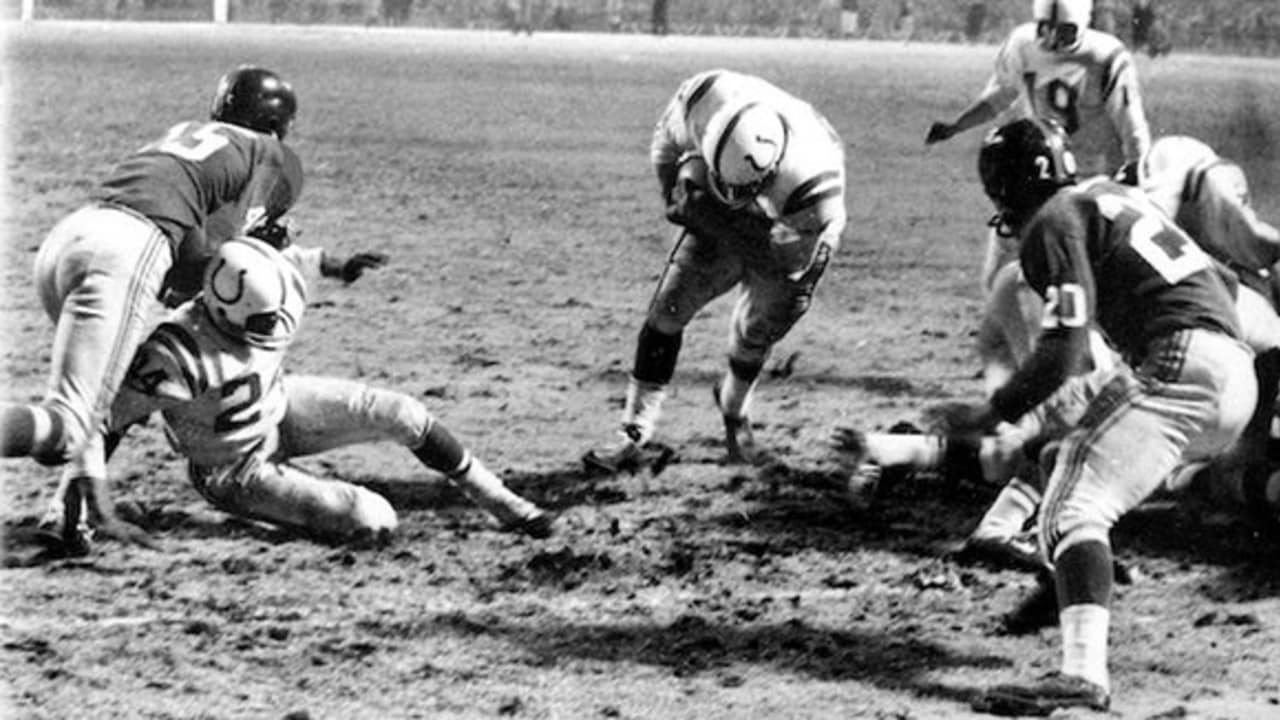
Alan Ameche scores the winning touchdown.
Lenny Moore (24) provides the key block on Emlen Tunnell.
Johnny Unitas (19) watches.

December 28, 1958: The NFL Championship Game is held at Yankee Stadium. The New York Giants, Champions of the NFL Eastern Division, play the Baltimore Colts, Champions of the Western Division. It is the 1st Championship Game for the Colts, the 10th for the Giants, who had previously won it in 1934, 1938 and 1956. (Why Baltimore, a Northeastern city, was placed in the League's Western Division, I don't know.)

The Giants had Charlie Conerly as their quarterback, and the biggest football star of the time, Frank Gifford, at running back. They were the 1st team to really make defense a priority, led by future Hall-of-Famers Sam Huff, Andy Robustelli and Emlen Tunnell. Two years earlier, they had destroyed the Chicago Bears in the Championship Game, 47-7.
The pre-renovation original Yankee Stadium, set up for football

But the Colts were on the rise. Their quarterback was Johnny Unitas. He had Raymond Berry to throw to, Lenny Moore in his backfield, and Jim Parker to block for him. All 4 would make the Hall of Fame. His defense was led by Hall-of-Famers Gino Marchetti and Art Donovan.

The 1st half was a bit sloppy, and didn't live up to the legend. Pat Summerall, future broadcasting legend, began the scoring with a field goal in the 1st quarter, putting the Giants up 3-0. In the 2nd quarter, Alan Ameche, who won the Heisman Trophy at the University of Wisconsin in 1954, scored a touchdown to put the Colts ahead. Unitas threw a touchdown pass to Berry, giving the Colts a 14-13 lead at the half.

In the 3rd quarter, Mel Triplett snuck the ball over the goal line to put the Giants back in it. Early in the 4th quarter, Conerly threw a touchdown pass to Gifford, giving the Giants a 17-14 lead. As the clock wound down, Unitas drove the Colts, but couldn't get them over. So Steve Myhra was sent in to kick a field goal as time expired. With the clock reading 0:00, the scoreboard read 17-17.

No NFL Championship Game had ever ended in a tie. Overtime was needed, for the 1st time in NFL history. (The League didn't institute overtime for the regular season until 1974.) The Giants won the toss, but couldn't score. Unitas led an inspiring drive, toward what would have been left field in The Stadium's baseball setup, which finally ended with Ameche scoring from the 1-yard line -- appropriately where Monument Park would later be in The Stadium's post-renovation period (1976-2008).

Bob Wolff, who had been in the same Stadium 2 years earlier to call Don Larsen's perfect game for the New York Yankees against the Brooklyn Dodgers in the 1956 World Series, was at the microphone for NBC again, and had the call: "Unitas gives to Ameche... The Colts are the World Champions! Ameche scores!" He later said he was glad he didn't "bury the lead" by saying, "Ameche scores!" first.

This game had the largest TV audience in NFL history to that point, 45 million people. The fact that it was in New York, and involved a New York team, helped it loom large in the public consciousness. This was the game that launched the NFL on a path to becoming, at least in perception, more popular than Major League Baseball.

It made legends of the Colts, and Unitas in particular. He would go on to be recognized as the greatest quarterback of all time. It's been 62 years, and some people still think he is. And the Colts, playing in a city that didn't have a big college football team -- Morgan State University is a historically black school, the U.S. Naval Academy is a national school, and the University of Maryland is closer to Washington -- became known as the team of America's working class, an "America's Team" in a way that felt artificial when the Dallas Cowboys later called themselves that.
Johnny Unitas

It also became known as "The Greatest Game Ever Played." It has been noted that it would never have been called that had the Colts beaten, say, the Philadelphia Eagles. But it was the New York team that they beat, in New York City. And so, every so often, polls are taken that show this game as the "greatest." The most recent was in 2019, for the NFL's 100th Anniversary. In 1981, John Thorn left his comfort zone, baseball, and published Pro Football's 10 Greatest Games. He included this game as one of them.

The teams had a rematch in the 1959 NFL Championship Game. In those days, home field was rotated between the Eastern and Western Champions, and the Colts hosted it at Memorial Stadium, beating the Giants again.

It remains the longest game in New York Giants history.

*

December 28, 1958, as you may have guessed, was a Sunday. There were no more NFL games to be played. It was the off-season for baseball.

There was only 1 NBA game played that day: The Cincinnati Royals beat the Minneapolis Lakers, 120-116 at the Cincinnati Gardens. Jack Twyman of the Royals scored 32 to lead all players in this game. Bob "Slick" Leonard, later to coach the Indiana Pacers to 3 ABA Championships, led the Lakers with 20 points.

The Lakers moved to Los Angeles in 1960. The Royals moved to Kansas City, becoming the Kings, in 1972, and to Sacramento in 1985.

All of the NHL's "Original Six" were in action that day:

* The New York Rangers beat the Montreal Canadiens, 5-3 at the old Madison Square Garden. This was an anomaly, as the Canadiens were in the middle of a run of 5 straight Stanley Cups, and the Rangers were in a down period.

* The Detroit Red Wings, beat the Boston Bruins, 5-3 at the Olympia Stadium in Detroit.

* And the Chicago Black Hawks beat the Toronto Maple Leafs, 4-3 at the Chicago Stadium. ("Black Hawks" was written as 2 words until 1986, when the team's original charter document was found, and it was discovered that "Blackhawks" was written as one word, and it has officially been so ever since.) 

Monday, December 26, 2022

December 26, 1960: A Philly Title Among the Ivy

Norm Van Brocklin (11) hands off to Billy Ray Barnes (33)

December 26, 1960: The NFL Championship Game is played at Franklin Field, on the campus of the University of Pennsylvania, an Ivy League school nestled into the hardscrabble city of Philadelphia. Since this was an odd-numbered year, it was the Eastern Division winner's turn to host the game, and that was the Philadelphia Eagles. They would play the Green Bay Packers.

The Packers, winners of 6 NFL Championships between 1929 and 1944, fell into a down period, going just 1-10-1 in 1958. Vince Lombardi was hired as head coach, and in just 2 seasons, he got them to 8-4 and the Western Division title.

The Eagles were coached by Buck Shaw, and their quarterback was Norm Van Brocklin, who had led the Los Angeles Rams to the 1951 NFL Championship. After losing their season opener at home to the Cleveland Browns, they won 9 straight, before losing away to the Pittsburgh Steelers, and finished 10-2. It was their 1st Eastern Division title since their 1949 NFL Championship. 

Since the Sunday after the last week of the regular season was Christmas Day, the game was moved back to the following day. And, since Franklin Field didn't have lights -- a permanent system wasn't added until 1972, and it still isn't considered NFL-quality -- and the NFL Championship Game had gone to overtime just 2 years earlier, it was decided to move the starting time up to 12:00 Noon.

Temporary seats were added, bring the Ivy League facility to a sellout crowd of 67,325. It had snowed a few days before, and the field was dry in some places, muddy in others, and surrounded by a snowbank. It was 48 degrees at kickoff.
Franklin Field

On the 1st play from scrimmage, a lateral from Van Brocklin deflected off the hands of receiver Billy Ray Barnes, and was intercepted by Bill Quinlan. The Packers had possession at the Eagles' 14-yard line, but the Eagle defense held, and forced the Packers to turn it over on downs at the 6. But Barnes shot his team in the foot again with a fumble, and Bill Forester recovered at the 22. Still, the Eagle defense held, and all the Packers could get was a 20-yard field goal from Paul Hornung, and a 3-0 lead.

Early in the 2nd quarter, the Eagles again held the Packers, and Hornung kicked a 23-yard field goal. Later in the quarter, Van Brocklin threw a 35-yard touchdown pass to Tommy McDonald, whose momentum led him to tumble through the end zone and into the snowbank. Bobby Walston kicked the extra point, and the Eagles led, 7-6. The perfectionist Lombardi was surely very displeased. Before the half ended, another Eagle drive led to a 15-yard field goal for Walston.

As time ran out, Hornung tried a field goal from just 13 yards out -- the goalposts were on the goal line until 1974, when they were moved back to the end line -- but it went wide left. The Packers should have been up by no less than 17-10, but were losing, 10-6. The perfectionist Lombardi was surely displeased.

In the 3rd quarter, the Packers got to the Eagles' 34, but turned the ball over on downs. To make matters worse, Hornung, also a great running back, had to leave the game due to a shoulder injury. Van Brocklin led the Eagles downfield, but was intercepted in the end zone by John Symank.

The Packers got the lead back with 13:07 left in regulation, with Bart Starr passing to Max McGee for a 7-yard touchdown. But Ted Dean, a local man from nearby Radnor, Pennsylvania, ran the ensuing kickoff back 58 yards. Van Brocklin got the Eagles close, and handed off to Dean for a 5-yard touchdown run. With 5:21 left, the Eagles led, 17-13.

The Packers got a last chance, starting at their 35 with 1:05 left. Starr got them to the Eagle 22 with 25 seconds to go. He threw a pass to Jim Taylor, who caught it at the 17-yard-line. There, he was faced by Chuck Bednarik, the Eagles' center and linebacker, the last man to play regularly on both offense and defense, and the last link to their 1949 title. Though from the steel town of Bethlehem, Pennsylvania, and a waist gunner on a B-24 bomber in World War II, Bednarik had played on that field for the University of Pennsylvania, before starting a 14-year Hall of Fame career with the Eagles.

Known as "Concrete Charlie," not for his hitting but for his off-season job as a concrete salesman, Bednarik hit Taylor at the 17, and shoved him down to the grass. He held Taylor down, and watched the clock tick down to zero. Today, he probably would have been penalized for delay of game, but that didn't happen.

Taylor knew there would be time for at least one more play, if Bednarik would just let him up, and yelled, "Get off me, you son of a bitch!" Bednarik stayed on him, and saw the clock reach 0:00. Only then did he jump up, pump his fists, and yell, "You can get up now, you son of a bitch, this fucking game is over!"
When you've just won the NFL Championship,
you can smoke a cigarette and a victory cigar,
and nobody is going to say anything.

The Packers had outgained the Eagles, 401-296; and had gotten more 1st downs, 22-13. But they made a lot of mistakes. Lombardi knew he had made more than anyone, going for it on 4th down 3 times rather than attempt field goals. He told the media, "When you get down there, come out with something. I lost the game, not my players."

It was his 1st Playoff game as a head coach. He would never lose another: He guided the Eagles into the NFL Championship Game again in 1961, 1962, 1965, 1966 and 1967, winning them all. Winning the last 2 of those got the Packers into the 1st 2 Super Bowls, and they won those, too.

In contrast, the 1960 title would be a watershed moment for the Eagles. Shaw retired as head coach, and Van Brocklin retired as a player, feeling that backup Sonny Jurgensen was ready to lead the team. Van Brocklin hoped that he would be named the new head coach.

Instead, team owner James P. Clark -- the leader of a group known as "The Happy Hundred" -- promoted assistant coach Nick Skorich. He led them to a 10-4 record in 1961. Before the next season, Clark died of a stroke, and the team's ownership situation was a mess, leading to seasons of 3-10-1 and 2-10-2.

Van Brocklin was hired as the head coach of the expansion Minnesota Vikings, and later coached the Atlanta Falcons, but never did well as head coach. Maybe he would have done better with the Eagles, the team he knew. Or maybe he would have been frustrated by the front-office mess.

For a while, the Kennedy family, looking for something for President John F. Kennedy to do once he was no longer President, was considering buying the team. His younger brother, Senator Ted Kennedy, a former football star at Harvard, was set to meet with representatives of the Happy Hundred in October 1962, but had to cancel the meeting, due to the Cuban Missile Crisis. By the time the Kennedys were ready to resume negotiations, the Happy Hundred had started them with trucking magnate Jerry Wolman. He completed his purchase of the team on December 4, 1963. By that point, JFK had been assassinated.

Wolman did the right thing in firing Skorich, but made a mistake in hiring failed Notre Dame coach Joe Kuharich, a moralist who traded the hard-partying Jurgensen for the strait-laced Norm Snead. Kuharich got the Eagles to a 2nd-place finish at 9-5 in 1966, but in just 2 more years, had crashed to 2-12.

Another trucking company boss, Leonard Tose, a former member of the Happy Hundred, bought the Eagles from the bankrupt Wolman in 1969, and rebuilt the team. It took time, but in 1978, they made the Playoffs again. In 1980, they won the NFC Championship, but lost the Super Bowl.

Tose, an alcoholic and a compulsive gambler, also went bankrupt, and had to sell the team to Norman Braman in 1985. Under Braman, the team was good enough to make the Playoffs, but not to reach the Super Bowl. Despised by Eagle fans for his cheapness and his absentee ownership, he sold the team to Jeffrey Lurie in 1995. They made 4 straight NFC Championship Games, but only got to the Super Bowl the last time, the 2004 season, losing.

After a rebuild, they finally won Super Bowl LII in 2018, ending a 57-season title drought. Along with the Cleveland Browns (last title in 1964), the Detroit Lions (1957) and the Arizona Cardinals (1947, then the Chicago Cardinals), the Eagles were 1 of the last 4 teams to have won an NFL Championship, but not a Super Bowl. Some people ascribed the drought to "The Curse of the Dutchman," but Van Brocklin never made a public statement against the Eagles for not hiring him as head coach.

The Eagles left Franklin Field for Veterans Stadium in 1971. The shift from Ivy League stadium built just for football to a concrete oval built for both baseball and football in the middle of a parking lot could not have been more stark. In 2003, they moved a new football-only stadium built in the same sports complex, Lincoln Financial Field. The Vet lasted 33 years before it was demolished. Amazingly, Franklin Field still stands, having opened in 1922, with the University of Pennsylvania having played football on the site since 1895.

UPDATE: Through the 2025 season, the Eagles have elected the following players from the 1960 NFL Champions to their team Hall of Fame: Chuck Bednarik, Norm Van Brocklin, Sonny Jurgensen, Tommy McDonald, Tom Brookshier, Pete Retzlaff, Timmy Brown, Maxie Baughan and Bobby Walston; plus team executive Jim Gallagher. They have not, however, elected head coach Buck Shaw.

Bednarik McDonald, Brooshier, Retzlaff, Brown, Baughan, Walston and broadcaster Bill Campbell have also been elected to the Philadelphia Sports Hall of Fame -- but not Shaw, or, even more oddly, Van Brocklin.

*

December 26, 1960 was, a Monday. Baseball was out of season. No NHL games were scheduled.  There were 4 games in the NBA:

* The New York Knicks beat the Los Angeles Lakers, 119-112 at the old Madison Square Garden. Elgin Baylor scored 44 points in defeat.

* The Boston Celtics beat their arch-rivals, the Philadelphia Warriors, 119-115 at the Boston Garden. Wilt Chamberlain scored 30 points and had 36 rebounds, but, as was so often the case against Wilt, the Celtics had the better team.

* The Detroit Pistons beat the Cincinnati Royals, 137-132 at the Olympia Stadium in Detroit. Oscar Robertson scored 43 points for the Royals.

* And the St. Louis Hawks beat the Syracuse Nationals, 133-112 at the Kiel Auditorium in St. Louis.

And in English soccer, Arsenal and Yorkshire team Sheffield Wednesday play to a 1-1 draw at the Arsenal Stadium, a.k.a. Highbury, in North London.

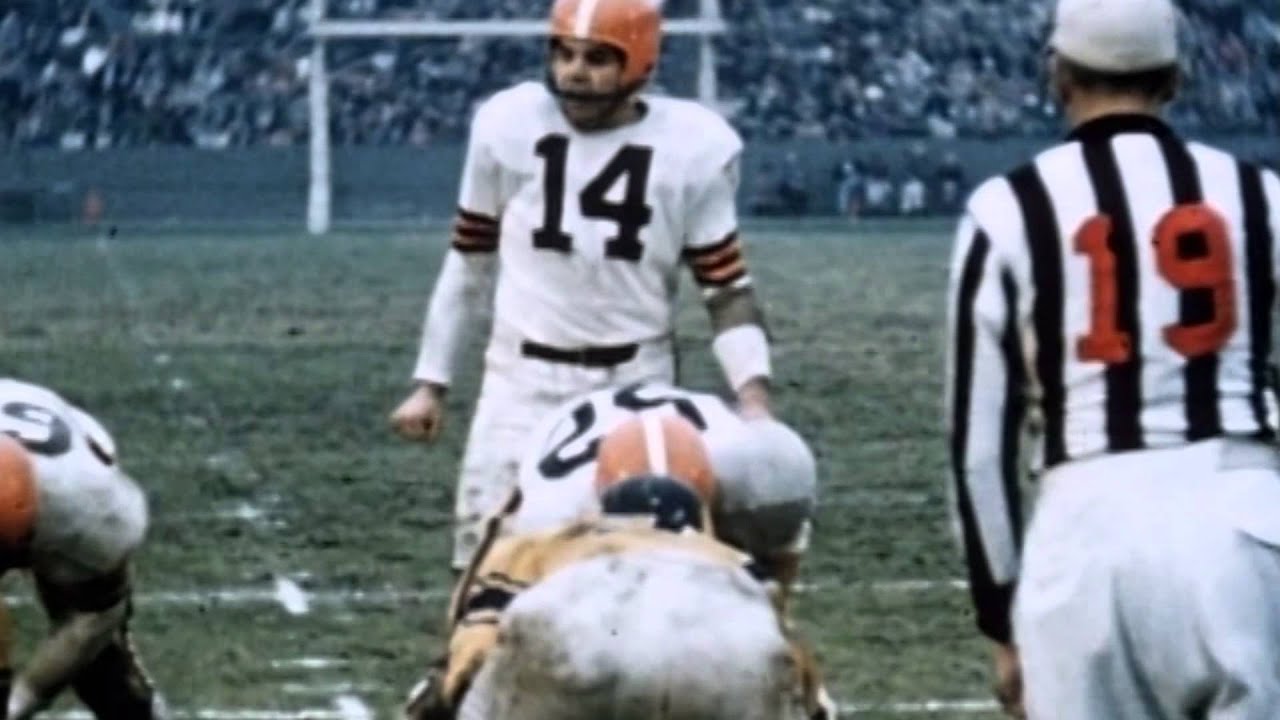
December 26, 1955: Otto Graham Goes Out a Winner

December 26, 1955: The NFL Championship Game is played at the Los Angeles Memorial Coliseum. It was moved up a day, because, that year, December 25 fell on a Sunday, and the NFL refused to play on Christmas Day until 1971.

The Cleveland Browns were playing in a league championship game for the 10th straight year: The 1st 4 in the All-America Football Conference (1946-49), winning all 4 of those; and the last 6 in the NFL, having beaten the Los Angeles Rams in 1950, lost to the Rams in 1951, lost to the Detroit Lions in 1952 and 1953, and beaten the Lions in 1954. Now, they were playing the Rams again.

Quarterback Otto Graham had been there for all of those games. Under head coach Paul Brown, an offensive genius, he had been, in terms of results, the most successful quarterback in pro football history. (Sure, Tom Brady later got teams into 10 championship games under the Super Bowl name, all within the NFL. But Graham did 10 in a row, and matched Brady with 7 wins. And Graham never had to cheat.)

Graham had retired after the 1954 Championship Game, but Brown talked him into returning for 1 more season. He led the Browns to a 9-2-1 record. They opened with a loss to the Washington Redskins, but shrugged it off to beat the San Francisco 49ers away, the Philadelphia Eagles at home, the Redskins away, the Green Bay Packers at home, the Chicago Cardinals away, and the New York Giants at home.

In addition to Graham, the Browns still had receiver Dante Lavelli, center Frank Gatski, tackle and placekicker Lou Groza, and defensive end Len Ford, who would all be elected to the Pro Football Hall of Fame. So would Brown. So would linebacker Chuck Noll, albeit as the later head coach of the Pittsburgh Steelers.

The Browns lost to the Eagles in Philadelphia, then beat the Steelers at home. They could only manage a tie with the Giants in New York, then won away to Pittsburgh, and closed by beating the Cardinals at home.

The Rams were coached by Sid Gillman, whose innovations in the passing game had begun to rival those of Paul Brown. They had finished 8-3-1, with 2 of their losses inflicted by the Chicago Bears. They still finished ahead of the Bears, who went 8-4.

The Rams still had several of the players who beat the Browns in the 1951 title game, including quarterback Norm Van Brocklin and his top 2 receivers, Tom Fears and Elroy "Crazy Legs" Hirsch, all of whom would be elected to the Pro Football Hall of Fame. So would Gillman, and linebacker Les Richter. Running back Paul "Tank" Younger and defensive tackle Gene "Big Daddy" Lipscomb have not yet been elected to the Hall, but should be.

And, this being an odd-numbered year, the Western Division winners would have the home-field advantage. And the Coliseum was the only stadium in the NFL that seated more than the Browns' Cleveland Municipal Stadium, so 87,695 fans came out, supporting the blue and gold, rather than the orange and white.

Groza kicked a 43-yard field goal to give the Browns a 3-0 lead at the end of the 1st quarter. The 2nd quarter featured several big plays, including Don Paul intercepting Van Brocklin, and returning it 65 yards for a touchdown, to make it 10-0 Browns; Van Brocklin throwing a 67-yard touchdown pass to Volney "Skeet" Quinlan, closing the Rams to within 10-7; and Graham throwing a 50-yard touchdown pass to Lavelli, giving the Browns a 17-7 halftime lead.

Graham himself ran the ball in for 2 touchdowns in the 3rd quarter, and the Browns led, 31-7. In the 4th quarter, Graham's last touchdown pass was 35 yards to Ray Renfro. Ron Waller scored from 4 yards out to give the Rams a consolation score, and the Browns won, 38-14.

It was the 7th league championship, the 3rd in the NFL, for Graham and Paul Brown. It would be the last. Graham retired again, and, this time, stuck with it. Brown led the Browns until 1962, before being fired by new owner Art Modell. He later founded the Cincinnati Bengals.

Gillman would further develop his passing ideas, and lea the San Diego Chargers to the 1963 AFL Championship. Bill Walsh, who served as an assistant on the Bengals under Brown, and also under on the Oakland Raiders under Al Davis, who had been an assistant on the Chargers under Gillman, would coach the San Francisco 49ers to 3 Super Bowl wins.

Under the new regime, the Browns won the Championship in 1964 -- and haven't reached a world championship game since. The Rams would fare little better, not reaching another until Super Bowl XIV in the 1979 season, and losing. They moved to St. Louis in 1995, won Super Bowl XXXIV in the 1999 season, lost Super Bowl XXXVI in the 2001 season, moved back to Los Angeles in 2016, and have lost Super Bowl LIII in the 2018 season and won Super Bowl LVI in the 2021 season.

Graham started his professional career wearing Number 60, from 1946 to 1951. From 1952 onward, he wore Number 14. The Browns retired that number, and also named him to their Ring of Honor. He was elected to the Pro Football Hall of Fame in its 3rd class, in 1965.

He later served as head coach and general manager of the Washington Redskins, and as head coach and athletic director at the U.S. Coast Guard Academy. In 1999, he was ranked 7th on The Sporting News' list of the 100 Greatest Football Players, trailing only Joe Montana and Johnny Unitas among quarterbacks. He died in 2003.

In 2010, the NFL Network ranked Graham 16th on its list of the 100 Greatest Players, among quarterbacks trailing only Montana, Unitas, Peyton Manning and the even earlier Sammy Baugh, but not yet Tom Brady. He was named to the NFL's 50th Anniversary Team in 1969, its 75th Anniversary Team in 1994, and its 100th Anniversary Team in 2019. Also in 2019, a statue of Graham was dedicated outside Huntington Bank Field in Cleveland.

*

December 26, 1955 was, as suggested, a Monday. Evan Bayh, who would follow his father Birch Bayh in being elected U.S. Senator from Indiana, was born on this day.

Baseball was out of season. No college football bowl games were played. There were no games scheduled in the NHL. There were 3 games played in the NBA:

* The New York Knicks beat the Philadelphia Warriors, 108-97 at the Philadelphia Civic Center.

* The Rochester Royals beat their arch-rivals, the Syracuse Nationals, 93-91 at the Rochester Community War Memorial (now the Blue Cross Arena) in Rochester, New York.

* And the Fort Wayne Pistons beat the St. Louis Hawks, 83-67 at the Allen County War Memorial Coliseum in Fort Wayne, Indiana.

In Britain, the day after Christmas is Boxing Day, and it's a day for major soccer matches. Arsenal and Birmingham-area team Wolverhampton Wanderers played to a draw, 3-3 at the Arsenal Stadium, a.k.a. Highbury, in North London.

Sunday, December 25, 2022

December 25, 1954: The Death of Johnny Ace

December 25, 1954: Johnny Ace dies, because somebody shouldn't have had access to a gun: Himself.

John Marshall Alexander Jr. was born on June 9, 1929 in Memphis. In 1951, Ike Turner, already a music-business veteran but still years away from meeting the woman who would become Tina, hired him to play piano on recording sessions for blues guitarist B.B. King. In 1952, now calling himself Johnny Ace, apparently after the vocal group The Four Aces, he began singing his own songs, mostly ballads.

By 1954, he was one of the biggest-selling singers in America, regardless of race or style. He had already recorded "Pledging My Love," and was booked for the City Auditorium in Houston on Christmas Day. Among the other performers booked for the show was Willie Mae "Big Mama" Thornton, the 1st performer to record "Hound Dog." If you only know this song, by Jerry Lieber and Mike Stoller, from Elvis Presley's version, you'll be surprised at how different it is. Nevertheless, she topped the rhythm & blues chart with it in 1953.

Between sets, Johnny was drinking with Big Mama and her band. Suddenly, he pulled out a .32 caliber revolver, and started playing with it. Thornton later told police that he pointed it at a few people (not at her), but didn't fire. But she also said, contrary to what was later reported, that it was not a game of "Russian roulette." Nor was it a suicide: Johnny had just bought a brand-new Oldsmobile, and was looking forward to driving it.

Curtis Tillman, Thornton's bass player, told what happened next:

I will tell you exactly what happened! Johnny Ace had been drinking, and he had this little pistol he was waving around the table, and someone said, "Be careful with that thing!" And he said, "It’s okay! Gun’s not loaded! See?" And pointed it at himself with a smile on his face, and "Bang!" Sad, sad thing. Big Mama ran out of the dressing room yelling, "Johnny Ace just killed himself!"

Johnny Ace was only 25 years old, and was really just starting to become a star. Not surprisingly, "Pledging My Love" hit Number 1 on the R&B charts. But it also hit Number 17 on Billboard magazine's pop chart, making him the 1st performer to debut on it only after his death.

Some people consider Johnny Ace to be "the first dead rock star." His death came nearly 2 years after that of Hank Williams, who has also received that distinction. Neither man had really performed rock and roll as that term would later be used, though. Maybe they would have.

In 1983, Paul Simon wrote and recorded "The Late Great Johnny Ace." It tells of a boy who had never known Johnny Ace was alive until he knew that he was dead, and became a fan of his. Years later, the song has the boy growing up to be a fan of 2 other "Johnny Aces" who died from gunshot wounds: John F. Kennedy and John Lennon.

But maybe rock and roll broke even this day: Annie Lennox, lead singer of Eurythmics, was born.

*

December 25, 1954 was a Saturday. In England, North London's Arsenal hosted West London's Chelsea at Highbury, and won, 1-0, on a goal by former Everton star Tommy Lawton. But Chelsea went on to win the League title for the 1st time in their 50-year history. They did so the 1st man ever to win the League as both a non-managing player and a non-playing manager. And he's an Arsenal man: Ted Drake.

Four games were played in the NBA. The New York Knicks beat the Syracuse Nationals, 109-101 at the old Madison Square Garden. The Rochester Royals beat the Fort Wayne Pistons, 80-73 at the Edgerton Park Arena in Rochester. The Boston Celtics beat the Milwaukee Hawks, 108-99 at the Milwaukee Arena. In 1974, it was renamed the Milwaukee Exposition, Convention Center and Arena, or "The MECCA." Since 2014, it has been named the UW-Panther Arena. And the Minneapolis Lakers beat the Philadelphia Warriors, 99-91 at the Minneapolis Auditorium.

For the 1st time in 5 years, the entire NHL played on Christmas. The New York Rangers lost to the Montreal Canadiens, 4-1 at the Montreal Forum. The Boston Bruins and the Chicago Black Hawks played to a 3-3 tie at the Boston Garden. And the Detroit Red Wings beat the Toronto Maple Leafs, 3-2 at Maple Leaf Gardens in Toronto.

Friday, December 23, 2022

December 23, 1954: The 1st Successful Kidney Transplant

December 23, 1954: Surgeons Joseph Murray, John Merrill and J. Hartwell Harrison -- left to right, top row in this photo -- perform the world's 1st successful kidney transplantation, at Brigham Hospital in Boston, between identical twins Richard J. Herrick (seated at left) and Ronald Richard Herrick. Identical twins were chosen because of the reduced risk of organ rejection.

The recipient, Richard Herrick, died 8 years after the transplantation, due to complications with the donor kidney that were unrelated to the transplant. Ronald became a teacher, and lived until 2010.

Merrill, who became known as "The Father of Nephrology," the study of the kidney, lived until 1984. Harrison, who had a similar role in the advancement of urology, the study of the urinary system, also died in 1984. He was a member of the Harrison political family of Virginia, which produced a Signer of the Declaration of Independence and 2 Presidents.

In 1990, Murray was awarded the Nobel Prize in medicine for pioneering work not only in transplant surgery, but also in organ rejection and the drugs that fight it. He lived until 2012.

*

December 23, 1954 was a Thursday. The only major character on the TV show The West Wing whose specific birthdate was mentioned was Toby Ziegler, the White House Press Secretary, who was said to be born on that day.

Baseball was out of season. No college football bowl games were played on the day. The NFL Championship Game was played 3 days later, and the Cleveland Browns beat the Detroit Lions, 56-10. No games were scheduled for the NHL.

There was 1 game played in the NBA: The Fort Wayne Pistons beat the Philadelphia Warriors, 92-82 at Huntingburg High School in Huntingburg, Indiana. The school was renamed Southridge High School in 1972. This was nowhere near Fort Wayne: 254 miles to the southwest. It was nowhere near anything: 130 miles southwest of Indianapolis, 77 miles west of Louisville, 53 miles northeast of Evansville. Why there? Among people still alive today, who knows?

Sunday, December 18, 2022

December 18, 1959: "North By Northwest" Premieres

December 18, 1959: North By Northwest premieres. It is easily my favorite film directed by Alfred Hitchcock.

The opening montage, including director Alfred Hitchcock playing a man just missing a bus, contains some of the best color footage of old New York.

Cary Grant does what Cary Grant does: Get in and out of trouble while looking suave. Really, the word "suave" was created for Cary Grant. Eva Marie Saint (born in Newark but grew up outside Albany, and still alive at age 95) does what Eva Marie Saint does: Look fabulous while being mixed up in intrigue.

Leo G. Carroll played the leader of the American intelligence team, and went on to play the British leader of the intelligence team on the TV series The Man from U.N.C.L.E. James Mason plays the bad guys' leader.

But for those of us who met him on reruns of Mission: Impossible and Space: 1999 -- he seemed to like shows with colons in the title -- to see Martin Landau as the bad guy's top henchman was a bit jarring.

One note that I found interesting: Edward Platt played a character named Victor Larrabee. Six years later, on the sitcom Get Smart, Platt played the Chief of CONTROL, one of whose agents, played by Victor Karvelas, was named Larabee.

Carroll died in 1972, Platt in 1974, Mason in 1984, Grant in 1986, Landau in 2017. As of July 1, 2022, Eva Marie Saint is still alive.

*

December 18, 1959 was a Friday. There were no scores on this historic day: Baseball was out of season, the NFL was in midweek, and no games were scheduled for the NBA or the NHL.

Friday, December 16, 2022

December 16, 1953. The Yankees Trade Vic Power

Vic Power at Yankee Stadium -- after the trade

December 16, 1953. The New York Yankees trade Vic Power, Don Bollweg, Jim Finigan, Johnny Gray, Bill Renna and Jim Robertson to the Philadelphia Athletics for Loren Babe, Harry Byrd, Tom Hamilton, Carmen Mauro and Eddie Robinson.

Byrd was a decent pitcher, who simply didn't get run support with the A's. But he didn't do much for the Yankees. Other than him, the only name in this trade that you really need to know is Vic Power. Or, legally, Victor Pellot, which is what he always called himself.

Born in 1927 in Arecibo, Puerto Rico as Victor Felipe Pellot Pove (first name, middle name, father's family name, mother's family name, as is common in Spanish-speaking places), Power was a sensational fielder at 1st base, and in the 1952 season batted .331 with 40 doubles, 17 triples, 16 home runs and 109 RBIs for the Yankees' top farm team, the Kansas City Blues, playing in Blues Stadium, which eventually became Kansas City Municipal Stadium, and was always a pitcher's park.

In 1953, Power batted .349 for the Blues, winning the American Association batting title, with 39 doubles, 10 triples, 16 homers and 93 RBIs. At the time of the trade, he was already 27 years old.

And still, the Yankees hadn't yet brought him up to the majors. This at a time when the Yanks' starting 1st baseman was Joe Collins. He was a good player, but Power was probably already better.

(For comparison's sake: Mickey Mantle was 24 when he won the Triple Crown in 1956; Reggie Jackson, not yet a Yankee, was 23 when he hit 47 home runs in 1969; and Aaron Judge was 25 when he hit 52 home runs in 2017.)

So why would the Yankees trade Vic Power for 5 guys who amounted to nothing in Pinstripes? The official reason was that he was "too flashy" or a "hot dog," for the way he fielded at 1st base. It wasn't "the Yankee way."

Turned out that the real reason was that general manager George Weiss was a bigot, and didn't want black players on the Yankees. To make matters worse, Power was dating a white woman at the time. This was the final straw. How "uppity," as was said at the time of black men who acted out of line with what white men in positions of power demand. Off you go, to the House of Mack.

The A's had already been integrated for 5 years, and Power broke into their starting lineup right away in 1954, and became a star after their move to Kansas City, where he'd starred in Triple-A, and later with the Cleveland Indians.

He won 7 straight Gold Gloves, batted over .300 3 times, led the AL in triples in 1958 with 10, and made 4 All-Star teams. In 12 big-league seasons, he batted .284, collected 1,716 hits, including 290 doubles, 49 triples and 126 homers. And, in the media, he never seemed to be all that controversial after leaving the Yankees.

After his retirement, he went back to Puerto Rico and became a youth baseball coach, living until 2005, dying of cancer at age 78.

Late in life, as the number of Hispanic players in the majors grew, and interest in their forebears did the same, he gave some interviews in English, and did not seem particularly bitter about his treatment by the Yankees.

Was the decision to trade him justified? In any way? Well, in 1954, the Yankees did get a new starting 1st baseman, Bill "Moose" Skowron, and he was terrific for them until 1962, playing the position superbly, and hitting with more power than any righthanded Yankee would between Joe DiMaggio and Dave Winfield.

And, a year later, in 1955, tired of the mounting criticism from civil rights groups, Yankee owners Dan Topping and Del Webb overruled Weiss, and promoted outfielder/catcher Elston Howard to become the 1st black Yankee. He was 26.

Unlike Power, he was quiet, unflashy, already married to a woman of his own race, and did his job well, and was thus "worthy of the Yankee uniform." He became the 1st black Most Valuable Player award winner in the American League -- in 1963, after the National League had already had black MVPs Jackie Robinson, Roy Campanella (3 times), Willie Mays (the 1st of 2 he would win), Don Newcombe, Hank Aaron, Ernie Banks (twice), Frank Robinson and Maury Wills.

Based on the successes of Skowron and Howard, it can be argued from a competitive standpoint -- if not from a moral one -- that the Yankees lost nothing by trading Power away. Still, they should have gotten something more for him than 5 who's-he's.

And I wonder how much good it would have done in the community to have a terrific player who was not only black, but Hispanic. But Weiss thought it would upset the Yankee fan base, which he considered to be white commuters from Westchester, Connecticut and North Jersey. If only he had known that the real base was working-class Irish and Italians, guys who wore T-shirts, jeans and boots to work, and only wore suits for weddings and funerals. You know: Just like the fans at the Polo Grounds and Ebbets Field.

Power, despite playing less than 4 full seasons with the Indians, was named one of the team's 100th Anniversary 100 Greatest Players. Howard is honored with a Plaque in Yankee Stadium's Monument Park. But Weiss has no Monument Park Plaque, although he is, unlike the other two, in the Hall of Fame.

*

December 16, 1953 was a Wednesday. Baseball and football were out of season. There were 2 games played in the NBA. The Boston Celtics beat the Fort Wayne Pistons, 91-74 at the Boston Garden. And the Minneapolis Lakers beat the Milwaukee Hawks, 69-63 at the Milwaukee Arena. In 1974, it was renamed the Milwaukee Exposition, Convention Center and Arena, or "The MECCA." Since 2014, it has been named the UW-Panther Arena.

One game was played in the NHL: The New York Rangers beat the Boston Bruins, 4-3 at the old Madison Square Garden. Ron Murphy scored the winning goal with 3:41 left in regulation.

Thursday, December 15, 2022

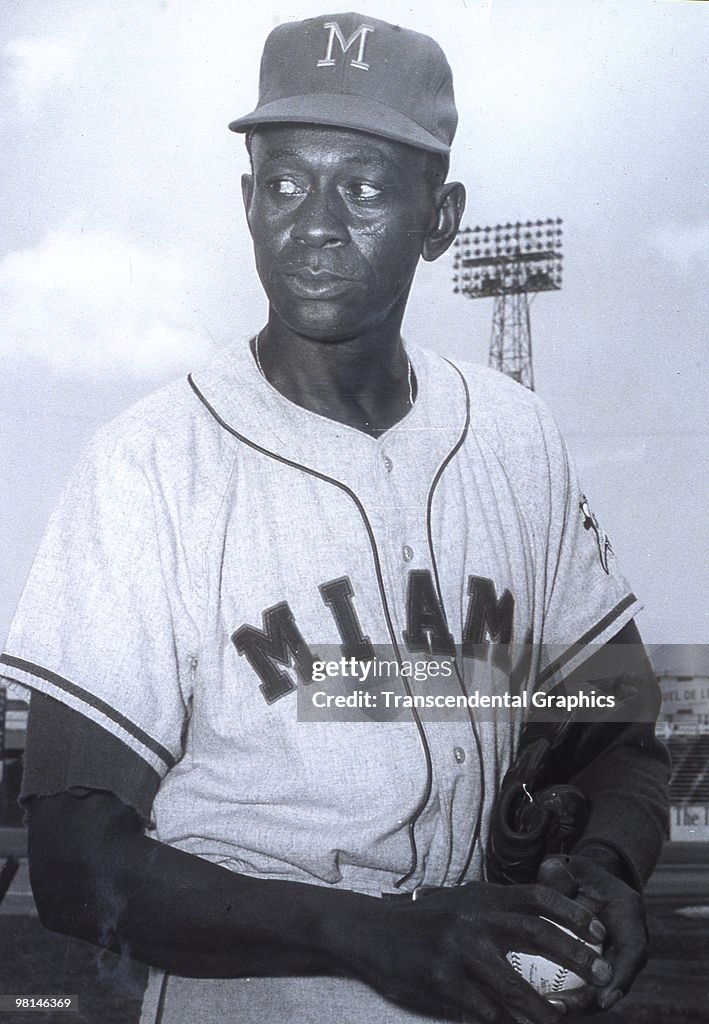
December 15, 1956: Satchel Paige at the Orange Bowl

December 15, 1956: A crowd of 57,000 baseball fans packs Burdine Stadium -- renamed the Orange Bowl in 1959 -- in Miami, to see Negro League legend Satchel Paige pitch in a minor league exhibition game. It was the largest crowd to ever watch a minor-league game to that point.

The 50-year-old Paige wore the uniform of the Miami Marlins of the Class AAA International League. He started the game, and pitched into the 8th inning before leaving the game with a 6-2 lead over the Ohio-based Columbus Jets, another IL team. He even knocked in half the Marlins runs with a 3-run double in the 2nd inning.
All the proceeds went to charity, and the pre-game entertainment included jazz legend Cab Calloway. To compensate for the short dimensions in right field, a giant fence was constructed at the wall, much like the one they would construct a year and a half later for the left field wall at the Los Angeles Memorial Coliseum for the newly-arrived Dodgers.

Paige enjoyed a stellar campaign with the Marlins finishing the 1956 season with an 11-4 record and 1.86 ERA, and would pitch 2 more remarkable years in Miami. In 1957, he had a 10-8 record and a 2.42 ERA. The following year, he went 10-10, and his ERA was 2.95.

The Marlins, formerly an early version of the Syracuse Chiefs, debuted in the IL that 1956 season, and remained in it through 1960. Their usual home was Miami Stadium, built in 1949, and later renamed Bobby Maduro Stadium, for a Miami-based baseball executive.

In the 1956, '57 and '58 seasons, they were a farm team of the Philadelphia Phillies; in 1959 and '60, of the Baltimore Orioles. The owners signed a working agreement with the St. Louis Cardinals for 1961, and moved the franchise to San Juan, Puerto Rico; and, in mid-season, to Charleston, West Virginia.

In 1962, a new Miami Marlins debuted in the Class D Florida State League, playing at Miami Stadium, as a Phillies farm team. The entire FSL was promoted to Class A in 1964, and remains so. The Marlins returned to the Orioles' fold in 1966, winning FSL Pennants in 1969, 1970, 1971, 1972 and 1978. They were a San Diego Padres farm team in 1983 and 1984, but declining attendance ended the team.

In 1993, the National League's expansion included the Florida Marlins, playing at the Miami Dolphins' new stadium in suburban Miami Gardens. Miami Stadium was demolished in 2001, and the Orange Bowl in 2008. In 2012, when what is now named LoanDepot Park opened on the site of the Orange Bowl, the Marlins moved in, and restored the Miami Marlins name.

The Orange Bowl's record for the largest crowd in minor-league history stood until July 4, 1981, when the Denver Bears of the Class AAA American Association got 59,691 fans for a game at Mile High Stadium. They broke it again a year later: On July 4, 1982, they got 65,666 fans in, to see them lose to the Omaha Royals, 7-4. That remains the minor-league record.

*

December 15, 1956 was a Saturday. This special exhibition game aside, baseball was out of season. There were no college football games: Even the Orange Bowl, home field to the University of Miami, had wrapped up its season aside from its eponymous New Year's Day bowl game. The previous Saturday, December 8, Miami, then ranked Number 6 in the country, were beaten by the University of Pittsburgh, ranked Number 12, 14-7 at the stadium. On January 1, 1957, in the Orange Bowl game, Number 20 Colorado would beat Clemson, 27-21.

There were 3 games in the NBA:

* The New York Knicks beat the Rochester Royals, 91-76 at the Rochester Community War Memorial (now the Blue Cross Arena) in Rochester, New York.

* The Boston Celtics beat the St. Louis Hawks, 102-99 at the Boston Garden.

* And the Philadelphia Warriors beat the Syracuse Nations, 117-108 at the Onondaga County War Memorial (now the Upstate Medical University Arena) in Syracuse, New York.

The NHL's entire "Original Six" were in action:

* The New York Rangers lost to the Toronto Maple Leafs, 2-1 at Maple Leaf Gardens in Toronto.

* The Montreal Canadiens beat the Boston Bruins, 6-4 at the Montreal Forum.

* And the Detroit Red Wings beat the Chicago Black Hawks, 5-1 at the Olympia Stadium in Detroit.

And in English soccer, North London team Arsenal went to Wales, and beat Cardiff City, 3-2 at Ninian Park in Cardiff.

December 15, 1944: Five-Star Officers

Admiral of the Fleet William D. Leahy

December 15, 1944: William D. Leahy is named the 1st Fleet Admiral, a 5-star Admiral. This makes him the 1st U.S. military officer, in any branch, to wear 5 stars. Regardless of official status, George Washington, Andrew Jackson and Zachary Taylor never wore more than 2 stars; while Ulysses S. Grant and John J. Pershing limited themselves to 4.

The next day, December 16, George C. Marshall was named the 1st 5-star General in U.S. history: "General of the Army." On December 17, Ernest J. King was named a Fleet Admiral. On December 18, Douglas MacArthur was named a General of the Army. On December 19, Chester Nimitz was named an Admiral of the Fleet. On December 20, Dwight D. "Ike" Eisenhower was named a General of the Army. On December 21, 1944, Henry H. "Hap" Arnold was named a General of the Army.

On December 11, 1945, after V-E Day and V-J Day, William F. "Bull" Halsey was named an Admiral of the Fleet. On May 7, 1949, Hap Arnold was made the 1st General of the Air Force. He remains the only one.

On September 22, 1950, during the Korean War, Omar Bradley was named a General of the Army, our last. Despite some calls for it, there was no promotion from 4 stars for William C. Westmoreland (Vietnam War), Colin Powell (Persian Gulf War) or Norman Schwarzkopf (also the Persian Gulf War). There has never been a 5-star General in the U.S. Marine Corps.

After World War II, it was recommended that George C. Marshall be named the 1st Field Marshal in American history. Other countries have that rank, but America doesn't. President Harry S Truman admitted that Marshall deserved it, but thought that calling him "Marshal Marshall" wouldn't be dignified. So we still don’t have the rank.

*

December 15, 1944 was also the day the Battle of the Bulge began in the Ardennes Forest of France, Belgium and Luxembourg. It was Nazi Germany's last stand on the Western Front. On December 22, the Nazis sent an officer to deliver a surrender demand to the U.S. Army's 101st Airborne Division, then stationed in Bastogne, Belgium, and virtually surrounded. General Anthony McAuliffe, in command, sent him away with a one-word reply: "Nuts!"

The Nazis held the upper hand through Christmas, but the day after, the 4th Armored Division arrived with reinforcements, and turned the tide of the battle. Once that happened, the Nazis were doomed, both on the Western Front and overall.

It was also the day that Glenn Miller, the biggest bandleader of the World War II era, disappeared, his plane lost somewhere over the English Channel, as he was preparing for a concert for the troops in Paris. I have a separate entry for that event.

And it was the day the film Hollywood Canteen opened. I have a separate entry for that, too.

December 15, 1944 was a Friday. Baseball was in the off-season. The NFL Championship Game was played 2 days later, with the Green Bay Packers beating the New York Giants, 14-7 at the Polo Grounds in New York. The NBA hadn't been founded yet. And, while the NHL was in-season, no games were scheduled for that day. So there are no scores on this historic day.

Wednesday, December 14, 2022

December 14, 1959: Dave Brubeck Calls "Time Out"

December 14, 1959: The Dave Brubeck Quartet release their album Time OutIt concludes perhaps the most emotional year in jazz history, with epochal releases by Miles Davis and John Coltrane, and Jack Kerouac appearing on The Steve Allen Show to talk about how jazz influenced the Beat Generation writers -- but also the deaths of legends Sidney Bechet, Lester Young and Billie Holiday.

Time Out includes the best-selling single in jazz history, "Take Five." The title comes from the expression, meaning, "Take five minutes to rest"; but also for its 5/4 time signature, which is unusual for any piece of music. Film composer Lalo Schifrin used 5/4 time for his "Tar Sequence" in the film Cool Hand Luke, which became the theme song for ABC's local Eyewitness News broadcasts; and for the theme for the TV show Mission: Impossible.

David Warren Brubeck was born on December 6, 1920 in Concord, in the East Bay region of California. He formed the Dave Brubeck Quartet in 1952, with alto saxophonist Paul Desmond, bass player Eugene Wright (who was also an esteemed cornet player), and drummer Joe Morello. The Quartet made Brubeck the leader of the West Coast jazz scene.

"Take Five" had been written by Desmond in 1954. It was recorded in the same Columbia Records studio, the 30th Street Studio in Midtown Manhattan, in which Miles Davis recorded his album Kind of Blue earlier in the year, and in which Bob Dylan and Simon & Garfunkel would make their signature recordings. Sadly, the building has been demolished.

Brubeck married jazz lyricist Iola Whitlock in 1942; the couple were married for 70 years. They had 5 sons and a daughter, Catherine. Of the sons, 4 also became professional musicians: Darius, a pianist; Dan, a percussionist; Chris, a composer who played multiple instruments; and Matthew, a cellist. Michael, the son who did not go into the music business, predeceased his parents, dying in 2009.

Dave Brubeck died on December 5, 2012, a day before his 92nd birthday. Iola followed him in 2014. Desmond died in 1977, Morello in 2011, and Wright in 2020.

*

December 14, 1959 was a Monday. Baseball was out of season. Football was in midweek: Monday Night Football did not debut for another 11 years. And no games were scheduled in the NBA or the NHL. So there were no scores on this historic day.

December 31, 1999 & January 1, 2000: The Millennium

December 31, 1999:  The Millennium arrives. The people of planet Earth survived. At a terrible cost. But we hadn't destroyed ourselves. ...