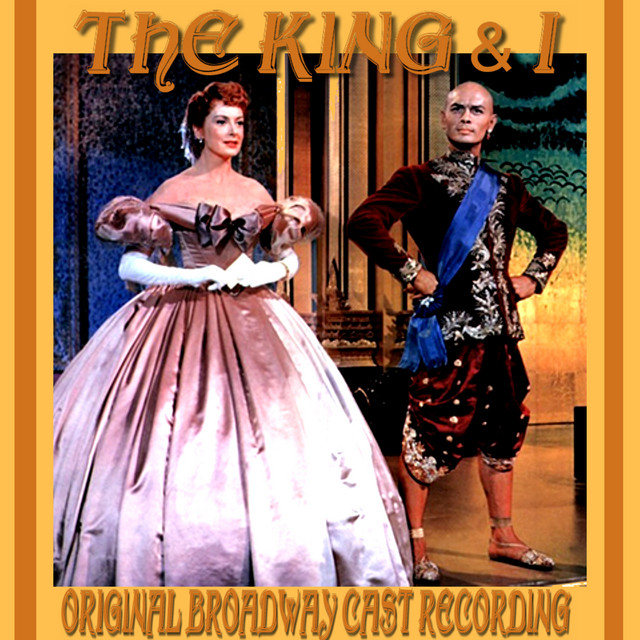
Yes, that's Yul Brynner, with hair,
and with Gina Lollobrigida.
December 25, 1959: The film Solomon and Sheba premieres. Because most businesses are closed on Christmas Day, and Jews don't celebrate the day, with a big meal or otherwise, movie theaters stay open, in the hopes that Jews will come and spend money there. For this reason, December 25 is often a premiere day for blockbuster films. The fact that Solomon and Sheba was an Old Testament tale helped, and the film was a hit.
In the Bible, where his story is told in 2nd Samuel, 1st Kings and 2nd Chronicles, Solomon was the son of King David and Queen Bathsheba, reigning for 40 years in the middle of the 10th Century BC, building the Temple that became the center of Jewish life, and being the wisest man in the known world. This last belief may have been contradicted by his marrying 700 women, having 300 concubines, and fathering countless children.
He is said to have met "the Queen of Sheba," who is not otherwise named in the text. 1st Kings 10:2 says she came to Jerusalem "with a very great retinue, with camels bearing spices, and very much gold, and precious stones." 2nd Chronicles 9 says, "Never again came such an abundance of spices."
1st Kings 10:13 says that when Solomon gave her "all her desire, whatsoever she asked," she left satisfied. That's a bit vague, and it could imply a sexual relationship between them. But that's the end of her mention in the Bible. Aside from a few inscriptions found in modern times, suggesting that there was trade between Israel and Sheba at the time, the land that is now "The Holy Land" (Israel, Jordan, Lebanon, and the Palestinian Territories) has given no known evidence. The Bible's Song of Songs, also known as The Song of Solomon, is an epic poem that is often suggested to be about the love between Solomon and the Queen of Sheba, but this remains speculation.
There are other stories, which contradict the West's habit of calling the Queen by the name "Sheba." The Arab world, including the Quran, suggests that her name was Bilquis, that the land of Sheba was "Saba," including what is now southern Saudi Araba, Oman and Yemen. Modern Ethiopia suggests that her name was Makeda, and that Sheba was Ethiopia, Eritrea, Djibouti and Somalia, across the Red Sea and the Gulf of Aden from Saudi Arabia and Yemen. Historians are not convinced that the woman existed, but concede that it is possible that her kingdom did, on either side, or even that she (or someone) ruled over both.
And both Arabic tradition and Ethiopian tradition says that, when the Queen left Jerusalem, she was pregnant with Solomon's child. He became her successor, the Emperor Menelik, who eventually copied his mother's journey, and met Solomon at the Temple, where he was received with joy. They also say that, upon his return, he took the Ark of the Covenant back with him, something not backup by any Jewish text.
In the film, Sheba is an enemy of Israel, as is Egypt, and the Queen (played by Italian actress Gina Lollobrigida) conspires with their Pharoah (British actor David Farrar) to undermine Solomon (the Russian-born American actor Yul Brynner, who had famously played a different Pharoah in The Ten Commandments). She seduces him, but as she spends more time with him, she finds herself falling in love with him as well.
The Queen introduces Sheban worship to the Temple Solomon has built, and an angry God damages the Temple and destroys the Sheban altar. Solomon's brother, Adonijah (British actor George Sanders), who was older and thought he should have been named successor by David, conspires with the Pharoah to raise an army to defeat Solomon. It succeeds, and Adonijah takes the throne.
The Hays Code still being in effect, the Queen repents of the harm she has done, and prays for God to restore Solomon. He wins a battle, and returns to Jerusalem. Adonijah finds that the people are not behind him, so he decides to win them over by sacrificing the Queen. Solomon arrives to find her already wounded and near death, but kills Adonijah. He prays for the Queen to be healed, and she is. But the price for regaining his throne and her health is that they be separated. The film ends as the Queen leaves for Sheba, knowing that she is pregnant with Solomon's child.
Sanders died in 1972, Vidor in 1982, Brynner in 1985, Farrar in 1995. As of December 25, 2022, Lollobrigida is still alive. (UPDATE: She died in 2023.)
Solomon, or Suleiman as he is known to Muslims, is revered by all 3 Abrahamic faiths, and by Ethiopian Jews and Christians. The Queen of Sheba is claimed by both Arabs and black Africans as one of their own. Both the Asiatic Russian Brynner and the Roman Lollobrigida looked "exotic" enough to have filled their roles to the satisfaction of Eisenhower-era Americans.
In the 1995 Showtime film Solomon & Sheba, the couple were played, respectively, by Hispanic actor Jimmy Smits and African-American actress Halle Berry; in the 1997 TNT film Solomon, by English actor Ben Cross and African-American actress Vivica A. Fox; and in the 2022 film Three Thousand Years of Longing by Lebanese actor Nicolas Mouawad and Ugandan model-actress Aamito Lagum. The story has been modernized in the 2001 film Brooklyn Babylon and the 2014 country-music-themed film The Song.
*
December 25, 1959 was a Friday. Baseball was out of season. There were no college bowl games. The NFL was between the end of its regular season and its Championship Game, which the Baltimore Colts would win over the New York Giants in a rematch of the previous year's event.
There were 4 games in the NBA:
* The New York Knicks lost to the Boston Celtics, 123-119 at the old Madison Square Garden.
* The Philadelphia Warriors beat the Syracuse Nationals, 129-121 at the Hershey Sports Arena (now the Hersheypark Arena), outside Harrisburg in Hershey, Pennsylvania. Rookie Wilt Chamberlain scored 45 points and grabbed 34 rebounds. On March 2, 1962, he would have an even bigger game at that arena, scoring 100 points.
After that season, the Warriors moved to San Francisco. After another season, the Nationals moved to replace them, becoming the Philadelphia 76ers.
* The Cincinnati Royals beat the Detroit Pistons, 121-103 at the Cincinnati Gardens.
* And the St. Louis Hawks beat the Minneapolis Lakers, 112-96 at the Kiel Auditorium in St. Louis. The Lakers moved to Los Angeles in 1960, and the Hawks moved to Atlanta in 1968.
There were 2 games in the NHL. The New York Rangers beat the Detroit Red Wings, 5-2 at the Olympia Stadium in Detroit. And the Boston Bruins beat the Chicago Black Hawks, 5-1 at the Boston Garden.
While the NBA has made Christmas Day a traditional showcase for their league, the NHL last scheduled games for December 25 in 1971 -- not for religious reasons, but because the NFL began playing games on the day, and the NHL didn't want to compete for attention.

.jpg/250px-The_Ten_Commandments_(1956_film_poster).jpg)