Showing posts with label south pacific. Show all posts

Tuesday, November 1, 2022

November 1, 1952: The 1st Hydrogen Bomb

November 1, 1952: America successfully detonates the 1st hydrogen bomb, at Eniwetok Atoll in the Marshall Islands in the central Pacific Ocean.
A thermonuclear weapon, fusion weapon or hydrogen bomb -- H-bomb -- is a second-generation nuclear weapon design. Its greater sophistication affords it vastly greater destructive power than first-generation nuclear bombs (fission bombs), a more compact size, a lower mass, or a combination of these benefits.
Characteristics of nuclear fusion reactions make possible the use of non-fissile depleted uranium as the weapon's main fuel, thus allowing more efficient use of scarce fissile material such as uranium-235 or plutonium-239.

Edward Teller, a Hungarian-born Jewish physicist who won a power struggle with A-bomb pioneer J. Robert Oppenheimer within the American government, is considered "The Father of the Hydrogen Bomb." Late in life, he admitted in an interview, "I think the world has enough nuclear weapons."
He was more than right: The H-bomb was supposed to give the U.S. a leg up on the Soviet Union, but they detonated their 1st H-bomb on August 12, 1953, only 9 months later.

*

November 1, 1952 was a Saturday. Baseball season was over. These were among the college football games played:

* Number 1 Michigan State beat Number 8 Purdue, 14-7 at Ross-Ade Stadium in West Lafayette, Indiana. MSU finished 9-0, but, in this, their last season before joining the Big Ten (which was officially the Big Nine since 1940, when the University of Chicago dropped out), they were not invited to the Rose Bowl, or to any other bowl game. Nonetheless, after the season, they were voted the consensus National Champion.

* Number 2 Maryland beat Boston University, 34-7 at Fenway Park in Boston. Previously undefeated, Maryland lost its last 2 games, and didn't even get invited to a bowl game.

* Number 3 Oklahoma beat Iowa State, 41-0 at Clyde Williams Stadium in Ames, Iowa. Oklahoma won the Big Seven Conference title, but did not go to a bowl game.

* Number 4 Georgia Tech beat Number 5 Duke, 28-7 at Duke Stadium (later Wallace Wade Stadium) in Durham, North Carolina. Tech went on to win the Southeastern Conference title. However, they did not play the University of Mississippi during the regular season, and, despite 2 ties, and despite not even being ranked in the Top 20 until the week after this, "Ole Miss" were also undefeated. So the teams were paired up in the Sugar Bowl, and Tech won, earning National Championship honors from some minor polls.

Duke won the Southern Conference title, but were already on their way out of that league: The next season, they were charter members of the Atlantic Coast Conference (ACC).

* Number 6 USC, the University of Southern California, had the week off. Number 7 UCLA, the University of California at Los Angeles, beat Number 11 Cal, the main campus of the University of California, 28-7 at California Memorial Stadium in Berkeley. Three weeks later, USC beat UCLA for the Pacific Coast Conference title.

* Rivalry: Number 9 Kansas beat Kansas State, 26-6 at Memorial Stadium in Manhattan, Kansas. The Jayhawks lost 2 of their last 3 games, knocking themselves out of league title honors and bowl consideration. Most people there didn't care, as they were still basking in their National Championship in basketball, won in March.

* Number 12 Tennessee beat North Carolina, 41-14 at Shields-Watkins Field (later renamed Neyland Stadium) in Knoxville, Tennessee.

* Number 13 Notre Dame beat Navy, 17-6 at Cleveland Municipal Stadium. This was the end of an 0-2-1 stretch that saw Navy fall out of the Top 20. They were still invited to the Orange Bowl, but declined. Notre Dame declined all bowl invitations between the 1925 and 1969 seasons.

* Number 14 Texas beat Southern Methodist University (SMU), 31-14 at Memorial Stadium in Austin, Texas. Texas won the Southwest Conference title, then beat Tennessee in the Cotton Bowl.

* Number 15 Michigan were upset by Illinois, 22-13 at Michigan Stadium in Ann Arbor.

* Number 16 Virginia were upset by South Carolina, 21-14 at Scott Stadium in Charlottesville, Virginia.

* Number 17 University of Pennsylvania were upset by Pennsylvania State University, a.k.a. Penn State, 14-7 at Franklin Field in Philadelphia. The night before, another of Philadelphia's "Big 5" college basketball schools failed to win in football despite being nationally ranked: Number 10 Villanova were held to a tie by to the Parris Island Marines, 20-20 at Villanova Stadium in the Philadelphia suburb of Villanova, Pennsylvania. The Marines had their ranks swelled by volunteers to fight in the Korean War.

* Number 18 Wisconsin beat Rice University, 21-7 at Rice Stadium in Houston. It sounds like a bowl game, but it was in the regular season. Wisconsin did go on to win the Big Ten Conference title, but USC beat them in the Rose Bowl.

* Number 19 Alabama beat Georgia, 34-19 at Legion Field in Birmingham, Alabama. Losses to Tennessee and Georgia Tech cost 'Bama the SEC title, but they were still invited to the Orange Bowl, where they played Syracuse, who were idle on November 1. Alabama won, 61-6, and those 61 points stood as a record for the most points in a bowl game until 2008.

* Rivalry: Minnesota beat Iowa, 17-7 at Memorial Stadium in Minneapoli.s.

* Rivalry: Montana beat Montana State, 35-12 at Dornblaser Field in Missoula. (Montana State is in Bozeman.)

* Army beat Virginia Military Institute (VMI), 42-14 at Michie Stadium in West Point, New York.

* Among New York City teams, NYU beat Lafayette, 14-7 at Fisher Field in Easton, Pennsylvania. Fordham lost to the University of Detroit, 28-20 at Triborough Stadium (later Downing Stadium) on Randall's Island in the East River. And Columbia lost to Cornell, 21-14 at Baker Field in Upper Manhattan.

* And in New Jersey, Rutgers beat Temple, 40-28 at Rutgers Stadium in Piscataway; while Princeton beat Brown, 39-0 at Palmer Stadium in Princeton.

There were 5 games played in the NBA:

* The New York Knicks beat the Baltimore Bullets, 69-53 at the old Madison Square Garden.

* The Philadelphia Warriors beat the Syracuse Nationals, 86-84 in overtime at the Philadelphia Civic Center.

* The Rochester Royals beat the Fort Wayne Pistons, 94-82 at the Rochester War Memorial Arena (now the Blue Cross Arena) in Rochester, New York.

* The Milwaukee Hawks beat the Indianapolis Olympians, 73-71 at the Milwaukee Arena. In 1974, it was renamed the Milwaukee Exposition, Convention Center and Arena, or "The MECCA." Since 2014, it has been named the UW-Panther Arena.

* And the Minneapolis Lakers beat the Boston Celtics, 94-91 at the Minneapolis Auditorium. Ed Macauley scored 37 in defeat for Boston.

There were 2 games played in the NHL. The New York Rangers lost to the Montreal Canadiens, 4-1 at the Montreal Forum. And the Toronto Maple Leafs beat the Boston Bruins, 3-2 at Maple Leaf Gardens in Toronto. The Detroit Red Wings and the Chicago Black Hawks were not scheduled.

And in English soccer, North London team Arsenal went to the Birmingham area, and lost 2-0 to West Bromwich Albion at The Hawthorns. Arsenal went on to win the Football League title for the 1952-53 season, anyway.

Wednesday, August 17, 2022

August 17, 1934: “Treasure Island” Premieres

Wallace Beery (left) and Jackie Cooper

August 17, 1934: The film Treasure Island premieres, based on the 1883 novel by Robert Louis Stevenson. It stars Jackie Cooper (then 11 years old, a child star long before he was Perry White in the Chris Reeve Superman movies or a M*A*S*H director), Lionel Barrymore, and Wallace Beery as Long John Silver.

The story is set in the mid-18th Century. Jim Hawkins (Cooper) and his mother (Dorothy Peterson) run the Admiral Benbow, a tavern near Bristol, in the West Country of England. One dark and stormy night, during a birthday celebration, the mysterious Billy Bones (Barrymore) arrives, and drunkenly talks about treasure. Soon after, Bones is visited by Black Dog (Charles McNaughton), then Pew (William V. Mong), and drops dead, leaving a chest, which he bragged contained gold and jewels.

Instead of money, Jim finds a map that his friend Dr. Livesey (Otto Kruger) realizes will lead them to the famous Flint treasure. Squire Trelawney (Nigel Bruce, later to play Dr. Watson in Sherlock Holmes films) raises money for a voyage to the treasure island, and they set sail on the Hispaniola, commanded by Captain Alexander Smollett (Lewis Stone). Also on board is the one-legged Long John Silver (Wallace Beery) and his cronies. Even though Bones had warned Jim about a sailor with one leg, he and Silver become friends.

During the voyage, several fatal "accidents" happen to sailors who disapprove of Silver and his cohorts. Then, the night before landing on the island, Jim overhears Silver plotting to take the treasure and kill Smollett's men. Jim goes ashore with the men, and encounters an old hermit named Ben Gunn (Chic Sale), who tells him that he has found Flint's treasure.

Smollett and his loyal men flee to Flint's stockade on the island for safety. Silver's men then attack the stockade when Smollett refuses to give them the treasure map. While the situation looks hopeless, Jim secretly goes back to the Hispaniola at night, sails it to a safe location and shoots one of the pirates in self-defense. When he returns to the stockade, Silver's men are there, and Silver tells them that a treaty has been signed. The pirates want to kill Jim, but Silver protects him. Dr. Livesey comes for Jim, but the boy refuses to break his word to Silver not to run away.

The next day, the pirates search for the treasure hold, but, when they find it, it is empty. When some of the pirates mutiny against Silver, Livesey and Gunn join him in the fight. Smollett then sails home with the treasure, which Gunn had hidden in his cave, and with Silver as his prisoner. Silver tells Jim a horror story of a slow death by hanging due to his one leg, causing Jim to be unable to stand by and let his friend be hanged, and he frees Silver. As he sails away, Silver promises to hunt treasure with Jim again some day, as "Honest John" Silver.

So many of the clichés we developed about pirates come from this film: The big hat, the peg leg, the parrot on the shoulder, the exclamation "Arrrrgh!" and the calling of friends "Matey," the burying of treasure in chests on deserted desert islands, usually in the South Pacific, and the marking of the locations of such treasures on a map with an X. However, the pirate exclamation "Shiver me timbers!" meaning, "May my ship's timbers break," appeared in the original novel, and maybe have been around long before that.

A lot of our pop-culture clichés came from the films of the early Thirties, which is why people were shocked when later Tarzans had better vocabularies than Johnny Weissmuller's, and when Gary Oldman didn't look like Bela Lugosi's take on the vampire Count in Bram Stoker's Dracula.

Treasure Island would be remade in color in 1950, with Robert Newton as Long John Silver. He popularized the pirate exclamation "Blow me down!" meaning, "May the wind blow me down." As a native of Shaftesbury, in Dorset, his West Country accent became the familiar "pirate accent," although the most famous real-life pirate, Edward "Blackbeard" Teach, was also from the West Country, which Newton, who played him in a movie, likely knew.

*

August 17, 1934 was a Friday. Ron Henry, the left back on Tottenham Hotspur's "Double"-winning side of 1961, was born. And these baseball games were played:

* A doubleheader was split at Yankee Stadium. The New York Yankees beat the Detroit Tigers, 5-0 in the opener. Lefty Gomez pitched an 8-hit shutout. Tony Lazzeri hit a home run. The Tigers won the nightcap, 2-0. Lynwood "Schoolboy" Rowe pitched a 3-hit shutout, striking out 11, outpitching Jimmie DeShong. Over the 2 games, Babe Ruth went 1-for-5, Lou Gehrig went 1-for-7 with an RBI, Hank Greenberg went 1-for-8, and Marv Owen went 4-for-7.

* The New York Giants swept a doubleheader from the Pittsburgh Pirates, 7-3 and 8-3 at Forbes Field in Pittsburgh. Carl Hubbell went the distance in the 2nd game. Over the 2 games, Giants player-manager Bill Terry went 6-for-10 with an RBI, Mel Ott went 6-for-9 with a home run in each game, a walk and 6 RBIs, Paul Waner went 2-for-8, and Lloyd Waner went 2-for-6 with 2 walks and 2 RBIs.

* A doubleheader was split at Fenway Park in Boston. The Boston Red Sox won the 1st game, 6-0. Wes Ferrell pitched a 2-hit shutout, outpitching Bobo Newsom. The St. Louis Browns won the 2nd game, 5-2.

* A doubleheader was split at Shibe Park in Philadelphia. The Philadelphia Athletics beat the Chicago White Sox in the 1st game, 9-8. This was a wild game: Each team scored 2 runs in the 7th inning, 2 in the 8th, and 1 in the 9th. Ed Coleman hit 3 home runs and had 5 RBIs. Edwin "Dib" Williams doubled Bill Dietrich home with the winning run in the bottom of the 10th. Dietrich was also the winning pitcher, in relief of Al Benton. George Earnshaw went the distance for the A's. 

The White Sox won the 2nd game, 3-2. Ted Lyons went the distance for the win. Over the 2 games, Jimmie Foxx went 1-for-7 with a home run, a walk and an RBI. For the White Sox, former A's star Al Simmons went 4-for-9 with 5 RBIs, and Luke Appling went 2-for-8.

* The Washington Senators swept a doubleheader from the Cleveland Indians, 4-3 and 1-0 at Griffith Stadium in Washington. In the 1st game, the Indians scored a run in the top of the 9th, but the Senators tied it with 2 in the bottom of the 9, and won it in the 10th with Cliff Bolton singling Cecil Travis home. In the 2nd game, Bobby Burke pitched a 3-hit shutout, outpitching future Yankee Monte Pearson. The only run came in the bottom of the 2nd, when Pearson threw a wild pitch to Dave Harris, allowing Buddy Myer to score.

* The Brooklyn Dodgers beat the Cincinnati Reds, 12-4 at Crosley Field in Cincinnati. Sam Leslie and Tony Cuccinello each went 3-for-5 with 3 RBIs.

* The Boston Braves beat the Chicago Cubs, 5-2 at Wrigley Field in Chicago.

* And the St. Louis Cardinals beat the Philadelphia Phillies, 12-2 at Sportsman's Park in St. Louis. James "Ripper" Collins went 4-for-4 with a home run, a walk and 3 RBIs.

Sunday, August 7, 2022

August 7, 1947: The Kon-Tiki Expedition

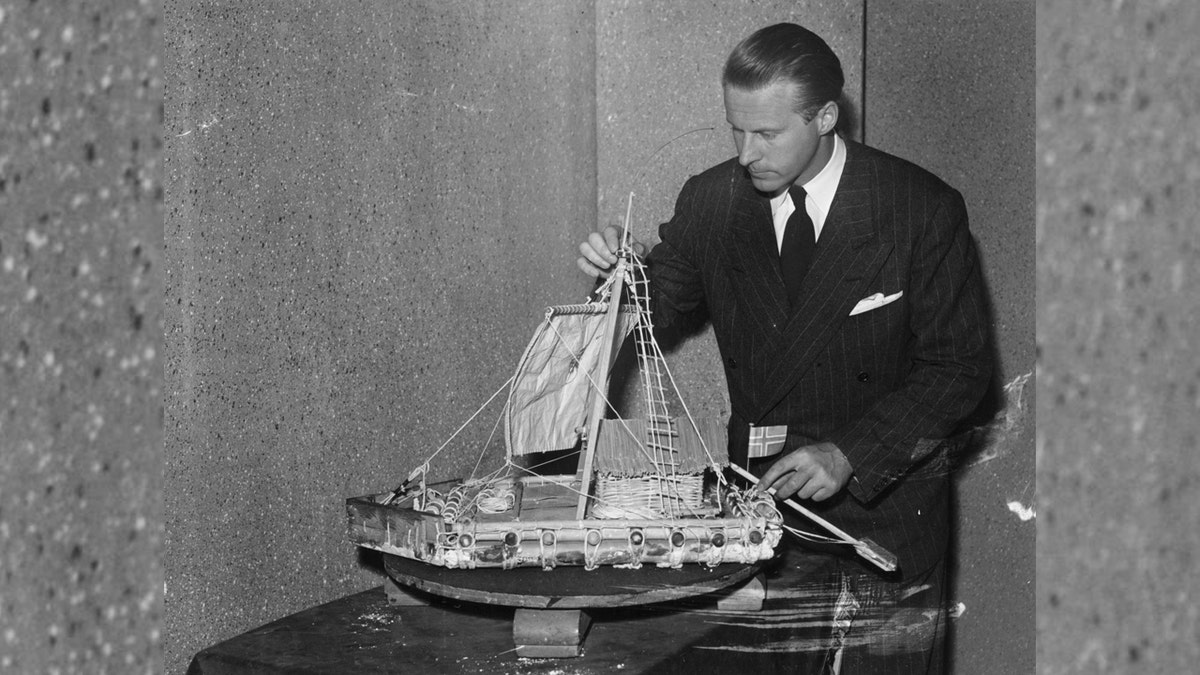
Heyerdahl with a model of the Kon-Tiki

August 7, 1947: The raft Kon-Tiki arrives on a reef in the Tuamotus, in French-controlled Polynesia. This backs up the theory of its captain that ancient peoples from there and South America could reach each other's lands without modern technology, and meet and interact with each other.

Thor Heyerdahl was born on October 6, 1914 in Larvik, Norway. With his backgrounds in biology, zoology, botany and geography, he could have been one of the inspirations for the character of Indiana Jones.

He had the raft Kon-Tiki, named for a god of the Incas in what is now Peru, built to prove a theory that, using only the materials and technologies available to them at the time, people from South America could have reached Polynesia during pre-Columbian times. (In other words, before Christopher Columbus crossed the Atlantic Ocean in 1492.) There had been suggestion of this, based on the genetics of the respective peoples.

There were 5 others with Heyerdahl on the raft: Erik Hesselberg, navigator; Bengt Danielsson, steward, in charge of supplies and daily rations; Knut Haugland, radio operator; Torstein Raaby, also a radio operator, because there had to be at least one awake and available to operate at all times; and Herman Watzinger, engineer and meteorologist, the latter skill making him a key figure on the voyage.

The team built the raft out of balsa logs and other native materials, in a dockyard in Peru, on South America's Pacific Coast. They headed out on April 28, 1947, covering 4,300 miles in 101 days, before arriving at the reef at Raroia in the Tuamotus. That island remains under French control. (Presumably, Heyerdahl met with the French authorities, and let them know of his plans beforehand, and got permission to travel to those islands.)

Heyerdahl narrated a 1950 documentary film about the expedition, and it won the Academy Award for Best Documentary Feature, despite requiring translation: For all his skills, Heyerdahl did not speak English.

Heyerdahl died in 2002. The last survivor of the voyage was Haugland, who lived until 2009. The original Kon-Tiki raft is on display at the Kon-Tiki Museum in the Norwegian capital of Oslo.

*

August 7, 1947 was a Thursday. These baseball games were played that day:

* The New York Giants beat the Philadelphia Phillies, 5-2 at the Polo Grounds.

* The Brooklyn Dodgers lost to the Boston Braves, 3-1 at Braves Field in Boston. Jackie Robinson went 0-for-4.

* The Boston Red Sox beat the Washington Senators, 12-2 at Griffith Stadium in Washington. Ted Williams went 2-for-4 with a home run.

* The St. Louis Cardinals beat the Cincinnati Reds, 9-2 at Crosley Field in Cincinnati.

* The Pittsburgh Pirates beat the Chicago Cubs, 3-0 at Wrigley Field in Chicago. Krby Higbe pitched a 7-hit shutout for the Pirates. Hank Greenberg went 0-3 with a walk. Ralph Kiner 1/for-3.

* The Chicago White Sox beat the St. Louis Browns, 8-4 at Sportsman's Park in St. Louis.

* The Cleveland Indians and the Detroit Tigers were rained out at Briggs Stadium (later renamed Tiger Stadium) in Detroit. The game was made up as part of a doubleheader on September 20. The Tigers won the opener, 3-2. Eddie Mayo singled Jimmy Outlaw home with the winning run in the bottom of the 10th inning. Fred Hutchinson of Detroit and Bob Feller of Cleveland both went the distance. The 2nd game went 10 innings, and was tied 5-5, when rain came again, and the game was called.

* And the New York Yankees and the Philadelphia Athletics were not scheduled.

Thursday, April 7, 2022

April 7, 1949: "South Pacific" Premieres On Broadway

April 7, 1949: South Pacific premieres on Broadway, at the Majestic Theatre, at 245 West 44th Street. (The Theatre is still operating.) It is based on Tales of the South Pacific, the Pulitzer Prize-winning World War II book by James Michener. Richard Rodgers wrote the music, Oscar Hammerstein II wrote the lyrics, and Hammerstein and Joshua Logan wrote the text. Logan also directed.

The story: Ensign Nellie Forbush is a young U.S. Navy nurse serving on a Polynesian island. Living there is Emile de Becque, a middle-aged French plantation owner. They fall in love, and recall their first meeting, with the musical's best-remembered song, "Some Enchanted Evening."

But Nellie, from the Southern city of Little Rock, Arkansas, discovers that he has had 2 children from a previous relationship with a native woman. After deciding that her prejudice is stronger than her love, singing, "I'm Gonna Wash That Man Right Outa My Hair," he persuades her to change her mind, and she sings, "I'm In Love with a Wonderful Guy."

A secondary plot involves men in the Navy's Construction Battalions -- C.B.'s, or Seabees. Some have become infatuated with Navy nurses, and they have to contend with the fact that nurses are officers, and off-limits to enlisted men like themselves. This leads to the song "There Is Nothing Like a Dame."

The two plots eventually combine, and one of the Seabees laments that he didn't start out feeling prejudiced, singing, "You've Got to Be Carefully Taught." Given that this was 2 years after the debut of Jackie Robinson, and 5 years before Brown v. Board of Education, Rodgers & Hammerstein (and Michener) had to use the Polynesians as an allegory for black Americans.

In the original Broadway cast, Nellie was played by Mary Martin, who ended up washing her hair (wearing a bathing suit inside a large tub, obscuring most of her body) onstage 8 times a week for 2 years; and Emile by the Italian bass singer Ezio Pinza.

The musical was filmed, with Logan again directing, in 1958, by which point Brown v. Board and the Montgomery Bus Boycott had happened. Mitzi Gaynor played Nellie, and, this time, Emile was played by 2 Italian actors: Rossano Brazzi played his physical form, but Giorgio Tozzi dubbed his singing. It was filmed again in 2001, long after the Civil Rights Movement. This time, Nellie was played by a much older actress, Glenn Close, and Emile by Croatian actor Rade Šerbedžija.

To put it in perspective: When they played Nellie, their ages were: Martin, 35; Gaynor, 27; and Close, 54. When they played Emile, Pinza was 56, Brazzi 41, and Šerbedžija 55. So only the 2001 couple were age-appropriate for each other.

Ezio Pinza died in 1957, before he could be included in the film. Oscar Hammerstein II died in 1960, Richard Rodgers in 1979, Joshua Logan in 1988, Mary Martin in 1990, Rossano Brazzi in 1994, and James Michener in 1997. As of April 7, 2022, Mitzi Gaynor is still alive. (UPDATE: She died in 2024.)

*

April 7, 1949 was a Thursday. Mitch Daniels was born. He was elected Governor of Indiana as a Republican, and served President George W. Bush as the Director of the Office of Management and Budget.

Scores were hard to come by, at least in America. The baseball season hadn't started yet. Football was in the off-season. The Basketball Association of America and the National Basketball League would merge before the next season to form the National Basketball Association. Their 1948-49 regular seasons had not yet ended, but the BAA had no games scheduled for April 7, and NBL teams' records don't seem to be available on any source I can find.

The Stanley Cup Finals began the next day. The Toronto Maple Leafs opened them by beating the Detroit Red Wings, 3-2 on an overtime goal by Joe Klukay. On April 10, the Leafs won again, 3-1. Both of those games were played at the Olympia Stadium in Detroit. At Maple Leaf Gardens in Toronto, the Leafs won Game 3, 3-1 on April 13; and completed the sweep, 3-1 on April 16.

December 31, 1999 & January 1, 2000: The Millennium

December 31, 1999:  The Millennium arrives. The people of planet Earth survived. At a terrible cost. But we hadn't destroyed ourselves. ...