Showing posts with label mlb all-star game. Show all posts

Saturday, July 23, 2022

July 23, 1969: Nixon Welcomes the All-Stars -- and Then Doesn't

The National League's starting lineup. Left to right:
Manager Red Schoendienst, Matty Alou, Don Kessinger, Hank Aaron,
Willie McCovey, Ron Santo, Cleon Jones, Johnny Bench and Félix Millán.

July 23, 1969: The Major League Baseball All-Star Game is played at the newly-renamed Robert F. Kennedy Stadium in Washington. Vice President Spiro Agnew throws out the first ball. President Richard Nixon had intended to do so, then fly to California to greet the splashed-down Apollo 11 astronauts. But the one-day rain delay led Tricky Dick to say, "(expletive deleted) it," and he went straight to California (his home State, after all), and so the Baltimore kickback-taker did the honors.

The day before, Nixon had honored the All-Stars at the White House. He had also invited some men who had been honored in a poll in honor of the 100th Anniversary of professional baseball, which chose the greatest players at each position, plus the greatest player of all time, Babe Ruth; and, as the "greatest living player," a title he insisted upon every time he was introduced for the rest of his life, Joe DiMaggio.

The Yankees in the game were pitcher Mel Stottlemyre and reserve outfielder Roy White. Reggie Jackson started in center field, but he was with the Oakland Athletics at the time. The Mets in the game were starting left fielder Cleon Jones, and pitchers Tom Seaver and Jerry Koosman.

This was an expansion season. For the NL, original 1962 Met Chris Cannizzaro represented the San Diego Padres, and future Met Rusty Staub the Montreal Expos. For the AL, the 1st All-Star for the Kansas City Royals was Eliseo "Ellie" Rodríguez; while the 1st 2 for the Seattle Pilots were Don Mincher and Mike Hegan. The Pilots went bankrupt, and became the Milwaukee Brewers the next season. The year after that, Ellie Rodríguez was traded to the Brewers.
The American League's starting lineup, albeit in reverse order.
Left to right: Bill Freehan, Rico Petrocelli, Sal Bando,
Frank Howard (6-foot-7, 280 pounds), John "Boog" Powell (6-foot-4, 230),
Frank Robinson, Reggie Jackson (partly obscured), Rod Carew.
Manager Mayo Smith is mostly obscured.

Stottlemyre started for the American League, and Steve Carlton of the St. Louis Cardinals started for the National League. In the 2nd inning, Frank Howard of the host Washington Senators and Johnny Bench of the Cincinnati Reds hit home runs. In the 3rd inning Willie McCovey of the San Francisco Giants and Bill Freehan of the Detroit Tigers hit home runs. McCovey hit another home run in the 4th. The NL won, 9-3.

McCovey went on to be named the NL's Most Valuable Player, despite Seaver being the single most valuable player for any season that the Mets have ever had. Through the 2021 season, the Mets have never had a regular-season MVP.

*

July 23, 1969 was a Wednesday. The MLB All-Star Game is usually played on a Tuesday, but, as I said, this one was postponed by rain. Since there were no other major league sports in season at the time, there were no other scores on this day.

Raphael Warnock was born on that day. He became the pastor at Ebenezer Baptist Church in Atlanta, formerly presided over by Martin Luther King Sr. and Jr.; and was elected a U.S. Senator from Georgia.

Tuesday, July 19, 2022

July 19, 1977: An All-Star Game for a Troubled New York

July 19, 1977: The Major League Baseball All-Star Game is held at Yankee Stadium, the only one held in New York City between 1964 and 2008.

Three days earlier, the New York Mets had held Old-Timers' Day at Shea Stadium, and they honored the 4 great living center fielders of New York baseball: Joe DiMaggio and Mickey Mantle of the Yankees, Willie Mays of the Giants (who, due to his last 2 seasons, was wearing a Mets uniform), and Edwin "Duke" Snider of the Dodgers.

DiMaggio had been elected to the Baseball Hall of Fame in 1955; Mantle, in 1974; and Mays would become eligible in 1979, and everyone presumed that he would be elected that year, and he was. Snider was eligible, but not yet in. In 1980, he was finally elected, leading songwriter Terry Cashman to write and record "Talkin' Baseball (Willie, Mickey and the Duke)."
Left to right: Snider, DiMaggio, Mays, Mantle

Holding the All-Star Game in New York seemed problematic. True, the Yankees had won the American League Pennant the year before, and were contenders again. And the Stadium had just been renovated, making it capable of hosting a major event again.

But the City was in trouble. Crime seemed to be out of control. The serial killer known as the Son of Sam was on the loose. Just 6 days earlier, there had been a City-wide blackout that led to terrible looting and multiple fires. There was already a lot of burned-out, and otherwise substandard, housing and commercial property in The Bronx, the Yankees' home Borough; Harlem, former home of the Giants; and Brooklyn, former home of the Dodgers. And there seemed little that the City government could do about it, because it was still recovering from its near-bankruptcy of 2 years earlier. The incumbent Mayor, Abe Beame, wasn't even going to make the runoff for the Primary in his own Democratic Party.

But, for this night, as it so often does, sport, especially baseball, provided a distraction from it all.

DiMaggio was named Honorary Captain for the AL, and Mays was so named for the National League. (Mantle had been so honored at the 1975 All-Star Game, along with Stan Musial.) Rachel Robinson threw out the ceremonial first ball, as a nod to the 30th Anniversary of her husband, Jackie Robinson, re-integrating the sport. (Jackie had died in 1972.)

Yankees selected to play at home were Reggie Jackson, Thurman Munson, Sparky Lyle, Graig Nettles, Willie Randolph, and, as manager of the defending Pennant winners, Billy Martin. The only current Met selected was John Stearns. Former Mets Tom Seaver, Nolan Ryan and Ken Singleton were also selected. (Seaver and Singleton both became broadcasters for the Yankees.)

The game featured a lot of players who would later play in New York: For the Yankees: Rich "Goose" Gossage, Dave Winfield, Ruppert Jones, Rick Reuschel, Dave LaRoche, Butch Wynegar, Jason Thompson, Bert Campaneris and Ken Griffey Sr. For the Mets: Willie Montanez, Jerry Morales and Ellis Valentine. For both: Frank Tanana and John Candelaria.

This was also an expansion year, with the American League adding 2 teams. The 1st All-Star for the Seattle Mariners was center fielder Ruppert Jones. The 1st All-Star for the Toronto Blue Jays was 1st baseman Ron Fairly, a former Los Angeles Dodgers star, who had been an All-Star for the Montreal Expos. He was the only player to be an All-Star for both Canadian-based teams before the Expos moved to Washington after the 2004 season.

Jim Palmer of the Baltimore Orioles started for the AL. Usually, he pitched well against the Yankees. This time, pitching in Yankee Stadium did him no favors. He gave up a leadoff home run to Joe Morgan of the Cincinnati Reds. He struck out Steve Garvey of the Los Angeles Dodgers. Then he gave up a single to Dave Parker of the Pittsburgh Pirates. Then he gave up an RBI double to George Foster of the Reds, who ended up leading the NL with 52 home runs and winning the NL's MVP. Then Palmer gave up a home run to Greg Luzinski of the Philadelphia Phillies.

It was 4-0 NL, the AL's starting pitcher had gotten 1 out, and the game was essentially already over. Or, as Warner Wolf, then the sports anchor for Eyewitness News on New York's WABC-Channel 7, would have said, "Turn your sets off right there!"

In contrast, the NL's starter, Don Sutton of the Los Angeles Dodgers, pitched 3 strong innings, allowing no runs, 1 hit and 1 walk. This was a foreshadowing of that season's World Series -- and the next season's -- when the Yankees faced the Dodgers. So was Garvey hitting a home run in the 3rd, to make it 5-0.

Seaver got a standing ovation when he came out to pitch the bottom of the 6th, wearing his gray Reds road uniform. But he didn't pitch well, allowing a leadoff single to Rod Crew of the Minnesota Twins, who flirted with a .400 average for much of the season, ending at .388, and winning the AL MVP; a walk to Fred Lynn of the Boston Red Sox; and a double by Richie Zisk of the Chicago White Sox, making the score 5-2.

Rarely getting the chance to face Yankees, in the 7th, Seaver faced Nettles, who reached on an error, allowing Butch Wynegar of the Twins to get into scoring position; and then Randolph singled Wynegar home, to make it 5-3.

The NL got 2 more runs in the 8th, while in the bottom of the 9th, George Scott of the Red Sox homered off Rich "Goose" Gossage of the Pirates to get the AL within 7-5. But Gossage, apparently auditioning for the Yankees, impressed team owner George Steinbrenner by getting Randolph to short and striking Munson out to end the game.

The National League won, 7-5. This is the only game in the YES Network series Yankees Classics in which current Yankees are shown to lose.

*

July 19, 1977 was a Tuesday. Since no other major league sport was then in season, this was the only score on this historic day. 

Sunday, July 17, 2022

July 17, 1979: The Dave Parker Throw

Commissioner Bowie Kuhn (left) and Dave Parker

July 17, 1979: The Major League Baseball All-Star Game is held at the Kingdome in Seattle. Due to the fact that 2 ASGs were held from 1959 to 1962, this game was celebrated as the 50th edition, although it had been 46 years since the 1st one, at Comiskey Park in Chicago in 1933.

It was an ugly game. The Kingdome was described as a "concrete toadstool." dull and gray, both inside and out, with n artificial turf field that was a sickly green. And, typical of the end of the 1970s, the uniforms were horrible. Since the hosts were the Seattle Mariners, the American League was designated the home team. So we were spared the powder-blue road uniforms of the Mariners, the Kansas City Royals, the Milwaukee Brewers, the Minnesota Twins, the Texas Rangers and the Toronto Blue Jays. And, thankfully, the Baltimore Orioles wore their white shirts with orange lettering, not their orange shirts with black lettering. But Chet Lemon wore the Chicago White Sox' dark blue "softball shirts."

But the National League wore their road uniforms. That meant that powder-blue uniforms were worn by the Chicago Cubs (made worse by having white pinstripes), the Montreal Expos, the St. Louis Cardinals, and the Philadelphia Phillies. Well, not all the Phillies: Pete Rose, and his son Pete Jr., who served as a batboy, wore the Phils' alternate burgundy shirts.

The San Francisco Giants did what the Orioles refused to do: Wear orange shirts with black lettering. The Pittsburgh Pirates wore all yellow. The San Diego Padres wore brown shirts with yellow sleeves. And the Houston Astros wore their jerseys that have alternately been called 'Rainbow Brite" and "Tequila Sunrise," which they would have worn regardless, just that the background was white on the home version and gray on the away version.

The starting pitchers were Steve Carlton of the Phillies and Nolan Ryan of the California Angels. In 1983, Ryan would break Walter Johnson's career record for strikeouts, but was soon surpassed himself by Carlton, and they would go back and forth as all-time leaders before Carlton ran out of gas and Ryan pulled away, finishing with 5,714 to Carlton's 4,136. Each man was the 1st in his League to strike out 19 batters in a game. (Ryan did it 4 times, but needed extra innings on 3 of them.)

But Carlton would end up winning more games, 329 to Ryan's 324. Ryan had the slightly lower career ERA, 3.19 to Carlton's 3.22; but Carlton had the higher ERA+, 115 to 112. Carlton had 4 Cy Young Awards to Ryan's none, but Ryan pitched 7 no-hitters to Carlton's none. Oddly, they had the same career WHIP, 1.247.

After 1 inning, it was 3-2 AL. After 3, it was 5-4 AL. After 6, it was 6-5 AL. All of these had been achieved without either side hitting a home run in the Kingdome. Until it was built, it was presumed that all domed stadiums would be like the Astrodome in Houston, where the ball didn't travel far. But in the Kingdome, and later in the Metrodome in Minneapolis, it did.

Dave Parker singled in the top of the 7th, but was stranded. Jim Rice of the Boston Red Sox led off the bottom of the 7th with a double down the right field line. Parker got it, and threw him out at 3rd base. Parker had succeeded Roberto Clemente as the Pirates' right fielder, and barely missed a beat. In 1975 and 1977, he finished 3rd in the NL's Most Valuable Player voting.

In 1977 and 1978, he won the NL batting title, despite being hit in the face with a pitch in '78, and having to wear a facemask for much of the season. He was named the MVP, and was regarded by many fans as the best all-around player in baseball. Rice was not, despite having won the AL's 1978 MVP due to his heavy hitting, because he was only an average fielder and, as became painfully obvious here, a slow runner. Parker's performance through 1978 earned him baseball's 1st $1 million per year contract, but, when he got off to a slow start in 1979, he faced some nasty racism.

In MLB's All-Star Game, every team is entitled to at least 1 player being selected. For the New York Mets in 1979, that player was outfielder Lee Mazzilli. In the top of the 8th inning, Mazzilli, billed by the poorly-playing, and even more-poorly-attended, Mets as a teen idol, a baseball version of John Travolta, became the 1st player to hit a pinch-hit home run in an All-Star Game, off Jim Kern of the Rangers, to tie the game.

Kern would finish the season 13-5, with a 1.57 ERA and 29 saves. But he would never be so effective again. The following season, he went 3-11 with a 4.83 ERA and just 2 saves. At one point, he told a reporter, "I'm working on a new pitch. It's called a strike."

In the bottom of the 8th, Brian Downing of the Angels singled off Bruce Sutter of the Cubs. Two outs later, Downing was on 2nd. Graig Nettles of the New York Yankees blooped a single to right, but Parker got to it, and made perhaps the most famous throw in baseball history, a laser beam that reached catcher Gary Carter of the Expos on the fly. Carter caught it, and pushed Downing aside to keep him away from the plate, to preserve the tied score.

In the top of the 9th, the NL loaded the bases, and Mazzilli drew a walk on Yankee pitcher Ron Guidry, who had been nearly unbeatable the previous season, to give the NL a 7-6 win. Parker was named the Game's MVP.

Met fans argued that it should have gone to Mazzilli, and the fact that he'd beaten Guidry, the previous year's AL Cy Young Award winner and should-have-been winner of the AL MVP, led them to claim "bragging rights" over the Yankees, who had won 2 straight World Series and 3 straight Pennants. They weren't going anywhere in 1979, though, but they were still better off than the Mets, broken up by team president M. Donald Grant, to the point where Shea Stadium's sparse attendance earned it the nickname "Grant's Tomb."

This would be the only All-Star Game at the Kingdome. The Seattle Mariners moved to Safeco Field in 1999, and it hosted the Game in 2001. In 2019, it was renamed T-Mobile Park. It is scheduled to host the All-Star Game again in 2023.

*

July 17, 1979 was a Tuesday, as the day of the MLB All-Star Game usually is. Also as usual, this was the only score on the day.

Wednesday, July 13, 2022

July 13, 1976: Baseball's Bicentennial All-Star Game

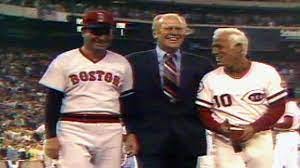
Left to right: Darrell Johnson, Gerald Ford, Sparky Anderson

July 13, 1976: The Major League Baseball All-Star Game is played, as all sports' All-Star Games are in this Bicentennial year, in Philadelphia, at Veterans Stadium.

As usual, the opposing managers were the managers of the defending Pennant winners: Sparky Anderson of the Cincinnati Reds for the National League, and Darrell Johnson of the Boston Red Sox for the American League. President Gerald Ford, who once dropped a Yogi Berra-type line by saying, "I watch a lot of baseball on the radio," threw out the ceremonial first balls -- righthanded to AL catcher Thurman Munson of the New York Yankees, and lefthanded (his natural side) to NL catcher Johnny Bench of the Reds.
The 1976 American League All-Stars

Honorary Captains were a pair of newly-elected Hall-of-Famers: Robin Roberts of the host Phillies for the NL, and Bob Lemon of the Cleveland Indians for the AL.

The NL teams wore sleeve patches in honor of the League's 100th Anniversary. The AL did not do the same for their 75th Anniversary. There were 6 NL teams wearing special old-style "pillbox" caps with horizontal stripes in connection with the Centennial. The Reds, the Philadelphia Phillies, the Pittsburgh Pirates and the St. Louis Cardinals were all teams that went back to the 19th Century, though not to the founding season of 1876; while the Chicago Cubs and the Atlanta (formerly Boston) Braves did, but didn't wear the special caps. The New York Mets only went back to 1962, and the Montreal Expos only back to 1969, but they also wore the Centennial caps. Only the Pirates kept them after the season, keeping them through the 1986 season. The entire NL All-Star Team wore special white pillbox caps for this Game.
The 1976 National League All-Stars

The most heralded rookie in many years, Mark Fidrych of the Detroit Tigers, started for the American League. The similarly-curly-haired phenom Randy Jones of the San Diego Padres started for the National League.
 
The NL plucked "The Bird" early, jumping out to a 4-0 lead after 3 innings, and won 7-1. César Cedeño of the Houston Astros hit the only home run.
 
It was not a good day for New York players: Tom Seaver of the Mets gave up the AL's only run, while Mets Dave Kingman and Jon Matlack, and Yankees Munson, Chris Chambliss, Willie Randolph, Mickey Rivers, Jim "Catfish" Hunter and Sparky Lyle were non-factors.

Jones was 16-3 at the All-Star Break, and Sports Illustrated put him on their cover with the headline "THREAT TO WIN 30." He must have been hit by "The Dreaded SI Cover Jinx," because he went 6-11 the rest of the way, to finish 22-14. He did win the NL's Cy Young Award, having finished 2nd in the voting the year before, when he was 20-12. Fidrych was 9-2 at the Break, and finished 19-9, winning the AL's Rookie of the Year, finishing 2nd to Jim Palmer of the Baltimore Orioles for the AL's Cy.
As it turned out, both peaked with their selections to that '76 All-Star Game. Jones hurt his arm in his last start of that season, never again had a winning season, and never again won more than 13 in a season. Fidrych got hurt in the next season's Spring Training. He threw his last major league pitch at age 28, Jones his at 32. Fidrych finished 29-19; Jones, 100-123.

Fidrych left baseball, and became a farmer and a mechanic in his native Massachusetts, and ended up making more money on the baseball memorabilia circuit than he did as a player. He died in a work-related accident in 2009, only 54.

Jones was luckier: The Padres made him a broadcaster, and retired his Number 35. Like Boog Powell in Baltimore, Greg Luzinski in Philadelphia, Luis Tiant in Boston, and Gorman Thomas in Milwaukee, he opened a barbecue stand at San Diego's ballpark. (UPDATE: He died in 2025, at 75.)

*

July 13, 1976 was a Tuesday, as the day of the MLB All-Star Game usually is. And, with baseball being the only sport in season in North America, there were no other scores on this historic day.

Hockey player Sheldon Souray was born.

Sunday, July 10, 2022

July 10, 1962: The Mets' 1st All-Star: A Phillies Legend

This is not a happy man.
This is a proud man, with much to be proud of,
working in a place where his pride is regularly hurt.

July 10, 1962: From 1958 to 1962, Major League Baseball held 2 All-Star Games every season, 1 in a ballpark of each League. This day was the day of the season's 1st, at the new District of Columbia Stadium in Washington.

President John F. Kennedy attended, and threw out the ceremonial first ball. No one could have foreseen that, within just 6 years, both JFK and his brother, then the Attorney General of the United States, would be assassinated, and that, a year after that, D.C. Stadium would be renamed Robert F. Kennedy Memorial Stadium.

Before the first ball ceremony, JFK spoke to Stan Musial of the St. Louis Cardinals, an ardent Democrat. Musial was 41 years old, 2 years younger than JFK was when he was elected. JFK said, "They said I was too young to be President, and you were too old to play baseball. I guess we both proved them wrong."

Selected for the American League team from the defending World Champion New York Yankees were starting center fielder Mickey Mantle, starting right fielder Roger Maris, catcher Elston Howard, 2nd baseman Bobby Richardson, shortstop Tom Tresh and pitcher Ralph Terry.

Mantle would win his 3rd AL Most Valuable Player award, though he said that Richardson deserved it. Tresh, the eventual AL Rookie of the Year, would be moved to left field when Tony Kubek returned from his military service. Terry went on to win 23 games, not including his shutout in Game 7 of the World Series.

But, at a time when the Cy Young Award was given to the best pitcher in both leagues, it was given to Don Drysdale of the Los Angeles Dodgers, who was the National League's starting pitcher in this game. Jim Bunning of the Detroit Tigers started for the AL.

For the 1st time, the All-Star Game had a Most Valuable Player award. It was given to Maury Wills of the Dodgers, on his way to setting a new major league record with 104 stolen bases in a season. In the 6th inning, he entered the game as a pinch-runner for Musial. Wills stole 2nd base, and was singled home by Dick Groat of the Pittsburgh Pirates. In the 8th inning, Wills singled, was singled to 3rd by Jim Davenport of the San Francisco Giants, and scored on a sacrifice fly by the Giants' Felipe Alou. The NL won, 3-1.

For the NL's expansion New York Mets and Houston Colt .45s, the team that would become the Houston Astros in 1965, this was the 1st All-Star Game. Houston's 1st All-Star was pitcher Richard "Turk" Farrell. The Mets' 1st was center fielder Richie Ashburn. Each had previously been named an All-Star while with the Phillies.

The 2nd 1962 All-Star Game was played on July 30, at Wrigley Field in Chicago, and the AL won, 9-4. Since then, it has been 1 All-Star Game a year for Major League Baseball, except in 2020 when it was canceled due to COVID restrictions.

Don Richard Ashburn -- like Ford, he was nicknamed Whitey due to his very light blond hair, and didn't mind, because, like later Phillies star Dick Allen, he didn't like being called "Richie" -- was born in 1927 in Tilden, Nebraska, and grew up there. He had debuted with the Phillies in 1948, leading the NL in stolen bases. In 1950, he was the sparkplug of the Phils' Pennant-winning team known as the Whiz Kids. He won the NL batting title in 1955 and 1958, and was named to 5 All-Star Teams -- 6 games counting this season's dual entry.
He was traded to the Cubs in 1960, and the Mets purchased him in their 1st off-season, 1961-62. At the age of 35, he was still an exceptional center fielder, and batted .306, just below his career average of .308. But it was a season of misery, as the Mets went 40-120. He said that he knew it was time to retire when he was named the most valuable player of, as he and many others believed the '62 Mets to be, "the worst team in history."

He returned to the Phillies as a broadcaster, and became an even more beloved figure. As his contemporary, Phil Rizzuto, was to the Yankees, he was the beloved player who became a broadcaster, and had to wait too long to be elected to the Baseball Hall of Fame. He was finally elected in 1995, a year after Rizzuto was, and died 2 years later.

The Phillies did not reach the postseason without him being involved as either a player or a broadcaster between 1915 and 2007. They went on to retire his Number 1, and dedicate a statue to him at Citizens Bank Park when it opened in 2004.

*

July 10, 1962 was a Tuesday, as the day of the MLB All-Star Game tends to be. This being the All-Star Break, and with no other sports in progress at the time, this was the only score on the day.

This was also the day that Telstar 1 was launched. I have a separate entry for that event.

July 10, 1945: Baseball's All-Star Game: A Casualty of War

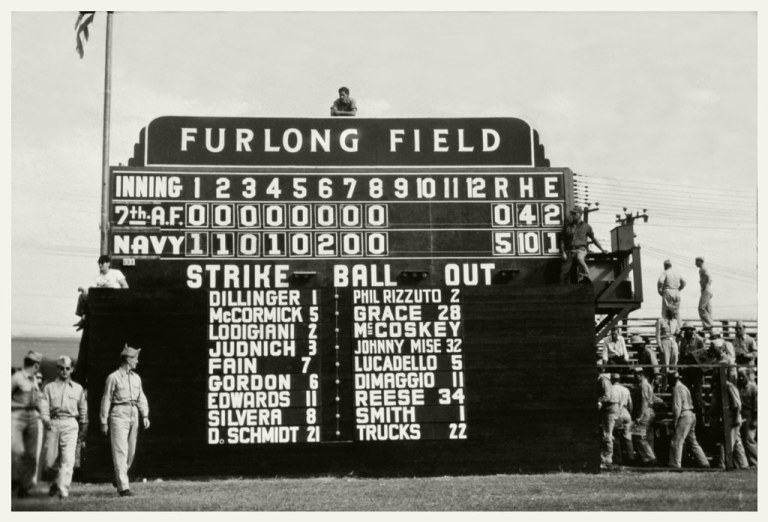
Scoreboard at Furlong Field,
Naval Air Station (NAS) Kaneohe, Hawaii

July 10, 1945: For the 1st time ever, what we would now call "Major League Baseball" cancels its All-Star Game. This is due to travel restrictions, designed to save fuel for the military in World War II. That didn't seem to be a problem in 1942, '43 or '44, however.

The game was intended to be played at Fenway Park in Boston. It was held there the next year.

The U.S. Army, Navy, Marine Corps and Coast Guard -- the Air Force wouldn't be separated from the Army until 1947 -- formed various "service teams" to play each other in the various sports, especially baseball. The Great Lakes Naval Training Station outside Chicago -- once famous for George Halas leading its football team to victory in the 1919 Rose Bowl -- had Bob Feller and so many other stars that it was called "The 17th Major League Team."

An All-Star series was set up in Hawaii, as seen in the scoreboard in the picture above. Notable names there include both of New York City's great shortstops, Phil Rizzuto and Pee Wee Reese, plus Johnny Mize and Joe DiMaggio's brother Dom. The Army Air Force team includes 1942 American Legue Most Valuable Player Joe Gordon of the New York Yankees. (All those Italian names, and the one name misspelled on that board is "MISE.")

Typical of service ball was Ted Lyons, enlisting in the Marines though he was over 40, and pitching for a Corps team that faced an Army Air Force team that included Joe DiMaggio. Lyons, who won 260 games for the Chicago White Sox, usually a bad team. Yankee manager Joe McCarthy said that if he had pitched for the Yankees, he would have won 400. But on this day, Lyons was quoted as saying, "I enlisted to get away from DiMaggio, and now here he is!"

The All-Star Game would not be canceled again until 2020, due to COVID restrictions.

*

July 10, 1945 was a Tuesday, as is usually the case for baseball's All-Star Game. Since it was the All-Star Break, no games were played.

There was one piece of sports news on the day, but that wasn't known for many years: Tennis star Virginia Wade was born.

December 31, 1999 & January 1, 2000: The Millennium

December 31, 1999:  The Millennium arrives. The people of planet Earth survived. At a terrible cost. But we hadn't destroyed ourselves. ...