Showing posts with label jackie robinson. Show all posts

Tuesday, December 13, 2022

December 13, 1956: Jackie Robinson Counter-Screws Walter O'Malley

December 13, 1956: Jackie Robinson retires from baseball. In moving on to the next chapter of his life, he also manages to tell his boss, "Screw me? No: Screw you."

Although Jackie always revered Branch Rickey, the Brooklyn Dodger team president who brought him into the organization to reintegrate the game in 1945, after the 1950 season Rickey was forced out by one of the other co-owners, Walter O'Malley, who concentrated his control. And, as much as O'Malley loved money and control, he hated Rickey and anything to do with him. Including Jackie Robinson.

So on the date listed above, with Jackie's weight going up, his once-great speed reduced, and his 38th birthday approaching, O'Malley traded him to, of all teams, the Dodgers' arch-rivals, the New York Giants, for Dick Littlefield, a lefthanded pitcher already with a reputation for being less than mediocre, and $30,000.
A Topps 1957 baseball card that never was

Jackie knew this was done not so much to improve the team (after all, they'd just won their 2nd straight Pennant, their 6th in the 10 years he was with them), but for spite. So he refused to report to the Giants, retiring instead. The trade was voided, and Littlefield was returned to the Giants, who ended up trading him to the Chicago Cubs instead.

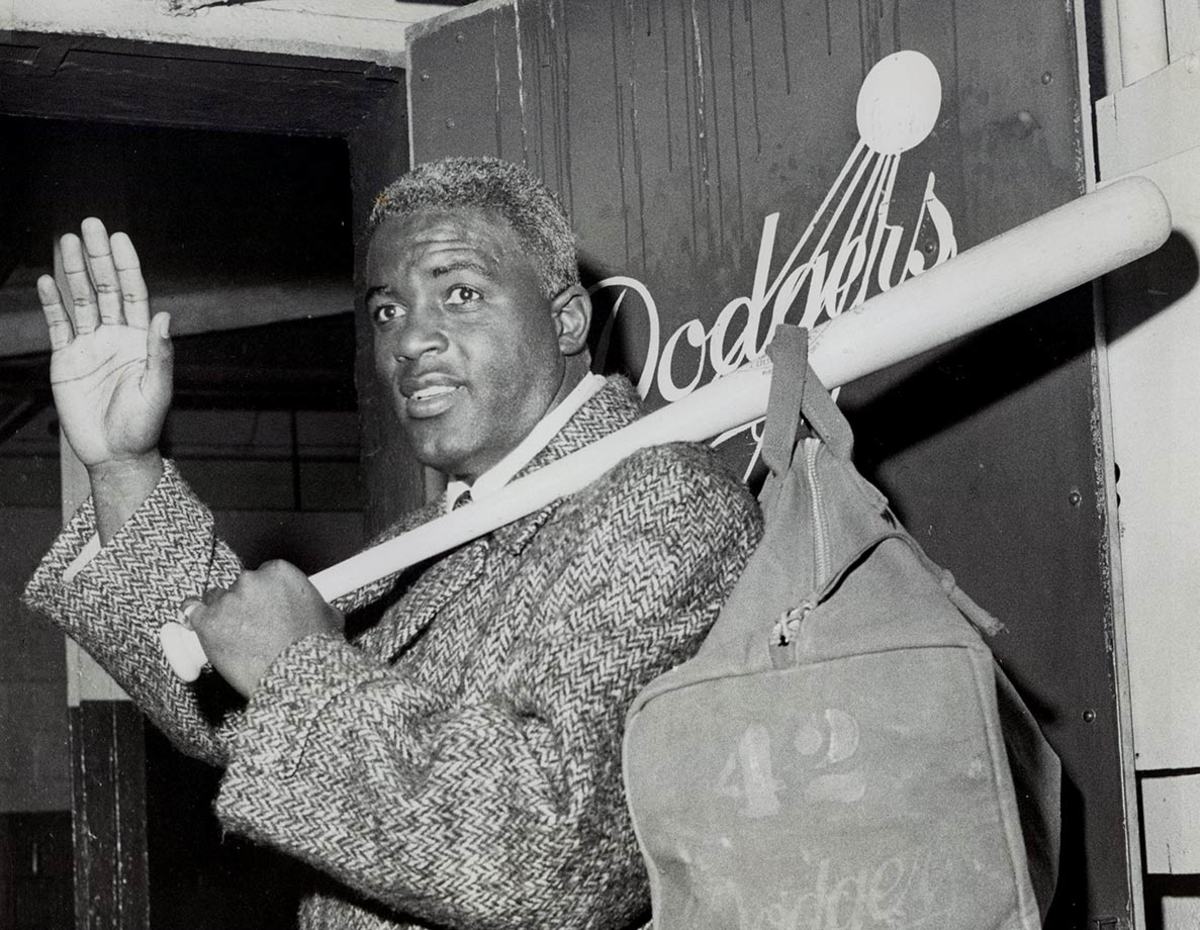
Jackie formally announced his retirement on January 5, 1957. A photo was taken of him, leaving the Dodger clubhouse at Ebbets Field. The contrast with the photo of him arriving is stark: In 1947, wearing his Montreal Royals uniform, he was 28 but looked 18; now, he was about to turn 38, but with his hair going gray and his face filled out, he looked 50. He was soon diagnosed with diabetes.

He became an executive with Chock full o'Nuts, then known more for their chain of lunch counters, a precursor to fast food, than for selling their coffee packs in supermarkets. The company had gone out of its way to hire black employees at good wages. He was later one of the founders of the black-owned Freedom National Bank. He died in 1972, only 53 years old.

In 1953, in between his hostile takeover of Rickey's stock (for which Rickey found a way to make him pay a lot more than he'd intended) and his exile of Robinson, O'Malley drove broadcaster Red Barber away, into the hands of the Yankees. Rickey, Barber, Robinson: Three of the most honorable and influential people in the history of American sport, and O'Malley drove them all away, all in a span of 6 years.

All this before he greedily moved the Dodgers to Los Angeles. In other words, had O'Malley gotten his new stadium where he originally wanted it, and were the Dodgers now preparing to play a 2012 season in Brooklyn, Walter Francis O'Malley would still have been a dirty filthy greedy bastard.

*

December 13, 1956 was a Thursday. Baseball was out of season. Football was in midweek. The NBA had no games scheduled. But the NHL's entire "Original Six" were in action:

* The New York Rangers lost to the Detroit Red Wings, 2-1 at the Olympia Stadium in Detroit.

* The Montreal Canadiens beat the Toronto Maple Leafs, 6-2 at the Montreal Forum.

* And the Boston Bruins beat the Chicago Black Hawks, 3-2 at the Boston Garden.

Thursday, December 8, 2022

December 8, 1947: The Trade That Made "The Boys of Summer"

Preacher Roe

December 8, 1947: The Brooklyn Dodgers trade right fielder Fred "Dixie" Walker, and pitchers Hal Gregg and Vic Lombardi to the Pittsburgh Pirates for pitcher Elwin Charles "Preacher" Roe, 3rd baseman Billy Cox and utility infielder Gene Mauch.

Walker was a 5-time All-Star. He had helped the Dodgers win the National League Pennant in 1941, their 1st in 21 years. He had led the NL In batting average in 1944, and in RBIs in 1945. He had helped the Dodgers win another Pennant just 3 months before the trade. He was so popular, that he was known as "The People's Cherce" -- "The People's Choice," in the Brooklyn accent. Why trade him away? And why trade Gregg and Lombardi, a pair of decent pitchers?

For one very good reason: Dixie, as his nickname suggests, was a Southerner, and opposed to team president Branch Rickey's desegregation of the team, starting with Jackie Robinson. Plus, Walker was 37, and the Dodgers had Carl Furillo coming up. He would also become an NL batting champion, in 1953; and while Walker was a good fielder in right field, Furillo was a better one, with an arm that got him nicknamed, after his Pennsylvania hometown, the Reading Rifle.

Walker played 2 more seasons, mainly as a pinch-hitter, and retired. Aside from the manpower-drain year of 1945, when he went 18-13, Gregg was never more than a journeyman, and was done after 1952. Lombardi was average at best, and was done after 1950.

What did the Dodgers get? Mauch was an afterthought. Ironically, he became one of a few players stuck at shortstop behind Pee Wee Reese who went on to become major league managers. That list would also include Dick Williams, Sparky Anderson and Don Zimmer.

Cox was certainly not acquired for his bat. Only once in Brooklyn would he top .279, only once reach double figures in home runs, and he never had more than 54 RBIs in a season. But he was one of the best-fielding 3rd basemen of all time.

Before Brooks Robinson, before the Yankees' Clete Boyer, he dove all over Ebbets Field to snare anything hit to the left side. It was said that he could get to a grounder and count the stitches on the ball, and still throw the batter out. My grandmother, a Dodger fan from Queens, insisted to the end of her life that Billy Cox was the best 3rd baseman she'd ever seen.
Billy Cox

The real key to the trade was Roe. A lefthander from Arkansas, his nickname came at the age of 3, when an uncle asked his name and Roe responded "Preacher," because of a minister who would take him on horse-and-buggy rides.

His key pitch was a sinker, though many have suggested that he really threw a spitball. Along with righthanders Don Newcombe and Carl Erskine, he gave the Dodgers what amounted to 3 aces in their starting rotation.

Rickey phased out the farmboys who helped the Dodgers win the 1941 and 1947 Pennants, and the near-misses of 1942 and 1946. By Opening Day 1949, he had the classic lineup that would become known, in the title of the book by Roger Kahn, a Brooklyn-born sportswriter who covered them, taken from the poetry of Dylan Thomas, as "The Boys of Summer": Gil Hodges at 1st base, Robinson at 2nd base, Reese at shortstop, Cox at 3rd base, they never quite settled on a left fielder, Edwin "Duke" Snider in center field, Furillo in right field, and Roy Campanella as catcher.

This Dodger team won the Pennant in 1949, fell 1 game short in 1950, lost a painful Playoff for the Pennant in 1951, won the Pennant in 1952, and won it again in 1953. But they couldn't quite win the World Series.

In 1949, Roe went 15-6. In 1950, he went 19-11. In 1951, he went 22-3, and would have won the NL Cy Young Award had one then been available. In 1952, missing part of the season due to injury, he went 11-2. In 1953, again missing time due to injury, he went 11-3. So, over a 3-year stretch, he was 44-8, a winning percentage of .846.

Roe was a terrible hitter, even by the standards of pitchers. My grandmother was always telling me that Roe was a great pitcher, but the worst hitter she ever saw. On July 7, 1953, the Dodgers swept a doubleheader against the Pirates at Forbes Field. Erskine started and won the 1st game. Roe started and won the 2nd game, and also hit a home run. On the radio, Red Barber said, "Well, old Number 28 has hit a home run, and we'll never hear the end of it, folks!" What Grandma didn't say was that Roe got a 2nd hit in the game; and that, in the same game, the light-hitting Cox hit 2 home runs. The Dodgers won, 9-5.

Roe and Cox arrived in Brooklyn together, and they left together: On December 14, 1954, they were traded to the Baltimore Orioles for a pair of minor-leaguers, infielder Harry Schwegman and right-handed pitcher John Jancse, and $60,000. The following year, with Johnny Podres having replaced Roe as Dem Bums' top lefty starter, and Robinson and Zimmer splitting time at 3rd base, the Dodgers finally won the World Series.

Roe retired rather than report to the Orioles, and never pitched again, finishing his career with a record of 127-84, an ERA of 3.43, a .110 batting average, 28 RBIs, and that 1 home run. Cox played 1 more season, and was replaced as Oriole 3rd baseman by Brooks Robinson. Cox died in 1978, while Roe proved more durable, living until 2009, age 92.
 
*

December 8, 1947 was a Monday. Rock music legend Gregg Allman was born. Baseball was out of season. Football was in midweek: Monday Night Football was 23 years away. There were no games scheduled in the NHL. There was 1 game in the league that would become the NBA: The New York Knicks beat the St. Louis Bombers, 71-56 at the old Madison Square Garden.

Sunday, November 27, 2022

November 27, 1947: The MVP "Robbery" of Ted Williams

Ted Williams (left) and Joe DiMaggio

November 27, 1947: Despite it being Thanksgiving Day, the vote for the American League’s Most Valuable Player is announced. Joe DiMaggio of the New York Yankees wins for the 3rd time, despite the fact that Ted Williams of the Boston Red Sox won the Triple Crown. Why?

The official reason is that one sportswriter, who didn't like Ted, and whose name has never been revealed, left him off his ballot completely. Had he given Ted even a 10th-place vote, he would have won.

There were previous MVP controversies involving Ted. In 1941, with his 56-game hitting streak, Joe put the Yankees on his back, and carried them to glory. On Game 3 of the streak, on May 17, the Yankees were 7 1/2 games out of 1st place in the American League. The day the streak ended, exactly 2 months later, they were in 1st place by 7 games, a 14 1/2-game swing.

Don't tell me Ted was the most valuable player, capitalized or otherwise, in the AL that season. His .406 batting average didn't help his team come anywhere near a Pennant. The latest in the season that the Boston Red Sox were in 1st place was April 22. After June 25, they were never within 3 games of 1st place. From July 13 onward, they were never within 10. From August 9 onward, they were never within 14. On September 4, they bottomed out at 20 1/2 back. And when the regular season ended on September 28, they were 84-70, not a bad record, and in 2nd place, not a bad finish -- but 17 games behind the Yankees.

Ted batted .406, with an on-base percentage of .553, a slugging percentage of .735, a 235 OPS+, and hit 37 home runs, all of which led both major leagues. He had 120 RBIs. In comparison, Joe's "slash line" for the season was .357/.440/.643, his OPS+ was 185, and he hit 30 homers, but led both Leagues with 125 RBIs.

But with the streak, DiMaggio put the Yankees on his back, and carried them to glory. On Game 3 of the streak, on May 17, the Yankees were 7 1/2 games out of 1st place in the American League. When it was stopped in Game 57, exactly 2 months later, they were in 1st place by 7 games, a 14 1/2-game swing.

The Yankees went 41-13, with a game tied when called due to darkness and another tied when called due to rain, over those 56 games, including winning streaks of 14 and 8. Of those 56, 4 went to extra innings, but Joe got his 1st hit within the 1st 9 each time; and 4 were shortened due to rain, making it even more impressive that Joe got at least 1 hit in each.

For those of you who believe in "WAR," Wins Above Replacement: Ted's was 10.4, Joe's was 9.3. More evidence that WAR is misleading, and should be ignored.

In 1942. Ted batted .356, hit 36 home runs, and had 137 RBIs. Each of these led the League, giving him the Triple Crown. But the Sox finished 2nd to the Yankees, a not-very-close 9 games back, and the MVP went to Joe Gordon, who did bat .302 with 103 RBIs, though only 18 home runs, and played 2nd base superbly. How do you deny a Triple Crown winner the MVP? Again: Most Valuable Player, not Most Outstanding Player.

In 1946, the Red Sox ran away with the Pennant. This time, there was no denying Ted: He batted .342, hit 38 home runs, and had 123 RBIs (oddly, none of these led the AL), and he was an easy choice for MVP.

Then came the World Series. The opposition was the St. Louis Cardinals. Led by the NL's answer to Ted, Stan Musial, the Cards were in their 4th World Series in 6 years, having won in 1942 and 1944, and lost in 1943. But Ted was nursing an elbow injury, and only batted .200, 5-for-25. Stan didn't hit well, either, and neither would end up the big story of the Series. The Cards won in 7 games.

Ted won the Triple Crown again in 1947, as he batted. .343, hit 32 home runs and had 114 RBIs. But, again, the Sox didn't win the Pennant, finishing 3rd, 14 games behind the Yankees (and 2 behind the Tigers). Joe batted .315, hit 20 homers, had 97 RBIs, and led his team to the Pennant, and then to the World Series.

The National League's MVP went to Bob Elliott, the 3rd baseman for the Boston Braves. He batted .317, hit 22 homers, and had 113 RBIs. The Braves finished 3rd, 8 games behind the Pennant-winning Brooklyn Dodgers. Ewell Blackwell of the Cincinnati Reds finished 2nd in the voting, going 22-8, including a 16-game winning streak, the 9th game of which was a no-hitter; and led the major leagues with 193 strikeouts.

Johnny Mize of the New York Giants finished 3rd, batted .302, led the majors with 138 RBIs, and shared the major league lead in home runs with Ralph Kiner of the Pittsburgh Pirates, who finished 6th, with 51. Finishing 4th and 5th were members of the Pennant-winning Dodgers: Catcher Bruce Edwards, and 1st baseman Jackie Robinson, the 1st black player in modern baseball, who received the 1st-ever Rookie of the Year award.

Personally, I think Jackie should have gotten it: He was the biggest reason the Dodgers won. Only twice has a player ever gotten the MVP and the ROY in the same season: Fred Lynn of the 1975 Boston Red Sox, and Ichiro Suzuki of the 2001 Seattle Mariners. Ichiro, who had starred in Japan, and Jackie, who had played in the Negro Leagues and had starred in football at UCLA, were both 28, and only "rookies" by the letter of the law.

In 1949, the Sox and Yanks battled for the Pennant all the way to the final weekend. The Sox led the Yanks by 1 game with 2 to go, against each other, at Yankee Stadium. All the Sox had to do was win 1 of the 2. The Yankees won them both, 5-4 and 5-3. Ted went 1-for-3 with a walk in the Saturday game, and 0-for-2 with 2 walks in the Sunday game.

In spite of the Sox not winning the 1949 Pennant, the Yanks didn't have any single player who stood out above the others -- DiMaggio being hurt much of the year, keeping his power stats down -- so Ted got his 2nd MVP. But he had also begun to get a reputation as coming up small in big games. This ignores the fact that, in those 3 end-of-season games in '48 and '49, he did reach base 5 times. But, in those days, you rarely heard the cliché, "A walk is as good as a hit."

Ted hit 43 home runs and had 159 RBIs. His .343 slightly trailed George Kell of the Tigers for the batting title, costing him a record 3rd Triple Crown by the slimmest of margins. But he got 13 of a possible 16 1st-place votes, and won the MVP.

Among the Yankees, Phil Rizzuto finished 2nd, reliever Joe Page 3rd, and Tommy Henrich 6th. But the Scooter just didn't have big stats, and as for Page, nobody was willing to give the MVP to a relief pitcher to that point. The next year, Jim Konstanty of the Philadelphia Phillies became the 1st, in the NL. No AL reliever would get the award until Rollie Fingers of the Milwaukee Brewers in 1981.

So Ted didn't help his team win the Pennant. Yogi Berra finished 15th in the voting, but, giving the Yankees their 1st good year from a catcher since 1943, he was probably the best choice.

In 1978, Jim Rice got the MVP in a year when Ron Guidry may have been more valuable to the Yankees than any player has ever been to a single team for a single season. So Red Sox fans who say Ted was robbed of one or more MVPs can put a red sock in it.

*

November 27, 1947, like all Thanksgiving Days, was a Thursday. The Chicago Bears beat the Detroit Lions, 34-14 at Briggs Stadium (later Tiger Stadium) in Detroit. In the All-America Football Conference, the Cleveland Browns beat the Los Angeles Dons, 27-17; and the San Francisco 49ers beat the Brooklyn Dodgers, 21-7 at Ebbets Field. Yes, from 1930 to 1948, there were 2 different professional football teams named the Brooklyn Dodgers.

There were 14 college football games played, including some major rivalries:

* Rivalry: Number 7 Texas beat Texas A&M, 32-13 at Kyle Field in College Station.

* Number 8 University of Pennsylvania beat Cornell, 21-0 at Franklin Field in Philadelphia.

* Rivalry: Number 14 William & Mary beat Richmond, 35-0 at City Stadium in Richmond, Virginia.

* Rutgers beat Brown, 27-20 at Brown Stadium in Providence, Rhode Island.

* George Washington University beat the U.S. Merchant Marine Academy, 40-0 at Griffith Stadium in Washington.

* Rivalry: Virginia Military Institute (VMI) beat Virginia Tech, 28-14 at Victory Stadium in Roanoke. It would be several more years before VMI became a "small college team," and the University of Virginia replaced them as Tech's main rival.

* South Carolina beat Wake Forest, 6-0 at American Legion Memorial Stadium in Charlotte, North Carolina.

* Davidson University beat Furman University, 20-6 at Sirrine Stadium in Greenville, South Carolina.

* North Texas beat Chattanooga, 14-7 at Chamberlain Field in Chattanooga, Tennessee.

* Saint Louis University beat Duquesne, 14-13 at Walsh Stadium in St. Louis.

* The Municipal University of Wichita (now Wichita State University) beat Colorado College (not to be confused with the University of Colorado or Colorado State), 62-6 at Veterans Field in Wichita, Kansaas.

* Arkansas beat the University of Tulsa, 27-13 at Skelly Stadium (now Skelly Field at H.A. Chapman Stadium) in Tulsa, Oklahoma.

* Rivalry: The University of Denver beat the University of Colorado, 26-20 at DU Stadium at Denver.

* Rivalry: Utah beat Utah State, 40-14 at Ute Stadium (later Robert Rice Stadium) in Salt Lake City.

These days, the NBA does not play on Thanksgiving. In the 1947-48 season, still using the name of the Basketball Association of America, they did, playing 2 games. The New York Knicks beat the Philadelphia Warriors, 81-59 at the Philadelphia Arena. And the Baltimore Bullets beat the Providence Steam Roller, 76-61 at the Rhode Island Auditorium in Providence.

The NHL also does not play on Thanksgiving in the modern era. But, on this day, they also played 2 games. The Montreal Canadiens beat the Toronto Maple Leafs, 2-0 at the Montreal Forum. And the Detroit Red Wings beat the Boston Bruins, 4-1 at the Olympia Stadium in Detroit. Boston has a tradition of high school football on Thanksgiving Day, which is probably why the Bruins did not play at home. The New York Rangers and the Chicago Black Hawks did not play.

Monday, October 31, 2022

October 31, 1950: The NBA's 1st Black Player

Earl Lloyd

October 31, 1950: The Rochester Royals defeat the Washington Capitols, 78-70, at the Edgerton Park Arena in Rochester. (It was demolished in the late 1950s.) Arnie Risen scores 20 for the home team, as they begin a season that will bring their 1st NBA Championship.

They had previously won the title in the National Basketball League in 1945. They will become the Cincinnati Royals in 1957, the Kansas City Kings in 1972, and the Sacramento Kings in 1985. Their long-term future in Sacramento is now settled, as they've opened a new arena.


Earl Lloyd, a forward wearing Number 11, scores 2 baskets and 2 free throws for the Capitols, for a total of 6 points. It doesn't sound like much, but his mere presence in the game makes him the NBA's 1st black player.
Chuck Cooper had been the 1st black player drafted, by the Boston Celtics. But, the way the schedule worked out, Earl beat him to the court by 1 day. Chuck should not be confused with another early black star, Charles "Tarzan" Cooper, who played for the New York Renaissance (a.k.a. the Rens) in the 1930s. 
Chuck Cooper
Nat "Sweetwater" Clifton, formerly of the Rens and the Harlem Globetrotters, had been the 1st black player actually signed to a contract, by the New York Knicks, but Earl beat him to the court by 4 days. So, in a way, the NBA had 3 "Jackie Robinsons."
Nat Clifton

Earl Lloyd was born on April 3, 1928 in Alexandria, Virginia, across the Potomac River from Washington, D.C. His hometown team, having fired coach Red Auerbach in 1949, was 10-25 on January 9, 1951, and folded, leaving the nation's capital without an NBA team for the next 22 years. Lloyd was then drafted, and served in the Korean War.

Discharged in 1952, "the Big Cat" (also the nickname of Baseball Hall-of-Famer Johnny Mize, then wrapping up his career with the Yankees) played for the Syracuse Nationals until 1958, and the Detroit Pistons from then until his retirement in 1960. He averaged 8.4 points per game in his 9 NBA seasons. The Pistons then hired him as a scout.
In 1968, they named him the 1st black assistant coach in the NBA. In 1972, they named him the 2nd black head coach, after Bill Russell of the Celtics, and the 1st non-playing black head coach. But the Pistons were awful then, and his career coaching record was just 22-55.
He worked for the Detroit school system, helping students find jobs, then did the same thing for a company run by Pistons Hall-of-Famer Dave Bing. He retired to Tennessee. In 2003, the Basketball Hall of Fame elected him as a "contributor," for his historical prominence.
In 2007, T.C. Williams High School, the integrated Alexandria school into which his former all-black school, Parker-Gray, had been consolidated (a tale told, with considerable dramatic license taken, in the football-themed film Remember the Titans), named their new gym's court after him. He was also elected to the Virginia Sports Hall of Fame, and died on February 26, 2015, a few weeks short of his 87th birthday.

*

October 31, 1950 was a Tuesday. This was the only game played in the NBA on that Halloween Night. Baseball season had ended 24 days earlier, with the New York Yankees sweeping the Philadelphia Phillies in the World Series. Football was in midweek. And no NHL games were scheduled. So there were no other scores on this historic day.

And comedian and actor John Candy was born on this day.

Monday, October 24, 2022

October 24, 1972: Jackie Robinson Dies

October 24, 1972: Jackie Robinson dies. The 1st black player in modern baseball had been suffering from diabetes, which had robbed him of most his eyesight, caused such poor circulation in his legs that amputation was being considered, and damaged his heart to the point where it killed him at age 53.

Just 9 days earlier, he had flown from his home in Stamford, Connecticut, and was a special guest at Game 2 of the World Series between the A's and Reds in Cincinnati. It had been 25 years since the great experiment that he and Brooklyn Dodger president Branch Rickey (who died in 1965) had reached its successful conclusion with the Dodgers winning the Pennant and Jackie making it through the season, not just surviving but excelling. His former teammate, Pee Wee Reese, was on hand, and former Dodger broadcaster Red Barber introduced him.

Jackie said, "I'm extremely pleased to be here, but I must confess, I'm going to be even more pleased when I see a black face managing in baseball."

Jackie's eulogy was delivered by the Rev. Jesse Jackson, and his funeral was attended by most of his surviving teammates. Roy Campanella was there in his wheelchair. Among his pallbearers were former Dodger pitcher Don Newcombe and basketball legend Bill Russell, who had been the 1st black head coach in the NBA.

Earlier in the year, on June 4, in Los Angeles, Jackie's hometown (if not the team's), the Dodgers retired uniform numbers for the first time, packing away Jackie's Number 42, Campy's Number 39 and Sandy Koufax' Number 32. Jackie was the 1st black player in the Hall of Fame, Campy the 2nd, and Koufax had been newly elected at the time of the ceremony.

It would be 2 more years, on October 3, 1974, before Frank Robinson, no relation, was hired as Major League Baseball's 1st black manager, with the Cleveland Indians, the team that had been the first in the American League to add black players, with Larry Doby and Satchel Paige.

Oddly, Frank beat Jackie to being the 1st black player to get his number retired: The Orioles let him go before the 1972 season, and, though he was still active, announced the retirement of his number on March 10 of that year.

Ironically, while black Hispanics are the leading presence in the game in the 2020s, very few black Americans are in the major leagues. Jackie would probably be disturbed by that, but not puzzled, as he would surely factor in the rise of pro football and basketball as sports preferred by African-Americans, especially since he played those, in addition to baseball, at UCLA.

Of the 30 current MLB franchises, only the Houston Astros currently have a black manager: Dusty Baker, and he is 73 years old and managing his 5th different team. There's 3 others that have a Hispanic manager: Alex Cora of the Boston Red Sox, Oliver Marmol of the St. Louis Cardinals, and Dave Martinez of the Washington Nationals.

And 4 teams have never had a manager who was either black or Hispanic: The Yankees, the Minnesota Twins, the Oakland Athletics, and the Philadelphia Phillies -- by an unfortunate coincidence, also the last National League team to have had a black player.

(The Yankees have had black coaches, such as Elston Howard, Willie Randolph and Tony Peña, but no black or Hispanic managers, unless you count Peña on those occasions when Joe Torre or Joe Girardi was thrown out of a game, or took a personal day.)

As of this posting, 5 teams' managerial offices are vacant: The Chicago White Sox, the Kansas City Royals, the Miami Marlins, the Texas Rangers and the Toronto Blue Jays. That's right: More teams have their manager's jobs vacant than have them filled with a nonwhite man.

It took until 2016, with former Red Sox star Dave Roberts, for the Dodgers to have their 1st black manager. Currently, of the 24 MLB teams that don't have vacancies, 5 have a black or Hispanic manager.

In 1997, on the 50th Anniversary of Jackie's arrival, Baseball Commissioner Bud Selig announced that Jackie's Number 42 would be retired for all of baseball, as yet a unique honor. All players then wearing it would be allowed to continue to do so for the remainder of their careers, but no new players could wear it, and no current players could switch to it.

The last remaining Number 42 in baseball was Mariano Rivera of the Yankees; the Yankees appeared to have been waiting for Mariano to retire before retiring the number for both him and Jackie, but in 2007, on the 60th Anniversary of Jackie's arrival, they retired it for Jackie, and did so again for Mariano when he hung 'em up in 2013, just as they retired Number 8 for both Bill Dickey and Yogi Berra.

*

October 24, 1972 was a Tuesday. The baseball season had ended 2 days earlier, with the Oakland Athletics beating the Cincinnati Reds in the World Series. Football was in midweek. There were 5 NBA games played:

* The New York Knicks beat the Cleveland Cavaliers, 123-90 at Madison Square Garden.

* The Boston Celtics beat the Buffalo Braves, 105-97 at the Buffalo Memorial Auditorium.

* The Los Angeles Lakers beat the Kansas City-Omaha Kings, 114-94 at the Kansas City Municipal Auditorium.

* The Chicago Bulls beat the Phoenix Suns, 107-106 at the Arizona Veterans Memorial Coliseum in Phoenix. Charlie Scott scored 42 points for the Suns, but, for the Bulls, Bob Love scored 29 and Chet "the Jet" Walker scored 28.

* And the Atlanta Hawks beat the Portland Trail Blazers, 118-110 at the Portland Memorial Coliseum.

There were 2 games played in the American Basketball Association. The Virginia Squires beat the Memphis Tams, 123-111 at the Mid-South Coliseum in Memphis. Julius "Dr. J" Erving scored 35 for the Squires. And the San Diego Conquistadors beat the Carolina Cougars, 123-109 at the San Diego Sports Arena (now the Pechanga Arena).

There were 4 games played in the NHL:

* The expansion New York Islanders lost to the Montreal Canadiens, 4-3 at the Nassau Coliseum.

* The Minnesota North Stars beat the St. Louis Blues, 2-1 at the St. Louis Arena.

* The Los Angeles Kings beat their then-geographic rivals, the California Golden Seals, 5-0 at The Forum outside Los Angeles in Inglewood, California. The Seals, the Memphis Tams, and the Oakland A's were all owned by Charlie Finley, and, at the time, all wore green and gold uniforms. But, unlike the A's, the Tams and the Seals never won anything.

* And the Pittsburgh Penguins beat the Vancouver Canucks, 4-0 at the Pacific Coliseum in Vancouver.

And there were 4 games played in the World Hockey Association:

* The Quebec Nordiques beat the Houston Aeros, 5-3 at the Colisée de Québec.

* The New England Whalers beat the Cleveland Crusaders, 3-2 in overtime at the Cleveland Arena.

* The Winnipeg Jets beat the Philadelphia Blazers, 5-3 at the Winnipeg Arena.

* And the Alberta Oilers and the Chicago Cougars played to a tie, 3-3 at the Edmonton Coliseum. The next season, the Oilers changed their name to the Edmonton Oilers.

Friday, October 7, 2022

October 7, 1952: Billy Martin's Desperate Dash

October 7, 1952: In the decisive Game 7 of the World Series, the New York Yankees beat the Brooklyn Dodgers at Ebbets Field, 4-2, to win their 4th consecutive World Championship, their 15th overall, and their 1st without Joe DiMaggio in 20 years.
The Dodgers still haven't won a World Series, and the idea that "Next Year" will come is getting more and more frustrating.
This game was highlighted by the Dodgers loading the bases with 1 out in the bottom of the 7th. Carl Furillo was on 3rd base, Billy Cox on 2nd, and Pee Wee Reese on 1st. Yankee manager Casey Stengel had already used each of his "Big Three" starting pitchers in the game: Vic Raschi, Eddie Lopat, and now Allie Reynolds. He called on the lefthanded reliever who had closed out the previous year's Series, Bob Kuzava.
The dangerous Duke Snider was up: The Dodgers' best slugger, a lefthanded hitter, with Ebbets Field being the best hitter's park in the National League, and the right-field pole being only 297 feet from home plate. But Kuzava got the Duke to pop up to 3rd baseman Gil McDougald. Now, to get out of the threat, he had to stop Jackie Robinson.
He got Robinson to pop the ball up, too, but the late afternoon Sun was peeking through the decks of Ebbets Field, and nobody saw the ball!
The day before, Raschi had attempted a sacrifice bunt, and it ricocheted off the leg of Dodger pitcher Billy Loes, helping a Yankee rally that forced this Game 7. Asked about it after the game, Loes said, "I lost the ball in the Sun!" It sounded stupid, because he was bent over, not looking up, but his teammates, more familiar with playing in the Flatbush ballyard, stood up for him.
Still, it ended up defining Loes' career: While such Brooklyn pitchers as Don Newcombe, Carl Erskine, Elwin "Preacher" Roe and this game's starter, Joe Black, would remain admired by reminiscing ex-Dodger fans, Loes was not.
This time, the Yankee infielders couldn't see the ball, and all 3 runners were on the move. If the ball dropped, it would have been no worse for the Dodgers than a tie game. None of them saw it, except 2nd baseman Billy Martin, who dashed in, and caught the ball at his knee to end the threat.
Game 7 of the 1952 World Series was the 1st time that Billy Martin was a Yankee hero, and the 1st time he ruined Dodger hopes. The last time for each of these, it would be as a manager, and the Dodgers would represent Los Angeles.
Even though he did not enter the game, or any game in this Series, Dodger pitcher Ralph Branca was ejected by home plate umpire Larry Goetz, for excesses in bench-jockeying.
Gil Hodges finished the Fall Classic hitless in 21 at-bats, which had prompted some Brooklyn fans, some fellow Catholics, some not, to gather at local churches asking for divine help for their beloved 1st baseman.
Fortunately, Dodger owner Walter O'Malley, mean old man that he was, was not George Steinbrenner, and didn't do what George did to Dave Winfield following his 1-for-21 performance in the '81 Series against the L.A. edition of the Dodgers: Call him "Mr. May," in comparison to "Mr. October," Reggie Jackson.
Outfielder Irv Noren was the last surviving 1952 Yankee, dying on November 15, 2019. Whitey Ford, who lived for nearly another year, was not on the roster in this season, as he was serving in the Korean War.
*

October 7, 1952 was a Tuesday. It was a great day for the Yankees, but it was a bad day for the world at large, only we wouldn't know it for half a century: Vladimir Putin was born in St. Petersburg, Russia (then Leningrad, the Soviet Union).

Football was in midweek. The new NHL season started in 2 days; the NBA season, in 24 days. So there were no other scores on this historic day.

Thursday, September 29, 2022

September 29, 1946: The Rams Debut & Desegregate the NFL

Kenny Washington

September 29, 1946: The Rams, who played in Cleveland from 1936 to 1945, play their 1st home game in Los Angeles, making them the city's 1st real major league sports team. (Previous pro football teams had "Los Angeles" as their name, but their leagues could hardly be called "major.") The defending NFL Champions lose to the Philadelphia Eagles, 25-14.

This game is even more significant than the city's debut on the major league stage, because it is the NFL debut for halfback Kenny Washington and end Woody Strode, both of whom had played for UCLA at the Rams' new home, the Los Angeles Memorial Coliseum. They became the 1st black players in the NFL in 13 years, ending the color bar.
Woody Strode

Marion Motley and Bill Willis of the Cleveland Browns were doing the same in the All-America Football Conference that Autumn, so pro football had "four Jackie Robinsons," a few months before baseball had one. (Robinson had also played football at UCLA, and ran in the same backfield as Washington in 1939 and '40. In between UCLA and the Rams, Washington had played for the Hollywood Bears of the Pacific Coast Professional Football League.)

Washington played 3 seasons in the NFL before knee injuries forced him to retire at age 30. He worked for the Los Angeles Police Department, and when the Dodgers moved to Los Angeles in 1958, he became a scout for them. His son Kenny Jr. played in their farm system. But Kenny Sr. battled ill health, and died in 1971, only 52 years old. He was elected to the College Football Hall of Fame, UCLA retired his Number 13, the Los Angeles Memorial Coliseum Commission inducted him into the stadium's Court of Honor.

Strode only played the one season with the Rams, then went to Canada, helping the Calgary Stampeders win their 1st Grey Cup in 1948. He became a professional wrestler and an actor, notable for his role as the Ethiopian gladiator Draba in the 1960 film Spartacus. He seemed to specialize in Westerns, and his last role, filmed just prior to his death in 1994, showed him as an old man watching Sharon Stone walk into town in The Quick and the Dead.

Motley and Willis, both Ohio natives, helped the Browns dominate the AAFC winning its title all 4 years, before coming into the NFL and winning their title in 1950, beating the Rams in a classic NFL Championship Game. (By that point, both Washington and Strode were out of football.) Motley, who had played at the University of Nevada, where his Number 41 was retired, remained with the Browns until 1953, and last played with the Pittsburgh Steelers in 1955. With the Browns, he wore 76 and then 36. He was frustrated by his attempts to gain a coaching job, and worked in various capacities.
Marion Motley

Willis had his Number 99 retired by Ohio State, whom he'd helped win the 1942 National Championship. He was elected to the College Football Hall of Fame. He also remained with the Browns through 1953, usually wearing Number 30. He worked with the City of Cleveland Department of Recreation.
Bill Willis

He and Motley were both elected to the Pro Football Hall of Fame. Paul Zimmerman, the Sports Illustrated pro football expert known as Dr. Z, called Motley the greatest player he'd ever seen. Motley died in 1999. Willis, the last survivor of the 4, lived until 2007.

Canadian professional football also integrated in 1946 -- but might have done so earlier. It has been suggested that Robert "Stonewall" Jackson, a player for the Regina Roughriders (now the Saskatchewan Roughriders) in 1930, was black. But he may have been passing as white.

The first player to be signed by a Canadian football team that knew he was black was Herb Trawick, with the 1946 Montreal Alouettes. He was a two-way lineman from Pittsburgh, who attended what's now named Kentucky State University, an HBCU in the State capital of Frankfort.
Herb Trawick

He played 12 seasons with the Als, made 7 CFL All-Star teams, helped them win the Grey Cup in 1949, had his Number 56 retired and was elected to the Canadian Football Hall of Fame. He lived until 1985.

*

September 29, 1946 was a Sunday. In the NFL, in addition to the Rams losing to the Eagles:

* The Washington Redskins and the Pittsburgh Steelers played to a tie, 14-14 at Griffith Stadium in Washington.

* The Chicago Bears beat the Green Bay Packers, 30-7 at Green Bay City Stadium, the predecessor to Lambeau Field.

(The following day, the Chicago Cardinals beat the Detroit Lions, 34-14 at Comiskey Park in Chicago. The day after that, the New York Giants beat a team named, believe it or not, the Boston Yanks, 17-0 at Braves Field in Boston.)

In baseball:

* The New York Yankees closed out a lackluster regular season with the sweep of a doubleheader from the Philadelphia Athletics, 6-0 and 2-1 at Shibe Park. Joe DiMaggio goes 1-for-7 across the 2 games.

These were the last games for Ed Barrow as general manager: Every bit as unhappy as recently resigned manager Joe McCarthy was with the new ownership of Del Webb, Dan Topping and Larry MacPhail, he resigned as GM on December 31.

Other MLB scores on this day:

* The Brooklyn Dodgers lose to the Boston Braves, 4-0 at Ebbets Field. Mort Cooper pitches a 4-hit shutout.

* The Chicago Cubs beat the St. Louis Cardinals, 8-3 at Sportsman's Park in St. Louis. This Cardinal loss, combined with the Dodgers' loss, forces the 1st-ever official Playoff for either major league's Pennant. The Cardinals will sweep the best-2-out-of-3 series.

* The New York Giants beat the Philadelphia Phillies, 3-1 at the Polo Grounds.

* The Washington Senators beat the Boston Red Sox, 7-0 at Fenway Park in Boston. Ray Scarborough allowed 7 hits, including a single by Ted Williams, but kept the shutout. Nevertheless, the Sox had run away with the American League Pennant, and faced the Cardinals in the World Series.

* The Cincinnati Reds swept a doubleheader from the Pittsburgh Pirates, at Crosley Field in Cincinnati. The Reds won the opener 1-0, as Johnny Vander Meer pitches a shutout, but, unlike those famed back-to-back games in 1938, it is not also a no-hitter: He allows 6 hits. The Reds won the nightcap 3-2.

* The Cleveland Indians beat the Detroit Tigers, 4-1 at Briggs Stadium in Detroit. (It was renamed Tiger Stadium in 1961.)

* And the St. Louis Browns beat the Chicago White Sox, 8-7 at Comiskey Park in Chicago.

Wednesday, September 28, 2022

September 28, 1955: Jackie Robinson Steals Home Plate In the World Series

September 28, 1955: Game 1 of the World Series, at the original Yankee Stadium. Yes, a World Series game was played on a September 28. This was also the 1st World Series game broadcast in color, on NBC, although hardly anyone has a color TV set at this point. No TV recording of it, in color or otherwise, is known to survive. (All World Series from the 1st telecast of one in 1947 were on NBC, until 1975.)
There is film footage, though. That footage shows Jackie Robinson of the Brooklyn Dodgers stealing home plate against the New York Yankees. Home plate umpire Bill Summers rules him safe. Yankee catcher Yogi Berra says Jackie was out, and has a fit.
To the end of his life, Yogi insisted that he wouldn't have argued that strenuously if he wasn't sure, or if Jackie was definitely safe. Monte Irvin of the New York Giants stole home on Yogi in the 1951 World Series, and Yogi did not argue that time.
Whitey Ford was pitching, and he insisted to the end of his life that Jackie was out. But Phil Rizzuto claimed that Jackie was safe, and he said he knew, because he was playing shortstop, and had the best view of the play.
Whitey didn't like that, so he looked it up. The steal was in the top of the 8th inning -- and in the bottom of the 6th, manager Casey Stengel had pinch-hit Eddie Robinson (white, and thus not related to Jackie) for Rizzuto! In the top of the 7th, a new shortstop took the field: Jerry Coleman (normally a 2nd baseman). Coleman was playing short when Jackie stole home. Oops on the Scooter.
So who was right? Judge for yourself. Here's the film. It's hard to tell from there. But the photo shown above makes it obvious: He was out! See: Yogi's mitt was between Jackie's foot and the plate.
And if the Yankees had lost the game, and the World Series, because of this, there would have been an uproar -- or, as the Dodgers' legendary broadcaster, ironically now with the Yankees, Red Barber, would have put it, a rhubarb.
But the Yankees did not lose the Series, or even the game, because of the steal. Indeed, the Yankees won the game, 6-5. Left fielder (and backup catcher) Elston Howard, the 1st black player for the Yankees and a "rookie" at age 30, hit a home run off Don Newcombe in the 2nd inning, while 1st baseman Joe Collins hit 2 homers off Big Newk. Carl Furillo and Duke Snider hit home runs off Ford.
Like Carlton Fisk's home run in Game 6, 20 years later, Robinson's steal of home was a spectacular moment, but, ultimately, it had no effect on the result of the Series.
Still, stealing home plate became Jackie Robinson's signature, along with his grace under more pressure than any American athlete has ever faced. He stole home plate 19 times in the regular season, plus this 1 time in the World Series -- still the last steal of home in a World Series game. (One of the many records that Ty Cobb set, and one that he still holds, is the most steals of home in a career: 54.) It even became a point of reference in Buddy Johnson's 1949 song about Jackie, with the Count Basie Orchestra having made the best-known recording:
Did you see Jackie Robinson hit that ball?
Did he hit it?
Yeah!
And that ain't all:
He stole home!
Yes, yes, Jackie's real gone.
"Gone" meaning "cool." Not as in "has left the vicinity" or "gone in the head." No player ever kept his head -- or had to -- as much as Jack Roosevelt Robinson of Pasadena, California (and Stamford, Connecticut).
Eddie Robinson was the last surviving player from this game, living until 2021.
This Series was a classic, and it went to 7 games. In the end, as would be said in the Brooklynese accent, the Dodgers finally dooed it. After World Series losses in 1916, 1920, 1941, 1947, 1949, 1952 and 1953 (the last 5 of those 7 against the Yankees), losses in Playoffs for the National League Pennant in 1946 and 1951 (the latter against the hated New York Giants), losing the Pennant on the final day of the regular season in 1942 and 1950, and finishing 2nd to the Giants in 1954 -- 10 close calls in a span of 14 years -- 1955 turned out to be the "Next Year" that Dodger fans from Williamsburg to Coney Island, from Morristown to Montauk, from Poughkeepsie to Point Pleasant, had waited for.
*
September 28, 1955 was a Wednesday. Football was in midweek, and it was too early for the 1955-56 NBA and NHL seasons to start. So this was the only score on this historic day. 

Tuesday, July 12, 2022

July 12, 1949: Baseball's 1st Black All-Stars

Left to right: Roy Campanella, Larry Doby,
Don Newcombe and Jackie Robinson.

July 12, 1949: Ebbets Field, home of the Brooklyn Dodgers, hosts the All-Star Game for the only time. This is the 1st All-Star game with black players. Jackie Robinson, Roy Campanella and Don Newcombe of the Dodgers become the National League's 1st black All-Stars. Larry Doby of the Cleveland Indians becomes the American League's 1st black All-Star. Newcombe and Doby had been teammates on the Negro League's Newark Eagles in 1944.

The starting pitchers are Warren Spahn of the Boston Braves for the National League, and Mel Parnell of the Boston Red Sox for the American League. The AL tagged Spahn for 4 runs in the top of the 1st, but the NL got 2 back in the bottom of the 1st, on a double by Robinson and a home run by Stan Musial of the St. Louis Cardinals. Newcombe, a good hitter for a pitcher, scored Willard Marshall of the New York Giants with a sacrifice fly, and it was 4-3 AL after 2.

The NL took a 5-4 lead in the bottom of the 3rd. Eddie Joost of the Philadelphia Athletics singled home 2 runs in the top of the 4th, and it was 6-5 AL. Joe's brother, Dom DiMaggio of the Red Sox, led off the top of the 6th with a double. George Kell of the Detroit Tigers drew a walk. Bob Dillinger of the St. Louis Browns pinch-ran for Kell. Ted Williams of the Red Sox flew to center. But Joe DiMaggio doubled his brother and Dillinger home, and it was 8-5. Kell would end up beating Williams for the batting title by .0002, and denying him the Triple Crown by the smallest margin ever.

Ralph Kiner of the Pittsburgh Pirates hit a home run in the bottom of the 6th, driving in Robinson ahead of him. But the AL tacked on 3 runs in the top of the 7th, and won, 11-7. Newcombe was the losing pitcher. The winning pitcher was Virgil Trucks of the Tigers, and Raschi got the save.

Robinson played the entire game, going 1-for-4 with a walk, and also reached base due to a fielder's choice. Campanella replaced Andy Seminick of the Philadelphia Phillies behind the plate for the 4th inning, and went 0-for-2. Doby pinch-ran for Joe DiMaggio in the 6th, and moved into right field, while Dom DiMaggio moved from right to center. Doby batted only once, grounding out.

So while there were black players in the All-Star Game for the 1st time, only 1, Newcombe, made much of a difference. He would still win the NL's Rookie of the Year award, while Robinson would win the NL's Most Valuable Player award, and lead the Dodgers to the Pennant, before losing the World Series to the Yankees. Doby had helped the Indians win the previous year's World Series.

*

July 12, 1949 was a Tuesday, as most All-Star Game days have been. There were no other scores on this historic day, as no other major league sport was in season. 

Saturday, July 2, 2022

July 2, 1964: The Civil Rights Act Becomes Law

July 2, 1964: President Lyndon B. Johnson signs the Civil Rights Act of 1964 into law. Among those attending the signing ceremony is Dr. Martin Luther King Jr., then the nation's leading civil rights activist.

Angry over various events holding African-Americans back, President John F. Kennedy gave a nationally-televised speech on June 10, 1963, asking Congress for a bill that would ban racial and religious discrimination "in facilities which are open to the public: Hotels, restaurants, theaters, retail stores, and similar establishments."

There were 3 key hurdles to the bill's passage. Many Congressional committees were then chaired by powerful Southern Democrats, unwilling to help civil rights. The bill had to pass the House Judiciary Committee. Fortunately, it was then chaired by Emmanuel Celler, a Jewish New Yorker, who got it through. The next step was being passed by the House Rules Committee, then chaired by Howard W. Smith, a racist from Virginia.

And before that could happen, Kennedy was assassinated on November 22, 1963. Johnson, his Vice President and a Texan who favored the bill, became President, and demanded that the bill pass.

Smith knew the rules of the U.S. House of Representatives as well as anyone. But so did Celler, who had a plan: He filed a petition to discharge the bill from the Rules Committee, and move it directly to the House floor, for a vote by the full House. That required the support of a majority of House members.

When the Winter recess began, Celler was 50 votes short, but letters, telegrams and phone calls were coming in to members on the fence. Smith "read the room," and realized that he would be utterly humiliated if the bill was discharged, so he told the Rules Committee members they could vote their conscience, and it passed.

On February 10, 1964, the full House voted 290-130 to pass it. It went on to the Senate, and Southern Democrats filibustered it for 54 days. But Northern and Western Democrats, and Republicans who were conservative but believed that civil rights could be good for business, worked on breaking the filibuster.

In particular, 2 Senators led the way: Hubert Humphrey of Minnesota, the Democrats' "Whip"; and Everett Dirksen of Illinois, the Republicans' Leader. Each man's personal popularity was enough. Indeed, it was Humphrey, as Mayor of Minneapolis and a 1st-time candidate for the Senate, who had addressed the 1948 Democratic Convention, and said the Party should move on from States' rights to protecting human rights.

On June 19, 1964, the Senate passed the bill. The vote was 73-27. The Senators who voted No:

* Democrats: Lister Hill and John Sparkman of Alabama, William Fulbright and John McClellan of Arkansas, Spessard Holland and George Smathers of Florida, Richard Russell and Herman Talmadge of Georgia, Allen Ellender and Russell Long of Louisiana, James Eastland and John Stennis of Mississippi, Sam Ervin and Everett Jordan of North Carolina, Strom Thurmond and Olin Johnston of South Carolina, Albert Gore and Herbert Walters of Tennessee, Harry Byrd and Willis Robertson of Virginia, and Harry's cousin Robert Byrd of West Virginia. So, 21 "Dixiecrats."

* Republicans: Norris Cotton of New Hampshire, Bourke Hickenlooper of Iowa, Edwin Mechem of New Mexico, John Tower of Texas, Milward Simpson of Wyoming... and Barry Goldwater of Arizona.

The only Southern Senator of either Party to vote for the bill was Ralph Yarborough of Texas, an ally of LBJ's, who was with him in the car behind the one carrying JFK, Governor John Connally, and their wives when JFK was assassinated in Dallas. One of the reasons JFK went to Dallas in the first place was because, after Tower won LBJ's Senate seat, becoming the 1st Republican Senator in the South since Reconstruction, Texas' Democrats were split between factions led by Yarborough (a liberal) and Connally (a conservative who would later switch to the Republicans).

Robert Byrd, the Senate Majority Leader from 1977 to 1988, had belonged to the Ku Klux Klan during World War II, more for its opposition to Communism than its hatred of blacks, Catholics and Jews. He later called joining the KKK "the greatest mistake I ever made."

In his last book, the 2008 Letter to a New President -- he knew that fellow Senator Barack Obama was a rising star, but did not yet suspect that he would become said new President -- he wrote, "I know now I was wrong. Intolerance had no place in America. I apologized a thousand times... and I don't mind apologizing over and over again. I can't erase what happened."

Ervin never renounced his anti-civil rights votes, but redeemed himself somewhat with his Chairmanship of the Select Committee investigating Watergate in 1973 and '74.

Thurmond had been Governor of South Carolina in 1948, and briefly left the Democratic Party to run for President on the ticket of the States' Rights Party, all former Democrats. From that point onward, Southern Democrats who opposed civil rights were known as "Dixiecrats." Thurmond launched a filibuster designed to stop the Civil Rights Act of 1957, lasting a little over 24 hours, setting a record previously held by Huey Long of Louisiana, Russell's father. When the CRA of 1964 became law, Thurmond became the 1st major Democratic official in the South to switch to the Republican Party.

Gore was running for re-election, and was, by his own later admission, afraid to vote for the bill. He had previously voted for the Civil Rights Acts of 1957 and 1960. His re-election secure, he went on to vote for the Voting Rights Act of 1965, the confirmation of Thurgood Marshall as the 1st black Justice on the U.S. Supreme Court, and the Fair Housing Act of 1968. He lost his next bid for re-election in 1970, but that's been attributed to his opposition to the Vietnam War, rather than to his pro-civil rights votes. His son, usually known as Al Gore, would also be elected to both houses of Congress, serve as Bill Clinton's Vice President, and be the Democratic nominee for President in 2000.

Robertson was the father of Marion G. "Pat" Robertson, the Virginia Beach-based televangelist who ran for the Republican nomination for President in 1988, and has been a major figure in "Christian" conservatism ever since, often on the back of various forms of bigotry. (UPDATE: Pat died in 2023.)

Cotton -- no relation to current Republican Senator Tom Cotton of Arkansas -- also ended up voting for every other Civil Rights Act from 1957 to 1968, including the Voting Rights Act of 1965, as well as the 24th Amendment, banning poll taxes. (Gore was not present for the vote on that Amendment.) He voted against the Civil Rights Act of 1964, he said, on the grounds that part of it was unconstitutional.

Goldwater, like Cotton, claimed the bill was unconstitutional. Although he was the conservative movement's favorite son at the time, he had never previously been accused of racism. Indeed, in Arizona, a State then with few Black people, he had been praised by Hispanics and Native Americans for his efforts on their behalf.

Hickenlooper was the great-uncle of John Hickenlooper, now a Senator from Colorado, previously that State's Governor and Mayor of Denver -- and a Democrat. Simpson was the father of a later Senator from Wyoming, Alan Simpson.

The bill the Senate passed was slightly different from the one passed by the House, so the House had to approve it again. That took until July 2, and the vote was 289-126. Now, it headed to the President's desk, and LBJ wasted no time: He called in the media, and he called in key figures, including Dr. King, and the Attorney General, who was also the previous President's brother, Robert F. Kennedy.

It was Johnson who began the tradition of the President using a different pen to sign each letter of his name, including the period after the middle initial B. This way, he could give out 15 ceremonial pens -- 6 for "Lyndon," 2 for "B.," and 7 for "Johnson" -- and 15 different people could truthfully say, "I have the pen that made this bill a law."

On the film, he can be heard telling RFK to give pens to his deputies, Nicholas Katzenbach and Burke Marshall, as well as to take one for himself. The best-known photograph of the ceremony, shown above, shows LBJ giving a pen to MLK.

A generous gesture, given that LBJ and RFK couldn't stand each other, for reasons that don't matter here. RFK resigned as Attorney General on September 3 -- he probably would have if his brother lived, anyway, to run the re-election campaign -- and ran for a U.S. Senate seat from New York. He won it -- but won by a smaller margin than Johnson did in the State.

By this point, Goldwater had already secured the Republican nomination for President, beating out pro-civil rights candidates like Governors Nelson Rockefeller of New York and William Scranton of Pennsylvania, and former Senator Henry Cabot Lodge of Massachusetts.

But people who cared about civil rights -- for or against -- didn't care why Goldwater voted against the Act, only that he did. Southerners who would never have voted for the nominee of "the Party of Lincoln" before this voted for Goldwater, because he voted the way they wanted. And Midwesterners and Westerners that would have normally voted Republican went for Johnson.

On Election Day, November 3, Johnson won 61.0 percent of the national popular vote, still an all-time record, while Goldwater got just 38.4 percent. Johnson won 44 States with 486 Electoral Votes, Goldwater 6 with 52. Goldwater won Mississippi, Alabama, South Carolina, Louisiana and Georgia, all in the South; and his home State of Arizona, barely, with 50.4 percent, a winning margin of 4,782 votes.

He came close in some other Southern States. He got 48.8 percent in Florida, 46.1 in Virginia, and was the 1st Republican in the 20th Century to top 40 percent in Tennessee, Oklahoma, North Carolina and Arkansas.

He also got 49.1 percent in Idaho, 47.4 in Nebraska, 45.1 in Utah and 45.0 in Kansas. But if he had won every State where he got at least 45 percent, that still would have given him only 98 Electoral Votes. Even if he had won every State where he got at least 40 percent, including California (40.8, then with 40 EVs) and Illinois (40.5, 26), he still would have had only 199, well short of the necessary majority of 270.

To be fair, the false perception that Goldwater was racist was not the only reason he lost. But it didn't help. As no less than Jackie Robinson, a Republican who had worked for Rockefeller, put it, "It would make everything I worked for meaningless if baseball were integrated, but America's political parties were segregated."

Johnson knew it, too: "I think we have just given the South to the Republican Party for a generation." It's now been 3 generations. There have been blips since, but:

* Virginia has voted for the Democratic nominee for President in every election since 2008. But, before that, it hadn't voted for one since 1976, Jimmy Carter; and not for a non-Southern Democratic nominee since 1948, Harry Truman.

* Georgia voted for Joe Biden in 2020. Other than that, they haven't voted for the Democratic nominee since Bill Clinton in 1992.

* Florida last voted for the Democratic nominee in 2012, Barack Obama.

* North Carolina last voted for the Democratic nominee in 2008, Obama. Other than that, they haven't voted for the Democratic nominee since 1976; and not for a non-Southern Democratic nominee since 1948.

* Arkansas, Tennessee and Louisiana last voted for the Democratic nominee in 1996, Bill Clinton. Arkansas last voted for a non-Southern Democratic nominee in 1956, Adlai Stevenson; Louisiana in 1952, Stevenson; and Tennessee in 1948. Tennessee didn't even vote for native son Al Gore in 2000, although that's been attributed to guns as much as to race. This is also the case for West Virginia, which was a reliably Democratic State until 2000.

* Texas, Mississippi, Alabama and South Carolina last voted for the Democratic nominee in 1976, and haven't voted for a non-Southern Democratic nominee since 1960, John F. Kennedy.

Oklahoma last voted for the Democratic nominee in 1976, and hasn't voted for a non-Southern Democratic nominee since 1948.

We will never know how many of the 21 Democrats who voted against the Civil Rights Act of 1964 would have done so if they weren't afraid of their respective electorates dumping them for more racist candidates in Democratic Primaries, or switching to Republican candidates. The two Mississippians, Eastland and Stennis, were true believers in segregation. Thurmond, however, did begin to hire black staffers in 1971.

What we do know is that racism, like all other forms of bigotry, is an inherently conservative trait, and the American Southeast remains conservative. And when conservatism meant switching from Democratic to Republican, they did, and have stayed as such.

And what has voting Republican gotten them? Extended poverty and lousy services.

Neil Young may be Canadian, and didn't gain American citizenship until 2020, specificially so he could vote against Donald Trump, but he was right: "Southern man, better use your head." And Lynyrd Skynyrd were wrong: A Southern man does need him around, anyhow.

The last serving Senator who voted for the Civil Rights Act of 1964 was Ted Kennedy, brother of Jack and Bobby, who died in office in 2009. The last surviving Senator who voted for it was Birch Bayh of Indiana, who lived until 2019. The last serving and the last surviving Senator who voted against it was Robert Byrd, who died in office in 2010.

*

July 2, 1964 was a Thursday. Scandal-ridden baseball star Jose Canseco, and his identical but far less successful twin brother Ozzie, were born on this day.

It was the off-season for the NFL, the AFL, the NBA and the NHL. But nearly a full slate of Major League Baseball games was played, with every team except the Chicago White Sox and the Washington Senators scheduled:

* The New York Yankees beat the Kansas City Athletics, 4-3 in 15 innings at Yankee Stadium. Despite the game's length, only 1 home run was hit, and not by somebody you might expect, like Mickey Mantle, Roger Maris or Joe Pepitone. It was Bobby Richardson. (Mantle and Maris did both get 2 hits in the game.)

Richardson led off the bottom of the 15th with a groundout. But Mantle hit a triple to left field. With the winning run on 3rd, and 1st and 2nd open, the A's intentionally walked Tom Tresh and then Pepitone, hoping for a forceout at any based, preferably an infield-to-home-to-1st double play. Instead, Hector Lopez -- appropriately for the day, both Black and Hispanic -- singled to left to bring Mantle home with the winning run. Rollie Sheldon started for the Yankees, but the winning pitcher was Steve Hamilton.

* The New York Mets lost to the Houston Colt .45s, 7-1 at Colt Stadium in Houston. The next season, the Colts moved into their new home, the Astrodome, and changed their name to the Houston Astros.

* The Minnesota Twins beat the Boston Red Sox, 15-9 at Fenway Park in Boston. Harmon Killebrew went 2-for-5. He didn't hit a home run, but Tony Oliva, Rich Rollins and Don Mincher did. For the Red Sox, Carl Yastrzemski went 3-for-4 with an RBI. Boston homers were hit by Felix Mantilla and Dick Williams -- who, 3 years later, would manage the Sox to the "Impossible Dream" Pennant, led by Yastrzemski's Triple Crown and Most Valuable Player performance.

* The Los Angeles Angels beat the Baltimore Orioles, 10-6 at Memorial Stadium in Baltimore. In defeat, Jackie Brandt hit 2 home runs, and Brooks Robinson went 1-for-5.

* The Cincinnati Reds beat the Chicago Cubs, 7-0 at Crosley Field in Cincinnati. Jim Maloney pitched a 4-hit shutout. Marty Keough hit a home run, Frank Robinson went 1-for-2 with 2 walks and 2 RBIs, and Pete Rose went 3-for-4 with 2 RBIs. For the Cubs, Ernie Banks went 1-for-4.

* The Detroit Tigers beat the Cleveland Indians, 9-1 at Tiger Stadium in Detroit. Al Kaline went 2-for-3.

* The St. Louis Cardinals beat the Milwaukee Braves, 4-3 at Milwaukee County Stadium. Hank Aaron went 1-for-4, and Joe Torre went 0-for-4.

* The Philadelphia Phillies beat the Los Angeles Dodgers, 3-2 at Dodger Stadium in Los Angeles.

* And the San Francisco Giants beat the Pittsburgh Pirates, 6-5 at Candlestick Park in San Francisco. Willie Mays drew a walk and scored in the 1st inning, but was injured, and had to leave the game. Roberto Clemente went 1-for-3.
December 31, 1999 & January 1, 2000: The Millennium

December 31, 1999:  The Millennium arrives. The people of planet Earth survived. At a terrible cost. But we hadn't destroyed ourselves. ...