Showing posts with label walter o'malley. Show all posts

Tuesday, December 13, 2022

December 13, 1956: Jackie Robinson Counter-Screws Walter O'Malley

December 13, 1956: Jackie Robinson retires from baseball. In moving on to the next chapter of his life, he also manages to tell his boss, "Screw me? No: Screw you."

Although Jackie always revered Branch Rickey, the Brooklyn Dodger team president who brought him into the organization to reintegrate the game in 1945, after the 1950 season Rickey was forced out by one of the other co-owners, Walter O'Malley, who concentrated his control. And, as much as O'Malley loved money and control, he hated Rickey and anything to do with him. Including Jackie Robinson.

So on the date listed above, with Jackie's weight going up, his once-great speed reduced, and his 38th birthday approaching, O'Malley traded him to, of all teams, the Dodgers' arch-rivals, the New York Giants, for Dick Littlefield, a lefthanded pitcher already with a reputation for being less than mediocre, and $30,000.
A Topps 1957 baseball card that never was

Jackie knew this was done not so much to improve the team (after all, they'd just won their 2nd straight Pennant, their 6th in the 10 years he was with them), but for spite. So he refused to report to the Giants, retiring instead. The trade was voided, and Littlefield was returned to the Giants, who ended up trading him to the Chicago Cubs instead.

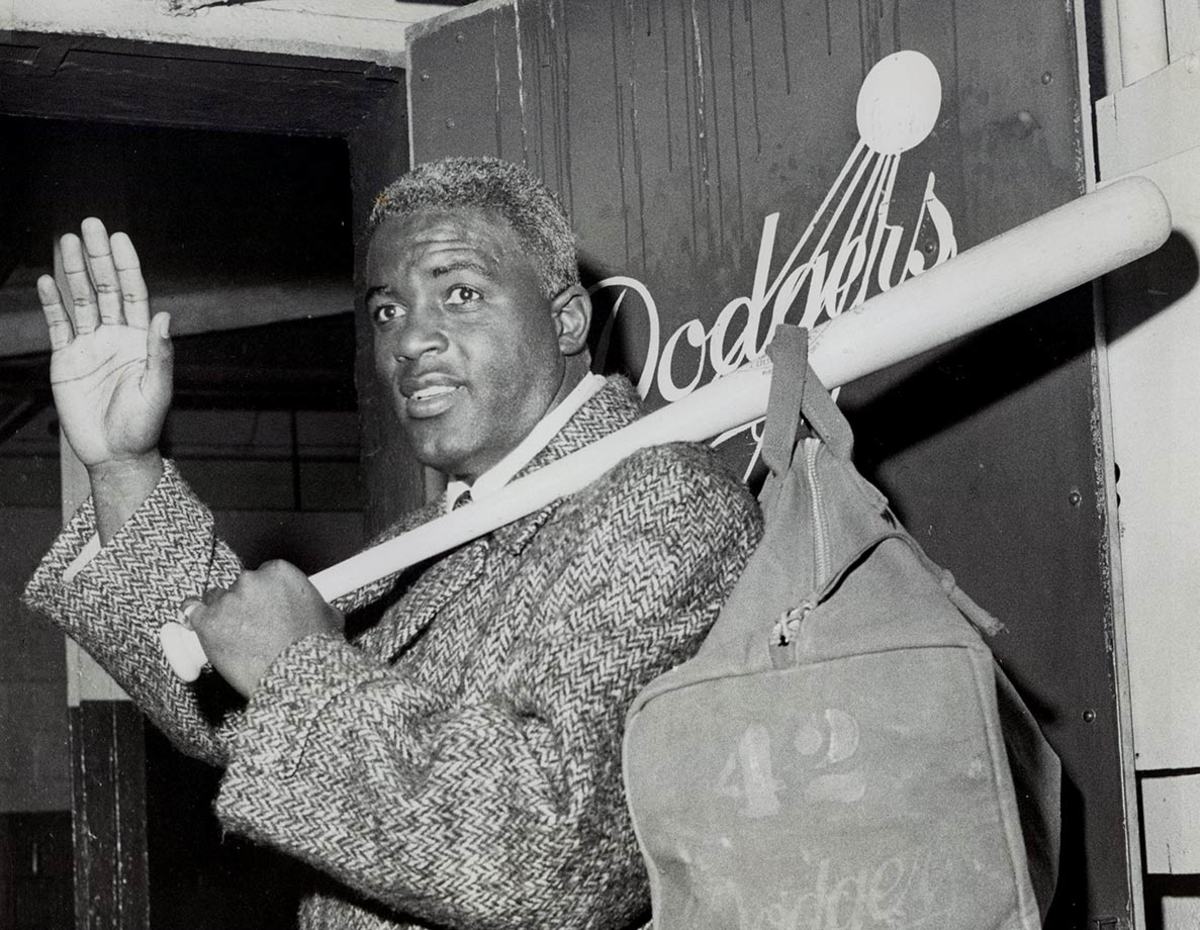
Jackie formally announced his retirement on January 5, 1957. A photo was taken of him, leaving the Dodger clubhouse at Ebbets Field. The contrast with the photo of him arriving is stark: In 1947, wearing his Montreal Royals uniform, he was 28 but looked 18; now, he was about to turn 38, but with his hair going gray and his face filled out, he looked 50. He was soon diagnosed with diabetes.

He became an executive with Chock full o'Nuts, then known more for their chain of lunch counters, a precursor to fast food, than for selling their coffee packs in supermarkets. The company had gone out of its way to hire black employees at good wages. He was later one of the founders of the black-owned Freedom National Bank. He died in 1972, only 53 years old.

In 1953, in between his hostile takeover of Rickey's stock (for which Rickey found a way to make him pay a lot more than he'd intended) and his exile of Robinson, O'Malley drove broadcaster Red Barber away, into the hands of the Yankees. Rickey, Barber, Robinson: Three of the most honorable and influential people in the history of American sport, and O'Malley drove them all away, all in a span of 6 years.

All this before he greedily moved the Dodgers to Los Angeles. In other words, had O'Malley gotten his new stadium where he originally wanted it, and were the Dodgers now preparing to play a 2012 season in Brooklyn, Walter Francis O'Malley would still have been a dirty filthy greedy bastard.

*

December 13, 1956 was a Thursday. Baseball was out of season. Football was in midweek. The NBA had no games scheduled. But the NHL's entire "Original Six" were in action:

* The New York Rangers lost to the Detroit Red Wings, 2-1 at the Olympia Stadium in Detroit.

* The Montreal Canadiens beat the Toronto Maple Leafs, 6-2 at the Montreal Forum.

* And the Boston Bruins beat the Chicago Black Hawks, 3-2 at the Boston Garden.

Sunday, October 16, 2022

October 16, 1950: O'Malley vs. Rickey, and the Brooklyn Dodgers' Fate Is Sealed

Branch Rickey

October 16, 1950: Branch Rickey's contract as president, and de facto general manager, of the Brooklyn Dodgers expires. He is still owner of 1/4 of the franchise. With the death of quarter-owner John L. Smith, another quarter-owner, Walter O'Malley, buys Smith's share from his heirs, making him the largest owner: O'Malley 50 percent, Rickey 25 percent, and James Mulvey and his wife, Elizabeth "Dearie" Mulvey each having 12.5 percent.

Dearie was the daughter of Steve McKeever, who with his brother Ed ran the construction company that helped former sole owner Charlie Ebbets build Ebbets Field in 1912-13.

O'Malley knew he could dominate the Mulveys, and did so until he finally bought their children out in 1975. But he and Rickey were both very strong personalities, with little in common except being lawyers, cheapness, the Republican Party, the love of a good cigar, and the belief that they always had to be right.
Walter O'Malley

O'Malley hated everything about Rickey, including his favorite player, Jackie Robinson, and his favorite broadcaster, Red Barber; and would force Rickey, Robinson and Barber out of the organization -- all before moving the team, meaning he would have been a dirty bastard even if the team were still in Brooklyn to this day.

O'Malley offered to buy Rickey's quarter-share of the club. Seeing no reason to hold onto it -- he was not going to be offered a new contract as president, and thus would no longer have control over transactions and salaries -- Rickey decided to comply.

But Rickey knew a trick that O'Malley didn't know. He knew that an agreement in the Dodger partnership said that if any of the partners got an offer for their shares, and another partner wanted to buy, that other partner had to match the offer. Rickey found someone willing to pony up a million bucks, and so O'Malley had to pay through the nose: The $350,000 of '42 was worth $515,000 in inflation-adjusted dollars, while, in reverse, the $350,000 of '50 was worth just $237,000, so O'Malley was really offering Rickey a 54 percent loss. Instead, O'Malley had to pay Rickey a 104 percent profit.

Nevertheless, O'Malley got what he wanted: Control. From this day onward, the Brooklyn Dodgers were doomed. Over the next 7 years, O'Malley guided them to 4 National League Pennants, their only World Series win -- and their move from Brooklyn to Los Angeles. From his takeover in 1950 until his death in 1979, the Dodgers won 11 Pennants, including 4 World Series.

Today, Rickey's original '42 investment is worth $6.3 million, O’Malley's '50 offer $4.3 million, and Rickey's $1.05 million becomes $12.8 million. In 1969, O'Malley admitted his holdings in the Dodgers were worth $24 million, which is $191 million in 2022 dollars.

At his death in 1979, at which point his son Peter became owner, they were said to be worth $50 million, or today's $201 million. When Peter sold the Dodgers in 1998, it was for $311 million, or today's $558 million. When Magic Johnson bought the Dodger franchise, including Dodger Stadium, in 2012, the price was rumored to be about $2 billion, or today's $2.55 billion.

Rickey's son, Branch Rickey Jr. -- known as "Twig," but never to his face, or to his father's -- was already the Dodgers' farm director. After leaving the Dodgers, Branch Sr. was offered the position of general manager for the Pittsburgh Pirates. He took it, and took Branch Jr. with him to direct their farm system. Health problems forced Branch Sr. to retire in 1955, but his contributions, and those of Branch Jr., would help lead to a World Championship for Pittsburgh in 1960.

Oddly, Branch Jr., who had diabetes, died first, in 1961; Branch Sr. died in 1965. Branch Jr.'s son, Branch Barrett Rickey (never "Branch Rickey III," but that's what people call him), served as the president of the Pacific Coast League, having also worked in the Pirates' organization, and also in that of the Cincinnati Reds (which makes sense, since Branch Sr. was from Ohio).

*

October 16, 1950 was a Monday. The baseball season had ended 9 days earlier, with the New York Yankees completing a 4-game sweep of the World Series over the Philadelphia Phillies. The NBA season began 2 weeks later. The NHL season was underway, but no games were scheduled. And football was in midweek. There would be no Monday Night Football for another 20 years. Therefore, there were no scores on this historic day.

However, this was the day on which C.S. Lewis published The Lion, the Witch and the Wardrobe, beginning his Chronicles of Narnia series. I have a separate entry for that event.

Saturday, September 24, 2022

September 24, 1957: The Last Game at Ebbets Field

September 24, 1957: The last game is played at Ebbets Field. The Brooklyn Dodgers beat the Pittsburgh Pirates 2-0 on a 5-hit shutout by rookie lefthander Danny McDevitt.

It was also the day that President Dwight D. Eisenhower sent the U.S. Army's 101st Airborne Division to assist with the desegregation of Central High School in Little Rock, Arkansas. And it was the day the Camp Nou stadium opened in Barcelona, Spain. I have a separate entry for each of those events.

It was a Tuesday night, a school night, and Dodger fans were already depressed by the fact that the move was, though not yet officially announced, already heavily rumored. Only 6,702 fans came out.

Gladys Gooding was the organist and the National Anthem singer at Ebbets Field, and also at Madison Square Garden. This made her the answer to the snarky trivia question, "Who is the only person to 'play' for the Brooklyn Dodgers, the New York Knicks and the New York Rangers?" (Ray Castoldi has since done so for the Mets, the Knicks and the Rangers. John Kiley was Boston's version, having played the organ at Fenway Park and the Boston Garden.)
Having started with the Dodgers in 1942, Gooding had also written the team's theme song, "Follow the Dodgers." She began the tradition of tailoring "walkup songs" for the players. For Pee Wee Reese, it was "My Old Kentucky Home." For Gil Hodges, it was "Back Home Again in Indiana." For Carl Furillo, "the Reading Rifle," it was "The Pennsylvania Polka."

But for Duke Snider, who was born in Los Angeles and grew up in neighboring Compton -- yes, the Duke of Flatbush really was "straight outta Compton" -- her playing of "California, Here I Come" proved to be all true prophetic. (She also could have played it for Jackie Robinson, who grew up outside L.A. in Pasadena, but she might not have had a song for him. At any rate, he wasn't in this game, having retired after the 1956 season.)

An urban legend says that the reason that umpiring crews became standardized at four isn't just because there's four bases, but also because the umpires were tired of her playing "Three Blind Mice" every time a Dodger argued with an umpire.

But, all through this game, she played sad songs, many of them songs of endings, including "Am I Blue," "After You're Gone," "When I Grow Too Old to Dream," "Silver Threads Among the Gold," "Don't Ask Me Why I'm Leaving" and "How Can You Say We're Through." She was not used to playing the new form of music sweeping the country, rock and roll: The most recent tune she played was Doris Day's hit of the previous year, "Que Sera, Sera (Whatever Will Be, Will Be)."

There was some appropriateness to her playing of "When the Blue of the Night Meets the Gold of the Day." Not only was blue the Dodgers color, but that song was known as the signature song of crooner Bing Crosby, who was a part-owner of the Pirates, the opponent that evening. Crosby was not in attendance. She also played "Thanks for the Memories," the signature song of Crosby's former film partner, Bob Hope, who was a part-owner of the Cleveland Indians. He did not attend, either.

Jim Gilliam led off the bottom of the 1st inning with a walk. A bad pickoff throw by Pirate starter Bennie Daniels, making his major league debut, allowed Gilliam to reach 2nd base. Daniels struck Gino Cimoli out, but Elmer Valo doubled to right field, scoring Gilliam and putting the Dodgers up, 1-0.

Cimoli led off the bottom of the 3rd by beating out a grounder to 2nd. Valo grounded out, but Cimoli advanced to 2nd on the play. Hodges singled Cimoli home. That made it 2-0 Dodgers, and that was the last scoring play in the ballpark's history.

Daniels pitched the 1st 7 innings for the Pirates, and was the losing pitcher. Like Snider, he grew up in Compton. Unlike Snider, he was black. He was still with the Pirates in 1960, when they won the World Series. He was then lost to the "new" Washington Senators in the expansion draft, and, on September 21, 1961, he was the losing pitcher in the last game at Griffith Stadium in Washington, as the Senators lost to the Minnesota Twins, who had been the "old" Washington Senators. 

The last play at Ebbets Field was a groundout, Dee Fondy hitting the ball to shortstop Don Zimmer, who threw to 1st baseman Hodges, who thus became the last Brooklyn Dodger to play in a home game. The night before, Snider had hit the last Brooklyn home run.

After the last out, Gooding played, "May the Lord Bless and Keep You." Somebody turned on her record of "Follow the Dodgers." No one wanted to follow them to Los Angeles. She quickly reached for the record player, turned it off, and played the last song at Ebbets Field: "Auld Lang Syne."

(If you're familiar with the Brooklyn Dodger Sym-Phony Band, I have no record of whether any of them attended; and, if so, what songs they attempted to play.)

The Dodgers would have the next 2 days off, and close their history as a Brooklyn-based team away to the Philadelphia Phillies, losing the finale. The official announcement of the move was made on October 8. After 75 seasons, 45 of them at Ebbets Field, the Brooklyn Dodgers were dead.

(In the wake of the NFL's Washington Redskins, now the Washington Commanders, calling themselves "The Washington Football Team" in the interim of their name-change, I have taken to calling the L.A. version of the Dodgers "The Los Angeles Baseball Team.")

The ballpark was torn down in 1960. In 1962, the Ebbets Field Apartments opened. By the time I first visited, on June 18, 1988, the area, on the edge of the neighborhoods of Flatbush, Crown Heights and Bedford-Stuyvesant, was a gang-riddled, drug-infested hole.

I last visited on December 29, 2012, and the area is still a bit iffy, but a far cry from what it was in the 1980s and early '90s. Brooklyn has gone from all but uninhabitable to actually hip since then. But it will never be what it was when the Dodgers were there.

September 24, 1957, a date which lives in misery. And yet, if the Dodger fans were so great, how come only 6,702 showed up? Huh? (Well, for one thing, the Dodgers were in fourth place. For another, that was also a Tuesday night, a workday and a school night.)

The Brooklyn Dodgers weren't moved. They were assassinated. To this day, Walter O'Malley, the banker's lawyer who owned the team in part from 1942 and wholly from 1950 to his death in 1979, is despised in the New York Tri-State Area.

Some people blame Robert Moses, New York City's "master builder," who refused to condemn the land, across from the Flatbush Avenue Terminal of the Long Island Rail Road on which O'Malley, to his credit, had decided to spend his own money, not taxpayer dollars, to build a new stadium, a domed facility that would be known as the Brooklyn Sports Center. But if O'Malley was truly the "visionary" that his apologists have claimed, he could have found a way around Moses. O'Malley's "vision" only seemed to work when it helped him make more money, not when it could have helped others.

The story is told of two Brooklynites, both boys of the 1940s and young men of the 1950s, who went on to write for the New York Post. Pete Hamill (Irish Catholic) and Jack Newfield (Eastern European Jewish) were having lunch, and one of them said so-and-so was "the worst person who ever lived." (Shades of Bob & Ray's "Worst Person in the World" sketch, later co-opted by MSNBC's Keith Olbermann, who admits to being heavily influenced by Bob & Ray.)

And Pete says, "Let's collaborate on a column: 'The Ten Worst Human Beings Who Ever Lived.' Let's start. I'll write my three worst on my napkin, you write your three worst on yours, and we'll compare."

And each of them ended up writing the same three names, in the same order: Adolf Hitler, Josef Stalin, Walter O'Malley.

Today, of course, the more apt comparison is to Lord Voldemort from the "Harry Potter" stories. O'Malley is, for many old people originally from Brooklyn, He Who Shall Not Be Named. The one who said, "Avada Kedavara" to their childhood dreams. Lord Waltemort.

And yet, one person who escaped punishment was the Mayor, Robert Wagner Jr., son of the U.S. Senator from the State of New York who wrote the 1935 bills that became the Social Security Act and the National Labor Relations Act. A former State Assemblyman and Borough President of Manhattan, he had been elected in 1953 with 46 percent of the vote, and was up for re-election just 6 weeks after the last game at Ebbets Field, and less than 7 week after the last Giants game at the Polo Grounds.

He had received letters saying things like, "I want the Dodgers in Brooklyn. And you can do it by building the Sports Center. You had better get it done, or you'll not get a vote for me." Wagner could have found a way around Moses. He did not try. Instead, up for re-election in mere weeks, he lost 2 major league baseball teams.

The Republican nominee was Robert Christenberry, former Chairman of the New York State Athletic Commission. He was endorsed by President Eisenhower, Vice President Richard Nixon, and the State's most recent Republican Governor, 2-time Presidential nominee Thomas E. Dewey. He never mentioned the loss of the Dodgers, or the loss of the Giants, instead basing his campaign around Wagner's apparent failures on the issue of crime.

Result? Overall, Wagner won 69 percent of the vote, Christenberry only 27. In no Borough did Wagner get less than 64 percent. In aggrieved Brooklyn, Wagner got 75 percent. He would be elected to a 3rd term in 1961. Most likely, this was due less to Christenberry's refusal to make the loss of the baseball teams an issue than it was to the strength of New York City's Democratic political machine, the weakness of its Republican Party, and the weakness of the State's Republican Party.

In 1971, Bob Aspromonte, a Brooklyn native, retired, making him the last active Brooklyn Dodger.

In 2012, roughly where O'Malley wanted to build the Sports Center, the Barclays Center opened, becoming the home of the NBA's Brooklyn Nets, formerly the New Jersey Nets and the Long Island-based New York Nets. Maybe, if there was any justice, the team that moved to Brooklyn should have been the Los Angeles Clippers.

Instead, the "Brooklyn Dodgers" of the other major sports have been the NBA's Minneapolis Lakers, who moved to Los Angeles in 1960; the NFL's Baltimore Colts, who moved to Indianapolis in 1984; and the Minnesota North Stars, who moved to Dallas in 1993.

Despite the move, the Los Angeles Dodgers honored some Brooklyn Dodgers with the retirement of their uniform numbers: 1, Harold "Pee Wee" Reese; 4, Edwin "Duke" Snider; 14, Gil Hodges; 39, Roy Campanella; and 42, Jackie Robinson, the last of these eventually retired for all of baseball.

While they played in Brooklyn, Tommy Lasorda (2), Jim Gilliam (19), Sandy Koufax (32) and Don Drysdale (53), retired number honorees, are better known for playing in Los Angeles. This is also true of manager Walter Alston and broadcaster Vin Scully.

*

September 24, 1957 was a Tuesday. No NFL games were played. And the starts of the NBA and NHL seasons were a month away. But a full slate of Major League Baseball games was played. In addition to the Ebbets Field finale:

* The New York Giants, who had already announced their move to San Francisco for the 1958 season, lost to the Phillies, 5-0 at Connie Mack Stadium in Philadelphia. Curt Simmons pitched a 4-hit shutout. Willie Mays went 0-for-3. Five days later, on Sunday, September 29, the Giants played their last game at the Polo Grounds, and lost to the Pirates, 9-1.

For the next 4 seasons, New York's National League baseball fans, unwilling to give up baseball, but unwilling to switch to the American League's New York Yankees, took the Pennsylvania Railroad from Penn Station in New York to the North Philadelphia station, and walked the 7 blocks from Broad Street down Lehigh Avenue to 21st Street, and walked into Connie Mack Stadium to watch the Phillies play the Los Angeles Dodgers or the San Francisco Giants.

If they were feeling particularly adventurous, they would drive down, and risk their cars, parking in the North Philly ghetto. Some would cheer their old heroes. Some would boo them.

In 1962, the New York Mets arrived, and the former fans of the Dodgers and the Giants would join in a "marriage of convenience" -- one which produced "The New Breed," the Met fans too young to really remember the former teams.

* The New York Yankees? They didn't play that night. Nor did the Baltimore Orioles, the Cleveland Indians, or the Detroit Tigers.

* The Boston Red Sox beat the Washington Senators, 2-1 at Griffith Stadium in Washington. Ted Williams hit a home run.

* The Cincinnati Redlegs -- from 1954 to 1958, the Reds used that name due to the stupidity of the Red Scare -- swept a doubleheader from the Chicago Cubs, at Crosley Field in Cincinnati. The Reds won the opener 4-3, and the nightcap 11-9. Over the 2 games, Ernie Banks went 2-for-9 with a home run and 2 RBIs for the Cubs; while, for the Reds, Frank Robinson went 1-for-6 with an RBI, and Wally Post homered in both games.

* The Milwaukee Braves, having clinched their 1st NL Pennant the night before on an 11th-inning home run by Hank Aaron, beat the St. Louis Cardinals at Milwaukee County Stadium again, this time 6-1 in the regulation 9 innings. In this game, Aaron went 1-for-5, but the hit was a grand slam. Stan Musial went 1-for-2 with 2 walks.

* And the Chicago White Sox beat the Kansas City Athletics, 7-6 at Kansas City Municipal Stadium. 
Sunday, April 10, 2022

April 10, 1962: Dodger Stadium Opens

April 10, 1962: Dodger Stadium opens in Los Angeles. The Cincinnati Reds spoil the party, winning 6-3. Wally Post hits the 1st home run, off 1955 World Series hero Johnny Podres. Frank Robinson goes 1-for-4 for the Reds. Maury Wills goes 0-for-3 for the Dodgers. No one knew yet, but he would steal a new record of 104 bases this season.

This was Doug Harvey's 1st game as a major league umpire. In a career that lasted until 1993, he was so admired for his accuracy and fairness that the players nicknamed him "God." He was elected to the Baseball Hall of Fame.

Walter O'Malley, owner of the Brooklyn Dodgers, wanted out of Ebbets Field, which had only 31,497 seats and 750 parking spaces. He tried to get baseball's 1st domed stadium built in Downtown Brooklyn, across from the Atlantic Avenue Terminal of the Long Island Rail Road, which would have cut down on his need for parking, as so many Dodger fans had taken advantage of the post-World War II economy and veterans' benefits to move out to Long Island.

But Robert Moses, who controlled construction in New York City, refused to condemn the land necessary to build the stadium. So he looked for options elsewhere. Los Angeles offered him the best deal. In order to cut down on travel costs, he talked Horace Stoneham, owner of the New York Giants, who was already considering moving, to move to San Francisco. This took the National League's best rivalry to the West Coast.

For 4 years, including the 1959 season in which the Dodgers won the World Series, they played at the Los Angeles Memorial Coliseum, a football stadium that resulted in a way-too-close left-field fence, while Dodger Stadium was built in Chavez Ravine, north of downtown.

It was a beautiful stadium, with lots of parking all around it, and a view of the San Gabriel Mountains in front of it -- when not obscured by the infamous L.A. smog, that is. And the common saying was that, "You could eat off the floors." Why would you want to?

From 1962 to 2021, the Dodgers have won 11 National League Pennants and 5 World Series while playing home games at Dodger Stadium. It's been home to many legendary pitchers: Sandy Koufax, Don Drysdale, Don Sutton, Fernando Valenzuela, Orel Hershiser and Clayton Kershaw. It's also seen legendary home runs, including by Dodger stars Steve Garvey, Kirk Gibson, Max Muncy and Mookie Betts. But it's also seen notable home runs by opponents, such as Reggie Jackson, Jack Clark, Charlie Culberson, George Springer and Steve Pearce.

The stadium has hosted other sports. Never American football, but soccer: On August 3, 2013, in a doubleheader called the International Champions Cup, the Los Angeles Galaxy beat Juventus of Turin, Italy, 3-1; and Real Madrid of Spain beat Everton of Liverpool, England, 2-1. On January 25, 2014, the NHL Stadium Series came to Chavez Ravine, and the 2 L.A.-area teams played each other. The Anaheim Ducks beat the Los Angeles Kings, 3-0.

But only one boxing card has ever been held there, and it ended in tragedy: On March 21, 1963, Davey Moore, Heavyweight Champion of the World, fought Cuban fighter Ultiminio "Sugar" Ramos, and was knocked out in the 10 round, dying 2 days later from a head injury. This led Bob Dylan to write a song, "Who Killed Davey Moore?" (UPDATE: In 2023, the climactic fight in the movie Creed III was filmed there.)

Concerts there have been sporadic. In the stadium's 1st 22 years, only 2 stands were held there: The Beatles on their final tour, on August 28, 1966; and Elton John on October 25 and 26, 1975. Michael Jackson and his brothers held 6 concerts on their Victory Tour there between November 30 and December 9, 1984. The Three Tenors -- José Carreras, Plácido Domingo and Luciano Pavarotti -- sang there on July 16, 1994, in celebration of the next day's World Cup Final at the nearby Rose Bowl.

It's hard to believe, but Dodger Stadium has not only lasted longer than Ebbets Field did, but it is now the 3rd-oldest park in MLB, behind Fenway Park and Wrigley Field.

But Dodger fans, so quick to call it the best ballpark, and to come over 3 million strong every year, usually leading MLB in attendance, don't seem to like being there that much. The joke is that they arrive in the 3rd inning, and leave at the 7th-inning stretch. In 1982, just a year after a Dodger World Series win, Johnny Carson, in his monologue on The Tonight Show, said, "The only reason people go to Dodger games is to see if they can beat the traffic home."

UPDATE: On June 3, 2023, the Yankees began an Interleague series there, losing to the Dodgers, 8-4. And many of the home fans did leave early. Thinking of Los Angeles, I played The Doors' "Riders On the Storm" on YouTube. Just as Jim Morrison got to the line, "There's a killer on the road, his brain is squirming like a toad" -- and don't tell me he ever wrote a better line -- the YES Network's camera switched to the L.A. fans driving out, hitting the road.

You can't make this stuff up.


April 10, 1962 was a Tuesday. There were 7 other MLB games played on this day:

* For the 1st time, a regular-season Major League Baseball game is played in the Southern United States -- or, to put it another way, in a city that had once been a part of the Confederate States of America. I have a separate entry for this event.

The expansion Houston Colt .45s make their debut at Colt Stadium in Houston, and beat the Chicago Cubs, 11-2. Román Mejías hit Houston's home run, and hit a 2nd homer later in the game. Hal Smith also hit one out for the Colt .45s (often listed as simply the Colts), while Ernie Banks homered for the Cubs. Former Philadelphia Athletics MVP Bobby Shantz went the distance for the Colts to be the winning pitcher.

Colt Stadium, which seated 32,000, was basically an oversized high school football stadium, and was never going to be more than a stopgap facility for a real stadium. It was completely exposed to the elements: Not just the heat, but mosquitoes. As Sandy Koufax said, "Some of those mosquitoes were twin-engine jobs."

Three years later, the Astrodome opened, and the home team was renamed the Houston Astros. Colt Stadium remained as a practice facility for a few years, and NRG Stadium, current home of the NFL's Houston Texans, was built on the site.

* The New York Yankees beat the Baltimore Orioles, 7-6 at Yankee Stadium. Johnny Temple hit a home run off Whitey Ford, but Bill "Moose" Skowron and Roger Maris both hit them off Billy Hoeft, and, in the 8th inning, Mickey Mantle won the game with a home run off Hal Brown, to make Ralph Terry the winning pitcher, for the 1st of 23 times that season.

Mantle finished 1-for-3 with that homer and RBI, Maris 1-for-4 with a homer and 3 RBIs. Yogi Berra did not play. Brooks Robinson went 2-for-4 for the Birds.

* The Cleveland Indians beat the Boston Red Sox, 4-0 at Fenway Park in Boston. Dick Donovan pitched a 5-hit shutout, with Carl Yastrzemski getting 2 of the hits.

* The Pittsburgh Pirates beat the Philadelphia Phillies, 6-0 at Forbes Field in Pittsburgh. Bob Friend pitched a 5-hit shutout. Roberto Clemente went 1-for-3, and his hit was a grand slam home run.

* The Chicago White Sox beat the Los Angeles Angels, 2-1 at Comiskey Park in Chicago.

* The Kansas City Athletics beat the Minnesota Twins, 4-2 at Kansas City Municipal Stadium.

* And the San Francisco Giants beat the Milwaukee Braves, 6-0 at Candlestick Park in San Francisco. Juan Marichal pitched a 3-hit shutout, striking out 10, while Warren Spahn was knocked out of the box in the 4th inning. Willie Mays went 1-for-4 with a home run and an RBI, while Hank Aaron went 0-for-4.

Four MLB teams opened their seasons the day before. The Phillies beat the Reds, 12-4. And the Washington Senators beat the Detroit Tigers, 4-1 in the 1st MLB game at District of Columbia Stadium in Washington. President John F. Kennedy threw out the ceremonial first ball at the stadium that would later be named for his brother, Robert F. Kennedy.

Two MLB teams started their season the next day: The St. Louis Cardinals and the other expansion team, the New York Mets.

April 10 was also the day the 1962 Stanley Cup Finals got underway. The Toronto Maple Leafs beat the defending Champion Chicago Black Hawks, 4-1 at Maple Leaf Gardens in Toronto. The Leafs would win the Cup in 6 games.

And Game 3 of the NBA Finals was played at the Los Angeles Memorial Sports Arena. The Los Angeles Lakers beat the Boston Celtics, 117-115. Elgin Baylor had 39 points and 23 rebounds for the Lakers, Bill Russell 26 points and 32 rebounds for the Celtics. The Lakers led 2 games to 1, but the Celtics would win the title in Game 7. 

December 31, 1999 & January 1, 2000: The Millennium

December 31, 1999:  The Millennium arrives. The people of planet Earth survived. At a terrible cost. But we hadn't destroyed ourselves. ...