Showing posts with label ferenc puskas. Show all posts

Friday, November 25, 2022

November 25, 1953: The Magnificent Magyars Stun England

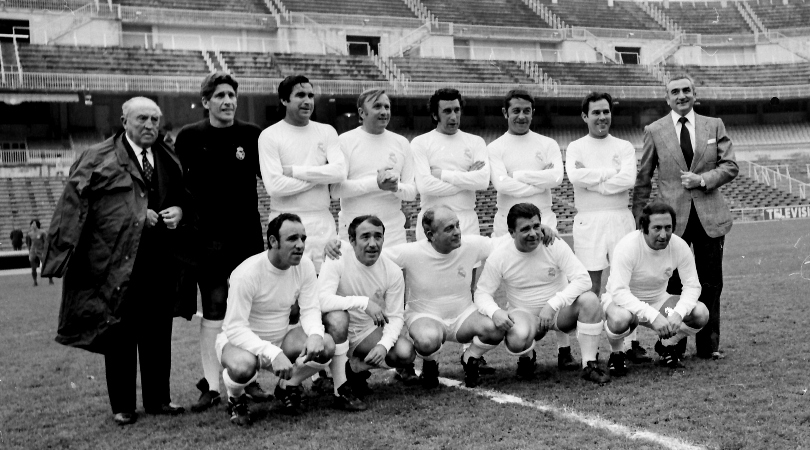
Ferenc Puskás

November 25, 1953: Hungary defeat England, 6-3 at Wembley Stadium in West London, becoming the 1st team from outside the British Isles to defeat England on English soil.

Known as "the Golden Team," "the Magnificent Magyars" and "the Magical Magyars," from 1950 to 1956, they used an early form of what the Netherlands would later call "Total Football" to put up a record of 58 wins, 10 draws, and only 1 loss.

Manager Gusztáv Sebes built the team around forwards Ferenc Puskás, Sándor Kocsis and Nándor Hidegkuti; midfielders Zoltán Czibor and József Bozsik, and goalkeeper Gyula Grosics. Hidegkuti played his "club football" for MTK Hungária (now MTK Budapest), while the rest played for Budapest Honvéd.

There was no European Championship tournament for them to compete in until 1960. But they won the Gold Medal at the 1952 Olympics in Helsinki, Finland. In 1953, they won the Central European International Cup, competing against Austria, Czechoslovakia, Italy and Switzerland.

They won this game in front of 105,000 stunned spectators at London's Wembley Stadium. England were captained by right half Billy Wright of Wolverhampton Wanderers; and also included the pair of Stanley Matthews (a.k.a. the Wizard of Dribble) and Stan Mortensen, who had led Blackpool F.C. to the FA Cup earlier in the year; and right back Alf Ramsey and outside left George Robb, who had led Middlesex team Tottenham Hotspur to the 1951 Football League title.

Hungary had shown England what modern football looked like. Ramsey took notes, and eventually managed Ipswich Town to the English Football League title, and became the England manager who won the World Cup.

"Eventually" would not, however, come soon. A rematch in Budapest the next year was even less of a contest, a 7-1 loss that is still the heaviest that England's national team have ever faced. Puskás, known as the Galloping Major for his service in the Hungarian Army, was now considered the best player in the world.

He would lead them to the Final of the 1954 World Cup, but would play hurt in that game, and West Germany gave them their 1 and only defeat in that stretch, which was ended by the 1956 Hungarian Revolution. The national team was out of the country at the time, and many did not return home for many years. Puskás starred for Spanish team Real Madrid, while Kocsis and Czibor starred for Real's arch-rivals, FC Barcelona.

Times changed. Democracy returned to Hungary in 1989, and the national stadium in Budapest was named for Puskás in 2002. He died in 2006, and the old stadium was demolished in 2017, replaced in 2019 by the Puskás Aréna.

*

November 25, 1953 was a Wednesday. Baseball was out of season. Football was in midweek. There were 3 games played in the NBA:

* The New York Knicks lost to the Boston Celtics, 96-84 at the Boston Garden.

* The Baltimore Bullets beat the Syracuse Nationals, 66-58 at the Baltimore Coliseum. The Bullets folded a year later, and were eventually replaced in 1963, by the team that moved to the D.C. area in 1973, and are now known as the Washington Wizards. Also in 1963, the Nats moved, becoming the Philadelphia 76ers.

* And the Milwaukee Hawks beat the Fort Wayne Pistons, 64-58 at the Milwaukee Arena. In 1974, it was renamed the Milwaukee Exposition, Convention Center and Arena, or "The MECCA." Since 2014, it has been named the UW-Panther Arena. The Hawks moved to St. Louis in 1958 and Atlanta in 1968; the Pistons, to Detroit in 1957.

There was 1 game in the NHL: The New York Rangers beat the Boston Bruins, 5-3 at Madison Square Garden.

Friday, November 4, 2022

November 4, 1956: The Hungarian Revolution Is Crushed

Time with a collective "Man of the Year" for 1956.
Note the Communist seal cut out of the flag.

November 4, 1956: Soviet troops enter Hungary to end the Hungarian Revolution that started on October 23. Thousands are killed, more are wounded, and nearly a quarter of a million people leave the country. (Today, the population is about 10 million.)

Cardinal József Mindszenty, the leader of the Catholic Church in Hungary, having previously been imprisoned by the Nazis, was arrested in 1949, and imprisoned and tortured for his anti-Communist activities. He was freed during the Revolution, and given asylum in the U.S. Embassy in Budapest. He became a hero of the movement, remained there until 1971, and died in 1975.
József Mindszenty

The city of New Brunswick, New Jersey once had a large Hungarian community, and their St. Ladislaus Roman Catholic Church has a memorial to the Revolution and a statue of Mindszenty out front.

Imre Nagy, Chairman of the Council of Ministers (effectively, the Prime Minister) from July 4, 1953 to April 18, 1955, wasn't so lucky. He was forced out of office by hardliner András Hegedüs, who was forced out by the Revolution on October 24, fleeing to the Soviet Union. Nagy was reappointed, dissolved the secret police (ÁVH), and withdrew Hungary from the Warsaw Pact on November 1.
Imre Nagy

When the Soviet tanks rolled in, he fled to the Yugoslavian Embassy, hoping that country's leader, Josip Broz Tito, a fellow anti-Moscow Communist, could protect him. He was lured out of the embassy under false promises on November 22, was arrested, and was deported to Romania. On June 16, 1958, Nagy was tried and executed for treason alongside his closest allies, and his body was buried in an unmarked grave. His remains would be repatriated to Hungary after the 1989 revolution. (Hegedüs returned to Hungary thereafter, but taught at a university rather than return to governing, and lived until 1989.)

Soccer team Budapest Honvéd FC was out of the country at the time of the Revolution, playing Athletic Bilbao in the European Cup. Eliminated, they managed to get their families out of the country. Their stars, the bulk of the "Magnificent Magyars" team that won the 1952 Olympics, embarrassed England at Wembley Stadium in 1953, and reached the 1954 World Cup Final, went elsewhere, including some staying in Spain: Ferenc Puskás to Real Madrid, and Sándor Kocsis and Zoltán Czibor to FC Barcelona. 

Since that year's Olympics were given to Melbourne, Australia, in the Southern Hemisphere, they began on November 22 so the weather would be warm. Throughout the Olympics, Hungarian athletes were cheered by fans from the host nation and other countries. Many of them gathered in the boxing arena when Laszlo Papp won a Gold Medal.

A few days later, the crowd was with the Hungarian water polo team in its match against the Soviet Union which became known as "the Blood In the Water Match." The game became rough and, when a Hungarian player, Ervin Zador, was forced to leave the pool with blood streaming from a cut over his eye, a riot almost broke out. But police restored order, and the game was called early, with Hungary leading 4–0. The Hungarians went on to win the Gold Medal.

At the end of the calendar year, Time magazine named the Hungarian Freedom Fighters their Men of the Year. This was before they made the distinction "Person (or People) of the Year," although women had been recognized as such before.

At the same time as the Hungarian Revolution, the "Polish October" was taking place. President
Bolesław Bierut, a Stalinist dictator, had died on March 12. On June 28, a demonstration by workers in Poznań was crushed, leading to at least 57 and possibly more than 100 deaths. In October, a reform faction took over, led by Władysław Gomułka. However, Gomulka's administration ended up getting more and more repressive until his removal in 1970. As Hungary, Poland, and the rest of Eastern Europe found out, post-Stalin Communism was only a slight improvement over Stalinist Communism.

*

November 4, 1956 was a Sunday. These NFL games were played:

* The New York Giants beat the Pittsburgh Steelers, 17-14 at Forbes Field in Pittsburgh.

* The Chicago Cardinals beat the Philadelphia Eagles, 28-17 at Comiskey Park in Chicago.

* The Cleveland Browns beat the Green Bay Packers, 24-7 at Milwaukee County Stadium.

* The Chicago Bears beat the Los Angeles Rams, 35-24 at the Los Angeles Memorial Coliseum.

* The Detroit Lions beat the San Francisco 49ers, 17-13 at Kezar Stadium in San Francisco.

* And the Baltimore Colts and the Washington Redskins had a bye week.

Three games were played in the NBA:

* The New York Knicks beat the Fort Wayne Pistons, 96-83 at the Allen County War Memorial Coliseum in Fort Wayne, Indiana. (It still stands.)

* The St. Louis Hawks beat the Syracuse Nationals, 78-76 at the Onondaga County War Memorial in Syracuse, New York. (It still stands, as the Upstate Medical University Arena.) Dolph Schayes had 28 points and 25 rebounds for the Nats, but it wasn't enough.

* And the Minneapolis Lakers beat the Rochester Royals, 88-87 at the Minneapolis Auditorium. (This venue does not still stand.)

Two games were played in the NHL. The New York Rangers lost to the Boston Bruins, 4-1 at the Boston Garden. And the Montreal Canadiens beat the Chicago Black Hawks, 1-0 at the Chicago Stadium. The Toronto Maple Leafs and the Detroit Red Wings were not scheduled.

Monday, July 4, 2022

July 4, 1954: The Miracle of Bern

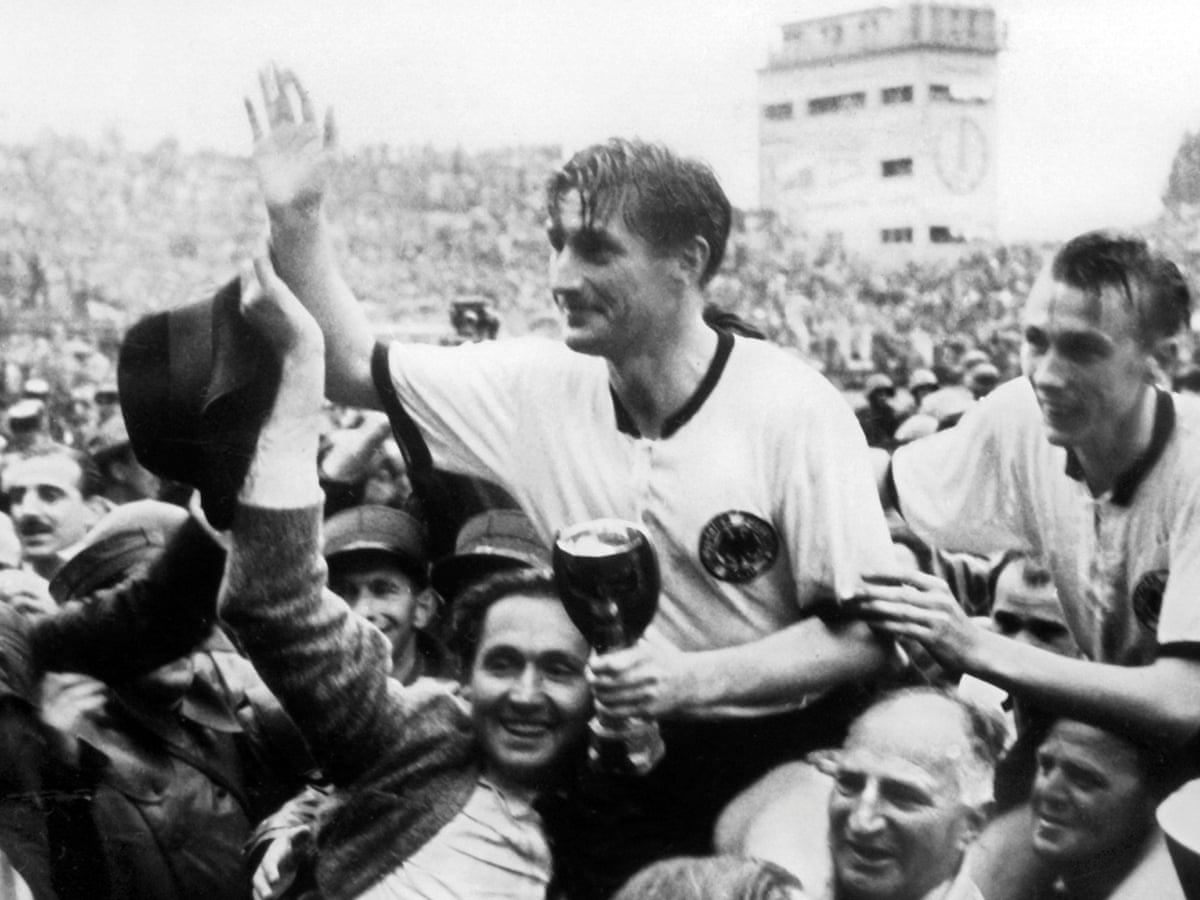
West German Captain Fritz Walter,
with the Jules Rimet Trophy

July 4, 1954: The World Cup Final is held at the Wankdorf Stadium in Bern (sometimes written as "Berne"), the capital of Switzerland. Due to the cancellations of the tournament for 1942 and 1946, and the 1950 edition being held in Brazil, it is the 1st World Cup held in Europe since 1938.

It is also the 1st time the tournament is held in a country where the predominant language is German. Western Switzerland, bordering France, uses French as its main language (about 23 percent of the country's population); some southern and eastern regions, bordering Italy, use Italian (about 8 percent); and a few eastern parts of the country speak a language called Romansh (about 0.5 percent). But most of the country (68 percent) uses German. Germany would eventually host the World Cup in 1974 and 2006, while Austria has never hosted it, although they co-hosted Euro 2008 with Switzerland.

Among the Quarterfinals, played in 104-degree heat in Stade Olympique de la Pointaise in Lausanne, was a match between hosts Switzerland and neighboring Austria. The players' feet were as hot as the weather, and the game ended 7-5 to Austria. It remains the highest-scoring game in World Cup history.

Also among the Quarterfinals was Uruguay eliminating England, 4-2 at Basel. England’s starting lineup included Billy Wright of Wolverhampton Wanderers, Stanley Matthews Blackpool FC, Nat Lofthouse of Bolton Wanderers and Tom Finney Preston North End, each of whom now has a statue outside his stadium; plus Roger Byrne of Manchester United, memorialized outside Old Trafford as one of the victims of the Munich Air Disaster.

Not in England's starting lineup, or even anywhere in its squad, were any players from North London team Arsenal FC, even though Arsenal had won the League the year before, and came close to the Double the year before that. No room on this England squad, apparently, for Cliff Holton, Doug Lishman or Don Roper. Joe Mercer had finished the season with an injury, so he wouldn't have been available, anyway. And, of course, Alex Forbes and Jimmy Logie couldn't play for England, being Scots; while Walley Barnes and Jack Kelsey were Welsh.

Fittingly, West Germany were one of the teams in the Final. Among the punishments for its predecessor state, Nazi Germany, after World War II was a slower integration into postwar Europe. The Federal Republic of Germany, a.k.a. West Germany, allied with the Western democracies; while the German Democratic Republic (which was neither democratic nor a republic), a.k.a. East Germany, were controlled by the Soviet Union. Both were formed in 1949, and neither was admitted to FIFA, the governing body for world soccer, in time for qualifying for the 1950 World Cup.

Josef "Sepp" Herberger had managed the national team, known in Germany as Die Mannschaft, from 1936 until its 1942 disbanding due to the war. In spite of having been a member of the Nazi Party, there seemed to be no one more qualified to rebuild the team than he. He built the team around players from 1. FC Kaiserslautern, in the western Rhineland, including star forward Fritz Walter (who was named national team Captain) and his brother Ottmar Walter.
Sepp Herberger

In the Group Stage, they beat Turkey, but lost to Hungary, forcing a playoff with Turkey to get into the knockout stage, which West Germany won. They beat Yugoslavia in the Quarterfinal and Austria in the Semifinal.

No one was surprised that they lost to Hungary, or even that the score was 8-3. Known as "the Golden Team," "the Magnificent Magyars" and "the Magical Magyars," from 1950 to 1956, they used an early form of what the Netherlands would later call "Total Football" to put up a record of 58 wins, 10 draws, and only 1 loss.

Manager Gusztáv Sebes built the team around forwards Ferenc Puskás, Sándor Kocsis and Nándor Hidegkuti; midfielders Zoltán Czibor and József Bozsik, and goalkeeper Gyula Grosics. Hidegkuti played his "club football" for MTK Hunagaria (now MTK Budapest), while the rest played for Budapest Honvéd.

There was no European Championship tournament for them to compete in until 1960. But they won the Gold Medal at the 1952 Olympics in Helsinki, Finland. In 1953, they won the Central European International Cup, competing against Austria, Czechoslovakia, Italy and Switzerland.

Later that year, they became the 1st team from outside the British Isles to defeat England on English soil, 6-3 in front of 105,000 stunned spectators at London's Wembley Stadium. A rematch in Budapest the next year was even less of a contest, a 7-1 loss that is still the heaviest that England's national team have ever faced. Puskás, known as the Galloping Major for his service in the Hungarian Army, was now considered the best player in the world.
Ferenc Puskás

Hungary beat South Korea and West Germany in the Group Stage, to top their group. However, in the West Germany game, Puskás was kicked in the ankle by Germany centerback Werner Liebrich, and sustained a hairline fracture. It didn't seem to matter much, as Hungary then beat both 1950 Finalists: Brazil in the Quarterfinal, and defending Champions Uruguay in the Semifinal. They were heavy favorites for the Final against the Germans, especially after it was announced that Puskás was ready to play.

But the night before the Final, a village fair took place in front of the hotel that lasted until the early morning hours, and disrupted the players' sleep. By contrast, the German team resided in the tranquil lake town of Spiez, where it was unaffected from such disturbances. The Spirit of Spiez became proverbial in Germany for describing the team's morale and comradeship.

West Germany came back quickly. In the 10th minute, Fritz Walter fired a shot that was deflected by midfielder József Zakariás, but it went right to Max Morlock, a forward from 1. FC Nürnberg (Nuremberg), who closed Die Mannschaft to within 2-1. In the 18th minute, Helmut Rahn of Rot Weiss Essen (Red and White, of Essen) tied the game.

In the 23rd minute, Hidegkuti nearly scored, but German goalkeeper Toni Turek, of Fortuna Düsseldorf, made a spectacular save. Four minutes later, Hidegkuti hit the goalpost. Early in the 2nd half, Turek made a save on Puskás, and then Kocsis hit the crossbar. In the 72nd minute, Grosics made a great save on Rahn.

In the 84th minute, Rahn pretended to pass to Ottmar Walter, then fired past Grosics. Herbert Zimmerman, calling the game for German national radio, yelled, "Aus dem Hintergrund müßte Rahn schießen. Rahn schießt! Tor! Tor! Tor! Tor!" (Meaning, "Rahn should shoot from deep. Rahn shoots! Goal! Goal! Goal! Goal!" "Tor" can also mean "gate": The native name for the Brandenburg Gate in Berlin is Brandenberger Tor.)
Helmut Rahn
After 8 seconds of letting the roar of the crowd tell the story, Zimmerman resumed: "Tor für Deutschland! Drei zu zwei führt Deutschland. Halten Sie mich für verrückt, halten Sie mich für übergeschnappt!" (Goal for Germany! Germany lead 3-2. Call me mad, call me crazy!" Shades of 3 years earlier, in New York, when Russ Hodges broadcast, "The Giants win the Pennant!")
But the game was not over, and Hungary did not give up. Just 2 minutes later, Puskás appeared to have tied the game when he converted a pass from forward Mihály Tóth. But the goal was controversially ruled offside. In the 90th and last minute of regular time, Turek made one more save, on Czibor. 
West Germany won, 3-2. I mentioned that the Magnificent Magyars only lost 1 game from 1950 to 1956. This was it, at the worst possible time.

It became known as "The Miracle of Bern." In his book Tor! The Story of German Football -- named in part for Zimmerman's call -- Uli Hesse wrote that it was the 1st time since the end of the war that the German people were allowed to feel good about themselves and their country again, and helped to make Die Mannschaft a vital part of German cultural life.

West Germany reached the Final again in 1966, losing to England; in 1974, beating the Netherlands on home soil; in 1982, losing to Italy; in 1986, losing to Argentina; and in 1990, beating Argentina. Shortly after that World Cup, the country was reunified. A united Germany reached the Final in 2002, losing to Brazil; hosted the tournament in 2006, but lost a Semifinal to Italy; and beat Argentina in the Final in 2014, for their 4th World Cup win, matching Italy's total, and trailing only Brazil's 5.

Hungary, however, have never been a soccer power again. The Soviets' crushing of the 1956 Revolution shattered the national team, forcing its players to play in other countries. They reached the Quarterfinals of the World Cup in 1962 and '66, but haven't done even that well since. They last qualified for the tournament in 1986.

The Wankdorf Stadium, or Wankdorfstadion, was built in the Bern neighborhood of Wankdorf in 1925, as the home of the team BSC Young Boys. It later hosted the 1961 European Cup Final, where Benfica beat Barcelona. It was torn down in 2001, and was replaced by a new stadium of the same name on the same site in 2008.
The Wankdorf Stadion

Kaiserslautern's home was renamed Fritz-Walter-Stadion in 1985, and was one of the host venues for the 2006 World Cup. Walter died in 2002. That year, Budapest's Népstadion (People's Stadium), which had opened as a showcase for Hungary's national team in 1953, at the height of its powers, was renamed Puskás Ferenc Stadion. (Hungarian naming convention puts the surname first). Puskás died in 2006. In 2016, the stadium named for him was demolished, and replaced with the new Puskás Aréna on the same site in 2019.

Jenő Buzánszky was the last surviving player from Hungary's "Magnificent Magyars," living until 2015. Horst Eckel was the last surviving player from the West German team that won, living until 2021.

UPDATE: An article for ESPN.com, published after the 2026 World Cup, ranking all 23 tournaments, rated this one tied for 8th, suggesting that, after the struggles of the pre-World War II tournaments and the difficulties of the 1950 edition, the World Cup had finally become what it was supposed to be.

*

July 4, 1954 was a Sunday. These baseball games were played that day, including 2 doubleheaders, which had usually been customary for the 4th of July:

* The New York Yankees beat the Washington Senators, 3-0 at Yankee Stadium. Bob Grim pitched a 3-hit shutout, and would be named that season's American League Rookie of the Year. He later converted to a relief pitcher, much like a later Yankee Rookie of the Year, Dave Righetti. Mickey Mantle went 0-for-4, and no home runs were hit. Yogi Berra singled home 2 runs in the bottom of the 6th inning, and Andy Carey doubled one home in the 7th.

* A doubleheader was split at the Polo Grounds. The New York Giants won the opener, 9-2. The Pittsburgh Pirates won the nightcap, 7-6. Willie Mays went 4-for-10 over the 2 games.

* The Brooklyn Dodgers beat the Philadelphia Phillies, 5-3 at Connie Mack Stadium in Philadelphia. Jackie Robinson did not play. In the top of the 10th inning, the Dodgers got a triple from Jim Gilliam, a triple by Walt "Moose" Moryn, an intentional walk to Duke Snider, a double by Gil Hodges, and a double by Carl Furillo, his 3rd hit of the game, to score 4 runs. Stan Lopata hit a 2-run home run in the bottom of the 10th, but Carl Erskine hung on for the win, outpitching Robin Roberts.

* The Boston Red Sox beat the Philadelphia Athletics, 8-0 at Fenway Park in Boston. Leo Kiely allowed 8 hits, but kept the shutout. Ted Williams went 1-for-4 with a walk.

* The Baltimore Orioles beat the Detroit Tigers, 3-1 at Memorial Stadium in Baltimore.

* The Cleveland Indians beat the Chicago White Sox, 2-1 at Cleveland Municipal Stadium.

* A doubleheader between arch-rivals was split at Wrigley Field in Chicago. The Chicago Cubs won the 1st game, 4-2. The St. Louis Cardinals won the 2nd game, 7-0, with Royce Lint pitching an 9-hit shutout. Stan Musial went 3-for-10 with an RBI. Ralph Kiner, then playing for the Cubs, went 3-for-7. Ernie Banks, in his 1st full season in the white major leagues, went 4-for-6 with an RBI.

* And the Cincinnati Redlegs -- in the 1st of 5 seasons with that name, before dropping the stupid anti-Communist hysteria and switching back to "Reds" -- beat the Milwaukee Braves, 4-3 at Milwaukee County Stadium. Rookie Hank Aaron went 0-for-4 for the Braves.

Thursday, June 2, 2022

June 2, 1971: The Triumph of Total Football

June 2, 1971: The European Cup Final is held at Wembley Stadium in London. It marks a revolution in soccer tactics.

Johan Cruijff -- pronounced "KROYF," and English-speaking media usually spelled it "Cruyff" -- was born in 1947 in Amsterdam, the Netherlands. In 1964, having grown up a 5-minute walk away from their ground, De Meer, he made his debut for Amsterdamsche Football Club Ajax, pronounced "EYE-ax," and named for the mythical Greek hero. They were the leading soccer team in the largest Dutch city and the nation's capital.

(And to clear something up: The names "Holland" and "the Netherlands" are not interchangeable. While Holland includes the country's 3 largest and most important cities -- Amsterdam, Rotterdam and The Hague -- it has about 1/3rd of the country's population, and about 1/6th of its area. Telling someone from Eindhoven, in North Brabant, that he lives in "Holland" is less dangerous than telling someone from Glasgow that he lives in "England," but it's still an insult.)

In 1965-66, he scored 25 goals, leading Ajax back from an awful finish the season before, their worst ever, to the league title, the 1st of 8 he would win with the club. In 1967, Ajax again won the league, and also won the Koninklijke Nederlandse Voetbalbond Beker -- the Royal Dutch Football Association Cup, usually written as the KNVB Cup. This was the 1st time Ajax had won the Dutch equivalent of "The Double," the 1st of 4 times they would do so with Cruijff.

In 1969, Ajax advanced to the European Cup Final, losing to AC Milan, led by perhaps the greatest Italian player of them all, Gianni Rivera. This may have had an effect on Cruijff and Ajax manager Rinus Michels, who began to devise what became known as "totaalvoetball" -- "Total Football."

The idea is that any outfield player -- anyone ahead of the goalkeeper -- can move to another part of the field, and another player can move to slip into the space vacated by the preceding player. This had been previously been attempted by the great Real Madrid and Hungary teams of the 1950s, both including the great Hungarian star Ferenc Puskás; and the Burnley side in England that won the 1960 Football League title, but they didn't maintain it for long.

In his book Brilliant Orange: The Neurotic Genius of Dutch Football, David Winner described what they made Dutch soccer into as being like Dutch art: "Cruyff became the greatest exponent and teacher of totaalvoetball. His vision of perfect movement and harmony on the field was rooted in the same sublime ordering of space that one sees in the pictures of Vermeer or church painter Pieter Jansz Saenredam. It was the music of the spheres on grass."

In 1970, Ajax's arch-rivals, Rotterdam-based Feyenoord, having won the previous season's Eredivisie title, became the 1st Dutch team to win the European Cup. But Ajax again won The Double, and launched the most stunning run of soccer play Europe has ever seen.

In 1971, Ajax progressed all the way to the Final of the European Cup again (at that time, only a defending national league champion could appear in it, unless they were the previous season's European Cup winners), and were set to play Panathinaikos of Athens, Greece.

The Final of what was known from 1955 to 1992 as the European Cup and since 1992 as the UEFA Champions League has always been set for a neutral site, although it hasn't always worked out that way. For 1971, the site chosen was the original Wembley Stadium in London. This factor cannot be underemphasized: The European Cup Final was the only non-English soccer game broadcast live on British television at the time, and, because it was at England's national stadium, the BBC promoted the heck out of this game.

Ajax had already played Arsenal, the North London side that won the League and FA Cup Double in that 1970-71 season, in the Semifinal of the 1969-70 Inter-Cities Fairs Cup, with Arsenal winning and then beating Belgium's Anderlecht in the Final.

The British interest wasn't just about fans' recent familiarity with Ajax, and how good they already believed Ajax to be. There was also intense interest in their Greek opponents. "Pana" had modeled themselves after a great British side, Glasgow-based Celtic, down to wearing green uniforms and having a shamrock as their logo; and were managed by Puskás, whose masterclass for the aforementioned Hungary side at Wembley in 1953 resulted in the England national team's 1st defeat on home soil to a team from outside the British Isles. (Scotland, Wales and Ireland had all done it by this point.)

In those days, teams generally didn't seek out foreign players or managers. Puskás wasn't Greek, but all of his players were. Sweeper Velibor Vasović, a Serb from Yugoslavia, and substitute defender Horst Blankenburg of Germany, were the only non-Dutch players to get into this game for Ajax. The others: Goalkeeper Heinz Stuy; defenders Wim Suurbier and Barry Hulshoff; midfielders Cruijff, Nico Rijnders, Johan Neeskens, Gerrie Mühren and substitute Arie Haan; and forwards Sjaak Swart, Piet Keizer and Dick van Dijk -- yes, his name was pronounced like "Dick Van Dyke."

van Dijk scored in only the 5th minute, and Pana desperately held on, looking for an equalizer, and not finding it, before Haan put the game away with a goal in the 87th. Ajax won, 2-0, and had become Champions of Europe for the 1st time.

Despite manager Michels being lured away by the money of Spanish club FC Barcelona, Ajax repeated in 1972 under Romanian manager Stefan Kovacs, winning the Netherlands' 1st European Treble: the national league, the national cup, and the European Cup. They lost only 1 game all season long, including knocking Arsenal out in the European Cup Quarterfinal.

The 1972 European Cup Final proved to be Total Football's finest hour. They faced Internazionale of Milan, a team which had won the European Cup in 1964 and 1965, and lost to Celtic in the 1967 Final, with a system called catenaccio (a word meaning "padlock"): Defense above all. "Il Grande Inter" had been so successful with the system, in contrast to the free-flowing format of their groundsharing rivals AC Milan, that they were considered the hallmark of soccer defense.

Italian sportswriter Gianni Brera, a man often thought of as an Inter fan (he denied it), reflected the dominant thought of the Italian game at this point, writing that the perfect game of "calcio" (what the Italians call soccer) would end 0-0.

No such luck for Inter on this night: Despite having the great Sandro Mazzola and world-class defenders Giacinto Facchetti and Tarcisio Burgnich, Cruijff controlled the game from first whistle to last, scoring in the 47th and 78th minute to provide the 2-0 margin of victory.

"The Death of Catenaccio" was reported all over Europe. The Dutch newspaper Algemeen Dagblad wrote, "The Inter system undermined. Defensive football is destroyed." To make the moment all the sweeter, the venue was Stadion Feijenoord in Rotterdam, home ground of hated Feyenoord.

Ajax did it again, as Johnny Rep scored in the 5th minute for the only tally in the 1973 European Cup Final, defeating another Italian side, Turin-based Juventus, 1-0 at the Red Star Stadium in Belgrade, Yugoslavia (Serbia). Three straight European Cups would be done again by Bayern Munich in the next 3 years, but it hasn't been done in the 40 years since.

But all good things must come to an end. In August 1973, due to infighting at Ajax, Cruijff wanted out, and he got it: His former manager Michels brought him to Barcelona, for what was then a world record transfer fee, worth about $2 million at the time. Barça fans, known as cules, were ecstatic, getting the man then generally regarded as the best player in the world, something their arch-rivals, Real Madrid, had previously had with Puskás and Alfredo Di Stéfano. Now, it was La Blaugrana who had this advantage over Los Merengues. 

Cruijff would lead the Netherlands' national team, with their bright orange shirts seeming to stand for their style, into the 1974 World Cup Final in Munich. But hosts West Germany, with their all-white kits suggesting the contrasting, defense-first, very dull style, won, 2-1. The Netherlands, this time without Cruijff, would repeat in 1978: Reaching the Final, but losing to the host nation, Argentina.

Cruijff and Ajax had a stormy relationship over the years, making peace and breaking it again. He served as manager for a time, then left, and went back to Barcelona, building them into one of the greatest teams in the world well into the 21st Century. He died in 2016.

*

June 2, 1971 was a Wednesday. These Major League Baseball games were played that day:

* The New York Yankees beat the Boston Red Sox, 6-1 at Yankee Stadium. Stan Bahnsen outpitched Sonny Siebert. Bobby Murcer hit 2 home runs, 1 off Siebert, 1 off Bill Lee.

* The New York Mets beat the San Francisco Giants, 5-2 at Candlestick Park in San Francisco. Willie Mays went 0-for-2 with 3 walks. The winning pitcher for the Mets was Charlie Williams. A year later, the Mets traded Williams for the 41-year-old Mays, even-up. The losing pitcher was Juan Marichal, who gave up a home run to Art Shamsky.

* The California Angels were leading the Washington Senators, 2-1 at Robert F. Kennedy Memorial Stadium, after 8 innings, when the game was called due to rain, a win for the Angels.

* The Atlanta Braves beat the Houston Astros, 3-1 at Atlanta Stadium (later renamed Atlanta-Fulton County Stadium). Hank Aaron went 2-for-4.

* The Pittsburgh Pirates beat the St. Louis Cardinals, 10-1 at Three Rivers Stadium in Pittsburgh. Roberto Clemente went 1-for-2 before being replaced. Willie Stargell went 2-for-4 with a walk and 3 RBIs. Lou Brock went 1-for-5.

* The Chicago Cubs swept a doubleheader from the Cincinnati Reds, 6-3 and 4-1 at Riverfront Stadium in Cincinnati. In his last season, Ernie Banks went 1-for-4 with a home run and 3 RBIs in the opener, then sat out the nightcap. Over the 2 games, Pete Rose went 3-for-6 with 2 walks and an RBI, and Johnny Bench went 0-for-7.

* The Baltimore Orioles beat the Chicago White Sox, 3-2 at Comiskey Park in Chicago. Terry Forster threw a wild pitch in the top of the 12th inning, allowing Frank Robinson to score. Frank went 1-for-5. Brooks Robinson went 2-for-4 with a walk and 2 RBIs.

* The Cleveland Indians beat the Milwaukee Brewers, 4-2 at Milwaukee County Stadium.

* The Detroit Tigers beat the Minnesota Twins, 5-4 at Metropolitan Stadium in the Minneapolis suburb of Bloomington, Minnesota. Al Kaline went 1-for-4 with a walk. Harmon Killebrew went 0-for-4, but Rod Carew went 2-for-4 with 2 RBIs.

* The San Diego Padres beat the Philadelphia Phillies, 6-0 at San Diego Stadium (later renamed Jack Murphy Stadium and Qualcomm Stadium). Steve Arlin pitched a 5-hit shutout.

* The Los Angeles Dodgers beat the Montreal Expos, 7-1 at Dodger Stadium in Los Angeles.

* And the Kansas City Royals and the Oakland Athletics were not scheduled.

Wednesday, May 18, 2022

May 18, 1960: Five Straight European Cups

May 18, 1960: For the 5th time, the European Cup plays its Final. For the 5th time, Real Madrid win it.

In front of a record crowd for the event, 127,621 at Hampden Park in Glasgow, Scotland, Los Blancos defeated German champions Eintracht Frankfurt, 7-3. Hampden would also host the Final in 1976, with Bayern Munich winning; and in 2002, with Real Madrid winning again. Because of this 1960 performance, Real Madrid have been popular in Scotland ever since.
Hampden Park in the 1960s

Ferenc Puskás, known as the Galloping Major due to his service in the Hungarian Army, scored 4 goals. Alfredo Di Stéfano, known as the Blond Arrow although his hair was starting to go, scored the other 3.

Despite their association with the Fascist government of Francisco Franco, Real Madrid were the first true "United Nations" soccer team. Forward Raymond Kopa, who had helped them win the tournament in 1957, '58 and '59, had gone back to Stade de Reims in his native France. But inside left Puskás was from Hungary. Center forward Di Stéfano and goalkeeper Rogelio Domínguez were from Argentina. Outside right Darcy Silveira dos Santos, known as Canário, was from Brazil. Centerback José Emilio Santamaría was from Uruguay.

The rest of the team were natives of Spain. Captain and left half José María Zárraga and right half José María Vidal were from Madrid. Right back Marcos Alonso, known as "Marquitos," left back Enrique Pérez, known as "Pachín," and outside left Francisco "Paco" Gento were from Cantabria. And inside right Luis del Sol was from Andalusia.

Miguel Muñoz, a Madrid native, was Real's manager. He had won the European Cup as a player with Real Madrid in 1956, '57 and '58, and now he had become the 1st man to win it as a player and as a manager. He would lead them to it again in 1966. 

Through the 2021-22 season, he is 1 of only 7 to complete the feat. The others:

* Giovanni Trapattoni, as a player with AC Milan in 1963 and '69; and as a manager with Juventus in 1985.

* Johan Cruyff, as a player with AFC Ajax of Amsterdam in 1971, '72 and '73; and as a manager with FC Barcelona in 1992.

* Carlo Ancelotti, as a player with AC Milan in 1989 and '90; and as a manager with AC Milan in 2003 and '07, and with Real Madrid in 2014. (UPDATE: With Real again in 2022 and '24.)

* Frank Rijkaard, as a player with AC Milan in 1989 and '90 (as Ancelotti's teammate), and with Ajax in 1995; and as a manager with Barcelona in 2006.

* Pep Guardiola, as a player with Barcelona in 1992 (under Cruyff); and as a manager with Barcelona in 2009 and '11, (UPDATE He won again by managing Manchester City in 2023.)

* Zinédine Zidane, as a player with Real Madrid in 2002; and as a manager with Real Madrid in 2016, '17 and '18.

Gento was on Real's 1966 winners, becoming the 1st player to be on 6 European Cup winners. Through the 2021-22 season, he remains the only one. (UPDATE: In 2024, 4 Real Madrid players joined him: Luka Modrić, Dani Carvajal, Nacho Fernández and Toni Kroos. Kroos had won 1 at Bayern Munich, but all the others were won at Real Madrid.)

Since 1960, 3 straight European Cups -- the name of the trophy was kept after the tournament was rebranded as the UEFA Champions League in 1992 -- has been done by Ajax in 1971, '72 and '73; Bayern Munich in 1974, '75 and '76; and Real again in 2016, '17 and '18. Benfica of Lisbon fell just short by losing the 1963 Final.

*

May 18, 1960 was a Wednesday. Hockey star Jari Kurri and tennis star Yannick Noah were born.

These baseball games were played:

* The New York Yankees beat the Cleveland Indians, 4-2 at Cleveland Municipal Stadium. Ralph Terry outpitched Wynn Hawkins. Gil McDougald hit a home run. Mickey Mantle went 0-for-1 with 3 walks. Yogi Berra went 0-for-3 with 1 walk. Roger Maris went 0-for-3, but had an RBI on a sacrifice fly.

* The Pittsburgh Pirates beat the St. Louis Cardinals, 4-2 at Forbes Field in Pittsburgh. Vern Law, on his way to the Cy Young Award, went the distance for the win. Roberto Clemente went 1-for-4. Stan Musial singled as a pinch-hitter.

* The Cincinnati Reds beat the Los Angeles Dodgers, 5-4 at Crosley Field in Cincinnati. Ed Bailey singled Frank Robinson home in the bottom of the 12th inning to win it. Robinson had gone 2-for-3 with a home run, 2 walks and 2 RBIs.

* The Washington Senators beat the Detroit Tigers, 3-0 at Briggs Stadium in Detroit. (The ballpark was renamed Tiger Stadium the next year.) Cliché Alert: Walks can kill you, especially the leadoff variety. Dave Sisler (son of George, brother of Dick and George Jr.) started the top of the 11th inning by walking Bob Allison, and then gave up a home run to Jim Lemon. He gave up another walk, and then 2 singles, for a 3rd run in the inning. Al Kaline went 2-for-5 for the Tigers.

* The Chicago White Sox beat the Boston Red Sox, 6-5 at Comiskey Park in Chicago. Ted Williams, in his last season, appeared as a pinch-hitter, and had an RBI as a sacrifice fly.

* The Milwaukee Braves beat the San Francisco Giants, 3-1 at Milwaukee County Stadium. Hank Aaron went 0-for-3 with a walk. Eddie Mathews went 1-for-4. Willie Mays went 1-for-3 with 2 walks. Willie McCovey went 0-for-4 with a walk.

* The Baltimore Orioles beat the Kansas City Athletics, 5-4 at Kansas City Municipal Stadium. Jackie Brandt hit a home run in the top of the 9th inning. Hoyt Wilhelm, usually a reliever, started, and pitched 5 innings. Steve Barber pitched the last 4, for the win. Apparently, his arm was neither sore nor a little stiff. Brooks Robinson went 2-for-4.

* And the Chicago Cubs and the Philadelphia Phillies were rained out at Connie Mack Stadium in Philadelphia. The game was made up as part of a doubleheader on June 21. The Phils won each game by a score of 7-6. Tony Curry singled Alvin Dark home to win the opener in the bottom of the 13th inning. Ken Walters went 4-for-5 with 2 home runs and 3 RBIs. Ernie Banks also had 2 homers and 3 RBIs. Each man had 2 more RBIs in the nightcap.

December 31, 1999 & January 1, 2000: The Millennium

December 31, 1999:  The Millennium arrives. The people of planet Earth survived. At a terrible cost. But we hadn't destroyed ourselves. ...