Showing posts with label 101st airborne division. Show all posts

Thursday, December 22, 2022

December 22, 1944: General McAuliffe Says, "Nuts!"

December 22, 1944: Seven days after beginning their last stand on the Western Front, and sensing victory, Nazi Germany sends a surrender demand to the American commander. They got a response they did not expect.

With the Allies having liberated France, and marching toward Germany itself from the West, and the Soviet Union's Red Army marching from the East, the Nazis needed a win, somewhere. On December 15, they attacked in the Ardennes Forest, which stretches over France, Belgium, Luxembourg, and even part of Germany.

They pushed forward, and formed a "bulge" in the American line, leading to the conflict being known as "The Battle of the Bulge." By the 22nd, they had the U.S. Army's 101st Airborne Division, then stationed in Bastogne, Belgium, virtually surrounded.

One of the reasons the attack was launched when it was is that the 101st's commanding officer, Major General Maxwell D. Taylor, was away, attending a staff conference. In temporary command was Brigadier General Anthony C. McAuliffe.

(In the Army, the Marine Corps, and, since its separation from the Army in 1947, the Air Force, A Brigadier General wears one star, a Major General two, a Lieutenant General three, a full General four, and a General of the Army five. In the Navy, the equivalent ranks are, respectively: Commodore, Rear Admiral, Vice Admiral, Admiral, and Admiral of the Fleet. However, the Navy discontinued the rank of Commodore in 1985.)

On December 22, the Nazi commander, General der Panzertruppe Heinrich Diepold Georg Freiherr von Lüttwitz, sent a major under a flag of truce, and delivered this message to McAuliffe:

To the U.S.A. Commander of the encircled town of Bastogne.
The fortune of war is changing. This time the U.S.A. forces in and near Bastogne have been encircled by strong German armored units. More German armored units have crossed the river Ourthe near Ortheuville, have taken Marche and reached St. Hubert by passing through Hompre-Sibret-Tillet. Libramont is in German hands.
There is only one possibility to save the encircled U.S.A. troops from total annihilation: that is the honorable surrender of the encircled town. In order to think it over a term of two hours will be granted beginning with the presentation of this note.
If this proposal should be rejected one German Artillery Corps and six heavy A. A. Battalions are ready to annihilate the U.S.A. troops in and near Bastogne. The order for firing will be given immediately after this two hours term.
All the serious civilian losses caused by this artillery fire would not correspond with the well-known American humanity.
The German Commander. 
According to those present when McAuliffe received the German message, he read it, crumpled it into a ball, threw it in a wastepaper basket, and muttered, "Aw, nuts." The officers in McAuliffe's command post were trying to find suitable language for an official reply when Lieutenant Colonel Harry Kinnard suggested that McAuliffe's first response summed up the situation pretty well, and the others agreed. The official reply was typed and delivered by Colonel Joseph Harper. It read as follows:
To the German Commander.
NUTS!
The American Commander.
The German major appeared confused, and asked Harper what the message meant. Harper said, "In plain English? 'Go to Hell.'"
The choice of "Nuts!" rather than something earthier was typical for McAuliffe. Captain Vincent Vicari, his personal aide at the time, recalled that "General Mac was the only general I ever knew who did not use profane language. 'Nuts' was part of his normal vocabulary."
The artillery fire did not materialize, although several infantry and tank assaults were directed at the positions of the 327th Glider Infantry. In addition, the German Luftwaffe attacked the town, bombing it nightly. The 101st held off the Germans until the 4th Armored Division arrived on December 26 to provide reinforcement.
The Battle of the Bulge was the largest battle ever to involve American troops, with 705,000 men eventually taking on a peak of 449,000 Germans. Losses: 75,000 Americans, 104,000 Germans. Among the Americans serving, and earning a Bronze Star and a Purple Heart, was Warren Spahn, who would survive the war and pitch his way into the Baseball Hall of Fame.
Once the American reinforcements arrived, the Nazis were doomed, both on the Western Front and overall. By January 28, 1945, they were in retreat.
A 1919 West Point graduate, McAuliffe would be awarded a Distinguished Service Cross, a Silver Star and 2 Bronze Stars over the course of his career. After General Taylor returned, McAuliffe was given command of the 103rd Infantry Division, which liberated the Kaufering concentration camp and the Austrian city of Innsbruck. He was named Commander of the Seventh Army in 1953. In 1955, he was promoted to a full General, and appointed Commander-in-Chief of the U.S. Army Europe. He retired in 1956, and lived until 1975.
Harry Kinnard, who recommended the response of "Nuts!", had already received the Distinguished Service Cross for his service in Operation Market Garden earlier in the year. He remained in the Army. During the Vietnam War, he came up with the "airmobile" concept: Using helicopters to send troops into battle and then get them out. He retired as a Lieutenant General, and lived until 2009.
Freiherr von Lüttwitz was captured in the Battle of the Ruhr Pocket on April 16, 1945, and was held as a prisoner of war until July 1, 1947. He was not charges with war crimes, was permitted to retire in peace, and lived until 1969.
*
December 22, 1944 was a Friday. Baseball Hall of Fame pitcher Steve Carlton was born on this day.

Baseball was in the off-season. The NFL Championship Game was played 5 days earlier, with the Green Bay Packers beating the New York Giants, 14-7 at the Polo Grounds in New York. The NBA hadn't been founded yet. And, while the NHL was in-season, no games were scheduled for that day. So there are no scores on this historic day.

Monday, June 6, 2022

June 6, 1944: D-Day, the Most Important Day

June 6, 1944: The Allies invade Nazi-held Normandy, on the French side of the English Channel. The liberation of Europe has begun.

It was officially called "Operation Overlord" by the United States Army, and "Operation Neptune" by the United States Navy. Since Neptune was the Roman name for the god of the sea -- known as Poseidon to the ancient Greeks -- the name was equivalent to "Overlord."

Oddly, the planned invasion of the Japanese home island of Kyushu, set for November 1, 1945, was code-named not another "D-Day," but "X-Day"; while that of the main island of Honshu, set for February 1, 1946, was "Y-Day." Both were rendered unnecessary by the atomic bomb.

And various other events in World War II have been retroactively labeled "D-Days": November 8, 1942, for North Africa; September 3, 1943, the landing at Salerno, has been called "D-Day in Italy"; and June 15, 1944, the start of the Battle of Saipan, became known as "D-Day in the Pacific." The landing an Incheon, on September 15, 1950, has been called "Korea's D-Day." 

June 6, 1944 was the largest amphibious (sea and land) assault in military history. Five beaches were invaded. The U.S. Army sent V Corps to Omaha Beach, and VII Corps -- including the 82nd and 101st Airborne Divisions, helping to make those perhaps the most famous single units in the entire U.S. armed forces -- to Utah Beach.

Among the men assigned to the 101st Airborne were the 1st Demolition Section of the Regimental Headquarters Company of the 506th Parachute Infantry Regiment. They became known as "The Filthy Thirteen," and inspired the 1965 novel and the 1967 film The Dirty Dozen.

The British Empire sent their Second Army to Gold Beach, their I Corps to Sword Beach, and Canada's 3rd Infantry Division to Juno Beach. There was also assistance from Free French and exiled Polish forces.

All told, there were about 350,000 men on the Allied side, against about 50,000 for the Nazis, a 7-1 manpower advantage. And still, because of the defensibility of the terrain, the Allies lost 4,415 men -- all in one day, nearly as many as America lost in Iraq over an 8-year stretch, and half again as many as died on 9/11. The Nazis lost over 9,000 men, and were forced to retreat from what they were calling "Fortress Europe."

The commanding officer for the operation, General Dwight D. Eisenhower, had originally scheduled it for the day before, June 5, but had to call it off due to unfavorable weather reports. He saw that the weather reports for the next few days weren't getting appreciably better, and decided that June 6 would be "D-Day."

"Ike," a 53-year-old native of Abilene, Kansas, wrote a statement to use in the event the invasion failed, claiming full responsibility. He never had to use it. The invasion would make him the most famous commanding officer of The War, and he would go on to become the 34th President of the United States.
Photo staged, after the fact

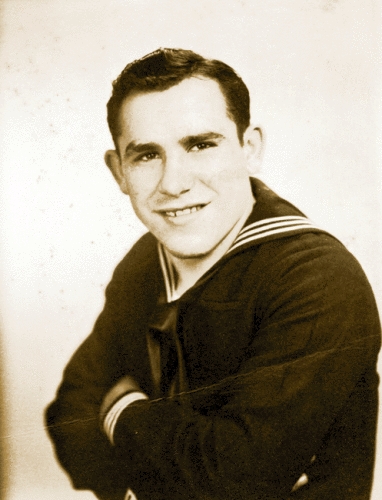
Among the nearly 200,000 U.S. Navy personnel was a 19-year-old old gunner's mate from St. Louis, aboard the attack transport vessel USS Bayfield. He saw "the rockets' red glare," and later told an interviewer, "It looked like the 4th of July." He may have been the calmest man in the entire operation. He was the one man who both took part in the D-Day invasion and played Major League Baseball. He was Seaman Second Class Lawrence Peter Berra. That's right: Yogi.
He did not thank the Nazis "for making this day necessary,"
but he could legitimately have said
the Nazis "made too many wrong mistakes,"
and called the Allies "overwhelming underdogs."

Also serving in this battle was Captain James Doohan of the Canadian Army. The man who went on to play Chief Engineer Montgomery Scott in the Star Trek franchise was 24, and gunned down a bunch of Nazis. He took a bullet to the chest, but was saved by a steel cigarette case in his pocket. Unfortunately, the story that he "gave the Nazis the finger" isn't true: He lost the middle finger on his right hand, all right, but it was from "friendly fire," a mistake from one of his own men.
Compared to facing the Nazis,
the Klingons were "no tribble at all."

Anyway, that's why every time "Scotty" was shown fixing something or pushing a button, he used his left hand. When he used the transporter, or was "reversing the polarity" in the episode "That Which Survives," another actor's hands were shown.

Also serving that day were Arsenal FC physiotherapist and later manager Tom Whittaker, British writers William Golding (Lord of the Flies) and Kingsley Amis (Lucky Jim), and American writer J.D. Salinger (Catcher in the Rye).

Brigadier General Theodore Roosevelt Jr. had been warned by his doctor that participating in the invasion could kill him, even if he didn't get shot or blown up. But, being an Oyster Bay Roosevelt, nobody could tell him anything, and he went. His son, Captain Quentin Roosevelt II, named for his brother who had been shot down over France in World War I, also landed on Utah Beach with him. They survived the invasion. Just 36 days later, on July 12, General Roosevelt died of a heart attack, in Méautis, Normandy. He was 56. Quentin survived the war, but was killed in a civilian plane crash in 1948.
Theodore Roosevelt Jr.

The only woman to land on Normandy was Martha Gellhorn, journalist, and then-wife of author Ernest Hemingway. She was denied press credentials, so she posed as a nurse, was allowed onto a hospital ship, locked herself in a bathroom so she would be part of the landing, and, once found out, became an actual nurse, carrying stretchers. She later became one of the reporters who divulged the story of the Dachau concentration camp.
Time magazine named Eisenhower its Man of the Year for 1944. It gave him the distinction again during his Presidency, in 1959.

June 6, 1944 was a Tuesday. And no games were played on that day. It was the off-season for the National Football League. The National Hockey League had completed its season on April 13, with the Montreal Canadiens winning the Stanley Cup. There was, as yet, no National Basketball Association. 

And with the news of the invasion reaching American shores early in the morning, the Commissioner of Baseball, Kenesaw Mountain Landis -- whose father survived the Battle of Kennesaw Mountain, outside Atlanta, in the American Civil War, and named his son in honor of it, with a different spelling -- ordered the postponement of all professional baseball games scheduled for the day.

According to the website of the National D-Day Memorial in Bedford, Virginia, about halfway between Roanoke and Lynchburg, and over 200 miles southwest of Washington:

Assuming that D-Day veterans have died at the same rate as other WWII veterans, we can estimate that 1.8% of the 140,000 are still living. That gives us an estimate of 2,520 D-Day veterans still living in 2021.

These are the last survivors of the men, and a few women in support roles, who won the most crucial battle against Nazi Germany. This day, 78 years ago, was the most important day in human history. If the Allies had lost, the Nazis could have held on and negotiated a stalemate, and still ruled a big chunk of Europe for the foreseeable future.

But the Allies won. The good guys won. We won. We freed Europe from Fascism. (Except for Spain and Portugal, which were neutral, as they had been in World War I. Their liberation from Fascism took another 30 years or so, and they had to do it on their own.) We defeated, and punished, the greatest evil that the planet Earth has ever known.

These people, and those who fought in the war earlier from September 1939 onward, were the original "Antifa." We owe these people everything.

Including the decision to cancel the day's baseball games. As Baseball Hall-of-Famer Bob Feller, then serving in the U.S. Navy in the Pacific Theater of Operations, told people for the rest of his life, "Anybody who says sports is war has never been in a war."

Notable films about D-Day include:

* Breakthrough, 1950.
* The Desert Fox: The Story of Rommel, 1951, with British actor James Mason portraying Erwin Rommel as a General too good for the Nazis.
* D-Day The Sixth of June, 1956, a British film whose actors included an actual D-Day lander, Richard Todd.
* The Longest Day, 1962, based on the 1959 book by Cornelius Ryan. It is an epic with a huge cast: Richard Todd again, John Wayne, Robert Mitchum, Richard Burton, Henry Fonda, Red Buttons with no comedy whatsoever, Peter Lawford, Eddie Albert, Jeffrey Hunter, Rod Steiger, George Segal, Robert Wagner, singer Paul Anka; and, notably, the man about to become James Bond, Sean Connery, plus 2 future Bond villains as German officers, Gert Fröbe and Curd Jürgens. My mother saw it when it came out, and mentioned that it was notable as one of the earliest films in which the actors are shown speaking the languages they're supposed to, with subtitles. But she also said it was so long, it should be called The Longest Film.
* Two 1964 films with James Garner: 36 Hours, and The Americanization of Emily, also with Julie Andrews, a year before she took on the Nazis in The Sound of Music.
* A Matter of Resistance, 1966, a French romantic comedy, that happens to include the invasion, starring Catherine Deneuve.
* Where Eagles Dare, 1968 (another with Richard Burton, in which Clint Eastwood infiltrates the Nazis, much as he would later do with the Soviet Union in Firefox.
* Patton, 1970, with George C. Scott playing General George S. Patton through the entire European Theater of Operations.
* Overlord, 1975, a post-Vietnam film looking at World War II as an overall failure of humanity.
* The Big Red One, 1980, with Mark Hamill fighting actual Nazis, not just an allegory for them as in the Star Wars films.
* Saving Private Ryan, 1998, Steven Spielberg aiming to make the most realistic version, and, in the opinion of many D-Day survivors, succeeding.
* Ike: Countdown to D-Day, 2004, with Tom Selleck, bald and without his famous mustache, nearly unrecognizable as Eisenhower.
* Storming Juno, 2010, the story told from the Canadian perspective.

Also on June 6, 1944, jazz pianist Monty Alexander was born. Phillip Allen Sharp was born, the 1993 winner of the Nobel Prize for Physiology or Medicine. Derrel McKinley "Bud" Harrelson was born, the shortstop on the New York Mets team that won the 1969 World Series and the 1973 National League Pennant. But D-Day may have been a bigger "miracle" than the '69 Mets. And track star Tommie Smith was born. He would become known for his protest at the 1968 Olympics, during another war, one that divided rather than united America.

December 31, 1999 & January 1, 2000: The Millennium

December 31, 1999:  The Millennium arrives. The people of planet Earth survived. At a terrible cost. But we hadn't destroyed ourselves. ...