Showing posts with label preston north end. Show all posts

Wednesday, September 7, 2022

September 8, 1888, The Football League Begins Play

September 8, 1888: The 1st games are played in England's Football League. Their national sport, which America would come to call "soccer," had been played for decades. The Football Association (FA) had been founded in 1863. A national tournament, the FA Cup, had been contested since the 1871-72 season. But now, there was a national league.

It was made up solely of teams from the North. From Birmingham and the surrounding area: Aston Villa, West Bromwich Albion and Wolverhampton Wanderers, a.k.a. Wolves. From the East Midlands: Derby County and Notts County. (Nottingham Forest had applied to be a charter member, but were turned down. They were admitted in 1892.) From Staffordshire: Stoke City. From Liverpool: Everton. (Liverpool F.C. would be founded in 1892.) From the Manchester area: Bolton Wanderers. (Manchester United wouldn't join the League until 1892, and Manchester City weren't founded until 1894.) From Lancashire: Preston North End, Blackburn Rovers, Burnley and Accrington Stanley.

Of the 12 teams, 10 played on the 1st day. The 2 that didn't were Blackburn Rovers and Notts County.

The 1st goal was scored by Kenny Davenport of Bolton, 2 minutes into their match with Derby. However, Derby won the game, 6-3. West Brom beat Stoke 2-0. Preston beat Burnley 5-2. Everton beat Accrington 2-1. And Aston Villa and Wolves drew 1-1.

Preston, which had won the FA Cup the previous season, not only won it again in 1889, but went through the League season undefeated: Played 22, won 18, drew 4, lost exactly none. At the time, a win was 2 points, and a draw 1. They finished with 40 points, with Aston Villa finishing 2nd with 29 points.

Hail the Champions: James Trainer, goalkeeper; Bob Howarth, right back; Bob Holmes, left back; George Drummond, right half; David Russell, centre half; Johnny Graham, left half; Jack Gordon, right wing; Jimmy Ross, inside forward; John Goodall, centre forward; Fred Dewhurst, inside forward; Sammy Thomson, left wing.

It would take 115 years for another English team to go through a League season unbeaten: In the 2003-04 season, North London team Arsenal played 38, won 26, drew 12, lost exactly none.

*

September 8, 1888 was a Saturday. There was no professional football, as Americans understand that word. There was no professional hockey. Basketball wouldn't even be invented for another 3 years. But there was what we would later call Major League Baseball:

* The New York Giants beat the Indianapolis Hoosiers, 3-2 at Athletic Park in Indianapolis. The Giants went on to win the National League Pennant. The Hoosiers played just 1 more season before going out of business.

* A doubleheader was split at Recreation Park in Pittsburgh. The Pittsburgh Alleghenys won the opener, 2-0. The Philadelphia Quakers won the nightcap, 3-2. The Alleghenys would be accused of unfairly acquiring a player, a method that was called "nothing but piratical." So they became the Pittsburgh Pirates for the 1891 season. The Quakers became the Philadelphia Phillies in 1890.

* The Cleveland Blues beat the Cincinnati Red Stockings, 2-1 at League Park in Cleveland. The following season, the Blues became the Cleveland Spiders, because a writer noted that their fielders were so good, they seemed to have 8 arms. They went out of business after the 1899 season. The Red Stockings became simply the Reds in 1890.

* A doubleheader was split at Recreation Park in Detroit. The Washington Nationals won the 1st game, 2-1. The Detroit Wolverines won the 2nd game, 7-2. Despite having won the Pennant in 1887, the Wolverines ran out of money, and folded at the end of the 1888 season. The Nationals went out of business after the 1899 season, and have no connection to the current National League team of that name.

* The Chicago White Stockings beat the Boston Beaneaters, 11-6 in Chicago. The White Stockings became the Cubs in 1903, and the Beaneaters became the Braves in 1912. 

Saturday, May 7, 2022

May 7, 1938: Lucky Arsenal & the Crash of Manchester City

Eric Brook

May 7, 1938: One of the most stunning seasons in the history of English football (soccer) comes to a conclusion. As the Lancashire Evening Post put it -- I have changed neither their spelling nor their grammar -- "If it were possible to stage-manage a football season, skilfully building the actions of the play up to a tremendous climax, that which occurred on Saturday would stand as the perfect example of contrariness."

In the 1936-37 season, under manager Wilf Wild, Manchester City Football Club had won the Championship of England's Football League Division One, by 3 points over South London team Charlton Athletic, and 5 points over North London team Arsenal. (At the time, the Football League awarded a team 2 points for a win and 1 point for a draw. In 1982, to encourage playing to win, they made it 3 points for a win.)

Although this was City's 1st League title, it was not a big surprise, as they'd been a good team in recent years, finishing 5th and winning the FA (Football Association) Cup in 1934, and 4th in 1935, before dropping to 9th in 1936. Their usual starting lineup included such fine players as goalkeeper Frank Swift, inside forward Eric Brook, and centre-half Matt Busby, who would go on to manage crosstown rivals Manchester United to glory in the 1950s and '60s.

Charlton were a bit of a surprise: That 2nd place finish remains their best ever. Arsenal finishing a strong 3rd was no surprise: They had won the League in 1931, 1933, 1934 and 1935; had won the FA Cup in 1930 and 1936; and were runners-up in both in 1932. Having built on the success of manager Herbert Chapman, who died in 1934, George Allison sent out a team with an attack led by forward Ted Drake, wingers Cliff Bastin and Joe Hulme, and defenders George Male, Eddie Hapgood and Wilf Copping.
Ted Drake

As the new season began in August 1937, William "Dixie" Dean, former star forward of Liverpool-based team Everton, told one of the national newspapers, the Daily Mail, "This threatens to be the most open campaign we've ever seen. Half a dozen clubs stand a good chance of winning it, and any one of 10 clubs could go down."

Birmingham-area team Wolverhampton Wanderers were the preseason favorites, led by Stan Cullis. But on September 4, in only the 3rd game of the season, "Wolves" walked into Highbury, Arsenal's home ground, and got clobbered, 5-0. But after winning their 1st 3 games easily, Arsenal went on a tailspin, winning only 2 of their next 12.

But no team's dropoff was as shocking as Man City's. They lost 3 of their 1st 5 games, 4 straight during Christmas and New Year's week, and 5 straight in February and March. The FA Cup had given them a respite from their awful League form, but on March 3, Birmingham team Aston Villa knocked them out in the Quarterfinal.

That season's Cup, and the League schedule as well, was hit hard by a rough Winter. In the 3rd Round of the Cup alone, snow caused 261 postponements, and that Round took 66 days to complete.

Arsenal got their act together: From January 29 to April 9, they won 7 games, drew 4, and lost only 2. But 1 of those losses was in the 5th Round of the Cup, to Lancashire team Preston North End, featuring Bill Shankly, who would lift Liverpool FC to glory in the 1960s and '70s.

On April 23, on a very muddy pitch at their home of Deepdale, Preston lost to Arsenal, knocking them out of the title race and seriously boosting Arsenal's chances. But Preston reached the FA Cup Final a week later, at Wembley Stadium in West London. Their opponents would be Yorkshire team Huddersfield Town.

It was the 1st Cup Final ever televised. The 93,000-strong Wembley crowd outnumbered British TV owners 10 to 1, but that didn't stop the Daily Herald from running the headline: "The day is not far off when you may be able to watch your favourite football team from your fireside."

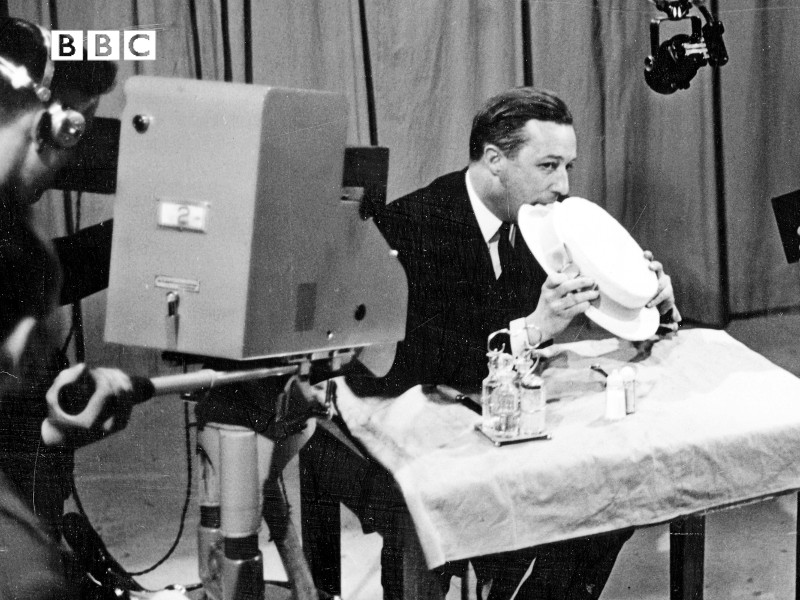
The game ended scoreless, and went to extra time. Just as it looked like extra time would also end scoreless, necessitating a replay, BBC commentator Thomas Woodrooffe said, "If there's a goal scored now, I'll eat my hat."

Right after he said that, Preston inside forward George Mutch was fouled in the penalty area, and referee Jimmy Jewell awarded Preston a penalty. The validity of the call has never been seriously questioned. Mutch took the penalty himself, and scored. Preston won, 1-0, and their Captain, Tom Smith, was handed the Cup by King George VI. At a banquet a few days later, Woodrooffe was served a cake in the shape of a hat, allowing him to keep his promise.
George Mutch

Just 7 days later, the League had its final slate of games for the season. Wolves led Arsenal by 1 point. All they had to do, away to North-East team Sunderland, was gain a draw, and there would be nothing that Arsenal could do: Even a win, in their last game, home to Manchester-area team Bolton Wanderers, wouldn't be enough to deny Wolves their 1st-ever League title.

But Sunderland had some pride, too: They had won the Cup the year before (but they've won it only once since, in 1973), and the League the year before that (but they haven't won it since). Although they were in 8th place, they were at home at Roker Park, and they were going to put up a fight. A rightful dismissal dropped them to 10 men, but they hung on to win, 1-0.

Wolves kicked off 15 minutes before Arsenal, but the Arsenal players didn't yet know the result until their game was over. They beat Bolton, 5-0, and had finished 1 point ahead of Wolves. Arsenal were Champions for the 5th time in 8 seasons, their 6th major trophy in 9. "Lucky Arsenal," the newspapers called them. Even then, the English media seemed to be aligned against the Gunners.

At the time, there were 22 teams in Division One, and the bottom 2 were relegated to Division Two, with the top 2 teams of Division Two promoted to Division One. Manchester City struggled hard to stay afloat, and in their next-to-last game, they beat Leeds 6-2, putting them in 16th place.

But on the last day, May 7, at Leeds Road, they lost 1-0 to Huddersfield Town. With the other teams between them and the drop positions winning, Man City finished 21st, and, along with 22nd-placed Birmingham-area team West Bromwich Albion, were relegated.

Dixie Dean turned out to be more right than even he imagined: Only 5 points separated 21st-place Man City from 10th-place Chelsea. And the 16-point gap between Champions Arsenal and relegated City is tied for the smallest one ever -- and, with the raising of a win to 3 points, it will almost certainly remain so.

Through the 2021-22 season, the 1937-38 Manchester City side still hold 2 unique distinctions: They are the only defending League Champions ever to be relegated, and they are the only side with a positive goal difference ever to be relegated. With the Premier League, replacing the old Division One in 1992, having 20 teams, the 20-places drop can never again be matched.

Stan Cullis would manage Wolves to the League title in 1954, 1958 and 1959, and the FA Cup in 1949 and 1960. Manchester City would be promoted back to Division One after World War II, but wouldn't win the League again until 1968 -- and then, not again until 2012, in dramatic circumstances, but would dominate the League for years to come.

*

May 7, 1938 was a Saturday. The only sport then in season in North America was baseball, and these games were played:

* The New York Yankees beat the Detroit Tigers, 12-8 at Yankee Stadium. Lefty Gomez outpitched Elden Auker. Lou Gehrig went 3-for-5 with 2 RBIs. Joe DiMaggio went 3-for-4 with a walk and an RBI. But the big hitting star for the Yankees was left fielder Myril Hoag, with 2-for-4 with 4 RBIs. Hank Greenberg went 0-for-3.

* The New York Giants beat the Pittsburgh Pirates, 6-5 at Forbes Field in Pittsburgh. Mel Ott went 2-for-4 with a walk and an RBI. Lloyd Waner went 3-for-5 with 2 RBIs, but Paul Waner only went 1-for-5.

* The Brooklyn Dodgers beat the Cincinnati Reds, 7-4 at Crosley Field in Cincinnati.

* The Boston Red Sox beat the St. Louis Browns, 7-2 at Fenway Park in Boston. Jimmie Foxx hit a home run.

* The Cleveland Indians beat the Philadelphia Athletics, 4-2 at Shibe Park in Philadelphia.

* The Washington Senators beat the Chicago White Sox, 5-4 at Griffith Stadium in Washington. The ChiSox took a 4-3 lead in the top of the 10th inning, but back-to-back singles by John Stone and Cecil Travis got the tying and winning runs home.

* The Chicago Cubs beat the Boston Bees (as the Braves were known from 1936 to 1941), 5-4 at Wrigley Field in Chicago. Joe Marty singled home the winning run in the bottom of the 10th.

* And the Philadelphia Phillies and the St. Louis Cardinals were rained out at Sportsman's Park in St. Louis. The game was made up as part of a doubleheader on August 30. The Phils won the opener, 4-3. The Cards won the nightcap, 8-7 in 10 innings.

Monday, May 2, 2022

May 2, 1964: Bubbles at Wembley

Bobby Moore with the FA Cup

May 2, 1964: The FA Cup Final is held at Wembley Stadium in West London.

West Ham United Football Club, despite its name, is located in the East End of London. Since 1895, when they were founded as Thames Ironworks FC, "the Hammers," a.k.a. "the Irons," have represented that part of town with grit and courage, if not with much success.

Through the 1962-63 season, the closest they had come to a major trophy were the London Combination in 1917, the Football League War Cup in 1940 (and both of those were won under unusual wartime conditions), and the championship of the Football League Division Two in 1958. In 1923, when Wembley Stadium opened, and hosted its 1st FA Cup Final, West Ham reached it, but lost to Manchester-area team Bolton Wanderers. It would take until 1964 for them to get that far again.

At this point, they weren't even known for having the most fearsome "hooligan firm" in the British Isles, the Inter-City Firm. That would come later. They were best known as the country's ultimate working-class team, and for their song, "I'm Forever Blowing Bubbles."

The song was written in 1918. The music was written by John Kellette. The lyrics were written the next year, by 3 men: James Kendis, James Brockman and Nat Vincent. The song debuted in a Broadway musical, The Passing Show of 1918, where it was first sung by Helen Carrington.

The song was the World War I-era equivalent of a hit -- the dawn of radio broadcasting was soon to arrive, so it was sales of sheet music that determined that sort of thing, not airplay and record sales -- and became popular in British music halls.

West Ham player Billy Murray had a resemblance to the boy in the painting "Bubbles" by Sir John Millais, which was used in a print ad for Pears soap. So his nickname became "Bubbles," and West Ham fans began to sing the song to honor him. Just as "You'll Never Walk Alone" survived as a "club song" for Liverpool F.C. after the hit version of the song by Gerry & the Pacemakers dropped off the charts in 1963, so, too, did Hammers fans continue to sing "I'm Forever Blowing Bubbles" after Murray left the team.

And so, those fans sang it all through their team's FA Cup run: Beating South London team Charlton Athletic in the 3rd Round, East London team Leyton Orient in the 4th Round (with a replay), Wiltshire team Swindon Town in the 5th Round, Lancashire team Burnley in the Quarterfinal, and Cup holders Manchester United in the Semifinal.

They would play Preston North End, then in the Football League Division Two. Preston were, and are, best known as the team that, in the 1st season of the Football League, 1888-89, won both the title, by going undefeated, and the Cup, the 1st "Double." Preston had famously won the Cup in 1938, with a fairly-awarded penalty in the last minute of extra time.

Doug Holden opened the scoring, putting Preston ahead 1-0 in the 10th minute. But right after that, John Sissons equalized for the Irons. At the age of 18, he was then the youngest scorer in Final history. Alex Dawson scored in the 40th, and Preston took a 2-1 lead into the break.

But Geoff Hurst scored in the 52nd, and the game was tied again. Extra time loomed, but in the 90th and last minute of normal play, Ronnie Boyce scored on a header, and West Ham won, 3-2. Bobby Moore, centreback, Captain of West Ham and Captain of the England national team, received the FA Cup from George Lascelles, the 7th Earl of Harewood, a 1st cousin of Queen Elizabeth II, representing the Football Association. (Two years later, when England won the World Cup at Wembley, Moore would receive that trophy from the Queen herself.)

Playing left halfback for Preston was Howard Kendall, a few days short of his 18th birthday, even younger than Sissons. This made him the youngest player to play in an FA Cup Final since the game moved to Wembley. That record would be broken by a West Ham player, Paul Allen in 1980. But this would not be what Kendall would be best known for: He won the League playing for Liverpool team Everton in 1970, and managed that team to the League title in 1985 and 1987, the FA Cup in 1984, and the European Cup Winners' Cup in 1985.

West Ham have never won the League, or even finished 2nd. Even when they won the FA Cup in 1964 and the European Cup Winners' Cup in 1965, they only finished 14th and 9th, respectively. And their 1980 win remains the last time the FA Cup has been won by a team from outside Division One, although they won Division Two in 1980-81 to get promoted back into Division One for 1981-82.

Harry Redknapp, later to manage several English teams, including West Ham, played for them from 1965 to 1972, and was later a teammate of Moore's on the North American Soccer League's Seattle Sounders. He once remarked, "We had Bobby Moore, Geoff Hurst, Martin Peters, John Bond, Ronnie Boyce and John Sissons. And we finished 14th. That should tell you how bad the rest of us were."

But winning the FA Cup meant that the Hammers had qualified for the European Cup Winners' Cup, their 1st European competition. (That tournament was last held in 1999, and the teams that would have qualified for it thereafter were, instead, placed in the UEFA Cup, known since 2010 as the UEFA Europa League.)

They did improve to 9th in the League. But it would take until 1986 for West Ham to finish higher than 6th in the top flight. That season, they finished 3rd. They quickly fell to 15th the next season. They finished 5th in 1999. Those 1986 and 1999 finishes remain their 2 best League seasons ever.

As for Preston, they have never seriously challenged for another major trophy, and have not played in England's top flight since 1961.

*

May 2, 1964, like most FA Cup Final days, was a Saturday. The NBA season had ended 6 days earlier, with the Boston Celtics beating the San Francisco Warriors for their 6th straight Championship. The NHL season had ended the day before that, with the Toronto Maple Leafs beating the Detroit Red Wings for their 3rd straight Stanley Cup. And American football was out of season.

But these baseball games were played, and some of them had weird occurrences:

* The New York Yankees lost to the Washington Senators, 5-4 at Yankee Stadium. The Yankees were beaten in the top of the 10th inning, on a single by former Yankee Bill "Moose" Skowron. Tom Tresh hit a home run. Mickey Mantle only appeared as a pinch-hitter, and did not reach base.

* The New York Mets beat the Cincinnati Reds, 3-0 at Crosley Field in Cincinnati. Al Jackson pitched a 2-hit shutout, allowing only a single by Deron Johnson and, oddly, one by the opposing pitcher, Jim Maloney. But Maloney balanced that out by throwing a wild pitch that allowed a run while Jackson was at bat. Frank Robinson did not play. Pete Rose went 0-for-4. 

* The Detroit Tigers beat the Boston Red Sox, 4-0 at Fenway Park in Boston. Dave Wickersham pitched a 6-hit shutout. Al Kaline went 1-for-3 with 2 walks.

* The Cleveland Indians beat the Baltimore Orioles, 6-4 at Memorial Stadium in Baltimore. Much as he did in 1959, after pitching 12 perfect innings for Pittsburgh against Milwaukee, Harvey Haddix fell apart in the top of the 13th inning for Baltimore in this game. Brooks Robinson went 1-for-5 with a walk. An escalator accident injured 46 people, killing a 14-year-old girl. I have a separate entry for that event.

* The Chicago White Sox beat the Los Angeles Angels, 3-1 at Comiskey Park in Chicago.

* The Milwaukee Braves beat the Philadelphia Phillies, 11-2 at Milwaukee County Stadium. Hank Aaron went 3-for-4 with a walk and an RBI. He did not hit a home run, but Eddie Mathews did. So did their former Brave teammate, Wes Covington, for the Phils, as did Johnny Callison.

* The Pittsburgh Pirates beat the St. Louis Cardinals, 5-4 at Busch Stadium (formerly Sportsman's Park) in St. Louis. The Cards led 4-3 in the top of the 9th, but Gene Freese singled home 2 runs to win it. Roberto Clemente went 1-for-4 with a walk. Willie Stargell did not play.

So the 3 teams that finished the regular season within 1 game of each other at the top of the National League standings -- Cincinnati, Philadelphia and St. Louis -- all lost on this day.

* The Minnesota Twins beat the Kansas City Athletics, 7-3 at Kansas City Municipal Stadium. The game was 2-2 after 8 innings. In the top of the 9th, Harmon Killebrew hit a home run for the Twins. In the bottom of the 9th, Rocky Colavito singled home Ed Charles for the A's, and the game went to extra innings.

In the top of the 11th, with Dan Pfister pitching for the A's, the Twins did something that has only happened 11 times in major league history, and this was only the 3rd time: They hit 4 straight home runs. They were hit by Tony Oliva, Bob Allison, Jimmie Hall and Killebrew.

* The Chicago Cubs beat the Houston Colt .45s, 9-0 at Colt Stadium in Houston. The Colts became the Astros the next season. Bob Buhl pitched a 3-hit shutout. Ernie Banks went 3-for-5 with 2 RBIs. Lou Brock went 3-for-4 with a walk and a stolen base. The Cubs, desperate for pitching, traded him a few weeks later anyway, to St. Louis, for Ernie Broglio. It didn't work out well for them. It worked out great for the Cardinals.

* And the San Francisco Giants beat their arch-rivals, the Los Angeles Dodgers, 5-4 at Dodger Stadium in Los Angeles. Chuck Hiller singled home the winning run in the top of the 12th inning. Duke Snider hit a home run -- for the Giants, against the Dodgers. It was the 404th home run of his career, which, at the time, ranked 6th all-time. He would hit only 3 more. Willie Mays went 1-for-6.

Sunday, May 1, 2022

May 1, 1953: Arsenal Win In the Football League's Closest Finish

May 1, 1953: England's Football League Division One has its closest finish ever.

Arsenal Football Club, of North London, had dominated the League in the 1930s, winning 5 League titles and 2 FA Cups, with another season of being runner-up in both, in a 9-year stretch. World War II shut the League down, but in 1948, the 2nd full season after The War, Arsenal won the League again.

This was the 1st full season under manager Tom Whittaker. He had played for Arsenal in the 1920s, before the glory began. His career ended due to an injury, but it led directly to him tending to his former teammates' injuries as their physio -- or "trainer," as would be said in American sports. All through the glory years, managed by Herbert Chapman until his death in 1934, and then under George Allison, he kept them going.

When Allison stepped down in 1947, Whittaker was considered the natural choice to succeed him. He led them to the 1948 League title, and the 1950 FA Cup. He got them back to the FA Cup Final in 1952, ironically losing due to an injury, to Walley Barnes. English football did not allow substitutes until the 1968-69 season, largely due to Barnes' injury beginning a stretch of several Cup Finals that ended up being decided by injuries sending teams down to 10 men.

There was no European competition at the time. And Arsenal went out of the 1952-53 FA Cup in the Quarterfinal. But a strong run through January and February kept them close to the League lead. They stumbled a little in March, but picked up again in April.

Whittaker found a young gem in goalkeeper Jack Kelsey. Otherwise, it was a veteran team: Right back Joe Wade, left back Barnes; halfbacks Alex Forbes, Ray Daniel and team Captain Joe Mercer; and forwards Don Roper, Jimmy Logie, Peter Goring, Doug Lishman and Ben Marden. (Kelsey, Barnes and Daniel were Welsh. Forbes and Logie were Scottish. The rest of the starting lineup was English.)

By April 18, Arsenal were tied for 1st with Birmingham-area team Wolverhampton Wanderers, a.k.a. Wolves, with 2 games in hand. At a time when a win was 2 points, they had 3 games to go, and needed just 3 points -- a win and a draw -- to win the title.

But they faltered, with a 0-0 draw away to Welsh team Cardiff City on the 22nd, and then a 2-0 loss away to Lancashire team Preston North End on the 25th. Now, Arsenal and Preston were tied for the League lead with 1 game left to play, which gave Preston hope that they could still take the title. Wolves were out: They had finished their schedule, and were 1 point back.

On April 29, Preston played their game in hand, beating East Midlands team Derby County away, 1-0. This meant that Arsenal had to win their last game to take the title: Regardless of how many goals they won by, a win would give them 54 points, the same as Preston, and the title, based, on the rules of the time, on goal average. But a draw would leave them with 53, and a loss with 52.

Arsenal were taking a ragged, muddy pitch at the Arsenal Stadium, known as Highbury for its North London neighborhood, on May 1, a damp Friday night. It was moved back to this day, to avoid clashing with the FA Cup Final the next day. Their opponents were Lancashire team Burnley, who were in 5th place, and had held Arsenal to a 1-1 draw at Burnley's stadium, Turf Moor, the preceding December 13. So it was hardly a gimme for the Gunners.

A crowd of 51,586 was on hand. That might sound big to more recent fans, knowing Highbury's seating capacity as 38,000, but that was after it was converted to all-seater. The standing areas -- the North Bank and the southern Clock End -- were not full, possibly due to the weather, possibly due to the unfamiliarity of a Friday night match. But Lishman remembered those who had showed up being loud: "The crowd was at their best that night. The noise they made was unbelievable, it was really ear-piercing... However much the players and the fans were in conflict that season, I can't deny they were superb on that night."

The game kicked off at 6:00 PM. Just 6 minutes into the game, Burnley scored. Midway through the 1st half, Forbes and Lishman scored within minutes of each other to give Arsenal the lead. Logie scored just before the half to make it 3-1 to The Arsenal.

But the sky opened again, and it rained so hard that there was consideration of abandoning the game, and restarting it on another date. The 2nd half started anyway, and Burnley soon scored to make it 3-2. Logie and Goring both later admitted they found it difficult to move on the waterlogged pitch. Roper tore ligaments in his knee, and Mercer later said, "Playing in that match crocked me for good." (He had to be talked out of retirement, but broke his leg the next season, and never played again. He later managed Manchester City to the League title in 1968 and the FA Cup in 1969.)

Both Roper and Mercer kept playing through their injuries, so as not to reduce Arsenal's full complement of 11 men. The League would not allow substitutions, even for injury, until 1965. The only thing that seemed to be saving them is that Burnley were struggling with the awful playing surface as well.

The pressure got to manager Whittaker: He left the dugout, and retreated to his office, pouring himself a stiff drink. He may have been better off: Later in the game, a Burnley shot beat Kelsey and hit the crossbar. Later still, Burnley thought they should have been awarded a penalty, but they weren't. Finally, at 8:00, the referee blew his whistle, and the game was over, 3-2 to The Arsenal.

Arsenal were the Champions, having finished level on points with Preston, and having finished just 0.099 of a goal better than Preston. Under the current rules, the first tiebreaker would be goal difference. That would have given Arsenal a bigger cushion, +33 to +25.

And so, in a 24-year stretch -- 17 seasons, taking out the war-affected seasons -- Arsenal had won the League 7 times, and the Cup 3 times. No other team in England had done so well over that stretch. But the run took a lot out of them. Aside from Kelsey, it was an aging team, and most of them never won another trophy as a player.

Whittaker died of a heart attack in 1956, still the Arsenal manager. There are those who believe that he had more than just the one stiff drink that night, and that he might well have set himself on a path to death at age 58.

Replacing Whittaker and the players proved difficult, and the 1953 League title turned out to be Arsenal’s last trophy for 17 years. A month later, Queen Elizabeth II was crowned, and, after Arsenal lost the League Cup Final in 1968 and again in 1969, the line became "Arsenal haven't won a trophy since the Coronation." They won 3 over the next 2 seasons.

*

May 1, 1953 was a Friday. The following day, the FA Cup Final was held at Wembley Stadium in West London, and Lancashire team Blackpool beat Manchester-area team Bolton Wanderers, 4-3. That was also the day of the Kentucky Derby, and Dark Star beat Northern Dancer. It was the only loss of Northern Dancer's career: He went on to win the Preakness Stakes and the Belmont Stakes.

Football, basketball and hockey were out of season. These baseball games were played that Friday:

* The New York Yankees lost to the Chicago White Sox, 6-5 at Comiskey Park in Chicago. Billy Pierce outpitched Johnny Sain. Mickey Mantle went 0-for-3 with 2 walks.

* The New York Giants lost to the St. Louis Cardinals, 3-2 at the Polo Grounds. Stan Musial went 2-for-4 with an RBI. Willie Mays was serving in the Korean War, and unavailable for the Giants.

* The Brooklyn Dodgers beat the Chicago Cubs, 6-5 at Ebbets Field. The Cubs scored 3 runs in the top of the 8th, but the Dodgers scored 4 in the bottom of the 8th, including a home run by Pee Wee Reese. Jackie Robinson did not play.

* The Milwaukee Braves beat the Philadelphia Phillies, 5-2 at Connie Mack Stadium in Philadelphia.

* The Pittsburgh Pirates beat the Cincinnati Reds, 8-3 at Forbes Field in Pittsburgh.

* The Boston Red Sox beat the Cleveland Indians, 8-1 at Cleveland Municipal Stadium. Ted Williams was serving in the Korean War, and unavailable for the Red Sox.

* The Detroit Tigers beat the Philadelphia Athletics, 7-3 at Briggs Stadium (later Tiger Stadium) in Detroit.)

* And the Washington Senators beat the St. Louis Browns, 6-5 at Sportsman's Park in St. Louis, which had just been renamed Busch Stadium.

Saturday, April 30, 2022

April 30, 1938: The Hat-Eater's Final

Thomas Woodrooffe -- with hat intact.

April 30, 1938: The Football Assocation Cup Final is held at Wembley Stadium in West London. Both teams are from the North of England.

Huddersfield Town, of West Yorkshire, had won the Football League in 1924, '25 and '26; finished 2nd in 1927, '28 and '34; won the FA Cup in 1922; and lost in the Final in 1920, '28 and '30. So they were a team that had seen greatness recently.

But Preston North End, of Lancashire, had the greater history. In 1888, they reached the FA Cup Final. The following season, 1888-89, was the 1st season of the Football League, and they went unbeaten in 22 games, 18 wins and 4 draws, earning them the nickname "The Invincibles." As the League season was lengthened, there has only been one "Invincibles" since, the 2003-04 Arsenal team that had 26 wins and 12 draws in 38 games.

Preston also won the FA Cup in 1889. Thus, in the 1st season that it was possible, they won the League and the Cup, which became known as "The Double." They won the League again in 1890, and finished 2nd in 1891, '92, '93 and 1906. They didn't reach the Cup Final again until 1922, losing to Huddersfield. They lost it again in 1937, to North-East team Sunderland.

Managed by Clem Stephenson, Huddersfield had a Scottish centre forward, Willie MacFadyen. (That's correct: Not "MacFayden.") Otherwise, they fielded an entirely English lineup, captained by centreback Alf Young, and including former Arsenal star Joe Hulme. In contrast, Preston, managed by James Taylor (a very common name), had only 4 Englishmen and 7 Scotsmen, including their Captain, centreback Tom Smith (also a very common name, especially in British "football"), and right halfback Bill Shankly, who would later manage Liverpool FC to glory.

This was the 1st FA Cup Final to be broadcast on television. Thomas Woodrooffe called the match for the BBC. But there wasn't much action for him to call, and after 90 minutes plus stoppage time, the game was 0-0. Extra time was played, and almost used up. With 1 minute to go, plus whatever stoppage time there would have been -- probably only 1 more minute -- Woodrooffe said, "If there's a goal scored now, I'll eat my hat."

Famous last words: Right after he said that, Preston inside forward George Mutch was fouled in the penalty area, and referee Jimmy Jewell properly awarded Preston a penalty. The validity of the call has never been seriously questioned: Huddersfield fans have not moaned about being "robbed" ever since. I've seen the film: The penalty was properly given. Mutch took the penalty himself, and scored. Preston won, 1-0, and Captain Smith was handed the Cup by King George VI.
George Mutch

At a banquet a few days later, Woodrooffe was served a cake in the shape of a hat, allowing him to keep his word. This was broadcast on the BBC television "programme" Picture Page.
Both teams have struggled since, only rarely seeing the glory of the top flight. Huddersfield haven't won a major trophy since 1926, and haven't reached the Cup Final again since 1938. Preston have, losing it in 1954 and '64. They've also finished 2nd in the League in 1953 and '58. But their last major trophy has been the Football League War Cup in 1941.

Woodrooffe lived until 1978; Mutch, until 2001. Left back Bobby Beattie was the last survivor of the 1938 Preston team, living until 2002.

*

April 30, 1938 was a Saturday. This was also the day that the 1st cartoon with Bugs Bunny in it premiered. I have a separate entry for that event.

Elsewhere in English soccer, Arsenal beat Liverpool, 1-0 at the Arsenal Stadium, a.k.a. Highbury in North London. A week later, Arsenal beat Manchester-area team Bolton Wanderers, and won the Football League title.

And these games were played in America's major league baseball:

* The New York Yankees beat the Washington Senators, 8-4 at Griffith Stadium in Washington. Spurgeon "Spud" Chandler outpitched Emil "Dutch" Leonard. Red Rolfe went 3-for-5 with 3 RBIs. Lou Gehrig went 0-for-5. Joe DiMaggio went 1-for-3.

* The New York Giants beat their arch-rivals, the Brooklyn Dodgers, 3-1 at the Polo Grounds. Carl Hubbell outpitched Van Lingle Mungo. Mel Ott went 1-for-3 with a walk and an RBI.

* The Boston Bees beat the Philadelphia Phillies, 16-11 at Baker Bowl in Philadelphia. After a horrible 1935 season, the Braves changed their name to the Bees, but it didn't catch on, and they switched back in 1941. For the Bees, Gene Moore went 2-for-5 with a home run, a walk and 4 RBI, Tony Cuccinello went 3-for-4 with 2 walks and 3 RBIs, Ray Mueller went 3-for-5 with an RBI, and Harl Maggert pinch-hit a grand slam. For the Phillies, Chuck Klein went 4-for-6 with 2 RBIs, and Hersh Martin went 2-for-5 with 4 RBIs.

* The Detroit Tigers beat the Cleveland Indians, 5-3 at League Park in Cleveland. Hank Greenberg went 1-for-3 with a walk.

* The Cincinnati Reds beat the Pittsburgh Pirates, 2-0 at Crosley Field in Cincinnati. Roy "Peaches" Davis pitched a 5-hit shutout.

* The Chicago White Sox beat the St. Louis Browns, 3-0 at Comiskey Park in Chicago. Ted Lyons allowed 9 hits, but kept the shutout.

* The Chicago Cubs beat their arch-rivals, the St. Louis Cardinals, 11-5 at Sportsman's Park in St. Louis.

* The Philadelphia Athletics and the Boston Red Sox were rained out at Fenway Park in Boston. The game was made up as part of a doubleheader on August 17. The Red Sox swept, 4-3 and 5-0. Joe Heving pitched a 7-hit shutout in the nightcap. Jimmie Foxx went 3-for-7 with a home run, a walk, and 2 RBIs over the 2 games.

December 31, 1999 & January 1, 2000: The Millennium

December 31, 1999:  The Millennium arrives. The people of planet Earth survived. At a terrible cost. But we hadn't destroyed ourselves. ...