Showing posts with label 1946. Show all posts

Tuesday, December 20, 2022

December 20, 1946: "It's a Wonderful Life" Premieres

December 20, 1946: It's a Wonderful Life premieres. Like many of the films directed by Frank Capra, it's homey, and corny, earning those films the nickname "Capra Corn." But it is one of the most beloved films ever made.

It wasn't a success at first. Indeed, it turned out to be the only motion picture that Liberty Films ever made, dragging the studio into bankruptcy. But a legal loophole put it into the public domain in 1974, and allowed anyone who wanted to show it on television to do so, as it was cheap to do so. That made it a Christmas classic.

George Bailey lives in Bedford Falls, somewhere in New York State. In 1919, when they are boys, he saves the life of his brother, Harry, but loses the hearing in one ear in the process. A girl named Mary Hatch has a childhood crush on him that doesn't go away once they grow up (with adult George played by James Stewart -- that's how he was billed in every movie, but everybody tended to call him "Jimmy Stewart" -- and adult Mary by Donna Reed).

George's father Peter (Samuel S. Hinds) and his uncle Billy (Thomas Mitchell) run the Bailey Brothers Building & Loan. The father dies right after George graduates from high school in 1928, and the Building & Loan's board of directors votes to make George, despite his youth, the new chairman, as Uncle Billy is an alcoholic, and not all that bright when he's sober.

George refuses, and is told by the board that if he refuses, the board will elect Henry Potter (Lionel Barrymore) the new chairman. Potter is the richest and meanest man in town, and if he runs the Building & Loan, he'll close it, meaning that the entire town will be at his mercy. George hates Potter, so he accepts. This means that he has to stay in town, and the money that was going to send him to college instead sends brother Harry to college.

The Great Depression soon follows, and there's a run on the banks on the day in 1932 that George and Mary get married. They use the $2,000 that they were going to spend on their honeymoon to save their customers, as Potter's bank is offering only 50 cents on the dollar. They just barely make it. (In the sequence, $242 then would be $5,169 in 2022; $20 would be $427.23; $17.50 would be $373.83; and the $2.00 the Baileys ended up with would be $42.72.

George and Mary become well-respected in town, and the parents of 4 children. When World War II arrives, Harry enlists in the U.S. Navy, and, as a pilot, shoots down planes attacking a troop ship, saving hundreds of lives. (The movie doesn't say whether the enemy planes were German or Japanese). But because of his bad ear, George is classified 4-F, and "fights the Battle of Bedford Falls," running drives for things the war effort needs, like scrap metal, rubber, and food.

On Christmas Eve, December 24, 1945, a party is being set up for the returning hero Harry. But, at the bank, Uncle Billy loses $8,000 meant for the firm's accounts -- about $171,000 in today's money. Unable to come up with the money, George runs into one awful occurrence after another (and, let's be honest, behaves very badly in response to them), and wishes he'd never been born.

All this is told by the angel Joseph (voiced by Joseph Granby), who has been hearing the prayers for George by the people of Bedford Falls. Joseph assigns George's case to an angel named Clarence Goodbody (Henry Travers), so that Clarence can finally "earn his wings." Clarence shows George  what the world would have been like if he had never been born. The results are shocking:

* Potter became the director of the Building & Loan, and closed it down. Now, he owned everything in town, and he changed its name to Pottersville.

* The major businesses in town low-class joints: Dive bars, burlesque houses, casinos that the Potter-controlled police looked the other way on.

* Without George, Bailey Park, the housing development he built through the Building & Loan, was never built, so people living in town had no alternative but to live in "Potter's slums."

* Mr. Gower (H.B. Warner), the pharmacist, spent time in prison, because George wasn't there to stop him from making a mistake with pills in 1919, which led to a local boy's death. He's now a homeless alcoholic.

* Giuseppe Martini (Bill Edmunds), operator of Martini's bar, a nice establishment, and a resident of Bailey Park, is neither. He isn't even in the alternate sequence: There is no Bailey Park, and Nick (Sheldon Leonard), who had been the head bartender at Martini's, now owns the place, naming it Nick's, and isn't nearly as friendly without Martini's influence.

* Mary is "an old maid," never married (at age 38, that was a big deal at the time), and works in the local library -- which, surprisingly, Potter didn't have shut down. Still, she's better off than most people in town.

* Worst of all, while Billy was born on time in 1911, none of the other kids who were with George that day in 1919 was able to save him from falling into the ice, and he died. So he wasn't there to save that troop transport during The War, and every American serviceman on that ship died. Clarence never says whether this affects the outcome of the war: For all we know, at Christmas '45, the war could still be going on, and the Allies could even be losing.

George changes his mind, and wants to live again. He gets his wish, goes home to face the music, and finds that all the people he'd selflessly helped over the years have come to pay him back. There's a big basket of cash, which ends up being more than the $8,000 he needs. They show him that, in the way that matters, he's "the richest man in town."

As of December 20, 2022, there are 4 surviving castmembers from It's a Wonderful Life: Ronnie Ralph, who played George's friend Sam Wainwright as a child; Carol Coombs, George & Mary's daughter Janie Bailey; Karolyn Grimes, George & Mary's daughter Zuzu Bailey; and Jimmy Hawkins, George & Mary's son Tommy Bailey.

*

December 20, 1946 was a Friday. Several celebrities were born on this day: Illusionist Uri Geller, TV producer Dick Wolf, actor John Spencer, and Sonny Perdue, who was elected Governor of Georgia as a Republican, and then served as Secretary of Agriculture under Donald Trump.

Baseball was out of season. The NFL Championship Game had been played 5 days earlier, with the Chicago Bears beating the New York Giants, 24-14 at the Polo Grounds in New York. And no games were scheduled in the NHL.

There was one score on this historic day. The NBA was in its 1st season, under the name of the Basketball Association of America. One game was played that night: The Toronto Huskies beat the New York Knicks, 74-70 at Maple Leaf Gardens in Toronto. On the preceding November 1, the league's 1st-ever game was played between the same teams in the same arena, but the Knicks won it.

Wednesday, December 7, 2022

December 7, 1946: The Winecoff Hotel Fire

December 7, 1946: The Winecoff Hotel in Atlanta catches fire, resulting in the deadliest hotel fire in American history.

The Winecoff Hotel, 15 floors, opened in 1913, at 176 Peachtree Street at Ellis Street. It was touted in advertisements and on its stationery as "absolutely fireproof." That turned out not to be true at 3:15 AM on December 7, 1946, when a bellboy saw a fire on the 5th floor, and alerted the night manager. Instead of sounding the building's fire alarm, the manager called as many rooms as he could before calling the fire department at 3:42. The Atlanta Fire Department later determined that the cause was dropped cigarette on the 3rd floor.

There were 119 deaths, including the hotel's builder and namesake, William Fleming Winecoff, and his wife, Grace Smith Winecoff. They were both 76 years old, and lived in Suite 1011-1012. He was found in the hall, while she was found on the sidewalk, apparently having jumped.

She was one of several victims who jumped to their deaths. A photograph of the fall of one survivor, Daisy McCumber, was taken by Arnold Hardy, a graduate student at nearby Georgia Tech. He sent it to the Associated Press, and it won the 1947 Pulitzer Prize for Photography.
Daisy McCumber sustained serious injuries,
including the loss of a leg, but survived, and lived until 1992.
Arnold Hardy lived until 2007.

It was a bad year for hotel fires: 61 died in the La Salle Hotel in Chicago on June 5, 19 in the Canfield Hotel on June 9. This spurred significant changes in North American building codes, most significantly requiring multiple protected means of egress and self-closing fire-resistant doors for guest rooms in hotels.

The Winecoff Hotel reopened, with the name of the Peachtree Hotel on Peachtree and the latest in fire safety technology. In 1967, it became public housing for the elderly, but was left vacant in the 1980s. In 2007, after a renovation, it was reopened as the Ellis Hotel. A historical marker paying tribute to the fire victims stands across the street.

*

December 7, 1946 was a Saturday. Baseball was out of season. There were 2 games in college football.

Utah State beat the University of Denver, 28-14 at Hilltop Stadium in Denver. And Nevada beat Hawaii, 26-7 at Honolulu Stadium.

There were 5 games played in the league that would become the NBA:

* The New York Knicks beat the Boston Celtics, 90-65 at the Boston Garden.

* The Toronto Huskies beat the Providence Steam Rollers, 68-59 at the Rhode Island Arena in Providence.

* The Washington Capitols beat the Detroit Falcons, 75-64 at the Uline Arena (now the Washington Coliseum).

* The Chicago Stags beat the Cleveland Rebels, 86-78 at the Chicago Stadium.

* And the Philadelphia Warriors beat the St. Louis Bombers, 57-47 at the St. Louis Arena.

There was 1 game in the NHL: The Toronto Maple Leafs beat the Boston Bruins, 5-1 at Maple Leaf Gardens in Toronto.

And in English soccer, North London team Arsenal went up to North Yorkshire, and lost to Middlesbrough, 2-0 at Ayresome Park. 

Wednesday, November 23, 2022

November 23, 1946: The Disgrace of Bill Tilden

November 23, 1946: Two Beverly Hills police officers pull over a car that had been moving erratically. The driver appeared to be a teenage boy. An older man had his arm around him. When the officers pulled the car over, the man hurriedly changed places with the boy. The boy's fly was open. The police arrested the older man.

His name was Bill Tilden. At the time, he was 53 years old, and considered the greatest tennis player who ever lived.

William Tatem Tilden Jr. was born on February 10, 1893, to a wealthy family in the Germantown section of Philadelphia. By the time he was 22, both of his parents and 3 older siblings had all died. For the rest of his life, as one of his biographers, Sports Illustrated writer Frank Deford, explained, he spent his adult life trying to create father-son relationships with tennis students and ball boys.

He had taken up tennis at the age of 6, after seeming to already be depressed over the loss of one of the siblings.

He never competed in the Australian Open -- given the distance, many of the best American and European players didn't make the trip -- and was 0-2 in French Open Finals. But, from 1920 to 1930, he won the U.S. Open 7 times and Wimbledon 3 times. From 1920 to 1926, he helped the U.S. team win 7 straight Davis Cups.

As the "Roaring Twenties" were considered "the Golden Age of Sports," sportswriters put him on a pedestal with baseball's Babe Ruth, boxing's Jack Dempsey, football's Red Grange, hockey's Howie Morenz, track's Paavo Nurmi, golf's Bobby Jones, and racehorse Man o' War. (Basketball, as yet, was not considered big enough for its best player, whoever that would have been deemed to be, to be an equivalent to those men.)

In 1930, he won his last major, Wimbledon. He was 37 years old. But those tournaments, until 1968, were all-amateur. And he had blown through his family fortune. So he turned professional, and was rated the Number 1 professional player in the world in each of the next 3 years, making money through the depth of the Great Depression.

But age caught up with him, and by the late 1930s, he was living in Los Angeles, making money by giving tennis lessons to film actors, including Charlie Chaplin, who became a close friend, and other wealthy people.

Then came his arrest in 1946. He was numb from shock, and, not having his glasses with him, signed a confession without even looking at it. When he recovered, he asked for a lawyer. He wanted Jerry Giesler, who had achieved fame by defending Chaplin and Errol Flynn in suits resulting from their sexual escapades. Giesler wanted no part of him, since he defended only heterosexual predators.

Tilden finally engaged Richard Maddox, a young former prosecutor. Maddox had a hard time convincing Tilden that he was in serious trouble. Maddox pointed out that the scandal sheets and rumor-mongers would have a field day, imagining tennis parties at the Chaplin estate, thinking there were orgies with Chaplin, a known Communist, and "In Like" Flynn seducing the little girls, while Queer Bill seduced the little boys.

The state's case was weak, the lawyer said. If Tilden repudiated his statement, the only evidence would be the boy's statement. The boy, a precociously dissolute 14-year-old, had been expelled from several schools because of his sexual activities and general delinquency. If Tilden pleaded not guilty, Maddox said, the boy's parents would not want him to testify. And they had said they didn't want Tilden to go to jail.

But Tilden refused to plead not guilty. He said he must accept responsibility. "He was hung up on the sportsman thing," Maddox said later.

Tilden was still convinced that, with his celebrity and his famous friends, he would get no more than a tongue-lashing and a fine. Dr. J. Paul De River, a psychiatrist who examined Tilden, told the court he was "impulsively weak... passive autistic with egocentric traits... in need of special psychiatric care." He said, "Any jail sentence would of necessity be limited and would not tend to work as a curative measure, and would probably bring... more harm." He concluded, "He is... in some ways quite juvenile... This man should be regarded as someone who is mentally ill."

De River believed Tilden suffered from "an endocrine dysfunction so often seen during the evolutionary stage of life when the sex curve is on the decline." Even the prosecutor, Deputy District Attorney William Ritzi, said, years later, "The poor man was a sick individual. We realized it then, and we realize it now. It's just that society treats it differently today than in those days."

At the sentencing hearing, Tilden compounded his trouble by lying to the judge, A.A. Scott. He said he had never been involved in a situation like this before. Scott, like almost everybody in Beverly Hills, knew better. He sentenced Tilden to one year in jail. Tilden was so stunned at this, Maddox had to lift him to his feet.

De River was right: Jail was no cure. Tilden was released after serving 7 1/2 months. Both the tennis world and Hollywood wanted nothing to do with him. It was one thing if a person being gay, or a woman being a "homewrecker" or having a child out of wedlock, or if a person being a Communist was "a well-kept secret" -- that is, if everybody in Hollywood knew, but the general public did not. But once said secret was exposed, they wanted nothing to do with the person. Tilden had embarrassed them, and that was the greatest sin of all.

And so, invitation to play at a pro tournament at the Beverly Wilshire Hotel was withdrawn at the last moment. He was unable to give lessons at most clubs. Even on public courts, he had fewer clients. At first, Chaplin stood by him, allowing him to use his private court for lessons.

But he couldn't help himself, and he was arrested again in January 1949, for groping a 16-year-old hitchhiker. He was sentenced to another year, but he got out after about 10 months. Shortly before he was released, the Associated Press' poll of American sportswriters voted him the greatest men's tennis player of the 1st half of the 20th Century.

The AP's other honorees: Babe Ruth for baseball, George Mikan for basketball, Howie Morenz for hockey, Jack Dempsey for boxing, Suzanne Lenglen for women's tennis, Man o' War as the greatest racehorse; and Jim Thorpe for football and track and field, and as greatest athlete overall.

Few others honored him. Chaplin may have wanted to, but he couldn't: He had gone home to England, and, with the Red Scare having significantly ramped up in 1950, he was barred from returning to America. Almost all of Tilden's other acquaintances avoided him. Mentally, he was rapidly disintegrating. He stopped bathing and changing his clothes. When he visited Maddox, the lawyer's secretary complained that his odor was unbearable.

According to George Lott, a player and later tennis coach at DePaul University, who spoke to Deford, Tilden never made advances to players, whether other adults or his pupils. Art Anderson of Burbank, who took lessons from Tilden from the age of 11, and remained a lifelong loyal friend, reported that Tilden never made advances toward him.

Tilden would not concede that he was finished. In 1953, at the age of 60, sick and out of shape, he persuaded a former pupil to give him money for the trip to Cleveland for the U.S. Professional Tennis Championships. On June 5, 1953, preparing to leave for the tournament, he dropped dead of a heart attack at his apartment in Hollywood Dell.

The International Tennis Hall of Fame was established in Newport, Rhode Island, America's 1st great tennis center, and inducted its 1st class in 1955. It was still too soon: People remembered Tilden's fall too easily. He was inducted in 1959.

*

November 23, 1946 was a Saturday. Bobby Rush, a Black Panther who was later elected to Congress as a Democrat from Illinois, was born on this day.

Baseball was out of season. No games were played in either the NFL or the insurgent All-America Football Conference. But it was a big day in college football, including some major rivalries:

* The night before, Number 9 Louisiana State (LSU) beat Fordham, 40-0 at Tiger Stadium in Baton Rouge, Louisiana.

* Number 1 Army had the week off. They were preparing to play Navy the next week, at Municipal Stadium (later John F. Kennedy Stadium) in Philadelphia. In a near-upset, Army hung on to win, 21-18.

* Number 2 Notre Dame beat Tulane, 41-0 at Tulane Stadium in New Orleans.

* Number 3 Georgia beat the University of Chattanooga (now the University of Tennessee at Chattanooga), 48-27 at Chamberlain Field in Chattanooga, Tennessee. Georgia won the Southeastern Conference title.

* Rivalry: Number 4 UCLA (University of California at Los Angeles) beat Number 10 USC (University of Southern California), 13-6 at the Los Angeles Memorial Coliseum. UCLA won the title in the Pacific Coast Conference, a forerunner of the league now known as the Pac-12.

* Rivalry: Number 5 Illinois beat Northwestern, 20-0 at Dyche Stadium (now Ryan Field) outside Chicago in Evanston, Illinois. Illinois won the title of the Big Nine Conference (as the Big Ten was known between the University of Chicago canceling its program in 1940 and the admission of Michigan State in 1953). They went to the Rose Bowl, and beat UCLA.

* Number 6 Georgia Tech beat Furman, 41-7 at Grant Field in Atlanta.

* Rivalry: Number 7 Tennessee beat Kentucky, 7-0 at Shields-Watkins Field (now Neyland Stadium) in Knoxville, Tennessee.

* Rivalry: Number 8 Michigan beat Ohio State, 58-6 at Ohio Stadium in Columbus.

* Number 11 Arkansas were not scheduled. They played LSU to a tie in the Cotton Bowl.

* Number 13 Rice beat Texas A&M, 27-10 at Kyle Field in College Station, Texas. Rice won the Southwest Conference title, then beat Tennessee in the Orange Bowl.

* Rivalry: Number 14 North Carolina beat Duke, 22-7 at Kenan Stadium in Chapel Hill, North Carolina. Carolina won the Southern Conference title (not to be confused with the SEC or the SWC), and went to the Sugar Bowl. There, they lost to Georgia, who were then awarded a share of the National Championship.

* Rivalry: Number 15 Yale beat Harvard, 27-14 at Harvard Stadium in Boston.

* Rivalry: Number 18 Oklahoma beat Nebraska, 27-6 at Owen Field in Norman, Oklahoma.

* Rivalry: Lafayette beat Lehigh, 13-0 at Fisher Field in Easton, Pennsylvania.

* Rivalry: The University of Pittsburgh beat Penn State, 14-7 at Pitt Stadium.

* Rivalry: Virginia beat West Virginia, 21-0 at Scott Stadium in Charlottesville.

* Rivalry: Indiana beat Purdue, 34-20 at Ross-Ade Stadium in West Lafayette, Indiana.

* Rivalry: Minnesota beat Wisconsin, 6-0 at Camp Randall Stadium in Madison, Wisconsin.

* Rivalry: Mississippi State beat Mississippi (Ole Miss), 20-0 at Hemingway Stadium (now Vaught-Hemingway Stadium) in Oxford, Mississippi.

* Rivalry: Stanford beat the University of California, 25-6 at California Memorial Stadium in Berkeley.

* Rivalry: Oregon State beat Oregon, 13-0 at Bell Field in Corvallis, Oregon.

* In New York City, Columbia beat Syracuse, 59-21 at Baker Field in Manhattan. The next day, New York University (NYU) lost to Georgetown, 19-12 at Yankee Stadium in The Bronx.

* And in New Jersey, Rutgers beat Bucknell, 25-0 at Rutgers Stadium in Piscataway; and Princeton lost to Dartmouth, 20-13 at Palmer Stadium in Princeton.

There were 4 games played in the Basketball Association of America, which was in its 1st season. It became the NBA in 1949.

* The New York Knicks beat the Cleveland Rebels, 82-76 at the old Madison Square Garden.

* The St. Louis Bombers beat the Providence Steam Rollers, 65-59 at the Rhode Island Arena in Providence.

* The Washington Capitols beat the Toronto Huskies, 74-50 at the Uline Arena (now the Washington Coliseum) in Washington.

* And the Detroit Falcons beat the Boston Celtics, 54-46 at the Olympia Stadium in Detroit.

Although Cleveland, Washington, Toronto and Detroit currently have teams in the NBA, and St. Louis would get a new one before losing it to Atlanta, of those 8 teams, only 2 still exist: The Knicks and the Celtics.

And there were 2 games in the NHL. The New York Rangers beat the Montreal Canadiens, 3-2 at the Montreal Forum. And the Detroit Red Wings beat the Toronto Maple Leafs, 4-2 at Maple Leaf Gardens in Toronto. The Boston Bruins and the Chicago Black Hawks were not scheduled.

Monday, November 21, 2022

November 21, 1946: “The Best Years of Our Lives” Premieres

Harold Russell

November 21, 1946: The Best Years of Our Lives premieres, directed by William Wyler. Many a film has looked at war. This was the first great film to look at what happens when the war is over.

The film features 3 veterans returning from World War II to the fictional Midwestern town of Boone City. Fredric March (nearly 50 years old, and too old for the role) is Army Technical Sergeant Al Stephenson, married to Milly, played by Myrna Loy. (As they said in those days, "Hubba hubba.") Dana Andrews is U.S. Army Air Forces bombardier Captain Fred Derry, married to Marie, played by Virginia Mayo. And Harold Russell is Navy Petty Officer 2nd Class Homer Parrish, who, before the war, had intended to marry Wilma Cameron, played by Cathy O'Donnell.

Russell had lost both of his hands while serving in The War -- as my grandmother put it, always Capital T, Capital W -- and while his character of Homer has adjusted to the hooks that served as prosthetic hands in those days, he is sure Wilma won't want to marry him now. Al was a bank officer, but has fallen victim to alcoholism. And Fred has flashbacks, due to what was then called "battle fatigue," but is now usually called "post-traumatic stress disorder" or "PTSD." But, because this is 1940s Hollywood, all 3 men get a happy ending.

Composer Hoagy Carmichael played Homer's uncle. Drummer Gene Krupa, singer Tennessee Ernie Ford, future director Blake Edwards, and Wyler's daughters Catherine and Judy all appeared, uncredited.

The Best Years of Our Lives was the highest-grossing film of the 1940s. It was nominated for 8 Academy Awards, winning 7, including Best Picture, Best Director for Wyler, Best Actor for March, Best Supporting Actor for Russell (and it was legit, not just a nod to his disability>

Cathy O'Donnell died of cancer in 1970, only 47 years old. March died in 1975, Wyler and Carmichael in 1981, Andrews in 1992, Loy in 1993, Russell in 2002, and Mayo in 2005 (as did Teresa Wright, whose character also figures into the plot).

*

November 21, 1946 was a Thursday. Baseball was out of season. Football was in midweek. There were 3 games played in the brand-new Basketball Association of America, the league that became the NBA 3 years later:

* The St. Louis Bombers beat the Boston Celtics, 65-53 at the Boston Garden.

* The Washington Capitols beat the Providence Steam Rollers, 66-58 at the Rhode Island Auditorium in Providence.

* And the Chicago Stags beat the Philadelphia Warriors, 65-63 at the Philadelphia Arena.

And there was 1 game played in the NHL: The Detroit Red Wings beat the New York Rangers, 3-1 at the Olympia Stadium in Detroit.

Saturday, November 12, 2022

November 12, 1946: Walt Disney's "South of the South" Premieres

November 12, 1946: Walt Disney Pictures releases Song of the South. Combining live-action with animation, it is based on the Uncle Remus stories, as adapted by Joel Chandler Harris, and stars James Baskett in his final film role.

A member of the cast of the radio show Amos 'n' Andy, and a versatile actor who had played everything from tribal leaders to gangsters -- pretty much anything that a black actor was allowed to play at the time -- Baskett had diabetes, resulting in heart trouble, and, recognizing this, the Academy of Motion Picture Arts and Sciences awarded him an Academy Honorary Award in 1948.

He died later that year, as the 1st black man to receive any kind of "Oscar." Also winning an Oscar, for Best Original Song, was "Zip-a-Dee-Doo-Dah," written by Allie Wrubel and Ray Gilbert, and sung by Baskett. Hattie McDaniel, the 1st black actor of either gender to win an Oscar, for Best Supporting Actress for her role in Gone with the Wind, also appeared in the film.

Of course, the premiere of Song of the South was in Atlanta, as was that of Gone with the Wind, 7 years earlier. And, as with that one, the black actors in the very film being premiered were not permitted to attend, due to segregation laws.

Both films were part of a long-term campaign to glorify the pre-Civil War South, to show that, for the slaves, life wasn't all that bad, and that the North should have left everybody alone, and that the fight to maintain the Southern way of life, "The Lost Cause," was a noble one. It was not. It was an evil cause.

The film takes place in Georgia, during the Reconstruction Era (1865-77). The story follows 7-year-old Johnny (played by Bobby Driscoll), who is visiting the plantation of his grandmother (Lucile Watson). Johnny befriends Uncle Remus, an elderly worker on the plantation, and takes joy in hearing his tales about the adventures of Br'er Rabbit (voiced by Johnny Lee), Br'er Fox (voiced by Baskett) and Br'er Bear (also voiced by Baskett). Johnny learns from the stories how to cope with the challenges he is experiencing while living on the plantation.

It is inaccurate to say that the film is only considered controversial in hindsight: It was attacked immediately. The NAACP commended the movie’s technical wizardry and its blend of animation and live action, but it also issued a statement that it "regrets, however, that in an effort neither to offend audiences in the North or South, the production helps to perpetuate a dangerously glorified picture of slavery... [the film] unfortunately gives the impression of an idyllic master-slave relationship, which is a distortion of the facts."

Adam Clayton Powell Jr., the minister elected to Congress from Harlem, branded the film an "insult to American minorities (and) everything that America as a whole stands for." Richard Dier of The Baltimore Afro-American called the film "as vicious a piece of propaganda for white supremacy as Hollywood ever produced."

The National Negro Congress set up picket lines in theaters in the big cities where the film played, with its protesters holding signs that read "Song of the South is an insult to the Negro people," and, lampooning "Jingle Bells", chanted: "Disney tells, Disney tells/lies about the South." 

On April 2, 1947, a group of protesters marched around the Paramount Theater in Oakland, California with picket signs reading, "We want films on Democracy not Slavery" and "Don't prejudice children's minds with films like this."

But the black actors stood behind the movie. Baskett said, "I believe that certain groups are doing my race more harm in seeking to create dissension than can ever possibly come out of the Song of the South." And McDaniel said, "If I had for one moment considered any part of the picture degrading or harmful to my people, I would not have appeared therein." 

Disney frequently re-released its classic movies, and Song of the South got a re-release in 1986, by which point the original Civil Rights Movement had come and gone, and Martin Luther King Day was already celebrated as a national holiday. The film netted more than $17 million when it toured theaters a 2nd time, a decent total for a 40-year-old film, regardless of controversy.

In 1989, Disney opened Splash Mountain, a log flume ride based on Song of the South, at Disneyland in California, with a version at Walt Disney World in Florida opening in 1992.

The film was released internationally on VHS and LaserDisc, but it has never been released on video in the United States, not on VHS, not on DVD, not on Blu-Ray. In 2019, Bob Iger, by then the CEO of Disney, said, "It wouldn't be in the best interest of our shareholders to bring it back, even though there would be some financial gain."

In 2020, following the height of the Black Lives Matter protests, Iger announced that the film would never appear on the streaming service Disney+, not even with a disclaimer with words to the effect of, "This was a perception of the way things were at the time the film took place, and it was wrong when the film was released, and it is wrong now." No mention of "outdated cultural depictions." Iger flat-out said that the film is "not appropriate in today's world."

The same year, the Splash Mountains were rebranded as Tiana's Bayou Adventure, based on the 2009 film The Princess and the Frog, whose protagonist is Tiana, a black girl in 1920s New Orleans.

UPDATE: In 2023, Disney removed all recordings of "Zip-a-Dee-Doo-Dah" from its theme parks, and prohibited the various musical acts performing there from playing it.

*

November 12, 1946 was a Tuesday. This was also the day that the 1st drive-up teller windows opened at any bank in the world. I have a separate entry for that event.

Baseball was out of season. Football was in midweek. The brand-new Basketball Association of America, later to become the NBA, was in its 1st month of games, and none were scheduled for this day. Nor were any scheduled for the NHL. So there were no scores on this historic day. 

November 12, 1946: The 1st Drive-Up Teller Window

November 12, 1946: A Chicago branch of the Exchange National Bank -- later part of the Bank of America -- opens the 1st 10 drive-up teller windows. This is a big step forward in making personal banking more convenient.

World War II was over, and, along with American car production, American car culture was going into overdrive. Pretty soon, drive-up restaurants would become common. The growth of suburban supermarkets led to a process where a customer could phone in his order, drive to the store, and have it delivered right to his car.

Automatic teller machines were first tried in 1960, but it would be 1967 before they became practical and a few more years before they became drive-up as well.

*

November 12, 1946 was a Tuesday. This was also the day that Walt Disney Pictures released the controversial film Song of the South. I have a separate entry for that event.

Baseball was out of season. Football was in midweek. The brand-new Basketball Association of America, later to become the NBA, was in its 1st month of games, and none were scheduled for this day. Nor were any scheduled for the NHL. So there were no scores on this historic day.

Wednesday, November 9, 2022

November 9, 1946: Army vs. Notre Dame, "The Game of the Century"

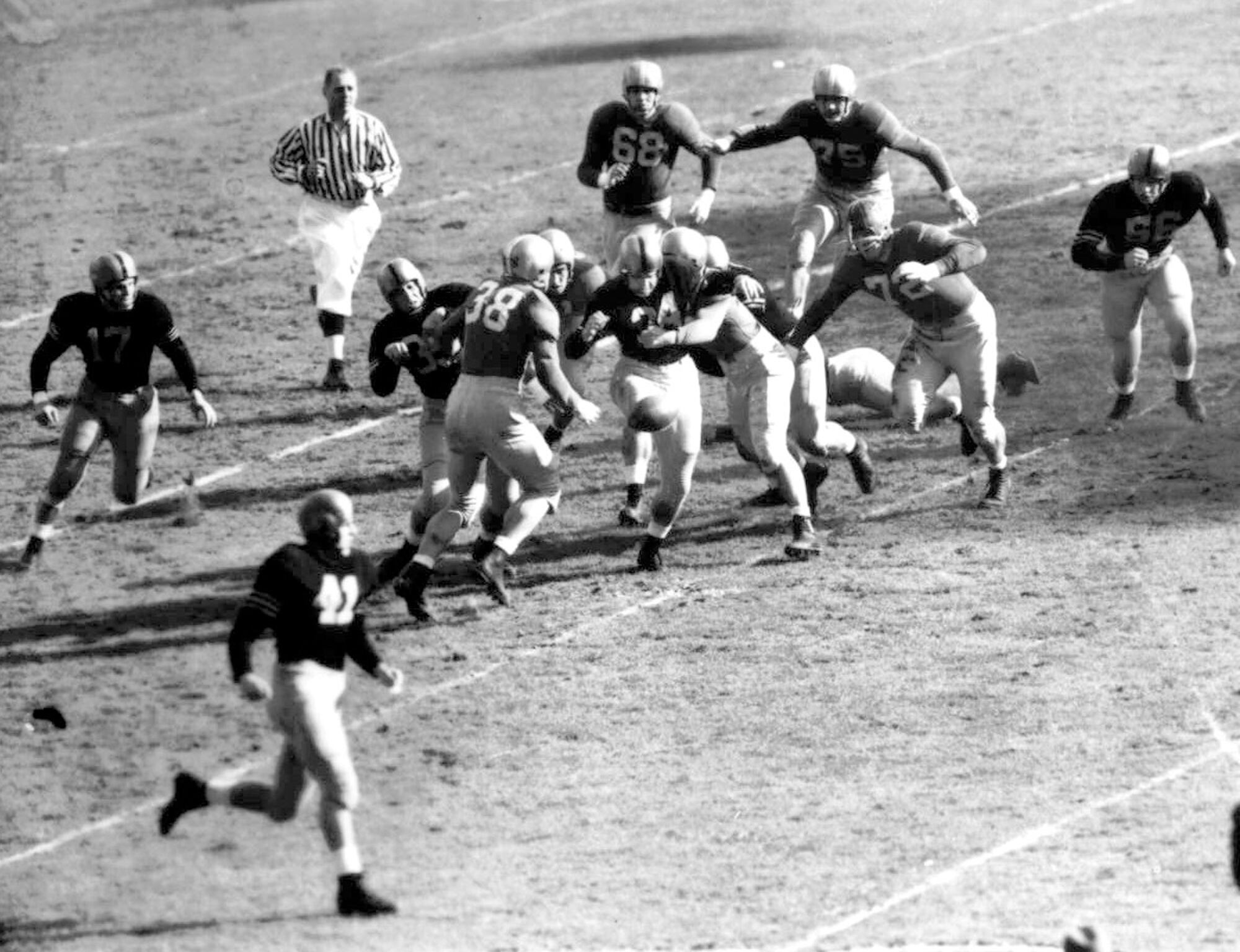
November 9, 1946: One of those college football games that gets the label "Game of the Century" is played at the original Yankee Stadium.

The football team at the United States Military Academy at West Point, New York -- 47 miles north of The Stadium, and they'd used both it and the nearby Polo Grounds as a home-away-from-home a few times -- was usually just called "Army." The teams, as were the students, were known as the Cadets. But, by this point, they were already being called "the Black Knights of the Hudson" in the press. In 1999, the Academy dropped "Cadets," and made "Black Knights" official.

Unlike most college football teams, Army didn't have a manpower drain due to World War II: Quite the opposite: They were training men for war. As a result, head coach Earl "Red" Blaik had the best backfield in the sport, and that included the NFL: Felix "Doc" Blanchard, Number 35; and Glenn Davis, Number 41. Due to their running style, Blanchard became known as "Mr. Inside" and Davis as "Mr. Outside."
In 1943, Army went 7-2-1. They were ranked Number 3 when they played the University of Notre Dame, ranked Number 1, at Yankee Stadium, and lost, 26-0. Army also lost their season finale, to Navy, at Municipal Stadium in Philadelphia (later renamed John F. Kennedy Stadium), 13-0.

But they went 9-0 in 1944, and were named National Champions. This included a 59-0 shellacking of then-Number 5 Notre Dame at Yankee Stadium, and a 23-7 win over Navy at Municipal Stadium in Baltimore. (Memorial Stadium was built on the site in 1954.)

In 1945, again, they went 9-0 and were named National Champions. This included another game at Yankee Stadium, against Notre Dame, then Number 2, and they won it 48-0. And they beat Navy, who had risen to Number 2, 32-13 at Philadelphia Municipal Stadium.

In 1946, they won their 1st 7 games. They beat Villanova at home, 35-0. They beat a rising Oklahoma team at home, 21-7. They beat Cornell at home, 46-21. They went to Ann Arbor and beat Number 4 Michigan, 20-13. They hosted Columbia and won, 48-14. The played Number 13 Duke at the Polo Grounds, and won 19-0. They hosted West Virginia and won, 19-0. They went into Yankee Stadium for the Notre Dame game with a 25-game winning streak.

Notre Dame, based in South Bend, Indiana and known as the Fighting Irish, were coached by Frank Leahy. They won the National Championship in 1943, led by quarterback Angelo Bertelli, who won the Heisman Trophy. In 1944, they went 8-2, losing to Navy and Army in back-to-back games. In 1945, they went 7-2-1. Their loss to Army was immediately preceded by a tie against Navy, and they also lost to the Great Lakes Naval Training Station team.

But in 1946, they were ready to make another run at the National Championship. They beat eventual Big Ten Champion Illinois in Champaign, 26-6. They beat the University of Pittsburgh at home, 33-0. They beat Purdue at home, 49-6. They went to Number 17 Iowa and beat them, 41-6. Then they went to Baltimore and beat Navy, 28-0. They were 5-0 and ranked Number 2 as they went into The Bronx to face Army.

When the teams took the field, there were 4 men who had, or would, win the Heisman Trophy: Blanchard won it in 1945, Davis would win it for 1946, Notre Dame quarterback Johnny Lujack would win it for 1947, and Notre Dame end Leon Hart -- due to the war, freshmen were temporarily made eligible -- would win it for 1949.
Johnny Lujack

There was already history between these teams, and not just in the 3 preceding seasons. In 1913, when Army was one of the top teams in the country and Notre Dame was almost unnoticed, Notre Dame became the 1st college football team to make headlines with the passing game, and upset Army at West Point.

In 1924, they played each other at the Polo Grounds, and Notre Dame won. Nationally-syndicated sportswriter Grantland Rice labeled Notre Dame's backfield "the Four Horsemen." In 1928, they played each other at Yankee Stadium, and Notre Dame coach Knute Rockne invoked the memory of George Gipp, a player who had starred for their 1920 National Championship team and then died, telling them to "win one for the Gipper." The Fighting Irish did just that.

Now, these two powerhouses were playing to set the winner up for the National Championship, in front of 74,121 fans. They saw it in color, but people seeing photographs and newsreels after the fact only saw black & white, and had trouble telling the teams apart: Army wore black jerseys, Notre Dame navy blue ones, and both teams wore gold helmets, with Army's having a black stripe down the middle.
The Corps of Cadets, in formation on the field prior to the game

With the New York and Eastern press pushing Army, and the Chicago and Midwestern press pushing Notre Dame, it was billed as "The Game of the Century."

Sometimes, when a game gets that label, it lives up to the hype. This one did not. Notre Dame had 6 turnovers, 3 of them interceptions of Lujack by Arnold Tucker, who was also Army's quarterback, and finished 5th in the Heisman balloting, behind Davis, Charley Trippi of Georgia, Lujack and Blanchard. (Future Detroit Lions Hall of Fame quarterback Bobby Layne finished 8th.) Army had 4 turnovers.

Notre Dame fumbled on their 1st possession of the game, giving Army the ball on the Notre Dame 23-yard line. But the Cadets couldn't capitalize, and turned the ball over on downs. Notre Dame got to Army's 4-yard line in the 2nd quarter, but also turned it over on downs. Neither Blaik nor Leahy was willing to attempt a field goal; at the very least, the game should have been 3-3 at that point.

In the 3rd quarter, Lujack threw deep, but Tucker intercepted him. Tucker looked like he might return it all the way for a touchdown, but Lujack himself brought him down. A few plays later, Davis tried an option pass, but was intercepted.

And that was the game's last scoring threat. Blanchard and Davis were held to a total of 79 yards. Neither team attempted a field goal. Final score: Army 0, Notre Dame 0. Leahy called it "a terrific battle of defenses."

Army went to Philadelphia, and beat Penn at Franklin Field, and went back there 2 weeks later and beat Navy, to finish the season 9-0-1. Notre Dame hosted Northwestern and beat them, went to New Orleans and beat Tulane, and closed the season by beating Number 16 USC at home.

Neither team accepted an invitation to a postseason bowl game, which was usually the case for each of them. (Although, by playing at Tulane Stadium, site of the Sugar Bowl, it could be argued that Notre Dame played in an equivalent game.) Number 3 Georgia beat Number 9 North Carolina in the Sugar Bowl. Number 5 Illinois beat Number 4 UCLA in the Rose Bowl, the 1st time that game would officially be between the Champions of the Big Nine and the Pacific Coast Conference, the leagues now known as the Big Ten and the Pacific Twelve (or Pac-12). Number 10 Rice beat Number 7 Tennessee in the Orange Bowl. And Number 16 Arkansas beat Number 8 Louisiana State in the Cotton Bowl.

So the question for the National Championship wasn't whether 9-0-1 Army or 8-0-1 Notre Dame was going to receive it, but which one of them. After the season, the Associated Press (AP) released a final poll, with Notre Dame at Number 1 and Army at Number 2. The American Football Coaches Association poll, which became the United Press International (UPI) poll in 1958, also chose Notre Dame. A few minor polls chose Army, and one chose 11-0 Georgia. But Notre Dame was the main pick.

Army eventually extended their unbeaten streak to 31 games, before October 25, 1947, losing to Columbia in a game known as "The Miracle of Morningside Heights." Two weeks after that, they lost to Notre Dame again.

Notre Dame repeated as National Champions, although they split the polls with Michigan. (Now considered big rivals, the teams did not play each other that season.) Only a tie with USC in the season finale spoiled things for the Fighting Irish in 1948, as they again split the polls with Michigan. They went undefeated again in 1949, and there was no split. It was 4 straight National Championships, and a 39-game unbeaten streak. Not until October 7, 1950 did they lose again, at home to Purdue.

That streak would be a record until 1957, when Oklahoma made it 47 straight. Just as would be the case with UCLA basketball and their record 88-game streak from 1971 to 1974, the last team to beat Oklahoma, and the next one, was Notre Dame.

The 1913 game at West Point was the 1st between Army and Notre Dame. They also played each other at West Point in 1914, 1915, 1916, 1917, 1919, 1920, 1921 and 1922. They played at Ebbets Field in 1923. They played at the Polo Grounds in 1925. They played at Yankee Stadium from 1925 to 1929, at Soldier Field in Chicago, Yankee Stadium again from 1931 to 1946. They played at South Bend in 1947, fulfilling their contract. But then they called the rivalry off, as they agreed that the hype had gotten out of control.

They resumed in 1957, at Philadelphia Municipal Stadium. They played at Notre Dame in 1958, 1966, 1970, 1974, 1980, 1985, 1998 and 2006. They played at Shea Stadium in 1965, the old Yankee Stadium in 1969, and West Point in 1973. They played at Giants Stadium in 1977, 1983 and 1995. They played at the new Yankee Stadium in 2010 -- with Notre Dame as the official home team despite Army's proximity -- and the Alamodome in San Antonio in 2016.

Notre Dame leads the rivalry, 39-8-4. Army hasn't beaten Notre Dame since 1958, when Army had Heisman Trophy winner Pete Dawkins. That was Blaik's last season as Army head coach. He lived until 1989. Leahy stayed at Notre Dame through the 1953 season, one more National Championship, and lived until 1973.

The U.S. Army spun the U.S. Air Force off in 1947, and Doc Blanchard was part of its charter officer corps. He later coached Army's freshman football team. He flew 84 combat missions in the Vietnam War, and retired with the rank of Colonel. He served as Commandant of the New Mexico Military Institute, and died in 2009.

Unlike Blanchard, Davis did serve out his military commitment and then play pro football. Unfortunately, when he and Blanchard were filming the movie Spirit of West Point in early 1947 -- which turned out to be Blanchard's last football action -- Davis injured his knee, and arrived with the Los Angeles Rams as damaged goods. He reached the NFL Championship Game in 1950, losing to the Cleveland Browns; and got the Rams back into it in 1951, this time beating the Browns.

Although he made the Pro Bowl in 1950, the knee held him back. And the Rams were loaded in their backfield, with players like Paul "Tank" Younger, "Deacon" Dan Towler and V.T. "Vitamin" Smith. A reinjury of the knee cost Davis the entire 1952 season, and he was released afterward, never to play again. Although both he and Blanchard were elected to the College Football Hall of Fame during their lifetimes, neither became a pro legend. Davis became the organizer of charity events for the Los Angeles Times, and died in 2005.

Lujack played 4 seasons in the NFL, all with the Chicago Bears, succeeding Hall-of-Famer Sid Luckman as starting quarterback. He led the NFL in passing yards and passing touchdowns in 1949, and, despite being a quarterback, led it in rushing touchdowns in 1950. He made the Pro Bowl in 1950 (making him, for the only time in his career, a teammate of Glenn Davis) and 1951.

He returned to Notre Dame as an assistant coach in 1952 and '53, and then became a successful car dealer. As far as I know, Johnny Lujack, now 97 years old, is the last surviving player from this game. He is also the earliest living Heisman Trophy winner. (UPDATE: He died in 2023, leaving Dawkins as the earliest living Heisman winner.)

*

November 9, 1946 was a Saturday. There were other major college football games played that day:

* Number 3 Georgia beat Florida, 33-14 at Fairfield Stadium in Jacksonville, the precursor stadium to the Gator Bowl and the stadium now named TIAA Bank Field.

* Number 6 Michigan beat Michigan State, 55-7 at Michigan Stadium in Ann Arbor.

* Rutgers beat Lafayette, 41-2 at Rutgers Stadium in Piscataway, New Jersey.

* And Princeton lost to Virginia, 20-6 at Palmer Stadium in Princeton, New Jersey.

The baseball season was over. There were 4 games played in the brand-new Basketball Association of America, the league that would become the NBA:

* The Providence Steamrollers beat the Pittsburgh Ironmen, 76-66 at the Rhode Island Auditorium in Providence.

* The Detroit Falcons beat the Boston Celtics, 69-46 at the Olympia Stadium in Detroit.

* The Chicago Stags beat the Toronto Huskies, 62-54 at the Chicago Stadium.

* And the St. Louis Bombers beat the Washington Capitols, 70-69 at the St. Louis Arena.

And there were 2 games played in the NHL:

* The New York Rangers lost to the Toronto Maple Leafs, 4-2 at Maple Leaf Gardens.

* And the Montreal Canadiens beat the Boston Bruins, 5-2 at the Montreal Forum.

Also, Arsenal lost to Preston North End, 2-0 at Deepdale in Preston, Lancashire. 

November 8, 1946: Viola Desmond, the Rosa Parks of Canada

November 8, 1946: Canada develops its own Rosa Parks -- 9 years before America had theirs.

Viola Irene Davis was born on July 6, 1914 in Halifax, Nova Scotia. Her father was a barber, and she wanted to go into the hair care profession, too. But the only beauty school in town wouldn't admit her, because she was black. So she trained where she could: Montreal, Atlantic City, and New York. She married Jack Desmond, and they opened a combination barbershop/beauty salon. She also opened her own beauty school, so no other black woman would have to be denied like she was.

On November 8, 1946, she drove across Nova Scotia to Sydney, to sell her beauty products, but her car broke down in New Glasgow. The good news was, the mechanic she went to was willing to fix a black person's car. The bad news was, it would take a day.

So she went to see a movie. The Roseland Theatre was showing The Dark Mirror, and sold her a ticket to the balcony section, which matched America's treatment of black people in segregated movie theaters. But her eyesight was poor, so she asked for a floor seat. The ticket seller said, "I'm not permitted to sell downstairs tickets to you people." Which, legally, was a lie. She took her ticket for the balcony, and sat in the floor section.

And usher found her, and told her to move. She refused. She offered to pay the additional 10 cents for a floor seat. They responded to this by calling the police, who picked her up, injuring her hip. With that injury, she was in jail for the next 12 hours. She was never informed about her right to legal advice, a lawyer, or bail.

The charge was tax evasion. She wasn't evading anything: She had offered to pay the extra 10 cents. One cent of that was slated for the Province of Nova Scotia, and she was convicted of depriving the government of a single cent. Instead of paying an extra 10 cents, she was fined $26.

Her husband wanted her to let it go, and pay the fine. But her church stood buy her, and hired a lawyer. His name was Frederick Bissett, and he made a critical mistake: He opted for a judicial review, rather than appeal the original conviction. Desmond's lawyer tried to appeal the decision on the basis of her being wrongfully accused of tax evasion, not on the basis of racial discrimination. The prosecutors stood by the theater's story, that the issue wasn't race, it was taxes. Which was a lie, because she had offered to pay the money. The fine stood.

To make matters worse, her husband soon left her. She closed her business, went to college in Montreal, moved to New York, and died on February 7, 1965, only 50 years old. She had surely heard the story of Rosa Parks and the Montgomery Bus Boycott, but there is no record of Mrs. Parks and Mrs. Desmond ever having met.

The legend of Viola Desmond grew after her death. In 2010, the Nova Scotia Provincial government granted her a pardon and an apology. They were posthumous, of course: She would have been 94 years old. Beginning in 2018, her face adorned the Canadian $10 bill, replacing that of the country's 1st Prime Minister, Sir John A. Macdonald.

As of November 8, 2022, there has never been a film made about her, even though a prominent black American film actress shares her birth name of Viola Davis.

*

November 8, 1946 was a Friday. Baseball season was over. There were 3 college football games played that night:

* The University of Miami, based in Coral Gables, Florida, played Miami University, based in Oxford, Ohio, at Burdine Stadium in Miami, the stadium renamed the Orange Bowl in 1959. UM beat MU, 20-17. Each school is named for a Native American tribe, with no connection to each other, and the English translation of each's name to "Miami" was a coincidence. They've faced each other 3 times, and the Florida school has won them all, also winning in 1945 and 1987. (UPDATE: They faced each other again in 2023, and the school usually listed as "Miami (FL)" beat "Miami (OH)" again.)

* Villanova beat the University of Detroit, 23-6 at Titan Stadium in Detroit.

* And Texas A&M beat Southern Methodist University, 14-0 at Ownby Stadium in Dallas.

The NHL season was underway, but no games were scheduled for this day. One game was played in the brand-new Basketball Association of America, the league that would become the NBA: The Toronto Huskies beat the Detroit Falcons, 73-71 at Maple Leaf Gardens in Toronto. Neither team lasted into a 2nd season.

Saturday, November 5, 2022

November 5, 1946: Rifleman 1, Backboard 0

November 5, 1946: The Boston Celtics play their 1st home game, at the Boston Garden. Only 4,329 fans attend, and it's delayed for an hour, because a Celtic player damaged a wooden backboard with a dunk during warmups. A new backboard was brought in from the Boston Arena (now Matthews Arena, home court and ice of Northeastern University). The Celtics lose 57-55 to the Chicago Stags.

The Stags, and the original NBA teams of Washington, Toronto, Pittsburgh, Cleveland, Detroit and St. Louis, would quickly fail. The Celtics might have as well, had their owner, Walter Brown, not also owned the Garden, the NHL's Bruins, and the Ice Capades. He was able to keep the team going long enough to hire Red Auerbach as head coach, and the rest is history.

Oh, the player who became the 1st NBA player to break a backboard? A 6-foot-5 25-year-old Brooklynite who played at New Jersey's Seton Hall University. He went on to play 1 game for his hometown Dodgers in 1949, coming to bat once as a pinch-hitter, never playing the field for them. He then got traded to the Chicago Cubs, and played 66 games at 1st base for them in the 1951 season.

The Cubs' top farm team at the time was the Los Angeles Angels of the Pacific Coast League. While playing in L.A., this athlete found off-season work as a stuntman, and, like John Wayne, moved from stunts to acting, mostly in Westerns. His name was Chuck Connors, famed for his portrayal of Lucas McCain, the lead character of The Rifleman; and as Jason McCord, the lead in Branded. He died in 1992, at age 71.

*

November 5, 1946 was a Tuesday. One other BAA (NBA) game was played that day: The St. Louis Bombers beat the Detroit Falcons, 53-49 at the Olympia Stadium in Detroit. This was the only score on this historic day: Baseball was out of season, football was in midweek, and while the NHL season had started, no games were scheduled for this day.

This was also an election day. The Republican Party won control of both houses of the U.S. Congress. Among the new members of the U.S. House of Representatives were Democrat John F. Kennedy of Massachusetts and Republican Richard Nixon of California.

Among the new Senators were Republicans Joseph R. McCarthy of Wiscoinson, Henry Cabot Lodge Jr. of Massachusetts (grandson of a Senator of the same name), and John Bricker of Ohio (former Governor and the Party's 1944 nominee for Vice President); and Democrat Willis Robertson of Virginia (father of future TV evangelist Pat Robertson).

Tuesday, November 1, 2022

November 1, 1946: The 1st NBA Game

The 1946-47 New York Knicks

November 1, 1946: The the 1st NBA game is played, at Maple Leaf Gardens in Toronto. (Until 1949, the National Basketball Association was known as the Basketball Association of America, or the BAA.) A crowd of 7,090 -- about half of capacity -- attends, and the New York Knickerbockers beat the Toronto Huskies, 68-66.

For the Knicks, coached by Neil Cohalan, 41, and formerly head coach at Manhattan College:

* Number 6, guard Ossie Schectman, 27, from Kew Gardens, Queens, and Long Island University in Brooklyn, where he was coached by Hall-of-Famer Clair Bee, scored the 1st NBA basket, and ended up with 11 points on the night.

* Number 9, guard Leo Gottlieb, about to turn 26, from The Bronx, never went to college, led all scorers with 14.

* Number 7, forward Stan Stutz, 26, from Worcester, Massachusetts, and the University of Rhode Island, scored 9.

* Number 5, forward Ralph Kaplowitz, 27, from The Bronx, where he was a teammate of Gottlieb at DeWitt Clinton High School, and also played for Hall-of-Famer Howard Cann at New York University, scored 7.

* Number 11, center Jake Weber, 28, from Rushville, Indiana, and Purdue University, scored 6. At 6-foot-6, he was the tallest player on the team.

* Number 12, Hank Rosenstein, 26, from Bedford-Stuyvesant, Brooklyn, and played for Hall-of-Famer Nat Holman at City College of New York, scored 5.

* Number 15, guard Dick Murphy, 25, from College Point, Queens, and played for Cohalan at Manhattan College, scored 5.

* Number 4, forward Nat Militzok, 23, from the Lower East Side of Manhattan, and Cornell University, scored 5.

* Number 14, forward Tommy Byrnes (not to be confused with Yankee pitcher Tommy Byrne), 23, from The Bronx, another Clinton High graduate but too young to have played with Gottlieb and Kaplowitz, scored 4.

* Number 8, guard Sidney "Sonny" Hertzberg, 24, from Flatbush, Brooklyn, and a CCNY teammate of Rosenstein, scored 2.

* And Number 10, guard Bob Mullens, on his 24th birthday, from Staten Island, and Fordham University, played, but scored none. In a weird twist of fate, before the season was out, Mullens would be traded to the Huskies. So would Militzok.

So that's 11 players, only 2 of them from outside New York City, 3 of them Irish and the rest Jewish. This would not have been odd for a college team from New York at that time, so it's not odd for the 1st real major league team from The City.

For the Huskies: Ed Sadowski scored 18, George Nostrand 16, Charlie Hoefer 8, Mike McCarron (from Elmhurst, Queens, and Seton Hall) 6, Ray Wertis 6, Dick Fitzgerald 6, his brother Bob Fitzgerald (both from Elmhurst, and Fordham) 4, Harry Miller (from West Orange, New Jersey, and Seton Hall) 1, Frank Fucarino (from Astoria, Queens, and an LIU player) 1, Roy Hurley none, and Hank Biasatti none. (I wonder if anyone attended the game thinking they were actually getting a recent college star, Stanford's Hank Luisetti.)
Maple Leaf Gardens in Toronto, site of the 1st NBA game

This film purports to be from that first game. Is it? It could be: The teams are the Knicks and the Huskies, and the Huskies are wearing white as home teams tend to do in basketball. However, the Knicks did make 2 more visits that season, winning both, on December 20, 1946 and March 28, 1947, so this film could be from any of those 3 games.

The Knicks are 1 of only 2 charter NBA teams still playing in their current city. The other is the Boston Celtics. These 2 teams have just started their 81st season. The Celtics started their 1st on November 2, 1946, losing to the Providence Steamrollers, 59-53 at the Rhode Island Auditorium in Providence.

Neither, however, is pro basketball's oldest franchise. The Philadelphia SPHAs were founded in 1917, as the team of the South Philadelphia Hebrew Association. They, too, were a charter BAA/NBA team, as the Philadelphia Warriors. They are still playing today, as the Golden State Warriors, having moved to the San Francisco Bay Area in 1962. On November 7, the Warriors made their debut, beating the Pittsburgh Ironmen, 81-75 at the Philadelphia Arena.

The Knicks went 33-27, good enough to make the Playoffs. The Huskies went 22-38, going through 4 head coaches, the last being former New York Yankees 3rd baseman Red Rolfe, who lasted the longest, going 17-27. They missed the Playoffs, and went out of business after just 1 season. The NBA did not return to Toronto until 1995 with the Raptors.

Maple Leaf Gardens, built for the NHL's Toronto Maple Leafs in 1931, closed in 1999, the last of the NHL's "Original Six" arenas in use. It has been converted into retail space, like its great rival, the Montreal Forum.

Also missing the Playoffs: The Celtics, who took a few years to get going; the Providence Steamrollers, named for a 1920s football team, and went out of business after the 1948-49 season; the Detroit Falcons, who folded after that 1st season; and the Pittsburgh Ironmen, whose 15-45 record was the worst in the league, and also folded after the 1st season.

The NBA has never returned to Pittsburgh, although the Pipers won the 1st ABA Championship, in 1967-68. The Ironmen's most notable attribute is that their players included Petar Maravich, known as "Press" because he had delivered The Pittsburgh Press newspaper as a boy. If his name sounds familiar, it's because, 20 years later, at Louisiana State, he was the head coach, and his players included his son, Peter Press Maravich, a.k.a. Pistol Pete.

In the 1st Round of the Playoffs, the Knicks defeated the Cleveland Rebels, who folded after that 1st season. The Warriors eliminated the St. Louis Bombers, who lasted through the 1949-50 season.

In the Semifinals, the Warriors eliminated the Knicks. And the Chicago Stags beat the Washington Capitols, whose 49-11 record had been the best in the league. They lasted through the 1950-51 season.

In the Finals, the Warriors beat the Stags, 4 games to 1, clinching the title on April 22, 1947, at the Philadelphia Arena: Warriors 83, Stags 80. Joe Fulks of the Warriors was the league's 1st scoring champion.

As I mentioned, Ossie Schectman of the Knicks scored the 1st NBA basket. He died on July 30, 2013, at the age of 94. He was the last surviving player from the original Knicks. Jerry Rullo, a Philadelphia native who played for the Warriors, was the last surviving player from the NBA's 1st season, living until the 70th Anniversary, October 21, 2016, age 93.

*

November 1, 1946 was a Friday. Ric Grech, who played bass guitar with the British bands Traffic and Blind Faith, was born on this day.

Baseball season was over. No football games were played. And no other pro basketball games were played.

The 2 Canadian teams in the National Hockey League, the Toronto Maple Leafs and the Montreal Canadiens, played each other to a 1-1 tie at the Montreal Forum. Gus Bodnar put the Leafs ahead with a power play goal, with 5:22 left in the 1st period. But with 9:55 left in regulation, George Allen (no relation to the Pro Football Hall of Fame coach of the same name) tied the game for the Habs.

December 31, 1999 & January 1, 2000: The Millennium

December 31, 1999:  The Millennium arrives. The people of planet Earth survived. At a terrible cost. But we hadn't destroyed ourselves. ...