Showing posts with label ira. Show all posts

Sunday, November 27, 2022

November 27, 1975: The Assassination of Ross McWhirter

The McWhirter Twins, 1974: Norris (left) & Ross

November 27, 1975: Ross McWhirter, with his twin brother Norris a sportswriter, co-founder of The Guinness Book of World Records, and a Conservative Party activist, is assassinated outside his home in Enfield, North London. He was 50 years old.

The twin brothers were born on August 12, 1925 in North London, and both served in the Royal Navy in World War II, on a minesweeper. They became sports journalists. In 1951, they published Get to Your Marks, and earlier that year they had founded an agency to provide facts and figures to Fleet Street, the catch-all name for British newspapers, even if they were no longer based on the London street of that name.

In 1954, Norris served as the public address announcer for the track meet at Oxford University in which Roger Bannister became the 1st man to run a mile race in under 4 minutes. Also competing that day was Christopher Chataway, who worked for the Guinness brewery, and introduced them to his boss, Sir Hugh Beaver.

The following year, the 1st Guinness Book of World Records was published, billed as the ultimate settler of bar bets. It quickly became the biggest-selling book in Britain, setting a world record itself, and eventually became more famous than the stout itself. In 1965, the twins were guests on the American panel game show I've Got a Secretwhere they exhibited their memorization of their book.

Both brothers became Conservative Party activists. Both ran for seats in Parliament in the 1964 general election, but were unsuccessful. Norris tried again in 1966, and lost again. In 1972, Prime Minister Edward Heath, Leader of the Conservative Party, brought Britain into the European Common Market. Norris called it "treason." In a 2017 article in The Guardian, Stuart Jeffries called him "the original Brexiter":

Imagine, if you dare, that Katie Hopkins is also the status guru on Test Match Special. Or that Nigel Farage is renowned not just as the beef-faced broker who got us out of the EU but for his astute postgame analysis on Match of the Day.

Neither of these comparisons really does justice to Norris McWhirter. He was something else. He was alt-right before the term was invented. 

(For readers not familiar with British politics: Hopkins is a newspaper columnist, known for her anti-immigrant views; Farage was the longtime leader of the far-right UK Independence Party, and claims to be the person most responsible for Britain finally leaving the European Union, the process known as "Brexit"; Test Match Special is a TV show about cricket; Match of the Day, about soccer. And, yes, there is another show on British TV, called Soccer Saturday, so they don't always call that sport "football.")

Ross advocated and lobbied for various restrictions on the freedom of the Irish community in Britain, such as compulsory registration with the local police, and a requirement for signed photographs when renting flats or booking hotel rooms. If that sounds like something that Donald Trump would like, that's not my fault.

In 1975, Ross McWhirter offered a £50,000 reward -- in 2022 money, about £342,000; with the current exchange rate, about $415,000 -- for information leading to a conviction for several recent high-profile bombings in England that were publicly claimed by the Provisional Irish Republican Army (IRA).

On November 27, at 6:45 PM, he was shot by 2 members of the Balcombe Street Gang. The killers were Harry Duggan and Hugh Doherty. Duggan said later, "McWhirter thought he lived in Texas. He put a bounty on our heads. He asked to be killed."

No, he didn't. Being a right-wing jerk is not an invitation to murder. And killing him didn't accomplish anything.

Duggan and Doherty were captured 9 days later, and charged with his murder and 10 others. They were sentenced to life imprisonment, but freed in 1999 under the terms of the Good Friday Agreement. As of November 27, 2022, both men are still alive.

Norris McWhirter lived on, without his brother, as a union-bashing libertarian. With the election of the Conservatives, and of the twins' longtime friend Margaret Thatcher as Prime Minister, in 1979, his beliefs became, for the most part, official government policy.

He had medals cast and given to athletes boycotting the Olympics in Moscow in 1980, and publicly defended athletes who dared to resist the ban on playing sporting events in then-apartheid South Africa. Defenders of that state, in both Britain and America, defended by saying they weren't personally racist, themselves, but supported a regime that was openly anti-Communist. Of course, the implication was that the country's black activists were Communists.

Norris sold his interest in the Guinness Book in 1996, and died on April 19, 2004, at the age of 78.

*

November 27, 1975 was a Thursday. In America, it was Thanksgiving Day. Since 1934, that had meant that the Detroit Lions played at home. This would be their 1st T-Day game in the suburbs, and they lost, 20-0 to the Los Angeles Rams, at the Silverdome in Pontiac, Michigan.

Since 1966, Thanksgiving had meant that the Dallas Cowboys played at home. But this year, and again in 1977 (but not in 1976), the NFL deviated from Dallas, giving the home game to the football version of the St. Louis Cardinals. The Cards lost to the Buffalo Bills, 32-14 at Busch Memorial Stadium. The NFL might have been motivated to give St. Louis the game not because of the Cardinals, but because of their opponents: The Bills featured the most popular player in the League, running back O.J. Simpson.

One game was played in college football, the rivalry known as "Clean Old-Fashioned Hate": Georgia, then ranked Number 15, beat Georgia Tech, 42-26 at Grant Field in Atlanta.

Baseball was out of season. There were 3 games played in the NBA:

* The New York Knicks beat the Washington Bullets, 96-90 at the Capital Centre in the Washington suburb of Landover, Maryland.

* The Kansas City Kings beat the Cleveland Cavaliers, 95-91 at The Coliseum in the Cleveland suburb of Richfield, Ohio.

* And the Golden State Warriors beat the Milwaukee Bucks, 106-105 at the Milwaukee Exposition & Convention Center Arena, a.k.a. The MECCA. (It's now the UW-Milwaukee Panther Arena.)

And there was 1 game in the American Basketball Association: The Utah Stars beat the Kentucky Colonels, 128-126 in overtime at the Salt Palace in Salt Lake City, Utah. Despite the defeat, William "Bird" Averitt of the Colonels led all scorers on the night with 43 points. Ron Boone led the Stars with 34.

There were 2 games in the NHL. The Montreal Canadiens beat the New York Islanders, 2-1 at the Nassau Coliseum. And the League's Missouri teams played each other: The Kansas City Scouts beat the St. Louis Blues, 3-2 at the Kemper Arena (now the Hy-Vee Arena) in Kansas City. This may have been the Scouts' high point: A year later, they moved to Denver, becoming the Colorado Rockies. In 1982, they moved again, becoming the New Jersey Devils.

And there were 4 games in the World Hockey Association:

* The Indianapolis Racers beat the Winnipeg Jets, 3-1 at the Market Square Arena in Indianapolis.

* The Minnesota Fighting Saints beat the Cincinnati Stingers, 5-3 at the St. Paul Civic Center in St. Paul, Minnesota.

* The Calgary Cowboys beat the Phoenix Roadrunners, 5-1 at the Arizona Veterans Memorial Coliseum in Phoenix.

* And the San Diego Mariners beat the Quebec Nordiques, 5-1 at the San Diego Sports Arena (now the Pechanga Arena).

Wednesday, October 12, 2022

October 12, 1984: The Brighton Hotel Bombing

October 12, 1984: At 2:54 AM, a bomb planted by the Provisional Irish Republican Army explodes in Room 629 of the Grand Hotel in Brighton, Sussex, on England's South Coast. There was a Conservative Party meeting there, and 5 people were killed. But the main target, Prime Minister Margaret Thatcher, escaped serious injury.

The victims were Anthony Berry, a Member of Parliament; Donald Maclean, the President of the Scottish Conservative and Unionist Party; his wife, Muriel; Lady Jeanne Shattock, the wife of the Western Area chairman of the Conservative Party, Sir Gordon Shattock, who was injured but survived; and Roberta Wakeham, wife of John Wakeham, then the Government Chief Whip in the House of Commons, who has since been created a Baron.

(Both Shattock and Wakeham would remarry. In the latter's case, he married his secretary, Alison Ward -- who had previously served as Thatcher's secretary.)

The explosion caused several floors a wing of the hotel to collapse. Norman Tebbit, then Secretary of State for Trade and Industry, recalled:

The ceiling came crashing down on us and then, in a hail of debris, the floor collapsed, catapulting us down under an avalanche of bricks, timber and plaster. The force of the impact was indescribable, blow after blow as the debris smashed on to my left side. Something tore into my abdomen with a terrible blow, and I heard my very guts sloshing inside me. There was a colossal impact tearing a great hole in my side, then I stopped falling, with no idea where, nor even which way up I was, as the debris cascaded down.

But he survived. His wife, Margaret, fell through 4 floors, and was wheelchair-bound for the rest of her life. Thatcher's room was below the Tebbits'. Her bathroom was badly damaged but she, her husband Denis, and Robin Butler, her personal private secretary, were all uninjured.

According to Rory Carroll, then 12 years old and living in Dublin, but later the Ireland correspondent for English newspaper The Guardian and the author of a book on the bombing, the bomb "did not even scratch her. But it came very, very close." He theorized that if she had still been in the bathroom, "she would have been cut to ribbons, perhaps fatally."

The Provisional IRA released this statement: "Mrs. Thatcher will now realise that Britain cannot occupy our country and torture our prisoners and shoot our people in their own streets and get away with it. Today we were unlucky, but remember we only have to be lucky once. You will have to be lucky always. Give Ireland peace and there will be no more war."

Thatcher responded with her usual bluntness: "That is the scale of the outrage in which we have all shared, and the fact that we are gathered here now -- shocked, but composed and determined -- is a sign not only that this attack has failed, but that all attempts to destroy democracy by terrorism will fail."

The man who planted the bomb was Patrick Magee, then a 33-year-old Provisional IRA member who had previously served 2 years in prison. He was sentenced to 8 life terms, but was released in 1999 as part of the Good Friday Accord. As of October 12, 2022, he is still alive, and has written a book about his experiences.

If the Provisional IRA thought this bombing would rally people to their cause, they were wrong. Support for Thatcher only grew, as she achieved the rare distinction of being both strong leader and victim at the same time.

Thatcher had led the Conservative Party to victory in the national elections of 1979 and 1983, and would do so again in 1987. But an intraparty squabble forced her out in 1990. Tebbit was among those considering running to support her, but, still needing to look after his wife, he retired from the Commons instead, and John Major became Prime Minister. Like Wakeham, Tebbit was later created a Baron, and sat in the House of Lords.

Thatcher was loved by conservatives for her toughness and her belligerence, but hated by the poor, labor unions, and especially the Irish, for being bigoted and openly harmful to them. She was renowned for her alliance with Ronald Reagan, whose entire Presidency was during her Premiership. When Reagan died, the half of America that hated him held its tongue out of respect; when Thatcher died, the half of Britain that hated her rejoiced.

*

October 12, 1984 was a Friday. Game 3 of the World Series was played at Tiger Stadium in Detroit. The Detroit Tigers beat the San Diego Padres, 5-3. Milt Wilcox outpitched Tim Lollar. Marty Castillo hit a home run for the Tigers, who would win the Series in 5 games.

Football was in midweek. The NBA season hadn't started yet, but there were 2 games played in the NHL. The New Jersey Devils beat the New York Islanders, 7-2 at the Brendan Byrne Arena at the Meadowlands. And the Edmonton Oilers beat the St. Louis Blues, 5-1 at the Northlands Coliseum in Edmonton.  

Thursday, May 5, 2022

May 5, 1981: The Death of Bobby Sands

May 5, 1981: Bobby Sands, Member of Parliament for Fermanagh and South Tyrone, dies at Her Majesty's Prison Maze in County Down, Northern Ireland, 66 days after starting a hunger strike there. He was 27 years old.

He was 15 when the Northern Irish civil war known as "The Troubles" began in 1969, and, as a Catholic, he discovered that Protestant kids who once considered him a friend would no longer even talk to him. He dropped out of school, and took a job building buses. Members of a Loyalist "Tartan gang" found him on the job, held him at gunpoint, and told him never to come back if he valued his life.

In 1971, he joined the Provisional Irish Republican Army. He served 3 years in prison on a gun charge. He and a colleague planned the bombing of the Balmoral Furniture Company in Dunmurry in 1976. A gun battle ensued, and Sands was among those arrested trying to escape. He and 3 other men were sentenced to 14 years in prison -- not for the bombing, but for possession of the gun used in the ensuing shootout. It was as if they were giving him the bombing's punishment for the much smaller charge.

Conditions at Maze were brutal. Guards frequently took prisoners, including Sands, and stripped them naked and beat them. This was in response to the end of "Special Category Status," as they began to be treated like any other criminal, and not like a political prisoner, and thus forced to wear prison uniforms.

A committee of prisoners, led by Sands, presented a list of demands, including the right not to wear a prison uniform, and more blankets for the Winter months. These demands were flat-out refused. On March 1, 1981, Sands began his strike, saying he and the other prisoners would not eat until the demands were met.

Four days later, Frank Maguire, Member of Parliament for the district of Fermanagh and South Tyrone, died of a heart attack, forcing a by-election for his seat on April 9. In solidarity, some potential candidates withdrew, and threw their support to Sands, who was unable to campaign, and was in no position to even intend to. He won, 30,493 votes to 29,046 for a Loyalist candidate, a 1,447-vote margin of victory, 51.2 percent of the vote.

But he would never be able to take that seat. He remained in prison, and his strike went on and on. Because of the large Irish presence in America, the national news here covered this story day after day, counting up the days just as they did with the recently-ended Iran Hostage Crisis.

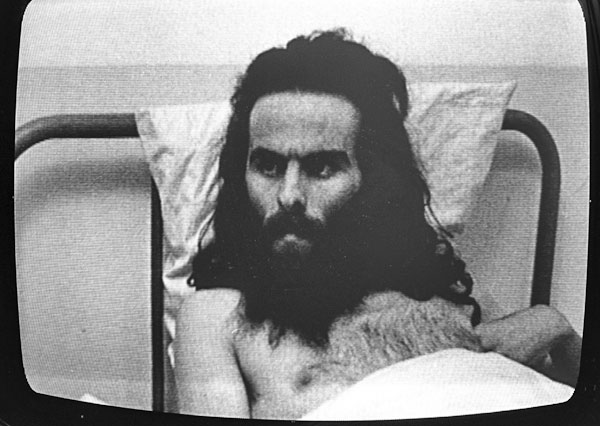
On Day 55 of the strike, ABC World News Tonight showed the photograph above, showing what Sands looked like before his conviction, and then, not having access to a current photograph, showed an artist's depiction of what he looked like at this point. I can't find that drawing on the Internet, but he looked like images I'd seen of newly-freed prisoners from the Nazi Holocaust. The only photograph I've seen shows him with a long beard that obscures how skinny he'd gotten, and it isn't clear how close to the end he was.
People from all over the world, including Pope John Paul II, head of the Roman Catholic Church, contacted British Prime Minister Margaret Thatcher, begging her to give in to the demands, rather than let a duly-elected Member of Parliament die. A Protestant and a hard-right-wing Conservative, she flat-out refused.

On Day 66, May 5, Sands died. Thatcher's official response, while addressing Parliament: "Mr. Sands was a convicted criminal. He chose to take his own life. It was a choice that his organization did not allow to many of its victims."

Over 100,000 people lined the route of Sands' funeral, and he was buried not far from his parents' home, in Milltown Cemetery in West Belfast.

The 1981 British Home Championships were canceled, because the "national" soccer teams of England and Wales refused to play away to Northern Ireland, not because they opposed Sands (not officially, anyway), but because they were afraid they would be attacked by the home fans.

In New York, the International Longshoremen's Association announced a 24-hour boycott of providing service to British ships; and the Archbishop, Terence Cardinal Cooke, offered a Mass of Reconciliation. Perhaps the greatest tribute was an agreement of the City's Irish bars: For 2 hours, they closed.

In New Jersey, the General Assembly, the lower house of the State legislature, voted 34-29 for a resolution honoring Sands' "courage and commitment." Just 28 miles away, in East Brunswick -- and with towns named Milltown and Old Bridge, also the names of towns in Northern Ireland, on either side -- the 11-year-old version of me couldn't understand why Thatcher let it happen.

President Ronald Reagan, an American of Irish descent, but a Protestant one, survived an assassination attempt during the hunger strike (although that had nothing to do with it), and made no public statement about Sands' cause, and made no statement on the occasion of Sands' death.

Another 9 hunger strikers would die, before the remaining strikers gave up. What did they gain? Publicity and sympathy, but nothing else.

On July 2, Parliament passed the Representation of the People Act 1981, automatically disqualifying anyone from election if they were serving more than one full year in prison. On August 20, a by-election for Sands' seat was held, and Owen Carron, a Sands ally, won with 49.1 percent of the vote, but with a larger margin of victory than Sands. Although never officially connected with terrorism, he lost his bid for re-election in 1983.

On October 5, James Prior, newly installed as the British government's Northern Ireland Secretary, agreed to Sands' original demands for the remaining political prisoners.

Thatcher remained Prime Minister until 1990. The Good Friday Agreement, not even remotely possible as long as she remained in office, ended The Troubles in 1998. HM Prison Maze was closed in 2000, and demolition began in 2006. Had the British government shown some humanity, and accepted his reasonable demands, Bobby Sands would have been 52 years old.

In 2013, Thatcher died, and while half of Great Britain, including the Protestant sectors of Northern Ireland, went into deep mourning, the other half, including the Catholic sectors of Northern Ireland, cheered. There was no holding of tongues by her opponents, as happened in America in 2004 upon Reagan's death.

Also in 2013, the Maze site was redeveloped into Balmoral Park, a showgrounds. With some irony, the main tenant is the Balmoral Show, an agriculture exhibition.

*

May 5, 1981 was a Tuesday. Actress Danielle Fishel was born. She played Topanga Lawrence on the sitcom Boy Meets World, and later, having married the earlier show's protagonist, Topanga Matthews on the sequel sitcom Girl Meets World.

These games were played in Major League Baseball:

* The New York Yankees lost to the California Angels, 6-2 at Anaheim Stadium (now Angel Stadium of Anaheim). Barry Foote hit a home run, but Reggie Jackson went 0-for-4, and Tom Underwood was removed when he couldn't get an out in the 4th inning. Brian Downing later hit a home run for the Halos.

* The New York Mets lost to the San Francisco Giants, 9-7 at Shea Stadium.

* The Montreal Expos beat the San Diego Padres, 4-3 at the Olympic Stadium in Montreal.

* The Philadelphia Phillies beat the Los Angeles Dodgers, 8-7 at Veterans Stadium in Philadelphia. Manny Trillo homered, and Mike Schmidt and Pete Rose each had a 2-RBI double.

* The Baltimore Orioles beat the Minnesota Twins, 3-2 at Memorial Stadium in Baltimore.

* The Houston Astros beat the Chicago Cubs, 4-3 at Wrigley Field in Chicago.

* The St. Louis Cardinals beat the Atlanta Braves, 4-1 at Busch Memorial Stadium in St. Louis.

* The Kansas City Royals beat the Boston Red Sox, 2-1 at Royals Stadium (now Kauffman Stadium) in Kansas City. George Brett went 1-for-4 for the Royals, while Carl Yastrzemski did not play for the Red Sox.

* The Texas Rangers beat the Chicago White Sox, 6-1 at Arlington Stadium in the Dallas suburb of Arlington, Texas.

* The Oakland Athletics beat the Detroit Tigers, 6-2 at the Oakland Coliseum.

* The Milwaukee Brewers beat the Seattle Mariners, 4-1 at the Kingdome.

* The Cincinnati Reds and the Pittsburgh Pirates were supposed to play each other at Three Rivers Stadium in Pittsburgh, but were rained out. The game was made up as part of a doubleheader on May 7, and the Pirates won both games, 3-1 and 7-1.

* The Cleveland Indians and the Toronto Blue Jays were supposed to play each other at Exhibition Stadium in Toronto. This game was never made up, due to the Strike of '81.

Football was out of season. The NBA Playoffs were in the Conference Finals. In the East, the Boston Celtics beat the Washington Bullets, 131-126 in double overtime at the Boston Garden, to move on to the Conference Finals. And the Milwaukee Bucks beat the Philadelphia 76ers, 110-98 at The Spectrum in Philadelphia. But, 2 nights later, the Sixers beat the Bucks to advance to face the Celtics.

In the West, the San Antonio Spurs eliminated the Seattle SuperSonics, 109-103 at the Kingdome in Seattle, setting them up to play the Los Angeles Lakers, who had already wrapped up their Conference Final berth. (Yes, the Kingdome hosted baseball and basketball on the same day.) In the NBA Finals, the Lakers beat the 76ers.

The Stanley Cup Playoffs were approaching their climax. The day before Sands' death, the New York Islanders had wrapped up their 3rd straight Finals bid, completing a 4-game sweep of the Quebec Nordiques. The day after his death, the Vancouver Canucks clinched their 1st Finals appearance, beating the Chicago Black Hawks in 5 games.

Sunday, January 30, 2022

January 30, 1972: Bloody Sunday In Derry

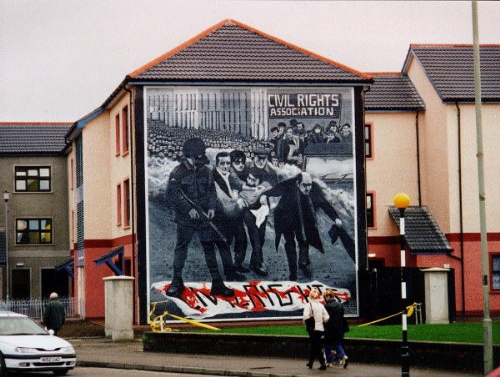
A commemorative mural in Derry

January 30, 1972: The Bogside Massacre occurs in Derry, Northern Ireland. It is one of many events in Ireland's history to be known as "Bloody Sunday."

NOTE: This event should not be confused with the Battle of the Bogside, also in Derry, a 3-day riot in August 1969.

Ireland had been controlled by England since 1649, until the settlement of the Irish War of Independence in 1922 founded the Republic of Ireland, and left only 6 Counties still under British control: Antrim, Armagh, Down, Fermanagh, Londonderry (including the city that the British call Londonderry and the Irish call simply Derry) and Tyrone. The capital of Northern Ireland, Belfast, straddles Antrim and Down.

By 1969, angry at the continued oppression they faced from the Protestant British establishment, and inspired by the Civil Rights Movement for black Americans, the Catholics of Northern Ireland had begun to assert their rights. The government, through the police, known as the Royal Ulster Constabulary (RUC), fought back, and what became known as "The Troubles" began.

An offshoot of the original Irish Republican Army (IRA) began attacking the RUC. In response, paramilitary groups like the Ulster Volunteer Force (UVF) began a campaign of atrocities. Each side kept upping the ante. The IRA had started out as a defensive force, but were, by no means, innocent.

An explosion was destined to happen. Hoping to avoid it, British Prime Minister Edward Heath sent the British Army in to keep the peace. Some Catholics accepted this as better than the RUC and the UVF. Some saw that the Army was every bit as hostile and biased.

On January 18, 1972, Prime Minister Brian Faulkner of Northern Ireland banned all political demonstrations -- Protestant and Catholic alike -- for the rest of the calendar year. But on January 22, a march was made to the internment camp at Magilligan Strand near Derry. The Army blocked the way. The marchers threw rocks, and the soldiers charged and beat people with their batons.

It was decided to hold another march on January 30. The Army decided to allow it to reach the Bogside, a neighborhood outside the old city walls of Derry, but not to reach Guildhall Square. About 15,000 people marched, and the peaceful nature of it was broken when some protestors, again, began throwing rocks at the soldiers.

This time, as with the Boston Massacre of 1770, British soldiers responded to the throwing of rocks by opening fire. There were 26 people wounded, with 13 dying immediately, and a 14th later dying of his injuries.

In April, the Widgery Tribunal issued a report, blaming the protestors, who were not only throwing rocks, which was true; but bombs, and were shooting, which was denounced as a lie.

With his band Wings, Paul McCartney, like the other ex-Beatles an Englishman of Irish descent, released a song: "Give Ireland Back to the Irish." It was banned by the BBC. Ex-Beatle John Lennon released a song titled "The Luck of the Irish," singing, "If you really had the luck of the Irish, you'd wish you were English instead." He wrote another song about the incident, "Sunday Bloody Sunday." Geezer Butler of Black Sabbath followed this by writing "Sabbath Bloody Sabbath." In 1983, the Belfast-based U2 released a different song titled "Sunday Bloody Sunday."

In 1998, the Good Friday Accord finally put an end to The Troubles. In 2010, the Saville Inquiry -- having nothing to do with the notorious English entertainer Jimmy Savile -- released a report saying that none of those shot on Bloody Sunday '72 were armed, no bombs were thrown by the protestors, and that the Army's shooting was "unjustified" and "unjustifiable." Prime Minister David Cameron offered an official apology on behalf of the British government.

*

January 30, 1972 was, as I said, a Sunday. Baseball and football were out of season. There were no games played in the American Basketball Association that day. But there were 6 games played in the NBA: 

* The Boston Celtics beat their arch-rivals, the Philadelphia 76ers, 130-114 at the Boston Garden. Billy Cunningham scored 41 in defeat for the Sixers.

* The Milwaukee Bucks beat the Baltimore Bullets, 116-112 at the Baltimore Civic Center (now the CFG Bank Arena). In a rematch of the previous season's NBA Finals, Kareem Abdul-Jabbar socred 39 for the Bucks.

* The Buffalo Braves beat the Cleveland Cavaliers, 99-98 at the Cleveland Arena.

* The Chicago Bulls beat the Detroit Pistons, 109-99 at the Chicago Stadium.

* The Phoenix Suns beat the Atlanta Hawks, 105-103 at the Arizona Veterans Memorial Coliseum in Phoenix.

* And the Los Angeles Lakers beat the Portland Trail Blazers, 153-131 at The Forum outside Los Angeles in Inglewood, California.

There were no games played in the ABA that day. But there were 6 NHL games played:

* The New York Rangers played the Minnesota North Stars to a tie, 1-1 at Madison Square Garden.

* The Boston Bruins beat the St. Louis Blues, 5-2 at the Boston Garden. Yes, the old North End barn hosted the Celtics and the Bruins on the same day.

* The Philadelphia Flyers beat the Pittsburgh Penguins, 4-0 at The Spectrum in Philadelphia.

* The Buffalo Sabres played the Los Angeles Kings to a tie, 2-2 at the Buffalo Memorial Auditorium.

* In an "Original Six" matchup, the Chicago Black Hawks beat their arch-rivals, the Detroit Red Wings, 4-2 at the Chicago Stadium. Yes, the old West Side barn hosted the Bulls and the Hawks on the same day.

* And the California Golden Seals beat the Vancouver Canucks, 2-0 at the Pacific Coliseum in Vancouver.

December 31, 1999 & January 1, 2000: The Millennium

December 31, 1999:  The Millennium arrives. The people of planet Earth survived. At a terrible cost. But we hadn't destroyed ourselves. ...