Showing posts with label braves field. Show all posts

Tuesday, October 11, 2022

October 11, 1948: The Cleveland Indians Win the World Series

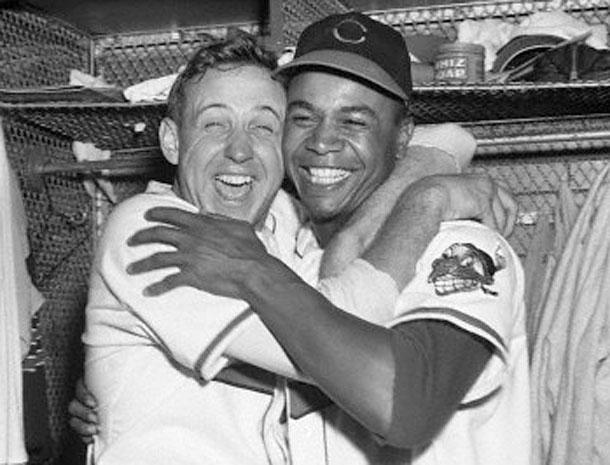
Steve Gromek (left) and Larry Doby

October 11, 1948: The Cleveland Indians defeat the Boston Braves behind "rookie" 30-year-old knuckleballer Gene Bearden, 4-3 at Braves Field, and take Game 6 and win the World Series. It is their 2nd title, the 1st coming in 1920.

Team owner Bill Veeck had built this team. Larry Doby and Satchel Paige thus become the 1st black players to play on a World Series winner. Doby became the 1st black player to hit a home run in a World Series game. And Lou Boudreau, age 31, both shortstop and manager, becomes the last player-manager to win a World Series, or even a Pennant. Bob Feller would join Veeck, Doby, Paige and Boudreau in the Baseball Hall of Fame, although he ended up as the losing pitcher in both games the Indians lost in the Series: Game 1, to Johnny Sain; and Game 5, to another Hall-of-Famer, Warren Spahn.

A photograph of Doby being hugged by a white teammate, pitcher Steve Gromek, circulated, and was considered another step forward in black and white players working together.

The team has never won another World Series. They have had some close calls, some of them truly agonizing. And they're not even called the Indians anymore: In 2021, after years of complaints about their Native American name and its racist implications, they announced that, for the following season and thereafter, they would be named the Cleveland Guardians.

But at least they're still in Cleveland, despite a number of fears of having to move in the 1960s, '70s and '80s. In contrast, despite all their success in the 19th Century and winning Pennants in 1914 and 1948, that 1948 World Series Game 6 was the last late-season meaningful game the Boston franchise of the National League would ever play. The Braves would be in Milwaukee by the next time they reached the Series, in 1957.

The Indians' Eddie Robinson was the last surviving player from the 1948 World Series, living until 2021, age 100, 73 years later. Clint Conatser was the last survivor of the '48 Braves, living until 2019, at 98.

UPDATE: The Guardians have a team Hall of Fame. From the 1948 World Champion Indians, they have honored Lou Boudreau, Bob Feller, Satchel Paige, Bob Lemon, Early Wynn, Mike Garcia, Joe Gordon, Larry Doby, Al Rosen, Ken Keltner, Jim Hegan, team owner Bill Veeck, scout Cy Slapnicka, and broadcasters Jack Graney and Jimmy Dudley. Feller and Hegan have also been elected to the Greater Cleveland Sports Hall of Fame.

*

October 11, 1948 was a Monday. This was also the day Thomas Merton publishes his memoir The Seven Storey Mountain. I have a separate entry for that event.

The baseball season had ended that day. Football was in midweek. And it was too soon for the NBA and NHL seasons. So there were no other scores on this historic day.

Sunday, October 9, 2022

October 9, 1916: Babe Ruth's 16-Inning World Series Win

October 9, 1916: Game 2 of the World Series is played at Braves Field in Boston, because it has a higher seating capacity than Fenway Park, and the Red Sox had previously extended the use of Fenway to the Boston Braves in the 1914 World Series, for the same reason, before Braves Field was completed. The Braves would also allow this for the Red Sox in 1915 and 1918.

Boston's opponent in this series was the Brooklyn Robins. They carried this name starting in 1914, when they hired Wilbert Robinson as their manager. After firing him at the end of the 1931 season, they would go back to the name they had from 1911 to 1913: The Brooklyn Dodgers.

The starting pitchers were Sherrod "Sherry" Smith for the Robins, and George Herman "Babe" Ruth for the Boston Red Sox. Both were lefthanders. Smith was a 25-year-old native of Georgia, who would also help the Robins win the Pennant in 1920. He appeared in the major leagues from 1911 to 1927, and went 114-118 in his career. But this game would be his most notable appearance.

Ruth, from Baltimore, was only 21, completing his 3rd major league season, his 2nd full season. He had gone 18-8 for the Red Sox in 1915, but did not make an appearance in the World Series. In 1916, he went 23-12, and led the American League with a 1.75 ERA. Along with Walter Johnson of the Washington Senators and Grover Cleveland Alexander of the Philadelphia Phillies, he was already 1 of the 3 best pitchers in baseball. He had also hit 7 home runs in 228 at-bats over the last 2 seasons, a good ratio for the period now known as "The Dead Ball Era."

The Series began 2 days earlier, at Braves Field, and the Red Sox won, 6-5. Sunday baseball still being illegal in New England, they took the day off, and Game 2 was played on this day. Both starters went the distance. This was hardly unusual for the time period, but the distance turned out to be exceptionally long.

In the 1st inning, Hy Myers hits an inside-the-park home run, the only round-tripper hit off Ruth the entire season. Ruth, in most un-Ruthian fashion, ties the game with a groundout in the 3rd. After that, runs were very hard to come by.

The Dodgers got a leadoff walk by Jake Daubert in the 4th, a single by Ivy Olson with 2 out in the 5th, a walk by Jimmy Johnston in the 6th, and singles by Mike Mowrey and Otto Miller that gave them 1st and 3rd with 1 out in the 8th. But, despite having Zack Wheat, a Hall-of-Famer, and Daubert, a lifetime .303 hitter, they could not score again.

The Red Sox got a walk from Dick Hoblitzell in the 4th, a triple from Pinch Thomas with 2 out in the 5th, a leadoff walk from Hoblitzell in the 7th, and a leadoff double from Hal Janvrin and an intentional walk to Duffy Lewis in the 9th. But, despite having Ruth, Lewis and Hall-of-Famer Harry Hooper in their lineup, they could not score again, either, and the game went to extra innings.

Ruth walked Olson with 2 out in the top of the 10th, but stranded him. Everett Scott singled to lead off the bottom of the 10th, and was sacrificed over by Thomas. But Smith struck Ruth out, and when Hooper hit a grounder to 3rd, Mowrey, the Dodger 3rd baseman, tagged Scott out before he could get to the bag. Hoblitzell drew another walk with 2 out in the bottom of the 11th, but was stranded. Scott drew a walk with 1 out in the bottom of the 12th, but could not be brought home.

Finally, in the bottom of the 14th inning, Hoblitzell led off with his 4th walk of the game. Mike McNally was sent in to pinch-run for him. Lewis bunted him over to 2nd. Del Gainer was sent in to pinch-hit for Larry Gardner -- a bit of an irony since Gardner's sacrifice fly in the 12th inning of Game 8 had won the 1912 World Series for the Red Sox. This time, Gardner singled to left, and McNally scored.

The Red Sox won, 2-1, and Ruth was the winning pitcher, having gone the last 13 1/3rd innings without allowing a run. His streak of 29 2/3 consecutive scoreless innings pitched was underway, a World Series record that would stand until 1961, when Whitey Ford surpassed it.

This would be the longest World Series game by innings for over a century. Game 3 in 2005 and Game 1 in 2015 also went 14 innings. The record finally fell in 2018, when Game 3 went 18 innings. Again, it was the Red Sox and the Dodgers, by this point in Los Angeles. The joke on social media was that the game began at Ebbets Field and ended at Dodger Stadium.

In 1986, a National League Championship Series game went 16 innings. In 2005, an NL Division Series game went 18. And in 2014, we had another NLDS game go 18 innings. Through the 2021 World Series, 18 innings remains the postseason record.

The Robins/Dodgers won Game 3 of the 1916 World Series, but the Red Sox -- described by one newspaper at the time as "the carmine-hosed warriors" -- won Games 4 and 5, and repeated as World Champions. Ruth did not appear in the Series again, such was the strength of the Sox' pitching. But, with both his arm and his bat, he would help the Sox win the Series again in 1918.

That season, he led the AL with 18 home runs. In 1919, playing the outfield nearly full time, he set a new record with 29. He would finish his career with a record of 94-46, and an ERA of 2.28. It's been said that, had he stuck with pitching, he might have made the Baseball Hall of Fame with that.

Of course, he stuck with neither pitching nor the Red Sox. For the 1920 season, fed up with his salary demands and his carousing, the Red Sox sold him to the New York Yankees. The rest is history, and legend.

*

October 9, 1916 was a Monday. Football was in midweek. Hockey was out of season. And the NBA hadn't been founded yet. So there were no other scores on this historic day.

Friday, October 7, 2022

October 7, 1916: Georgia Tech 222, Cumberland 0

John Heisman

October 7, 1916: Game 1 of the World Series, played at Braves Field in Boston. Since the Red Sox had lent the use of Fenway Park to the Braves in the 1914 World Series, since it had a larger capacity than the antiquated South End Grounds, the Braves, having now opened the larger Braves Field, let the Sox use it in the 1915, '16 and '18 World Series. Bill Carrigan becomes the 1st man to manage the Red Sox in back-to-back World Series, and he remains the only one. (Jimmy Collins was denied the chance to do so when the Giants wouldn’t play in one in 1904.)

Ernie Shore is in control until the 9th, but melts down, allowing 4 runs and loading the bases before Collins has to call on Carl Mays to bail him out. Mays does so, and the Sox have a hard-earned 6-5 win over the Brooklyn Robins. (The Dodgers were then named for their manager, Wilbert Robinson.)

But that's not the biggest sports story of the day. At Grant Field in Atlanta, Georgia Tech wins the biggest blowout in the history of college football, defeating Cumberland College, 222-0. No, that's not a typo: Tech won by a score of two hundred and twenty-two to zero.

John Heisman, for whom the national player of the year trophy would be named, was Tech's coach, and would lead them to the National Championship the next year. Cumberland, a small Presbyterian school in Lebanon, Tennessee, now in NCAA Division III, should never have been on a big school's schedule, but needed the money, and Tech was willing to pay them to come to Atlanta and play the big boys.

Why the big score? Indeed, why that many points? Because, earlier in the year, Cumberland had beaten Tech's baseball team, of which Heisman was also the coach, 22-0. In those days, sportswriters also tended to rank teams based on how many points they scored, which Heisman thought was ridiculous. He may have wanted to prove his point, as later sportscaster Warner Wolf tended to do when mocking gamblers and their obsession with point spreads. Had Warner been around in 1916, he would have said, "If you had Cumberland and 221 points, you lost!"

Also on this day, Lance Corporal Leigh Richmond Roose is killed at the Battle of the Somme in World War I. Dick Roose was a Welsh soccer player, a goalkeeper for several teams, including Stoke City, Everton, Sunderland, Celtic of Glasgow, Huddersfield Town, Aston Villa, and, in the 1911-12 season, Woolwich Arsenal, the team that would move to North London in 1913.

*

October 7, 1916 was a Saturday. Some other college football games of note that day:

* The University of Tennessee beat Maryville College, of Maryville, Tennessee, 32-0 at Waite Field in Knoxville, Tennessee. Like Georgia Tech, they would finish 8-0-1, and be declared Co-Champions of the Southern Intercollegiate Athletic Association, a precursor to the Southeastern Conference.

* Ohio State beat Ohio Wesleyan, 12-0 at Ohio Field in Columbus. A week later, they beat Oberlin College, 128-0. Georgia Tech fans must have thought, "Big deal."

* Oregon, probably the best team on the West Coast, beat cross-State opponents Willamette University, 97-0 at Kincaid Field in Eugene. Georgia Tech fans probably weren't impressed by this, either.

* Notre Dame beat Western Reserve, 48-0 at League Park in Cleveland.

* Army beat Washington & Lee, 14-7 on The Plain at West Point, New York.

* Navy beat Georgetown, 13-7 at Worden Field in Annapolis, Maryland.

* The University of Pittsburgh, along with Army probably the best team in the East, beat fellow Western Pennsylvanians Westminster College, 57-0 at Forbes Field in Pittsburgh.

* Tufts stunned Harvard, 7-3 at Harvard Stadium in Boston. That probably would have gotten a lot more notice if Georgia Tech had only won by 22 points, instead of by 222.

* Yale beat Virginia, 61-3 at the Yale Bowl in New Haven, Connecticut.

* Fordham beat Western Maryland, 20-0 at Fordham Field in The Bronx.

* New York University beat Rensselaer Polytechnic Institute -- NYU over RPI -- 22-0 at Ohio Field in The Bronx.

* Princeton beat North Carolina, 29-0 at Palmer Stadium in Princeton, New Jersey.

* And Rutgers beat Villanova, 33-0 at Neilson Field in New Brunswick, New Jersey.

Thursday, October 6, 2022

October 6, 1948: The Phil Masi Game

Assuming Boudreau has hung onto the ball,
Masi looks out in this photo.

October 6, 1948: Game 1 of the World Series. For the 1st time in a career that dates back 12 years (but included nearly 4 years missed due to World War II), Bob Feller is pitching in the Fall Classic, pitching for the Indians against Johnny Sain of the Boston Braves at Braves Field.

As could be guessed with such great starting pitchers, the game was scoreless in the bottom of the 8th. But Feller walked catcher Bill Salkeld, and manager Billy Southworth (who was managing in his 4th World Series, having taken the Cardinals there in 1942, '43 and '44 -- but not '46, Eddie Dyer managed that one) pinch-ran Phil Masi, also a catcher, for him. Mike McCormick bunted him over to 2nd, and Feller walked Eddie Stanky intentionally to set up a double play. Southworth sent in another pinch-runner, Sibby Sisti.

Then Feller tried to pick Masi off 2nd, and Lou Boudreau, the Cleveland shortstop and manager, appeared to tag him out. But umpire Bill Stewart called him safe. Tommy Holmes singled Masi home, and the Braves won 1-0.

The next day, the picture taken by an Associated Press photographer showed that Masi was out. Now, there's no guarantee that the Braves wouldn't have won the game anyway -- after all, it was still scoreless at the time. But there was quite a to-do about Stewart's call. It would probably be remembered much more, along the lines of the Don Denkinger play in the 1985 World Series, if the Braves had gone on to win the Series, but they didn't. This game was the last time the Boston Braves led a World Series.

Masi was actually a pretty good player, a good-fielding catcher who batted a decent .264 and made 4 All-Star Games. He died on May 29, 1990 at the age of 74. Upon his death, his will revealed that he knew he really was out on the pick-off play. He deserves to be known for more than that.
As does Stewart, who really got a bum rap. He was one of the larger sports figures of his time. This was his 3rd World Series, and he would be assigned to a 4th, in 1953. He had also umpired in his 3rd All-Star Game in 1948, and was assigned to a 4th in 1954. He was also named crew chief for the 1951 Dodgers-Giants Playoff series. He had been behind the plate for Johnny Vander Meer's 2nd straight no-hitter in 1938. Following none of those games did the losing team question his calls.

And calling the Vander Meer achievement wasn't the biggest thing he did in 1938: The native of Fitchburg, Massachusetts, who had been a pro baseball and hockey player, coached the Chicago Blackhawks to the 1938 Stanley Cup, making him the 1st American-born coach to win it. He also refereed in hockey, and lived until 1964, age 70.

Feller would also start Game 5 of the 1948 World Series, but lose to fellow Hall-of-Famer Warren Spahn. The Indians won the Pennant again in 1954, but he did not appear in the World Series. So he never won a World Series game. But he won his most important fight, as did Spahn: Both men were decorated for their service in World War II.

*

October 6, 1948 was a Wednesday. There were no other scores on this historic day: Football was in midweek, and the NBA and NHL seasons hadn't started yet.  

Wednesday, May 25, 2022

May 25, 1935: Babe Ruth's Last Hurrah

May 25, 1935: Babe Ruth has his last good game. It is the icing on the cake of his legend.

George Herman Ruth Jr. had started his career in Boston, with the 1914 Red Sox. He became a star with them, and was sold to the New York Yankees for the 1920 season, becoming the biggest star in the history of North American sports.

But he wanted to manage, and the Yankees wouldn't let him. After the 1934 season, Yankee owner Jacob Ruppert gave him his release, so that he could seek a managing job elsewhere. Judge Emil Fuchs, owner of the Braves, desperate for attendance in the Great Depression, told Ruth he would be "assistant manager" to Bill McKechnie for 1935, and would become manager for 1936, with the promise of a part-ownership of the team. The Sultan of Swat jumped at the chance, and returned to Boston.

The Babe was often very gullible, but he wasn't stupid. He soon saw that McKechnie wasn't listening to him in the slightest -- not that he needed to, having already won a World Series managing the Pittsburgh Pirates in 1925 -- and that the Braves had absolutely no intention of making him the manager the next season. (McKechnie remained their manager through 1937, and won another World Series managing the Cincinnati Reds in 1940.) The Great Bambino was nothing more than a drawing card to the Braves, and he figured it out.

To make matters worse, the 40-year-old Ruth hurt his elbow, making it difficult to swing. When he wasn't in pain, he could still hit. He hit a home run on Opening Day, April 16, giving the Braves a win over the New York Giants. He hit another on April 21. But then the injury got worse, and he went into a slump. By the time he hit his next home run, an entire month later, he was batting just .149.

On May 25, the Braves played the Pirates at Forbes Field in Pittsburgh. In the top of the 1st inning, Ruth came to bat against Charles "Red" Lucas, and hit a home run off him, making the score 2-0. Lucas pitched to only 5 batters, getting 1 out, before Harold "Pie" Traynor, the Pirates' Hall of Fame 3rd baseman now also serving as manager, took him out due to a nagging injury that had already cost him all but 1 of his 1st 8 starts, and would cost him 3 more in June.

Guy Bush ("Guy" was his real first name, not a nickname) was brought in, and he pitched the next 6 innings, although not very effectively. Ruth batted against him in the 3rd inning, and hit another 2-run homer. Ruth singled home another run in the 5th. In the top of the 7th, once more against Bush, Ruth hit a drive over the right-field stands at Forbes Field, making him the 1st player ever to do that. It was considered the longest home run ever hit there, and it was the 714th home run of his career, and his 2,873rd hit. Overall, he went 4-for-6 with 6 RBIs on the day.

It wasn't enough: The Pirates won, 11-7. The Pirates' last pitcher, and the winning pitcher, was Ruth's former Yankee teammate, eventually a fellow Hall-of-Famer, Waite Hoyt.

Legend has it that, thinking it wasn't going to get any better than that, he retired right after that game. Maybe he should have. But he didn't. The next day, he pulled a muscle playing the field. He continued to try to play every day, but that homer over the Forbes Field roof wasn't just his last home run, it was his last hit.

On May 30, at Baker Bowl, Ruth started the game in left field, batting in his usual 3rd position. In the top of the 1st inning, batting against rookie Jim Bivin, he grounded to 1st baseman Dolph Camilli, who made the putout himself.

In the bottom of the 1st, Ruth was unable to get to a fly ball, and it dropped in for a hit. The next batter, Lou Chiozza, hit another fly to left. Not only couldn't the Babe catch it, but it rolled past him, all the way to the wall. While he wasn't always the fat man of the public imagination, by this point, his gut and his pulled muscle rendered him as slow as molasses.

When he finally got to the ball, Chiozza was trying to stretch it into an inside-the-park home run. With the left arm that had won 94 games as a pitcher still strong, Ruth threw the ball to 3rd baseman Pinky Whitney, who threw to catcher Al Spohrer, and Chiozza was out.

Instead of going back to the dugout, he walked to center field, where both teams' clubhouses were located. The fans, realizing he was taking himself out of the game, gave him a standing ovation. Three days later, he announced his retirement.

Ruth was lucky that there was no constant replaying of his fielding, so he wasn't embarrassed the way Willie Mays was with the New York Mets, and Johnny Unitas was with the San Diego Chargers, both in 1973. Or Joe Namath was with the 1977 Los Angeles Rams. Or any number of boxers having one last fight too many, like Muhammad Ali against Larry Holmes in 1980. There was no ESPN to show him as a Boston Brave, the way they showed Michael Jordan as a Washington Wizard, or Jerry Rice as a Denver Bronco, or Roger Clemens in his 2nd go-round with the Yankees.

The Babe never did get an offer to manage a major league team. The Brooklyn Dodgers hired him as 1st base coach in 1938, but they really hired him to hit pregame batting practice, as they were in a rebuilding year, and were desperate for attendance. Ruth played in old-timers' games to raise money for war bonds at Yankee Stadium in 1942 and 1943, batting against Walter Johnson, and that was it. He died of cancer in 1948.

*

May 25, 1935 was a Saturday. These other baseball games were played that day:

* The New York Yankees, no longer having Ruth, swept a doubleheader from the St. Louis Browns, 3-1 and 8-7 at Yankee Stadium. In the opener, Jack Burns got 3 hits, but Red Ruffing allowed the Browns only 4 more.

The Yankees went into the 9th inning of the nightcap leading 5-2, but the Browns scored 4 runs, including a home run by Ed Coleman. In the bottom of the 9th, Earle Combs singled, Red Rolfe reached 2nd base on an error that scored Combs, a passed ball got Rolfe to 3rd, Ben Chapman and Lou Gehrig (who had homered earlier) were both intentionally walked (their runs meant nothing), and Tony Lazzeri (who had also homered earlier) singled Rolfe home with the winning run.

* The New York Giants beat the Chicago Cubs, 3-2 at Wrigley Field in Chicago. Carl Hubbell outpitched Lon Warneke. Jo-Jo Moore hit a home run. Manager-1st baseman Bill Terry and right fielder Mel Ott both went 1-for-4.

* The Detroit Tigers beat the Boston Red Sox, 3-2 at Fenway Park in Boston. Hank Greenberg went 3-for-4 with a home run and 2 RBIs.

* A doubleheader was split at Shibe Park in Philadelphia. The Cleveland Indians won the 1st game, 9-6. They scored 4 runs in the top of the 10th, including an RBI single by pitcher Monte Pearson, before allowing 1 run in the bottom of the 10th. The Philadelphia Athletics won the 2nd game, 6-1. Jimmie Foxx went 2-for-8 with 2 walks and an RBI over the 2 games.

* The Chicago White Sox beat the Washington Senators, 8-3 at Griffith Stadium in Washington.

* The Brooklyn Dodgers lost to the St. Louis Cardinals, 10-3 at Sportsman's Park in St. Louis.

* And the Cincinnati Reds beat the Philadelphia Phillies, 4-3 at Crosley Field in Cincinnati.

Friday, May 13, 2022

May 13, 1942: The Jim Tobin Game

Jim Tobin

May 13, 1942: The Boston Braves beat the Chicago Cubs, 6-5 at Braves Field in Boston. The Braves' Jim Tobin was not only the winning pitcher, but hit 3 home runs -- and he would need all of them.

The game was uneventful, until, with 2 outs in the top of the 3rd inning, 2 Braves errors and a Bill Nicholson single gave the Cubs a 2-0 lead. In the bottom of the 3rd, Tobin hit a long fly ball to right field, caught by Nicholson. He had to work out of another error-aided jam in the top of the 4th. It was beginning to look like it wasn't his day.

But it was. His catcher, former Cincinnati Reds star Ernie Lombardi, hit a home run in the bottom of the 4th. Tobin himself led off the bottom of the 5th with a game-tying home run. Nicholson -- known as "Swish" because his strikeouts made his home runs not really worth it, making him, as a Cub, the Dave Kingman of his day -- turned the tide back with a 2-run homer in the top of the 6th.
Bill Nicholson

Still down 4-2, Tobin led off the bottom of the 7th with a home run. Two outs later, Braves shortstop Eddie Miller tied the game with another homer. With 1 out in the 8th, Paul Waner, the former Pittsburgh Pirates star now closing in on 3,000 career hits -- "Big Poison" got the milestone on June 19 -- singled. After Sibby Sisti grounded out, Tobin came up again. Rather than pinch-hit for a tired pitcher, the Braves' manager played a hunch, to see if he had another homer in him. He did, and the Braves led, 6-4.

The Braves' manager was Casey Stengel. On April 19 of that season, Warren Spahn made his major league debut for the Braves. The following year, Stengel was hit by a taxi and sidelined for a few weeks, 

In 1965, in what would be Stengel's last year as a manager and Spahn's last year as a player, they were reunited on the New York Mets. Spahn said, "I'm the only guy who played for Stengel both before and after he was a genius." A sportswriter called the taxi driver the man who had done the most for Boston baseball that season. One man wrote an open letter to Casey, sending it to a Boston newspaper, saying, "There is a train leaving Boston at 6:00 tonight. Be under it." Not on it, under it.

The pitcher who gave up Tobin's 3rd homer was Hiram Bithorn, the 1st Puerto Rican to play in the major leagues. Light-skinned enough to be considered "white" in that segregated era, "Hi" Bithorn debuted with the Cubs that season, and led the National League in shutouts in 1943 with 7, then served in the U.S. Navy in World War II, missing the Cubs' Pennant season of 1945. He was murdered in Mexico while playing in their league in 1951.

Despite his performance thus far, Tobin was not out of the woods yet. He got the 1st out in the 9th, but gave up a walk to Phil Cavarretta. He got the 2nd out, but, pinch-hitting for Bithorn, Glen "Rip" Russell doubled Cavarretta home. Tobin got Charlie Gilbert to pop up to 2nd, and the Braves were 6-5 winners.

Tobin remains the only pitcher ever to win a game while hitting 3 home runs. Nobody noticed it at the time, but if his earlier drive, before his 1st, had gone just a little further, it would have been 4 home runs in a game, by a pitcher.

Then a 29-year-old native of Oakland, Tobin went 105-112 in a career that lasted from 1937 to 1945. In 1944, he pitched a no-hitter, and was named to the All-Star Game. As for his hitting, it was no fluke: He batted .230 for his career, topping out at .280 in 1943, and hit 17 home runs with 102 RBIs. In 1944, the year of his no-hitter, he drew a walk against Clyde Shoun, making him the only baserunner in another pitcher's no-hitter. He was called on as a pinch-hitter over 100 times.

He was with the Detroit Tigers when they won the 1945 World Series, went back to the Pacific Coast League, and was still pitching in the high minors until 1950. Reunited with Stengel, he pitched and won the PCL Pennant clincher for the Oakland Oaks in 1948. His 105 major league wins were accompanied by 81 in the minors. He had a bad heart, and, after a few years of running a bar, died in 1969, only 56 years old.

His brother, Jackie Tobin, played the infield for the Braves in the "Let's call up anybody who's not yet in the service" year of 1945.

*

May 13, 1942 was a Wednesday. This was also the day that Edward Hopper's painting Nighthawks was sold. I have a separate entry for that event.

These other baseball games were played that day:

* The New York Yankees lost to the Cleveland Indians, 7-2 at League Park in Cleveland. Alfred "Chubby" Dean -- no relation to Dizzy and Daffy -- outpitched Lefty Gomez. Both Yankee runs came on solo home runs by Joe DiMaggio.

* The New York Giants lost to the Pittsburgh Pirates, 3-1 at the Polo Grounds. Mel Ott went 0-for-3 with a walk, but had an RBI on a sacrifice fly.

* The Brooklyn Dodgers beat the Cincinnati Reds, 4-0 at Ebbets Field. Curt Davis pitched a 2-hit shutout.

* The St. Louis Cardinals beat the Philadelphia Phillies, 9-1 at Shibe Park in Philadelphia. Rookie Stan Musial went 3-for-6 with an RBI.

* The Detroit Tigers beat the Washington Senators, 6-2 at Briggs Stadium (later Tiger Stadium) in Detroit.

* The Chicago White Sox beat the Boston Red Sox, 2-1 at Comiskey Park in Chicago. Myril Hoag singled Joe Kuhel home with the winning run in the bottom of the 10th inning. Ted Williams went 0-for-4 with a walk.

* And the Philadelphia Athletics beat the St. Louis Browns, 10-9 at Sportsman's Park in St. Louis.

Sunday, May 1, 2022

May 1, 1920: Major League Baseball's Longest Game

Leon Cadore (left) and Joe Oeschger

May 1, 1920: The longest game in the history of what we now call Major League Baseball takes place. Though the 2 teams involved have since moved, it only seems like they did so in the middle of the game.

Only an estimated 4,500 fans filed into Braves Field in Boston to see the Boston Braves take on the Brooklyn Robins, as the Dodgers were known while Hall-of-Famer Wilbert Robinson was their manager from 1914 to 1931.

The Boston starter was Joe Oeschger, a righthander from Chicago, about to turn 28. He had been a member of the Philadelphia Phillies team that won the National League Pennant in 1915. The Brooklyn starter was Leon Cadore, also righthanded, also from Chicago, and already 28. He had helped the Dodgers/Robins win the NL Pennant in 1916. Both men were considered decent pitchers, though neither was especially noteworthy.

Until this day. Oeschger helped his own cause by hitting a leadoff double in the bottom of the 3rd, and got to 3rd base on a sacrifice bunt, but was stranded. The Robins got men on 1st and 2nd in the 4th, but no runs. The Robins scored in the top of the 5th, when Ernie Krueger drew a leadoff walk, got sacrificed to 2nd by Cadore, and singled home by Ivy Olson.

But with 1 out in the bottom of the 6th, the Braves got a triple from Walton Cruise. Walter Holke flew to left, but it wasn't deep enough to score Cruise. Tony Boeckel singled Cruise home with the tying run. But when Walter "Rabbit" Maranville doubled to center, Boeckel tried to score the go-ahead run, and was through out at the plate by relay from center fielder Hi Myers to Cadore, to catcher Ernie Krueger.

The Braves came close to going ahead in the bottom of the 8th: Les Mann led off with a single, Cruise sacrificed him to 2nd, and a Holke groundout got him to 3rd. But Boeckel popped up to end the threat.

They had another chance in the bottom of the 9th: Maranville led off with a single, and Lloyd Christenbury singled him to 2nd. Today, the Braves' manager would probably have pinch-hit for the pitcher. Instead, with nobody out, George Stallings led Oeschger bat for himself, and bunt the runners over. And when Ray Powell walked to load the bases, it looked like the strategy would work. But Charlie Pick grounded into a double play, and it was on to extra innings.

No one had any idea just how many extra innings there would be.

Oeschger and Cadore kept putting up goose eggs. Neither team would seriously threaten again until the bottom of the 15th inning. Cruise led off with a walk. Holke bunted him over to 2nd. But Boeckel and Maranville grounded into force plays, and Hank Gowdy flew out.

The Robins had a good chance in the top of the 17th. Zack Wheat led off with a single. Wally Hood bunted him over to 2nd. Ed Konetchy singled, but Wheat had to stop at 3rd. Chuck Ward grounded to short. Again, Wheat couldn't score, and Ward was thrown out. And Rowdy Elliott grounded into a double play.

If anything, Oeschger and Cadore seemed to be growing stronger. After Konetchy's single, there wasn't another baserunner, on either side, until the bottom of the 20th, when Mann led off with a single -- and was picked off 1st. With 2 out in the top of the 22nd, Wally Hood drew a walk, and stole 2nd. But Konetchy grounded out.

And there was only 1 more baserunner for the rest of the game. In the top of the 26th inning, Ward popped to 1st, Elliott flied to right, and Cadore, batting for himself, flied to center. In the bottom half, Mann popped to 2nd, Cruise hit a weak grounder in front of the plate, Holke singled up the middle, and Boeckel grounded to 1st, ending the 26th inning.

It was then that home plate umpire Barry McCormick called the game due to darkness, 15 years before the 1st MLB game with lights. For the Braves: 1 run, 15 hits, 2 errors, 17 men left on base. For the Robins: 1 run, 9 hits, 2 errors, 11 men left on base.

It was nearly 3 full games' worth of innings, and yet the time of the game was "only" 3 hours and 50 minutes. Today, if the Los Angeles Dodgers and the Atlanta Braves played a 9-inning game that lasted 3:50, nobody would think it was anything unusual.

For the Braves, Boeckel went 3-for-11, Maranville went 3-for-10, Oeschger went 1-for-9, and poor Charlie Pick went 0-for-11, an entire slump's worth of at-bats in a single game. For the Robins, Cadore and Chuck Ward went 0-for-10.   

Cadore appears never to have given an interview about the game. Oeschger did, saying, "If a pitcher couldn't go the distance, he soon found himself some other form of occupation."

I can find no record of how many pitches each man threw. Perhaps none was kept, given that, as Oeschger suggested, in those days, nobody cared. It's just as well: Reading those figures would probably give Brian Cashman a stroke.

UPDATE: In 2025, reading that the official record for most pitches thrown in an MLB game is 235, by Nolan Ryan over 13 innings of a 15-inning California Angels win over the Boston Red Sox on June 14, 1974, a Google search suggests that Cadore threw 360 pitches, and that this is the unofficial record.

You may be wondering what happened to the pitchers after this. Cadore was bypassed for his next start, and only went 4 1/3rd innings in his next one, but settled back into a regular rhythm, and finished the season 15-14 with a 2.59 ERA. Oeschger ended up missing 2 starts. And he did lose his next 2. After that, though, he was fine, finishing the season with a record of 15-13 and a 3.46 ERA.

Cadore continued pitching in the major leagues until 1924, with a career record of 68-72. He married Maie Ebbets, daughter of team owner Charles Ebbets. He died in 1958. Oeschger continued pitching in the major leagues until 1925, with a career record of 82-116. In 1983, as the last living member of the Pennant-winning 1915 Phillies, he was invited to throw out the ceremonial first ball before Game 1 of the World Series. He lived until 1986.

McCormick, like most umpires in those days, was a former player, having been a major league infielder from 1895 to 1904, mostly with the team now known as the Chicago Cubs. He umpired in the Federal League in both of its seasons, 1914 and 1915; in the American League in 1917; and in the National League from 1919 to 1929. He died in 1956.

The longest MLB game played to a conclusion? Two of them have gone 25 innings. On September 11, 1974, the St. Louis Cardinals beat the New York Mets, 4-3 at Shea Stadium. And on May 8, 1984, then suspended and resumed on May 9, the Chicago White Sox beat the Milwaukee Brewers, 7-6 at Comiskey Park in Chicago. At 8 hours and 6 minutes, that White Sox-Brewers game is the longest MLB game ever by time.

The Mets also lost a 24-inning game in Houston in 1968, and a 23-inning game at home to San Francisco in 1964. The Dodgers and Braves (this time, it was the Braves trying a new name that didn't stick, the Boston Bees) played to 23 innings, called because of darkness, in a 1939 game.

The longest in Yankee history? June 24, 1962, at Tiger Stadium in Detroit. The Yankees blew a 6-0 lead against the Detroit Tigers, but won anyway, 9-7, when Jack Reed hit a home run off Phil Regan in the top of the 22nd inning. Rocky Colavito went 7-for-10 for the Tigers, one of only 6 7-hit single-game performances in baseball history.

*

May 1, 1920 was a Saturday. A full slate of MLB games was played:

* The New York Yankees beat the Boston Red Sox, 6-0 at the Polo Grounds. Bob Shawkey pitched a 4-hit shutout, defeating Herb Pennock, who the Yankees traded for in 1923. Babe Ruth went 2-for-4 with his 1st home run as a Yankee, off Pennock, over the right field roof.

To this point, only Ruth himself, once before, with the Red Sox, and Shoeless Joe Jackson had hit a ball over the right field roof at the Polo Grounds. Mel Ott also did it later on. The only ball known to be hit over the left field roof came in 1951, the 1st major league home run of Willie Mays.

* The New York Giants lost to the Philadelphia Phillies, 5-2 at Baker Bowl in Philadelphia.

* The Philadelphia Athletics beat the Washington Senators, 9-4 at National Park in Washington. (It was renamed Griffith Stadium in 1922.)

* The Cincinnati Reds beat the Pittsburgh Pirates, 7-1 at Forbes Field in Pittsburgh.

* The Cleveland Indians beat the Detroit Tigers, 9-3 at Navin Field in Detroit. (It was renamed Briggs Stadium in 1938, and Tiger Stadium in 1961.) Tris Speaker not only managed the Indians to victory, but went 4-for-5 with a home run and 7 RBIs. Ty Cobb went 1-for-4 for the Tigers.

* The St. Louis Cardinals beat the Chicago Cubs, 12-4 at Cubs Park in Chicago. (It was renamed Wrigley Field in 1926.) Rogers Hornsby went 3-for-4. So did Jack Fournier, but, while Hornsby had no RBIs, Fournier had 5.

* And the Chicago White Sox beat the St. Louis Browns, 8-5 at Sportsman's Park in St. Louis. Shoeless Joe Jackson went 3-for-5 with 3 RBIs for Chicago, while George Sisler went 0-for-4 with 3 RBIs for St. Louis. How did that happen? A sacrifice fly and 2 RBI groundouts. Perhaps not as unusual as a game going 26 innings, but pretty unusual.

And in the last game of their Football League Division One season, Arsenal defeated Bradford Park Avenue (a Yorkshire team, now defunct), 3-0 at Highbury, North London. 
Friday, March 18, 2022

March 18, 1953: Baseball On the Move

Milwaukee County Stadium, as it appeared during the Braves' tenure

March 18, 1953: For the 1st time in 50 years, a major league baseball team moves from one city to another. And it does so right on the heels of a new season.

For years, several cities in "the high minors" had tried to get the major leagues to put a team there. Milwaukee, where the Boston Braves had their top farm team, was the first to break through. Moving there meant that they already owned the rights to have a major league team there, and wouldn't have to pay someone else a territorial indemnification fee.

The case for the Braves staying in Boston was actually stronger than you might think. They had won the National League Pennant as recently as 1948. They still had Warren Spahn, a Hall of Fame pitcher. They had Eddie Mathews, who turned out to be a Hall of Fame 3rd baseman, coming off a good rookie season. They had Hank Aaron, who turned out to be a Hall of Fame right fielder, in their farm system. Many of the other players who would win Pennants in Milwaukee in 1957 and '58 were also in their farm system.

In contrast, the American League's Boston Red Sox had one bankable star: Ted Williams. At the end of the 1952 season, Williams was in the U.S. Marine Corps, flying a jet in the Korean War. He wouldn't be back until late 1953 -- and no one knew that would be the case in the preceding Winter. For all they knew, he could have ended up missing all of '53, '54, and so on... maybe even retire.

The Red Sox had Fenway Park. But Fenway wasn't considered special in the early Fifties. Its Fenway's age (40 years old) didn't make it special: 8 of the other 13 major league ballparks (2 of them having 2 teams sharing) opened in April 1912 or earlier. Nor did the other things that are now considered to make Fenway "special": Other parks had big, close walls, and most had a hand-operated scoreboard. The CITGO sign? Didn't go up until 1965. The bleachers on top of the Green Monster? 2002.

No, the Red Sox weren't special because of their players, or their ballpark, or their history. They hadn't won the World Series since 1918, and as for their 1946 Pennant, well, the Braves had won one more recently. Neither team was a glamour team, but the Braves were, at the least, not far behind the Sox by that measure.

If the Braves had just hung on in Boston one more season, they would have had Mathews' 47 home runs (or thereabouts; Braves Field was roughly as hitter-pitcher balanced as Milwaukee County Stadium), and the attendance would have gone up. One more, and Aaron would have arrived. The team was getting better.

Despite the manpower shortage of World War II, and having a really inadequate ballpark in Borchert Field (it was older than any major league park, and its dimensions were similar to those of the Polo Grounds), the minor-league version of the Milwaukee Brewers drew rather well.

This was mainly because they were winning. They won the American Association Pennant in 1943, '44 and '45. They also had success because their owner was Bill Veeck, and this was where he became the king of the baseball promotion. This included starting games at 8:00 in the morning so people working the overnight shift at Milwaukee-area defense plants could come to a ballgame right from work.

But Veeck and his Brewers proved that Milwaukee could support a major league team. So the County of Milwaukee began building a stadium, confident that they could get a team. By then, Veeck had owned the Cleveland Indians, and was owning the St. Louis Browns, and intended to move them to Milwaukee. There was also a group trying to buy the St. Louis Cardinals from Fred Saigh, who had to go to prison and sell the team due to tax fraud, and move them to Milwaukee.

So if the Braves hadn't exercised their option before the 1953 season, some major league team would surely have been playing home games at Milwaukee County Stadium in April 1954. But the Braves, literally and figuratively, made their move. Gussie Busch bought the Cardinals, keeping them in St. Louis. Veeck tried to move the Browns to Baltimore, but MLB voted that the move could only go forward with another owner, so he sold them, and they became the Baltimore Orioles.

Milwaukee was a good market. The Braves ended up bringing in more fans in their 1st 13 home games in Milwaukee in 1953, 312,936, than they did in all 77 games in Boston in 1952, 281,281. In 1954, they set an NL record for highest attendance, and did it again in 1957. O'Malley got jealous of the attendance and the parking spaces, and the rest is history.
Downtown Milwaukee, circa 1957

Oddly, the Braves made their move during Spring Training, with 45 days before the regular season opened. On April 14, 1953, they played, interestingly enough, the Cardinals, and beat them, 3-2 in 10 innings. Spahn went the distance, and Billy Bruton hit a home run off Gerry Staley to win it.

The Braves broke the ice:

* 1953-54: The St. Louis Browns moved, becoming the Baltimore Orioles.
* 1954-55: The Philadelphia Athletics moved, becoming the Kansas City Athletics.
* 1957-58: The Brooklyn Dodgers moved, becoming the Los Angeles Dodgers. Horace Stoneham, owner of the New York Giants, was preparing to move his team to Minneapolis, where they had their top farm team. But, needing a reasonably close team to cut down on travel costs, Dodger owner Walter O'Malley talked him into San Francisco instead.
* 1960-61: The Washington Senators moved to Minneapolis, becoming the Minnesota Twins. The AL expanded, creating a new Washington Senators, and the Los Angeles Angels.
* 1961-62: The New York Mets and the Houston Colt .45s began play. In 1965, the Colt .45s changed their name to the Houston Astros.
* 1965-66: The bloom had come off the rose for the Braves, who moved to Atlanta.
* 1967-68: After threatening to move to Dallas and Louisville, Charlie Finley moves the Kansas City Athletics to Oakland.
* 1969: Another expansion creates the Kansas City Royals, the Seattle Pilots, the Montreal Expos and the San Diego Padres.
* 1969-70: After a disastrous first season in Seattle, the Pilots move, becoming the Milwaukee Brewers. The Chicago White Sox had been threatening to move to Milwaukee.
* 1971-72: The "new" Washington Senators move to the Dallas area, where they became the Texas Rangers. The White Sox threaten to move to Denver.
* 1973-74: The Padres nearly move to Washington, before they are sold.
* 1975-76: The White Sox again threaten to move, this time to Seattle, before being sold and kept in Chicago.
* 1976-77: The San Francisco Giants nearly move to Toronto, leading to the creation of 2 new expansion teams, the Toronto Blue Jays and the Seattle Mariners.
* 1977-78: Finley nearly moves the A's to Denver.
* 1978-79: Finley nearly moves the A's to New Orleans. He sells them in 1980.

The Tampa Bay nearly got the White Sox for 1989 and the Giants for 1993, before last-minute moves kept those teams where they were. Denver and Miami finally got teams in 1993, the Colorado Rockies and the Florida Marlins (later the Miami Marlins). In 1998, the Tampa Bay Rays and the Arizona Diamondbacks were created. In 2004-05, the Expos moved, becoming the Washington Nationals.

Mathews played until 1968, making him the last active former Boston Braves. Catcher Del Crandall was the last living former Boston Brave, living until May 5, 2021.

UPDATE: The Atlanta Braves have a team Hall of Fame. The Boston Braves they've inducted into it are Harry Wright, Kid Nichols, Herman Long, Hugh Duffy, Fred Tenney, Rabbit Maranville, Wally Berger, Johnny Sain, Tommy Holmes and Warren Spahn. The Milwaukee Braves they've inducted are Spahn, Hank Aaron, Eddie Mathews, Del Crandall, Joe Adcock and Joe Torre.

Aaron, Spahn, Mathews and Braves broadcaster Earl Gillespie have been elected to the Wisconsin Athletic Hall of Fame.

*

March 18, 1953 was a Wednesday. As I said, baseball was in Spring Training. Football was out of season. One game was played in the NBA: The Indianapolis Olympians beat the Milwaukee Hawks, 74-69 at the Milwaukee Arena. In 1974, it was renamed the Milwaukee Exposition, Convention Center and Arena, or "The MECCA." Since 2014, it has been named the UW-Panther Arena.

Ironically, just 2 years after getting the Braves, and only 4 years after getting the Hawks, Milwaukee would lose the Hawks: They moved to St. Louis in 1955, and then to Atlanta in 1968, the year Milwaukee got a new NBA team, the Bucks.

There were 2 games in the NHL. The Boston Bruins beat the New York Rangers, 2-1 at the old Madison Square Garden. And the Toronto Maple Leafs beat the Chicago Black Hawks, 4-3 at Maple Leaf Gardens in Toronto. The Montreal Canadiens and the Detroit Red Wings were not scheduled.

December 31, 1999 & January 1, 2000: The Millennium

December 31, 1999:  The Millennium arrives. The people of planet Earth survived. At a terrible cost. But we hadn't destroyed ourselves. ...