Showing posts with label tony conigliaro. Show all posts

Saturday, September 24, 2022

September 24, 1970: "The Odd Couple" Premieres On TV

Tony Randall (left) and Jack Klugman

September 24, 1970: The Odd Couple premieres on ABC. It turns out to be one of the funniest shows in the history of television.

It began as a Broadway play, written by Neil Simon. Just as the TV show would have continuity issues, including 3 different versions of how the 2 main characters met (as children, while serving together in World War II, and years later on a jury), there are conflicting reports as to the play's inspiration.

What everybody agrees on was that the play was written about a couple splitting up. The version usually agreed upon was Neil's brother, Danny Simon, who was a good cook but a bit high-strung, moving in with another newly-split husband, the sloppy theatrical agent Roy Gerber. The competing version was that the high-strung one was Mel Brooks, who moved in with a writer named Irving "Speed" Vogel.

Which version is true? Well, it does seem likely that Neil would get the idea from watching his brother. But both brothers, and Brooks, as well as Carl Reiner, M*A*S*H co-creator Larry Gelbart, and, later on, Woody Allen, had all been writers for Sid Caesar's Your Show of Shows. And the fact that one of the poker-playing buddies on The Odd Couple would be nicknamed "Speed" (on the show, his real name was given as Homer Deegan, played by Garry Walberg) lends some credence to the Brooks version.

At any rate, the opening of the TV show, narrated by Bill Woodson, explains the story:

On November 13, Felix Unger was asked to remove himself from his place of residence. That request came from his wife. Deep down, he knew she was right. But he also knew that, one day, he would return to her. With nowhere else to go, he appeared at the home of his friend, Oscar Madison. Several years earlier, Madison's wife had thrown him out, requesting that he never return. Can two divorced men share an apartment without driving each other crazy?


November 13 was chosen because it was the birthday of one of the show's producers, Garry Marshall.

The play and the movie that came from it may surprise people who only know the TV show. For one thing, Felix's name is spelled "Ungar." For another, Felix is a news writer. Oscar is still a sportswriter, but he has children, which he didn't have on the show. Felix's ex-wife is named Frances, while on the show, she was Gloria. But Felix is still a neat freak, a hypochondriac, and hung up on his ex, while Oscar has moved on from his ex. Neither ex appears as a character in the play or the film.

When Simon finished the play, he showed it to actor Walter Matthau, saying, "I wrote it for you." Matthau was excited to play Felix. Simon said no, he wanted Matthau to play Oscar. And so, on March 10, 1965, at the Plymouth Theatre, the play opened with Matthau as Oscar and Art Carney, previously best known as Ed Norton on The Honeymooners, as Felix. Mike Nichols directed. It was a hit, and lasted for a little over 2 years. A film version was released in 1968. Again, Matthau played Oscar, and Jack Lemmon played Felix.

The TV version had Tony Randall as Felix, now a commercial photographer -- as he said, "Portraits a specialty" -- and Jack Klugman as Oscar, now promoted to sports columnist for the New York Herald. (In real life, there was a paper with that name, merging in 1924 with the Tribune, to form the Herald Tribune, which was noted for a great sports section, but it went out of business in 1966, enabling Paramount Television to get around copyright laws.)

They lived on the 11th floor of 1049 Park Avenue, which is a real address, between 87th and 88th Streets on the Upper East Side. "Park Avenue" was already a byword (byphrase?) for "rich in New York." Neither man could afford the rent on their own, but they could afford it together. The building is still there, and, while the famous awning from the show's opening has been changed, the building looks pretty much the same.

The only performers from the play and the film who reprised their roles on the TV version were the Pigeon Sisters, British ladies who lived upstairs: Monica Evans as Cecily and Carole Shelley as Gwendolyn. But the characters only appeared in 4 episodes, all early in the 1st season.

The ex-wives were Gloria, played by Janis Hansen; and Blanche, played by Brett Somers, Klugman's real-life wife. A flashback episode showed a New Year's Eve party, with both couples still together, but both already fighting. Blanche seemed to have caught Oscar with another woman. The audience knows he wasn't actually cheating, but she didn't know that, and she was already drunk, assumed the worst, and, contradicting the show's opening, left him, rather than staying and throwing him out. Unlike Felix, Oscar was glad to be divorced, the alimony payments that he was frequently late on being the only part he didn't like.

Life imitated art: The Klugmans split up during the show's run. It didn't help that Klugman had been a panelist on the 1st week of the revived game show Match Game in July 1973, and Somers said it looked like fun and asked if he could get her on it, and he did, and she proved more popular on it than he did. 

From October 1973 until the show was canceled in May 1982, Somers was on nearly every installment, often making jokes about her ex-husband and kids; verbally sparring with fellow panelists Charles Nelson Reilly, Betty White and Fannie Flagg; hinting that she and host Gene Rayburn would be heading to a motel in Encino after the show; and having the other panelists make references to her apparently excessive drinking and her vain attempts at staying young.

In the play and film, Felix's son, Leonard, was the older sibling. On the show, the daughter, Edna, was older. Pamelyn Ferdin played Edna (named for Randall's real sister), before Doney Oatman took over the role; while Willie Aames and later Leif Garrett played Leonard (named for Randall's real name, Aryeh Leonard Rosenberg -- yes, both Randall and Klugman were Jewish, something that is only hinted at for the characters, never explicitly said).

Then there were the poker buddies. Along with Wahlberg (who would later co-star on Quincy, M.E., as a police lieutenant to Klugman's titular medical examiner) as Speed, Al Molinaro played Murray Greshler, a well-meaning but dumb police sergeant; Larry Gelman played Vinnie Barella, whose job was never mentioned; and Ryan McDonald played Roy, Oscar's accountant, whose last name was never mentioned. Roy was written out after Season 1, and the poker games became fewer and further between; but Wahlberg (no relation to singer-actors Donnie and Mark) and Gelman would make occasional appearances after that.

Both main characters would eventually get girlfriends who appeared in several episodes across the seasons. Oscar started dating Nancy Cunningham (Joan Hotchkis), a doctor; while Felix dated Miriam Welby (Elinor Donahue). Oscar had also made some references to an on-again-off-again girlfriend, whom he called Crazy Rhoda Zimmerman, but she was never shown onscreen.

Garry Marshall and Jerry Belson were the show's producers, and Garry's sister, Penny Marshall, later to star on Laverne & Shirley and became a major film director, played Oscar's secretary, Myrna Turner. Myrna's defining feature was that she had a really strong N'Yawk accent and a ridiculous, equally nasal laugh, like Fran Fine, Fran Drescher's character on The Nanny; or Janice Hosenstein, Maggie Wheeler's character on Friends. (In real life, Wheeler doesn't have much of a New York accent. Marshall did and Drescher does, but none of theirs was as bad as those of their characters.) On one episode, Rob Reiner of All in the Family, Penny's real-life husband at the time, played her boyfriend Sheldn -- that's how he spelled it -- until then often mentioned but never seen.

There were plenty of celebrity guest stars. Football legends Deacon Jones, Bubba Smith and Sonny Sixkiller all appeared, the 1st 2 as themselves, who knew Oscar within the show's reality; the latter as a quarterback offered a scholarship because of his Native American heritage, but loved to play the cello, and Felix tried to get him to drop football for a music conservatory scholarship.

Tennis stars and rivals Billie Jean King and Bobby Riggs appeared together on one of the show's best episodes, with Riggs hustling Oscar for more and more money until King helps him get it back. ABC sportscaster Howard Cosell played himself, hating Oscar, and the feeling was mutual; but Cosell also belonged to the same opera-fan club as Felix, whom he told, "Don't call me 'Howie'!"

Opera singer Marilyn Horne played a secretary with a thing for Felix, while opera singers Martina Arroyo and Richard Fredericks, the last of whom played on a Central Park softball team with Oscar, played themselves. Also playing themselves were singer Jaye P. Morgan, and singer-songwriter Paul Williams, whom Edna wanted to run away and follow on tour. (This must have been a parody of such stories: While Williams is immensely talented, and a good guy by all accounts, he is 5-foot-2, and, even when young, was not the most handsome or charismatic of men.)

Game show hosts Monty Hall, Richard Dawson and Allen Ludden played themselves, as did Ludden's wife, Betty White. Ludden hosted Password, on which White was often a celebrity panelist, and Felix and Oscar got on the show. But Felix's answers and clues both turned out to be, as Oscar put it, ridiculous. And when they appeared on Let's Make a Deal, Hall told them that, because he and Oscar were friends, their winnings would have to be donated to charity. This led to perhaps the funniest final scene in the show's history.

The show ran for 5 seasons. In the final episode, airing on March 7, 1975, Gloria takes Felix back, they remarry in Oscar's apartment, and Felix moves out. Randall and Klugman would occasionally appear in the play version of the show, and in character in commercials. When Klugman was hired to do commercials for Canon copiers, Randall was hired by rival Minolta, and couldn't resist doing it as Felix might have.

There would be a reunion movie in 1993: Edna is getting married, and Felix is driving everyone crazy with the preparations, so Gloria kicks him out again, just until the wedding. This works out well for Oscar, because, with art imitating life, Klugman was recovering from surgery for throat cancer, his voice reduced to a whisper, so Felix moves back in to take care of Oscar.

In 1998, Lemmon and Matthau starred in The Odd Couple II, a direct sequel to the 1968 film, which totally ignores the TV show. In this one, Felix and Oscar haven't seen each other in many years, until Oscar's son proposes to Felix's daughter.

Walter Matthau died in 2000, Jack Lemmon in 2001, Tony Randall in 2004, Jerry Belson in 2006, Brett Somers in 2007; Neal Hefti, who composed the beloved them esong, in 2008; Jack Klugman and Garry Wahlberg in 2012, Al Molinaro in 2015, Garry Marshall in 2016, Bill Woodson in 2017; Neil Simon, Carole Shelley and Penny Marshall in 2018; Ryan McDonald in 2020, and Larry Gelman and Janis Hansen in 2021. As of September 24, 2022, Monica Evans, Joan Hotchkis, Elinor Donahue, Willie Aames, Leif Garrett, Pamelyn Ferdin and Doney Oatman are still alive. (UPDATE: Joan Hotchkis died on September 27, 2022.)

In 1975, right after the show ended, ABC aired The Oddball Couple, a cartoon version. Frank Nelson, best known as the "Yeeeeeeeessss?" guy on The Jack Benny Program, played Spiffy, a neat-freak cat; while Paul Winchell, a legendary ventriloquist who had already made a name for himself in cartoon voiceovers (Dick Dastardly on Wacky Races, Tigger on Winnie-the-Pooh, and eventually Gargamel on The Smurfs), was a dog, whose name, Fleabag, spoke for itself.

In the 1982-83 TV season, ABC tried The New Odd Couple, with Ron Glass of Barney Miller as Felix and Demond Wilson of Sanford & Son as Oscar. The main characters, and their exes, were the only ones who were switched to black: Everyone else stayed white. Most of the episodes were redos of the original, with the cultural references updated. It was good, but not as good as the original.

In 1985, Simon rewrote the play for women. Sally Struthers of All in the Family played Florence Ungar, and Rita Moreno played Olive Madison. It didn't work nearly as well. (Personally, I would have switched them: Rita as Florence, and Sally as Olive.) The game was switched from poker to Trivial Pursuit, and the other players were also women, named Mikey, Sylvie, Vera, and Renee. The English-born Pigeon sisters became the Spanish-born Costazuela brothers, Manolo and Jesus. The play lasted 8 months, and Rita and Sally didn't get along.

Eventually, CBS bought the rights to the original show, and in 2015, tried a new The Odd Couple, which ran for 3 seasons. Matthew Perry of Friends played Oscar, updated to be host of a sports-talk show on radio. But Felix, as played by Thomas Lennon of Reno 911!, was a total betrayal of the character. The one time I watched the show, just out of curiosity, Lennon as Felix was walking around the apartment naked (creatively covered by various household objects). Tony Randall's Felix wore a bathrobe over a suit to go to bed.

*

September 24, 1970 was a Thursday. Only 6 Major League Baseball games were played that day:

* The Baltimore Orioles beat the Detroit Tigers, 7-4 at Memorial Stadium in Baltimore. Mike Cuellar advanced to 24-8, outpitching John Hiller. Paul Blair hit 2 home runs, Brooks Robinson 1. Frank Robinson went 0-for-2, but drew 3 walks. Tiger legend Al Kaline, playing in his hometown, went 2-for-4.

* The Boston Red Sox beat the Washington Senators, 4-3 at Robert F. Kennedy Memorial Stadium in Washington. Carl Yastrzemski went 2-for-3 with a walk. Tony Conigliaro hit 2 home runs, but his eyesight was fading again, and he was feuding, not just with Sox management, but with his own brother and teammate, Billy. These were the 158th and 159th home runs of his career. He was 25 years old. He would only hit 7 more: He was traded to the California Angels, played 74 games with them, and was released.

He made a brief comeback with the Sox in 1975, but his eyes still hadn't healed enough, and played just 21 games before being released, before he could appear in the postseason. He became a broadcaster, but had a heart attack in 1982, and spent the rest of his life in hospitals before dying in 1990.

* The San Diego Padres beat the Atlanta Braves, 5-0 at Atlanta Stadium (later Atlanta-Fulton County Stadium). Dave Roberts pitched a 6-hit shutout. Hank Aaron went 1-for-4.

* The Pittsburgh Pirates beat the Montreal Expos, 8-0 at Three Rivers Stadium in Pittsburgh. They did this without Roberto Clemente, who did not play, and mostly without Willie Stargell, who went 0-for-4. But Gene Alley had 4 RBIs, and he and Manny Sanguillen each had 3 hits. Luke Walker pitched a 7-hit shutout.

* The Milwaukee Brewers beat the California Angels, 7-3 at Milwaukee County Stadium.

* And the Chicago Cubs beat their arch-rivals, the St. Louis Cardinals, 7-1 at Busch Memorial Stadium in St. Louis. Ernie Banks did not play, but Joe Pepitone hit a home run for the Cubs. Lou Brock went 2-for-4 for the Cardinals, but also made a key error. Ken Holtzman went the distance, outpitching Mike Torrez. Both would be key pitchers for the New York Yankees when they won the World Series in 1977.

Friday, September 16, 2022

September 16, 1964: The 1st Female Broadcaster for an MLB Team

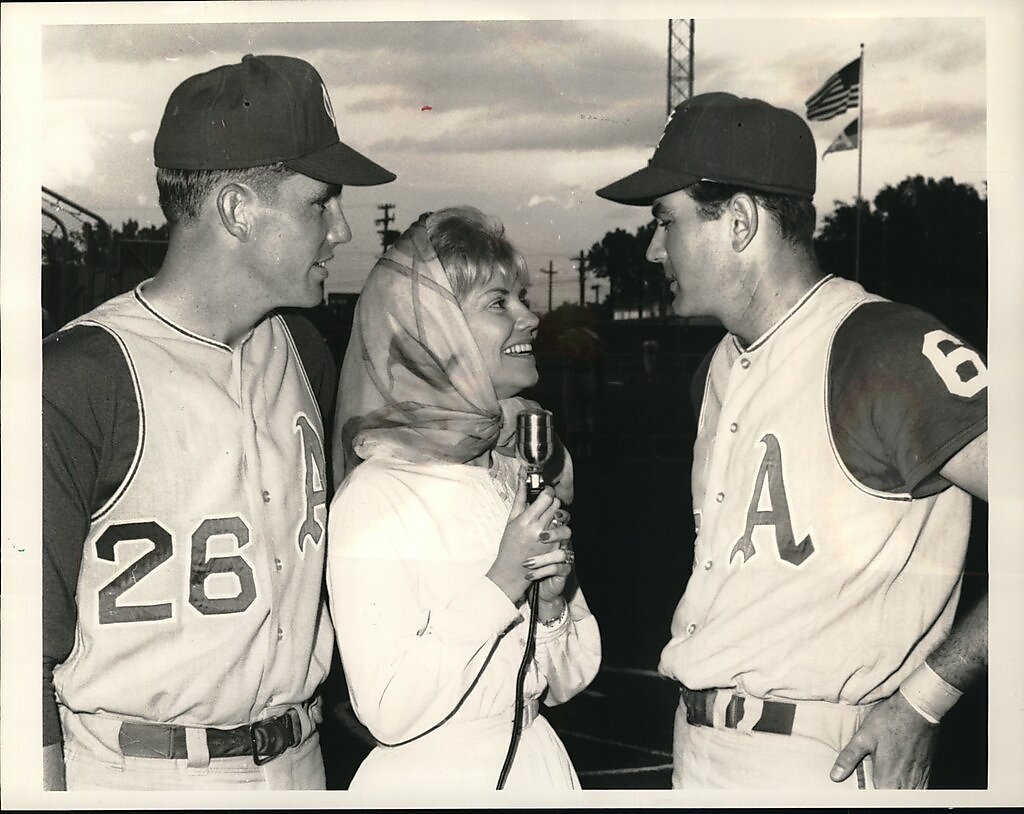
Betty Caywood interviews John O'Donoghue
(left) and Jim Gentile.

September 16, 1964: Betty Caywood is hired to provide color commentary on radio broadcasts of Kansas City Athletics games for the rest of the season. This makes her the 1st female broadcaster for a Major League Baseball team.

Born in Chicago in 1931, she grew up in Kansas City, and returned to the Chicago area to earn a degree in speech therapy from Northwestern University. She then worked as a weather reporter for a Chicago television station, where she was watched by A's owner Charlie Finley on his farm in northwestern Indiana.

She had also modeled, and taught speech and drama at a high school in Salina, Kansas, about 175 miles west of Kansas City. Divorced with 2 young children, she said modeling and broadcasting paid more than teaching.

Finley wasn't exactly progressive, but he'd do anything for good publicity (except spend more money). He hired her to do color commentary, alongside Monte Moore and George Bryson. "The idea is that putting a woman on the staff will appeal to the dolls," he told a newspaper reporter.

In her 1st game, the A's lost to the Boston Red Sox, 10-1 at Fenway Park in Boston. Tony Conigliaro, the Sox' 19-year-old local phenom, hit 2 home runs. The Sox also got home runs from Bob Tillman and Dick Stuart, the 1st baseman so bad a fielder, he was nicknamed Doctor Strangeglove. Carl Yastrzemski went 1-for-4.

By her own admission, she didn’t know much about baseball then. Her next game was 2 days later, with the A's playing the New York Yankees at Yankee Stadium. When the legendary Red Barber called her over during the game, he asked who was batting. She had no idea. He asked who he was by his number, which was 7. She did not know it was Mickey Mantle. Barber asked her what the batter was doing. “I said striking,” she later said. Red told her it was "swinging."

Because her job was so unusual for a woman, she even appeared as a mystery guest on the CBS show What’s My Line? that week.

She called the A's last 16 games of the season, in which they went 3-13, although none of it was her fault: They went 57-105 for the season. She was not rehired for 1965, and wouldn't have taken the job if she was. Not many women have entered baseball commentary since. She joked, "I was so bad, there were no more."

She soon met Jordan Bushman, a principle with Bushman Construction Company. They married, raised 2 more children, and were married for over 50 years. At one point, she said, she got an offer to host The Today Show. But that would have meant moving to New York City, where she did not like the look of schools and living conditions for her children. "Barbara Walters owes me her job," she said.

On August 16, 2008, Betty Caywood Bushman broadcast one more game, invited to join the team on radio station WHB, broadcasting the Kansas City T-Bones, of Kansas City, Kansas, in the independent Northern League. She lived until 2020.

On August 3, 1993, Gayle Gardner became the first woman to do televised play-by-play of an MLB game. The Cincinnati Reds beat the Colorado Rockies, 5-4 in 10 innings at Riverfront Stadium in Cincinnati. In 1997, Suzyn Waldman was hired as the 1st non-interim female broadcaster for an MLB team, joining the Yankees' radio team, providing color commentary alongside play-by-play announcer John Sterling. Through the 2022 season, she is still there.

UPDATE: In 2024, Jenny Cavnar was hired by the Oakland Athletics, as MLB's 1st female play-by-play announcer.

*

September 16, 1964 was a Wednesday. Actress Molly Shannon, best known as a castmember of Saturday Night Live, was born.

These other baseball games were played that day:

* The New York Yankees beat the Los Angeles Angels, 9-4 at Yankee Stadium. Jim Bouton, future author of Ball Four, was the winning pitcher. This was when he could still smoke them inside. Roger Maris hit a home run. Mickey Mantle went 0-for-3 with a walk.

* The New York Mets beat the San Francisco Giants, 4-0 at Candlestick Park in San Francisco. Tracy Stallard, best known for giving up Maris' 61st home run of the 1961 season, may have had his best game: He went the distance for the win, pitched a 5-hit shutout, walked only 2, and struck out 10, outpitching Gaylord Perry.

George Altman went 3-for-4 with a home run and 3 RBIs. Willie Mays did not play. Willie McCovey went 0-for-3. Duke Snider, in one of his last games as an active player, and looking very odd in a Giants uniform, did not reach base as a pinch-hitter.

* The Minnesota Twins beat the Baltimore Orioles. 2-1 at Memorial Stadium in Baltimore. Camilo Pascual outpitched Wally Bunker. Harmon Killebrew hit a home run. Brooks Robinson went 4-for-4, and drove in the Orioles' only run.

* The Cleveland Indians swept a doubleheader from the Washington Senators, 3-1 and 3-2 at Cleveland Municipal Stadium.

* The Chicago White Sox outpitched the Detroit Tigers, 4-1 at Tiger Stadium in Detroit. Al Kaline went 0-for-4.

* The Cincinnati Reds beat the Chicago Cubs, 5-3 at Wrigley Field in Chicago. Frank Robinson went 2-for-4 with an RBI. Pete Rose went 1-for-5. Ernie Banks went 1-for-3 with an RBI. Ron Santo hit a home run.

* The Milwaukee Braves beat the St. Louis Cardinals, 3-2 at Milwaukee County Stadium. Hank Aaron did not play. Joe Torre went 0-for-4. But Denis Menke, a prototypical good-field/no-hit 2nd baseman for the era, drove in all the Braves' runs with a home run. Lou Brock went 1-for-4 with an RBI.

* The Houston Colt .45os beat the Philadelphia Phillies, 6-5 at Colt Stadium in Houston. The day before, the Phillies were 88-57, and led the National League by 6 games with 17 games to play. From this game onward, they went 4-13, and blew the Pennant. The next year, the Colts moved into the Astrodome, and renamed themselves the Houston Astros.

* And the Pittsburgh Pirates beat the Los Angeles Dodgers, 7-5 at Dodger Stadium in Los Angeles. Vern Law was the winning pitcher, and helped his own cause with a home run. Roberto Clemente went 1-for-3 with a walk.

Thursday, August 18, 2022

August 18, 1967: Tony Conigliaro Is Beaned

August 18, 1967: Tony Conigliaro of the Boston Red Sox is hit in the head with a pitch. This changes not just his life, but the history of baseball, in ways that can only be imagined.

After winning the American League Pennant in 1946, with near-misses in 1948, 1949 and 1951, the Red Sox fell into mediocrity. In 1961, rookie Carl Yastrzemski replaced retiring legend Ted Williams in left field. In 1964, a new right fielder came in: Tony Conigliaro, 19 years old and from nearby Revere, Massachusetts.

The local boy made his major league debut on April 16, 1964, in a 4-3 11-inning win by the Red Sox against their arch-rivals, the New York Yankees, at Yankee Stadium. The next day, he made his home debut at Fenway Park, and hit a home run in the Red Sox' 4-1 win over the Chicago White Sox.

He had a right-handed swing tailor-made for Fenway's left field wall: The foul pole at "The Green Monster" was labeled at 315 feet, was later "corrected" to 310 feet, and some people think it's closer than that. To protect businesses across the street, it's 37 feet high, and had a 23-foot-high screen on top, before 2003 renovations put the "Monster Seats" on top of it.

"Tony C" hit 24 home runs in that rookie season. In 1965, he hit 32, becoming the youngest player ever to lead the AL in home runs. In 1966, he hit 28. Through August 18, 1967, he had 104 career home runs, making him, at 22, the 2nd-youngest player ever to reach 100 homers, behind only Mel Ott.

And, as a good-looking local kid, and an Italian in America's most Catholic city (nuns liked to have their picture taken with him), Boston, and New England as a whole, embraced him. Despite being a Polish Catholic and immensely talented -- he had won the AL batting title in 1963 -- Yastrzemski always seemed a little aloof. So it was Tony C, not "Yaz," who seemed like the natural successor to Ted Williams.

And, as Williams had been Boston's answer to the New York Yankees' Joe DiMaggio, so, too, did Conigliaro seem like Boston's answer to the Yankees' Mickey Mantle. But there was a side to him that no one knew about: Like Mantle, he was a carouser whose excesses were covered up by the media, who had a vested interest in keeping up his hero image.

Had his career continued unimpeded, there's no way to know if he truly would have become Boston's Mantle, hitting over 500 runs, winning Pennants, and going to the Baseball Hall of Fame; or if he would have become Boston's Joe Pepitone, the Italian charmer whose "sweet swinging" wasn't just toward his home park's closest fence.

In his book Tales from the Impossible Dream Red Sox, shortstop Rico Petrocelli, said, "While he dated actresses and Playboy bunnies, he wasn't a playboy like Bo Belinsky." (Belinsky was a Los Angeles Angels pitcher of the early 1960s who was wild in more ways than one. He pitched a no-hitter in 1962, and the increased attention that brought him was the worst thing that could have happened to him.) But Petro also cited the recording contract Tony had, which could have become a distraction for him as much as it was for his contemporary, Tiger pitcher and Las Vegas lounge organist Denny McLain.

Petrocelli also said in his book, "Tony was not only a chick magnet, he was a magnet for stray pitches. Five times he had bones broken by pitches, including the one that broke his shoulder blade 5 months earlier in spring training." That does not bode well for a long, stat-heavy career.

After finishing 9th in 1966, the Red Sox hired a new manager, Dick Williams. (No relation to Ted.) He had managed their top farm team, the Toronto Maple Leafs (for whom the hockey team was named), to International League Pennants in 1965 and 1966, so he knew what was available to him. And, unlike previous Sox managers -- they were the last MLB team to integrate -- he was willing to use his more talented players, regardless of race. And he boldly predicted that they would win more than they would lose.

What no one could have predicted was perhaps the greatest Pennant race in American League history. With a lineup that included Tony C, Yaz and Petrocelli, all of them All-Stars, plus future All-Stars Reggie Smith in center field and George Scott at 1st base; and Jim Lonborg on his way to winning 22 games and the AL's Cy Young Award, the Red Sox were right in the thick of it.

When the games of August 17 were over, the Minnesota Twins led the Chicago White Sox by a game and a half, the Detroit Tigers by 3, the Red Sox by 3 1/2, and the California Angels by 4 1/2. With anywhere from 44 to 48 games left in the regular season, 5 teams still legitimately had a shot. In tune with one of the most popular songs of the year, Red Sox fans began to speak of the Pennant as "The Impossible Dream."

On Friday night, August 18, the Red Sox hosted the Angels at Fenway. The game was scoreless in the bottom of the 4th inning, when Scott led off with a single. Smith flew to center. Conigliaro came to bat, against Jack Hamilton.

At some point, someone threw a smoke bomb into the field. Surviving film of the event shows that it was 9:32 PM, and that the smoke hadn't yet cleared. Hamilton had only hit 1 batter all season long, and was not known as a "purpose pitcher." In fact, aside from this one at-bat, he never gained much notice in a career that lasted from 1962 to 1969, going 32-40.

He threw a fastball that tailed up and in, and hit Conigliaro in the face. Conigliaro was wearing a batting helmet, but the ball hit him in the left cheekbone, right under his eye. Although ear flaps had been introduced in batting helmets, most didn't have them yet. Had Conigliaro's helmet had one, he might have sustained a concussion, and been out for a few days, but he would have been all right. Instead, he sustained a life-threatening injury, and it was not immediately clear that he would survive it.

José Tartabull was sent in to pinch-run for Conigliaro, Petrocelli was up next, and hit a triple that scored Scott and Tartabull. Red Sox starting pitcher Gary Bell helped his own cause by singling a run home in the 6th inning. He gave up 2 home runs to Jimmie Hall, but those were the only runs he gave up, and the Red Sox won, 3-2.

Even though Tony recovered quickly, and could rejoin his teammates soon -- in the clubhouse if not on the field -- it could have been a defining blow against the Red Sox' Pennant hopes. Instead, they kept fighting, and won the Pennant on the last day of the season, October 1, finishing 1 game ahead of both the Twins and the Tigers, all of whom entered the last day with a chance at the Pennant. The White Sox still had a chance going into the last weekend, finishing 3 back. The Angels tailed off, finishing 7 1/2 back.

In the Sox' locker room, Tony C was a side figure in the celebrations. Still with a black eye from his injury 44 days earlier, he wondered what he had done to achieve the Pennant. He had batted .287 with 20 home runs and 67 RBIs. Projected over a full season, that would have been 28 home runs and 92 RBIs, a pretty good season. In 1970, when he was ready to tell his side of the story, he told it to Sports Illustrated magazine, which printed one of its most memorable, and most shocking, covers.
He missed the entire 1968 season. In 1969, his vision finally cleared, and he hit 20 home runs and had 82 RBIs. He was named the AL's Comeback Player of the Year. He was joined by his younger brother, Billy, also an outfielder. The Red Sox had tumbled down the standings in 1968, and hadn't come back in 1969, but Tony C had. In 1970, he hit 36 home runs and had 116 RBIs, both career highs. He was 25, and his superstar status seemed assured.

But his eyesight had begun to deteriorate again. And he was making a nuisance of himself within the organization. There was also dissension between him and Billy. After the season, the Sox traded Tony to, of all teams, the Angels, for 2nd baseman Doug Griffin. (Hamilton was already out of the major leagues, never to return.) The New England fans, knowing little about what was going on inside the team, were shocked. But the team decided that Tony C had to go.

He played 74 games for the Angels in 1971, and batted just .222 with 4 home runs and 15 RBIs. He last played on July 9, was sent down, and, rather than report, quit. He was 26 years old.

In 1975, at 30 -- having missed what should have been the 1st half of his prime -- he tried to make a comeback, and the Red Sox were willing to try him again. On April 11, he hit a home run for the Red Sox against the Baltimore Orioles, and Sox fans were ready to believe again.
But he still couldn't see well enough, and batted just .123 with 2 home runs and 9 RBIs before being sent down to Class AAA Pawtucket on June 13. There, he played 37 games, and only batted .203 in 37 games. He was released on September 2, again missing out on a Red Sox Pennant, as they dethroned the 3-time defending World Champion Oakland Athletics in the AL Championship Series, before losing the World Series to the Cincinnati Reds. (His brother Billy was a member of the A's 1973 title team -- the only ring the family has ever won.)

He was quickly hired by WJAR-Channel 10 in Providence, Rhode Island, as sports anchor. The following year, he moved to KGO-Channel 7 in San Francisco. On January 9, 1982, he was ready to come home, and interviewed for a position on the Red Sox broadcasting team. While his brother Billy was driving him back to Boston's Logan International Airport, Tony had a heart attack. While in the hospital, he had a stroke, putting him in a coma with brain damage. At 37, his able life was over. He hung on in hospitals until February 24, 1990, shortly after his 45th birthday. He was buried at Holy Cross Cemetery in Malden, Massachusetts.

Later in 1990, the Red Sox established the Tony Conigliaro Award, given to the MLB player "who best overcomes obstacles and adversities through the attributes of spirit, determination and courage that were considered Tony's trademarks." The NHL has an equivalent award, the Bill Masterton Trophy, named for the only player to die as a result of an in-game injury. In 1995, the Red Sox elected Tony C to their team Hall of Fame.

In her book Confessions of a She-Fan, Yankee Fan Jane Heller told of how she and a friend of hers met Conigliaro after hours, and said friend suggested that she was the only fan who ever dated both Conigliaro and the pitcher who beaned him, Jack Hamilton.

Hamilton went into the restaurant business, opening several successful ones in his native Iowa and in neighboring Missouri. He died in 2018, having insisted to the end that he hadn't hit Conigliaro on purpose. To their credit, Red Sox fans, not always the classiest bunch, tended to either take his word for it or leave him alone. Billy Conigliaro died in 2021.

*

August 18, 1967 was a Friday. These other baseball games were played that day:

* The New York Yankees split a doubleheader with the Minnesota Twins at Yankee Stadium. The Yankees won the opener, 1-0. Steve Barber pitched a 6-hit shutout, outpitching Jim Kaat. The Twins won the nightcap, 4-3. Rich Reese hit a home run off Fred Talbot in the top of the 9th inning. Mickey Mantle went 1-for-2 with 2 walks in the 1st game, and appeared as a pinch-hitter in the 2nd game, failing to reach base.

* The New York Mets beat the Pittsburgh Pirates, 7-2 at Forbes Field in Pittsburgh. Roberto Clemente did not play, but Willie Stargell went 2-for-4 with a home run and 2 RBIs.

* The Chicago Cubs beat the Philadelphia Phillies, 3-1 at Connie Mack Stadium in Philadelphia. Ernie Banks did not play.

* The Washington Senators beat the Kansas City Athletics, 7-6 at District of Columbia Stadium in Washington. (It was renamed Robert F. Kennedy Memorial Stadium in 1969.)

* The Detroit Tigers were leading the Cleveland Indians, 4-0 at Tiger Stadium, after 5 innings, when the game was called due to rain.

* A doubleheader was split at Comiskey Park in Chicago. The Chicago White Sox won the 1st game, 3-1. The Baltimore Orioles won the 2nd game, 8-2. Over the 2 games, Brooks Robinson went 0-for-8 with an RBI on a sacrifice fly, and Frank Robinson went 3-for-9.

* The St. Louis Cardinals beat the Houston Astros, 5-3 at the Astrodome in Houston.

* The Los Angeles Dodgers beat the Atlanta Braves, 5-1 at Dodger Stadium in Los Angeles. Hank Aaron went 1-for-4.

* And the San Francisco Giants beat the Cincinnati Reds, 3-1 at Candlestick Park in San Francisco. Willie Mays went 1-for-4 with an RBI. Pete Rose went 1-for-4 with an RBI. Johnny Bench made his major league debut 10 days later.

December 31, 1999 & January 1, 2000: The Millennium

December 31, 1999:  The Millennium arrives. The people of planet Earth survived. At a terrible cost. But we hadn't destroyed ourselves. ...