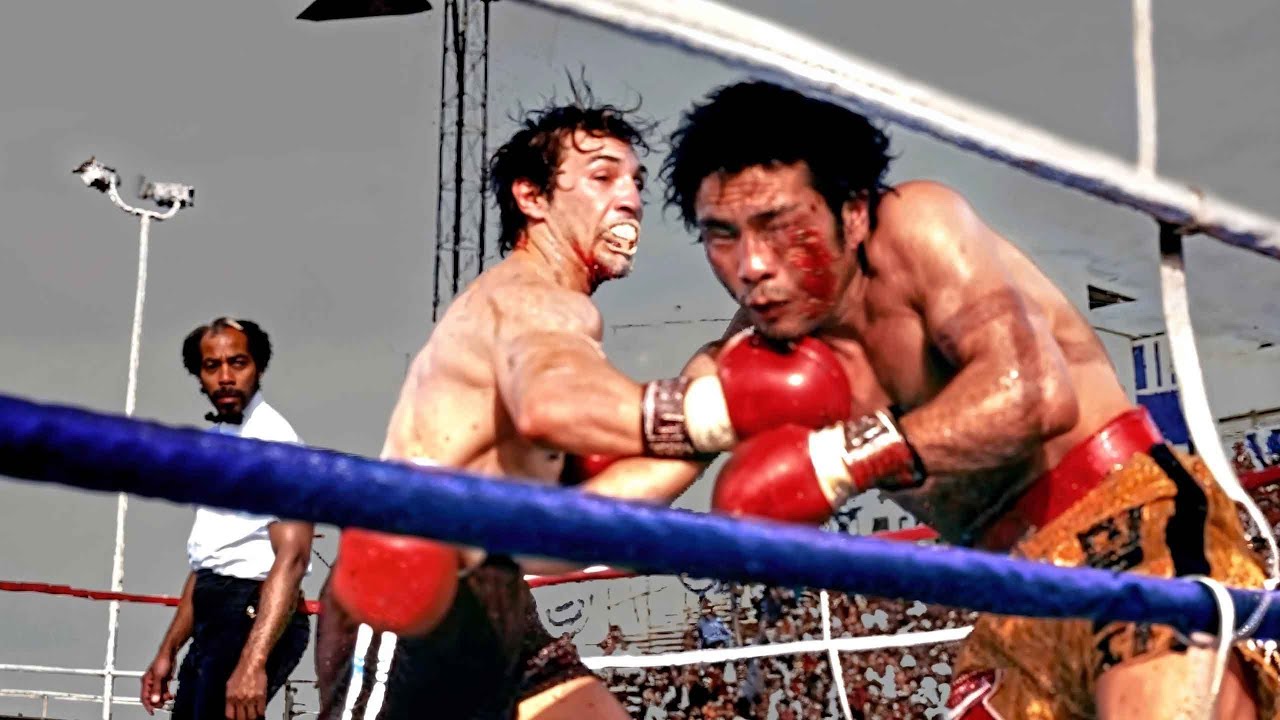
November 13, 1982: Boxer Ray Mancini, the WBA Lightweight Champion of the World, defends his title against Korean boxer Kim Duk-koo in the outdoor stadium at Caesar's Palace in the Las Vegas suburb of Paradise, Nevada. (Kim's name usually then listed as "Duk Koo Kim.")
Kim was 27, had a career record of 17-1-1, and was the Lightweight Champion of the Oriental and Pacific Boxing Federation (OPBF). But except for 1 fight in the Philippines, this would be his 1st time fighting outside Korea. Indeed, except for that, and 1 fight each in Pusan and Ilsan, he had only fought in the South Korean capital of Seoul.
In contrast, Mancini, a native of Youngstown, Ohio, and like his father Lenny nicknamed "Boom-Boom" for his hard punching, was only 21, but was 24-1 going into the fight. His only loss was the year before, to Alexis Argüello, who held the WBC Lightweight Championship. On May 8, 1982, Mancini beat Arturo Frias to win the WBA version of the lightweight title. On July 24, he successfully defended that title against Ernesto España, and was looking forward to a rematch and unification bout with Argüello. But, first, he had to fight Kim. And then, the night before Mancini vs. Kim, Argüello lost his piece of the title to Aaron Pryor.
Kim struggled to make the 135-pound weight limit. Before the fight, Kim was quoted as saying "Either he dies, or I die." He wrote the message "live or die" on his Las Vegas hotel lampshade only days before the bout -- which led to a mistaken translation of "kill or be killed" being reported in the media.
On November 26, in fight for the Heavyweight Championship of the World, broadcast in prime time on ABC, Larry Holmes won a unanimous 15-round decision over Randall "Tex" Cobb. The fight was brutal, and it made announcer Howard Cosell, known for his boxing broadcasts, swear never to broadcast another professional fight, a vow he kept until his death.
Between them, these 2 fights led to changes in boxing. The maximum of 15 rounds was reduced to 12. A standing eight-count for any knockdown was required. And any fighter knocked out automatically had his license suspended for 45 days, for his own safety.
Mancini went to Kim's funeral in Korea, and while boxing fans didn't seem to hold Kim's death against him, he fell into a deep depression. To make matters worse, Kim's mother died by suicide 3 months after the fight; and the bout's referee, Richard Green, did so 6 months after that.
Mancini never did fight Pryor, and never got a rematch against Argüello. Officially, he defended his title 4 times, plus won 2 non-title fights, raising his record to 29-1. On June 1, 1984, at the Buffalo Memorial Auditorium, he lost the title on a technical knockout against Livingstone Bramble, a fighter from the Caribbean nation of St. Kitts and Nevis, the only Rastafarian ever to win a boxing title. He sometimes fought under the name Ras-I Alujah Bramble.
Mancini got a rematch against Bramble, losing a very close, but unanimous, decision. He fought twice more, losing a split decision to former Lightweight Champion Héctor "Macho" Camacho in 1989, and a 7th-round TKO to former Lightweight Champion Greg Haugen in 1992. Mancini retired with a record of 29-5. He went on to become a film producer, and as of November 13, 2022, is still alive.
*
November 13, 1982 was a Saturday.
Among the college football games played that day were these:
* Number 1 Georgia beat Auburn, 19-14 at Jordan-Hare Stadium in Auburn, Alabama. Georgia won the Southeastern Conference Championship.
* Number 2 Southern Methodist University beat Texas Tech, 34-27 at Jones Stadium in Lubbock, Texas. SMU won the Southwest Conference Championship.
* Number 3 Arizona State were upset by Number 7 Washington, 17-13 at Sun Devil Stadium (now Mountain America Stadium) in the Phoenix suburb of Tempe, Arizona.
* Number 4 Nebraska beat Iowa State, 48-10 at Cyclone Stadium (now Jack Trice Stadium) in Ames, Iowa. Nebraska won the Big 8 Conference Championship.
* Number 5 Penn State beat Number 13 Notre Dame, 24-14 at Notre Dame Stadium in South Bend, Indiana. An independent with no conference title available to them, Penn State rose to Number 2, and beat Number 1 Georgia in the Sugar Bowl, to win their 1st National Championship.
* Number 6 Louisiana State University were upset by Mississippi State, 27-24 at Scott Field (now Davis Wade Stadium) in Starkville, Mississippi. LSU were invited to the Orange Bowl, where they lost to Nebraska.
* Number 8 University of Pittsburgh beat Army 24-6 at Michie Stadium in West Point, New York. As for the other service academies, Navy lost to South Carolina, 17-14 at Williams-Brice Stadium in Columbia, South Carolina; while Air Force had the week off.
Pitt were invited to the Cotton Bowl, where they lost to SMU. With no losses but a tie, SMU claimed the National Championship ahead of 1-loss Penn State, but both the AP and the UPI had Penn State ahead of them in their polls.
* Number 9 Florida State beat Louisville, 49-14 at Doak Campbell Stadium in Tallahassee, Florida.
* Number 10 Arkansas beat Texas A&M, 35-0 at Razorback Stadium in Fayetteville, Arkansas.
* Number 11 Clemson beat Number 18 Maryland, 24-22 at Byrd Stadium (now SECU Stadium) in the Washington suburb of College Park, Maryland.
* Number 12 UCLA beat Stanford, 38-35 at the Rose Bowl in the Los Angeles suburb of Pasadena, California. UCLA won the Pac-10 Conference Championship.
* Number 13 Oklahoma beat Missouri, 41-14 at Memorial Stadium in Norman, Oklahoma. Oklahoma were invited to the Fiesta Bowl, where they lost to Arizona State, on ASU's home field.
* Number 14 Michigan beat Purdue, 52-21 at Michigan Stadium in Ann Arbor. Michigan won the Big 10 Conference Championship, but lost the Rose Bowl to UCLA.
* Number 17 Alabama were upset by Southern Mississippi, 38-29 at Bryant-Denny Stadium in Tuscaloosa, Alabama.
* As for New Jersey's teams, Princeton lost to Yale, 37-19 at the Yale Bowl in New Haven, Connecticut; while Rutgers played 2 nights earlier, losing to Number 19 West Virginia, 44-17 at Giants Stadium. RU played 3 "home games" at the Meadowlands that year, and all 3 crowds could have fit at Rutgers Stadium, provided they opened the grass hills in the corners.
And in New Jersey high school football, the school I would enter in the 10th grade 2 years later, East Brunswick, lost to Union of Union Township, Union County, 10-0 at Jay Doyle Field in East Brunswick.
Baseball was out of season. There were 7 games in the NBA:
* The New York Knicks beat the Detroit Pistons, 112-100 at Madison Square Garden. Kelly Tripucka, a native of Bloomfield, New Jersey who grew up as a Knicks fan, scored 35 points for the Pistons. Isiah Thomas added 30 points, perhaps the first time he drove Knick fans crazy, but by no means the last. Bernard King, as he so often did in those days, led the Knicks in scoring, with 27 points.
* The New Jersey Nets lost to the Philadelphia 76ers, 110-100 at the Brendan Byrne Arena at the Meadowlands.
* The Indiana Pacers beat the Chicago Bulls, 119-115 at the Market Square Arena in Indianapolis. At the time, the Bulls would have been considered at the time to be the Pacers' arch-rivals, at least geographically. They probably should still be, but are not generally thought of that way.
* The Denver Nuggets beat the Dallas Mavericks, 140-130 at the Reunion Arena in Dallas. Alex English scored 40 points for the Nuggets.
* The Seattle SuperSonics beat the San Antonio Spurs, 107-98 at the HemisFair Arena in San Antonio. David "Skywalker" Thompson scored 32 for the Sonics.
* The Kansas City Kings beat the San Diego Clippers, 112-111 at the San Diego Sports Arena (now the Pechanga Arena). Eddie Johnson, known as "the Man Who Put the J in 'Jump Shot,'" scored 35 for the Kings.
* The Golden State Warriors beat the Atlanta Hawks, 114-101 at the Oakland Coliseum Arena. Joe Barry Carroll scored 30 points and grabbed 18 rebounds. He did not always show that much effort, which earned him the uncomplimentary nickname "Joe Barely Cares."
There were 10 games in the NHL, with every team except the New York Rangers scheduled to play:
* The New York Islanders lost to the Washington Capitals, 3-1 at the Capital Centre in the Washington suburb of Landover, Maryland.
* The New Jersey Devils lost to the Quebec Nordiques, 7-2 at the Colisée de Québec.
* The Boston Bruins beat the Buffalo Sabres, 3-2 at the Boston Garden.
* The Hartford Whalers beat the St. Louis Blues, 5-2 at the Hartford Civic Center (now the PeoplesBank Arena).
* The Edmonton Oilers beat the Philadelphia Flyers, 4-3 at The Spectrum in Philadelphia.
* The Toronto Maple Leafs beat the Minnesota North Stars, 4-3 at Maple Leaf Gardens in Toronto.
* The Calgary Flames beat the Pittsburgh Penguins, 3-1 at the Civic Arena in Pittsburgh.
* In an "Original Six" matchup, the Chicago Black Hawks beat their arch-rivals, the Detroit Red Wings, 3-2 at the Joe Louis Arena in Detroit.
* The Winnipeg Jets beat the Vancouver Canucks, 3-2 at the Winnipeg Arena.
* The Los Angeles Kings beat the Montreal Canadiens, 2-1 at The Forum outside Los Angeles in Inglewood, California.
And in English soccer, Arsenal and Everton, the blue club in Liverpool, played to a draw, 1-1 at the Arsenal Stadium, a.k.a. Highbury, in North London.


