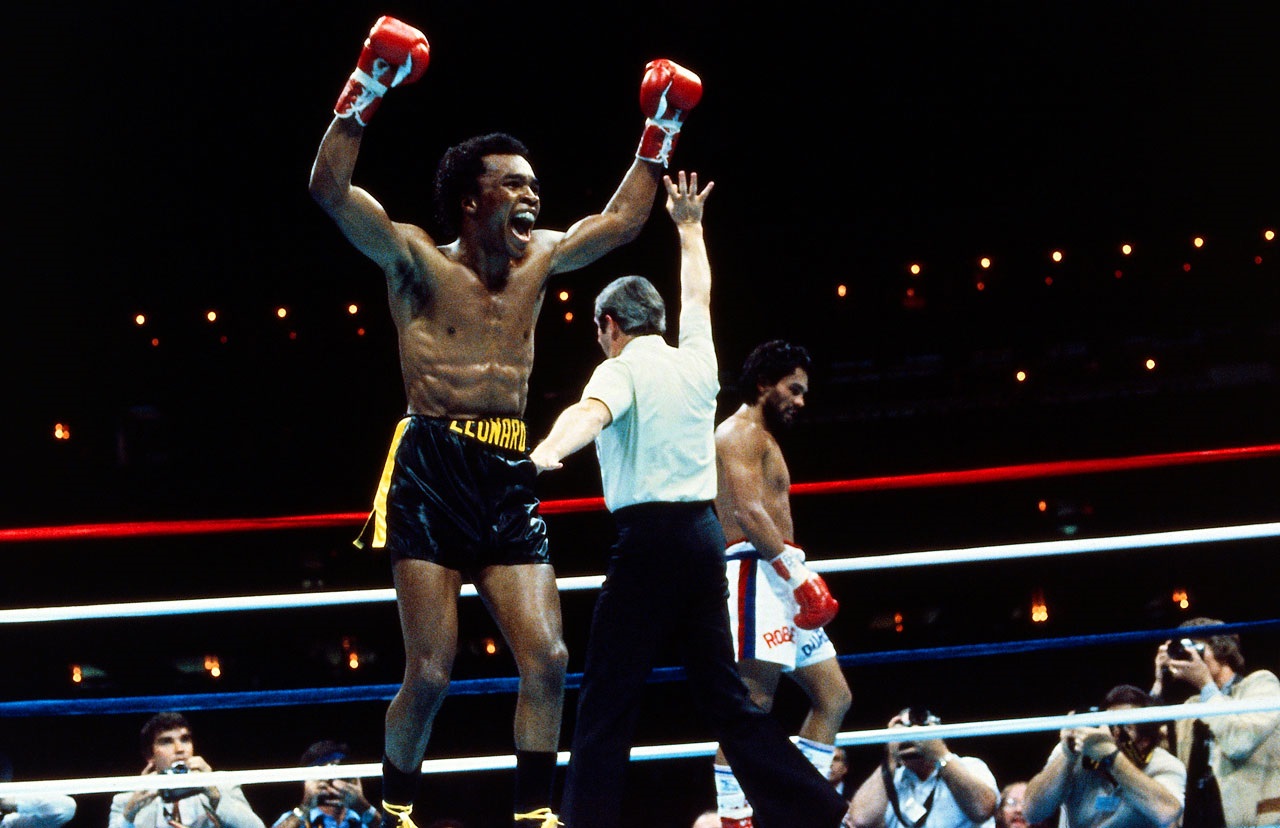
November 25, 1980: The Welterweight Championship of the World is contested at the Superdome in New Orleans. It is a rematch between 2 of the greatest fighters, pound-for-pound, of their generation.
Roberto Durán, 29, might have been the greatest Lightweight Champion ever, holding that title from 1972 to 1979. The man known as "Hands of Stone" was a hero in Latin America, in particular treated nearly as a god in his native Panama.
Sugar Ray Leonard, 24, won a Gold Medal for America at the 1976 Olympics at the Montreal Forum. In 1979, he won the Welterweight title by defeating Wilfred Benitez.
Durán was ready to move up in weight class, and take Leonard on. On June 20, 1980, back in Montreal, this time at the much larger Olympic Stadium, in front of 60,000 people, Leonard came in with a career record of 27-0, Durán at 71-1. Durán won a unanimous decision, but it was close: The cards had him leading 148-147, 146-144 and 145-144.
"I did the best I could", Leonard said. "I think I pretty much fought from the heart." Asked if Leonard was the best he ever fought, Durán thought for a moment and then answered, "Si, si." Durán said. "He does have a heart. That's why he's living."
Since the fight was so close, a rematch was in order. A crowd of 70,000 people crammed into the Superdome in New Orleans. This time, Leonard fought better, and was taunting Durán. At the end of the 8th round, Durán, trailing on all cards, and having lost his respect for Leonard, turned to the referee, also a Latin American, Octavio Meyran of Mexico, and said to him in Spanish, "I don't want to fight with this clown," and he went back to his corner and quit.
Broadcasting the fight for ABC, Howard Cosell said -- erroneously, as it turned out -- that what Durán had told the ref was, "No más" -- "No more." Leonard was declared the winner by technical knockout, and regained the title.
To make matters worse, the official excuse for Durán quitting was "stomach cramps." If he had them before the fight, it should have been postponed.
The man known as Hands of Stone was viewed to have feet of clay. Back in Panama, both his house and his mother's house were vandalized. Graffiti appeared in Panama City calling him a coward, a traitor, and even "maricón" -- roughly, the Caribbean Spanish word for the anti-gay slur "faggot."
("Maricón" was the word that Benny "the Kid" Paret had used at Emile Griffith during the weigh-in for their 1962 Welterweight Championship and trilogy-decider fight, that led Griffith to pound away at him so hard during the fight that Paret died.)
The man known as Hands of Stone was viewed to have feet of clay. Back in Panama, both his house and his mother's house were vandalized. Graffiti appeared in Panama City calling him a coward, a traitor, and even "maricón" -- roughly, the Caribbean Spanish word for the anti-gay slur "faggot."
("Maricón" was the word that Benny "the Kid" Paret had used at Emile Griffith during the weigh-in for their 1962 Welterweight Championship and trilogy-decider fight, that led Griffith to pound away at him so hard during the fight that Paret died.)
In 1983, Durán fought Super Welterweight Champion Davey Moore in front of a mostly-Latino crowd at Madison Square Garden, hoping to see the return of a former hero to heroic status. It was no contest: Durán crushed Moore, whose cornermen threw in the towel -- appropriately enough, in the 8th round, the same round that did Durán in 3 years earlier. Durán regained not only a title (if not the same one), but also his strong, masculine image, his pride, his reputation, and his fans.
On December 7, 1989, with both men well past their prime, but with Leonard holding the WBC version of the Super Middleweight Championship, they fought for a 3rd time, at The Mirage hotel and casino outside Las Vegas. Leonard won a unanimous decision.
It was the last fight that Leonard ever won. He lost to Terry Norris and Héctor "Macho" Camacho, finishing 36-3-1. Durán must have needed the money, because he kept on fighting until 2001, and his last fight was also a loss to Camacho. His final record was 103-16, having lost nearly half his fights after his win over Leonard.
There were 4 truly great welterweight and middleweight fighters in the 1980s: Leonard, Durán, Thomas Hearns and Marvelous Marvin Hagler. Durán followed up his win over Moore by losing back-to-back fights to Hagler (a 15-round decision) and Hearns (an awful 2nd-round knockout.) Leonard won a very tough decision over Hearns, and won a controversial decision over Hagler. Hagler knocked Hearns out in the 3rd round, surviving a furious fusillade, in one of the greatest short fights ever.
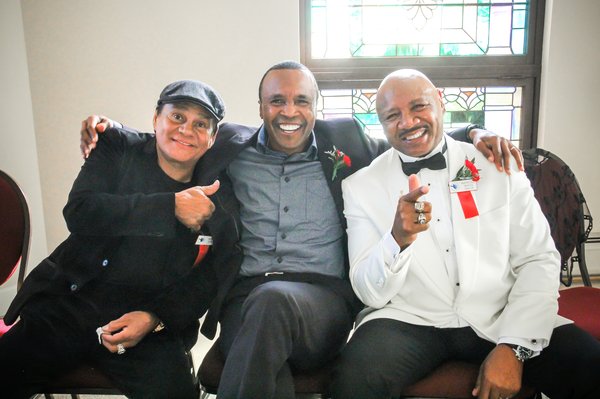
Left to right: Durán, Leonard, Hagler.
I found a photo of Leonard, Durán and Hearns together,
but not one of all 4 of them together.
Despite the various controversies between them, the 4 of them became friends after their careers, as boxers tend to do. There usually is a healthy respect between worthy opponents. Hagler died of a heart attack in 2021, at the age of 66. As of November 25, 2022, the other 3 are still alive.
UPDATE: In 2026, Ronald Hearns, also a boxer, places his father Thomas under conservatorship, as he has begun to show signs of boxing-related dementia. Hagler is not suspected of having had it. Nor is Leonard or Durán.
*
November 25, 1980 was a Tuesday. Baseball was out of season, but later baseball star Nick Swisher was born. Football was in midweek. There were 3 games played in the NBA:
* The Atlanta Hawks beat the Portland Trail Blazers, 112-108 at The Omni in Atlanta. John Drew led all scorers on the night with 34 points.
* The Philadelphia 76ers beat the expansion Dallas Mavericks, 108-92 at the Reunion Arena in Dallas. Julius "Dr. J" Erving had 31 points.
* And the San Diego Clippers beat the Denver Nuggets, 108-94 at the San Diego Sports Arena (now the Pechanga Arena).
There were 4 games played in the NHL:
* The New York Islanders played the Winnipeg Jets to a tie, 4-4 at the Nassau Coliseum.
* The Calgary Flames beat the Montreal Canadiens, 5-4 at the Montreal Forum.
* The St. Louis Blues beat the Buffalo Sabres, 5-3 at the Checkerdome (as the St. Louis Arena was then known).
* And the Colorado Rockies beat the Edmonton Oilers, 4-3 at the McNichols Arena in Denver.


