Showing posts with label pittsburgh panthers. Show all posts

Saturday, November 26, 2022

November 26, 1982: Dan Marino's College Failure

November 26, 1982: Number 2 Penn State beat Number 5 University of Pittsburgh, 19-10 at Beaver Stadium in State College, Pennsylvania. This was a big moment for Penn State, as it set them up to win their 1st National Championship, after controversial denials of such in the seasons of 1968, 1969, 1973, 1977 and 1978.

It was a bad moment for "Pitt," because it meant that the man often regarded as their greatest player ever, quarterback Dan Marino, would finish his career without a major championship. Both schools were then independents, and thus had no Conference Championship to win. It was possible for them to win the National Championship, but now, Dan Marino would not win one.

Under head coach Johnny Majors, with Heisman Trophy winner Tony Dorsett running the ball, Pitt went undefeated and won the National Championship in 1976. Then Majors took the job at his alma mater, the University of Tennessee, and was replaced by his defensive coordinator, Jackie Sherrill.

There are 2 games Pitt fans demand a win from every year, their 2 closest rivals: Penn State, 136 miles to the northeast; and West Virginia, 77 miles to the south. The Pitt-West Virginia rivalry is known as "The Backyard Brawl," and, while Western Pennsylvania can be very rural, Pitt fans view it as a city vs. country matchup.

In 1979, with Marino, from Pittsburgh's Central Catholic High School, as a freshman who became the starter midway through the season, Pitt went 11-1, losing only an early-season game away to North Carolina, 17-7. They beat West Virginia away, 24-17. Three weeks later, ranked Number 11, they beat Number 20 Penn State, 29-14. On Christmas Day, they beat Arizona in the Fiesta Bowl, and finished the season ranked Number 6. Had they beaten North Carolina, they would have been 11-0, and likely would have been paired up with undefeated and Number 1 Alabama in the Sugar Bowl, for a National Championship decider. Instead, Alabama beat Arkansas to win it.

In 1980, Sports Illustrated made Pitt their preseason Number 1, putting defensive end Hugh Green on the cover. With Marino starting all the way as a sophomore, Pitt again went 11-1, their only defeat away to then-Number 11 Florida State, 36-22, as coach Bobby Bowden was rebuilding their long-moribund program. He had wanted to beat Pitt, because his previous job was at West Virginia. He remarked, "In Morgantown, the bumper stickers read, 'BEAT PITT.' In Tallahassee, they read, 'BEAT ANYBODY.'" The Seminoles were beginning to beat anybody.

The week after losing to Florida State, Pitt beat West Virginia at home, 42-14. The day after Thanksgiving, back up to Number 4, they went to Number 5 Penn State, and beat them, 14-9. They were invited to the Gator Bowl, and beat South Carolina. Had they beaten Florida State and remained undefeated, they likely would have been paired with Number 1 Georgia in the Sugar Bowl -- the same matchup that won them the title in 1976 -- for a National Championship game. Instead, Georgia beat Notre Dame to win it. Regardless, Marino was now 15-1 as a starter, and, in 2 years, Pitt were 22-2.

In 1981, with Marino a junior, and the most highly-regarded quarterback in the country, Pitt beat West Virginia in Morgantown, 17-0, and after beating Boston College away on Halloween, rose to Number 1. They went into the Penn State game undefeated, and had it at home, but were slaughtered, 48-14.

This time, they were invited to play Georgia in the Sugar Bowl, and beat them, 24-20, but finished 11-1, and ranked Number 4 in the AP writers' poll and Number 2 in the UPI coaches poll. Had they beaten Penn State, there might have been a split poll, as Clemson beat Nebraska in the Orange Bowl. Marino was now 26-2 as a starter, and, in 3 years, Pitt were 33-3. This was one of the best 3-year stretches in college football history, but they hadn't won the National Championship.

In 1982, with Marino as senior, and Sherrill having been lured away to Texas A&M and replaced by Serafino "Foge" Fazio, Pitt were the consensus preseason Number 1. Penn State started out Number 8. The 2 Keystone State teams were on a collision course.

Pitt began the season at the Steelers' Three Rivers Stadium, beating Number 5 North Carolina, 7-6 in a game nationally televised on CBS. They beat Florida State and Number 19 Illinois away, then West Virginia (16-13) and Temple at home, Syracuse away and the University of Louisville at home, the last of these by a whopping 63-14 score. They had now won 40 of their last 43 games.

But on November 6, Number 1 Pitt lost at home to Notre Dame, 31-16. They beat Army away and Rutgers at home, and up next was Penn State on the day after Thanksgiving, on ABC.

Penn State's 1st 4 games were at home. They beat Temple, Maryland, Rutgers, and, on a controversial play, then-Number 2 Nebraska. On October 9, they went to Birmingham, and were throttled by Number 4 Alabama, 42-21. They picked themselves up, and beat Syracuse at home, West Virginia and Boston College away, North Carolina State at home, and Number 13 Notre Dame away.

Both teams went into the big game 9-1, with at least a theoretical shot at the National Championship: Penn State were then Number 2, while Pitt were Number 5. A crowd of 85,722 filed into Beaver Stadium for a 12:30 PM kickoff on ABC. Pitt led 7-3 at the half, but Penn State scored a touchdown and a field goal in the 3rd quarter, and 2 more field goals to Pitt's 1 in the 4th quarter. Penn State won, 19-10, ending the National Championship dream of the University of Pittsburgh and quarterback Dan Marino.

In 4 seasons, Pitt ended up 42-6, with Marino going 35-5 as a starting college quarterback. Pitt has never been so good again, finishing Number 7 in 1989, Number 9 in 2003, and Number 8 in 2009. Sherrill won 3 Southwest Conference titles at Texas A&M, but never got higher in a final poll with them than Number 6.

Marino was drafted by the Miami Dolphins. In his 2nd season, 1984, he set several single-season passing records, and led the Dolphins to the AFC Championship. But they were embarrassed in Super Bowl XIX by the San Francisco 49ers. Marino played another 15 NFL seasons, but only reached 2 more AFC Championship Games, losing both. He is one of the greatest passers in the history of football, but, both in college and in the NFL, despite being surrounded by talented players, he failed to win a championship.

Penn State finally got that elusive National Championship by beating Georgia in the Sugar Bowl. They won another in 1986.

In 1991, Pitt joined the Big East Conference, as that league began playing football. In 1993, Penn State joined the Big Ten Conference. In 2013, with the Big East breaking up, Pitt joined Boston College, Syracuse and the University of Miami in moving to the Atlantic Coast Conference.

Penn State won the Big 10 and the Rose Bowl in 1994, but, as in 1968, '69 and '73, they were denied the National Championship despite being undefeated. They won the Big 10 again in 2005 and 2008. Pitt tied for the Big East title in 2004, and won the ACC title in 2021.

Because of the conference shifts, Pitt and Penn State did not play each other from 1993 to 1996, did play each other from 1997 to 2000, did not from 2001 to 2015, and did from 2016 to 2019. As of November 26, 2022, they have not played since September 14, 2019; and Penn State leads the all-time series, 53-43-4.

*

November 26, 1982 was a Friday: As I said, the day after Thanksgiving. Baseball was out of season. The NFL was in midweek. There was another college football game that day, also a major rivalry, and also a clash between highly-ranked teams: Number 3 Nebraska beat Number 11 Oklahoma at Memorial Stadium in Lincoln, Nebraska.

Nebraska clinched the Big Eight Conference title. Penn State went to the Sugar Bowl in New Orleans, which became a de facto National Championship game, because they were playing the Southeastern Conference Champions, Number 1 Georgia. Nebraska went to the Orange Bowl in Miami, and played Number 13 Louisiana State University.

The games were being played at the same time, the Orange Bowl on NBC and the Sugar Bowl on ABC, and Nebraska's only hope of winning the National Championship was to blow LSU out, and hope that Penn State beat previously undefeated Georgia in a dull game. Instead, it was a very good game, although for those of us who don't like Penn State, it was a bad result: The Nittany Lions won, 27-23. And the Tigers held the Cornhuskers to another classic, with Nebraska winning, 21-20. So Penn State got the National Championship.

Pitt lost the Cotton Bowl to Southern Methodist University, 7-3, and finished Number 10. SMU, led by running back Eric Dickerson, had gone 11-0-1, and claimed the National Championship, but both the AP and UPI gave it to 11-1 Penn State.

There were 8 games in the NBA:

* The New Jersey Nets lost to the Phoenix Suns, 110-99 at the Arizona Veterans Memorial Coliseum.

* The Boston Celtics beat the Utah Jazz, 137-103 at the Boston Garden.

* The Philadelphia 76ers beat the Cleveland Cavaliers, 120-102 at The Coliseum in the Cleveland suburb of Richfield, Ohio.

* The Detroit Pistons beat the Portland Trail Blazers, 132-118 in overtime at the Silverdome in the Detroit suburb of Pontiac, Michigan.

* The Washington Bullets beat the Indiana Pacers, 87-85 at the Market Square Arena in Indianapolis.

* The San Antonio Spurs beat the Chicago Bulls, 122-120 at the HemisFair Arena in San Antonio. George Gervin led all scorers on the day with 44 points.

* The Los Angeles Lakers beat the San Diego Clippers, 117-115 at the San Diego Sports Arena (now the Pechanga Arena). Magic Johnson scored 32 points.

* And the Seattle SuperSonics beat the Denver Nuggets, 127-106 at the Seattle Center Coliseum.

And there were 6 games in the NHL:

* The New Jersey Devils and the Vancouver Canucks played to a tie, 4-4 at the Pacific Coliseum in Vancouver.

* The Chicago Black Hawks beat the Hartford Whalers, 4-3 at the Hartford Civic Center (now the PeoplesBank Arena).

* The Washington Capitals beat the Toronto Maple Leafs, 5-3 at the Capital Centre in the Washington suburb of Landcover, Maryland.

* The Buffalo Sabres beat the St. Louis Blues, 8-6 at the Buffalo Memorial Auditorium.

* The Pittsburgh Penguins and the Minnesota North Stars played to a tie, 6-6 at the Metropolitan Sports Center in the Minneapolis suburb of Bloomington, Minnesota.

* And the Edmonton Oilers beat the Winnipeg Jets, 6-5 at the Winnipeg Arena. 

Sunday, November 6, 2022

November 6, 1893: Pyotr Ilich Tchiakovsky Dies

November 6, 1893: Pyotr Ilich Tchiakovsky dies in St. Petersburg, Russia, 9 days after conducting the premiere of his Symphony No. 6 in B minor, the Pathétique, there.

He was 53 years old, and the cause is in dispute. There was a cholera outbreak, and he may have drunk tainted water. Whether this was an accident or suicide is also unsure. He was also a prodigious consumer of tobacco and alcohol.

He was known as a piano maestro, and his Piano Concerto No. 1, premiered in 1875, is one of the most famous pieces ever composed for the instrument. In 1882, he composed The 1812 Overture, still one of the most familiar pieces of classical music. And less than a year earlier, The Nutcracker had premiered in St. Petersburg on December 18, 1892. It remains one of the most famous ballets ever written, and, because of its Christmastime setting, its Dance of the Sugar Plum Fairy has become one of the most familiar pieces of Christmas music.

But he never seemed to find happiness. His surviving letters contain admissions that he was homosexual, and had entered into a marriage of convenience in 1877 with Antonina Miliukova. She turned out to be a nymphomaniac, and more of an embarrassment to him than his own sexual proclivities. They lived together for less than 3 months.

Given his death so soon after the 6th Symphony premiered, some music historians have suggested that its downcast nature made it a "suicide note." 

*

November 6, 1893 was a Monday. Baseball season was over. Hockey was still all-amateur. And basketball had barely been invented. But there was one score on this tragic, historic day: For the 1st time, Pennsylvania State University and the Western University of Pennsylvania -- the schools that would become known as Penn State and the University of Pittsburgh -- played each other in football. Penn State won, 32-0 at Beaver Field in State College -- not to be confused with their home since 1960, Beaver Stadium.

Sunday, October 16, 2022

October 16, 1937: The Seven Blocks of Granite

The 1937 Fordham offense.
Back row, left to right: Joe Granski, Dom Principe, Steve Kazlo.
Middle: Angelo Fortunato.
Front, left to right: Johnny Druze, Al Babartsky, Vince Lombardi,
Alex Wojciechowicz, Mike Kochel, Ed Franco, Harry Jacunski.

October 16, 1937: Fordham University and the University of Pittsburgh play to a scoreless tie in front of 52,000 fans at the Polo Grounds, where Fordham played home games that were too big for their on-campus stadium in The Bronx.

Pitt were coached by Dr. John "Jock" Sutherland. He was a Scottish immigrant, hence "Jock"; and a licensed dentist, hence he was usually called "Doctor Jock." On the field, the Panthers were led by two-way back Marshall "Biggie" Goldberg, later a star for the Chicago Cardinals.

Fordham were coached by Jim Crowley, who had been one of the Four Horsemen of Notre Dame in 1924, and were led by the most famous offensive line in college football history, "The Seven Blocks of Granite." (The Four Horsemen's line had been called the Seven Mules.)

This line featured 2 future Pro Football Hall-of-Famers. Center Alex Wojciechowicz would star in the NFL for the Detroit Lions and the Philadelphia Eagles, but it was one of the guards who would make a bigger impact, though not as a player: Vince Lombardi. A 3rd future Hall-of-Famer, future Giants owner Wellington Mara, was then a student at Fordham.

The Blocks were: Center, Wojciechowicz; guards, Lombardi and Mike Kochel; tackles, Al Babartsky and Ed Franco; and ends, Leo Paquin, replaced in 1937 by Harry Jacunski, and Johnny Druze. Druze lived until 2005, and was the last survivor.
Monument to the Seven Blocks of Granite,
on the Fordham campus

Both teams finished the season undefeated, Pitt ranked Number 1 in the country, Fordham Number 3. Neither team accepted a bowl bid, though it should be kept in mind that the bowls were still, for the most part, a new idea. The Rose Bowl had been played since 1902, and continuously since 1916; however, the Orange Bowl and the Sugar Bowl only started in 1935, and the Cotton Bowl in 1937.

This was the 3rd season in a row that these teams played each other at the Polo Grounds, and it was the 3rd time in a row that the game ended 0-0. The teams would face each other again in Pittsburgh on October 29, 1938. Fordham weren't so lucky this time: Pitt beat them, 24-13. It was the only game Fordham lost all season. From 1935 to 1938, Fordham went 24-3-7, while Pitt went 32-4-4.

*

October 16, 1937 was a Saturday. Baseball season had ended 6 days earlier, also at the Polo Grounds, with the New York Yankees beating the New York Giants in Game 5 to clinch the World Series. The NHL season wouldn't start for another 19 days. There was a professional basketball league at this time, the National Basketball League, but results of individual games are not readily available.

But there were other college football games that day, including the following:

* Alabama beat Tennessee, 14-7 at Shields-Watkins Field (now Neyland Stadium) in Knoxville, Tennessee.

* The University of California beat the College of the Pacific, 20-0 at California Memorial Stadium in the San Francisco suburb of Berkeley. Cal finished Number 2 in the national rankings, between Pitt and Fordham, and beat Alabama in the Rose Bowl.

As for Pacific: From 1933 to 1946, the Stockton, California-based school was coached by "The Grand Old Man of Football," Amos Alonzo Stagg, now 75 years old. For 41 seasons before coming to Stockton, he had coached at the University of Chicago. He last coached at Stockton College in 1958, at the age of 96, and lived to be 103. The school's name was changed to the University of the Pacific in 1961, but it dropped its football program in 1995.

* Auburn beat Mississippi State, 33-7 at Legion Field in Birmingham, Alabama.

* Michigan State beat Missouri, 2-0 at Memorial Stadium (now Faurot Field) in Columbia, Missouri. Auburn beat Michigan State in the Orange Bowl.

* Louisiana State beat Mississippi, 13-0 at Tiger Stadium in Baton Rouge, Louisiana.

* Rice University and the University of Tulsa played to a tie, 0-0 at Rice Field in Houston.

* Colorado beat Brigham Young University, 14-0 at Colorado Stadium (now Folsom Field) in the Denver suburb of Boulder, Colorado. They were led by running back Byron White, so fast he was nicknamed "Whizzer."

Rice beat Colorado in the Cotton Bowl. In 1939, the NCAA held its 1st basketball tournament, and Colorado were 1 of the last 4 teams in it. Whizzer White played on this team as well. Through the 2022 NCAA Tournament, he is the only person ever to play in both a bowl game and what we now call the Final Four. He played 3 seasons in the NFL. He served in U.S. Naval Intelligence in World War II, and was awarded 2 Bronze Stars. As if that wasn't enough, he went into law, then into politics. From 1962 to 1993, he was a Justice of the Supreme Court of the United States.

* Texas Tech beat Arizona, 20-0 at Tech Field in Lubbock.

* West Virginia beat Xavier, 13-7 at Corcoran Stadium, Xavier's home field, in Cincinnati. West Virginia went on to beat Texas Tech in the Sun Bowl in El Paso, Texas.

* Oklahoma and Nebraska, eventually to be arch-rivals, played to a 0-0 tie at Memorial Stadium in Lincoln, Nebraska.

* Washington and Washington State, arch-rivals, played to a 7-7 tie at Rogers Field in Pullman, Washington. The rivalry's trophy, the Apple Cup, would not be introduced until 1963.

* Army lost to Yale, 15-7 at Michie Stadium in West Point, New York. Navy played Harvard to a 0-0 tie, at Thompson Stadium in Annapolis, Maryland.

* Carnegie Tech, whose campus was pretty much next-door to Pitt's, beat Notre Dame, 9-7 at Pitt's facility, named Pitt Stadium. In 1967, Carnegie Institute of Technology merged with the nearby Mellon Institute of Industrial Research, to form Carnegie-Mellon University. They now compete in NCAA Division III. Also in Pittsburgh, Duquesne University now competes in NCAA Division I FCS (formerly known as Division I-AA).

* Among New York City teams other than Fordham, Columbia beat Penn, 26-6 at Baker Field in Manhattan. New York University beat St. John's -- not the University in Queens, but the College in Annapolis, Maryland -- 59-0 at Ohio Field in The Bronx. I can't find a reference to when St. John's dropped football, but NYU did so after the 1952 season.

City College of New York beat Susquehanna University, 8-6 in Selinsgrove, Pennsylvania. CCNY dropped football after the 1950 season, while Susquehanna now competes in NCAA Division III.

Manhattan College lost to Villanova, 20-0 at Ebbets Field in Brooklyn. So you have a school named Manhattan, whose campus is in The Bronx, and playing football in Brooklyn. After the 1942 season, the manpower drain of World War II led Manhattan to suspend its program, and it has never been restarted.

* Among New Jersey teams, Princeton beat the University of Chicago, 16-7 at Stagg Field in Chicago. And Rutgers beat Springfield College, 26-0 at Pratt Field in Springfield, Massachusetts. Springfield, formerly the Springfield YMCA, birthplace of basketball, now competes in NCAA Division III.

* The day after these games, Santa Clara University beat the University of Portland, 27-0 at Kezar Stadium in San Francisco. Santa Clara went on to beat LSU in the Sugar Bowl. Portland shut down their football program after the 1949 season, and should not be confused with Portland State University, who compete in NCAA Division I FCS. Santa Clara eventually dropped to NCAA Division II, and shut their program down after the 1992 season.

Monday, October 10, 2022

October 10, 1936: The 1st "Script Ohio"

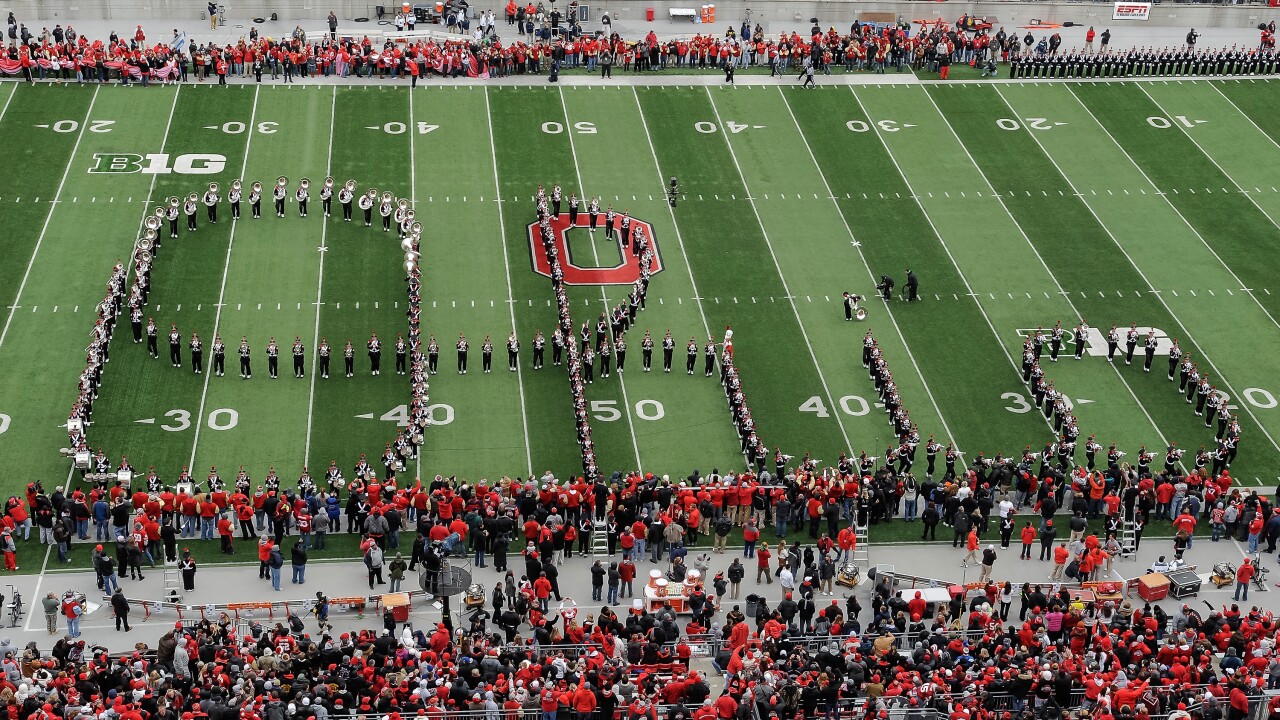
October 10, 1936: The Ohio State University Marching Band first performs their Script Ohio
formation, at Ohio Stadium in Columbus. Their football team is not up to the task: It loses to the University of Pittsburgh, 6-0.

The formation is based on the sign at the Loew's Ohio Theatre in downtown Columbus, although the capital O now resembles the block O in Ohio State's logos. They march to "Le Régiment de Sambre et Meuse,a French poem by Paul Cézano (not to be confused with the painter Paul Cézanne), set to music by Robert Planquette and arranged and expanded into a military march by Joseph-François Rauski. It was composed in 1870 -- the same year in which The... Ohio State University was founded.

At the various junctions in the formation, the band members swing their horns. This is especially difficult for those with heavy instruments, like the sousaphone. At the conclusion of the formation, the drum major leads a sousaphone player to the top of the lower case i in "Ohio," and he "dots the i." It's always a senior, and the seniors get their choice of games. The one with the most seniority inevitably chooses the Michigan game.

"Dotting the i" is considered the highest honor at Ohio State. The following people have been honorary i-dotters:

* 1971: Novice Fawcett, University President, 1956-72.

* 1974: Richard Heine, Band head composer and arranger, 1935-85, making him, essentially the father of Script Ohio.

* 1978: Bob Hope, entertainer, who grew up in Cleveland.

* 1979: Jack Evans, Band Director, 1952-64.

* 1983: Dr. Paul Droste, Band Director, 1970-83.

* 1983: Woody Hayes, head football coach, 1951-78.

* 1985: Robert Ries, Ohio State ticket director, 

* 1990: James "Buster" Douglas, a Columbus native, then in his brief reign as Heavyweight Champion of the World.

* 1995: Dr. E. Gordon Gee, University President, 1990-98, and again 2007-13.

* 2006: Jack Nicklaus, golf legend, Columbus area native, played at Ohio State. He left a few credits short of a degree, but was awarded an honorary doctorate in 1972.

* 2009: John Glenn, former astronaut and U.S. Senator, and his wife, Annie Glenn, advocate for people with disabilities. Both graduated from nearby Muskingum College, but maintained ties to Ohio and to OSU.

* 2011: Dr. Jon Woods, band director, 1984-2012.

* 2011: Lex Wexner, Ohio State Class of 1959, CEO of L Brands, makers of women's lingerie and beauty products, and a major OSU donor.

* 2016: Earle Bruce, head football coach, 1979-87.

UPDATE: 2024: Archie Griffin, Ohio State running back, the only 2-time winner of the Heisman Trophy, 1974 and '75.

On occasion, the Band will do a "Double Script": A Script facing each side. On Homecoming, they join with the Alumni Band to do a "Quadruple Script."

*

October 10, 1936 was a Saturday. The baseball season had ended 4 days earlier, when the New York Yankees beat the New York Giants in the World Series. It was too early for the basketball season or the hockey season. The NFL played the next day. But there were other college football games on this day:

* Minnesota beat Nebraska, 7-0 at Memorial Stadium in Minneapolis. Nebraska would win the Big Six Conference title anyway.

* Northwestern beat North Dakota Agricultural, 40-7 at Dyche Stadium in Evanston, Illinois. Northwestern would later be ranked Number 3 in the nation -- 1936 was the 1st season of the Associated Press (AP) poll of sportswriters -- and beat Number 1 Minnesota at Dyche Stadium, giving them the Big Ten Conference title. But a season-ending loss to Notre Dame would cost them the National Championship, which ended up being awarded to Minnesota, anyway.

Northwestern would rename Dyche Stadium Ryan Field in 1997. North Dakota Agricultural would change its name to North Dakota State in 1960.

* Speaking of Notre Dame, they beat Washington University of St. Louis, 14-6 at Notre Dame Stadium in South Bend, Indiana.

* Louisiana State beat Georgia, 47-7 at Tiger Stadium in Baton Rouge, Louisiana. LSU were declared Southeastern Conference Champions, but blew a shot at the National Championship when they went into the Sugar Bowl ranked Number 2 in the country, and lost to Santa Clara University. (For some reason, they did not play on this day, instead playing the next day, a rare college game on Sunday: They beat the University of San Francisco, 15-7 at Kezar Stadium in San Francisco.)

* Alabama beat Mississippi State, 7-0 at Denny Stadium in Tuscaloosa, Alabama. It was renamed Bryant-Denny Stadium in 1975. Like LSU, 'Bama finished the regular season undefeated, but it had a tie in conference play, to Tennessee the week after this, and that cost them the SEC title.

* Arkansas beat Baylor, 14-10 at The Hill in Fayetteville, Arkansas. They went on to win the Southwest Conference Championship.

* The University of Washington beat UCLA, 14-0 at the Los Angeles Memorial Coliseum. Washington went on to win the Pacific Coast Conference, but lost to the University of Pittsburgh in the Rose Bowl. Pitt thus claims this season's National Championship -- although, at 8-1-1, it's debatable as to whether they had a better claim to it than did 7-1 Minnesota.

* Navy beat Virginia, 35-14 at Thompson Stadium in Annapolis, Maryland.

* In New York City, Army beat Columbia, 27-16 at Yankee Stadium.

* New York University beat Pennsylvania Military College, 26-0 at Ohio Field in The Bronx. PMC became Widener University in 1972, and now compete in NCAA Division III. At least they still have a football team: NYU suspended their program in 1953, and its other sports teams also compete in Division III.

* And in New Jersey, Princeton beat Rutgers, 20-0 at Palmer Stadium in Princeton.

Friday, October 7, 2022

October 8, 1921: The 1st Football Game on Radio

The 1921 University of Pittsburgh football team

October 8, 1921: For the 1st time, a football game is broadcast on radio. KDKA in Pittsburgh, who had debuted by broadcasting the previous year's Presidential election results, and earlier this year had become the 1st station to broadcast a baseball game, heads for the gridiron.

Harold Arlin, a foreman at KDKA's parent company Westinghouse, was the announcer., for radio's 1st football game, as he had been 2 months earlier for radio's 1st baseball game. He was an engineer working for the station's owner, the Westinghouse Electric and Manufacturing Company. Although he had no background in the nascent radio industry, or in anything else that required the use of his voice, like stage acting, the company assigned him to call these games.

The opponents are the University of Pittsburgh and West Virginia University, a rivalry later nicknamed The Backyard Brawl, at Forbes Field, home of baseball's Pirates. Pitt wins, 21-13. 
Forbes Field

On September 14, 1923, Arlin became the 1st boxing announcer over radio, going to the Polo Grounds in New York, to announce Jack Dempsey's wild comeback to knock Luis Firpo out and retain the Heavyweight Championship of the World.

But after 1921, Arlin never broadcast the Pirates again. He became known as radio's first celebrity interviewer, conducting interviews with William Jennings Bryan, Lillian Gish, Will Rogers and Babe Ruth. He later moved to Mansfield, Ohio, and ran Westinghouse's plant there. He lived until 1896.

*

October 8, 1921 was a Saturday. Some of the other notable college football games of the day:

* The University of Iowa upset Notre Dame, the defending National Champions, 10-7 at Iowa Field in Iowa City. Iowa Stadium was built in 1929, and was renamed Kinnick Stadium in 1972.

* The University of California, on its way to being declared National Champions for 1921, beat the University of Nevada, 51-6 at California Field in Berkeley. California Memorial Stadium was built 2 years later, on the profits of Cal's "Wonder Team."

* Army beat Lebanon Valley College of Annville, Pennsylvania, 33-0 on The Plain at West Point, New York. Michie Stadium opened in 1924.

* Harvard beat Indiana University, 19-0 at Harvard Stadium in Boston. But 3 weeks later, Harvard would be the victims of a stunning upset, 6-0 at Harvard Stadium, by Centre College of Danville, Kentucky.

* In New York City, Columbia beat Wesleyan University, 14-3 at South Field. Baker Field, on which today's Wien Stadium was built, opened in 1923. Fordham beat the Catholic University of America, based in Washington, D.C., 10-0 at Fordham Field in The Bronx. And New York University lost to Brown, 13-0 at Andrews Field in Providence, Rhode Island. 

* In New Jersey, Princeton beat Colgate, 19-0 at Palmer Stadium. And Rutgers lost to Lehigh, 7-0 at Neilson Field in New Brunswick.

October 8 was an off-day in the World Series, which was played entirely at the Polo Grounds in Upper Manhattan, and which the New York Yankees led over the New York Giants, 2 games to 1. But the Giants would win it, 5 games to 3. This remains the last World Series not to be a best-4-out-of-7.

And Arsenal lost to Sunderland, 1-0 at Roker Park in Sunderland, in the North-East of England. 

Saturday, October 1, 2022

October 1, 1932: Babe Ruth's Called Shot

 
October 1, 1932: Game 3 of the World Series is played at Wrigley Field in Chicago. There was bad blood between the New York Yankees and the Chicago Cubs, because the Cubs had acquired former Yankee shortstop Mark Koenig late in the season, he'd helped them win the Pennant, and the team had announced that, whatever their individual players' shares of the World Series money would be, he would get only half as much.

The Yankees, including Babe Ruth himself, publicly called the Cubs cheap, and there was some rough stuff in the 1st 2 games at Yankee Stadium. When Ruth and his wife Claire got off the train at Union Station in Chicago, Cub fans were waiting for them, throwing garbage at them, and spitting on them. Neither was naive: The Babe had been treated badly before, and Mrs. Ruth, under her maiden name of Claire Hodgson, was an actress, and was used to rough customers. But this was over the line.

In Game 3, the Yankees took a 4-1 lead, including home runs by Ruth and Lou Gehrig (in that case, not back-to-back). But the Cubs tied it up in the bottom of the 4th. Ruth led off the top of the 5th, and the Cub fans were abusing him like crazy. In the Cubs dugout, the "bench jockeying" was nasty as well.

Ruth was no stranger to this. Because of his large, wide nose and big lips, there had been suggestions that he was part black. Research into his family history showed him to be almost completely German -- in fact, because his grandparents were born in Pennsylvania, before moving to Baltimore, they were "Pennsylvania Dutch" -- ethnically Amish, if practicing Catholics.

But that didn't stop people from indulging in rumors, and one of the names he was sometimes called was "(N-word) Lips." On one memorable occasion, which may be apocryphal, he heard this particular insult, walked over to the opposing dugout, and said, "Listen, you guys, call me 'bastard' or 'cocksucker,' or whatever you want, but lay off the personal stuff, would ya?"

Charlie Root was pitching for the Cubs, and he threw a called strike. The Babe didn't like the pitch, and the Cubs' bench jockeying got worse. A home movie -- sadly, silent, and with all the crowd noise, we probably wouldn't be able to hear what the players were saying, anyway -- shows Ruth waving his right hand at the Cub dugout, a classic "Ah, go on, ya bum" gesture.

The way the story is usually told, including on a newsreel by Ruth himself, there were only 3 pitches in this at-bat. In fact, Root's next 2 pitches were out of the strike zone, and called balls. His 4th pitch was called a strike. The home movie shows Ruth pointing directly at Root -- twice. His arm is not extended. Contrary to legend, he is not pointing at a spot beyond the outfield fence, as if to say, "I'm going to hit the next pitch there."

But he is sending a message. Cubs catcher Gabby Hartnett claimed Ruth said, "It only takes one." Another source said Ruth said, "You got one more, kid!" (To the Babe, who was terrible with names, if you were a young guy, you were "Kid"; if you were older, you were "Doc"; and if he didn't like you, or sometimes even if he did, you were "You son of a bitch!") Gehrig, in the on-deck circle, told a reporter that what Ruth yelled at Root was, "I'm gonna hit the next pitch right down your goddamned throat!"

So, yes, Babe Ruth called his shot.

Root threw him one more pitch. The Babe crushed it to dead center field. Longtime Cub observers said it was the longest home run ever hit in Wrigley Field to that point. The now-familiar center field scoreboard wouldn't go up until 1937, and no player has ever hit it with a home run. Supposedly, Roberto Clemente once missed it by less than a foot. Had it been there in 1932, the Babe's blast might have hit it.

The crowd knew that the Babe had made his point, and, like the Russian fans turning from Drago to Balboa in Rocky IV, switched sides, and cheered him as he rounded the bases, making a few more gestures, as if to say, "I told you so!"

For the rest of their lives, all the Cubs who had been interviewed on the subject said he didn't "call his shot." Charlie Root said that if Ruth had done that, "I'd have put one on his ear, and knocked him on his ass." Offered the chance to play himself in The Babe Ruth Story, the awful 1948 film starring William Bendix, Root, who went 201-160 for his career and died in 1970, said, "Not if you're going to show him pointing," and turned it down.

For the rest of their lives, all the Yankees who had been interviewed on the subject said he did it, including Charlie Devens, who pitched for the Yankees from 1932 to 1934, and was the last living player from the team.

There was one exception: Frank Crosetti, the Yankees' shortstop. I used to think that was why Crosetti never appeared at Old-Timers' Day between 1968, his last season as a Yankee coach, and 2002, when he died. It turned out that he simply didn't accept the invitation, preferring not to cross the country from his home in Stockton, California.

Franklin Delano Roosevelt, Governor of New York, and running for President, threw out the ceremonial first ball at the game, and according to a reporter covering his campaign, threw his head back and laughed when Ruth hit the home run. But through his entire 12-year Presidency, FDR never publicly offered his opinion on whether Ruth had "called his shot."

Francis Cardinal Spellman, then the Archbishop of New York, was at the game, and he said Ruth did it. So did John Paul Stevens, then a 12-year-old Chicago schoolkid, later a Justice of the U.S. Supreme Court, and a Cub fan to the end of his life in 2019. If a Cub fan could admit it, then that's good enough for me.

The next batter was Gehrig, and he also hit his 2nd home run of the game. The Yankees hung on to win, 7-5, and completed the sweep the next day.

It was Ruth's 10th World Series, and his 7th World Series win. And it was his 15th home run in World Series play. In each case, it would be his last. The Washington Senators would win the American League Pennant in 1933, and the Detroit Tigers in 1934 and 1935. Ruth retired early in the 1935 season. In 1936, Joe DiMaggio made his Yankee debut, teaming with Gehrig to start a new dynasty.

Ruth's Called Shot remains, along with Bobby Thomson's 1951 Pennant-winning "Shot Heard 'Round the World," one of the two most talked-about home runs in baseball history, more so even than the World Series Game 7-winning shot by Bill Mazeroski in 1960, or the home runs that broke Ruth's records: Single-season, 61 by Roger Maris in 1961, then 70 by Mark McGwire in 1998, then 73 by Barry Bonds in 2001; and career, 715 by Hank Aaron in 1974, then 756 by Bonds in 2007.

UPDATE: Among the Yankees' many traditions is Monument Park at Yankee Stadium. From this 1932 team, they have honored right fielder George "Babe" Ruth, and 1st baseman Lou Gehrig, with Monuments. They have honored manager Joe McCarthy, catcher Bill Dickey, and pitchers Charles "Red" Ruffing and Vernon "Lefty" Gomez with Plaques. McCarthy never wore a number, but the team retired Number 3 for Ruth, 4 for Gehrig, and 8 for Dickey. They have also honored team owner Jacob Ruppert and general manager Ed Barrow with Plaques.

Along with each of the preceding, 3rd baseman Joe Sewell is in the Baseball Hall of Fame. But it is for his earlier playing for the Cleveland Indians, and he is not honored in Monument Park.

The Cubs have a team Hall of Fame. Inducted from their 1932 Pennant winners have been catcher Charles "Gabby" Hartnett, 2nd basemen Rogers Hornsby and Billy Herman, 3rd baseman Stan Hack, left fielder Riggs Stephenson, right fielder Hazen "Kiki" Cuyler, pitcher Charlie Root, manager Charlie Grimm, team owner Philip K. Wrigley, executive Margaret Donahue, and public address announcer Pat Pieper.

*

Of course, this was the only baseball game of the day. And it was the off-season for the NHL. And the NBA hadn't been founded yet.

But October 1, 1932 was a Saturday, so while all the NFL games played that weekend were played the next day, there were college football games played, including 2 major rivalries.

The University of Michigan opened its season by beating Michigan State University, 26-0 at Michigan Stadium in Ann Arbor. This was the depth of the Depression, so only 33,786 fans came into what has since been nicknamed "The Big House," then seating 85,752, to see the Wolverines blank the Spartans. The Michigan went on to win the Big Ten Conference.

Another Big Ten team, the University of Minnesota, played its 1st game under head coach Bernie Bierman. They beat South Dakota State, 12-0 at Memorial Stadium in Minneapolis. Over the next 9 seasons, 1933 to 1941, Bierman would lead the Golden Gophers to 7 Conference Championships and 5 National Championships.

The University of Southern California beat Washington State University, 20-0 at the Los Angeles Memorial Coliseum. Only 35,000 paid to get into the 100,000-seat Coliseum. USC would go on to win the Pacific Coast Conference, a forerunner of today's Pac-12.

In a rivalry later to be known as "The Backyard Brawl," the University of Pittsburgh beat West Virginia University, 40-0 at the old Mountaineer Field in Morgantown, West Virginia. (Built in 1924, it was replaced with a new Mountaineer Field, now named Milan Puskar Stadium, elsewhere on campus in 1980.)

Pitt had no conference to win, but were invited to play USC in the Rose Bowl on January 2, 1933. USC left no doubt as to who was the better team, winning 35-0. But the various outlets that selected National Champions in those days were divided, some picking USC, some picking Michigan. Under the current format, USC would have played Michigan in the Rose Bowl to decide it.

The University of Notre Dame did not play that day, opening their season a week later. Army beat Furman University 13-0 at Michie Stadium in West Point, New York. Navy lost to the College of William & Mary, 6-0 at Thompson Stadium in Annapolis, Maryland.

In New York City, Columbia beat Lehigh 41-6 at Baker Field in Manhattan. Fordham beat the University of Baltimore, 69-0 at Fordham Field in The Bronx. New York University beat Hobart College, 33-0 at Ohio Field in The Bronx.

In New Jersey, Rutgers beat Pennsylvania Military Academy, 20-6 at Neilson Field in New Brunswick. And Princeton beat Amherst College at Palmer Stadium in Princeton.

Also, Arsenal beat Blackpool, 2-1 at Bloomfield Road, in Blackpool, Lancashire.

Saturday, July 16, 2022

July 16, 1970: Three Rivers Stadium Opens In Pittsburgh

July 16, 1970: Three Rivers Stadium opens in Pittsburgh. It replaces Forbes Field, which had been home to baseball's Pittsburgh Pirates since 1909. In their last games there, on June 28, the Pirates had swept a doubleheader from the Chicago Cubs, 3-2 and 4-1.

Classrooms for the University of Pittsburgh were built on the site of Forbes Field. Unlike some other teams, the Pirates did not move home plate to their new home. It is encased under glass in Posvar Hall -- but not quite in its exact location. That turned out to be where a women's bathroom was built. Some of Forbes' brick outfield wall was left standing, and a brick path marks the rest, including a plaque where Bill Mazeroski's home run ball cleared the fence to win the 1960 World Series.

The Cincinnati Reds spoil the opening party at Three Rivers, beating the Pirates 3-2. Dock Ellis runs out of gas in the 9th inning, and gives up a single to Tony Pérez, a walk to Johnny Bench, and a single to Lee May. Earlier in the game, Pérez had hit the 1st home run in the new stadium, and Willie Stargell hit the 1st home run for the home team.

The NFL's Pittsburgh Steelers also moved in. Their regular-season debut there was no better: On September 20, 1970, they lost to the Houston Oilers, 19-7.

Three Rivers -- named for the spot where the Allegheny River and the Monongahela River combine to form the Ohio River -- was an artificially-turfed multipurpose stadium, not very good for either baseball or football.

It hosted 28 postseason baseball games, including games of the 1971 and 1979 World Series, both of which the Pirates won; and 18 NFL Playoff games, including 9 AFC Championship Games and the 1972 AFC Divisional Playoff that featured the Terry Bradshaw to Franco Harris pass known as the "Immaculate Reception," a game that launched the Steelers' 1970s dynasty that saw them win play in 4 Super Bowls, and win them all.

Oddly, while Stargell hit the longest home runs ever at Veterans Stadium in Philadelphia, the Olympic Stadium in Montreal, and, through the 2021 season, Dodger Stadium in Los Angeles, he did not hit the longest at Three Rivers. Given that he had crossed Pennsylvania to hit the longest at The Vet, it was somewhat appropriate that a Philadelphia Phillies slugger had gone in the opposite direction to hit the longest homer at Three Rivers: Greg Luzinski.

The Pittsburgh Maulers of the United States Football League (USFL) played 1 season, 1984, and their home games were at Three Rivers. It also served as a home field for Duquesne University in 1971, and the University of Pittsburgh for scattered games, and all their home games in the 2000 season, from the demolition of Pitt Stadium (where the Steelers had played from 1964 to 1969) until the opening of Heinz Field/Acrisure Stadium.

The stadium fulfilled its purpose: It saved the Pirates and Steelers from having to move. But it was a bad design, and both teams moved to new stadiums after their 2000 season, one on either side of Three Rivers. The Pirates' finale was on October 1, 2000. As with the Forbes Field finale, it was against the Cubs. Unlike that 1970 contest, the Cubs won, 10-9. The Steelers' finale was on December 16, 2000, and they beat the Washington Redskins, 24-3.

Three Rivers Stadium, age 30, was demolished on February 11, 2001. This time, the Pirates did move home plate from the old stadium to the new one, so they're presumably using the same plate that they were using in the Summer of 1970.

The Pirates opened PNC Park on April 9, 2001. As with the Three Rivers opener, Cincinnati spoiled the occasion, 8-2. Pitt played the 1st regular-season football game at Heinz Field on September 1, 2001, beating East Tennessee State, 31-0. The Steelers played their 1st regular-season game there on October 7, 2001, beating the Cincinnati Bengals, 16-7. Heinz Field was renamed Acrisure Stadium in 2022.

*

July 16, 1970 was a Thursday. These other Major League Baseball games were played that day:

* The New York Yankees split a doubleheader with the Oakland Athletics at Yankee Stadium. The A's won the opener, 8-2. Chuck Dobson outpitched Fritz Peterson. Frank Fernández hit a home run for the A's, and Curt Blefary hit one for the Yankees. The Yanks won the nightcap, 4-1. Stan Bahnsen outpitched Diego Seguí. Pete Ward went 2-for-3 with 3 RBIs for the Yanks. Over the 2 games, future Yankee Reggie Jackson went 1-for-5 with 2 walks and 3 RBIs.

* The New York Mets lost to the Los Angeles Dodgers, 3-1 at Dodger Stadium in Los Angeles. Bill Singer outpitched Jim McAndrew.

* The Boston Red Sox beat the Milwaukee Brewers, 6-5 at Fenway Park in Boston. George Scott scored Carl Yastrzemski with a sacrifice fly to win the game in the bottom of the 10th inning. Yaz had gone 2-for-5. Billy Conigliaro hit 2 home runs, and his brother Tony got a hit, but the love affair between Red Sox fans and the Congiliaros was, to put it in Friends-speak, on a break.

* The Baltimore Orioles beat the Minnesota Twins, 5-1 at Memorial Stadium in Baltimore. Frank Robinson went 1-for-4. Brooks Robinson went 0-for-3 with a walk. Harmon Killebrew hit a home run. Rod Carew did not play.

* The California Angels beat the Washington Senators, 3-2 at Robert F. Kennedy Stadium in Washington.

* The Detroit Tigers beat the Chicago White Sox, 11-6 at Comiskey Park in Chicago. Al Kaline went 2-for-4 with a walk.

* The Atlanta Braves beat the St. Louis Cardinals, 7-3 at Busch Memorial Stadium in St. Louis. Pat Jarvis outpitched Steve Carlton. Hank Aaron went 1-for-4 with a walk. Lou Brock went 2-for-4 with a walk.

* The Cleveland Indians beat the Kansas City Royals, 6-0 at Kansas City Municipal Stadium. Rich Hand pitched a 4-hit shutout.

* The Houston Astros beat the Chicago Cubs, 2-1 at the Astrodome in Houston. Don Wilson outpitched Ken Holtzman. Ernie Banks did not play.

* The Philadelphia Phillies beat the San Diego Padres, 10-7 at San Diego Stadium (later renamed Jack Murphy Stadium and Qualcomm Stadium).

* And the Montreal Expos and the San Francisco Giants were not scheduled. The All-Star Game had been played 2 days earlier, and these 2 teams got an extra day of the All-Star Break.

Monday, April 11, 2022

April 11, 1948: Dr. Jock Sutherland Dies

April 11, 1948: Jock Sutherland dies in Pittsburgh. He was only 59 years old. He had more to do.

John Bain Sutherland was born on March 11, 1889 in Copuar Angus, Perth and Kinross, Scotland. Scots, especially if their name is John, are called "Jocks," an accent-oriented variation of "Jack," so it has nothing to do with sports. He came to America as a boy, and, instead of soccer, the game his country calls "football," he played American-style football.

Sutherland decided, unlike Casey Stengel, that he would be both a dentist and an athlete, hence he was usually called "Doctor Jock Sutherland." Along with Wild West gunfighter John Henry "Doc" Holliday (but not Stengel, who never actually qualified for the profession), he might be the most famous dentist in American history.

He played on the undefeated 1917 football team at the University of Pittsburgh, played briefly with the professional Massillon Tigers, coached at Lehigh University, and went back to Pitt, leading them to National Championships in 1929, 1931, 1934, 1936 and 1937 -- going undefeated in the last of these seasons, led by two-way back Marshall "Biggie" Goldberg, later to star with the NFL's Chicago Cardinals.

Sutherland moved on to the pros, leading the Brooklyn Dodgers to a 2nd-place finish in the NFL's Eastern Division in 1941. Like the baseball team for which they were named, the football Dodgers played at Ebbets Field, and their players and fans took great joy in beating their sport's New York Giants.

Although the Giants won the NFL East in 1941, the Dodgers won both games between them that season -- including the one played at the Polo Grounds on December 7, 1941, which was interrupted by several announcements in the second half of military personnel being told by the public-address announcer to report to their bases, where they would soon find out that the Japanese had attacked Pearl Harbor.

Sutherland did not serve in World War I, even though he was draft-eligible. But he volunteered for World War II, rising to the rank of Lieutenant Commander in the U.S. Navy. When the war ended, he returned to Pittsburgh as head coach of the Steelers. In 1947, he led them to a tie for the title of the NFL East, and thus the franchise's 1st Playoff berth (though the NFL does not officially recognize the game that followed as a "playoff game").

The Steelers lost to the cross-State Philadelphia Eagles, and would not play in the postseason again until 1972. A major reason why is that this was the last football game that Dr. Jock Sutherland ever saw. He died of a brain tumor 4 months later.

We'll never know if Sutherland would have turned the Steelers into an NFL power, but over the next 10 years, they would have the following quarterbacks in their training camps: Johnny Unitas, Len Dawson and Jack Kemp. I find it hard to believe that Sutherland, assuming he lived and Art Rooney kept him (I don't see why not, Art was a man renowned for his loyalty), wouldn't have kept at least one of those future legends, changing the history of football in untold ways.

*

April 11, 1948 was a Sunday. The baseball season started 8 days later. Football was out of season. The Finals of the Basketball Association of America, the league that would become the NBA for the 1949-50 season were underway. The Baltimore Bullets would defeat the defending Champion Philadelphia Warriors.

And Game 2 was played in the Stanley Cup Finals. The Toronto Maple Leafs beat the Detroit Red Wings, 4-2 at Maple Leaf Gardens in Toronto. Max Bentley scored 2 goals. The Leafs completed the sweep 4 days later.

Sunday, January 2, 2022

January 2, 1956: The 1st Integrated Bowl Game In the South

Bobby Grier

January 2, 1956: The college football season comes to an end, with the traditional New Year's Day bowl games, pushed back a day because January 1 was a Sunday.

This Monday saw the playing of the Sugar Bowl, at Tulane Stadium in New Orleans. The Georgia Institute of Technology, a.k.a. Georgia Tech, entered the game at 8-1-1, having lost to Auburn and been tied by Tennessee; however, they had beaten the University of Miami, Florida and Duke, each of them ranked at the time. Tech came in ranked Number 7.

However, they were only 3rd in the Southeastern Conference. Mississippi, instead of accepting the usual invitation given by the Sugar Bowl to the SEC Champions, instead accepted an invitation to play in the Cotton Bowl. "Ole Miss" and Tech did not play each other that season. Auburn, who finished 2nd, were not invited by the Sugar Bowl, and ended up losing the Gator Bowl to the 5th-place team in the SEC, Vanderbilt. (Tennessee finished 4th.) So the Sugar Bowl invited Georgia Tech.

Their opponents were the University of Pittsburgh. An Independent, Pitt were only 7-3, losing to Oklahoma, Navy and Miami. However, they had beaten ranked teams Duke and West Virginia, and teams from other regions, Nebraska and the University of California. They came into the game ranked Number 11.

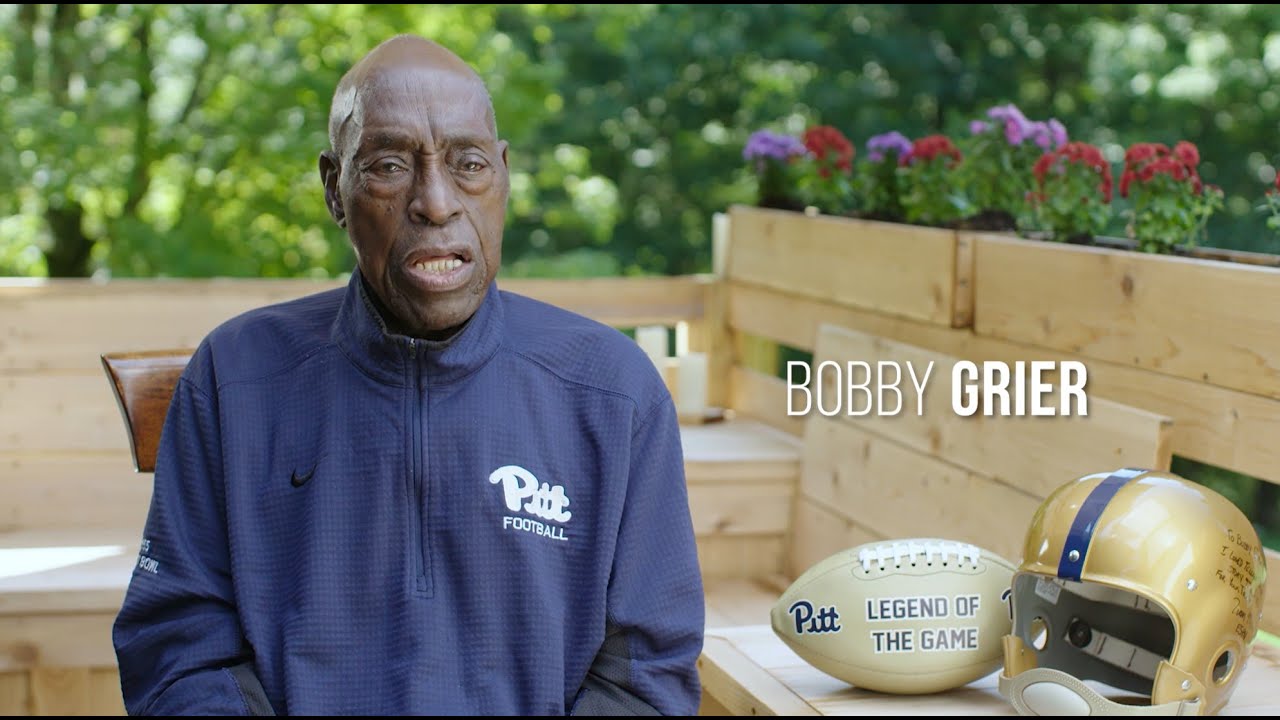
Pitt's best player was Bobby Grier, a fullback and a linebacker, as most college football teams were still sending players to play what was known as "single-platoon football," the same players playing on both offense and defense. Grier, a native of the football-mad town of Massillon, Ohio, was black.

Segregationists didn't want Grier to play in the Sugar Bowl. Governor Marvin Griffin of Georgia sent a telegram to Tech's Board of Regents, in an attempt to pressure the school's president, Blake Van Leer, to pull the team out of the game. Van Leer was already catching heat for pushing through a vote to allow women in Georgia Tech.

But Van Leer, who had held the office since 1944, refused to be bullied by the ignorant redneck Governor: He told a meeting of the Faculty Senate, "Either we're going to the Sugar Bowl, or you can find yourself another damn president of Georgia Tech." The Senate gave him a standing ovation.

This was one month after Rosa Parks refused to stand up on a bus in Montgomery, Alabama, with the bus boycott ongoing; 4 months after the murder of 14-year-old Emmett Till in Money, Mississippi; and a year and a half after the U.S. Supreme Court struck down public school segregation in the case of Brown v. Board of Education of Topeka, Kansas.
Grier, supported by his white teammates 

As it turned out, there was no law that could prevent Grier from playing in the game, and, for the 1st time, a bowl game in the South had a black player in it.

Georgia Tech won the game, 7–0. The margin of victory mostly resulted from a disputed pass interference penalty, in the 1st quarter. It was called on Grier, giving Georgia Tech a 1st and goal on the Pitt 1-yard line. The Yellow Jackets scored the game's only touchdown on the next play. Photographic evidence later strongly indicated the referee's call was incorrect.

The irony of the bad call is that it was made by referee Rusty Coles, who was from the Pittsburgh area, and who had no objective in making the wrong call, but simply made a mistake, which he admitted after seeing the game films.

Grier finished the game as its leading rusher with 51 yards. After the game, he protested the pass interference call, but praised the Georgia Tech players, saying, "They were good sportsmen, perhaps the best I've played against all season. They played hard, but clean. It was a good game. But believe me. I didn't push that man."

As it turned out, the State of Georgia needed to find a new president of Georgia Tech, anyway: Blake Van Leer died of a heart attack on January 24, 1956, just 22 days after the game. Edwin D. Harrison was named the new president. In 1960, he oversaw a vote by an overwhelming majority of Tech students to endorse the integration of qualified applicants, regardless of race.

Bobby Grier did not play professional football. Instead, he enlisted in the U.S. Air Force, and later served as an administrator at a community college in the Pittsburgh area. As of January 2, 2022, he is still alive.
UPDATE: Later in 2022, Grier was elected to the Pitt Athletics Hall of Fame. He died in 2024.

*

January 2, 1956 was, as I said, a Monday. These other bowl games were played that day:

* Oklahoma beat Maryland, 20-6, in the Orange Bowl, at Burdine Stadium in Miami. In 1959, the stadium was renamed the Orange Bowl. This was, effectively, the National Championship Game: Oklahoma, in the middle of their 47-game winning streak, still a college football record, were ranked Number 1, and had won the Big Seven Conference title; while Maryland were ranked Number 3, and had won the Atlantic Coast Conference title.

Oklahoma were favored by 7 points. If Maryland had pulled the upset, it's likely that they would have been awarded the National Championship, regardless of whether Number 2 Michigan State won the Rose Bowl. At the very least, there could have been a split in the polls. But Oklahoma won, making the Rose Bowl academic.

* Michigan State did their part, beating the University of California at Los Angeles, 17-14, in the Rose Bowl, in the stadium of the same name in the Los Angeles suburb of Pasadena, California. Michigan State were ranked Number 2, and Champions of the Big Ten Conference. UCLA were ranked Number 4, and Champions of the Pacific Coast Conference. But Oklahoma's 2-touchdown win put the National Championship out of reach for Michigan State.

* Mississippi beat Texas Christian University, 14-13, in the Cotton Bowl, in the stadium of the same name in Dallas. As previously stated, Ole Miss were the SEC Champions, and went into the game ranked Number 10. TCU were the Champions of the Southwest Conference, and were ranked Number 6.

* Wyoming beat Texas Tech, 21-14 in the Sun Bowl, at Kidd Field in El Paso, Texas. Wyoming finished 4th in the Skyline Conference, while Texas Tech were the Champions of the Border Conference.

* Juniata College and Missouri Valley College played to a tie, 6-6 in the Tangerine Bowl, in the stadium of the same name in Orlando, Florida. The Tangerine Bowl game was a showcase for what were then called "small college" teams. Both the game and the stadium would become bigger, and become known as the Citrus Bowl.

Juniata, of Huntingdon, Pennsylvania, then an Independent, now competes in NCAA Division III. Missouri Valley, of Marshall, Missouri, were the Champions of the Missouri College Athletic Union, and now compete in the NAIA -- for all intents and purposes, NCAA Division IV.

December 31, 1999 & January 1, 2000: The Millennium

December 31, 1999:  The Millennium arrives. The people of planet Earth survived. At a terrible cost. But we hadn't destroyed ourselves. ...