Showing posts with label sherlock holmes. Show all posts

Wednesday, November 23, 2022

November 24, 1887: Sherlock Holmes Debuts

Jeremy Brett as Holmes, in the PBS
anthology series Mystery!, sometime in the 1980s

November 24, 1887: The British magazine Beeton's Christmas Annual is published. It sells out before Christmas, largely on the strength of a novel whose text it contains: A Study in Scarlet, by Dr. Arthur Conan Doyle. The story introduces the character of consulting detective Sherlock Holmes, and his assistant, Dr. John H. Watson.

Watson was based on Conan Doyle himself. (He used "Conan Doyle" as a compound surname, but Britain's list of knighthoods, and most libraries, list him alphabetically under D for "Doyle.") Born on May 22, 1859 in Edinburgh, Scotland, as Arthur Ignatius Conan Doyle, his mother was Irish Catholic, and his father's parents were as well, but he left the Church as a young man and became an agnostic.

He attended the University of Edinburgh Medical School, and studied botany at the Royal Botanical Garden there. He would have Holmes frequently rely on his knowledge of botany, particularly in how some plants are poisonous.

One of his professors was Dr. Joseph Bell (1837-1911), and it was on him that Conan Doyle based Holmes, writing to him in 1892, "It is most certainly to you that I owe Sherlock Holmes... Round the centre of deduction and inference and observation which I have heard you inculcate I have tried to build up a man."

Another University of Edinburgh graduate (though not of its medical school) who turned to writing, Robert Louis Stevenson, used Holmes-like deduction to figure it out, writing to Conan Doyle, "My compliments on your very ingenious and very interesting adventures of Sherlock Holmes... Can this be my old friend Joe Bell?"

In September 1879, Conan Doyle was published for the first time, both with an academic article and a short story. And -- relevant to the 2020s -- he was a staunch supporter of early vaccination and a denouncer of anti-vaccinators.

In 1885, he married Louisa Hawkins, and they had a daughter named Mary Louise and a son named Arthur Kingsley. Known as "Kingsley," he was wounded in World War I, and died of pneumonia just 14 days before the Armistice. Louisa died of tuberculosis in 1906. The following year, he married Jean Leckie, and they had a son named Denis, a son named Malcolm, and a daughter named Jean.

He earned his medical doctorate, but was unsuccessful in the practice of medicine. In 1886, he wrote A Study in Scarlet, and it was accepted for publication by Ward Lock & Co., although they waited an entire year to print it in their Beeton's Christmas Annual. It got excellent reviews, and Ward Lock commissioned a sequel, which became The Sign of the Four.

In 1890, having fulfilled this commitment, and not liking the way he was being exploited, Conan Doyle stuck to writing short Holmes stories for The Strand magazine, and it through these stories that Holmes is best remembered.
Conan Doyle took the name and profession, but nothing else, from Dr. James Watson, once a colleague in Portsmouth, Hampshire, England. Dr. John H. Watson narrated most of Holmes' stories. There was a Chief Inspector William Sherlock whose name was frequently  in the London newspapers, and Conan Doyle was find of the poetry of American writer Oliver Wendell Holmes.

It has been suggested that there was then a popular cricket player named Sherlock who inspired the detective's name, but this idea is usually dismissed. Nevertheless, Conan Doyle was a keen sportsman, and loved cricket, playing 10 first-class matches for the Marylebone Cricket Club at Lords. He played for an Authors XI alongside James M. Barrie (creator of Peter Pan), P.G. Wodehouse (Jeeves and Wooster) and A.A. Milne (Winnie the Pooh). As a bowler (equivalent in baseball to the pitcher), he had one first-class wicket (major league strikeout): W.G. Grace, a fellow physician, who was then regarded as the greatest batsman the sport had ever known.

He previously played as a goalkeeper for Portsmouth Association Football Club, while practicing medicine in the city. (That team went out of business in 1896, and the current Portsmouth Football Club -- "Play up, Pompey!" -- was formed 2 years later.) In 1901, he was 1 of 3 judges for the world's 1st major bodybuilding competition.  In 1908, he was a judge for the Olympic Games held in London, and was one of the judges who assisted Dorando Pietri after he fell on the final lap of the marathon, leading to Pietri's disqualification.

He had been an amateur boxer and, while on a lecture tour of America in 1910, was invited by boxing promoter Tex Rickard to referee the Heavyweight Championship fight between Jack Johnson and Jim Jeffries. He declined, citing the distance and his schedule. (Rickard ended up refereeing the fight himself, which Johnson won by a 15th round knockout.) That same year, he was elected captain of the Crowborough Beacon Golf Club in Sussex. He entered the English Amateur billiards championship in 1913. And some time that he spent in Switzerland, before creating Holmes, led to a love of skiing.

But his time spent in Switzerland also inspired the "death" of Holmes. He wanted to write about other things. Inspired by the  "scientific novels" of Jules Verne -- H.G. Wells had not yet tried the genre, and Hugo Gernsback had not yet coined the phrase "science fiction" -- he created the scientist Professor Challenger, including The Lost World, one of the 1st pieces of fiction to incorporate dinosaurs. He created Brigadier Gerard, an officer in Napoleon's Grand Armée. He created Sir Nigel Loring, a knight in the Hundred Years War.

His scientific and historical fiction got him the best reviews of his career. But the general public wanted more and more of Holmes. Conan Doyle couldn't take it anymore: In 1893, he published The Final Problem. He created a villainous equal for Holmes, Professor James Moriarty. Though Moriarty appeared in only this story, Holmes told Watson that they had been in a battle of wits for years.

They made their way to the Reichenbach Falls, a real place in the Bernese Oberland of Switzerland. There, according to the story, on May 4, 1891, 10 years after Holmes and Watson first met, Holmes and Moriarty fight, and tumble over a protective fence to their deaths. From such a height, neither could have possibly survived.

Holmes fans were furious! How dare the man who created their hero kill him! Conan Doyle got death threats in the mail. He was attacked on the street, by men with umbrellas and women with purses. It was the first "toxic fandom" in the history of popular culture.

It also produced some of the earliest "fanfiction," as people began writing their own Holmes stories, not considering copyright laws. As you might guess, this included some pornographic stories, some involving Holmes and Irene Adler, and some even involving a homosexual relationship between Holmes and Watson, thus inventing what came to be known -- after similar "Kirk/Spock" stories by whacked-out female Star Trek fans -- in the 1970s as "slash fiction."

Irene Adler, like Moriarty, canonically appeared only once, in A Scandal in Bohemia, but to Holmes would always be "the woman," though Watson specifically said that Holmes held only respect for her: "It was not that he felt any emotion akin to love for Irene Adler." Later film adaptations of Holmes would romantically link them, however. And author William S. Baring-Gould, a Holmes expert, suggested that Rex Stout's fictional private detective, Nero Wolfe, was the illegitimate son of Sherlock and Irene, the result of an affair after meeting again sometime after the incident at the Reichenbach Falls.

Bowing to pressure, in 1901, Conan Doyle published a full-length novel, The Hound of the Baskervilles, obviously taking place before Holmes' death. This only increased the demand for more Holmes stories. In 1903, Conan Doyle gave in, writing The Empty House, and explaining how Holmes survived the Reichenbach Falls. Fandom had its 1st victory over the "cancellation" of a popular series. It would not happen again until the aforementioned Star Trek, 65 years later.

Though associated with the Victorian era, and (within his fictional world) known all over Europe for his detective work, the character of Holmes was never knighted by Queen Victoria. Nor was he knighted by her son, King Edward VII; nor by his son, King George V. But in 1902, King Edward did knight Conan Doyle -- not for his Holmes stories, but for his recent writings supporting the country, its government, and its Army in the Boer War.

In 1917, Conan Doyle published His Last Bow, which depicts Holmes and Watson, by then in their 60s, aiding the British government against the German Empire in the Summer of 1914, on the eve of World War I. As late as 1927, he was publishing Holmes stories, taking place between The Empty House and His Last Bow, and having Watson assure readers that Holmes, who had taken to beekeeping, "is long retired from his profession of detective but is still alive and well, albeit suffering from a touch of rheumatism."

Conan Doyle died on July 7, 1930, at 71, from a heart attack, at Windlesham Manor, his house in Crowborough, Sussex, about 40 miles south of London. He was buried in Minstead Churchyard in New Forest, Hampshire. His wife Jean died in 1940. None of his 5 children had children of their own, so, with his daughter Jean's death in 1997, the bloodline of Arthur Conan Doyle died out.

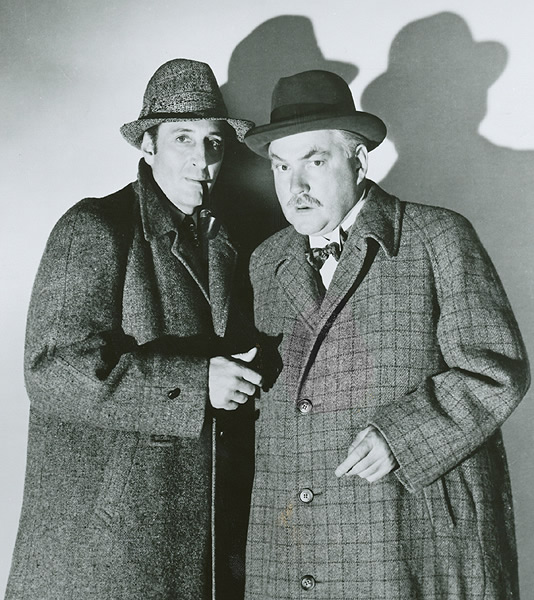
Baring-Gould, who placed Holmes' birth in 1854, considered the date of the creator's death to also be that of the creation. But Holmes lives on. His best known portrayal remains that of Basil Rathbone, in 14 films between 1939 and 1946. Some were set in Holmes' original period, but some were set in the present, and featured Holmes and Watson riding in automobiles and fighting Nazis, with Holmes wearing a fedora hat instead of a deerstalker cap. Nigel Bruce's portrayal rendered Watson as something of a bumbler, unworthy of standing alongside Holmes, for a generation of fans.

From 1970 to 2012, PBS' Sesame Street featured a Muppet named Sherlock Hemlock, voiced by Jerry Nelson, better known as the voice of The Count. Jeremy Brett played Holmes in 41 episodes of a Granada TV series from 1984 to 1994, which were broadcast in America as part of PBS' anthology series Mystery! Dr. Watson was played by David Burke in the 1st season, and Edward Hardwicke thereafter.

In 1987, the CBS movie The Return of Sherlock Holmes told the story of Jane Watson (Margaret Colin), the Doctor's great-granddaughter, a private detective living in present-day Boston, inheriting her family's English property, which included a cryogenic chamber in which Holmes (Michael Pennington) had frozen himself after being infected with plague. After getting him cured, he sees that modern London is no place for him, so she takes him home, his first experience on an airplane. Together, they solve a murder as he adjusts to the late 20th Century.

I was working at a movie theater in 1988 when Without a Clue was shown there. Ben Kingsley played Watson, and his creation, Holmes, had proven so popular that he hires an actor, Reginald Kincaid, played by Michael Caine, to play Holmes for the public. Together, they -- actually, just Watson, as Kincaid is called by Watson "You idiot!" to his face and, correctly, "a gambler, a womanizer, and a drunkard!" to others -- solve crimes, but Holmes gets the public credit. When Watson is kidnapped by Moriarty, Kincaid must take the lead for the first time, and be a real Holmes for the first time. With help from Mrs. Hudson, the landlady at 221b Baker Street, and a kid from the Baker Street Irregulars, he defeats Moriarty and closes the case.

More recently, 2 Holmes films have been made with Robert Downey Jr.; the TV series Sherlock, starring Benedict Cumberbatch as a present-day Holmes, also shown on PBS' Mystery!; and the CBS series Elementary, with Jonny Lee Miller as a present-day Holmes moving from London to New York, where he meets Dr. Joan Watson, a divorcée born Joan Yun (Lucy Liu). Despite Watson now being a woman, the series never made them a romantic couple.

That show's title brings up an important point. Arthur Conan Doyle never, not even once, had Sherlock Holmes say to his partner the words, "Elementary, my dear Watson." Rathbone used it, making it forever identified with the character, but Conan Doyle didn't. He did have Holmes use the word "elementary" a few times, and call his partner "my dear Watson" a few times (other times, "my dear fellow"), but never paired them up.

In the Marvel Cinematic Universe, Cumberbatch played Dr. Strange, while Downey played Iron Man. I think the Marvel writers missed an opportunity: Neither actor had the chance in any Marvel film to say to the other, "No shit, Sherlock!"

As for the world's most famous address: During Conan Doyle's lifetime, addresses on London's Baker Street did not go as high as 221, but the street was later extended. In 1932, the Abbey National Building Society moved into a complex at 219 to 229 Baker Street. Abbey National employed a full-time secretary to answer mail that came to 221b, addressed to Holmes. Abbey House closed in 2005. Since then, the Sherlock Holmes Museum, at 237 to 241 Baker Street, NW1 6XE, has had legal ownership of the building at 221b.

In a 2012 episode of the YouTube series Epic Rap Battles of History, rapper-comedian Zach Sherwin played Sherlock Holmes, and Saturday Night Live castmember Kyle Mooney played Dr. John Watson, against "Nice" Peter Shukoff as the Christian Bale version of Batman, with "Epic" Lloyd Ahlquist, incongruously, as the Burt Ward version of Robin.

*

November 24, 1887 was a Thursday. Erich von Manstein was born on this day. He became a Field Marshal of the Wehrmacht, Nazi Germany's army, and was convicted of war crimes. He served 4 years in prison, and, under NATO supervision, led the rebuilding of West Germany's armed forces.

In America, it was Thanksgiving Day. So, while baseball season was over, hockey hadn't yet come over the Canadian border, basketball hadn't yet been invented, and football hadn't yet gone professional, there was college football played that day:

* Yale beat Harvard in "The Game," 17-8 at the original Polo Grounds, at 111th Street and 5th Avenue in Manhattan. Effectively, this was the National Championship Game, as both teams came in undefeated. Harvard had outscored its opponents 652-0; Yale, 509-4. Led by quarterback Harry Beecher, who became the 1st football player to appear on what would later come to be called baseball cards, Yale won the game.

* That game at the Polo Grounds was the 2nd game of a doubleheader. In the 1st game, Wesleyan University beat the University of Pennsylvania, 10-4. Yale, Harvard and Penn, as Ivy League schools, now compete in the NCAA's Football Championship Subdivision (FCS, formerly Division I-AA); while Wesleyan, in Middletown, Connecticut, competes in NCAA Division III.

* The U.S. Naval Academy beat Johns Hopkins, 8-0 on the Academy grounds in Annapolis, Maryland. Hopkins, the Baltimore university famous for its medical school, now competes in Division III.

* The University of Richmond beat Randolph-Macon College, 14-13 in Richmond, Virginia. Richmond now compete in the FCS. Randolph-Macon, in Ashland, Virginia, compete in Division III.

* And the University of Michigan beat the Chicago Harvard School, 26-0 on a mudpatch of a field at the Wanderer Cricket Ground, at 37th Street and Indiana Avenue on the South Side of Chicago.

Michigan had intended to play Northwestern University on the day, but Northwestern backed out after the Michigan team had already arrived in Chicago. It was suggested to them that the CHS team was better than Northwestern, anyway, so the game was set up. It rained, and instead of being "the great equalizer," the rain held CHS back, and allowed Michigan to dominate.

The Chicago Harvard School was basically a private high school, intended to prepare its students for schools like Harvard and the University of Chicago, and did not play a major college in football again. It closed in 1962.

Tuesday, November 8, 2022

November 9, 1888: Jack the Ripper's Last Murder

Who the bloody hell was he?

November 9, 1888: Jack the Ripper strikes again. This time, it is the most brutal of his murders.

In the last few years of the reign of Queen Victoria, London was the biggest and most advanced city in the world. But it was also one of economic extremes: Great wealth, and dire poverty. Dreamers came from all over the British Isles, and from all over the world, in the hopes of making their living, or even their fortune, in the seat of the British Empire, which stretched all over the world, and thus, it was said, the Sun never set on it.

As with other cities -- in America from that time onward, the leading example has been New York, and would be joined by Los Angeles -- in London, that hope soon vanished in a morass of deprivation. Unless a woman had a man to work alongside, the only living most women could make was through prostitution.

And while there was always a market for it, that didn't mean that one would meet that market every night. Paying rent on even the meagerest of lodgings was hard. And as for keeping yourself well-fed, clean and healthy, and thus attractive enough for your potential customers, that was unlikely. Not that some men cared: They would take whatever they could afford.

Being a prostitute was a good way for a woman to get killed. Every year, a few "ladies of the evening" were murdered in London. But it didn't happen often enough for the police to notice a pattern. In 1887, there was a murder in the East End that some later tried to tie to the Ripper killings, but most people who've studied the case don't see enough similarities to think it was one.

The murders of Emma Elizabeth Smith on April 3, 1888 and Martha Tabram on August 7 of that year, both in the Whitechapel district of the East End, bear some resemblance to the Ripper killings, but the differences were noticeable enough for them to be ruled not the work of the Ripper. Generally, there are 5 murders said to be his work, known as "the Canonical Five." I'll spare you the most gruesome, and the most intimate, details.

1. August 31, 1888. Mary Ann Nichols, 43 years old, from Soho, West London. She was discovered on Buck's Row, now Durward Street, in Whitechapel -- current London postcode, E1 5BA. Found at about 3:40 AM by her roommate, Emily Holland. It was a vicious knife attack, by anyone's standards. Still, the area had seen killings like this before.

2. September 8, 1888. Annie Chapman, not quite 48, from Paddington, West London. Found at about 6:00 AM at 29 Hanbury Street, Spitalfields, E1 6QS, about a mile west of the Nichols murder. A witness had seen her half an hour earlier, "in the company of a dark-haired man wearing a brown deer-stalker hat and dark overcoat."

This was just 8 days after the Nichols murder, and the details were very similar. Now, people in the neighborhood were getting scared. Already, guesses were being made, based on the wounds. The killer was lefthanded. Or not. The killer was used to using knives. Maybe he was a surgeon. Or a barber. Or a butcher. Or a shoemaker. (Hence the 1st nickname the London press gave him: "Leather Apron.") Maybe he was of one of the immigrant groups in the East End. An Irishman. A Russian. A Pole. A Hungarian. A Jew. Take your pick of bigotries: It was available.

On September 27, the Central News Agency received a letter postmarked that same day, dated September 25. On September 29, they gave it to the London police, collectively called Scotland Yard after their headquarters' address. It read (grammar, spelling and underlining are shown here exactly as written):
Dear Boss,
I keep on hearing the police have caught me but they wont fix me just yet. I have laughed when they look so clever and talk about being on the right track. That joke about Leather Apron gave me real fits. I am down on whores and I shant quit ripping them till I do get buckled. Grand work the last job was. I gave the lady no time to squeal. How can they catch me now. I love my work and want to start again. You will soon hear of me with my funny little games. I saved some of the proper red stuff in a ginger beer bottle over the last job to write with but it went thick like glue and I cant use it. Red ink is fit enough I hope ha. ha. The next job I do I shall clip the ladys ears off and send to the police officers just for jolly wouldn't you. Keep this letter back till I do a bit more work, then give it out straight. My knife's so nice and sharp I want to get to work right away if I get a chance. Good Luck. Yours truly
Jack the Ripper
Dont mind me giving the trade name

PS Wasnt good enough to post this before I got all the red ink off my hands curse it. No luck yet. They say I'm a doctor now. ha ha


Was this letter actually from the killer? Or was it someone having a little fun with the police? The police weren't sure if they should take it seriously. And then...

3. September 30, 1888: Elizabeth Stride, 44, a Swedish immigrant born Elizabeth Gustafsdotter, and known as Long Liz for her unusual height. She was found at around 1:00 AM in Dutfield's Yard, off Berner Street (now 71 Henriques Street), E1 1LZ. The places where Nichols and Chapman were found were both less than a mile away.

Witnesses said they had seen Stride talking to a man on the street a few hours earlier, but their descriptions did not agree, split on both his complexion and his clothes. This murder was also different in that there was only one incision, across her neck. This had been done to Nichols and Chapman, but they'd had more done.

This led to 2 competing theories: Either the Ripper was disturbed in mid-murder, and left so he wouldn't be caught, and thus felt he had to kill another prostitute, in order to fulfill his compulsion; or Stride was killed by someone other than the Ripper, possibly what would now be called a "copycat killer," and it happened to have occurred right before an actual Ripper murder. But the next one is almost universally agreed to be the Ripper's work:

4. September 30, 1888: Catherine Eddowes, 46, from Wolverhampton in the West Midlands, near Birmingham. Found in Mitre Square, not in the East End but in "The City of London," EC3A 5DE. Still, this was within a one-mile walk of the other murders.

She was found at around 1:45 AM -- only about 45 minutes after Stride was found. Certainly, an able-bodied man would have been able to walk less than one mile within 45 minutes. And part of her ear was missing, just as "the Dear Boss Letter" had suggested would happen -- something the police would have known, but the general public would not have, meaning that, almost certainly, this killer was no copycat.

At 2:55 AM, a bloody apron was found in front of a tenement on Goulston Street, about 6 blocks away from Mitre Square. It was recognized as belonging to Eddowes. Above it, someone had written in chalk, "The Juwes are The men That Will not be Blamed for Nothing." (Again, I have not changed the text.) Was this graffito already there? Or was it a suggestion that Jack was Jewish? Police Commissioner Charles Warren thought it might spark an anti-Semitic riot, and ordered it washed away before dawn -- thus removing potential evidence.

Two murders in 45 minutes? It became known as "The Double Event." Now, the whole city was in terror, and the newspapers and magazines of the time didn't help, publishing sensational stories of the murders, with wild theories.

On October 1, 1888, the day after the Double Event, the Central News Agency received a postcard, postmarked that day. It read:

I was not codding dear old Boss when I gave you the tip, you'll hear about Saucy Jacky's work tomorrow double event this time number one squealed a bit couldn't finish straight off. Had not time to get ears off for police thanks for keeping last letter back till I got to work again.
Jack the Ripper

In 1931, 43 years later, a reporter claimed that he'd written all the correspondence attributed to the Ripper to "keep the business alive." In 2018, a handwriting expert concluded that, at the very least, "The Dear Boss Letter" and "The Saucy Jacky Postcard" were definitely written by the same person. Which didn't mean that said person was the actual killer, or somebody riding his attention.

By October 16, there had not been another murder resembling those of Nichols, Chapman, Stride and Eddowes. Things had not calmed down, however. The Whitechapel Vigilance Committee had been formed, a group of local volunteers who patrolled the streets at night, looking for the Ripper. Their chairman was George Lusk, a 49-year-old builder.

On October 16, Lusk received a letter, postmarked the day before. Again, I have not changed the text, leaving the misspellings and grammar intact:

From hell.
Mr Lusk,
Sor
I send you half the Kidne I took from one women prasarved it for you tother piece I fried and ate it was very nise. I may send you the bloody knif that took it out if you only wate a whil longer
signed
Catch me when you can Mishter Lusk

To me, someone who grew up outside New York City and remembers 1977, the Dear Boss Letter looks reminiscent of the letters that David Berkowitz, the Son of Sam, sent to the police and the New York Daily News. But "The From Hell Letter" sounds more like Hannibal Lecter, the villain of Thomas Harris' novels including The Silence of the Lambs. (In 2014, the Internet series Epic Rap Battles of History had the Ripper, played by English online celebrity Dan Bull, face Lecter, played by "Epic" Lloyd Ahlquist.)

It was noted that the handwriting on the From Hell Letter was different from the Dear Boss Letter and the Saucy Jacky Postcard. Nor did it mention, let alone taunt, the police. Nor did it include a prediction of a murder to come. Nor did it include the name "Jack the Ripper" or any derivation thereof. But it did come with a box containing half a human kidney. If the journalist who claimed in 1931 to have written the 2 earlier notes was telling the truth, then the From Hell Letter may be the only real thing.

And then came a killing that truly seemed to come from Hell itself:

5. November 9, 1888: Mary Jane Kelly. Less is known about her than the other victims. She was apparently 25 years old, or around that age, making her young enough to be the daughter of the 1st 4. She claimed to have come from Limerick, Ireland, and grown up in Wales.

This murder was different, and not just because of the victim's age or origin. For one thing, her body was found indoors, at 13 Miller's Court, off Dorset Street, Spitalfields. The street names have changed since: It's at the corner of Brushfield Street and Commercial Street, E1 6AG. One big similarity: Each of the other 4 murder sites was within a one-mile walk, and Chapman's was right around the corner.

Because she wasn't murdered on the street, where she could be easily found by a passerby, it took until 10:45 AM to find her. There were morgue photos taken of the 1st 4, so we have facial photos of them, if not living ones. That was impossible with Kelly: Her face was "hacked beyond all recognition," and it was, by far, the bloodiest and goriest of the Canonical Five crime scenes.

Five prostitutes murdered, all in the same neighborhood, all within 70 days. And then... the killings stopped.

Or... did they? After 1888, pretty much anytime a woman, especially a prostitute, anywhere in the world, was stabbed to death, people blamed Jack the Ripper. There were "Rippers" all over the world. Later murders of prostitutes in Whitechapel were attributed to the Ripper, including those of Alice McKenzie, known as "Clay Pipe Alice," on July 17, 1889; and Frances Coles, known as "Carrotty Nell" for her carrot-orange hair, on February 13, 1891. But the differences in the details of the killings dismissed the unknown killer as theirs.

But the killer was never officially identified, and this is what keeps the Ripper case active in public memory. Who was he? There were several immigrants who were questioned, but the evidence against them wasn't strong enough to bring a case: Doctors like Irish-American Francis Tumblety and Russian Michael Ostrog, and shoemakers like Pole Aaron Kosminsky.

A popular theory is that it was Dr. William Gull, a physician working for the royal family, who killed prostitutes known to have been visited by Prince Albert Victor, Duke of Clarence and Avondale, eldest son of the Prince of Wales, grandson of Queen Victoria, and thus would have been King of England had he lived. Gull -- possibly acting on the Queen's orders -- had to silence these women. There's even a theory that the Duke himself, a.k.a. "Prince Eddy," was the Ripper, leading to the title of a book: Frank Spiering's 1981 Prince Jack.

It wasn't Prince Eddy: Records show that he was at Windsor Castle, 25 miles away, at the time of every one of the Ripper's "canonical five murders." Given the transportation available at the time, there was no way he could have gotten to the murder sites and back without blowing his cover. It wasn't Gull, either: He was 71 years old, and had suffered a stroke, and was unlikely to have been able to overpower the women enough to kill them. If he ever killed anybody, it was through medical mistake, not willful murder.

Another theory, proposed by the initial investigator, Inspector Frederick Abberline, is that Jack was actually a Jill: A midwife would have carried blades, would be able to move around a poor neighborhood at night without raising suspicion, would have known how to render a patient/victim unconscious, could have bloodstained clothing explainable by her work, and would have known how to perform the particulars of some of the mutilations of the Ripper victims. And, since everyone was looking for a man, "Jill the Ripper" was far less likely to become a suspect. Two female murderers contemporary to the Ripper case have been identified as suspects, but circumstances make either seem unlikely.

A theory with some merit is that the last murder, that of Mary Jane Kelly, shocked even the Ripper himself, so deeply that whatever sanity he had left snapped, and that he was found mad on the street, and committed, and no one ever found out that the Ripper had, in fact, been caught -- because he was not identified as the Ripper.

A similar theory is that he was so guilt-stricken by what he'd done to Kelly that he killed himself, possibly by drowning himself in the River Thames. His body would have been found, and, even if identified, no one would ever have known he was the Ripper. Either way, it would explain why Kelly was the last "canonical victim."

Then there are those who notice that the 3rd and 5th killings, those of Stride and Kelly, don't really match the others, and suggest that, while Nicholas, Chapman and Eddowes were killed by the same man, Stride and Kelly were murders separate from them, and separate from each other. Some take this theory to the next logical step: All 5 killings were done by different people, and the name "Jack the Ripper" was totally made up. In other words, There was no Jack the Ripper. Given the nature of crime at the time, there is some logic to this theory.

DNA evidence is useless: The artifacts of the case that survive have been handled by so many people, a positive identification is impossible. In 2014, a shawl belonging to Eddowes was discovered to have DNA from both her and Aaron Kosminsky. But all that proves is that they had sex. She was, after all, a prostitute, and he did live in the same neighborhood. It could have been a one-time thing, or he could have been a regular customer. It doesn't even prove that they were together on the night of her murder, let alone that he was the Ripper.

Most cultural depictions of the Ripper make up fictional characters with which to identify him, including the 1979 film Time After Time: Malcolm McDowell, better known for playing bad guys, is cast not as the Ripper, but as H.G. Wells, author of The Time Machine. In this film, Wells himself invents a time machine, and discovers a friend of his, Dr. John Stevenson, played by David Warner, is the Ripper. Stevenson escapes to the present day, and Wells has to follow him. Stevenson decides to stay, believing that the late 20th Century is much better suited to his sadistic, homicidal ways.

The 1989 DC Comics story Gotham By Gaslight, which puts Batman in the Victorian era, and has his civilian identity, Bruce Wayne, convicted of Ripper-like slayings in Gotham City, before he breaks out of jail and discovers that the Ripper and the man who killed his parents were, in this story, one and the same: Jacob Packer, a man who was in love with Martha Wayne, and kills her and Thomas out of jealousy. This graphic novel launched DC's Elseworlds line, out-of-canon stories involving their characters in "worlds that don't, couldn't, or shouldn't exist."

Other authors have tried to link the Ripper killings to such Victorian-based characters as Wells' The Invisible Man and Robert Louis Stevenson's Strange Case of Dr Jekyll and Mr Hyde; to have Arthur Conan Doyle's Sherlock Holmes, a contemporary of the Ripper, solve the case; and, in one novel, Michael Dibdin's 1978 The Last Sherlock Holmes Story, combine all three: Holmes tries to find a cure for his cocaine addiction, which leads him to become a Hyde-like character, and commit the Ripper murders.

Barring the invention of an actual time machine, we will never know.

In a 2014 episode of the YouTube series Epic Rap Battles of History, British comedian Dan Bull played the Ripper, against "Epic" Lloyd Ahlquist as Hannibal Lecter from Silence of the Lambs.

*

November 9, 1888 was a Friday. The baseball season was over. Hockey was still all-amateur. Basketball wouldn't be invented for another 3 years. And no college football games were played. So there were no scores on this historic day.

It was the birthdate of Jean Monnet, a French civil servant and diplomat, who is considered one of the founding fathers of the European Union.

Sunday, September 25, 2022

September 26, 1903: Arthur Conan Doyle Invents "Fan Service"

September 26, 1903: Dr. Sir Arthur Conan Doyle caves in to public pressure, and invents "fan service," by bringing back his most famous fictional character: Sherlock Holmes.

The 1st Holmes story, A Study in Scarlet, had been published on November 24, 1887 in the British magazine Beeton's Christmas Annual. It sold out before Christmas, and the public couldn't get enough of the stories of the consulting detective Holmes and his assistant, Dr. John H. Watson.

Conan Doyle was a highly intelligent man with many interests, and he wanted to write about other things. Inspired by the  "scientific novels" of Jules Verne -- H.G. Wells had not yet tried the genre, and Hugo Gernsback had not yet coined the phrase "science fiction" -- he created the scientist Professor Challenger, including The Lost World, one of the 1st pieces of fiction to incorporate dinosaurs. He created Brigadier Gerard, an officer in Napoleon's Grand Armée. He created Sir Nigel Loring, a knight in the Hundred Years War.

His scientific and historical fiction got him the best reviews of his career. But the general public wanted more and more of Holmes. Conan Doyle couldn't take it anymore: In 1893, he published The Final Problem. He created a villainous equal for Holmes, Professor James Moriarty, a man so brilliant and evil that Holmes called him "The Napoleon of Crime." Though Moriarty appeared in only this story, Holmes told Watson that they had been in a battle of wits for years.

They made their way to the Reichenbach Falls, a real place in the Bernese Oberland of Switzerland. There, according to the story, on May 4, 1891, 10 years after Holmes and Watson first met, Holmes and Moriarty fight, and tumble over a protective fence to their deaths. From such a height, neither could have possibly survived.

Holmes fans were furious! How dare the man who created their hero kill him! Conan Doyle got death threats in the mail. He was attacked on the street, by men with umbrellas and women with purses. It was the first "toxic fandom" in the history of popular culture.

It also produced some of the earliest "fanfiction," as people began writing their own Holmes stories, not considering copyright laws. As you might guess, this included some pornographic stories, some involving Holmes and Irene Adler, from "A Scandal in Bohemia," the only woman ever to defeat Holmes, whom he called "the woman," so she must have meant something to him.

Some of these fan-written stories even involved a homosexual relationship between Holmes and Watson, thus inventing what came to be known -- after similar "Kirk/Spock" stories by whacked-out female Star Trek fans -- in the 1970s as "slash fiction." And you thought the English Victorians were uptight about sex. (Heterosexual porn stories involving famous fictional characters created by others came to be called "hetslash.")

Bowing to pressure, in 1901, Conan Doyle published a full-length novel, The Hound of the Baskervilles, obviously taking place before Holmes' death. If he thought it would satisfy the demand for more Holmes material, he was wrong: It backfired, only increasing the demand.

So, in 1903, Conan Doyle gave in, writing The Empty House, and explaining how Holmes survived the Reichenbach Falls. It was published in America on September 26, in the magazine Colliers; and in Britain in Holmes' previous usual forum, The Strand magazine, the following month. Fandom had its 1st victory over the "cancellation" of a popular series. It would not happen again until the original Star Trek series, 65 years later.

The story explains that what came to be known to Holmes fans as "The Great Hiatus," from May 4, 1891 to March 30, 1894, began when Holmes managed to grab onto an outcropping of a cliff at the Reichenbach Falls, but knew that one of Moriarty's men, Colonel Sebastian Moran, had discovered that he'd survived. By fooling Moran into thinking that he'd killed Holmes, Holmes exposes Moran as the perpetrator of a recent murder, and puts the highest-ranking remaining member of Moriarty's organization away, striking a blow from which it never recovers.

Conan Doyle continued to publish Holmes stories until 1917, with "His Last Bow," showing Holmes and Watson as old men, helping out the British government at the dawn of what came to be called World War I. Conan Doyle died on July 7, 1930, and Holmes fans accepted as "canon" that Holmes died at the same time.

But the Holmes movies starring Basil Rathbone, starting in 1939, would move from the Victorian era to the present day. And 2 TV shows, one on the BBC, another on CBS, moved Holmes into the 21st Century. People still can't get enough of the man at 221B Baker Street.

UPDATE: In 2025, CBS began airing Watson, set in the present day, but unconnected to their previous series Elementary, which ran from 2012, with Jonny Lee Miller as Holmes and Lucy Liu as an Asian-American female Watson. This new Watson, a black American played by singer Morris Chestnut, has lost his friend Holmes, and moves to Pittsburgh to establish a new medical practice.

*

September 26, 1903 was a Saturday. Woolwich Arsenal of South-East London, which would became Arsenal Football Club and move to North London, beat Bristol City, 4-0 at St. John's Lane in Bristol, Gloucestershire, in England's West Country.

And these baseball games were played:

* A doubleheader was split at Hilltop Park in Washington Heights, Manhattan The New York Highlanders, the team that would become the Yankees, nears the end of its 1st season. They lose the opener to the Detroit Tigers, 13-8. Future Hall-of-Famer Sam Crawford goes 4-for-6 with 4 RBIs. The Highlanders leading the Detroit Tigers, 5-1 after 6 innings of the nightcap, when rain comes and the game is called. Jimmy Williams, their 2nd baseman, went 2-for-3 with 3 RBIs.

* The New York Giants beat the Pittsburgh Pirates, 4-1 at Exposition Park in Pittsburgh. "Iron Man" Joe McGinnity advanced to 31-20. That's for one season. He outpitched William "Brickyard" Kennedy, who fell to 9-6. Honus Wager of the Pirates, at this point the best player in baseball, did not play in this game.

* The Brooklyn Superbas beat the Cincinnati Reds, 10-7 at the Palace of the Fans in Cincinnati. What became Crosley Field was built on the site in 1912. The Superbas became the Dodgers in 1911.

* A doubleheader is split at the Huntington Avenue Grounds in Boston. The St. Louis Browns beat the Boston Americans, the team that will become the Red Sox, to win the 1st game, 6-2. Cy Young (28-9) is outpitched by Ed Siever (13-14, and definitely not to be confused Cy Young or a Cy Young Award winner like, say, Tom Seaver). The Americans are leading the 2nd game, 8-2 after 8 innings, when the rain that hit the Northeast hits them, and they go no further.

* The Philadelphia Athletics beat the Cleveland Naps, 4-2 at Columbia Park in Philadelphia. Napoleon "Nap" Lajoie had briefly starred for the A's, but, because he'd previously played in the city for the Phillies, an injunction meant that he couldn't play in the City of Philadelphia unless it was for the Phillies. Since he could only play away games -- and there was no health risk as there would be over a century later, as with Kyrie Irving and the Brooklyn Nets -- the A's let him go to the Cleveland Bronchos. In 1903, they made the 2nd baseman their manager, and even changed their name to the Cleveland Naps, which held until he left them after the 1914 season. They then became the Indians, and the Guardians in 2022.

* The Chicago White Sox beat the Washington Senators, 7-4 at Boundary Park in Washington.

* The Boston Beaneaters beat the Chicago Cubs, 4-3 at West Side Park in Chicago, in a game limited to 8 innings by rain. The Beaneaters became the Braves in 1912.

* And the Philadelphia Phillies beat the St. Louis Cardinals, 7-2 at Robison Field in St. Louis. (Not "Robinson.")

Thursday, March 31, 2022

March 31, 1939: Basil Rathbone's Sherlock Holmes Films Begin

Basil Rathbone (left) and Nigel Bruce

March 31, 1939: The Hound of the Baskervilles premieres, the 1st of 14 films starring Basil Rathbone, coming off his villainous turn as Sir Guy of Gisbourne for the 1938 film The Adventures of Robin Hood, as "consulting detective" Sherlock Holmes, and Nigel Bruce as his partner in crime-solving, Dr. John H. Watson. The Rathbone/Bruce series has defined the characters of Holmes and Watson ever since.

Both characters were created by the man for whom Watson was a stand-in, Dr. Sir Arthur Conan Doyle, who had died in 1930, and thus had only seen stage plays and silent films based on the characters.

Based on Conan Doyle's 1902 novel, Holmes is called on by Sir Henry Baskerville, heir to a family's country estate, to find out about a large, vicious dog that has allegedly killed much of the family. Holmes discovers that the dog belongs to another heir, who wants the family fortune for himself.

This was followed later in 1939 by The Adventures of Sherlock Holmes, pitting the hero against his arch-enemy, Professor James Moriarty, "the Napoleon of Crime," played by George Zucco. Ida Lupino guest-starred.

The subsequent films are moved from the stories' native late Victorian era to the present day. Sherlock Holmes and the Voice of Terror was released in 1942, and was based on the story "His Last Bow," in which an aging Holmes solved a case for the British government on the eve of World War I. In this version, Holmes leaves behind his famed deerstalker cap for a fedora, and stops a Nazi agent from sabotaging Britain at a low point in World War II.

"The Adventure of the Dancing Men," from 1903, was adapted into Sherlock Holmes and the Secret Weapon, released at Christmas 1942, as Moriarty (now played by Lionel Atwill) is now working with the Nazis. Sherlock Holmes in Washington is an original story, and closes with Holmes and Watson riding down Pennsylvania Avenue toward the U.S. Capitol Building in an open convertible, a jarring thought to anyone used to his usual Victorian London setting.

"The Adventure of the Musgrave Ritual" became the 1943 film Sherlock Holmes Faces Death. The 1944 film The Spider Woman is a combination of "The Sign of the Four," "The Adventure of the Dying Detective" and "The Final Problem." The Scarlet Claw, released for Summer 1944, was an original story. "The Adventure of the Six Napoleons" became the 1944 film The Pearl of Death. "The Five Orange Pips" became the 1945 film The House of Fear. The Woman In Green, released for Summer 1945, was an original story, with Henry Daniell as Moriarty.

Pursuit to Algiers, released late in 1945, was an original story. "The Adventure of the Empty House" and "The Adventure of the Blue Carbuncle" were adapted for the 1946 film Terror By Night. The last film, Dressed to Kill, released on June 7, 1946, was an original story.

Despite many subsequent attempts, including the 21st Century films with Robert Downey Jr., and the present-day TV updates Sherlock with Benedict Cumberbatch and Elementary with Jonny Lee Miller, Basil Rathbone is still the defining Holmes for many fans of the character. Bruce died in 1953, Rathbone in 1967.

*

March 31, 1939 was a Friday. Baseball was in Spring Training. Football was out of season. The NBA hadn't been founded yet. And the Stanley Cup Playoffs were between rounds. So there were no scores on this historic day.

There was one noteworthy event connected with sports on this day, although no one would know it for many years: Karl-Heinz Schnellinger was born. The left back starred for German soccer team FC Köln and Italy's AC Milan, and was a member of the West Germany team that reached the 1966 World Cup Final, losing to England.

Wednesday, January 5, 2022

January 5, 1886: "Strange Case of Dr. Jekyll and Mr. Hyde" is Published

January 5, 1886: Strange Case of Dr. Jekyll and Mr. Hyde -- there is no "The" in the title -- by Robert Louis Stevenson is published. It becomes one of the most-copied stories in popular culture.

What people tend to remember is this: Dr. Henry Jekyll, a London physician, feeling constrained by the conventions of Victorian society, concocts a potion, drinks it, and turns into Edward Hyde, the embodiment of his repressed selfish desires. He ends up committing a murder as Hyde, and eventually finds himself transforming into Hyde even without the potion, and finally commits suicide.

What people tend to forget is this: There is a hero to the novel, and it's not Jekyll in his natural form. It's Jekyll's friend, a lawyer named Gabriel Utterson, who investigates Hyde, and discovers that Hyde was actually Jekyll. The 1st half of the book is Utterson's investigation, and the 2nd half is Jekyll's confession.

Ever since, "Jekyll and Hyde" has referred to a person who appears to be mild-mannered, but has a dark side. The story inspired the Marvel Comics character of the Hulk.

The original story has been filmed many times, with the Spencer Tracy version of 1941 being the best-known. That version is also the one that changed the pronunciation. Up until 1931, with Frederic March in the dual role, the doctor's name was pronounced "JEE-kill." From 1941 onward, it's been "JEHK-ill."

The story has been, sort-of, reversed. In 1963, Jerry Lewis starred in The Nutty Professor, playing Dr. Julius Kelp, a goofy-looking nerd whose formula turns him into the handsome, suave Buddy Love, whose conduct becomes worse as the film goes along. It has long been believed to be a swipe by Lewis at his former comedy partner, singer-actor Dean Martin. Lewis always wanted to do a sequel, but never got around to it. When Eddie Murphy made his remake in 1996, he credited Lewis as a producer, and did produce a sequel.

There's also been gender bends. In 1971, Ralph Bates and Martine Beswick starred in Dr. Jekyll and Sister Hyde, one of several stories that makes the Hyde character Jack the Ripper, even though the Ripper murders happened in 1888, 2 years after the book's publication. In 1995, Tim Daly played the doctor's great-grandson, and Sean Young the result of his experiments, in Dr. Jekyll and Ms. Hyde.

In the years following the death of Sir Arthur Conan Doyle in 1930, some authors have put his creation, Sherlock Holmes, on the trail of Hyde, and on that of the Ripper. Michael Dibdin's 1978 novel The Last Sherlock Holmes Story combines all three: Holmes tries to find a cure for his cocaine addiction, which leads him to become a Hyde-like character, and to commit the Ripper murders.

And of the man who created Jekyll and Hyde? Robert Louis Balfour Stevenson was born on November 13, 1850 in Edinburgh, Scotland -- the same city where Conan Doyle would be born, 9 years later. Always interested in the sea and in stories of the South Pacific, he published Treasure Island in 1883, creating the character of Long John Silver and forming the common view of pirates ever since.

Like Conan Doyle with Holmes, he based Jekyll and Hyde on a well-known figure in Edinburgh. Unlike Conan Doyle, it was a man he could never have met: William Brodie was a cabinetmaker, respected enough to be elected to the city council, but who fell into deep debt due to gambling, and secretly turned to burglary, and was hanged for it in 1788.

But for all his fame and fortune for writing Treasure Island and Jekyll & Hyde, 2 of the most popular and most-adapted stories in English-language literature, he was in ill health for much of his life. Bronchial trouble led him to seek a warmer climate, and he went to the South Pacific, dying in Samoa of a cerebral hemorrhage on December 3, 1894, only 44 years old. He had been trying to open a bottle of wine, and stopped, and said, "What's that?" He turned to his wife, Fanny, an American born Frances Matilda Van de Grift, herself a writer, and asked her, "Does my face look strange?" Perhaps it was appropriate that the last word he spoke was "strange."

Robert and Fanny had no children together, but Fanny had 3 children, 2 surviving, from her 1st marriage. Those 2 surviving children have living descendants today.

*

January 5, 1886 was a Tuesday. Baseball and football were in their off-seasons. Hockey was not yet organized. And basketball had not yet been invented. So there were no scores on this historic day.

December 31, 1999 & January 1, 2000: The Millennium

December 31, 1999:  The Millennium arrives. The people of planet Earth survived. At a terrible cost. But we hadn't destroyed ourselves. ...