Showing posts with label florida state university. Show all posts

Saturday, December 24, 2022

December 24, 1966: The 1st "Yule Log" Special

December 24, 1966: At 9:30 PM, New York television station WPIX, Channel 11, begins airing a six-minute loop of a Yule log burning in a fireplace. The program, titled simply Yule Log, was in color, and aired all through Christmas Day, December 25. In the years to come, other TV stations -- usually "independent" stations, not aligned with a major network -- would also run it.

The original footage was filmed on 16-millimeter film, at Gracie Mansion, the official residence of the Mayor of New York. (At the time, John Lindsay.) It was replaced in 1970, with a seven-minute loop, on 35-millimeter film.

In recent years, WPIX usually runs a marathon of 1950s sitcom The Honeymooners on Christmas Day. But it usually takes 5 hours out of the day to run Yule Log. (On both the 4th of July and New Year's Eve, they run a marathon of The Twilight Zone.)

The Yule log was originally one of the traditions that Christmas borrowed from the Winter Solstice. It was believed that burning one fended off evil spirits. Eventually, it became a symbol of Christmas cheer.

*

December 24, 1966 was a Saturday. Actor Diedrich Bader was born.

There was only one college football game played on this Christmas Eve, the Sun Bowl, at the stadium of the same name, in El Paso, Texas. The University of Wyoming beat Florida State, 28-20.

Baseball was out of season. The NFL and the AFL were between their regular seasons and their Championship Games. And no games were played in the NBA.

There were 2 games played in the NHL. The New York Rangers beat the Montreal Canadiens, 4-3 at the Montreal Forum. And the Toronto Maple Leafs beat the Boston Bruins, 3-0 at Maple Leaf Gardens in Toronto. The Chicago Black Hawks and the Detroit Red Wings were not scheduled.

Saturday, November 26, 2022

November 26, 1994: The Choke at Doak

November 26, 1994: The football team at the University of Florida leads their arch-rivals, Florida State University, 31-3 going into the 4th quarter of their game at Doak Campbell Stadium, on FSU's campus in Tallahassee.

Doak Sheridan Campbell (1888-1973) was, from 1941 to 1957, President of Florida State College for Women and its successor coeducational school, Florida State University. He oversaw the creation of the combined new University. His opposition to the admission of African-American students has caused controversy about the naming of the University's stadium in his honor.

The Florida Gators, coached by Steve Spurrier, who had won the Heisman Trophy as their quarterback in 1966, won the Southeastern Conference Championship, going 9-1, losing only to Auburn. They were ranked Number 4 in the country.

The Florida State Seminoles, coached by Bobby Bowden, won the Atlantic Coast Conference Championship, also going 9-1, their only loss being to their other major rivals, the University of Miami. They came into this game ranked Number 7. So this game should have been close.

It didn't start out that way. The Seminoles scored first, on a field goal by Dan Mowrey. But Danny Wuerffel, who would win the Heisman Trophy 2 years later, threw 3 touchdown passes, and led drives for a 4th touchdown and a field goal. With 13 minutes left to play, it was 31-3 Gators. The Seminoles were getting humiliated, not just at home, but on live national TV, on ABC.

A funny thing happened on the way to the Gators' big win: The win disappeared. With 12:59 to go, Zack Crockett ran 5 yards for a touchdown. 31-10. The Seminoles forced the Gators to punt, and, with 10:04 left, Danny Kanell threw a 6-yard touchdown pass to Andrew Cooper. 31-17.

The Seminoles forced the Gators to punt again, and, with 5:25 left, Kanell took the ball in himself for a 3-yard touchdown run. 31-24.

The Seminoles forced the Gators to punt, and, with 1:45 left, Rock Preston ran the ball in from 4 yards out. Gators 31, Seminoles 30. Bowden overruled his entire coaching staff, who all wanted to go for the 2-point conversion for the possible win, and decided to kick the extra point for the tie. Mowrey's kick was successful: Seminoles 31, Gators 31.

The Gators still had time, and they only needed a field goal. But, once more, they had to punt. The Seminoles didn't have enough time to get within field goal range, and the game ended, 31-31. It became known as "The Choke at Doak."

In 1946, Navy trailed Army 21-18 with time for one more play, and had the ball on Army's 1-yard line, but Navy coach Tom Hamilton went for the winning touchdown instead of the tying field goal. When asked why, he coined a phrase that has lived on in American sports: "A tie is like kissing your sister."

For Seminole fans, this tie was more like kissing your sister's really hot best friend. For Gator fans, it was like kissing your sister's other friend. You know the one: The one with the "great personality."

Florida beat Alabama in the SEC Championship Game. So a rematch was ordered for the Sugar Bowl, as the SEC Champion always received a bid, while the ACC Champion was not locked into a bowl. Florida State won it, 23-17.

The Choke at Doak was a major reason why the NCAA instituted overtime for bowl games in 1995; and, with success there, for regular-season games in 1996. But that 1996 season would see another chapter in the UF-FSU rivalry: The Number 2 Seminoles beat the Number 1 Gators, but the Gators won the SEC Championship Game, and fans at that game held up signs reading, "GOD WANTS A REMATCH." Regardless of that God really wanted, a rematch was granted in the Sugar Bowl, and the Gators blew the Seminoles out, to win their 1st National Championship.

*

November 26, 1994 was a Saturday. Among the other college football games played that day:

* Number 1 Nebraska beat arch-rival Oklahoma, 13-3 at Owen Field in Norman, Oklahoma. Nebraska won the Big Eight Conference title.

* Number 2 Penn State beat Michigan State, 59-31 at Beaver Stadium in State College, Pennsylvania. Penn State won the Big Ten Conference title, in only their 2nd season in the league.

* Number 3 Auburn, coached by Terry Bowden, Bobby Bowden's son, were not scheduled for that weekend, and were ineligible for a bowl game, due to violations committed by Terry's predecessor, Pat Dye.

* Number 5 Miami beat Number 25 Boston College, 23-7 at the Orange Bowl in Miami. Miami won the Big East Conference title, but Nebraska beat them in the Orange Bowl, avenging their 1984 Orange Bowl defeat, and finally winning Coach Tom Osborne his 1st National Championship.

* Among rivalry games, Number 17 Southern California and Notre Dame played to a 17-17 tie at the Los Angeles Memorial Coliseum; Number 19 Mississippi State beat Mississippi, 21-17 at Vaught-Hemingway Stadium in Oxford; Tennessee beat Vanderbilt, 65-0 at Vanderbilt Stadium (now FirstBank Stadium) in Nashville; Louisiana State beat Arkansas, 30-12 at Razorback Stadium in Fayetteville, Arkansas; and Rice beat the University of Houston, 31-13 at the Astrodome.

* The day before, Number 16 Arizona beat Arizona State, 28-27 at Arizona Stadium in Tucson; and Georgia beat Georgia Tech, 48-10 at Sanford Stadium in Athens.

* And the day before that, Thanksgiving Day, Number 22 Syracuse were upset by West Virginia, 13-0 at Mountaineer Field (now Milan Puskar Stadium) in Morgantown, West Virginia; and Texas beat Baylor, 63-35 at Floyd Casey Stadium in Waco, Texas.

The baseball players were on strike, and the season would have been over by this point, anyway. The NHL players were locked out, meaning that 2 of the "Big Four" sports in North America were stopped cold due to management's unfairness to the players.

But there were 8 games played in the NBA:

* The New York Knicks lost to the Charlotte Hornets, 105-95 at Madison Square Garden. Alonzo Mourning had 27 points and 18 rebounds.

* The Boston Celtics beat their arch-rivals, the Philadelphia 76ers, 108-99 at The Spectrum in Philadelphia.

* The Los Angeles Lakers beat the Washington Bullets, 112-96 at the Capital Centre in the Washington suburb of Landover, Maryland.

* The Seattle SuperSonics beat the Houston Rockets, 98-94 at The Summit in Houston. (The arena has since been converted into the Central Campus of the Lakewood Church, Dr. Joel Osteen's "megachurch.")

* The Cleveland Cavaliers beat the Golden State Warriors, 101-87 at the Gund Arena (now the Rocket Arena) in Cleveland.

* The Orlando Magic beat the Milwaukee Bucks, 113-105 at the Bradley Center in Milwaukee.

* The Dallas Mavericks beat the Denver Nuggets, 124-123 in overtime at the McNichols Arena in Denver. Jim Jackson scored 50 points.

* And the Phoenix Suns beat the San Antonio Spurs, 111-108 at the America West Arena (now the Mortgage Matchup Center) in Phoenix.

And in English soccer, Arsenal and Manchester United played to a 0-0 draw at Highbury in North London.

Sunday, November 13, 2022

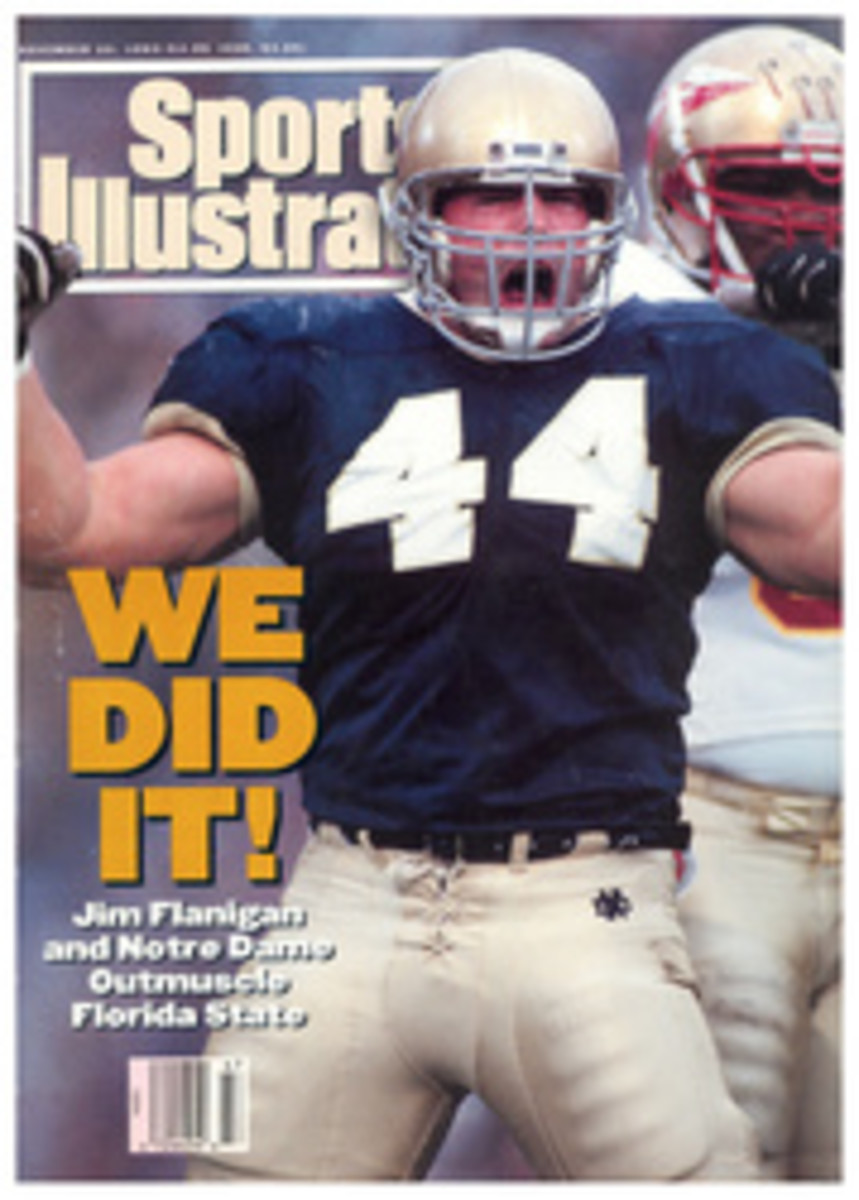
November 13, 1993: Florida State vs. Notre Dame, "The Game of the Century"

November 13, 1993: Not every college football game billed as "The Game of the Century" lives up to the billing. This one did.

Florida State University, coached by Bobby Bowden, and quarterbacked by eventual Heisman Trophy winner Charlie Ward, had gone through several near-misses for the National Championship. In 1993, they looked ready to go all the way. They won their 1st 5 games: 42-0 over Kansas in the Kickoff Classic at the Meadowlands, 45-7 away to Duke, 57-0 home to Number 17 Clemson, 33-7 away to Number 13 North Carolina, and 51-0 home to Georgia Tech.

The 2 previous years, they had lost to one of their rivals, the University of Miami, on missed last-play field goals. This time, with Miami coming into Doak Campbell Stadium in Tallahassee with the Number 3 ranking, the Seminoles left no doubt, winning 28-10. No last-play, or even last-minute, heroics necessary. They followed this with a 40-14 win home to Number 15 Virginia, a 54-0 home win over Clemson, and a 49-20 win away to Maryland.

That set up a meeting with the University of Notre Dame. The Fighting Irish played about as tough a schedule as could be played without being part of a major conference, including 4 Big 10 schools. They opened the season by beating Northwestern at home, 27-12. The beat then-Number 3 Michigan away, 27-23; Michigan State at home, 36-14; Purdue away, 17-0; Stanford away, 48-20; the University of Pittsburgh at home, 44-0; Brigham Young University (BYU) award, 45-20; the University of Southern California (USC) at home, 31-13; and Navy at Veterans Stadium in Philadelphia, 58-27.

The Irish were also undefeated, and looked every bit as unstoppable as the Seminoles. With NBC having the contract to broadcast Notre Dame home games, they could hype this Number 1 vs. Number 2 matchup as "The Game of the Century."

Notre Dame outplayed Florida State the entire game, to the tune of a 31–17 lead in the 4th quarter. The offense had hung its shoulders around their junior running back Lee Becton, who had yet another 100+ yard afternoon.

With 1:39 left, Ward drove Florida State down the field, and hit Kez McCorvey on 4th-and-20 for a touchdown. The pass bounced off of Notre Dame safety Brian McGee and into McCorvey's hands.

Notre Dame then went three-and-out on their next possession, giving Florida State one last shot. In just 3 plays, Ward led Florida State to the Notre Dame 14 with 3 seconds to play. On the last play of the game, Ward rolled out, and had his final pass attempt batted down by Notre Dame cornerback Shawn Wooden, clinching the final score as Notre Dame 31, Florida State 24.

There was pandemonium in South Bend. Meanwhile, all of Florida, people were crushed. It looked like Florida State's best chance ever to win the National Championship had been lost. Not exactly "blown," as it was with the missed field goals of the preceding 2 years, but definitively taken away from them by a team which, if not necessarily better, was certainly good enough and had the home-field advantage.

Afterward, all Notre Dame had to do was beat Boston College at home the following Saturday, and theyvwould be able to play Nebraska for the National Championship in the Orange Bowl on New Year’s Day. That was all.

They didn't. BC were ranked Number 17, and David Gordon kicked a 41-yard field goal on the last play of the game, to give them a 41-39 win. It was BC's biggest win since Doug Flutie led them past Miami in 1984, and their biggest without Flutie since clinching a share of the National Championship in the 1941 Sugar Bowl.

Had there been a Bowl Championship Series or a National Championship Playoff at the time, Notre Dame would still have gotten into it. Instead, they dropped from Number 1 to Number 4. They ended up beating Number 7 Texas A&M in the Cotton Bowl.

In contrast, losing away to Notre Dame by 7 points only dropped Florida State to Number 2. They beat North Carolina State, 62-3 at home, to clinch the Atlantic Coast Conference title, to retake the Number 1 spot. Then they beat Number 7 and arch-rival Florida away, 33-21, to set up a National Championship matchup with Number 2 Nebraska in the Orange Bowl. Florida State won, 18-16.

In the final polls, both the Associated Pres (AP, the sportswriters) and United Press International (UPI, the head coaches) had Florida State at Number 1, and Notre Dame at Number 2.

*

November 13, 1993 was a Saturday. These other major college football games were played that day:

* Number 3 Miami beat Rutgers, 31-17 at the Orange Bowl in Miami.

* Number 4 Nebraska beat Iowa State, 49-17 at Memorial Stadium in Lincoln, Nebraska.

* Number 5 Ohio State beat Number 19 Indiana, 23-17 at Ohio Stadium in Columbus.

* Number 7 Auburn beat Georgia, 42-28 at Sanford Stadium in Athens, Georgia.

* Number 8 Florida beat South Carolina, 37-26 at Williams-Brice Stadium in Columbia, South Carolina.

* Number 9 West Virginia beat Temple, 49-7 at Veterans Stadium in Philadelphia.

* Number 10 UCLA were upset by Arizona State, 9-3 at the Rose Bowl in the Los Angeles suburb of Pasadena, California.

* Number 11 Texas A&M beat Number 20 University of Louisville, 42-7 at Kyle Field in College Station, Texas.

* Number 12 Alabama beat Mississippi State, 36-25 at Bryant-Denny Stadium in Tuscaloosa, Alabama.

* Number 13 Arizona were upset by the University of California, 24-20 at California Memorial Stadium in Berkeley, California.

* Number 18 Virginia were upset by Clemson, 23-14 at Memorial Stadium in Clemson, South Carolina.

* Number 23 Wyoming were upset by New Mexico, 10-7 at University Stadium in Albuquerque, New Mexico.

* Number 25 University of Washington were upset by the University of Southern California (USC), 22-17 at Husky Stadium in Seattle.

* In the "Little Brown Jug," Michigan beat Minnesota, 58-7 at the Metrodome in Minneapolis.

* Army beat Lafayette, 35-12 at Michie Stadium in West Point, New York.

* Navy lost to Vanderbilt, 41-7 at Vanderbilt Stadium (now FirstBank Stadium) in Nashville.

In New Jersey high school football, my Alma Mater, East Brunswick, lost to Woodbridge, 29-23 at Jay Doyle Field in East Brunswick.

Baseball was out of season. There were 8 games played in the NBA:

* The New York Knicks beat the Milwaukee Bucks, 99-86 at Madison Square Garden. John Starks scored 35 points.

* The New Jersey Nets lost to the Philadelphia 76ers, 98-97 at the Brendan Byrne Arena in the Meadowlands.

* The Boston Celtics beat the Chicago Bulls, 98-97 at the Chicago Stadium.

* The Utah Jazz beat the Dallas Mavericks, 101-100 at the Reunion Arena in Dallas.

* The Houston Rockets beat the Phoenix Suns, 99-95 at The Summit in Houston. (The arena has since been converted into the Central Campus of the Lakewood Church, Dr. Joel Osteen's "megachurch.")

* The Golden State Warriors beat the Denver Nuggets, 106-98 at the McNichols Arena in Denver.

* The Los Angeles Clippers beat the San Antonio Spurs, 92-90 at the Los Angeles Memorial Sports Arena.

* And the Seattle SuperSonics beat the Atlanta Hawks, 97-89 in overtime at the Seattle Center Coliseum.

And there were 12 games played in the NHL, with every team in action except the 2 new expansion teams, the Florida Panthers and the Mighty Ducks of Anaheim:

* The New York Rangers beat the Washington Capitals, 2-0 at the USAirways Arena (formerly the Capital Centre) in the Washington suburb of Landover, Maryland.

* The New York Islanders lost to the Boston Bruins, 5-2 at the Nassau Coliseum.

* The New Jersey Devils lost to the San Jose Sharks, 4-2 at the Brendan Byrne Arena at the Meadowlands.

* The Buffalo Sabres beat the Philadelphia Flyers, 7-2 at The Spectrum in Philadelphia.

* The Ottawa Senators beat the Montreal Canadiens, 3-2 at the Montreal Forum. Dave McLlwain scored the winning goal with 1:38 left in overtime. 

* The Edmonton Oilers and the Hartford Whalers played to a tie, 4-4 at the Hartford Civic Center (now the PeoplesBank Arena).

* The Tampa Bay Lightning beat the Quebec Nordiques, 4-3 at the ThunderDome (now Tropicana Field) in St. Petersburg, Florida.

* In an "Original Six" matchup, the Chicago Blackhawks beat the Toronto Maple Leafs, 3-2 at Maple Leaf Gardens in Toronto.

* The Detroit Red Wings beat the Pittsburgh Penguins, 7-3 at the Civic Arena in Pittsburgh.

* The Dallas Stars beat the Winnipeg Jets, 3-2 at the Winnipeg Arena.

* The Calgary Flames beat the Vancouver Canucks, 4-3 at the Saddledome in Calgary.

* The Los Angeles Kings beat the St. Louis Blues, 6-3 at The Forum outside Los Angeles in Inglewood, California.


Thursday, October 20, 2022

October 20, 1962: The Birth of Florida State's "Sod Cemetery"

October 20, 1962: Florida State University beats the University of Georgia, 18-0 at Sanford Stadium in Athens, Georgia, which has a hedge ring surrounding the field, and it is said that, there, football is played "Between the Hedges."

Dean Coyle Moore, a professor at Florida State and a member of the school's athletic board, had told the Seminoles, "Bring back some sod from Between the Hedges at Georgia." The victory complete, team captain Gene McDowell pulled a small piece of grass out, and showed it to Moore at the next football practice. Coach Bill Peterson took the grass to the practice facility, Harkins Field, and planted it. A plaque was made, and the Sod Cemetery was born.

Ever since, every time the Seminoles win an away game in which they are the underdog, or at the University of Florida, or at bowl games, or, since the Atlantic Coast Conference established a championship game, said game, the team captains cut out a small piece of the playing surface, and have it planted inside the gates of Harkins Field.

By 1970, it had been done 23 times in 9 seasons. But in the 5 seasons before Bobby Bowden arrived, 1971 to 1975, it hadn't been done at all. Although the 'Noles lost their 1st 3 games under Bowden, and 6 of their 1st 8, on October 9, 1976, they went up to The Hub and beat Boston College, and took a piece of Alumni Stadium turf home with them -- the 1st artificial turf to be planted there.

The most recent such win was this past September 4, beating Louisiana State (LSU), 24-23 at the Superdome. The Cemetery now includes 106 pieces of sod, from 42 different stadiums (the University of Florida's Ben Hill Griffin Stadium the most frequent victim, with 12), against 39 different opponents (UF the most often, 13), in 20 States (Florida easily the most with 44, Louisiana next with 9), in 10 different bowl games.

*

October 20, 1962 was a Saturday. This was also the day that "Monster Mash" by Bobby "Boris" Pickett hit Number 1. I have a separate entry for that event.

The other college football games played that day included:

Baseball season had ended 4 days earlier, with the New York Yankees beating the San Francisco Giants in Game 7 of the World Series. There were 4 games played in the NBA:

* The New York Knicks lost to the Boston Celtics, 149-116 at the Boston Garden. No Celtic scored more than Sam Jones' 25, but 7 Celtics scored in double figures.

* The Syracuse Nationals beat the Los Angeles Lakers, 108-102 at the Onondaga County War Memorial (now the Upstate University Medical Arena) in Syracuse, New York. Elgin Baylor led all scorerers on the night, with 42 points. This would be the Nationals' last season in Syracuse: For 1963-64, they moved to become the Philadelphia 76ers.

* The Chicago Zephyrs beat the Cincinnati Royals, 113-109 at the Chicago Coliseum. The Zephyrs became the Baltimore Bullets in 1963, the Capital Bullets in 1973, the Washington Bullets in 1974, and the Washington Wizards in 1997. The Royals became the Kansas City-Omaha Kings in 1972, the Kansas City Kings in 1975, and the Sacramento Kings in 1985. Don't worry, there's no test for all of this to be on.

* And the St. Louis Hawks beat the Detroit Pistons, 120-111 at the Kiel Auditorium in St. Louis.

And there were 2 games in the NHL. The Montreal Canadiens beat the Boston Bruins, 7-3 at the Montreal Forum. And the Toronto Maple Leafs beat the Chicago Black Hawks, 3-1 at Maple Leaf Gardens in Toronto. The New York Rangers and the Detroit Red Wings were not scheduled.

Tuesday, January 4, 2022

January 4, 1999: The 1st Bowl Championship Series Game

Number 17 is Tee Martin.

January 4, 1999: The Fiesta Bowl is played at Sun Devil Stadium on the campus of Arizona State University, in the Phoenix suburb of Tempe, Arizona. It was the 1st game played under the Bowl Championship Series system, with the intention of selecting a definitive National Champion, something college football had never had before.

The Fiesta Bowl had hosted de facto National Championship games before, because it didn't have an automatic league tie-in: The Rose Bowl in the Los Angeles suburb of Pasadena, California had the Big Ten and Pacific-10 Champions play each other; the Big Eight, and now Big Twelve, Champions were locked into the Orange Bowl in Miami; the Southeastern Conference Champions were locked into the Sugar Bowl in New Orleans; and the Champions of the now-defunct Southwest Conference were locked into the Cotton Bowl Classic in Dallas.

But, effective with the 1998 season, the BCS was determined to make it official. As a result, the NCAA allowed Conference Champions to opt out of their usual bowls, and play in the BCS National Championship Game, if they finished the last pre-bowl national poll ranked Number 1 or Number 2.

The Number 1 team in the last 1998 poll was the University of Tennessee, coached by Phillip Fullmer. For 4 years, the Volunteers had been an elite team, led by quarterback Peyton Manning, but they couldn't get past the University of Florida in the SEC. Now, their quarterback was the less-heralded Tamaurice "Tee" Martin, but they had a better all-around team, going 12-0, beating teams then ranked Number 2 (Florida), 7 (Georgia, away), 10 (Arkansas), 17 (Syracuse, away), and 23 (Mississippi State, in the SEC Championship Game).

The Number 2 team was Florida State University, coached by Bobby Bowden. The Seminoles opened the season by beating Number 14 Texas A&M at the Kickoff Classic at the Meadowlands, but then stumbled with a 24-7 loss away to North Carolina State.

They followed it by dropping 62 points on Duke, and beating Number 18 USC. They beat Clemson 48-0, then went to Atlanta and beat Number 20 Georgia Tech. They beat Number 12 Virginia, and won the Atlantic Coast Conference Championship. And they had to get past Number 4 Florida, beating them, 23-12 -- and they didn't need overtime to beat Florida, as Tennessee did. Perhaps that's why, despite having a loss, the Seminoles were favored by 5 1/2 points.

The 'Noles had been National Champions in 1993. The Vols, despite many good teams over the years, last won a National Championship in 1951.

The 1st quarter ended scoreless. In the 1st minute of the 2nd quarter, Martin threw a short touchdown pass to Shawn Bryson. On the next drive, the Vols' Dwayne Goodrich intercepted Marcus Outzen, and took it in 54 yards for a touchdown. It was 14-0 Tennessee.

Outzen drove the Seminoles to the Volunteer 1-yard line, and William McCray scored. Still fuming over missed field goal attempts earlier in the decade, Bowden had recruited Sebastian Janikowski, a 6-foot-1, 255-pound native of WaÅ‚brzych, Poland, who grew up in Florida, and became the top high school kicker in the nation. But Janikowski missed the extra point on this touchdown. He made up for it on the last play of the 1st half, kicking a 34-yard field goal. It was Tennessee 14, Florida State 9, and still anybody's ballgame.

Goodrich, whose interception had been key, and had been assigned to cover Outzen's favorite receiver, All-American Peter Warrick, did not return for the 2nd half, having sustained an ankle injury. He was replaced by Gerald Griffin, who had hardly played, but limited Warrick to a single catch.

The 3rd quarter saw no scoring. With 9:17 left in the 4th, Martin threw to the superbly named Peerless Price, and he took it 79 yards for a touchdown. But as had Janikowski, Vols kicker Jeff Hall missed the extra point. With 6 minutes left, Hall again followed Janikowski's pattern, and kicked a field goal, from 23 yards out. It was 23-9 Tennessee.

Florida State wasn't done. There was still time for the 2 scores they needed. Outzen got them to within 7 yards, and scored on his own run with 3:42 left, to make it 23-16. Their defense forced a fumble by Travis Henry, and they had a last shot with 2 minutes to go. But Outzen threw a pass that was intercepted by Steve Johnson, and that was the ballgame, and the National Championship: Tennessee had won.

Unlike his predecessor Peyton Manning, Tee Martin did not have a good pro quarterbacking career. He played 1 series, throwing no passes, backing Kordell Stewart up for the Pittsburgh Steelers in 2001. He played in 2 games, completing 6 of 16 passes, backing Rich Gannon up on the 2003 Oakland Raiders. He also played for the Rhein Fire of NFL Europe in 2002, and the Winnipeg Blue Bombers of the CFL in 2004 and '05. He has since coached at the high school, college and professional level, including a return to Tennessee, but never as a head coach.

The BCS didn't always work as intended. There would always be a team stuck at Number 3, sometimes even Number 4, that thought it deserved to get into the final game. Finally, taking effect with the 2013 season (settled in early January 2014), a College Football Playoff National Championship system was set up.

Except that the new system, as had the BCS, allows teams that didn't win their Conference, sometimes not even their Division -- read: Alabama, or a team that lost the SEC Championship Game to Alabama, or lost the West Division to Alabama -- to be one of the last 4.

There is no perfect system. It may just be that the hated BCS is the best system we have yet had.

UPDATE: In 2023, Sun Devil Stadium was renamed Mountain America Stadium.

*

January 4, 1999 was a Monday. No other college football bowl games were played that day. The NFL was between its regular season and its Playoffs. Baseball was out of season. And the NBA players were still locked out by their team's owners, so the season didn't start until February 5. So the only other games were in the NHL, 7 of them:

* The New York Rangers beat the San Jose Sharks, 4-3 at Madison Square Garden.

* The Boston Bruins beat the Calgary Flames, 5-1 at what's now named the TD Garden.

* The Toronto Maple Leafs beat the Tampa Bay Lightning, 5-4 in one of the last games played at Maple Leaf Gardens in Toronto. Fredrik Modin scored the winning goal, 1:54 into overtime.

* The Ottawa Senators and the Carolina Hurricanes played to a tie, 4-4 at the Greensboro Coliseum, where the 'Canes played from their 1997 move from Hartford until what's now the PNC Arena opened in Raleigh in 1999.

* The Nashville Predators beat the Mighty Ducks of Anaheim, 2-1 at what's now the Bridgestone Arena in Nashville.

* The St. Louis Blues beat the Vancouver Canucks, 4-0 at what's now the Enterprise Center in St. Louis.

* And the Colorado Avalanche beat the Montreal Canadiens, 4-3 at the McNichols Arena in Denver.

And Swiss hockey soccer player Nico Hischier was born on this day.

Saturday, January 1, 2022

January 1, 1994: Florida State Finally Does It

 
January 1, 1994: The Orange Bowl is played, at the stadium of the same name in Miami. The University of Nebraska hasn't won the National Championship since the 1971 season, 32 years earlier. Florida State University has never won it. Both teams have had some agonizing close calls the last few years. Something's got to give.

Bobby Bowden had been an assistant coach at Florida State before becoming the offensive coordinator, and then the head coach, at West Virginia. After taking the Mountaineers to victory in the 1975 Peach Bowl, FSU asked him to come back.

He inherited a mess. As he said at the time, "At West Virginia, the bumper stickers say, 'BEAT PITT.' At Florida State, they say, 'BEAT ANYBODY.'" It took him just 2 years to turn them into a 10-2 team and winners of the Tangerine Bowl.

The Seminoles were not in a league until joining the Atlantic Coast Conference in 1992. But they put together some great teams. In 1979, they had an undefeated regular season, 11-0. In 1980, they went 10-1. But, both seasons, they lost a chance at the National Championship by losing the Orange Bowl.

In 1987, they went 11-1 and won the Fiesta Bowl. In 1988, they went 11-1 and won the Sugar Bowl. But, both times, they lost a regular season game to the University of Miami, one of their main rivals, costing them a shot at the National Championship. In 1989 and 1990, they went 10-2.

The 1991 season seemed like the year. They began the season ranked Number 1, and won their 1st 10 games. And then it all fell apart. In back-to-back games -- though with a bye week in between -- they faced Number 2 Miami at home at Doak Campbell Stadium in Tallahassee, and lost 17-16; and then faced their other main rivals, Number 5 University of Florida, away, and lost 14-9. A win over Texas A&M in the Cotton Bowl did little to console them, as Miami won the National Championship for the 4th time in the last 9 seasons.

Could 1992 be the year? They won their 1st 5 games, then had to go to the Orange Bowl stadium to play Miami: The Hurricanes were Number 2, the Seminoles Number 3, so it was a big game, if not the big game of the regular season, as it was the year before. Miami won, 19-16. Florida State won the rest of their games, including a return to the Orange Bowl where they beat Nebraska, but finished Number 3. Miami lost the Sugar Bowl to Alabama, costing them another National Championship.

In both 1991 and 1992, Miami won because Florida State missed a last-play field goal: The 1st time, by Gerry Thomas from 34 yards; the 2nd time, by Dan Mowrey from 39. Both were wide and to the right. These games are now known as Wide Right I and Wide Right II.

Seminole fans could only console themselves by calling on Miami's "thug" image, saying, "You can't spell SCUM without UM." In time, a free sneakers scandal would lead to Miami (and Florida) fans saying, "FSU" stood for "Free Shoes University."

Again in 1993, Florida State opened the season at Number 1. And they tempted fate by recruiting Scott Bentley, a native of the Denver suburbs and the country's highest-ranked high school kicker, and letting him be put on the cover of Sports Illustrated's 1993 College Football Preview Issue. It was as if they were telling "The Dreaded SI Cover Jinx," "Come on, then!"

As it turned out, Bentley missed 7 extra points in the team's 1st 5 games. Not 7 field goals. Seven extra point attempts. The Jinx was punishing Bentley for his team's defiance.

As it turned out, it didn't matter: It was only Bentley, not the team as a whole, that was getting punished. They won those 1st 5 games: 42-0 over Kansas in the Kickoff Classic at the Meadowlands, 45-7 away to Duke, 57-0 home to Number 17 Clemson, 33-7 away to Number 13 North Carolina, and 51-0 home to Georgia Tech.

This time, with Miami coming into Doak Campbell with the Number 3 ranking, the Seminoles left no doubt, winning 28-10. No last-play, or even last-minute, heroics necessary. They followed this with a 40-14 win home to Number 15 Virginia, a 54-0 home win over Clemson, and a 49-20 win away to Maryland.

That set up a showdown with Number 2 Notre Dame in South Bend, Indiana. NBC tried billing it as "The Game of the Century," and it lived up to the hype, being in doubt until a last-gasp FSU pass was broken up in the end zone. Notre Dame won, 24-17, and rose to Number 1.

It looked like the Seminoles' dreams had been shattered again. But the very next week, Notre Dame were upset by Boston College on a last-play field goal. Meanwhile, Florida State beat North Carolina State 62-3 to clinch the ACC title, and won 33-21 away to Number 7 Florida to regain the Number 1 ranking.

Since winning back-to-back National Championships in 1970 and 1971, Nebraska had won 11 Big Eight Conference Championships, 3 Sugar Bowls, 2 Orange Bowls and a Cotton Bowl. But they hadn't won another National Championship. They only lost 1 game in 1982, by 3 points, away to Penn State. They put up one of the most stunning seasons in college football history in 1983, but lost the Orange Bowl to Miami on a missed 2-point conversion, starting Miami's quasi-dynasty.

Expectations for 1993 were not especially high, as the Cornhuskers started out ranked Number 9. Putting up 76 points on North Texas, 50 on Texas Tech, 49 on Missouri, 49 on Iowa State, 48 on Colorado State, and 45 on Kansas State were not unusual for The 'Huskers under head coach Tom Osborne.

What did get people's attention was a nationally-televised 14-13 win over UCLA at the Rose Bowl stadium; a 21-17 win away to Colorado, which had been the top team in the Big 8 the last few years; and a 21-7 day-after-Thanksgiving win over their arch-rivals, Number 16 Oklahoma.

It pushed Nebraska up to Number 2, and set up a New Year's Day prime-time matchup between Osborne's 'Huskers and Bowden's 'Noles. One of these teams was going to end their years of heartbreak, while the other was going to extend it. It was college football's equivalent of having a World Series between the pre-2004 Boston Red Sox and the pre-2016 Chicago Cubs.

Nebraska were undefeated. Florida State were not. And yet, Florida State were favored by 17 1/2 points. Was it because they had the Heisman Trophy winner, quarterback Charlie Ward? It shouldn't have been: Nebraska had the country's best defense. Was it because Nebraska had a history of choking? It shouldn't have been: So did Florida State.

Was it because Florida State were used to playing on this field? Not really: So were Nebraska. And being in the same State didn't make any difference: It was 482 miles from Doak Campbell Stadium to the Orange Bowl, so this was no "home game" for the Seminoles and their fans.

The 1st quarter ended scoreless, but it shouldn't have been: Nebraska returned a punt for a touchdown, but it was called back due to an illegal block, which the instant replay showed didn't happen. Bentley opened the scoring with a field goal midway through the 2nd quarter. Nebraska scored a touchdown, but with time running out in the half, Bentley kicked another field goal. It was Nebraska 7, Florida State 6.

Nebraska got robbed again early in the 3rd quarter. William Floyd appeared to have scored a touchdown for FSU, but the replay showed that he fumbled before crossing the goal line. The 2-point conversion attempt failed, and the Seminoles led 12-7. Bentley kicked another field goal, and it was 15-7 Seminoles at the end of the quarter. By all rights, it should have been 14-9 Cornhuskers.

At the beginning of the 4th quarter, Lawrence Phillips scored a touchdown for Nebraska. Just as it had on the same field 10 years earlier, the 2-point conversion attempt did not go Nebraska's way, and it was still 15-13 Seminoles. Time began to run out. But quarterback Tommie Frazier drove the 'Huskers down, and with 1:16 left, Byron Bennett kicked a 27-yard field goal. Nebraska led, 16-15.

But it wasn't over yet. The 'Noles still had Heisman winner Ward. He got them down to a 1st & goal on the Nebraska 3-yard line. The 'Husker defense held, and, with 21 seconds left, Scott Bentley finally had his date with destiny. It was an attempt from 22 yards out. Basically, an extra point attempt. If he makes it, he's a Seminole hero for all time. If he misses it, he's the biggest flop in team history. He nailed it, and his teammates piled onto him.

But the game still wasn't over. The Seminoles were penalized for excessive celebration. That, and a bad kickoff -- by Bentley, mind you -- gave the 'Huskers the ball at their own 43. They only needed about 25 yards for a game-winning field goal.

Frazier got Nebraska to the Seminole 28, with a pass to Trumane Bell. That would make a field goal attempt 45 yards. Not easy on natural grass, but with hardly any wind, certainly possible. But the clock seemed to run out when Bell went down. Thinking their coach had finally won his National Championship, some Florida State players dumped the Gatorade on Bowden.

But referee John Soffey ruled that Bell was down with 1 second left. By NCAA rules, the clock must stop to move the first down marker. This gave Nebraska time to get their field goal unit on in time. If Bennett made his attempt, it would have been the cruelest loss yet for Florida State: Losing on a last-play field goal when you thought you already had the National Championship won.

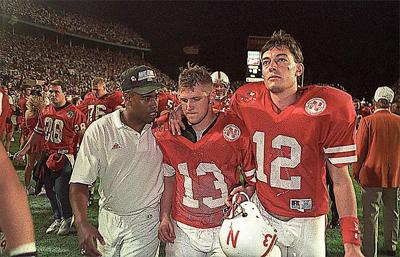
Bennett missed. Not wide right, but wide left.
Like Ralph Branca, a victim of big-game fate
in baseball in 1951, he wore Number 13.

Now, Florida State were the National Champions -- clinching it with the other team missing a field goal attempt. No one cared about the irony, or that they hadn't played especially well: They were Champions at last.

It was another crushing defeat for Nebraska. Finally, the next season, they went all the way -- and in the perfect way, beating Miami on their own field in the Orange Bowl game. This started a run of 3 National Championships in 4 seasons.

Byron Bennett would not be a part of it. The man who thought he'd made the field goal to get Tom Osborne his 1st National Championship as a head coach -- he'd been an assistant to Bob Devaney in 1970 and '71 -- and then missed the one that would have really done it, became a parole officer in Dallas, and then a high school football coach. He's done rather well at it.

Bobby Bowden would lead Florida State to another National Championship in 1999. His successor, Jimbo Fisher, did so in 2013.

Scott Bentley remained with Florida State through the 1996 season, and graduated. In 1997, the Atlanta Falcons signed him as a kickoff specialist, but released him after 2 games. The Denver Broncos picked him up, as a backup to Jason Elam, and he played 1 game, kicking 2 field goals in 3 attempts and going 4-for-4 on extra points. He remained a kickoff specialist, playing 2 games in 1999 for the Kansas City Chiefs; and, in 2000, 1 more for the Broncos and 6 for the Washington Redskins, making 1 field goal, for 50 yards. He is now an operations manager for Amazon.com.

One other note: This game was broadcast on NBC, with Dick Enberg and former Cincinnati Bengals star Bob Trumpy in the booth, and legendary USC and Buffalo Bills running back O.J. Simpson as the sideline reporter. If what happened between Florida State and Nebraska on January 1, 1994 was shocking, what Simpson did in the week of June 12 to 17, 1994 was even more so.

*

January 1, 1994 was a Saturday. In the other New Year's Day bowl games:

* Rose Bowl, Pasadena, California: Number 9 Wisconsin beat Number 14 UCLA, 21-16.

* Sugar Bowl, Superdome, New Orleans: Number 8 Florida beat Number 3 and previously undefeated West Virginia, 41-7. West Virginia fans were hoping that the Orange Bowl, being played at the same time, would be a dull, or mistake-filled, game, giving them hope for the National Championship. But Florida, who'd lost only to Florida State and Auburn, put a quick stop to that.

* Cotton Bowl, Dallas: Number 4 Notre Dame beat Number 7 Texas A&M, 24-21.

* Fiesta Bowl, Sun Devil Stadium, Tempe, Arizona: Number 16 Arizona beat Number 10 Miami, 29-0. Arizona did this despite playing on the home field of their arch-rivals, Arizona State.

* Hall of Fame Bowl, Tampa Stadium: Number 23 Michigan beat unranked North Carolina State, 42-7.

* Florida Citrus Bowl, Orlando, Florida: Number 13 Penn State beat Number 6 Tennessee, 31-13.

* Carquest Bowl, Joe Robbie Stadium, Miami Gardens, Florida: Number 15 Boston College beat unranked Virginia, 31-13. This game debuted in 1990 as the Blockbuster Bowl, and has gone through many names. It moved to Orlando in 2001, and took up the former name of the Florida Citrus Bowl, the Tangerine Bowl. Still in Orlando, it is now known as the Cheez-It Bowl.

This was also the last weekend of the NFL regular season. No games were played that day: Most were played the next day, January 2, with 1 played on Friday, New Year's Eve; and a Monday Night Football game played on January 3.

Baseball, of course, was out of season. No NBA games were scheduled. But 5 NHL games were:

* The New Jersey Devils beat the Ottawa Senators, 7-1 at the Ottawa Civic Centre. (It's now named the TD Place Arena.) Bernie Nicholls scored a hat trick, and the Devils also got goals from Corey Millen, Stéphane Richer, Bill Guerin and Tom Chorske.

* The New York Islanders lost to the Hartford Whalers, 4-3 at the Nassau Coliseum. (The New York Rangers were not scheduled.)

* The Tampa Bay Lightning and the Washington Capitals played to a 5-5 tie, at the Capital Centre in the Washington suburb of Landover, Maryland.

* The League's 2 new expansion teams played each other, and the Florida Panthers beat the team then known as the Mighty Ducks of Anaheim, 4-2 at the Miami Arena.

* And the Los Angeles Kings beat the Toronto Maple Leafs, 7-4 at Maple Leaf Gardens in Toronto.

Also, Arsenal beat Wimbledon FC, 3-0. The game was played at Selhurst Park, home of Crystal Palace FC, in the Croydon section of South London. Wimbledon's former home of Plough Lane was deemed unable to be adapted to all-seater status in the wake of the Hillsborough Stadium Disaster and the subsequent Taylor Report.

December 31, 1999 & January 1, 2000: The Millennium

December 31, 1999:  The Millennium arrives. The people of planet Earth survived. At a terrible cost. But we hadn't destroyed ourselves. ...