Showing posts with label 1916. Show all posts

Friday, December 30, 2022

December 30, 1916: The Assassination of Grigori Rasputin

In the early part of the 20th Century,
Russian women found this guy irresistible.

December 30, 1916: Grigori Rasputin is assassinated. Apparently, it wasn't easy.

Grigori Yefimovich Rasputin was born on January 21, 1869 in Pokrovskoye, in what is now Tyuman Oblast, in the central Siberia region of Russia. Little is known of his youth, although it is believed that he didn't learn how to read until he was an adult. In 1886, he went to Abalak, about 150 miles northeast of his hometown, where he met Prakovya Dubrovina. They married the next year, and had 7 children, though only 3 survived to adulthood.

In 1897, Rasputin had a religious awakening, and became a monk in Russian Orthodox Catholicism. By 1905, he had developed a following, particularly among women, who found him irresistible. With his long hair and long beard, he might not match a modern American woman's idea of an attractive man, but he was said to have had hypnotic eyes. He was also renowned for... how shall I put this... being extraordinarily well-endowed.

Czar Nicholas II wrote in his diary for November 1, 1905 (Russia was still using the Julian Calendar, so it was November 14 in most of the world) that he and his wife, Czarina Alexandra had "made the acquaintance of a man of God -- Grigory, from Tobolsk province." They met again on July 18, 1906, and again in October, when Rasputin first came into contact with the Romanov children. He was told that the heir to the throne, Czarevitch Alexei, had hemophilia, and that they had heard that Rasputin could heal the sick.

In 1907, Rasputin appeared to have saved Alexei during a hemophilic episode. In 1912, he did so again. One of the doctors who had been treating Alexei on this occasion wrote, "The recovery was wholly in explicable from a medical point of view." Alexandra, born a German Princess and raised Lutheran, had reluctantly converted to the Russian Orthodox Church, was now convinced that Rasputin was a holy man and a miracle worker.

It has been speculated that the real reason Alexei recovered is that he told the doctors not to disturb the boy, and that allowed him to rest and regain his strength; or that, by keeping his mother calm, Rasputin kept him calm, and that allowed him to regain his strength; or that he stopped Alexei's treatment through aspirin, which had helped with his pain, but prevents clotting of the blood. Indeed, that's what hemophilia is: An inability to have one's blood clot, so that bleeding continues. Maybe Alexei never had hemophilia at all, and he was just improperly treated with aspirin.

From this point on, Alexandra was convinced that Rasputin could do no wrong. And, since the Czar trusted the Czarina, and the Czarina trusted Rasputin, the Czar gave Rasputin pretty much anything he asked for. This meant access to the imperial family at any time. It also allowed Rasputin access to pretty much any woman he wanted, although the rumors of his having had an affair with the Czarina, or any of the 4 Romanov daughters (Grand Duchesses), have never been backed up by any evidence.

(At the time of Rasputin's assassination, Olga was 21 years old, Tatiana 19, Maria 17, Anastasia 15, and Alexei, the youngest but the heir because he was the only son, 12.)

By the Autumn of 1915, World War I was going badly for Russia. Their Army had huge numbers, but little else in the way of preparedness: Training, weapons, transportation, infrastructure. Every so often, Russia falls behind, and becomes a backward country, and needs a great leader to, as Maximilian Schell said while starring in the 1986 NBC miniseries Peter the Great, "drag you, kicking and screaming if I have to, into the modern world!"

Ivan IV, a.k.a. Ivan the Terrible, did it in the 1550s. Peter I, a.k.a. Peter the Great, did it in the 1680s. Catherine II, a.k.a. Catherine the Great, did it in the 1760s. Alexander II tried it in the 1860s, but it didn't take. In the 1910s, Nicholas II was on the throne, and he had neither the heart nor the will to do it, nor the mind to know how to do it if he wanted to.

This was made all too clear when Nicholas left St. Petersburg, then the capital, to take personal command of the Army. This left Alexandra in charge. Except, many saw her as having left Rasputin in charge. They, rather than the Czar, got blamed for everything going wrong in the country. After all, the Czar wasn't there, was he?

Finally, conditions in the country, and rumors about Rasputin's hedonistic behavior, became too much for some Russian noblemen. One was Grand Duke Dmitri Pavlovich, a grandson of Czar Alexander II and thus a first cousin of Nicholas II. Another was Prince Felix Yusupov, husband of Princess Irina Alexandrovna, Nicholas' niece. Another was Vladimir Purishkevich, a right-wing member of the Duma, the Russian Parliament. They invited Rasputin to the Moika Palace, Yusupov's home.

The date, on the Russian/Julian Calendar, was December 17, 1916 -- in most of the world, December 30. Historian Douglas Smith has written, "What really happened at the Yusupov home on 17 December will never be known." Yusupov's memoir contains the best-known version, and while it can't be certain that he was telling the truth, it is certain that he stuck by his story for the rest of his life. Here's that story:

Rasputin arrived shortly after midnight. Yusupov walked him into the basement, and offered him tea and small cakes. Rasputin drank the tea and, after first refusing the cakes, ate them. Then he asked for Madeira wine. He got it, and drank it. At about 2:30 AM, Yusupov excused himself, and went upstairs.

Upstairs was where the other conspirators were waiting. The tea, the cakes, and the wine had all been laced with poison. Rasputin had ingested enough doses to kill several men. So Yusupov decided to be certain. Dmitry Pavlovich gave him a loaded revolver. He took the gun, went downstairs, and, pointing to a crucifix on the wall, said, "Better look at the crucifix and say a prayer. And he fired once, hitting Rasputin in the chest. Rasputin slumped to the floor.

As cover, another conspirator, who had long hair and a long beard, was given Rasputin's coat and hat, was driven to Rasputin's apartment, and went in, so that witnesses could see that "Rasputin" had arrived home, thus moving suspicion away from the conspirators. They then drove back to the Moika Palace, to complete their plausible deniability.

But when Yusupov went back to the basement, Rasputin jumped up from the floor, and started hitting Yusupov. He'd been poisoned several times over and shot in the chest, and was still alive. Yusupov managed to get away, and run into the courtyard. Rasputin ran after him, but was shot by Purishkevich. He collapsed into a snowbank. Purishkevich then finished the job, by firing point-blank at Rasputin's forehead. "The Mad Monk" was 47 years old.

The conspirators wrapped his body in cloth, drove it to the Petrovsky Bridge, and dropped his body into the Malaya Nevka River. Grigori Rasputin now slept with the fishes.

Two days later, the body was found. An autopsy was conducted. Three bullet wounds were found, including the one to the head. No evidence of poison was found. According to legend, the autopsy found that the cause of death, after all that had happened, was drowning, that he had still been alive when he was thrown into the river. But the bullet in the head was found, and was proven to be the cause of death.

If the conspirators thought that getting rid of Rasputin would solve Nicholas' mismanagement of the Empire, they were wrong. They were proven wrong on March 15, 1917, when revolution had reached the point where the Army told the Czar that he had no choice but to abdicate, and he did. They were proven wrong again on November 7, 1917, when the Bolsheviks took control of the country. And they were proven wrong again on July 17, 1918, when the Bolsheviks executed the Czar, his wife, and all 5 of their children -- including Alexei, only 14 years old.

In 1932, the Barrymore family made the film Rasputin and the Empress, with Lionel as Rasputin, Ethel as the Czarina, and John as Prince Paul Chegodireff. Ralph Morgan played the Czar. In 1966, Hammer Films produced Rasputin the Mad Monk, starring Christopher Lee.

In 1997, Disney made Anastasia, an animated musical, far from the first version of the story where Grand Duchess Anastasia survived the execution, fled to the West, and tried to live a normal life. But, unique to this version, Rasputin, voiced by Christopher Lloyd, also survived, and is the villain of the story.

Through his daughter, Maria, Rasputin has descendants living in America.

Following viewer demands for a battle with a Russian, a 2013 episode of the YouTube series Epic Rap Battles of History, featured a five-man "battle royale": "Nice" Peter Shukoff played Rasputin, Vladimir Lenin and Vladimir Putin; while "Epic" Lloyd Ahlquist played Joseph Stalin and Mikhail Gorbachev.

*

December 30, 1916 was a Saturday. Baseball was out of season. All the college and pro football teams had completed their schedule. The NBA hadn't been founded yet.

Nor had the National Hockey League, for 1 more year. But in the National Hockey Association, the Ottawa Senators beat the Montreal Canadiens, 7-1 at Dey's Arena in Ottawa. And the Toronto Blueshirts beat the Quebec Bulldogs, 8-5 at the Mutual Street Arena in Toronto.

Monday, November 14, 2022

November 14, 1916: Saki Falls In War

November 14, 1916: Lance Sergeant Hector Hugh Munro is shot and killed by a German sniper at Beaumont-Hamel, France. The writer who called himself "Saki" was 45.

He was born on December 18, 1870 in Akyab, Burma, British India -- now Sittwe, Rakhine State, Myanmar. His father was an Inspector General for the Indian Imperial Police, his mother the daughter of a Rear Admiral in the Royal Navy. His mother died when he was 2 years old, and his father sent the children home, Pilton, Devon, in the West Country of England.

When his father retired, he took the children on a series of European travels. Hector followed his father into the Indian Imperial Police, including in Burma, but frequent illness sent him home. He began a journalism career in 1896, then began writing poetry under the pen name, so as not to risk his journalism career. "Saki" was a reference to the cupbearer in the Rubáiyát of Omar Khayyám, a collection of poetry from medieval Persia that regained popularity in Victorian Age Britain. His poetry was much more successful than his journalism.

When World War I broke out, he was 43, but he refused an officer's commission and enlisted as an ordinary trooper. He was sheltering in a shell crater when he was killed by a German sniper. His last words were, "Put that bloody cigarette out!" The light of one cigarette could provide enough light for a sniper to see his target, and one did.

*

November 14, 1916 was a Tuesday. Sherwood Schwartz, creator of the TV shows Gilligan's Island and The Brady Bunch, was born.

Baseball was out of season. Football was in midweek. Professional basketball barely existed. And in the early days of professional hockey, the season didn't start until mid-December. So there were no scoers on this historic day.

Friday, November 11, 2022

November 11, 1916: Rutgers Stands By Paul Robeson

November 11, 1916: The football team at Rutgers College stands up for their best player -- a month after cowardly refusing to do so.

On October 14, Rutgers were hosting Washington & Lee University at Neilson Field in New Brunswick, New Jersey. Washington & Lee is in Lexington, Virginia, and is named for George Washington and Robert E. Lee. Lee was the leading General of the Confederate States of America. Virginia was still a Southern State. And it had only been 51 years since the end of the American Civil War.
Neilson Field

And Paul Robeson was a sophomore offensive lineman, tackle and guard, for Rutgers. And he was really good. And he was black. And the Washington & Lee players refused to play against him, because of his race.

So Rutgers head coach George Sanford benched Robeson. A friend of him called it "a wound that never healed." The game ended in a 13-13 tie.

A month later, West Virginia University sent its team to play Rutgers. West Virginia had seceded from Virginia and rejoined the Union in 1863. And their campus is further north than one-quarter of Rutgers' home State of New Jersey. Nevertheless, the Mountaineer players also insisted that Robeson not play.

This time, Sanford stood up for Robeson, saying that if the Mountaineers didn't want to play against a black man, they could go home. They didn't want to forfeit either the game, or the money their school would make by playing, so they played, and Robeson made a game-saving tackle near the goal line to preserve a 0-0 tie. Afterward, the WVU players lined up to shake his hand.

In 1917 and 1918, Robeson was considered by many observers to be the best player in the country. In 1920, making his all-time All-American team, Walter Camp, the legendary Yale player and coach who invented the "All-American team" concept, named Robeson the best defensive end he'd ever seen.
Robeson's pro career was brief, but he did play for the 1st champions of the league that became the NFL, the Akron Pros, led by black coach and back Fritz Pollard. Robeson went on to bigger things in the law, music, acting and social activism.
Rutgers' original name, in use from 1766 to 1825, was Queens College. Their administration building, opening in 1825, it still known as Old Queens. And so, when they began intercollegiate sports, their teams became known as the Queensmen.
In 1925, the name was changed to the Chanticleers. A chanticleer is a rooster, a fighting cock. There was precedent: The University of South Carolina calls their teams the Gamecocks -- although calling them the Cocks for short is a bit problematic. New Brunswick's radio station, and the carrier for Rutgers' football games, at 1450 on the AM dial, named their call letters after the ChanTiCleers: WCTC.
But too many people associated "Chanticleer" with "chicken," and thus with cowardice. So, in 1955, a student vote was held, and the name chosen the most was "Scarlet Knights." And so they have been ever since.
*
November 11, 1916 was a Saturday. These other noteworthy college football games were played that day:
* Harvard beat Princeton, 3-0 at Harvard Stadium in Boston.
* Army beat Maine, 17-3 on The Plain in West Point, New York.
* Cornell beat Michigan, 23-20 at Schoellkopf Field in Ithaca, New York.
* Dartmouth and Pennsylvania played to a 7-7 tie at the original Franklin Field in Philadelphia.
* Navy beat North Carolina State, 50-0 at Worden Field in Annapolis, Maryland.
* Georgia Tech, 5 weeks after beating Cumberland College 222-0, took it relatively easy on Alabama, beating them 16-0 at Grant Field in Atlanta. Tech went 8-0-1, and were retroactively named National Champions by the Billingsley Report in 1996.
* Rivalry: Tennessee beat Vanderbilt, 10-6 at Waite Field in Knoxville, Tennessee.
* The University of Pittsburgh made Washington & Jefferson continue to pay for their racism, beating them, 37-0 at Forbes Field in Pittsburgh. Pitt went 8-0, and were retroactively named National Champions by most sources other than Billingsley.
* Notre Dame beat South Dakota, 21-0 in Sioux Falls, South Dakota.

Monday, November 7, 2022

November 7, 1916: President Woodrow Wilson Is Re-Elected -- Barely

November 7, 1916: America elects a President. The Democratic nominee is the incumbent, President Woodrow Wilson, campaigning against American entry into World War I. His slogan was, "He kept us out of war."

The Republican nominee is Charles Evans Hughes, who had been Governor of New York and a Justice of the Supreme Court, who believes America should enter the war. It should be noted that each man's party is roughly evenly divided on the subject, for various reasons.

When the night is over, Hughes appears to be the winner. But, as with President Samuel J. Tilden, there's a reason most of you have never heard of President Charles E. Hughes: He, too, went to bed as the President-elect, and woke up as not that.

The problem turns out to be the communication systems of the time, with the results in rural areas not getting to the State capitals quickly, and thus not being sent on to the national capital quickly. For example, New Hampshire: Wilson ended up winning it by 56 votes. Not 56,000, not 5,600, but fifty-six. That's the smallest margin ever recorded in a State in a Presidential vote.

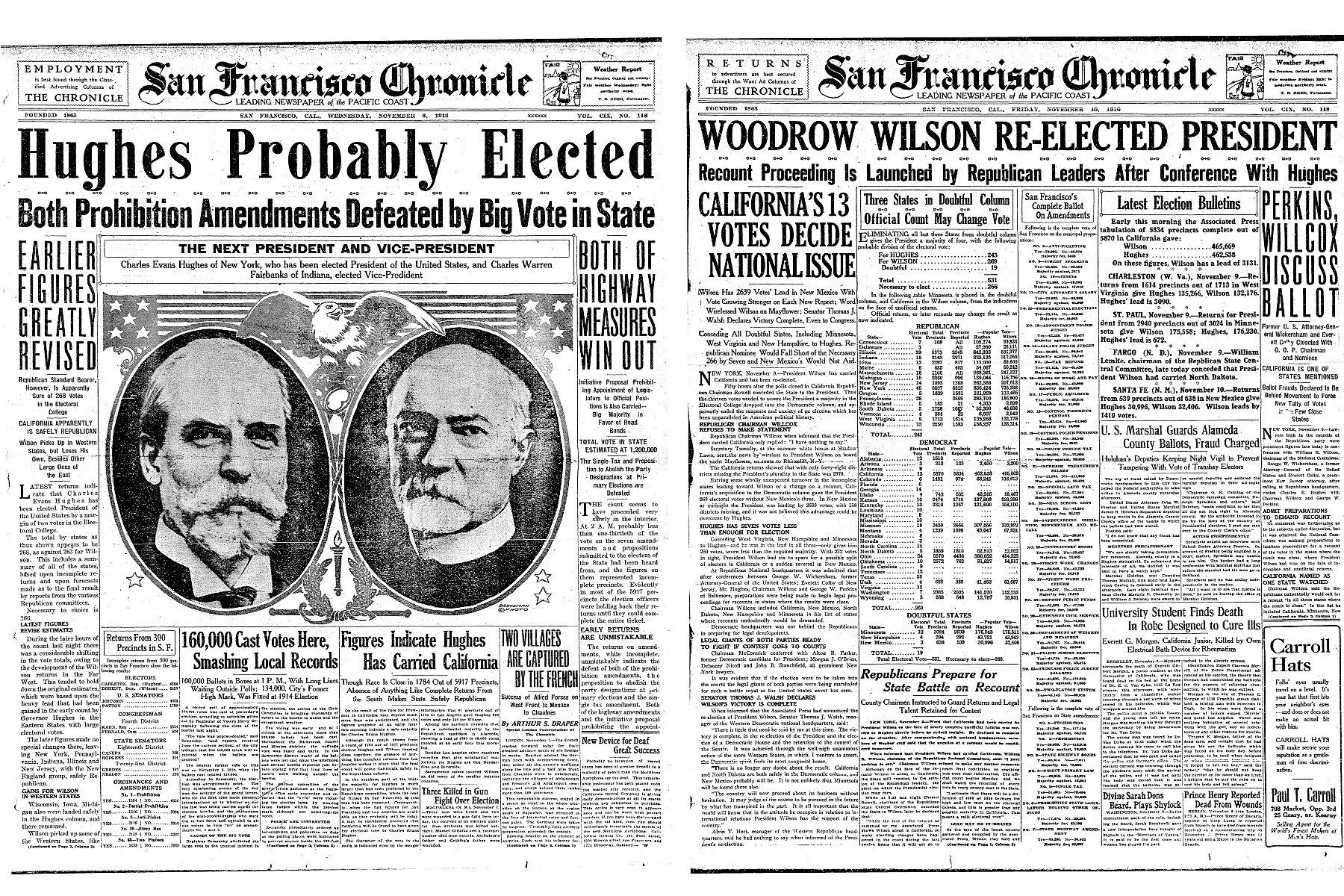
The key State is California, then having 13 Electoral Votes (about 1/4 of what it has now). At first, Hughes is winning it, and he goes to bed believing he has won it. Wilson, too, had gone to bed, thinking he had lost the State, and thus the country.
The San Francisco Chronicle, needing 2 tries to get it right

The story, perhaps apocryphal, tells of a reporter learning early the next morning that Wilson has taken the lead in California, and thus won the election, and calling Hughes' home. Hughes' son, or his butler, or someone else (depending on who's telling the story), tells the reporter, "The President-elect is asleep." The reporter says, "When he wakes up, tell him he's not the President-elect anymore."

With 266 Electoral Votes then needed for victory, Wilson wins, 277-254. If Hughes had won California, he would have won, 267-264. Wilson won 49.2 percent of the national popular vote, Hughes 46.1 percent. For both of his terms, Wilson would be a plurality President -- which had already happened to Grover Cleveland, and would later happen to Bill Clinton.

By the time he is Inaugurated again on March 5, 1917 (the usual date until 1933, March 4, was a Sunday that year), it is clear that Wilson will have to take America into the war. The war will make him beloved around the world. The peace process will make him despised at home.

A stroke in October 1919 paralyzed him, and when he left office in March 1921, he was, physically and emotionally, a broken man. He died in 1924. Hughes was appointed Secretary of State by Wilson's successor, Warren Harding, in 1921, and Chief Justice of the Supreme Court by Herbert Hoover in 1930. He served until retiring in 1941, and lived until 1948.

In the same election, Jeannette Rankin becomes the 1st woman elected to Congress. At the time, her home State of Montana was 1 of 10 States which then had full voting rights for women – all of them West of the Missouri River.
A pacificst, Rankin voted against America's entry into World War I, and was defeated for re-election in 1918. She bided her time, rebuilt her reputation, and was elected again in 1940. And voted against America's entry into World War II, and was defeated for re-election in 1942. She lived on until 1973.

*

November 7, 1916, like all modern American election days, was a Tuesday. Baseball was out of season. Football was in midweek. Professional basketball barely existed. And the professional hockey season was still a few months away. So there were no scores on this historic day.

Sunday, October 16, 2022

October 16, 1916: Margaret Sanger Opens Her Clinic

October 16, 1916: Margaret Sanger opens the 1st birth control clinic in America, at 46 Amboy Street in the Brownsville neighborhood of Brooklyn. Planned Parenthood of America considers this its founding.
Brownsville has long been a ghetto, but, at the time, it was a Jewish one.
Sanger is arrested for obscenity, as printing and distributing literature about birth control involved mention of sexual organs and sexual behavior, and mentions of either were then illegal. She was convicted, and sentenced to 30 days in a workhouse.
In February 1917, she began publishing a magazine, Birth Control Review. It was, appropriately, published once a  month. In 1918, the New York Court of Appeals issued a ruling that allowed doctors to prescribe contraception. Sanger died in 1966, 15 months after the U.S. Supreme Court ruled, in Griswold v. Connecticut, that birth control was part of a person's right to privacy.
*
October 16, 1916 was a Monday. The baseball season had ended 4 days earlier, when the Boston Red Sox beat the Brooklyn Dodgers in Game 5 to clinch the World Series. Football was in midweek. And it was too soon, in that era, for the basketball and hockey seasons to begin. So there were no scores on this historic day.

Friday, October 14, 2022

October 14, 1916: The 1st PGA Championship

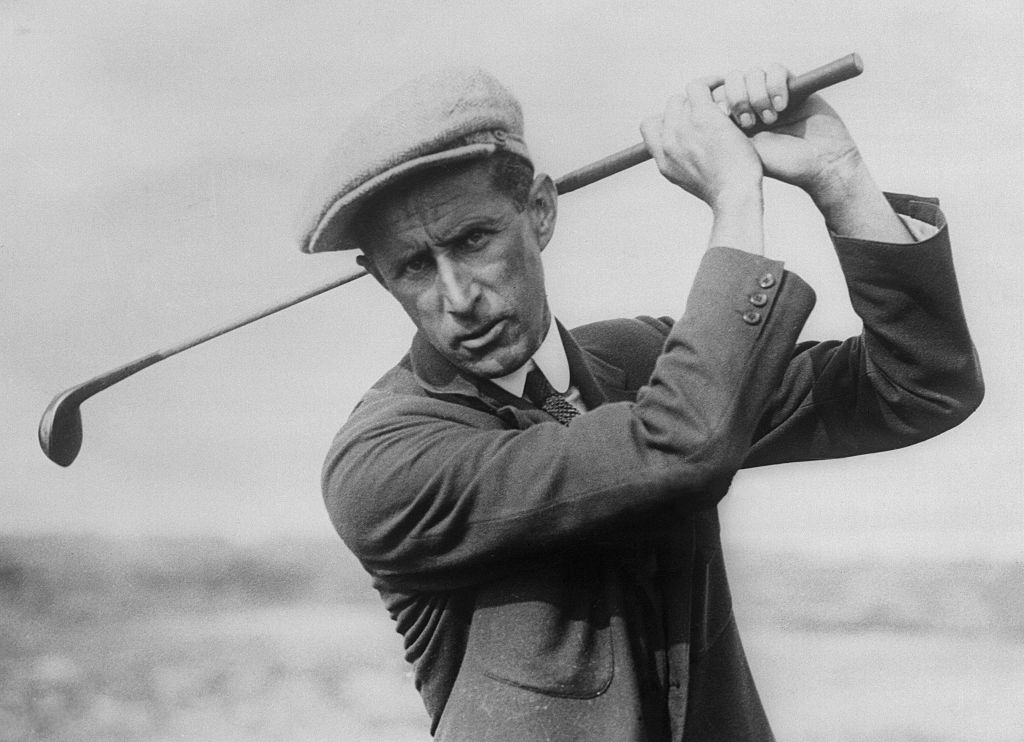
Jim Barnes

October 14, 1916: The 1st PGA Championship is played, at Siwanoy Country Club in Bronxville, Westchester County, New York. Jim Barnes is the winner. The 30-year-old native of Leland, Cornwall, in England's West Country would win it again in 1919, and went on to win the 1921 U.S. Open and the 1925 British Open. He lived until 1966.

NOTE: For a long time, with this project, I resisted putting in references to golf, because of the kind of people who tend to play it. I finally caved in, although I haven't included as many references as I would if it were a real sport, which it is not.

The United States Golf Association (USGA) was founded in 1894, but, in America, golf was still widely considered a sport for wealthy amateurs who could afford the clubs, shoes, and other equipment. Playing it professionally was one of those things that "simply isn't done." By 1916, that had been brushed aside: The Professional Golfers Association was founded in New York that February, and it staged the 1st PGA Championship.

One of the reasons there has never been a Grand Slam winner in the professional era is the timing: For years, the PGA Championship was played the week after the British Open, making it difficult to compete in both events. In 1965, the PGA was moved to August, giving enough space for a golfer to play in all 4 with sufficient rest. In 2017, the PGA was moved to May, making it the 2nd of the 4, rather than the last. Even so, to this day, no golfer has ever gone into the last major having won the 1st 3.

The PGA Championship was not played in 1917 or 1918, due to World War I. It was resumed in 1919, and has been played every year since, except for 1943, during World War II. Jock Hutchison was the 1st American winner, in 1920. After Barnes, no foreigner won it again until 1947, when Australian Jim Ferrier did. From then until Australian David Graham in 1979, the only non-American winner was Gary Player of South Africa, and he did it twice, in 1962 and 1972.

Although a few courses have hosted it 3 times, only 1 has hosted it 4, and that 1 has hosted it 5: Southern Hills Country Club in Tulsa, Oklahoma. (UPDATE: In 2023, Oak Hill Country Club in Rochester, New York hosted it for the 4th time. Valhalla Golf Club in Louisville, Kentucky hosted for the 4th time in 2024.)

Walter Hagen and Jack Nicklaus won it 5 times each, while Tiger Woods has won it 4. Phil Mickelson is the oldest winner, at 50 in 2021. The youngest winner is Gene Sarazen, at 20 in 1922. The record low score is 265, by David Toms in 2001.

*

October 14, 1916 was a Saturday. The baseball season had ended 2 days earlier, with the Boston Red Sox beating the Brooklyn Dodgers in the World Series, in 5 games. Actually, the Red Sox, with Babe Ruth pitching, beat the Brooklyn Robins, as the team was known from 1914 to 1931, while Wilbert Robinson managed them.

These notable college football games were played:

* Rutgers played Washington and Lee University to a 13-13 tie at Neilson Field in New Brunswick, New Jersey. The visitors, based in Lexington, Virginia, and named for President George Washington and General Robert E. Lee, the latter buried on their grounds, refused to play unless Rutgers kept their one black player out of the game. That was sophomore tackle and guard Paul Robeson. A friend of his called it "a wound that never healed."

Later in the year, West Virginia University came to New Brunswick, and refused to play Rutgers unless Robeson were held out. This time, Rutgers stood up for him, and said that West Virginia could mix the races or they could take their redneck asses back to Morgantown with a forfeit and no share of the gate receipts. Since they considered green to be more important than white, they played. Robeson made a game-saving tackle near the goal line to preserve a scoreless tie. Afterward, the WVU players lined up to shake his hand.

* Princeton beat Tufts, 3-0 at Palmer Stadium in Princeton, New Jersey.

* Army beat Holy Cross, 17-0 on The Plain at West Point, New York.

* Swarthmore upset Penn, 6-0 at the original Franklin Field in Philadelphia.

* Navy lost to the University of Pittsburgh, 20-19 at Worden Field in Annapolis, Maryland. Three days earlier, they beat nearby Maryland State at home. Four days before that, they beat nearby Georgetown at home. They probably shouldn't have played games 3 games in 8 days.

* In a then-unusual North vs. South contest, Harvard beat North Carolina, 21-0 at Harvard Stadium in Boston.

* In a game that was apparently already a major rivalry, West Virginia beat VPI (Virginia Polytechnic, now usually called Virginia Tech), 20-0 at Charleston, West Virginia, in Mountaineer territory but roughly halfway between the schools.

* In a game that would one day become a major rivalry, Georgia beat Florida, 21-0 at Sanford Field (predecessor of Sanford Stadium) in Athens, Georgia.

* Alabama beat Mississippi College, 13-7 at University Field in Tuscaloosa, Alabama. Not to be confused with the University of Mississippi, a.k.a. "Ole Miss" (which beat Hendrix College of Arkansas, 61-0 at home in Oxford), or Mississippi State University, then named Mississippi A&M (which beat the University of Chattanooga, 33-0 away), Mississippi College was, and remains, a Baptist school in Clinton, Mississippi. They now compete in NCAA Division II.

* Notre Dame beat Haskell, 25-0 at Cartier Field in South Bend, Indiana.

* Colgate upset Illinois, 15-3 at Illinois Field in Champaign.

* In a game that was already a major rivalry, Texas Christian University (TCU) beat Southern Methodist University (SMU), 48-3 at the State Fair Grounds in Dallas.

* In a game that never became a major rivalry, the University of Tulsa beat the University of Oklahoma, 16-0 at Boyd Field in Norman.

Sunday, October 9, 2022

October 9, 1916: Babe Ruth's 16-Inning World Series Win

October 9, 1916: Game 2 of the World Series is played at Braves Field in Boston, because it has a higher seating capacity than Fenway Park, and the Red Sox had previously extended the use of Fenway to the Boston Braves in the 1914 World Series, for the same reason, before Braves Field was completed. The Braves would also allow this for the Red Sox in 1915 and 1918.

Boston's opponent in this series was the Brooklyn Robins. They carried this name starting in 1914, when they hired Wilbert Robinson as their manager. After firing him at the end of the 1931 season, they would go back to the name they had from 1911 to 1913: The Brooklyn Dodgers.

The starting pitchers were Sherrod "Sherry" Smith for the Robins, and George Herman "Babe" Ruth for the Boston Red Sox. Both were lefthanders. Smith was a 25-year-old native of Georgia, who would also help the Robins win the Pennant in 1920. He appeared in the major leagues from 1911 to 1927, and went 114-118 in his career. But this game would be his most notable appearance.

Ruth, from Baltimore, was only 21, completing his 3rd major league season, his 2nd full season. He had gone 18-8 for the Red Sox in 1915, but did not make an appearance in the World Series. In 1916, he went 23-12, and led the American League with a 1.75 ERA. Along with Walter Johnson of the Washington Senators and Grover Cleveland Alexander of the Philadelphia Phillies, he was already 1 of the 3 best pitchers in baseball. He had also hit 7 home runs in 228 at-bats over the last 2 seasons, a good ratio for the period now known as "The Dead Ball Era."

The Series began 2 days earlier, at Braves Field, and the Red Sox won, 6-5. Sunday baseball still being illegal in New England, they took the day off, and Game 2 was played on this day. Both starters went the distance. This was hardly unusual for the time period, but the distance turned out to be exceptionally long.

In the 1st inning, Hy Myers hits an inside-the-park home run, the only round-tripper hit off Ruth the entire season. Ruth, in most un-Ruthian fashion, ties the game with a groundout in the 3rd. After that, runs were very hard to come by.

The Dodgers got a leadoff walk by Jake Daubert in the 4th, a single by Ivy Olson with 2 out in the 5th, a walk by Jimmy Johnston in the 6th, and singles by Mike Mowrey and Otto Miller that gave them 1st and 3rd with 1 out in the 8th. But, despite having Zack Wheat, a Hall-of-Famer, and Daubert, a lifetime .303 hitter, they could not score again.

The Red Sox got a walk from Dick Hoblitzell in the 4th, a triple from Pinch Thomas with 2 out in the 5th, a leadoff walk from Hoblitzell in the 7th, and a leadoff double from Hal Janvrin and an intentional walk to Duffy Lewis in the 9th. But, despite having Ruth, Lewis and Hall-of-Famer Harry Hooper in their lineup, they could not score again, either, and the game went to extra innings.

Ruth walked Olson with 2 out in the top of the 10th, but stranded him. Everett Scott singled to lead off the bottom of the 10th, and was sacrificed over by Thomas. But Smith struck Ruth out, and when Hooper hit a grounder to 3rd, Mowrey, the Dodger 3rd baseman, tagged Scott out before he could get to the bag. Hoblitzell drew another walk with 2 out in the bottom of the 11th, but was stranded. Scott drew a walk with 1 out in the bottom of the 12th, but could not be brought home.

Finally, in the bottom of the 14th inning, Hoblitzell led off with his 4th walk of the game. Mike McNally was sent in to pinch-run for him. Lewis bunted him over to 2nd. Del Gainer was sent in to pinch-hit for Larry Gardner -- a bit of an irony since Gardner's sacrifice fly in the 12th inning of Game 8 had won the 1912 World Series for the Red Sox. This time, Gardner singled to left, and McNally scored.

The Red Sox won, 2-1, and Ruth was the winning pitcher, having gone the last 13 1/3rd innings without allowing a run. His streak of 29 2/3 consecutive scoreless innings pitched was underway, a World Series record that would stand until 1961, when Whitey Ford surpassed it.

This would be the longest World Series game by innings for over a century. Game 3 in 2005 and Game 1 in 2015 also went 14 innings. The record finally fell in 2018, when Game 3 went 18 innings. Again, it was the Red Sox and the Dodgers, by this point in Los Angeles. The joke on social media was that the game began at Ebbets Field and ended at Dodger Stadium.

In 1986, a National League Championship Series game went 16 innings. In 2005, an NL Division Series game went 18. And in 2014, we had another NLDS game go 18 innings. Through the 2021 World Series, 18 innings remains the postseason record.

The Robins/Dodgers won Game 3 of the 1916 World Series, but the Red Sox -- described by one newspaper at the time as "the carmine-hosed warriors" -- won Games 4 and 5, and repeated as World Champions. Ruth did not appear in the Series again, such was the strength of the Sox' pitching. But, with both his arm and his bat, he would help the Sox win the Series again in 1918.

That season, he led the AL with 18 home runs. In 1919, playing the outfield nearly full time, he set a new record with 29. He would finish his career with a record of 94-46, and an ERA of 2.28. It's been said that, had he stuck with pitching, he might have made the Baseball Hall of Fame with that.

Of course, he stuck with neither pitching nor the Red Sox. For the 1920 season, fed up with his salary demands and his carousing, the Red Sox sold him to the New York Yankees. The rest is history, and legend.

*

October 9, 1916 was a Monday. Football was in midweek. Hockey was out of season. And the NBA hadn't been founded yet. So there were no other scores on this historic day.

Friday, October 7, 2022

October 7, 1916: Georgia Tech 222, Cumberland 0

John Heisman

October 7, 1916: Game 1 of the World Series, played at Braves Field in Boston. Since the Red Sox had lent the use of Fenway Park to the Braves in the 1914 World Series, since it had a larger capacity than the antiquated South End Grounds, the Braves, having now opened the larger Braves Field, let the Sox use it in the 1915, '16 and '18 World Series. Bill Carrigan becomes the 1st man to manage the Red Sox in back-to-back World Series, and he remains the only one. (Jimmy Collins was denied the chance to do so when the Giants wouldn’t play in one in 1904.)

Ernie Shore is in control until the 9th, but melts down, allowing 4 runs and loading the bases before Collins has to call on Carl Mays to bail him out. Mays does so, and the Sox have a hard-earned 6-5 win over the Brooklyn Robins. (The Dodgers were then named for their manager, Wilbert Robinson.)

But that's not the biggest sports story of the day. At Grant Field in Atlanta, Georgia Tech wins the biggest blowout in the history of college football, defeating Cumberland College, 222-0. No, that's not a typo: Tech won by a score of two hundred and twenty-two to zero.

John Heisman, for whom the national player of the year trophy would be named, was Tech's coach, and would lead them to the National Championship the next year. Cumberland, a small Presbyterian school in Lebanon, Tennessee, now in NCAA Division III, should never have been on a big school's schedule, but needed the money, and Tech was willing to pay them to come to Atlanta and play the big boys.

Why the big score? Indeed, why that many points? Because, earlier in the year, Cumberland had beaten Tech's baseball team, of which Heisman was also the coach, 22-0. In those days, sportswriters also tended to rank teams based on how many points they scored, which Heisman thought was ridiculous. He may have wanted to prove his point, as later sportscaster Warner Wolf tended to do when mocking gamblers and their obsession with point spreads. Had Warner been around in 1916, he would have said, "If you had Cumberland and 221 points, you lost!"

Also on this day, Lance Corporal Leigh Richmond Roose is killed at the Battle of the Somme in World War I. Dick Roose was a Welsh soccer player, a goalkeeper for several teams, including Stoke City, Everton, Sunderland, Celtic of Glasgow, Huddersfield Town, Aston Villa, and, in the 1911-12 season, Woolwich Arsenal, the team that would move to North London in 1913.

*

October 7, 1916 was a Saturday. Some other college football games of note that day:

* The University of Tennessee beat Maryville College, of Maryville, Tennessee, 32-0 at Waite Field in Knoxville, Tennessee. Like Georgia Tech, they would finish 8-0-1, and be declared Co-Champions of the Southern Intercollegiate Athletic Association, a precursor to the Southeastern Conference.

* Ohio State beat Ohio Wesleyan, 12-0 at Ohio Field in Columbus. A week later, they beat Oberlin College, 128-0. Georgia Tech fans must have thought, "Big deal."

* Oregon, probably the best team on the West Coast, beat cross-State opponents Willamette University, 97-0 at Kincaid Field in Eugene. Georgia Tech fans probably weren't impressed by this, either.

* Notre Dame beat Western Reserve, 48-0 at League Park in Cleveland.

* Army beat Washington & Lee, 14-7 on The Plain at West Point, New York.

* Navy beat Georgetown, 13-7 at Worden Field in Annapolis, Maryland.

* The University of Pittsburgh, along with Army probably the best team in the East, beat fellow Western Pennsylvanians Westminster College, 57-0 at Forbes Field in Pittsburgh.

* Tufts stunned Harvard, 7-3 at Harvard Stadium in Boston. That probably would have gotten a lot more notice if Georgia Tech had only won by 22 points, instead of by 222.

* Yale beat Virginia, 61-3 at the Yale Bowl in New Haven, Connecticut.

* Fordham beat Western Maryland, 20-0 at Fordham Field in The Bronx.

* New York University beat Rensselaer Polytechnic Institute -- NYU over RPI -- 22-0 at Ohio Field in The Bronx.

* Princeton beat North Carolina, 29-0 at Palmer Stadium in Princeton, New Jersey.

* And Rutgers beat Villanova, 33-0 at Neilson Field in New Brunswick, New Jersey.

Saturday, August 20, 2022

August 20, 1916: The 1st Game of the U.S. National Soccer Team

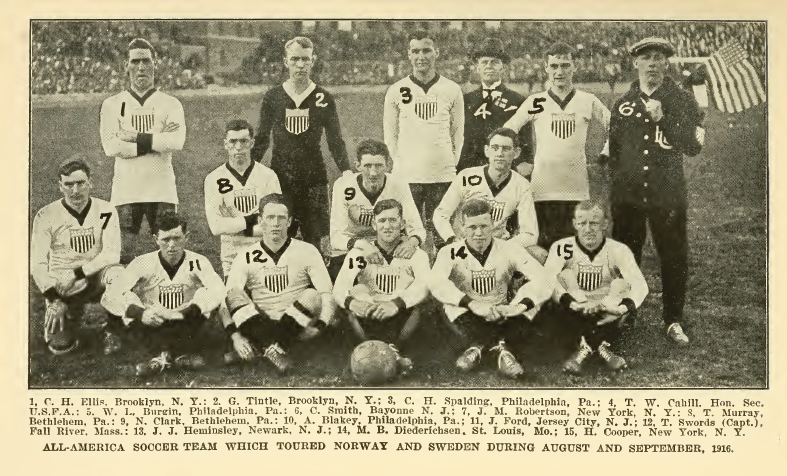
August 20, 1916: The United States of America fields a national soccer team for the 1st time.

Sponsored by the United States Soccer Federation (USSF), founded in 1913, the team took the pitch against Sweden at the Stockholm Olympiastadion, site of the 1912 Olympics, where Jim Thorpe had won the decathlon. A crowd of 16,000 attended. The referee was Hagbard Vestergaard of Denmark.

This was the U.S. team for the game, keeping in mind that uniform numbers were not used in soccer until 1933:

* Goalkeeper: George Tintle of Harrison, New Jersey
* Right Back: Tommy Murray of Bethlehem, Pennsylvania
* Left Back: Jimmy Robertson of New York
* Defender: Dick Spalding of Philadelphia
* Defender: Neil Clarke of Scotland, moved to Paterson, New Jersey
* Defender: Clarence Smith of Bayonne, New Jersey
* Outside Right: Jimmy Ford of Kearny, New Jersey
* Inside Right: Charles Ellis of New York
* Center Forward: John Hemingsley of Newark
* Inside Left: Thomas Swords of Fall River, Massachusetts (Captain)
* Outside Left: Harry "Buck" Cooper of Newark

As you can see, the tradition of soccer in Newark, its across-the-Passaic-River towns of Harrison and Kearny, and its across-Newark-Bay town of Bayonne goes back at least this far. Bethelehem, in the Lehigh Valley of northeastern Pennsylvania, was home to Bethlehem Steel Football Club, a "company team" (or, as the English would have called it, a "works side"), one of the top U.S. teams of the era.

And Fall River and nearby New Bedford, Massachusetts, manned by Portuguese immigrants and their sons, would have strong teams into the 1950s, including the legendary Ponta Delgada, named for an island in the Portugal-controlled Azores Islands. Because of Massachusetts' "blue laws," if these teams wanted to play on Sunday, they would go right across the State Line, and play at St. Mark's Stadium in Tiverton, Rhode Island.

James Robertson is a very common name among soccer players, especially in Scotland. A later Jimmy Robertson was the 1st player ever to score for both Tottenham Hotspur against Arsenal and for Arsenal against Tottenham in the North London Derby.

Konrad Törnqvist scored for Sweden, in only the 7th minute of the game. But Spalding equalized in the 22nd. Ellis scored in the 53rd. Cooper scored in the 68th. Törnqvist brought the Swedes back within 1 in the 81st, but the U.S. defense held on for a 3-2 win.

On September 3, still in Scandinavia, the U.S. team played Norway to a 1-1 draw in Kristiana. Ellis scored the only goal.

History seems to have lost track of some of these players. As far as I can tell, the last survivor was Cooper, who died in 1963.

The stadium still stands. Djurgårdens IF, Sweden's most successful soccer team, played there until the new Tele2 Arena opened, but maintain their offices there.
Due to World War I continuing through 1918, and then for longer for reasons I don't have, the U.S. national team didn't play another game until 1924, and then seemed to play only 2 or 3 games a year until World War II. This may have held them back. The U.S. team didn't play its 1st game on home soil until November 8, 1925, beating Canada 6-1 at Ebbets Field in Brooklyn, thanks to 5 goals from Archie Stark. Like so many early U.S. soccer stars, Stark was born in Glasgow, Scotland but grew up in Kearny, New Jersey.

This period did include reaching the Semifinal of the 1st World Cup in 1930, and reaching the World Cup again in 1934, before failing to qualify in 1938.

*

August 20, 1916 was a Sunday. Because many States still banned professional sports on Sunday, only 3 games were played in what would later be known as Major League Baseball:

* The New York Giants lost to the St. Louis Cardinals, 5-0 at Robison Field in St. Louis. Bob Steele allowed the Giants 8 hits, but kept the shutout. Rogers Hornsby, a rookie, went 2-for-2 with 2 walks for the Cardinals.

* The Boston Braves beat the Cincinnati Reds, 4-3 at Redland Field (renamed Crosley Field in 1934) in Cincinnati.

* The Brooklyn Robins (as the Dodgers were known from 1914 to 1931) beat the Chicago Cubs, 1-0 at Weeghman Park (renamed Cubs Park in 1920 and Wrigley Field in 1926) in Chicago. Jack Coombs allowed only 1 hit, a single by Max Flack. Coombs even got a hit for Brooklyn. So did the man who is still the Dodger franchise's all-time leader in hits, Zack Wheat. So did future managing legend Casey Stengel.

Friday, July 29, 2022

July 30, 1916: The Black Tom Explosion

July 30, 1916: German saboteurs set off what becomes known as the Black Tom Explosion in Jersey City, New Jersey.

"Black Tom" sounds like it might be a racially insensitive nickname. In fact, it was a munitions depot on an island on the New Jersey side of New York Bay, within sight of the Statue of Liberty and Ellis Island. Up until the breakout of World War I on August 1, 1914, munitions companies in America, which was then neutral in the war, could sell to any country. But with the outbreak of the war, Britain's Royal Navy blockaded Germany, and so only the Allied powers -- Britain and its Empire, France and its colonies, and the Russian Empire -- could buy American munitions.

So, just as they would in World War II a generation later, the German Empire sent saboteurs to America to mess with our ability to help their enemies. On July 29, 1916, about 2 million pounds of ammunition were stored at Black Tom, in freight cars and on barges, waiting to be shipped to Russia. After midnight, so it was now July 30, some small fires were found on the pier.

The pier was evacuated, and the Jersey City Fire Department was called in. At 2:08 AM, Johnson Barge No. 17 exploded, sending 50 tons of TNT up in smoke and flames. Several firemen were thrown into the air, some of them out of their boots. It registered at 5.5 on the Richter scale, making it equivalent to a serious earthquake. 

The explosion destroyed over 100 railroad cars and 13 warehouses, and left a 375-by-175-foot crater. Debris struck the Statue of Liberty's arm, and, for safety's sake, her  torch has been off-limits to human occupancy ever since. Fragments flew a mile away to Journal Square, striking the clock tower of The Jersey Journal newspaper, stopping the clock at 2:12 AM. Windows were broken all over New York City. The Brooklyn Bridge shook. The explosion was felt 90 miles away in Philadelphia.

The evacuation was mostly successful: The death toll was kept down to 4. With no FBI and no CIA at the time, and only Jersey City Police and New Jersey State Police available to investigate, finding out who actually set off the explosions proved impossible. If there was any punishment for Germany, it came after President Woodrow Wilson, who ran for re-election in 1916 on the slogan, "He kept us out of war," could do so no longer, and asked for a Declaration of War on April 2, 1917, and got it on April 6.

Landfill eventually connected the island to the Jersey City mainland, and what had been Black Tom Island is now part of Liberty State Park. A monument is now on the site.

Six months later, on January 11, 1917, another American munitions plant exploded in New Jersey, 11 miles to the northwest, in Lyndhurst. The Kingsland Explosion caused a lot of damage, but no deaths. German sabotage was suspected, but never proven.

On October 4, 1918, still another American munitions plant exploded in New Jersey, 27 miles to the south of Black Tom, in Sayreville. The Morgan Explosion killed over 100 people. Again, German sabotage was suspected, but an investigation revealed this one to be an accident.

*

July 30, 1916 was a Sunday. Actor Dick Wilson was born on that day, best known for playing Mr. Whipple in commercials for Charmin toilet paper from 1965 to 1989: "Please don't squeeze the Charmin!"

In baseball, as it turned out, the entire American League played that day, and the entire National League did not:

* The New York Yankees were swept by the St. Louis Browns in a doubleheader at Sportsman's Park in St. Louis. The Browns won the opener, 2-1, as Ernie Koob outpitched George Mogridge. The Browns won the nightcap, 2-0, as Eddie Plank outpitched Ray Fisher. No home runs were hit in either game. This was still the Dead Ball Era.

* The Washington Senators beat the Cleveland Indians, 2-1 in 10 innings at League Park in Cleveland. Walter Johnson outpitched fellow future Hall-of-Famer Stan Coveleski.

* The Boston Red Sox beat the Detroit Tigers, 9-3 at Navin Field in Detroit. It was renamed Briggs Stadium in 1938 and Tiger Stadium in 1961. Duffy Lewis and Larry Gardner each got 3 hits for the Red Sox. Babe Ruth did not play for them. Ty Cobb did play for the Tigers, going 3-for-3 with a walk and 2 RBIs.

* The Chicago White Sox swept a doubleheader from the Philadelphia Athletics at Comiskey Park in Chicago. The Pale Hose won the 1st game 10-1, and the 2nd game 7-0.

Wednesday, July 20, 2022

July 20, 1916: The New York Giants Trade Edd Roush

July 20, 1916: The New York Giants trade pitcher Christy Mathewson, center fielder Edd Roush and 3rd baseman Bill McKechnie to the Cincinnati Reds for infield Charles "Buck" Herzog and outfielder Wade "Red" Killefer.

This isn't quite as lopsided a trade as the one the Giants made to get Mathewson from the Reds, 16 years earlier, when he hadn't yet won a major league game, and the man they gave up, ace pitcher Amos Rusie, never won another. But it was lopsided, and not because they gave up Mathewson, their most popular player, who was approaching his 36th birthday and only had 1 win left in him.

Giving up McKechnie meant little, although he would later manage Pennant winners with the 1925 Pittsburgh Pirates, the 1928 St. Louis Cardinals, and the 1939 and 1940 Cincinnati Reds. As for what they got back, Herzog was a minor player, and Killefer only played 2 games for the Giants, and then disappeared from the major leagues.

The reason this trade is lopsided is that they gave up Roush. Born in 1893 in rural Indiana, he once told an interviewer, "I didn't know if I'd make it to the major leagues, but I didn't care. I just had to get away from those damn cows." The Giants picked him and McKechnie up from the folded Newark Peppers of the Federal League, but didn't keep either one. Committed to an outfield of George Burns (not the comedian) in left, Benny Kauff (another pickup from the Peppers) in center, and Dave Robertson in right, the Giants were willing to let Roush go.

In 1917, he batted .341 to lead the National League. In 1918, he batted .333, finishing just .002 short of the Brooklyn Robins' Zack Wheat for another batting title. In 1919, he batted .321, to lead the NL, and led the Reds to win the World Series. As the last surviving player from that Series, on either side, living until 1988, he always insisted that the Reds would have won even if the 8 Chicago White Sox players who were later banned for "throwing" the Series had played it on the level. In addition, he developed a reputation for having the best outfield arm in baseball.

So why did the Giants make the trade? Maybe manager John McGraw sensed something. Roush rarely showed up for Spring Training on time, and held out several times, missing the 1st month of the 1921 season, and most of 1922. McGraw wouldn't have wanted to deal with that.

Or would he? The Giants reacquired Roush in 1927, but he missed much of 1928 due to an injury, and retired in 1930 rather than take a pay cut. The Reds talked him out of retirement for 1931, and he played 1 more season. He retired with a .323 batting average, and 2,376 hits, including 339 doubles, 182 triples and 68 home runs. He was elected to the Hall of Fame.

*

July 20, 1916 was a Thursday. These baseball games were played that day:

* The New York Giants did not better on the field than they did in the front office. They lost to the Chicago Cubs, 1-0 at Weeghman Park in Chicago. (It became Cubs Park in 1920, and Wrigley Field in 1926.) Rollie Zeider singled Max Flack home with the winning run scored with the winning run in the bottom of the 10th inning.

* The New York Yankees lost to the St. Louis Browns, 4-2 at the Polo Grounds. Bob Groom outpitched Cliff Markle. George Sisler went 2-for-4 with an RBI.

* The Detroit Tigers beat the Boston Red Sox, 3-2 in 13 innings at Fenway Park in Boston. Harry Coveleski (Stan's brother) went the distance for the win. Babe Ruth relieved Rube Foster, pitched the last 5 innings, and took the loss, going 0-for-2 at the plate. Ty Cobb went 3-for-6 with 2 RBIs.

* A doubleheader was split at Shibe Park in Philadelphia. The Cleveland Indians won the opener, 4-2. The Philadelphia Athletics won the nightcap, 2-0. Bullet Joe Bush pitched a 4-hit shutout. Tris Speaker went 1-for-4 in each game.

* The Washington Senators swept a doubleheader from the Chicago White Sox, 4-3 and 2-1 at National Park in Washington. (It became Griffith Stadium in 1920.) Both games went 10 innings. In the 1st game, Clyde Milan grounded out, but it got Danny Moeller home, to make a losing pitcher of Eddie Cicotte, who relieved Lefty Williams, the 2 pitchers among the "Black Sox." Joe Boehling went the distance for the win.

Patsy Gharrity doubled home Same Rice to win the 2nd game. Harry Harper went the distance for the win. Over the 2 games, Eddie Collins went 3-for-9, and Shoeless Joe Jackson went 0-for-6.

* A doubleheader was split at Redland Field in Cincinnati. (It became Crosley Field in 1934.) The Philadelphia Phillies won the 1st game, 6-0. Grover Cleveland Alexander pitched a 2-hit shutout. The Cincinnati Reds won the 2nd game, 5-3.

* The St. Louis Cardinals beat the Boston Braves, 5-2 at Robison Field in St. Louis.

* And the Brooklyn Robins (as the Dodgers were known while Wilbert Robinson managed them from 1914 to 1931) and the Pittsburgh Pirates were rained out at Forbes Field in Pittsburgh. The game was made up as part of a doubleheader 2 days later. The Robins swept, 7-1 and 3-2. Over the 2 games, Zack Wheat went 1-for-8 with 2 walks and 2 RBIs, including a sacrifice fly that got the winning run home in the top of the 15th inning of the 2nd game. Honus Wagner went 0-for-10, and was a year away from retiring.

Friday, July 1, 2022

July 1, 1916: The Jersey Shore Shark Attacks

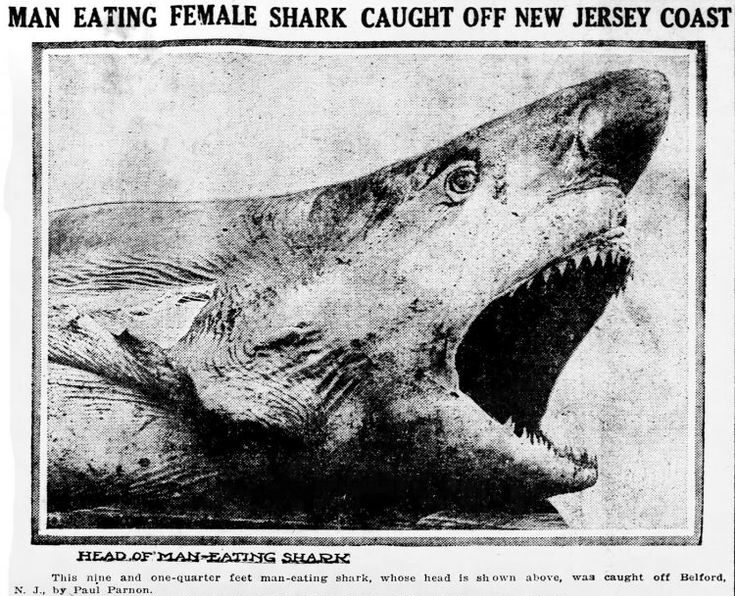
July 1, 1916: Charles Vansant, a 23-year-old Philadelphia native, is attacked by a shark in the Atlantic Ocean, off Beach Haven, on Long Beach Island on the New Jersey Shore. A lifeguard and a bystander tried to rescue him, but he had lost too much blood, and died.

Over the next few days, 3 other people would be killed and another badly injured in shark attacks on the Jersey Shore. The incidents occurred while there was both a Summer heat wave and a polio epidemic, causing people to flee steaming hot New York City, Philadelphia, and the cities of New Jersey for the Shore. The bigger crowds on the beaches gave the sharks an unexpected food source.

The second major attack occurred on July 6, further north in Spring Lake. Charles Bruder, 27, was a bell captain at the Essex & Sussex Hotel. Lifeguards reached him, but his legs had been severed, and he died before they reached shore. Guests and workers at the Essex & Sussex and neighboring hotels raised money for Bruder's mother, in Switzerland.

Further north still, on July 12, a shark got into Raritan Bay, and then into Matawan Creek near the towns of Matawan and Keyport, attacking 3 boys, killing 2 of them. The water shouldn't have been deep enough for a shark to swim in.

There were no further attacks, but their happening so close to the New York media blew the story out of proportion. By the time Jaws was filmed in 1974, sharks had been the Atlantic's boogeymen for over half a century. As Murray Hamilton, playing Mayor Larry Vaughn, put it, "It's all psychological. You yell, 'Barracuda!' Everybody says, 'Huh? What?' You yell, 'Shark!' We've got a panic on our hands on the Fourth of July."

*

July 1, 1916 was a Saturday. Actress Olivia de Havilland was born on this day. And the Battle of the Somme, the biggest bloodbath of World War I, began. I have a separate entry for this event.

These baseball games were played:

* The New York Yankees beat the Philadelphia Athletics, 5-4 at Shibe Park (later renamed Connie Mack Stadium) in Philadelphia. Les Nunamaker doubled home the winning run in the top of the 9th inning.

* The New York Giants lost to the Philadelphia Phillies, 9-2 at the Polo Grounds. Al Demaree went the distance for the Phils, allowing only 5 hits, 3 of them to Dave Robertson. He appears not to have been related to the later Yankee pitcher David Robertson.

* The Brooklyn Dodgers were swept in a doubleheader by the Boston Braves, 7-4 and 2-0 at Braves Field in Boston. Pat Ragan pitched a 2-hit shutout in the 2n game, outpitching future Hall-of-Famer Rube Marquard. The Dodgers -- or, more accurately, the Brooklyn Robins, as they were known from 1914 to 1931, as Wilbert Robinson was their manager -- won the National League Pennant, anyway.

* The Washington Senators beat the Boston Red Sox, 4-2 at American League Park (later renamed Griffith Stadium) in Washington. Walter Johnson pitched the last 2 innings for the Senators, and got the save, not that anyone knew what a "save" was at the time. Babe Ruth started for the Red Sox, pitched 3 1/3rd innings, and got the loss. He had no official at-bats, but had an RBI on a sacrifice fly. The Red Sox went on to beat the Dodgers/Robins in the World Series.

* The Cleveland Indians beat the St. Louis Browns, 5-4 at League Park in Cleveland. The game went 11 innings, although I can't find how the winning run was scored. Stan Coveleski was the winning pitcher, Eddie Plank the losing pitcher. Neither started the game. Both made the Baseball Hall of Fame. Tris Speaker went 2-for-3 with 2 walks. George Sisler went 1-for-4.

* The Pittsburgh Pirates beat the Cincinnati Reds, 2-1 at Redland Field (later renamed Crosley Field) in Cincinnati. Honus Wagner hit a home run.

* The Chicago White Sox beat the Detroit Tigers, 6-0 at Comiskey Park in Chicago. Eddie Collins went 3-for-4 with an RBI. Shoeless Joe Jackson went 1-for-3 with an RBI. Ty Cobb went 1-for-4.

* And a doubleheader between arch-rivals was played at Robison Field in St. Louis. The Chicago Cubs won the opener, 9-2. The St. Louis Cardinals won the nightcap, 4-3. This was another game that went 11 innings, without Baseball-Reference or Retrosheet having a record of how the winning run was scored. 

July 1, 1916: The Battle of the Somme

British "Tommies" emerging from the trenches
and "going over the top"

July 1, 1916: The Battle of the Somme breaks out, along the River Somme, outside Ovillers-la-Boisselle, 100 miles north of Paris. It becomes the 2nd-longest battle of World War I, behind the Battle of Verdun -- which started earlier in the year, and finished after the Somme -- and is the war's largest battle in terms of manpower.

On one side: Imperial Germany, with 1 million men, commanded by Rupprecht, Crown Prince of Bavaria. On the other side: France, defending their homeland with 1.3 million men, commanded by Marshal Ferdinand Foch; and Britain, assisting their ally with 1.2 million men, commanded by General Douglas Haig.
Douglas Haig

The 1st day at the Somme was one of the few days on which the Allies made significant progress in World War I. But it was also one of the bloodiest: In one day, the British lost 19,240 men. To put that in perspective: America lost its mind when nearly 60,000 men were lost in the 8 years of the Vietnam War. The British lost nearly 20,000 men in one day, the worst day in terms of losses that their army has ever had, since there has been a nation of England to keep records. The Germans lost 12,000. The French, 1,590.

But that battle continued. In September, the British used tanks in battle for the 1st time. It was also one of the earliest battles in which air power was used. Hostilities finally ceased on November 18, at which point the British and French had gained... 6 miles.

Among the British soldiers -- known as "Tommies," derived from "Tommy Atkins," a long-standing name for them, not from "Thompson submachine guns," as the term "tommy-guns" was -- was Lieutenant John Ronald Ruel Tolkien, later the author of the Lord of the Rings books. He arrived early in July, and suffered all the horrors of the trenches, including lice, which led to trench fever, which led to him being evacuated in early November. After that, everyone in his platoon was killed in action. People who thought his books were allegories for World War II were way off: They were allegories for World War I.
J.R.R. Tolkien, 1916

When the battle was over, the Germans claimed losses of 440,000 men, plus 73,000 prisoners of war; the French, 200,000 dead; the British, 420,000. Add it up: 1,060,000 soldiers killed. That's right: One battle, over one million men dead. And for what? Six miles.

It was a "Pyrrhic victory." The phrase originates from a quote from Pyrrhus of Epirus, whose triumph against the Romans in the Battle of Asculum, in what is now Southern Italy, in 279 BC destroyed much of his forces, forcing the end of his campaign. According to legend, he said, "If we are victorious in one more battle with the Romans, we shall be utterly ruined." The more common translation is, "Another such victory, and I am undone."

Haig was promoted to Field Marshal in 1917, given the title The Earl Haig in 1919, and lived until 1928. His grandson is Alexander, the 3rd Earl Haig. Despite the name and the shared profession, former U.S. Army General and Secretary of State Alexander Haig was not closely related.

For many years thereafter, the 1st Earl Haig was considered one of the most effective commanders of the war. But, in the words of the Canadian War Museum, "His epic but costly offensives at the Somme (1916) and Passchendaele (1917) have become nearly synonymous with the carnage and futility of First World War battles."

Marshal Foch became France's greatest military hero of the modern era, and accepted the German surrender on November 11, 1918. He lived until 1929.
Ferdinand Foch

With the Bavarian monarchy, as well as the larger German one, abolished by the Weimar Republic, Crown Prince Rupprecht tried and failed to establish a constitutional monarchy for Bavaria. The Nazis never asked him to be a part of their movement. He fled to Italy, then to Hungary, and was captured by the Nazis, and held at the Dachau concentration camp (which, at the absolute least, was in Bavaria). The postwar American occupation allowed him to return home, and he lived until 1955.

*

July 1, 1916 was a Saturday. Actress Olivia de Havilland was born on this day. And a series of shark attacks along the Jersey Shore began. I have a separate entry for this event.

These baseball games were played:

* The New York Yankees beat the Philadelphia Athletics, 5-4 at Shibe Park (later renamed Connie Mack Stadium) in Philadelphia. Les Nunamaker doubled home the winning run in the top of the 9th inning.

* The New York Giants lost to the Philadelphia Phillies, 9-2 at the Polo Grounds. Al Demaree went the distance for the Phils, allowing only 5 hits, 3 of them to Dave Robertson. He appears not to have been related to the later Yankee pitcher David Robertson.

* The Brooklyn Dodgers were swept in a doubleheader by the Boston Braves, 7-4 and 2-0 at Braves Field in Boston. Pat Ragan pitched a 2-hit shutout in the 2n game, outpitching future Hall-of-Famer Rube Marquard. The Dodgers -- or, more accurately, the Brooklyn Robins, as they were known from 1914 to 1931, as Wilbert Robinson was their manager -- won the National League Pennant, anyway.

* The Washington Senators beat the Boston Red Sox, 4-2 at American League Park (later renamed Griffith Stadium) in Washington. Walter Johnson pitched the last 2 innings for the Senators, and got the save, not that anyone knew what a "save" was at the time. Babe Ruth started for the Red Sox, pitched 3 1/3rd innings, and got the loss. He had no official at-bats, but had an RBI on a sacrifice fly. The Red Sox went on to beat the Dodgers/Robins in the World Series.

* The Cleveland Indians beat the St. Louis Browns, 5-4 at League Park in Cleveland. The game went 11 innings, although I can't find how the winning run was scored. Stan Coveleski was the winning pitcher, Eddie Plank the losing pitcher. Neither started the game. Both made the Baseball Hall of Fame. Tris Speaker went 2-for-3 with 2 walks. George Sisler went 1-for-4.

* The Pittsburgh Pirates beat the Cincinnati Reds, 2-1 at Redland Field (later renamed Crosley Field) in Cincinnati. Honus Wagner hit a home run.

* The Chicago White Sox beat the Detroit Tigers, 6-0 at Comiskey Park in Chicago. Eddie Collins went 3-for-4 with an RBI. Shoeless Joe Jackson went 1-for-3 with an RBI. Ty Cobb went 1-for-4.

* And a doubleheader between arch-rivals was played at Robison Field in St. Louis. The Chicago Cubs won the opener, 9-2. The St. Louis Cardinals won the nightcap, 4-3. This was another game that went 11 innings, without Baseball-Reference or Retrosheet having a record of how the winning run was scored.

December 31, 1999 & January 1, 2000: The Millennium

December 31, 1999:  The Millennium arrives. The people of planet Earth survived. At a terrible cost. But we hadn't destroyed ourselves. ...