Showing posts with label switzerland. Show all posts

Monday, September 26, 2022

September 26, 1905: Einstein's Theory of Special Relativity

Yes, he was young once.
No, his hair never was under much control.

September 26, 1905: The German magazine Annalen der Physik (Annals of Physics) publishes a research paper by Albert Einstein, a 26-year-old German physicist living in Bern, the capital of Switzerland and part of the country's German section.

One of four "Annus Mirabilis" (Year of Miracles) papers of his that were published that year, it includes a fundamental new definition of space and time. It identifies 2 fundamental principles: The principle of relativity, and the principle of the constancy of light, which served as the axiomatic basis of his theory.

The speed of light is constant, at 299,792.458 meters, or 186,282 miles, per second. That doesn't change, no matter how fast the observer is traveling. Einstein, who never learned how to drive a car, but enjoyed riding a bicycle, used this example: Suppose it were possible to ride a bike that were capable of traveling at (let's round up) 30,000 meters per second, or about 1/10th of the speed of light. And suppose there were a headlight on the front of the bike. The light projected from that headlight wouldn't gain any speed due to the 30,000 MPS at which the bike was moving: It would still be traveling at 300,000 MPS, not 330,000.

But there was more. The paper also included the most famous equation in the history of science, which has become as identified with Einstein as the topic of genius or his later unruly white hair: E = mc2. Here, "E" means the amount of energy contained in an object; "m" means the object's mass; and "c" means the speed of light. Therefore: The energy contained in an object equals the multiplication of the object's mass and the square of the speed of light.

This would seem like it would produce enormous amounts of energy. But since most objects don't have enough mass to contain much energy, this gives us little to worry about -- most of the time. Eventually, with prodding from physicists following up on his work, Einstein realized that, given enough mass, terrible weapons could be designed and built using his theory. And Einstein never wanted that.

He once said, "If my theory of general relativity should be proven correct, Germany will say that I am a German, and France will say that I am a citizen of the world. But if it should be proven incorrect, France will say that I am a German, and Germany will say that I am a Jew."

On May 29, 1919, Sir Arthur Eddington, a British astronomer, observed a solar eclipse on the island of Principe, off the west coast of Africa, and saw how stars near the Sun were displaced from their normal positions. He declared this to be proof of Einstein's theory. French astronomer Andrew Crommelin observed the same eclipse in Sobral, Ceará, Brazil, and also declared the theory to have been proven correct.

But not everyone agreed with Eddington, or Crommelin, or Einstein. One Hundred Authors Against Einstein was published in 1931. When asked to comment on this denunciation of relativity by so many scientists, Einstein replied that to defeat relativity, one did not need the word of 100 scientists, just one fact.

Annalen der Physik was founded in 1799, and published almost exclusively in the German language until the 20th Century, as German was then the world's leading language for scientists. It began publishing articles in English if they were written by non-Germans. It suspended operations during World War II, and when restarted in 1946, English became its more common language. In 1990, following the reunification of Germany, Annalen der Physik began publishing only in English. It is still published monthly today.

In a 2011 episode of the YouTube series Epic Rap Battles of History, rapper-comedian Zach Sherwin made his debut in the series, as Einstein, against "Nice" Peter Shukoff, playing Stephen Hawking. His best line was, "I'm as dope as two rappers, so you'd better be scared, because that means Albert E. equals M-C, squared!" (MC meaning "Master of Ceremonies," or lead rapper.) The episode was so well-received that Sherwin became a regular guest star in it.

*

September 26, 1905 was a Tuesday. These baseball games were played:

* The New York Highlanders were swept in a doubleheader by the St. Louis Browns, at Hilltop Park in Upper Manhattan. The Browns won the opener, 6-3 in 10 innings. Tom Jones (not related to the later Welsh singer) had 3 hits for the Browns.

The Browns won the nightcap, 7-2, in a game called due to darkness after 8 innings. For the Browns, future Hall-of-Famer Bobby Wallace and Ben Koehler hit home runs, while Jones had 3 more hits, and George Stone also had 3 hits.

For the Highlanders, who officially took on the informal nickname Yankees in 1913, feisty shortstop Norman Elberfeld, known as the "Tabasco Kid" for his hot temper, but usually just "Kid," had 2 hits, but the rest of the team combined only had 5 off winning pitcher Jim Buchanan, 1 by losing pitcher Louis LeRoy. Buchanan went 5-9 for the Browns that season, his only season in the major leagues.

Incidentally, while many players, most notably Hall of Fame pitcher Grover Cleveland Alexander, have been named after Presidents, Jim Buchanan, born James Forrest Buchanan, is 1 of only 5 players in Major League Baseball history to have the same first and last name of a President of the United States. Bert Adams, a catcher for the Cleveland Indians and Philadelphia Phillies in the 1910s, was born John Bertram Adams. John Anthony "Johnny" Tyler was a left fielder who played for the Boston Braves in 1934 and '35.

There have been 2 John Kennedys to reach the majors. John Irvin Kennedy was the 1st black player for the Phillies, a shortstop who played only 5 games in the majors, all in 1957. And John Edward Kennedy debuted as an infielder for the Washington Senators, while JFK was President in Washington in 1962. He closed his career in 1974, with JFK's hometown team, the Boston Red Sox. There was also a James Azar "Jim" Carter who pitched in the Negro Leagues, for the 1948 Newark Eagles.

* The New York Giants beat the Pittsburgh Pirates, 9-5 at Exposition Park in Pittsburgh. Honus Wagner went 3-for-5 with an RBI for the Pirates. Despite this, the Giants' Red Ames won his 21st game of the season, and Christy Mathewson picked up his 3rd save.

* The Brooklyn Superbas beat the Chicago Cubs, 1-0 at the West Side Grounds in Chicago. Mal Eason had the highlight of a horrible season, pitching a 3-hit shutout for the team that would become the Dodgers in 1911. He finished 5-21 on the season.

* The Chicago White Sox swept a doubleheader from the Boston Americans at the Huntington Avenue Grounds in Boston, 10-5 and 3-1, the 2nd game called due to darkness after 8 innings. In the opener, Doc White pitched to just 1 batter, allowing a hit, and had to leave the game due to an injury. Future Hall-of-Famer Ed Walsh pitched the rest of the way. Walsh then won the 2nd game. The Americans became the Boston Red Sox in 1908.

* The Detroit Tigers beat the Philadelphia Athletics, 6-4 in 10 innings at Columbia Park in Philadelphia. Ty Cobb, just 20 years old, went 0-for-4.

* A doubleheader was split at American League Park in Washington. The Cleveland Naps won the 1st game, 2-0. The Washington Senators won the 2nd game, 13-6. Napoleon "Nap" Lajoie, the Cleveland team's best hitter, 2nd baseman, manager and namesake, did not play in either game. In the 1st game, Bob Rhoads pitched a 6-hit shutout. In the 2nd game, Charlie Hickman went 4-for-5 with 3 RBIs for the Senators, and Joe Stanley went 2-for-5 with 5 RBIs. The Naps became the Cleveland Indians in 1915, and the Cleveland Guardians in 2022.

* The Cincinnati Reds beat the Boston Beaneaters, 13-1 at the Palace of the Fans in Cincinnati. The Beaneaters became the Braves in 1912.

* And the Philadelphia Phillies beat the St. Louis Cardinals, 9-2 at Sportsman's Park in St. Louis.

Monday, July 4, 2022

July 4, 1954: The Miracle of Bern

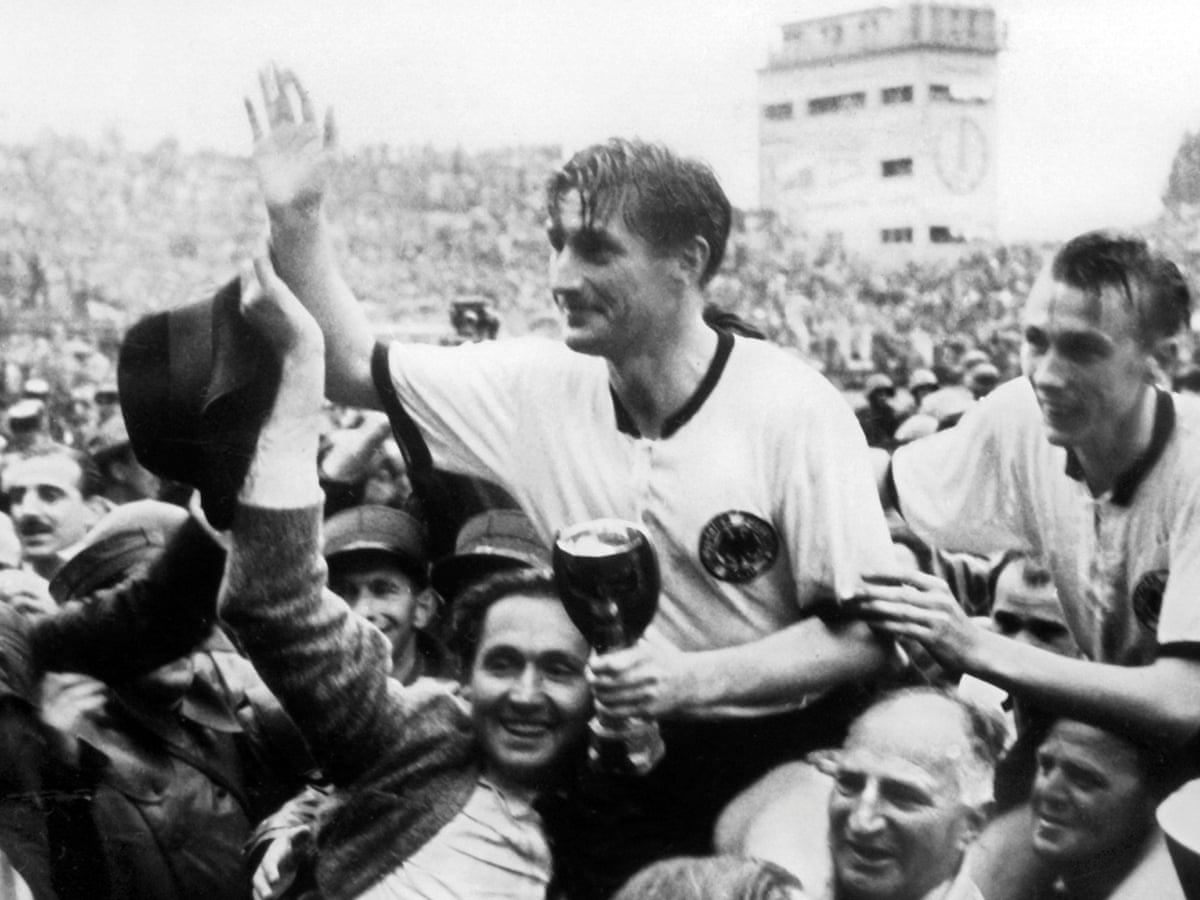
West German Captain Fritz Walter,
with the Jules Rimet Trophy

July 4, 1954: The World Cup Final is held at the Wankdorf Stadium in Bern (sometimes written as "Berne"), the capital of Switzerland. Due to the cancellations of the tournament for 1942 and 1946, and the 1950 edition being held in Brazil, it is the 1st World Cup held in Europe since 1938.

It is also the 1st time the tournament is held in a country where the predominant language is German. Western Switzerland, bordering France, uses French as its main language (about 23 percent of the country's population); some southern and eastern regions, bordering Italy, use Italian (about 8 percent); and a few eastern parts of the country speak a language called Romansh (about 0.5 percent). But most of the country (68 percent) uses German. Germany would eventually host the World Cup in 1974 and 2006, while Austria has never hosted it, although they co-hosted Euro 2008 with Switzerland.

Among the Quarterfinals, played in 104-degree heat in Stade Olympique de la Pointaise in Lausanne, was a match between hosts Switzerland and neighboring Austria. The players' feet were as hot as the weather, and the game ended 7-5 to Austria. It remains the highest-scoring game in World Cup history.

Also among the Quarterfinals was Uruguay eliminating England, 4-2 at Basel. England’s starting lineup included Billy Wright of Wolverhampton Wanderers, Stanley Matthews Blackpool FC, Nat Lofthouse of Bolton Wanderers and Tom Finney Preston North End, each of whom now has a statue outside his stadium; plus Roger Byrne of Manchester United, memorialized outside Old Trafford as one of the victims of the Munich Air Disaster.

Not in England's starting lineup, or even anywhere in its squad, were any players from North London team Arsenal FC, even though Arsenal had won the League the year before, and came close to the Double the year before that. No room on this England squad, apparently, for Cliff Holton, Doug Lishman or Don Roper. Joe Mercer had finished the season with an injury, so he wouldn't have been available, anyway. And, of course, Alex Forbes and Jimmy Logie couldn't play for England, being Scots; while Walley Barnes and Jack Kelsey were Welsh.

Fittingly, West Germany were one of the teams in the Final. Among the punishments for its predecessor state, Nazi Germany, after World War II was a slower integration into postwar Europe. The Federal Republic of Germany, a.k.a. West Germany, allied with the Western democracies; while the German Democratic Republic (which was neither democratic nor a republic), a.k.a. East Germany, were controlled by the Soviet Union. Both were formed in 1949, and neither was admitted to FIFA, the governing body for world soccer, in time for qualifying for the 1950 World Cup.

Josef "Sepp" Herberger had managed the national team, known in Germany as Die Mannschaft, from 1936 until its 1942 disbanding due to the war. In spite of having been a member of the Nazi Party, there seemed to be no one more qualified to rebuild the team than he. He built the team around players from 1. FC Kaiserslautern, in the western Rhineland, including star forward Fritz Walter (who was named national team Captain) and his brother Ottmar Walter.
Sepp Herberger

In the Group Stage, they beat Turkey, but lost to Hungary, forcing a playoff with Turkey to get into the knockout stage, which West Germany won. They beat Yugoslavia in the Quarterfinal and Austria in the Semifinal.

No one was surprised that they lost to Hungary, or even that the score was 8-3. Known as "the Golden Team," "the Magnificent Magyars" and "the Magical Magyars," from 1950 to 1956, they used an early form of what the Netherlands would later call "Total Football" to put up a record of 58 wins, 10 draws, and only 1 loss.

Manager Gusztáv Sebes built the team around forwards Ferenc Puskás, Sándor Kocsis and Nándor Hidegkuti; midfielders Zoltán Czibor and József Bozsik, and goalkeeper Gyula Grosics. Hidegkuti played his "club football" for MTK Hunagaria (now MTK Budapest), while the rest played for Budapest Honvéd.

There was no European Championship tournament for them to compete in until 1960. But they won the Gold Medal at the 1952 Olympics in Helsinki, Finland. In 1953, they won the Central European International Cup, competing against Austria, Czechoslovakia, Italy and Switzerland.

Later that year, they became the 1st team from outside the British Isles to defeat England on English soil, 6-3 in front of 105,000 stunned spectators at London's Wembley Stadium. A rematch in Budapest the next year was even less of a contest, a 7-1 loss that is still the heaviest that England's national team have ever faced. Puskás, known as the Galloping Major for his service in the Hungarian Army, was now considered the best player in the world.
Ferenc Puskás

Hungary beat South Korea and West Germany in the Group Stage, to top their group. However, in the West Germany game, Puskás was kicked in the ankle by Germany centerback Werner Liebrich, and sustained a hairline fracture. It didn't seem to matter much, as Hungary then beat both 1950 Finalists: Brazil in the Quarterfinal, and defending Champions Uruguay in the Semifinal. They were heavy favorites for the Final against the Germans, especially after it was announced that Puskás was ready to play.

But the night before the Final, a village fair took place in front of the hotel that lasted until the early morning hours, and disrupted the players' sleep. By contrast, the German team resided in the tranquil lake town of Spiez, where it was unaffected from such disturbances. The Spirit of Spiez became proverbial in Germany for describing the team's morale and comradeship.

West Germany came back quickly. In the 10th minute, Fritz Walter fired a shot that was deflected by midfielder József Zakariás, but it went right to Max Morlock, a forward from 1. FC Nürnberg (Nuremberg), who closed Die Mannschaft to within 2-1. In the 18th minute, Helmut Rahn of Rot Weiss Essen (Red and White, of Essen) tied the game.

In the 23rd minute, Hidegkuti nearly scored, but German goalkeeper Toni Turek, of Fortuna Düsseldorf, made a spectacular save. Four minutes later, Hidegkuti hit the goalpost. Early in the 2nd half, Turek made a save on Puskás, and then Kocsis hit the crossbar. In the 72nd minute, Grosics made a great save on Rahn.

In the 84th minute, Rahn pretended to pass to Ottmar Walter, then fired past Grosics. Herbert Zimmerman, calling the game for German national radio, yelled, "Aus dem Hintergrund müßte Rahn schießen. Rahn schießt! Tor! Tor! Tor! Tor!" (Meaning, "Rahn should shoot from deep. Rahn shoots! Goal! Goal! Goal! Goal!" "Tor" can also mean "gate": The native name for the Brandenburg Gate in Berlin is Brandenberger Tor.)
Helmut Rahn
After 8 seconds of letting the roar of the crowd tell the story, Zimmerman resumed: "Tor für Deutschland! Drei zu zwei führt Deutschland. Halten Sie mich für verrückt, halten Sie mich für übergeschnappt!" (Goal for Germany! Germany lead 3-2. Call me mad, call me crazy!" Shades of 3 years earlier, in New York, when Russ Hodges broadcast, "The Giants win the Pennant!")
But the game was not over, and Hungary did not give up. Just 2 minutes later, Puskás appeared to have tied the game when he converted a pass from forward Mihály Tóth. But the goal was controversially ruled offside. In the 90th and last minute of regular time, Turek made one more save, on Czibor. 
West Germany won, 3-2. I mentioned that the Magnificent Magyars only lost 1 game from 1950 to 1956. This was it, at the worst possible time.

It became known as "The Miracle of Bern." In his book Tor! The Story of German Football -- named in part for Zimmerman's call -- Uli Hesse wrote that it was the 1st time since the end of the war that the German people were allowed to feel good about themselves and their country again, and helped to make Die Mannschaft a vital part of German cultural life.

West Germany reached the Final again in 1966, losing to England; in 1974, beating the Netherlands on home soil; in 1982, losing to Italy; in 1986, losing to Argentina; and in 1990, beating Argentina. Shortly after that World Cup, the country was reunified. A united Germany reached the Final in 2002, losing to Brazil; hosted the tournament in 2006, but lost a Semifinal to Italy; and beat Argentina in the Final in 2014, for their 4th World Cup win, matching Italy's total, and trailing only Brazil's 5.

Hungary, however, have never been a soccer power again. The Soviets' crushing of the 1956 Revolution shattered the national team, forcing its players to play in other countries. They reached the Quarterfinals of the World Cup in 1962 and '66, but haven't done even that well since. They last qualified for the tournament in 1986.

The Wankdorf Stadium, or Wankdorfstadion, was built in the Bern neighborhood of Wankdorf in 1925, as the home of the team BSC Young Boys. It later hosted the 1961 European Cup Final, where Benfica beat Barcelona. It was torn down in 2001, and was replaced by a new stadium of the same name on the same site in 2008.
The Wankdorf Stadion

Kaiserslautern's home was renamed Fritz-Walter-Stadion in 1985, and was one of the host venues for the 2006 World Cup. Walter died in 2002. That year, Budapest's Népstadion (People's Stadium), which had opened as a showcase for Hungary's national team in 1953, at the height of its powers, was renamed Puskás Ferenc Stadion. (Hungarian naming convention puts the surname first). Puskás died in 2006. In 2016, the stadium named for him was demolished, and replaced with the new Puskás Aréna on the same site in 2019.

Jenő Buzánszky was the last surviving player from Hungary's "Magnificent Magyars," living until 2015. Horst Eckel was the last surviving player from the West German team that won, living until 2021.

UPDATE: An article for ESPN.com, published after the 2026 World Cup, ranking all 23 tournaments, rated this one tied for 8th, suggesting that, after the struggles of the pre-World War II tournaments and the difficulties of the 1950 edition, the World Cup had finally become what it was supposed to be.

*

July 4, 1954 was a Sunday. These baseball games were played that day, including 2 doubleheaders, which had usually been customary for the 4th of July:

* The New York Yankees beat the Washington Senators, 3-0 at Yankee Stadium. Bob Grim pitched a 3-hit shutout, and would be named that season's American League Rookie of the Year. He later converted to a relief pitcher, much like a later Yankee Rookie of the Year, Dave Righetti. Mickey Mantle went 0-for-4, and no home runs were hit. Yogi Berra singled home 2 runs in the bottom of the 6th inning, and Andy Carey doubled one home in the 7th.

* A doubleheader was split at the Polo Grounds. The New York Giants won the opener, 9-2. The Pittsburgh Pirates won the nightcap, 7-6. Willie Mays went 4-for-10 over the 2 games.

* The Brooklyn Dodgers beat the Philadelphia Phillies, 5-3 at Connie Mack Stadium in Philadelphia. Jackie Robinson did not play. In the top of the 10th inning, the Dodgers got a triple from Jim Gilliam, a triple by Walt "Moose" Moryn, an intentional walk to Duke Snider, a double by Gil Hodges, and a double by Carl Furillo, his 3rd hit of the game, to score 4 runs. Stan Lopata hit a 2-run home run in the bottom of the 10th, but Carl Erskine hung on for the win, outpitching Robin Roberts.

* The Boston Red Sox beat the Philadelphia Athletics, 8-0 at Fenway Park in Boston. Leo Kiely allowed 8 hits, but kept the shutout. Ted Williams went 1-for-4 with a walk.

* The Baltimore Orioles beat the Detroit Tigers, 3-1 at Memorial Stadium in Baltimore.

* The Cleveland Indians beat the Chicago White Sox, 2-1 at Cleveland Municipal Stadium.

* A doubleheader between arch-rivals was split at Wrigley Field in Chicago. The Chicago Cubs won the 1st game, 4-2. The St. Louis Cardinals won the 2nd game, 7-0, with Royce Lint pitching an 9-hit shutout. Stan Musial went 3-for-10 with an RBI. Ralph Kiner, then playing for the Cubs, went 3-for-7. Ernie Banks, in his 1st full season in the white major leagues, went 4-for-6 with an RBI.

* And the Cincinnati Redlegs -- in the 1st of 5 seasons with that name, before dropping the stupid anti-Communist hysteria and switching back to "Reds" -- beat the Milwaukee Braves, 4-3 at Milwaukee County Stadium. Rookie Hank Aaron went 0-for-4 for the Braves.

Thursday, June 30, 2022

June 30, 1936: Emperor Haile Selassie's Plea Falls On Deaf Ears

June 30, 1936: Emperor Haile Selassie of Ethiopia speaks before the League of Nations, at the Palais Wilson on the shore of Lake Geneva in Switzerland.

Ethiopia was one of the few independent nations in Africa when Italy invaded on October 2, 1935, in fascist dictator Benito Mussolini's bid to create a new Roman Empire. At the end of the year, for his resistance, Time magazine named Haile Selassie its Man of the Year. On May 7, 1936, Italy completed its annexation of the country. Two days later, Mussolini declared the colony of Italian East Africa, also including Eritrea and Somalia.

Like all who had sat on his throne, Haile Selassie claimed to trace his lineage back to the affair between Solomon, one of the Biblical Kings of Israel, and the Queen of Sheba, known in modern Ethiopia as Makeda. But now, the man known to his people as King of Kings, Lord of Lords, Elect of God, and Lion of Judah had been overthrown, and had to flee his country.

The League of Nations had been founded after World War I, by President Woodrow Wilson (hence, the name of the its assembly hall), in the hopes of preventing small conflicts, especially to prevent them from becoming bigger conflicts, as the fight between Serbia and the Austrian Empire in July 1914 snowballed into World War I.

But America's U.S. Senate refused to ratify the Treaty of Versailles, which had created the League. Thus, America, and the large moral authority it had gained from winning the war, were not in the league. Therefore, the League was considerably weaker than it could have been.

Still, Haile Selassie believed that, if he told the League what the Italians were doing in his country, they would respond, and help. Although fluent in French, the League's working language, the Emperor delivered his speech in his native language, Amharic, translated for the Assembly. He said:

I, Haile Selassie I, Emperor of Ethiopia, am here today to claim that justice which is due to my people, and the assistance promised to it eight months ago, when fifty nations asserted that aggression had been committed in violation of international treaties.
There is no precedent for a Head of State himself speaking in this assembly. But there is also no precedent for a people being victim of such injustice and being at present threatened by abandonment to its aggressor. Also, there has never before been an example of any Government proceeding to the systematic extermination of a nation by barbarous means, in violation of the most solemn promises made by the nations of the earth that there should not be used against innocent human beings the terrible poison of harmful gases.
It is to defend a people struggling for its age-old independence that the head of the Ethiopian Empire has come to Geneva to fulfil this supreme duty, after having himself fought at the head of his armies...
Apart from the Kingdom of the Lord there is not on this earth any nation that is superior to any other. Should it happen that a strong Government finds it may with impunity destroy a weak people, then the hour strikes for that weak people to appeal to the League of Nations to give its judgment in all freedom. God and history will remember your judgment...
On behalf of the Ethiopian people, a member of the League of Nations, I request the Assembly to take all measures proper to ensure respect for the Covenant. I renew my protest against the violations of treaties of which the Ethiopian people has been the victim. I declare in the face of the whole world that the Emperor, the Government and the people of Ethiopia will not bow before force; that they maintain their claims that they will use all means in their power to ensure the triumph of right and the respect of the Covenant...
It is us today. It will be you tomorrow...
I ask the fifty-two nations, who have given the Ethiopian people a promise to help them in their resistance to the aggressor, what are they willing to do for Ethiopia? And the great Powers who have promised the guarantee of collective security to small States on whom weighs the threat that they may one day suffer the fate of Ethiopia, I ask what measures do you intend to take?
Representatives of the World: I have come to Geneva to discharge in your midst the most painful of the duties of the head of a State. What reply shall I have to take back to my people?
The League's reply was pathetic: Only partial and ineffective sanctions on Italy. It is often said that the League of Nations effectively collapsed due to its failure to condemn Italy's invasion of Ethiopia. 
He spent his exile in Bath, England. Back in Ethiopia, one of his daughters died in captivity, and his sons-in-law were executed. Another daughter died in childbirth shortly after the restoration.
But the restoration did come. When Britain declared war on Nazi Germany on September 3, 1939, it also declared war on Italy, as part of the same Axis. On January 18, 1941, a combined force of Ethiopian, British Empire, Free France and Free Belgium troops invaded. On May 5, the Italians surrendered, and Haile Selassie entered the capital of Addis Ababa, and addressed his people again.
By that point, the League of Nations had only a skeleton staff. For all intents and purposes, it existed only on paper. In 1946, with the United Nations already operating, the League Assembly voted to dissolve the League.
*
June 30, 1936:  was a Tuesday. These baseball games were played that day:

* The New York Yankees swept a doubleheader from the Boston Red Sox, 10-5 and 6-3 at Yankee Stadium. Lou Gehrig went 3-for-6 with a home run in each game, 3 walks and 4 RBIs. Rookie Joe DiMaggio went 3-for-9 with an RBI. For the Sox, Jimmie Foxx 3-for-7 with 2 walks and 2 RBIs.

* The New York Giants lost to the Boston Bees, 7-6 at National League Park in Boston. This was the 1st season for which the Boston Braves tried to abandon their losing tradition by changing the name of their team and their ballpark, Braves Field. After 5 years, they realized it wasn't working.

* And the St. Louis Cardinals swept a doubleheader from the Pittsburgh Pirates, 2-1 and 4-3 at Forbes Field in Pittsburgh.

Tuesday, May 24, 2022

May 24, 1956: The 1st Eurovision Song Contest

Lys Assia

May 24, 1956: The 1st Eurovision Song Contest is held at Teatro Kursaal in Lugano, Switzerland. It is primarily a radio program at this stage, as few Europeans can afford TV sets. Only 7 countries participated: In alphabetical order, Belgium, France, (West) Germany, Italy, Luxembourg, the Netherlands, and Switzerland.
 
The winner is the Swiss entry, "Refrain," with music by Géo Voumard, lyrics by Émile Gardaz, and sung by Rosa Mina Schärer, under the name Lys Assia. Gardaz died in 2007, Voumard in 2008, Schärer in 2018.

Most Eurovision winners turn out to be forgettable. Indeed, what may be the most famous winner came in 1967, England's entry, "Puppet On a String" by Sandie Shaw. And, presaging American Idol by decades, that wasn't even the most significant entry! A songwriting team from Luxembourg, writing in French, got Greek singer Vicky Leandros to sing their composition, "L'amour est Bleu." It finished 4th. Luxembourg and Leandros won in 1972, with "Après toi."

If you listen to American "oldies" stations, you know "L'amour est Bleu," although you may never have heard its words, in any language: In 1968, French conductor Paul Mauriat would record his orchestra playing it as an instrumental, and use its English title: "Love Is Blue." He hit Number 1 with it.

There was a 4-way tie vote in 1969: Britain, France, Spain and the Netherlands. Sweden won in 1974, with "Waterloo," launching the career of ABBA. Ireland and Sweden have won it the most, 7 times. Britain has won 4 times.

Here are the winners:

Ireland, 7: 1970, 1980, 1987, 1992, 1993, 1994 and 1996.
Sweden, 6: 1974, 1984, 1991, 1999, 2012 and 2015. (UPDATE: They won again in 2023.)
Luxembourg, despite its small size, 5: 1961, 1965, 1972, 1973 and 1983.
France, 4: 1958, 1960, 1962 and 1977.
Britain, 4: 1967, 1976, 1981 and 1997.
Israel, even though it's in Asia, 4: 1978, 1979, 1998 and 2018.
Netherlands, 4: 1957, 1959, 1975 and 2019.
Denmark, 3: 1963, 2000 and 2013.
Norway, 3: 1985, 1995 and 2009.
Italy, 3: 1964, 1990 and 2021.
Ukraine, 3: 2004, 2016 and 2022.
Switzerland, 2: 1956 and 1988. (UPDATE: They won again in 2024.)
Germany, 2: 1982 (as West Germany) and 2010.
Austria, 2: 1966 and 2014. (UPDATE: They won again in 2025.)
Spain, 1: 1968.
Monaco, 1: 1971.
Belgium, 1: 1986.
Estonia, 1: 2001.
Latvia, 1: 2002.
Turkey, even though most of the country is in Asia, 1: 2003.
Greece, 1: 2005.
Finland, 1: 2006.
Serbia, 1: 2007.
Russia, 1: 2008.
Azerbaijan, even though it's in Asia, 1: 2011.
Portugal, 1: 2017.

(UPDATE: Bulgaria was a first-time winner in 2026.)

*

May 24, 1956 was a Thursday. Larry Blackmon, the lead singer of the hip-hop group Cameo, was born.

There were only 2 scores on this day, both in baseball. The New York Yankees beat the Detroit Tigers, 11-4 at Briggs Stadium in Detroit. The ballpark was renamed Tiger Stadium in 1961. Tom Sturdivant was the winning pitcher. It was just another day at the office for Mickey Mantle, as he went 5-for-5, with a home run, a walk, and 3 RBIs. The Bronx Bombers also got home runs from Joe Collins, Eddie Robinson and Andy Carey. Al Kaline went 0-for-3 with a walk.

And the Philadelphia Phillies beat the Brooklyn Dodgers, 6-4 at Connie Mack Stadium in Philadelphia. Robin Roberts outpitched a rookie named Don Drysdale -- and a veteran named Sal Maglie. As the ace of the New York Giants, Maglie was the player Dodger fans had hated the most, but he would turn out to be integral to the Dodgers' National League Pennant win. Roberts got a hit in his own cause. Willie "Puddin' Head" Jones went 3-for-4 with 2 home runs and 4 RBIs. The Dodgers got home runs from Jackie Robinson, Duke Snider and Carl Furillo.

Saturday, February 19, 2022

February 19, 1928: The Magic of Sonja Henie

February 19, 1928: Sonia Henie wins the Gold Medal in Ladies' Figure Skating at the Winter Olympics in St. Moritz, in the Swiss Alps.

"Ladies" may have been a bit of a stretch: She was only 15 years old.

Sonia Henie -- apparently, her entire birth name -- was born on April 8, 1912, in Kristiana, the capital of Norway. The name of the city was changed to Oslo in 1925. Figure skating is an expensive sport to pursue, but her father, Wilhelm Henie was a wealthy furrier.

Just as importantly, he was an athlete, a world cycling champion in 1894, and he encouraged his children, Sonja and her older brother Leif, to take up sports. Sonia did well in tennis, swimming and equestrian events. But skating was where he true talent lay, and after seeing the great Russian ballerina Anna Pavlova perform in London, she tried to pattern her skating style after her. At the 1st Winter Olympics, in Chamonix, France in 1924, she finished 8th -- and she was only 11 years old.

More than any other region, the Alps have hosted the Winter Olympics: France, Chamonix in 1924, Grenoble in 1968, and Albertville in 1992; Switzerland, St. Moritz in 1928 and 1948; Germany, Garmisch-Partenkirchen in 1936; Italy, Cortina d'Ampezzo in 1956 and Turin in 2006; and Austria, Innsbruck in 1964 and 1976. Indeed, except for Lake Placid, New York, in the U.S. in 1932, the Winter Games wouldn't be held outside the Alps until 1952, when they were held in Henie's hometown of Oslo.

For the 1928 Winter Games, the Opening Ceremony, on February 11, was hit by a blizzard. Then the opposite happened: The weather quickly warmed up, causing lots of problems, as most events were still outdoors.

Out of a possible 14 events, the U.S. won 2 Gold Medals: In the now-defunct event of the 5-man bobsled, and in the later-discontinued, since-restored event of skeleton, won by Jennison Heaton. In each case, Americans also won the Silver Medal. Switzerland won just 1 medal, a Bronze, which remains the worst performance ever by a host nation at an Olympic Games, Summer or Winter. Norway led the way with 15 Medals, 6 of them Gold, including Henie's.

Henie would also win in 1932, in Lake Placid; and in 1936, in Garmisch-Partenkirchen. Later in 1936, she starred in the film One In a Million, and made a living in professional skating shows and, for all intents and purposes, playing herself in movies, for which she was paid as much as anybody in Hollywood. The surviving footage shows that her moves would now be considered rather basic; but, at the time, nobody had ever seen anything like it.
j
As a European celebrity of the 1930s, she made the acquaintance of the various national leaders of the time, including the Chancellor of Nazi Germany, Adolf Hitler, who was rather taken with her, and once gave her a photograph with an autograph and a long inscription. In spite of this, and in spite of her match for the Nordic physical ideal, there is no evidence that she ever accepted the Nazi philosophy.

She married 3 times, but had no children. Her 1st husband was Dan Topping, but she divorced him shortly after he became a part-owner of baseball's New York Yankees. Her 3rd husband was a Norwegian shipping magnate, Niels Onstad, and, together, they built a substantial art collection. She died of leukemia on October 12, 1969, only 57 years old.

*

February 19, 1928 was a Sunday. Baseball and football were out of season. Professional basketball barely existed. There were 2 games in the NHL. The Boston Bruins beat the New York Rangers, 2-0 at the new building that would eventually be known as "the old Madison Square Garden." And the Chicago Black Hawks beat the Detroit Cougars, the team that would become known as the Detroit Red Wings, 2-1 at the Olympia Stadium in Detroit.

December 31, 1999 & January 1, 2000: The Millennium

December 31, 1999:  The Millennium arrives. The people of planet Earth survived. At a terrible cost. But we hadn't destroyed ourselves. ...