Showing posts with label scotland. Show all posts

Friday, December 30, 2022

December 30, 1899: Ibrox Stadium Opens

December 30, 1899: Ibrox Park opens in the Ibrox neighborhood, on the West Side of Glasgow, Scotland. Home to Rangers Football Club, it hosted its 1st game 2 days later, on January 1, 1900, against the team that had already become their "Old Firm" arch-rivals, Celtic F.C., who won, 3-2.

This was the 2nd Ibrox Park, built just to the west of the 1st one, which Rangers had called home since 1887. While playing there, Rangers had won the Scottish Football League in 1891 and 1899. After moving to the 2nd Ibrox, they raised their title total to a national record 54: Adding them in 1900, '01, '02, '11, '12, '13, '18, '20, '21, '23, '24, '25, '27, '28, '29, '30, '31, '33, '34, '35, '37, '39, '47, '49, '50, '53, '56, '57, '59, '61, '63, '64, '75, '76, '78, '87, '89, '90, '91, '92, '93, '94, '95, '96, '97, '99, 2000, '03, '05, '09, '10 and '11.

(Unlike England, Scotland did not suspend league "football" for the duration of World War I. They did, however, suspend it for the duration of World War II.)

The stadium has been the site of 3 fatal disasters. On April 5, 1902, shortly after kickoff of a match between the national teams of Scotland and England, a section of terracing collapsed, causing 125 people to fall 50 feet to the ground below, killing 25 of them. Repairs were made, and also an expansion, raising capacity from the original 40,000 to 63,000.

The stadium was expanded again in 1929. On January 2, 1939 -- it has been tradition for the "Old Firm" rivals to play on New Year's Day, or on January 2 if January 1 falls on a Sunday -- Rangers beat Celtic, 2-1, in front of 118,567. This remains the largest attendance for a football match in any league in the United Kingdom.

The stadium got lights in 1953. Safety legislation cut capacity to about 80,000. But Ibrox Park had the worst fan safety record in Britain. Two fans died on September 16, 1961, when a barrier collapsed on Stairway 13, resulting in a crush. Stairway 13 was a popular exit from the East Terracing due to its proximity to the Copland Road subway station and parking areas for the Rangers supporters' coaches, but it was often overcrowded and very steep.

After this incident, Rangers installed safety measures, but further injuries were sustained in crushes on Stairway 13 in both 1967 and 1969. On October 23, 1968, the main stand was hit by fire. Just 7 months later, there was another fire, which destroyed more than 200 seats behind the directors box.

But when people speak of "The Ibrox Disaster," they usually mean what happened after the Old Firm game on January 2, 1971, when 66 people died of asphyxiation, due to another crush on Stairway 13. The game itself ended in a 1–1 draw, with Colin Stein scoring a late equalizer for Rangers. This led to a widespread belief that the crush had been caused by fans who had left the game early, but had turned back when they heard the roar that greeted the Rangers goal.

A public inquiry discounted this initial story. It established that the crowd had been travelling in the same direction when the crush happened, with it perhaps being precipitated by some bending over to pick up items that had been discarded during the goal celebrations. The downward force of the crowd leaving the stadium meant that when people started to fall there was no means of preventing a crush.

Adjustments made after the passage of the Safety of Sports Grounds Act 1975 cut the capacity of Ibrox to 44,000 by 1981. The Taylor Report, which applied to Scotland was well as England, led to a total rebuilding of each stand, which was completed in 1997, at which point Ibrox Park was officially renamed Ibrox Stadium. Capacity is now 50,817, all-seater.

In 2012, financial issues forced the liquidation of Rangers Football Club, ending them after 140 years. A new organization was founded, and a team of the same name took up residence at Ibrox, climbing up the Scottish "football pyramid." In 2021, they won the Scottish Premier League. Rangers fans count this as a 55th title. The rest of Scotland, who treat Rangers the way Englishmen treat Manchester United, and Americans treat the New York Yankees, do not.

*

December 30, 1899 was a Saturday. Among the games in English soccer, Leicester Fosse and Woolwich Arsenal played to a 0-0 draw at Filbert Street in Leicester, in the East Midlands. Woolwich Arsenal moved from South London to North London in 1913, becoming simply Arsenal. Leicester Fosse became Leicester City in 1919.

But in North America, there were no scores on this historic day.

Saturday, December 24, 2022

December 25, 1875: The Death of Young Tom Morris

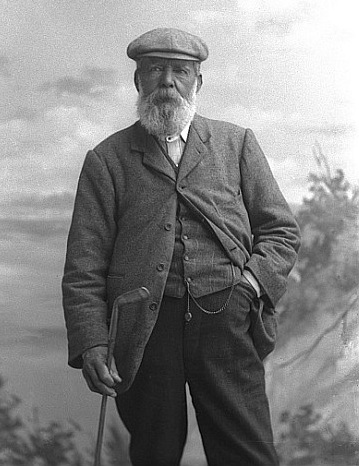
Young Tom Morris

December 25, 1875: It is not a merry Christmas in St. Andrews, Fife, Scotland. "Young Tom" Morris, an early golf legend, and the son of an early golf legend known as "Old Tom" Morris, dies there. He is only 24 years old. He had recently played a match in terrible weather, and probably caught pneumonia.
Old Tom Morris

Although it would be a Scotsman, Alexander Fleming, who discovered penicillin, it would be decades before it could have saved Young Tom, who had also recently lost his wife and child in childbirth, and, between his grief and his illness, may have lost the will to live.

Thomas Mitchell Morris, born in 1821 in St. Andrews, lived on until 1908, as "The Grand Old Man of Golf." His son, named only Thomas Morris, was born in 1851 in St. Andrews. That town, home of the Royal and Ancient Golf Club, and the site of 30 British Opens (but never, through 2022, a Ryder Cup), is still "the Home of Golf," partly because of the legacy of the Tom Morrises.

NOTE: For a long time, with this project, I resisted putting in references to golf, because of the kind of people who tend to play it. I finally caved in, although I haven't included as many references as I would if it were a real sport, which it is not.

*

December 25, 1875 was a Saturday. There were no American sports on this day: Although both football and basketball would come to be associated with Christmas Day, the former barely existed, and its last game of the season was played on December 4; and the latter wasn't even invented for another 16 years.

But there was soccer in Britain, including in the Morrises' native Scotland. The 1st Edinburgh Derby is played at a park known as The Meadows. Heart of Midlothian defeat Hibernian 1-0.

This is the oldest remaining senior "derby" in the world, older than the "Old Firm" in Glasgow, with similarities: Like Rangers, "Hearts" were founded as an all-Protestant side; while, like Celtic, "Hibs" ("Hibernia" was the Roman Empire's name for Ireland) were founded as a team for Catholic immigrants from Ireland. The colors are also similar: Like Celtic, Hibs wear green and white stripes; while Hearts wear blue, albeit a darker blue than Rangers.
In the modern era, the teams frequently play each other on the day after Christmas, Boxing Day, but not in the 1875 season.

Wednesday, December 21, 2022

December 21, 1988: The Bombing of Pan Am Flight 103

December 21, 1988: Pan Am Flight 103 is blown up over Lockerbie, Scotland. It is one of the most notorious cases of terrorism to date, and remains the deadliest ever to occur in the British Isles.

A Boeing 747, it had taken off from Frankfurt, Germany at 4:19 PM, and stopped over at Heathrow Airport in London at 5:40. At 6:25, it took off again, heading for John F. Kennedy International Airport in New York. After a refueling, it would then have taken off for Detroit, its final stop.

But at 7:03 PM, Greenwich Mean Time -- 2:03, U.S. Eastern Time -- the plane exploded over Lockerbie, about 15 miles northwest of the Scotland-England "border," 74 miles south of Edinburgh, 72 miles southeast of Glasgow, and 341 miles northwest of Central London.

The bombing and crash claimed the lives of all 259 individuals on board the plane, and 11 people on the ground below. The victims were citizens of 21 countries. Of those killed, 190 were United States citizens, making the bombing of Pan Am Flight 103 the deadliest terrorist attack against American civilians prior to September 11, 2001. It remains the deadliest attack in the history of the United Kingdom.

The bombing didn't just kill 270 people. Essentially, it killed Pan American World Airways as well: Already in financial trouble, Pan Am never recovered, and went out of business on December 4, 1991, just under 3 years later.

The bombing hung over the Christmas season in both America and Britain. On December 23, 2 days later, reports surfaced that the U.S. Embassy in Finland received bomb threats against a Pan Am flight. On December 28, 5 days after that, British investigators reported that a bomb in the luggage compartment caused the explosion.

The bombing came 2 1/2 years after President Ronald Reagan retaliated for Libyan terrorist attacks that had killed American soldiers stationed in Europe, by bombing targets in Libya, including a palace owned by dictator Muammar Gaddafi.

Conservatives used to tell me that once Reagan bombed Libya, Gaddafi left Americans alone. He did – until he gave Reagan, who was to leave office a month later due to term limits, something dictators don't officially have, this going-away present.

Arrest warrants were issued for two Libyan nationals in November 1991. After protracted negotiations and United Nations sanctions, on April 5, 1999, Gaddafi handed over the two men for trial at Camp Zeist, the Netherlands. On January 31, 2001, Abdelbaset al-Megrahi, a Libyan intelligence officer, was found guilty of 270 counts of murder in connection with the bombing. He remains the only person ever convicted of involvement. The other man handed over, Lamin Khalifah Fhimah, was found not guilty, and released.

On November 2, 2009, having been diagnosed with cancer, the Scottish government released him on compassionate grounds. He had been in custody for 10 1/2 years, for murdering 270 people. He lived until May 20, 2012.

In 2003, Gaddafi accepted Libya's responsibility for the Lockerbie bombing, and paid over $1 billion dollars in compensation to the families of the victims, a very unusual outcome for a terrorist bombing. He maintained that he had never personally given the order for the attack.

He finally answered for his crime on October 20, 2011. His former Minister of Justice, Mustafa Abdul Jalil, claimed that Gaddafi had personally ordered the attack.

As of December 21, 2022, Lamin Khalifah Fhimah is still alive.

*

December 21, 1988 was a Wednesday. Baseball was out of season. The NFL was in midweek, and there were no college bowl games that day. There were 6 games in the NBA:

* The New Jersey Nets beat the Dallas Mavericks, 122-120 in overtime at the Brendan Byrne Arena at the Meadowlands.

* The Cleveland Cavaliers beat the Boston Celtics, 115-114 at the Boston Garden.

* The Utah Jazz beat the Washington Bullets, 98-82 at the Capital Centre in the Washington suburb of Landover, Maryland.

* The Milwaukee Bucks beat the Charlotte Hornets, 112-100 at the Charlotte Coliseum.

* The Seattle SuperSonics beat the Miami Heat, 109-101 at the Miami Arena.

* And the San Antonio Spurs beat the Sacramento Kings, 125-107 at the HemisFair Arena in San Antonio.

And there were 8 games in the NHL:

* The New York Rangers lost to the Buffalo Sabres, 5-2 at Madison Square Garden.

* The New Jersey Devils and the Winnipeg Jets played to a tie, 5-5 at the Winnipeg Arena.

* The Montreal Canadiens beat their Provincial rivals, the Quebec Nordiques, 6-4 at the Montreal Forum.

* The Boston Bruins beat their fellow New Englanders, the Hartford Whalers, 4-3 at the Hartford Civic Center (now the PeoplesBank Arena).

* The Pittsburgh Penguins beat the Toronto Maple Leafs, 6-1 at Maple Leaf Gardens in Toronto.

* The Washington Capitals beat the Chicago Blackhawks, 4-3 at the Chicago Stadium.

* The Vancouver Canucks beat the Edmonton Oilers, 3-1 at the Northlands Coliseum in Edmonton.

* And The Los Angeles Kings beat the Minnesota North Stars, 8-6 at The Forum outside Los Angeles in Inglewood, California.

Tuesday, November 29, 2022

November 30, 1872: The 1st International Football Match

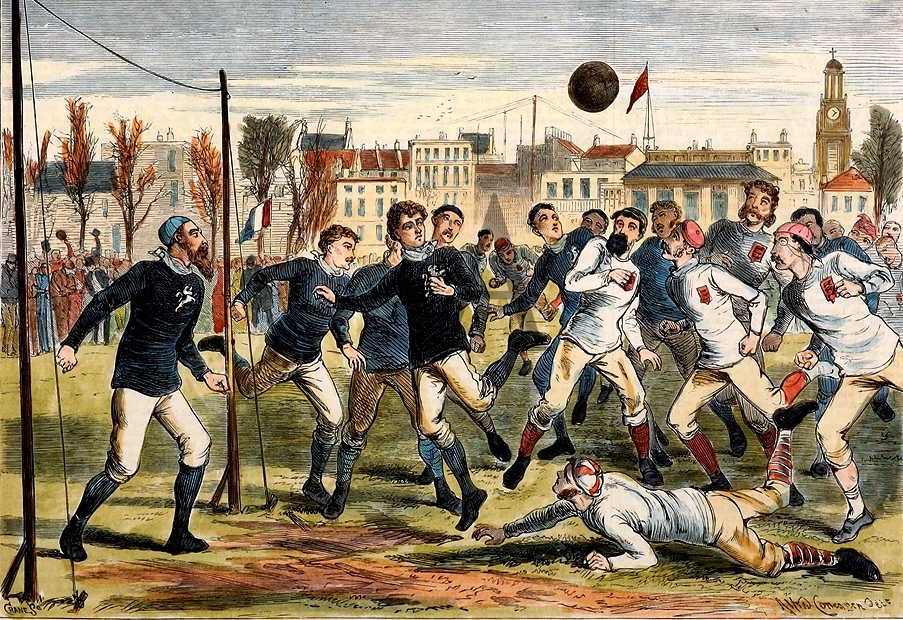
Artist's depiction. England in white, Scotland in blue.

November 30, 1872: For the 1st time, soccer teams representing the best players in their respective countries play each other.

As comedian Jason Sudeikis asked, when introducing the character of Ted Lasso, an American football coach who'd gotten a job coaching an English "football" (soccer) team, "How many countries are there in this country?" By "this country," he meant the United Kingdom of Great Britain and Northern Ireland. The answer is four: England, Scotland, Wales and Northern Ireland -- with the Republic of Ireland, since 1921, being its own nation, not in the United Kingdom.

Charles Alcock, a soccer and cricket star of the era, had organized the 1st FA Cup in England the preceding year, and had also organized matches between teams representing the football associations of both his native England and Scotland. But these were matches between English players and Scottish players for teams based in and around London, and were not what would now be recognized as "full internationals."
Charles Alcock

So Alcock proposed a match between the truly best players from each country. It was set for November 30, 1872, at Hamilton Crescent, the home ground of the West of Scotland Cricket Club, in Glasgow.

The England team wore white caps, white shirts, white shorts, and blue socks:

* Goalkeeper: Robert Barker, of Wouldham, Kent, and Watford-based club Hertfordshire Rangers.
* Fullback: Harwood Greenhalgh, of Mansfield, Nottinghamshire, and Notts County.
* Halfback: Reginald Welch, of Kensington, West London, and London team Wanderers. He was the only one of these players to have also played in the 1st FA Cup Final, won by Wanderers 8 months earlier.
* Forward: Frederick Maddison, of Westminster, London, and Oxford University.
* Forward: William Maynard, of London, and 1st Surrey Rifles F.C.
* Forward: John Brockbank, of Whitehaven, Cumberland, and Cambridge University.
* Forward: Charles Clegg, of Sheffield, Yorkshire, and Sheffield Wednesday.
* Forward: Arnold Kirke Smith, also of Sheffield, and Oxford University.
* Forward and Captain: Cuthbert Ottaway, of Dover, Kent, and Oxford University. He was named Captain because Alcock was injured and unable to play. But Alcock did select every player on the England squad.
* Forward: Charles Chenery, of Lambourne, Berkshire, and the original Crystal Palace F.C. of South London (not the current team of that name).
* Forward: Charles Morice, of London, and Harrow Chequers.

Ottaway died of tuberculosis in 1878, only 27 years old. He remains the only Englishman to represent a university in 5 different sports. Welch lived until 1939.

The Scotland team wore red cowls, navy blue shirts (which would become traditional for them), white shorts, and socks of navy and white stripes, and was represented by the top Scottish club team of the time, Queen's Park of Glasgow.

Scotland captain Robert Gardner, an organizer in Scottish sports on the same level that Alcock was for England, attempted to gain the services of the top two Scottish players from the London area, who had both played in the 1872 FA Cup Final: Arthur Kinnaird of Wanderers and Henry Renny-Tailyour of Royal Engineers. As it turned out, both men were unavailable. Here's the team that Gardner did select, starting with himself:

* Goalkeeper: Robert Gardner, of Glasgow. He was described years later as the best goalkeeper in the world, although, given that England and Scotland were pretty much the only countries then playing the sport, that doesn't say much.
* Fullback: William Ker, of the Scottish capital of Edinburgh.
* Fullback: Joseph Taylor, of Glasgow.
* Halfback: James Thomson, of Annan, Dumfries.
* Halfback: James Smith, of Aberdeen.
* Forward: Robert Smith, of Aberdeen.
* Forward: Robert Leckie, of Killearn, Stirlingshire.
* Forward: Alex Rhind, of Aberdeen.
* Forward: Billy MacKinnon, of Glasgow, described as "a brilliant dribbling artist," perhaps the first player to use the overhead, or what became known as the "bicycle," kick.
* Forward: Jerry Weir, of Glasgow.
* Forward: David Wotherspoon, of Hamilton, South Lanarkshire.
Robert Gardner

James Smith died in 1876, only 32, from what's listed only as "a long illness," although he was listed as having played for South London team South Norwood in that calendar year. Weir died in 1887, of typhoid fever. Gardner also died in 1887, just short of turning 40. Leckie also died in 1887, just after turning 40. Taylor died in 1888, only 37. I cannot find a cause of death for any of them. MacKinnon was the last survivor of the game, living until 1942.

The referee was William Keay, a Scot. Given the tenor of the times, when athletes were supposed to conduct themselves as "sporting" and "gentlemen," I surmise that he must have already had a reputation for fairness that led to him being acceptable to Captain Ottaway as well as to Captain Gardner.

The game was attended by 4,000 people, and the same price of admission was charged as for the FA Cup Final: One shilling. In 2022 British money, that's about £24.10. In U.S. money, about $31.70. A more than reasonable price for such historic events.

The match was scheduled to kick off at 2:00. A delay meant that it got underway at 2:20. The field, or pitch, was a bit muddy, having been pelted with the infamous Scottish rain for 3 days.

The Scotsman, a national newspaper still in business today, wrote, "During the first half of the game the English team did not work so well together, but in the second half they left nothing to be desired in this respect." The Scots had a goal disallowed, because the umpire decided that the ball did not clear the tape that was used to represent a crossbar.

At halftime, as was traditional at the time, the teams rotated their goalkeeping duties. England put Maynard in goal, and moved Barker to Maynard's place on the forward line. Gardner was moved into Robert Smith's place, and Smith moved into goal.

England never had a serious attempt on goal. Scotland had one more, late in the game, when Leckie launched a shot that landed on top of the tape. Final score: England 0, Scotland 0.

The Aberdeen Journal wrote, "It was allowed to be the best game ever seen in Scotland." A sports-themed magazine titled The Field wrote, "The match was in every sense a signal success as the play was throughout as spirited and as pleasant as can possibly be imagined."

Really? All this from a game that ended scoreless? Well, deep into the 20th Century, Gianni Brera, considered Italy's greatest sportswriter, wrote that the ideal soccer game would end 0-0. Even today, "purists" -- the kind of people who, if they are baseball fans, prefer "pitchers' duels" to "slugfests" -- would agree.

A return match was played on March 8, 1873, at the Kennington Oval in South London. This time, there was scoring, and lots of it. William Kenyon-Slaney of England set the tone by scoring in only the 2nd minute, and England beat Scotland, 4-2.

Scotland gained their 1st win over England in 1874. They achieved celebrated wins over England in 1928, at Wembley Stadium in London, giving their side the name "The Wembley Wizards"; and in 1967, when a team led by Manchester United's Denis Law beat essentially the same England team that had won the World Cup the year before, winning the British Home Championship and becoming "Wembley Wizards II."

These 2 countries have played each other more often than any other. As of November 30, 2022, England have won 48 matches, to Scotland's 41, with 26 draws. However, a long decline of Scottish football means that Scotland have not beaten England in the sport since 1999 (though that win was at Wembley), and only that once since 1985.

UPDATE: The teams played again on September 12, 2023, at Hampden Park in Glasgow, Scotland's national stadium. England won, 3-1, raising their lead in the series to 49-41.

*

November 30, 1872 was a Saturday. In North American sports, baseball season was over, basketball hadn't yet been invented, hockey barely was, and while there was college football as Americans understood that term, the season had already ended. So there were no other scores on this historic day.

But there was a notable person born on this day: John McCrae, the Canadian physician and poet who commemorated the dead of World War I in his 1915 poem "In Flanders Fields," and would join them in 1918.

Sunday, October 30, 2022

October 31, 1903: Hampden Park Opens

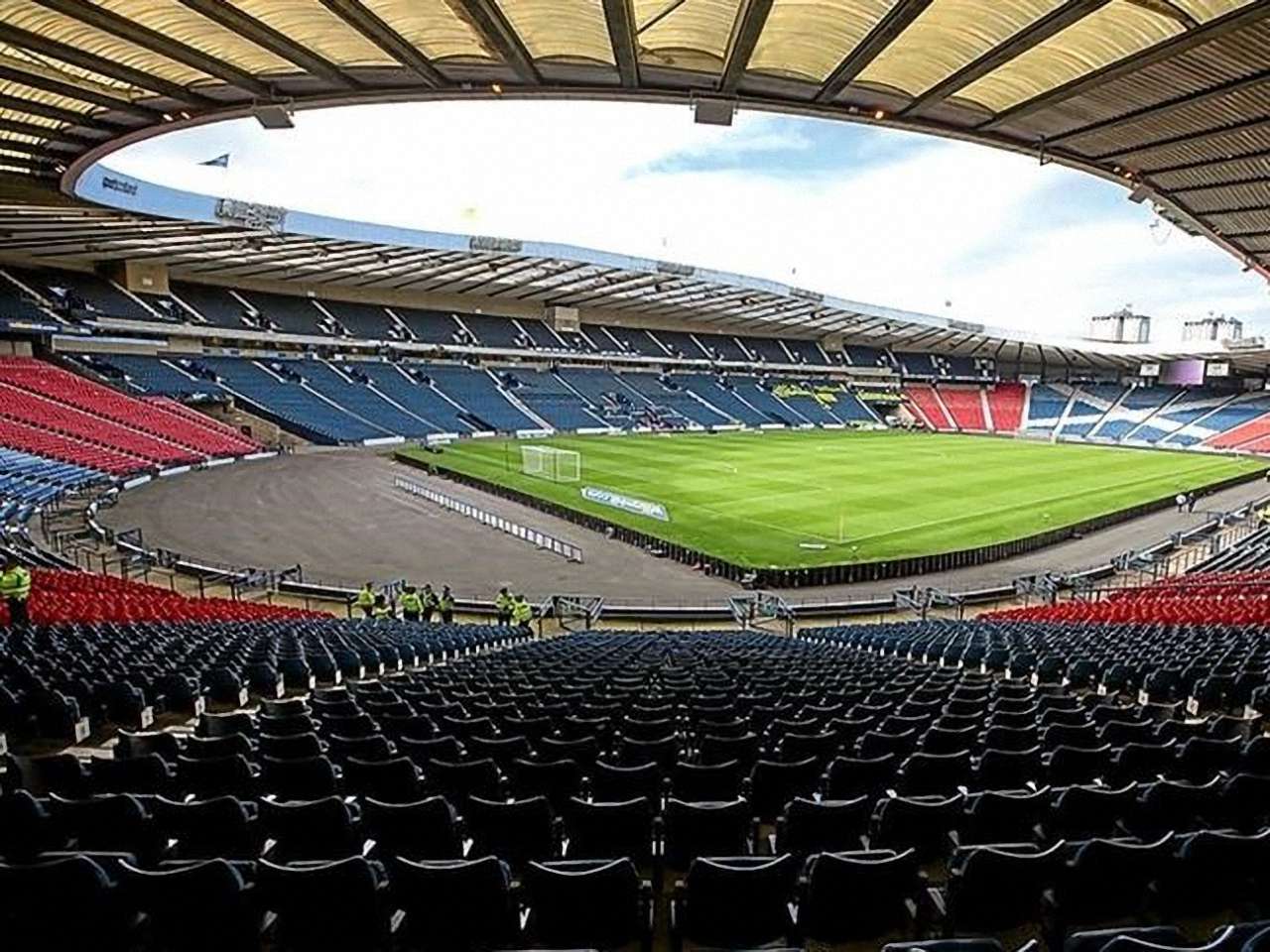
October 31, 1903: Hampden Park opens in Glasgow, and becomes Scotland's national stadium. The previous facility with the name had been home to Queen's Park Football Club, the 1st professional sports team in Scotland, since 1873.

Queen's Park have played on the current site since 1903, the Scottish Cup Final has been held there since 1904, the national team has used it as their main home since 1906, and the Scottish Claymores of NFL Europe played there from 1998 to 2004.

The east and north stands of the stadium were redeveloped as all-seater in 1994, in time for Glasgow team Celtic to use Hampden while their own Celtic Park was redeveloped in the 1994-95 season. The rest of the stadium was upgraded by 1999. A record crowd of 149,415 saw a Scotland vs. England game in 1937, but the capacity is now 51,866.
Hampden hosted the Final of the European Cup in 1960 (Real Madrid beating Eintracht Frankfurt), 1976 (Bayern Munich beating Saint-Étienne), and 2002 (by which point the tournament had been renamed the UEFA Champions League, with Real Madrid beating Bayer Leverkusen). It was used as a venue for Euro 2020 (delayed until 2021 due to the COVID pandemic).

*

October 31, 1903 was a Saturday. Baseball season was over. Basketball barely existed, and hockey hadn't yet turned professional. These other noteworthy games were played in college football:

* The universities of Michigan and Minnesota played to a 6-6 tie at Northrop Field in Minneapolis. This led to the rivalry known as "The Little Brown Jug." I have a separate entry for that event.

* The game that was supposed to be played between Indiana University and Purdue University was canceled, due to the Purdue Wreck. I have an entry for that event as well.

* Army beat Vermont, 32-0 on The Plain in West Point, New York.

* Penn State beat Navy, 17-0 at Worden Field in Annapolis, Maryland.

* Yale beat Columbia, 25-0 at the Polo Grounds.

* Harvard beat the Carlisle Indian School, 12-11 at Soldier's Field in Boston. Jim Thorpe was too young to play on the Carlisle varsity, but they almost didn't need him. Two weeks later, on November 14, Harvard Stadium opened, and Harvard lost to Dartmouth. They still play there today.

* The University of Pennsylvania beat Bucknell, 47-6 at Franklin Field in Philadelphia. A new stadium by that name would be built on the same site in 1922.

* Lafayette beat New York University, 8-6 at Ohio Field in The Bronx.

* Princeton beat Cornell, 44-0 at University Field in Princeton, New Jersey.

* And Rutgers beat Stevens Institute, 36-6 at Neilson Field in New Brunswick, New Jersey.

Monday, October 17, 2022

October 17, 1987: The Old Firm's "Shame Game"

October 17, 1987: What might be the nastiest match in the history of what might be the world's nastiest sports rivalry takes place. It became known as "The Shame Game."

Rangers Football Club was founded in 1872, as a soccer team for the Protestant citizens of Glasgow, Scotland. Their arch-rivals are Celtic Football Club, a team founded in 1888, by and for Irish Catholics living in Glasgow. The former's Ibrox Stadium, on the west side of Glasgow, and the latter's Celtic Park, on the east side, are separated by just 5 miles -- but, Cliché Alert: They might as well be on opposite sides of the world.

These 2 teams -- Rangers, in blue shirts, like their counterparts in New York hockey and Texas baseball; and Celtic, in green and white stripes, giving them the nickname "The Hoops" -- have dominated Scottish soccer, and, together, are known as "The Old Firm."

But perhaps no 2 teams in all of sport hate each other as much, because religion is thrown into the mix. It has made both teams much bigger than they ordinarily would have been. Celtic, not the University of Notre Dame, are the most famous Catholic-themed sports team in the world. They, not Notre Dame and not the Boston Celtics, are the most famous Irish-themed sports team in the world. They can call upon that heritage in ways that Rangers have tried to do with the world's Protestants, but just can't.

This game, at Ibrox, followed a 1-0 Celtic win at Celtic Park on August 29, and was truly nasty. An altercation after 17 minutes between Celtic's Frank McAvennie and Rangers goalkeeper Chris Woods resulted in both being shown red cards, thus getting sent off. Rangers defenders Terry Butcher and Graham Roberts were also involved, with Butcher receiving a yellow card for dissent. This was a time when teams were limited to naming 2 possible substitutes, and didn't use one of them on a goalkeeper, resulting in position players having to occasionally take the goalie's place, as Roberts did in this case.

Andy Walker scored in the 33rd minute, and an own goal by Butcher 2 minutes later made it 2-0 Celtic. Things got worse for Rangers early in the 2nd half, when Butcher received a 2nd yellow card, resulting in a sendoff, and Rangers were down to 9 men. But in the 65th minute, Ally McCoist, perhaps Rangers' greatest player ever, scored to pull them to within 2-1. And in the 90th minute, Richard Gough tied it up.

After the final whistle, Roberts walked over to the fans, and waved his fans, who took this to mean he was "conducting" their singing; songs which included anti-Catholic chants, infuriating the Celtic fans.

Three days later, the Procurator Fiscal ordered a Police enquiry into the events of the match. The Rangers trio of Woods, Butcher and Roberts, and Celtic's McAvennie, were later charged with breach of the peace, and appeared at Court. After a trial lasting several days, Butcher and Woods were convicted and fined, Roberts was found "not proven" (a verdict that exists in courts in Scotland, but not in "England and Wales" or in the United States), and McAvennie was found not guilty.

The teams usually play on or close to New Year's Day, and on January 2, 1988, Celtic won 2-0 at Celtic Park. On March 20, they played at Ibrox again, and Celtic won, 2-1. Celtic won the title with 72 points, 10 ahead of Edinburgh-based Heart of Midlothian (a.k.a. "Hearts"), and 12 ahead of Rangers. Celtic also won the Scottish Cup, beating Dundee United in the Final. Rangers fans had to be content with the Scottish League Cup, including a Final win over Aberdeen.

*

October 17, 1987 was a Saturday. Game 1 of the World Series was played, the 1st Series game ever played indoors. Dan Gladden and Steve Lombardozzi backed Frank Viola with home runs, and the Minnesota Twins beat the St. Louis Cardinals, 10-1 at the Metrodome in Minneapolis.

By a weird turn of events, the song "U Got The Look" peaked at Number 2 n Billboard magazine's Hot 100 singles chart on this date. The song was written and performed by Prince, a Minneapolis native, and contains the line, "Boy versus girl in the World Series of love."

Among the college football games played on the day were these:

* Number 1 Oklahoma beat Kansas State, 59-10 at KSU Stadium (now Bill Snyder Family Stadium) in Manhattan, Kansas. Oklahoma had an undefeated regular season, and won the Big 8 Conference title.

* Number 2 Nebraska beat Number 12 Oklahoma State, 35-0 at Lewis Field (now Boone Pickens Stadium) in Stillwater, Oklahoma. Nebraska were undefeated and ranked Number 1, until November 21, when they lost to Number 2 Oklahoma, costing them the Big 8 title and a shot at the National Championship. They were invited to the Fiesta Bowl, anyway.

* Number 3 University of Miami had the week off. They were then an independent, and thus ineligible for any Conference Championship. The season before, they had gone into the Fiesta Bowl at Number 1, but lost the National Championship to Number 2 Penn State. This time, they again went undefeated in the regular season, were ranked Number 2, played in the Orange Bowl, at their home venue, the Orange Bowl stadium, and beat Number 1 Oklahoma to win the National Championship.

* Number 4 Florida State beat the University of Louisville, 32-9 at Doak Campbell Stadium in Tallahassee, Florida. Florida State were then an independent, and thus ineligible for any Conference Championship. Two weeks earlier, they had lost to the University of Miami, costing them a shot at the National Championship. They were invited to the Fiesta Bowl, where they beat Nebraska.

* Number 5 Auburn beat Georgia Tech, 20-10 at Grant Field in Atlanta. Auburn had been tied by Tennessee 3 weeks earlier, and would lose a non-conference game to Florida State 3 weeks later. But they still went undefeated in Southeastern Conference play, and thus won the league title.

* Number 6 Louisiana State University beat Kentucky, 34-9 at Tiger Stadium in Baton Rouge, Louisiana. A loss to Alabama 3 weeks later cost them the SEC title and a shot at the National Championship.

* Number 7 Clemson beat Duke, 17-10 at Memorial Stadium in Clemson, South Carolina. Clemson won the Atlantic Coast Conference title.

* Rivalry: Number 8 Tennessee were upset by Alabama, 41-22 at Legion Field in Birmingham, Alabama. This loss in their annual 3rd Saturday in October contest with 'Bama cost Tennessee a shot at the SEC title, and they ended up going to the Peach Bowl, where they beat Indiana.

* Number 9 UCLA beat Number 16 Oregon, 41-10 at the Rose Bowl in the Los Angeles suburb of Pasadena, California.

* Number 10 Penn State were upset by Number 13 Syracuse, 48-21 at the Carrier Dome (now the JMA Wireless Dome) in Syracuse, New York. Syracuse were an independent, so there was no Conference Championship for them to win. But they were undefeated in the regular season, and were invited to the Sugar Bowl, where they played Auburn to a tie. Nevertheless, they went into that game at Number 4, and would not have had a chance at the National Championship. Penn State were invited to the Florida Citrus Bowl, and lost to Clemson.

* Rivalry: Number 15 Arkansas were upset by Texas, 16-14 at War Memorial Stadium in Little Rock, Arkansas.

* Number 19 Michigan State beat Northwestern, 38-0 at Ryan Field in the Chicago suburb of Evanston, Illinois. (Due to force of habit, I originally typed that as "the Chicago cuburb.")

* The University of Southern California beat the University of Washington, 37-23 at Husky Stadium in Seattle. Neither team was ranked at the time. USC won the Pacific-10 Conference title. Michigan State pulled off a rare feat in college football, even rarer in those pre-Playoff, pre-BCS days: They beat a team twice in one season, opening the year by beating USC, and ending it by beating them again in the Rose Bowl.

* Rivalry: North Carolina beat North Carolina State, 17-14 at Carter-Finley Stadium in Raleigh, North Carolina.

* Texas A&M, then unranked, beat Baylor, 34-10 at Baylor Stadium (later Floyd Casey Stadium) in Waco, Texas. A&M went on to win the Southwest Conference, and beat Notre Dame in the Cotton Bowl.

* Among the service academies, Army lost to Colgate, 22-20 at Michie Stadium in West Point, New York; Navy beat the University of Pennsylvania, 38-28 at Franklin Field in Philadelphia; and Air Force lost to Number 11 Notre Dame, 35-14 at Falcon Stadium in Colorado Springs, Colorado.

* And Rutgers beat Boston College, 38-24 at the old Rutgers Stadium in Piscataway, New Jersey.

The NBA season hadn't started yet. There were 9 games in the NHL:

* The New York Rangers lost to the Washington Capitals, 4-3 at the Capital Centre in the Washington suburb of Landover, Maryland.

* The New York Islanders lost to the Philadelphia Flyers, 4-3 at the Nassau Coliseum.

* The New Jersey Devils lost to the Hartford Whalers, 4-3 at the Hartford Civic Center (now the PeoplesBank Arena). Sylvain Turgeon, who would play the 1989-90 season with the Devils, scored the winning goal for the Whalers, with 1:01 left in overtime.

* The Buffalo Sabres beat the Quebec Nordiques, 6-3 at the Colisée de Québec.

* The Montreal Canadiens beat the Pittsburgh Penguins, 3-2 at the Montreal Forum.

* In an "Original Six" matchup, the Toronto Maple Leafs beat the Detroit Red Wings, 7-4 at Maple Leaf Gardens in Toronto.

* The Winnipeg Jets beat the Minnesota North Stars, 5-2 at the Metropolitan Sports Center in the Minneapolis suburb of Bloomington, Minnesota.

* The Chicago Blackhawks beat the St. Louis Blues, 3-2 at the St. Louis Arena.

* And the Edmonton Oilers beat the Boston Bruins, 4-3 at the Northlands Coliseum in Edmonton. This turned out to be a preview of the Stanley Cup Finals, where the Oilers swept the Bruins.

Saturday, October 15, 2022

October 15, 1949: Hibernian's "Famous Five"

October 15, 1949: For the 1st time, Gordon Smith, Bobby Johnstone, Lawrie Reilly, Eddie Turnbull and Willie Ormond start as a forward line for Hibernian Football Club of Edinburgh, Scotland. They become known as The Famous Five. "Hibs" defeat Dumfries club Queen of the South 2-0.

Smith had been playing for Hibs since 1941. Johnstone, Reilly and Ormond had joined in 1946, and the four of them had helped Hibs win the Scottish league title in 1948. Turnbull joined the next season, and, together, they won the league in 1951 and 1952, just missing the title in 1950 and 1953.

Johnstone left right before the 1955-56 season, and helped Manchester City win England's FA Cup that season, the only real success any of them had with any other club. That same season, as something of a "last stand," the remaining four played for Hibs in the 1st European Cup, and reached the Semifinals, before losing to French club Stade Reims, led by the great Frenchman of Polish descent, Raymond Kopa.

Reilly left in 1958, Smith and Turnbull in 1959, and Ormond in 1961. Turnbull managed Hibs from 1971 to 1980. Ormond managed perhaps the best Scotland national side ever, into the 1974 World Cup. He managed Hibs' Edinburgh arch-rivals, Heart of Midlothian, a.k.a. "Hearts," before replacing Turnbull as a caretaker manager of Hibs in 1980.

Ormond died in 1984. The others were still alive and on hand when Hibs opened the rebuilt north stand at their Easter Road stadium in 1995, renamed the Famous Five Stand. Reilly was the last survivor of the Famous Five, living until 2013.

*

October 15, 1949 was a Saturday. In English soccer, the North London team I would eventually support, Arsenal F.C., traveled to Ayresome Park, and played Middlesbrough F.C. to a 1-1 draw. Arsenal would win the FA Cup in that 1949-50 season.

In American football, these were some of the college games played that day:

* Number 1 Notre Dame beat Number 4 Tulane, 46-7 at Notre Dame Stadium in South Bend, Indiana.

* Number 2 Army beat Harvard, 54-14 at Harvard Stadium in Boston. 

* Number 3 Oklahoma beat Kansas, 48-26 at Memorial Stadium in Norman, Oklahoma.

* Number 5 Minnesota beat Number 11 Ohio State, 27-0 at Ohio Stadium in Columbus.

* Number 6 North Carolina beat Wake Forest, 28-14 at Kenan Stadium in Chapel Hill, North Carolina.

* Number 7 Michigan were upset by Northwestern, 21-20 at Dyche Stadium (now Ryan Field) outside Chicago in Evanston, Illinois.

* Number 8 Kentucky beat The Citadel, 44-0 at McLean Stadium in Lexington, Kentucky.

* Number 9 University of California beat Number 12 University of Southern California, 16-10 at Memorial Stadium in Berkeley, California.

* Number 10 Southern Methodist University (SMU) were upset by Rice University, 41-27 at the Cotton Bowl in Dallas.

* Number 18 Navy were upset by Wisconsin, 48-13 at Camp Randall Stadium in Madison, Wisconsin.

* Columbia University lost to the University of Pennsylvania, 27-7 at Franklin Field in Philadelphia.

* Fordham University of The Bronx beat the University of Scranton, 33-13. Scranton didn't have a home field, and so the game was played at the stadium of Dunmore High School in nearby Dunmore, Pennsylvania. (The night before, New York University had lost to Georgetown, 21-6 at Griffith Stadium in Washington.)

* And in New Jersey, Princeton beat Brown, 27-14 at Palmer Stadium in Princeton; while Rutgers lost to Syracuse, 21-9 at Rutgers Stadium in Piscataway.

The baseball season ended 6 days earlier, when the New York Yankees beat the Brooklyn Dodgers in Game 5 to win the World Series. The NBA season opened 14 days later. Two games were played in the NHL. The New York Rangers lost to the Montreal Canadiens, 3-1 at the Montreal Forum. And the Toronto Maple Leafs and the Chicago Black Hawks played to a 4-4 tie at Maple Leaf Gardens in Toronto. The Boston Bruins and the Detroit Red Wings were not scheduled.

Saturday, September 10, 2022

September 10, 1985: The Death of Jock Stein

September 10, 1985: The Scotland soccer national team gets a late equalizer to tie Wales, in a World Cup qualifying match at Ninian Park in Cardiff. But at the end of the game, Scotland manager John "Jock" Stein suffers a heart attack and dies. He was 62 years old.

Stein -- pronounced "Steen," not "Stine" -- was born on October 5, 1922 in Burnbank, Lanarkshire, Scotland. Like many Scots, especially those named John, he was nicknamed "Jock." After years of playing centre half with Coatbridge side Albion Rovers, and an ill-fated season with Llanelli Town in Wales, in 1951 he signed with Celtic of Glasgow, and helped them win the Scottish Football League title in 1954.

He managed Dunfermline Athletic to the 1961 Scottish Cup, and spent some time at Hibernian of Edinburgh, before Celtic hired him as manager in 1965. He managed them to 9 consecutive Scottish Football League titles, 1966 to 1974, and a 10th in 1977. He led them to 8 Scottish Cups from 1965 to 1977. He managed them to 6 Scottish League Cups from 1966 to 1975.

In 1967, he became the 1st manager of a British team, and the 1st British manager, to win the European Cup, as Celtic beat Internazionale Milano in the Final, at Portugal's National Stadium in Lisbon, earning them the nickname the Lisbon Lions. As Celtic also won all 3 domestic trophies, they became the 1st, and remain the only, side in European history to win such a Quadruple.

Like Brian Clough, he was a successful manager who nonetheless managed very briefly at Leeds United -- each man managing the Yorkshire club for just 44 days. He managed Scotland briefly in 1965, and was hired to manage the national side again in 1978. He got them into the 1982 World Cup. In 1985, managing a Home Nations match against Wales at Ninian Park in Cardiff, which ended in a 1-1 draw, he suffered a heart attack, and died in the dressing room. He was only 62.

A stand at Celtic Park was named in his memory, and a statue of him holding the European Cup stands outside. He was posthumously elected to the Scottish Football Hall of Fame.

A stand at Celtic Park in Glasgow is named for him, and a statue of him stands outside. (And that's pronounced "Steen," not "Styne.")

*

September 10, 1985 was a Tuesday. These Major League Baseball games were played:

* The New York Yankees beat the Milwaukee Brewers, 13-10 at Milwaukee County Stadium. The Yankees got home runs from Dan Pasqua, Ron Hassey and Ken Griffey Sr. Dave Winfield went 1-for-4. Don Mattingly went 1-for-5 with 3 RBIs. Rickey Henderson went 1-for-4 with a walk and 3 RBIs. For the Brewers, Robin Yount did not play, but Paul Molitor went 2-for-5 with an RBI.

Ed Whitson was the winning pitcher, but, due to manager Billy Martin being a psychopath, didn't win another game that season.

* The New York Mets beat the St. Louis Cardinals, 5-4 at Busch Memorial Stadium in St. Louis. Ron Darling outpitched Danny Cox, and Howard Johnson hit a home run.

* A doubleheader was split at Fenway Park in Boston. The Baltimore Orioles won the opener, 7-5. Mike Young hit 2 home runs for the O's. The Boston Red Sox won the nightcap, 5-3. Over the 2 games, Eddie Murray went 2-for-8 with a home run, a walk and 2 RBIs; Cal Ripken went 3-for-7 with 2 walks; and Wade Boggs went 6-for-8 with a walk.

* The Philadelphia Phillies beat the Montreal Expos, 5-2 at Veterans Stadium in Philadelphia. Mike Schmidt won the game with a home run in the bottom of the 11th inning.

* The Los Angeles Dodgers swept the Atlanta Braves, 10-1 and 10-4 at Atlanta-Fulton County Stadium.

* The Pittsburgh Pirates beat the Chicago Cubs, 2-1 at Three Rivers Stadium in Pittsburgh.

* The Toronto Blue Jays beat the Detroit Tigers, 2-1 at Exhibition Stadium in Toronto.

* The San Diego Padres beat the Cincinnati Reds, 3-2 at Riverfront Stadium in Cincinnati. Tony Gwynn went 2-for-4. Reds player-manager Pete Rose went 0-for-4, letting down a crowd of 51,045. The next day, he got his 4,192nd career hit, breaking what had officially been the all-time hits record.

* The Chicago White Sox beat the Minnesota Twins, 7-2 at Comiskey Park in Chicago.

* The Houston Astros beat the San Francisco Giants, 4-1 at the Astrodome in Houston.

* The Kansas City Royals beat the California Angels, 6-0 at Anaheim Stadium (now Angel Stadium of Anaheim). Charlie Liebrandt pitched a 3-hit shutout. George Brett went 2-for-4. Neither Reggie Jackson nor Rod Carew, in his last full month as an active player, got into the game.

* The Oakland Athletics beat the Texas Rangers, 10-3 at the Oakland Coliseum.

* And the Cleveland Indians beat the Seattle Mariners, 8-5 at the Kingdome in Seattle.

Thursday, September 8, 2022

September 8, 2022: Queen Elizabeth II Dies

September 8, 2022: Queen Elizabeth II, who reigned longer as monarch of England or Great Britain than anyone, dies after 70 years on the throne. She was 96 years old, making her also the oldest English or British monarch ever.

She was born on April 21, 1926, as Elizabeth Alexandra Mary Windsor, at 17 Bruton Street, in the Mayfair section of London. This was the home of her maternal grandfather, the Scottish nobleman Claude Bowes-Lyon, 14th Earl of Strathmore and Kinghorne. Her mother was Lady Elizabeth Bowes-Lyon, and her father was Prince Albert Arthur Frederick George, the Duke of York, the 2nd son of King George V. In 1930, her younger sister, Princess Margaret, was born.

In 1936, George V died, and was succeeded by his eldest son as King Edward VIII. But before the year was out, Edward abdicated the throne in order to marry the woman he loved, Wallis Simpson, who, as a divorcée (never mind a commoner and an American), was unacceptable as a spouse for the monarch. So Elizabeth's father became King George VI, and, at age 10, she was suddenly heir presumptive to the throne.

During World War II, the Nazis bombed London, including Buckingham Palace, but the royal family survived. Princesses Elizabeth and Margaret, still teenagers, entered the British Army. Elizabeth worked in a motor pool, meaning she could, literally, fix your wagon and clean your clock. To the end of her life, she hated fascists.
In 1947, she married Philip Mountbatten, descended through intermarriages from the royal houses of Britain, Germany, Denmark and Greece. Like Elizabeth, he was a great-great-grandchild of Britain's Queen Victoria, making them 3rd cousins. They went on to have 4 children: Charles, Prince of Wales; Anne, the Princess Royal; Andrew, Duke of York; and Edward, Earl of Wessex. Each child had 2 children, so Elizabeth had 4 grandchildren; and lived long enough to see 12 great-grandchildren.
Left to right: Princess Elizabeth, Prince Philip,
Queen Elizabeth (known after 1952 as the Queen Mother),
King George VI, Princess Margaret

In 1952, while Elizabeth and Philip were on vacation in Kenya, then still a British colony, King George died. They had to fly back, a 25-year-old Queen and her 30-year-old Prince Consort, the Duke of Edinburgh. They were met at Croydon Airport in London -- Heathrow had not yet been expanded into London's international airport -- by the Prime Minister, Sir Winston Churchill, the 1st of 15 Prime Ministers to serve under her. (Harold Wilson lost the office in 1970, and regained it in 1974, but is only counted as one Prime Minister.)

She became the greatest diplomat the world has ever known. No monarch ever traveled more. She enjoyed visiting America, where some of the racehorses she owned were kept, and she met (sometimes in America, sometimes in Britain) with every President from Harry Truman to Joe Biden, except Lyndon Johnson. (As far as I know, she didn't refuse to meet him, it was simply never set up.) She enjoyed visiting Canada, and she met with every Prime Minister from Louis St. Laurent to Justin Trudeau. And she was the 1st British monarch to visit Australia.
With President John F. Kennedy, 1961

But during her reign, several colonies declared their independence, though some of them remained in the British Commonwealth: There were still 15 nations, including Canada and Australia, where she was still the head of state, represented in said countries by a Governor-General.

Although various individual members of the royal family, including her jet-setting sister, saw their popularity rise and fall, her own remained high. The exception was the aftermath of the death of Princess Diana, the ex-wife of Prince Charles, in 1997. Charles had treated her poorly, including in public. And when the Queen stuck too closely to protocol thereafter, including not making a televised statement at first, the public turned on her.

It was the only time she ever lost a popularity contest, and the only time she ever had to eat crow: The day before Diana's funeral, she took to the airwaves and gave a brief, conciliatory speech. Unlike Charles, whose reputation was permanently damaged, the Queen won most of her new critics back.

But she knew she was reigning in a modern world. She proved adept at new media, including social media. She even agreed to record a short film for the Opening Ceremony of the 2012 Olympics in London, with actor Daniel Craig in character as James Bond. Through his many incarnations, the Queen is the one woman to whom Bond was always faithful. When two figures jumped out of what appeared to be the royal helicopter into the Olympic Stadium, it was the sort of thing Bond would do, but not the 76-year-old Queen. Then again, who could say it was completely out of character? She did attend the Ceremony, and took the traditional head-of-state role in the host nation of declaring the Olympic Games open.
A common joke from 2017 to 2022:
"Your orders regarding Trump, Ma'am?"
"Make it look like an accident, 007."

Like most British monarchs since it opened, she didn't much like Buckingham Palace, the official royal residence in London. She preferred Windsor Castle in Berkshire, a royal home since William the Conqueror had it built in 1070; and, even more so, Balmoral Castle outside Aberdeen, Scotland, built for Queen Victoria in 1856. (Kings Edward VII and George VI, and Prince Charles, had Sandringham House in Norfolk as their preferred getaways.)

Like many other monarchs (in particular, Edward VII), she loved horses and horse racing. She also loved dogs, and was known for her Welsh corgis, 2 of whom even made guest appearances in the Bond Olympic video. When England won the World Cup on home soil in 1966, she presented the trophy to team Captain Bobby Moore. And she supported North London soccer team Arsenal.

On a 1991 visit to America, President George H.W. Bush invited her to a baseball game at Memorial Stadium in Baltimore, then the closest city to Washington with a team in Major League Baseball. The Orioles hosted the Oakland Athletics, who had one of their legends, Reggie Jackson, as a guest.

This was a bit awkward: In 1988, the film The Naked Gun had Jeannette Charles, who often played the Queen in movies and TV shows due to her resemblance, play the Queen as the target of a murder plot of a villain played by Ricardo Montalban. Leslie Nielsen played Lieutenant Frank Drebin, the Los Angeles policeman charged with protecting her.

The climax of the film was at a baseball game between the team then known as the California Angels and the Seattle Mariners -- supposedly at Anaheim Stadium (now named Angel Stadium of Anaheim), but actually filmed up the freeway at Dodger Stadium in Los Angeles. During the game, Reggie -- who had played for the Angels, but, by this point, was retired in real life -- was brainwashed, Manchurian Candidate-style, and robotically walked from his position in right field to the Queen's box seat, all the while robotically saying, "I... must kill... the Queen." Drebin manages to stop him, in a rather haphazard way.

Retroactively, the most bizarre thing about this spoof of police movies is that one of the Los Angeles cops is played by O.J. Simpson. The Queen was very media-savvy, and was, doubtless, aware of the film. But there were no hard feelings when she and Reggie were introduced for real.

There were jokes that the reason the Queen lived so long was that she didn't want to hand the crown over to Prince Charles. But, understanding her duty, she refused to abdicate, even as King Albert II of Belgium and Queen Beatrix of the Netherlands had done so in 2013, and King Juan Carlos I of Spain had in 2014.

Or maybe she was willing herself to live long enough to see Prime Minister Boris Johnson and "President" Donald Trump leave office. She didn't like either one. In 2021, she saw Trump leave, but when Prince Philip died a few weeks later, at the age of 99, royal observers thought she wouldn't live much longer. Nevertheless, at age 95, having survived the Great Depression, World War II, the Cold War, the modernization of the world, and even a bout with COVID-19, she continued to not only do her job, but enjoy her job.

The year 2022 marked her 70th Anniversary on the throne, her Platinum Jubilee. For the 1st half of the year, turning 96, she was still involved in the celebrations. But she began canceling some appearances, due to what were being officially called "mobility issues." When she appeared in public, she seemed thinner, and was using a cane.

On September 6, with the Conservative Party having finally chosen a new Leader, triggering Johnson's announced resignation, that new Leader, Liz Truss, went to Balmoral, where the Queen was spending the Summer.

This was the 1st time since the establishment of the office of Prime Minister that the new holder of it had met with the monarch other than at a palace in London. That was considered a bad sign. And when no video of the event was released, that was also considered a bad sign. But in the official photographs, the Queen, while still thinner and looking frail, was smiling, and appeared to be fully mentally engaged. That was a good sign.

Just 2 days later, at 12:30 PM British time on September 8, Buckingham Palace released this announcement: "Following further evaluation this morning, the Queen's doctors are concerned for Her Majesty's health and have recommended she remain under medical supervision. The Queen remains comfortable and at Balmoral."

It was eventually revealed that she died at 3:10 PM, with the cause of death listed as "old age." At 4:30 PM, Truss was informed that the Queen had died. At 6:30 PM -- 1:30 PM, U.S. Eastern Time -- the Queen's death was announced on the BBC.

Over 90 percent of people living in Britain had no memory of any monarch except Queen Elizabeth II. Now, they do: Her son became King Charles III. His son, Prince William, is now next in line.

Although Charles automatically gave up the titles he had previously held, including his father's title of Duke of Edinburgh, William, already Duke of Cambridge, did not immediately receive Charles' title of Prince of Wales, which is usually given to the eldest son of the monarch. He will likely be invested in that title after Charles' coronation, which usually takes place a little over a year after the death of the preceding monarch.

William did, however, immediately inherit Charles' former titles as Duke of Cornwall, Duke of Rothesay (a Scottish title), Earl of Carrick (a Northern Irish title), Baron of Renfrew (also Scottish), Lord of the Isles, and Prince and Great Steward of Scotland.

On September 9, in his first address to the nation as King, Charles announced that he had given William and his wife, the former Catherine Middleton, the titles of Prince and Princess of Wales. Officially, William is now listed in England as Prince of Wales, and Duke of Cornwall and Cambridge, and retains his pre-2022 titles of Earl of Strathearn (Scottish) and Baron Carrickfergus (Northern Irish). (UPDATE: In 2023, Charles gave the title Duke of Edinburgh to his brother Edward.)

And so, after 70 years, British coins and banknotes would have a new face on them. All the institutions that were named "Her Majesty's (whatever)" are now "His Majesty's." (This means that, for the first time since the character was created in books in 1953, James Bond will be on His Majesty's Secret Service.) And the National Anthem, for 70 years titled "God Save the Queen," became, for the first time since February 6, 1952, "God Save the King."

Charles waited 73 years for this. He should get it right. There are people in the Commonwealth who no longer want a monarchy. Indeed, in Australia, it is said that there are many people who were Elizabethans, but not monarchists. It is entirely possible that some of the 14 nations in the Commonwealth, other than Britain itself, were waiting for the Queen to be gone before finally jettisoning the monarchy. We shall see.

Prime Minister Philip Davis of the Bahamas announced that his country would have a referendum on whether to become a republic, which would leave the country in the Commonwealth, but no longer have the British monarch as their head of state. Barbados had already done so earlier in the year, but, if the Bahamian referendum ends with a majority of votes for Yes, it would make the nation of islands in the Caribbean, less than 200 air miles east of Miami, the 1st country to say, "Cheerio" to King Charles and his Governor-General. (UPDATE: As of March 2024, that vote had not yet been held.)

Not counting individuals implied as being part of a group, like the Beatles and the performers at Woodstock, Queen Elizabeth was 1 of the last 5 people mentioned in Billy Joel's 1989 song "We Didn't Start the Fire" who were still alive. The 4 to survive her were actress Brigitte Bardot, singers Chubby Checker and Bob Dylan, and 1984 New York "subway vigilante" Bernhard Goetz.

Among the actresses who have played Elizabeth II have been Helen Mirren in The Queen in 2006, Sarah Gadon in A Royal Night Out in 2015, and Jennifer Saunders providing her voice in the cartoon Minions in 2015.

In the 2009 Channel 4 serial The Queen, she was played at various stages of her life by Emilia Fox, Samantha Bond, Susan Jameson Barbara Flynn and Diana Quick. In the 2016 Netflix series The Crown, scheduled to end in 2023, she has been played by Claire Foy in Seasons 1 and 2, Olivia Colman in Seasons and 4, and Imelda Staunton in Seasons 5 and 6.

*

September 8, 2022 was a Thursday. It was Opening Night of a new NFL season. The Buffalo Bills defeated the defending World Champions, the Los Angeles Rams, 31-10 at Sofi Stadium, outside Los Angeles in Inglewood, California.

There were 7 games scheduled for Major League Baseball that day:

* The New York Yankees lost to the Minnesota Twins, 4-3 at Yankee Stadium. After taking the 1st 3 games of the series, the Bronx Bombers lost when former Houston Astro nemesis Carlos Correa hit a 2-run home run in the top of the 8th inning.

* The Miami Marlins beat the Philadelphia Phillies, 6-5 at Citizens Bank Park in Philadelphia.

* The Cincinnati Reds beat the Chicago Cubs, 4-3 at Wrigley Field in Chicago.

* The Milwaukee Brewers swept a doubleheader from the San Francisco Giants, 2-1 and 4-2 at American Family Field in Milwaukee.

* The Washington Nationals beat the St. Louis Cardinals, 11-6 at Busch Stadium in St. Louis.

* And the Chicago White Sox played the Oakland Athletics, at the Oakland Coliseum (then named the RingCentral Coliseum).

December 31, 1999 & January 1, 2000: The Millennium

December 31, 1999:  The Millennium arrives. The people of planet Earth survived. At a terrible cost. But we hadn't destroyed ourselves. ...