Showing posts with label wales. Show all posts

Thursday, December 22, 2022

December 22, 1962: Britain's "Big Freeze" Begins

December 22, 1962: The "Big Freeze" begins in Britain. There were no frost-free nights until March 5, 1963 – 74 straight days.

The Winter of 1962–1963 remains the coldest since at least 1894-95 in all meteorological districts of the United Kingdom, although in north Scotland the Winter of 2009-10 was equally cold.

A cold easterly set in on December 22, as an anticyclone formed over Scandinavia, drawing cold continental winds from Russia. Throughout the Christmas period, the Scandinavian high collapsed, but a new high formed near Iceland, bringing northerly winds. Significant snowfall occurred on December 26 and 27, as the air mass moved south, and became firmly established.

Overnight on December 29 and 30, 1962 a blizzard swept across southern England and Wales. Snow drifted to more than 20 feet deep in places, driven by gale force easterly winds, blocking roads and railways. The snow stranded villages and brought down power lines.

On December 31, the clock on the Palace of Westminster -- often called Big Ben, even though that's actually the name of the bell in the clock -- was delayed by 10 minutes due to the large amount of snow that had accumulated on the clock hands, and the New Year ended up being 10 minutes late.

The near-freezing temperatures meant that the snow cover lasted for more than 2 months in some areas. There was so much snow, and temperatures were so cold, that the 3rd Round of the FA Cup, which normally begins on the 1st Saturday in January, was not completed until March 11, at a time when the 6th Round, the Quarterfinals, would usually be played. As a result, the Final, usually set for the 1st Saturday in May, was pushed back to the last, May 25.

*

December 22, 1962 was a Saturday. Also starting in England on this day is Ralph Nathanial Twisleton Wykeham Fiennes, in Ipswich, Suffolk. We would know him as the actor Ralph Fiennes, pronounced "Raif Fines."

And, on that day, for the first time, a British band hit Number 1 on the American popular music charts. No, it wasn't The Beatles. It was The Tornadoes, with the instrumental "Telstar," named for the communications satellite launched earlier in the year. As far as the U.S. charts were concerned, The Tornadoes turned out to be "one-hit wonders."

The cold postponed all Football League games in England. In American football, the NFL was between the last week of its regular season and its Championship Game, which, on December 30, the Green Bay Packers won, beating the New York Giants, 16-7 at Yankee Stadium. The American Football League played its Championship Game on December 23, and the Dallas Texans beat the Houston Oilers, 20-17 in overtime at Jeppesen Stadium in Houston. (I have separate entries for each of those games.)

There were 2 college football bowl games played that day. The Tangerine Bowl was played at the stadium then carrying the same name, now named Camping World Stadium, in Orland, Florida. The University of Houston beat Miami University of Ohio, 49-21.

UH did not play its bowl game in Houston. That would be the Bluebonnet Bowl, at Rice Stadium. Missouri beat Georgia Tech, 14-10.

Baseball was out of season. There were 3 games in the NBA, and 2 were a doubleheader at the Boston Garden. The Detroit Pistons beat the Chicago Zephyrs, 122-110. The Zephyrs became the Baltimore Bullets the next season. And the New York Knicks beat the Boston Celtics, 120-106 at the Boston Garden. Richie Guerin scored 37 points for the Knicks.

* And the San Francisco Warriors beat the Syracuse Nationals, 123-118 at the Onondaga County War Memorial in Syracuse, New York. It was just another day at the office for Wilt Chamberlain: He scored 39 points and grabbed 28 rebounds, leading the Warriors to victory. This was the NBA's only season without a Philadelphia team: The Warriors had moved in the previous off-season, while the Nats would move the next off-season, becoming the Philadelphia 76ers for 1963-64.

And there were 2 games in the NHL. The New York Rangers lost to the Toronto Maple Leafs, 4-2 at Maple Leaf Gardens in Toronto. And the Chicago Black Hawks and the Montreal Canadiens played to a tie, 1-1 at the Montreal Forum. The Boston Bruins and the Detroit Red Wings were not scheduled.

Friday, December 16, 2022

December 16, 1905: Rugby's "Match of the Century"

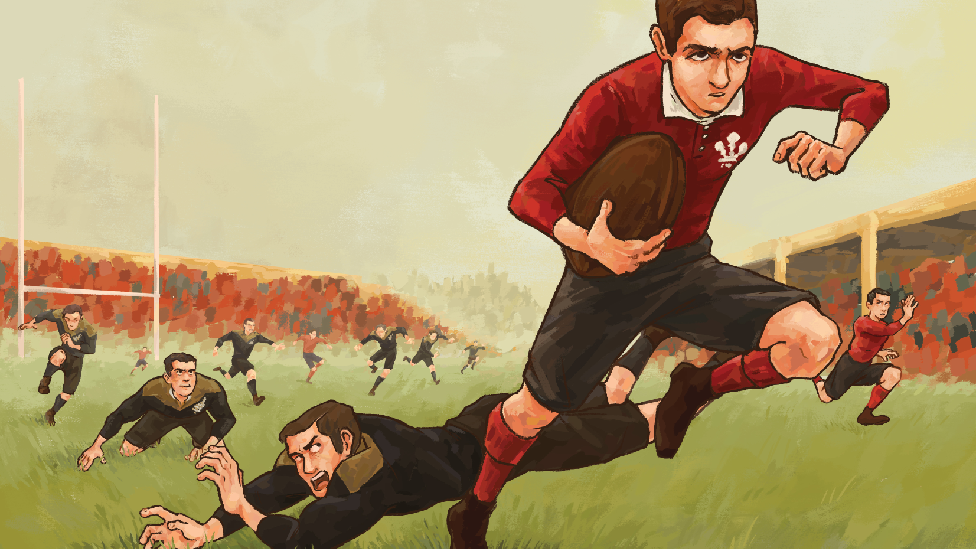
Illustration for a children's book about the match

December 16, 1905: A rugby union match is played, becoming known as the sport's "Match of the Century."

Rugby was allegedly invented at the prep school of the same name in England's Midlands in 1823. Wales began playing it in 1850, the Welsh Rugby Union was formed in 1881, and the Home Nations Championship, between Wales, England, Scotland and Ireland was first played 2 years later. (France was added in 1910, making it the Five Nations Championship. In 2000, Italy was added, making it the Six Nations Championship.)

The sport was first played in New Zealand in 1870. By 1904, New Zealand was sending its national team on tour. Because of their all-black uniforms, they became known as the All Blacks. (The soccer team eventually became known as the All Whites, and their cricket team as the Black Caps.)

The Original All Blacks, also known simply as "The Originals," were the first New Zealand team to tour outside Australasia. They toured the British Isles, France and the United States during 1905–1906. Their opening game, on September 16, 1905, was against Devon, in England's West Country, whom they defeated 55–4. They defeated every English side that they faced, including a 16–3 victory over English county champions Durham in the North-East, and a 32–0 victory over Blackheath in South-East London.

They defeated the national teams of Scotland, 12-7, easily the closest match on the tour before December 16; Ireland, 15-0; and England, also 15-0. On December 13, they beat Yorkshire in Leeds, 40-0. By the time the tour arrived in Wales, the All Blacks had not conceded a single point in their last 600 minutes of rugby. They had played 27 matches on the tour so far, scoring 801 points and conceding just 22.

The team travelled to Wales by train on 15 December, arriving at Cardiff Station in the evening. Despite the late hour, the visitors received a raucous welcome, a large crowd (contemporary estimates put it crowd at 20,000) had gathered to greet the All Blacks both inside the station and along the neighboring streets, preventing the players from getting to their hotel, and police had to force a path through the crowd for the tourists.

As early as October, the Welsh Match Committee had been observing the All Blacks tour. On October 19, the committee travelled to Gloucester, and say the tourists defeat one of the best club sides in England, 44–0. Rugby historians tend to accept that the scale and manner of this All Blacks victory encouraged the Welsh observers to develop new tactics that could match the tourists' unorthodox style.

As early as 1888, the New Zealand players had been performing a pregame routine that featured the haka, a dance of their native Māori people. They brought it with them to Britain. The Wales team debated how to counter this, and it was agreed that they would simply sing "Hen Wlad Fy Nhadau" ("Land of My Fathers"). It is believed to be the earliest performance of a National Anthem before a sporting event, and it whipped the crowd at Catdiff Arms Park into a frenzy, charging the players up.

As has become traditional for them, Wales wore all red, which would have been distinctive in person against New Zealand's literal all-black uniforms, but makes it difficult to tell the teams apart in black & white photographs.

Having studied the All Blacks' tactics, Wales concentrated on outside play. This resulted in a defensive struggle, and accounts of the match were unanimous in reporting how unusually poor New Zealand were in the 1st half, conceding an abundance of penalties in the opening 15 minutes. (Rugby union matches are 80 minutes, 2 halves of 40 minutes each.) One reporter stated that the normally free-scoring All Blacks did not get any play inside the Welsh 25 yard line until the very moment before half-time.

In the 23rd minute, a scrum was called, and Dicky Owen saw a chance to call the move he devised in training. As Wales won the ball, Owen ran it down the blindside, with the backline of Percy Bush, Gwyn Nicholls (the team Captain) and Willie Llewellyn following him in support. This initial move drew several New Zealand players. Owen then switched the play, throwing a long pass back to the openside, with Cliff Pritchard having to take the ball at his feet. The long pass gave Pritchard time to draw a covering tackle, before passing to Rhys Gabe, who similarly drew a would-be tackler. Finally, Gabe passed to Teddy Morgan, who sprinted more than 20 yards to touch down in the left corner. It was 3-0 to Wales, the first time that the All Blacks had conceded without first scoring themselves. Wales failed to kick the conversion.

The All Blacks had most of the attacking play in the 2nd half. Billy Wallace crossed the try line, but was called back, having run into touch and a forward pass from Bob Deans prevented an inevitable try for Duncan McGregor.

The closest opportunity came for the All Blacks when Deans was brought down inches from the line. By this point, there was a mist over the field, and it wasn't clear who had made the key tackle, with reports at the time saying it was a combined effort of Morgan and Gabe, but Morgan gave Gabe sole credit.

The mist led the All Blacks to believe that Deans had scored, which would have tied the game, and given them the chance to take the lead on the ensuing conversion. Even some of the Welsh players admitted that they thought he had scored, then been pulled back. But the referee, J.D. Dallas of Scotland, ruled that he never crossed the line, and was 6 to 12 inches short.

The 3-0 score held, and the crowd invaded the pitch after the final whistle, carrying some of the Wales players off on their shoulders. Dave Gallaher, the New Zealand Captain, went into the Wales locker room, congratulated their team, and admitted that the better team had won. He and Captain Nicholls exchanged shirts. Gallaher's shirt is now on display at the World Rugby Museum at Twickenham Stadium, "The Home of Rugby" in South-West London.

The All Blacks continued their tour, and managed narrow wins against 4 Welsh club teams, before opposing the France national team in its 1st-ever test match. On New Year's Day, January 1, 1906, New Zealand beat France, 38-8. They returned to New Zealand via North America, where they played 2 matches against Canadian teams. Overall, they played a total of 35 matches, which included 5 Tests. The Wales Test was their only loss.

The 1905 All Blacks tour of Britain went on to achieve legendary status within the rugby world, and New Zealand in particular. They scored 976 points and conceded only 59, and thus set the standard for future All Blacks sides. The tour also saw the first use of the All Blacks name, and established New Zealand's reputation as a world-class rugby nation. Some of these players eventually defected, to participate in the professional 1907-08 tour of Australia and Great Britain, where they played against Northern Union sides, in the variation on the sport that would eventually become known as rugby league.

Bob Deans died in 1908, only 3 years after the match, from a botched appendicitis operation. He was only 24. To the end, he insisted that he had scored.

Despite the sport's popularity around the world, there wasn't a Rugby World Cup until 1987, a joint hosting by Australia and New Zealand. It's also been hosted by each of those nations separately, England, Wales, a joint British-Irish hosting, France, South Africa and Japan. It's been won by New Zealand in 1987, 2011 and 2015; Australia in 1991 and 1999; South Africa in 1995, 2007 and 2019; and England in 2003. (UPDATE: South Africa repeated in 2023, making them the 1st 4-time winner, surpassing New Zealand with 3.)

*

December 16, 1905 was a Saturday. There were no scores in North America: Baseball was out of season, football season had just ended, and basketball and hockey were mostly all-amateur.

England's Football League played that day, among the games being a 2-2 tie between Woolwich Arsenal and Yorkshire team Middlesbrough, at the Manor Ground in Plumstead, South-East London. In 1913, the hosts moved to the Highbury section of North London, and dropped the Woolwich locality from their name, becoming simply Arsenal Football Club.

Sunday, November 27, 2022

November 27, 2011: The Tragedy of Gary Speed

Note the White Rose of the House of York,
still the symbol of Yorkshire, on Leeds' badge.

November 27, 2011: Gary Speed, the Welsh soccer star who became one of Britain's greatest TV studio analysts for the sport, takes his own life. He was 42 years old.

Gary Andrew Speed was born on September 8, 1969 in Mancot, Flintshire, Wales. He grew up on the street where Kevin Ratcliffe, then captain of Liverpool-based team Everton Football Club, lived. As Liverpool is near Wales, many people in the Principality support Everton, and many others support Liverpool FC. Also from Wales, and on the great Everton teams of the 1980s, were goalkeeper Neville Southall and left back Pat Van Den Hauwe. So was midfielder Barry Horne, a star (along with Southall) of their 1995 FA Cup winners.

A midfielder, with pace to match his name, Speed was signed by Yorkshire club Leeds United, and helped them win the Football League Division One title in 1992 -- the last title under the old banner, before the English top flight became known as the Premier League.

In 1996, he was sold to the club he loved growing up, Everton. A year later, Howard Wilkinson, his manager at Leeds, became his manager again, but their relationship soured. In 1998, he was sold to Newcastle United, and helped them reach the FA Cup Final that year (although they lost to North London team Arsenal) and the next (losing to Man United). In 2002, he helped Newcastle qualify for the UEFA Champions League.

He was sold to Lancashire team Bolton Wanderers in 2004, and stayed with them until 2008. They sold him to Yorkshire team Sheffield United, and he played the last 2 seasons of his career with them. He scored 104 goals in his career, and was known for scoring with headers.

He appeared 85 times for the Wales national team between 1990 and 2004, eventually serving as their Captain 44 times. Rarely troubled by injury or suspension, at the time of his retirement, he held the record for the most appearances in the Premier League at 535, until it was surpassed by David James; and only his Everton teammate Southall had made more appearances for Wales.

He retired as a player when Sheffield United named him manager. Only 4 months later, on December 11, 2010, he was named manager of his national team. As usual, Wales struggled, and by August 2011, they were ranked 117th in the world (out of 211 "nations" recognized by FIFA, the world's governing body for soccer). But 2 wins in the Autumn got them up to 45th.
Speed as Wales manager,
with one of his successors as team Captain,
Aaron Ramsey of Arsenal.

He married Louise in 1996, and had sons Tommy and Eddie. In 2010, he was awarded an MBE: Member of the Order of the British Empire.

On November 26, 2011, still manager of Wales, he appeared on the BBC One TV show Football Focus, and joined his former Newcastle United teammate Alan Shearer to watch that team play Manchester United, at Man U's Old Trafford. No one seemed to think anything was wrong.

The next day, Louise found him dead in the garage at their home in Huntington, Cheshire, England. He had hanged himself.

He seemed to have so much to look forward to, and so much respect among his peers, and so many friends. He didn't leave a suicide note, so no one really knows why he did it. It has been suggested that he was depressed. It is also possible that, with his reputation for heading the ball, he may have sustained brain damage, similar to American football players, and a few other British soccer stars. He was cremated, so there is no gravesite.

*

November 27, 2011 was a Sunday. Baseball was out of season. These games were played in the NFL:

* The New York Jets beat the Buffalo Bills, 28-24 at MetLife Stadium in the Meadowlands.

* The New England Patriots beat the Philadelphia Eagles, 38-20 at Lincoln Financial Field in Philadelphia.

* The Atlanta Falcons beat the Minnesota Vikings, 24-14 at the Georgia Dome in Atlanta.

* The Houston Texans beat the Jacksonville Jaguars, 20-13 at EverBank Field (now EverBank Stadium) in Jacksonville.

* The Tennessee Titans beat the Tampa Bay Buccaneers, 23-17 at LP Field (now Nissan Stadium) in Nashville.

* The Cincinnati Bengals beat their arch-rivals, the Cleveland Browns, 23-20 at Paul Brown Stadium (now Paycor Stadium) in Cincinnati.

* The Carolina Panthers beat the Indianapolis Colts, 27-19 at Lucas Oil Stadium in Indianapolis.

* The Arizona Cardinals beat the St. Louis Rams, 23-20 at the Edward Jones Dome (now The Dome at America's Center) in St. Louis.

* The Pittsburgh Steelers beat the Kansas City Chiefs, 13-9 at Arrowhead Stadium in Kansas City.

* The Denver Broncos beat the San Diego Chargers, 16-13 at Qualcomm Stadium in San Diego.

* The Oakland Raiders beat the Chicago Bears, 25-20 at the O.co Coliseum (as the Oakland-Alameda County Coliseum was then known).

* The Washington Redskins beat the Seattle Seahawks, 23-17 at CenturyLink Field (now Lumen Field) in Seattle.

* Three days earlier, on Thanksgiving Day, the Green Bay Packers beat the Detroit Lions, 27-15 at Ford Field in Detroit; the Dallas Cowboys beat the Miami Dolphins, 20-19 at AT&T Stadium in the Dallas suburb of Arlington, Texas; and the Baltimore Ravens beat the San Francisco 49ers, 16-6 at M&T Bank Stadium in Baltimore.

* And on ESPN Monday Night Football, the New Orleans Saints beat the New York Giants, 49-24 at the Superdome.

The NBA team owners had locked the players out, and the season did not begin until Christmas Day. But there were 4 games played in the NHL:

* The Ottawa Senators beat the Carolina Hurricanes, 4-3 at Scotiabank Place (now the Canadian Tire Centre) in Ottawa.

* The St. Louis Blues beat the Columbus Blue Jackets, 2-1 at the Nationwide Arena in Columbus, Ohio.

* The Calgary Flames beat the Minnesota Wild, 5-2 at the Xcel Energy Center in St. Paul, Minnesota.

* And the Toronto Maple Leafs beat the Anaheim Ducks, 5-2 at the Honda Center in Anaheim.

Wednesday, November 9, 2022

November 9, 1953: Dylan Thomas Dies

November 9, 1953: Dylan Thomas dies at St. Vincent's Hospital in Greenwich Village, Manhattan, New York City. He was only 39 years old.

Dylan Marlais Thomas was born on October 27, 1904 in Swansea, Wales. (That was the day the New York Subway system opened.) A poet and playwright, he was called, in his time, "a roistering, drunken and doomed poet." He made radio recordings for the BBC during World War II, making him world-famous. But, as with other noted alcoholics (and abusers of other substances), he proved unreliable.

He came to New York in the early 1950s, lived at the Chelsea Hotel, and drank at the White Horse Tavern in Greenwich Village. In those last years, he wrote the short story A Child's Christmas in Wales, the play Under Milk Wood, and an untitled poem, published in 1952, that begins and ends with the words, "Do not go gentle into that good night. Rage, rage against the dying of the light."

When that poem appeared in Collected Poems, 1934-1952, British critic Philip Toynbee said, "Thomas is the greatest living poet in the English language."

Apparently, Thomas didn't take his own advice. Nor did he stay the greatest living English-language poet for long, and not because any other poet surpassed him. By October 24, 1953, after appearing in a New York performance of Under Milk Wood, he told a friend, "The circus out there has taken the life out of me for now." He turned 39 on October 27, but left the party thrown for him after just 1 hour, and headed back to the Chelsea.

New York was hit with a smog attack on November 2. By the end of the month, over 200 people had died. Whatever was wrong with Thomas' lungs, the smog made it worse. On November 3, he walked into the lobby of the Chelsea, after a night at the White Horse, saying, "I've had 18 straight whiskeys. I think that's the record." Interviewed some time after, the bartender said it might have been half as many, which would still be a dangerous amount.

His breathing got worse, and late at night on November 5, he was taken to St. Vincent's Hospital, where he died on November 9, leaving behind a wife, 2 sons and a daughter.

He has a sports connection, though he would never know it. In 1972, sportswriter Roger Kahn, who had been a student of the classics at New York University, titled his memoir of the Brooklyn Dodgers of the early 1950s after a Thomas poem: 
I see the boys of summer in their ruin Lay the gold tithings barren, Setting no store by harvest, freeze the soils; There in their heat the winter floods Of frozen loves they fetch their girls, And drown the cargoed apples in their tides.
This poem would also lend itself to "The Boys of Summer," a hit song by Don Henley in 1985. 

*

November 9, 1953 was a Monday. Comedian Dennis Miller and actress Kate Capshaw were born.

Baseball was out of season, the NFL didn't have Monday Night Football back then; and while both the NBA and the NHL had started their seasons, neither scheduled any games for that day. So there were no scores on this historic day.

Friday, October 21, 2022

October 21, 1966: The Aberfan Disaster

The slurry after the disaster

October 21, 1966: The Aberfan Disaster occurs. A mine collapses in Aberfan, outside Merthyr Tydfil, Wales, about 20 miles northwest of Cardiff and 160 miles west of London. The mine was built over a natural spring, causing hot water to bubble up and spill down a hill into a school, killing 116 children and 26 adults.

A period of heavy rain led to a buildup of water within a colliery spoil tip, causing it to suddenly slide downhill as a slurry, which engulfed Pantglas Junior School, killing 109 children and 5 teachers; and a row of houses, killing an additional 7 children and 21 adults.

An inquiry laid the blame for the disaster at the National Coal Board, but no one was ever prosecuted, imprisoned, or even fined for it.

There had been mine disasters in Britain that killed more people. But this one happened to children, and it happened early in the television era, so it has stuck in the minds of the British public considerably more.

*

October 21, 1966 was a Friday. The baseball season had just ended. It was midweek for football. And the NHL played no games that day. But the newly-started NBA season had 4 games that day:

* The Boston Celtics beat the Baltimore Bullets, 111-91 at the Boston Garden. John Havlicek scored 28 points for the defending NBA Champions.

* The Philadelphia 76ers beat the St. Louis Hawks, 119-110 at the Philadelphia Civic Center. Wilt Chamberlain scored 23 points, but that didn't lead the Sixers: Hal Greer scored 30.

* The Chicago Bulls, an expansion team, beat the Los Angeles Lakers, 108-101 at the Los Angeles Memorial Sports Arena.

* And the San Francisco Warriors beat the Detroit Pistons, 136-119 at the Cow Palace in the San Francisco suburb of Daly City, California. Rick Barry led all scorers on the night with 37. 

Thursday, October 20, 2022

October 20, 1945: Wales Shock England In a "Victory International"

October 20, 1945: It was a good idea for the England national football (soccer) team to play a series of "Victory International" matches against the national teams of Great Britain's other "Home Nations" following World War II. But it might not have been a good idea to play the match they played on this day.

They had begun on September 15, a month after V-J Day, beating Ireland -- a combined Republic and Northern Ireland team -- 1-0 at Windsor Park in Belfast, on a goal by Stan Mortensen. But, on this day, they played Wales at The Hawthorns, in West Bromwich, outside Birmingham, home ground of West Bromwich Albion, and lost 1-0, in front of 54,611.

This is the greatest victory that Wales has ever had over their far more storied neighbors, and would have remained their greatest victory ever so had they not done well in the 1958 World Cup and Euro 2016. The goal was scored by Aubrey Powell, a forward who played most of his career for Yorkshire team Leeds United, and turned out to be the last survivor of this Wales team, living until 2009.

England would go on to play 5 more Victory Internationals in 1946. On January 19, they beat Belgium 2-0 at the old Wembley Stadium in London. On April 13, they were stunned 1-0 by Scotland at Hampden Park in Glasgow. On May 11, they beat Switzerland 4-1 at Wembley. On May 19, they lost to France 2-1 at the Stade Colombes in Paris. (That's the main stadium from the 1924 Olympics, and it still stands.)

And on August 24, they played Scotland to a 2-2 draw at Maine Road in Manchester, then the home of both big clubs in Manchester, as Manchester City had invited Manchester United to "groundshare" while Old Trafford was repaired following the Nazis bombing it. Other stadiums, including Arsenal's Highbury in North London, had sustained Luftwaffe damage, but none nearly as bad as Old Trafford.

The last survivor of the England players from these Victory Internationals was Bert Williams, who went on to star as goalkeeper for the great Wolverhampton Wanderers teams of the 1950s, and lived until 2014.

*

October 20, 1945 was a Saturday. Baseball season was over. The NFL played the next day. The NBA hadn't been founded yet. And the NHL season wouldn't start for another 4 days. But there were a lot of college football games, and here were some of the bigger ones:

* Number 1 Army beat the Melville PT Boat crew, 55-13 at Michie Stadium in West Point, New York. At the end of the season, the polls patriotically named Army the National Champions.

* Number 2 Navy beat Georgia Tech, 20-6 at Municipal Stadium, in Baltimore, which they frequently used for games too large for Thompson Stadium on their campus in nearby Annapolis, Maryland. From 1950 to 1954, Municipal Stadium was reconstructed and turned into Memorial Stadium. Navy took a 7-0-1 record into their season finale with Army, but lost.

* Number 3 Notre Dame beat the University of Pittsburgh, 39-9 at Pitt Stadium in Pittsburgh. The Fighting Irish would lose their perfect record 2 weeks later in a tie with Navy in Cleveland, lose their unbeaten status the next week against Army at Yankee Stadium, and end the season with a loss to the Great Lakes Naval Training Station on their ground in Chicago.

* Number 4 Ohio State lost to Number 9 Purdue, 35-13 at Ohio Stadium in Columbus. Ohio State's only other loss would be in their season finale against Michigan. Purdue would fall from the ranks of the unbeaten a week after this, against Northwestern.

* Number 5 Minnesota beat Northwestern, 30-7 at Memorial Stadium in Minneapolis. The Golden Gophers were 4-0. But they lost their last 5 games, though it should be noted that the next 3 were all against ranked teams.

* Number 6 Alabama beat Tennessee, 25-7 at Legion Field in Birmingham. 'Bama finished undefeated, won the Southeastern Conference title, and beat USC in the Rose Bowl. But they only finished Number 2 in the final polls.

* Number 8 Indiana beat Iowa, 52-20 at Iowa Stadium (later Kinnick Stadium) in Iowa City. The Hoosiers finished 9-0-1, and won what remains their only outright Big Ten Conference title. But they were not invited to a bowl game, and finished the season ranked Number 4.

* Number 10 Texas beat Arkansas, 34-7 at the old Memorial Stadium in Little Rock, Arkansas. Texas' only loss came the next week, 7-6 to Rice. They went on to win the Southwest Conference title, and beat Missouri in the Cotton Bowl.

* Number 12 Georgia were upset by Louisiana State, 32-0 at Sanford Stadium in Athens, Georgia. The Bulldogs would lose the next week, too, 28-14 to Alabama in Birmingham. Those would be their only losses that season.

* Number 14 USC beat the College of the Pacific, 52-0 at the Los Angeles Memorial Coliseum. Southern Cal would win the Pacific Coast Conference title, but lose to Alabama in the Rose Bowl.

* Number 15 Oklahoma A&M, between back-to-back National Championships by their basketball team, beat Utah, 46-6 at Ute Stadium in Salt Lake City. A&M would beat St. Mary's, of California's East Bay, in the Sugar Bowl, finish ranked Number 5, and change their name to Oklahoma State in 1958.

* Number 19 Holy Cross beat Brown, 25-0 at Brown Stadium in Providence, Rhode Island. Holy Cross went to the Orange Bowl, but lost it to the University of Miami, who were idle on October 20.

* In New York City, Number 17 Columbia beat Colgate, 31-7 at Baker Field in Manhattan. The Lions went 8-1, their only loss to Penn at Franklin Field in Philadelphia.

* New York University beat their arch-rivals, City College of New York. It was NYU 47, CCNY 0 at Ohio Field, NYU's home field, in The Bronx.

* Fordham University suspended its program for the 1943, '44 and '45 seasons, restarting in 1946.

* Among New Jersey teams, Princeton beat Cornell, 14-6 at Schoellkopf Field in Ithaca, New York.

* And Rutgers beat Rhode Island State, 39-7 at Rutgers Stadium in Piscataway.

Thursday, September 22, 2022

September 22, 1934: The Gresford Colliery Disaster

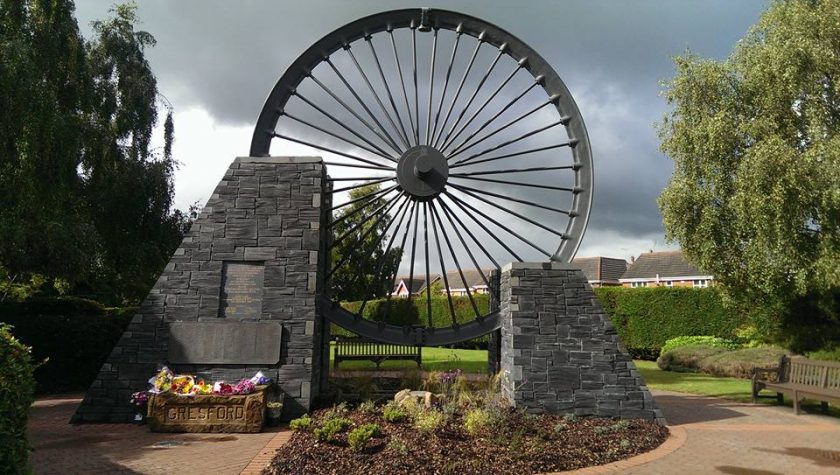
The memorial to the Disaster

September 22, 1934: The Gresford Colliery Disaster occurs in Gresford, about 3 miles north of Wrexham, Wales. A total of 266 deaths is attributed to it.

Like the rest of the island on which Great Britain rests, also including England and Scotland, Wales is coal-mining country. The Gresford Colliery had opened in 1911, and, by 1934, in spite of the Great Depression, employed 2,200 people.

Tthe mine was extremely dry, unlike mines to the west of the fault, and was therefore prone to firedamp: Any flammable gas found in coal mines, typically coalbed methane. The gas accumulates in pockets in the coal and adjacent strata. When they are penetrated, the release can trigger explosions.

This is what happened in Gresford's Dennis Shaft, at 2:08 AM on September 22, 1934, with about 500 men working the overnight shift. Because of the intense heat, only 6 men were recovered alive, and 11 were recovered dead. The rest were presumed incinerated.

Without any decisive evidence, the report of the investigation, issued 3 years later, could not attribute any outright blame or definitive cause for the disaster.

In 1947, the Labour government created the National Coal Board, nationalizing the industry. Gresford Colliery finally closed on economic grounds in 1973. In the 1980s the site was redeveloped as an industrial estate. In 1982, a memorial to the victims of the disaster was erected nearby; it was constructed using a wheel from the old pit-head winding gear. The last direct link to the disaster, Eddie Edwards, who began work in the mine aged 14, and who participated in the rescue efforts, died on January 6, 2016, at the age of d 102.

*

September 22, 1934 was a Saturday. The British soccer team I would one day begin supporting, Arsenal F.C. of North London, traveled to Yorkshire, and played Sheffield Wednesday to a 0-0 draw at Hillsborough Stadium in Sheffield.

In America, it was early in the college football season, and most schools in what would later be called the major conferences hadn't yet begun their seasons. Most games played that day ended up having little significance. But these baseball games were played:

* The New York Giants lost to the Boston Braves, 3-2 at Braves Field in Boston. Hal Schumacher walked Les Mallon with the bases loaded in the bottom of the 12th inning, forcing Randy Moore home with the winning run. Giants player-manager Bill Terry went 1-for-4 with a walk. Mel Ott went 2-for-4 with a walk and an RBI.

* The Pittsburgh Pirates swept a doubleheader from the Chicago Cubs, 2-1 and 11-7 at Forbes Field in Pittsburgh.

* The Cleveland Indians beat the Chicago White Sox, 9-8 at Comiskey Park in Chicago.

* The Detroit Tigers swept a doubleheader from the St. Louis Browns, 8-3 and 15-7 at Sportsman's Park in St. Louis.

* The New York Yankees and the Boston Red Sox were rained out at Yankee Stadium. The game was made up the next day, as part of a doubleheader. The Yankees swept, 1-0 and 5-4. Lefty Gomez pitched a 3-hit shutout in the opener. In the nightcap, Ben Chapman singled Red Rolfe home with the winning run in the bottom of the 10th inning. Red Ruffing went the distance for the win. Over the 2 games, Babe Ruth, in his last few days on the Yankee roster, went 0-for-5 (he only appeared in the 2nd game as a pinch-hitter), and Lou Gehrig went 3-for-7 with 2 walks and an RBI.

* The Cincinnati Reds and the St. Louis Cardinals were rained out at Crosley Field in Cincinnati. The game was made up as part of a doubleheader the next day. 

* The Brooklyn Dodgers and the Philadelphia Phillies were rained out at Ebbets Field. The game was made up as part of a doubleheader on the following Monday, September 24. The Dodgers swept, 5-3 and 10-1. The Cardinals won the 1st game, 9-7. Jesse Haines was the winning pitcher, and Dizzy Dean got the save, not that anyone knew what a save was at the time. The Reds won the 2nd game, 4-3. In the bottom of the 9th, Dizzy's brother Paul Dean was done in by his own throwing error, and Dizzy had to come in to relieve him. But Mark Koenig, of the 1927 Yankees, hit a sacrifice fly to win the game.

* The Philadelphia Athletics and the Washington Senators were rained out at Shibe Park in Philadelphia. This game was also made up as part of a doubleheader on the following Monday, September 24. The A's swept, 5-4 and 3-0. In the nightcap, Bill Dietrich pitched a 3-hit shutout against the defending AL Champions.

Saturday, September 17, 2022

September 18, 1903: Bertrand Russell Publishes "The Principles of Mathematics"

September 18, 1903: Bertrand Russell publishes The Principles of Mathematics. It presents a view of the foundations of mathematics, and has become a classic reference book.

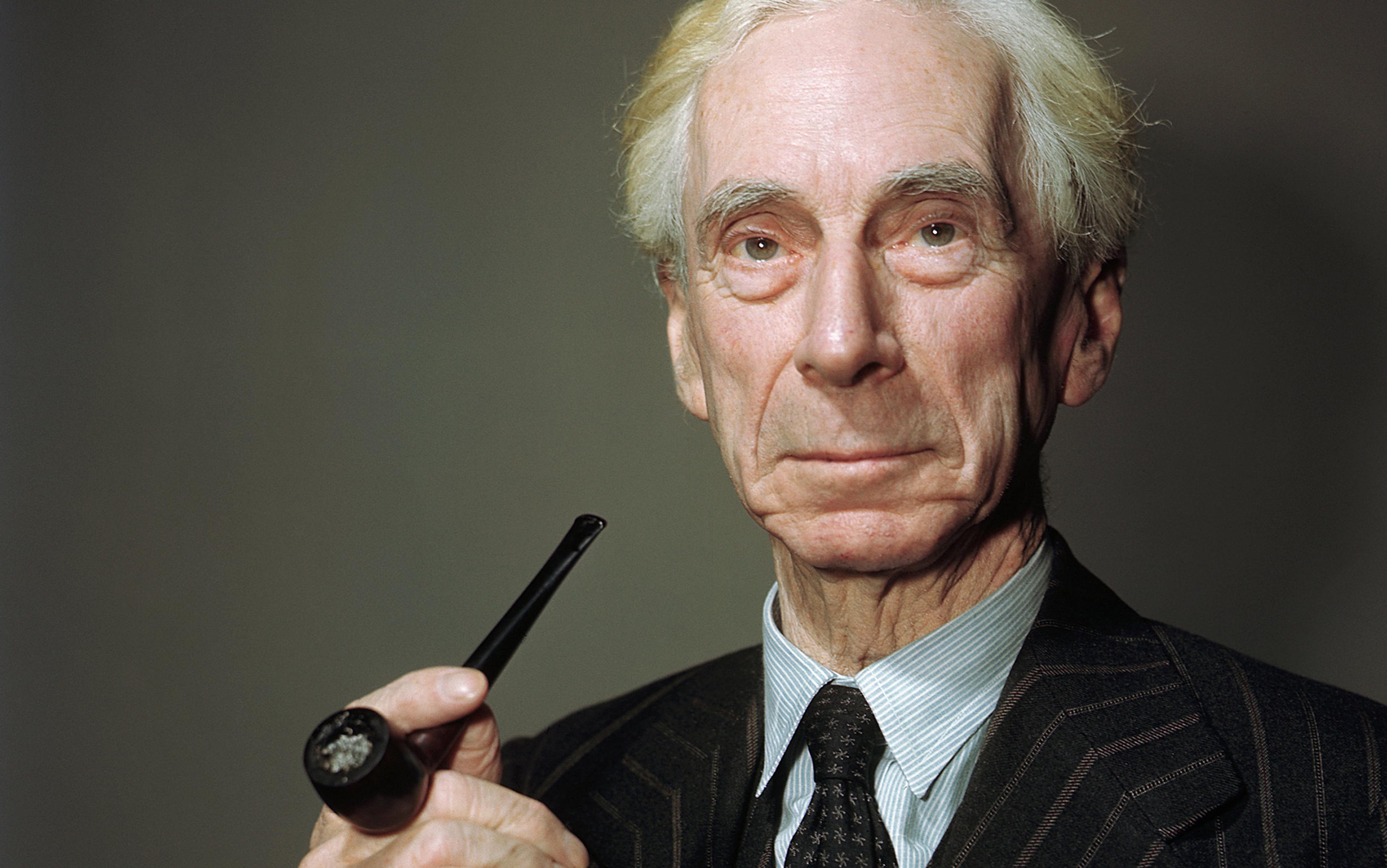
Bertrand Arthur William Russell was born on May 18, 1872 in Trellech, Monmouthshire, Wales. He was the son of John Russell, Viscount Amberley; the grandson of John Russell, 1st Earl Russell, Prime Minister of Great Britain from 1846 to 1852, and again from 1865 to 1866; and the great-grandson of John Russell, 6th Duke of Bedford. The 1st Duke of Bedford, William Russell, was an aide to King William III, and had been the 5th Earl of Bedford. The 1st Earl of Bedford was an advisor of King Henry VIII. Suffice it to say, Bertrand Russell's family was worth a few quid.

With his family's money and connections, it was easy to get him into Trinity College at the University of Cambridge, from which he graduated in 1893. At first, he dedicated himself to mathematics, and published his magnum opus when he was just 31 years old.

In 1937, Russell prepared a new introduction saying, "Such interest as the book now possesses is historical, and consists in the fact that it represents a certain stage in the development of its subject." Further editions were published in 1938, 1951, 1996, and 2009.

The book consists of 59 chapters, divided into 7 parts: Indefinables in mathematics, number, quantity, order, infinity and continuity, space, matter and motion. In chapter one, "Definition of Pure Mathematics," Russell asserts that:

The fact that all Mathematics is Symbolic Logic is one of the greatest discoveries of our age; and when this fact has been established, the remainder of the principles of mathematics consists in the analysis of Symbolic Logic itself.

But he was more than a mathematician. And the things he became in his life came to trouble his country. He became an atheist at age 18. In 1902, he joined the socialist Fabian Society. In 1916, during World War I, he joined the No-Conscription Fellowship, as a pacifist and an anti-imperialist, and not only lost his Cambridge teaching post, but was imprisoned for 6 months:

I found prison in many ways quite agreeable. I had no engagements, no difficult decisions to make, no fear of callers, no interruptions to my work. I read enormously; I wrote a book, "Introduction to Mathematical Philosophy"... and began the work for "The Analysis of the Mind." I was rather interested in my fellow-prisoners, who seemed to me in no way morally inferior to the rest of the population, though they were on the whole slightly below the usual level of intelligence as was shown by their having been caught.

Although he was rich, he sympathized with the poor. In 1935, he wrote In Praise of Idleness and Other Essays, including this passage:

The idea that the poor should have leisure has always been shocking to the rich. In the early nineteenth century, fifteen hours was the ordinary day's work for a man; children sometimes did as much, and very commonly did twelve hours a day. When meddlesome busybodies suggested that perhaps these hours were rather long, they were told that work kept adults from drink and children from mischief.

When I was a child, shortly after urban working men had acquired the vote, certain public holidays were established by law, to the great indignation of the upper classes. I remember hearing an old Duchess say: "What do the poor want with holidays? They ought to work." People nowadays are less frank, but the sentiment persists, and is the source of much of our economic confusion.

In 1894, he married Alyssa "Alys" Smith, an American Quaker and a feminist. They separated in 1911, and had no children. In 1919, he began a relationship with Dora Black, a women's rights and birth control activist. They were married right after his divorce from Alys became final in 1921, but had an open marriage. They divorced in 1935, but not before Dora had 2 children with another man.

In 1936, Bertrand married his children's former governess, Patricia Spence. She contributed to his 1945 book A History of Western Philosophy. They had a son, Conrad. They divorced in 1952, so Bertrand could marry American writer Edith Finch. Already 51 at the time of their marriage, they had no children.

In 1931, Bertrand's elder brother Frank died without an heir, and he became the 3rd Earl Russell. In 1950, Russell was awarded the Nobel Prize in Literature. 

In 1943, during World War II, he changed his mind about pacifism, describing war as a necessary "lesser of two evils." (That expression was coined in 4th Century BC Greece by Aristotle, and Geoffrey Chaucer introduced it to the English language in the late 14th Century.) He came to prefer American world leadership over the postwar weakness of Britain and strength of the Soviet Union, but opposed the Vietnam War, and spoke out for nuclear disarmament. Just before his death, he denounced Israeli aggression against their Arab neighbors, ignoring, as so many do, the fact that the Arab neighbors are nearly always the actual aggressors.

He died on February 2, 1970, at the age of 97. He had remarked that he had been raised by his grandfather, who had met Napoleon Bonaparte. And yet, Russell lived long enough to have been on the Earth at the same time as me, as I was born 46 days earlier.

Dora Russell lived until 1986, at 92. Patricia Russell lived until 2004, age 94. Edith Russell lived until 1978, age 77.

John Russell became the 4th Earl Russell, and served in the House of Lords from his father's death in 1970 until his own in 1987, only 63, defying the family's legacy of hardiness. But he, his wife, Susan Lindsay (daughter of American poet Vachel Lindsay) and all 3 of their children, all daughters and ineligible to inherit the earldom, were diagnosed as mentally ill.

His daughter, Lady Katharine Jane Tait, founded the Bertrand Russell Society in 1974, to preserve and understand his work. She also authored several essays about her father, and a biography, My Father, Bertrand Russell, which was published in 1975. She lived until 2021, age 98.

Conrad Russell became the 5th Earl Russell upon the death of his half-brother, and served in the House of Lords from 1987 until his death in 2004, at 67. His son, Nicholas, became the 6th Earl Russell, and was an activist for disability rights. He died of a blood clot in 2014, only 45 years old. His brother, John Russell, a photographer, became the 7th Earl Russell. The 5th and 6th Earls were both grandsons of Bertrand Russell.

*

September 18, 1903 was a Friday. These baseball games were played:

The New York Highlanders swept a doubleheader from the Chicago White Sox, 7-1 and 6-3 at Hilltop Park in Upper Manhattan. Over the 2 games, Willie Keeler went 6-for-7 with a stolen base and 3 RBIs. The Highlanders officially became the New York Yankees in 1913.

A doubleheader was played at Columbia Park in Philadelphia. The Philadelphia Athletics won the opener, 7-5. Charles "Chief" Bender couldn't get out of the 1st inning, but Eddie Plank pitched the rest of the way for the win. The St. Louis Browns won the nightcap, 9-2.

* The New York Giants beat the Cincinnati Reds, 7-5 at the Palace of the Fans in Cincinnati. Charlie Babb and Jack Warner each got 3 hits for the Giants. Deaf pitcher Luther "Dummy" Taylor pitched the 1st 7 innings, and was relieved by Christy Mathewson. The Giants scored a run in the 8th and a run in the 9th to win it, and Mathewson was credited with his 29th win of the season. He would finish 30-13.

* The Boston Americans beat the Cleveland Naps, 7-6 at the Huntington Avenue Grounds in Boston. Bill Dineen won his 20th game of the year for Boston. Chick Stahl went 3-for-4 with a walk and an RBI. Freddy Parent went 2-for-5 with a home run and 2 RBIs. The Americans went on to win the 1st World Series, and Parent went on to become the last surviving member of the team, living until 1972. The Americans became the Red Sox in 1908.

The Cleveland team was named for its manager and 2nd baseman, Napoleon "Nap" Lajoie, who went 0-for-4 on this day, but had an RBI on a sacrifice fly. They became the Cleveland Indians in 1915, and the Cleveland Guardians in 2022.

* The Washington Senators swept a doubleheader from the Detroit Tigers, 4-0 and 6-5 at National Park in Washington. Harold Wilson lasted only 1 inning in the 1st game, apparently leaving due to an injury. Davy Dunkle pitched the rest of the way, completing a 7-hit shutout.

* The Pittsburgh Pirates swept a doubleheader from the Boston Beaneaters, 7-6 and 6-5 at Exposition Park in Pittsburgh. Over the 2 games, Honus Wagner went 3-for-6 with 3 walks. (RBIs were not always recorded at this time.)

* A doubleheader was split at the West Side Grounds in Chicago. The Chicago Cubs won the 1st game, 6-5. The Philadelphia Phillies won the 2nd game, 10-0. Charles "Chick" Fraser pitched a no-hitter. It wasn't close to a perfect game: He walked 5 batters, and his fielders made 3 errors.

* And the Brooklyn Superbas and the St. Louis Cardinals were simply not scheduled to play that day.

Saturday, September 10, 2022

September 10, 1985: The Death of Jock Stein

September 10, 1985: The Scotland soccer national team gets a late equalizer to tie Wales, in a World Cup qualifying match at Ninian Park in Cardiff. But at the end of the game, Scotland manager John "Jock" Stein suffers a heart attack and dies. He was 62 years old.

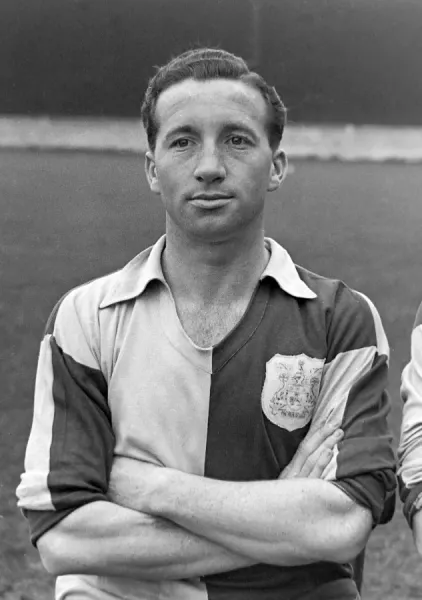
Stein -- pronounced "Steen," not "Stine" -- was born on October 5, 1922 in Burnbank, Lanarkshire, Scotland. Like many Scots, especially those named John, he was nicknamed "Jock." After years of playing centre half with Coatbridge side Albion Rovers, and an ill-fated season with Llanelli Town in Wales, in 1951 he signed with Celtic of Glasgow, and helped them win the Scottish Football League title in 1954.

He managed Dunfermline Athletic to the 1961 Scottish Cup, and spent some time at Hibernian of Edinburgh, before Celtic hired him as manager in 1965. He managed them to 9 consecutive Scottish Football League titles, 1966 to 1974, and a 10th in 1977. He led them to 8 Scottish Cups from 1965 to 1977. He managed them to 6 Scottish League Cups from 1966 to 1975.

In 1967, he became the 1st manager of a British team, and the 1st British manager, to win the European Cup, as Celtic beat Internazionale Milano in the Final, at Portugal's National Stadium in Lisbon, earning them the nickname the Lisbon Lions. As Celtic also won all 3 domestic trophies, they became the 1st, and remain the only, side in European history to win such a Quadruple.

Like Brian Clough, he was a successful manager who nonetheless managed very briefly at Leeds United -- each man managing the Yorkshire club for just 44 days. He managed Scotland briefly in 1965, and was hired to manage the national side again in 1978. He got them into the 1982 World Cup. In 1985, managing a Home Nations match against Wales at Ninian Park in Cardiff, which ended in a 1-1 draw, he suffered a heart attack, and died in the dressing room. He was only 62.

A stand at Celtic Park was named in his memory, and a statue of him holding the European Cup stands outside. He was posthumously elected to the Scottish Football Hall of Fame.

A stand at Celtic Park in Glasgow is named for him, and a statue of him stands outside. (And that's pronounced "Steen," not "Styne.")

*

September 10, 1985 was a Tuesday. These Major League Baseball games were played:

* The New York Yankees beat the Milwaukee Brewers, 13-10 at Milwaukee County Stadium. The Yankees got home runs from Dan Pasqua, Ron Hassey and Ken Griffey Sr. Dave Winfield went 1-for-4. Don Mattingly went 1-for-5 with 3 RBIs. Rickey Henderson went 1-for-4 with a walk and 3 RBIs. For the Brewers, Robin Yount did not play, but Paul Molitor went 2-for-5 with an RBI.

Ed Whitson was the winning pitcher, but, due to manager Billy Martin being a psychopath, didn't win another game that season.

* The New York Mets beat the St. Louis Cardinals, 5-4 at Busch Memorial Stadium in St. Louis. Ron Darling outpitched Danny Cox, and Howard Johnson hit a home run.

* A doubleheader was split at Fenway Park in Boston. The Baltimore Orioles won the opener, 7-5. Mike Young hit 2 home runs for the O's. The Boston Red Sox won the nightcap, 5-3. Over the 2 games, Eddie Murray went 2-for-8 with a home run, a walk and 2 RBIs; Cal Ripken went 3-for-7 with 2 walks; and Wade Boggs went 6-for-8 with a walk.

* The Philadelphia Phillies beat the Montreal Expos, 5-2 at Veterans Stadium in Philadelphia. Mike Schmidt won the game with a home run in the bottom of the 11th inning.

* The Los Angeles Dodgers swept the Atlanta Braves, 10-1 and 10-4 at Atlanta-Fulton County Stadium.

* The Pittsburgh Pirates beat the Chicago Cubs, 2-1 at Three Rivers Stadium in Pittsburgh.

* The Toronto Blue Jays beat the Detroit Tigers, 2-1 at Exhibition Stadium in Toronto.

* The San Diego Padres beat the Cincinnati Reds, 3-2 at Riverfront Stadium in Cincinnati. Tony Gwynn went 2-for-4. Reds player-manager Pete Rose went 0-for-4, letting down a crowd of 51,045. The next day, he got his 4,192nd career hit, breaking what had officially been the all-time hits record.

* The Chicago White Sox beat the Minnesota Twins, 7-2 at Comiskey Park in Chicago.

* The Houston Astros beat the San Francisco Giants, 4-1 at the Astrodome in Houston.

* The Kansas City Royals beat the California Angels, 6-0 at Anaheim Stadium (now Angel Stadium of Anaheim). Charlie Liebrandt pitched a 3-hit shutout. George Brett went 2-for-4. Neither Reggie Jackson nor Rod Carew, in his last full month as an active player, got into the game.

* The Oakland Athletics beat the Texas Rangers, 10-3 at the Oakland Coliseum.

* And the Cleveland Indians beat the Seattle Mariners, 8-5 at the Kingdome in Seattle.

Sunday, July 31, 2022

July 31, 1917: An Irish Poet and a Welsh Poet Die for Great Britain

Francis Ledwidge

July 31, 1917: The Battle of Passchendaele, also known as the Third Battle of Ypres, begins at what used to be the village of Passchendaele in Belgium, but was basically now a bombed-out wasteland.

Among those who died that day was Francis Ledwidge. Born August 19, 1887 in Slane, County Meath, Ireland, about 30 miles northwest of Dublin, working menial jobs such as coal mining made him a trade union activist, and he joined the pro-independence political party Sinn Féin.

He met the writer Edward John Moreton Drax Plunkett, 18th Baron Dunsany, who gave him a desk job at his castle, and access to his large library. Thus inspired to write his own poetry, Ledwidge completed Songs of the Fields, which Lord Dunsany published in 1915.

Ledwidge enlisted in the British Army because he saw the advancing German Empire as the greatest threat to the Irish people, not the British Empire that then controlled it. He served at the Battle of Gallipoli in 1915, continued to write, and mailed his work back to Lord Dunsany so it could be published. Although still an Irish patriot, he was dismayed when he learned of the Easter Rising of 1916, fearing it would do more harm than good, and losing a friend to execution in its aftermath.

In a letter home from the front, he wrote:

Oh what a pleasant world 'twould be,
How easy we'd step thro' it,
If all the fools who meant no harm,
Could manage not to do it!

On July 31, 1917, Corporal Francis Ledwidge was serving with a battalion of the Royal Inniskilling Fusiliers that was road-laying in preparation for an assault, at a spot called Hell Fire Corner for the frequency of German shelling, 78 miles west of Brussels. (It's actually closer to London, 165 miles, than it is to Paris, 167.)

A Catholic Mass, with rain falling, was delivered outdoors by an army chaplain, Father Devas. Without wine for Communion, tea was offered instead. He reported that Ledwidge took a sip of his tea, and then a German shell landed next to him and exploded. There was nothing left of him. An Irish tricolour was later raised as a memorial at the spot where he died.
Lord Dunsany republished all of Ledwidge's work that could be collected in a single volume in 1919, allowing him to be claimed as a patriot poet by both the United Kingdom and, after 1922, the independent Republic of Ireland.

Ledwidge wasn't the only British soldier who was a notable poet but not an Englishman to die in service on that day. Ellis Humphrey Evans was born on January 13, 1887 in Trawsfynydd (pronounced "Trous-VEN-yith"), Gwyendd, Wales, about 140 miles north of Cardiff and 70 miles southwest of Liverpool. By the time he was 11, he was already writing poetry; at 20, he won his 1st poetry contest. At a poets' meeting in 1910, he was given the "bardic name" Hedd Wyn: "Hedd" ("Heth") meaning "peace," and "Wyn" meaning "white" or "pure." Hedd Wyn: Pure peace.
He took the name to heart, refusing to enlist at the outbreak of war in August 1914, believing that he could never willingly kill anyone. In "Rhyfel," meaning "War" in the Welsh language, he wrote, when translated into English:


Translation:

Why must I live in this grim age,
When, to a far horizon, God
Has ebbed away, and man, with rage,
Now wields the sceptre and the rod?

Man raised his sword, once God had gone,
To slay his brother, and the roar
Of battlefields now casts upon
Our homes the shadow of the war.

The harps to which we sang are hung,
On willow boughs, and their refrain
Drowned by the anguish of the young
Whose blood is mingled with the rain.

Farming was considered a "reserved occupation" and exempt from the draft, but the Evans family had 2 sons of draft age. In early 1917, Ellis enlisted so that his younger brother Robert wouldn't be drafted. In June, under his birth name, Private Ellis Evans he joined the 15th Service Battalion, Royal Welsh Fusiliers. Upon his arrival on the Continent, he wrote, "Heavy weather, heavy soul, heavy heart. That is an uncomfortable trinity, isn’t it?"

Before sunrise on July 31, the Germans began shelling Pilckem Ridge, and the 15th attacked. Hedd Wyn was shot in the stomach, and was carried to a first aid post. He asked the doctor, "Do you think I will live?" The doctor did not, and, at 11:00 that morning was proven right.

Wyn was buried in the Artillery Wood Cemetery in Boezinge, Belgium, a 3-minute walk from Ledwidge's monument. About a mile and a quarter down the next road is the Welsh National Memorial Park, which includes the spot where Wyn was hit. 
A statue of Wyn stands in his hometown, with an inscription he had written for a fallen friend:

His sacrifice was not in vain, his face
In our minds will remain,
Although he left a bloodstain
On Germany's iron fist of pain.

Hedd Wyn, "The Shepherd War Poet," had reached his 30th birthday. Francis Ledwidge, "The Poet of the Blackbirds," didn't quite make it to his own. Neither man ever married, and neither is known to have fathered any children.

In 1992, Huw Garmon starred in the film Hedd Wyn. Although he was the subject of the 1973 documentary Behind the Closed Eye, through 2022, there has never been a feature film about Francis Ledwidge.

*

It's unclear how many soldiers, British on one side and German on the other, died in the Battle of Passchendaele, since many men were either literally blown to pieces like Ledwidge, or sank into the mud in what Wyn called the "Heavy weather," never to be seen again. But it may have been over 200,000 on each side, plus that many again who were wounded, inhaled mustard gas and were removed from action that way, or otherwise were no longer available, and thus got counted as "casualties" even though they didn't die quickly.

Canadian writer James Fell, who proudly calls himself a "sweary historian," has said, "Between August and November of 1917, Passchendaele ranks near the top of places you did not want to fucking be":

It was another one of those "hey the Germans are ready to break all we need to do is throw hundreds of thousands of young men in their prime into a hail of gun and artillery fire and we can end this war" ideas that had proven false before, and would prove a crock of shit yet again. Germany was far from ready to collapse, and most of what the offensive accomplished was a metric shit-ton of muddy death.

If this sounds like the American strategy in Vietnam, which added air power but not any effectiveness, then you're paying attention. But the British Empire had other Dominions to throw into it. General Sir Douglas Haig threw Australians and New Zealanders into the mix, and gained no ground. Then he sent Canadians in, over the objection of their commander, General Arthur Currie. By November 10, they had pushed the Germans back a bit, and the battle was over. The idea that the war would last another full year would have further depressed anyone.

*

July 31, 1917 was a Tuesday. These baseball games were played:

* The New York Yankees beat the St. Louis Browns, 4-1 at the Polo Grounds. Ray Caldwell was the winning pitcher. Charles "Paddy" Baumann, the Yankees' 2nd baseman, went 1-for-3 with 2 RBIs. Why a man of German descent got the Irish nickname "Paddy," I don't know. George Sisler went 1-for-4 for the Browns.

* The New York Giants swept a doubleheader from the Pittsburgh Pirates, 11-7 and 9-3 at Forbes Field in Pittsburgh. Over the 2 games, Benny Kauff went 6-for-10 with a stolen base and 4 RBIs, Joe Wilhoit went 5-for-8 with 2 walks and 5 RBIs, George Burns (for whom the later entertainer named himself) went 5-for-9 with a walk and 3 RBIs, and Heinie Zimmerman went 4-for-8 with 5 RBIs.

For the Pirates, Max Carey went 5-for-8 with a walk and 2 RBIs, Carson Bigbee went 5-for-7 with an RBI; and Honus Wagner, in his final season, playing 1st base instead of his former shortstop, went 1-for-8 with an RBI.

This was the Dead Ball Era: There were 30 runs scored in this game, but none came through a home run, not even of the inside-the-park variety, despite Forbes Field having deep dimensions everywhere but the right field corner.

* The Brooklyn Robins (as the Dodgers were known under manager Wilbert Robinson, from 1914 to 1931) beat the Cincinnati Reds, 4-2 at Redland Field (later Crosley Field) in Cincinnati. Leon Cadore, who would one day pitch 26 innings in one game, outpitched Fred Toney, who, earlier in the year, pitched a 10-inning no-hitter to beat a man who'd pitched one for 9 innings.

* The Boston Red Sox beat the Chicago White Sox, 5-2 at Fenway Park in Boston. Dutch Leonard outpitched Eddie Cicotte. Harry Hooper hit a home run. At the time, Babe Ruth did not bat unless he also pitched. Eddie Collins went 1-for-3 with an RBI. Shoeless Joe Jackson went 0-for-3 with a walk.

* The Cleveland Indians beat the Philadelphia Athletics, 8-5 at Shibe Park in Philadelphia. Robert "Braggo" Roth went 3-for-5 with 4 RBIs. Tris Speaker went 2-for-5. Frank "Ping" Bodie went 3-for-4 with a walk and 3 RBIs for the A's.

* The Detroit Tigers beat the Washington Senators, 8-4 at National Park (later Griffith Stadium) in Washington. Ty Cobb went 1-for-5.

* A doubleheader was split at Weeghman Park, later to be renamed Wrigley Field, in Chicago. The Chicago Cubs won the opener, 9-6. The Boston Braves won the nightcap, 8-1.

* And a doubleheader was split at Robison Field in St. Louis. The Philadelphia Phillies won the 1st game, 6-4. Grover Cleveland Alexander pitched a 4-hit shutout, and went 2-for-4 with 2 RBIs. The St. Louis Cardinals won the 2nd game, 4-2. Over the 2 games, Milt Stock went 6-for-8 with a walk and an an RBI, while Rogers Hornsby went 1-for-4.

December 31, 1999 & January 1, 2000: The Millennium

December 31, 1999:  The Millennium arrives. The people of planet Earth survived. At a terrible cost. But we hadn't destroyed ourselves. ...