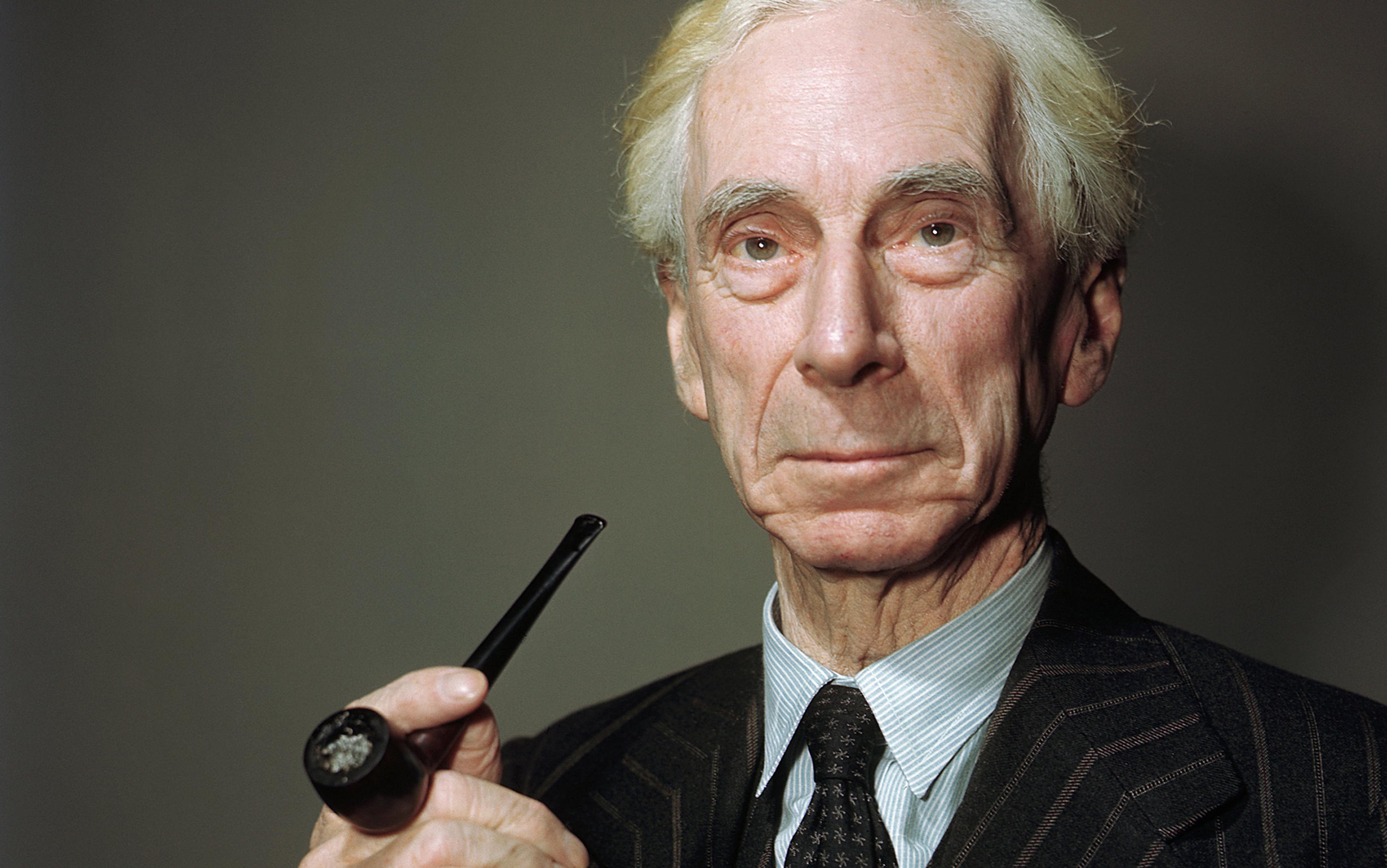
September 18, 1903: Bertrand Russell publishes The Principles of Mathematics. It presents a view of the foundations of mathematics, and has become a classic reference book.
Bertrand Arthur William Russell was born on May 18, 1872 in Trellech, Monmouthshire, Wales. He was the son of John Russell, Viscount Amberley; the grandson of John Russell, 1st Earl Russell, Prime Minister of Great Britain from 1846 to 1852, and again from 1865 to 1866; and the great-grandson of John Russell, 6th Duke of Bedford. The 1st Duke of Bedford, William Russell, was an aide to King William III, and had been the 5th Earl of Bedford. The 1st Earl of Bedford was an advisor of King Henry VIII. Suffice it to say, Bertrand Russell's family was worth a few quid.
With his family's money and connections, it was easy to get him into Trinity College at the University of Cambridge, from which he graduated in 1893. At first, he dedicated himself to mathematics, and published his magnum opus when he was just 31 years old.
In 1937, Russell prepared a new introduction saying, "Such interest as the book now possesses is historical, and consists in the fact that it represents a certain stage in the development of its subject." Further editions were published in 1938, 1951, 1996, and 2009.
The book consists of 59 chapters, divided into 7 parts: Indefinables in mathematics, number, quantity, order, infinity and continuity, space, matter and motion. In chapter one, "Definition of Pure Mathematics," Russell asserts that:
But he was more than a mathematician. And the things he became in his life came to trouble his country. He became an atheist at age 18. In 1902, he joined the socialist Fabian Society. In 1916, during World War I, he joined the No-Conscription Fellowship, as a pacifist and an anti-imperialist, and not only lost his Cambridge teaching post, but was imprisoned for 6 months:
I found prison in many ways quite agreeable. I had no engagements, no difficult decisions to make, no fear of callers, no interruptions to my work. I read enormously; I wrote a book, "Introduction to Mathematical Philosophy"... and began the work for "The Analysis of the Mind." I was rather interested in my fellow-prisoners, who seemed to me in no way morally inferior to the rest of the population, though they were on the whole slightly below the usual level of intelligence as was shown by their having been caught.
Although he was rich, he sympathized with the poor. In 1935, he wrote In Praise of Idleness and Other Essays, including this passage:
The idea that the poor should have leisure has always been shocking to the rich. In the early nineteenth century, fifteen hours was the ordinary day's work for a man; children sometimes did as much, and very commonly did twelve hours a day. When meddlesome busybodies suggested that perhaps these hours were rather long, they were told that work kept adults from drink and children from mischief.
When I was a child, shortly after urban working men had acquired the vote, certain public holidays were established by law, to the great indignation of the upper classes. I remember hearing an old Duchess say: "What do the poor want with holidays? They ought to work." People nowadays are less frank, but the sentiment persists, and is the source of much of our economic confusion.
In 1894, he married Alyssa "Alys" Smith, an American Quaker and a feminist. They separated in 1911, and had no children. In 1919, he began a relationship with Dora Black, a women's rights and birth control activist. They were married right after his divorce from Alys became final in 1921, but had an open marriage. They divorced in 1935, but not before Dora had 2 children with another man.
In 1936, Bertrand married his children's former governess, Patricia Spence. She contributed to his 1945 book A History of Western Philosophy. They had a son, Conrad. They divorced in 1952, so Bertrand could marry American writer Edith Finch. Already 51 at the time of their marriage, they had no children.
In 1931, Bertrand's elder brother Frank died without an heir, and he became the 3rd Earl Russell. In 1950, Russell was awarded the Nobel Prize in Literature.
In 1943, during World War II, he changed his mind about pacifism, describing war as a necessary "lesser of two evils." (That expression was coined in 4th Century BC Greece by Aristotle, and Geoffrey Chaucer introduced it to the English language in the late 14th Century.) He came to prefer American world leadership over the postwar weakness of Britain and strength of the Soviet Union, but opposed the Vietnam War, and spoke out for nuclear disarmament. Just before his death, he denounced Israeli aggression against their Arab neighbors, ignoring, as so many do, the fact that the Arab neighbors are nearly always the actual aggressors.
He died on February 2, 1970, at the age of 97. He had remarked that he had been raised by his grandfather, who had met Napoleon Bonaparte. And yet, Russell lived long enough to have been on the Earth at the same time as me, as I was born 46 days earlier.
Dora Russell lived until 1986, at 92. Patricia Russell lived until 2004, age 94. Edith Russell lived until 1978, age 77.
John Russell became the 4th Earl Russell, and served in the House of Lords from his father's death in 1970 until his own in 1987, only 63, defying the family's legacy of hardiness. But he, his wife, Susan Lindsay (daughter of American poet Vachel Lindsay) and all 3 of their children, all daughters and ineligible to inherit the earldom, were diagnosed as mentally ill.
His daughter, Lady Katharine Jane Tait, founded the Bertrand Russell Society in 1974, to preserve and understand his work. She also authored several essays about her father, and a biography, My Father, Bertrand Russell, which was published in 1975. She lived until 2021, age 98.
Conrad Russell became the 5th Earl Russell upon the death of his half-brother, and served in the House of Lords from 1987 until his death in 2004, at 67. His son, Nicholas, became the 6th Earl Russell, and was an activist for disability rights. He died of a blood clot in 2014, only 45 years old. His brother, John Russell, a photographer, became the 7th Earl Russell. The 5th and 6th Earls were both grandsons of Bertrand Russell.
*
September 18, 1903 was a Friday. These baseball games were played:
* The New York Highlanders swept a doubleheader from the Chicago White Sox, 7-1 and 6-3 at Hilltop Park in Upper Manhattan. Over the 2 games, Willie Keeler went 6-for-7 with a stolen base and 3 RBIs. The Highlanders officially became the New York Yankees in 1913.
* A doubleheader was played at Columbia Park in Philadelphia. The Philadelphia Athletics won the opener, 7-5. Charles "Chief" Bender couldn't get out of the 1st inning, but Eddie Plank pitched the rest of the way for the win. The St. Louis Browns won the nightcap, 9-2.
* The New York Giants beat the Cincinnati Reds, 7-5 at the Palace of the Fans in Cincinnati. Charlie Babb and Jack Warner each got 3 hits for the Giants. Deaf pitcher Luther "Dummy" Taylor pitched the 1st 7 innings, and was relieved by Christy Mathewson. The Giants scored a run in the 8th and a run in the 9th to win it, and Mathewson was credited with his 29th win of the season. He would finish 30-13.
* The Boston Americans beat the Cleveland Naps, 7-6 at the Huntington Avenue Grounds in Boston. Bill Dineen won his 20th game of the year for Boston. Chick Stahl went 3-for-4 with a walk and an RBI. Freddy Parent went 2-for-5 with a home run and 2 RBIs. The Americans went on to win the 1st World Series, and Parent went on to become the last surviving member of the team, living until 1972. The Americans became the Red Sox in 1908.
The Cleveland team was named for its manager and 2nd baseman, Napoleon "Nap" Lajoie, who went 0-for-4 on this day, but had an RBI on a sacrifice fly. They became the Cleveland Indians in 1915, and the Cleveland Guardians in 2022.
* The Washington Senators swept a doubleheader from the Detroit Tigers, 4-0 and 6-5 at National Park in Washington. Harold Wilson lasted only 1 inning in the 1st game, apparently leaving due to an injury. Davy Dunkle pitched the rest of the way, completing a 7-hit shutout.
* The Pittsburgh Pirates swept a doubleheader from the Boston Beaneaters, 7-6 and 6-5 at Exposition Park in Pittsburgh. Over the 2 games, Honus Wagner went 3-for-6 with 3 walks. (RBIs were not always recorded at this time.)
* A doubleheader was split at the West Side Grounds in Chicago. The Chicago Cubs won the 1st game, 6-5. The Philadelphia Phillies won the 2nd game, 10-0. Charles "Chick" Fraser pitched a no-hitter. It wasn't close to a perfect game: He walked 5 batters, and his fielders made 3 errors.
* And the Brooklyn Superbas and the St. Louis Cardinals were simply not scheduled to play that day.


No comments:
Post a Comment