Showing posts with label 1930. Show all posts

Wednesday, December 7, 2022

December 14, 1930: The New York Giants Beat the Notre Dame All-Stars

December 14, 1930: A football game was played at the Polo Grounds in Upper Manhattan. The home team was not the one cheered by most of the fans. Most of them left stunned at the result.

America was a year into the Great Depression, and Jimmy Walker, the flamboyant, corrupt Mayor of New York City, had a private unemployment relief fund. He contacted his friend, Charles Stoneham, owner of the New York Giants baseball team and its home, the Polo Grounds; and another friend, Tim Mara, owner of the New York Giants football team, which leased the Polo Grounds from Stoneham. He asked if Stoneham would host, and Mara would play, a benefit game for the relief fund. Both agreed.

But who would be the opponent? There was a football team called the Brooklyn Dodgers, and another called the Staten Island Stapletons, but neither had a following that would fill the Polo Grounds' 56,000 seats. Nor did the Giants: Only once all season did they have a home crowd over 25,000, and that was on November 23, when 37,000 saw them beat the Green Bay Packers, 13-6. That would be the Packers' only loss of the season, as they won the Championship by 1 game over the Giants.

The most popular football team among New Yorkers was a college team, 700 miles west: The University of Notre Dame, in South Bend, Indiana. Although there is a school in Washington, D.C. named "The Catholic University of America," the high profile of Notre Dame's football team had made their school America's most familiar Catholic school.

This was due to the success of their head coach, the charismatic Norwegian immigrant Knute Rockne. Coaching players like the ill-fated George Gipp on his National Championship teams of 1919 and 1920, and the four-man backfield known as "The Four Horsemen" on his National Championship team of 1924, Rockne had made himself and his school legend. Catholics in cities like New York, Philadelphia, Boston and Chicago, who couldn't afford to go to college, or even to finish high school, read of Notre Dame's exploits in the newspapers, and became fans, known as "Subway Alumni."

The game in which the great Southern, but nationally-syndicated, sportswriter Grantland Rice had named quarterback Harry Stuhldreher, halfback Don Miller and Jim Crowley, and Elmer Layden "The Four Horsemen," after the Apocalypse figures in the Bible's book of Revelation, had been at the Polo Grounds, a win over the U.S. Military Academy, a.k.a. "Army." The 1928 game in which Rockne had told his players of the dying wish of Gipp, suffering from an infection in those pre-antibiotic days, to "win just one for the Gipper," had also been against Army, at Yankee Stadium.

And Notre Dame had won the National Championship again in 1929 and 1930. In the current season alone, they had gone 10-0, and brought 66,000 fans to Pitt Stadium for their win over the University of Pittsburgh, 75,000 to Franklin Field in Philadelphia for their win over the University of Pennsylvania, 110,000 to Soldier Field in Chicago for their win over Army, and 74,000 to the Los Angeles Memorial Coliseum for their win over the University of Southern California.

So they were the ideal opponent. And it's not as though teams in the NFL's early days hadn't played college teams before. So the Giants asked Rockne if he would bring his "Fighting Irish" east to play the Giants.

He wouldn't do it. Not because he objected to playing professionals -- or because the game would be on a Sunday. (The State of New York had only legalized professional sports on Sundays in 1919.) It was because the game had been set for December 14, only 8 days after their win over USC, and, having needed 3 days to get back to South Bend by train, and needing another day to get to New York by train, Rockne thought his players would be too tired to play.

So a team of "Notre Dame All-Stars" was set up: A few of the current players, who felt they could do it, came east. And the Four Horsemen, none of whom had made the trip to Los Angeles, were reunited.

But Stuhldreher was now the head coach at Villanova University in Philadelphia, Crowley the head coach at Michigan State, Layden the head coach at the University of Pittsburgh, and Miller the backfield coach at Ohio State. None of them had played beyond the 1926 season, and they were now 29 (Stuhldreher), 28 (Miller and Crowley) and 27 (Layden) years old -- not old if they had still been playing all along, but old enough to not be able to fully resume their playing careers if they had wanted.

Nevertheless, the American media had put into the heads of the American football-watching public that college football was superior to professional football, that pro football was a way for boys who hadn't grown up to make money playing the game they loved, on top of, or maybe instead of, getting a "real job." The consensus was that the Giants would be no match for the 24 men who assembled to represent the great Notre Dame.

But the Giants had quarterback Benny Friedman, who has been called the NFL's 1st great passer. They had end Red Badgro. They had tackle Steve Owen, who was also their head coach. All 3 would one day make the Pro Football Hall of Fame. They had backs Dale Burnett and Chris Caple. There were reasons why the Giants nearly won the NFL Championship.

Instead, the Giants sacked Stuhldreher in the end zone for a safety just 2 minutes into the game, and led 2-0. The Giants' big linemen overwhelmed the Notre Dame line, including some of the "Seven Mules" who had blocked for the Four Horsemen. It did no good: The Irish gained only 34 yards -- the entire game. Their passing attack was 0-for-9, with 2 interceptions.

In the New York Daily News, Marshall Hunt wrote of the crowd that came to see Notre Dame and ended up seeing the Giants, "More than 50,000 cheered every futile thrust of Knute Rockne's improvised squadron of former Notre Dame football players against the super line of Tim Mara's team."

In the 2nd quarter, Friedman drove the Giants down the field, and scored on a 4-yard touchdown run. Close to halftime, the Giants' line opened a hole for him, and he ran in from 22 yards. Giants 15, Fighting Irish 0.
Rockne lost the plot, as would be said in English soccer. This was not something he did often. He found Giants team president Harry March, and tore into him for allowing the Giants to embarrass his squad in a purported charity game. He told March to call off the dogs in the second half.

March must have gotten the message to Owen, because he sent in the reserves. And still, in the 3rd quarter, Francis "Hap" Moran threw a touchdown pass to Glenn Campbell (no relation to Glen Campbell the later singer). The Giants won, 22-0.

As sports historian Clayton Trutor wrote for Notre Dame Magazine in 2021:

The 22-0 final score headlined all newspapers in the city, earning the hometown team a grudging respect from writers who had previously discounted the professional game. Nevertheless, they were treated like sparring partners by many of the New York papers, who instead focused their coverage on the plucky performance of a Notre Dame alumni team that had assembled just a few days earlier.

It wasn't the catalyst for the NFL to take over from the pros in the minds of the public, but it was part of a gradual process that began, also with the Giants at the Polo Grounds, when Red Grange and the Chicago Bears beat them in front of 75,000.

Rockne died in a plane crash the next year, and many of the other great old football coaches, some of whom had spoken ill of the professional game -- passed from the scene, either through death or retirement.

In 1933, Jim Crowley became the head coach at Fordham University in The Bronx, and coached a line known as "The Seven Blocks of Granite," including future Packer coach Vince Lombardi. That team played their bigger games at the Polo Grounds, and had a famous 0-0 tie with Pittsburgh there, with both teams going in undefeated.

*

December 14, 1930 was a Sunday. There was 1 regular-season game in the NFL that day: The Green Bay Packers, their Championship already assured, played the Portsmouth Spartans to a tie, 6-6 at Universal Stadium (now Spartan Memorial Stadium) in Portsmouth, Ohio.

Baseball was out of season. The NBA hadn't been founded yet. There were 2 games in the NHL. The New York Rangers beat the Detroit Falcons, 3-0 at the old (but then-new) Madison Square Garden. And the Montreal Maroons beat the Chicago Black Hawks, 2-0 at the Chicago Stadium. The Falcons became the Red Wings in 1932, and the Maroons folded in 1938.

Friday, November 11, 2022

November 11, 1930: Philadelphia's Disastrous 1st NHL Team

Hib Milks

November 11, 1930: For the 1st time, a team represents Philadelphia in the National Hockey League. It doesn't go so well. The rest of the season doesn't get any better.

The Pittsburgh Pirates, named for the city's baseball team, had been founded in 1925, and they made the Playoffs in 1926 and 1928. But the Great Depression hurt them, and in 1930, they moved across Pennsylvania, becoming the Philadelphia Quakers, taking the name of a 19th Century baseball team, and also the University of Pennsylvania's teams.

In their 1st game, at the Philadelphia Arena, they hosted the next-closest NHL team, the New York Rangers. The Rangers won, 3-0, getting a goal in each period: Butch Keeling at 4:37 of the 1st, Gene Carrigan at 13:04 of the 2nd, and Ivan "Ching" Johnson at 6:51 of the 3rd. There is no record of how many shots the Quakers had, but Ranger netminder John Ross Roach turned them all away, for the shutout.

The Quakers became the worst team in NHL history. They lost their 1st 3 games, tied the next, and lost the next, before finally winning in their 6th game, a 2-1 win over the Toronto Maple Leafs, at home on November 25. Then they went on a 15-game losing streak, including going 0-for-December, before beating the Montreal Maroons, 4-3 in overtime on January 10, 1931.

Then they went 0-9-2, before beating the Detroit Falcons, forerunners of the Red Wings, on February 17. This would be their only road win. They lost 6 more, before beating the Falcons in Philadelphia on March 12. They lost their next 2, and closed the season with a 4-4 tie away to the Montreal Canadiens on March 21, 1931. Ironically, the Canadiens were defending Stanley Cup Champions, and would win the Cup again.

In a 44-game season, they won 4, lost 36, and tied 4, for 12 points. Those 4 victories remain the fewest wins in an NHL season. The 4-36-4 record meant that their "winning" percentage, if ties are counted, was .136. That would remain an NHL record low until the 1974-75 expansion season of the Washington Capitals: In an 80-game season, they went 8-67-5, for .131.

The Depression really did the Quakers in: They averaged only 2,500 fans per home game, couldn't afford to acquire good players -- Hibbert "Hib" Milks led them with 12 goals in the 44 games -- and they lost $100,000. The franchise folded, and Philadelphia was doomed to minor-league hockey for the next 37 years.

The Philadelphia Arena opened in 1920, at 46th and Market Streets in West Philadelphia. ABC would build its Philadelphia affiliate's radio and later television studios across the street, broadcasting American Bandstand from there from 1952 to 1964.
The Arena hosted games of the NBA's Philadelphia Warriors and Philadelphia 76ers, but the opening of The Spectrum in 1967, allowing the 76ers and the expansion Flyers to move there, doomed it. It burned down in 1983, and a housing complex is now on the site.

*

November 11, 1930 was a Tuesday. Baseball was out of season. Football was in midweek. The NBA hadn't been founded yet. There were 2 other games in the NHL that night. The New York Americans lost to the Boston Bruins, 1-0 at the Boston Garden. And the Ottawa Senators beat the Montreal Maroons, 2-0 at the Ottawa Auditorium.

And in English soccer, in a benefit game for war veterans on this anniversary of the end of World War I, North London team Arsenal traveled to Paris, and beat Racing Club de France, 7-2. I have a separate entry for this event.

November 11, 1930: The Arsenal-Racing Armistice Day Game

Racing in the stripes, Arsenal in the all-red shirts.
The famed red shirts with white sleeves did not debut until 1933.

November 11, 1930: It is Armistice Day, the anniversary of the end of "The Great War," sometimes called "The World War" -- though not yet "World War I." To symbolize the alliance between Great Britain and France, a benefit football match (soccer game) is played between the largest teams in each country's capital.

Arsenal F.C., of North London, had just won the FA Cup for the 1st time, and were about to begin a stretch of winning the Football League 5 times in 8 seasons. Racing Club de France, of Paris, so named because they were formed by members of a bicycle-racing club, had won some minor trophies, but had only won the title in France's national league in 1907. Nevertheless, they were the most popular team in Paris.

So the managers of the teams, Herbert Chapman of Arsenal and Jean Bernard Levy of Racing, set up the "friendly" as a benefit for war veterans, on the anniversary, at Racing's home, Stade Olympique Yves-du-Manoir, which had been the main stadium for the 1924 Olympic Games.

In the game, Jack Lambert -- no relation to the later American football linebacker of the same name -- scored 4 goals, as Arsenal won, 7-2. Seeking revenge, Racing invited Arsenal back one year later, and this time, Arsenal again won, but only 3-2.

The matches brought Arsenal international fame, and its first very close link with France. There are stories of the French press giving Arsenal players nicknames such as Le Feu d’Artifice (The Firework) for Cliff Bastin, and La Miracle for Alex James.

The games continued, alternating between the Yves-du-Manoir and the Arsenal Stadium, known as Highbury for its neighborhood, until 1962. In 1935, Racing avoided defeat for the 1st time, drawing with Arsenal, 2-2. It took until 1952 for Racing to emerge victorious, 2-0. In the meantime, Racing won Ligue 1 in 1936, and the Coupe de France in 1936, 1939, 1940, 1945 and 1949.

In the 1960s, French football went through a major financial crisis. At Racing, the creation of a "team of stars" -- what Spanish team Real Madrid would later call "Galactico" -- fell apart in a way that such grand rescue schemes have a habit of doing whenever they turn up in football. Racing tumbled down the divisions of the French league, and by 1970, a new team became the biggest one in the national capital, named Paris Saint-Germain.

Today, having gone through several name changes, the old club is named Racing Club de France Football. They still play at the Stade Olympique Yves-du-Manoir, and are in the Championnat National 2, France's 4th division.

On November 11, 2011, in commemoration of Armistice Day/Veterans Day here, the U.S. and France national teams played a friendly at the Stade de France in Saint-Denis, outside Paris. Unfortunately, and with some irony, it was ruined by a German. Jürgen Klinsmann, once one of the great strikers, was then the manager of the U.S. team, but could not pick a lineup. France won, 1-0. 

*

November 11, 1930 was a Tuesday. Baseball was out of season. Football was in midweek. The NBA hadn't been founded yet.

There were 3 games in the NHL that night. The New York Rangers beat the Philadelphia Quakers, 3-0 at the Philadelphia Arena. This was the 1st NHL game played in Philadelphia, and it was a harbinger of things to come, as the Quakers had the worst season in NHL history, and then folded due to the Great Depression. I have a separate entry for this event.

The New York Americans lost to the Boston Bruins, 1-0 at the Boston Garden. And the Ottawa Senators beat the Montreal Maroons, 2-0 at the Ottawa Auditorium. 

Thursday, November 3, 2022

November 3, 1930: The Detroit-Windsor Tunnel Opens

The Detroit Entrance

November 3, 1930: The Detroit-Windsor Tunnel opens, connecting Detroit, Michigan, in the United States with Windsor, Ontario, Canada, under the Detroit River. 

Detroit and Buffalo are the only major American cities on the border with Canada, our northern neighbor. Seattle is 111 miles away, Boston 220, Minneapolis 300, and New York 330. And because of the bend of the Detroit River, Detroit is the only place where you can go from north to south, and go from America to Canada.
The Windsor Entrance

The Tunnel followed a ferry system, a rail tunnel that opened in 1910, and the Ambassador Bridge that opened in 1929.

Being a border crossing, with Customs stations at each end, it takes longer to get through than, say, the Lincoln Tunnel in New York. And large trucks are not allowed. For these reasons, many drivers prefer the Ambassador Bridge.

CKLW, 800 on the AM dial, is a Windsor-based radio station, not bound by regulations of America's FCC, so it can have a signal more powerful than the American limit of 50,000 watts. Calling itself "The Big 8," it became the Detroit area's main Top 40 music station in the 1960s, and bought the rights to have the Tunnel rewired, so that its signal could be picked up inside. WJR, Detroit's top news station, later did the same.
The midpoint, with flags

In 2007, Matty Moroun, owner of the Ambassador Bridge, tried to monopolize Detroit-to-Windsor (and back) traffic by buying the Tunnel from the Detroit-Windsor Tunnel Company, LLC. They refused to sell.

*

November 3, 1930 was a Monday. Baseball was out of season. Football was in midweek. The NBA hadn't been founded yet. And the NHL season started 8 days later. So there were no scores on this historic day.

Sunday, October 30, 2022

October 30, 1930: Grant Wood's Painting "American Gothic" Is Introduced

October 30, 1930: Grant Wood's painting American Gothic is put on display. It becomes an American classic.

Grant DeVolson Wood was born on February 13, 1891 in Anamosa, Iowa, and grows up in nearby Cedar Rapids. He enrolled at the Art Institute of Chicago, and designed camouflage scenes for the U.S. Army during World War I. He spent the early 1920s teaching art in the Cedar Rapids public schools, and the late 1920s studying art in Europe.
A self-portrait, 1932

In August 1930, he was driven around Eldon, Iowa by John Sharp, a young local painter. He saw the Dibble House on Finney Avenue. Built in 1882 by railroad worker Charles Dibble, it was a typical small farmhouse, but Wood sketched it on the back of an envelope in the car. His first biographer, Darrell Garwood, wrote that he "thought it a form of borrowed pretentiousness, a structural absurdity, to put a Gothic-style window in such a flimsy frame house.
A recent photo of the house

The house was then owned by Selma Jones-Johnston, and Wood gained her permission to paint a portrait, with the house in the background. But instead of the Johnston family, he painted "the kind of people I fancied should live in that house." His models were his sister, Nan Wood Graham (1899-1990), wearing a colonial-print apron; and his family's dentist, Dr. Byron McKeeby (1867-1950), holding a pitchfork.

The age difference has always caught people's attention: McKeeby was 63 years old, and Nan was 31, although, standing next to him, and with the grayish-blue background, her blonde hair could be considered gray. But in a letter written in 1941, Wood confirmed, "The prim lady with him is his grown-up daughter."

Wood entered the painting in a competition at the Art Institute of Chicago, and a museum patron convinced the jury to award the painting a bronze medal, and the Institute to buy the painting, where it remains to this day.

When the image appeared in the Cedar Rapids Gazette, the people of Iowa were angry that Wood had depicted them as "pinched, grim-faced, puritanical Bible-thumpers." (Or did he hit a nerve? Find video of the Republican side of the Iowa Caucuses sometime.) Many observers from outside the Hawkeye State considered it a criticism of rural and/or small-town American live, such as the novels Winesburg, Ohio by Sherwood Anderson and Main Street by Sinclair Lewis. Wood said his aim was the complete opposite, saying, "I had to go to France to appreciate Iowa."

But the Great Depression was on, and it got deeper. The old man and the grown daughter began to be seen as a depiction of the American pioneer spirit, standing strong against hardships like the economic disaster, banks alternating between predation and their own failure, and the Dust Bowl. 

Wood taught art at the University of Iowa, but developed pancreatic cancer, and died on February 12, 1942, only 50 years old. As he had married and divorced, and had no children -- it has been suggested that he was gay -- Nan inherited his estate. Upon her death, she willed his artistic legacy to the Figge Art Museum in Davenport, Iowa.

In 1991, the last private owner of the American Gothic House donated it to the State Historical Society of Iowa. The historic site now includes the house, in its original form, and a visitors center. The Society has rented it to a series of live-in caretakers.

*

October 30, 1930 was a Thursday. Baseball season was over. The NFL was in midweek. The NBA hadn't been founded yet. And the NHL season didn't start for another 12 days. But there was 1 score on this historic day, a college football game: The University of South Carolina beat another Palmetto State school, the Charleston military college The Citadel, 13-0 at the County Fairgrounds in Orangeburg, South Carolina.

Wednesday, October 26, 2022

October 26, 1930: The Cotton Bowl Opens

October 26, 1930: Fair Park Stadium opens in Fair Park on the east side of Dallas. In 1937, with the establishment of the city's New Year's Day "bowl game," it was renamed the Cotton Bowl.
It seated 45,000 at its opening. It was home to Southern Methodist University football from 1932 to 1978, and SMU used it for home games again from 1995 to 1999. In 1948, a second deck was added to the west side, increasing capacity to 67,000. The east side was double-decked the following year, increasing capacity to 75,504. These decks were added to respond to the demand for fans to watch SMU's Heisman Trophy-winning halfback Doak Walker, leading the Cotton Bowl to be known as "the House That Doak Built."
1949-2007 configuration
It hosted the Cotton Bowl Classic from 1937 to 2009. Two short-lived teams called the Dallas Texans used it, the NFL team of 1952 that became the Baltimore Colts the next year, and the AFL team of 1960 to 1962 that became the Kansas City Chiefs. Those Texans won the 1962 AFL Championship there.
It was the 1st home of the Dallas Cowboys, from 1960 to 1971, when Texas Stadium opened. The North American Soccer League's Dallas Tornado used it in 1967 and 1968, and the Major League Soccer team formerly known as the Dallas Burn, now just "FC Dallas," used it from 1996 to 2005.
The era of stadium rock concerts is said to have begun with The Beatles in 1964, but Elvis Presley played before 27,000 fans at the Cotton Bowl on October 11, 1956. The stadium didn't host another until July 6, 1975, the 1st of 7 it would host with The Rolling Stones. Eric Clapton, The Eagles, Aerosmith, Heart, Journey, Van Halen, U2 and Coldplay have also played there.

Today, with both the Cowboys and the Cotton Bowl Classic playing at AT&T Stadium in Arlington, the Cotton Bowl is mainly the host of 2 games: The annual Red River Rivalry between the Universities of Texas and Oklahoma every 2nd Saturday in October, during the Texas State Fair; and the State Fair Classic, held a week earlier, between historically black schools Prairie View A&M of the Houston area and Grambling State University of Louisiana. The State Fair is held in the week between these 2 games.

The Cotton Bowl used AstroTurf from 1970 to 1993, before returning to natural grass so that it could host 6 games of the 1994 World Cup, including Brazil's Quarterfinal win over the Netherlands. I will never forget New Year's Day 1985, when, in response to the previous night's rain, the grounds crew used squeegees to get the rain off the field. Boston College, led by Heisman Trophy-winning quarterback Doug Flutie, beat the University of of Houston.
A 2008 expansion fully connected the upper deck, and seating capacity is now 92,100. The 1st NHL Winter Classic held in the South was held there on January 1, 2020. The Dallas Stars beat the Nashville Predators, 4-2, in front of 85,630 fans.
*
October 26, 1930 was a Sunday. Les Richter, a Hall of Fame linebacker for the Los Angeles Rams, was born on this day. And these NFL games were played:
* The New York Giants beat the Providence Steamroller, 25-0 at the Polo Grounds.
* The Staten Island Stapletons beat the Newark Tornadoes, 6-0 at City Stadium in Newark, New Jersey. It was renamed Newark City Schools Stadium, and became a home for high school football. The original opened in 1925, and the new one opened on the same site in 2011. But the Tornadoes, in only their 2nd season, folded at the end of the season. New Jersey wouldn't host another NFL game until the opening of Giants Stadium in 1976.
* The Chicago Bears beat the Frankford Yellow Jackets, 13-7 at Wrigley Field in Chicago.
* The Chicago Cardinals beat the Portsmouth Spartans, 23-13 at Comiskey Park in Chicago.
* And the Green Bay Packers beat the Minneapolis Red Jackets, 19-0 at City Stadium in Green Bay, Wisconsin.

Thursday, October 13, 2022

October 13, 1930: Agatha Christie Introduces Miss Marple

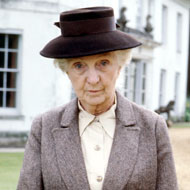
Joan Hickson in the role

October 13, 1930: The Murder at the Vicarage by Agatha Christie is published. It introduces the character of Jane Marple. This early version of "Miss Marple," as she is perennially known, is a gleeful gossip, and not an especially nice woman. The citizens of the fictional town of St. Mary Mead, said to be 25 miles from London, like her, but are often tired by her nosy nature and how she seems to expect the worst of everyone. In later books, along with a great private detective, she becomes a kinder and more modern person.

She did not appear in a film until 1961, when Margaret Rutherford played her in Murder, She Said. This, and Angela Lansbury's portrayal in the 1980 version of The Mirror Crack'd, inspired the title of Lansbury’s later TV series, Murder, She Wrote.

In 1976, Neil Simon spoofed her as Jane, a.k.a. Miss Marbles, played by Elsa Lanchester, in the film Murder By Death, with James Coco playing Milo Perrier, a sendup of Christie's other great detective, Hercule Poirot. Joan Hickson played her in 12 films for the BBC from 1984 to 1992, which aired on PBS as part of its Mystery! anthology series. ITV began airing movies with the character in 2004, with Geraldine McEwan playing the role until 2009, and Julia McKenzie from then until 2013.

*

October 13, 1930 was a Monday. The World Series ended 5 days earlier, with the Philadelphia Athletics beating the St. Louis Cardinals. Football was in midweek. The NBA hadn't been founded yet. And the NHL season was a week away. So there were no scores on this historic day.

Tuesday, October 11, 2022

October 11, 1930: The NHL's 1st Blockbuster Trade

October 11, 1930: The National Hockey League sees its 1st blockbuster trade, as opposed to the acquisition of a major player because a team badly needed to sell him.

Francis Michael Clancy was known as King, as was his father, Tom Clancy. (They were not related to the American novelist Tom Clancy.) Tom had starred in football for the Ottawa Rough Riders, and Frank starred as a defenseman for the Ottawa Senators, helping them win the 1923 and 1927 Stanley Cups.

On October 11, 1930, seeing Clancy come off the most productive season of his career, with 17 goals and 40 points in 44 games with the Senators, Toronto Maple Leafs head coach and general manager Conn Smythe acquired him, sending the Senators for left wing Eric Pettinger, defenseman Art Smith, and $35,000. 

Smith played 43 games for the Senators in 1930-31, and Pettinger 13. After that season, neither ever played in the NHL again. In contrast, in 1931-32, Clancy's 2nd season with the Leafs, and their 1st at Maple Leaf Gardens, they won the Stanley Cup. The Senators moved in 1934, becoming the St. Louis Eagles, played 1 more season there, and became victims of the Great Depression, going out of business. Ottawa did not return to the NHL until 1992. Toronto definitely got the better part of this deal.

Clancy remained with the Leafs through 1937. He coached the Pittsburgh Hornets, a Leafs farm team, to the 1952 American Hockey League Championship, the Calder Cup. He was an assistant coach on their 1962, '63, '64 and '67 Stanley Cup winners. He was elected to the Hall of Fame in 1958, and his Number 7 was retired -- for both him and a player he coached in Pittsburgh and Toronto, Tim Horton -- in 2016.

He died in 1986, at the age of 84, after 65 years of service to the NHL, a record since broken by Johnny Bucyk of the Boston Bruins' organization. In 1988, the NHL introduced the King Clancy Memorial Trophy, awarded annually to the "player who demonstrates leadership qualities on and off the ice and who has made exceptional humanitarian contributions in the community."

In 1998, The Hockey News ranked him 52nd on their list of the 100 Greatest Hockey Players. In 2017, 80 years after his last game, the NHL named him to its 100th Anniversary 100 Greatest Players.

*

October 11, 1930 was a Saturday. The start of the NHL season was a month away. The NBA hadn't been founded yet. The baseball season had ended 3 days earlier, when the Philadelphia Athletics won the World Series, beating the St. Louis Cardinals in 6 games.

Among the college football games played that day were these: 

* Army beat Swarthmore, 39-0 at Michie Stadium in West Point, New York; and Navy lost to Notre Dame, 26-2 at Notre Dame Stadium in South Bend, Indiana. That stadium had opened the week before, on October 4, with a 20-14 win over Southern Methodist University (SMU).

* In an early example of the football rivalry that would develop between professional teams in the 2 big steel cities, the University of Pittsburgh beat Western Reserve University, 52-0 at League Park in Cleveland. In 1967, Western Reserve merged with the Case Institute of Technology, and became Case Western Reserve University. CWR now competes in NCAA Division III, and their arch-rivals are Pitt's neighbors, Carnegie-Mellon University.

* Speaking of whom, Carnegie-Mellon were also formed by a merger in 1967, between the Carnegie Institute of Technology and the Mellon Institute of Industrial Research. On this day, in an intersectional matchup, Carnegie Tech beat Georgia Tech, 31-0 at Pitt Stadium.

* In another big intersectional game, Georgia beat Yale, 18-14 at the Yale Bowl in New Haven, Connecticut. This came a year after Georgia opened Sanford Stadium in Athens, Georgia by beating Yale, 15-0. Both games were considered big by Georgia because their school had been founded by missionaries from Yale, their 1st 4 campus buildings were designed to resemble Yale buildings, and they chose their mascot from Yale's, the Bulldogs.

* In a game that would become one of the biggest rivalries in the sport, Oklahoma beat Nebraska, 20-7 at Memorial Stadium in Norman, Oklahoma.

* Texas Christian University opened their new Amon G. Carter Stadium in Fort Worth, named for the publisher of the Fort Worth-Star Telegram, who had contributed toward its construction. TCU walloped the University of Arkansas, 40-0.

* The University of California beat their East Bay neighbors, Saint Mary's College, 7-6 at California Memorial Stadium in Berkeley. It was a bit of an upset, as it was the only game that Saint Mary's would lose all season, going 8-1, while Cal finished just 4-5. (Like another Catholic school, Saint Louis University, the "Saint" is always spelled out, never abbreviated.)

* Among New York City teams, Columbia beat Wesleyan University of Connecticut, 48-0 at Baker Field in Upper Manhattan; New York University (NYU) beat Philadelphia's Villanova, 20-6 at Yankee Stadium; City College of New York (CCNY) beat Seton Hall of South Orange, New Jersey, 44-12 at Lewisohn Stadium in Upper Manhattan; . 

The night before, Manhattan College had lost to Oglethorpe University of Georgia, 19-0 under temporary lights at the Polo Grounds; and, in the 1st night football game in Brooklyn, St. John's University beat Niagara University of Buffalo, 20-7 at Dexter Park. Fordham University had the week off.

* Among New Jersey teams, the aforementioned Seton Hall lost to CCNY; Rutgers lost to Syracuse, 27-0 at Archbold Stadium in Syracuse, New York; and Princeton lost to Brown, 7-0 at Palmer Stadium in Princeton.

* And Brigham Young University played Northern Colorado to a 7-7 tie at Jackson Field in Greeley, Colorado. This was a much bigger day for BYU than this result would suggest, because, also on this day, Reuben LaVell Edwards was born in Orem, Utah. In spite of playing football at Utah State University, and getting a master's degree at the University of Utah, he coached at BYU, as an assistant starting in 196,2 and then as head coach from 1972 to 2000.

He won 257 games, 19 Conference Championships (the 1st 18 in the Western Athletic Conference, the last in the Mountain West), and a dubious but official National Championship in 1984. BYU's former Cougar Stadium, built in 1964, was renamed LaVell Edwards Stadium in 2001, and he's in the College Football Hall of Fame. He died in 2016. His former assistants include Mike Holmgren, Brian Billick and Andy Reid.

Also on this day, William Charles Fischer is born in Wausau, Wisconsin. Bill Fischer had a rather unremarkable career as a baseball pitcher, going 45-58 from 1956 to 1964. The most notable moment in his career was with the Kansas City Athletics on May 22, 1963. He gave up a walkoff home run to Mickey Mantle, and it hit the frieze (it's usually, but incorrectly, called "the facade") above the right field stands, coming closer than any other fair ball to being hit out of the old Yankee Stadium. Fischer died on October 30, 2018, at age 88, and was a member of the Wisconsin Sports Hall of Fame.

Also on this day, Ronald Campbell Simpson is born in Glasgow, Scotland. The son of Glasgow Rangers centreback Jimmy Simpson, he was the starting goalkeeper for Newcastle United in the 1952 and 1955 FA Cup Finals, and then returned home to Glasgow to play for Celtic, where he won 4 Scottish League titles and the 1967 European Cup, as one of the "Lisbon Lions." He also played for Scotland in their shocking win over recent World Cup winners England at Wembley Stadium in 1967. He died in 2004, and is a member of the Scottish Football Hall of Fame. 

Finally, on this day, in English soccer, Arsenal, the North London team I would one day support, went to the East Midlands, and lost to Derby County, 4-2 at a stadium named The Baseball Ground. Derbyshire was one of the few places in England where baseball had caught on, but that didn't last long. The Baseball Ground, however, kept its name, from 1899 until 1997, when Derby moved into a new stadium.

Tuesday, October 4, 2022

October 4, 1930: Notre Dame Stadium Opens

October 4, 1930: Notre Dame Stadium, the house that Knute Rockne built, opens on the school's campus in South Bend, Indiana, 95 miles east of Chicago, 142 miles north of Indianapolis, and 206 miles west of Detroit. The 1st game is against Southern Methodist University of Dallas. Final score: Catholics 20, Protestants 14.
Notre Dame went undefeated that season, 10-0, and aside from SMU, only Army seriously challenged them, losing 7-6 in front of 110,000 at Soldier Field in Chicago. Years later, Notre Dame was retroactively recognized as National Champions for the 1930 season.
The season finale, a 27-0 win over USC at the Los Angeles Coliseum on December 6, would turn out to be the last game Rockne ever coached, as he was killed in a plane crash in Kansas on March 31, 1931.
Having previously played at Cartier Field since 1900, Notre Dame Stadium originally seated 59,075, which was big for the time. In 1996, that was still its capacity, making it one of the smaller stadiums among the powers of college football. After that season, it was expanded to its current 80,795, and it also received its first permanent lighting.
The expansion raised the height of the stadium, and partially (but not entirely) blocked the view of the Hesburgh Library, built as Memorial Library in 1963, and named for Father Theodore Hesburgh, president of the University from 1952 to 1987. The side facing the stadium is covered with a mural by Millard Sheets, titled Word of Life. It depicts Jesus surrounded by several saints. Since Jesus has his hands raised, and faces the stadium, the figure is known as "Touchdown Jesus."
Since opening Notre Dame Stadium, the Fighting Irish have won 9 National Championships: In 1930, under Rockne; in 1943, 1946, 1947 and 1949, under Frank Leahy; in 1966 and 1973, under Ara Parseghian; in 1977, under Dan Devine; and in 1988, under Lou Holtz.

The field has always been natural grass, and the end zones have never been decorated with anything but thin chalk slashes. The Stadium has hosted 2 games with the unofficial "Game of the Century" distinctions: Notre Dame's tie with Michigan State in 1966, and their win over Florida State in 1993.

They've had 7 Heisman Trophy winners: Quarterback Angelo Bertelli in 1943, quarterback Johnny Lujack in 1947, end Leon Hart in 1949, running back Johnny Lattner in 1953, quarterback Paul Hornung in 1956, quarterback John Huarte in 1964, and receiver Tim Brown in 1987. And 10 of their 1930-onward players have been elected to the Pro Football Hall of Fame: Hornung, Brown, end Wayne Millner, end George Connor, defensive end Alan Page, linebacker Nick Buoniconti, tight end Dave Casper, quarterback Joe Montana, defensive tackle Bryant Young and running back Jerome Bettis.

The stadium never hosted a concert until 2018, with Garth Brooks as the headliner. In January 2019, it hosted 2 outdoor hockey games: The NHL Winter Classic, with the Chicago Blackhawks, as the home team, losing 4-2 to the Boston Bruins; and then, 4 days later, Notre Dame's hockey team losing by the same score to one of their traditional rivals, the University of Michigan, the school that pioneered outdoor hockey.

*

October 4, 1930 was a Saturday. These other notable college football games were played on this day:

* Army beat Furman, 54-0 at Michie Stadium in West Point, New York.

* Navy beat William & Mary, 19-6 at Thompson Stadium in Annapolis, Maryland.

* New York University (NYU) beat West Virginia Wesleyan at Yankee Stadium.

* Columbia beat Union College, 25-0 at Baker Field (now Wien Stadium) in Upper Manhattan.

* Rutgers beat George Washington University, 20-6 at Neilson Field in New Brunswick, New Jersey.

* Princeton beat Amherst, 23-0 at Palmer Stadium in Princeton, New Jersey.

* In a rivalry later known as the Backyard Brawl, the University of Pittsburgh beat West Virginia, 16-0 at the old Mountaineer Field in Morgantown, West Virginia.

* Alabama beat Mississippi, 64-0 at Denny Stadium (later Bryant-Denny Stadium) in Tuscaloosa, Alabama.

* And Michigan and Michigan State played to a tie, 0-0 at Michigan Stadium in Ann Arbor.

Game 3 of the World Series was played. The St. Louis Cardinals beat the Philadelphia Athletics, 5-0 at Sportsman's Park in St. Louis. Bill Hallahan pitched a 7-hit shutout, and Taylor Douthit hit a home run. But the A's went on to win the World Series in 6 days.

Also on this day, Bill Wade, quarterback of the 1963 NFL Champion Chicago Bears, was born. So was Roz Wyman, whose vote on the Los Angeles Board of Supervisors made the difference in giving the land at Chavez Ravine to Walter O'Malley, owner of the Brooklyn Dodgers, so he could build a stadium there, moving the Dodgers to the Los Angeles Memorial Coliseum in the interim.

Tuesday, September 27, 2022

September 27, 1930: Bobby Jones Wins the Grand Slam

September 27, 1930: Bobby Jones completes what was then considered the Grand Slam of golf.

NOTE: For a long time, with this project, I resisted putting in references to golf, because of the kind of people who tend to play it. I finally caved in, although I haven't included as many references as I would if it were a real sport, which it is not.

Robert Tyre Jones Jr. was born on March 17, 1902 in Atlanta, the son of a prominent lawyer, and he became a lawyer himself. He battled health issues as a boy, and golf was recommended as a way of getting out into the open and breathing fresh air. He won his 1st tournament at the age of 14.

In the amateur age of golf, he won the U.S. Open in 1923, 1924, 1925, 1927 and 1928; the U.S. Amateur in 1924, 1925, 1927 and 1928; and The Open Championship, more commonly called the British Open, in 1926 and 1927.

Even at the time, the 1920s was called "The Golden Age of Sports." It was Babe Ruth in baseball, Red Grange in football, Howie Morenz in hockey, Jack Dempsey in boxing, Paavo Nurmi in track, Bill Tilden in tennis, and Man o' War in horse racing. In golf, it was Bobby Jones.

But Jones' best year would be after the Twenties stopped, Roaring and otherwise. In the Spring of 1930, while the world was falling into the Great Depression, he took a cruise to Britain. On May 31, at the place where golf is said to have been invented, the Old Course at St. Andrews, Fife, Scotland, he won The Amateur Championship, a.k.a. the British Amateur. He stayed, and, on June 20, he won The Open Championship, a.k.a. the British Open, at the Royal Liverpool Golf Club.

He came home to America, and, facing amateurs and professionals, without having given up his amateur status -- it must have been nice having a rich father -- he won the U.S. Open at Interlachen Country Club in the Minneapolis suburb of Edina, Minnesota on July 12. On September 27, at Merion Golf Club in the Philadelphia suburb of Haverford, Pennsylvania, he won the U.S. Amateur. At this point, this was considered "The Grand Slam" of golf.

Jones then retired, without ever having turned professional. Which means he never entered the PGA Championship, because PGA stands for "Professional Golfers' Association." In 1932, in Augusta, Georgia, he and investment banker Clifford Roberts founded Augusta National Golf Club on the site of a former plantation. Jones and Alister MacKenzie, a Scot who had designed courses all over the world, designed the golf course at the Club.

In 1934, Jones founded the Masters Tournament there. Still effectively an amateur, he entered the 1st edition of his own tournament... and finished in a tie for 13th. Horton Smith won it. By retiring from golf at the age of 28, the game's fans were spared from seeing the decline of Bobby Jones.

In 1953, Ben Hogan won the Masters and the U.S. and British Opens, becoming the 1st to win 3 of what became known as the 4 majors in a single year. However, the schedules for the British Open and the PGA Championship overlapped, making the winning of all 4 in 1 year impossible.

In 1960, Arnold Palmer won the Masters in April and the U.S. Open in June. According to his autobiography, A Golfer's Life, he and his friend Bob Drum of the Pittsburgh Presswhile on the trans-Atlantic flight to the British Open at St. Andrews, came up with the idea that adding it and the PGA titles that July would constitute a modern "Grand Slam." Drum spread the notion among the gathered media and it caught on. Palmer couldn't hold up his end of the bargain, finishing 2nd at the British Open, to Kel Nagle.

Jack Nicklaus won the Masters and the U.S. Open in 1972, but, like Hogan, finished 2nd in the British, to Lee Trevino. In 2000, Tiger Woods did not win the Masters, but won the next 4 majors: The 2000 U.S. Open, the 2000 British Open, the 2000 PGA Championship, and the 2001 Masters. Winning all 4 in a row became known as "The Tiger Slam."

But that's not the Grand Slam, because it wasn't all done in the same year. Indeed, while someone wins each of the majors in every year, winning all 4 is tough: Hogan, Nicklaus, Woods, Gene Sarazen and Gary Player are the only 5 golfers ever to have won "The Career Grand Slam." Famously, Sam Snead won 3 Masters, 3 PGA titles, and the 1946 British Open, but never won the U.S. Open, finishing 2nd 4 times. Phil Mickleson has had even more trouble at the U.S. Open, finishing 2nd 6 times, despite winning the Masters 3 times, the PGA twice and the British once. Trevino won the U.S., the British and the PGA twice each, but his best performance at the Masters was 10th place.

Bobby Jones died on December 18, 1971. He was not related to Robert Trent Jones and his son Robert Trent Jones Jr., also designers of golf courses.

*

September 27, 1930 was a Saturday. These baseball games were played that day:

* The New York Yankees beat the Philadelphia Athletics, 10-8 at Shibe Park in Philadelphia. Roy Sheird outpitched George Earnshaw. Babe Ruth had 2 home runs and 5 RBIs, while Lou Gehrig went 2-for-3 with 2 walks and an RBI. For the A's, Jimmie Foxx went 3-for-4 with a walk and an RBI.

Despite this Yankee win, the A's had already wrapped up the American League Pennant. Indeed, from 1926 to 1932, either the Yanks or the A's had won the Pennant every year.

* The New York Giants beat the Philadelphia Phillies, 5-3 at the Polo Grounds. Bill Terry went 1-for-4 with an RBI. Mel Ott went 2-for-4.

* A doubleheader was split at Ebbets Field. The Brooklyn Robins (as the Dodgers were known when Wilbert Robinson managed them from 1914 to 1931) won the opener, 8-2. The Boston Braves won the nightcap, 7-1.

* The Washington Senators beat the Boston Red Sox, 8-3 at Fenway Park in Boston.

* The Cleveland Indians beat the St. Louis Browns, 9-7 at League Park in Cleveland.

* A doubleheader was split at Navin Field (later Briggs Stadium and Tiger Stadium) in Detroit. The Detroit Tigers won the 1st game, 6-5. The Chicago White Sox won the 2nd game, 10-5.

* The Chicago Cubs beat the Cincinnati Reds, 13-8 at Wrigley Field in Chicago.

* And the Pittsburgh Pirates beat the St. Louis Cardinals, 11-8 at Sportsman's Park in St. Louis. Paul Waner went 2-for-5 with a walk and an RBI. Lloyd Waner did not play.

Among the college football games played that day were these:

* Alabama beat Howard College, 43-0 at Denny Stadium in Tuscaloosa, Alabama. Alabama went on to win the Southern Conference. The Southeastern Conference wasn't founded until 1933. Denny Stadium was renamed Bryant-Denny Stadium in 1975. Definitely not to be confused with the historically black Howard University in Washington, D.C., the then-all-white Howard College became Samford University in 1965.

* Michigan beat Michigan State Normal, 7-0 at Michigan Stadium in Ann Arbor. Not to be confused with Michigan State, Michigan State Normal became Eastern Michigan University in 1956.

* Washington State beat Albertson, 47-12 at Rogers Field in Pullman, Washington. "Wazzu" went on to win the Pacific Coast Conference. Albertson became the College of Idaho.

* In what will eventually be recognized as a major rivalry, the University of Southern California, USC, beat the University of California at Los Angeles, UCLA, 52-0 at at the Los Angeles Memorial Coliseum. Both teams played home games there, but, officially, this was a home game for UCLA.

* Army beat Boston University, 39-0 at Michie Stadium in West Point, New York.

* Among New York City teams, Columbia beat Middlebury, 48-0 at Baker Field in Upper Manhattan. Fordham beat the University of Baltimore, 73-0 at Fordham Field in The Bronx. New York University beat Hobart College, 35-0 at Ohio Field in Upper Manhattan. City College of New York beat Long Island University, 44-0 at Lewisohn Stadium in Upper Manhattan. Manhattan College lost to Rider College (now Rider University) of Lawrenceville, New Jersey, 14-7 at Innisfall Park in The Bronx. And St. John's University opened their season the next week.

* In addition to Rider beating Manhattan, one other New Jersey team was in action: Rutgers lost to Providence College, 12-6 at Neilson Field in New Brunswick. Princeton and Seton Hall opened their season the next week. Seton Hall dropped football after the 1932 season, due to the Great Depression. Providence dropped football after 1941, due to World War II.

* Texas played the next day, beating Texas Mines, the school now known as Texas-El Paso or UTEP, 28-0 at Memorial Stadium in Austin. Texas went on to win the Southwest Conference title.

* Notre Dame, who would go on to be awarded the National Championship, opened their season the following week. So did Kansas, who would go on to win the Big Six Conference title. Navy also opened the next week.

And in English soccer, North London team Arsenal went to St. Andrews Stadium, and beat Birmingham City, 4-2.

Thursday, September 15, 2022

September 15, 1930: Hoagy Carmichael Records "Georgia On My Mind"

September 15, 1930: Hoagy Carmichael records his composition "Georgia On My Mind" at RCA Victor's studio at 155 East 24th Street in New York City.

Hoagland Howard Carmichael was born on November 22, 1899 in Bloomington, Indiana. Sidney Zion, a columnist for the New York Daily News, listed him as one of "The Century Seven," 7 people born in 1899, the last year of the 19th Century, whose work guided American popular culture through much of the 20th Century. They were: Duke Ellington, born on April 29; Fred Astaire, May 10; James Cagney, July 17; Alfred Hitchcock, August 13; Hoagy Carmichael, November 22; Noël Coward, December 16; and Humphrey Bogart, December 25.

A pianist and composer, "Hoagy" attended Indiana University in his hometown, and, on visits to Chicago, became a professional pianist, meeting the great trumpeters Louis Armstrong and Leon "Bix" Beiderbecke. In 1925, he began recording with his own band, with "Washboard Blues." He became a star with his 1927 recording "Stardust," with lyrics by Mitchell Parish. The song's opening, "Sometimes, I wonder" became the title of his memoir.

His saxophone player, Frankie Trumbauer, was from St. Louis, but suggested to him that he write a song about the State of Georgia, contributing the opening: "Georgia, (pause), Georgia... " Carmichael's IU roommate was Stuart Gorrell, another Indiana native, and he wrote the lyrics.

Gorrell's name was absent from the copyright, but Carmichael sent him royalty checks anyway, so he could enjoy the benefits of the song's fame. Beiderbecke would not: He died from the effects of alcoholism on August 6, 1931.

In 1938, with Frank Loesser, Carmichael wrote "Heart and Soul." In 1942, with Johnny Mercer, he wrote "Skylark." In 1946, with Jack Brooks, he wrote "Ole Buttermilk Sky." In 1951, with Mercer, he wrote "In the Cool, Cool, Cool of the Evening."

In his 1st James Bond novel, Casino Royale, Ian Fleming had 2 characters remark that Bond looked like Carmichael. Fleming would repeat the comparison in his 3rd Bond novel, Moonraker.

On September 23, 1930, 8 days after Carmichael recorded "Georgia On My Mind," Ray Charles was born in Albany, Georgia. In 1960, Charles recorded the song, and made it a Number 1 hit, something that wasn't possible for Carmichael, as Billboard magazine didn't start its popular music chart until 1940. In 1979, the State of Georgia made Charles' recording the official State Song.

Frankie Trumbauer died in 1956, Stuart Gorrell in 1963. Hoagy Carmichael developed a 2nd career as a character actor, appearing in films and on television, and lived until December 27, 1981, when a heart attack took his life in Rancho Mirage, California. He was 82.

The RCA studio at 155 East 24th Street would also be the site of the recordings of such classics as Benny Goodman's "King Porter Stomp," Artie Shaw's "Begin the Beguine," Bunny Berigan's "I Can't Get Started," Glenn Miller's "Moonlight Serenade," Tommy Dorsey's "I'm Getting Sentimental Over You," Coleman Hawkins' "Body and Soul" and Duke Ellington's "Harlem Air Shaft." And, moving on to rock and roll, both sides of the greatest double-sided hit in music history: "Don't Be Cruel" and "Hound Dog" by Elvis Presley.

In 1968, RCA opened a new main recording studio to 110 West 44th Street, just off Times Square. They sold the 24th Street building to the City University of New York. CUNY tore it down in 1998, and built a "vertical campus" for Baruch College on the site.

*

September 15, 1930 was a Monday. These baseball games were played that day:

* The New York Yankees beat the Detroit Tigers, 5-3 at Navin Field in Detroit. (It was later renamed Briggs Stadium and Tiger Stadium.) Babe Ruth went 3-for-4 with a walk and an RBI. Lou Gehrig went 0-for-4.

* The New York Giants beat the Pittsburgh Pirates, 6-1 at the Polo Grounds in New York. Bill Terry went 4-for-5 with 2 RBIs. Mel Ott went 1-for-2 with 2 walks. Paul Waner and Lloyd Waner each went 1-for-4, with Lloyd adding an RBI.

* The Brooklyn Robins (as the Dodgers were known under the managing of Wilbert Robinson from 1914 to 1931) beat the Cincinnati Reds, 13-5 at Ebbets Field. Babe Herman and Del Bissonette each went 4-for-5 with 2 RBIs. Glenn Wright and Al Lopez each had 3 RBIs.

* A doubleheader was split at Baker Bowl in Philadelphia. The Philadelphia Phillies won the opener, 12-11. The Chicago Cubs won the nightcap, 6-4. With its 280-foot right-field pole, and a 60-foot wall, Baker Bowl was amenable to lefthanded hitters and slugfests, as these numbers show:

Over the 2 games, the Cubs' 5 Hall-of-Famers batted as follows: Rogers Hornsby went 2-for-6 with an RBI; Charles "Gabby" Hartnett went 2-for-4 with an RBI in the opener, but did not play in the nightcap; Lewis "Hack" Wilson went 3-for-8 with a walk and 2RBIs; Hazen "Kiki" Cuyler went 3-for-9 with an RBI; and former Giants legend George "High Pockets" Kelly went 5-for-8 with an RBI. In addition, Woody English went 3-for-10 with 3 RBIs, and Cliff Heathcote went 5-for-10 with 2 RBIs. The Phillies' only Hall-of-Famer, Chuck Kline, went 3-for-8 with 4 RBIs, while Don Hurst went 5-for-8.

* The Washington Senators beat the Chicago White Sox, 14-9 at Comiskey Park in Chicago.

* A doubleheader was split at Sportsman's Park in St. Louis. The St. Louis Browns won the opener, 3-1. The Boston Red Sox won the nightcap, 2-1, when Russ Scarritt singled home the winning run in the top of the 11th inning.

* To get a bigger gate, the game scheduled for this day between the Boston Braves and the Cincinnati Reds at Braves Field in Boston was moved to the day before, for a Sunday doubleheader. The Braves won the opener, 9-2. The Reds won the nightcap, 6-4.

* And the Cleveland Indians and the Philadelphia Athletics were not scheduled.

Wednesday, August 24, 2022

August 24, 1930: "All Quiet On the Western Front" Premieres

August 24, 1930: All Quiet On the Western Front premieres, directed by Lewis Milestone, and based on the novel published the year before by Erich Maria Remarque. The original German title was Im Westen nichts Neuesmeaning, "In the West, Nothing New."

The film begins with young recruits joining the German Army, ready to serve in "The Great War," as World War I was originally known. They are quickly disillusioned by the conditions of trench warfare. Since the movie was made in America, the cast was entirely American, including Lew Ayers as the lead character, Paul Bäumer.

After recovering from being wounded, Paul is given a furlough, and returns to his home town. There, he is shocked about how little the "home front" knows about the war. Returning to the classroom where his professor had talked him and his classmates into enlisting, he tells the class what war is really like. The professor, who has clearly never been in a war -- the Franco-Prussian War was nearly half a century before -- calls him a coward, and the students go along with this, and Paul has to leave.

In the final scene, Paul is back on the front line. He sees a butterfly just beyond his trench. Smiling, he reaches out for the butterfly. While reaching, however, he is shot and killed by an enemy sniper. A harmonica plays throughout the scene, until the sniper's bullet is heard, at which point Paul's hand and the harmonica both stop. The final sequence shows the 2nd Company arriving at the front for the first time, fading out to the image of a cemetery.

The film won Best Picture, and Milestone won Best Director, at the Academy Awards. It was remade in 1979, starring Richard Thomas and Ernest Borgnine, and another remake is set to premiere later in 2022, this time directed by German director Edward Berger, and Austrian actor Paul Kammerer as Paul Bäumer.

Erich Maria Remarque, then still using his birth name of Erich Paul Remark, was wounded while fighting for Germany in 1917. In 1933, the Nazis declared his writing "unpatriotic." Copies were removed from all libraries and restricted from being sold or published anywhere in the country. The film was banned in some countries because it was sympathetic to Germany, and in others because it promoted pacifism. It wasn't shown in Germany until 1952.

Remarque's sister was executed for anti-Nazi activities. He married actress Ilse Jutta Zambona, divorced her, then remarried her to prevent her from being deported from Switzerland to Germany, moved with her to New York, and finally returned to Switzerland.

He and Zambona cheated on each other, many times. He had affairs with actresses Hedy Lamarr, Dolores del Rio and Marlene Dietrich. Divorcing Zambona again, he married actress Paulette Goddard, who had been living in Switzerland since the time that she was married to actor Charlie Chaplin. Remarque was still married to her when he died in 1970.

Lewis Milestone lived until 1980, Lew Ayres until 1996.

*

August 24, 1930 was a Sunday. Rock and roll pioneer Jackie Brenston was born on that day. And these baseball games were played:

* A doubleheader was split at Yankee Stadium. The New York Yankees won the opener, 5-3. Allen "Dusty" Cooke won the game with a home run in the bottom of the 11th inning. Red Ruffing went the distance for the win. The Cleveland Indians won the nightcap, 4-2. Wes Ferrell outpitched Herb Pennock. Over the 2 games, Babe Ruth went 0-for-8 with a walk, and Lou Gehrig went 6-for-8 with a walk, but no RBIs.

* The New York Giants lost to the Chicago Cubs, 3-2 at Wrigley Field in Chicago. Bill Terry went 1-for-4, Mel Ott went 2-for-4.

* A doubleheader was split at Fenway Park in Boston. The Boston Red Sox won the 1st game, 2-0. Milt Gaston pitched a 3-hit shutout. The Chicago White Sox won the 2nd game, 5-4. Smead Jolley singled Bill Cissell home with the winning run in the top of the 11th inning.

* The Washington Senators beat the Philadelphia Athletics, 7-3 at Griffith Stadium in Washington. Rube Walberg went 3-for-4, but still ended up as the losing pitcher, as Alvin "General" Crowder held off the powerful lineup that included Jimmie Foxx, Mickey Cochrane and Al Simmons.

* A doubleheader was split at Redland Field (later Crosley Field) in Cincinnati. The Pittsburgh Pirates won the 1st game, 9-6. Pie Traynor went 4-for-5. The Cincinnati Reds won the 2nd game, 2-0. Ray Kolp pitched a 5-hit shutout.

* The St. Louis Browns beat the Detroit Tigers, 7-5 at Navin Field (later Briggs Stadium and Tiger Stadium) in Detroit.

* The St. Louis Cardinals swept the Philadelphia Phillies, 9-4 and 6-4 at Sportsman's Park in St. Louis.

* And the Brooklyn Dodgers (or the Brooklyn Robins, as they were known under Wilbert Robinson's management from 1914 to 1931) and the Chicago Cubs were rained out at Ebbets Field. The game was made up as part of a doubleheader on September 27. The Dodgers won the 1st game, 8-2. The Cards won the 2nd game, 7-1.

December 31, 1999 & January 1, 2000: The Millennium

December 31, 1999:  The Millennium arrives. The people of planet Earth survived. At a terrible cost. But we hadn't destroyed ourselves. ...