Showing posts with label 1935. Show all posts

Thursday, December 15, 2022

December 15, 1935: The Detroit Lions' Quick Title

Dutch Clark

December 15, 1935: In only their 2nd season, the Detroit Lions win the NFL Championship, defeating the New York Giants, 26-7 at the University of Detroit Stadium, a.k.a. Titan Stadium.

Having bought the Portsmouth Spartans of southern Ohio, radio executive George Richards moved them to his adopted hometown of Detroit. In their 1st season, 1934, they went 10-3 under head coach George "Potsy" Clark.

Quarterback Earl "Dutch" Clark (no relation to Potsy) and running back Ernie Caddell led the way. They began the 1935 season with a 35-0 home win over the Philadelphia Eagles. They tied the Chicago Cardinals at home, lost away to the Brooklyn Dodgers, beat the Boston Redskins away, and lost to the Green Bay Packers away.

They beat the Redskins at home, beat the Cardinals away, lost away to the Packers, then beat the Packers at home. They tied the Bears away, then beat them at home on Thanksgiving, and beat the Brooklyn Dodgers at home, finishing the regular season 7-3-2, and atop the NFL's Western Division. They would play the New York Giants, winners of the Eastern Division for the 3rd season in a row, and the defending Champions.

At the time, the NFL alternated home-field advantage in the Championship Game between the Division winners. This meant that the Lions would be hosting the game at a stadium seating only 25,000 people -- and only 15,000 tickets were bought. Lions quarterback and kicker Glenn Presnell recalled, "I remember that it was a snowy day, very cold, and there were far less fans there than the '34 Thanksgiving Day game. In those days, people didn’t go very often when it wasn’t nice weather."
Titan Stadium

In the 1st quarter, Leroy "Ace" Gutowsky and Dutch Clark rushed for touchdowns, though Glenn Presnell only converted 1 of the 2 extra points. Ed Danowski threw a 42-yard touchdown pass to Ken Strong in the 2nd quarter, to bring the Giants to within 13-7 at the half. But in the 4th quarter, Caddell and Raymond "Buddy" Parker each rushed for a touchdown, to give the Lions the 26-7 victory.

It had been just 2 months since the Detroit Tigers won the World Series. Four months later, the Detroit Red Wings would win the Stanley Cup. The year after that, they would do it again, and a Detroit-trained boxer, Joe Louis, would become the Heavyweight Champion of the World. Detroit had become, however briefly, the City of Champions.

Presnell was the last survivor of the 1935 Lions, living until 2004. He told an interviewer:

For winning the championship, we each received $300. We never got a championship ring like they do now, but it was certainly one of my proudest moments. Remember, professional football was not nearly as popular as college football and baseball. It was much more exciting to play college football at Nebraska in front of 40,000 people. It was a way to make a living during the Depression.

In 1938, Tigers owner Walter Briggs, having inherited the team from his late partner, Frank Navin, expanded their ballpark, Navin Field, enclosing it with two decks, and renaming it Briggs Stadium for himself. The Lions moved in.

In 1952 and 1953, Parker would coach the Lions to the NFL Championship. He was succeeded as head coach by George Wilson in 1957, and he led the Lions to another Championship. The 1953 and 1957 NFL Championship Games were played at Briggs Stadium, which was renamed Tiger Stadium in 1961. Through the 2021 season, the Lions have still not won another title since 1957.

The University of Detroit canceled its football program after the 1964 season. University of Detroit Stadium was demolished in 1971. A new, smaller athletic complex and its parking lot are now on the site. In 1990, the all-male University of Detroit merged with the all-female Mercy College of Detroit. The single coeducational school was named the University of Detroit Mercy.

The Lions do not have a team Hall of Fame. But they did name an All-Time Team in 2019, in connection with the NFL's 100th Season. From their 1935 NFL Champions, they named quarterback Earl "Dutch" Clark and guard-linebacker Grover "Ox" Emerson. From between their 1935 and 1952 titles, they named center-linebacker Alex Wojciehowicz.

Dutch Clark (but not Potsy Clark), Buddy Parker, Gutowsky, Wojciehowicz, George Richards and Byron "Whizzer" White, later to be a Justice of the U.S. Supreme Court, have been elected to the Michigan Sports Hall of Fame.

*

December 15, 1935 was a Sunday. Baseball out of season. The NBA hadn't been founded yet. There were 3 games in the NHL:

* The New York Rangers lost to the Detroit Red Wings, 4-2 at the Olympia Stadium.

* The New York Americans beat the Chicago Black Hawks, 3-0 at the (then relatively new) old Madison Square Garden.

* And the Boston Bruins beat the Montreal Canadiens, 2-1 at the Boston Garden.

Wednesday, December 14, 2022

December 14, 1935: Ted Drake Scores 7 Goals

December 14, 1935: Arsenal Football Club, of North London, travel to Birmingham, and defeat Aston Villa F.C., 7-1 at Villa Park. Forward Ted Drake scores all 7 of Arsenal's goals.

Drake did this despite a nagging knee injury; despite having Alex James, the little Scottish dynamo who usually served as Arsenal's Captain, out with an injury; and despite Villa, having struggled but invested heavily in recent days, signing 6 players for national teams (England, Scotland, Wales, Republic of Ireland and Northern Ireland), earning them the nickname "The Bank of England Club."

Drake scored 3 goals in the 1st half, reached 6 by the hour mark, and then saw the newly-acquired Jack Palethorpe score Villa's only goal. Drake thought he had a 7th when his shot hit the crossbar and bounced down, but the referee ruled that it had not crossed the line. In the game's last minute, he got his 7th. He had one other shot, which was saved.

At the time, this was believed to have tied the record for most goals scored in a Football League game, set back in the League's 1st season, 1888-89, when Jimmy Ross of Preston North End, the Lancashire team that went on to win the title and the FA Cup, English football's first "Double," scored 7 in a game against Staffordshire team Stoke City. Years later, research discovered that Ross had scored "only" 4 goals, and Drake had the record all to himself.

Just 12 days later, on December 26, Robert "Bunny" Bell scored 9 goals -- and missed a penalty that could have made it 10 -- for Merseyside team Tranmere Rovers against Manchester-area team Oldham Athletic. But this was in the Football League's Division Three North. Drake's record of 7 remained untouched for the remainder of the League's Division One. Nor has it been matched in the Division's successor, the Premier League, since its institution in 1992.

Drake helped Arsenal win the League in 1934, 1935 and 1938; and the FA Cup in 1936. In 1955, he managed West London team Chelsea to win the League title. This made him the 1st man to win the League as both a non-managing player and a non-playing manager. He died in 1995, at the age of 82.

*

December 14, 1935 was a Saturday. Actress Lee Remick was born on this day. So was actor Lewis Arquette, son of actor Cliff Arquette, and father of actors Patricia, Alexis, Rosanna, David and Richmond; making him the former father-in-law of actors Courteney Cox, Thomas Jane and Nicolas Cage, and composer James Newton Howard.

In America, baseball season was over, and the NBA hadn't been founded yet. There were no NFL games played, but the NFL Championship Game was played the next day: The Detroit Lions beat the New York Giants, 26-7 at Titan Stadium on the campus of the University of Detroit.

Three college football games were played:

* The University of Pittsburgh beat the University of Southern California, 12-7 at the Los Angeles Memorial Coliseum. This intersectional matchup wasn't officially a bowl game, but it may have felt like one to Pitt, more so than to USC.

* The University of California at Los Angeles (UCLA) beat St. Mary's, 13-7 at Kezar Stadium in San Francisco.

* And Hawaii beat Utah, 21-20 at Honolulu Stadium.

And 2 games were played in the NHL. The New York Rangers beat the Montreal Maroons, 6-2 at the Montreal Forum. And the Detroit Red Wings beat the Toronto Maple Leafs, 4-2 at Maple Leaf Gardens in Toronto.

Saturday, December 10, 2022

December 10, 1935: The 1st Heisman Trophy Is Awarded

Jay Berwanger

December 10, 1935: The Heisman Trophy is awarded for the 1st time, to Jay Berwanger.

John Jacob Berwanger was born on March 19, 1914 in Dubuque, Iowa. Like every other football star of the era, he played both offense and defense, in the backfield in his case. Like baseball legend Honus Wagner, he was of German descent, but nicknamed "The Flying Dutchman."

In a 1934 game for the University of Chicago against Michigan, he collided with their center, and left him a permanent scar near his eye. That Michigan center was Gerald Ford, who later became the President of the United States. Both men ended up in the College Football Hall of Fame. In his senior year, 1935, he rushed for 577 yards, passed for 405, returned kickoffs for 359, scored 6 touchdowns, and kicked 5 points-after-touchdown. 

And yet, both seasons, the Chicago Maroons went only 4-4. This was part of a decline of a once-great program: In 1939, they went 2-6, closing on November 25 with a 46-0 home loss to Illinois. On December 22, the University of Chicago dropped its football program. It reinstated its program in 1969, on an NCAA Division III level, where they remain. The Big Ten Conference dropped to a Big Nine, until 1953, when they admitted Michigan State.

As a pre-television football star at a school that no longer plays at the top level, Berwanger probably would have been forgotten, if not for a vote made by the Downtown Athletic Club in New York. They decided to recognize "the most valuable college football player east of the Mississippi." The following year, the Club's athletic director, coaching legend John Heisman, died, and the award was renamed for him: The Heisman Memorial Trophy. It was also expanded to allow for the best player in the entire country.

The trophy, designed by sculptor Frank Eliscu, is modeled after Ed Smith, a leading player in 1934 for New York University (NYU). The two men were classmates at Manhattan's George Washington High School, and so, commissioned by the Downtown Athletic Club for a commissioned sculpture of a football player, he asked Smith to pose in his uniform.

Smith did not realize until 1982, when Sports Illustrated decided to have the model tracked down, that the sculpture for which he had posed had become the Heisman Trophy. The DAC presented Smith with a Heisman Trophy of his own in 1985, on its 50th Anniversary.

The trophy is made out of cast bronze, 13.5 inches tall, 14 inches long, 16 inches wide, and weighs 45 pounds. From its inception in 1935, the statue was cast by Dieges & Clust in New York, and later Providence, Rhode Island, until 1980, when Dieges and Clust was sold to Herff Jones. Since 2005, the trophy has been made by MTM Recognition in Del City, Oklahoma.
The 1st vote went to Berwanger, receiving 43 percent of the votes. For as long as the Trophy is awarded, he will be remembered as its 1st winner. It was awarded at the Downtown Athletic Club in Lower Manhattan from 1936 to 2000. The DAC's facilities were ruined as a result of the 9/11 attacks, and so the Yale Club took over hosting duties in 2001.

The DAC went out of business, and the Heisman Trust was created to award the Trophy and to do the other things that the DAC had done. The Marriott Marquis Hotel in Times Square hosted in 2002, '03 and '04. From 2005 to 2019, the ceremony was held across the street at the PlayStation Theater in Times Square. The COVID-19 epidemic prevented a full ceremony for 2020, and so the award was presented at the ESPN Studios in Bristol, Connecticut.  Since 2021, it has been held at Jazz at Lincoln Center.

As the player of the year, Berwanger was an easy choice to be the 1st pick in the 1st-ever NFL Draft, the following February. He was chosen by the team with the previous season's worst record: The Philadelphia Eagles.

But the Eagles also made the 1st-ever puzzling Draft Day move: Team owners Bert Bell (later to be the Commissioner of the NFL) and Lud Wray had heard that Berwanger was going to demand $1,000 per game (NFL contracts were per game back then, not per season), and they didn't think they could afford that, so they traded Berwanger's rights to the Chicago Bears, in exchange for tackle Art Buss. Buss played 2 seasons for the Eagles, having already played 2 for the Bears, and this is the most interesting thing about him.

But at least the Eagles got something for Berwanger's rights. The Bears got nothing. At first, Berwanger chose not to sign for the Bears, or any team for that matter, because he wanted to maintain his amateur status, so that he could compete in the decathlon at the 1936 Olympics in Berlin. Certainly, a worthy goal, and one that Bears owner, general manager and head coach George Halas could respect. The Olympics would be in early August, and the Bears' 1st game wouldn't be until September 20. Halas could afford to bide his time.

But Berwanger didn't make the Olympic team, and the Gold Medal in the decathlon went to another American, Glenn Morris, who had also played football, at Colorado A&M University (which became Colorado State in 1958). So Berwanger went to Halas, and asked for $15,000 for the season -- which worked out to $1,250 a game, more than the Eagles thought he would demand.

Halas was known for his cheapness, but was willing to go as high as $13,500. Berwanger declined, and got a job with a Chicago-based rubber company, and also coached at the University of Chicago until it dropped its football program in 1940. He never played a down of professional football, and told an interviewer that he regretted not having accepted Halas' offer.
Ed Smith was chosen in the 3rd round of that 1st draft, by the Washington Redskins. He played for them in 1936, and for the Green Bay Packers in 1937. He later worked for the Otis Elevator Company, and lived until 1998. Trophy sculptor Frank Eliscu lived until 1996. Berwanger died after a lengthy battle with lung cancer, at his home in the Chicago suburb of Oak Brook, Illinois, on June 26, 2002, at the age of 88. 

*

December 10, 1935 was a Tuesday. Football was in midweek. The NFL Championship Game was played the following Saturday: The Detroit Lions beat the New York Giants, 26-7 at the University of Detroit Stadium.

Baseball was out of season. The NBA hadn't been founded yet. There were 2 games played in the NHL. The New York Americans beat the Toronto Maple Leafs, 4-2 at the old Madison Square Garden. And the Boston Bruins beat the Montreal Maroons, 2-0 at the Boston Garden.

Sunday, December 4, 2022

December 4, 1935: Swastikas Over White Hart Lane

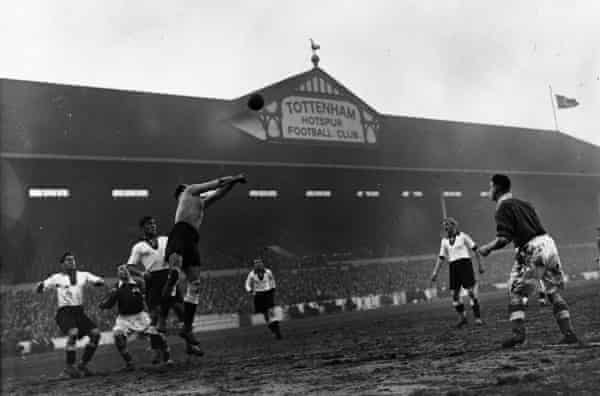
The Swastika flag can be made out,
in the upper-right corner of the photo.

December 4, 1935: The national soccer teams of England and Germany play each other at White Hart Lane in Tottenham, Middlesex, a northern suburb of London. The match is surrounded by controversy.

That had not been the case the 1st time the teams played each other. On May 10, 1930, at the Poststadion in Berlin, with Germany governed by the Weimar Republic, there were no incidents, and the game ended in a draw, 3-3.

But in 1933, the Nazi Party took power in Germany. Their oppression of the nation's Jews, for blaming them for Germany's defeat in World War I, caught the attention of the world. And so, when a 2nd football match between the countries was set for England, many people worried about what Germans, traveling to watch their team play, might do to English people they perceived as Jewish.

To make matters worse, the chosen venue for the match was White Hart Lane, in Tottenham. Until a 1963 Act of Parliament redrew the boundaries of England's Counties, Tottenham was part of Middlesex. Effective January 1, 1965, it would be a part of London, as would parts of Kent and Surrey, while Middlesex was eliminated entirely.

Fans of Tottenham Hotspur, or "Spurs," the team playing home games at The Lane, have always claimed that "North London is ours." It's never been true: Arsenal, 4.7 miles away, and officially within London since 1913 (even though White Hart Lane never moved following its opening in 1899), have always been the more successful team.

Why did the choice of venue make things worse? Because Tottenham has long been thought of as a Jewish area of London, and "Spurs" a "Jewish club." It's not true: Their local area does not have a noticeably larger percentage of Jewish residents than most of London.

Nevertheless, their fans have accepted this identity, flying Israeli flags, and even using an anti-Semitic slur (which I won't use here) for the name of their hooligan firm. Fans of other London teams, including (regrettably) Arsenal, East End team West Ham United, and West London team Chelsea have also used slurs and anti-Semitic tropes against them.

It had been rumored that 8,000 Germans were traveling to London for the match, and trouble was feared. In fact, none of the Germans among the crowd of 54,164 is known to have caused any trouble. Still, the photographs showing the Nazi Swastika flag flying over White Hart Lane, as well as the English Cross of St. George and the British Union Jack, was jarring.

Germany wore white shirts. England, wearing blue, fielded this lineup:

* Goalkeeper, Henry Gibbs, of Birmingham City.
* Right back, George Male of Arsenal.
* Left back and team Captain, Eddie Hapgood of Arsenal.
* Right half, Jack Crayston of Arsenal.
* Centre half, Jack Barker of Derby County.
* Left half, John Bray of Manchester City.
* Outside right, Stanley Matthews of Stoke City.
* Inside right, Horatio "Raich" Carter of Sunderland.
* Centre forward, George Camsell of Middlesbrough.
* Inside left, Ray Westwood of Bolton Wanderers. And...
* Outside left, Cliff Bastin of Arsenal.

If 4 Arsenal players in the starting lineup seems excessive, let the record show that Arsenal had won the last 3 Football League titles, and that the 1934 match against Italy known as "The Battle of Highbury," at Arsenal's stadium, had 7 Arsenal players.

As The Times of London reported, the game was not much of a contest. I have left the account as written, with no changes of spelling or grammar:

England beat Germany at White Hart Lane yesterday by three goals to none. The football was naither as interesting to watch nor as perfect in technique as it might have been, but the afternoon was a great success for at least two reasons. First, the game was played throughout in the friendliest of spirit ; and, secondly, after a morning of heavy and persistent rain, the sun came out, and both the players and the spectators had far better conditions than they could have expected three or four hours before the kick-off.

Germany were fortunate in that the margin against them was not bigger, and it would be flattery to pretend otherwise...

England's one goal came when Camsell was given a pass which sent him racing through in the inside-left position, and his shot, taken from an extremely acute angle, could not be stopped...

First a movement down the left wing begun by Hapgood ended with Bastin centreing across for Camsell to head into the net, and then some splendid football by Bastin, who had worked into the centre, led up to Camsell, who had run over to the left, to return the ball to Bastin, who never looked like making a mistake with his shot.

So that was 2 goals for Camsell, and 1 for Bastin, whose 178 goals for Arsenal would be a club record until 1997, and are still 3rd all-time behind the 228 of Thierry Henry and the 185 of Ian Wright.

The Observer, which had warned of German violence, had to admit: "So chivalrous in heart and so fair in tackling were the English and German teams who played at Tottenham in mid-week that even the oldest of veterans failed to recall an international engagement played with such good manners by everybody."

The teams would play just once more before World War II broke out, at the Olympiastadion in Berlin in 1938. The German players saluted the Nazi flag. The English players did as well, in a gesture of solidarity, except for Stan Cullis of Wolverhampton Wanderers, later to manage that team to glory.

*

December 4, 1935 was a Wednesday. Baseball was out of season. Football was in midweek. The NBA hadn't been founded yet. And while the NHL season was underway, no games were scheduled. So the England-Germany football match produced the only score on this historic day.

Wednesday, November 30, 2022

November 30, 1935: The Game That Made Texas Football

November 30, 1935: If, as they say, football is a religion in the State of Texas, then this was their moment of evangelism, when they spread their gospel throughout the land.

Dallas is the largest city in North Texas. Fort Worth is the 2nd-largest. Dallas is home to Southern Methodist University. Fort Worth is home to Texas Christian University, affiliated with a different Protestant sect, the Disciples of Christ. SMU's Ownby Stadium and TCU's Amon G. Carter Stadium are just 40 miles apart, making their schools among the closest major rivals in college football. (For comparison's sake, in the State's biggest football rivalry, Texas and Texas A&M are 104 miles apart.)

Ownby Stadium was named for its benefactor, Jordan C. Ownby. Amon G. Carter was the publisher of the city's largest newspaper, the Fort Worth Star-Telegram, a.k.a. the Startle-gram. Left his fortune, his daughter Ruth Carter Stevenson spent much of it to found Fort Worth's Amon Carter Museum Museum of American Art, the most popular museum dedicated to art about the American West.

As with any other pair of big cities that are relatively close -- such as Minneapolis and St. Paul, Tampa and St. Petersburg, San Francisco and Oakland, etc. -- Dallas and Fort Worth don't like each other, despite all that they have in common. Fort Worthers think Dallasites are stuck-up, what with their nouveau riche money in oil, banking and insurance. Dallasites point to the fact that Fort Worth is known for its stockyards, and think of Fort Worthers as their country cousins, bumpkins.

From 1916 to 1921, interrupted by serving in World War I, Leo Robert Meyer, nicknamed Dutch because he was of German descent and people tended not to be able to tell the difference between "Dutch," from the Netherlands, and "Deutsch," the Germans' name for themselves, played end for TCU.

In 1923, he was named an assistant coach for them. In 1934, he was named head coach, and would remain so until 1952. He also coached baseball there, on and off, from 1926 to 1957; and basketball from 1934 to 1937. He was also their athletic director from 1950 to 1963, and lived until 1982, age 84.

In 1981, TCU graduate Dan Jenkins, the college football expert for Sports Illustrated, wrote an article for their College Preview Issue about growing up in Fort Worth as a TCU fan. He was just about to turn 7 when this game was played, but seemed to remember it well. He also claimed to remember Dutch Meyer once telling his players, "Football is a game played by men! Not by a bunch of damn sissies and city slickers from Dallas!"

And how did the "men" play for the Horned Frogs of TCU in 1935? Pretty well: They came into the game 10-0, their defeated opponents including Texas, Texas A&M and Arkansas. They were led by a quarterback named Sammy Baugh. Slingin' Sammy was the greatest passer Texas had ever seen -- maybe the greatest anybody had ever seen to that point.

And how did the "bunch of damn sissies and city slickers from Dallas" play for the Mustangs of SMU that year? About equally well: They came into the game 10-0, their defeated opponents including Texas, Arkansas, and UCLA at the Los Angeles Memorial Coliseum. They had a game at Texas A&M yet to come. Their best player was halfback Bob Wilson.

They were coached by William Madison "Matty" Bell, who had also played end, although not at the school he was coaching now, but at Centre College in Kentucky. He had been TCU's head coach from 1923 to 1928, with Meyer on his staff. So perhaps Meyer was taking this personally.

So the rivals came into the game undefeated, with the championship of the Southwest Conference on the line. It could have even been for the National Championship, because the Rose Bowl was talking about inviting the winner. Four weeks earlier, Notre Dame had beaten Ohio State in a game that was called "The Game of the Century" by some people. But in Texas, this game was called "The Game of the Century." NBC decided to broadcast it live on radio to the entire country. A crowd of 36,000 packed into Carter Stadium to watch it in person.
Amon G. Carter Stadium. Built in 1930
and expanded a few times since, TCU still play there.

The only scoring in the 1st quarter was an SMU touchdown. The Mustangs scored again early in the 2nd quarter. But Baugh led the Frogs on a touchdown drive, and the half ended 14-7 SMU. It remained that way through the 3rd quarter, but Baugh led a touchdown drive early in the 4th quarter, and the game was tied.

With 9 minutes left to play, and a 4th down and long to go, Bob Finley faked a punt and threw to Wilson, who took the ball in for a touchdown. The extra point was missed, so SMU's lead was 20-14, giving TCU fans hope of winning, 21-20.

With the clock winding down, Baugh took the Horned Frogs down the field, and got to the SMU 35-yard line. But on the final play, he threw into the end zone, and his receiver was too well-covered, and SMU's 20-14 lead held. SMU's band played "California, Here I Come."

Grantland Rice, the nation's leading syndicated sports columnist, covered the game, called it "one of the greatest football games ever played." It is credited with elevating the Southwest Conference to the college football equivalent of "major league" status. In 2017, The Dallas Morning News ranked it the greatest game ever played between the 2 rivals. However, having taken place in the age of radio, it tends to get passed over in "Game of the Century" discussions in Texas, in favor of the nationally-televised 1969 game between Texas and Arkansas.

SMU still had to play Texas A&M, but beat them, after which they were, indeed, invited to the Rose Bowl. But they lost it to Stanford. TCU went to San Francisco to play their last scheduled regular-season game, beating Santa Clara University. They were invited to the Sugar Bowl in New Orleans, and beat Louisiana State.

TCU, in spite of their loss to SMU, were named National Champions by the Williamson System. SMU, in spite of their loss to Stanford, were named National Champions by the Dickinson System, the Houlgate System, and, retroactively, by the Berryman System and the Sagarin Ratings. The University of Minnesota were selected as National Champions by United Press (UP, forerunners of United Press International or UPI), the Billingsley Report, the Boand System, the Helms Athletic Foundation, the Litkenhous System, the Poling System, and retroactively by the College Football Researchers Association and the National Championship Foundation.

This system didn't work too well. For the 1936 season, the Associated Press (AP) began polling the sportswriters who covered college football. Usually, they got it right. UP/UPI, which polled the nation's head coaches, usually named a National Champion, and it usually matched the AP's selection. On the occasions when it didn't, their selection was usually justifiable, if not the better choice. Still, this system proved unsatisfying. The Bowl Championship Series made things better, and the current College Football National Playoff system better still, but there have been flaws in every system yet tried.

Baugh went on to a great career with the NFL's Washington Redskins, and was a charter inductee into the College and Pro Football Halls of Fame. TCU won a legitimate National Championship in 1938, with another great quarterback, Heisman Trophy winner Davey O'Brien. But for the rest of the 20th Century, they tended to struggle, before a revival in the early 21st Century.

None of SMU's players did much in the pros, but they had a better record over the next few decades than TCU. In 1982, they nearly won the National Championship with their "Pony Express" backfield of Eric Dickerson and Craig James. But their cheating on top of cheating led them to become the 1st, and still the only, college football program ever to receive the NCAA's "death penalty," in 1986. They started play again in 1989, and they've been what college basketball fans call a "mid-major" school ever since. But then, so have TCU.

Carter Stadium still stands, with significant modernization. Ownby Stadium was demolished in 1998, and Gerald J. Ford Stadium was built on the site. Again, the new stadium was named for its funder. He was not related to Gerald R. Ford, the 38th President of the United States -- although that Gerald Ford was an All-American football player in 1935, a center at the University of Michigan.

*

November 30, 1935 was a Saturday. Comedian and director Woody Allen was born on this day.

These other notable college football games were played that day:

* Army beat Navy, 28-6 at Franklin Field in Philadelphia.

* Georgia Tech beat Georgia, 19-7 at Grant Field in Atlanta.

* Mississippi beat Mississippi State, 14-6 at Hemingway Stadium (now Vaught-Hemingway Stadium) in Oxford, Mississippi.

* Louisiana State beat Tulane, 41-0 at Tulane Stadium.

* Washington University beat crosstown rivals Saint Louis University, 26-0 at Walsh Memorial Stadium.

* Columbia beat Dartmouth, 13-7 at Baker Field in Manhattan.

* And Princeton beat Yale, 38-7 at the Yale Bowl in New Haven, Connecticut.

Actually, most of the big rivalries that weekend were played 2 days earlier, on Thanksgiving Day: Fordham beat New York University 21-0 in front of 72,000 at Yankee Stadium, Pittsburgh and next-door neighbors Carnegie Tech (now Carnegie-Mellon) played to a 0-0 tie, Kentucky beat Tennessee, Missouri and Kansas played to a 0-0 tie, Oklahoma beat Oklahoma State, and Utah and Utah State played to a 14-14 tie.

And, most important from the Lone Star State's perspective, for if football is a religion there, then this is its holy war: Texas A&M beat Texas, 20-6 at Kyle Field in College Station.

Baseball was out of season. The NBA hadn't been founded yet. There were 3 NHL games played that day:

* The New York Americans beat the Boston Bruins, 2-1 at the old (but then still relatively new) Madison Square Garden.

* The Montreal Maroons beat the Detroit Red Wings, 3-2 at the Montreal Forum.

* And the Toronto Maple Leafs beat their arch-rivals, the Montreal Canadiens, 8-3 at Maple Leaf Gardens in Toronto.

And in English soccer, North London team Arsenal went to Yorkshire, and played Huddersfield Town to a draw, 0-0 at Leeds Road in Huddersfield.

Wednesday, November 16, 2022

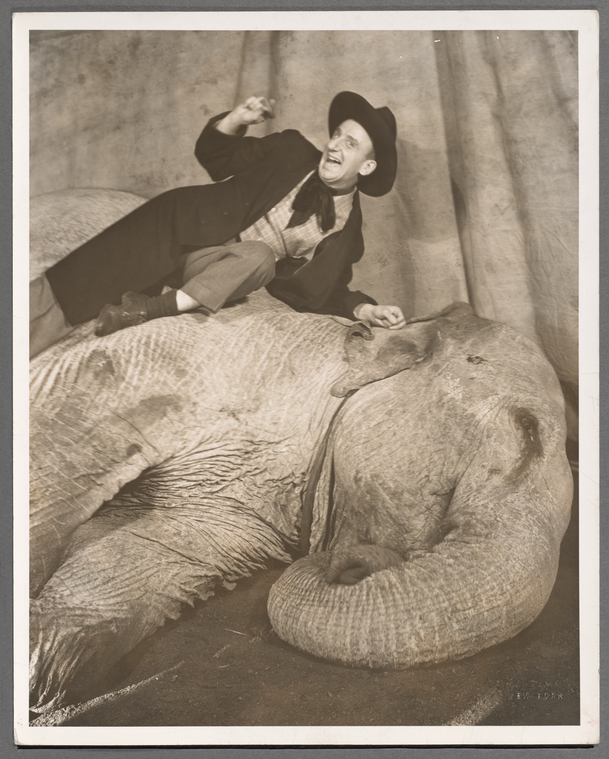
November 16, 1935: Billy Rose's "Jumbo" Premieres, Starring Jimmy Durante

November 16, 1935: Jumbo opens at the New York Hippodrome. The music was written by Richard Rodgers, the lyrics by Lorenz Hart, and the book by Ben Hecht and Charles MacArthur. It was produced by Billy Rose, one of the leading impresarios of the era.

It tells the story of a troubled circus that gets saved by a large elephant, a story based on how the real Jumbo was featured by P.T. Barnum from 1882 until its death in 1885. It is filmed in 1962, as Billy Rose's Jumbo, as Rose made a deal that, if it were ever made into a movie, his name would appear in the title, even if he had nothing to do with it.

William Samuel Rosenberg was born on September 6, 1899 in Manhattan. He began his entertainment career as a songwriter, writing the lyrics for such songs as "Me and My Shadow" with Edward Eliscu, "Does the Spearmint Lose Its Flavor on the Bedpost Overnight" (later "Does Your Chewing Gum Lose... ") with Marty Bloom, "I Found a Million Dollar Baby" with Mort Dixon, and "It's Only a Paper Moon" with Yip Harburg.

He moved into producing shows, including several on Broadway. In 1937, he established Billy Rose's Aquacade, a water stunt show, moving it to the New York World's Fair in 1939. The amphitheater where it was staged was one of the last remaining structures from that Fair.

He was married 5 times to 4 different women. The 1st of these was the famed comedienne Fanny Brice, on whom the musical Funny Girl was based. The 2nd was Olympic Gold Medal swimmer Eleanor Holm, who starred in his Aquacade. Their affair had broken up both of their marriages. His 3rd and 4th wife was showgirl Joyce Matthews, who had also married and divorced comedian Milton Berle twice.

In his later years, Rose continued to run theaters and produce shows, and was an activist for the State of Israel. He died on February 10, 1966, at his vacation home in Montego Bay, Jamaica.

The star of both the Broadway and the film versions of Jumbo was Jimmy Durante. In it, he led a live elephant across the stage. An actor playing a policeman asked him, "What are you doing with that elephant?" Durante said, "What elephant?" Thus was born the expression "the elephant in the room." Doris Day co-starred in the film version.

James Francis Durante was born on February 10, 1893, on the Lower East Side of Manhattan, the son of immigrants from Salerno in southern Italy. In 1918, Durante's Original New Orleans Jazz Band (he was the only member not from New Orleans) was (as far as is known) the 1st racially integrated jazz band. Known as "Ragtime Jimmy," he played piano and sang, but he couldn't resist stopping a song to tell a joke.

He was nicknamed "Schnozzola" (an Italianization of the Yiddish word "schnoz") for his enormous nose, but his heart was bigger. Through vaudeville, film, radio and television, he made people laugh from coast to coast. He was known for singing the 1934 hit "Inka Dinka Doo," the 1944 hit "You Gotta Start Off Each Day With a Song," and his version of the 1954 hit "Young at Heart." His catchphrases included "Ah-cha-cha-cha!" "Everybody wants to get into the act!" and "I got a million of 'em!"

In the 1942 film The Man Who Came to Dinner, he played Banjo, a character based on Harpo Marx of the Marx Brothers. In 1963, he played Smiler Grogan, the dying gangster whose stash of cash kicks off the "cast of thousands" comedy It's a Mad, Mad, Mad, Mad World. In 1969, he voiced the narrator of the Christmas special Frosty the Snowman. He inspired numerous cartoon characters, including Spike the bulldog in the Tom & Jerry cartoons, and Doggie Daddy (father of Augie Doggie) from the Hanna-Barbera cartoons.

He hosted 2 different TV shows in the 1950s, closing by saying, "And goodnight, Mrs. Calabash, wherever you are." "Mrs. Calabash" was his pet name for his 1st wife, Jeanne Olsen, died in 1943.

Jimmy was a poor kid who made it big, and, unlike some, he never forgot. He was a big supporter of President Franklin D. Roosevelt's New Deal. He was one of the performers at the Madison Square Garden fundraiser for President John F. Kennedy's birthday in 1962, which everyone remembered for Marilyn Monroe singing "Happy Birthday."

He died on January 29, 1980. The Shriners had a statue made of him, for his contributions to their cause, with an inscription that truthfully stated that his heart was even bigger than his nose.

The Hippodrome Theatre, also called the New York Hippodrome, was on 6th Avenue between 43rd and 44th Streets, a block east of Times Square. It operated from 1905 to 1939 and was called the world's largest theater by its builders, with a seating capacity of 5,300 and a stage measuring 100 by 200 feet. It had state-of-the-art theatrical technology, including a tank built into the stage apron that could be filled with water for aquatic performances. A modern office tower known as The Hippodrome Center opened on the site in 1952.

*

November 16, 1935 was a Saturday. Political columnist Elizabeth Drew was born.

Baseball was out of season. The NBA hadn't been founded yet. There were 2 games in the NHL. The New York Rangers lost to the Toronto Maple Leafs, 3-2 at Maple Leaf Gardens in Toronto. And the Montreal Maroons beat the Boston Bruins, 1-0 at the Montreal Forum.

And these notable college football games were played:

* Minnesota beat Michigan, 40-0. It was one of the worst defeats the Wolverines have ever sustained at Michigan Stadium in Ann Arbor. The Golden Gophers went on to go undefeated and win the Big Ten Conference and National Championships.

* In a major rivalry, Virginia and Virginia Tech played to a tie, 0-0 at Scott Stadium in Charlottesville, Virginia.

* In a major rivalry, Duke beat North Carolina, 25-0 at Duke Stadium (now Wallace Wade Stadium) in Durham, North Carolina. Duke won the Southern Conference Championship.

* In a major rivalry, Vanderbilt beat Tennessee, 13-7 at Shields-Watkins Field (later Neyland Stadium) in Knoxville, Tennessee. At the time, this was not an upset, let alone a major one, like it would be in the modern era.

* Louisiana State University beat Georgia, 13-0 at Sanford Stadium in Athens, Georgia. This clinched the Southeastern Conference Championship for LSU.

* The University of Pittsburgh beat Nebraska, 6-0 at Pitt Stadium in Pittsburgh. In spite of their defeat, Nebraska won the Big Six Conference title.

* Southern Methodist University beat Arkansas, 17-6 at The Hill in Fayetteville, Arkansas.

* Texas Christian University beat Texas, 28-0 at Memorial Stadium in Austin. Two weeks later, SMU beat TCU to win the Southwest Conference Championship. TCU went on to beat LSU in the Sugar Bowl.

* Stanford beat the University of Montana, 32-0 at Stanford Stadium in the San Francisco suburb of Palo Alto, California. The next week, Stanford beat the University of California, to win the Pacific Coast Conference title. They went on to beat SMU in the Rose Bowl, 7-0, eliminating SMU from National Championship consideration. A 7-6 loss to UCLA earlier in the season cost them an undefeated season and the National Championship.

* Army and Notre Dame played to a 6-6 tie in front of 78,114 people at Yankee Stadium.

* Navy beat Columbia, 28-7 at Thompson Stadium in Annapolis, Maryland.

* Fordham beat Muhlenberg, 45-0 at the Polo Grounds.

* The University of Pennsylvania beat Penn State, 33-6 at Franklin Field in Philadelphia.

* Princeton beat Lehigh, 27-0 at Palmer Stadium in Princeton, New Jersey.

* And the night before, New York University beat Rutgers, 48-0 at Ohio Field in The Bronx.

Wednesday, November 9, 2022

November 9, 1935: The Floyd of Rosedale Trophy

November 9, 1935: One of college football's greatest rivalry trophies has its origin.

Ask longtime fans of the University of Iowa, and they'll say the Hawkeyes' real arch-rival isn't Iowa State, or the University of Nebraska. It's the University of Minnesota. And ask longtime fans of the University of Minnesota, and they'll say the Golden Gophers' real arch-rival isn't the University of Wisconsin, or the University of Michigan. It's the University of Iowa.

The neighboring States' State universities had been playing each other since 1891, and in 1934, things turned nasty over the rough treatment of Ozzie Simmons, a black halfback for Iowa.

The rhetoric got really threatening for the 1935 game, and even the Governors got in on it, with Clyde Herring of Iowa saying the Iowa City crowd wouldn't stand for any rough stuff by the Minnesota players. He got accused of inciting a riot by Minnesota's Attorney General, Harry Peterson. Peterson's boss, Governor Floyd Olson, decided to lighten the mood, with what is, as far as I can tell, the first friendly bet between politicians representing opposing teams: A Minnesota "prize hog" against one from Iowa. Herring took the bet.

The game was played in Iowa City, at Iowa Stadium, renamed Kinnick Stadium in 1972, in memory of Nile Kinnick, Iowa's 1939 Heisman Trophy winner who was killed in a World War II flight training accident in 1943.

There was no incident at the game, either on the field or in the stands. Both teams played cleanly. Simmons walked off the field, receiving handshakes rather than injuries from the Minnesota players. Minnesota won, 13-6, and won their 3rd straight Big Ten Conference Championship, and their 2nd of 3 straight National Championships.

Herring contacted Rosedale Farms outside Fort Dodge, Iowa, and sent the pig to Olson, naming it Floyd of Rosedale, for Olson and the farm. (Had Iowa won, there could have been a trophy named Clyde of Minnetonka.) Olson then commissioned a trophy to be given annually to the winner of the game, because a 98-pound trophy is easier to move than a several-hundred-pound live pig.
Governor Clyde Herring of Iowa (left)
and Governor Floyd Olson of Minnesota,
with the original Floyd of Rosedale, 1935

Herring, a Democrat, was elected to the U.S. Senate in 1936, but lost in 1942, and died in 1945. Olson, a member of the Farmer-Labor Party, a kind of Socialist party that Hubert Humphrey later merged with the State Democratic Party, wasn't so lucky: He was already dying of cancer at the time of the bet, and passed away 9 months later.

Going into their meeting on November 19, 2022, Minnesota lead Iowa, 62-51-2, despite Iowa having won the last 7 games, and 17 of the last 21. Minnesota's lead is partly due to having won the 1st 12 games, from 1891 to 1916. Since the trophy (counting the original pig) was first awarded in 1935, Iowa lead, 43-42.

Iowa also play Iowa State for the Cy-Hawk Trophy (Cyclones vs. Hawkeyes), and Nebraska for the Heroes Trophy. Minnesota also play Wisconsin for Paul Bunyan's Axe, and Michigan for the Little Brown Jug. But both teams would rather win The Pig: Floyd of Rosedale.

*

November 9, 1935 was a Saturday. Among the other college football games played that day were these:

* A doubleheader was held at the Los Angeles Memorial Coliseum. Stanford beat Southern California, 3-0. And Southern Methodist beat UCLA. Stanford won the Pacific Coast Conference title, and SMU the Southwest Conference title. They were on a collision course, and Stanford upset heavily favored SMU in the Rose Bowl on New Year's Day 1936, 7-0. However, Minnesota were awarded the National Championship.

* Tennessee beat Mississippi, 14-13 at Crump Stadium in Memphis. Although the game was in Tennessee's State, the game was much closer to the campus of Ole Miss, 84 miles to 392. This didn't help Ole Miss, though, and the loss cost them the Southeastern Conference title. They did, however, get invited to the Orange Bowl.

* The Catholic University of America, based in Washington, D.C., beat West Virginia Wesleyan, 19-6 at Brookland Stadium in Washington. CUA then beat Ole Miss in the Orange Bowl on New Year's Day. CUA suspended its football program for World War II, and didn't restart it until 1977, at the NCAA Division III level. The 1936 Orange Bowl remains their sports program's greatest moment. West Virginia Wesleyan now compete in NCAA Division II.

* Louisiana State beat Mississippi State, 28-13 at Tiger Stadium in Baton Rouge, Louisiana. LSU won the Southeastern Conference title.

* The night before, Texas Christian University beat Loyola University, 14-0 at Loyola University Stadium in New Orleans. TCU, of Forth Worth, led by quarterback Sammy Baugh, were on a collision course with Dallas arch-rivals SMU for the Southwest Conference title. SMU won, the only loss inflicted upon TCU all season. TCU were invited to the Sugar Bowl, and beat LSU. (The Cotton Bowl didn't start until the next season.)

* Among the service academies, Navy beat Penn, 13-0 at Franklin Field in Philadelphia; but Army lost to the University of Pittsburgh, 29-6 at Pitt Stadium in Pittsburgh.

* New York University beat their arch-rivals, City College of New York, 45-0 at Yankee Stadium. NYU's team included running back Ed Smith, who made money on the side as a male model. He modeled for sculptor Frank Eliscu. It was only when a film crew, making a documentary about the Heisman Trophy for its 50th Anniversary, contacted him that Smith realized that he had been the model for the trophy. He thought he was just posing in his football uniform for a friend who happened to be an artist. The Downtown Athletic Club, caretakers of the Trophy, gave him a copy. He did play in the pros, for the Boston Redskins in 1936 and the Green Bay Packers in 1937.

* Across the Harlem River, at the Polo Grounds, a New York vs. California matchup took place. Fordham and St. Mary's, of Moraga in the East Bay region, played to a 7-7 tie. This game attracted 55,000 fans, while, at Yankee Stadium, NYU vs. CCNY attracted only 6,000.

* And among New Jersey teams, Rutgers beat Boston University, 12-6 at Fenway Park in Boston; and Princeton beat Harvard, 35-0 at Palmer Stadium in Princeton. Princeton went 9-0, but the days when a team in what had recently been unofficially dubbed "the Ivy League" could be awarded the National Championship were over. (It became an official league in 1954.)

Baseball season was over. And the NBA hadn't been founded yet. One NHL game were played that day: The New York Americans and the Toronto Maple Leafs played to a 5-5 tie at Maple Leaf Gardens in Toronto.

And in English soccer, Arsenal and East Midlands side Derby County played to a 1-1 draw at Highbury in North London.

Also, Bob Gibson, the Hall of Fame pitcher for the St. Louis Cardinals, was born on this day.

Tuesday, November 8, 2022

November 8, 1935: The Original Version of "Mutiny On the Bounty" Premieres

A mustache-less Gable (left) as Christian,
and Laughton as Bligh

November 8, 1935: The 1st film version of Mutiny On the Bounty premieres, based on the 1932 novel by Charles Nordhoff and James Norman Hall. I was based on historical events.

EDIT: This was actually the 3rd film based the story, and the 2nd to have been based on a novel about the story, by Charles Nordhoff and James Norman Hall. In the Wake of the Bounty premiered in 1933, starring the man who would become the king of seafaring movies, Errol Flynn, as Christian. A silent film, The Mutiny of the Bounty, was released in 1916, and is considered lost. It's easier for me to admit the error than it would be to change the title of the post, both on the post itself and in my records.

In 1788, the HMS Bounty set sail under the command of Lieutenant William Bligh, a 33-year-old native of Plymouth, in England's West Country, and a veteran of the 3rd voyage of Pacific explorer James Cook. It was to sail to Tahiti, in the South Pacific, to acquire breadfruit plants, which would then be taken to the British West Indies, as a cheap source of food for the region's slaves.

(Slavery was still legal in the British Empire until 1834. And while it was tradition in the Royal Navy, and became such in the U.S. Navy, for sailors to address their ship's commanding officer as "Captain," regardless of his actual rank, Bligh, at the time, was a Lieutenant -- and the British pronounce that "Lef-TEN-unt," instead of "Loo-TEN-unt.")
William Bligh

The original intent was to sail around Cape Horn, at the southern tip of South America. (In the era before the Panama Canal, this gave rise to the baseball term "around the horn," for a double play starting at the furthest position, 3rd base.) Bad weather prevented this, so, instead, they sailed east, rounding the southern tip of Africa, and crossing the Indian Ocean. This made the trip a lot longer.

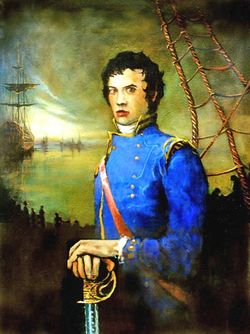
During that voyage, Bligh demoted Sailing Master John Fryer, replacing him with Fletcher Christian, a 23-year-old native of Cumbria, in the North of England. This act caused dissension among the crew.
Fletcher Christian

The ship reached Tahiti after 10 months, and stayed 5 months. Bligh allowed the crew to live ashore and care for the potted breadfruit plants, and they became socialized to the customs and culture of the Tahitians. Many of the seamen and some of the "young gentlemen" had themselves tattooed in native fashion. Acting Lieutenant Christian married Maimiti, a Tahitian woman. Other warrant officers and seamen were also said to have formed "connections" with native women.

Bounty set sail with her breadfruit cargo on April 4, 1789. On April 28, about 1,300 miles west of Tahiti, near Tonga, a mutiny broke out. Despite strong words and threats heard on both sides, the ship was taken bloodlessly, and apparently without struggle by any of the loyalists except Bligh himself. 

The mutineers ordered Bligh, two midshipmen, the surgeon's mate, and the ship's clerk into the ship's boat. Several more men voluntarily joined Bligh rather than remain aboard. Of the 42 men on board aside from Bligh and Christian, 22 joined Christian in mutiny, two were passive, and 18 remained loyal to Bligh.

Bligh and his men sailed the open boat 30 miles to Tofua in search of supplies, but were forced to flee after attacks by hostile natives resulted in the death of one of the men. Bligh then undertook an arduous journey to the Dutch settlement of Coupang, over 3,500 miles from Tofua. He safely landed there 47 days later, having lost no men during the voyage except the one killed on Tofua.

The mutineers sailed for the island of Tubuai, where they tried to settle. After three months of bloody conflict with the natives, however, they returned to Tahiti. Sixteen of the mutineers – including the four loyalists who had been unable to accompany Bligh – remained there, taking their chances that the Royal Navy would not find them and bring them to justice.

HMS Pandora was sent out to capture the mutineers and bring them back to Britain to face a court martial. She arrived in March 1791, and captured fourteen men within two weeks. They were locked away in a makeshift wooden prison on Pandora's quarterdeck. The men called their cell "Pandora's box." They remained in their prison until August 29, 1791, when Pandora was wrecked on the Great Barrier Reef with the loss of 35 lives, including four mutineers.

As for the rest: On January 15, 1790, the Bounty reached Pitcairn Island. After the decision was made to settle on Pitcairn, livestock and other provisions were removed from Bounty. To prevent the ship's detection, and anyone's possible escape, the ship was burned on January 23. They were not found until 1808, when the last surviving mutineer, John Adams, and the surviving Tahitian women and their children were discovered by the Boston sealer Topaz. 

Adams lived on until 1829. He gave conflicting accounts of Christian's death to visitors on ships that subsequently visited Pitcairn. He was variously said to have died of natural causes, committed suicide, become insane or been murdered. Regardless, it appears to have happened in 1793, only 4 years after the mutiny.

Upon reaching British soil again, Bligh was court-martialed -- which was, and remains, a standard U.K. and U.S. procedure for a commander who loses his ship -- but was acquitted, and hailed as a hero. He was promoted to Commander, and eventually to Vice-Admiral. He commanded 11 ships after the Bounty, and from 1806 to 1808 served as the Governor of the Colony of New South Wales, now a State in Australia, which includes Sydney. William Bligh died in 1817, at the age of 63.

Nearly 100 years later, as First Lord of the Admiralty, Winston Churchill was accused of "destroying the traditions of the Royal Navy." He said, "And what are those? Rum, sodomy, and the lash." The last of these referred to sailors being whipped over minor offenses. Bligh was not an overly aggressive punisher: Indeed, he was known to be among the more tolerant commanding officers of his era.

The novel was a libel on his memory, and so have been the 3 major motion pictures made about the events. The 1935 film Mutiny On the Bounty starred Charles Laughton, already known for his portrayal of the wicked King Henry VIII, as a much meaner Bligh than actually existed; and Clark Gable as a considerably more dashing version of Fletcher Christian than actually existed. The last straw in starting the mutiny was cutting the crew's water rations, to provide more water for the breadfruit plants. Despite the inaccuracies, this was the highest-grossing film of 1935.

The film was remade in 1962, with Trevor Howard as Bligh and Marlon Brando as Christian. This one is more explicit, and is grossly inaccurate: Two men die in attempting to disobey Bligh's excessive orders, before Christian agrees to the mutiny. And it ends with Christian deciding to return to Britain to testify against Bligh, and the other mutineers burning the ship in order to prevent it, and Christian dying in an attempt to save it. Unlike the earlier film, this one was a box office flop.

The 1984 film The Bounty is not based on the novel. Anthony Hopkins played Bligh, and Mel Gibson played Christian. It was hailed as being considerably more historically accurate. Apparently, Gibson did not learn that lesson, and went on to make a bunch of historical films that were way off the mark.

A note of interest: Movita Castaneda, an Arizona native of Mexican descent, played Tehani, the chief's daughter, in the 1935 film. She later married Marlon Brando. After their divorce, Brando starred in the 1962 version of the film, and married Tarita TeriÊ»ipaia, who played Maimiti, the real Christian's wife. Brando kept a home in the South Pacific for the rest of his life.

In the 1986 film Star Trek IV: The Voyage Home, Doctor McCoy (DeForest Kelley) named the Klingon ship that the crew of the lost USS Enterprise had taken the HMS Bounty.

*

November 8, 1935 was a Friday. French actor Alain Delon was born. This was also the day that famed pilot Charles Kingsford Smith disappeared. I have a separate entry for that event.

Baseball was out of season. The NBA hadn't been founded yet. And the NHL season had started the night before, but no games were scheduled for this day.

Two college football games were played. George Washington University beat Davis & Elkins, 53-7 at Griffith Stadium in Washington. GWU dropped its football program after the 1966 season. Davis & Elkins College, of Elkins, West Virginia, now play in NCAA Division II.

And Texas Christian University (TCU) beat Loyola University, 14-0 at Loyola University Stadium in New Orleans. Loyola dropped their program after the 1939 season.

November 8, 1935: Charles Kingsford Smith Disappears

November 8, 1935: Sir Charles Kingsford Smith and his co-pilot Tommy Pethybridge disappear over the Bay of Bengal, off the coast of Burma (now Myanmar). They were attempting the Allahabad-to-Singapore leg of their bid to break the speed record between Britain and their native Australia. Pieces of their plane, the Lady Southern Cross, have been found, but their bodies never have.
Kingsford Smith had been a hero pilot in World War I. In 1928, he and Charles Ulm flew the original Southern Cross from Oakland, California to Brisbane, Queensland, Australia; with stops in Honolulu, Hawaii and Suva, Fiji. This made them the 1st pilots to successfully fly across the Pacific Ocean.
"Smithy" was 38 years old at the time of his final flight. Pethybridge was 28. They were attempting to break a record set by a team led by Ulm, who had disappeared the year before, on a training flight between Oakland and Honolulu. He was 36.
*

November 8, 1935 was a Friday. French actor Alain Delon was born on this day. This was also the day that the original film version of Mutiny On the Bounty premiered. I have a separate entry for that event.

Baseball was out of season. The NBA hadn't been founded yet. And the NHL season had started the night before, but no games were scheduled for this day.

Two college football games were played. George Washington University beat Davis & Elkins, 53-7 at Griffith Stadium in Washington. GWU dropped its football program after the 1966 season. Davis & Elkins College, of Elkins, West Virginia, now play in NCAA Division II.

And Texas Christian University (TCU) beat Loyola University, 14-0 at Loyola University Stadium in New Orleans. Loyola dropped their program after the 1939 season.

December 31, 1999 & January 1, 2000: The Millennium

December 31, 1999:  The Millennium arrives. The people of planet Earth survived. At a terrible cost. But we hadn't destroyed ourselves. ...