Showing posts with label lyndon johnson. Show all posts

Saturday, December 31, 2022

December 31, 1967: The 1st Oakland Championship

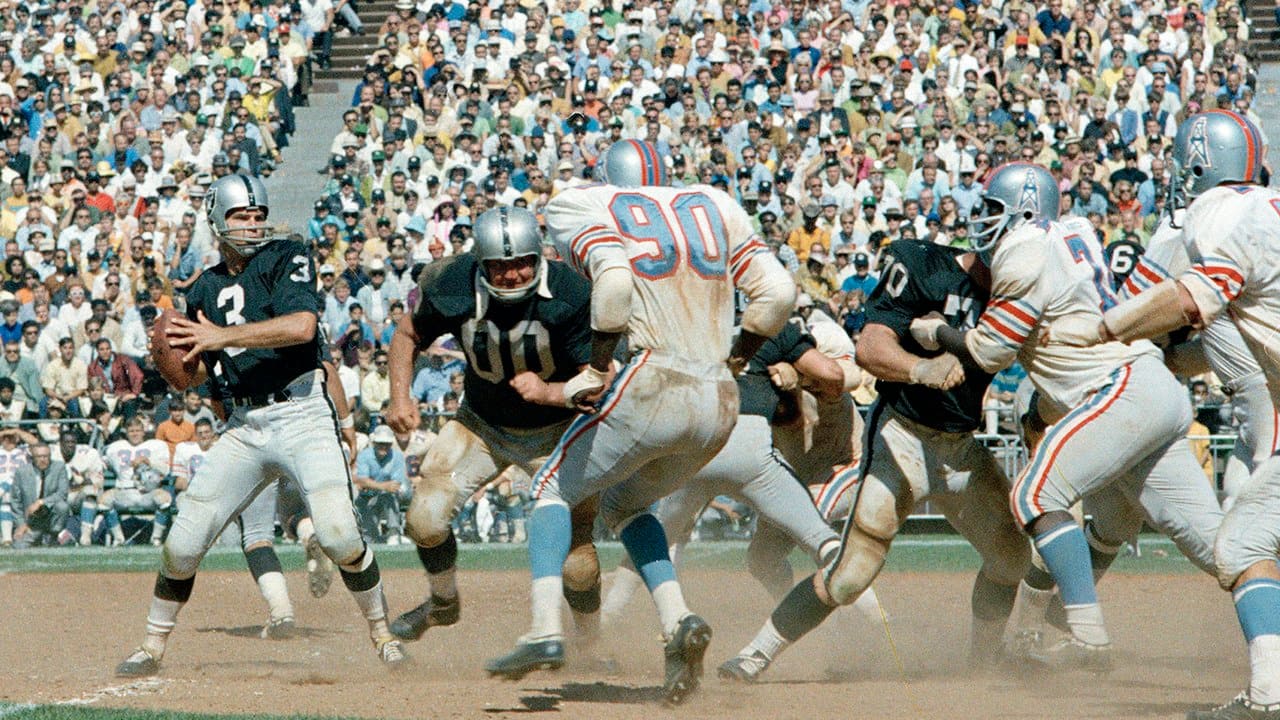
Daryle Lamonica (3) back to pass. Blocking for him
are Jim Otto (00), Dan Archer (78) and Jim Harvey (70).
Note the infield dirt, left over for baseball.

December 31, 1967: The American Football League Championship Game is played at the Oakland-Alameda County Coliseum on this New Year's Eve. The Oakland Raiders hosted the Houston Oilers.

The Oilers had played in the 1st 3 AFL Championship Games, winning in 1960 and 1961, but losing in 1962. Their starting quarterback was George Blanda. Pete Beathard was now the Oilers' quarterback. This would be the Raiders' 1st title game. Blanda was now playing for them.

But while he was their main placekicker, he was not their starting quarterback. That would be Daryle Lamonica, who threw the ball so often, and so far, he became known as "The Mad Bomber." Raider coach John Rauch, having been a quarterback himself, knew he had two good ones. Lamonica would not be elected to the Pro Football Hall of Fame, but Blanda would, along with receiver Fred Biletnikoff, center Jim Otto, guard Gene Upshaw, and cornerback Willie Brown.

The game kicked off at 2:00 Pacific Standard Time (5:00 Eastern), and the temperature was 47 degrees. Just a few minutes earlier, the NFL Championship Game had ended in Green Bay, Wisconsin, and, to those inside Lambeau Field, 47 degrees would have seemed like beach weather in comparison.

The only scoring in the 1st quarter was a 37-yard field goal by Blanda. But the Raiders pulled away in the 2nd quarter, with Hewritt Dixon scoring on a 69-yard run, and Lamonica throwing a 17-yard touchdown pass to Dave Kocourek. It was 17-0 Raiders at the half.

In the 3rd quarter, Lamonica scored on a quarterback sneak, and Blanda kicked a 40-yard field goal. Blanda kicked one from 42 yards, giving the Raiders a 30-0 lead early in the 4th quarter. The Oilers finally scored on a 5-yard touchdown pass from Beathard to Charley Frazier. But the Raiders put it away with another field goal from Blanda, this one 36 yards, and a 12-yard touchdown pass from Lamonica to Bill Miller. The final was Oakland 40, Houston 7.

This was the 1st league championship for Raiders owner Al Davis. There would be more. Moreover, while Oakland had been the much-maligned "little brother" to cosmopolitan San Francisco across the Bay, this game was the beginning of a shift.

The San Francisco Giants had won the National League Pennant in 1962, and just missed Pennants in 1964, '65 and '66. But the Raiders were now AFL Champions, and Oakland had just become home to the NHL's Seals and the ABA's Oaks, and were about to become home to baseball's Athletics. Oakland would soon have 4 teams, to San Francisco's 3 -- and when the San Francisco Warriors moved in 1971, taking the name "Golden State Warriors," taking the place of the Oaks who had moved, Oakland would, briefly, have 4 teams to San Francisco's 2.

From this game until the 49ers' NFC Championship of January 10, 1982, the City of San Francisco had no league champions in any sport, while the City of Oakland had 8: The 1967 AFL Champion Raiders; the 1969 ABA Champion Oaks; the 1972, 1973 and 1974 World Series Champion Athletics; the 1975 NBA Champion Warriors; and the 1976 and 1980 NFL Champion Raiders. And that doesn't even count the Oakland Clippers, earlier in 1967, winning the title in the National Professional Soccer League, which could hardly have been called "major league." But it did happen.

For a few years, sports-wise, Oakland was the place to be. It was a golden age -- or, as A's and Seals owner Charlie Finley might have put it, a Green and Golden Age.

*

December 31, 1967 was a Sunday. The 1967 NFL Championship Game was played the same day. While the Oakland Coliseum has been known for chilly conditions, there was no issue with the weather there on that day. That would not be the case for the NFL title game: It was well below zero at Lambeau Field in Green Bay, Wisconsin. The Green Bay Packers beat the Dallas Cowboys, 21-17, in a game that became known as the Ice Bowl. I have a separate entry for that event. The Packers went on to beat the Raiders, 33-14 in Super Bowl II, in a much-warmer Orange Bowl in Miami.

There were 2 games played in the NBA. The Los Angeles Lakers beat the expansion San Diego Rockets, 147-118. It was the 1st game the Lakers played at their new arena, The Forum, outside Los Angeles in Inglewood, California.

And the San Francisco Warriors beat the other expansion team, the Seattle SuperSonics, 126-124 at the Seattle Center Coliseum. For the Warriors, Nate Thurmond had 34 points and 25 rebounds.

There was 1 game played in the American Basketball Association, which was in its 1st season: The Pittsburgh Pipers beat the Indiana Pacers, 121-106 at the Civic Arena in Pittsburgh. The Pipers would go on to win the 1st ABA Championship. But before the 1972-73 season, they were out of business. The Pacers would win the ABA title in 1970, '72 and '73, and were 1 of the 4 teams absorbed from the ABA into the NBA in 1976.

There were 4 games played in the NHL that day:

* The New York Rangers beat the Toronto Maple Leafs, 4-0, in one of the last events at the old Madison Square Garden.

* The Philadelphia Flyers beat the Los Angeles Kings, 9-1 at The Spectrum in Philadelphia.

* The Detroit Red Wings beat the Boston Bruins, 6-4 at the Olympia Stadium in Detroit.

* The Chicago Blackhawks beat the Oakland Seals, 3-0 at the Chicago Stadium.

* The Montreal Canadiens, the Pittsburgh Penguins, the St. Louis Blues and the Minnesota North Stars were not scheduled. 

December 31, 1967: The Ice Bowl

Lambeau Field as it appeared in 1967.
Note the shadow cast by the scoreboard
at the south end. This will matter later on.

December 31, 1967: As the narrator for a 1987 NFL Films production put it, "On a day savage enough to make a Saint Bernard whimper, they played the 1967 NFL Championship Game." Or, as it has become known in football lore, The Ice Bowl.

I don't know who the narrator was -- the Internet has failed me in this regard -- but the film was made in 1987, so it wasn't John Facenda, the voice of NFL Films from 1966 until his death in 1984. Let the record show that Facenda never actually spoke the words "the frozen tundra of Lambeau Field." ESPN's Chris Berman, imitating Facenda, made that up.

The Ice Bowl isn't even the coldest game in NFL history anymore. The 1981 AFC Championship Game, played at Riverfront Stadium in Cincinnati on January 10, 1982, was 9 degrees below zero without the wind chill factor, and 37 below with it. The San Diego Chargers, used to warm weather, had played one of the hottest games in NFL history just 8 days earlier, against the Miami Dolphins at the Orange Bowl, and were totally unused to this kind of cold. The Bengals won, 27-7. This one is known as the Freezer Bowl.

Many NFL Championship Games, nearly all played in December to that point, had been plagued by cold weather. Vince Lombardi had been born and raised in Brooklyn, and had coached the Green Bay Packers since 1959, so he could handle cold weather.

But from having coached in the title games of 1956, 1958 (these 2 as an assistant coach with the New York Giants), 1961, 1962 and 1965, he knew that cold weather could be a problem for football. Fortunately, since the Packers' unusual ownership structure, and his role as both head coach and general manager, left him a virtual dictator, he had the field torn up, and heating coils placed under the field. When resodded, the idea was that the coils would keep the field from freezing. It became known as "Lombardi's Electric Blanket."

Lombardi had been offensive coordinator to Giants head coach Jim Lee Howell. The defensive coordinator was Tom Landry, who became the 1st head coach of the Dallas Cowboys, the team the Packers had defeated to win the 1966 NFL Championship, and whom they would have to beat again to win for 1967. Lombardi and Landry were opposites: Landry was a great stone face, never showing emotion during the game; while Lombardi was, in the words of his Hall of Fame guard Jerry Kramer, "a raving Italian lunatic!"

But the teams were the other way around: The Cowboys -- not yet the dominant team that they would become -- were braggarts, having earned very little right to do so thus far; while the Packers let their performance do the talking for them. The exception was Hall of Fame running back Paul Hornung, but he was retired by this point. The Packers were going for their 5th NFL Championship in 7 years, which included ending the previous season by winning "The AFL-NFL World Championship Game," retroactively named "Super Bowl I."

The day before the game, NFL Commissioner Pete Rozelle made some phone calls, and was told that the game-time temperature would be about 5 degrees above zero. (All temperatures mentioned in this post will be in degrees Fahrenheit.)

Rozelle didn't like that, and began to consider postponing the game to the next day, Monday, New Year's Day 1968, despite the fact that it would compete for TV ratings with the college bowl games. But he was told that the oncoming cold front would make it even colder on Monday. So, already in Green Bay, he called Lombardi at his house, and Landry at his hotel, and told them the game would go on as scheduled.

But the cold front arrived sooner, and was worse than expected. As Cowboy receiver Rentzel reported, he was told that it was 15 degrees below zero. The official NFL Films record of the game shows a rotating bank clock backing that up, reading "-15°."
I couldn't find a photo online.
I had to photograph it off my computer screen.
Yes, that's me and my phone in the reflection.

When Lombardi got to Lambeau Field, he discovered that it was so cold (This was before comedians began doing things like, "How cold was it?"), the mechanism for the heating coils broke. With the machine inoperable, the field was frozen. To make matters worse, when the tarp was taken off the field, it had left moisture on it, which froze. The field was an ice rink.

At the time, Lambeau Field held 50,861 people. That was the official attendance: In spite of the cold, there was not an empty seat in the house -- until an elderly spectator died from exposure. Yes, only one fan died from the cold. Among those in attendance was a 12-year-old boy from Appleton, Wisconsin, who went on to become a renowned actor: Willem Dafoe. In 2017, NFL Films released a 50th Anniversary documentary on the Ice Bowl, with Dafoe narrating. 

The marching band of the University of Wisconsin-La Crosse was scheduled to perform the pregame and halftime shows. But during -- pardon the choice of words -- the warmups, the spit inside their woodwind instruments froze, rendering them impossible to play. The mouthpieces of brass instruments stuck to their players' lips. Seven members of the band were taken to the hospital for hypothermia.

The officials' whistles also had the spit freeze inside, and, during the pregame midfield meeting with the team captains, they said that play would be stopped by the officials putting their hands on the backs of players who, due to concentrating on the ballcarrier, couldn't otherwise see that play had stopped.

Frank Gifford, the Hall of Fame running back for the Giants who was serving as one of the CBS announcers for the game, said, on the air, "I'm going to take a bite of my coffee."
The game was played anyway. When it kicked off at 1:00 PM Central Standard Time -- 2:00 Eastern -- it was 13 below, with a wind-chill factor, on the since-changed current scale, of -36.
Note the ticket price: $10. That's about $83 in 2022 money.
For the Championship Game. Today, a regular-season game
would almost certainly cost you much more.

The game did affect the Cowboys more than the Packers. The film shows Hall of Fame linebacker Ray Nitschke running onto the field in short sleeves, with no gloves. He was from Chicago. He could handle it. But Meredith's face froze, to the point where he couldn't make his words understood in the huddle unless he pressed on his cheeks. Bob Hayes, the Olympic sprinting champion who'd hauled in so many of Meredith's passes, had to run with his hands tucked in a hole cut in his jersey.

The Packers opened the game with a 9-minute drive that ended with a touchdown pass from Bart Starr to Boyd Dowler. Starr connected with Dowler again in the 2nd quarter, giving the Packers a 14-0 lead. It would then have been very easy to guess that the Texas-based team were done in by the cold, and were finished.

They weren't. They showed a tremendous amount of courage, and came back. They didn't get a single 1st down in the 2nd quarter, but fumbles by Starr and of a punt return by Wood led to Cowboy scores, making it 14-10 Green Bay at the half.

In the 3rd quarter, the Packers stopped a Cowboy drive with a fumble, and ended another that resulted in a missed field goal by Danny Villanueva. At the start of the 4th quarter, Landry gambled, and called an option pass for Dan Reeves -- later to coach the Denver Broncos, the Giants and the Atlanta Falcons -- to Rentzel. It went for 50 yards and a touchdown.

Despite seemingly everything going against them, the Cowboys led 17-14. The Packers' Don Chandler missed a field goal, and it looked like the Packers would be dethroned.

With 4 minutes and 50 seconds left, the Packers took over on their own 32-yard line. Since the goalposts would be on the goal line until the 1974 season, but Chandler had already missed a 40-yard attempt, this meant that they probably needed to get the ball to the Dallas 30-yard line for a field goal -- but that would only have tied it, and sent this already-miserable experience to overtime.

Starr advanced the Packers with short passes to Dowler and Donny Anderson. But a hit knocked Dowler down, and his head hit the frozen turf. Even with the protection of a football helmet, he was knocked unconscious. As with the Super Bowl nearly a year earlier, Max McGee came in to replace him. Unlike that Super Bowl, McGee would not turn out to be the hero this time.

Lombardi's most famous play was the "power sweep": Both guards, Kramer and Fred "Fuzzy" Thurston, would pull out of the line at the snap, and run in the same direction (either left or right), and Starr would pitch to a running back, who would then run behind the guards. This had worked so many times with Hornung and Jim Taylor, and now with Anderson and Elijah Pitts.

This time, Lombardi had a trick up his sleeve, a play known in the Packer playbook as "54-Give." He called it the "sucker play": It was a fake power sweep, with Gale Gillingham, having replaced Thurston, pulling to the right. This caught the attention of the Cowboys' Hall of Fame defensive tackle, Bob Lilly, and he followed. This left a hole up the middle, and running back Chuck Mercein got to the 3-yard line.

The Packers then needed to get to the 1-yard line for a 1st down, and did. Some of the Cowboys thought Anderson had scored. Had there been a rule at the time, allowing a coach to challenge a call via instant replay, what happened next might not have happened, and Anderson would have been the big hero of the game. But the officials didn't see the ball cross the plane of the goal line, and so it was 1st and goal on the 1.

It was getting late. Lambeau Field did have lights, so darkness was not going to be an issue. But a lack of sunlight was. To make matters worse, the action was now at the south end of the field, where the shadow of the scoreboard loomed, making it even colder. I've seen sources say that, with the wind chill factor (on the old scale), it was as low as 48, or even 55, degrees below zero.

There was less than a minute left. On 1st down, Starr handed off to Anderson, but he slipped on the icy field. On 2nd down, Anderson slipped even before Starr could get the ball to him. Now, it was 3rd and goal on the 1. The Packers called their last timeout. There were 16 seconds left.

On the film, Lilly can be shown kicking the field, and he kicks up specks of frost. The Cowboys actually considered getting a drill, and drilling holes in the field, to get a better footing. I don't know if that was legal at the time, or if they would have had time for it, even if they took all their remaining timeouts.

The Packers' dilemma was equally tricky. Run the ball and fail, and they wouldn't be able to stop the clock in time to kick the tying field goal. Pass the ball, and it could fall incomplete, leaving 4th down with the clock stopped with a few seconds left, and you could still kick the field goal -- but it could also be intercepted, as Tom Brown did with Meredith's desperation pass with just under a minute to play, which clinched the Packer victory in the Championship Game the year before, in Dallas. Kick the field goal now, on 3rd down, and Chandler could miss again; and, even if he makes it, the game is still only tied.

Starr wasn't as good a passer as his contemporaries Johnny Unitas, Sonny Jurgensen and Joe Namath, but he was smarter than any of them. He recommended a play called "31-Wedge," telling Lombardi, "Coach, the linemen can get their footing on the wedge, but the backs are slipping. I'm right there. I can just shuffle my feet and lunge in."

At this point, Lombardi, who had famously said, "Fatigue makes cowards of us all," was as cold and as tired as anyone, and was not looking forward to overtime, so he told Starr, "Run it, and let's get the hell out of here!"

Starr called the play. It required guard Kramer and center Ken Bowman to double-team the Cowboys' other tackle, Jethro Pugh. Bowman snapped the ball, Starr took it, lowered his head, and followed the block.

Touchdown. On the film, Mercein can be shown raising his hands. He's not signaling, "Touchdown!" He's showing the referee that he's not illegally helping Starr. To this day, Cowboy fans insist that Kramer was offside. As if the Cowboys wouldn't win a whole slew of games due to cheating and favorable officials' calls in the years to come. Besides, Anderson might have broken the plane of the goal line 3 plays earlier, and the refs missed that.
Starr (15) over the goal line. Mercein (30) with his hands up.
Kramer (64) having blocked Pugh (75).
This is Walter Iooss Jr.'s photo for Sports Illustrated.
The most familiar shot of the touchdown is in black & white,
and I wanted a color photo.

In his 1981 book Pro Football's 10 Greatest Games, in which he included both this game and the previous season's NFL Championship Game between the Packers and the Cowboys, sports historian (usually specializing in baseball) John Thorn wrote, "It is the most famous touchdown in football history."

He published that book before the 1982 Dwight Clark "The Catch," but put Starr's Sneak ahead of the 1958 Alan Ameche overtime score (he included that title game in the book), and the 1974 Clarence Davis "Sea of Hands" catch (he included that game, too), and apparently ahead of the 1972 Franco Harris "Immaculate Reception" (he did not include that game).

Chandler kicked the extra point to make it 21-17. There were still 13 seconds left. The Packers kicked off, and the Cowboys let it go into the end zone. Meredith threw 2 incompletions, and, at 3:44 PM Central Time (4:44 Eastern), the game was over.
How anybody still had any desire to remain outside
long enough to tear down the goalposts, I'll never know.

The Packers went Super Bowl II, in considerably friendlier weather at the Orange Bowl in Miami, and beat the AFL Champion Oakland Raiders, 33-14. Lombardi retired as head coach after that game, but stayed on as general manager. As with the 1964-65 Yankees, the team seemed to get old all at once, and the dynasty collapsed. The team wouldn't reach the title game again for 29 years, winning Super Bowl XXXI in the 1996-97 season.

After the 1968 season, Lombardi accepted Edward Bennett Williams' offer to be head coach and general manager of the Washington Redskins, and began to rebuild them in 1969. But he developed colon cancer -- much more easily treatable now, but fatal then. He died on September 3, 1970, only 57 years old. The Redskins hired George Allen away from the Los Angeles Rams, and reached Super Bowl VII 3 seasons later.

The Cowboys got tagged as a team that "can't win the big one." They reached Super Bowl V, but lost to the Baltimore Colts. Finally, they came to dominate the NFC in the 1970s, reaching 5 Super Bowls, winning Super Bowls VI and XII. They began calling themselves "America's Team." They were featured on TV so much that people joked that CBS stood for "Cowboys Broadcasting System." Landry remained head coach until 1989, and died in 2000.

The Ice Bowl lives on in sports memory. It still gives chills, even to people like me who weren't even born yet. In 2019, a poll ranked this game 3rd on a list of the 100 Greatest Games of the NFL's 1st 100 years.

*

December 31, 1967 was a Sunday. The 1967 AFL Championship Game was played the same day. The Oakland Raiders beat the Houston Oilers, 40-7 at the Oakland Coliseum. While that stadium has been known for chilly conditions, there was no issue with the weather there on that day.

There were 2 games played in the NBA. The Los Angeles Lakers beat the expansion San Diego Rockets, 147-118. It was the 1st game the Lakers played at their new arena, The Forum, outside Los Angeles in Inglewood, California.

And the San Francisco Warriors beat the other expansion team, the Seattle SuperSonics, 126-124 at the Seattle Center Coliseum. For the Warriors, Nate Thurmond had 34 points and 25 rebounds.

There was 1 game played in the American Basketball Association, which was in its 1st season: The Pittsburgh Pipers beat the Indiana Pacers, 121-106 at the Civic Arena in Pittsburgh. The Pipers would go on to win the 1st ABA Championship. But before the 1972-73 season, they were out of business. The Pacers would win the ABA title in 1970, '72 and '73, and were 1 of the 4 teams absorbed from the ABA into the NBA in 1976.

There were 4 games played in the NHL that day:

* The New York Rangers beat the Toronto Maple Leafs, 4-0, in one of the last events at the old Madison Square Garden.

* The Philadelphia Flyers beat the Los Angeles Kings, 9-1 at The Spectrum in Philadelphia.

* The Detroit Red Wings beat the Boston Bruins, 6-4 at the Olympia Stadium in Detroit.

* The Chicago Blackhawks beat the Oakland Seals, 3-0 at the Chicago Stadium.

* The Montreal Canadiens, the Pittsburgh Penguins, the St. Louis Blues and the Minnesota North Stars were not scheduled.

Friday, December 30, 2022

December 30, 1967: The Forum Opens In Inglewood

December 30, 1967: The Forum opens, outside Los Angeles in Inglewood, California. It becomes, and remains, the most famous indoor sports venue in the Western United States.

It was designed by architect Charles Luckman, and built on the site of a golf course, at Manchester Boulevard and Prairie Avenue, across Kelso Street from the Hollywood Park racetrack, 11 miles southwest of downtown Los Angeles.

It was built because Jack Kent Cooke, the Canadian media mogul who owned the NBA's Los Angeles Lakers, wanted to bring the NHL to Los Angeles. He had been told that there were more than 300,000 former Canadians living within a three-hour drive of Los Angeles. The Lakers had arrived in 1960, and had played at the Los Angeles Memorial Sports Arena, next-door to the Los Angeles Memorial Coliseum, whose Commission owned both buildings.

Dan Reeves, owner of the Rams, who played in the Coliseum, also owned the Western Hockey League's Los Angeles Blades, who played in the Sports Arena. The Coliseum Commission wanted to own L.A.'s NHL team, and told Cooke that, if he won the bid, his team wouldn't be allowed to play in the Sports Arena.

(This Dan Reeves was no relation to the man of the same name, then a running back for the Dallas Cowboys, who later became a successful NFL coach.)

So Cooke built The Forum, with $16 million his own money (about $140 million in 2022 dollars), and won the bid. The Kings debuted on October 14, at the Long Beach Convention Center, beating another expansion team, the Philadelphia Flyers, 4-2. The Kings played 11 home games at the Sports Arena, and 6 at Long Beach, before The Forum opened on December 30, with a 2-0 loss to the Philadelphia Flyers, a fellow expansion team. The Lakers played their 1st Forum game the next day, December 31, beating the San Diego Rockets, 147-118. (The Rockets moved to Houston in 1971.)

The Lakers did very well at The Forum. The Kings did not, and their attendance reflected this. About those 300,000 people, Cooke remarked, "Now I know why they left Canada: They hate hockey!" In 1979, Cooke sold the Forum, the Kings, and the Lakers to Dr. Jerry Buss (his doctorate was in chemistry) for a then-record $67.5 million (equivalent to $272 million in 2022). Half of the payment was in cash, and half was in real estate, with part of Buss's payment including the Chrysler Building in New York.

The Forum hosted 14 NBA Finals: 1968, 1969, 1970, 1972, 1973, 1980, 1982, 1983, 1984, 1985, 1987, 1988, 1989 and 1991, with the Lakers winning in 1972, 1980, 1982, 1985, 1987 and 1988; but only 1 Stanley Cup Finals, in 1993, with the Kings losing it. It never hosted an NCAA Final Four (the Sports Arena did so in 1968 and 1972), but it hosted the NBA All-Star Game in 1972 and 1983, the NHL All-Star Game in 1981, and the Olympic basketball games in 1984.

In addition to the Lakers and Kings, it hosted the Los Angeles Strings of World Team Tennis from 1975 to 1978, the indoor-season games of the Los Angeles Aztecs of the North American Soccer League in the 1979-80 season, and the Los Angeles Sparks of the WNBA from 1997 to 2000.

For sponsorship purposes, The Forum was known as the Great Western Forum from 1988 to 2003, The Forum presented by Chase from 2014 to 2022, and now as the Kia Forum.

In 1999, the Lakers, the Kings, the Sparks, and the NBA's Los Angeles Clippers all moved into the Staples Center, now named the Crypto.com Arena, in downtown Los Angeles. The last Kings game at The Forum was on April 18, 1999, a 3-2 loss to the St. Louis Blues. The last Lakers game was on May 23, 1999, a 118-107 loss to the San Antonio Spurs. Both teams played preseason exhibitions there before moving downtown.

Faithful Central Bible Church, with a congregation of over 12,000, purchased The Forum at the end of 2000, and began holding church services there on Sunday mornings. Unlike Houston's Lakewood Church, whose pastor, Dr. Joel Osteen, converted the Rockets' former arena, The Summit, into their church, Faithful Central representatives said that they never intended to convert the arena for religious purposes. In 2009, the church discontinued their regular use of the Forum for services.

The Forum was used for the 2002 film Like Mike and the 2009 film Hannah Montana: The Movie. In 2009, Michael Jackson rehearsed at The Forum for his upcoming concert tour, but died while those rehearsals were in progress.

In 2012, the Madison Square Garden Corporation bought The Forum, and renovated it until 2014. It began hosting award shows: The Nickelodeon Kids' Choice Awards in 2015, '16 and '18; the American Country Countdown Awards in 2016; the Teen Choice Awards in 2016 and '18; the MTV Video Music Awards in 2017; and the iHeartRadio Music Awards in 2016, '17 and '18.

In 2020, SoFi Stadium was built on the site of the demolished Hollywood Park; and Clippers owner Steve Ballmer bought The Forum, planning to built a new arena for his team nearby, the Intuit Dome. The Forum will remain standing through at least 2028, when Los Angeles hosts the Olympics again: The Forum is slated to host gymnastics.

*

December 30, 1967 was a Saturday. Baseball was out of season. Two college football bowl games were played that day: Penn State and Florida State played to a tie, 17-17, at the Gator Bowl in Jacksonville, Floirda; and the University of Texas at El Paso (UTEP), playing on its home field, beat Mississippi (Ole Miss), 14-7 in the Sun Bowl.

The next day, New Year's Eve, the pro football leagues' Championship Games were held. In the AFL, the Oakland Raiders beat the Houston Oilers, 40-7 at the Oakland Coliseum. And in a game so cold it became known as the Ice Bowl, the Green Bay Packers beat the Dallas Cowboys, 21-17 at Lambeau Field in Green Bay, Wisconsin.

The day after that, New Year's Day 1968, the major college bowls were played. Number 1 University of Southern California (USC) beat Indiana, 14-3 in the Rose Bowl in Pasadena, and clinched the National Championship. Number 3 Oklahoma beat Number 2 Tennessee, 26-24 in the Orange Bowl in Miami. Louisiana State University (LSU) beat Number 6 Wyoming, 20-13 in the Sugar Bowl in New Orleans. And Texas A&M beat Number 8 Alabama, 20-16 in the Cotton Bowl in Dallas.

There were 2 NBA games played on December 30, 1967. The Philadelphia 76ers beat the Detroit Pistons, 122-107 at Cobo Hall (now Huntington Place) in Detroit. Wilt Chamberlain scored 30 points and grabbed 18 rebounds. And the Los Angeles Lakers beat the St. Louis Hawks, 106-104 at the Kiel Auditorium in St. Louis. Jerry West scored 34 points.

There were 4 games played in the American Basketball Association, which was in its 1st season:

* The New Jersey Americans (who became the New York Nets the next season) beat the Oakland Oaks, 123-117 at the Oakland Coliseum Arena.

* The Indiana Pacers beat their rivals, the Kentucky Colonels, 124-80 at the Indiana State Fairgrounds Coliseum (now the Corteva Coliseum) in Indianapolis.

* The Minnesota Muskies beat the Dallas Chaparrals, 104-92 at the Metropolitan Sports Center in the Minneapolis suburb of Bloomington, Minnesota.

* And the Denver Rockets beat the Houston Mavericks, 96-80 at the Auditorium Arena in Denver.

And the entire newly-expanded NHL was in action. In addition to the Kings and the Flyers:

* The New York Rangers and the Chicago Black Hawks played to a tie, 3-3 at the old Madison Square Garden.

* The Montreal Canadiens beat the Oakland Seals, 2-0 at the Montreal Forum.

* The Toronto Maple Leafs beat the St. Louis Blues, 8-1 at Maple Leaf Gardens in Toronto.

* The Detroit Red Wings beat the Pittsburgh Penguins, 5-2 at the Civic Arena in Pittsburgh.

* And the Minnesota North Stars beat the Boston Bruins, 5-4 at the Met Center in Bloomington. Yes, it hosted an NHL game and an ABA game on the same day.

And in English soccer, a London derby was held at the Arsenal Stadium, a.k.a. Highbury, in North London. Arsenal and Chelsea played to a 1-1 draw.

Thursday, December 29, 2022

December 29, 1968: The New York Jets Win the AFL Championship

December 29, 1968: The American Football League Championship Game is played at Shea Stadium in Flushing Meadow, Queens, New York City. By any objective measure, it was a better game than the Super Bowl that was held 2 weeks later.

The Oakland Raiders had won the AFL Championship the year before, and were back in the Championship Game. The New York Jets were in it for the 1st time. Earlier in the season, on November 17, in Oakland, The Jets blew a lead with a little over 1 minute to play, and the Raiders scored 2 touchdowns. Most of the country didn't see it, though, as NBC cut away at 7:00 PM Eastern Time, to show the children's movie Heidi, infuriating millions of TV viewers. "The Heidi Bowl" was a sign that the AFL had finally achieved a place in the American sports firmament, alongside the established NFL.

Quarterbacked by Joe Namath, who had already earned the nickname "Broadway Joe" for his showmanship, the Jets finished the season 11-3. The Raiders, with a quarterback named Daryle Lamonica, known as "The Mad Bomber," and with a devastating, often dirty, defense, were 12-2. Each team won its Division.

Since it was an even-numbered year, it was the Eastern Division Champion's turn to host the Championship Game. And so, Shea Stadium, also the home of baseball's New York Mets, hosted a football championship before it hosted a postseason game in baseball. A crowd of 62,627 was on hand, the biggest in AFL history.

A short punt led to Namath passing to Don Maynard for a touchdown to open the scoring. The Raiders stalled on their next drive, and George Blanda hit the crossbar on a field goal attempt. Jim Turner kicked a field goal to put the Jets up 10-0 at the end of the 1st quarter.

The Raiders got off the deck, and Lamonica threw a 29-yard touchdown pass to Fred Biletnikoff. Turner kicked another field goal, and Blanda kicked one right before the half, to close the Raiders to within 13-10.

Blanda tied the game with a field goal in the 3rd quarter, but Namath took the Jets downfield, and just before the quarter ended, he threw a touchdown pass to Pete Lammons, putting New York up, 20-13.

Early in the 4th quarter, George Atkinson intercepted a Namath pass, and took it to the Jets' 5-yard line. Pete Banaszak ran it in on the next play, and for the 1st time, the Raiders led, 23-20. But Namath needed just 3 passes -- 10 yards to George Sauer, 52 to Maynard, and 6 to Maynard -- to put the Jets up, 27-23.

With a little over 5 minutes left, with the Raiders having the ball on the Jets' 26-yard line and 4th & 10, head coach John Rauch decided to go for the 1st down. It didn't work, as Verlon Biggs sacked Lamonica. On their next drive, Lamonica got to the Jets' 24, but he made a bad throw that was ruled a fumble, and Ralph Baker recovered for the Jets. With 1 last chance, the Raiders had the ball on their own 22 with 42 seconds left, but could only get to midfield before the clock ran out. The Raiders had outgained the Jets, 443 total yards to 400, but the Jets had won, 27-23.

In the off-season, Rauch decided he'd had enough meddling by Raiders owner Al Davis, and resigned. Davis promoted the linebackers coach to head coach: John Madden. Madden's legend was just beginning, while Namath's was about to reach the stratosphere.

And a storybook period for New York sports had begun: In a span of 17 months, the Jets had won the AFL Championship, the Jets would pull off one of the greatest upsets in sports history by becoming the 1st AFL team to win a Super Bowl, the Mets would win a "Miracle" World Series, and the Knicks would win their 1st NBA Championship.

*

December 29, 1968 was a Sunday. The NFL Championship Game was played the same day, and the Baltimore Colts, 13-1 on the regular season, avenged their only defeated annihilating the Cleveland Browns, 34-0 at Cleveland Municipal Stadium. (As with the AFL, home-field advantage was determined on a rotating basis, not by best record. The merged NFL wouldn't start doing it that way until 1975.)

There were 4 games played in the NBA:

* The New York Knicks beat the Seattle SuperSonics, 120-112 at Madison Square Garden. Willis Reed scored 34 points.

* The Atlanta Hawks beat the Baltimore Bullets, 101-99 at the Alexander Memorial Coliseum (now the McCamish Pavilion) in Atlanta.

* The Chicago Bulls beat the Milwaukee Bucks, 102-97 at the Milwaukee Arena. In 1974, it was renamed the Milwaukee Exposition, Convention Center and Arena, or "The MECCA." Since 2014, it has been named the UW-Panther Arena.

* And the Los Angeles Lakers beat the Detroit Pistons, 111-108 at The Forum outside Los Angeles in Inglewood, California. Jerry West scored 34 points, Elgin Baylor scored 24, and Wilt Chamberlain scored 22 and had 25 rebounds.

There were 5 games in the American Basketball Association:

* The New York Nets lost to the Kentucky Colonels, 118-116 in overtime at the Long Island Arena in Commack, New York. Ron Perry scored 36 in defeat for the Nets.

* The Miami Floridians beat the New Orleans Buccaneers, 107-106 at the Miami Beach Convention Center.

* The Houston Mavericks beat the Los Angeles Stars, 93-83 at the Sam Houston Coliseum in Houston.

* The Oakland Oaks beat the Minnesota Muskies, 120-99 at the Metropolitan Sports Center in the Minneapolis suburb of Bloomington, Minnesota.

* The Denver Nuggets beat the Dallas Chaparrals, 102-92 at the Denver Auditorium Arena.

And there were 4 games in the NHL:

* The New York Rangers beat the Montreal Canadiens, 3-1 at Madison Square Garden.

* The Oakland Seals beat the Philadelphia Flyers, 2-1 at The Spectrum in Philadelphia.

* The Boston Bruins and the Detroit Red Wings played to a tie, 3-3 at the Olympia Stadium in Detroit.

* And the Chicago Black Hawks beat the Los Angeles Kings, 4-1 at the Chicago Stadium.

December 29, 1964: "The T.A.M.I. Show"

December 29, 1964: The T.A.M.I. Show is released in movie theaters. It was filmed at the Santa Monica Civic Auditorium on October 28 and 29, 1964.

The Auditorium opened in 1958, and from 1961 to 1967 hosted the Academy Awards -- the Oscars. On May 27, 1972, George Carlin recorded his album Class Clown there, including his bit "Seven Words You Can Never Use On Television." It still stands.

"T.A.M.I." stood for "Teen Age Music International." The show was directed by Steve Binder, who later went on to direct Elvis Presley's 1968 "Comeback Special." It was hosted by Jan Berry and Dean Torrence. Jan & Dean had already had a few hits together.

The various acts were backed up by go-go dancers, including Teri Garr, who became a major actress; and Toni Basil, who become one of America's top choreographers, and had a Number 1 hit in 1982 with "Mickey." Film director John Landis claimed he attended the show with his classmate, future Partridge Family star David Cassidy.

Here's the set list, and the songs they sang at the show. It's one hell of a list, even if you only count what these performers had already done, not what they would later do. An asterisk (*) indicates the performer has been elected to the Rock and Roll Hall of Fame:

1. Jan and Dean, singing "(Here They Come From) All Over the World." The song incorrectly places The Rolling Stones in Liverpool, when they were from London and environs.

2. * Chuck Berry: "Johnny B. Goode," "Maybellene," "Sweet Little Sixteen" and "Nadine."

3. Gerry and the Pacemakers, who actually were from Liverpool: "Don't Let the Sun Catch You Crying," "It's Gonna Be Alright" and "I Like It."

4. * The Miracles, from Motown Records, led by Smokey Robinson: "That's What Love Is Made Of," "You've Really Got a Hold On Me" and "Mickey's Monkey."

5. * Marvin Gaye, from Motown Records: "Stubborn Kind of Fellow," "Pride and Joy," "Can I Get a Witness" and "Hitch Hike."

6. Lesley Gore: "Maybe I Know," "You Don't Own Me," "You Didn't Look Around," "Hey Now," "It's My Party" and its sequel "Judy's Turn to Cry."

A reprise of Jan and Dean: "The Little Old Lady from Pasadena" and "Sidewalk Surfin'" (the 1st hit song about skateboarding).

7. * The Beach Boys: "Surfin' U.S.A.," "I Get Around," "Surfer Girl" and "Dance, Dance, Dance."

8. Billy J. Kramer and The Dakotas: "Little Children," "Bad to Me," "I'll Keep You Satisfied" and "From a Window."

9. * The Supremes, from Motown Records, with Diana Ross singing lead: "When the Lovelight Starts Shining Through His Eyes," "Run, Run, Run," "Baby Love" and "Where Did Our Love Go."

10. The Barbarians, probably the only band ever to come out of Cape Cod. They never had a Top 40 single, not even the song they performed here, "Hey Little Bird."

11. * James Brown and The Famous Flames: "Out of Sight," "Prisoner of Love," "Please, Please, Please" and "Night Train." This performance is often credited with introducing The Godfather of Soul to white audiences. Within a year, his new audience had given him his 2 biggest hits: "Papa's Got a Brand New Bag" and "I Got You (I Feel Good)."

12. * The Rolling Stones: "Around and Around," "Off the Hook," "Time Is On My Side," "It's All Over Now," "I'm Alright" and "Let's Get Together." They were still a few months away from releasing "(I Can't Get No) Satisfaction."

*

December 29, 1964 was a Tuesday. Baseball was out of season. The NFL and the AFL had just wrapped up their seasons. No college football bowl games were played. There was 1 NBA game played that day: The St. Louis Hawks beat the San Francisco Warriors, 122-104 at the Kiel Auditorium in St. Louis. Wilt Chamberlain scored 35 points in a losing effort.

And there was 1 NHL game: The Chicago Black Hawks beat the New York Rangers, 4-2 at the old Madison Square Garden. The Rangers led 2-0 and blew it. Bobby Hull scored 2 goals for the Hawks. 

Tuesday, December 27, 2022

December 27, 1964: The Cleveland Browns' Last Title -- So Far

Jim Brown (32) takes a handoff from Frank Ryan (13)

December 27, 1964: The NFL Championship Game is played, at Cleveland Municipal Stadium. The host Cleveland Browns had been a dominant team from their 1946 inception until 1957, and were back after a rebuild.

Controversially, that rebuild involved Art Modell buying the team, and firing the founding head coach and general manager, Paul Brown. Blanton Collier was put in charge, and he revamped the team, including installing Frank Ryan at quarterback. Ryan was working on a doctorate in mathematics, and would later teach at the university level.

Collier also gave Jim Brown a bit more leeway. In 1963, Collier's 1st season, Brown rushed for 1,863 yards, an NFL record that stood for another 10 years. In 1964, he ran for 1,446. The Browns had another Hall-of-Fame running back in Leroy Kelly. Paul Warfield, a rookie receiver, would also go to Canton. So would guard Gene Hickerson. And so would their one holdover from their 1950s titlists, placekicker Lou Groza.

The Browns went 10-3-1. The St. Louis Cardinals tied them 33-33 at Cleveland Municipal Stadium, and beat them 28-19 in St. Louis. The Browns also lost 23-7 at home to the Pittsburgh Steelers, and 28-21 to the Green Bay Packers in Milwaukee. The losses in Milwaukee and St. Louis were both late in the season. But a 52-20 demolition of the Giants at Yankee Stadium in the final regular-season game gave them the Eastern Division title by half a game over the Cardinals, who went 9-3-2.

They would host the NFL Championship Game against the Baltimore Colts, who were favored, having gone 12-2. With Johnny Unitas quarterbacking several holdovers from their 1958 and '59 NFL Champions, they lost their opener away tot he Minnesota Vikings, and their next-to-last game at home to the Detroit Lions. But they won the rest of their games. They did not play the Browns in the regular season. Despite the Browns having the home field, the Colts were favored by 7 points.

There was no scoring in the 1st half. The Browns began the 3rd quarter with the wind at their backs, and Groza's kickoff went beyond the end zone. The Browns' defense held the Colts, and Tom Gilburg had to punt into the wind. The Browns took over in Colt territory, but could only get a 43-yard field goal from Groza.

That seemed to break the ice, though: The Colts could do nothing on their ensuing drive, and an 18-yard run by Brown was followed by an 18-yard touchdown pass from Ryan to Gary Collins, and the Browns were up, 10-0.

The Colts could not recover. Tony Lorick ran Groza's kickoff out of the end zone, and was tackled at his own 11. A clipping penalty forced another punt into the wind, and the Browns got the ball back at the Colt 39. Another pass from Ryan to Collins made it 17-0. Unitas got the Colts into Browns territory on the next drive, but the usually reliable Lenny Moore fumbled a handoff, and the Browns recovered. The 3rd quarter closed with a 23-yard run by Jim Brown.

Never before had a single quarter so turned around an NFL championship game, and none would again for 23 years, until the 2nd quarter of Super Bowl XXII, when Denver led 10-0 at the start, and Washington led 35-10 at the end.

The Colts held the Browns to another Groza field goal, and it was 20-0. Unitas looked to have gotten the Colts to the Brown 15, by a wide-open Jimmy Orr dropped the pass, and the Colts had to punt. This time, they had the wind, but it made no difference, and a 3rd Ryan-to-Collins touchdown made the final score 27-0. Collins -- no relation to the actor and game-show host of the same name -- thus became the 1st player ever to catch 3 touchdown passes in an NFL title game.

In spite of the performances of Ryan, Brown and Collins, the Browns' defense was as much of a story. They held Unitas to 95 passing yards, and the team as a whole to 92 rushing yards.

This game had 5 officials: A referee, an umpire, a head linesman, a back judge and a field judge. And their penalty flags were white. The next season, a line judge was added, and penalty flags were changed to yellow, to show up better on color television. In 1978, the side judge brought the on-field officials' complement to their current 7.

This would prove to be Jim Brown's only title. The next season, the Browns got back into the NFL Championship Game, but lost to the Green Bay Packers. Jim then retired to focus on acting and civil rights activism. The Browns would reach the NFL Championship Game again in 1968, but lost to the Colts; and again in 1969, but lost to the Vikings. They reached the AFC Championship Game in the seasons of 1986, 1987 and 1989, but lost all 3. They have never won another NFL title, not since this game, which could be retroactively labeled "Super Bowl -II."

The Colts lost Super Bowl III to close the 1968-69 season, but won Super Bowl V. In 1984, they moved to Indianapolis. In 1995, angry that he couldn't get a new stadium, or at least a better lease at Municipal Stadium, Art Modell moved the Browns -- to Baltimore, where they became the Ravens. You would think that, having had their hearts broken 11 years earlier, Baltimore would have known better. They won Super Bowls XXXV and XLVII.

A new Browns franchise was established for 1999, but they have largely struggled: In their 1st 24 seasons, they've only made the Playoffs twice, winning just 1 game.

Along with the Detroit Lions, the Browns are 1 of 2 teams to have won an NFL Championship, but, through the 2021 season, never reached the Super Bowl. The Browns, the Lions, and the team now known as the Arizona Cardinals are the only 3 teams to have won an NFL Championship, but not won a Super Bowl. (The Cardinals have reached one, but lost it. I should say 4 teams, as the Minnesota Viking won the 1969 NFL Championship, but lost Super Bowl IV.)

The fact that the Browns' titles came before the advent of the Super Bowl means that they get discounted: Even before the distance of time became what it is now, NFL fans had come to regard any title won before the Super Bowl, NFL or AFL, as not a "real" championship.

What's more, the 1964 Browns are often considered, along with the 1963 Chicago Bears, to be an NFL Champion that would have lost to that season's AFL Champions. The day before this game, the AFL Championship Game was played at War Memorial Stadium in Buffalo, New York. The Buffalo Bills beat the San Diego Chargers, 20-7.

The Browns' 1964 NFL Championship would be the last title won by any Northern Ohio team for a long time, and many gut-wrenching close calls would come in the interim. The Browns would have "The Drive" in the 1986 AFC Championship Game, and "The Fumble" in the 1987 edition, before "The Move" and "The Return."

The Cleveland Indians, now known as the Cleveland Guardians, wouldn't even get close to the Playoffs until winning the American League Pennant in 1995, lost that year's World Series, and then lost the 1997 World Series despite leading in the bottom of the 9th inning of Game 7. And they blew a 3-games-to-1 lead in the 2007 AL Championship Series. The Cleveland Cavaliers were a hard-luck team, losing a 1989 NBA Playoff series to the Chicago Bulls on the last play, when Michael Jordan made "The Shot."

Finally, in 2016, the Cavaliers won the NBA Championship, ending Cleveland's overall title drought after 51 1/2 years. LeBron James and Jim Brown posed together with the NBA trophy.

*

December 27, 1964 was a Sunday. Baseball was out of season. There were 3 games in the NBA:

* The New York Knicks lost to the St. Louis Hawks, 99-89 at the old Madison Square Garden.

* The Boston Celtics beat the Detroit Pistons, 112-106 at the Boston Garden. Sam Jones scored 40 points.

* And the Baltimore Bullets beat the Cincinnati Royals, 126-119 at the Baltimore Civic Center (now the CFG Bank Arena). Walt Bellamy and Gus Johnson each scored 32 for the Bullets, while Oscar Robertson scored 48 for the Royals.

And There were 2 games in the NHL. The New York Rangers lost to the Detroit Red Wings, 3-1 at the Olympia Stadium in Detroit. And the Chicago Black Hawks beat the Boston Bruins, 6-2 at the Chicago Stadium. The Montreal Canadiens and the Toronto Maple Leafs were not scheduled.

Monday, December 26, 2022

December 26, 1965: The Tom Matte Game

December 26, 1965: The Green Bay Packers play the Baltimore Colts in a Playoff to decide the Championship of the NFL's Western Conference, at Lambeau Field in Green Bay, Wisconsin. Like its predecessor, the facility had been named City Stadium, but had recently been renamed, in memory of Earl "Curly" Lambeau, the Packers' co-founder and original head coach, who guided them to 6 NFL Championships.

Both teams finished the season 10-3-1. The Packers had won both games between them that season, but head-to-head was not a tiebreaker: Won-lost record was the only one, and so a Playoff was mandated. 

In this win-or-go-home game, both teams would have to rely on backup quarterbacks. For the Packers, Edmund "Zeke" Bratkowski, a career backup now 34 years old -- he was born on October 20, 1931, the same day as baseball legend Mickey Mantle -- had to substitute for the injured Bart Starr early in the game.

The Packers were thus taken by surprise. The Colts were not, but they were down to their 4th string quarterback. They were 9-1-1 when Johnny Unitas, then considered the best quarterback in the game, was injured in a 13-0 loss to the Baltimore Colts. Gary Cuozzo stepped in, but he was injured in the next game, a 42-27 loss to the Packers.

The only player the Colts had left on their roster who had ever played quarterback was running back Tom Matte, who had played quarterback at Ohio State, under coach Woody Hayes. But, given Hayes' disdain for the passing game -- he famously said, "There are three things that can happen when you throw the football, and two of them are bad," meaning an incompletion and an interception -- that meant that he hardly ever threw the ball. So he wasn't considered a long-term option.

For their season finale, the Colts signed a free agent, Ed Brown, who was also a good punter. He guided them to a 20-17 win over the Los Angeles Rams. The problem was, he was signed too late in the season to be eligible for any postseason games. So the Colts were stuck with Matte as quarterback. And it would be in Green Bay, and it would be "Packer Weather": No snow, but just 22 degrees, with the wind-chill factor making it 12. Baltimore can get cold in the Winter, but that kind of cold was unusual for Colt games at Memorial Stadium.

At first, it seemed to work. Matte threw 12 passes, completing 5, ran for 57 yards, and was sacked only once. Don Shinnick picked up a fumble by the Packers' Donny Anderson, and returned it 25 yards for a touchdown, just 21 seconds into the game. Starr was the last man between the huge Shinnick and the end zone, and hurt his ribs in his failure to make the tackle, resulting in Bratkowski having to take over.

Lou Michaels kicked the extra point. In the 2nd quarter, Matte drove the Colts downfield, and Michaels kicked a 15-yard field goal, and the Colts went into the locker room leading, 10-0.

In the 3rd quarter, Paul Hornung, who was a Heisman Trophy-winning quarterback at Notre Dame before becoming a running back with the Packers, ran the ball in from the 1-yard line to score a touchdown. Don Chandler kicked the extra point.

With 1:58 left to play in regulation, Chandler attempted a tying field goal from 22 yards out. The ball appeared to be wide of the right upright, and Chandler's reaction suggested that he thought he'd missed it. But referee Jim Tunney ruled that it was good, and it was 10-10. Overtime.

Bratkowski led the Packers downfield, and, with 1:21 left in the 1st overtime, Chandler attempted a 25-yard field goal. There was no doubt about this one: It was good, and the Packers would host the NFL Championship Game, against the Cleveland Browns. 

Baltimore football fans have complained ever since that Chandler's 4th quarter field goal was no good. Before the 1966 season, the NFL made 2 changes in response to these complaints: Goalposts were extended from to 10 feet high to 20 feet, and an official would be placed directly under each upright on field goal attempts.

In 1981, John Thorn left his comfort zone, baseball, and published Pro Football's 10 Greatest Games. He included this game as one of them.

The Packers beat the Browns, 23-12. They won the next 2 NFL Championships, and the subsequent games, too, which were retroactively renamed Super Bowl I and Super Bowl II. With Matte as running back, and Earl Morrall filling in for an injured Unitas, the Colts won the 1968 NFL Championship, but lost Super Bowl III to the New York Jets. Unitas led them to win the 1970 NFC Championship, but got hurt in Super Bowl V, and Morrall had to come to the rescue, and the Colts beat the Dallas Cowboys. Matte, and all the other Colts who had lost Super Bowl III, got their redemptions and their rings.

Bratkowski died in 2019, Matte in 2021.

*

December 26, 1965 was a Sunday. The American Football League held its Championship Game that day, and the Buffalo Bills beat the San Diego Chargers, 23-0 at Balboa Stadium in San Diego. The Bills had now won 2 straight AFL Championships. They have not won a league championship since.

Baseball was out of season. There were 3 games played in the NBA:

* The Boston Celtics beat the Baltimore Bullets, 120-99 at the Boston Garden. Sam Jones scored 34 points.

* The Philadelphia 76ers beat the San Francisco Warriors, 121-107 at the Philadelphia Civic Center. Wilt Chamberlain had 33 points and 30 rebounds.

* And the Cincinnati Royals beat the St. Louis Hawks, 117-115 at the Kiel Auditorium in St. Louis. Oscar Robertson led all scorers on the day with 37 points.

And the NHL's entire "Original Six" were in action:

* The New York Rangers beat the Boston Bruins, 6-4 at the old Madison Square Garden. Bob Nevin had a hat trick.

* The Toronto Maple Leafs and the Chicago Black Hawks played to a tie, 1-1 at the Chicago Stadium.

* And the Detroit Red Wings beat the Montreal Canadiens, 1-0 at the Olympia Stadium in Detroit. This turned out to be a preview of the Stanley Cup Finals, but the Canadiens beat the Wings.

December 26, 1964: The Buffalo Bills Triumphant

December 26, 1964: The American Football League Championship Game is played for the 1964 season.

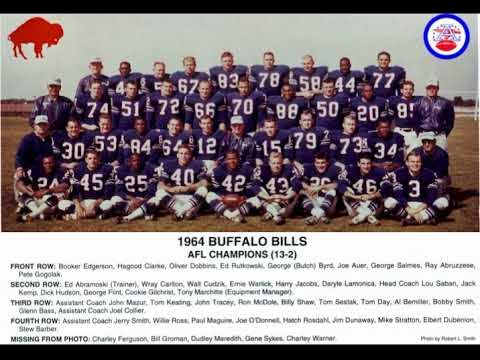
The season before, the San Diego Chargers, coached by Sid Gillman, had won the title, showing football fans that the AFL wasn't just a pass-happy "basketball league": It could feature good defense, too. The Buffalo Bills, coached by Lou Saban, followed the same path, with a defense led by end Ron McDole, tackle Tom Sestak, and linebacker Mike Stratton.

The Chargers would regret letting quarterback Jack Kemp go, as the Bills had acquired him to run their offense. Protected by a future Hall-of-Famer, guard Billy Shaw, he could hand off to running back Carlton Chester "Cookie" Gilchrist, or pass to receiver Elbert Dubenion.

There was once a common trivia question: Name the men wearing Number 32 who won the Most Valuable Player awards in the American League, the National League, the NFL and the AFL in 1963. But the question was no good: Elston Howard, Sandy Koufax, Jim Brown and Gilchrist won their respective awards, but, while the other 3 players wore 32, Gilchrist wore 34.

The Bills went 12-2 in 1964. They dropped 48 points on the Houston Oilers, and scored at least 30 points in 6 other games. Their only losses were on November 15, 36-28 at home to the Boston Patriots; and on December 6, 16-13 away to the Oakland Raiders.

As it was an even-numbered year, it was the Eastern Division winners' turn to host the AFL Championship Game, and the Bills welcomed the defending Champion Chargers into War Memorial Stadium. Built in 1938, it was already dilapidated, known as "The Old Rockpile." Buffalo native Brock Yates, a screenwriter who created the race upon which the Cannonball Run movies were based, said that it "looks as if whatever war it was a memorial to had been fought within its confines." And it was small: At 40,242 seats, its capacity would prove too small when the AFL and the NFL merged in 1970, so the Bills had to build a larger stadium.
In the 1st quarter, Tobin Rote threw a 26-yard touchdown pass to Dave Kocourek, to put the Chargers up, 7-0. But they never scored again. The Bills' defense was symbolized by Stratton hitting Keith Lincoln midway through the 1st quarter, breaking a rib and knocking him out of the game. It was the most famous defensive play in AFL history.
Pete Gogolak and his brother Charley, natives of Hungary, became pro football's 1st "soccer-style kickers," approaching the placement from the side and hitting the ball with the instep of the foot, rather than the traditional straight-on, hit-with-the-toes style. Pete kicked a field goal late in the 1st quarter, and another in the 2nd. In between, Kemp guided the Bills down to where Wray Carlton could score on a 4-yard run. In the 4th quarter, Kemp scored on a quarterback sneak. The Bills won, 20-7.
The Bills won the AFL Championship again in 1965, again beating the Chargers; then lost the 1966 AFL Championship Game to the Kansas City Chiefs. Saban would leave, then return as head coach, and lead the Bills to the AFC Wild Card Playoff berth in 1974.
Like basketball coach Larry Brown, Saban was known, somewhat unfairly, for never staying in the same place for very long, also serving as head coach for the Boston Patriots, the Denver Broncos, and several college teams. He died in 2009. His son, Nick Saban, in junior high school at the time of the Bills' AFL titles, would win 7 National Championships in the college ranks. Unlike many father & son coaching pairs, they never coached together. Indeed, while Lou was head coach at Army in 1979, Nick was an assistant coach at Navy in 1982.
The Bills had won the last 2 AFL Championships before the AFL Champion was allowed to play the NFL Champion for a World Championship, and had lost the game that would have put them in Super Bowl I. It would take until the 1990 season before they finally got into a Super Bowl. And they got into 4 in a row, something no other franchise has done. And yet, they lost all 4, and only the 1st one was all that close (although they were leading the 4th at the half).
The Bills have become to the NFL what the Chicago Cubs once were to baseball, the sport's "lovable losers" with a history of close calls breaking the hearts of some of the most passionate fans in the sport. From 1964 onward, they have been 1 of the last 2 teams standing 6 times, something only 7 other teams have done.
But the fact that the Bills' titles came before the advent of the Super Bowl means that they get discounted: Even before the distance of time became what it is now, NFL fans had come to regard any title won before the Super Bowl, NFL or AFL, as not a "real" championship.
As it stands, through Christmas 2022, no team based in, or near, Buffalo has ever won a major league sports championship. The NHL's Sabres are 0-for-2 in Stanley Cup Finals, and the NBA's Braves, like the Sabres a 1970 expansion team, moved in 1978. Due to Canadian COVID restrictions, the Toronto Blue Jays had to play some "home games" at Buffalo's Sahlen Field in 2020 and '21. Before that, there hadn't been a Major League Baseball team in Buffalo since the 1914-15 Blues of the Federal League; before that, the Bisons of the National League, who folded after the 1885 season. And none of those teams won a Pennant.
Unless you count soccer as a major league sport in North America, with the 1971 Rochester Lancers and the 2016 Western New York Flash, then the last World Championship won by a team that can be considered "Western New York" remains the 1955 NBA Champion Syracuse Nationals. If you don't count Syracuse as "Western," then it's the 1951 NBA Champion Rochester Royals.
In 1998, Vincent Gallo, a Buffalo native, wrote, directed and starred in the film Buffalo '66.. Despite the title, while there are flashbacks, the film took place mostly in the present day. He played Billy Brown, whose mother was going to go to the 1966 AFL Championship Game at War Memorial Stadium, but went into labor, and she has blamed the son's birth for her missing the game, and her missing the game for the Bills' inability to win a title ever since.

The son grew up to become a compulsive gambler, and when Scott Norwood missed his field goal attempt on the last play of Super Bowl XXV, causing the Bills to lose the game, still the closest they've come since 1965, Billy lost a $10,000 bet. Unable to pay up, his bookmaker forced him to clear his debt by confessing to a crime he did not commit, resulting in 5 years in prison.

When he gets out, he decides he wants to get revenge -- not on the bookie, but on Norwood (known as “Scott Wood” in the film), whom he's convinced took a payoff to miss the kick on purpose, a la the Chicago White Sox throwing the 1919 World Series. Have you ever wanted to kill someone who ruined a sporting event for you? Maybe. Would you ever actually attempt it? No. Billy sets out to attempt it. For the record, nobody has ever credibly accused Norwood of missing that kick on purpose.

UPDATE: The Bills have a Wall of Fame, with these members:
* From the 1960s: Quarterback Jack Kemp, running back Chester "Cookie" Gilchrist, receiver Elbert Dubenion, guards Billy Shaw and Bob Kalsu, defensive tackle Tom Sestak, linebacker Mike Stratton, cornerback Booker Edgerson, safety George Saimes; plus founding owner Ralph Wilson, team executive Pat McGroder, head coach Lou Saban, longtime broadcaster Van Miller and trainer Edward Abramoski. Kalsu only played one season before being drafted, and was the only active NFL player killed in action in the Vietnam War. 
* From the 1970s: Quarterback Joe Ferguson, guard Joe DeLamielleure, cornerback Robert James, and running back O.J. Simpson, whose name has never been removed despite his post-playing infamy; plus Wilson, McGroder, Saban, Miller and Abramoski.
* From the 1980s: Quarterback Jim Kelly, receivers Andre Reed and Steve Tasker, center Kent Hull, guard Jim Ritcher, defensive end Bruce Smith, defensive tackle Fred Smerlas, and linebacker Darryl Talley; plus Wilson, Miller and Abramoski.
* From the 1990s: Kelly, Reed, Tasker, Hull, Ritcher, Smith, running back Thurman Thomas and defensive end Phil Hansen; plus Wilson, Miller, Abramoski, head coach Marv Levy and general manager Bill Polian. The Bils have not yet honored whose main contribution was afterward.
In addition, Bills fans have been honored with induction, as "The 12th Man."
And the Greater Buffalo Sports Hall of Fame has honored Kemp, Gilchrist, Dubenion, Saimes, Sestak, Ferguson, DeLamielleure, Simpson, Smerlas, Kelly, Hull, Ritcher, Reed, Smith, Talley, Tasker, Thomas, Wilson, Levy, Saban, Polian, 1960s linebacker and later NBC broadcaster Paul Maguire, 1970s guard Reggie McKenzie, 1990s linebacker Shane Conlan, 1970s defensive tackle Jeff Yeates, 1990s kicker Steve Christie, and 2000s and 2010s defensive tackler Kyle Williams. Yeates and Williams were honored less for what they did with the Bills, and more because they were Buffalo area native who played in the NFL.
*
December 26, 1964 was a Saturday. The game was scheduled for that day, so as not to conflict with the NFL Championship Game being played the next day. One college bowl game was played: Georgia beat Texas Tech, 7-0 at the Sun Bowl, in the stadium of the same name, in El Paso, Texas.
Baseball was out of season. There were 4 games played in the NBA:

* The New York Knicks beat the Baltimore Bullets, 118-116 at the Baltimore Civic Center (now the CFG Bank Arena).

* The Cincinnati Royals beat the Philadelphia 76ers, 135-125 at the Philadelphia Civic Center. Oscar Robertson scored 38 points.

* The Boston Celtics beat the St. Louis Hawks, 97-84 at the Kiel Auditorium in St. Louis.

* And the Los Angeles Lakers beat the San Francisco Warriors, 129-122 at the Los Angeles Memorial Sports Arena. Jerry West scored 44 points.

The NHL's entire "Original Six" were in action:

* The New York Rangers lost to the Boston Bruins, 2-0 at the old Madison Square Garden.

* The Montreal Canadiens beat the Detroit Red Wings, 6-3 at the Montreal Forum.

* And the Chicago Black Hawks beat the Toronto Maple Leafs, 5-3 at Maple Leaf Gardens in Toronto.

And in English soccer, on this day after Christmas, Boxing Day, Arsenal beat Staffordshire team Stoke City, 3-2 at the Arsenal Stadium, a.k.a. "Highbury," in North London.

Saturday, December 24, 2022

December 24, 1968: The Earth As Seen From the Moon

December 24, 1968: Apollo 8 becomes the 1st Earth spacecraft to orbit Earth's Moon. It shows 2 images never before seen on Earth: The far side of the Moon, and Earth as seen from the Moon.

The mission was commanded by Colonel Frank Borman, U.S. Air Force. The pilot of the command module was Commander James Lovell, U.S. Navy. This was the first "space reunion": They had flown together on Gemini 7. Lovell was set to fly on Apollo 9, but was moved up to this mission after the intended CM pilot, Michael Collins, required back surgery. The pilot of the lunar module was Colonel William A. Anders, U.S. Air Force. 

It was Borman's 2nd spaceflight, and Lovell's 3rd, and it remains the only U.S. spaceflight on which the commanding officer was not the most-experienced in space. Lovell had also flown aboard Gemini 12. It was Anders' 1st spaceflight, and, as it turned out, his only one.

The entire setup, with command, service and lunar modules, was being sent even though the lunar module was not going to be separated, much less land on the Moon. Unlike later Apollo missions, neither the command module nor the lunar module had a codename.

The mission was launched on December 21. They entered lunar orbit on December 24, Christmas Eve. They became the 1st humans to see the Far Side of the Moon, and the 1st to see not a sunrise, or a moonrise, but an Earthrise, with the Earth in "phase," like the Moon is usually seen in from Earth.

"Look at that picture over there!" Anders called out. "Here's the Earth coming up. Wow, is that pretty!" He then took the photo at the top of this post. Borman called it "the most beautiful, heart-catching sight of my life."

They knew that they would be the 1st people from Earth to spend Christmas away from Earth. They wanted to express a Christmas-style message of "Peace on Earth, good will toward men." But instead of something actually Christmas-related, they instead read back to the people of Earth, through television, the Bible's Creation story.

At 9:30 PM, Eastern Time, Anders said, "We are now approaching lunar sunrise, and for all the people back on Earth, the crew of Apollo 8 has a message that we would like to send to you: In the beginning, God created the Heaven and the Earth. And the Earth was without form, and void; and darkness was upon the face of the deep. And the Spirit of God moved upon the face of the waters. And God said, 'Let there be light.' And there was light. And God saw the light, that it was good: and God divided the light from the darkness."

Lovell: "And God called the light Day, and the darkness He called Night. And the evening and the morning were the first day. And God said, 'Let there be a firmament in the midst of the waters, and let it divide the waters from the waters.' And God made the firmament, and divided the waters which were under the firmament from the waters which were above the firmament, and it was so. And God called the firmament Heaven. And the evening and the morning were the second day."

Borman: "And God said, 'Let the waters under the Heaven be gathered together unto one place, and let the dry land appear.' And it was so. And God called the dry land Earth; and the gathering together of the waters called he Seas, and God saw that it was good.' And from the crew of Apollo 8, we close with good night, good luck, a Merry Christmas, and God bless all of you, all of you on the good Earth."

After a very hard year, of war, of assassinations, of civil strife, this was a message of hope, a sign that, maybe, just maybe, things would be all right in the years to come. That was not to be, but the people of Earth had reason to believe that it might be. Because of this, in spite of the Vietnam War, and the election of Richard Nixon as the next President of the United States, Time magazine named Borman, Lovell and Anders their Men of the Year.
Apollo 8 was significant for another reason: It made the Soviet Union surrender in the race to the Moon. Their Zond project had originally planned a manned flyby of the Moon in late 1967, and a landing in December 1968. But they fell behind, due to various failures. The success of Apollo 8 showed them that trying to beat the U.S. to a manned Moon landing was pointless, and that their resources would be better spent in other ways.

Michael Collins would become the command module pilot for Apollo 11, the 1st mission to land on the Moon. Borman was offered the role of commanding Apollo 11, which would have made him the 1st human to walk on the Moon. He declined, saying he was done with spaceflights, and retired from the Air Force in 1970. So the 1st Moonwalker was the backup to Borman as the commander for Apollo 8, Neil Armstrong. It happened on July 20, 1969, beating the late President John F. Kennedy's deadline of doing it by the end of the 1960s by 164 days.

Lovell would command Apollo 13, the only Moon landing mission that had to be aborted.

As of December 24, 2022, the entire crew of Apollo 8 is still alive. They are the earliest surviving specific Time Persons of the Year. (Time had named American fighting men in 1950, and would again in 2003; American scientists in 1960, and people age 25 and under in 1966.)

UPDATE: Borman died on November 7, 2023; Anders, on June 7, 2024; Lovell, on August 7, 2025.

None of them lived to see the return of humans to lunar orbit, aboard Artemis II. On April 6, 2026, crewmember Reid Wiseman took a new photo, a companion piece to Anders' Earthrise, naming it Earthset.
It had been so long than none of the Artemis II astronauts had even been born yet when humans last left the Moon on Apollo 17 in 1972.

*

December 24, 1968 was a Tuesday. No NBA, ABA, NHL or college football bowl games were scheduled for that Christmas Eve. So there were no scores on that historic day.

December 31, 1999 & January 1, 2000: The Millennium

December 31, 1999:  The Millennium arrives. The people of planet Earth survived. At a terrible cost. But we hadn't destroyed ourselves. ...