Showing posts with label glenn miller. Show all posts

Thursday, December 15, 2022

December 15, 1944: Glenn Miller Disappears

December 15, 1944: Glenn Miller, the biggest name of the "Big Band" era of music, disappears.

Miller was a trombonist, and led The Glenn Miller Orchestra. In 1939, they had hits with "Moonlight Serenade" and "In the Mood." In 1940, he would record "Tuxedo Junction" and "PEnnsylvania 6-5000." In 1941 came "Chattanooga Choo Choo." In 1 day, May 20, 1942, he recorded "At Last" (now better known for the 1961 version by Etta James) and "(I've Got a Gal in) Kalamazoo."

So in a span of a little over 3 years, he recorded 7 iconic songs, which led to his band being featured in some movies. They became the biggest band of the World War II years (I'm talking about popularity, not just in number of members) -- bigger than Benny Goodman's, bigger than either Tommy Dorsey's or Jimmy Dorsey's, and (no doubt helped by the fact that he and his band were white) bigger than Duke Ellington's and Count Basie's.

Miller's career came to what was expected to be a temporary interruption when he joined the war effort. He was ready to give up a civilian income of $20,000 per week -- about $339,000 in 2022 money, or around $17 million a year, so it was comparable to today's biggest stars -- to put on a uniform and serve his country.

At 38, he was too old to be drafted by the U.S. Army. So he volunteered for the U.S. Navy. They told him they didn't need him. So he wrote to an Army General, suggesting that he "be placed in charge of a modernized Army band."

This was done, as he was assigned to the U.S. Army Air Forces, the precursor to the U.S. Air Force. This allowed his band members -- not the same ones he had in his Orchestra -- to fly to various U.S. installations and perform for their fellow troops.

On December 15, 1944, Major Glenn Miller boarded a single-engine UC-64 Norseman at Clapham, England, heading for recently-liberated Paris, where he would establish the headquarters his band intended to have for the duration of the War. With him were 2 other officers: Lieutenant Colonel Norman Baessell, who would supervise the construction of the HQ; and the pilot, Flight Officer John Morgan.
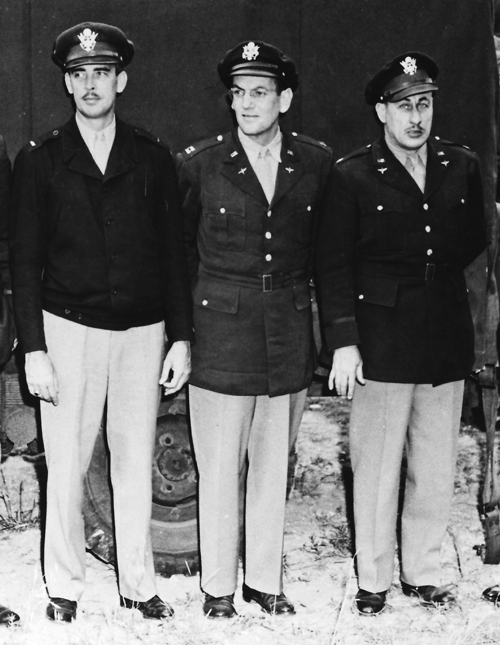
Left to right: Morgan, Miller, Baessell

The weather was bad the day before, leading to all planes being grounded. Miller was expected to be in Paris on the 16th, but on the 15th, Baessell made a guess that there would be enough of a break in the weather to fly. So the plane took off at 1:55 PM Greenwich Mean Time (8:55 AM on the U.S. East Coast).

No one was expecting the plane to arrive in Paris that afternoon, and so, when it didn't show up, no one thought to look for it. It was only when the rest of the band arrived at Paris' Orly Airport on December 18, and Miller wasn't there to meet them, that anybody realized that anything was wrong. The intended hotel was called, and Miller hadn't checked in.

It was only on December 24, Christmas Eve, that it was announced by the Army that Miller's plane was missing and presumed lost. No trace of it has ever been found. The band's deputy leader, Technical Sergeant Jerry Gray, led the band in that evening's performance in Miller's place.

Investigations turned up nothing solid, but the most common theory is that, given the weather, the plane's carburetor iced up, causing a crash that would have killed everybody on impact with the water. Suggestions of the Nazis shooting the plane down, or a horrible mistake of "friendly fire," or Miller having made it to Paris, dying in a brothel, and having the Army cover it up were dismissed as impossible.

Miller was 39, and left behind a wife and 2 children. His wife, Helen, was given a Bronze Star awarded to him 3 months later.

Today, as with some of the other bands I mentioned, a "legacy band," authorized by the Miller estate, performs the Miller catalog. Trumpeter Ray Anthony was the last surviving member of the original Glenn Miller Orchestra. On January 20, 2022, he celebrated his 100th birthday.

*

December 15, 1944 was also the day the Battle of the Bulge began in the Ardennes Forest of France, Belgium and Luxembourg, Nazi Germany's last stand on the Western Front. On December 22, the Nazis sent an officer to deliver a surrender demand to the U.S. Army's 101st Airborne Division, then stationed in Bastogne, Belgium, and virtually surrounded. General Anthony McAuliffe, in command, sent him away with a one-word reply: "Nuts!"

The Nazis held the upper hand through Christmas, but the day after, the 4th Armored Division arrived with reinforcements, and turned the tide of the battle. Once that happened, the Nazis were doomed, both on the Western Front and overall.

It was also the day the first five-star Generals were promoted. I have a separate entry for that.

And it was the day the film Hollywood Canteen opened. I have a separate entry for that, too.

December 15, 1944 was a Friday. Baseball was in the off-season. The NFL Championship Game was played 2 days later, with the Green Bay Packers beating the New York Giants, 14-7 at the Polo Grounds in New York. The NBA hadn't been founded yet. And, while the NHL was in-season, no games were scheduled for that day. So there are no scores on this historic day.

Monday, August 1, 2022

August 1, 1939: Glenn Miller Records "In the Mood"

August 1, 1939: The Glenn Miller Orchestra records "In the Mood." It becomes one of the signature songs of the Big Band Era.

Miller, then 35 years old, was a trombonist, and had already become a star earlier in the year with "Moonlight Serenade." In 1940, he would record "Tuxedo Junction" and "PEnnsylvania 6-5000." In 1941 came "Chattanooga Choo Choo." In 1 day, May 20, 1942, he recorded "At Last" (now better known for the 1961 version by Etta James) and "(I've Got a Gal in) Kalamazoo."

So in a span of a little over 3 years, he recorded 7 iconic songs, which led to his band being featured in some movies. They became the biggest band of the World War II years (I'm talking about popularity, not just in number of members) -- bigger than Benny Goodman's, bigger than either Tommy Dorsey's or Jimmy Dorsey's, and (no doubt helped by the fact that he and his band were white) bigger than Duke Ellington's and Count Basie's.

Miller's career came to what was expected to be a temporary interruption when he joined the war effort. He was ready to give up a civilian income of $20,000 per week -- about $339,000 in 2022 money, or around $17 million a year, so it was comparable to today's biggest stars -- to put on a uniform and serve his country.

At 38, he was too old to be drafted by the U.S. Army. So he volunteered for the U.S. Navy. They told him they didn't need him. So he wrote to an Army General, suggesting that he "be placed in charge of a modernized Army band."

This was done, as he was assigned to the U.S. Army Air Forces, the precursor to the U.S. Air Force. This allowed his band members -- not the same ones he had in his Orchestra -- to fly to various U.S. installations and perform for their fellow troops.

On December 15, 1944, Major Glenn Miller boarded a single-engine UC-64 Norseman at Clapham, England, heading for recently-liberated Paris, where he would establish the headquarters his band intended to have for the duration of the War. No one was expecting the plane to arrive in Paris that afternoon, and so, when it didn't show up, no one thought to look for it. It was only when the rest of the band arrived at Paris' Orly Airport on December 18, and Miller wasn't there to meet them, that anybody realized that anything was wrong. The intended hotel was called, and Miller hadn't checked in.

On December 24, Christmas Eve, it was announced by the Army that Miller's plane was missing and presumed lost. No trace of it has ever been found. Investigations turned up nothing solid, but the most common theory is that, given the weather, the plane's carburetor iced up, causing a crash that would have killed everybody on impact with the water. Miller was 39, and left behind a wife and 2 children. His wife, Helen, was given a Bronze Star awarded to him 3 months later.

Although a "legacy band" performs under the Miller name today, as with some of the others I mentioned, trumpeter Ray Anthony was the last surviving member of the original Glenn Miller Orchestra. He turned 100 on January 20, 2022.

*

August 1, 1939 was a Tuesday. Novelist Robert James Waller was born on this day.

The following Major League Baseball games were played:

* The New York Yankees lost to the Detroit Tigers, 5-2 at Yankee Stadium. George Selkirk hit a home run, and Joe DiMaggio went 1-for-4, but it wasn't enough, as Dizzy Trout was backed by a home run from Hank Greenberg, allowing him to outpitch Red Ruffing.

* The New York Giants beat the Cincinnati Reds, 5-4 at Crosley Field in Cincinnati. Harry "the Horse" Danning singled home the winning run in the top of the 10th inning. 

* The Brooklyn Dodgers beat the Pittsburgh Pirates, 5-3 at Forbes Field in Pittsburgh.

* The Boston Red Sox beat the Cleveland Indians, 7-5 at Fenway Park in Boston. Bob Feller only lasted 6 innings for the Tribe, and Lefty Grove got the win for the BoSox, thanks to 2 home runs and 5 RBIs from Bobby Doerr. Rookie Ted Williams went 0-for-3 with a walk, but did get an RBI on a groundout.

* The Chicago White Sox beat the Philadelphia Athletics, 4-1 at Shibe Park in Philadelphia.

* The Washington Senators beat the St. Louis Browns, 7-5 at Griffith Stadium in Washington.

* The Chicago Cubs beat the Philadelphia Phillies, 6-2 at Wrigley Field in Chicago.

* And the St. Louis Cardinals beat the Boston Bees, 4-3 at Sportsman's Park in St. Louis. (The Braves had a terrible season in 1935, and decided to rebrand as the Bees, but the name never caught on with the public, and they changed it back to Braves in 1941.) 

Thursday, February 10, 2022

February 10, 1942: The 1st Gold Record

February 10, 1942: For the 1st time, a song is awarded a gold record. It's the recording of "Chattanooga Choo Choo" (no hyphen in the title) by Glenn Miller and His Orchestra. The award is by RCA Victor Records, for achieving the sale of 1 million copies.

The music was composed by Harry Warren. The lyrics were written by Mack Gordon, and they're a little troubling today, due to the retroactively obvious racism. It begins with a traveler at New York's Pennsylvania Station talking to a shoe-shine man, and men in that profession were nearly always black:

Traveler: Pardon me, boy: Is that the Chattanooga Choo Choo?
Shine man: Yes, yes, Track 29!
Traveler: Boy, you can give me a shine.
Shine man: Can you afford to board the Chattanooga Choo Choo?
Traveler: I've got my fare, and just a trifle to spare.

At the time, there were 3 trains that ran from Penn Station to Chattanooga. The Southern Railway's Birmingham Special, as its name suggests, went on to Birmingham, Alabama. The Tennessean went on to Memphis. The Pelican went past Birmingham to New Orleans, and remains in operation on Amtrak today, under the name of the Crescent.

Supposedly, Gordon and Warren rode the Birmingham Special together, and were inspired to write the song. But they took some artistic license. "Track 29" may rhyme with "shine," but Penn Station only had 21 tracks at the time. The Birmingham Special didn't "leave the Pennsylvania Station 'bout a quarter to four," 3:45 PM, unless it was seriously delayed: It left at 12:30.

And all 3 of those trains went through western Virginia into East Tennessee, through the State Line-straddling city of Bristol. U.S. Route 11 was built roughly parallel to this line, and Interstate 81 was added. So, if you had ham and eggs for breakfast on the train, it could be in the Great Smoky Mountains, but it would be in Tennessee, not in North or South Carolina.

Miller and His Orchestra recorded the song in Manhattan on May 7, 1941. Saxophonist Gordon "Tex" Beneke (so nicknamed because he came from Fort Worth, Texas) sang lead, and Paula Kelly and The Four Modernaires sang backup. It was released on RCA's Bluebird Records subsidiary on July 25, was included in the film Sun Valley Serenade that premiered on August 21, and hit Number 1 on November 29.
Tex Beneke, the biggest-selling singer you've
(probably) never heard of, until now.

For years, I was under the incorrect impression that the lead singer on the original version was Ray McKinley, a.k.a. "Eight Beat Mack," Miller's drummer. While he sing lead on some Miller recordings, including a later version of this song, he did not sing it on the original recording.

Glenn Miller disappeared during a flight over the English Channel in 1944, his plane probably crashing due to icing on the wings. Alex Gordon died in 1959, Harry Warren in 1981, Ray McKinley in 1995, and Tex Benecke in 2000.

Built in 1909, Chattanooga's Terminal Station closed in 1970, with the Birmingham Special canceled, due to the bankruptcy of the Southern Railway. The station was converted into a train-themed hotel in 1973. Although "Chattanooga Choo Choo" remains America's most popular train-themed song -- ahead of "The Ballad of Casey Jones," "The Orange Blossom Special," "M.T.A." and "The City of New Orleans" -- since its incorporation in 1971, Amtrak has never provided service to Chattanooga.
There's an old joke about "singing cowboy" Roy Rogers having a brand new pair of boots. After camping out all night, he hears a noise outside his tent. A mountain lion is chewing up his boots. Roy shoots it, and brings it home. When he gets home, his wife and co-star, Dale Evans, sees the dead lion and the chewed-up boots, and says, "Pardon me Roy, is that the cat that chewed your new shoes?"

And in 2007, Senator Larry Craig of Idaho, a Republican known for his pro-gun and anti-gay crusades, was arrested in a rest room at the airport in Minneapolis, having tapped shoes with the man in the stall next to him, a signal from one gay man to (potentially) another that he's interested. The man in the next stall was a cop, and Craig was arrested, and the joke was, "Pardon me, boy: Is that the chap that tapped your new shoe?"

*

The first "precious metal" record was a silver record, awarded by Regal Zonophone to British singer George Formby, in 1937, for selling 100,000 copies of his song "The Window Cleaner." RCA Victor copied this by waiting until "Chattanooga Choo-Choo" sold over a million.

In 1958, the Recording Industry Association of America decided to make it official, introducing the gold record award for any record, whether a single or an album, that sold at least one million copies domestically. Foreign sales were not included. Under this system, the 1st single to receive a gold record was "Catch a Falling Star" by Perry Como, and the 1st album to get one was the soundtrack to the film version of the musical Oklahoma!

In 1976, the RIAA introduced the platinum record, for 1 million albums and 2 million singles, downgrading the gold record to 500,000 albums, while keeping 1 million as the standard for singles. This time, an album crossed the threshold first, Their Greatest Hits (1971-1975) by The Eagles, followed by the 1st single, "Disco Lady" by Johnnie Taylor.

In 1999, by which point the gold record threshold for singles had also been dropped to half a million, the RIAA introduced the diamond record, for 10 million units. The 1st single so certified was the new version of "Candle in the Wind" that Elton John sang for Princess Diana.

For albums, they went retroactive: The 1st one certified diamond was The Wall by Pink Floyd, even though, as of February 10, 2022, several albums have sold more, including Pink Floyd's own Dark Side of the Moon, with Michael Jackson's Thriller topping them all with over 51 million sales certified, and probably a lot more than that which can't be certified.

The RIAA has never stopped record companies from taking matters into their own hands. In 2017, Universal Music Group gave Luis Fonsi a plutonium disc for the sales of "Despacito." It's sold 36 million digital copies -- not physical units like records or compact discs.

Bing Crosby's original 1942 version of "White Christmas" remains the biggest-selling single record ever, with over 50 million in sales, while Elton's 1997 version of "Candle in the Wind" is a distant 2nd, at 33 million. With 41 million sales, the best-selling song digitally is Ed Sheeran's 2017 "Shape of You."

*

February 10, 1942 was a Tuesday. Baseball and football were out of season. The NBA hadn't been founded yet. There were 2 games played in the NHL. The New York Rangers lost to the Chicago Black Hawks, 5-2 at the old Madison Square Garden. And the Boston Bruins beat the Montreal Canadiens, 8-1 at the Boston Garden.

December 31, 1999 & January 1, 2000: The Millennium

December 31, 1999:  The Millennium arrives. The people of planet Earth survived. At a terrible cost. But we hadn't destroyed ourselves. ...