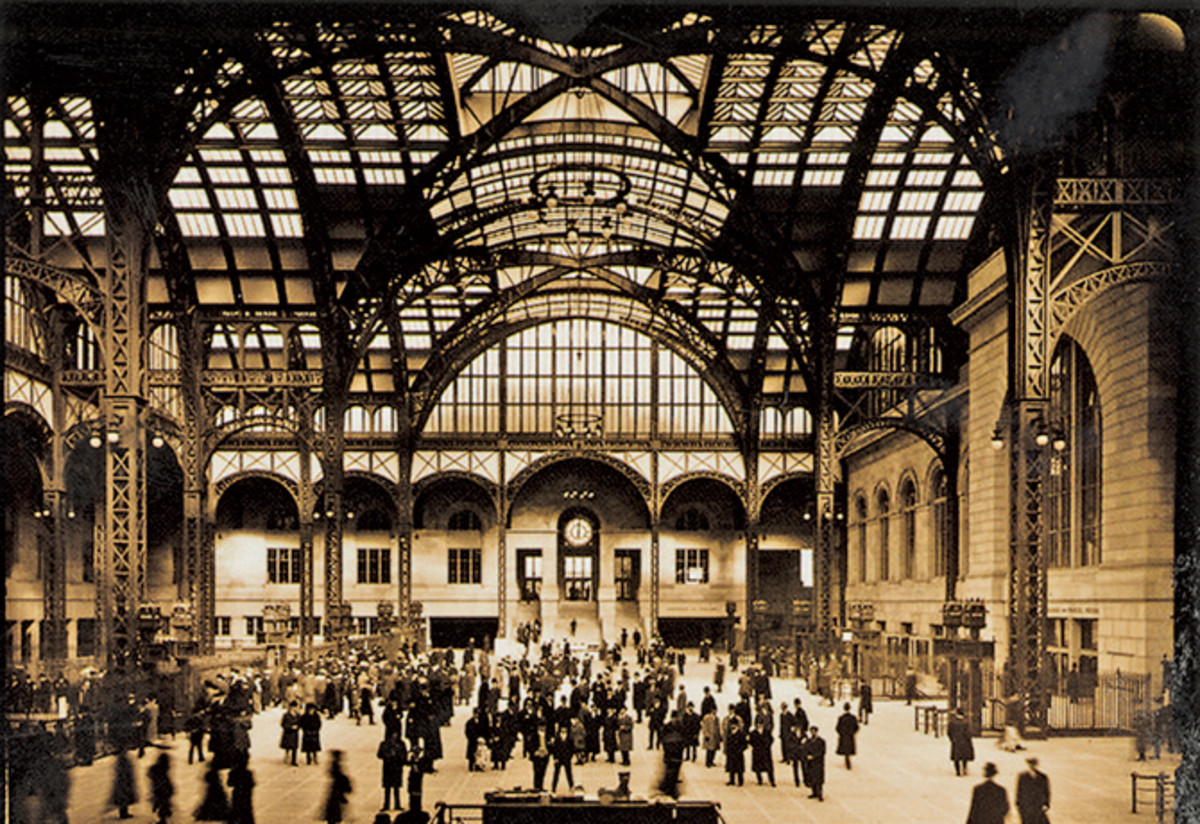
Showing posts with label penn station. Show all posts

Friday, October 28, 2022

October 28, 1963: The Demolition of the Old Penn Station

October 28, 1963: Demolition begins on the original Pennsylvania Station in Midtown Manhattan, built in 1910. Since most of the station's operations were underground, there wasn't much disruption of service.

By this point, the most beloved train station in America didn't look so good. That photo above is not colorized: The marble had been stained by over half a century of pollution. (Note the tailfins on the taxi.) And with the decline in train travel compared to the rise of driving and flying, a train station this grand was no longer necessary. The successor station would be utilitarian at best -- and a commuter's nightmare at worst.

When the Pennsylvania Plaza complex opened in 1968, including the new Madison Square Garden above it, Penn Station had become completely subterranean, and it went from being one of the most beloved transit centers in America to one of the most hated.

But the original station's destruction spurred the landmark preservation movement in New York City, which helped to save Grand Central Terminal in the 1970s, Carnegie Hall in the 1980s, and so many other great buildings. Still, not every great building was saved: Once Lincoln Center opened, the original Metropolitan Opera House was demolished in 1967, and a boxy skyscraper was put up in its place.

*

October 28, 1963 was a Monday. Actress Lauren Holly was born.

Baseball season had ended 3 weeks earlier, with the  Los Angeles Dodgers beating the New York Yankees in the World Series. And there would be no Monday Night Football for another 7 years. And while the NBA and NHL seasons were underway, no games were scheduled. So there were no scores on this historic day.

Wednesday, September 7, 2022

September 8, 1910: Pennsylvania Station Opens In New York

September 8, 1910: Pennsylvania Station -- or "Penn Station" for short -- opens in Manhattan, between 31st and 33rd Streets, and between 7th and 8th Avenues. It is hailed as the greatest train station ever built, and eliminated the need for trans-Hudson ferries.

It serves New Jersey and beyond via the Pennsylvania Railroad, and the Counties of Nassau and Suffolk via the Long Island Rail Road. To get to points north, such Upstate New York, New England and Canada, one must still use Grand Central Depot, or, after its replacement in 1913, Grand Central Terminal.
The growth of highways and the auto industry ruined passenger rail travel in America, beyond the commuter level. In 1963, New York's Penn Station was a dirty relic, and hardly resembled the great temple of transit that people who hate its replacement want to think of it as.
The upper structure was demolished, and service continued below ground, protected by a temporary steel roof, until 1968, when the new Penn Station opened, with the new Madison Square Garden above.
Penn Station II, New York, which opened in 1968

By 1968, both the Pennsylvania and its great rival, the New York Central Railroad, were bankrupt. They merged, forming the Penn Central Transportation Company. It didn't work: They filed for bankruptcy in 1970, their regional service was taken over by the newly-formed Amtrak in 1971, and Conrail took over their local service in 1976. In 1983, New Jersey Transit took over. All the while, the LIRR kept rolling in and out. Penn Station remains America's busiest passenger rail terminal.

*

September 8, 1910 was a Thursday. There was no NFL, NBA or NHL yet. But there were games in what would later be called Major League Baseball:

* The New York Highlanders beat the Washington Senators, 8-2 at League Park in Washington. Jack Warhop went the distance, backed by a 4-for-4 performance by his 1st baseman, who was also his manager -- who was also a man throwing games, though not on this day: Hal Chase. In 1913, the Highlanders officially changed their name to what people were already calling them: The New York Yankees.

* The New York Giants played the Boston Doves at the Polo Grounds, and the game was called due to darkness after 10 innings, tied 1-1. The Doves were named for their owner, John Dovey. He sold them to William Russell in 1911, and they were renamed the Boston Rustlers. Russell died after the season, and the team was bought by James Gaffney, an officer, or "Brave," in New York's Tammany Hall political organization. So they were renamed the Braves.

* The Brooklyn Superbas lost to the Philadelphia Phillies, 8-1 at Baker Bowl in Philadelphia. Named for a circus troupe, Hanlon's Superbas, because they had once been managed by Ned Hanlon, they resumed using one of their former names the next season: The Brooklyn Dodgers.

* The Philadelphia Athletics beat the Boston Red Sox, 3-2 at the Huntington Avenue Grounds in Boston.

* The St. Louis Cardinals beat the Pittsburgh Pirates, 4-2 at Forbes Field in Pittsburgh.

* The Cleveland Naps beat the Detroit Tigers, 7-4 at League Park in Cleveland. The home team was named for their 2nd baseman and manager, Napoleon "Nap" Lajoie. After he left in 1914, they were renamed the Cleveland Indians. Lajoie went 2-for-4 with 2 RBIs. Ty Cobb did not play for the Tigers in this game.

Lajoie and Cobb would famously battle for the American League batting title to the end of that season, with Cobb sitting out the last 2 games and Lajoie going 8-for-8 in the finale, and Cobb still winning it -- until 1981, when someone discovered that one of Cobb's games was counted twice, giving him 2 more hits than he should have had.

* The Chicago Cubs beat the Cincinnati Reds, 8-3 at West Side Park in Chicago.

* And a doubleheader was played at Sportsman's Park in St. Louis. The Chicago White Sox won the opener, 1-0. Fred Olmstead pitched a 1-hit shutout. The St. Louis Browns won the nightcap, 6-4.

Saturday, April 9, 2022

April 9, 1925: Babe Ruth's "Bellyache Heard 'Round the World"

Ruth being loaded into the ambulance at Penn Station.
Every paper in the country had this photo then, but it's rare now.

April 9, 1925: Babe Ruth, the biggest star in baseball, is rushed to the hospital. It becomes known as "The Bellyache Heard 'Round the World."

History remembers the great New York Yankees slugger as a big jolly fat man who loved children and delivered for his fans, baseball's answer to Santa Claus -- or, as his contemporary, sportswriter Jimmy Cannon, put it, "Santa Claus drinking his whiskey straight, and complaining of a bellyache." But for much of his career, his 6-foot-2 frame carried a strapping 215 pounds, hardly fat at all.

But his massive appetites, including for food and drink, got him in trouble. He was overweight for much of the 1922 season, and used farmwork at his home in Sudbury, Massachusetts, 23 miles west of downtown Boston, to get in shape for the 1923 season. He remained in good shape for 1923 and 1924.

But the 1924-25 off-season saw him out of control. By the time he got to Hot Springs, Arkansas -- where Spring Training had been invented in 1885 by Cap Anson of the team now known as the Chicago Cubs, to "boil the beer out" of his players, Ruth was 256 pounds. On this annual "Babe Boil," he lost 30 pounds.

But Hot Springs had become a resort town, with all kinds of illegal establishments, from bars (it was the middle of Prohibition) to casinos to houses of otherwise ill repute -- to satisfy yet another of the Babe's irresistible-force appetites, while his wife, Helen, and their daughter, Dorothy, were left behind in Sudbury.

He suffered abdominal pains and a fever in Hot Springs, before joining the Yankees in St. Petersburg, Florida. The Yankees had previously trained in New Orleans, but, already known as America's biggest party city, it offered too many temptations for the Great Bambino. So they moved to St. Pete, where they stayed until 1961.

(They moved to Fort Lauderdale in 1962, and the Mets took up the Yankees' former complex at Miller Huggins Field, renaming it Huggins-Stengel Field. The Mets moved to Port St. Lucie in 1988, and the Yankees moved to Tampa in 1996. Huggins-Stengel Field is still in use for amateur baseball.)

While in St. Pete, Ruth fell ill again. On April 7, as the team's train headed north, it stopped in Asheville, North Carolina, where the Yankees were to play an exhibition game. Ruth collapsed on the platform, and was hospitalized. The team played the game without him.

Trying to get back to New York, he missed a train connection, making him unable to meet the team in Washington. This story got around the world, and, like a "game of telephone," it got wilder until a newspaper in London printed that the Sultan of Swat was dead at the age of 31. (He was actually 30. How he didn't know his own birthdate is a story for another time.) He sent a telegram to Helen, telling her to meet him in New York, so she would know he was alive. This, and his groans of pain, were the kind of roars that the Roaring Twenties did not need.

As his train got through New Jersey on its way to Pennsylvania Station on April 9, Ruth, having just had a typically huge breakfast, lost consciousness in the train's rest room. He was taken to his sleeping compartment, and, upon arrival, its window had to be removed to get him out on a stretcher. He went into convulsions in the ambulance, and it took 6 attendants to hold him down. He was given a sedative, and taken to St. Vincent's Hospital at 14th Street and 7th Avenue in Greenwich Village.

What did Ruth have? Sportswriter W.O. McGeehan wrote that Ruth's illness was due to binging on hot dogs and soda pop before a game -- a "safe for public consumption" story. Because of this, it became known as "The Bellyache Heard 'Round the World." A report from his doctor, issued through the Yankees' front office, said that Ruth had a "fistula" -- essentially, a gastric ulcer. Also, a safe story.

Decades later, a distant cousin on his father's side said that Crohn's disease, an inflammation of the colon (the large intestine), runs in the Ruth family. This would explain the symptoms, but Crohn's tends to be a chronic issue, and this was the only time in Ruth's life that he suffered such symptoms.

Given Ruth's carousing, there has been a rumor ever since that he was suffering from some sort of sexually-transmitted disease. Supposedly, this was confirmed by Yankee general manager Ed Barrow. But Ruth underwent surgery on April 17, and surgery has never been a typical treatment for either syphilis or gonorrhea, the 2 main venereal diseases.

In 1959, in her memoir, Claire Ruth, the Babe's 2nd wife, wrote that it was something that couldn't be mentioned in polite company at the time, but not V.D.: It was a torn groin muscle. But that wouldn't have explained the fever or the faintings.

In his 1938 memoir Farewell to Sport, sportswriter Paul Gallico wrote, "A baseball player lay close to death and an entire nation held its breath, worried and fretted, and bought every edition of the newspapers to read the bulletins as though the life of a personal friend or a member of the family were at stake." (And, remember, this was before his epic 1927 season, or his 1932 "called shot.") There was no 24-hour TV news or social media to spread the stories, true or otherwise. Even radio broadcasting was still in its infancy.

On April 24, with the Babe still hospitalized, Helen collapsed on the grounds of St. Vincent's, having "a complete nervous breakdown." She couldn't take all the talk about his illness, and the various things that could have caused it.

They separated not long thereafter. He wasn't too Catholic to cheat on her, but he was too Catholic to ever divorce her. She eventually left him for another man, and died in a house fire in 1929. Ruth seemed genuinely sad at her funeral. However, just three months later, he married Claire, who had basically been the real Mrs. Ruth since 1923.

Ruth didn't make his season debut until June 1, and had his worst season as a Yankee. Several other Yankees weren't hitting, either. Indeed, between June 1, 1925 -- also the day Lou Gehrig's playing streak began -- and April 13, 1926, the next season's Opening Day, the starters were replaced at 1st base, 2nd base, shortstop, center field and catcher. Respectively: Wally Pipp was replaced by Gehrig, Aaron Ward was replaced by Tony Lazzeri, Everett Scott was replaced by Mark Koenig, Whitey Witt was replaced by Earle Combs; and Wally Schang was replaced by a platoon of Mike Gazella, Pat Collins and Benny Bengough. (It is odd that the 1927 Yankees, often considered the greatest team of all time, were weak at the most important position, catcher.)

What's more, Ruth talked to the one athlete in the 1920s who could match him for press attention, the Heavyweight Champion of the World, Jack Dempsey. Dempsey lent Ruth one of his trainers, Artie McGovern. This made Ruth perhaps the 1st person in America, other than prizefighters like Dempsey and actors, to have what would now be called a personal trainer. He whipped Ruth back into shape.

The results speak for themselves: Year, Ruth's age, batting average, home runs, RBIs, OPS+, Yankees' finish:

1926, 31: .372, 47, 153, 226, 91-63, Won Pennant, but lost World Series
1927, 32: .356, 60, 165, 225, 110-44, Won World Series
1928, 33: .323, 54, 146, 206, 101-53, Won World Series
1929, 34: .345, 46, 154, 193, 88-66, 2nd place
1930, 35: .359, 49, 153, 211, 86-68, 3rd place
1931, 36: .373, 46, 162, 218, 94-59, 2nd place
1932, 37: .341, 41, 137, 201, 107-47, Won World Series

No steroids necessary.

*

April 9, 1925 was a Thursday. Baseball, as stated, was still in Spring Training. Football was out of season. Professional basketball barely existed. The hockey season ended 10 days earlier, when the Victoria Cougars beat the Montreal Canadiens for the Stanley Cup. So there were no scores on this historic day.

Thursday, February 10, 2022

February 10, 1942: The 1st Gold Record

February 10, 1942: For the 1st time, a song is awarded a gold record. It's the recording of "Chattanooga Choo Choo" (no hyphen in the title) by Glenn Miller and His Orchestra. The award is by RCA Victor Records, for achieving the sale of 1 million copies.

The music was composed by Harry Warren. The lyrics were written by Mack Gordon, and they're a little troubling today, due to the retroactively obvious racism. It begins with a traveler at New York's Pennsylvania Station talking to a shoe-shine man, and men in that profession were nearly always black:

Traveler: Pardon me, boy: Is that the Chattanooga Choo Choo?
Shine man: Yes, yes, Track 29!
Traveler: Boy, you can give me a shine.
Shine man: Can you afford to board the Chattanooga Choo Choo?
Traveler: I've got my fare, and just a trifle to spare.

At the time, there were 3 trains that ran from Penn Station to Chattanooga. The Southern Railway's Birmingham Special, as its name suggests, went on to Birmingham, Alabama. The Tennessean went on to Memphis. The Pelican went past Birmingham to New Orleans, and remains in operation on Amtrak today, under the name of the Crescent.

Supposedly, Gordon and Warren rode the Birmingham Special together, and were inspired to write the song. But they took some artistic license. "Track 29" may rhyme with "shine," but Penn Station only had 21 tracks at the time. The Birmingham Special didn't "leave the Pennsylvania Station 'bout a quarter to four," 3:45 PM, unless it was seriously delayed: It left at 12:30. And all 3 of those trains went through western Virginia into East Tennessee, roughly parallel to U.S. Route 11, and eventually Interstate 81. So, if you had ham and eggs for breakfast on the train, it could be in the Great Smoky Mountains, but it would be in Tennessee, not in North or South Carolina.

Miller and His Orchestra recorded the song on May 7, 1941. Saxophonist Gordon "Tex" Beneke (so nicknamed because he came from Fort Worth, Texas) sang lead, and Paula Kelly and The Four Modernaires sang backup. It was released on RCA's Bluebird Records subsidiary on July 25, was included in the film Sun Valley Serenade that premiered on August 21, and hit Number 1 on November 29.
Tex Beneke, the biggest-selling singer you've
(probably) never heard of, until now.

For years, I was under the incorrect impression that the lead singer on the original version was Ray McKinley, a.k.a. "Eight Beat Mack," Miller's drummer. While he sing lead on some Miller recordings, including a later version of this song, he did not on the original recording.

Glenn Miller disappeared during a flight over the English Channel in 1944, his plane probably crashing. Alex Gordon died in 1959, Harry Warren in 1981, Ray McKinley in 1995, Tex Benecke in 2000.

Built in 1909, Chattanooga's Terminal Station closed in 1970, with the Birmingham Special canceled, due to the bankruptcy of the Southern Railway. The station was converted into a train-themed hotel in 1973. Although "Chattanooga Choo Choo" remains America's most popular train-themed song -- ahead of "The Ballad of Casey Jones," "The Orange Blossom Special," "M.T.A." and "The City of New Orleans" -- since its incorporation in 1971, Amtrak has never provided service to Chattanooga.
There's an old joke about "singing cowboy" Roy Rogers having a brand new pair of boots. After camping out all night, he hears a noise outside his tent. A mountain lion is chewing up his boots. Roy shoots it, and brings it home. When he gets home, his wife and co-star, Dale Evans, sees the dead lion and the chewed-up boots, and says, "Pardon me Roy, is that the cat that chewed your new shoes?"

And in 2007, Senator Larry Craig of Idaho, a Republican known for his pro-gun and anti-gay crusades, was arrested in a rest room at the airport in Minneapolis, having tapped shoes with the man in the stall next to him, a signal from one gay man to (potentially) another that he's interested. The man in the next stall was a cop, and Craig was arrested, and the joke was, "Pardon me, boy: Is that the chap that tapped your new shoe?"

*

The first "precious metal" record was a silver record, awarded by Regal Zonophone to British singer George Formby, in 1937, for selling 100,000 copies of his song "The Window Cleaner." RCA Victor copied this by waiting until "Chattanooga Choo-Choo" sold over a million.

In 1958, the Recording Industry Association of America decided to make it official, introducing the gold record award for any record, whether a single or an album, that sold at least one million copies domestically. Foreign sales were not included. Under this system, the 1st single to receive a gold record was "Catch a Falling Star" by Perry Como, and the 1st album to get one was the soundtrack to the film version of the musical Oklahoma!

In 1976, the RIAA introduced the platinum record, for 1 million albums and 2 million singles, downgrading the gold record to 500,000 albums, while keeping 1 million as the standard for singles. This time, an album crossed the threshold first, Their Greatest Hits (1971-1975) by The Eagles, followed by the 1st single, "Disco Lady" by Johnnie Taylor.

In 1999, by which point the gold record threshold for singles had also been dropped to half a million, the RIAA introduced the diamond record, for 10 million units. The 1st single so certified was the new version of "Candle in the Wind" that Elton John sang for Princess Diana.

For albums, they went retroactive: The 1st one certified diamond was The Wall by Pink Floyd, even though, as of February 10, 2022, several albums have sold more, including Pink Floyd's own Dark Side of the Moon, with Michael Jackson's Thriller topping them all with over 51 million sales certified, and probably a lot more than that which can't be certified.

The RIAA has never stopped record companies from taking matters into their own hands. In 2017, Universal Music Group gave Luis Fonsi a plutonium disc for the sales of "Despacito." It's sold 36 million digital copies -- not physical units like records or compact discs.

Bing Crosby's original 1942 version of "White Christmas" remains the biggest-selling single record ever, with over 50 million in sales, while Elton's 1997 version of "Candle in the Wind" is a distant 2nd, at 33 million. With 41 million sales, the best-selling song digitally is Ed Sheeran's 2017 "Shape of You."

*

February 10, 1942 was a Tuesday. Baseball and football were out of season. The NBA hadn't been founded yet. There were 2 games played in the NHL. The New York Rangers lost to the Chicago Black Hawks, 5-2 at the old Madison Square Garden. And the Boston Bruins beat the Montreal Canadiens, 8-1 at the Boston Garden.

December 31, 1999 & January 1, 2000: The Millennium

December 31, 1999:  The Millennium arrives. The people of planet Earth survived. At a terrible cost. But we hadn't destroyed ourselves. ...