Showing posts with label new jersey transit. Show all posts

Wednesday, September 7, 2022

September 8, 1910: Pennsylvania Station Opens In New York

September 8, 1910: Pennsylvania Station -- or "Penn Station" for short -- opens in Manhattan, between 31st and 33rd Streets, and between 7th and 8th Avenues. It is hailed as the greatest train station ever built, and eliminated the need for trans-Hudson ferries.

It serves New Jersey and beyond via the Pennsylvania Railroad, and the Counties of Nassau and Suffolk via the Long Island Rail Road. To get to points north, such Upstate New York, New England and Canada, one must still use Grand Central Depot, or, after its replacement in 1913, Grand Central Terminal.
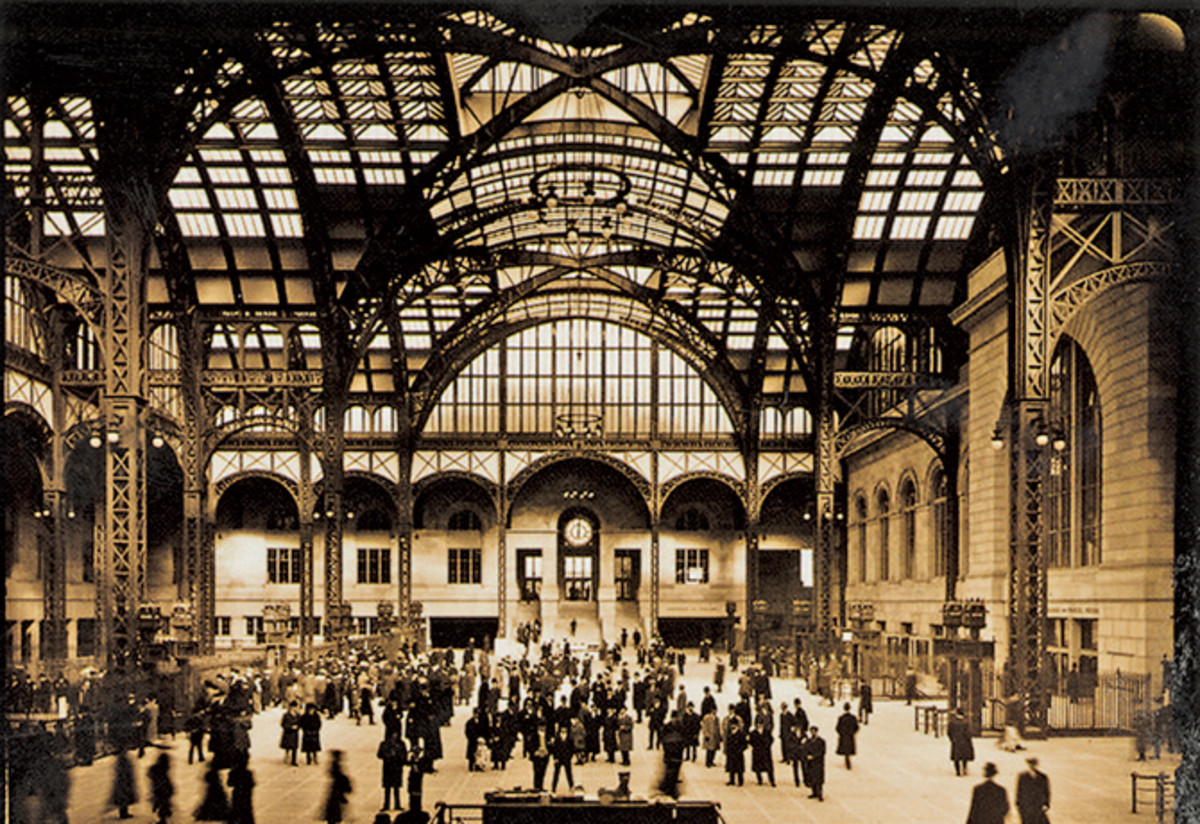
The growth of highways and the auto industry ruined passenger rail travel in America, beyond the commuter level. In 1963, New York's Penn Station was a dirty relic, and hardly resembled the great temple of transit that people who hate its replacement want to think of it as.
The upper structure was demolished, and service continued below ground, protected by a temporary steel roof, until 1968, when the new Penn Station opened, with the new Madison Square Garden above.
Penn Station II, New York, which opened in 1968

By 1968, both the Pennsylvania and its great rival, the New York Central Railroad, were bankrupt. They merged, forming the Penn Central Transportation Company. It didn't work: They filed for bankruptcy in 1970, their regional service was taken over by the newly-formed Amtrak in 1971, and Conrail took over their local service in 1976. In 1983, New Jersey Transit took over. All the while, the LIRR kept rolling in and out. Penn Station remains America's busiest passenger rail terminal.

*

September 8, 1910 was a Thursday. There was no NFL, NBA or NHL yet. But there were games in what would later be called Major League Baseball:

* The New York Highlanders beat the Washington Senators, 8-2 at League Park in Washington. Jack Warhop went the distance, backed by a 4-for-4 performance by his 1st baseman, who was also his manager -- who was also a man throwing games, though not on this day: Hal Chase. In 1913, the Highlanders officially changed their name to what people were already calling them: The New York Yankees.

* The New York Giants played the Boston Doves at the Polo Grounds, and the game was called due to darkness after 10 innings, tied 1-1. The Doves were named for their owner, John Dovey. He sold them to William Russell in 1911, and they were renamed the Boston Rustlers. Russell died after the season, and the team was bought by James Gaffney, an officer, or "Brave," in New York's Tammany Hall political organization. So they were renamed the Braves.

* The Brooklyn Superbas lost to the Philadelphia Phillies, 8-1 at Baker Bowl in Philadelphia. Named for a circus troupe, Hanlon's Superbas, because they had once been managed by Ned Hanlon, they resumed using one of their former names the next season: The Brooklyn Dodgers.

* The Philadelphia Athletics beat the Boston Red Sox, 3-2 at the Huntington Avenue Grounds in Boston.

* The St. Louis Cardinals beat the Pittsburgh Pirates, 4-2 at Forbes Field in Pittsburgh.

* The Cleveland Naps beat the Detroit Tigers, 7-4 at League Park in Cleveland. The home team was named for their 2nd baseman and manager, Napoleon "Nap" Lajoie. After he left in 1914, they were renamed the Cleveland Indians. Lajoie went 2-for-4 with 2 RBIs. Ty Cobb did not play for the Tigers in this game.

Lajoie and Cobb would famously battle for the American League batting title to the end of that season, with Cobb sitting out the last 2 games and Lajoie going 8-for-8 in the finale, and Cobb still winning it -- until 1981, when someone discovered that one of Cobb's games was counted twice, giving him 2 more hits than he should have had.

* The Chicago Cubs beat the Cincinnati Reds, 8-3 at West Side Park in Chicago.

* And a doubleheader was played at Sportsman's Park in St. Louis. The Chicago White Sox won the opener, 1-0. Fred Olmstead pitched a 1-hit shutout. The St. Louis Browns won the nightcap, 6-4.

Sunday, February 6, 2022

February 6, 1951: The Woodbridge Wreck

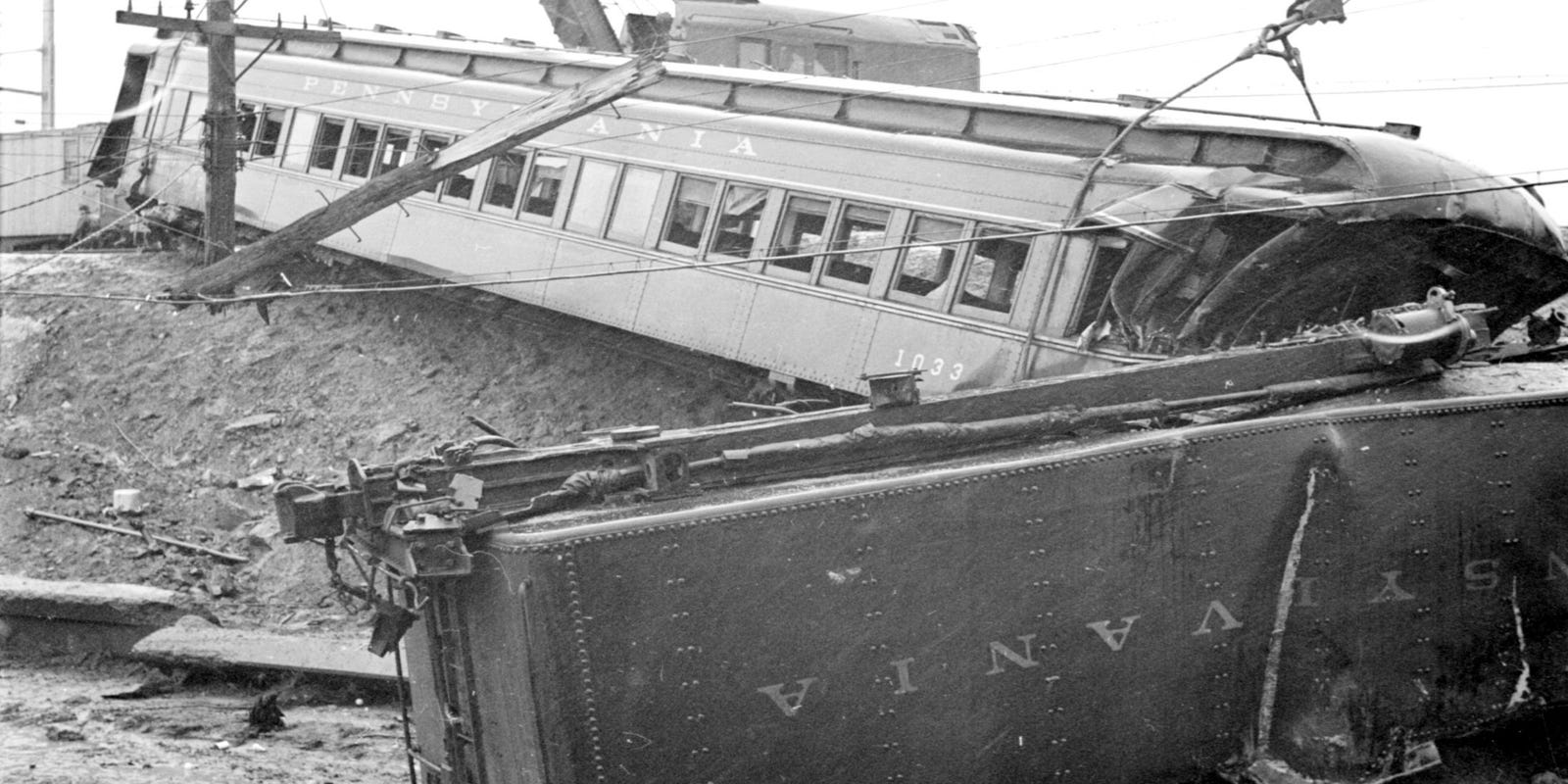
February 6, 1951: A Pennsylvania Railroad train derails on a temporary wooden trestle in Woodbridge, Middlesex County, New Jersey, killing 85 passengers. It is the deadliest rail disaster in New Jersey history, and the deadliest rail disaster anywhere in America since the Malbone Street Wreck, outside Prospect Park in Brooklyn, on November 1, 1918. 

Around 5:00 PM, Pennsylvania Railroad train Number 733 left Exchange Place station in Jersey City. It was to head down the PRR's Main Line to Rahway, where it would branch onto the North Jersey Coast Line. The Central Railroad of New Jersey was on strike, so No. 733 had more passengers than usual: Over 1,000 people on 11 cars.

At the time, there was a temporary wooden trestle near the Woodbridge station. The express was meant to bypass that station. The normal speed limit for a train doing so was 60 miles per hour. On the temporary trestle, the limit was 25.
A recent photo of the Woodbridge Station

But as the train approached the station at 5:43, the engineer, Joseph Fitzsimmons, only dropped the speed to 50. The tracks shifted under the weight of the locomotive, and 8 of the 11 cars derailed. The 3rd and 4th cars fell down a 26-foot-high embankment. Most of the 85 people killed were in one of these cars. The 5th and 6th cars were left hanging in mid-air over a street, and some people jumped out, some of those dying.

No one was charged with any crime as a result of the wreck. Fitzsimmons was kept on the payroll by the Railroad, but he never operated a train again.

Today, there is a memorial plaque outside the Woodbridge station. New Jersey Transit operates commuter lines, but even their express trains on the Coast Line usually stop at Woodbridge.
The successor to the main line of the Pennsylvania Railroad, NJT's Northeast Corridor, has a station on the other side of the Township of Woodbridge, in the Iselin section of town, known as Metropark. Amtrak also uses that station. It should not be confused with the main Woodbridge station, which is in downtown Woodbridge.

*

February 6, 1951 was a Tuesday. Major League Baseball and the NFL were in their off-seasons. There were no NHL games played on the day. But there were 3 NBA games:

* The New York Knicks beat the Baltimore Bullets, 91-82 at the Baltimore Coliseum. Harry "the Horse" Gallatin led all scorers with 29 points. This version of the Bullets went out of business in 1954. A new one started in 1963, moved to Washington in 1973, and became the Washington Wizards in 1997.

* The Philadelphia Warriors beat the Tri-Cities Blackhawks, 97-77 at the Philadelphia Arena. The Warriors moved to San Francisco in 1962, and changed their name to the Golden State Warriors in 1971. The Blackhawks represented the region now known as the Quad Cities: Moline (where they actually played) and Rock Island, Illinois; and Davenport and Bettendorf, Iowa. After this season, they became the Milwaukee Hawks; in 1955, the St. Louis Hawks; and in 1968, the Atlanta Hawks.

* The Indianapolis Olympians beat the Rochester Royals, 78-76 at the Butler Fieldhouse in Indianapolis. This arena was renamed the Hinkle Fieldhouse in 1966, after Butler University's longtime coach Tony Hinkle.

The Olympians were named for the members of the 1948 U.S. Olympic Team they'd signed, including Alex Groza, Ralph Beard and Cliff Barker of the 1948 and '49 National Champions from Kentucky. They won a Division Championship in 1950. The point-shaving scandal of 1951 got those 3 guys banned, and the franchise folded in 1953.

The Royals became the Cincinnati Royals in 1957, the Kansas City Kings in 1972, and the Sacramento Kings in 1985. 

December 31, 1999 & January 1, 2000: The Millennium

December 31, 1999:  The Millennium arrives. The people of planet Earth survived. At a terrible cost. But we hadn't destroyed ourselves. ...