Showing posts with label kansas city. Show all posts

Thursday, December 15, 2022

December 15, 1943: The Death of Fats Waller

December 15, 1943: Fats Waller, one of the giants of jazz, dies. He was only 39 years old.

Thomas Wright Waller was born on May 21, 1904 in Manhattan. He started playing the piano at the age of 6, and at 15, he dropped out of DeWitt Clinton High School to work as the organist at the Lincoln Theater in Harlem. In 1922, only 18 years old, he made his first recordings.

By 1928, he was not only appearing in Broadway musicals, he was composing for them. Contrary to an urban legend, he did not write "I Can't Give You Anything But Love." But he did write "Ain't Misbehavin'," "Honeysuckle Rose," "This Joint Is Jumpin'" and "Your Feet's Too Big." Oscar Levant called Waller "the black Horowitz," honoring him by comparing him to fellow classical pianist Vladimir Horowitz.

Waller had appeared in "soundies," the music videos of the time; and in films such as Stormy Weather, an all-black musical released on July 21, 1943. He had stayed in Los Angeles after making that film, with a long, successful engagement at the Zanzibar Room in Santa Monica.

But he got sick, and headed for home on the the Atchison, Topeka & Santa Fe Railroad's Super Chief, which ran from Chicago to Los Angeles and back, and was known as "The Train to the Stars." He never made it: On December 15, as the train pulled into Union Station in Kansas City, Missouri, Waller was found dead in his compartment, from pneumonia.

His funeral was held at the Abyssinian Baptist Church in Harlem, whose pastor, Adam Clayton Powell Jr., was preparing his 1st run for Congress. More than 4,200 people got inside, and Powell told them, "Fats always played to a packed house."

Fats left a wife, an ex-wife, and 3 sons. Darren Waller, a Pro Bowl tight end for the Las Vegas Raiders, is his great-grandson. (UPDATE: In 2023, Darren Waller was traded to the New York Giants.) In 1978, Fats returned to Broadway, in a way, when the musical Ain't Misbehavin' was produced. It was based around his songs, starred Ken Page as the Waller analogue, and helped to make a star out of singer-actress Nell Carter.

*

December 15, 1943 was a Wednesday. Baseball was out of season. Football was in midweek. The NBA hadn't been founded yet. And no games were scheduled for the NHL. Therefore, there were no scores on this historic day. 

Saturday, October 22, 2022

October 22, 1934: Pretty Boy Floyd Is Killed

"Pretty Boy"?

October 22, 1934: Pretty Boy Floyd is killed by FBI agents led by Melvin Purvis in East Liverpool, Ohio. The Midwest-based bank robber was 30 years old. Like his contemporary Lester Gillis, a.k.a. Baby Face Nelson, he hated his nickname.

Charles Arthur Floyd was born on February 3, 1904 in Adairsville, Georgia, and grew up in Akins, Oklahoma. He first got arrested at age 18, for stealing $3.50 from a post office. In 1925, he was busted for a payroll robbery in St. Louis, and served 3 1/2 years in prison.

He got involved with organized crime in Kansas City, and pulled off numerous robberies. In 1930, he was sentenced to 12 to 15 years for bank robbery in Ohio, but escaped. In 1931, members of his gang killed Patrolman R.H. Castner in Bowling Green, Ohio. Later that year, Floyd himself killed federal Agent Curtis Burke in Kansas City.

In 1933, Floyd was implicated in a shootout at Union Station that left 2 Kansas City detectives, an Oklahoma police chief, a federal agent dead, becoming known as the Kansas City Massacre. However, the available evidence suggests that Floyd wasn't even there.

Following the death of John Dillinger on July 22, 1934, FBI Director J. Edgar Hoover replaced him as "Public Enemy Number 1" with Floyd. By mid-October, Floyd was on the run in Ohio. On October 22, he made his way to East Liverpool, not far from Wheeling, West Virginia, and found refuge at a pool hall owned by a friend. Attempting to leave the pool hall, he was confronted by officers, tried to run, and was shot and killed.

It was a busy time for the nascent FBI, having gunned down some major bad guys in an 8-month span of 1934 and 1935: May 23, Bonnie Parker and Clyde Barrow in Arcadia, Louisiana; July 22, Dillinger in Chicago; October 22, Floyd November 27, Nelson outside Chicago in Wilmette, Illinois; and January 16, Ma Barker in Lake Weir, Florida.

*

October 22, 1934 was a Monday. Canadian football star Gerry James was born on this day.

Although Monday Night Football was still 36 years away, there was only 1 score on this historic day, and it was in the NFL: The new Detroit Lions beat the football version of the Brooklyn Dodgers, 28-0 at the University of Detroit Stadium.

Thursday, September 29, 2022

September 29, 2014: The Loudest Game In NFL History

September 29, 2014: The Kansas City Chiefs clobber the New England Patriots, 41-14 at Arrowhead Stadium in Kansas City. The ESPN Monday Night Football broadcast registered the crowd noise at 142.2 decibels, the loudest in NFL history -- without the benefit of a dome to hold in the noise.

To put that in perspective: The "threshold of pain" is usually considered to be 120 decibels.

Usually, the loudest stadiums in the NFL have been the first wave of domes: Houston's Astrodome, Seattle's Kingdome and Minneapolis' Metrodome in particular. Defying this were Arrowhead and Robert F. Kennedy Stadium in Washington.

The newer domes tend not to hold sound in so well. Hence, Houston's NRG Stadium and Minneapolis' U.S. Bank Stadium are not as loud as their predecessors.

Seattle's new Lumen Field, with a roof over the stands but not over the field, tends to hold sound in well, and it challenges Arrowhead as the loudest in the NFL.

*

September 29, 2014 was, as said, a Monday. That was the only score on this day. Baseball's regular season had ended the day before, and its Playoffs began the next day; while the NBA and NHL regular seasons were yet to come.

Sunday, September 25, 2022

September 25, 1965: Satchel Paige, MLB's Oldest Player

September 25, 1965: The Boston Red Sox beat the Kansas City Athletics, 5-2 at Kansas City Municipal Stadium. Lee Thomas and Tony Conigliaro hit home runs for the Red Sox, while Carl Yastrzemski went 2-for-4.

Satchel Paige started the game for the A's. He went 3 innings, allowed no runs, 1 hit, no walks, striking out 1. It was the K.C. bullpen -- Diego Seguí, Don Mossi and John Wyatt -- who lost the game.

So why take Satch out so early? Well, he was 59 years old. He was the oldest player ever to appear in a Major League Baseball game.

His birth name, Leroy Robert Paige, was known. Less known was how he got his nickname: Either his feet were as big as suitcases, or "satchels," and "Satchelfoot" became "Satchel," or "Satch" for short; or his constant traveling, as the loose structure of the Negro Leagues meant that he was always in demand, led to him always carrying a satchel.

Not known for sure, for a long time, was his birthdate. His contemporary, Dizzy Dean, would tell differing stories about his date of birth, place of birth, and real name, most of them lies. But as to his date of birth, Paige simply kept them guessing. He would say things like, "How old would you be if you didn't know how old you was?" And, "A goat ate the Bible that had my birth certificate. That goat lived to be 29 years old."

When Paige was finally brought to the major leagues in 1948, by Bill Veeck, owner of the Cleveland Indians, Veeck decided to find out for himself. He had heard Paige say he was born in Mobile, Alabama, a city which would later produce 2 other Hall-of-Famers, Hank Aaron and Willie McCovey. So Veeck went to Mobile, accepted the possibility that there might not be a birth record for a black child born in the early part of the 20th Century, and found one anyway: With the permission and accompaniment of members of the Paige family, he went to the Mobile County Board of Health, and found that Satch was born on July 7, 1906. That made him 42, the oldest rookie in major league history.

That didn't stop the speculation. One of his former Negro League teammates, Ted Radcliffe, known as "Double Duty" because he could catch and pitch, said he grew up with Paige in Mobile, and Paige was exactly 2 years older. Since Radcliffe's birthdate was established as July 7, 1902, that meant Paige was born on July 7, 1900, making him 48 when he reached the major leagues. (Radcliffe lived to be 103, stuck by his story to the end, and should be in the Hall of Fame.)

A few years after his debut, someone interviewed Paige's mother, and she said he was born in 1904, and she should know, right? Paige said, "She was in her nineties when she told the reporter that, and sometimes she tended to forget things." 

So people still wondered. Veeck said he'd seen the birth certificate, but he said a lot of things over the years, some of which were proven to be untrue.

Similarly, Archie Moore, Light Heavyweight Champion of the World from 1952 to 1962, was the subject of questions about his age. He said he was born on December 16, 1916, but his mother said it was 1913. Sonny Liston, Heavyweight Champion from 1962 to 1964, also faced questions about his age: He was officially 32 when Muhammad Ali dethroned him, but, as part of his poetic trash-talking, Ali, then still using his birth name, said, "You're 40 years old, if a day, and you don't belong in the ring with Cassius Clay!" Hispanic players, due to poor record-keeping, have also faced questions about their ages, including the Cuban pitchers Luis Tiant and Orlando "El Duque" Hernández.

Paige got around in the Negro Leagues and the Caribbean leagues. He debuted with the Chattanooga Black Lookouts in 1926, presumably as a teenager for a few weeks. Among his tenures: He played 4 seasons with the Birmingham Black Barons, 4 with the Pittsburgh Crawfords, and 8 with the Kansas City Monarchs. Negro League records are incomplete, but he is known for sure to have at least 118 wins against 80 losses. How many games he won in all those "barnstorming" appearances, God only knows.

As a "rookie" in 1948, Paige helped the Indians win the World Series. He pitched for them in 1949 as well. He returned to the Negro Leagues in 1950, because Veeck sold the Indians, and the new owner didn't want him. Veeck bought the St. Louis Browns in 1951, and brought Paige in. In 1953, with the Browns, at age 47, Paige became the oldest player to appear in the All-Star Game. But Veeck sold the Browns after that season, and they became the Baltimore Orioles. Paige did not go with them, and went back to barnstorming.

In 1955, Veeck bought the Miami Marlins of the Class AAA International League, whose name would later be taken by a major league team. He signed Paige, who stayed through the 1958 season, at 52. He kept barnstorming -- apparently, he needed the money -- until 1961, when he signed with the Portland Beavers of the Class AAA Pacific Coast League.

In 1965, desperate for attendance, Kansas City Athletics owner Charlie Finley, remembering that Paige had played longer in Kansas City than anywhere else, signed him to play one last major league game. Finley invited several Negro League veterans to be introduced before the game. If Finley wanted a big crowd, it didn't work: Only 9,289 fans came out.

Ironically, this last appearance may have delayed Satch's entrance into the Baseball Hall of Fame. At the Hall's 1966 induction ceremony, Ted Williams told the crowd that Paige, catcher Josh Gibson, and other Negro League stars should be eligible for the Hall. The Hall's rules state that a player must be retired for 5 full seasons. Paige was the 1st Negro Leaguer elected, in 1971 -- 5 full seasons after his last appearance. (Gibson had died in 1947, of a brain tumor while still an active player, 3 months before Jackie Robinson made his debut. He was elected in 1972.)

In 1968, Paige reached out to all 20 teams then in MLB, to try and join one of them on the active roster, in order to reach the 158 days he still needed to qualify for the five-year minimum for the Players' Association pension. On August 12, Atlanta Braves owner Bill Bartholomay signed him as an adviser and an assistant trainer, and Paige qualified. With his struggle in mind, the following season, MLB and the Players' Association reduced the requirement from 5 to 4 years, and "grandfathered in" all players who had played up to 1959.

Paige died on June 8, 1982, a month before his presumed 76th birthday, of a heart attack at his home in Kansas City. He was married 3 times, and had 7 children, all with his 3rd wife. In 1999, The Sporting News ranked him 19th on their list of the 100 Greatest Baseball Players. In 2022, ESPN ranked him 41st on their updated 100. In each case, he was the highest-ranking  among Negro League players. Statues of him stand in Cooperstown, New York, a block from the Hall of Fame; and in the Negro Leagues Baseball Museum in Kansas City.

Satch broke the record of Charley O'Leary, who was just short of turning 59 on September 30, 1934. He appeared as a pinch-hitter, singled and scored, making him the oldest player to get a hit and the oldest player to score a run. He was not then placed in the field. He had last played in the majors in 1913, his 21-year gap between appearances still an MLB record. But he had been a player-manager in the minors for a while, and had coached for the St. Louis Browns that season, activated for the season finale.

For a while, it was thought that Minnie Miñoso, brought out of retirement at 53 for the 1976 Chicago White Sox, as a publicity stunt by, you guessed it, team owner Bill Veeck, was the oldest player to get a hit. But later research found that O'Leary was older than previously thought. Miñoso made 1 more appearance, at 56 in 1980, making him a 5-decade player, but did not get a hit.

Jack Quinn, a pitcher, was the oldest player to appear regularly, last doing so at 50 with the 1933 Cincinnati Reds. He finished with a career record of 247-218. Julio Franco was the oldest position player to appear regularly, last doing so with the 2007 Atlanta Braves, at 49. In 2006, at 48, with the New York Mets, Franco became the oldest player to hit a home run.

In 2012, at 48, Jamie Moyer became the oldest pitcher to win a game, with the Colorado Rockies. Since the National League still didn't have the designated hitter, Moyer had to bat for himself, and also became the oldest player with an RBI.

The oldest players to appear at each position:

Pitcher: 59, Satchel Paige, 1965 Kansas City Athletics
Catcher: 54, Jim "Orator" O'Rourke, 1904 New York Giants
Third Base: 49, Jimmy Austin, 1929 St. Louis Browns
First Base: 48, Hughie Jennings, 1918 Detroit Tigers
Second Base: 48, Johnny Evers, 1929 Boston Braves
Right Field: 46, Sam Thompson, 1906 Detroit Tigers
Shortstop: 44, Omar Vizquel, 2012 Toronto Blue Jays
Left Field: 44, Ichiro Suzuki, 2018 Seattle Mariners
Center Field: 43, Ichiro Suzuki, 2017 Miami Marlins

*

September 25, 1965 was a Saturday. This was also the day that Barry McGuire's recording of "Eve of Destruction" became the Number 1 song in America. I have a separate entry for that event.

These other Major League Baseball games were played that day:

* The New York Yankees were swept by the Chicago White Sox in a doubleheader, 3-1 2-0 at Comiskey Park in Chicago. In the opener, not only did future Yankee Tommy John outpitch Bill Stafford, he hit a home run, the 1st of 5 he hit in a long career. Roy White, who made his major league debut 18 days earlier, went 1-for-3. Bobby Murcer, who made his major league debut 17 days earlier, went 3-for-4 with an RBI.

In the nightcap, Gary Peters (6 2/3rds innings) and Hoyt Wilhelm combined on a 6-hit shutout. White and Murcer didn't play. Roger Maris was injured, and didn't play in either game. Over the 2 games, Mickey Mantle went 1-for-7 with a walk.

* The New York Mets split a doubleheader with the Philadelphia Phillies at Connie Mack Stadium in Philadelphia. The Phils won the opener, and Mets won the nightcap, and both games ended 4-1. Dick Stuart and Clay Dalrymple hit home runs in the 1st game. Greg Goossen and Jim Hickman homered in the 2nd game.

* The Baltimore Orioles swept a doubleheader from the California Angels, 2-1 and 2-0 at Memorial Stadium in Baltimore. Brooks Robinson went 2-for-6 with 2 walks and an RBI over the 2 games. In the 2nd game, Milt Pappas pitched a 3-hit shutout. He pitched 1 more game for the Orioles, and was then traded to the Cincinnati Reds for Frank Robinson, in the greatest trade in Oriole history.

* The Minnesota Twins swept a doubleheader from the Washington Senators, 5-0 and 5-3 at District of Columbia Stadium (later Robert F. Kennedy Stadium) in Washington. In the opener, Jim "Mudcat" Grant allowed only 1 hit, a 3rd-inning double by Don Blasingame. Zoilo Versalles went 4-for-5 with a home run, on his way to winning the American League's Most Valuable Player award. Harmon Killebrew went 1-for-7 with 2 walks over the doubleheader.

The next day, the Twins clinched their 1st Pennant in Minnesota, the franchise's 1st since 1933 -- as the previous (though not first) franchise to be known as the Washington Senators.

* The Detroit Tigers beat the Cleveland Indians, 4-1 at Tiger Stadium in Detroit. Al Kaline did not play.

* The Chicago Cubs beat the Pittsburgh Pirates, 6-3 at Wrigley Field in Chicago. Ernie Banks went 0-for-2 with a walk, but had an RBI on a sacrifice fly. Roberto Clemente went 1-for-4. Bill Mazeroski hit a home run. Willie Stargell got a hit as a pinch-hitter.

* The Cincinnati Reds beat the Houston Astros, 1-0 at the Astrodome in Houston. Jim Maloney pitched a 2-hit shutout.

* The Los Angeles Dodgers beat the St. Louis Cardinals, 2-0 at Dodger Stadium in Los Angeles. Sandy Koufax pitched a 5-hit shutout.

* And the San Francisco Giants beat the Milwaukee Braves, 7-5 at Candlestick Park in San Francisco. Willie Mays hit his 50th home run of the season. He would finish with 52, and the National League's MVP, although the Dodgers would edge the Giants for the Pennant. Eddie Mathews hit what turned out to be his last home run for the Braves before they moved to Atlanta the next season. Hank Aaron did not hit a home run, going 1-for-5.

Among the college football games played that day were these:

* Number 1 Notre Dame were upset by Number 6 Purdue, 25-21 at Ross-Ade Stadium in West Lafayette, Indiana.

* Number 2 Nebraska beat Air Force, 27-17 at Falcon Stadium in Colorado Springs, Colorado.

* Number 3 Texas beat Texas Tech, 33-7 at Memorial Stadium in Austin, Texas.

* Number 4 Michigan beat the University of California, 10-7 at Michigan Stadium in Ann Arbor.

* Number 5 Arkansas beat the University of Tulsa, 20-12 at Razorback Stadium in Fayetteville, Arkansas.

* Number 7 Louisiana State (LSU) beat Rice, 42-14 at Tiger Stadium in Baton Rouge, Louisiana.

* Number 9 Syracuse were upset by the University of Miami, 24-0 at Archbold Stadium in Syracuse, New York.

* Number 10 Kentucky beat Mississippi, 16-7 at McLean Stadium in Lexington, Kentucky.

* With the other service academies, Army beat Virginia Military Institute (VMI), 21-7 at Michie Stadium in West Point, New York; and Navy played Stanford to a tie, 7-7 at the old Stanford Stadium in the San Francisco suburb of Palo Alto, Cailfornia.

* And in New Jersey, Princeton beat Rutgers, 32-6 at Palmer Stadium in Princeton, Mercer County.

In New Jersey high school football, East Brunswick of Middlesex County, the school that would one day be my Alma Mater, lost away to Steinert, 13-12 at Steinert High School Football Field (the only name the facility has ever had) in Hamilton, Mercer County (the school is often called "Hamilton East").

And in English soccer, Arsenal beat Manchester United, 4-2 at the Arsenal Stadium, a.k.a. Highbury, in North London.

Also, Basketball Hall-of-Famer Scottie Pippen was born.

Friday, August 19, 2022

August 19, 1976: Regrets at the Republican Convention

Ford welcomes Reagan to the rostrum,
as Nancy Reagan (left) and Nelson Rockefeller (right) look on

August 19, 1976: The Republican National Convention wraps up, at the Kemper Arena in Kansas City, Missouri. Hearing the speakers talk of upcoming victory, in the Presidential election and in the Congressional elections, you'd never know they were 2 years out from a President of their Party having to resign in disgrace, a year and a half out from badly losing in the Congressional races, and looking at a country still in a recession. They were not only confident, they were arrogant.

Gerald Ford, who became President when Richard Nixon resigned, had been President for a shade over 2 years, with a hell of a mess dumped into his lap. The results had been mixed: Certainly, the country was better off than when he took office, but it was hardly in great shape. The month before, he had ridden the celebrations of the country's Bicentennial, which had helped him. But little else had gone his way.

His pardon of Nixon, just 1 month into his Presidency, had angered millions of Americans. His refusal to support a federal bailout of a bankrupt New York City had infuriated millions, and his reversal on that issue had angered millions of others, without winning many of the first group back.

Conservatives in the Republican Party hated that he had chosen former Governor Nelson Rockefeller of New York as his Vice President, and refused to support him for a term of his own if he ran with Rockefeller on the ticket. He could have reminded him that he was now the leader of the Party, and that he wouldn't be bullied. Instead, he was, telling Rockefeller that he would be dropped. He chose Senator Bob Dole of Kansas.

None of it was enough. Ronald Reagan, who had recently wrapped up 2 terms as Governor of California, was the darling of the conservative movement. He challenged Ford in the Primaries, and the final Delegate total was very close. This remains the last major-party convention at which the nominee was not absolutely certain. Ford got 1,187 Delegates, Reagan 1,070.

Ford's acceptance speech was too dull to quote here. And he kept making the mistake of pointing out the differences in the last 2 years, reminding everyone that he had succeeded Richard Nixon, a fellow Republican. He could have compared the current situation to 1968, the last full year under a Democratic Administration, with war abroad and riots at home, but he didn't.

And then, as the balloons were falling, and everybody was reacting with tepid applause, he made a gracious gesture. Reagan had not had the chance to make a speech on his own behalf. So Ford asked Reagan to come down and make a speech.

Standing behind the podium, with the Presidential seal still affixed, Reagan looked more like a President than Ford ever had. He sounded more like one, too: Whatever else could be said about either man, Reagan, who had been an actor, was a better public speaker than Ford, who had been a lawyer, but not a trial lawyer, used to addressing crowds. Ford had become a good politician, but until he actually got the office, he had never intended to run for President, and he was not made for moments like these.

Reagan was. He spoke of being asked to write a letter for a time capsule, to be opened in Los Angeles in 2076, America's Tricentennial. He spoke of the world in 1976 being a battle between freedom and tyranny, with nuclear missiles as the potential deciding factor:

Those who would read this letter a hundred years from now will know whether those missiles were fired. They will know whether we met our challenge. Whether they will have the freedom that we have known up until now will depend on what we do here. Will they look back with appreciation and say, "Thank God for those people in 1976 who headed off that loss of freedom? Who kept us now a hundred years later free? Who kept our world from nuclear destruction?"

And if we fail, they probably wont get to read the letter at all, because it spoke of individual freedom, and they wont be allowed to talk of that or read of it.

This is our challenge, and this is why were here in this hall tonight. Better than we've ever done before, we've got to quit talking to each other and about each other, and go out and communicate to the world that we may be fewer in numbers than we've ever been, but we carry the message they're waiting for. We must go forth from here united, determined and what a great general said a few years ago is true: There is no substitute for victory. Mr. President.

Reagan's speech got a standing ovation. But a lot of people left the Arena thinking, "We've nominated the wrong guy."

Ford began the Convention far behind the Democratic nominee, former Governor Jimmy Carter of Georgia. The Convention helped. He eventually closed the gap to a virtual dead heat on Election Day. Carter won a very close race.

Would Reagan have won? This time, the Republicans were still tainted with scandal and recession. Reagan's message of tax cuts and Cold War aggressiveness would not have flown in 1976.

Four years later, it was a different world. And while Reagan looked finished after 1976, in 1980, America was ready for him. All 3 men had their moment where they were the man of the moment. For Ford, it was 1974, but not 1976. For Carter, it was 1976, but not 1980. For Reagan, it was 1980, but not 1976.

The Kemper Arena still stands, right on the State Line with Kansas City, Kansas. Originally named for local banker and philanthropist Rufus Kemper, it is now named the Hy-Vee Arena, after a supermarket chain.

*

August 19, 1976 was a Thursday. These Major League Baseball games were played:

* The New York Mets lost to the Los Angeles Dodgers, 6-5 at Dodger Stadium in Los Angeles. After 7 innings, it was 1-0 Los Angeles, a duel between the Dodgers' Burt Hooton and the Mets' Mickey Lolich. But the Mets scored 4 runs in the top of the 8th, and the Dodgers scored a run in the bottom of the 8th, to make it 4-2 New York. The Mets made it 5-2 in the top of the 9th. In the bottom of the 9th, the Dodgers got singles from Ted Sizemore and Bill Buckner, and home runs from Steve Garvey and Ron Cey.

* The Philadelphia Phillies beat the Houston Astros, 7-1 at Veterans Stadium in Philadelphia. For the Phillies, it was "Win Day": Steve Carlton went the distance for the win. Mike Schmidt and Jay Johnstone hit home runs.

* The Cincinnati Reds beat the Atlanta Braves, 3-2 at Riverfront Stadium in Cincinnati. Mike Lum singled Tony Pérez home with the winning run in the bottom of the 11th inning. Pete Rose went 2-for-3 with 2 walks and an RBI. Johnny Bench went 0-for-5.

* The Detroit Tigers beat the California Angels, 4-3 at Tiger Stadium in Detroit.

* The Chicago White Sox beat the Boston Red Sox, 4-2 at Comiskey Park in Chicago. Carl Yastrzemski went 0-for-4.

* The Milwaukee Brewers beat the Kansas City Royals, 6-4 at Milwaukee County Stadium. Hank Aaron, in his last season as a player, was available for the Brewers, but did not get into the game. George Brett went 1-for-3 with a walk.

* The Minnesota Twins beat the Baltimore Orioles, 5-4 at Metropolitan Stadium in the Minneapolis suburb of Bloomington, Minnesota. Brooks Robinson, in his last full season as a player, was available for the Orioles, but did not get into the game. Reggie Jackson did, going 2-for-4 with a walk and an RBI. For the Twins, Rod Carew had a rare 0-for-5 game.

* The Cleveland Indians beat the Texas Rangers, 7-5 at Arlington Stadium in the Dallas suburb of Arlington, Texas. Indians manager Frank Robinson, in his last season as a player, did not put himself into the game. He did put his former Baltimore teammate, John "Boog" Powell, in, and he hit 2 home runs.

* The Pittsburgh Pirates beat the San Francisco Giants, 1-0 at Candlestick Park in San Francisco. John Candelaria allowed 9 hits, but kept the shutout, outpitching Jim Barr. The only run came in the top of the 5th, when Richie Zisk singled home Candelaria himself, who had reached base via a forceout. Willie Stargell went 1-for-4.

* And the New York Yankees, the Oakland Athletics, the Chicago Cubs, the Montreal Expos, the St. Louis Cardinals and the San Diego Padres were not scheduled.

Tuesday, April 12, 2022

April 12, 1955: Kansas City Goes Major League

April 12, 1955: The Kansas City Athletics beat the Detroit Tigers, 6-2 at Kansas City Municipal Stadium. It was the 1st home game for the A's after moving from Philadelphia. Their new hometown was back in the major leagues after 40 years.

Former President Harry S Truman, from nearby Independence, Missouri, threw out the ceremonial first ball. For the Tigers, Al Kaline went 2-for-4, and Red Wilson hit the ballpark's 1st major league home run. For the A's, Bill Wilson hit a home run, and Alex Kellner was the winning pitcher.

Previously, Kansas City had these major league teams in baseball: The Kansas City Cowboys of the Union Association, a league which only played the 1884 season; the Kansas City Cowboys of the National League, a team which only played the 1886 season, with none of these teams have any official connection with the other; the Kansas City Cowboys of the American Association, a team which only played the 1888 and 1889 seasons; and the Kansas City Packers of the Federal League, a league which only played the 1914 and 1915 seasons. And, in football, the Kansas City Blues entered the NFL in 1924, became the Kansas City Cowboys in 1925, and folded after the 1926 season.

The Kansas City Blues won 10 American Association Pennants: 1888, 1890, 1898, 1901, 1918, 1923, 1929, 1938, 1952 and 1953. The Kansas City Monarchs won 11 Negro League Pennants: 1923, 12 1924, 1925, 1929, 1937, 1939, 1940, 1941, 1942, 1946 and 1953.

Both teams played at Muehlebach Field, built in 1923 by, and named for, George E. Muehlebach, who owned the Blues and a number of other Kansas City businesses, including Muehlebach Beer and the Muehlebach Hotel. The previous Kansas City ballpark, Association Park, was owned by a railroad, which decided to build a new line through it, creating the need for a new ballpark.

In 1937, the New York Yankees bought the Blues, made them their top farm team, and renamed the ballpark Ruppert Stadium, in honor of team owner Jacob Ruppert. Ruppert died in 1939, and the ballpark was renamed Blues Stadium in 1943.

Knowing that the Philadelphia Athletics had been purchased by Arnold Johnson, and were being moved to Kansas City for the 1955 season, the city added an upper deck to Blues Stadium, and renamed it Kansas City Municipal Stadium. It now seated 35,020 people. When the American Football's League's Dallas Texans became the Kansas City Chiefs in 1963, the addition of football bleachers raised seating capacity to 51,000.

When Johnson died in 1960, the A's were bought by Charles O. Finley. He wanted a bigger ballpark, and when the city wouldn't build him one, he flirted with moving the A's to Dallas and Louisville, before finally moving to Oakland, California for the 1968 season. Kansas City then got an expansion team, and the Royals played there from 1969 to 1972.

Unusual for that era, instead of building one stadium for both baseball and football, Kansas City built a stadium for each. Arrowhead Stadium opened in 1972, Royals Stadium opened in 1973, and the complex was named the Harry S Truman Sports Complex. Missouri's favorite son had died the day after Christmas, 1972.

When the Royals' original owner, pharmaceutical magnate Ewing Kauffman, died in 1993, the stadium was renamed Kauffman Stadium for him. Despite a major renovation in 2009, the Royals are looking to build a new stadium, downtown. (UPDATE: In 2024, the Royals released plans for a new stadium, tentatively set to open in 2028.) The Chiefs renovated Arrowhead Stadium at the same time, and have no plans to replace it.

The Chiefs won the AFL Championship in 1966 and 1969, losing Super Bowl I but winning Super Bowl IV. The Royals won the World Series in 1985 and 2015, having lost it in 1980 and 2014. The Chiefs have since won Super Bowl LIV, while losing Super Bowl LV. (UPDATE: They have since won Super Bowls LVII and LVIII.)

In soccer, the Kansas City Spurs won the 1969 North American Soccer League title, playing home games at Municipal Stadium. But they only lasted 1 more season. The Kansas City Wizards won the 2000 MLS Cup. In 2010, they rebranded as Sporting Kansas City, and moved from Arrowhead to a new stadium in nearby Kansas City, Kansas. They won the MLS Cup again in 2013.

A women's team, FC Kansas City, only lasted from 2013 to 2017, but won the National Women's Soccer League title in 2014 and 2015. In 2021, they were replaced by the Kansas City Current.

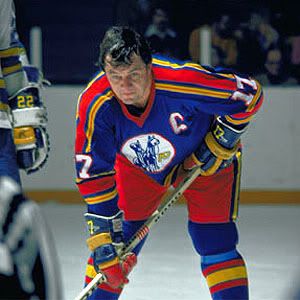
The area has been less successful in the indoor sports. In 1972, the NBA's Cincinnati Royals moved in, but, since the baseball team was already called the Royals, they became the Kansas City Kings. In 1974, they moved from the Municipal Auditorium to the new Kemper Arena. That same year, the NHL placed an expansion team there, the Kansas City Scouts.

The Scouts were lousy, and moved after 2 seasons. The Kings won a Division title in 1979 and reached the Western Conference Finals in 1981, but never drew well, and moved to Sacramento in 1985. In 2018, the Kemper Arena was downsized and rebranded as the Hy-Vee Arena. In 2007, the Sprint Center opened downtown, but it has failed to attract and NBA, WNBA or NHL team.

No matter: Kansas City still has MLB and the NFL, the 2 sports that mark a city and its metropolitan area as "major league." And while the A's left, the Royals and the Chiefs aren't going anywhere.

*

April 12, 1955 was a Tuesday. This was also the day on which Dr. Jonas Salk announced that the vaccine he had been testing against polio was effective and safe. I have a separate entry for that event

These other baseball games were played:

* The Boston Red Sox beat the Baltimore Orioles, 7-1 at Memorial Stadium in Baltimore. Ted Williams did not play that day.

* The Cleveland Indians beat the Chicago White Sox, 5-1 at Cleveland Municipal Stadium.

* The Chicago Cubs beat the St. Louis Cardinals, 14-4 at Wrigley Field in Chicago. For the Cubs, Randy Jackson hit a home run, and Ernie Banks went 2-for-4 with an RBI. For the Cards, Ken Boyer hit a home run, and Stan Musial went 2-for-4 with an RBI.

* The Milwaukee Braves beat the Cincinnati Redlegs, 4-2 at Milwaukee County Stadium. It was the 2nd of 5 seasons when, in the wake of anti-Communist hysteria, the Cincinnati team was known as the Redlegs, not the Reds. Warren Spahn was the winning pitcher, future World Series-winning manager Chuck Tanner hit a home run on the 1st pitch he ever sees in the major leagues, and Hank Aaron went 1-for-4, the hit an RBI triple.

The next day, April 13:

* The New York Yankees and the Washington Senators opened the season at Yankee Stadium. The Yankees won, 19-1.

* The New York Giants and the Philadelphia Phillies opened the season at Connie Mack Stadium in Philadelphia. The Phillies won, 4-2.

* The Brooklyn Dodgers and the Pittsburgh Pirates opened the season at Ebbets Field. The Dodgers won, 6-1. Nobody knew it yet, but the "Next Year" that their fans had long waited for had finally come.

Football was out of season. The NBA season had ended 2 days earlier, when the Syracuse Nationals beat the Fort Wayne Pistons in Game 7 of the NBA Finals. Game 6 of the Stanley Cup Finals was played at the Montreal Forum that night, and the Montreal Canadiens beat the Detroit Red Wings, 6-3. But the Wings would win the Cup in Game 7 in Detroit, 2 nights later.

Monday, April 4, 2022

April 4, 1988: Kansas' "Hometown" Upset

Danny Manning (left) and Larry Brown

April 4, 1988: The NCAA Final Four was held in Kansas City to celebrate its 50th renewal (although not its 50th Anniversary, which would come the next season), going back to the city that had hosted the most Final Fours.

This was K.C.'s 10th. The 1st 9 were held at the Kansas City Municipal Arena. This one was held at the Kemper Arena, just over the Missouri side of the Kansas State Line, and now named the Hy-Vee Arena. Only once more, in Denver in 1990, was the Final Four was played at a building with less than 20,000 seats.

Opened in 1974, the arena was named for local banking executive Rufus Kemper, who donated $3.2 million of the $23 million it took to build the arena. In 2018, it was renamed the Hy-Vee Arena, for a Midwestern supermarket chain.

As part of the 50th Tournament celebrations, many of the sport's icons showed up for a pregame ceremony, including University of Kansas legends Wilt Chamberlain (lost the 1957 Final to North Carolina) and Clyde Lovellette (won the 1952 Final over St. John's); UCLA coach John Wooden and some of his stars, including Bill Walton (but not Kareem Abdul-Jabbar, who was still active with the Los Angeles Lakers); and Howard Hobson, coach of the winners of the 1st Tournament in 1939, the University of Oregon. (Hobson lived until 1991.)

Having a virtual home-court advantage, the Kansas Jayhawks, based 40 miles to the west in Lawrence, pulled a big upset of the University of Oklahoma, 83-79. Danny Manning was the star for the Jayhawks, and Larry Brown, frequently mocked for how he never stayed at any coaching job for too long, won the National Championship, having previously lost the Final with UCLA against Louisville in 1980.

Brown would later coach the Detroit Pistons to the 2004 NBA title, and remains the only coach to win both an NCAA and an NBA title. Manning went on to play 15 seasons in the NBA, including under Brown on the Los Angeles Clippers and the Pistons. He later returned to Kansas as an assistant coach, and has been the head coach at the University of Tulsa, Wake Forest and Maryland.

*

April 4, 1988 was a Monday, as NCAA Tournament Finals tend to be. As they also tended to be in the late 20th Century, they coincided with Major League Baseball's Opening Day, and these games were played:

* The New York Mets beat the Montreal Expos, 10-6 at the Olympic Stadium in Montreal. Dwight Gooden outpitched Dennis Martinez. Darryl Strawberry went 4-for-4 with 2 solo home runs and a walk. One of the homers was the longest ever hit at Le Stade Olympique, crashing into the right field roof, 535 feet from home plate.

Lenny Dykstra (3 RBIs), Kevin Elster and Kevin McReynolds (4-for-5 with 3 RBIs) also hit home runs. Former Met Hubie Brooks homered for the Expos.

* The Detroit Tigers beat the Boston Red Sox, 5-3 at Fenway Park in Boston. Jack Morris and Roger Clemens both went 9 innings, but the game went to a 10th, where Lee Smith gave up a home run to Alan Trammell. Mike Henneman mopped up for Morris. Matt Nokes also homered for the Tigers. For the Sox, Wade Boggs went 2-for-5, and Brady Anderson went 3-for-5.

* The Milwaukee Brewers beat the Baltimore Orioles, 12-0 at Memorial Stadium in Baltimore. It was a bad omen for the O's: They lost their 1st 21 games of the season, an all-time record, and 107 games over the course of the season.

Teddy Higuera outpitched Mike Boddicker. Dale Sveum went 3-for-5 with a home run and 2 RBIs. Robin Yount went 1-for-4 with a walk. Paul Molitor went 1-for-4 with 2 walks. Eddie Murray went 0-for-4. Cal Ripken went 1-for-4.

* The Cincinnati Reds beat the St. Louis Cardinals, 5-4 at Riverfront Stadium in Cincinnati. Cliché Alert: Walks can kill you, especially the leadoff variety. Jeff Treadway led off the bottom of the 12th inning with a walk, and eventually scored on a single by Kal Daniels. Joe Magrane was the starting pitcher for the Cards, and hit a home run, but did not figure in the decision.

* The Chicago White Sox beat the California Angels, 8-5 at Comiskey Park in Chicago. Ricky Horton outpitched Mike Witt. Ken Williams, later to be the general manager who built the White Sox' 2005 World Series winners, went 2-for-3 with a home run and 3 RBIs.

* The Toronto Blue Jays beat the Kansas City Royals, 5-3 at Royals Stadium (now Kauffman Stadium) in Kansas City. Jimmy Key outpitched Bret Saberhagen. George Brett went 2-for-5 with a home run and 2 RBIs.

* The Texas Rangers beat the Cleveland Indians, 4-3 at Arlington Stadium in the Dallas suburb of Arlington, Texas. Pete O'Brien hit 2 homers, to make a winning pitcher out of Charlie Hough. He and the Indians' starter, Tom Candiotti, were both knuckleballers, but it would be Chris Codiroli who blew the lead for Candiotti.

* The San Francisco Giants beat their arch-rivals, the Los Angeles Dodgers, 5-1 at Dodger Stadium in Los Angeles. Dave Dravecky outpitched Fernando Valenzuela. Brett Butler went 3-for-5 with 2 RBIs. The only Dodger run came on a home run by Steve Sax.

The Giants had won the National League Western Division the year before, and would win it the year after, and the Pennant, too. Not this year: The Dodgers went on to win the World Series.

* The Oakland Athletics beat the Seattle Mariners, 4-1 at the Oakland Coliseum. Dave Stewart outpitched Mark Langston. José Canseco and Dave Henderson hit home runs for the A's.

* The New York Yankees opened the next day, April 5, beating the Minnesota Twins, 8-0 at Yankee Stadium. Rick Rhoden pitched a 3-hit shutout, beating Frank Viola. Mike Pagliarulo and Rickey Henderson hit home runs. Willie Randolph and Roberto Kelly each went 3-for-4. Dave Winfield went 1-for-3 with a walk and an RBI. Don Mattingly went 1-for-4 with an RBI.

* The Philadelphia Phillies and the Pittsburgh Pirates also opened the next day. The Pirates won, 5-3 at Veterans Stadium in Philadelphia. Mike Dunne outpitched Shane Rawley. Barry Bonds hit his 13th career home run. There would be 749 more. Mike Schmidt hit his 531st career home run. There would be 17 more.

* The Chicago Cubs and the Atlanta Braves also opened the next day. The Cubs won, 10-9 at Atlanta-Fulton County Stadium. Rick Sutcliffe and Rick Mahler started, but neither lasted into the 6th inning. Manny Trillo hit a sacrifice fly in the top of the 13th inning, to score Vance Law with the winning run, making a winning pitcher of Mike Bielecki.

* And the Houston Astros and the San Diego Padres also opened the next day. The Astros won, 6-3 at the Astrodome in Houston. Mike Scott outpitched Ed Whitson. Glenn Davis hit a home run. Tony Gwynn went 0-for-2 with 2 walks.

Football was out of season. No games were played in the NBA. And the NHL was between its regular season and the Stanley Cup Playoffs.

This was also the day that Evan Mecham of Arizona became the 1st Governor of any State to be removed through impeachment by his State's legislature. I have a separate entry for that event.

Wednesday, March 30, 2022

March 30, 1976: The End of Major League Hockey In Kansas City

Guy Charron

March 30, 1976: The major league hockey game in Kansas City, to date, is played at the Kemper Arena. The Kansas City Scouts lose 8-6 to the Los Angeles Kings.

The Scouts were founded by Edwin G. Thompson, a real estate developer who, through March 30, 2022, still holds Kansas City's record for points scored in a high school basketball game, with 41. The name "Scouts" was chosen as a tribute to the Scout statue that overlooks the city, and was copied for the team's logo. It also served as a nod towards local Boy Scout troops and military personnel stationed at nearby Fort Leavenworth Army Base, both groups considered essential parts of life in K.C. at that period.

For 2 years, Kansas City had teams in all of the "Big Four" North American sports: The Royals in MLB, the Chiefs in the NFL, the Kings in the NBA, and the Scouts in the NHL. But it couldn't be sustained, because, like so many sports team owners in the 1970s, Thompson underestimated how much it would cost to run a team. The Scouts went 15-54-11 in 1974-75, and 12-56-12 in 1975-76, and averaged just 8,218 fans per game, leaving Kemper Arena only half-full. This may have been due to the St. Louis Blues having already had a hold on Missouri as a territory.

After this last home game, they played 3 more games on the road to end a horrible season in which they lost their last 7 games, failed to win any of their last 27 (0-21-6), and won just 1 of their last 54 (0-46-8).

On June 25, Denver-based oilman Jack Vickers bought the team, and moved them to his hometown, where they became the Colorado Rockies. They failed there as well, making the Playoffs just once in 6 season, before moving again. In 1982, they become the New Jersey Devils. Kansas City has had minor-league teams since, but no major league team.

The Kemper Arena, built almost right on the Missouri-Kansas State Line, still stands, under the name of the Hy-Vee Arena. The Sprint Center opened in 2007, and was renamed the T-Mobile Center in 2020, but, due to Kansas City's relatively small size as a market -- its metropolitan area ranks it 28th in MLB and 26th in the NFL and it would be 24th in the NBA and 27th in the NHL -- it has never attracted a team.

Edwin Thompson died in 2015, at the age of 80.

*

March 30, 1976 was a Tuesday. These 4 other games were played in the NHL that day:

* The Boston Bruins and the Buffalo Sabres played to a tie, 4-4 at the Boston Garden.

* The Washington Capitals beat the Detroit Red Wings, 5-3 at the Capital Centre in the Washington suburb of Landover, Maryland.

* The St. Louis Blues beat the Minnesota North Stars, 5-3 at the Metropolitan Sports Center in the Minneapolis suburb of Bloomington, Minnesota.

* And the California Golden Seals and the Vancouver Canucks played to a tie, 4-4 at the Pacific Coliseum in Vancouver.

There were 3 games played in the World Hockey Association:

* The Quebec Nordiques beat the Edmonton Oilers, 8-3 at the Colisée de Québec.

* The San Diego Mariners beat the Houston Aeros, 4-3 at The Summit in Houston. (It's now the Central Campus of televangelist Joel Osteen's Lakewood Church.)

* And the Calgary Cowboys beat the Toronto Toros (perhaps appropriately), 6-2 at the Stampede Corral in Calgary.

Baseball was in Spring Training. Football was out of season. These 6 games were played in the NBA:

* The New York Knicks beat the Phoenix Suns, 113-97 at Madison Square Garden.

* The Buffalo Braves beat the Boston Celtics, 93-83 at the Buffalo Memorial Auditorium.

* The Cleveland Cavaliers beat the Houston Rockets, 95-86 at The Coliseum in the Cleveland suburb of Richfield, Ohio.

* The Golden State Warriors beat the Chicago Bulls, 94-84 at the Chicago Stadium.

* The Milwaukee Bucks beat the Atlanta Hawks, 130-126 in overtime at the Milwaukee Exposition and Convention Center Arena, a.k.a. The MECCA. (It's now the UW-Milwaukee Panther Arena.)

* And the Portland Trail Blazers beat the Kansas City Kings, 114-113 at the Portland Memorial Coliseum.

There was 1 game in the American Basketball Association: The Denver Nuggets beat the Spirits of St. Louis, 133-12 at the St. Louis Arena.

Friday, March 25, 2022

March 25, 1961: Cincinnati Basketball Triumphant

March 25, 1961: Ohio State University, which won the National Championship of college basketball the year before with super sophomores Jerry Lucas and John Havlicek, is dethroned in the Final but a cross-State rival, the University of Cincinnati, 70-65 at the Kansas City Municipal Auditorium.

Coached by Ed Jucker, the Bearcats reached what the NCAA now calls the Final Four in 1959 and 1960, with guard Oscar Robertson playing as well, all-around, as any basketball player ever has. Jucker reloaded, and won the title in 1961, and again in 1962, with Paul Hogue, Bob Wiesenhahn, and Tom Thacker.
Ed Jucker

Despite Cincinnati being a border-on-the-South city, and segregated until the Civil Rights Act of 1964, Jucker was able to bring in black players like Robertson, Hogue and Thacker. Hogue was a native of Knoxville, Tennessee, the son of the principal of his all-black high school, who was not recruited by major Southern schools because he was black.
Paul Hogue

Hogue's pro career was undistinguished: He played 2 seasons in the NBA, for the Knicks and the Baltimore Bullets (the team now known as the Washington Wizards), and in a minor league for Delaware's Wilmington Blue Bombers. He later became an official in the U.S. Postal Service, and served on the Village Council in the Cincinnati suburb where he lived. He died in 2009, and is buried at the same Cincinnati cemetery as Yankee legends Miller Huggins (a Cincinnati native) and Waite Hoyt (who broadcast for the Reds).

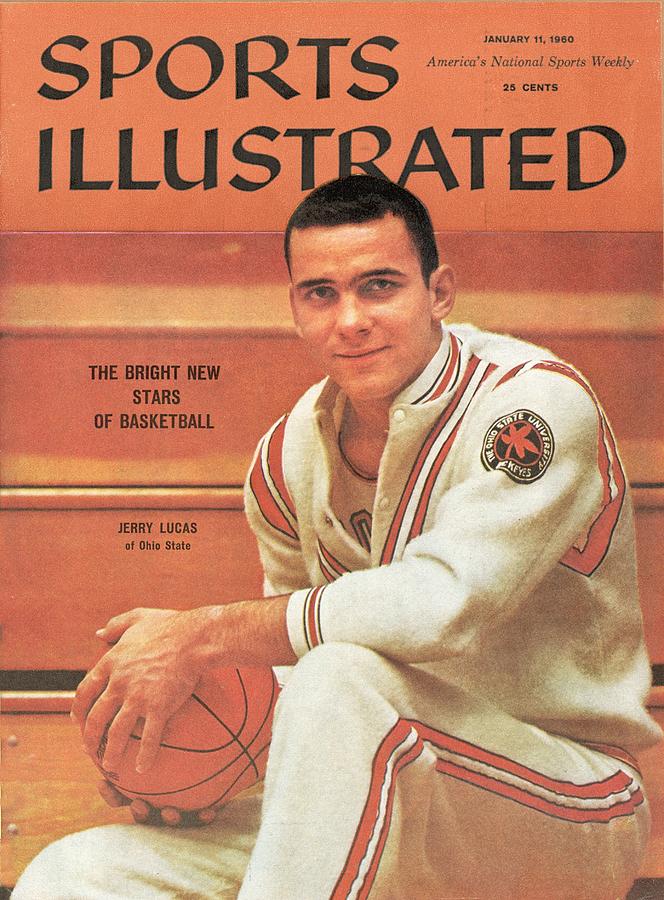
Despite Ohio State's defeat, Sports Illustrated named Lucas its Sportsman of the Year, as a good example of a scholar-athlete. They would use the same reason to name Oregon State football and basketball star Terry Baker the next year.
Jerry Lucas

The Bearcats would win the title again the next year, before losing the 1963 Final to Loyola of Chicago. (Sister Jean was just 43 at the time.) They have reached the Final Four only once since, in 1992.

The Queen City of the Midwest got an NBA team in 1957, the Cincinnati Royals. That team would have Hall-of-Famers Robertson, Lucas, Jack Twyman (another University of Cincinnati star) and Maurice Stokes. Despite all that talent, they could never seem to get past the Boston Celtics, getting as far as the Eastern Division Finals in 1963 and 1964, but never into the Finals. In 1972, they moved to Kansas City. Since that city already had a team called the Royals, the NBA team became the Kansas City Kings. In 1985, they moved again, becoming the Sacramento Kings.

Thacker would win a title with the Celtics, in 1968.

*

March 25, 1961 was a Saturday. Baseball was in Spring Training. Football was out of season. There were 2 games in the NBA. The Boston Celtics beat the Syracuse Nationals, 120-107 at the Onondaga County War Memorial, now called the Upstate Medical University Arena, in Syracuse, New York.

And the St. Louis Hawks beat the Los Angeles Lakers, at the gymnasium of what was then Los Angeles City College. In 1972, it became California State University at Los Angeles. The Forum in Inglewood wasn't built until 1967. Apparently, the Los Angeles Memorial Sports Arena, where the Lakers had been playing home games that 1st season in California, wasn't available. And using another college site was out: UCLA's pre-Pauley Pavilion Men's Gym seated only 2,400 people, while USC didn't have an on-campus gym, using the Shrine and Pan-Pacific Auditoriums, neither of which was very suitable to basketball.

There was 1 game in the NHL, a Stanley Cup Playoffs game: The Detroit Red Wings beat the Toronto Maple Leafs, 4-2 at Maple Leaf Gardens in Toronto.

And in English soccer, East London team West Ham United crossed town, to play Arsenal, at the Arsenal Stadium, a.k.a. Highbury, named for its neighborhood in North London. They played to a 0-0 draw.

Wednesday, March 23, 2022

March 23, 1957: North Carolina vs. Kansas In Triple Overtime

March 23, 1957: The past met the future in the Final of NCAA Tournament basketball, at the Kansas City Municipal Auditorium. The past won this battle -- but the future would be back.

The University of North Carolina came into the game undefeated, 31-0, and ranked Number 1 in the country. Head coach Frank McGuire was from New York City, and played at St. John's University before coaching there, leading them to what would later be called the Final Four in 1952.

He built his Carolina team around players from in and around New York. Lennie Rosenbluth was Jewish and from The Bronx. Danny Lotz was Jewish, and from Northport, Long Island. Most of the others were Irish Catholics like McGuire: Bob Cunningham from Manhattan, Pete Brennan and Joe Quigg from Brooklyn, Bob Young from Queens, and his best player, Tommy Kearns from Bergenfield, New Jersey. There were only 3 North Carolinians on the Tar Heels' roster: Ken Rosemond from Hillsborough, Roy Searcy from Draper, and Gehrmann Holland from Beaufort.

The University of Kansas had won the National Championship in 1952 and reached the Final again in 1953. Their legendary coach, Forrest "Phog" Allen -- who had coached Dean Smith, who would eventually succeed McGuire at UNC -- had retired, and in 1955, Allen Field House opened. In 1956-57, Dick Harp took them to a 24-2 record, and the nation's Number 2 ranking. Their only 2 losses, each by just 2 points, were to Iowa State and Oklahoma State, coached by the legendary Henry Iba.

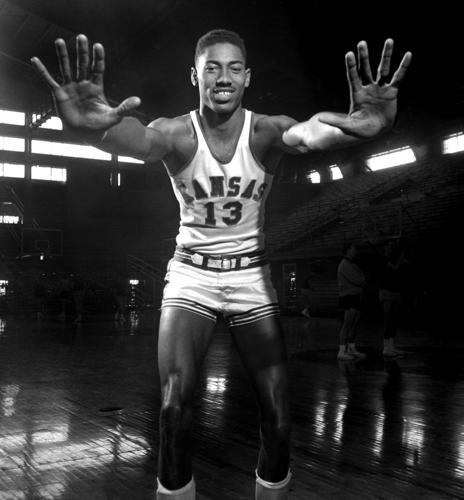
The reason the Jayhawks were this good was Wilton Norman Chamberlain, a 20-year-old sophomore from Overbrook High School in West Philadelphia. He stood 7-foot-1-and-1/16th inch, and weighed 275 pounds. He excelled, as you might guess, in the high jump for Kansas' track team. But in basketball, he was revolutionary. The lane was widened to make it harder for him to operate inside, and it failed.

Forty years later, when the NBA celebrated its 50th Anniversary by naming its 50 Greatest Players, there was a gathering of 47 of them -- 1 was dead, 1 was ill, and the other just didn't show up -- and Michael Jordan, who had played at North Carolina, was telling everyone that he was the greatest player ever. Sure, it's easy, when no one calls traveling on you.

Chamberlain called him out on this: "Michael, my man, when you played, they changed the rules to make it easier for you. When I played, they changed the rules to make it harder for me, and it didn't work."

No one had scored like Wilt. No one had rebounded like Wilt. No one had blocked like Wilt. Kansas' game was simple: Get the ball to Wilt. And, in 24 out of 26 games, it worked. As a result, the sports books made Kansas a 3-point favorite.

McGuire had what sounds like a crazy strategy: Have Kearns, only 5-foot-10, guard Chamberlain. At first, it worked well, as the Tar Heels jumped out to a 19-7 lead. But the Jayhawks came back, and at the half, Carolina's lead was down to 29-22. Kansas took the lead, and the game went back and forth to the end. It went to overtime, and to a 2nd overtime. In the closing seconds of the 3rd overtime, Quigg made 2 free throws to give Carolina a 54-53 win, and the National Championship.

For the Tar Heels: Rosenbluth scored 20, Brennan and Kearns 11 each, Quigg 10, Young 2, and Cunningham and Lotz played without scoring. For the Jayhawks: Chamberlain 23, Gene Elstun and Maurice King 11 each, John Parker 4, Lew Johnson and Ron Loneski 2 each, and Bob Billings played without scoring.

Brennan played 1 season in the NBA, for the New York Knicks. Kearns played 1, for the Syracuse Nationals. Rosenbluth played 2, for the Philadelphia Warriors. That was it.

Kansas went 18-5 in 1957-58, and did not make the NCAA Tournament. Chamberlain forewent his senior year, and played the 1958-59 season with the Harlem Globetrotters, making more money that season than any NBA player did.

Eligible to be selected by an NBA team for 1959-60, he was a territorial pick for the Warriors, and singlehandedly rewrote the league's record book. In 1961-62, he averaged 50.4 points per game, including a 100-point game against the Knicks; and 25.7 rebounds, including a 55-rebound game against Bill Russell and the Boston Celtics (who won the game, anyway). The Warriors' coach that season? Frank McGuire. 

*

March 23, 1957 was a Saturday. Actress Amanda Plummer was born on this day. She was the daughter of actors Christopher Plummer and Tammy Grimes.

Baseball was in Spring Training. Football was out of season. There was 1 game played in the NBA: The Boston Celtics beat the Syracuse Nationals, 120-105 at the Onondaga County War Memorial (now the Upstate Medical University Arena) in Syracuse.

The NHL's entire "Original Six" were in action:

* The New York Rangers beat the Boston Bruins, 4-2 at the Boston Garden.

* The Montreal Canadiens beat the Chicago Black Hawks, 3-0 at the Montreal Forum.

* And the Detroit Red Wings beat the Toronto Maple Leafs, 5-3 at Maple Leaf Gardens in Toronto.

And in English soccer, Arsenal, having fallen from their heights of earlier in the decade, held Birmingham-area team Wolverhampton Wanderers, then one of the top teams in the country, to a 0-0 at the Arsenal Stadium, a.k.a. Highbury, in North London.

Monday, March 21, 2022

March 21, 1964: The UCLA Dynasty Begins

March 21, 1964: The University of California at Los Angeles beat Duke University, 98-83, at the Municipal Auditorium in Kansas City, in the Final of the NCAA Men's Basketball Tournament. It is the 1st National Championship for UCLA. It will not be the last.

UCLA coach John Wooden had been good enough of a player at Purdue University in the early 1930s that he eventually became the 1st person elected to the Basketball Hall of Fame separately as a player and as a coach. He became UCLA's head coach in 1948, and took them to what would later be called the Final Four for the 1st time in 1962.

In 1963-64, with guards Walt Hazzard and Gail Goodrich, forwards Keith Erickson and Jack Hirsch, and center Fred Slaughter, he guided the Bruins to an undefeated season, 30-0. Goodrich and Erickson would star with the Los Angeles Lakers, and Goodrich would join Wooden in the Basketball Hall of Fame.

Ironically, considering that Wooden would later have Kareem Abdul-Jabbar (then known as Lew Alcindor) and Bill Walton, the '64 UCLA team not only didn't have a dominating center, they had the shortest roster ever to win the NCAA Tournament.

The closest they came to losing in the regular season was a 2-point win away to the main campus of the University of California in Berkeley in February, a 3-point win away to Kansas State early in the season, 4 over Illinois in the L.A. Classic (at the Memorial Sports Arena, not on their own campus), and 5 away to Washington State.

In the tournament, they won their regional games at Oregon State in Corvallis, beating Seattle University, 95-90; and the University of San Francisco, 76-72. In Kansas City, they faced Kansas State again, this time winning, 90-84, before beating a Duke team that featured future Golden State Warriors star Jeff Mullins.

UCLA made it back-to-back titles in 1965. These titles raised enough money that the Bruins could move out of their 2,400-seat Men's Gym, and also stop using the Sports Arena, which they were sharing with their arch-rivals, the University of Southern California (like the next-door Coliseum, it was on USC's campus), and into a large on-campus building, which became Pauley Pavilion. Wooden would eventually lead UCLA to 10 National Championships in 12 seasons. The school won an 11th in 1995, under Jim Harrick.

Duke had reached the Final Four in 1963, and would again in 1966. But they would not do so again until 1978, and then not again until 1986, the 1st of 14 times they would do so under Mike Krzyzewski. "Coach K" finally got them their 1st National Championship in 1991.

By another weird twist of fate, on March 21, 2014, on the 50th Anniversary of the event, Duke lost its first-round NCAA Tournament game -- not to a traditional power like UCLA, but to lightly-regarded Mercer University of Macon, Georgia. "March Madness."

*

March 21, 1964 was a Saturday. Baseball was in Spring Training. Football was out of season. There was 1 game in the NBA: The St. Louis Hawks beat the Los Angeles Lakers, 115-104 at the Kiel Auditorium in St. Louis. Jerry West scored 35 points in defeat.

There was 1 game in the NHL: The Montreal Canadiens beat the Boston Bruins, 5-1 at the Montreal Forum.

And in English soccer, Arsenal crossed from North London to the East End, and played West Ham United to a draw, 1-1 at Upton Park.

Sunday, February 13, 2022

February 13, 1920: The Founding of the Negro National League

Rube Foster

February 13, 1920: A meeting in Kansas City results in the birth of the Negro National League.

There had been baseball teams made up entirely of black players for as long as there had been baseball teams made up entirely of white players. All-black professional teams emerged alongside all-white ones. In the 20th Century, black baseball was one of the leading black-owned businesses.

Andrew "Rube" Foster, a pitcher for the Chicago American Giants, realized that it could be a bigger business, because, as the all-white major leagues had proven in the 1919 season, the appetite for baseball after World War I was stronger than ever. (Supposedly, Foster had been nicknamed "Rube" because he had once outpitched George "Rube" Waddell in an exhibition game.)

So Foster held the meeting, and the NNL featured 8 teams. One was Foster's team, the Chicago American Giants. Another was called simply the Chicago Giants, but had previously been known as the Leland Giants, named for Frank Leland, a former partner of Foster's. Leland died in 1914, and the team continued under the ownership of Charles "Joe" Green. Had Leland still been in charge, Foster might not have admitted the team to his new league.

The other original teams were the Detroit Stars, the Indianapolis ABCs, the Kansas City Monarchs, the St. Louis Giants, the Dayton Marcos and the Cuban Stars. At the time, "Cuban" -- like "Lincoln," as many teams were called -- was a thinly-veiled code for "black," even though there had been players from Cuba in the white majors. Such men were compared to the white men of Spain, rather than the black men of Africa, and were said to be "as white as a bar of Castilian soap."

The NNL was a Midwestern league. In 1920, a Negro Southern League was founded, and lasted until 1936. This league included the Birmingham Black Barons. Like several black teams, they simply named themselves after the established white minor-league team in town, and added "Black" to their name. Which became problematic when the Atlanta team tried this, becoming "The Atlanta Black Crackers."

In 1923, the Eastern Colored League was founded. In 1924, the two leagues began holding a "Negro World Series" between their champions. But the ECL's team owners rarely agreed on anything, and they disbanded during the 1928 season.

Sadly, Foster fell victim to mental illness. In 1926, his paranoia had reached a stage where he was institutionalized. He died in 1930, and the NNL fell victim to the Great Depression after the 1931 season.

In 1933, a new Negro National League was founded, led by the Homestead Grays, who played "home games" in both Washington and Pittsburgh, and featured Josh Gibson and Buck Leonard. In 1937, the Negro American League was founded. The Black Barons joined it, and in this league in 1948, they would have Willie Mays on their roster. But the NAL's dominant team would be the Kansas City Monarchs, featuring ace pitcher Leroy "Satchel" Paige. The NNL and the NAL would have a midseason East-West Game as an All-Star Game, and a postseason Negro World Series.

But the admission of black players to the previously all-white majors in 1947 led to the demise of the Negro Leagues. The NNL folded after the 1948 season, while the NAL continued until 1962, not just a victim of integration, but, like the previously all-white minor league, a victim of television: Why should a black baseball fan drive 20 miles, and pay $2.00 for a ticket and another $1.00 for a hot dog and a drink, and watch a game in the heat of a Summer night, when he could sit in his air-conditioned living room, with food and drinks he's already paid for, and watch an integrated major league game on TV for free?

In 1990, the Negro Leagues Baseball Museum was founded, and opened its current location in 1997. Unlike the Hall of Fame, in Cooperstown, New York, this museum opened where it was supposed to, where the Negro Leagues were invented, at 1616 East 18th Street in Kansas City, Missouri, a few blocks from the site of Municipal Stadium, home of the Monarchs, and later the American League's Athletics (1955-67) and Royals (1969-72).

*

February 13, 1920 was a Friday -- a Friday the 13th. Baseball and football were out of season. Professional basketball barely existed. And the NHL had no games scheduled. So there were no scores on this historic day.

December 31, 1999 & January 1, 2000: The Millennium

December 31, 1999:  The Millennium arrives. The people of planet Earth survived. At a terrible cost. But we hadn't destroyed ourselves. ...