Showing posts with label berlin wall. Show all posts

Wednesday, November 9, 2022

November 9, 1989: The Berlin Wall Comes Down

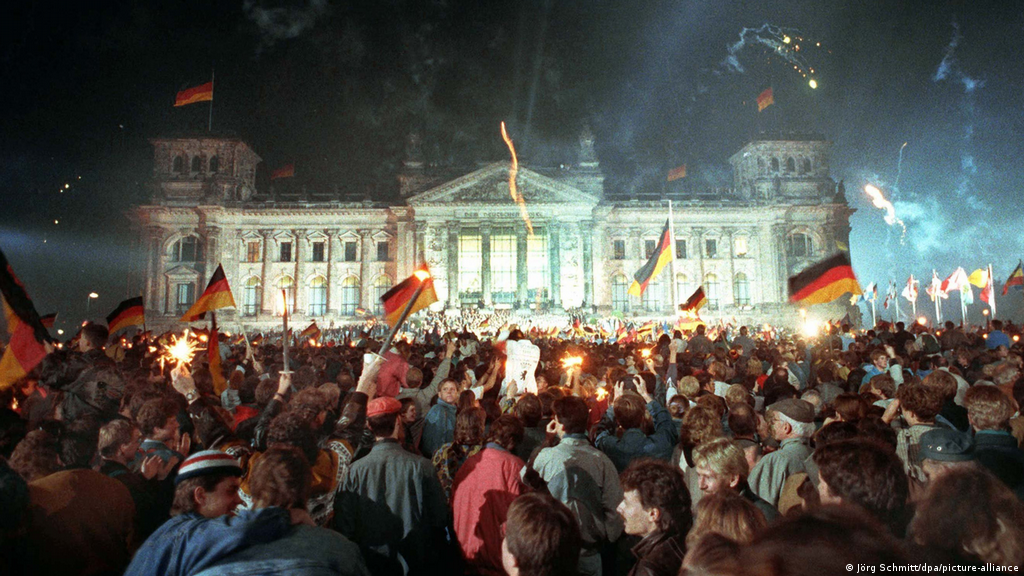
November 9, 1989: After several weeks of civil unrest, the government of the German Democratic Republic (a.k.a. East Germany) announces that its citizens could visit the Federal Republic of Germany (a.k.a. West Germany) and West Berlin.

This renders the Berlin Wall, the 11-foot-9-inch high, 96-mile long concrete barrier surrounding West Berlin and symbolizing the "Iron Curtain" that had separated Communist Eastern Europe from capitalist Western Europe since its erection began on August 13, 1961, unenforceable and irrelevant. Crowds of East Germans climb over the wall, and through the various checkpoints between East and West Berlin, some taking chisels and sledgehammers to the Wall while the world watches on television.

Speaking in front of the Brandenburg Gate on June 12, 1987, President Ronald Reagan challenged Soviet Premier Mikhail Gorbachev: "Mr. Gorbachev, dear down this wall!" While Gorbachev's reforms within the Soviet Union certainly inspired people, and even governments, throughout Eastern Europe, inspiring Time magazine to name him not just Man of the Year but Man of the Decade, he didn't lift a finger to make the Wall's irrelevance possible.

On Christmas Day, December 25, 1989, in a symbolic gesture of reunification and renewal, Leonard Bernstein conducted a performance of Ludwig van Beethoven's Symphony No. 9 in Berlin, to celebrate the fall of the Berlin Wall. It was his last major performance, as he died on October 14, 1990, at the age of 72.

The official demolition of the Wall began on June 13, 1990, and was officially completed in 1994. There are still pieces left in Berlin, and other pieces were bought and put on display as museum pieces. Some of America's Presidential Libraries, particularly those of Presidents who served during the Cold War, have pieces on display.

The fall of the Berlin Wall paved the way from German reunification, which was formalized on October 3, 1990. The East still hasn't fully caught up with the West, but it's closer now.

Ironically, from a sports perspective, reunification hasn't helped the nation's combined sports teams all that much. While both West Germany and East Germany did very well at the Olympics, the combined team hasn't won more medals than the two separate countries' previous combined totals. Thought that may be due to the East Germans no longer having access to Communist-administered steroids.

And the German national soccer team, while still successful, hasn't been more successful. West Germany won the World Cup in 1954, 1974 and 1990. The combined nation has won it once, in 2014, and did so with a single player born and trained in East Germany: Toni Kroos. Given that a child born in East Germany on the morning of October 3, 1990 would be 32 years old when the 2022 World Cup gets underway, Kroos is likely to be the only East German who ever wins it.

There is one more postscript. One of the buildings in East Germany that was stormed by demonstrators was the Stasi headquarters in Dresden, where a 37-year-old KGB agent was stationed. He called Moscow for permission to defend it, and didn't get it, and had to flee. He felt betrayed by his country's government, and swore revenge. His name was Vladimir Putin.

Just as Hitler barely survived being killed in World War I, Putin had a narrow escape from being captured the night the Wall fell.

November 9 has become Germany's "Day of Destiny": On that date, in 1918, the Kaiser abdicated and the 1st German Republic was proclaimed; in 1923, the Beer Hall Putsch failed; in 1938, Kristallnacht was carried out by the Nazis; and in 1989, the Berlin Wall was rendered legally moot.

*

November 9, 1989 was a Thursday. The baseball season had ended 12 days earlier, when the Oakland Athletics won the World Series against their fellow Bay Area team, the San Francisco Giants. Although Thursday night games are common in the NFL now, they weren't then, and so there was no NFL game on that day.

There were 4 NBA games played, including an intra-metropolitan one and an intra-State one:

* The New York Knicks beat the New Jersey Nets, 107-105 at Madison Square Garden. Charles Oakley led the Knickerbockers with 22 points, and Patrick Ewing scored 20. For the Nets, Chris Morris scored 21 and Dennis Hopson 20.

* The Milwaukee Bucks beat the Seattle SuperSonics, 155-154 at the Bradley Center in Milwaukee, in not 1, not 2, not 3, not 4, but 5 overtimes. Ricky Pierce scored 36 for the Bucks.. For the Sonics, Dale Ellis scored 53, and Xavier McDaniel 37. (There has been a 6-overtime game in NBA history: January 6, 1951, before the institution of the 24-second shot clock: Indianapolis Olympians 75, Rochester Royals 73.)

* The Denver Nuggets beat the Houston Rockets, 128-127 in overtime at The Summit in Houston. (The arena has since been converted into the Central Campus of the Lakewood Church, Dr. Joel Osteen's "megachurch.") Hakeem Olajuwon and Otis Thorpe each scored 33 points in a losing cause, while Danny Schayes led the Nugs with just 21.

* And the Los Angeles Lakers beat the Golden State Warriors, 106-95 at what's now named the Oracle Arena in Oakland. A.C. Green led the Lakers with 24, while Chris Mullen netted 30 for the Dubs.

There were 6 NHL games played, only 1 involving a New York Tri-State Area team: 

* The New York Islanders lost to the Quebec Nordiques, 7-5 at the Nassau Coliseum.

* The Toronto Maple Leafs beat the Philadelphia Flyers, 4-1 at The Spectrum in Philadelphia.

* The Boston Bruins beat the Edmonton Oilers, 6-2 at the Boston Garden. This turned out to be a preview of the Stanley Cup Finals, although the Oilers would win that.

* The Chicago Blackhawks beat the Pittsburgh Penguins, 4-3 at the Chicago Stadium.

* The Minnesota North Stars beat the Detroit Red Wings, 5-1 at the Metropolitan Sports Center in the Minneapolis suburb of Bloomington, Minnesota.

* And the Montreal Canadiens and the St. Louis Blues played to a tie, 1-1 at the St. Louis Arena.

Friday, October 7, 2022

October 7, 1949: The German Democratic Republic Is Established

October 7, 1949: The German Democratic Republic, a.k.a. East Germany, is founded by that country's Communist Party. In other words, it's not democratic, and it's not a republic. But it is quite German: Imagine Communist ideology combined with German demands for efficiency. It was a charter member of the Warsaw Pact in 1955.

Perhaps even more than the Soviet Union, East Germany became known for steroid-aided Olympic athletes. They were among the countries that joined the Soviets' boycott of the Summer Olympics in Los Angeles in 1984. But in that year's Winter Olympics, in Sarajevo, Yugoslavia (now in Bosnia), Katarina Witt won the 1st of 2 Olympic Gold Medals in women's figure skating, putting a human face on the country.

The notorious Ministry for State Security -- Ministerium für Staatssicherheit, or "Stasi" -- worked very hard to stop Witt from defecting to the West, bribing her with cars and the kind of travel allowances that would never have been given to a private citizen.

It worked, until reunification in 1989. She had already retired from competitive skating, and only made 1 return to compete for the united Germany. But she embraced the Western lifestyle anyway, posing nude for Playboy magazine, writing a romance novel, and hosting skating-themed TV shows on the TV networks that had dominated the media of the former West Germany.

After the fall of the Berlin Wall, Saturday Night Live did a parody of the game show The Hollywood Squares: "The East Berlin Squares" had half of the celebrity panelists missing, because they'd defected, including half of a comedy duo.

*

October 7, 1949 was a Tuesday. Game 3 of the World Series was played at Ebbets Field. Ralph Branca of the Brooklyn Dodgers ran out of gas in the top of the 9th inning, giving up a 2-RBI single to Johnny Mize, and then Jack Banta gave up an RBI single to Jerry Coleman. Luis Olmo and Roy Campanella hit solo home runs in the bottom of the 9th, but Joe Page hung on, and the New York Yankees won, 4-3, to take a 2-1 lead in the Series. They won the Series in Game 5.

The other New York Yankees also won on this day. What "other New York Yankees"? The team playing in the All-America Football Conference. They beat the Chicago Hornets, 38-24 at Soldier Field in Chicago.

Monday, October 3, 2022

October 3, 1990: Germany Is Reunified

October 3, 1990: The reunification of Germany is completed after 45 years.

There had been tribes identified as "Germanic" for over 2,000 years, and they stopped the advance of the Roman Empire under Arminius at the Battle of the Teutoburg Forest, in present-day
Osnabrück, Lower Saxony, in September of the year AD 9. And there had been a Holy Roman Empire, retroactively known as the First Reich, including most of present-day Germany, from the coronation of Charlemagne in AD 800 until Napoleon Bonaparte broke it up in 1806.

Germany was unified by Chancellor Otto von Bismarck in 1871, with Kaiser (Emperor) Wilhelm I reigning over a Second Reich. That ended with the Kaiser's grandson, Wilhelm II, abdicating at the end of World War I in 1918. Adolf Hitler proclaimed a Third Reich in 1933, calling it "The Thousand-Year Reich." It lasted 12 years, before the Allies smashed the Nazis.

But the Soviet Union took the eastern part, making it the "German Democratic Republic." It wasn't a republic, and it certainly wasn't democratic. The remaining Allies -- America, Britain and France -- established the Federal Republic of Germany in 1949. For 40 years, these 2 countries, nicknamed "East Germany" and "West Germany," respectively, were, essentially, the front line of the Cold War. This included the building of the Berlin Wall in 1961.

But by 1989, with the Soviet Union crumbling, and losing its grip on the nations of Eastern Europe, Poland, Czechoslovakia and Hungary moved away from Soviet influence, and held free elections, ending Communist Party rule. On November 9, the East German government removed restrictions on travel in and out of the country. This rendered the Berlin Wall moot, and the people of Berlin began to tear it down.

This began the process of German reunification. West German Chancellor Helmut Kohl reintegrated the East, politically and economically, with the Deutsche mark replacing the Ostmark -- a move made easier by the fact that Kohl was also among the people trying to bring most of Europe into the single Euro currency, which replaced both marks in 1999.

On October 3, 1990, a ceremony was held at the Reichstag, the old capital building in Berlin, marking the official unification of the state. It took a while for the East to catch up to the West in terms of economic and social progress. But, today, Germany is a united, free country of about 83 million people.

Oddly, the national soccer team, Die Mannschaft, had more success as West Germany than as a united Germany. Competing in the World Cup starting in 1954, they won the tournament in 1954, 1974 (on home soil, despite losing a Group Stage game to East Germany in one of the biggest upsets in tournament history) and 1990; and reached the Final in 1966, 1982 and 1986.

The unified team lost in the Semifinal on home soil in 2006, lost in the Semifinal again in 2010, and won it all in 2014, but crashed out in the Group Stage in 2018. Not the 1st time a group of Germans fell flat in Russia, although, this time, it was neither the Russians nor Winter weather that stopped them. Mostly, they beat themselves.
Mesut Özil with the World Cup,
at the Brandenburg Gate celebration, Berlin, 2014

Toni Kroos, a midfielder then with Bayern Munich, but soon to be transferred to Real Madrid, was on the 2014 Germany team, and he became the 1st native of East Germany ever to win the World Cup. He will likely also be the last, as anyone born in East Germany right before unification in 1990 will be 32 right before the 2022 tournament. With Kroos no longer on the roster, Marco Reus, born in Dortmund in 1989, is the only player currently on the team born before reunification who is likely to see any action in the 2022 World Cup.

*

October 3, 1990 was a Wednesday. It was midweek for the NFL, and preseason for the NBA and the NHL. But, due to the fact that a lockout had delayed Spring Training, this was the last day of baseball's regular season:

* The New York Yankees lost to the Detroit Tigers, 10-3 at Yankee Stadium. I was there. Cecil Fielder of the Tigers hit his 50th and 51st home runs of the season. This made him the 1st MLB player to hit 50 in a season since George Foster in 1977, and the 1st in the American League since the Yankees' Roger Maris in 1961.

The Yankees finished 67-95, their worst record since 1925, and their 1st last-place finish since 1966. They were 21 games behind the hated Boston Red Sox. The rebuilding began.

* The New York Mets beat the Pittsburgh Pirates, 6-3 at Three Rivers Stadium in Pittsburgh. Frank Viola won his 20th game of the season. Tim Teufel and Chris Jelic hit home runs. But times had changed: It was only 4 years since the Mets' 1986 World Series triumph, but Teufel was the only man in this game who had been on that Series roster.

The Pirates won the National League Eastern Division, by 4 games over the Mets. With a few breaks, this game could have been for the Division title.

* The Boston Red Sox beat the Chicago White Sox, 3-1 at Fenway Park in Boston.

* The Chicago Cubs beat the Philadelphia Phillies, 4-3 at Veterans Stadium in Philadelphia.

* The Baltimore Orioles beat the Toronto Blue Jays, 3-2 at Memorial Stadium in Baltimore.

* The Montreal Expos beat the St. Louis Cardinals, 9-2 at the Olympic Stadium in Montreal.

* The Cleveland Indians beat the Kansas City Royals, 5-2 at Cleveland Municipal Stadium.

* The Houston Astros beat the Cincinnati Reds, 3-2 at Riverfront Stadium in Cincinnati.

* The Milwaukee Brewers beat the Texas Rangers, 6-3 at Milwaukee County Stadium.

* The Minnesota Twins beat the Seattle Mariners, 7-4 at the Metrodome in Minneapolis.

* The San Diego Padres beat the Los Angeles Dodgers, 7-3 at Dodger Stadium in Los Angeles.

* The California Angels beat the Oakland Athletics, 11-6 at the Oakland Coliseum.

* And the San Francisco Giants beat the Atlanta Braves, 6-3 at Candlestick Park in San Francisco.

Saturday, August 13, 2022

August 13, 1961: The Berlin Wall Goes Up

August 13, 1961: The German Democratic Republic -- better known as East Germany, since it was not democratic and not a republic -- closes the border between the Eastern and Western Sectors of Berlin, to thwart its inhabitants' attempts to escape to the West. Construction of the Berlin Wall -- Der Berliner Mauer -- is started. The day is known as Stacheldraht-Sonntag -- Barbed Wire Sunday.

After the defeat of the Nazis in 1945, the German capital of Berlin was divided into 4 Sectors, 1 for each of the main victorious Allies: American in the southwest, British in the central west, French in the northwest, and Soviet in the east. In 1948, the Soviet Union sealed the border, trying to starve West Berlin (American, British and French) into submission. In response, President Harry S Truman started the Berlin Airlift, and the Soviets couldn't stop it, and gave up.

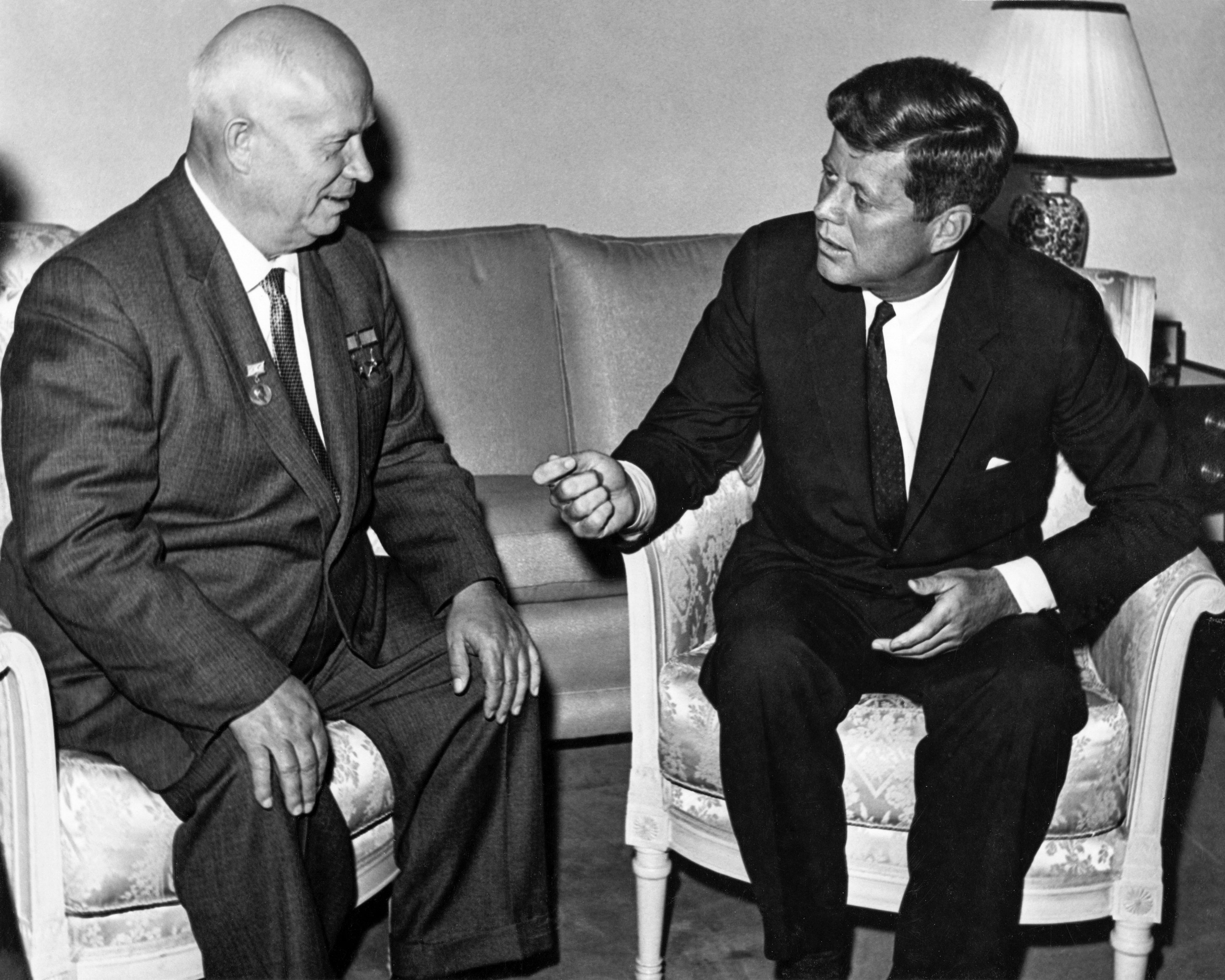
Now, in 1961, tensions had been again been rising between America and the Soviet Union over the status of Berlin. In June, President John F. Kennedy and Soviet Premier Nikita Khrushchev met for a summit in Vienna, Austria. It was the only time they would meet face-to-face.

The 67-year-old Khrushchev, already a hardened veteran of World War I by the time JFK was born in 1917, thought he could intimidate the youngest man ever elected President of the United States. He was right: The 44-year-old Kennedy was out of his league -- for the moment. By July, he was calling up U.S. Army Reserve units to send to West Berlin, because Khrushchev was doing the same with his country's Red Army.

The Warsaw Pact, dominated by the Soviets with East Germany as its 2nd-ranking partner, called the Wall "the Antifascist Protection Rampart." The idea was that it was supposed to keep America and its NATO allies, including Britain and France, out. This was a cover: So many people were fleeing from East Berlin to West Berlin that the Pact was willing to put the Wall up, heavily guarded by sniper towers, to stop them.

In his speech accepting the 1964 Republican nomination for President, Senator Barry Goldwater of Arizona called it "the wall of shame in Berlin." But, at the time, Kennedy was relieved: Better a wall than a war. Time magazine named Kennedy its Man of the Year for 1961.

The Cold War had nearly gotten hot, but had cooled off again. It nearly became World War III in October 1962, with the Cuban Missile Crisis. But Kennedy and Khrushchev, communicating by translator-aided phone, avoided it. In June 1963, Kennedy proposed a Nuclear Test Ban Treaty, and Khrushchev accepted it.

Later that month, Kennedy visited West Berlin. At City Hall, not far from the Wall, he gave a speech remembered for its metaphor-launching close: "All free men, wherever they may live, are citizens of Berlin. Therefore, as a free man, I take pride in the words, 'Ich bin ein Berliner.'" More important were these words, earlier in the speech: "Freedom has many difficulties, and democracy is not perfect. But we have never needed to put a wall up to keep our people in."

Goldwater thought he could use "the wall of shame" to beat Kennedy in 1964. But when Kennedy died a year before the election, from an assassin's bullet, Goldwater knew his chance of winning had also died. The Cold War was supposed to be his issue, not the Democrats', and the new President, Lyndon Johnson, clobbered him with it (among other issues).

In 1987, another President, Ronald Reagan, spoke in front of the Brandenburg Gate, which turned out to be a convenient landmark between East and West, with the Wall blocking access to it, and challenged the current Soviet leader, Mikhail Gorbachev: "Mr. Gorbachev, tear down this wall!"

He didn't. It would be another 2 1/2 years, after Reagan left office, before the East German government removed travel restrictions, rendering the Wall meaningless. It was the people of Berlin, East and West, who began tearing it down, after 28 years.

No one is sure how many people tried to escape through openings in the Wall, or climbing over it, or tunneling under it, during those 28 years. A fair estimate was 5,000 succeeding, and about 200 being shot and killed in attempts.

*

August 13, 1961 was a Sunday. Actress Dawnn Lewis was born.

This was the off-season for the NFL, the AFL, the NBA and the NHL. But it was still the era of Sunday doubleheader, so a full slate of Major League Baseball games was played, and then some:

* The New York Yankees split a doubleheader with the Washington Senators at Griffith Stadium in Washington. 

The Senators won the opener, 12-2. Bud Daley got shelled, and then so did Hal Reniff. The only Yankee runs came on a pair of solo home runs -- Roger Maris' 44th of the season, and Mickey Mantle’s 45th.

The Yankees won the nightcap, 9-4. Jim Coates went the distance for the win. Maris hit his 45th homer, and Clete Boyer hit his... 8th. Mantle didn't get a hit in this game.

* The Baltimore Orioles beat the Boston Red Sox, 6-5 at Memorial Stadium in Baltimore. The Sox scored in the 1st inning, and led 1-0 in the 4th, 3-1 in the 5th, and scored in their half of the 10th and the 11th, and still blew it. They blew 4 separate leads.

Arnold Earley pitched to 1 batter in the game, Russ Snyder, who bunted on him, and Earley threw the ball away, allowing the winning run to score in the bottom of the 11th inning.

* The Pittsburgh Pirates beat the Philadelphia Phillies, 13-4 at Forbes Field in Pittsburgh. This was the 16th game in a string of 23 consecutive losses for the Phils, still the longest in MLB since 1899.

* The Los Angeles Angels beat the Cleveland Indians, 8-7 at Cleveland Municipal Stadium. 

* The Chicago White Sox beat the Kansas City Athletics, 9-3 at Comiskey Park in Chicago.

* The Milwaukee Braves beat the Chicago Cubs, 8-3 at Milwaukee County Stadium. Hank Aaron got 2 hits, neither of them a home run. Eddie Mathews hit one.

* The Minnesota Twins beat the Detroit Tigers, 13-5 at Metropolitan Stadium in the Minneapolis suburb of Bloomington, Minnesota.

* The Los Angeles Dodgers beat the St. Louis Cardinals, 8-0 at the Los Angeles Memorial Coliseum. Despite allowing 8 hits, Stan Williams pitched a shutout.

* And the Cincinnati Reds beat the San Francisco Giants, 8-1 at Candlestick Park in San Francisco. Willie Mays went 1-for-4 in a losing cause.

Sunday, June 26, 2022

June 26, 1963: President John F. Kennedy Speaks in West Berlin

June 26, 1963: President John F. Kennedy visits City Hall in West Berlin, and it is the political high point of his European tour. His visit to Ireland, his ancestral homeland, 2 days later, will be the emotional high point, but the Berlin speech has become legend.

Let's take a step back. On May 4, 1962, in New Orleans, Kennedy gave a speech, saying, "Two thousand years ago, the proudest boast was to say, 'I am a citizen of Rome.' Today, I believe, in 1962, the proudest boast is to say, 'I am a citizen of the United States.' And it is not enough to merely say it: We must live it."

He echoed this in Berlin, divided since the end of World War II in 1945, between a capitalist West and a Communist East, and surrounded by the so-called German Democratic Republic, a.k.a. East Germany, with the Berlin Wall going up in 1961 to make the point in, almost (but not quite) literally, an inescapable way.

Flanked by the Chancellor of the Federal Republic of Germany, a.k.a. West Germany, Konrad Adenauer, and the Mayor of West Berlin, Willy Brandt, later to become Chancellor himself, JFK addressed a crowd estimated at 450,000 people, roughly the same number that was on hand for Woodstock, 6 years later. Heinz Weber, of the German mission to the United Nations, translated Kennedy's English words to the crowd:

Two thousand years ago, the proudest boast was "Civis Romanus sum." Today, in the world of freedom, the proudest boast is "Ich bin ein Berliner."

I appreciate my interpreter translating my German!

There are many people in the world who really don't understand, or say they don't, what is the great issue between the free world and the Communist world. Let them come to Berlin!

There are some who say that Communism is the wave of the future. Let them come to Berlin!

And there are some who say, in Europe and elsewhere, we can work with the Communists. Let them come to Berlin!

And there are even a few who say that it is true that Communism is an evil system, but it permits us to make economic progress. Lass' sie nach Berlin kommen. Let them come to Berlin!

Freedom has many difficulties and democracy is not perfect, but we have never had to put a wall up to keep our people in, to prevent them from leaving us.

The great Boston Irishman had the Germans eating out of the palm of his hand. The Hall was 3 miles from the Wall, but the speech was broadcast on West German television and radio. How well the East Germans were able to jam the transmission is unknown, but, surely, some people in East Berlin heard Kennedy's words.

He closed with:

Freedom is indivisible, and when one man is enslaved, all are not free. When all are free, then we can look forward to that day when this city will be joined as one, and this country and this great Continent of Europe in a peaceful and hopeful globe. When that day finally comes, as it will, the people of West Berlin can take sober satisfaction in the fact that they were in the front lines for almost two decades.

All free men, wherever they may live, are citizens of Berlin. And, therefore, as a free man, I take pride in the words "Ich bin ein Berliner."

A huge roar went up from the crowd. This was a roar of approval. It was not a roar of laughter. Nobody in that audience believed that, by saying, "Ich bin ein Berliner," Kennedy was actually saying, "I am a Berliner," meaning a pastry similar to a jelly donut. That myth came about years later, probably put forward by someone trying to unfavorably compare Kennedy's speech with Ronald Reagan's "Tear down this wall" speech at the Brandenburg Gate, 24 years later.

Adding the definite article "ein" didn't change the meaning of the word "Berliner." That term for a jelly donut is used in the north, west, and southwest of Germany, but not in Berlin, where the specific pastry known as a Berliner in those other parts of Germany is called a Pfannkuchen, or pancake. So no one in the crowd that day mistook JFK's meaning.

The Berlin Wall was rendered legally meaningless by an act of the GDR government on November 9, 1989. Had he lived, Kennedy would have been 72 years old. Today, there are pieces of that wall at most of the Presidential Libraries, including Kennedy's in Boston.

*

June 26, 1963 was a Wednesday. One other political note: David Ben-Gurion, the 1st and 3rd Prime Minister of Israel, retired for good, and his Minister of Finance, Levi Eshkol, was sworn in as the 4th Prime Minister.

In between Ben-Gurion's terms, the 2nd Prime Minister was Moshe Sharett. All over the world, many good Foreign Ministers have become Prime Ministers, but many of them have failed in the higher role. Sharett was one, and Ben-Gurion had to come back. Eshkol presided over the country's finest hour, the Six-Day War of June 5-10, 1967. But he died in office, of a heart attack at age 73, on February 26, 1969.

These games were played in Major League Baseball on June 26, 1963:

* The New York Yankees beat the Chicago White Sox, 3-2 at Comiskey Park in Chicago. Whitey Ford outpitched Gary Peters, who nonetheless went on to be named American League Rookie of the Year. Tom Tresh, the previous year's AL Rookie of the Year, and Roger Maris, the AL Most Valuable Player the 2 seasons before that, hit solo home runs. Elston Howard, who went on to be named this season's AL Most Valuable Player, singled home the Yankees' other run. Mickey Mantle was injured, and did not play. Nor did Yogi Berra.

From its establishment in 1956 until 1966, the Cy Young Award went to the best pitcher in both Leagues. Had there been a separate AL award, Ford would have gotten it. Instead, the overall award went to Sandy Koufax of the Los Angeles Dodgers.

* The New York Mets beat the Chicago Cubs, 8-6 at the Polo Grounds. Ernie Banks went 0-for-3. Duke Snider went 2-for-4 with an RBI for the Mets. The Mets won it on a home run by Tim Harkness in the bottom of the 14th inning.

* The Boston Red Sox beat the Cleveland Indians, 6-5 at Fenway Park in Boston. Carl Yastrzemski did not play, but Eddie Bressoud hit 2 home runs.

* The Philadelphia Phillies beat the Pittsburgh Pirates, 6-2 at Forbes Field in Pittsburgh. Johnny Callison hit a home run, and pitcher Cal McLish helped his own cause by going 2-for-4. Roberto Clemente and Willie Stargell each went 0-for-4.

* The Los Angeles Dodgers beat the Cincinnati Reds, 5-2 at Crosley Field in Cincinnati. Frank Robinson went 1-for-4.

* The Houston Colt .45s beat the Milwaukee Braves, 7-2 at Milwaukee County Stadium. Hank Aaron went 2-for-5 with an RBI, and Joe Torre went 1-for-5 with an RBI. But the game went to extra innings, and the Braves' Bob Hendley collapsed in the top of the 13th.

* The Minnesota Twins beat the Detroit Tigers, 6-1 at Metropolitan Stadium in the Minneapolis suburb of Bloomington, Minnesota. Harmon Killebrew went 0-for-4, but Bob Allison hit 2 home runs. Al Kaline went 2-for-4.

* The St. Louis Cardinals beat the San Francisco Giants, 6-5 at Busch Stadium (formerly Sportsman's Park) in St. Louis. Stan Musial, in his final season, went 0-for-3. Willie Mays went 0-for-4, but Orlando Cepeda hit a home run.

* The Los Angeles Angels swept a doubleheader from the Baltimore Orioles at Dodger Stadium, where they groundshared with the Dodgers from 1962 to 1965. They won the opener, 3-1, thanks to home runs by Bob "Buck" Rodgers and Leon "Daddy Wags" Wagner; and the nightcap, 3-2. Brooks Robinson went 0-for-6 over the doubleheader.

* The Kansas City Athletics and the Washington Senators were supposed to play each other at Kansas City Municipal Stadium, but were rained out. It was rescheduled as part of a doubleheader on August 20. The A's won both games, the opener, 9-0, on a 1-hit shutout by Moe Drabowsky; and the nightcap, 7-5, on a home run by Jerry Lumpe in the bottom of the 12th inning. Lumpe was a Yankee castoff: Manager Casey Stengel once said, "He looks like the greatest player in the world, until you play him."

Saturday, June 4, 2022

June 4, 1961: The Vienna Summit

June 4, 1961: The Vienna Summit marks the only meeting between American President John F. Kennedy and Soviet Premier Nikita Khrushchev.

This was part of a European trip on which JFK and his wife, the former Jacqueline Bouvier, of French descent and fluent in French, also visited France and met with President Charles de Gaulle in Paris. de Gaulle, 27 years older than JFK, and a tough guy who had been through a lot in 2 World Wars, was officially an ally of America's, and found both Kennedys very charming.

JFK knew just how valuable Jackie was to him in Europe. At a news conference at the Palais Chaillot on June 2, he said, "I do not think it altogether inappropriate to introduce myself to this audience: I am the man who accompanied Jacqueline Kennedy to Paris, and I have enjoyed it." Everyone laughed -- including Jackie.

Khrushchev was the leader of America's adversary, and would thus be another matter entirely. He was 23 years older, had also been through both World Wars, and was every bit as tough as de Gaulle. He thought he could intimidate JFK. He was right: Jack was outmatched on the international stage by the more experienced man, who had toyed with President Dwight D. Eisenhower the previous year, after the U-2 spy-plane incident.

Sensing Kennedy's weakness, Khrushchev made a move on Berlin the next month, and Kennedy had to scramble to make sure it didn't escalate into World War III. By July, he was calling up U.S. Army Reserve units to send to West Berlin, because Khrushchev was doing the same on his side.

Khrushchev responded by having East Germany build the Berlin Wall, surrounding the western part of the city. The Warsaw Pact, dominated by the Soviets with East Germany as its 2nd-ranking partner, called the Wall "the Antifascist Protection Rampart." The idea was that it was supposed to keep America and its NATO allies, including Britain and France, out. This was a cover: So many people were fleeing from East Berlin to West Berlin that the Pact was willing to put up Der Berliner Mauer, heavily guarded by sniper towers, to stop them.

Kennedy didn't like this, but he knew that a wall was better than a war.

The following year, Khrushchev thought he could push Kennedy around in regard to Cuba. That turned out not to be true. Kennedy got Khrushchev to back down. After that, there seemed to a thawing in the Cold War, what would later be called détente, a French word meaning "relaxation." They were on considerably better terms following the Nuclear Test Ban Treaty of 1963. But they would never meet again: By mid-October 1964, neither would be in power any longer.

*

June 4, 1961 was a Sunday. Singer Eldra "El" DeBarge was born. And these baseball games were played:

* The New York Yankees beat the Chicago White Sox, 10-1 at Comiskey Park in Chicago. Bill Stafford went the distance for the win, while Billy Pierce didn't get out of the 1st inning. Roger Maris went 2-for-4 with a solo home run and a walk. Mickey Mantle went 1-for-3 with 2 walks and an RBI. The only White Sox run came on a home run by Wes Covington.

* The Boston Red Sox beat the Baltimore Orioles, 6-5 at Fenway Park in Boston. Brooks Robinson went 2-for-4 with a walk and 2 RBIs. Rookie Carl Yastrzemski did not play for the Red Sox.

* The Kansas City Athletics beat the Washington Senators, 8-5 at Griffith Stadium in Washington.

* The Philadelphia Phillies beat the Pittsburgh Pirates, 5-0 at Forbes Field in Pittsburgh. Don Ferrarese pitched a 5-hit shutout. Roberto Clemente went 1-for-4.

* The Cleveland Indians swept a doubleheader from the Los Angeles Angels, 5-3 and 8-4 at Cleveland Municipal Stadium.

* A doubleheader was split at Crosley Field in Cincinnati. The Cincinnati Reds won the opener, 3-1. The Chicago Cubs won the nightcap, 8-2. Over the 2 games, Frank Robinson went 2-for-8 with a home run and 2 RBIs, and Ernie Banks went 1-for-7 with a home run and 2 walks.

* The Detroit Tigers swept a doubleheader from the Minnesota Twins, 10-4 and 9-3 at Tiger Stadium in Detroit. Over the 2 games, Al Kaline went 1-for-7 with a walk, and Harmon Killebrew went 2-for-7 with a walk.

* The Milwaukee Braves beat the St. Louis Cardinals, 7-1 at Milwaukee County Stadium. Warren Spahn outpitched Bob Gibson. Hank Aaron went 1-for-3 with a walk. Stan Musial went 0-for-3.

* And the San Francisco Giants beat their arch-rivals, the Los Angeles Dodgers, 4-2 at the Los Angeles Memorial Coliseum. Willie Mays went 1-for-4 with an RBI. Duke Snider went 0-for-4.

December 31, 1999 & January 1, 2000: The Millennium

December 31, 1999:  The Millennium arrives. The people of planet Earth survived. At a terrible cost. But we hadn't destroyed ourselves. ...