Showing posts with label afc championship game. Show all posts

Saturday, December 31, 2022

December 31, 1972: Color TV Sets Overtake Black-and-White

A 1972 Zenith print ad,
complete with period-typical shag carpeting

December 31, 1972: The end of the year leads the Federal Communications Commission to announce that this is the 1st year that Americans bought more color television sets than black-and-white sets, and the 1st year that a majority of American homes had color TV sets.

Although all-electronic color television sets were introduced in the U.S. in 1953, high prices and the scarcity of color programming greatly slowed its acceptance in the marketplace. It would take until the 1965-66 TV season for most American shows that had not already switched to color to do so.

But it still took until 1972 for color sets to overtake black-and-white sets. Indicative of this was TV Guide magazine making a switch: Until then, when they listed a show in color, it would have an icon next to it, a white "C" on a black background. Afterward, if a program was a black-and-white broadcast, such an old movie or a TV rerun, the icon next to the listing would be a black "BW" on a white background.

Oddly, while Britain developed what Americans would come to call "network television" in 1936, and we didn't really do so until 1947, their BBC and ITV didn't switch to color broadcasting until 1969.

*

December 31, 1972 was a Sunday. This was also the day that baseball star Roberto Clemente was killed in a plane crash. I have a separate entry for that event.

It was the off-season for baseball. The NFL played its Conference Championship Games:

* Although the Miami Dolphins had an undefeated regular season, the Pittsburgh Steelers hosted the AFC Championship Game at Three Rivers Stadium, because the NFL was still using a rotating system for hosting the title game, not home field advantage.

Eight days after the franchise's 1st-ever Playoff win, on the Franco Harris "Immaculate Reception," the Steelers led 10-7 in the 3rd quarter. But the Dolphins came from behind to win, 21-17.

* The Washington Redskins dominated the defending NFL Champions, the Dallas Cowboys, 26-3 at Robert F. Kennedy Stadium. Head coach George Allen led his veteran "Over-the-Hill Gang" to the team's 1st Playoff win in 30 years. 

But the Dolphins would complete the perfect season by beating the Redskins in Super Bowl VII, 2 weeks later at the Los Angeles Memorial Coliseum.

There were no games played in the NBA or the ABA on New Year's Eve 1972. There were 3 NHL games played that day:

* The New York Rangers beat the St. Louis Blues, 6-1 at Madison Square Garden. 

* The Detroit Red Wings and the Minnesota North Stars played to a tie, 4-4 at the Olympia Stadium in Detroit. 

* And the Chicago Black Hawks beat the Buffalo Sabres, 4-2 at Chicago Stadium. 

And there were 3 games played in the World Hockey Association, which was in its 1st season:

* The New England Whalers beat the New York Raiders, 3-0 in the other game played on Madison Square Garden ice that day.

* The Quebec Nordiques beat the Ottawa Nationals, 8-4 at Le Colisée de Québec. Rene Levesque must have loved that.

* And the Philadelphia Blazers beat the Los Angeles Sharks, 3-1 at the Los Angeles Memorial Sports Arena.

December 31, 1972: Roberto Clemente Is Killed

December 31, 1972: Roberto Clemente is killed in a plane crash, trying to get relief supplies from his native Puerto Rico to earthquake-ravaged Nicaragua.

Eight days earlier -- the same day as the football play known as the "Immaculate Reception" -- an earthquake measuring 6.3 on the Richter scale struck the Nicaraguan capital of Managua.

As with the San Francisco earthquake of 1906, there were fires started, and the city's firefighting equipment was damaged by the earthquake. Between the initial quake and the fires, the Managua disaster killed about 11,000 people, and left about 300,000 of the city's 1 million or so people homeless. The city's top 4 hospitals were destroyed, and there were food shortages.

The world responded with relief, but the country's right-wing dictator, Anastasio Somoza Debayle -- my autocorrect poignantly tried to turn that into "Debacle" -- had it distributed according to his own purposes, much like an old-style American city "machine politician."

Enter Roberto Clemente. The right fielder for the Pittsburgh Pirates had just completed his 18th major league season. At age 38, he showed no signs of slowing down. That season, he batted .312, helped the Pirates win their 3rd straight National League Eastern Division title, was named to his 15th All-Star game, was awarded his 12th Gold Glove, and collected his 3,000th career hit. He collected 1,877 hits in the 1960s, more than any other player.

He had won 4 NL batting titles, was named the NL's Most Valuable Player in 1966, and had helped the Pirates win the World Series in 1960 and 1971, being named the Series MVP in the ladder. 

He was not the first black Hispanic player in the major leagues, but, at this point, he was easily the greatest. Indeed, like actor-comedian Jackie Gleason was, and hockey star Wayne Gretzky later would be, he was nicknamed "The Great One." He was a point of pride for baseball fans all over Latin America, not just in his native Puerto Rico.

Already heavily involved in charities all over Latin America, Clemente had visited Managua only a few weeks before the earthquake. He organized three planeloads of relief supplies, but heard they had all been diverted by the Somoza government. He decided to accompany the fourth flight himself, to make sure that it didn't happen again.

The plane was a propeller-driven cargo plane, a DC-7. This particular plane, one of 338 that McDonnell-Douglas built between 1953 and 1958, was a bad choice, as it had a history of mechanical problems. On December 31, 1972, New Year's Eve, it was loaded up at Isla Verde International Airport outside the Puerto Rican capital of San Juan.
A DC-7, similar to the Clemente relief plane

Between cargo, and regular supplies like fuel, the plane ended up 4,200 pounds over its recommended limit. The plane took off at 9:20 PM (8:20 PM, U.S. East Coast time), for a 4-hour flight from San Juan to Managua -- meaning the New Year of 1973 would have begun for them in midflight.

But within 3 minutes, the pilot, Jerry Hill, realized he couldn't get the plane high enough due to the weight, and told the San Juan control tower that he had begun to turn around. Just afterward, one of the plane's four engines exploded, and it crashed into the Atlantic Ocean. 

Although most pieces of the plane were found, Hill was the only one of the five people on board whose body was found. There is no grand memorial for Roberto Clemente at any cemetery: He still lies somewhere off the coast of his homeland. He left behind a wife and three sons.
For baseball fans, January 1, 1973 did not present a "Happy New Year." The Pirates retired Clemente's Number 21, and wore that number in a patch on their sleeves all season long. It would be the only season from 1970 to 1975 that they didn't win the NL East title. On March 20, a special election was held for the Baseball Hall of Fame, and the five-year waiting period after a player's last game was waived, making Clemente eligible. He was elected with nearly 93 percent of the vote.
Manager Bill Virdon with the patch

The Pirates dedicated a statue of him outside Three Rivers Stadium. When they moved to the adjacent PNC Park in 2001, the statue went with them, and the neighboring 6th Street Bridge connecting the North Side with downtown Pittsburgh was renamed the Roberto Clemente Bridge.

An arena that was nearly ready to open in San Juan at the time of his death was named the Roberto Clemente Coliseum. New York City named a park across from the Bronx apartment building where Hank Greenberg grew up after a member of the Hall of Fame -- not Greenberg, but, reflecting that this neighborhood is now mostly Puerto Rican, Clemente.

On December 31, 1985, 13 years later, another New Year's Eve would be struck by air travel tragedy, as the crash outside Dallas of another McDonnell-Douglas plane with a troubled history, this one an old DC-3, killed seven people including early rock and roll star Ricky Nelson.

Earlier in 1985, Isla Verde International Airport in San Juan was renamed Luis Muñoz Marín International Airport, after the 1st elected Governor of the island, who had presided over the airport's opening in 1955.

*

December 31, 1972 was a Sunday. The end of the year marked the 1st year that Americans bought more color television sets than black-and-white sets, and the 1st year that a majority of American homes had color TV sets. I have a separate entry for that event.

It was the off-season for baseball. The NFL played its Conference Championship Games:

* Although the Miami Dolphins had an undefeated regular season, the Pittsburgh Steelers hosted the AFC Championship Game at Three Rivers Stadium, because the NFL was still using a rotating system for hosting the title game, not home field advantage.

Eight days after the franchise's 1st-ever Playoff win, on the Franco Harris "Immaculate Reception," the Steelers led 10-7 in the 3rd quarter. But the Dolphins came from behind to win, 21-17.

* The Washington Redskins dominated the defending NFL Champions, the Dallas Cowboys, 26-3 at Robert F. Kennedy Stadium. Head coach George Allen led his veteran "Over-the-Hill Gang" to the team's 1st Playoff win in 30 years. 

But the Dolphins would complete the perfect season by beating the Redskins in Super Bowl VII, 2 weeks later at the Los Angeles Memorial Coliseum.

There were no games played in the NBA or the ABA on New Year's Eve 1972. There were 3 NHL games played that day:

* The New York Rangers beat the St. Louis Blues, 6-1 at Madison Square Garden. 

* The Detroit Red Wings and the Minnesota North Stars played to a tie, 4-4 at the Olympia Stadium in Detroit. 

* And the Chicago Black Hawks beat the Buffalo Sabres, 4-2 at Chicago Stadium. 

And there were 3 games played in the World Hockey Association, which was in its 1st season:

* The New England Whalers beat the New York Raiders, 3-0 in the other game played on Madison Square Garden ice that day.

* The Quebec Nordiques beat the Ottawa Nationals, 8-4 at Le Colisée de Québec. Rene Levesque must have loved that.

* And the Philadelphia Blazers beat the Los Angeles Sharks, 3-1 at the Los Angeles Memorial Sports Arena. 

Tuesday, January 4, 2022

January 4, 1976: George Blanda: The NFL's Oldest Player

January 4, 1976: The Pittsburgh Steelers beat the Oakland Raiders, 16-10 at Three Rivers Stadium in Pittsburgh, in the AFC Championship Game. The Raiders' George Blanda attempted an extra point, and made it; and attempted 2 field goals, making 1.

Two weeks earlier, on December 21, 1975, in the Raiders' last regular-season game, a win over the Kansas City Chiefs at the Oakland Coliseum, Blanda threw 3 passes in relief of starting quarterback Ken Stabler, completing 1, for 11 yards.

The fact that Blanda was playing at all, never mind completed a pass, was extraordinary. He was 48 years old.

George Frederick Blanda was born on September 17, 1927 in Youngwood, Pennsylvania, outside Pittsburgh. He played at the University of Kentucky, the 1st renowned quarterback to play for future Alabama icon Bear Bryant, and was drafted by the Chicago Bears in 1949. In 1950, he succeeded Hall-of-Famer Sid Luckman as the Bears' starting quarterback, and remained in that spot through the 1958 season.

He was not particularly notable in the position. In 1953, he led the NFL in both attempts and completions. In 1954, he led in passing yards per game. In 1955, he led in field goal percentage. In 1956, he got the Bears to the NFL Western Division title, but they got clobbered by the New York Giants in the NFL Championship Game. He retired after the 1958 season, and he seemed destined to be a footnote in the history of professional football.

But the founding of the American Football League in 1960 changed a lot of things. He was coaxed out of retirement to become the quarterback for the Houston Oilers, and he led them to the AFL Championship in 1960 and 1961, and got them back into the AFL Championship Game in 1962. He was named AFL Player of the Year in 1961, a season that included his longest field goal: 55 yards.

In 1967, at the age of 40, he was traded to the Oakland Raiders, where he became the backup to Daryle Lamonica. The Raiders won the AFL Championship that season. He played for the Raiders until 1975, and only started 1 game for them, but he stayed on the roster because he was still one of the most accurate placekickers in the game. In 9 seasons with the Raiders, he attempted 250 extra points, and missed only 3; and he made 62.7 percent of his field goal attempts. Even in his last season, he made 13 out of 21.

Between the NFL and the AFL, he passed for 26,920 yards, which doesn't sound like much now, but was a big total for the time. He threw considerably more interceptions than touchdowns (277 to 238), but that wasn't surprising for a quarterback who debuted in the 1940s. He kicked 335 field goals, for 1,005 points; and kicked 943 extra points. He also ran 9 touchdowns in from the quarterback position, for 54 points. This gave him 2,002 points for his career, making him the NFL's 1st 2,000-point man.

In 2022, 46 years after his last game, he still ranks 7th all-time. The current all-time leader is Adam Vinatieri, with 2,673 points. However, Blanda's 238 touchdown passes means he had a hand in 3,430 points -- and that's before you factor in how many touchdowns and field goals his teams scored as a result of the drives he led. For the sake of perspective: As of December 21, 2022, Tom Brady has passed for 645 touchdowns, which accounts for 3,870 points.

Blanda still ranks 5th all-time with 340 games played. Morten Andersen leads with 382. He is still in 1st place among players who regularly played a position other than kicker, although Brady is now the leader among players who were never a kicker. (UPDATE: Brady played 1 more season, 2022, and retired at age 45, having played in 335, not quite surpassing Blanda.)

His 335 field goals has long since been surpassed. (Vinatieri leads with 599.) But his 26 seasons, his playing at age 48, and his 943 extra points made are still all-time records. A few players, mostly backup quarterbacks and placekickers (and Blanda was both), have played at 46, but Blanda remains the only one to play at 47, or 48. He and John Carney, who kicked for several teams from 1987 to 2010, are the only men to have played in the NFL in 4 different decades.

On January 20, 1976, 16 days after Blanda's last game, the ABC sitcom Happy Days, which took advantage of the 1950s nostalgia wave, aired an episode with Richie Cunningham (played by Ron Howard) and Ralph Malph (Donny Most) watching a game on television. It was December 9, 1956, and the Chicago Bears were playing the Chicago Cardinals at Wrigley Field.

Ed Brown, playing quarterback for the Bears, threw an interception. Richie said he wanted the other quarterback put in. Ralph said, "He's washed up. He's old. He's 30. He's got no future." Richie said, "George Blanda has 2 or 3 good years left." The Bears won the game, 10-3.

Blanda was elected to the Pro Football Hall of Fame in 1981, his 1st year of eligibility. He was retroactively named to the AFL All-Time Team. He died on September 27, 2010, a few days after his 83rd birthday.

*

January 4, 1976 was a Sunday. Also that day, the NFC Championship Game was played, and the Dallas Cowboys beat the Los Angeles Rams, 37-7 at the Los Angeles Memorial Coliseum. The Steelers went on to beat the Cowboys in Super Bowl X.

There were 3 games played in the NBA that day:

* The Kansas City Kings beat the Phoenix Suns, 98-86 at the Kemper Arena (now the Hy-Vee Arena) in Kansas City.

* The Los Angeles Lakers beat the Portland Trail Blazers, 110-101 at The Forum outside Los Angeles in Inglewood, California. Kareem Abdul-Jabbar had 39 points and 15 rebounds.

* And the Seattle SuperSonics beat the Golden State Warriors, 97-85 at the Seattle Center Coliseum.

There was 1 game in the American Basketball Association: The New York Nets beat the Indiana Pacers, 119-98 at the Nassau Coliseum.

There were 4 games in the NHL:

* In an "Original Six" matchup, the Toronto Maple Leafs beat the New York Rangers, 8-6 at Madison Square Garden. For the Leafs: Lanny McDonald, Inge Hammarstrom and Errol Thompson each had 2 goals, while McDonald also had an assist; and Ian Turnbull and Darryl Sittler each had 3 assists. For the Rangers: Carol Vadnais had 3 goals and an assist, Rod Gilbert had 2 goals, and Gilbert, Pete Stemkowski, Walt Tkaczuk and Phil Esposito each had 2 assists.

* The New York Islanders lost to the Philadelphia Flyers, 5-3 at The Spectrum in Philadelphia.

* The Vancouver Canucks beat the Detroit Red Wings, 4-3 at the Olympia Stadium in Detroit.

* And the Chicago Black Hawks beat the Pittsburgh Penguins, 5-3 at the Chicago Stadium.

And there were 4 games in the World Hockey Association:

* The Cleveland Crusaders beat the Phoenix Roadrunners, 3-2 at The Coliseum in the Cleveland suburb of Richfield, Ohio.

* The Indianapolis Racers beat the New England Whalers, 3-2 at the Market Square Arena in Indianapolis.

* The Ottawa Civics beat the Minnesota Fighting Saints, 5-2 at the St. Paul Civic Center in St. Paul, Minnesota. The Civics had been the Denver Spurs until 2 days earlier. Under the Civics name, they played just 6 games, only 2 in Ottawa, before folding on January 17.

* And the Winnipeg Jets beat the Edmonton Oilers, 8-1 at the Northlands Coliseum in Edmonton.

Saturday, January 1, 2022

January 1, 1978: Broncomania Makes Denver a Major League City

January 1, 1978: The American Football Conference Championship Game is played at Mile High Stadium in Denver, Colorado. It is the culmination of not just a great season for the home team, but of their city's coming of age.

The Denver Broncos were an original franchise in the American Football League in 1960. They played at Bears Stadium, built in 1948 as 18,000-seat ballpark, home of the Class AAA Denver Bears. For the Broncos, it was expanded to 34,000 seats with the addition of outfield seating. The name was changed to Mile High Stadium in 1966, and by 1968 much of the stadium was triple-decked and seated 51,706.

Denver had never previously had a major league sports team, unless you count the original version of the Denver Nuggets, who played in the Amateur Athletic Union from 1932 to 1948, in the National Basketball League in the 1948-49 season, and in the NBA in the 1949-50 season, before folding. The Bears had won a few minor-league Pennants, and Colorado was a college sports hotbed. It was hoped that the establishment of the Broncos would make the growing city "major league."

But, at least competitively, the Broncos did not cooperate. They never had a winning season for the length of the AFL, topping out at 7-7 in 1962. In 1973, their 4th season in the merged NFL, they went 7-5-2, including a notable tie with the Oakland Raiders in their 1st Monday Night Football game on ABC. In 1976, they finished 9-5, just missing the Playoffs.

In 1977, Mile High Stadium was transformed into a 76,273-seat horseshoe, whose east stands could be moved in to conform to the shape of a football field, or out to allow enough room for a regulation baseball field. The old-time ballpark had become, by the standards of the time, a modern football stadium.
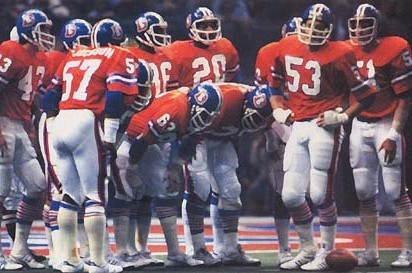
With a new coach, Robert "Red" Miller, the Broncos stood out, and not just because of their bright blue helmets and their brighter orange jerseys. Craig Morton, who had quarterbacked the Dallas Cowboys into Super Bowl V (but lost it), led an offense with running backs Otis Armstrong and Rob Lytle, and receivers Haven Moses and Rick Upchurch.

The defense, known as the Orange Crush after a brand of soda, was spectacular. With end Lyle Alzado, tackles Rubin Carter and Paul Smith, linebackers Randy Gradishar and Tom Jackson, cornerbacks Steve Foley and Louis Wright, and safety Billy Thompson, they were hard to score upon. And Jim Turner, who had kicked the Jets to Super Bowl glory 9 seasons earlier, was still a formidable weapon.

The Broncos won their 1st 6 games, holding opponents to an average of less than 6 points per game. When they won their 5th, demolishing the defending NFL Champion Oakland Raiders, 30-7 at the Oakland Coliseum on October 16, people began to take notice. The Raiders ending their streak in Denver, 2 weeks later, restored some doubt. But beating the team that won the 2 Super Bowls before that, the Pittsburgh Steelers, 21-7 at home, restored the feeling.

All the while, the City of Denver, the State of Colorado, and indeed the entire Rocky Mountain region was turned on by this. Orange decorations were everywhere. It seemed to carry over: The new Nuggets, formed as the Denver Rockets in the ABA in 1967, got off to a strong start. Even the NHL's Colorado Rockies, struggling for attendance, were playing well in their 2nd season in the city, after a difficult 1st one.

Still, at the time, Americans tended not to regard a city as "major league" unless it had a team in Major League Baseball. Denver wasn't there yet. But now, in the Autumn of 1977, there was talk that Charlie Finley might sell the Oakland Athletics to Denver oil baron Marvin Davis, so he could move the A's to Mile High Stadium for the 1978 season, and it seemed serious.

As Terry Frei, a sportswriter for the Denver Post in 1977, wrote in his 2008 book '77: Denver, the Broncos, and a Coming of Age:

Those of us in Colorado at the time got to watch and be a part of a town turning into a city. The transformation was already underway, involving forces that had nothing to do with sports. Yet, looking back, I'm convinced that never has one team, one season, one year, been such a crucial part of a market's transformation and even maturation. 

Frei seemed to suggest that Denver had become the 1st American city to truly be major league without having a major league baseball team. Miami and New Orleans had NFL teams, and New Orleans then also had an NBA team. But they were cities with a certain specific character, where they could be major American cities without being "major league." Washington, D.C. had lost its baseball team after the 1971 season, but it was the nation's capital, so, of course, it was major league.

Denver became the 1st city to truly cross that divide, because of "Broncomania." It had gripped Denver so much that people began to joke that the A's should drop their green & gold color scheme, and become the Orange Sox. (In the end, they stayed in Oakland for a while longer.)

The Broncos went 12-1, winning the AFC Western Division for the 1st time in their 18 seasons, before losing the regular season finale, 14-6 away to the Dallas Cowboys. At the time, that loss seemed meaningless, a dropped piece of cake at the end of a nice picnic.

On Christmas Eve, December 24, 1977, the Broncos played their 1st Playoff game. And it was against the mighty Steelers. The game was tied 14-14 at the half, but the Broncos dominated the 2nd half, and won, 34-21. This set up a duel in the mountains with the Raiders for New Year's Day, January 1.

Turner missed 3 field goals and had an extra point blocked. But the Raiders also had a problem, as their Hall of Fame receiver Fred Biletnikoff left the game with a shoulder injury. While the Raiders got to the Broncos' 2-yard line on their 1st drive, they were held to a field goal. Morton threw a 74-yard pass to Moses to make it 7-3, and that score held until halftime.

In the 3rd quarter, the Raiders' Clarence Davis fumbled, and Brison Manor recovered it at the Raider 17. The Broncos got to the 2, and then came one of those controversial plays that seemed to follow the Raiders around in the 1970s.

Lytle tried to jump over the goal line with the ball, but was hit in midair by Jack Tatum, and fumbled. The Raiders' Mike McCoy recovered, but the officials ruled that Lytle's forward progress was stopped before the fumble. Replays showed otherwise. The officials then penalized the Raiders half the distance to the goal line for their unsportsmanlike conduct in arguing the call, and Jon Keyworth scored the touchdown, giving the Broncos a 14-3 lead.

The Raiders and their fans have whined about it ever since. But after the Broncos then recovered a fumbled punt, Morton threw a touchdown pass to Jack Dolbin, but it was ruled an incomplete pass, and the replays showed that this call was also incorrect, leading to one of Turner's missed field goals. So, given the fact that the Raiders were saved from being down 21-3 with a quarter and change to go, and given how many bogus calls went their way in those days, they need a big steaming cup of shut the hell up.

Early in the 4th quarter, Ken Stabler threw a 7-yard touchdown pass to Dave Casper, and it was 14-10 Denver. A Floyd Rice interception appeared to put the Raiders in the driver's seat, and they got to the Bronco 22. But Bob Swenson intercepted Stabler, and returned the ball to the Raider 17. Morton then threw a touchdown pass to Moses, making it 20-10, though Turner's extra point was blocked.

With 3:16 left, Stabler threw a 17-yard touchdown pass to Casper, making it 20-17. But the Broncos managed to run the clock out, and they had their 1st Conference Championship. The capital city of the Rocky Mountain region, and their favorite sports team, had grown up.

This win put the Broncos into Denver's 1st World Championship in any sport, Super Bowl XII, at the Louisiana Superdome in New Orleans. They would face the Dallas Cowboys, who, on this day, defeated the Minnesota Vikings, 23-6 at Texas Stadium in the Dallas suburb of Irving, Texas, for the National Football Conference Championship.

But there would be no happy ending: They didn't handle the increased attention well, they didn't handle the distractions of the Big Easy well, and they certainly didn't handle the Cowboys well. Dallas won, 27-10, in a game considered one of the least interesting Super Bowls.

The Broncos didn't finish the job, but they did something more important. Like the 1967 Boston Red Sox, who lost the World Series after an "Impossible Dream" of a Pennant, the '77 Broncos lifted up their city, they made themselves an iconic team, and they made Bronco fans recognized as among the best in the NFL. The team would lose 3 more Super Bowls, before winning back-to-back Super Bowls in the late 1990s, and splitting a pair of Super Bowls in the 2010s.

*

January 1, 1978 was a Sunday. Because of this, the traditional New Year's Day bowl games were moved to the next day, January 2. Number 1 Texas were upset by Number 5 Notre Dame in the Cotton Bowl, Number 2 Oklahoma were upset by Number 6 Arkansas in the Orange Bowl, Number 3 Alabama beat Number 9 Ohio State in the Sugar Bowl, and Number 4 Michigan were upset by Number 13 Washington in the Rose Bowl. Notre Dame, rather than numerically-rightful Alabama, were recognized as National Champions.

Baseball was out of season. There were 3 games played in the NBA: 

* The New York Knicks beat the Cleveland Cavaliers, 96-87 at Madison Square Garden. This was Walt Frazier's 1st game back at The Garden after the Knicks shockingly traded him to the Cavs.

* The Portland Trail Blazers beat the Kansas City Kings, 107-102 at the Veterans Memorial Coliseum in Portland.

* And the Seattle SuperSonics beat the Chicago Bulls, 114-96 at the Seattle Center Coliseum. Gus Williams led all scorers on the day with 32 points.

There were 3 games in the NHL:

* The Atlanta Flames and the Buffalo Sabres played to a tie, 2-2 at the Buffalo Memorial Auditorium.

* The Vancouver Canucks beat the Chicago Black Hawks, 3-2 at the Chicago Stadium.

* And the Los Angeles Kings beat the Colorado Rockies, 5-1 at The Forum outside Los Angeles in Inglewood, California.

And there were 3 games in the World Hockey Association:

* The Quebec Nordiques beat the Birmingham Bulls, 5-2 at the Birmingham-Jefferson Civic Center in Birmingham, Alabama.

* The New England Whalers beat the Cincinnati Stingers, 4-3 at the Riverfront Coliseum (now the Heritage Bank Center) in Cincinnati.

* And the Houston Aeros beat the Edmonton Oilers, 2-1 at the Northlands Coliseum in Edmonton.

December 31, 1999 & January 1, 2000: The Millennium

December 31, 1999:  The Millennium arrives. The people of planet Earth survived. At a terrible cost. But we hadn't destroyed ourselves. ...