Showing posts with label snow. Show all posts

Thursday, December 22, 2022

December 22, 1962: Britain's "Big Freeze" Begins

December 22, 1962: The "Big Freeze" begins in Britain. There were no frost-free nights until March 5, 1963 – 74 straight days.

The Winter of 1962–1963 remains the coldest since at least 1894-95 in all meteorological districts of the United Kingdom, although in north Scotland the Winter of 2009-10 was equally cold.

A cold easterly set in on December 22, as an anticyclone formed over Scandinavia, drawing cold continental winds from Russia. Throughout the Christmas period, the Scandinavian high collapsed, but a new high formed near Iceland, bringing northerly winds. Significant snowfall occurred on December 26 and 27, as the air mass moved south, and became firmly established.

Overnight on December 29 and 30, 1962 a blizzard swept across southern England and Wales. Snow drifted to more than 20 feet deep in places, driven by gale force easterly winds, blocking roads and railways. The snow stranded villages and brought down power lines.

On December 31, the clock on the Palace of Westminster -- often called Big Ben, even though that's actually the name of the bell in the clock -- was delayed by 10 minutes due to the large amount of snow that had accumulated on the clock hands, and the New Year ended up being 10 minutes late.

The near-freezing temperatures meant that the snow cover lasted for more than 2 months in some areas. There was so much snow, and temperatures were so cold, that the 3rd Round of the FA Cup, which normally begins on the 1st Saturday in January, was not completed until March 11, at a time when the 6th Round, the Quarterfinals, would usually be played. As a result, the Final, usually set for the 1st Saturday in May, was pushed back to the last, May 25.

*

December 22, 1962 was a Saturday. Also starting in England on this day is Ralph Nathanial Twisleton Wykeham Fiennes, in Ipswich, Suffolk. We would know him as the actor Ralph Fiennes, pronounced "Raif Fines."

And, on that day, for the first time, a British band hit Number 1 on the American popular music charts. No, it wasn't The Beatles. It was The Tornadoes, with the instrumental "Telstar," named for the communications satellite launched earlier in the year. As far as the U.S. charts were concerned, The Tornadoes turned out to be "one-hit wonders."

The cold postponed all Football League games in England. In American football, the NFL was between the last week of its regular season and its Championship Game, which, on December 30, the Green Bay Packers won, beating the New York Giants, 16-7 at Yankee Stadium. The American Football League played its Championship Game on December 23, and the Dallas Texans beat the Houston Oilers, 20-17 in overtime at Jeppesen Stadium in Houston. (I have separate entries for each of those games.)

There were 2 college football bowl games played that day. The Tangerine Bowl was played at the stadium then carrying the same name, now named Camping World Stadium, in Orland, Florida. The University of Houston beat Miami University of Ohio, 49-21.

UH did not play its bowl game in Houston. That would be the Bluebonnet Bowl, at Rice Stadium. Missouri beat Georgia Tech, 14-10.

Baseball was out of season. There were 3 games in the NBA, and 2 were a doubleheader at the Boston Garden. The Detroit Pistons beat the Chicago Zephyrs, 122-110. The Zephyrs became the Baltimore Bullets the next season. And the New York Knicks beat the Boston Celtics, 120-106 at the Boston Garden. Richie Guerin scored 37 points for the Knicks.

* And the San Francisco Warriors beat the Syracuse Nationals, 123-118 at the Onondaga County War Memorial in Syracuse, New York. It was just another day at the office for Wilt Chamberlain: He scored 39 points and grabbed 28 rebounds, leading the Warriors to victory. This was the NBA's only season without a Philadelphia team: The Warriors had moved in the previous off-season, while the Nats would move the next off-season, becoming the Philadelphia 76ers for 1963-64.

And there were 2 games in the NHL. The New York Rangers lost to the Toronto Maple Leafs, 4-2 at Maple Leaf Gardens in Toronto. And the Chicago Black Hawks and the Montreal Canadiens played to a tie, 1-1 at the Montreal Forum. The Boston Bruins and the Detroit Red Wings were not scheduled.

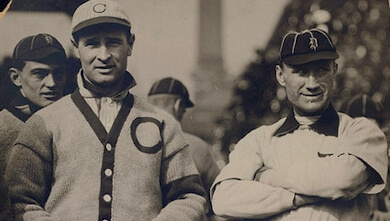
Tuesday, October 11, 2022

October 12, 1907: The Cubs Win In the Snow

Opposing managers Frank Chance (left) and Hughie Jennings.
It hadn't started snowing yet, but a sweater was a good idea.

October 12, 1907: The Chicago Cubs win the World Series. Having lost it the year before to the crosstown White Sox, this is sweet redemption for them.

It wasn't quite revenge, as the opponents were the Detroit Tigers. But it was a dish served cold. There was no choice: Temperature-wise, this was the coldest World Series ever.

Game 1 was played at the West Side Grounds in Chicago, and no winner could be found: It went 12 innings before the umpires called it due to darkness. There was some retroactive appropriateness to this: The Cubs were the last team in the major leagues to put lights up at their home stadium, in 1988; while the Tigers were the last team in the American League to do so, in 1948.

This was the 1st World Series game for Tigers superstar Ty Cobb, 2 months shy of his 21st birthday. "Wild" Bill Donovan of the Tigers struck out 12 batters, matching the Series record set by Ed Walsh of the White Sox the year before. That record stood until 1929, when Howard Ehmke of the Philadelphia Athletics struck out 13 Cubs. The record was raised to 14, by Carl Erskine of the 1953 Brooklyn Dodgers; 15, by Sandy Koufax of the 1963 Los Angeles Dodgers; and the current mark of 17, by Bob Gibson of the 1968 St. Louis Cardinals.

Game 2 was also played in Chicago. For the 1st, and perhaps only, time in World Series history, the "hidden-ball trick" is successfully tried. In Game 2 at the West Side Grounds, Detroit Tigers 3rd baseman Bill Coughlin tags out Cub center fielder Jimmy Slagle, who is leading off the base.

It didn't help the Tigers much. Their 2nd baseman Herman "Germany" Schaefer was caught stealing, and Tiger manager Hughie Jennings, the star shortstop of the 1890s Baltimore Orioles dynasty, argued the call, becoming the 1st manager to be thrown out of a World Series game, by umpire Hank O'Day. The Cubs won, 3-1. Game 3 was also played in Chicago. With considerably less controversy, the Cubs won again, 5-1.

The Series shifted to Bennett Park in Detroit for Game 4. A triple by Cobb led to the Tigers' 1st run, but it turned out to be the only run, as the Cubs won, 6-1. And in a chilly Game 5, with snow falling, and the lowest attendance in World Series history, only 7,370 fans, Mordecai "Three-Finger" Brown pitched a 7-hit shutout to outpitch George Mullin, and the Cubs won, 2-0.

Frank Chance, the Cubs' manager and 1st baseman known as "The Peerless Leader," was only 30 years old. He remains the youngest manager ever to win the World Series.

There would not be snow at a World Series game again for 90 years, until Game 4 in 1997, in Cleveland. That Series had the greatest extremes of temperature: While the 3 games in Cleveland were cold, the 4 games in the Miami suburbs were hot.

*

October 12, 1907 was a Saturday. Among the notable college football games played that day were these:

* Army beat Trinity College of Connecticut, 12-0 on The Plain on the U.S. Military Academy grounds in West Point, New York.

* Navy and Vanderbilt played to a tie, 6-6 at Worden Field on the Naval Academy grounds in Annapolis, Maryland.

* The Carlisle Indian School beat Syracuse, 14-6 at Archbold Stadium in Syracuse, New York.

* Rutgers lost to Lehigh, 16-6 at Neilson Field in New Brunswick, New Jersey.

* Princeton beat Villanova, 45-5 at University Field in Princeton, New Jersey.

* The Western University of Pennsylvania beat their neighbors, Carnegie Tech, 6-0 at Exposition Park in Pittsburgh. In 1908, WUP became the University of Pittsburgh. In 1967, the Carnegie Institute of Technology merged with the Mellon Institute of Industrial Research, and became Carnegie-Mellon University.

* In what would later become a major rivalry, the University of Michigan beat Michigan State Agricultural College, 46-0 at Ferry Field in Ann Arbor. MSAC became Michigan Agricultural College in 1909, Michigan State College in 1925, and Michigan State University in 1955.

* In what was already a major rivalry, Texas and Texas A&M played to a tie, 0-0 at Gaston Park, the Texas League baseball park in Dallas.


And in English soccer, Woolwich Arsenal, the South-East London team that would later become Arsenal F.C., the North London team I support, went to Birmingham in the West Midlands, and beat Aston Villa, 1-0 at Villa Park.

Friday, March 11, 2022

March 12, 1888: The Blizzard of 1888

Note all the snow-covered above-ground power lines,
not something seen in modern American cities.

March 12, 1888: The Blizzard of 1888, also known as the Great White Hurricane, paralyzes the Northeastern U.S., from Chesapeake Bay to Maine.

Places in Massachusetts and Connecticut got up to 50 inches of snow -- over 4 feet. New York City (then just Manhattan and part of The Bronx) got 22 inches, which would be a City record until 1947.

Over 400 fatalities were attributed to the storm, among them Roscoe Conkling, the legendarily corrupt U.S. Senator from New York, from pneumonia. Fire stations were immobilized, and, despite temperatures nearly dropping below zero, fire damage alone was estimated at $25 million (about $720 million in 2022 money).

Transportation was hopeless. Horses couldn't get through the snow to draw carriages, and railroads couldn't operate. The City was at a standstill. It took the New York, New Haven & Hartford Railroad -- including what's now the New Haven Line of the Metro-North Commuter Railroad -- 8 days to start operating again.

Just as a freezing-over of the East River led to the desire to build the Brooklyn Bridge, so too did the Blizzard of '88 lead to the Northeast beginning to build underground railway systems. Boston opened the Western Hemisphere's 1st subway line in 1897, New York followed in 1904, and Philadelphia in 1907. Telegraph and telephone lines were also brought down, and this led to cities putting those underground as well.

*

March 12, 1888 was a Monday. Baseball season had yet to begin. Football was out of season. Hockey was still all-amateur. And basketball hadn't yet been invented. So, regardless of the weather, there were not going to be any scores on this historic day.

Friday, February 11, 2022

February 11, 1983: The Megapolitan Blizzard

Manhattan, February 12, 1983

February 11, 1983: A blizzard hits the Northeastern U.S. It becomes known as the Megapolitan Blizzard.

It was a Friday, and I was in the 8th grade in East Brunswick, New Jersey. Snow began to fall around 11:00 AM, and they let us out around 12:00 Noon. I spent much of the night dipping a yardstick into the backyard to get measurements. By the time I went to bed, it was 22 inches. That would be the most that East Brunswick got between the day-after-Christmas blizzard of 1947 and the big one of January 1996.

New York reported 24 inches, or 2 full feet, in some spots. Philadelphia reported 21. Even southwestern Virginia reported 20. Glen Cary, West Virginia reported the most: 35 inches, or an inch under 3 feet. A total of 46 deaths were attributed to the blizzard.

And yet, by Monday morning, February 14, we were back in school. We only missed a shade over 2 hours. We got gypped. At that age, you think of snow as fun. As you get older, and snow means you lose a day's pay because you don't go to work, you realize that "snow" is a four-letter word.

*

February 11, 1983, as I said, was a Friday. Baseball and football were out of season. The NBA was lucky: They were in their All-Star Break, so they didn't get any games postponed due to the snow. On Sunday, February 13, at The Forum, outside Los Angeles in Inglewood, California, the East beat the West, 132-123. Julius Erving, "Dr. J," was named the game's Most Valuable Player.

The NHL wasn't so lucky, as some games were postponed. Only 1 game was played: The Edmonton Oilers beat the Quebec Nordiques, 7-3 at the Northlands Coliseum in Edmonton. It was 2-1 Nords 8 minutes into the 2nd period. Then Jari Kurri scored his 2nd of the game to tie it. In the 3rd period, the Oilers just unloaded, getting goals from Laurie Boschman, Mark Messier, Ken Linseman, Dave Semenko and Wayne Gretzky.

Also on this day, Dutch soccer star Rafael van der Vaart was born.

Thursday, February 10, 2022

February 10, 1969: The Lindsay Snowstorm

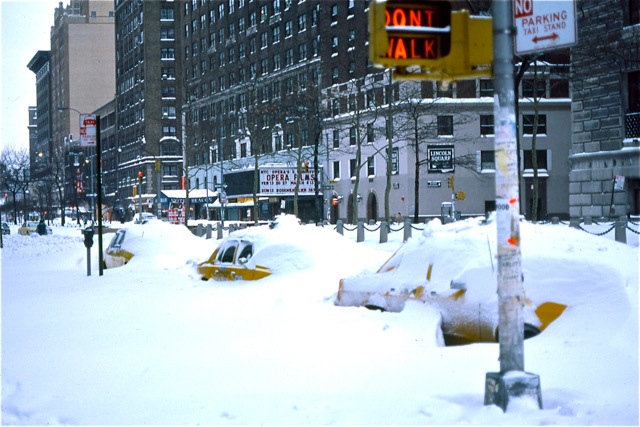
February 10, 1969: A severe Winter storm hits the Northeastern U.S. Although the heaviest snowfalls, up to 32 inches, are recorded in Maine, it hits hardest in New York City. Depths were reported at 15 inches in Central Park, and 20 inches at John F. Kennedy International Airport. Of the 94 deaths that were attributed to the storm, 42 were in the City, 3 of them at JFK Airport, found trapped and frozen in a car.

The Airport estimated that 6,000 travelers were stranded there. Drivers became trapped on the highways. As with the massive traffic jam caused by the Woodstock concert 6 months later, the New York State Thruway was closed, man. Cars were abandoned on the Tappan Zee Bridge. The Long Island Rail Road suspended service.

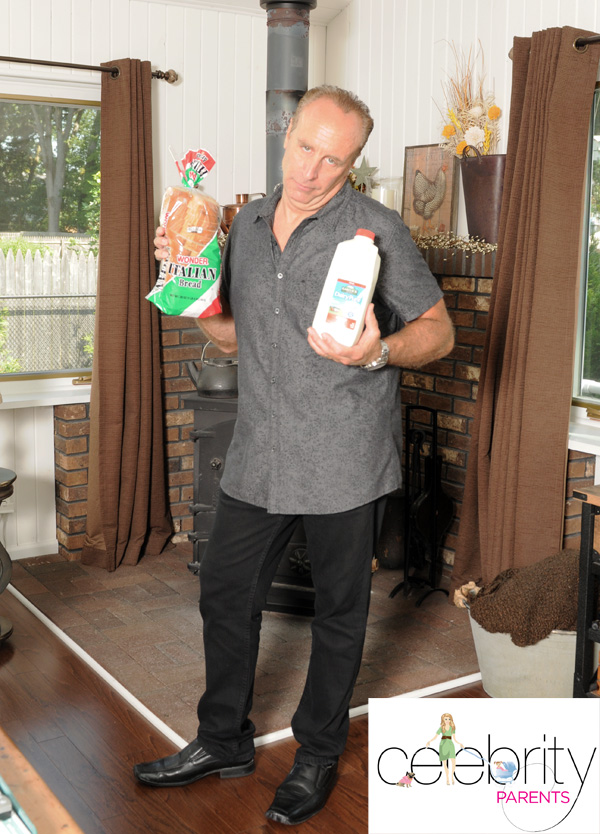
All the financial exchanges closed. It was the 1st time the New York Stock Exchange had ever closed due to bad weather. The bulk of the snow fell on a Sunday, but schools were still closed the next day. Buses, taxis, delivery vehicles, mail trucks and garbage trucks couldn't get through. Nor could food delivery trucks get to the stores. Comedian Vic DiBitetto had just turned 8 years old, and was living in Brooklyn. This may have been the original storm that inspired his famous 2013 video: "They said snow! I gotta get the bread and milk!"
Mayor John Lindsay got the streets of Manhattan cleared fairly quickly. But the "Outer Boroughs"? The Bronx, Queens, Brooklyn, Staten Island? It was almost as if Lindsay forgot they were part of the City. And the people living there were furious, especially in Queens. He tried to go there to apologize, but in the neighborhood of Kew Gardens, he got booed. It got worse: In Rego Park, his limousine got stuck. It became known as the Lindsay Snowstorm.

It was an election year, and Lindsay was running for re-election. The City's Republican Party ran John Marchi, a State Senator from Staten Island, against him in the primary, and beat him. Marchi also got the nomination of the City's Conservative Party.

The Democratic nominee was the City Comptroller, Mario Procaccino, and he turned out to be a conservative Democrat. Remembering Lindsay's limo trouble, he coined the expression "limousine liberal," to describe liberals who loved humanity in concept, but were out of touch with real people. But he also made some racist remarks, and it looked like the City had a choice between an Italian version of a Strom Thurmond-style "Dixiecrat" and a Barry Goldwater-style Republican. After all, while Lindsay did manage to keep the nomination of the City's Liberal Party, nobody wanted him for 4 more years.

As it turned out, enough people wanted Lindsay that he won the general election anyway.

*

February 10, 1969 was a Sunday. Baseball and football were out of season. No games were scheduled in either the NBA or the NHL. One game was scheduled in the American Basketball Association: The Miami Floridians beat the Los Angeles Stars, 126-112 at the Los Angeles Memorial Sports Arena.

Monday, February 7, 2022

February 7, 2013: Vic DiBitetto Posts "Bread & Milk"

February 7, 2013: Vic DiBitetto posts a video to YouTube: "Bread & Milk."

A Brooklyn native, Vic started doing comedy in the early 1980s, doing not well enough to become a star, but doing just well enough to keep doing it, while he made a living as a garbage truck driver, and then a school bus driver, on Staten Island. In 1991, he and his son Michael won $10,000 on America's Funniest People, for a home video of a mock ventriloquist act.

The coming of YouTube inspired Vic to make his own channel, and bring his comedy to the masses, a few minutes at a time. Frequently, he would open with, "Hey, whattaya say, my Facebook, YouTube, Instagram, Google Plus, your sister's ass, the Pony Express? A very ticked-off Vic here. You know what ticks me off?" And then he would explain what was ticking him off at the moment. Usually, it was something really annoying and stupid, instead of something actually dangerous. Such is life when you live in the New Jersey suburbs of New York. (I understood completely: At the time, we lived 16 miles apart.)

By early February 2013, he had turned 52, and had appeared in exactly one feature film -- and it was Paul Blart: Mall Cop 2. He got raves for this brief appearance in an otherwise forgettable movie, but he was still no closer to becoming a star than he was in 1991. Still, people were liking his videos and telling him he was funny. Again, he was getting just enough encouragement to continue.

Then came a weather report: A storm was going to dump a lot of snow on the Northeastern United States. Words like "blizzard," "nor'easter," "extratropical cyclone" and "bomb cyclone" were used.

When warnings of a big storm come, people tend to panic, and head to stores to get food. And paper products, such as toilet paper and paper towels. And, in case power is lost, fuel for portable generators, and candles. Runs on stores' supplies of bread and milk are common.

It's worth pointing out that this was just 14 weeks after Hurricane Sandy had ravaged the Northeast, so that was still on people's minds. There was no snow on that occasion. But if the snow that was being predicted for this occasion had turned out to be deep -- say, 2 feet (24 inches) or more, it might be days before you could get to the store again, so you'd better get what you need now, before the snowfall starts.

And so, Vic posted a 28-second video of himself running out of his house, and getting into his car to go to the store, getting more and more worried as he goes along:

Gotta get the bread and milk. I gotta get the bread and milk. I gotta get the bread and milk. Gotta get the bread and milk, oh my God! I gotta... I gotta get the bread and milk! I gotta get the bread and... They said snow! I gotta get the bread and milk! Oh my God! I gotta get the bread... I gotta get the bread and milk! I gotta get the bread and milk, oh my God!

Within a year of posting it, this video got over 12 million views. By 2022, it was up to 20 million. It was shown on CNN, NBC's The Today Show, and ABC's The View.

And the parodies of it came up fast. Within 5 days, a man recorded what he called "Bread & Milk (black version)": "I gotta get the sugar and Kool-Aid!" In January 2014, with snow already falling, another guy went through the whole shebang of saying he's gotta get the bread and milk, and closed with, "I'm gettin' Dunkin Donuts, screw this." In January 2016, with Shopkins being a toy craze, a woman taped her daughter, probably around 8 years old, getting into the car's driver's seat, and saying, "I gotta get the Shopkins!"

Vic said, "Thirty seconds of stupidity brought me more recognition than thirty years of stand-up." He now occasionally gets parts in comedy movies, usually playing guys like himself: Italians who yell a lot.

He parodies this with his character, Tony Gaga. That's with the accent on the 2nd syllable, Ga-GA, not like Lady Gaga (who is also Italian and from New York). Tony Gaga, whom Vic claims is his cousin, wears shades, an undershirt, and Bermuda shorts, and doesn't know the meaning of the words "inside voice." Whatever you're talking about, he says, "You gotta guy? You gotta go to the guy I go to! He'll get it for ya for two dollars! Two dollars!"
Vic as Tony Gaga

He also does videos pretending to be the manager of the New York Yankees, the head coach of the New York Giants (keeping his own personality for both, not pretending to be the actual field boss), Sylvester Stallone's Rocky Balboa, Al Pacino's Tony Montana of Scarface, Marlon Brando's Don Vito Corleone of The Godfather, Robert Shaw's Quint from Jaws, or the late, great comedian Rodney Dangerfield, who was a friend of his. Sometimes, he's himself, Tony Gaga, Rocky, Tony Montana, Don Corleone, Quint and Rodney, all in the same video.

But he's still best known as "The Bread and Milk Guy." In 2021, after a year of COVID, with its runs on store supplies, one commenter wrote, "This man was living in 2020 before 2020 was even a thing." Around that time, Vic actually did get COVID. He was miserable for 4 days, but survived, and, as of February 7, 2022, shows no ill effects, but minces no words: You don't want it.

As for the storm in question: New York got 11 inches of snow, and most of New Jersey got around that as well. New England was hit much worse: Boston got 25 inches; Portland, Maine set a city record with 32 inches; and Hamden, Connecticut got hit the worst, 40 inches -- that's 3-foot-4. Both New England and Atlantic Canada (the Maritime Provinces: New Brunswick, Nova Scotia, Prince Edward Island, and Newfoundland and Labrador) got hit with waves much higher than usual. Over 700,000 people lost power, some only briefly, others for days; and 18 deaths were attributed to the storm.
And, just so you know, he did get the bread and milk.
This head-tilt and glare is known to his fans as "Doing The Look."

*

February 7, 2013 was a Thursday. Baseball was out of season. The football season had just ended with Super Bowl XLVII, in which the Baltimore Ravens beat the San Francisco 49ers, 34-31.

Only 2 NBA games were played. That was what was scheduled; it wasn't due to the storm. The Boston Celtics beat the Los Angeles Lakers, 116-95 at the TD Garden in Boston; and the Denver Nuggets beat the Chicago Bulls, 128-96 at the Pepsi Center (now the Ball Arena) in Denver.

There were 12 games played in the NHL:

* The New York Rangers beat their arch-rivals, the New York Islanders, 4-1 at Madison Square Garden.

* The New Jersey Devils beat the Tampa Bay Lightning, 4-2 at the Prudential Center.

* The Florida Panthers beat the Philadelphia Flyers, 3-2 in a shootout at the Wells Fargo Arena (now the Xfinity Mobile Arena) in Philadelphia.

* The Nashville Predators beat the Los Angeles Kings, 3-0 at the Bridgestone Arena in Nashville.

* The Carolina Hurricanes beat the Ottawa Senators, 3-2 in overtime at Scotiabank Place (now the Canadian Tire Centre) in Ottawa.

* The Buffalo Sabres beat the Montreal Canadiens, 5-4 in a shootout at the First Niagara Center (now the KeyBank Center) in Buffalo.

* The Pittsburgh Penguins beat the Washington Capitals, 5-2 at the Consol Energy Center (now the PPG Paints Arena) in Pittsburgh.

* The Calgary Flames beat the Columbus Blue Jackets, 4-3 in overtime at the Nationwide Arena in Columbus.

* The Detroit Red Wings beat the St. Louis Blues, 5-1 at the Scottrade Center (now the Enterprise Center) in St. Louis.

* The Vancouver Canucks beat the Minnesota Wild, 4-1 at the Xcel Energy Center in St. Paul.

* The Toronto Maple Leafs beat the Winnipeg Jets, 3-2 at the MTS Centre (now the Canada Life Centre) in Winnipeg.

* The Chicago Blackhawks beat the Phoenix Coyotes, 6-2 at the Jobing.com Arena (now the Desert Diamond Arena) in the Phoenix suburb of Glendale, Arizona.

* And the Anaheim Ducks, the Boston Bruins, the Colorado Avalanche, the Dallas Stars, the Edmonton Oilers and the San Jose Sharks were not scheduled.

Sunday, February 6, 2022

February 6, 1978: The Northeast Blizzard of '78

That's Boston's New City Hall in the background.

February 6, 1978: A blizzard hits the Northeastern United States. The storm killed about 100 people, mostly in car crashes.

This came just 12 days after "The White Hurricane," the Midwest's version of the Blizzard of '78, struck the Ohio Valley and the Great Lakes, killing 70 people.

The biggest snowfall hit Woonsocket, Rhode Island: 38 inches; or 3 feet, 2 inches. Records for snowfall hit Boston with 27 inches; Providence, Rhode Island with 27 inches; and Atlantic City with 20 inches.

Not records, but bad enough: New York, 20 inches; Hartford, Connecticut, 17 inches; Philadelphia, 16 inches; Baltimore, 12 inches. Washington, D.C. was comparatively lucky: Only 4 inches.

February 6 was the date scheduled for the annual Beanpot Tournament, contested between hockey teams from 4 local colleges in Boston: Boston College, Boston University, Harvard University, and Northeastern University. But instead of postponing the tournament, it was played on February 6. The 11,666 fans who showed up actually got more hockey than they expected: The opening game went to overtime, and Harvard beat Northeastern, 4-3. In the nightcap, BU beat BC, 12-5.

And they couldn't get out. They were snowed in. They were stuck in the Boston Garden. Fortunately, there were bathrooms inside -- even if they were the kind of bathrooms you would expect in an arena that opened in 1928. And there was food inside, as the concession stands remained open until it ran out. The Celtics' famed parquet floor was put down over the ice, to provide sleeping space. Even the locker rooms were opened, to provide more.

The next day, the Garden was dug out, and people were able to leave. Traditionally, the Beanpot is held on the 1st and 2nd Mondays in February. This time, the 2nd round wasn't held until Wednesday, March 1: BC beat Northeastern, 3-2 in overtime; and BU won the tournament, beating Harvard, 7-1.

If Boston sports fans thought February 1978 was rough, they hadn't seen nothin' yet. The Celtics had the worst season, record-wise, in their history. The Bruins lost the Stanley Cup Finals. The Red Sox led the American League Eastern Division by 9 1/2 games, and were 14 games ahead of the arch-rival New York Yankees, then collapsed, and lost a Playoff for the Division title on October 2. And the Patriots won the AFC East title, but fell out of the Playoffs when they lost at home on New Year's Eve to the Houston Oilers.

*

February 6, 1978 was a Monday. Baseball and football were out of season. The NBA was in it's All-Star Break, holding the Game the day before, with the East beating the West, 133-125 at the Omni Coliseum in Atlanta.

Only 1 NHL game was scheduled: The Philadelphia Flyers beat the St. Louis Blues, 2-0 at The Spectrum in Philadelphia. And there were no games scheduled in the World Hockey Association.

Wednesday, February 2, 2022

February 2, 2011: The Groundhog Day Blizzard

February 2, 2011: A Winter storm peaks in intensity over the Midwestern United States, becoming known as the Groundhog Day Blizzard and "Snowmageddon."

It was preceded by an ice storm, which made things much worse. The blizzard actually started in the Southwest, dropping snow on places not used to it: Las Cruces, New Mexico; El Paso, Texas, on the State Line with New Mexico and the border with Ciudad Juarez, Mexico; Dallas and Houston, Texas; Oklahoma City and Tulsa, Oklahoma.

Chicago, normally used to bad Winter weather, was hit particularly hard, getting 21 inches of snow and winds over 60 miles per hour. Other Midwestern cities hard hit included (going from west to west) Kansas City, St. Louis, Milwaukee, Indianapolis, Detroit and Cleveland.

The storm moved east, and also hit Buffalo, Toronto, Montreal, and Albany, New York, before hitting the Northeast Corridor: Boston, New York, Philadelphia, Baltimore and Washington. And then it socked Canada's Maritime Provinces, before heading out to sea. At least 36 deaths were attributed to the storm, most of them from car crashes or heart attacks while shoveling snow.

*

February 2, 2011 was a Wednesday. Baseball was out of season. The football season was about to end, with Super Bowl XLV 4 days later: The Green Bay Packers beat the Pittsburgh Steelers, 31-25.

In spite of the bad weather, 11 NBA games were started, and all were played to their conclusion, including some in the affected cities:

* The New York Knicks lost to the Dallas Mavericks, 113-97 at Madison Square Garden.

* The New Jersey Nets lost to the Philadelphia 76ers, 106-92 at the Prudential Center in Newark.

* The Indiana Pacers beat the Cleveland Cavaliers, 117-112 at the Quicken Loans Arena (now the Rocket Arena) in Cleveland. Attendance: 18,877, close to a sellout. And this was in the 1st season of LeBron James' Miami sojourn, so that's extraordinary.

* The Charlotte Bobcats beat the Detroit Pistons, 97-87 at The Palace in the Detroit suburb of Auburn Hills, Michigan. Stephen Jackson scored 39 points for the Bobcats. Attendance: 14,376.

* The Memphis Grizzlies beat the Minnesota Timberwolves, 102-84 at the Target Center in Minneapolis. Attendance: 12,662.

* The Oklahoma City Thunder beat the New Orleans Hornets, 104-93 at the Chesapeake Energy Arena (now the Paycom Center) in Oklahoma City. Attendance: 17,849, close to a sellout.

* The Atlanta Hawks beat the Toronto Raptors, 100-87 at the Philips Arena (now the State Farm Arena) in Atlanta. Joe Johnson scored 37 points.

* The Denver Nuggets beat the Portland Trail Blazers, 109-90 at the Pepsi Center (now the Ball Arena) in Denver.

* The Houston Rockets beat the Utah Jazz, 97-96 at the Delta Center in Salt Lake City (then named the EnergySolutions Arena).

* The Phoenix Suns beat the Milwaukee Bucks, 92-77 at the the US Airways Center (now the Mortgage Matchup Center) in Phoenix.

* The Chicago Bulls beat the Los Angeles Clippers, 106-88 at the Staples Center (now the Crypto.com Arena) in Los Angeles.

And there were 6 games played in the NHL:

* The New York Islanders lost to the Pittsburgh Penguins, 3-0 at the Consol Energy Center (now the PPG Paints Arena) in Pittsburgh. The New York Rangers and the New Jersey Devils were not scheduled.

* The Montreal Canadiens beat the Florida Panthers, 3-2 at the Bell Center in Montreal. Attendance: Same as always, 21,273.

* The Detroit Red Wings beat the Ottawa Senators, 7-5 at Scotiabank Place (now the Canadian Tire Centre) in Ottawa. Attendance: 18,011, a sellout.

* The Vancouver Canucks beat the Phoenix Coyotes, 6-0 at the Jobing.com Arena (now the Desert Diamond Arena) in the Phoenix suburb of Glendale, Arizona.

* The Los Angeles Kings beat the Edmonton Oilers, 3-1 at Rexall Place (as the Northlands Coliseum was temporarily known) in Edmonton.

* And the San Jose Sharks beat the Anaheim Ducks, 4-3 at the Honda Center in the Los Angeles suburb of Anaheim, California.

Wednesday, January 19, 2022

January 19, 1977: Snow In Florida

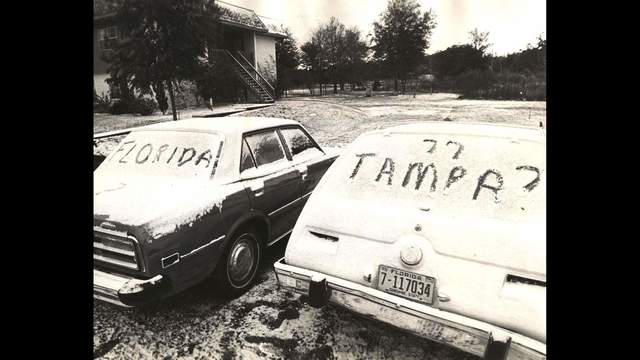
January 19, 1977: It snows in Florida. It was just a dusting, but it remains the only recorded snowfall in the history of "the Sunshine State."

A cold front combined with a high-pressure area over the Mississippi River Valley. This caused cold air to move south across Florida, causing both snow flurries and record-low temperatures for the region. Snow reached as far south as Homestead, 40 miles south of Miami.
One person was killed in a car accident in Central Florida. Most of the damage was done to the State's citrus fruit industry.

*

January 19, 1977 was a Wednesday. Baseball and football were out of season. There were 7 games played in the NBA that night:

* The New York Knicks lost to the Phoenix Suns, 97-90 at the Arizona Veterans Memorial Coliseum in Phoenix.

* The New York Nets lost to the Portland Trail Blazers, 109-94 at the Nassau Coliseum.

* The Philadelphia 76ers beat the Atlanta Hawks, 114-94 at The Spectrum in Philadelphia.

* The Washington Bullets beat the Buffalo Braves, 91-87 at the Capital Centre in the Washington suburb of Landover, Maryland.

* The Boston Celtics beat the Houston Rockets, 112-102 at The Summit in Houston. (The arena has since been converted into the Central Campus of the Lakewood Church, Dr. Joel Osteen's "megachurch.")

* The San Antonio Spurs beat the Chicago Bulls, 115-107 at the HemisFair Arena in San Antonio.

* And the Seattle SuperSonics beat the Indiana Pacers, 109-102 at the Seattle Center Coliseum.

There were no games played in the World Hockey Association that night, but there were 4 in the NHL:

* The New York Rangers played the Cleveland Barons to a tie, 3-3 at The Coliseum in the Cleveland suburb of Richfield, Ohio.

* The Washington Capitals beat the Buffalo Sabres, 4-2 at the Buffalo Memorial Auditorium.

* The St. Louis Blues beat the Chicago Black Hawks, 5-3 at the Chicago Stadium.

* The Pittsburgh Penguins beat the Vancouver Canucks, 3-0 at the Pacific Coliseum in Vancouver. 

Monday, January 10, 2022

January 10, 1949: Snow In Southern California

January 10, 1949: The Blizzard of '49... in Southern California! As far as anyone knows, this is the 1st time snow has ever fallen on Los Angeles, and the 1st time on San Diego since 1850.

Actually, there is a scientific definition of "blizzard," and this storm did not meet it. A "blizzard" is a severe snowstorm characterized by strong sustained winds and low visibility, lasting for a prolonged period of time, typically at least three or four hours. In other words, the amount of snowfall has nothing to do with it. Yet any major snowfall tends to get called a "blizzard," whether it meets the definition or not. And any snowfall in Southern California would feel like a "blizzard" to people living there who never lived anywhere else, and weren't used to it.

And, on January 10, 1949, a snowstorm hit Los Angeles and the surrounding areas. It was caused by a weather pattern that brought cold air from Canada and Alaska down to Southern California, where it met with a low-pressure system moving in from the Pacific Ocean.

The result was a snowstorm that dropped up to 4 inches of snow in some areas, and even more in some of the surrounding mountains. The snow caused widespread disruption and excitement, with schools closing, highways becoming blocked, and people flocking to parks and hillsides to play in the snow.

Many residents, especially those who had never experienced snow before, were thrilled by the novelty of the event, while others were less happy about the disruption to their daily lives.

The newspapers of the time reported extensively on the snowstorm, with headlines such as "Snowstorm Paralyzes Southland," "Southland Shivers Under Blanket of Snow," and "Record Snowfall Delights and Inconveniences Angelenos."

It was not unprecedented. It snowed in parts of Los Angeles in 1913, 1921, 1922, 1926 and 1944. But not since 1882, when the Los Angeles Herald was moved to print the headline, "How's That for Semi-Tropical?" had never been as widespread, or as deep, as it was in 1949.

Trace amounts of snow would fall on L.A. again in 1957 and 1962. I wonder what Dodger owner Walter O'Malley, used to the weather in New York, thought about that. At any rate, it hasn't happened since.

UPDATE: In 2025, when discussing Los Angeles weather and its effects that caused the devastating wildfires of the start of that year, Bill Pazeet, a climatologist at the NASA Jet Propulsion Lab in Pasadena, also addressed the city's long snow drought. He blamed it on the urban heat island effect -- paved surfaces are hotter than the natural ground -- and climate change.

Winter temperatures, particularly average daily lows, have risen dramatically over the past 75 years. While he said it's not impossible for it to snow again in Los Angeles, he thinks, based on prediction models, "by 2050, no way."

*

January 10, 1949 was a Monday. Future heavyweight boxing champion George Foreman was born.

Baseball and football were out of season. And no NHL games were scheduled. There was 1 game in the Basketball Association of America, the league that would become the NBA the next season: The Washington Capitols beat the Boston Celtics, 94-83 at the Boston Garden. The Caps would reach the BAA Finals, losing to the Minneapolis Lakers. Their coach would later coach the Celtics. His name was Arnold Jacob Auerbach, nicknamed Red even though his red hair was now mostly gone.

December 31, 1999 & January 1, 2000: The Millennium

December 31, 1999:  The Millennium arrives. The people of planet Earth survived. At a terrible cost. But we hadn't destroyed ourselves. ...