Showing posts with label metropolitan stadium. Show all posts

Wednesday, December 28, 2022

December 28, 1975: The Cowboys' Hail Mary, Full of Disgrace

December 28, 1975: The Minnesota Vikings host the Dallas Cowboys in an NFC Divisional Playoff game at Metropolitan Stadium, in the Minneapolis suburb of Bloomington, Minnesota. Each team had dominated, and would continue to dominate, its respective Division through the 1970s: The Vikings, the NFC Central; the Cowboys, the NFC East. The Cowboys had lost Super Bowl V and won Super Bowl VI; the Vikings had lost Super Bowls IV, VIII and IX, and were going for their 3rd straight NFC Championship.

The game's 1st half was relatively quiet, with only one score, a touchdown by the Vikings in the 2nd quarter that made it 7-0. The Cowboys tied it with a touchdown in the 3rd quarter. So the game was dominated by each team's defensive unit, the Cowboys' "Doomsday Defense" and the Vikings' "Purple People Eaters."

Early in the 4th quarter, Toni Fritsch, the Cowboys' Austrian-born placekicker, kicked a 24-yard field goal, and they led 10-7. But quarterback Fran Tarkenton, named the NFL's Most Valuable Player that season, led a touchdown drive that gave Minnesota a 14-10 lead with 5:24 left in regulation.

The Cowboys could not gain a 1st down on their next drive, so the Vikings got the ball with 3:12 left. With Tarkenton as a running quarterback, known as "Fran the Scrambler" -- as was the Cowboys' Roger Staubach, a.k.a. "Roger the Dodger" -- the Vikings kept the ball on the ground to run out the clock, forcing the Cowboys to use up all their timeouts.

But on a 3rd & 2 play, Charlie Waters sacked Tarkenton for a 3-yard loss, with the clock stopping for the 2-minute warning. Tarkenton later said, "That play cost us the game. It wasn't the Hail Mary pass. We had the game in control, but didn't make the play."

The Vikings punted, and the Cowboys got the ball back on their 15-yard line, with 1:51 left, and no timeouts, including the already-used 2-minute warning. Staubach got to the Cowboys' 31, then took a low snap and fumbled it, resulting in a 4th & 16 from the 23. He threw a pass to Drew Pearson, who was pushed out of bounds by Nate Wright before he caught it. Under the rule of the time, this counted as a reception. The rule was changed in 2008. The rule might not have been fair, but it was in place.

Staubach got the Cowboys to the 50-yard line with 32 seconds left. Staubach threw a long pass, usually called a "bomb" in those days. Being Catholic, he called it a "Hail Mary," putting that expression into the football lexicon.

The pass was intended for Pearson, who was again covered by Wright. Pearson pushed Wright, which should have resulted in a penalty for offensive pass interference. No penalty was called, and Pearson caught the pass, and took it in for a touchdown. The Cowboys led, 17-14.

To make matters worse for Tarkenton, he found out that his father -- named, with retroactive irony, the Reverend Dallas Tarkenton -- died while watching the game on television, back in their hometown of Athens, Georgia.

The Cowboys went on to beat the Los Angeles Rams for the NFC Championship, before losing Super Bowl X to the Pittsburgh Steelers. The Vikings rebounded to win the NFC Championship the next year, but lost Super Bowl XI to the Oakland Raiders. That made them 0-4 in Super Bowls, a total that would later be matched by the Denver Broncos and the Buffalo Bills. Through the 2021 season, the Vikings haven't even been to a Super Bowl since 1977. The Bills are still 0-4, but the Broncos have improved to 3-5.)

Viking fans have had to put up with a lot, but they still fume over the penalty that was not called on Staubach's pass. It wasn't a "Hail Mary, full of grace": It was full of disgrace. It remains the most infamous moment in the history of sports in the State of Minnesota.

The question needs to be asked, though: What if the penalty had been called? The Cowboys could still have won the game, anyway. Not for nothing was Staubach known as "Captain Comeback." And if the Vikings still won? They would have had to face the Rams in the NFC Championship Game, in Los Angeles. And if they'd won that, they would have had to face the Steel Curtain.

In this counterfactual scenario, I don't like their chances. They went to 4 Super Bowls between the seasons of 1969 and 1976, and they weren't the better team in any of them, and lost them all. So maybe their grievance over this game is bigger than it should be.

In hindsight, though, Pearson paid a price: It took until 2021 for him to be elected to the Pro Football Hall of Fame, his 33rd year of eligibility. For years, fans have speculated that there is a general bias against the Cowboys for the Hall: Mel Renfro had to wait 14 years; Rayfield Wright, 22 years; Bob Hayes, 30 years (and died before being elected); Cliff Harris, 36 years. Some are still waiting to get in: Don Meredith and Don Perkins have been eligible since 1974 (and both are dead), Chuck Howley since 1979, Lee Roy Jordan since 1981, Charlie Waters since 1987, Jay Novacek since 2001, and Darren Woodson since 2010. (UPDATE: Howley was elected in 2023, his 45th year of eligibility. He was 86 years old, but at least he was still alive. Jordan died in 2025.)

In Pearson's case, it seemed as though the statistical case was there: 489 receptions, 7,822 yards, 48 touchdowns, all big numbers for a 1970s receiver. It was widely believed that one play was keeping him out: Nobody had ever punished the Cowboys for this unfair result, so the Hall voters punished Pearson as an individual. Regardless, he is in now. And, unlike Hayes -- and the still-not-in Meredith and Perkins -- he lived long enough to see it.

*

December 28, 1975 was a Sunday. There was 1 other NFL Playoff game that day: The Oakland Raiders beat the Cincinnati Bengals, 31-28 at the Oakland Coliseum.

There were 6 games played in the NBA:

* The Cleveland Cavaliers beat the Buffalo Braves, 111-88 at The Coliseum in the Cleveland suburb of Richfield, Ohio. Dick Snyder scored 36 points for the Cavs.

* The Milwaukee Bucks beat the Phoenix Suns, 88-85 at the Milwaukee Exposition, Convention Center and Arena, or "The MECCA." Since 2014, it has been named the UW-Panther Arena.

* The Detroit Pistons beat the Kansas City Kings, 103-87 at the Kemper Arena (now the Hy-Vee Arena) in Kansas City.

* The Boston Celtics beat the Los Angeles Lakers, 123-113 at The Forum outside Los Angeles in Inglewood, California.

* The Portland Trail Blazers beat the Golden State Warriors, 96-92 at the Portland Memorial Coliseum.

* And the Seattle SuperSonics beat the Houston Rockets, 116-106 at the Seattle Center Coliseum.

There were 2 games played in the American Basketball Association. The Denver Nuggets beat the Indiana Pacers, 110-105 at the Market Square Arena in Indianapolis. And the Spirits of St. Louis beat the Virginia Squires, 102-97 at the St. Louis Arena.

There were 4 games played in the NHL:

* The Boston Bruins beat the Philadelphia Flyers, 4-2 at The Spectrum in Philadelphia.

* The Vancouver Canucks beat the Detroit Red Wings, 3-2 at the Olympia Stadium in Detroit.

* The Buffalo Sabres and the Chicago Black Hawks played to a tie, 2-2 at the Chicago Stadium.

* And the Kansas City Scouts beat the California Golden Seals, 3-1 at the Oakland Coliseum Arena.

And there were 6 games in the World Hockey Association:

* The New England Whalers beat the Cleveland Crusaders, 4-0 at the Hartford Civic Center (now the PeoplesBank Arena).

* The Quebec Nordiques beat the Toronto Toros, 6-1 at Maple Leaf Gardens in Toronto.

* The Cincinnati Stingers beat the Indianapolis Racers, 4-1 at the Riverfront Coliseum (now the Heritage Bank Center) in Cincinnati.

* The San Diego Mariners beat the Minnesota Fighting Saints, 2-1 at the St. Paul Civic Center in St. Paul, Minnesota.

* The Phoenix Roadrunners beat the Denver Spurs, 5-2 at the McNichols Arena in Denver.

* And the Calgary Cowboys beat the Winnipeg Jets, 6-4 at the Stampede Corral in Calgary. 

Tuesday, November 29, 2022

November 29, 1976: Reggie Jackson Brings His Star to New York

Left to right: Thurman Munson,
Reggie Jackson, Roy White

November 29, 1976: The New York Yankees sign the biggest available free agent, Reggie Jackson. The contract is for $2,960,000 over 5 years – $592,000 a year, or about $3.04 million in today's money.

This was the 1st off-season in which free agency was widespread. Charlie Finley, Reggie's boss with the Kansas City and Oakland Athletics from his 1966 signing (including his 1967 major league debut) until the previous April, was not going to sign him to a big contract. Finley wasn't going to sign anybody, because, as Reggie himself said in his memoir, "Lord, but the man was cheap."

Just before the start of the 1976 regular season, Finley had traded Reggie to the Baltimore Orioles. But their owner, Jerry Hoffberger, wasn't going to sing him, either.

Three team owners were willing to sign Reggie: Shipbuilding tycoon George Steinbrenner of the Yankees, McDonald's head honcho Ray Kroc of the San Diego Padres, and Seagram's whiskey baron Charles Bronfman of the Montreal Expos. Reggie thought about it, and decided that he didn't want to deal with the Canadian exchange rate -- or to learn French, and narrowed it down to the Yanks and Padres.

"George Steinbrenner hustled me," Reggie said at the press conference for his signing. He told George that Kroc was offering him more money to go to San Diego. George revealed that, whatever Kroc intended, the promise of more money was a half-truth: "Kroc is offering you more salary to go to San Diego." George reminded Reggie that New York was the media capital of the world, including the advertising capital of the world. Between salary, endorsements, and the glory that would come with winning with the New York Yankees, Reggie could get a lot more from George Steinbrenner than he ever could from Ray Kroc.

The press conference was held at the Versailles Terrace at the Americana Hotel. Reggie posed for pictures with George, with coaches Yogi Berra and Elston Howard, and with new teammates Thurman Munson and Roy White. One notable Yankee not there was manager Billy Martin. He didn't want Reggie, for reasons both professional (if misguided) and personal.

A 1974 Sports Illustrated cover had called Reggie, then the reigning Most Valuable Player of the American League and the World Series, a "Superduperstar." So he wasn't kidding when he told the New York media, "I didn't come to New York to be a star. I'm bringing my star with me."

A lot of people didn't like that. Munson was one of them: George had promised him he would be the highest-paid Yankee as long as he was on the team. George had already broken that promise once, 2 years earlier, when the chance to sign the best pitcher in baseball at the time, Reggie's former Oakland teammate Jim "Catfish" Hunter, came up. Thurman understood then. But breaking the promise again?

And a SPORT magazine article printed early in the 1977 season, with quotes -- or perhaps misquotes, or perhaps simply made-up quotes -- from Reggie about himself, and about Thurman, further drove a wedge between them. Things got ugly.

Two million, nine hundred and sixty thousand dollars? In Jerry Ford dollars? Bargain. Reggie defined an era in baseball, earning the nickname Mr. October. In 5 seasons, he got the Yankees to 4 postseasons, winning 3 Pennants and 2 World Series, and making them the biggest show in baseball.

Finley's other stars that he cheaply let get away?

* Kroc signed relief pitcher Rollie Fingers and 1st baseman Gene Tenace. He got no Playoff berths as a result, as the Dodgers were too strong. But at least he tried.

* Gene Autry, the entertainment legend who owned the team then known as the California Angels, signed A's left fielder Joe Rudi and designated hitter Don Baylor, along with former Oriole 2nd baseman Bobby Grich. He got 2 Division titles, but no Pennants.

* Allan "Bud" Selig, the used car dealer who owned the Milwaukee Brewers, signed 3rd baseman Sal Bando, and would later acquire Fingers in a trade. He won a Pennant, but no World Series.

* Brad Corbett, the oil executive who owned the Texas Rangers, signed shortstop Bert Campaneris, and made some other notable acquisitions. He got no Playoff berths as a result.

* And real estate tycoon Bob Lurie, who owned the San Francisco Giants, was the final landing spot for pitcher Vida Blue, after Finley had previously tried to sell Blue to the Yankees and trade him to the Cincinnati Reds. Both of those teams did better without the increasingly drug-addled Blue than the Giants did: They didn't make the Playoffs again until 1987.

Minnesota Twins owner Calvin Griffith, was not only nearly as cheap as Finley, but also blatantly racist. He refused to lift a finger to re-sign pitcher Bill Campbell. He went to the free-spending Boston Red Sox, who thought that having a lockdown reliever would have made the difference in the 1975 World Series against the Reds and the 1977 AL Eastern Division race against the Yankees. But the Yankees had also improved.

And pitcher Wayne Garland, who went 20-7 for the Orioles in 1976, was signed by the Cleveland Indians for $2.3 million over 10 years. But he wrecked his shoulder in Spring Training, and went 13-19 in 1977. He had won 40 games in the major leagues before his 27th birthday. He won 15 games after it.

*

November 29, 1976 was a Monday. Actors Chadwick Boseman and Anna Faris were born on this day.

Baseball was out of season. No games were played in the NBA, the NHL or the WHA. On ABC Monday Night Football, the San Francisco 49ers beat the Minnesota Vikings, 20-16 at Metropolitan Stadium in the Minneapolis suburb of Bloomington, Minnesota.

November 29, 1959: The Chicago Cardinals Play Their Last Home Game

Ken Gray (64) blocks for John David Crow (44)

November 29, 1959: The Chicago Bears beat the Chicago Cardinals, 31-7 at Soldier Field. But this is not a home game for "Da Bears": They won't begin playing home games at Soldier Field until the 1971 season.

Rather, this is a home game game for the Cardinals, who took up residence at Soldier Field this season, after playing most of their history at Comiskey Park, home of baseball's Chicago White Sox. The hope was that, by not having to start the season on the road, because the White Sox had first choice of scheduling, the Cards could get off to a good start, and generate better attendance.

Certainly, this worked in the White Sox' favor: They won the American League Pennant for the 1st time in 40 years. And it almost worked for the Cardinals: In their opener, on September 27, they beat the Washington Redskins, 49-21 -- but only 21,892 fans came out to Soldier Field. The next week, the had even fewer, 19,935, to see a 34-7 loss to the Cleveland Browns.

They forfeited a home game to "take one for the team" -- "the team" being the NFL, which was scouting Minneapolis as a location for an expansion team. On October 25, the Cardinals lost to the Philadelphia Eagles, 28-24, in front of 20,112, at Metropolitan Stadium in suburban Bloomington, Minnesota. They won their next game, 45-24 over the Pittsburgh Steelers, at Soldier Field, in front of 23,187.

That would be their last win -- ever. They lost 2 more on the road; went to Metropolitan Stadium again and lost to the New York Giants, 30-20 in front of 26,625; and then played this game, in front of 48,687, most of whom seemed to be rooting for the Bears.

They played 2 more games, losing both, the last a 35-20 defeat to the Pittsburgh Steelers at Forbes Field. They finished 2-10-2, and while 6 of those losses were by 10 points or less, only 2 were by 6 points or less, so they weren't in as many games as the previous statistic would suggest.

The Cardinals had talent. Running back John David Crow had won the Heisman Trophy in 1957, and had helped Texas A&M win the National Championship the year before. Bobby Joe Conrad was also a good running back. Defensive tackle Frank Fuller and safety Jerry Norton made the Pro Bowl that season. And they had perhaps the greatest cornerback who ever lived, Dick "Night Train" Lane.

But their coach was Lee "Pop" Ivy, a player on the Cardinals' 1947 NFL Championship team. A former assistant to Bud Wilkinson at the University of Oklahoma, who had led the Edmonton Eskimos (now the Edmonton Elks) to 3 straight Grey Cups, he was dreadful as a head man in America, going a combined 32-43-2 ties for the Cardinals in the NFL and the Houston Oilers in the AFL.

And their quarterback was Stuart King Hill, who went by his middle name. A Texas native and a star at Rice University in Houston, King Hill was no king of the hill, and spent most of his career backing up first Sonny Jurgensen, then Norm Snead, on the Eagles.

In their 40 seasons in Chicago, the Cardinals had won just 2 NFL Championships: In 1925, before the era of Championship Games, and that one disputed by the Pottsville Maroons; and in 1947, beating the Eagles at a frigid Comiskey. And they reached the Championship Game again the next season, losing to the Eagles. Even this brief run of glory came after the Bears had won 4 titles in 6 years, and the Cardinals were never going to be the more popular team in town. They were doomed from the get-go.

In the off-season, team owner Violet Bidwill Wolfner moved them to St. Louis -- and kept the team name, even though the baseball team was already named the St. Louis Cardinals. They shared Sportsman's Park with the baseball Cardinals from 1960 to 1965. In 1966, Busch Memorial Stadium opened. After the 1987 season, Violet's son, Billy Bidwill, moved the team to the Phoenix area, where they became known as the Arizona Cardinals.

The Arizona Cardinals have established a Ring of Honor. It includes all Chicago Cardinals in the Pro Football Hall of Fame in Canton, Ohio: John "Paddy" Driscoll, Ernie Nevers, Charlie Trippi, Marshall "Biggie" Goldberg, Dick "Night Train" Laine, Ollie Matson, 1947 NFL Championship coach Jimmy Conzelman, and team owner Charles Bidwill. 

*

November 29, 1959 was, of course, a Sunday. These other NFL games were played:

* The New York Giants beat the Washington Redskins, 45-14 at Yankee Stadium.

* The Baltimore Colts beat the Los Angeles Rams, 35-21 at Memorial Stadium in Baltimore.

* The Pittsburgh Steelers beat their cross-State rivals, the Philadelphia Eagles, 31-0 at Forbes Field in Pittsburgh.

* The San Francisco 49ers beat the Cleveland Browns, 21-20 at Kezar Stadium in San Francisco.

* And, 3 days earlier, on Thanksgiving Day, the Green Bay Packers beat the Detroit Lions, 24-17 at Briggs Stadium (later Tiger Stadium) in Detroit.

There were 2 games played in the NBA. The New York Knicks beat the Philadelphia Warriors, 127-126 at the Philadelphia Civic Center. Rookie sensation Wilt Chamberlain had 33 points and 34 rebounds. Willie Naulls led the Knicks with 30. And the Boston Celtics beat the Minneapolis Lakers, 109-93 at the St. Paul Auditorium in St. Paul, Minnesota.

And the NHL's entire "Original Six" were in action:

* The New York Rangers and the Chicago Black Hawks played to a tie, 2-2 at the old Madison Square Garden.

* The Montreal Canadiens beat the Boston Bruins, 4-2 at the Boston Garden.

* And the Toronto Maple Leafs beat the Detroit Red Wings, 4-1 at the Olympia Stadium in Detroit.

Wednesday, October 26, 2022

October 26, 1970: The Comic Strip "Doonesbury" Premieres

October 26, 1970: The comic strip Doonesbury premieres in national syndication. It was an adaptation of a strip that Garry Trudeau had been drawing for The Yale Daily News for 2 years, titled Bull Tales.

Set at fictional Walden College, like the real Yale in Connecticut, it featured an ensemble cast. The most commonly appearing ones have been:

* Michael J. Doonesbury, native of Tulsa, Oklahoma. Introduced in the first strip. Goes on to live at "the Walden Commune." In the 1980s, turns "Yuppie," becoming an advertising man and then co-founder of a software start-up.

* B.D., based very loosely on Yale's real-life quarterback, Brian Dowling, but written as a right-wing counterpart to the liberal Mike Doonesbury. Also introduced in the first strip.

He was always seen wearing a helmet: First, a football helmet, even when away from the field; then, an Army helmet, as he served in the Vietnam War; then, a policeman's helmet, as he became a motorcycle patrolman; then an Army helmet again, as he went back in for the Persian Gulf War; a football helmet again, as he became Walden's head coach; finally, again, an Army helmet, as he served in the Iraq War, until 2004, when -- by which point he would have been around 55 years old -- he lost a leg in combat, and the helmet was removed, showing him with short hair, dark but white at the temples.

* Barbara Ann Boopstein, a.k.a. Boopsie, debuting in 1971. She married B.D.

* Mark Slackmeyer, introduced about a month into the strip. A campus revolutionary who became the voice of the college radio station, and then a disc jockey. In the 1990s, he came out of the closet as gay.

* Zonker Harris, debuting in 1971. A stereotypical hippie who founded the Walden Commune. He won $23 million in the lottery, allowing him to pursue any hobby he wanted, which would include studying medicine in Haiti.

* Joanie Caucus, debuting in 1972. After leaving her 1st husband, she runs the day care center at the Commune, while studying for her law degree. She later serves as Chief of Staff to liberal Republican Congresswoman Lacey Davenport, based on the real-life Representative Millicent Fenwick of New Jersey.

* Rick Redfern, debuting in 1976. A reporter for The Washington Post, based on Bob Woodward. Marries Joanie. Together, they have a son, Jeff. After the Republican landslide of 1984, he laments that, one day, Newt Gingrich might be one of the country's leaders -- correctly, as it turned out. He tells his wife, "Joanie, if anything happens to me, you must tell our child about Adlai Stevenson!" After the Post lays him off in the 2000s, he becomes a freelance blogger.

* J.J. Caucus, debuting in 1973, but her name, short for "Joan Junior," was not mentioned until 1979. Joanie's daughter from her 1st marriage, she was engaged to Zeke, but married Mike (yes, there was an age difference, which will come up again). A performance artist who eventually became a practitioner of "modern art," she eventually divorced Mike, and married Zeke in 2001.

* Uncle Duke, debuted 1974, journalist and all-around mysterious figure. "Uncle by courtesy" of Zonker. Based on journalist Hunter S. Thompson, who created a character based on himself, Raoul Duke.

* Zeke Brenner, debuting in 1977, former former caretaker for Uncle Duke. Married J.J. in 2001.

* Rev. Scott Sloan, debuting in 1972, based on the Rev. William Sloane Coffin, activist chaplain at Yale, where Trudeau met him.

* Lacey Davenport, introduced 1974, Republican Congresswoman. Based on real-life Congresswoman Millicent Fenwick of New Jersey. Died in 1998, but has since reappeared as a ghost.

* Andy Lippincott, introduced 1976. Law school classmate of Joanie's. He became the 1st major comic strip character to be gay, and the 1st to be diagnosed with AIDS. Died in 1990, but has since reappeared as a ghost. (Mark Slackmeyer didn't come out until after Andy died.)

* Roland Hedley, introduced in 1974, journalist.

* Jimmy Thudpucker, introduced 1975. Rock star and friend of the others.

* Alexandra "Alex" Doonesbury, born in 1988, daughter of Mike and J.J., a scientific genius who graduated early from the Massachusetts Institute of Technology.

* Jeff Redfern, born in 1982, son of Joanie and Rick. Worked for the CIA, then wrote novels. 

* Zipper Harris, introduced in 1998. Zonker's nephew, and Jeff's roommate at Walden. He and Zonker run a legal marijuana farm in Colorado. 

* Kim Rosenthal, born 1975, later reappeared as an adult. "The last orphan out of Vietnam," adopted and raised by a Jewish American couple. She dropped out of a program towards a doctorate in computer science at MIT, because it was "too easy." Becomes Mike Doonesbury's 2nd wife, and thus Alex's stepmother. Alex gets along with her considerably better than her stepfather Zeke, whom she calls "Uncle Stupidhead."

* Leo "Toggle" DeLuca, a radio technician who served under B.D. in Iraq. Lost an eye and suffered brain trauma in combat. B.D. advocated for him as a veteran, and got him a job as an engineer in a recording studio. Married Alex in 2012, and they have 3 children.

* Samantha, a.k.a. Sam, daughter of B.D. and Boopsie, born in 1992. Became a social media influencer. In 2018, came out as "gender-fluid."

In the Summer of 1974, Trudeau drew President Richard Nixon literally building a stone wall around the White House. Timing is everything, though: The strip was scheduled to run on August 12, 1974. Three days earlier, Nixon resigned.

A few days later, Trudeau drew the wall coming down, and the Sun shining on the White House, now that Nixon was gone and Gerald Ford was in.

As of October 26, 2022, Trudeau still draws the strip, and is still married to journalist Jane Pauley.

*

October 26, 1970 was a Monday. The baseball season had ended 11 days earlier, when the Baltimore Orioles won the World Series over the Cincinnati Reds in 5 games.

On the brand-new TV series ABC Monday Night Football, the Minnesota Vikings beat the Los Angeles Rams, 13-3 at Metropolitan Stadium in the Minneapolis suburb of Bloomington, Minnesota.

There were no games played in the NHL. But there were 2 games played in the NBA. The Cincinnati Royals beat the Atlanta Hawks, 126-107 at the Cincinnati Gardens. And the Detroit Pistons beat the Seattle SuperSonics, 142-111 at Cobo Hall (now Huntington Place) in Detroit. Dave Bing scored 35 points for the Pistons.

There was 1 game played in the American Basketball Association. The Virginia Squires beat the Memphis Sounds, 120-103 at the Mid-South Coliseum in Memphis.

Friday, October 14, 2022

October 14, 1965: The Gutsiest Game 7

October 14, 1965: Game 7 of the World Series, at Metropolitan Stadium in the Minneapolis suburb of Bloomington. So far, every game in this Series has been won by the home team.

The Minnesota Twins stunned Los Angeles Dodger pitchers Don Drysdale in Game 1 and Sandy Koufax in Game 2 in Minnesota. But the Dodgers came back in Los Angeles, winning Game 3 behind Claude Osteen, Game 4 behind Drysdale, and Game 5 behind Koufax. Back in Minnesota, the Twins took Game 6 thanks to a shutout and a home run by Jim "Mudcat" Grant.

Now, he was working on 2 days rest‚ and throwing only fastballs so that his great curveball doesn’t hurt his aching elbow as much as it hurts the Minnesota batters, fighting both the pain and the home-team trend. He was facing Jim Kaat, who beat him in Game 2, before Koufax beat him in Game 5.

With 2 outs in the bottom of the 1st inning, Koufax walked American League batting champion Tony Oliva and dangerous slugger Harmon Killebrew, but struck Earl Battey out to end the inning. In the top of the 3rd, Kaat gave up a lead off double to John Roseboro and a walk to Koufax himself, but worked out of the jam.

Kaat had a no-windup delivery, so he was less prone to fatigue than most pitchers. But he began the top of the 4th by allowing a home run to Lou Johnson, a double to Ron Fairly, and a single to Wes Parker, giving the Dodgers a 2-0 lead. That was enough for Twins manager Sam Mele, who relieved Kaat with Al Worthington, who ended the threat.

Ordinarily, for Koufax, a 2-0 lead meant "game over." But the pain. No curveballs. Just fastballs. The Twins knew what was coming, and still, they had trouble with it. With 1 out in the bottom of the 5th, Frank Quilici hit a double to left. Pinch-hitting for Worthington, Rich Rollins worked Koufax for a walk, and the tying runs were on. But he got 2 groundouts to get out of it.

Mele had to trust his bullpen, and brought Johnny Klippstein in to pitch. Dodger manager Walter Alston decided that Koufax, in his condition, was still better than anyone in his bullpen. He was right, as Koufax got through the 6th, 7th and 8th innings without allowing another baserunner. The Dodgers were 3 outs away from the World Championship.

But to get those last 3 outs, he would have to face Oliva, Killebrew and Battey. If any of them got on, hard-hitting Bob Allison would come up as no worse than the tying run. He got Oliva to ground to 3rd, but Killebrew singled to left. He caught Battey looking. Allison worked him for a 2-ball, 2-strike count. With his 123rd pitch of the game, all of them fastballs, Koufax struck him out swinging.

He had allowed 3 hits and 3 walks, striking out 10. With only a fastball. On the road. Against a team that had won 102 games and scored an average of 4.78 runs per game. In a game that meant everything. Sports Illustrated named him their Sportsman of the Year.

Koufax had refused to pitch in Game 1, because he was Jewish and the game fell on Yom Kippur. The Dodgers lost. And then he lost Game 2, forcing him to pitch on short rest in Game 5 and on shorter rest in Game 7. If the Dodgers had lost the World Series, Koufax would have essentially sacrificed a World Series win for the sake of his religious beliefs.

Maybe his place in the pantheon of sports actually be higher if that had happened -- higher, that is, outside of Los Angeles and Southern California. Would he still have been so admired in the L.A. market? There's no way to know if Dodger fans, already spoiled, would have forgiven him.

They were already spoiled, because this was the Dodgers’ 4th World Championship, their 3rd since moving to Los Angeles, and their 2nd in 3 years. In each of the last 2, Koufax was named the Series' Most Valuable Player. Certainly, this time, he was its most courageous.

Among the players of his generation, Koufax is one of a few that was not only an all-time great, but had a genuine mystique that raised him even higher in the memories of baseball fans, including those who, like me, were too young to ever see him pitch. Those few also include Mickey Mantle, Willie Mays, Hank Aaron, Bob Gibson, Brooks Robinson, Frank Robinson and Roberto Clemente. If you want to extend it by a few years, you can add Carl Yastrzemski and maybe Pete Rose.

But because of the Los Angeles media, and the religious factor, Koufax occupies a truly rare place in the sports fan mind.

It had been a big year for the State of Minnesota, the "Twin Cities" metropolitan area of Minneapolis and St. Paul, and Metropolitan Stadium in particular. On July 13, it hosted baseball's All-Star Game, and a very entertaining one at that. On August 21, it hosted The Beatles. All Spring and Summer long, it hosted a Pennant-winning team for the 1st time. And on October 6, 7, 13 and 14, it hosted the World Series, one that was full of drama and glory on both sides. A nice year. But, for Minnesotans, it fell one win short.

One more note: The basketball team at the University of California at Los Angeles (UCLA) had won the NCAA Tournament earlier in this year. This Dodger World Series win allowed Los Angeles to follow New York (in 1950, CCNY and the Yankees) and Chicago (in 1963, Loyola and the Bears) as the 3rd city to win the NCAA Tournament and a major league sports championship in the same year.

In 1972, the Los Angeles Lakers would win the NBA Championship, with UCLA winning yet another National Championship. L.A. remains the only city to do it twice, let alone in 2 different sports. New York in 1950 and Los Angeles in 1965 remain the only cities to win both the NCAA Tournament and the World Series in the same calendar year.

*

October 14, 1965 was a Thursday. Football was in midweek. The NBA season started the next day. And the NHL season started 9 days later. So there were no other scores on this historic day.

Thursday, October 6, 2022

October 6, 1969: The 1st League Championship Series Are Won

 
I have been assured that this photo is from the NLCS clincher,
not the NL Eastern Division clincher or the World Series clincher.

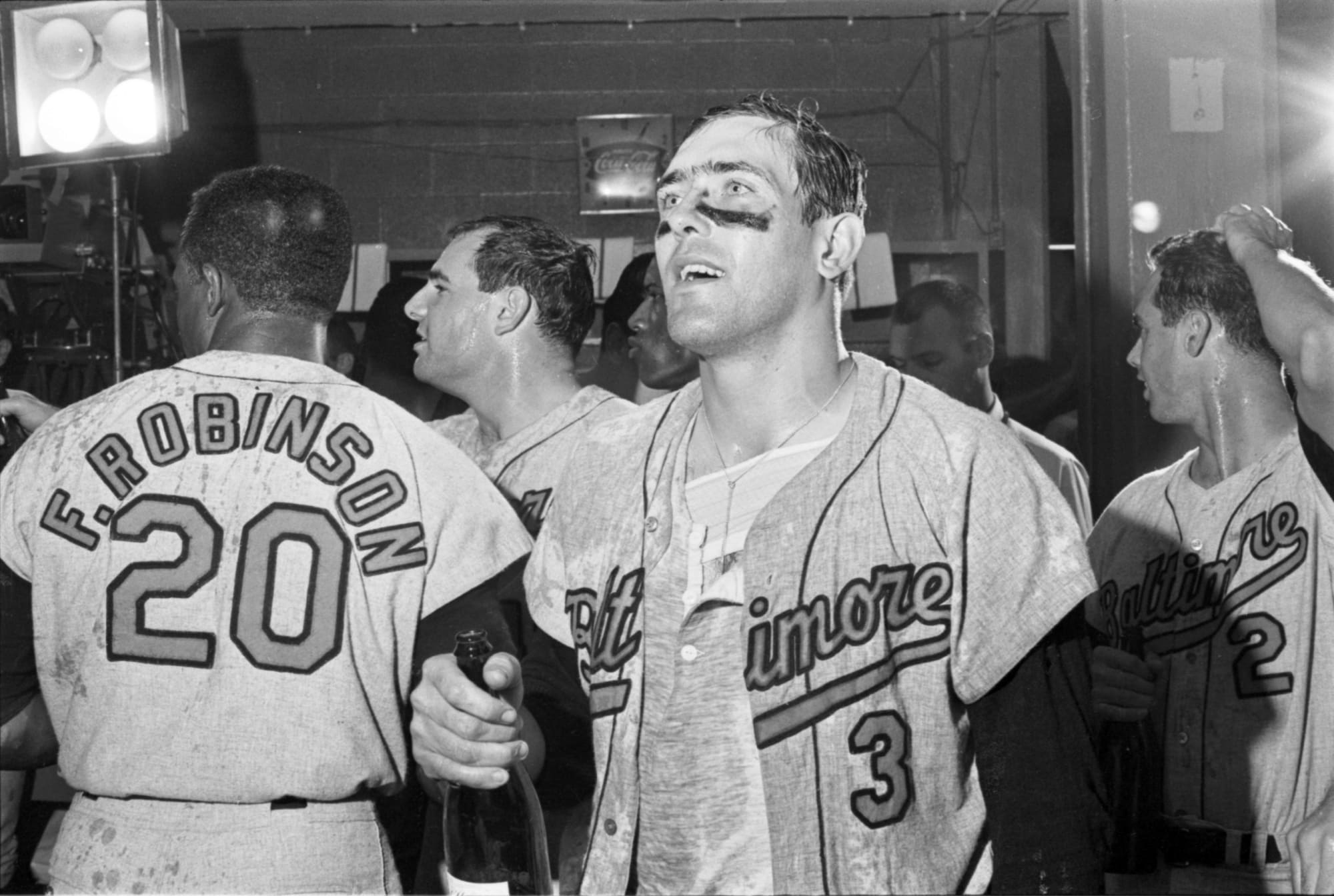
October 6, 1969: Tommie Agee, Ken Boswell and Wayne Garrett all hit home runs, leading the Mets to defeat the Atlanta Braves, 7-4 at Shea Stadium, and sweep the 1st-ever National League Championship Series. As they did after the NL Eastern Division clincher on September 24, the Met fans storm the field.

The Mets trailed 2-0 after the 1st inning, and Gary Gentry, on his 23rd birthday, is pulled after 2 innings, with Nolan Ryan pitching the rest of the way for the win.

It is the 1st Pennant won by a New York team in 5 years. A long time by New York standards. But for Met fans, the children of a "shotgun wedding" between 2 groups of fans who once hated each other, to use the late scientist and former Giant fan Stephen Jay Gould's phrase, "with that love that only hate can understand," it is the 1st Pennant in either 13 years (Dodgers) or 15 years (Giants).

After 7 bad years, 5 of them absolutely horrible, in Year 8 the Mets have won the Pennant. It is the fastest any team has reached the World Series since the early days of the competition. It will be 1980 – or 1973, if you count the Mets' 2nd Pennant – before a team other than one of the "Original 16" reaches the World Series again.

The 1st-ever American League Championship Series also ends in a sweep today. Paul Blair gets 5 hits and Don Buford 4, as the Baltimore Orioles beat the Minnesota Twins 11-2 at Metropolitan Stadium in the Minneapolis suburb of Bloomington, Minnesota. The Series is set: The heavily-favored 109-win Orioles will face the surprising 100-win "Miracle Mets."
Number 20, clearly, is Frank Robinson.
Number 3 is backup catcher Clay Dalrymple.
As a member of the ill-fated 1964 Philadelphia Phillies,
this must have been a very special moment for him.
October 6, 1969 was a Monday. It would be another year before ABC Monday Night Football debuted, so there was no football today. The NHL season wouldn't begin for another 5 days; the NBA, 8 days; the American Basketball Association, 11 days. So these 2 Pennant clinchers were the only scores on this historic day.

October 6, 1965: Sandy Koufax Does Not Pitch On Yom Kippur

October 6, 1965: Game 1 of the World Series at Metropolitan Stadium in the Minneapolis suburb of Bloomington, Minnesota, the 1st World Series game ever played in that State. The Minnesota Twins are hosting the Los Angeles Dodgers, whose ace is Sandy Koufax.
That season, Koufax had gone 26-8, with a 2.08 ERA, 27 complete games, 8 shutouts, a perfect game against the Chicago Cubs, a WHIP of 0.855, and 382 strikeouts, a new single-season record. (That record still stands for National League pitchers, and for lefthanded pitchers in either League.)
But Koufax, being Jewish, does not pitch today, because it is Yom Kippur, the Day of Atonement, the holiest day on the Jewish calendar. So he is pushed back to Game 2, and Don Drysdale is started today. No problem, right? Big D is also a future Hall-of-Famer, right?
Not today: Don Mincher and Zoilo Versalles -- who hit only 2 homers in the regular season, but was named the American League's Most Valuable Player for his contact hitting, speed and defense -- hit home runs off Drysdale. When manager Walter Alston comes to take him out in the 3rd inning, Drysdale says to him, "I bet you wish I was Jewish, too!"
Jim "Mudcat" Grant allows only 1 hit, a home run by Ron Fairly, and the Twins, in the 1st World Series game in their history (unless you count their Washington Senators days, in which case it's their 1st in 32 years), win 8-2.
To make matters worse for the Dodgers, Koufax loses Game 2 as well. The Dodgers will come back, though, and win the Series in 7 games. The Twins will not get this close to a World Championship again for another 22 years.
I wonder: If the Dodgers had lost the World Series, Koufax would have essentially sacrificed a World Series win for the sake of his religious beliefs. Would his place in the pantheon of sports actually be higher if that had happened?
In 1934, baseball's 1st Jewish star, Hank Greenberg, refused to play a regular-season game because it fell on Yom Kippur, and his team, the Detroit Tigers, were in a very tough AL Pennant race. They won the game and the Pennant, anyway, so he was hailed as a hero. So was Koufax.
On September 26, 2001, following the example of Greenberg and Koufax, Dodger right fielder Shawn Green sat out a game that fell on Yom Kippur – and also donated his day's pay of $75,000 to a charity for 9/11 survivors. The Dodgers lost the game to their arch-rivals, the San Francisco Giants, 6-4 at Dodger Stadium. It had little effect on the Playoff race: Neither team made it.
*
October 6, 1965 was a Wednesday. This was also the day that Ian Brady and Myra Hindley were arrested for "The Moors Murders." I have a separate entry for that event.
Football was in midweek. The NBA season wouldn't start for another 9 days, and the NHL season for another 17. So there were no other scores on this historic day.

Tuesday, October 4, 2022

October 4, 1976: The Ballad of Barbara and Harry

Harry Reasoner (left) and Barbara Walters.
The screen behind them shows Pope Paul VI.

October 4, 1976: ABC World News Tonight starts a new anchor team. Former anchor Howard K. Smith begins a semi-retirement, where he will only be doing a nightly commentary at the end of the broadcast. His former partner, Harry Reasoner, is joined by a new co-anchor: Barbara Walters. She is the 1st female anchor or co-anchor of a network news broadcast.

In hindsight, it might seem like putting pineapple on pizza: Two good things that didn't go  well together. But that's not the case at all. It was more like oil and water: It simply didn't mix.

Harry was born in 1923 in Iowa, and was a farm boy before the family moved to Minneapolis. He started as a newspaperman, a career interrupted by serving in the U.S Army in World War II. In 1946, he published a novel titled Tell Me About Women, about a fading marriage. It should have been a red flag.

He moved to CBS radio in 1948, and television in 1956. On November 22, 1963, President John F. Kennedy was assassinated, and Walter Cronkite, then the anchorman, delivered the news over CBS. Reasoner and Cronkite then relieved each other over the next 4 days as it was the only story in the world, boosting both men's profiles. It was Reasoner who broke the news that Lee Harvey Oswald, arrested as JFK's assassin, had, himself, been shot.

In 1967, Reasoner hosted a CBS Reports documentary, The Hippie Temptation. While it rightly warned of the dangerous of running away from home and joining the hippies in New York or San Francisco, and the drugs that could be involved, it made all the hippies look like dirty, drugged-out sex maniacs, hypocritically bashing capitalism while begging for spare change.

In 1968, Reasoner and Mike Wallace became the co-anchors of the first "news magazine" show, 60 Minutes. Morley Safer and Andy Rooney, also correspondents on the show, both cited Reasoner's drinking, and Rooney, a writer by trade, called Reasoner "a lazy writer." And this was his friends talking. ABC signed him away in 1970, and paired him with Smith.

Barbara was born in 1929 in Boston, descended from Russian Jews who changed the family name from Waremwasser to Warmwater to Walters. Her father owned the Latin Quarter, one of the top nightclubs in Boston, and she was immersed in show business from the beginning. And she went to private schools in New York City. With all of that, and being a woman, her background was very different from Harry's.

She eventually married and divorced 3 different men, 1 of them twice, adopted a daughter, and, in between husbands, had, by her own later admission, a love-life that might have been terribly scandalous had she not been so discreet.

She worked for NBC's New York affiliate, now WNBC-Channel 4, wrote and produced for children's TV shows, wrote for Redbook magazine, and, in 1961, joined the staff of NBC's morning program, The Today Show, hosted by Hugh Downs. She became co-anchor in 1963, and remained so after 1971, when Downs left and Frank McGee took his place. Downs liked her; McGee did not. When her contract ran out in 1976, ABC jumped at the chance to get her as nightly news co-anchor.

Walters said that the tension because Reasoner did not want to work with a co-anchor, and also because he was unhappy at ABC, not because he disliked Walters personally. She may have taken the high road: Several women recalled Reasoner making misogynistic remarks to them off-camera.

The experiment didn't even last 2 years. CBS wanted Reasoner back, and gave him an offer he couldn't refuse, including a return to 60 Minutes. On July 10, 1978, ABC went with a three-anchor setup: Peter Jennings at the foreign desk in London, Max Robinson (the 1st black man to even be a partial anchor on a major network's nightly news show) at the national desk in Chicago, and Frank Reynolds at the main desk in Washington. This held until Reynolds died of cancer in 1983, by which point Robinson's health had also begun to fail, and Jennings became the single anchor for the next 21 years.

But ABC had invested heavily in Walters, and found ways to use her talents. The Barbara Walters Special was a periodic show that ran for over 20 years, and featured her interviewing major figures from international leaders to show business stars. In 1980, she had the first major-network interview with former President Richard Nixon following his resignation, and the syndicated interview with David Frost in 1977. 

Her joint interview with Prime Minister Menachem Begin of Israel and President Anwar Sadat of Egypt, as they began the process that led to the Camp David Accord, was considered huge. So was her trip to Cuba, to interview dictator Fidel Castro, whose command of English was better than his command of his country.

In 1979, ABC started its own newsmagazine with a number in the title: 20/20. And it hired Downs and Walters as co-anchors, and they remained so until Downs' retirement in 1999. Walters continued to host it until 2004.

In 1981, on 20/20, Walters interviewed Reasoner, who had just published a memoir. They got along fine in this one-time-only meeting. Reasoner died in 1991, at the age of 68, while still with 60 Minutes. By that point, his reputation had recovered, but, from the rise of 20/20 onward, he was never again as big a news star as Walters.

In 1997, she began the daytime talk show The View, and she remained its main host and its executive producer in 2014, when her health began to fail. (UPDATE: She died on December 30, 2022, at 93.)

In 1997, Fox News made Catherine Crier, Walters' former ABC teammate, their nightly news anchor. But Fox has never been a respected news network. In 2001, Judy Woodruff became the main prime-time anchor on CNN.

Of the "Big Three" American networks, ABC tried again in 2005 with Elizabeth Vargas, CBS had their 1st female anchor in 2006 with Katie Couric, and NBC has still never had one. However, aside from Max Robinson as tri-anchor on ABC, NBC is the only one of the Big Three to have had a single black anchor, as Lester Holt has anchored The NBC Nightly News in 2015. In 2014, ABC replaced Diane Sawyer, after 5 years, with David Muir, who still anchors as of October 4, 2022. CBS has had Norah O'Donnell since 2019.

*

October 4, 1976 was a Monday. Actress Alicia Silverstone and soccer star Mauro Camoranesi were born. And Secretary of Agriculture Earl Butz resigned over a racist remark. I have a separate entry for that event. 

Baseball was between the end of the regular season and the start of the Playoffs. The NBA, NHL and WHA seasons were about to start. On ABC Monday Night Football, the Minnesota Vikings beat the Pittsburgh Steelers, 17-6 at Metropolitan Stadium in the Minneapolis suburb of Bloomington, Minnesota.

Thursday, April 21, 2022

April 21, 1961: Minnesota Becomes Major League

April 21, 1961: The Minnesota Twins play their first home game, at Metropolitan Stadium in suburban Bloomington. Ironically, they played the team that took their place, the "new" Washington Senators. Washington won, 5-3.

Major League Baseball in Minnesota began with Camilo Pascual pitching to Marty Keough, who singled to right. Pascual, noted for having one of the best curveballs of that era, gave up a 2-run home run in that inning, to Dale Long. In the 4th inning, Don Mincher hit the 1st Twins home run at "The Met." But the Senators won.

The Minneapolis Millers won 10 Pennants in the American Association: 1896, 1910, 1911, 1912, 1915, 1932, 1935, 1955, 1958 and 1959. Their arch-rivals, the St. Paul Saints, won only 2: 1924 and 1948. The arrival of the Twins for the 1961 meant the end for both of them.

The New York Giants baseball team almost moved to Minneapolis for the 1958 season. Metropolitan Stadium had opened 2 years earlier, in the hope of attracting both Major League Baseball and the NFL to the Gopher State, and the Millers were the Giants' top farm team. But when Walter O'Malley was preparing to move the Brooklyn Dodgers to Los Angeles, he needed another team in California to help him save on travel costs, and talked Giants owner Horace Stoneham into moving to San Francisco instead.

The Twins' original ballpark, Metropolitan Stadium, was in the suburb of Bloomington, on the Minneapolis side of the Mississippi River, but roughly equidistant from the downtowns of both Minneapolis and St. Paul. Or as close as could have been hoped for: Minneapolis' City Hall is 10 miles away from the site, and St. Paul's is 11.6 miles. The site of the Millers' previous home, Nicollet Park, was 8.2 miles; that of the Saints' Lexington Park, 9.6 miles.

The team is called "Minnesota," because they didn't want to slight either city. It is called the "Twins" because Minneapolis and St. Paul are the "Twin Cities." Well, these "twins" are not identical: They have different mindsets, and, manifesting in several ways. Minneapolis has about 430,000 people, St. Paul 300,000, and the combined metropolitan area a little under 3.7 million. And, despite being the smaller city, St. Paul is the State capital.

The Met had one deck along the 3rd base stands and in the right field bleachers, two decks from 1st base to right field and in the left field bleachers, and three decks behind home plate. Somebody once said the stadium looked like an Erector set that a kid was putting together, before his mother called him away to dinner, and he never finished it. At 45,919 seats, it had a capacity that was just fine for baseball; but at 48,446, it was too small for the NFL.

On September 17, 1961, the expansion Minnesota Vikings played their 1st regular-season game at The Met. They beat the Chicago Bears 37-13.

The Vikings reached 4 Super Bowls while playing at The Met, while the Twins won Games 1, 2 and 6 of the 1965 World Series there, but lost Game 7 to the Los Angeles Dodgers on a shutout by Sandy Koufax. (So the Twins are 11-1 all-time in World Series home games, but 0-9 on the road.) The Vikings were far more formidable in their ice tray of a stadium, which had no protection from the sun, and nothing to block an Arctic blast of wind.

Within 3 months in 1965, The Met played host to baseball's All-Star Game and its World Series, and to The Beatles. It was 1 of 11 major league ballparks where The Beatles played. The others were Shea Stadium in New York, Atlanta-Fulton County Stadium, Comiskey Park in Chicago, the Municipal Stadiums in Cleveland and Kansas City, District of Columbia Stadium (later Robert F. Kennedy Stadium) in Washington, Crosley Field in Cincinnati, Busch Memorial Stadium in St. Louis, Dodger Stadium in Los Angeles and Candlestick Park in San Francisco.

But the desire to not lose early games to postponements due to snow or cold, thus piling up games later in the season with fewer days off, led to the building of the Metrodome in downtown Minneapolis. The Twins' last game at The Met was on September 30, 1981, a 5-2 loss to the Kansas City Royals. The Vikings' last game there was on December 20, 1981, and they also lost to Kansas City, 10-6 to the Chiefs.

Demolition began early in 1985. The Mall of America, the largest shopping center in the United States, opened on the site in 1992. The location of home plate, and the red seat where the longest home run in the stadium's history, a 1967 blast by Harmon Killebrew, landed have been preserved in their original locations. The following year, across the street, the Metropolitan Sports Center, which had been home to the NHL's Minnesota North Stars and the ABA's Minnesota Muskies, was demolished in 1994, and an IKEA store was built on the site.

Like most of the combined baseball and football stadiums that were built in the 1950s, '60s and '70s, The Met did what it was supposed to do: It provided a place for teams to play, until a better one could be built. (In this case, that didn't happen. But it did happen to the Metrodome, when the Twins moved to Target Field in 2010, and the Vikings moved to U.S. Bank Stadium in 2016.) Some of those stadiums allowed teams to move in to a city/region, others prevented teams from moving out.

But, more than that, The Met made Minnesota "major league." It is true that the Minneapolis Lakers won 5 NBA Championships in a span of 6 seasons from 1949 to 1954. It is also true that the NBA wasn't exactly major at the time. But between 1961 and 1968, the Twin Cities would have teams in all 4 major league sports.

It lost the ABA's Minnesota Muskies in 1968, and didn't get another NBA team until the Timberwolves arrived in 1989. It lost the NHL's North Stars in 1993, and they were replaced by the Minnesota Wild in 2000. But, with Metropolitan Stadium bringing in a major league baseball team, it made Minneapolis, and all of Minnesota, major league. (At the time, the addition of a pro football team was considered basically a bonus.)

UPDATE: The Twins have a team Hall of Fame. From their 1965 American League Pennant, they have inducted team owner Calvin Griffith, executives George Brophy and Tom Mee, public address announcer Bob Casey, broadcaster Herb Carneal; 1st baseman Harmon Killebrew, shorstop Zoilo Versalles, left fielder Bob Allison, right fielder Tony Oliva, catcher Earl Battey, utility player César Tovar; and pitchers Camilo Pascual, Jim Kaat and Jim Perry.

From their 1969 and 1970 AL Western Division titles, they have inducted 2nd baseman Rod Carew, along with Griffith, Brophy, Mee, Casey, Carneal, Killebrew, Allison, Oliva, Tovar, Kaat and Perry.

From their 1987 World Champions, they have inducted Mee, Casey, Carneal, Oliva (now a coach), Blyleven (who had left and returned); team owner Carl Pohlad, general manager Andy MacPhail, executives Jerry Bell and Jim Rantz, manager Tom Kelly, coach Rick Stelmaszek, broadcasters Dick Bremer and John Gordon; 1st baseman Kent Hrbek, shortstop Greg Gagne, 3rd baseman Gary Gaetti, left fielder Dan Gladden, center fielder Kirby Puckett, and pitcher Frank Viola.

From their 1991 World Champions, they have inducted Pohlad, Mee, Casey, Carneal, Oliva, MacPhail, Bell, Rantz, Kelly, Stelmaszek, Bremer, Gordon, Hrbek, Gagne, Puckett; coach Ron Gardenhire, and pitcher Rick Aguilera.

From their AL Central Division titles of 2002, '03, '04, '06, '09 and '10, they have inducted Pohlad, Gardenhire (now the manager), Casey, Carneal, Gordon, Bell, Rantz, Stelmaszek, Blyleven (having returned as a broadcaster), general manager Terry Ryan; catcher Joe Mauer, 1st baseman Justin Morneau, 3rd baseman Corey Koskie, center fielder Torii Hunter, right fielder Michael Cuddyer; and pitchers Eddie Guardado, Brad Radke, Johan Santana and Joe Nathan.

As yet, there have been no honorees from their Division Champions of 2019, '20 and '23, except broadcaster Bremer, who retired after the 2023 season.

The Vikings have a Ring of Honor. From their 1969 NFL Champions, they have inducted head coach Bud Grant, general manager Jim Finks, team physician Fred Zamberletti; running back Bill Brown, center Mick Tinglehoff, offensive tackle Ron Yary, defensive ends Jim Marshall and Carl Eller, defensive tackle Alan Page, cornerback Bobby Bryant and safety Paul Krause -- but not quarterback Joe Kapp.

From their 1973, '74 and '76 NFC Champions, they have inducted Grant, Finks, Zamberletti, Brown, Tinglehoff, Yary, Marshall, Eller, Page, Bryant, Krause; quarterback Fran Tarkenton, running back Chuck Foreman, receiver Ahmad Rashad and linebacker Matt Blair.

From their team that reached the 1987 NFC Championship Game, they have inducted Zamberletti, head coach Jerry Burns, tight end Steve Jordan, defensive end Chris Doleman, linebacker Scott Studwell, and safety Joey Browner.

From their team that reached the 1998 and 2000 NFC Championship Games, they have inducted Zamberletti, head coach Dennis Green, receivers Cris Carter and Randy Moss, guard Randall McDaniel, offensive tackle Korey Stringer and defensive tackle John Randle -- but not quarterbacks Randall Cunningham or Daunte Culpepper.

From their team that reached the 2009 NFC Championship Game, they have inducted Zamberletti (who finally retired after the 2011 season), defensive tackle Kevin Williams, and defensive end Jared Allen. No members of their team that reached the 2017 NFC Championship Game have yet been inducted.

*

April 21, 1961 was a Wednesday. Football was out of season. The hockey season had ended 5 days earlier, with the Chicago Black Hawks defeating the Detroit Red Wings for the Stanley Cup. The basketball season had ended 5 days before that, with the Boston Celtics defeating the St. Louis Hawks for the NBA Championship.

And these other baseball games were played:

* The New York Yankees beat the Baltimore Orioles, 4-2 at Memorial Stadium in Baltimore. Whitey Ford outpitched Steve Barber, who did pitch well enough to suggest that his arm was neither sore nor a little stiff. (Ball Four reference.) Mickey Mantle hit his 4th home run of the season. Roger Maris was still looking for his 1st. Little did anyone know...

* The Chicago Cubs beat the Philadelphia Phillies, 3-2 at Connie Mack Stadium in Philadelphia. Ernie Banks went 1-for-3 with a walk.

* The Detroit Tigers beat the Los Angeles Angels, 9-1 at Tiger Stadium in Detroit. Al Kaline went 1-for-4 with a walk and an RBI.

* The Chicago White Sox beat the Boston Red Sox, 3-2 at Comiskey Park in Chicago. Rookie Carl Yastrzemski went 1-for-4.

* The Cleveland Indians beat the Kansas City Athletics, 5-3 at Municipal Stadium in Kansas City. (Cleveland's home was also named Municipal Stadium.)

* The St. Louis Cardinals and the San Francisco Giants were rained out at Candlestick Park in San Francisco. It was made up 2 days later, on April 23, as part of a doubleheader. The Giants won the opener, 2-1. Stan Musial went 1-for-4, but only appeared as a pinch-hitter, not reaching base, in the nightcap, which the Cardinals won, 7-4. Over the 2 games, Willie Mays went 3-for-7 with a walk and an RBI.

* The Milwaukee Braves and the Pittsburgh Pirates were rained out at Forbes Field in Pittsburgh. It was made up 3 days later, on April 24. The Pirates won, 7-6. Roberto Clemente went 2-for-4 with 2 RBIs. Hank Aaron went 1-for-3 with 2 RBIs.

* And the Los Angeles Dodgers beat the Cincinnati Reds, 5-3 at the Los Angeles Memorial Coliseum. Sandy Koufax went the distance for the win. He struck out 11, and walked only 3. He had found his control. He also got a hit in the game. But he did give up a home run to Frank Robinson.

December 31, 1999 & January 1, 2000: The Millennium

December 31, 1999:  The Millennium arrives. The people of planet Earth survived. At a terrible cost. But we hadn't destroyed ourselves. ...