Showing posts with label stockholm. Show all posts

Friday, December 9, 2022

December 10, 1901: The 1st Nobel Prize Ceremony

December 10, 1901: The 1st Nobel Prize ceremony is held in Stockholm, Sweden, on the 5th Anniversary of the death of Alfred Nobel.

Alfred Bernhard Nobel was born on October 21, 1833 in Stockholm. An engineer and inventor, his 355 patents included dynamite, in 1867. But he also founded a company that made military armaments and parts therefor.

There is a well known story about the origin of the Nobel Prize, although historians have been unable to verify it, and some dismiss the story as a myth. The story is as follows: In 1888, his brother Ludvig died while visiting Cannes, on the French Riviera. A local newspaper mistook him from Alfred, and published an obituary that spread, first throughout France, then throughout Europe, condemning him, saying, "Dr. Alfred Nobel, who became rich by finding ways to kill more people faster than ever before, died yesterday," and, "The merchant of death is dead."

Alfred realized that this was how people thought of him, and decided to change that. With no wife or children to leave his fortune to (though he was straight), he changed his will to found the Nobel Foundation, to annually award the Nobel Prizes, without distinction of nationality. He died on December 10, 1896.

A committee in Nobel's native Sweden awards the Prizes in the categories of Physiology or Medicine, Chemistry, Physics, Economic Science, and Literature. Another, in Norway, awards the Nobel Prize for Peace, although that is frequently given to someone involved in great humanitarian causes, rather than for efforts in stopping a war or maintaining a peace.

Marie Curie was the 1st female winner, for Physics in 1903. The 1st American winner was Theodore Roosevelt, for Peace in 1906. The 1st Asian winner was Rabindranath Tagore of India, for Literature in 1913. The 1st Hispanic winner was Carlos Saavedra Lamas of Argentina, for Peace in 1936. The 1st black winner was Ralph Bunche, for Peace in 1950; 10 years later, Albert Luthuli of South Africa was the 1st black African Nobel laureate, also for Peace.

*

December 10, 1901 was a Tuesday. Baseball was out of season. Football was in midweek. Basketball barely existed. And hockey had not yet turned professional. So there were no scores on this historic day.

Wednesday, September 28, 2022

September 28, 1994: The Sinking of MS Estonia

September 28, 1994: MS Estonia sinks in the Baltic Sea, en route from Tallinn, Estonia, to Stockholm, Sweden, killing 852 people – including 50 Swedes, 285 Estonians, 1 Canadian and 1 Englishman, but no Americans. There were 137 survivors.

The "cruiseferry" was built in 1980, for the Finnish shipping company Rederi Ab Sally. It was employed on ferry routes between Finland and Sweden by various companies, under the names Viking Sally until 1990, Silja Star until 1991, and then Wasa King until 1993.

At that point, it was sold to Nordström & Thulin, for use on Estline's Tallinn-Stockholm route. The 263-mile ferry trip usually takes about 10 1/2 hours. But on September 28, 1994, according to an official inquiry, failure of the locks on the bow visor caused water to flood the car deck, and quickly capsize the ship.

It remains the worst peacetime maritime disaster in European waters. Memorials have been dedicated in both terminal cities.

*

September 28, 1994 was a Wednesday. Baseball's Strike of '94 was on, football was in midweek, and it was too early for the NBA and NHL seasons to be playing.

But there were games in European soccer's UEFA Champions League, and, since this was an event in Europe, those results are worth posting:

* The most controversial of these games was played at Stadio Giuseppe Meazza, a.k.a. the San Siro, in Milan, Italy, AC Milan were playing Austrian team Casino Salzburg, when Casino's goalkeeper, Otto Konrad, was hit on the head with a plastic bottle thrown from the stands. He had to be substituted and taken to the hospital. Milan won, 3-0, but, as punishment for failing to control their fans, UEFA, the governing body for European soccer, docked them 2 points in the CL table, and were banned from playing their next 2 official home matches at the San Siro.

* Manchester United and Galatasaray played to a draw, 0-0 at Ali Sami Yen Stadium, Gala's home, in Istanbul, Turkey.

* SL Benfica beat RSC Anderlecht of Belgium, 3-1 at the old Estádio da Luz in Lisbon, Portugal.

* IFK Göteborg beat FC Barcelona, 2-1 at Gamla Ullevi in Gothenburg, Sweden.

* Bayern Munich beat Dynamo Kyiv, 1-0 at the Olympiastadion in Munich, Germany.

* AFC Ajax, of Amsterdam, beat AEK Athens, 2-1 at Nikos Goumas Stadium in Athens, Greece.

* Hajduk Split of Croatia beat Steaua București, 1-0 at Stadionul Steaua in Bucharest, Romania.

* And Paris Saint-Germain beat Spartak Moscow, 2-1 at Luzhniki Stadium in Moscow, Russia.

Saturday, August 20, 2022

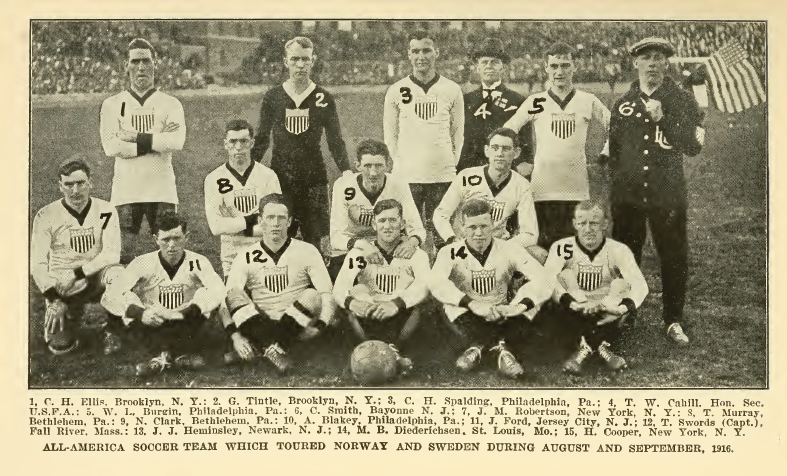
August 20, 1916: The 1st Game of the U.S. National Soccer Team

August 20, 1916: The United States of America fields a national soccer team for the 1st time.

Sponsored by the United States Soccer Federation (USSF), founded in 1913, the team took the pitch against Sweden at the Stockholm Olympiastadion, site of the 1912 Olympics, where Jim Thorpe had won the decathlon. A crowd of 16,000 attended. The referee was Hagbard Vestergaard of Denmark.

This was the U.S. team for the game, keeping in mind that uniform numbers were not used in soccer until 1933:

* Goalkeeper: George Tintle of Harrison, New Jersey
* Right Back: Tommy Murray of Bethlehem, Pennsylvania
* Left Back: Jimmy Robertson of New York
* Defender: Dick Spalding of Philadelphia
* Defender: Neil Clarke of Scotland, moved to Paterson, New Jersey
* Defender: Clarence Smith of Bayonne, New Jersey
* Outside Right: Jimmy Ford of Kearny, New Jersey
* Inside Right: Charles Ellis of New York
* Center Forward: John Hemingsley of Newark
* Inside Left: Thomas Swords of Fall River, Massachusetts (Captain)
* Outside Left: Harry "Buck" Cooper of Newark

As you can see, the tradition of soccer in Newark, its across-the-Passaic-River towns of Harrison and Kearny, and its across-Newark-Bay town of Bayonne goes back at least this far. Bethelehem, in the Lehigh Valley of northeastern Pennsylvania, was home to Bethlehem Steel Football Club, a "company team" (or, as the English would have called it, a "works side"), one of the top U.S. teams of the era.

And Fall River and nearby New Bedford, Massachusetts, manned by Portuguese immigrants and their sons, would have strong teams into the 1950s, including the legendary Ponta Delgada, named for an island in the Portugal-controlled Azores Islands. Because of Massachusetts' "blue laws," if these teams wanted to play on Sunday, they would go right across the State Line, and play at St. Mark's Stadium in Tiverton, Rhode Island.

James Robertson is a very common name among soccer players, especially in Scotland. A later Jimmy Robertson was the 1st player ever to score for both Tottenham Hotspur against Arsenal and for Arsenal against Tottenham in the North London Derby.

Konrad Törnqvist scored for Sweden, in only the 7th minute of the game. But Spalding equalized in the 22nd. Ellis scored in the 53rd. Cooper scored in the 68th. Törnqvist brought the Swedes back within 1 in the 81st, but the U.S. defense held on for a 3-2 win.

On September 3, still in Scandinavia, the U.S. team played Norway to a 1-1 draw in Kristiana. Ellis scored the only goal.

History seems to have lost track of some of these players. As far as I can tell, the last survivor was Cooper, who died in 1963.

The stadium still stands. Djurgårdens IF, Sweden's most successful soccer team, played there until the new Tele2 Arena opened, but maintain their offices there.
Due to World War I continuing through 1918, and then for longer for reasons I don't have, the U.S. national team didn't play another game until 1924, and then seemed to play only 2 or 3 games a year until World War II. This may have held them back. The U.S. team didn't play its 1st game on home soil until November 8, 1925, beating Canada 6-1 at Ebbets Field in Brooklyn, thanks to 5 goals from Archie Stark. Like so many early U.S. soccer stars, Stark was born in Glasgow, Scotland but grew up in Kearny, New Jersey.

This period did include reaching the Semifinal of the 1st World Cup in 1930, and reaching the World Cup again in 1934, before failing to qualify in 1938.

*

August 20, 1916 was a Sunday. Because many States still banned professional sports on Sunday, only 3 games were played in what would later be known as Major League Baseball:

* The New York Giants lost to the St. Louis Cardinals, 5-0 at Robison Field in St. Louis. Bob Steele allowed the Giants 8 hits, but kept the shutout. Rogers Hornsby, a rookie, went 2-for-2 with 2 walks for the Cardinals.

* The Boston Braves beat the Cincinnati Reds, 4-3 at Redland Field (renamed Crosley Field in 1934) in Cincinnati.

* The Brooklyn Robins (as the Dodgers were known from 1914 to 1931) beat the Chicago Cubs, 1-0 at Weeghman Park (renamed Cubs Park in 1920 and Wrigley Field in 1926) in Chicago. Jack Coombs allowed only 1 hit, a single by Max Flack. Coombs even got a hit for Brooklyn. So did the man who is still the Dodger franchise's all-time leader in hits, Zack Wheat. So did future managing legend Casey Stengel.

Wednesday, June 29, 2022

June 29, 1958: Brazil's Redemption

After the Final. Having kept his promise to his father,
17-year-old Pelé feels the moment.

June 29, 1958: The Brazil national soccer team, the Seleção, goes into the Final of the World Cup, against the host team, Sweden, and looking for redemption.

They had lost the Final in 1950, to neighboring Uruguay, on home soil, at the Estadio do Maracanã in Rio do Janeiro. The loss was a blow to the national psyche of Brazil, so often wrapped up in this sport of soccer. It is known as Maracanazo in Spanish, Maracanaço in Portuguese: "The Agony of Maracanã." The 1950 World Cup was supposed to be a statement for Brazil, showing the world that it was a modern country, worthy of respect and admiration around the postwar world. This was the country's coming-out party, and it was ruined.

Minister of Sport Aldo Rebelo said, "Losing to Uruguay in 1950 not only impacted on Brazilian football, it impacted on the country's self-esteem." Instead of hating Uruguay for the ruination, Brazilians blamed themselves.

In 1954, Brazil lost to Hungary in the Quarterfinal. At that point, Hungary were favored, so it wasn't as much of a blow. But by 1958, most the players from the 1950 team were gone, and replaced by new players, keeping in mind that many Brazilian players are known by nicknames:

* From Rio club Botafogo: Midfielders Garrincha and Didi, defender Nílton Santos.

* From Rio club Flamengo: Forward Mário Zagallo, midfielders Dida, Moacir and Joel.

* From Rio club Fluminense: Goalkeeper Carlos Castilho (a 1950 holdover, but a backup then).

* From Rio club Vasco da Gama: Defender and Captain Hilderaldo Bellini, defender Orlando Peçanha, forward Vavá.

* From Rio club Bangu: Defender Zózimo.

* From São Paulo FC: Midfielders Dino Sani and Nílton de Sordi, and defender Mauro Ramos.

* From São Paulo club Corinthians: Goalkeeper Gilmar, defender Oreco.

* From São Paulo club Palmeiras: Midfielder José Altafini.

* From São Paulo club Portuguesa: Defender Djalma Santos.

* And from São Paulo club Santos: Midfielders Zito and Pepe... and forward Pelé.

Pelé was born Edson Arantes do Nascimento. His father, known as Dondinho, had played for Fluminense, but his career came to an early end due to injury. Edson saw his father crying next to the radio after the 1950 World Cup Final, and promised him that, one day, the son would win the World Cup for the father. Now, he was 17 years old, might already have been the best player in the world.

This remains the only World Cup for which all 4 British “Home Nations” qualified. There were 4 Groups in the Group Stage, and each had 1 British team in it:

* Wales drew with a Hungary team weakened by the loss of players who had fled the country during their Revolution in 1956, drew with Mexico, and drew with Sweden, resulting in the need for a Playoff for the 2nd qualifier from their Group. They came from behind to beat Hungary, and advanced. They lost the Quarterfinal to Brazil.

* Northern Ireland beat Czechoslovakia, lost to Argentina, and drew with West Germany, to finish tied with the Czechs for 2nd in their Group. They beat the Czechs in a Playoff that went to extra time, and moved on to the Knockout Stage. They lost the Quarterfinal to France.

* Scotland weren't so lucky: They drew with Yugoslavia, then lost to Paraguay and France by 1 goal each, and finished last in their Group.

* And England, weakened by the Munich Air Disaster that killed 8 Manchester United players 4 months earlier, could only manage 3 draws: With the Soviet Union, then Brazil, then Austria. That forced them into a Playoff with the Soviets for the 2nd qualifier, and they lost.

Argentina lost their last Group Stage match, 6-1 to Czechoslovakia, at the Olympiastadion in Helsingborg on June 15, to finish last in their Group. The country remembers it as El Desastre de Suecia: The Disaster of Sweden.

Brazil topped their group, beating Austria 3-0 in Uddevalla, playing England to a 0-0 draw in Gothenburg, and beating the Soviet Union in Gothenburg. Pelé scored the only goal in Brazil's 1-0 win over Wales in the Quarterfinal at Gothenburg, and scored 3 in their 5-2 win over France at the Råsunda Stadium in Solna, part of the national capital of Sweden. The host nation had managed to reach the Final, despite never having gotten there before, and they haven't since.
Råsunda Stadium

As the host nation, Sweden got the first choice of uniform, and they chose yellow shirts with blue shorts -- Brazil's usual first-choice kit. Brazil was forced to wear their "change strip": Blue shirts and white shorts.

Nils Leidholm, the A.C. Milan legend, scored in only the 4th minute of the game, and the Swedish fans believed they were on their way to glory. But Vavá tied the game in the 9th, and gave Brazil the lead in the 32nd. Pelé made it 3-1 in the 55th, and Zagallo made it 4-1 in the 68th. Agne Simonsson scored in the 80th minute, to put the game back into doubt. But Pelé scored in stoppage time to give Brazil a 5-2 win, the Jules Rimet Trophy, and the redemption they sought.

Pelé had kept the promise he made to his father 8 years earlier. He would help Brazil win the World Cup again in 1962, although he would be injured during the Group Stage, and did not play in the Final in Santiago, Chile, beating Czechoslovakia. He helped them win again in 1970, beating Italy in the Final in Mexico City.

Brazil have gone on to win the World Cup a record 5 times, having beaten Italy in the Final again in the Rose Bowl in 1994, and beating Germany in Yokohama, Japan in 2002. They have also lost the Final to France in Paris in 1998.

You will notice that none of those 5 wins have been in Brazil. The World Cup has returned to that country only once, in 2014, and Brazil got to the Semifinal, but had an even more stunning loss at the Maracanã. It wasn't that they lost to Germany, who then beat Argentina in the Final. It wasn't even that they were looking forward to beating Argentina in the Final in the Maracanã themselves. The truly shocking part was the score: Germany beat Brazil, in the Maracanã, by a score of 7-1.

Opened in 1937, the Råsunda Stadium was Sweden's national stadium, and also the home field of Stockholm team AIK. It was demolished in 2013, having been replaced by the Friends Arena.

UPDATE: An article for ESPN.com, published after the 2026 World Cup, ranking all 23 tournaments, rated this one 14th, citing the 1950s' equivalent of big star power, but also suggesting that Brazil might have been a bit too dominant.

*

June 29, 1958 was a Sunday. These baseball games were played that day:

* The New York Yankees lost to the Kansas City Athletics, 12-6 at Kansas City Municipal Stadium. Bob Turley and once-and-future Yankee Ralph Terry were the starters, and neither got out of the 4th inning. Mickey Mantle went 1-for-4 with a home run, a walk and 2 RBIs. Yogi Berra went 2-for-5 with an RBI. Two future Yankees hit home runs for the A's: Roger Maris went 4-for-6 with 2 RBIs, and Héctor López went 1-for-2 with a walk and 2 RBIs.

* A doubleheader was scheduled for Connie Mack Stadium in Philadelphia. The Philadelphia Phillies won the 1st game, beating the St. Louis Cardinals, 5-4. Stan Musial went 3-for-5 with a walk. Harry Anderson doubled Solly Hemus home with the winning run in the bottom of the 13th inning.

Because Pennsylvania, the last State to legalize Sunday sports, still had a 7:00 PM curfew for the day, the game was suspended in the bottom of the 8th, with the Cards leading, 4-3. It was completed on July 29, and that score held. Musial got a hit as a pinch-hitter.

* A doubleheader was split at Forbes Field in Pittsburgh. The Pittsburgh Pirates won the 1st game, 4-3. The Chicago Cubs won the 2nd game, 8-3. Over the 2 games, Roberto Clemente went 1-for-5 (he left the 2nd game early), and Ernie Banks went 3-for-7 with 2 walks.

* The Baltimore Orioles swept a doubleheader from the Cleveland Indians, 11-6 and 5-2 at Cleveland Municipal Stadium.

* The San Francisco Giants beat the Cincinnati Reds, 2-0 at Crosley Field in Cincinnati. Al Worthington pitched 8 innings of 4-hit shutout ball, and Johnny Antonelli pitched a perfect 9th. Willie Mays went 2-for-5 with an RBI. Former Brooklyn Dodger star Don Newcombe pitched 8 strong innings, but was the losing pitcher. Frank Robinson appeared only as a pinch-hitter, and did not reach base.

* The Boston Red Sox beat the Detroit Tigers, 10-7 at Briggs Stadium (later Tiger Stadium) in Detroit. Ted Williams went 2-for-4 with a home run, a walk, and 3 RBIs. Al Kaline went 0-for-3.

* A doubleheader was split at Comiskey Park in Chicago. The Washington Senators won the opener, 12-0. Pedro Ramos pitched a 5-hit shutout. The Chicago White Sox won the nightcap, 12-11. Jim Rivera doubled Earl Battey home with the winning run in the bottom of the 11th inning.

* And the Milwaukee Braves beat the Los Angeles Dodgers, 10-6 at Milwaukee County Stadium. Hank Aaron went 4-for-5 with a grand slam off Don Drysdale, and 5 RBIs. Charlie Neal hit 2 home runs for the Dodgers.

Wednesday, June 15, 2022

June 15, 1912: Jim Thorpe, the Greatest Athlete In the World

June 15, 1912: Jim Thorpe wins the Olympic decathlon, and is proclaimed the greatest athlete in the world.

The 24-year-old native of Oklahoma, a member of the Sac and Fox tribe of Native Americans, had already starred in football for the Carlisle Indian School, outside Harrisburg, Pennsylvania. He made the U.S. track & field team for the 1912 Olympic Games in Stockholm, Sweden. He competed in the penathlon, a 5-contest even that consisted of the long jump, the javelin throw, the 200-meter dash, the discus throw, and the 1,500-meter run. (Not to be confused with the "modern pentathlon.") He won 4 of the 5 events, to take the Gold Medal.

He then entered the decathlon, a 10-contest, 2-day event. The 1st half was contested on Saturday, June 13. Thorpe finished 3rd in the 100 meters, 3rd in the long jump, and won the shot put to take the overall lead. He won the high jump, and finished 4th in the 400 meters. At the end of the 1st day, in the unusual scoring system for the decathlon, he was over 400 points ahead of the competitor in 2nd place, Swede Charles Lomberg. Another Swede, Hugo Wieslander, was also being cheered on by the home crowd.

The 14th was a Sunday, so there was no competition. On Monday, June 15, they resumed. Traditionally, the 6th event is the 110-meter high hurdles, and the 7th is the discus throw. This time, the events were reversed. Thorpe finished 3rd in the discus, and won the hurdles. Unless he dropped out for some reason, he was no longer catchable.

He finished tied for 3rd in the pole vault. He finished 4th in the javelin throw. And he won the 1,500 meters. The final totals: Thorpe 8,412 points, Wieslander 7,724, Lomberg 7,413. Another Swede, Gösta Holmér, finished 4th. A pair of Americans, James Donahue and Eugene Mercer, finished 5th and 6th, respectively.

Thorpe was presented with his Gold Medal by the Games' host, King Gustav V of Sweden. The King was overheard saying to Thorpe, "You, sir, are the greatest athlete in the world." To this, Thorpe replied, "Thanks, King." Ever since, the winner of the Olympic decathlon has been called "the world's greatest athlete."

But in 1913, the International Olympic Committee discovered that, prior to having competed in those Olympics, Thorpe had played baseball professionally. The fact that it wasn't the same sport made no difference, and the IOC stripped Thorpe of his medals.

A Gold Medal was given to 2nd-place finisher Wieslander, who had gone on to work with his country's cartography agency. He was uncomfortable with this, but it would not be until 1951 that he gave the Medal up -- not to Thorpe, but in a donation to the museum at the Swedish School of Sport and Health Sciences.

In 1950, the Associated Press named Thorpe the greatest track and field performer, the greatest football player, and the greatest overall athlete of the 1st half of the 20th Century. Their other honorees: Babe Ruth for baseball, George Mikan for basketball, Howie Morenz for hockey, Jack Dempsey for boxing, Bill Tilden -- despite his recent scandal -- for men's tennis, Suzanne Lenglen for women's tennis, and Man o' War as the greatest racehorse.

Thorpe died of cancer in 1953, having been hailed as the greatest athlete of the 1st half of the 20th Century for his achievements in track, football and baseball, but without having his Medals restored. The next year, the Medal that Wieslander donated was stolen, and it has never been recovered. Wieslander died in 1976.

In 1982, the IOC ruled that Thorpe's disqualification had been improper -- not because he was innocent, as had freely admitted at the time that he wasn't, but because no protest against his eligibility had been brought within 30 days. Whether the original rule was fair is a separate debate (it really wasn't, especially since he hadn't turned professional in the sport in question), but he was reinstated on a technicality. and reinstated Thorpe's Medals. Copies were made, and sent to Thorpe's children.

*

June 15, 1912 was, as I said, a Monday. These baseball games were played that day:

* The New York Highlanders lost to the St. Louis Browns, 2-1 at Sportsman's Park in St. Louis. The Highlanders had already been called the Yankees for a while, and made the name change official the next season.

* The New York Giants lost to the Pittsburgh Pirates, 5-4 at the Polo Grounds. Honus Wagner went 2-for-5.

* The Brooklyn Dodgers beat the St. Louis Cardinals, 5-4 in 11 innings at Washington Park in Brooklyn. Zack Wheat went 1-for-4.

* The Cincinnati Reds beat the Boston Braves, 6-3 at the South End Grounds in Boston.

* The Washington Senators beat the Cleveland Indians, 6-5 at League Park in Cleveland.

* The Philadelphia Athletics beat the Detroit Tigers, 6-1 at Navin Field in Detroit. That ballpark was renamed Briggs Stadium in 1938 and Tiger Stadium in 1961. Frank Baker lived up to the nickname he'd earned in the previous season's World Series, hitting a home run, part of a 3-for-4 with 2 RBIs day. Ty Cobb went 0-for-4.

* And the Boston Red Sox beat the Chicago White Sox, 4-3 at Comiskey Park. Future Hall-of-Famer Ed Walsh left due to injury after 2 innings. Tris Speaker went 2-for-4 with an RBI.

Tuesday, February 8, 2022

February 8, 1993: Alice in Chains, Nazi In Pains

February 8, 1993: Layne Staley of the rock band Alice in Chains punches an audience member at a concert in Stockholm, Sweden.

He deserved it. He was a neo-Nazi.

Alice in Chains were formed in Seattle in 1987, and became part of the city's hard-rock "grunge" music scene. Lead guitarist Jerry Cantrell and rhythm guitarist Layne Staley traded lead vocals, Mike Starr played bass guitar, and Sean Kinney played drums. As grunge became popular in 1990, they rose with local bands Nirvana, Pearl Jam and Mudhoney.

On February 8, 1993, "AiC" were playing Cirkus, a venue in Stockholm, Sweden, when Staley saw a neo-Nazi skinhead in the audience, harassing other fans and performing Fascist salutes. Toward the end of the song "It Ain't Like That," Staley noticed the man, stopped the performance, and had security bring him up on stage.

As soon as the man was on stage, Staley punched and slapped him, before instructing security to throw him off the stage. Following the altercation, Staley yelled into the microphone, "Fucking Nazis die!"

The man reported Staley to the Swedish police. However, when police investigated, they found the man had been harassing others, and his own brother defended the band's actions. The authorities praised Staley and released him immediately.

For the record: Sweden stayed neutral during World War II, and Nazi Germany left them alone. That was not the case with the rest of Scandinavia: Norway and Denmark resisted, and the Nazis invaded and took over before the Allies kicked them out; Iceland was part of a union with Denmark, declaring independence during the war and opposing the Nazis; and Finland fought the Soviet Union, so the Nazis treated them as allies.

Staley became addicted to drugs, as did his girlfriend, Demri Parrott. In 1996, she died of an overdose. Emotionally, he never recovered. After attending the 1997 Grammy Awards with his bandmates, he rarely appeared in public again, and followed her in 2002. Starr also died from an overdose, in 2011. As of February 8, 2022, Cantrell and Kinney are still alive, touring as Alice in Chains with Mike DuVall, formerly of No Walls on rhythm guitar; and Mike Inez, who previously worked with Ozzy Osbourne, on bass.

Cirkus, a 1,650-seat theater, opened on the island of Djurgården in Stockholm in 1892. It is still in operation.

*

February 8, 1993 was a Monday. Baseball and football were out of season. There were 4 games in the NBA:

* The New York Knicks beat the Philadelphia 76ers, 120-115 in overtime at The Spectrum in Philadelphia. Patrick Ewing scored 40 points.

* The Washington Bullets beat the Houston Rockets, 106-100 at The Summit in Houston. It's now the Central Campus of televangelist Joel Osteen's Lakewood Church.

* The Utah Jazz beat the Orlando Magic, 108-96 at the Delta Center in Salt Lake City, Utah.

* And the Los Angeles Lakers beat the Dallas Mavericks, 108-100 at The Forum outside Los Angeles in Inglewood, California.

And there were 4 games in the NHL:

* The New Jersey Devils beat their arch-rivals, the New York Rangers, 5-4 at the Brendan Byrne Arena at the Meadowlands.

* The St. Louis Blues beat the Hartford Whalers, 3-1. This was the 2nd season of a 2-year experiment in which the NHL played several neutral-site games, in a search for cities for expansion franchises. But this game was at the Peoria Civic Center in Peoria, Illinois. It was a sellout: 9,013 seats.

* The Pittsburgh Penguins beat the Boston Bruins, 4-0 -- at The Omni in Atlanta. Attendance: 12,572. Not a good sign, given that both teams were good at the time. Nevertheless, the Atlanta Thrashers debuted in 1999, once Atlanta got a new arena. They lasted 12 seasons.

* And the Ottawa Senators beat the Buffalo Sabres, 4-2 at the Ottawa Civic Centre (now the TD Place Arena).

December 31, 1999 & January 1, 2000: The Millennium

December 31, 1999:  The Millennium arrives. The people of planet Earth survived. At a terrible cost. But we hadn't destroyed ourselves. ...