Showing posts with label polo grounds. Show all posts

Saturday, December 17, 2022

December 17, 1944: The Malmédy Massacre

December 17, 1944: The Malmédy Massacre is carried out, in Malmédy, Wallonia, the French-speaking part of Belgium, during the Battle of the Bulge in World War II.

With the Allies having liberated France, and marching toward Germany itself from the West, and the Soviet Union's Red Army marching from the East, the Nazis needed a win, somewhere. On December 15, they attacked in the Ardennes Forest, which stretches over France, Belgium, Luxembourg, and even part of Germany.

They pushed forward, and formed a "bulge" in the American line, leading to the conflict being known as "The Battle of the Bulge." By the 22nd, they had the U.S. Army's 101st Airborne Division, then stationed in Bastogne, Belgium, virtually surrounded.

What is generally called "The Malmédy Massacre" was actually 2 separate incidents. At 4:30 AM local time on December 17, troops of the 1st SS Panzer Division captured dozens of American soldiers at a small fuel depot in Büllingen, in Belgium, but a German-speaking town, just 4 miles from the German border. The SS executed all of the American soldiers.

Later that day, between 12:00 Noon and 1:00 PM, Kampfgruppe Peiper approached the Baugnez crossroads, 2 miles southeast of the city of Malmédy. A U.S. Army convoy of 30 vehicles, from B Battery of the 285th Field Artillery Observation Battalion, was negotiating the crossroads, and then turning right, towards Ligneuville and St. Vith, in order to join the U.S. 7th Armored Division.

The Germans saw the U.S. convoy first, and the spearhead unit of Kampfgruppe Peiper fired upon and destroyed the first and last vehicles, which immobilized the convoy, and halted the American advance. As their immobilized convoy was outnumbered and outgunned, those soldiers of the 285th surrendered to the SS.

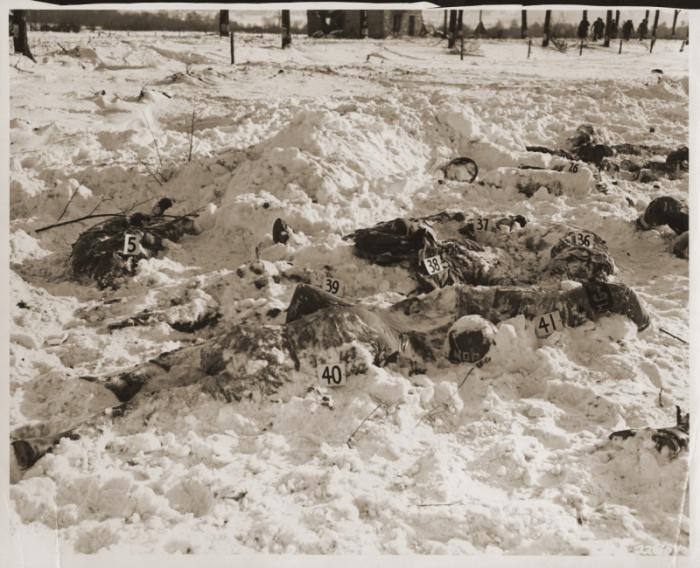
At the Baugnez crossroads, the SS infantry assembled the just-surrendered U.S. prisoners-of-war in a farmer's field, and added them to another group of U.S. POWs, soldiers who had been captured earlier that day. The POWs who survived the massacre at Malmédy said that a group of approximately 120 U.S. POWs stood in the farmer's field, when the SS fired machine guns at them. Panicked by the machine gun fire, some POWs ran and fled the field, but the SS soldiers shot and killed most of the grouped POWs where they stood; and some G.I.s had dropped to the ground and pretended to be dead.

Nonetheless, after the initial machine-gunning of the group of POWs, the SS soldiers walked amongst the POW corpses, searching for wounded survivors to kill with a coup de grâce gunshot to the head. Moreover, some of the POWs who fled the farmer's field had run to and hidden in a café at the Baugnez crossroads. The SS then set the café afire, and killed every U.S. POW who escaped the burning building.

At about 2:30 PM, 43 U.S. POWs who survived the massacre emerged from hiding from the SS, and then sought help and medical aid in nearby Malmédy, which was held by the U.S. Army. They were encountered by a patrol from the 291st Combat Engineer Battalion, and told them of what had happened. 

On December 26, reinforcements arrived, and the tide of the battle was turned. It was the beginning of the end of the Third Reich. Because it took until then for U.S. troops to push the Nazis back, and also because of the heavy snow, many of the bodies were not found for over a month.

In 1949, a U.S. Senate investigation concluded that, in the 36-day Battle of the Bulge, the soldiers of Kampfgruppe Peiper murdered between 538 and 749 U.S. POWs. Other investigations put the figure of the dead as being between 300 and 375 U.S. soldiers and 111 civilians executed.

The German commander, Joachim Peiper, was second-in-command to Heinrich Himmler in the SS. On July 16, 1946, he was convicted of war crimes, and sentenced to death. But the sentence was never carried out, and he was paroled after serving 10 years. In 1972, he moved to France. He was assassinated by an anti-Nazi group calling themselves The Avengers, on Bastille Day, July 14, 1976. He was 61.

On May 30, 2006, hosting The O'Reilly Factor on Fox News, Bill O'Reilly said, "In Malmédy, as you know, U.S. forces captured SS forces who had their hands in the air, and they were unarmed, and they shot them down."

O'Reilly lost his job -- not shortly after this, and not for this, but 11 years later, for his sexual assaults of women. Furthermore, Fox News scrubbed the reference to the Malmédy Massacre from the transcript of the show on their website.

*

December 17, 1944 was a Sunday. The NFL Championship Game was played at the Polo Grounds in Upper Manhattan. The Green Bay Packers, coached by team co-founder Earl "Curly" Lambeau, and led by quarterback Irv Comp and pro football's 1st great receiver, Don Hutson, visited the New York Giants, coached by Steve Owen, and led by former Packer quarterback Arnie Herber.

Four weeks earlier, also at the Polo Grounds, the Giants had beaten the Packers, 24-0. Not this time: The Packers won, 14-7, and won their 6th NFL Championship, all in a span of 16 years. They wouldn't get back to the title game for 16 years, upon the rebuilding led by Vince Lombardi.

The Giants thus fell to to 2-5 in NFL Championship Games, and would be 3-11 before their win in Super Bowl XXI in 1987.

Baseball was out of season. The NBA hadn't been founded yet. There were 2 games played in the NHL. The New York Rangers lost to the Montreal Canadiens, 4-1 at the old Madison Square Garden. And the Chicago Black Hawks beat the Detroit Red Wings, 2-1 at the Chicago Stadium. The Boston Bruins and the Toronto Maple Leafs were not scheduled.

Wednesday, December 14, 2022

December 14, 1963: The Polo Grounds Closes

December 14, 1963: The last event is held at the Polo Grounds, after 53 years of the current stadium, and 72 years of sports on the site. The New York Jets lose to the Buffalo Bills, 19-10.

I suppose it was only fair: The Jets, still known as the New York Titans at the time, ruined the Bills' 1st regular-season game, 27-3 over the September 11, 1960, also at the Polo Grounds -- and, of course, also the first game for the Jets-to-be.

It was a bit of an ignominious end for a stadium that had hosted 13 World Series, 5 NFL Championship Games and 2 Heavyweight Championship fights. Only 6,526 fans attended the wake. That was still more than the 1,752 who were at the last competitive baseball game at the old Harlem Horseshoe. On September 18, 1963, the New York Mets lost to the Philadelphia Phillies, 5-1.

The following April, with both the Mets and the Jets having moved into the new Shea Stadium, the same demolition crew that demolished Ebbets Field in 1960 used the same wrecking ball, painted to look like a baseball, to take the Polo Grounds down. The Polo Grounds Towers opened on the site in 1966, with a playground named Willie Mays Field.
Polo Grounds Towers, as seen from Coogan's Bluff

*

December 14, 1963 was a Saturday. Actress Cynthia Gibb was born. Singer Dinah Washington died. And the Baldwin Hills Dam broke in Los Angeles, killing 5 people. I have separate entries for Washington's death and the dam break.

Also in the American Football League that day, the Kansas City Chiefs beat the Boston Patriots, 35-3 at Kansas City Municipal Stadium. In the National Football League, the Green Bay Packers beat the San Francisco 49ers, 21-17 at Kezar Stadium in San Francisco. The rest of both Leagues played the next day, Sunday.

It was the last weekend of the college football season before the bowl games, and only 2 games were played. The University of Houston beat the University of Louisville, 21-7 at Rice Stadium in Houston, where they were groundsharing with their crosstown rivals, Rice University.

And Number 9 Alabama, coached by Paul "Bear" Bryant and quarterbacked by Joe Namath, beat the University of Miami, 17-12 at the Orange Bowl stadium in Miami. 'Bama and the University of Mississippi, each of whom had faced an integration crisis over the last year and change, did not play each other in the regular season, but 'Bama's losses to Florida and arch-rival Auburn, along with Ole Miss' undefeated season, gave Ole Miss the Southeastern Conference Championship. But since 'Bama hadn't had their shot at Ole Miss, they were pitted against each other in the Sugar Bowl, which traditionally features the SEC Champion, and 'Bama won, 12-7.

There were 4 games played in the NBA that day:

* The New York Knicks lost to the Philadelphia 76ers, 123-119 at the old Madison Square Garden.

* The Cincinnati Royals beat the Boston Celtics, 108-105 at the Boston Garden.

* The St. Louis Hawks beat the Detroit Pistons, 104-92 at the Kiel Auditorium in St. Louis.

* And the Los Angeles Lakers beat the Baltimore Bullets, 113-108 at the Los Angeles Memorial Sports Arena. Jerry West led all scorers on the day with 38 points.

The NHL's entire "Original Six" was in action that day:

* The New York Rangers lost to the Toronto Maple Leafs, 5-3 at Maple Leaf Gardens in Toronto.

* The Montreal Canadiens beat the Boston Bruins, 3-1 at the Montreal Forum.

* And the Detroit Red Wings beat the Chicago Black Hawks, 5-4 at the Olympia Stadium in Detroit.

And in English soccer, Arsenal, the North London team that I would one day support, traveled to the Birmingham area, and played Wolverhampton Wanderers, a.k.a. Wolves, to a 2-2 draw.

Tuesday, December 13, 2022

December 13, 1936: When Boston Didn't Care About Pro Football

Cliff Battles, Hall of Fame running back
for the Boston and Washington Redskins, 1932-37.

December 13, 1936: The NFL Championship Game is played, and it proved to be pivotal in the history of the league. The Green Bay Packers played the Boston Redskins… at the Polo Grounds in New York.

This game, 30 years before the 1st Super Bowl, was the first NFL title game, under any name, to be played at a neutral site. Redskins owner George Preston Marshall, having had small crowds for his home games at Fenway Park, decided that Boston didn't care about pro football, so it didn't deserve a pro football team.

The Redskins went 7-5 in 1936, though that was good enough to win the Eastern Division. They went 4-3 in home games. They got 15,000 fans for a 7-0 loss to the football version of the New York Giants on October 4, only 4,000 for a 17-7 win over the Philadelphia Eagles on October 18, 7,000 for a 13-10 win over the Chicago Cardinals on November 1, 11,220 (for some reason, they didn't settle for an estimate that time) for a 7-3 loss to the Packers on November 8, 12,000 for a 26-0 loss to the Chicago Bears on November 15, 5,000 for a 30-6 win over the football version of the Brooklyn Dodgers on November 22, and 7,000 for a 30-0 win over the Pittsburgh Pirates (who became the Steelers in 1940) on November 29. That's an average of 8,746 fans per home game.

Well, it was the Great Depression. And Boston is not exactly known for having nice weather in Autumn. However, Harvard University went 3-3-1 at home that season, and averaged 22,143 fans per home game. Boston College played 8 home games that season, going 5-1-2 in them. They averaged 10,833 fans for their 3 games at Alumni Field (predecessor to the current Alumni Stadium), and 16,720 for the 5 they played at Fenway.

One of those BC "home games" at Fenway was a 0-0 tie with Boston University, in front of 15,000. BU went 5-1-2 overall that season, but attendance records for their games are incomplete. The point is, the Depression and the weather didn't hurt Harvard, BC or BU as much as it hurt the Redskins.

So, since the Eastern Division Champion was the home team for NFL Championship Games played in even-numbered years, he asked NFL President Joe F. Carr for permission to move the game. Packers owner-coach Earl "Curly" Lambeau was in favor of it, since the visiting team would receive a share of the gate, and he wanted a bigger share.

Carr gave permission, and Marshall called up Horace Stoneham, owner of baseball's New York Giants and their ballpark, the Polo Grounds, and asked if he could rent it out. Stoneham was happy for the money, and he took it. (Football Giants owner Tim Mara had no say in it.)

The attendance at the Polo Grounds was 29,545, larger than for any home game that the Redskins had played in their 5-season history. In the 1st quarter, Arnie Herber threw a 48-yard touchdown pass to Don Hutson, the NFL's 1st great receiver, and the Packers went up, 7-0. In the 2nd quarter, Ernest "Pug" Rentner ran the ball in from 2 yards, but the Redskins missed the extra point, and it was 7-6 Green Bay at the half.

The Redskins did not score again. Herbert threw an 8-yard pass to Milt Gantenbein for a touchdown in the 3rd quarter, and Bob Monnett ran the ball in from 2 yards in the 4th quarter, making the final score Packers 21, Redskins 6.

Having moved his Championship Game to Boston, Marshall, who lived in Washington, D.C., moved his team there. (He had previously owned a pro basketball team, the Washington Palace Five.) The next year, 1937, the Redskins won the NFL Championship in their 1st year in the nation’s capital, and have been an enormous success ever since – frequently on the field, and always at the box office, even when the team hasn’t played well.

Marshall, whose innovations helped move the League forward, but whose prejudices held his team back, had a stroke in 1963, rendering him incapable of running the team from then until his death in 1969. The team got better in the 1970s, and were a perennial contender thereafter, reaching 4 Super Bowls, winning 3, in 9 years from 1983 to 1992. Its racist operations faded away, but the racist name stuck until 2020, when they became "The Washington Football Team" for 2 years, before settling on "Washington Commanders."

Boston would try its hand at pro football a few more times, never succeeding, until the American Football League set up the Boston Patriots in 1960. This team would eventually succeed, although it would take the AFL-NFL merger of 1970, a move out to the suburb of Foxborough, and a change of name to the New England Patriots.

Even so, into the 1980s -- especially in 1983 and '84, when Doug Flutie was quarterbacking BC -- there were times when the Patriots were only the 5th-most popular football team in Boston, behind BC, BU, Harvard, and Notre Dame. In those 2 seasons, BC played 5 home games at what was then named Sullivan Stadium, averaging 51,745. In contrast, the Patriots, not a bad team at 8-8 in '83 and 9-7 in '84, averaged 47,702. That included 2 games that wouldn't have sold out BC's Alumni Stadium, which then seated 32,000.

It would be interesting if the Commanders and Patriots ever played each other in a Super Bowl. Between them, they have played in 16 Super Bowls – counting the pre-Super Bowl era, 22 NFL Championship Games – but never against each other.

UPDATE: The Green Bay Packers have the largest team Hall of Fame of any team in the "Big Four" North American sports: The NFL, MLB, the NBA and the NHL. From their 1936 NFL Championship, they have inducted co-founder, owner, general manager and head coach Earl "Curly" Lambeau; co-founder George Whitney Calhoun; executives Frank Jonet, Gerald F. Clifford, Fred Leicht, Emil Fischer and Lee Joannes; backs Johnny "Blood" McNally, Arnie Herber, Hank Bruder, Clarke Hinkle, Bob Monnett, Joe Laws and Chester "Swede" Johnston; ends Milt Gantenbein and Don Hutson; tackle Charles "Buckets" Goldenberg; guards Mike Michalske, Len Evans, Paul "Tiny" Engebretsen and Russ Letlow; center George Svendsen; trainer Carl "Bud" Jorgensen and team doctor W. Webber Kelly; and the team's 1st broadcaster, Russ Winnie.

Lambeau, Herber and Hutson have also been inducted into the Wisconsin Athletic Hall of Fame.

*

December 13, 1936 was a Sunday. This was the only football game played that day, college or pro. Baseball was out of season. The NBA hadn't been founded yet. There were 2 games played in the NHL. The Boston Bruins beat the New York Americans, 4-3 at the old Madison Square Garden. And the Detroit Red Wings beat the Chicago Black Hawks, 2-1 at the Chicago Stadium. At the time, an entire 20-minute overtime period was played, regardless of whether anyone had scored, and Marty Barry scored the winning goal 7 minutes exactly into the overtime, with the remaining 13 minutes played.

Saturday, December 10, 2022

December 11, 1927: The 1st MLB-NFL Double

Earl Potteiger

December 11, 1927: The New York Giants football team completes its season with a record of 11 wins, 1 loss and 1 tie. This is good for 1st place in the National Football League. In just their 3rd season, they are NFL Champions.

Since the New York Yankees had won the World Series the preceding October 8, this makes New York the 1st city to have World Champions in 2 different sports.

Giants head coach Earl Potteiger, also a halfback on the team, could count on 

future members of the Pro Football Hall of Fame: Fullback Joe Guyon, and tackles Steve Owen, Cal Hubbard and Pete Henry. Owen would coach the Giants to wins in the NFL Championship Game in 1934 and 1938; while losing it in 1933, 1935, 1939, 1941, 1944 and 1946. Hubbard would win 3 more titles with the Green Bay Packers, and be named to the NFL's 50th, 75th and 100th Anniversary All-time Teams. The '27 Giants also included tackle Century Milstead (so named because he was born on January 1, 1901), a member of the College Football Hall of Fame; and guard Al Nesser, probably the best of the 6 Nesser brothers (plus a brother-in-law, a son and a son-in-law) to play in the early NFL.

And Henry "Hinkey" Haines was an outfielder when the Yankees won the 1923 World Series, and a halfback with the 1927 Giants, making him, to this day, the only man to play for a World Series winner and an NFL Champion. (Deion Sanders came close, winning 2 Super Bowls but losing 2 World Series.)

The Giants started slowly: They won 8-0 away to the Providence Steam Roller (no S on the end), played the Cleveland Bulldogs to a 0-0 tie away, beat the Pottsville Maroons away 19-0, and losing to the Bulldogs 6-0 at the Polo Grounds. Part of that was having to open the season on the road, as the baseball Giants had priority at the ballpark.

But this meant that, after the game in Pottsville, all but 1 of their games would be in New York City. On back-to-back days, they beat the Frankford Yellow Jackets, first 13-0 in Philadelphia, then 27-0 at the Polo Grounds.

They beat the Maroons 16-0, the Duluth Eskimos 21-0, the Steam Roller 25-0, the Chicago Cardinals 28-7, the Chicago Bears 13-7, and closed with a home-and-home series against the baseball version of the New York Yankees, who would have featured the great running back Red Grange, but he injured his knee earlier in the season. The Giants won 14-0 at the Polo Grounds, and 13-0 at Yankee Stadium. After nearly going out of business after their inaugural season of 1925, saved by the huge crowd that the Chicago Bears, then with Grange, brought in, the Giants were "World Champions."

On 11 occasions, the same city has been home to the champions of Major League Baseball and the NFL at the same time. New York has done it 5 of those times:

1. December 11, 1927 to December 16, 1928, the New York Yankees and the New York Giants. From April 14 onward, this included a 3rd team, the New York Rangers.

2. December 15, 1935 to October 6, 1936, the Detroit Tigers and the Detroit Lions. From April 11 onward, this included a 3rd team, the Detroit Red Wings.

3. December 11, 1938 to December 10, 1939, the New York Yankees and the New York Giants.

4. December 30, 1956 to October 10, 1957, the New York Yankees and the New York Giants.

5. October 16, 1969 to January 11, 1970, the New York Jets and the New York Mets. This was the 1st time the football title was won before the baseball title. The New York Knicks won the NBA Championship on May 8, 1970, but that was after the Jets were succeeded as World Champions.

6. January 17 to October 17, 1971, the Baltimore Colts and the Baltimore Orioles. The Baltimore Bullets almost made it 3, but they lost the NBA Finals.

7. October 17, 1979 to October 21, 1980, the Pittsburgh Steelers and the Pittsburgh Pirates.

8. January 25 to October 25, 1987, the New York Mets and the New York Giants.

9. October 28, 1989 to October 20, 1990, the San Francisco 49ers and the Oakland Athletics.

10. October 27, 2004 to October 26, 2005, the New England Patriots and the Boston Red Sox. They almost had 3, but while the Red Sox won the 2007 World Series and the Boston Celtics the 2008 NBA Championship, the Patriots lost Super Bowl XLII to the Giants.

11. February 3 to October 30, 2019, the Boston Red Sox and the New England Patriots. This time, the Red Sox won the title first.

Why not the 1920 Akron Pros with the Cleveland Indians? After all, downtown Akron is closer to downtown Cleveland than Levi's Stadium in Santa Clara, current home of the San Francisco 49ers, is to downtown San Francisco. Well, at the time, the concept of "metropolitan areas" wasn't really a thing. This also rules out the 1928 Providence Steam Roller and the 1929 Boston Bruins as being a "double." Under today's circumstances, we would count both of these confluences. That distance is further than San Francisco and Santa Clara.

The Giants have now won 8 NFL Championships, more than any team except the Green Bay Packers (13) and the Chicago Bears (9). In addition to the single-division NFL of 1927, they won the NFL Championship Game in 1934, 1938 and 1956; Super Bowl XXI in 1987; Super Bowl XXV in 1991; Super Bowl XLII in 2008; and Super Bowl XLVI in 2012.

*

December 11, 1927 was a Sunday. Baseball was out of season. The NBA hadn't been founded yet. There were 2 games played in the NHL. The Montreal Canadiens beat the New York Rangers, 2-0 at the old Madison Square Garden, which was then new. And the Boston Bruins beat the Detroit Cougars, 2-1 in overtime at the brand-new Olympia Stadium in Detroit. The Cougars became the Falcons in 1930, and the Red Wings in 1932.

Friday, December 9, 2022

December 9, 1961:The Gotham Bowl

The Polo Grounds, set up for football.
Judging by the number of fans and the number of cars,
this is probably for a Titans (proto-Jets) game in the early 1960s.
Definitely not for the 1961 Gotham Bowl.

December 9, 1961: New York City, despite its status as a cold-weather city, tries to get into the college football bowl business. The Gotham Bowl is staged at the Polo Grounds.

The organizers had tried to stage the event the year before, with Syracuse University, defending National Champions and with future Heisman Trophy-winning running back Ernie Davis. But the school announced that it would not accept any bowl bids.

That was not unusual: There weren't so many bowl games in those days, and if you weren't invited to one of the "Big Four" games that were annually held on New Year's Day -- the Rose in Pasadena, the Orange in Miami, the Sugar in New Orleans or the Cotton in Dallas -- it seemed pointless. Notre Dame accepted a bid to the 1925 Rose Bowl, and didn't accept another bowl bid until the 1970 Cotton Bowl.

The organizers then invited the Air Force Academy, figuring that, as a new program -- the Academy had only been founded in 1954, and started playing football the next year -- they would jump at the chance to showcase their team in the Big Apple. But they insisted upon playing Army, since they hadn't played each other in the regular season, even though this would be, essentially, a home game for Army. (West Point is only 47 miles up the Hudson River from the site of the Polo Grounds.) But Army also declined: The Academy never accepted a bowl bid until the 1984 Cherry Bowl. (In contrast, Navy had accepted 8 bowl bids before that, including each of the Big Four at least once, and Air Force had already been to the 1958 Cotton Bowl before considering the Gotham Bowl.)

So the Gotham Bowl organizers invited Holy Cross, Colorado and Oregon State. Only Oregon State accepted, so there was no opponent for them, and the game was canceled.

They tried again in 1961. This time, they got an acceptance from Utah State, undefeated at 9-0-1, Champions of the Skyline Conference, and ranked Number 10 in the nation; and Baylor University, only 6th out of 8 teams in the Southwest Conference, and only 5-5 overall, but willing to go to a cold-weather city for a bowl game. But only 15,123 fans came out, leaving the Polo Grounds with over 40,000 empty seats. Baylor pulled the upset, winning 24-9.

They tried again in 1962. Instead of a Northeastern team going to Miami to play in the Orange Bowl game in the Orange Bowl stadium, the University of Miami, who played their home games in that stadium, came north to play in the Gotham Bowl. They were 7-3, and, while not a ranked team -- the Associated Press then only ranked the Top 10 teams, not the Top 20 -- they had beaten one, one of their rivals, then-Number 9 Florida State.

But the organizers had trouble finding an opponent. It took until December 4, 11 days before the game, for the University of Nebraska to accept a bid. In their 1st season under head coach Bob Devaney, the Cornhuskers started the sellout streak at Memorial Stadium which extends to this day -- the 2020 games with no tickets sold due to COVID restrictions are not counted against it -- and they went 8-2, although they were not ranked, and lost their only game against a ranked opponent, then-Number 10 Oklahoma.

The game was moved to Yankee Stadium, in the hopes that, being in better condition than the Polo Grounds, and then being in a better neighborhood, it would attract more fans. But, in those days before television saturation of college football, and the growth of alumni organizations for faraway schools in big cities like New York, there weren't very many Nebraska fans or Miami fans there. Nebraska and Miami have played each other in some famous games since, raising their relationship to the status of a quasi-rivalry. But, at the time, there was no reason to consider that particular matchup special.

And while ABC had agreed to televise the game live, as part of ABC Wide World of Sports, the New York newspaper workers' unions were on strike, so the papers weren't being published, and they weren't publicizing the game. It got more attention outside the New York Tri-State Area than inside. Advance ticket sales were minimal.

As if enough things hadn't gone wrong, the day before the game, at the airport in Lincoln, the pilot for the Cornhuskers' plane refused to take off until the bowl's check for expenditures cleared. Phone calls went back and forth, the check cleared, and the plane took off. In contrast, the Hurricanes got their promised $30,000 up front.

Finally, on the day of the game, it was damp, and only 14°F. Attendance at the 67,224-seat Bronx ballyard was just 6,166, with another 5,000 tickets given away. In spite of the game actually being a good one, with Nebraska winning, 36-34, the staging of the game was an embarrassment from announcement to final gun.

If there was any consideration of another Gotham Bowl for December 1963, it died with President John F. Kennedy on November 22: Few people would be in the mood to sit in a cold Yankee Stadium to watch two college football teams with whom they were not familiar.

There would not be another bowl game in the New York Tri-State Area until Giants Stadium in the New Jersey Meadowlands hosted the Garden State Bowl, which lasted until 1981. In 2010, the Yankees began sponsoring the Pinstripe Bowl at the new Yankee Stadium, and it has been held every year since, except for the COVID-restricted 2020.

*

December 9, 1961 was a Saturday. Actor Joe Lando was born.

There was 1 other college football game played that day, the Aviation Bowl, in the Wright Brothers' hometown of Dayton, Ohio. The University of New Mexico beat Western Michigan University, 28-12. The game was played at Welcome Stadium. Built in 1949, and seating 11,000, it is the home field of the University of Dayton, which plays in NCAA FCS (formerly Division I-AA), and some high school teams.

There were no games played in the NFL that day, but there was 1 in the American Football League: The Boston Patriots beat the Oakland Raiders, 35-21 at Candlestick Park in San Francisco. (The Raiders played home games at Kezar Stadium in San Francisco in 1960, and Candlestick in 1961. Despite having the Oakland name, they took until 1962 to start playing home games in Oakland.)

Baseball was out of season. There were 4 games played in the NBA:

* The New York Knicks lost to the St. Louis Hawks, 102-91 at the Kiel Auditorium in St. Louis. Bob Pettit scored 32 points and grabbed 21 rebounds.

* The Philadelphia 76ers beat the Chicago Packers, 135-113 at the Philadelphia Civic Center. Yes, the Chicago Packers, named for the city's meatpacking industry. Having the same name as the football team that Chicagoans hate the most didn't help attendance. Being an expansion team didn't, either. Walt Bellamy scored 39 for them on this day. But, for the Warriors, Wilt Chamberlain scored 61 points and grabbed 36 rebounds. And that was only his 4th-best game of the season.

* The Boston Celtics beat the Syracuse Nationals, 106-102 at the Onondaga County War Memorial Auditorium (now the Upstate Medical University Arena) in Syracuse.

* And Los Angeles Lakers beat the Detroit Pistons, 114-107 at Cobo Hall (now Huntington Place) in Detroit. Elgin Baylor scored 38 points.

And the NHL's entire "Original Six" were in action:

* The New York Rangers and the Montreal Canadiens played to a tie, 2-2 at the Montreal Forum.

* The Toronto Maple Leafs beat the Boston Bruins, 9-2 at Maple Leaf Gardens in Toronto.

* And the Detroit Red Wings beat the Chicago Black Hawks, 3-0 at the Olympia Stadium in Detroit.

Thursday, December 8, 2022

December 9, 1934: The Sneaker Game

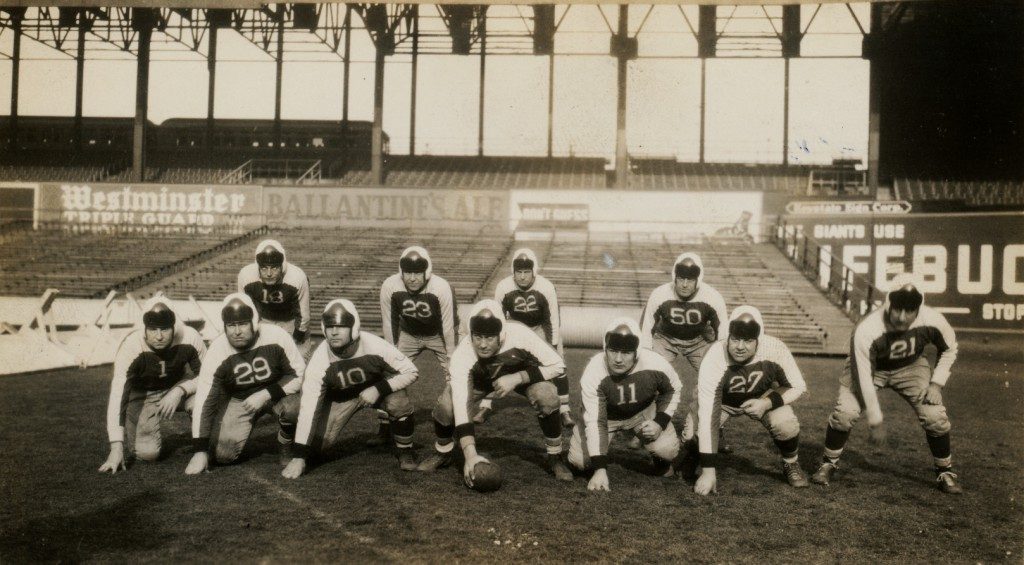
The starting offense of the 1934 New York Giants.
Back row, left to right: 18, Dale Burnett; 23, Bo Molenda;
22, Ed Danowski; and 50, Ken Strong.
Front row, left to right: 1, Ray Flaherty;
29, Red Badgro; 10, Potsy Jones; 7, Mel Hein;
11, Butch Gibson; 27, Bill Morgan; and 21, Ike Frankian.

December 9, 1934: For the 1st time, a New York football team wins a championship game. And they proved the old adage that revenge is a dish best served cold.

The New York Giants, named for the baseball team of the same name, were founded in 1925, and won the NFL Championship in 1927, at a time when the title went to the team that finished 1st in a single-division League. The Giants went 11-1-1, outpacing the Green Bay Packers at 7-2-1.

For the 1933 season, the NFL split into 2 Divisions, Eastern and Western. The Giants won the East, and the Chicago Bears won the West. While there had been a Playoff for the League title the season before, and the Bears had won it, 1933 was the year of the 1st official NFL Championship Game. It was played at Wrigley Field in Chicago, and the Bears came from behind to beat the Giants, 23-21.

The Giants won the East again in 1934, with an 8-5 record. The Bears won the West again, going 13-0, and riding a 17-game winning streak. With Red Grange and Bronko Nagurski, who would become charter members of the Pro Football Hall of Fame, the Bears were favorites.

In spite of a much more pedestrian record, the Giants were every bit as loaded as the year before. Center Mel Hein would also be a charter inductee in Canton, and would be joined by running back and kicker Ken Strong, and ends Red Badgro and Ray Flaherty. Each team's head coach would also be elected to the Hall of Fame: Steve Owen of New York and George Halas of Chicago. Each team's owner also would: Tim Mara and Halas.

As the Western winner hosted the Championship Game the year before, now it was the Eastern winner's turn to host. But the night before the game, a freezing rain hit New York, and when the Giants got to the Polo Grounds, they found the field frozen solid. The bad weather kept the crowd to 35,039, about 20,000 short of a sellout.
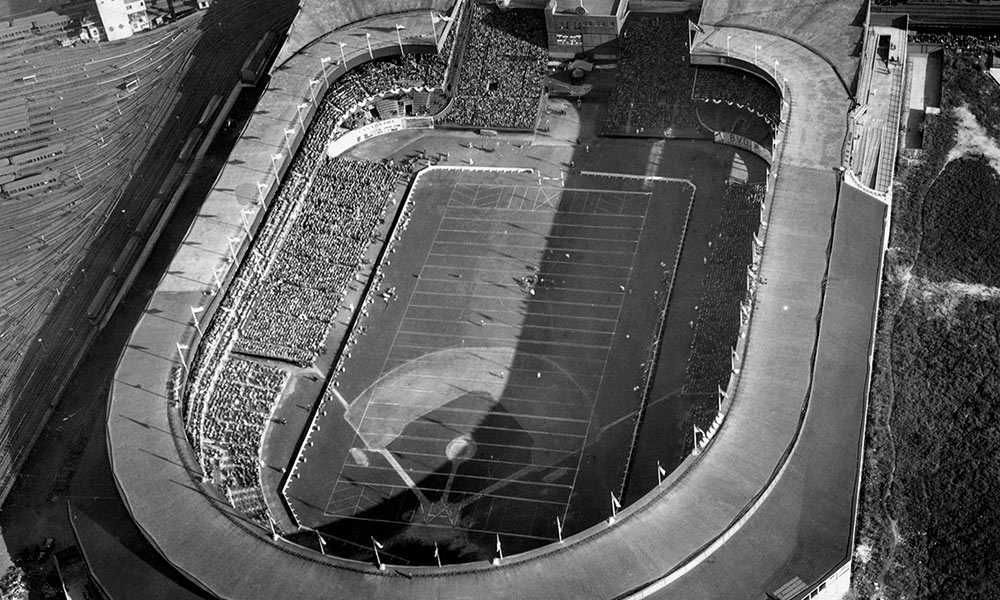
The Polo Grounds, looking more fit for football
than it ever did for baseball

Flaherty came up with an idea: The Giants should wear sneakers, to get a better footing on the field than the standard football cleats. But it was a Sunday: Sporting goods stores were closed. So Owen sent Abe Cohen, a tailor who served as the Giants' clubhouse attendant, to Manhattan College, 5 miles Uptown, to see if he could get some sneakers.

The athletic director -- contrary to legend, not the original Brother Jasper who founded Manhattan's athletic program and gave rise to the teams' name, the Jaspers, as he would have been long dead by this point -- gave Cohen the sneakers belonging to the basketball team, 9 pairs.

But by the time Cohen got back to the Polo Grounds, the 2nd half was already underway. Strong had opened the scoring with a field goal, but the Bears answered in the 2nd quarter with a Nagurski touchdown and a Jack Manders field goal. The Giants switched to the sneakers, but another Manders field goal made it 13-3 going into the 4th quarter.

But the sneakers did the trick. Ed Danowski threw a touchdown pass to Ike Frankian, making it 13-10 Chicago. The Bears could do nothing on their next drive. The Giants got the ball back, and Strong had enough footing to break away for a 42-yard touchdown run.

Strong scored another touchdown, this time from 11 yards out, as the Bears kept slipping, unable to keep up with the surer-footed Giants. Nagurski later said, "We immediately said something was wrong because they suddenly had good footing and we didn't... They just out-smarted us."

Danowski capped the game with a 9-yard quarterback keeper. The Giants won, 30-13, and their 27 points remain a record for the 4th quarter in an NFL championship game. (The New England Patriots scored 19 points in the 4th quarter of Super Bowl LI.) It became known as "The Sneaker Game." (It's never been called "The Sneaker Bowl.")

Beattie Feathers, a rookie running back out of the University of Tennessee, had become the 1st player to rush for over 1,000 yards in an NFL season. However, he was injured with 2 games remaining in the regular season. It probably wouldn't have mattered if he had been available to the Bears: He would have had to have helped them make up 3 touchdowns.

The Giants won another NFL Championship Game in 1938, but lost it in 1935, 1939, 1941, 1944 and 1946. In 1956, the Giants' 1st season playing their home games at the old Yankee Stadium, they again hosted the Bears in an NFL Championship Game. Again, the field was frozen solid. This time, with the legend of 1934 in mind, they had sneakers ready from the start, and it was no contest: The Giants won, 47-7.

Burned by it twice, Bears owner/coach and NFL co-founder George Halas talked the other owners into outlawing the sneaker tactic. The Giants would play on frozen fields in the NFL Championship Games of 1958 (at Yankee Stadium), 1961 (at Lambeau Field in Green Bay), 1962 (at Yankee Stadium again) and 1963 (at Wrigley Field in Chicago), and lost them all. 

Packer coach and general manager Vince Lombardi had been a Giants assistant in 1958, and had coached against them in 1961 and 1962. He knew that the cold weather of Green Bay made for a home-field advantage at Lambeau Field, but he didn't want a frozen field. So he had heating coils installed under the field, and it became known as "Lombardi's Electric Blanket." But on the morning of the 1967 NFL Championship Game, it was so cold, the machine keeping the coils heated broke, and the field froze. The game became known as the Ice Bowl, but the Packers won, anyway.

Since then, all natural-grass fields in the NFL have had similar heating systems. And, by the time the Giants made the Playoffs again, in 1981, many of the NFL's fields, including their own at Giants Stadium, were artificial. So while there have been many cold games in the NFL since, including a few at the Meadowlands, there has never been a frozen field since Lambeau became "the Frozen Tundra."

In 1999, The Sporting News released their list of the 100 Greatest Football Players. Mel Hein was ranked 38th. In 2010, the NFL Network released their list of the 100 Greatest Players. Hein was dropped to 96th.


*


December 9, 1934 was a Sunday. Actress Judi Dench and blues singer Junior Wells were born on this day.

This was the end of the football season, baseball was out of season, and there was no NBA yet. But there were 3 games played in the NHL that day:

* The New York Giants lost to the Chicago Black Hawks, 4-0 at the Chicago Stadium.

* The New York Americans and the Montreal Canadiens played to a tie, 2-2 at the old (then still relatively new) Madison Square Garden.

* And the Detroit Red Wings beat the St. Louis Eagles, 3-1 at the Olympia Stadium in Detroit. The Eagles had been the Ottawa Senators until this season, but the Great Depression did them in, and they folded at the end of the season. St. Louis would not return to the NHL until 1967, and Ottawa not until 1992.

* The Toronto Maple Leafs and the Montreal Maroons were not scheduled.

Wednesday, December 7, 2022

December 14, 1930: The New York Giants Beat the Notre Dame All-Stars

December 14, 1930: A football game was played at the Polo Grounds in Upper Manhattan. The home team was not the one cheered by most of the fans. Most of them left stunned at the result.

America was a year into the Great Depression, and Jimmy Walker, the flamboyant, corrupt Mayor of New York City, had a private unemployment relief fund. He contacted his friend, Charles Stoneham, owner of the New York Giants baseball team and its home, the Polo Grounds; and another friend, Tim Mara, owner of the New York Giants football team, which leased the Polo Grounds from Stoneham. He asked if Stoneham would host, and Mara would play, a benefit game for the relief fund. Both agreed.

But who would be the opponent? There was a football team called the Brooklyn Dodgers, and another called the Staten Island Stapletons, but neither had a following that would fill the Polo Grounds' 56,000 seats. Nor did the Giants: Only once all season did they have a home crowd over 25,000, and that was on November 23, when 37,000 saw them beat the Green Bay Packers, 13-6. That would be the Packers' only loss of the season, as they won the Championship by 1 game over the Giants.

The most popular football team among New Yorkers was a college team, 700 miles west: The University of Notre Dame, in South Bend, Indiana. Although there is a school in Washington, D.C. named "The Catholic University of America," the high profile of Notre Dame's football team had made their school America's most familiar Catholic school.

This was due to the success of their head coach, the charismatic Norwegian immigrant Knute Rockne. Coaching players like the ill-fated George Gipp on his National Championship teams of 1919 and 1920, and the four-man backfield known as "The Four Horsemen" on his National Championship team of 1924, Rockne had made himself and his school legend. Catholics in cities like New York, Philadelphia, Boston and Chicago, who couldn't afford to go to college, or even to finish high school, read of Notre Dame's exploits in the newspapers, and became fans, known as "Subway Alumni."

The game in which the great Southern, but nationally-syndicated, sportswriter Grantland Rice had named quarterback Harry Stuhldreher, halfback Don Miller and Jim Crowley, and Elmer Layden "The Four Horsemen," after the Apocalypse figures in the Bible's book of Revelation, had been at the Polo Grounds, a win over the U.S. Military Academy, a.k.a. "Army." The 1928 game in which Rockne had told his players of the dying wish of Gipp, suffering from an infection in those pre-antibiotic days, to "win just one for the Gipper," had also been against Army, at Yankee Stadium.

And Notre Dame had won the National Championship again in 1929 and 1930. In the current season alone, they had gone 10-0, and brought 66,000 fans to Pitt Stadium for their win over the University of Pittsburgh, 75,000 to Franklin Field in Philadelphia for their win over the University of Pennsylvania, 110,000 to Soldier Field in Chicago for their win over Army, and 74,000 to the Los Angeles Memorial Coliseum for their win over the University of Southern California.

So they were the ideal opponent. And it's not as though teams in the NFL's early days hadn't played college teams before. So the Giants asked Rockne if he would bring his "Fighting Irish" east to play the Giants.

He wouldn't do it. Not because he objected to playing professionals -- or because the game would be on a Sunday. (The State of New York had only legalized professional sports on Sundays in 1919.) It was because the game had been set for December 14, only 8 days after their win over USC, and, having needed 3 days to get back to South Bend by train, and needing another day to get to New York by train, Rockne thought his players would be too tired to play.

So a team of "Notre Dame All-Stars" was set up: A few of the current players, who felt they could do it, came east. And the Four Horsemen, none of whom had made the trip to Los Angeles, were reunited.

But Stuhldreher was now the head coach at Villanova University in Philadelphia, Crowley the head coach at Michigan State, Layden the head coach at the University of Pittsburgh, and Miller the backfield coach at Ohio State. None of them had played beyond the 1926 season, and they were now 29 (Stuhldreher), 28 (Miller and Crowley) and 27 (Layden) years old -- not old if they had still been playing all along, but old enough to not be able to fully resume their playing careers if they had wanted.

Nevertheless, the American media had put into the heads of the American football-watching public that college football was superior to professional football, that pro football was a way for boys who hadn't grown up to make money playing the game they loved, on top of, or maybe instead of, getting a "real job." The consensus was that the Giants would be no match for the 24 men who assembled to represent the great Notre Dame.

But the Giants had quarterback Benny Friedman, who has been called the NFL's 1st great passer. They had end Red Badgro. They had tackle Steve Owen, who was also their head coach. All 3 would one day make the Pro Football Hall of Fame. They had backs Dale Burnett and Chris Caple. There were reasons why the Giants nearly won the NFL Championship.

Instead, the Giants sacked Stuhldreher in the end zone for a safety just 2 minutes into the game, and led 2-0. The Giants' big linemen overwhelmed the Notre Dame line, including some of the "Seven Mules" who had blocked for the Four Horsemen. It did no good: The Irish gained only 34 yards -- the entire game. Their passing attack was 0-for-9, with 2 interceptions.

In the New York Daily News, Marshall Hunt wrote of the crowd that came to see Notre Dame and ended up seeing the Giants, "More than 50,000 cheered every futile thrust of Knute Rockne's improvised squadron of former Notre Dame football players against the super line of Tim Mara's team."

In the 2nd quarter, Friedman drove the Giants down the field, and scored on a 4-yard touchdown run. Close to halftime, the Giants' line opened a hole for him, and he ran in from 22 yards. Giants 15, Fighting Irish 0.
Rockne lost the plot, as would be said in English soccer. This was not something he did often. He found Giants team president Harry March, and tore into him for allowing the Giants to embarrass his squad in a purported charity game. He told March to call off the dogs in the second half.

March must have gotten the message to Owen, because he sent in the reserves. And still, in the 3rd quarter, Francis "Hap" Moran threw a touchdown pass to Glenn Campbell (no relation to Glen Campbell the later singer). The Giants won, 22-0.

As sports historian Clayton Trutor wrote for Notre Dame Magazine in 2021:

The 22-0 final score headlined all newspapers in the city, earning the hometown team a grudging respect from writers who had previously discounted the professional game. Nevertheless, they were treated like sparring partners by many of the New York papers, who instead focused their coverage on the plucky performance of a Notre Dame alumni team that had assembled just a few days earlier.

It wasn't the catalyst for the NFL to take over from the pros in the minds of the public, but it was part of a gradual process that began, also with the Giants at the Polo Grounds, when Red Grange and the Chicago Bears beat them in front of 75,000.

Rockne died in a plane crash the next year, and many of the other great old football coaches, some of whom had spoken ill of the professional game -- passed from the scene, either through death or retirement.

In 1933, Jim Crowley became the head coach at Fordham University in The Bronx, and coached a line known as "The Seven Blocks of Granite," including future Packer coach Vince Lombardi. That team played their bigger games at the Polo Grounds, and had a famous 0-0 tie with Pittsburgh there, with both teams going in undefeated.

*

December 14, 1930 was a Sunday. There was 1 regular-season game in the NFL that day: The Green Bay Packers, their Championship already assured, played the Portsmouth Spartans to a tie, 6-6 at Universal Stadium (now Spartan Memorial Stadium) in Portsmouth, Ohio.

Baseball was out of season. The NBA hadn't been founded yet. There were 2 games in the NHL. The New York Rangers beat the Detroit Falcons, 3-0 at the old (but then-new) Madison Square Garden. And the Montreal Maroons beat the Chicago Black Hawks, 2-0 at the Chicago Stadium. The Falcons became the Red Wings in 1932, and the Maroons folded in 1938.

Tuesday, December 6, 2022

December 6, 1925: Red Grange Saves the NFL

December 6, 1925: The New York Giants football team, in its 1st season of play, is in deep financial trouble, in spite of a 10-3 record to this point -- 8-2 against NFL teams. Too few fans have come out to the Polo Grounds that team owners Tim and Jack Mara are afraid that their team will financially fail. And if the NFL's New York team fails, so will the League.

Red Grange to the rescue. Harold Edward Grange, "the Galloping Ghost" out of the University of Illinois, the most famous (or, at least, the most-hyped) player in the history of college football, comes in with his new teammates, the Chicago Bears.

A crowd of 68,000 people pays to get into the Polo Grounds, more than the Giants' last 3 home games combined. It's believed that another 8,000 crashed the gate, making the 74,000 crowd the biggest in the NFL's 6-season history to that point.

The Ghost lives up to the hype: He scores a touchdown on a 35-yard interception return, runs for 53 yards on 11 carries, catches a 23-yard pass, and completes 2 of 3 passes for 32 yards. And he is part of a defense that recorded a shutout. He could do everything except kick.

The Bears win, 19-0, but that's beside the point: The gate receipts from all the people coming out to see Grange mean that the Giants will be able to play the 1926 season. In 1927, they finish 1st, taking the 1st of what is now 8 NFL Championships, including 4 Super Bowls.

The Bears? They were a good team throughout the 1st decade of NFL play, winning the title in 1921, but won't win another title until 1932. By that point, Grange will be joined by Bronislau "Bronko" Nagurski, and they will win the title in 1933 as well.

Grange was the template for every speedy scatback who followed him: Steve Van Buren, Doak Walker, Frank Gifford, Lenny Moore, Paul Hornung, Gale Sayers, O.J. Simpson, Tony Dorsett, Marcus Allen, Walter Payton, Terrell Davis, Marshall Faulk, Chris Johnson, Joe Mixon.

Nagurski is the model for every big bruising fullback to come: Clarke Hinkle, Marion Motley, Tank Younger, Jim Taylor, Jim Brown, Larry Csonka, Franco Harris, John Riggins, Roger Craig, Emmitt Smith, Terrell Davis, Jerome Bettis, Adrian Peterson.

This -- not the 1958 NFL Championship Game that the Giants lost to the Baltimore Colts at Yankee Stadium -- is not only the biggest football game ever played in New York City; it is the most important game in the history of American professional football. If Grange had, for whatever reason, been unable to play in it, the Giants would have folded, and the NFL would probably have gone down the tubes during the Great Depression.

This might have opened the door for soccer, with its working-class roots and its ethnic appeal (most U.S. soccer teams at that point were ethnically based), to become America's Fall and Winter sport, possibly also hurting basketball and hockey. If you want to know why "football" made it in America, and "futbol" didn't until the 1970s, this, as much as America's natural distrust for "foreign" things, is the moment.

Even at the time, the 1920s, "The Roaring Twenties," was called "The Golden Age of Sports." It was Babe Ruth in baseball, Howie Morenz in hockey, Jack Dempsey in boxing, Paavo Nurmi in track, Bill Tilden in tennis, Bobby Jones in golf, and Man o' War in horse racing. In football, it was the Galloping Ghost, Red Grange.

Grange played until 1934, and became a broadcaster. He lived until 1991. He was ranked 80th on The Sporting News' 100 Greatest Football Players in 1999, named the greatest player in college football history by ESPN in 2008, had a statue of him dedicated outside Illinois' Memorial Stadium in 2009, was named to the NFL's 100 Greatest Players by the NFL Network in 2010 (ranked 48th, actually gaining 32 places in the intervening 11 years), and was named the Big Ten Conference's greatest sports icon by the Big Ten Network in 2011.

Keep in mind, most of those honoring him had never seen him play, as he played his last NFL game in 1934, and there is precious little surviving footage of him.


*

December 6, 1925 was a Sunday. These other NFL games were played that day:

* The Pottsville Maroons beat the Chicago Cardinals, 21-7 at Comiskey Park in Chicago. This led to the most controversial awarding of the NFL Championship in the League's history. 

* The Green Bay Packers beat the Providence Steam Rollers, 13-10 at the Cycledrome in Providence. The Steam Rollers debuted in 1916, joined the NFL for the 1925 season, won its Championship in 1928, and folded due to the Depression in 1933.

* The Cleveland Bulldogs beat the Canton Bulldogs, 6-0 at Dunn Field in Cleveland. (League Park used that name from 1921 to 1927.) Despite being just 60 miles apart, the cities' respective Bulldogs were separate teams.

* While baseball was in the off-season, and the NBA wasn't founded yet, there was also 1 NHL game played on this day. The Pittsburgh Pirates beat the Toronto St. Patricks, 6-3 at the Duquesne Gardens in Pittsburgh.

While the St. Patricks became the Toronto Maple Leafs in 1927, the Pirates -- as the NFL's Steelers were from their 1933 debut through 1939, named after the baseball team in town -- are not the forerunners of the Pittsburgh Penguins. In 1930, they moved across Pennsylvania, and became the Philadelphia Quakers. After one of the worst seasons in NHL history, both on the ice and at the Depression-addled box office, they folded.

Monday, November 7, 2022

November 7, 1908: The Deaths (?) of Butch Cassidy & the Sundance Kid

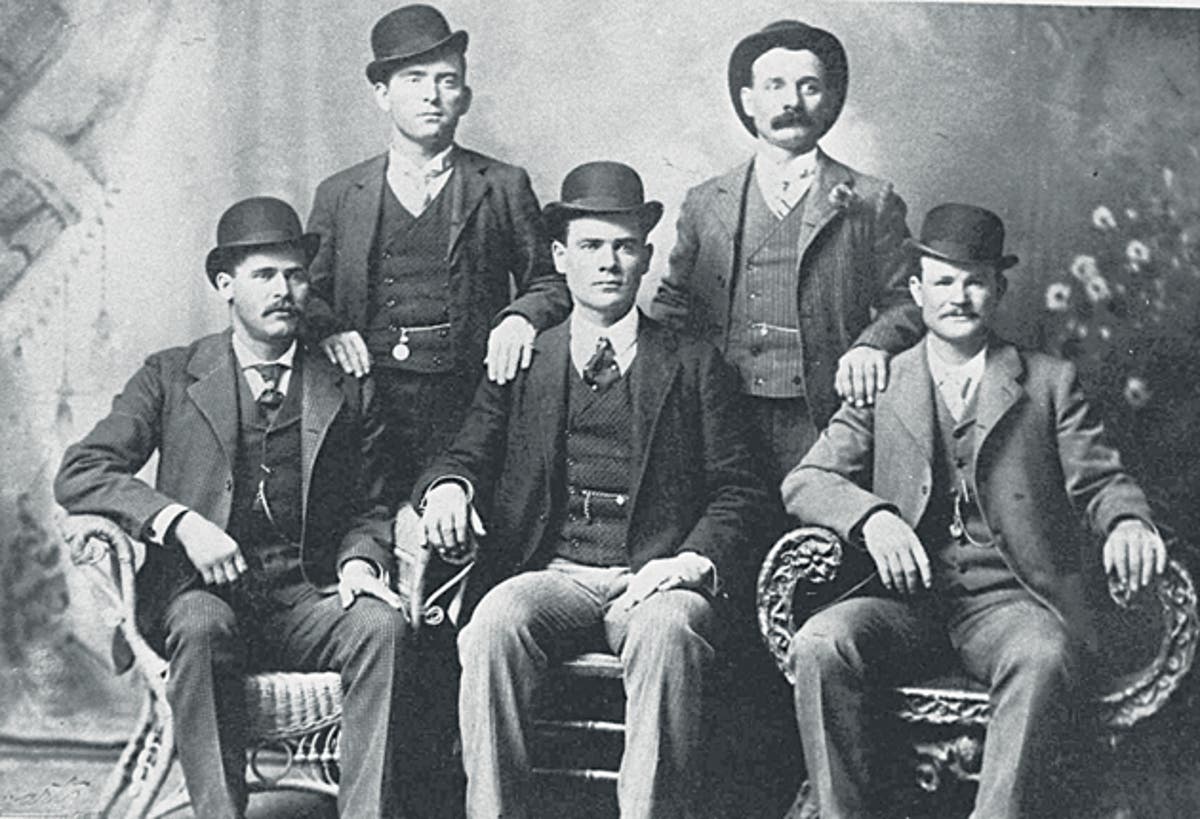
The 1899 "Fort Worth Five" photo.
Top row, left to right: William Carver and Harvey Logan.
Bottom row, left to right: Harry Longabaugh (the Sundance Kid),
Ben Kilpatrick, and Robert Parker (Butch Cassidy).

November 7, 1908: In San Vicente, Bolivia, soldiers engage in a shootout with 2 men who had robbed the payroll of a silver mine. The robbers were found dead: Apparently, with both men wounded, one shot the other to put him out of his misery, and then used his last bullet on himself.
The local authorities confirmed that these men were the robbers, but they did not know the men's names. The widely-accepted story is that the men were Robert Leroy Parker and Harry Alonzo Longabaugh -- a.k.a. the American outlaws known as Butch Cassidy and the Sundance Kid, respectively.
Butch and Sundance were the last of the major Wild West outlaws. From 1889 to 1901, with their Wild Bunch gang, they robbed banks and trains throughout the Rocky Mountain States, especially Parker's native Utah (which gained Statehood in 1896). In 1901, along with Longabaugh's girlfriend Etta Place, they escaped to New York, and then took a ship to South America: First to Argentina, then to Chile, and finally to Bolivia, in the hopes of becoming respectable ranchers.
But they couldn't make an honest living, so they turned back to robbery, which is why they had to leave Argentina and then Chile. Finally, in 1906, Place got tired of living on the run, and went back to America. History loses track of her after that.
Attempts to determine whether Butch and Sundance actually were the men killed in the San Vicente shootout have thus far failed. It has been alleged, including by Cassidy's sister, that Butch left Bolivia and was still alive as late as 1937. (He would have been 72.) A suggestion that Sundance was still alive as late as 1936 has been proven by DNA testing to be false, but, so far, that's as close as DNA testing has come to proving anything. Among the stories, it has been suggested that Etta may have been alive as late as 1966.
For all we know, the old Utah and Wyoming bank and train robbers of the 1890s may well have had a good laugh about it all for a long time thereafter.
Among the depictions of Butch and Sundance: The 1951 film The Texas Rangers (played by John Doucette and Ian MacDonald, respectively), the 1956 film The Three Outlaws (Neville Brand and Alan Hale Jr.), a 1958 episode of Tales of Wells Fargo (only Butch appears, played by a young Charles Bronson), the 1969 film Butch Cassidy and the Sundance Kid (Paul Newman and Robert Redford, with Katharine Ross as Etta), the 1979 film Butch and Sundance: The Early Days (Tom Berenger and William Katt), the 1994 TV-movie The Gambler V: Playing for Keeps (Scott Paulin and Brett Cullen, with Mariska Hargitay as Etta), and the 2004 TV-movie The Legend of Butch & Sundance (David Clayton Rogers and Ryan Browning, with Rachelle Lefevre as Etta).
*
November 7, 1908 was a Saturday. Baseball was out of season. Basketball and hockey were not yet professional. But there was college football to be played. Among the games:
* The Polo Grounds in New York hosted a crowd of 10,000, as undefeated Dartmouth (5-0-1) beat previously undefeated Princeton (5-0-3), 10-6.
* Harvard and the Carlisle Indian School (with Jim Thorpe not yet playing) were both 6-0-1 when facing each other in Cambridge, Massachusetts, and Harvard won, 17-0.
* Yale, undefeated, blew a 10-0 lead at home in New Haven, Connecticut, and escaped with a 10-10 with Brown.
* The University of Pennsylvania beat Lafayette, 34-4 at the original Franklin Field (built in 1895, replaced in 1922) in Philadelphia. They finished 11-0-1, and were recognized as the National Champions. A 6-6 tie with Carlisle was the only blemish on their record, though it should be noted that they didn't play either Harvard, Yale or Princeton. They did go on to beat Michigan, though.
* The University of Pittsburgh undefeated, stayed that way, beating the school that would become their arch-rivals, West Virginia, 11-0 at Exposition Park, home of baseball's Pirates. In their 1st 7 games, Pitt had outscored their opponents 128-4. But they lost 3 of their last 4 games, all at home.
* Army beat Springfield, 6-5 at West Point, New York.
* Navy beat Villanova, 30-6 at Annapolis, Maryland.
* Michigan beat Kentucky, 62-0 at Ann Arbor, Michigan.
* Notre Dame beat Indiana, 11-0 at Washington Park in Indianapolis.
* New York University lost to Rensselaer Polytechnic Institute. RPI beat NYU, 11-0 in Troy, New York.
* And Rutgers could only manage a 6-6 tie with Delaware.

Wednesday, October 26, 2022

October 27, 1904: The New York Subway Opens

October 27, 1904: The 1st Subway line opens in New York. It runs from City Hall to Grand Central Station (roughly today's 4, 5 and 6 Trains), then turns onto 42nd Street (today's S, or Times Square-Grand Central Shuttle), then up Broadway to 207th Street (today's 1 Train) before making one final curve into the Bronx to Bailey Street (this part is part of today's A Train). The fare is 5 cents -- $1.52 in today's money.
The Polo Grounds of the time, and its 1911 successor, were served by the 155th Street station that opened on this day. It was supposedly on this line in 1908 that Jack Norworth, a songwriter, saw a sign saying, "Baseball To-Day, Polo Grounds," inspiring him to write the lyrics to "Take Me Out to the Ballgame."
It would be 1918 before "34th St.-Penn Station" opened to service the 1910-built Pennsylvania Station, and thus to the successor station and the "new" Madison Square Garden built on the site. The 34th Street station on the 8th Avenue side of Penn Station opened in 1932, as did the 42nd Street station that serves the Port Authority Bus Terminal that opened in 1950, and the 50th Street station that served the old Garden from 1932 until its closing in 1968.
The current 4 Train station at 161st Street and River Avenue opened in 1917, and began serving Yankee Stadium at its opening in 1923. The D Train station there opened in 1933, probably to coincide with the opening of the nearby Bronx County Courthouse. The Prospect Park station now used by the Q Train became part of the City Subway in 1920, and was used to get to games at Ebbets Field.
The station now served by the 7 Train opened in 1939 for the 1939-40 New York World's Fair, well predating the 1964-65 World’s Fair and the opening of Shea Stadium and the National Tennis Center. It was named "Willets Point Blvd." from 1939 to 1964 and "Willets Point-Shea Stadium" from 1964 to 2008, and has been renamed "Mets-Willets Point," as the MTA did not want to use the name "Citi Field" due to CitiGroup's role in the 2008 financial crisis.
*
October 27, 1904 was a Thursday. Poet Dylan Thomas was born in Swansea, Wales. He would die in New York in 1953.

There were no scores on this historic day: The baseball season was over, professional football was in its infancy, it was a Thursday so there were no college football games, and there was no professional basketball or professional hockey.

October 26, 1952: Wild Man Willey

October 26, 1952: The Philadelphia Eagles beat the New York Giants 14-10, thanks in part to the efforts of Norm Willey, a 24-year-old defensive end from West Virginia. There appears to be no surviving film of this game, but Hugh Brown of the Philadelphia newspaper The Evening Bulletin
wrote, "Willey awed inhabitants of the Polo Grounds by dumping New York Giants quarterback Charlie Conerly 17 times as he attempted to pass."

The term "sack" hadn't yet been used to describe such a play. It would be years before Los Angeles Rams defensive end Deacon Jones came up with the term. Since passing ahead of the line of scrimmage is illegal, those 17 attempts could only have happened behind it -- therefore, they were sacks.

So unless Brown got it really wrong, "Wild Man" Willey sacked Conerly 17 times. In one game. To paraphrase a later Philly sports legend, "Not a season, not a season, not a season: We talkin' 'bout a game."

Interestingly, given what happened at that same stadium a little more than a year earlier, the name of the Eagles' starting quarterback was Bobby Thomason -- not quite "Bobby Thomson."

Willey wasn't huge, not even by the standards of his time: He was 6-foot-2 and 224 pounds. He must have been fast, though. At a time when seasons were 12 games long, he appears to have gotten 20 to 30 sacks a season.

Officially, the single-game record is 7, by Derrick Thomas of the Kansas City Chiefs in 1990; the single-season record is 22 1/2, by Michael Strahan of the Giants in 2001, and tied by T.J. Watt of the Pittsburgh Steelers in 2021; and the career record is 200 by Bruce Smith, from 1985 to 2003. If Brown was even half-off with his account, Thomas' record goes by the wayside, and the Strahan/Watt record is probably wrong as well.

So, is the record legit? There is no surviving film of the game, so we can't check that way. The Bulletin was the only paper to mention it the next day. The Inquirer, the Daily News, the Trenton Times, the Camden Post (South Jersey's largest paper is now named the Courier-Post), The Press of Atlantic City, the News-Journal (Delaware's largest paper), and, covering the game for New York, the papers of New York City and North Jersey didn't mention it.

There is one noticeable backup: The next week, the Eagles were supposed to play the Green Bay Packers, and, in a preview, the Green Bay Press-Citizen credited Willey with 13 sacks, which would still be far and away the record. (The Packers won, 13-12.)

Paul Zimmerman, later to be Sports Illustrated's lead NFL writer for decades, was at Columbia University at the time, and claimed to have been at the game, covering it for the Columbia Spectator. He kept a play-by-play log, and, hearing the Willey story long after the fact, checked his own notes from that game. The Eagles, as a team, had 14 sacks according to him -- 8 by Willey, which would still be a record, and 6 by Pete Pihos, which would be 1 short of the official record.

Willey played for the Eagles from 1950 to 1957. He remained in the Philadelphia area, coaching at Pennsville Memorial High School in Salem County, on the New Jersey end of the Delaware Memorial Bridge. He died in 2011, outliving Thomas, a victim of a car crash.

*

October 26, 1952 was a Sunday. These other NFL games were played that day:

* The Cleveland Browns beat the Washington Redskins, 19-15 at Cleveland Municipal Stadium.

* The Pittsburgh Steelers beat the Chicago Cardinals, 34-28 at Comiskey Park in Chicago.

* The Detroit Lions beat the Green Bay Packers, 52-17 at Green Bay City Stadium. That should not be a shock: The Lions went on to win the NFL Championship that season, and the Packers went on to finish 6-6.

* The Los Angeles Rams beat the Chicago Bears, 31-7 at the Los Angeles Memorial Coliseum.

* And the San Francisco 49ers beat the Dallas Texans, 48-21 at Kezar Stadium in San Francisco. Contrary to legend, which says that the Texans became the Baltimore Colts the next season, the team was actually folded, this created a new place in the NFL for 1953, into which a new Colts team came in, replacing the one that played from 1947 to 1950.

A new Dallas Texans was founded in the AFL in 1960, becoming the Kansas City Chiefs in 1963. But the '52 Texans became neither the Colts, nor the Chiefs, nor any other team -- including a '53 Texans.

The NBA season wouldn't start for another 5 days. But there were 2 games played in the NHL that day. The New York Rangers beat the Detroit Red Wings, 3-2 at the old Madison Square Garden. And the Boston Bruins and the Chicago Black Hawks played to a 1-1 tie at the Chicago Stadium. The Montreal Canadiens and the Toronto Maple Leafs were not scheduled.

December 31, 1999 & January 1, 2000: The Millennium

December 31, 1999:  The Millennium arrives. The people of planet Earth survived. At a terrible cost. But we hadn't destroyed ourselves. ...