Showing posts with label satchel paige. Show all posts

Thursday, December 15, 2022

December 15, 1956: Satchel Paige at the Orange Bowl

December 15, 1956: A crowd of 57,000 baseball fans packs Burdine Stadium -- renamed the Orange Bowl in 1959 -- in Miami, to see Negro League legend Satchel Paige pitch in a minor league exhibition game. It was the largest crowd to ever watch a minor-league game to that point.

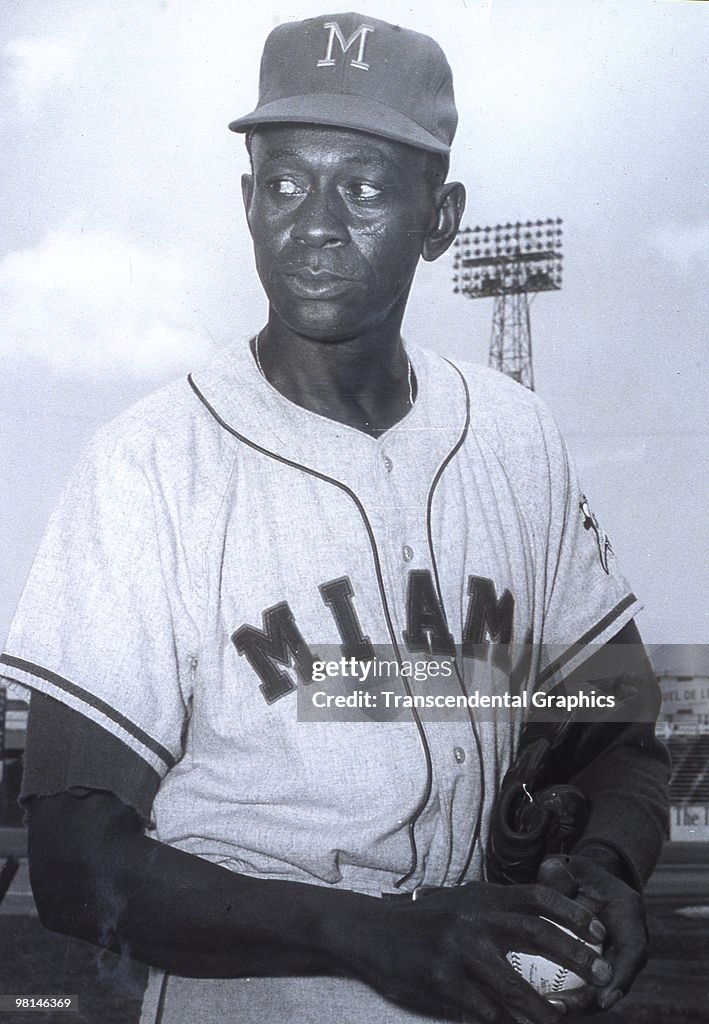
The 50-year-old Paige wore the uniform of the Miami Marlins of the Class AAA International League. He started the game, and pitched into the 8th inning before leaving the game with a 6-2 lead over the Ohio-based Columbus Jets, another IL team. He even knocked in half the Marlins runs with a 3-run double in the 2nd inning.
All the proceeds went to charity, and the pre-game entertainment included jazz legend Cab Calloway. To compensate for the short dimensions in right field, a giant fence was constructed at the wall, much like the one they would construct a year and a half later for the left field wall at the Los Angeles Memorial Coliseum for the newly-arrived Dodgers.

Paige enjoyed a stellar campaign with the Marlins finishing the 1956 season with an 11-4 record and 1.86 ERA, and would pitch 2 more remarkable years in Miami. In 1957, he had a 10-8 record and a 2.42 ERA. The following year, he went 10-10, and his ERA was 2.95.

The Marlins, formerly an early version of the Syracuse Chiefs, debuted in the IL that 1956 season, and remained in it through 1960. Their usual home was Miami Stadium, built in 1949, and later renamed Bobby Maduro Stadium, for a Miami-based baseball executive.

In the 1956, '57 and '58 seasons, they were a farm team of the Philadelphia Phillies; in 1959 and '60, of the Baltimore Orioles. The owners signed a working agreement with the St. Louis Cardinals for 1961, and moved the franchise to San Juan, Puerto Rico; and, in mid-season, to Charleston, West Virginia.

In 1962, a new Miami Marlins debuted in the Class D Florida State League, playing at Miami Stadium, as a Phillies farm team. The entire FSL was promoted to Class A in 1964, and remains so. The Marlins returned to the Orioles' fold in 1966, winning FSL Pennants in 1969, 1970, 1971, 1972 and 1978. They were a San Diego Padres farm team in 1983 and 1984, but declining attendance ended the team.

In 1993, the National League's expansion included the Florida Marlins, playing at the Miami Dolphins' new stadium in suburban Miami Gardens. Miami Stadium was demolished in 2001, and the Orange Bowl in 2008. In 2012, when what is now named LoanDepot Park opened on the site of the Orange Bowl, the Marlins moved in, and restored the Miami Marlins name.

The Orange Bowl's record for the largest crowd in minor-league history stood until July 4, 1981, when the Denver Bears of the Class AAA American Association got 59,691 fans for a game at Mile High Stadium. They broke it again a year later: On July 4, 1982, they got 65,666 fans in, to see them lose to the Omaha Royals, 7-4. That remains the minor-league record.

*

December 15, 1956 was a Saturday. This special exhibition game aside, baseball was out of season. There were no college football games: Even the Orange Bowl, home field to the University of Miami, had wrapped up its season aside from its eponymous New Year's Day bowl game. The previous Saturday, December 8, Miami, then ranked Number 6 in the country, were beaten by the University of Pittsburgh, ranked Number 12, 14-7 at the stadium. On January 1, 1957, in the Orange Bowl game, Number 20 Colorado would beat Clemson, 27-21.

There were 3 games in the NBA:

* The New York Knicks beat the Rochester Royals, 91-76 at the Rochester Community War Memorial (now the Blue Cross Arena) in Rochester, New York.

* The Boston Celtics beat the St. Louis Hawks, 102-99 at the Boston Garden.

* And the Philadelphia Warriors beat the Syracuse Nations, 117-108 at the Onondaga County War Memorial (now the Upstate Medical University Arena) in Syracuse, New York.

The NHL's entire "Original Six" were in action:

* The New York Rangers lost to the Toronto Maple Leafs, 2-1 at Maple Leaf Gardens in Toronto.

* The Montreal Canadiens beat the Boston Bruins, 6-4 at the Montreal Forum.

* And the Detroit Red Wings beat the Chicago Black Hawks, 5-1 at the Olympia Stadium in Detroit.

And in English soccer, North London team Arsenal went to Wales, and beat Cardiff City, 3-2 at Ninian Park in Cardiff.

Tuesday, October 11, 2022

October 11, 1948: The Cleveland Indians Win the World Series

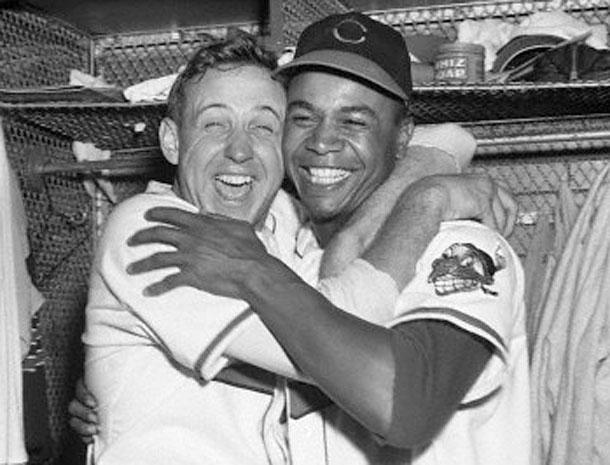
Steve Gromek (left) and Larry Doby

October 11, 1948: The Cleveland Indians defeat the Boston Braves behind "rookie" 30-year-old knuckleballer Gene Bearden, 4-3 at Braves Field, and take Game 6 and win the World Series. It is their 2nd title, the 1st coming in 1920.
Braves Field

Team owner Bill Veeck had built this team. Larry Doby and Satchel Paige thus become the 1st black players to play on a World Series winner. Doby became the 1st black player to hit a home run in a World Series game. And Lou Boudreau, age 31, both shortstop and manager, becomes the last player-manager to win a World Series, or even a Pennant. Bob Feller would join Veeck, Doby, Paige and Boudreau in the Baseball Hall of Fame, although he ended up as the losing pitcher in both games the Indians lost in the Series: Game 1, to Johnny Sain; and Game 5, to another Hall-of-Famer, Warren Spahn.
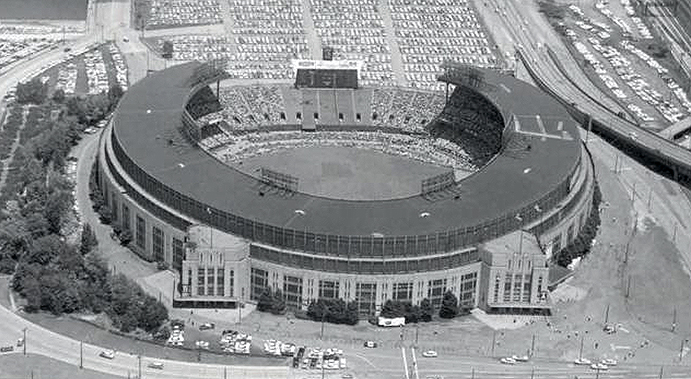
Cleveland Municipal Stadium

A photograph of Doby being hugged by a white teammate, pitcher Steve Gromek, circulated, and was considered another step forward in black and white players working together.

The team has never won another World Series. They have had some close calls, some of them truly agonizing. And they're not even called the Indians anymore: In 2021, after years of complaints about their Native American name and its racist implications, they announced that, for the following season and thereafter, they would be named the Cleveland Guardians.

But at least they're still in Cleveland, despite a number of fears of having to move in the 1960s, '70s and '80s. In contrast, despite all their success in the 19th Century and winning Pennants in 1914 and 1948, that 1948 World Series Game 6 was the last late-season meaningful game the Boston franchise of the National League would ever play. The Braves would be in Milwaukee by the next time they reached the Series, in 1957.

The Indians' Eddie Robinson was the last surviving player from the 1948 World Series, living until 2021, age 100, 73 years later. Clint Conatser was the last survivor of the '48 Braves, living until 2019, at 98.

UPDATE: The Guardians have a team Hall of Fame. From the 1948 World Champion Indians, they have honored Lou Boudreau, Bob Feller, Satchel Paige, Bob Lemon, Early Wynn, Mike Garcia, Joe Gordon, Larry Doby, Al Rosen, Ken Keltner, Jim Hegan, team owner Bill Veeck, scout Cy Slapnicka, and broadcasters Jack Graney and Jimmy Dudley. Feller and Hegan have also been elected to the Greater Cleveland Sports Hall of Fame.

*

October 11, 1948 was a Monday. This was also the day Thomas Merton publishes his memoir The Seven Storey Mountain. I have a separate entry for that event.

The baseball season had ended that day. Football was in midweek. And it was too soon for the NBA and NHL seasons. So there were no other scores on this historic day.

Friday, September 30, 2022

September 30, 1946: The Feller-Paige Tour

September 30, 1946: One of baseball's biggest postseason "barnstorming tours" begins. It is the end of one era, and the start of another.

Before World War II, Bob Feller of the Cleveland Indians was the best pitcher in baseball -- in the all-white major leagues, anyway. Leroy "Satchel" Paige was the best pitcher in the all-black Negro Leagues.

Feller missed most of 4 seasons in the war, and came back strong. At the age of 28, was as good as any pitcher ever: In the 1946 season, he went 26-15, had a 2.18 ERA, pitched a no-hitter against the New York Yankees -- the 2nd of 3 he would go on to pitch -- and struck out 348 batters.

For a while, that was believed to be a major league record, as Rube Waddell was believed to have topped out at 343 in 1904. A later check of the records revealed that Waddell had actually struck out 349, but that wasn't found out until after Sandy Koufax with 382 in 1965, and then Nolan Ryan with 383 in 1973, had surpassed Feller's total. So when Koufax broke the record, everyone thought it was Feller's.

Also happening in that 1946 season was the debut of Jackie Robinson with the Montreal Royals, the top farm team of the Brooklyn Dodgers. Feller had gone on record as saying that, if Robinson were white, he "would not be big-league material." He spent the rest of his life trying to make up for that misjudgment. As it turned out, in 1962, he and Robinson were elected to the Baseball Hall of Fame together.

But he had already had an idea, before his discharge from the U.S. Navy, of having a tour of two opposing teams, one white, one black. In an interview with William Marshall, for his book, Baseball's Pivotal Era, 1945-1951, he said, “I knew what I was going to do, and I knew the people personally that I was going to have get the black clubs together: The Kansas City operator, Mr. Wilkinson, and Satchel Paige, and many others that I wanted to oppose us.”

It was in mid-July of Feller’s stellar comeback campaign that he announced plans for a coast-to-coast exhibition tour featuring an all-star squad made up of players from both the American and National leagues and a team of the nation’s finest Negro League players.

He obtained from Commissioner Albert B. "Happy" Chandler's permission to carry the tour beyond the 10-day barnstorming limit. And he contacted J.L. Wilkinson, owner of the Kansas City Monarchs, correctly thinking him the man to be the go-between with the other Negro League owners, who would let their players go on this tour.

The 27-game tour began on September 30, at Forbes Field in Pittsburgh, with the itinerary including stops in such outposts as Cleveland, Chicago, Cincinnati, Baltimore, Newark, New York, Columbus, Dayton, Louisville, Davenport, Des Moines, St. Paul. Omaha, Wichita, St. Louis, Kansas city, Denver, Los Angeles, San Diego, Vancouver, San Francisco, Seattle, Portland and Tacoma. It ran concurrent with the World Series, which ran from October 6 to 15, and the St. Louis Cardinals beat the Boston Red Sox in 7 games.

No Red Sox, including Ted Williams winning what turned out to be his only Pennant despite retiring 14 years later, and no Cardinals, including Stan Musial, winning what turned out to be the last of his 4 Pennants despite retiring 17 years later, were available -- at least at first.

Musial joined in mid-tour. Williams did not: According to Feller's memoir, Red Sox owner Tom Yawkey offered him $10,000 not to go, and Detroit Tigers owner Walter "Spike" Briggs offered his star, Hank Greenberg, a similar amount. Part of the issue was that Feller had rented planes, and the players would be flying, and the team owners didn't want their players dying in plane crashes. Feller, himself a licensed pilot understood the danger, and heavily insured the tour.

Because the Yankees did not win the Pennant, it made their players available, and left fielder Charlie Keller, shortstop Phil Rizzuto and pitcher Spurgeon "Spud" Chandler joined Bob Feller's All-Stars. So did Feller's Indian teammates, pitcher Mel Harder and Bob Lemon; Boston Braves pitcher Johnny Sain; and Washington Senators 1st baseman Mickey Vernon.

In his memoir, Buck O'Neil wrote. "I was excited to be chosen for the Satchel Paige All-Stars, along with guys like Hilton Smith, Gene Benson and Quincy Trouppe, because I knew I'd be making more money in one month than I had made in the last six. And I was excited to able to play against guys like Mickey Vernon, Phil Rizzuto, Johnny Sain and Stan Musial right after the big-league World Series.

"I also felt that, even though it was black against white, this tour was an event that could have a real effect on big-league integration, because it took place after Jackie had proven himself, and if a lot of us weren't that lucky, we could at least prove ourselves against big-leaguers in these games."

In addition to the preceding, Satchel Paige's All-Star included Negro League stars Max Manning, Barney Brown, Hank Thompson, Art Wilson and Howard Easterling.

The itinerary:

* September 30, Forbes Field, Pittsburgh: Paige 3, Feller 1.
* October 1, Idora Park, Youngstown, Ohio: Feller 11, Paige 2.
* Later on October 1, Cleveland Municipal Stadium: Feller 5, Paige 2.
* October 2, Comiskey Park, Chicago: Feller 6, Paige 5.
* October 3, Crosley Field, Cincinnati: Feller 3, Paige 0.
* October 4, Yankee Stadium, New York: Feller 4, Paige 2.
* October 5, Ruppert Stadium, Newark, New Jersey: Feller 13, Paige 10.
* October 6, Yankee Stadium: Paige 4, Feller 0.
* Later on October 6, Bugle Field, Baltimore: Paige 7, Feller 4.
* October 7, Red Bird Stadium (later renamed Cooper Stadium), Columbus, Ohio: Paige 4, Feller 3.
* October 8, Hudson Field, Dayton, Ohio: Feller 7, Paige 6.
* October 9, a day off.
* October 10, Municipal Stadium, Richmond, Indiana: Feller 7, Paige 5.
* October 12, American Legion Park, Council Bluffs, Iowa: Feller 3, Paige 2.
* Later on October 12, Lawrence Field, Wichita, Kansas: Feller 5, Paige 3.
* October 13, Kansas City Municipal Stadium: Paige 3, Feller 2.
* October 14, K.C. Municipal Stadium: Feller 4, Paige 1.
* October 15, a day off.
* October 16, Wrigley Field, Los Angeles: Feller 4, Paige 3.
* October 17, Lane Field, San Diego: Feller 2, Paige 0.
* October 18 to 22: Time off.
* October 23, Sam Lynn Park, Bakersfield, California: Feller 12, Paige 4.

Overall record: Feller 14, Paige 5. So while the argument that the best black players could play in the white major leagues held up, the argument that the Negro Leagues were the equal of the white majors does not.

Two years later, Indians owner Bill Veeck signed Paige, despite his age being apparently 42. He helped Feller and the Indians win the World Series.

In 1990, the Yankees visited Cleveland for their Old-Timers Day, and their old-timers' game was held between games of a doubleheader. Rizzuto, by this point, was the Yankees aging, quirky broadcaster, and had former Met ace Tom Seaver in the booth with him. He asked Feller to interview, and Rizzuto brought up the tour. As patriotic as Feller was, he was also honest, telling the WPIX-Channel 11 audience, "We did the tour for one reason: To make money. I'm not going to kid you about that. We lost a lot of money during the war."

And when former Commissioner Francis T. "Fay" Vincent wrote a book, he interviewed Feller for it. He wouldn't change his story: "We were interested in one thing, making money. I mean, what else is there? Yes we put on a good show. There was racial rivalry, not amongst the players, but amongst the fans. And we got a few laughs. They're great friends of mine. They love me dearly. I love them dearly. I know all the guys. We made more money in that month of October than we made all year round."

By the time the tour concluded, approximately a quarter of a million fans had witnessed this unprecedented tour.

*

September 30, 1946 was a Monday. Baseball's regular season was almost over, and no games were played on this day. Nor in football: Monday Night Football was still 24 years away. And basketball and hockey were out of season. So there were no scores on this historic day.

Sunday, September 25, 2022

September 25, 1965: Satchel Paige, MLB's Oldest Player

September 25, 1965: The Boston Red Sox beat the Kansas City Athletics, 5-2 at Kansas City Municipal Stadium. Lee Thomas and Tony Conigliaro hit home runs for the Red Sox, while Carl Yastrzemski went 2-for-4.

Satchel Paige started the game for the A's. He went 3 innings, allowed no runs, 1 hit, no walks, striking out 1. It was the K.C. bullpen -- Diego SeguĂ­, Don Mossi and John Wyatt -- who lost the game.

So why take Satch out so early? Well, he was 59 years old. He was the oldest player ever to appear in a Major League Baseball game.

His birth name, Leroy Robert Paige, was known. Less known was how he got his nickname: Either his feet were as big as suitcases, or "satchels," and "Satchelfoot" became "Satchel," or "Satch" for short; or his constant traveling, as the loose structure of the Negro Leagues meant that he was always in demand, led to him always carrying a satchel.

Not known for sure, for a long time, was his birthdate. His contemporary, Dizzy Dean, would tell differing stories about his date of birth, place of birth, and real name, most of them lies. But as to his date of birth, Paige simply kept them guessing. He would say things like, "How old would you be if you didn't know how old you was?" And, "A goat ate the Bible that had my birth certificate. That goat lived to be 29 years old."

When Paige was finally brought to the major leagues in 1948, by Bill Veeck, owner of the Cleveland Indians, Veeck decided to find out for himself. He had heard Paige say he was born in Mobile, Alabama, a city which would later produce 2 other Hall-of-Famers, Hank Aaron and Willie McCovey. So Veeck went to Mobile, accepted the possibility that there might not be a birth record for a black child born in the early part of the 20th Century, and found one anyway: With the permission and accompaniment of members of the Paige family, he went to the Mobile County Board of Health, and found that Satch was born on July 7, 1906. That made him 42, the oldest rookie in major league history.

That didn't stop the speculation. One of his former Negro League teammates, Ted Radcliffe, known as "Double Duty" because he could catch and pitch, said he grew up with Paige in Mobile, and Paige was exactly 2 years older. Since Radcliffe's birthdate was established as July 7, 1902, that meant Paige was born on July 7, 1900, making him 48 when he reached the major leagues. (Radcliffe lived to be 103, stuck by his story to the end, and should be in the Hall of Fame.)

A few years after his debut, someone interviewed Paige's mother, and she said he was born in 1904, and she should know, right? Paige said, "She was in her nineties when she told the reporter that, and sometimes she tended to forget things." 

So people still wondered. Veeck said he'd seen the birth certificate, but he said a lot of things over the years, some of which were proven to be untrue.

Similarly, Archie Moore, Light Heavyweight Champion of the World from 1952 to 1962, was the subject of questions about his age. He said he was born on December 16, 1916, but his mother said it was 1913. Sonny Liston, Heavyweight Champion from 1962 to 1964, also faced questions about his age: He was officially 32 when Muhammad Ali dethroned him, but, as part of his poetic trash-talking, Ali, then still using his birth name, said, "You're 40 years old, if a day, and you don't belong in the ring with Cassius Clay!" Hispanic players, due to poor record-keeping, have also faced questions about their ages, including the Cuban pitchers Luis Tiant and Orlando "El Duque" Hernández.

Paige got around in the Negro Leagues and the Caribbean leagues. He debuted with the Chattanooga Black Lookouts in 1926, presumably as a teenager for a few weeks. Among his tenures: He played 4 seasons with the Birmingham Black Barons, 4 with the Pittsburgh Crawfords, and 8 with the Kansas City Monarchs. Negro League records are incomplete, but he is known for sure to have at least 118 wins against 80 losses. How many games he won in all those "barnstorming" appearances, God only knows.

As a "rookie" in 1948, Paige helped the Indians win the World Series. He pitched for them in 1949 as well. He returned to the Negro Leagues in 1950, because Veeck sold the Indians, and the new owner didn't want him. Veeck bought the St. Louis Browns in 1951, and brought Paige in. In 1953, with the Browns, at age 47, Paige became the oldest player to appear in the All-Star Game. But Veeck sold the Browns after that season, and they became the Baltimore Orioles. Paige did not go with them, and went back to barnstorming.

In 1955, Veeck bought the Miami Marlins of the Class AAA International League, whose name would later be taken by a major league team. He signed Paige, who stayed through the 1958 season, at 52. He kept barnstorming -- apparently, he needed the money -- until 1961, when he signed with the Portland Beavers of the Class AAA Pacific Coast League.

In 1965, desperate for attendance, Kansas City Athletics owner Charlie Finley, remembering that Paige had played longer in Kansas City than anywhere else, signed him to play one last major league game. Finley invited several Negro League veterans to be introduced before the game. If Finley wanted a big crowd, it didn't work: Only 9,289 fans came out.

Ironically, this last appearance may have delayed Satch's entrance into the Baseball Hall of Fame. At the Hall's 1966 induction ceremony, Ted Williams told the crowd that Paige, catcher Josh Gibson, and other Negro League stars should be eligible for the Hall. The Hall's rules state that a player must be retired for 5 full seasons. Paige was the 1st Negro Leaguer elected, in 1971 -- 5 full seasons after his last appearance. (Gibson had died in 1947, of a brain tumor while still an active player, 3 months before Jackie Robinson made his debut. He was elected in 1972.)

In 1968, Paige reached out to all 20 teams then in MLB, to try and join one of them on the active roster, in order to reach the 158 days he still needed to qualify for the five-year minimum for the Players' Association pension. On August 12, Atlanta Braves owner Bill Bartholomay signed him as an adviser and an assistant trainer, and Paige qualified. With his struggle in mind, the following season, MLB and the Players' Association reduced the requirement from 5 to 4 years, and "grandfathered in" all players who had played up to 1959.

Paige died on June 8, 1982, a month before his presumed 76th birthday, of a heart attack at his home in Kansas City. He was married 3 times, and had 7 children, all with his 3rd wife. In 1999, The Sporting News ranked him 19th on their list of the 100 Greatest Baseball Players. In 2022, ESPN ranked him 41st on their updated 100. In each case, he was the highest-ranking  among Negro League players. Statues of him stand in Cooperstown, New York, a block from the Hall of Fame; and in the Negro Leagues Baseball Museum in Kansas City.

Satch broke the record of Charley O'Leary, who was just short of turning 59 on September 30, 1934. He appeared as a pinch-hitter, singled and scored, making him the oldest player to get a hit and the oldest player to score a run. He was not then placed in the field. He had last played in the majors in 1913, his 21-year gap between appearances still an MLB record. But he had been a player-manager in the minors for a while, and had coached for the St. Louis Browns that season, activated for the season finale.

For a while, it was thought that Minnie Miñoso, brought out of retirement at 53 for the 1976 Chicago White Sox, as a publicity stunt by, you guessed it, team owner Bill Veeck, was the oldest player to get a hit. But later research found that O'Leary was older than previously thought. Miñoso made 1 more appearance, at 56 in 1980, making him a 5-decade player, but did not get a hit.

Jack Quinn, a pitcher, was the oldest player to appear regularly, last doing so at 50 with the 1933 Cincinnati Reds. He finished with a career record of 247-218. Julio Franco was the oldest position player to appear regularly, last doing so with the 2007 Atlanta Braves, at 49. In 2006, at 48, with the New York Mets, Franco became the oldest player to hit a home run.

In 2012, at 48, Jamie Moyer became the oldest pitcher to win a game, with the Colorado Rockies. Since the National League still didn't have the designated hitter, Moyer had to bat for himself, and also became the oldest player with an RBI.

The oldest players to appear at each position:

Pitcher: 59, Satchel Paige, 1965 Kansas City Athletics
Catcher: 54, Jim "Orator" O'Rourke, 1904 New York Giants
Third Base: 49, Jimmy Austin, 1929 St. Louis Browns
First Base: 48, Hughie Jennings, 1918 Detroit Tigers
Second Base: 48, Johnny Evers, 1929 Boston Braves
Right Field: 46, Sam Thompson, 1906 Detroit Tigers
Shortstop: 44, Omar Vizquel, 2012 Toronto Blue Jays
Left Field: 44, Ichiro Suzuki, 2018 Seattle Mariners
Center Field: 43, Ichiro Suzuki, 2017 Miami Marlins

*

September 25, 1965 was a Saturday. This was also the day that Barry McGuire's recording of "Eve of Destruction" became the Number 1 song in America. I have a separate entry for that event.

These other Major League Baseball games were played that day:

* The New York Yankees were swept by the Chicago White Sox in a doubleheader, 3-1 2-0 at Comiskey Park in Chicago. In the opener, not only did future Yankee Tommy John outpitch Bill Stafford, he hit a home run, the 1st of 5 he hit in a long career. Roy White, who made his major league debut 18 days earlier, went 1-for-3. Bobby Murcer, who made his major league debut 17 days earlier, went 3-for-4 with an RBI.

In the nightcap, Gary Peters (6 2/3rds innings) and Hoyt Wilhelm combined on a 6-hit shutout. White and Murcer didn't play. Roger Maris was injured, and didn't play in either game. Over the 2 games, Mickey Mantle went 1-for-7 with a walk.

* The New York Mets split a doubleheader with the Philadelphia Phillies at Connie Mack Stadium in Philadelphia. The Phils won the opener, and Mets won the nightcap, and both games ended 4-1. Dick Stuart and Clay Dalrymple hit home runs in the 1st game. Greg Goossen and Jim Hickman homered in the 2nd game.

* The Baltimore Orioles swept a doubleheader from the California Angels, 2-1 and 2-0 at Memorial Stadium in Baltimore. Brooks Robinson went 2-for-6 with 2 walks and an RBI over the 2 games. In the 2nd game, Milt Pappas pitched a 3-hit shutout. He pitched 1 more game for the Orioles, and was then traded to the Cincinnati Reds for Frank Robinson, in the greatest trade in Oriole history.

* The Minnesota Twins swept a doubleheader from the Washington Senators, 5-0 and 5-3 at District of Columbia Stadium (later Robert F. Kennedy Stadium) in Washington. In the opener, Jim "Mudcat" Grant allowed only 1 hit, a 3rd-inning double by Don Blasingame. Zoilo Versalles went 4-for-5 with a home run, on his way to winning the American League's Most Valuable Player award. Harmon Killebrew went 1-for-7 with 2 walks over the doubleheader.

The next day, the Twins clinched their 1st Pennant in Minnesota, the franchise's 1st since 1933 -- as the previous (though not first) franchise to be known as the Washington Senators.

* The Detroit Tigers beat the Cleveland Indians, 4-1 at Tiger Stadium in Detroit. Al Kaline did not play.

* The Chicago Cubs beat the Pittsburgh Pirates, 6-3 at Wrigley Field in Chicago. Ernie Banks went 0-for-2 with a walk, but had an RBI on a sacrifice fly. Roberto Clemente went 1-for-4. Bill Mazeroski hit a home run. Willie Stargell got a hit as a pinch-hitter.

* The Cincinnati Reds beat the Houston Astros, 1-0 at the Astrodome in Houston. Jim Maloney pitched a 2-hit shutout.

* The Los Angeles Dodgers beat the St. Louis Cardinals, 2-0 at Dodger Stadium in Los Angeles. Sandy Koufax pitched a 5-hit shutout.

* And the San Francisco Giants beat the Milwaukee Braves, 7-5 at Candlestick Park in San Francisco. Willie Mays hit his 50th home run of the season. He would finish with 52, and the National League's MVP, although the Dodgers would edge the Giants for the Pennant. Eddie Mathews hit what turned out to be his last home run for the Braves before they moved to Atlanta the next season. Hank Aaron did not hit a home run, going 1-for-5.

Among the college football games played that day were these:

* Number 1 Notre Dame were upset by Number 6 Purdue, 25-21 at Ross-Ade Stadium in West Lafayette, Indiana.

* Number 2 Nebraska beat Air Force, 27-17 at Falcon Stadium in Colorado Springs, Colorado.

* Number 3 Texas beat Texas Tech, 33-7 at Memorial Stadium in Austin, Texas.

* Number 4 Michigan beat the University of California, 10-7 at Michigan Stadium in Ann Arbor.

* Number 5 Arkansas beat the University of Tulsa, 20-12 at Razorback Stadium in Fayetteville, Arkansas.

* Number 7 Louisiana State (LSU) beat Rice, 42-14 at Tiger Stadium in Baton Rouge, Louisiana.

* Number 9 Syracuse were upset by the University of Miami, 24-0 at Archbold Stadium in Syracuse, New York.

* Number 10 Kentucky beat Mississippi, 16-7 at McLean Stadium in Lexington, Kentucky.

* With the other service academies, Army beat Virginia Military Institute (VMI), 21-7 at Michie Stadium in West Point, New York; and Navy played Stanford to a tie, 7-7 at the old Stanford Stadium in the San Francisco suburb of Palo Alto, Cailfornia.

* And in New Jersey, Princeton beat Rutgers, 32-6 at Palmer Stadium in Princeton, Mercer County.

In New Jersey high school football, East Brunswick of Middlesex County, the school that would one day be my Alma Mater, lost away to Steinert, 13-12 at Steinert High School Football Field (the only name the facility has ever had) in Hamilton, Mercer County (the school is often called "Hamilton East").

And in English soccer, Arsenal beat Manchester United, 4-2 at the Arsenal Stadium, a.k.a. Highbury, in North London.

Also, Basketball Hall-of-Famer Scottie Pippen was born.
Saturday, September 10, 2022

September 10, 1942: Satchel Paige vs. Josh Gibson

Satchel Paige (left) and Josh Gibson

September 10, 1942: The men generally recognized as the greatest pitcher and the greatest hitter in the history of the Negro Leagues have a showdown.

Josh Gibson was a catcher, and people who saw him -- nearly all of them black -- said he was the greatest catcher ever. That was defensively. Offensively, some people called him "The Black Babe Ruth." Others called Ruth "The White Josh Gibson." In a career that began in 1930, he starred for the Homestead Grays, who, for reasons I've never been able to figure out, divided their home games between Pittsburgh, near the coal-mining town of Homestead, for which they were named; and Washington, D.C. He also spent significant time with the Pittsburgh Crawfords.

How far could Gibson hit a baseball? He was alleged to be the only man ever to hit a fair ball out of the original Yankee Stadium in New York. No proof of this has ever been found. A historian decided to try to prove it, figuring that, if it had happened, the sources most likely to say so at the time were the black newspapers, such as New York's Amsterdam News, the Philadelphia Tribune, the Baltimore Afro-American, the Washington Afro-American, the Pittsburgh Courier, the Chicago Defender, and the Kansas City Call. He found plenty of references to Gibson playing in games at Yankee Stadium, and a few to him hitting home runs, some very long -- but none to him hitting one that left the complex in fair territory.

Another legend is that Gibson and the Crawfords played the Philadelphia Stars in Pittsburgh, and he hit a ball so far, nobody ever saw where it landed. After the game, the teams got on their respective buses, and went across Pennsylvania to play in Philadelphia the next day. And as they're getting ready to play, a ball comes out of nowhere, and one of the Stars' players catches it. The same umpire was on hand, saw this, pointed to Gibson, and said, "Yer out, yesterday in Pittsburgh!"

Gibson is credited with hitting 84 home runs in a season, and over 800 for his career. However, that's for all the games he played. That means many more than the 154 that major league teams then played in a regular season, because they played wherever they could, both within their league and without, so they could make more money. And how often did Gibson face a pitcher with major league talent? Only occasionally -- but one such pitcher, and then some, was Satchel Paige.

Leroy Robert Paige was known as "Satchel" because he always seemed to be carrying one, because he always seemed to be on the move. He first played in 1926, for the Chattanooga Black Lookouts, named for the all-white team of the same name. He starred for the Birmingham Black Barons, the Kansas City Monarchs, was a teammate of Gibson's on the Crawfords, and, in 1941, pitched for the New York Black Yankees. (They weren't nearly as successful as their namesakes: If there were a "Yankees of the Negro Leagues," it was the Monarchs, with the Grays not far behind.)

In 1942, the Monarchs won the Negro American League Pennant, while the Grays won the Negro National League Pennant. For the 1st time since 1927, there would be a Negro World Series. Oddly, each game was played in a different city.

Game 1 was played at Griffith Stadium in Washington -- one of the Grays' home fields -- on September 8. Paige pitched 5 innings, Jack Matchett 4, and the Monarchs won, 8-0.

Game 2 was played at Forbes Field in Pittsburgh -- the Grays' other home field -- on September 10. In the bottom of the 6th inning, the Monarchs led, 2-0, with Hilton Smith pitching a shutout, but Paige was brought in to relieve. In the 7th inning, the Grays loaded the bases with 2 outs, and Gibson came up to bat.

Gibson and Paige had long speculated as to what would happen if they faced each other in a truly big situation, a case of "the irresistible force vs. the immovable object." Gibson fouled off the 1st 2 pitches. He missed the 3rd: Paige struck him out.

As with the meeting between Grover Cleveland Alexander and Tony Lazzeri in Game 7 of the 1926 World Series, the legend has this confrontation happening in the 9th inning, ending the game, not just the inning. As with the preceding, it actually happened in the 7th inning, and the game was far from over. In the 8th, the Monarchs extended their lead to 5-0. The Grays came back to make it 5-4. But in the 9th, the Monarchs put the game away, and won, 8-4.

Game 3 was played on September 13, at Yankee Stadium. Paige was tired, and left after 2 innings, but Matchett pitched well the rest of the way, and the Monarchs won, 9-3. Game 4 was not played until September 20, at Ruppert Stadium in Kansas City, home of the Monarchs and the Kansas City Blues, the Yankees' top farm team. (It was later renamed Kansas City Municipal Stadium.) Stricken with injuries, the Grays brought in "ringers" like Leon Day. The Grays won, with Day outpitching Paige, but because of the ringers, the Monarchs lodged a protest. It was upheld, and Game 4 was stricken from the record.

So a new Game 4 was played on September 29, at Shibe Park in Philadelphia. (It was later renamed Connie Mack Stadium.) The Monarchs won, 9-5, completing a sweep. In the 5 games, including the one that didn't count, Paige appeared in each, going 16 innings, giving up 6 runs on 8 hits, striking out 18.

In early 1943, Gibson was diagnosed with a brain tumor. He refused the option of surgical removal, and lived the next four years with recurring headaches. In 1944, Gibson was hospitalized in Washington, D.C. at Gallinger Hospital, for mental observation. Gibson continued to play through the 1946 season, with intense pain, self-medicating, and getting addicted to prescription drugs. On January 20, 1947, Gibson died of a stroke in Pittsburgh. He was only 35 years old. Three months later, Jackie Robinson broke Major League Baseball's color barrier.

The following year, Paige made his MLB debut, at age 42, with the Cleveland Indians, He helped them win the World Series, and remained in the white majors until 1953, with a one-game return in 1965, at 59, making him the oldest player in major league history.

In 1966, Ted Williams was inducted into the Baseball Hall of Fame. In his acceptance speech, he asked that Negro League players be allowed the chance for election to the Hall, specifically naming Paige and Gibson. In 1971, Paige was the 1st such player so honored. The following year, Gibson and his Grays teammate Walter "Buck" Leonard were elected. Paige died in 1982.

Statues of Gibson now stand outside the current ballparks in the cities where he played most of his home games: Nationals Park in Washington and PNC Park in Pittsburgh. A statue of Paige stands in Cooper Park in Cooperstown, New York, around the corner from the Hall of Fame.

*

September 10, 1942 was a Thursday. These games were played in the white major leagues:

* The New York Yankees lost to the St. Louis Browns, 9-0 at Sportsman's Park in St. Louis. Denny Galehouse pitched a 3-hit shutout, while Wally Judnich hit 2 home runs. Joe DiMaggio went 0-for-3 with a walk.

* The New York Giants lost to the St. Louis Cardinals, 5-1 at the Polo Grounds. Stan Musial went 0-for-4. Mel Ott, also the Giants' manager at this point, hit a home run for the team's only run.

* The Brooklyn Dodgers lost to the Chicago Cubs, 10-2 at Ebbets Field.

* The Cincinnati Reds beat the Boston Braves, 6-2 at Braves Field in Boston.

* The Philadelphia Phillies beat the Pittsburgh Pirates, 2-1 at Shibe Park in Philadelphia. Danny Litwhiler doubled home the winning run in the bottom of the 11th inning.

* The Detroit Tigers beat the Boston Red Sox, 5-4 at Briggs Stadium (later Tiger Stadium) in Detroit. Ted Williams and Dom DiMaggio hit home runs for the BoSox, but it wasn't enough.

* A doubleheader was split at Comiskey Park in Chicago. The Chicago White Sox won the opener, 7-1. The Washington Senators won the nightcap, 5-4.

* And the Cleveland Indians and the Philadelphia Athletics were not scheduled.

September 10, 1933: The 1st Negro League All-Star Game

There is no known photo of the 1933 game,
but this photo from the 1934 game has many of the same players.

September 10, 1933: Just 2 months after the 1st All-Star Game in what is now called Major League Baseball was played at Comiskey Park in Chicago, the 1st Negro League East-West Game is played at the same venue.

Comiskey was not just a good logistical choice, since it was easy for pretty much anyone in the country to get to Chicago, but a symbolic choice: It was the home not just of the American League's Chicago White Sox, but of one of the best-known Negro League teams, the Chicago American Giants, whose greatest player, Rube Foster had founded the original Negro National League.

Fan balloting was conducted in the major black newspapers of the day. The most popular vote-getter was Oscar Charleston, with Willie Foster, Rube's brother and teammate, finishing 2nd, and 1st among pitchers. It was still relatively early in the careers of Satchel Paige and Josh Gibson, who would become the best-known pitcher and hitter, respectively, in Negro League play, so they didn't do as well in the voting as would now be expected: Paige was 4th among pitchers, while Gibson was 2nd to Biz Mackey among catchers.

The East team, managed by John Henry "Pop" Lloyd:

* From the Pittsburgh Crawfords: Starting 1st baseman Oscar Charleston, starting center fielder James "Cool Papa" Bell, starting pitcher Sam Streeter, starting 2nd baseman John Henry Russell, starting left fielder Vic Harris, reserve pitchers Leroy "Satchel" Paige and Bertrum Hunter, reserve 3rd baseman William "Judy" Johnson, and reserve outfielders Ted Page and Leroy Matlock.

* From the Philadelphia Stars: Starting catcher James "Biz" Mackey, starting 3rd baseman Ernest "Jud" Wilson, starting right fielder Herbert "Rap" Dixon, and starting shortstop Dick Lundy.

* From the Homestead Grays: Reserve pitcher George Britt. (Not to be confused with George Brett.)

* And from the Kansas City Monarchs (even though they were a West team): Reserve pitcher Andy Cooper.

Charleston, Bell, Paige, Johnson, Mackey, Wilson and Cooper were later elected to the Baseball Hall of Fame.

The West team, managed by Larry Brown (a player-manager):

* From the Chicago American Giants: Starting catcher Larry Brown, starting pitcher Willie Foster, starting 1st baseman George "Mule" Suttles, starting shortstop Willie Wells, starting center fielder Norman "Turkey" Stearnes, starting 3rd baseman Alex Radcliffe, starting left fielder Walter "Steel Arm" Davis, reserve pitcher William "Sug" Cornelius, and utility player Jack Marshall.

* From the Nashville Elite Giants: Starting right fielder Sammy Bankhead, reserve catcher Tommy Dukes, and reserve pitchers Jim Willis and Percy Bailey.

* From the Cleveland Giants: Starting 2nd baseman Leroy Morney.

* And from the Kansas City Monarchs: Reserve 2nd baseman Newton "Newt" Allen, and utility player T.J. Young.

Foster, Suttles, Wells and Stearnes would be elected to the Baseball Hall of Fame.

None of the West's bench players got into the game. The East batted first. The game was scoreless until the bottom of the 3rd, when Stearnes singled Bankhead home. The East made it 3-1 in the top of the 4th, but a Suttles home run was part of a 4-3 West lead. Wilson singled home 2 runs in the top of the 5th, making it 5-4 East.

The West took control from there, scoring 3 runs in the 6th, 3 more in the 7th, and 1 in the 8th. The East scored 2 in the 9th, but it wasn't enough, and the West won, 11-7. Gibson made the final out. There was no most valuable player in the game, but Suttles would have been the best choice, going 2-for-4 with a home run, a double, and 3 RBIs.

The East-West Game continued to be played until the Negro American League folded in 1962.

*

September 10, 1933 was a Sunday. Fashion designer Karl Lagerfeld was born.

In the still-all-white major leagues, these games were played:

* The New York Yankees swept a doubleheader from the Detroit Tigers, 2-1 and 9-1 at Yankee Stadium. Lefty Gomez and Johnny Allen were the winning pitchers. Over the 2 games, Babe Ruth went 1-for-4
 with a walk before sitting out most of the 2nd game, Lou Gehrig went 2-for-5 with a home run, 2 walks and 2 RBIs, and Hank Greenberg went 2-for-8 with an RBI.

* The New York Giants swept the Cincinnati Reds, 6-1 and 2-1 at Redland Field in Cincinnati. (The next season, the ballpark was renamed Crosley Field.) In the opener, Giants player-manager Bill Terry went 2-for-5 with an RBI. So did Mel Ott. So did Travis Jackson. In the nightcap, Terry went 0-for-4 with a walk, but had an RBI on a sacrifice fly; and Jackson went 0-for-4, but Ott went 3-for-5.

* A doubleheader was split at Ebbets Field. The Pittsburgh Pirates won the 1st game, 2-1. The Brooklyn Dodgers won the 2nd game, 3-2. Over the 2 games, Paul Waner went 4-for-8, and Lloyd Waner went 2-for-7 with a walk and an RBI.

* The St. Louis Browns swept the Boston Red Sox, 3-2 and 4-0 at Fenway Park in Boston. George Blaeholder of the Browns and Johnny Welch of the Red Sox battled to a 0-0 tie for 10 innings. Welch ran out of gas in the top of the 11th, and the Browns scored 4 runs.

* The Washington Senators beat the Cleveland Indians, 7-3 at Griffith Stadium in Washington.

* The Chicago Cubs swept the Philadelphia Phillies, 4-0 and 4-2 at Wrigley Field in Chicago. Bud Tripping pitched a 6-hit shutout in the 1st game.

* The St. Louis Cardinals swept the Boston Braves, 7-0 and 10-5 at Sportsman's Park in St. Louis. Bill Hallahan pitched a 4-hit shutout in the 1st game.

* And the Chicago White Sox and the Philadelphia Athletics were rained out at Shibe Park in Philadelphia. The game was made up as part of a doubleheader the next day. The A's swept, 5-3 and 8-0. In the 1st game, Lefty Grove outpitched Ted Lyons. In the 2nd game, Johnny Marcum pitched a 5-hit shutout.

Monday, May 30, 2022

May 30, 1961: The Assassination of Rafael Trujillo

May 30, 1961: Rafael Trujillo is assassinated -- with the aid of the CIA -- in Ciudad Trujillo, the capital of the Dominican Republic, ending 31 years as that country’s brutal Fascist dictator. He was 69.

Rafael LeĂłnidas Trujillo Molina was born on October 24, 1891 in San CristĂłbal, Dominican Republic. By 1924, he was the head of the national police, and in 1930, he became President following a coup and an election. He was re-elected in 1934, and stepped down in 1938 after 2 terms.

But he remained head of the army, and, like Franklin Roosevelt in America, being bound only by tradition, not law, he ran again in 1942, won, and consolidated his power so that he was even more of a dictator than before. He installed figurehead Presidents: Jacinto Peynado from 1938 until he fell ill and died in 1940, Manuel Troncoso de la Concha from then until 1942, and his brother HĂ©ctor from 1952 onward.

But, from 1930 onward, Rafael Trujillo was "El Jefe": "The Chief," or "The Boss." Detractors called him "Chapitas," meaning "Bottlecaps," because, like many dictators, he liked to wear military uniforms with a lot of medals, and boys pretended to be him by turning bottlecaps into toy medals.

During his rule, like many other dictators, he built a cult of personality around himself. Like a few others, he also built one around his family, including his wife, and putting his brothers and his sons in positions of power in the government and in the army. The Trujillo family amassed enormous wealth. El Jefe acquired cattle lands on a grand scale, and went into meat and milk production, operations that soon evolved into monopolies. Salt, sugar, tobacco, lumber, and the lottery were other industries which he or his family members dominated.

The capital of Santo Domingo was renamed Ciudad Trujillo (Trujillo City). Estimates for the number of deaths under his regime range from 25,000 to 50,000 deaths and disappearances. That's in about 30 years of rule. For comparison's sake: In about 60 years, depending on whose figures you believe, Cuba's Fidel Castro killed somewhere between 35,000 and 70,000.

The Dominican Republic occupies the eastern 63 percent of the island of Hispaniola, with Haiti holding the western 37 percent. While both countries are mostly Catholic, Haiti also has a large population of Africa religions. And while the Dominican was once part of Spain's empire and speaks Spanish, Haiti once belonged to France and speaks French. So there is a rivalry.

In 1937, 17,000 to 35,000 Haitians were killed by the Dominican Army under Trujillo's orders, in what became known as the Parsley Massacre. It continues to affect relations between the countries today.

Unlike most Dominicans, and unlike later Cuban dictator Fidel Castro, Trujillo didn't like baseball. Like many dictators, however, he understood how to manipulate sports for his own purposes. He invited many black American and Caribbean players, denied contracts to North American professional leagues, to play professionally in his country, for good pay and without segregation.

Satchel Paige was one, signed to El Jefe's team, the Dragones de Ciudad Trujillo. Paige remembered a 1937 game in which he saw soldiers with rifles around the field, an "encouragement" to pitch well. Fulfilling his contract with the Dragons at the end of the season, Satch left, later writing in his memoir, "I never did see Trujillo again, and I ain't sorry."

Trujillo had 2 daughters with his 1st wife, a daughter with his 2nd wife, 2 sons and a daughter with his 3rd wife, and a son and a daughter with one of his many mistresses.

On May 30, 1961, Trujillo was shot dead when his blue 1957 Chevrolet Bel Air was ambushed on a road outside the capital. But the plotters failed to gain control of the country, because each of them thought they should end up in charge, and they ended up betraying each other. This chaos was still in place in 1965, and President Lyndon Johnson sent U.S. Marines to help stabilize the country. The capital city’s name revered to what it was before, Santo Domingo.

Most of the family fled the country after the assassination. Rafael's son Ramfis briefly succeeded him as Generalissimo of the Army, but fled, and died in 1969, after a car crash in Spain. Rafael's brother Héctor Trujillo survived, and remained a power in Dominican politics, though he never became the power in it, and lived until 2002.

*

May 30, 1961 was a Tuesday. It was Memorial Day: That day was commemorated on May 30 until 1968, when it was switched to the last Monday in May. It was traditionally a day for baseball teams to hold doubleheaders, and these games were played:

* Playing a single game, the New York Yankees beat the Boston Red Sox, 12-3 at Fenway Park in Boston. Ralph Terry got into trouble in the 3rd inning, and Bill Stafford not only worked out of it, but pitched 4 perfect innings for the win. Mickey Mantle, Roger Maris and Bill "Moose" Skowron each hit 2 home runs, and Yogi Berra hit 1. Mickey and Roger each had 4 RBIs. Rookie Carl Yastrzemski did not play for the Red Sox.

* A doubleheader was split at Connie Mack Stadium in Philadelphia. The Milwaukee Braves won the opener, 3-1. The Philadelphia Phillies won the nightcap, 11-4. Over the 2 games, Hank Aaron went 3-for-8 with 2 RBIs.

* Playing a single game, the Washington Senators beat the Los Angeles Angels, 5-1 at Griffith Stadium in Washington.

* The Chicago Cubs swept the Pittsburgh Pirates, 5-3 and 10-0 at Forbes Field in Pittsburgh. Don Cardwell pitched a 7-hit shutout in the nightcap. Over the 2 games, Ernie Banks went 4-for-8 with an RBI, and Roberto Clemente went 1-for-8 with a walk.

* The Cleveland Indians swept the Minnesota Twins, 4-3 and7-5 at Cleveland Municipal Stadium. Over the 2 games, Harmon Killebrew went 1-for-5 with 3 walks.

* The Baltimore Orioles swept the Chicago White Sox, 6-0 and 2-1 at Comiskey Park in Chicago. Steve Barber pitched a 3-hit shutout in the 1st game. Over the 2 games, Brooks Robinson went 2-for-8.

* A doubleheader was split at Tiger Stadium in Detroit. The Detroit Tigers beat the Kansas City Athletics in the 1st game, 5-3. Norm Cash hit a grand slam. For the A's, Leo Posada (no relation to Jorge) went 4-for-5 with an RBI. The A's won the 2nd game, 9-3. Posada had another RBI, and Norm Siebern went 3-for-4 with 2 home runs, a walk, and 5 RBIs. Over the 2 games, Al Kaline went 3-for-9 with an RBI.

Playing a single game, the Los Angeles Dodgers beat the St. Louis Cardinals, 5-3 at the Los Angeles Memorial Coliseum. Stan Williams outpitched Bob Gibson. Gil Hodges hit a home run. Stan Musial went 0-for-4.

* And the Cincinnati Reds swept the San Francisco Giants, 7-6 and 6-4 at Candlestick Park in San Francisco. Willie Mays hit a pinch-hit home run in the 1st game, then went 1-for-5 in the 2nd game. Over the 2 games, Frank Robinson went 0-for-4 with a walk, and was substituted for a pinch-hitter in both games.

December 31, 1999 & January 1, 2000: The Millennium

December 31, 1999:  The Millennium arrives. The people of planet Earth survived. At a terrible cost. But we hadn't destroyed ourselves. ...